

IEC 60364-7-718:2011
(Main)Low-voltage electrical installations - Part 7-718: Requirements for special installations or locations - Communal facilities and workplaces
General Information
- Abstract
IEC 60364-7-718:2011 provides additional requirements for electrical installations applicable to communal facilities and workplaces. Typical examples of communal facilities and workplaces are:
- assembly halls,
- assembly rooms,
- exhibition halls,
- theatres,
- cinemas,
- sport arenas,
- sales areas,
- restaurants,
- hotels,
- guest houses,
- residential care homes,
- schools,
- enclosed car parks,
- meeting places,
- swimming halls,
- airports,
- railway stations,
- high-rise buildings,
- workshops,
- factories and
- industrial plants.
Access routes and escape routes are part of the above-mentioned examples. The necessity of providing safety services in special buildings and areas may be governed by national regulations which may contain more stringent requirements.
- Status
- Published
- Publication Date
- 22-Mar-2011
- Technical Committee
- TC 64 - Electrical installations and protection against electric shock
- Drafting Committee
- MT 34 - TC 64/MT 34
- Current Stage
- PPUB - Publication issued
- Start Date
- 23-Mar-2011
- Completion Date
- 31-Mar-2011
Overview
IEC 60364-7-718:2011 is an international standard published by the International Electrotechnical Commission (IEC) that specifies additional requirements for low-voltage electrical installations in communal facilities and workplaces. It supplements and modifies general electrical safety provisions outlined in IEC 60364 Parts 1 to 6, addressing specific challenges and safety needs in diverse public and work environments.
The standard covers typical locations such as:
- Assembly halls and rooms
- Theatres, cinemas, exhibition and sports halls
- Restaurants, hotels, care homes, and schools
- Enclosed car parks, airports, railway stations
- High-rise buildings, factories, workshops, and industrial plants
Special attention is given to access and escape routes, recognizing the critical role of safe evacuation during emergencies. While IEC 60364-7-718 sets a baseline for safety, national regulations might impose more stringent requirements to address specific local risks.
Key Topics
Additional Safety Protections
- Thermal Protection: Special provisions are mandated for thermal effects including fire risks and motor protection. Motors not under continuous supervision must have thermal protective devices or be impedance protected, except for small motors below 500 W or those that cannot overheat if stalled.
- Emergency Evacuation Conditions: The standard ensures that electrical installations in communal and workplace settings meet evacuation safety conditions (codes BD2, BD3, BD4) and references Part 42 for emergency scenarios.
Equipment Selection and Erection
- Switching and Isolation: The location of switches to disconnect electrical supply must minimize distance from cable entry points. Separate circuits should be considered for equipment that must remain energized when the building is unoccupied.
- Control Accessibility: Switching devices, especially in public access areas, may need to be secured or designed to prevent unauthorized use, while still allowing easy evacuation.
Lighting Installations
- Illumination Levels: A risk-based assessment is required to maintain adequate lighting for safety, according to classifications referenced from IEC 60364-5-51.
- Circuit Redundancy: In higher-risk locations, multiple lighting circuits must be used to ensure that failure in one does not compromise overall illumination.
- Dimmable Lighting Controls: Locations open to the public with dimmable lighting must provide switches to restore full illumination, with controls secured against unauthorized activation, particularly in entertainment venues.
Terminology and Scope
- Communal Facility: Any location or part of a building accessible to the public.
- Workplace: Locations where employees perform work-related activities.
Applications
IEC 60364-7-718 is essential for:
- Designing and maintaining safe electrical systems in public gathering places, ensuring both user safety and uninterrupted service.
- Guiding electrical contractors, engineers, and designers on how to handle complex safety issues inherent to communal and workplace environments.
- Assisting facility managers and safety officers in implementing compliant electrical safety measures that meet international standards and anticipate national regulatory demands.
- Enhancing emergency preparedness by integrating dedicated safety services in evacuation paths and access routes, minimizing risks during fire or power failure events.
- Ensuring continuity for critical operations (security, communications, emergency lighting) even during building off-hours by specifying circuits that remain energized.
Related Standards
- IEC 60364 (Parts 1 to 6): Core general requirements for low-voltage electrical installations covering fundamental safety and design principles.
- IEC 60364-5-51: Focuses on the selection and erection of electrical equipment - common rules that IEC 60364-7-718 supplements for special locations.
- IEC 60364-5-56: Addresses safety services which may apply to communal and workplace buildings for emergency and safety functionalities.
- IEC 60695-2 Series: Relates to glow wire tests for insulation materials used in enclosures, relevant for fire safety in electrical installations.
- National and Regional Regulations: Often build upon or extend IEC standards, tailoring specific requirements for local environmental, safety, or legal contexts.
Keywords: IEC 60364-7-718, low-voltage electrical installations, communal facilities, workplaces, electrical safety standards, emergency lighting, thermal protection, electrical equipment selection, switchgear installation, public buildings safety, escape routes, IEC standards low-voltage installations.
Relations
- Effective Date
- 25-Aug-2026
- Effective Date
- 25-Aug-2026
- Effective Date
- 25-Aug-2026
- Effective Date
- 25-Aug-2026
- Effective Date
- 25-Feb-2026
Get Certified
Connect with accredited certification bodies for this standard

DIBt (Deutsches Institut für Bautechnik)
German Institute for Building Technology.
DIN CERTCO
DIN Group product certification.

Aboma Certification B.V.
Specialized in construction, metal, and transport sectors.
Sponsored listings
Frequently Asked Questions
IEC 60364-7-718:2011 is a standard published by the International Electrotechnical Commission (IEC). Its full title is "Low-voltage electrical installations - Part 7-718: Requirements for special installations or locations - Communal facilities and workplaces". This standard covers: IEC 60364-7-718:2011 provides additional requirements for electrical installations applicable to communal facilities and workplaces. Typical examples of communal facilities and workplaces are: - assembly halls, - assembly rooms, - exhibition halls, - theatres, - cinemas, - sport arenas, - sales areas, - restaurants, - hotels, - guest houses, - residential care homes, - schools, - enclosed car parks, - meeting places, - swimming halls, - airports, - railway stations, - high-rise buildings, - workshops, - factories and - industrial plants. Access routes and escape routes are part of the above-mentioned examples. The necessity of providing safety services in special buildings and areas may be governed by national regulations which may contain more stringent requirements.
IEC 60364-7-718:2011 provides additional requirements for electrical installations applicable to communal facilities and workplaces. Typical examples of communal facilities and workplaces are: - assembly halls, - assembly rooms, - exhibition halls, - theatres, - cinemas, - sport arenas, - sales areas, - restaurants, - hotels, - guest houses, - residential care homes, - schools, - enclosed car parks, - meeting places, - swimming halls, - airports, - railway stations, - high-rise buildings, - workshops, - factories and - industrial plants. Access routes and escape routes are part of the above-mentioned examples. The necessity of providing safety services in special buildings and areas may be governed by national regulations which may contain more stringent requirements.
IEC 60364-7-718:2011 is classified under the following ICS (International Classification for Standards) categories: 91.140.50 - Electricity supply systems. The ICS classification helps identify the subject area and facilitates finding related standards.
IEC 60364-7-718:2011 has the following relationships with other standards: It is inter standard links to EN 12255-12:2024, EN 378-3:2008+A1:2012, EN 378-3:2016, EN 378-3:2016+A1:2020, EN 1473:2021. Understanding these relationships helps ensure you are using the most current and applicable version of the standard.
IEC 60364-7-718:2011 is available in PDF format for immediate download after purchase. The document can be added to your cart and obtained through the secure checkout process. Digital delivery ensures instant access to the complete standard document.
Standards Content (Sample)
IEC 60364-7-718 ®
Edition 1.0 2011-03
INTERNATIONAL
STANDARD
NORME
INTERNATIONALE
Low-voltage electrical installations –
Part 7-718: Requirements for special installations or locations – Communal
facilities and workplaces
Installations électriques à basse tension –
Partie 7-718: Exigences pour les installations et emplacements spéciaux –
Etablissements recevant du public et lieux de travail
All rights reserved. Unless otherwise specified, no part of this publication may be reproduced or utilized in any form or by
any means, electronic or mechanical, including photocopying and microfilm, without permission in writing from either IEC or
IEC's member National Committee in the country of the requester.
If you have any questions about IEC copyright or have an enquiry about obtaining additional rights to this publication,
please contact the address below or your local IEC member National Committee for further information.
Droits de reproduction réservés. Sauf indication contraire, aucune partie de cette publication ne peut être reproduite
ni utilisée sous quelque forme que ce soit et par aucun procédé, électronique ou mécanique, y compris la photocopie
et les microfilms, sans l'accord écrit de la CEI ou du Comité national de la CEI du pays du demandeur.
Si vous avez des questions sur le copyright de la CEI ou si vous désirez obtenir des droits supplémentaires sur cette
publication, utilisez les coordonnées ci-après ou contactez le Comité national de la CEI de votre pays de résidence.
IEC Central Office
3, rue de Varembé
CH-1211 Geneva 20
Switzerland
Email: inmail@iec.ch
Web: www.iec.ch
About the IEC
The International Electrotechnical Commission (IEC) is the leading global organization that prepares and publishes
International Standards for all electrical, electronic and related technologies.
About IEC publications
The technical content of IEC publications is kept under constant review by the IEC. Please make sure that you have the
latest edition, a corrigenda or an amendment might have been published.
Catalogue of IEC publications: www.iec.ch/searchpub
The IEC on-line Catalogue enables you to search by a variety of criteria (reference number, text, technical committee,…).
It also gives information on projects, withdrawn and replaced publications.
IEC Just Published: www.iec.ch/online_news/justpub
Stay up to date on all new IEC publications. Just Published details twice a month all new publications released. Available
on-line and also by email.
Electropedia: www.electropedia.org
The world's leading online dictionary of electronic and electrical terms containing more than 20 000 terms and definitions
in English and French, with equivalent terms in additional languages. Also known as the International Electrotechnical
Vocabulary online.
Customer Service Centre: www.iec.ch/webstore/custserv
If you wish to give us your feedback on this publication or need further assistance, please visit the Customer Service
Centre FAQ or contact us:
Email: csc@iec.ch
Tel.: +41 22 919 02 11
Fax: +41 22 919 03 00
A propos de la CEI
La Commission Electrotechnique Internationale (CEI) est la première organisation mondiale qui élabore et publie des
normes internationales pour tout ce qui a trait à l'électricité, à l'électronique et aux technologies apparentées.
A propos des publications CEI
Le contenu technique des publications de la CEI est constamment revu. Veuillez vous assurer que vous possédez
l’édition la plus récente, un corrigendum ou amendement peut avoir été publié.
Catalogue des publications de la CEI: www.iec.ch/searchpub/cur_fut-f.htm
Le Catalogue en-ligne de la CEI vous permet d’effectuer des recherches en utilisant différents critères (numéro de référence,
texte, comité d’études,…). Il donne aussi des informations sur les projets et les publications retirées ou remplacées.
Just Published CEI: www.iec.ch/online_news/justpub
Restez informé sur les nouvelles publications de la CEI. Just Published détaille deux fois par mois les nouvelles
publications parues. Disponible en-ligne et aussi par email.
Electropedia: www.electropedia.org
Le premier dictionnaire en ligne au monde de termes électroniques et électriques. Il contient plus de 20 000 termes et
définitions en anglais et en français, ainsi que les termes équivalents dans les langues additionnelles. Egalement appelé
Vocabulaire Electrotechnique International en ligne.
Service Clients: www.iec.ch/webstore/custserv/custserv_entry-f.htm
Si vous désirez nous donner des commentaires sur cette publication ou si vous avez des questions, visitez le FAQ du
Service clients ou contactez-nous:
Email: csc@iec.ch
Tél.: +41 22 919 02 11
Fax: +41 22 919 03 00
IEC 60364-7-718 ®
Edition 1.0 2011-03
INTERNATIONAL
STANDARD
NORME
INTERNATIONALE
Low-voltage electrical installations –
Part 7-718: Requirements for special installations or locations – Communal
facilities and workplaces
Installations électriques à basse tension –
Partie 7-718: Exigences pour les installations et emplacements spéciaux –
Etablissements recevant du public et lieux de travail
INTERNATIONAL
ELECTROTECHNICAL
COMMISSION
COMMISSION
ELECTROTECHNIQUE
PRICE CODE
INTERNATIONALE
CODE PRIX L
ICS 91.140.50 ISBN 978-2-88912-372-8
– 2 – 60364-7-718 © IEC:2011
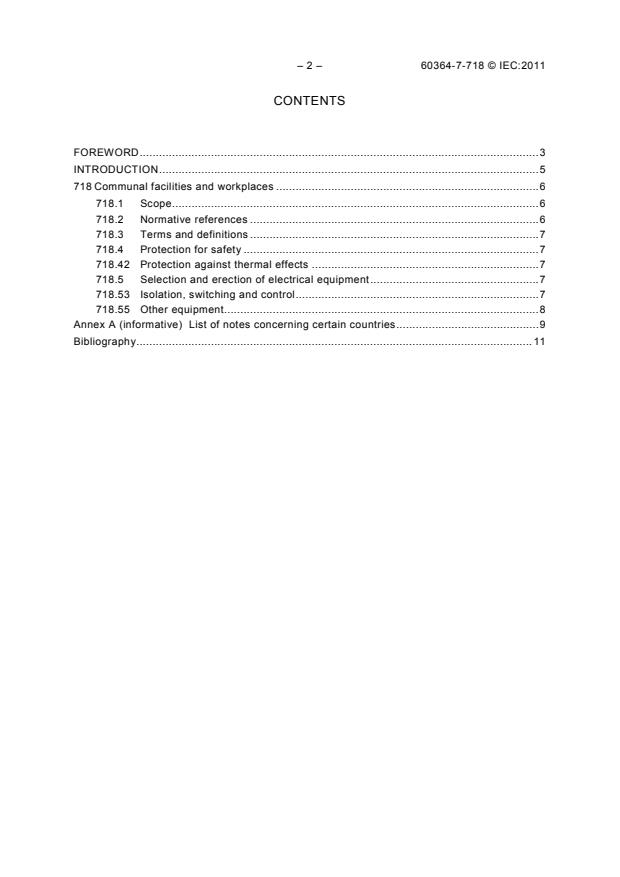
CONTENTS
FOREWORD . 3
INTRODUCTION . 5
718 Communal facilities and workplaces . 6
718.1 Scope . 6
718.2 Normative references . 6
718.3 Terms and definitions . 7
718.4 Protection for safety . 7
718.42 Protection against thermal effects . 7
718.5 Selection and erection of electrical equipment . 7
718.53 Isolation, switching and control . 7
718.55 Other equipment. 8
Annex A (informative) List of notes concerning certain countries . 9
Bibliography . 11
60364-7-718 © IEC:2011 – 3 –
INTERNATIONAL ELECTROTECHNICAL COMMISSION
____________
LOW-VOLTAGE ELECTRICAL INSTALLATIONS –
Part 7-718: Requirements for special installations or locations –
Communal facilities and workplaces
FOREWORD
1) The International Electrotechnical Commission (IEC) is a worldwide organization for standardization comprising
all national electrotechnical committees (IEC National Committees). The object of IEC is to promote
international co-operation on all questions concerning standardization in the electrical and electronic fields. To
this end and in addition to other activities, IEC publishes International Standards, Technical Specifications,
Technical Reports, Publicly Available Specifications (PAS) and Guides (hereafter referred to as “IEC
Publication(s)”). Their preparation is entrusted to technical committees; any IEC National Committee interested
in the subject dealt with may participate in this preparatory work. International, governmental and non-
governmental organizations liaising with the IEC also participate in this preparation. IEC collaborates closely
with the International Organization for Standardization (ISO) in accordance with conditions determined by
agreement between the two organizations.
2) The formal decisions or agreements of IEC on technical matters express, as nearly as possible, an international
consensus of opinion on the relevant subjects since each technical committee has representation from all
interested IEC National Committees.
3) IEC Publications have the form of recommendations for international use and are accepted by IEC National
Committees in that sense. While all reasonable efforts are made to ensure that the technical content of IEC
Publications is accurate, IEC cannot be held responsible for the way in which they are used or for any
misinterpretation by any end user.
4) In order to promote international uniformity, IEC National Committees undertake to apply IEC Publications
transparently to the maximum extent possible in their national and regional publications. Any divergence
between any IEC Publication and the corresponding national or regional publication shall be clearly indicated in
the latter.
5) IEC itself does not provide any attestation of conformity. Independent certification bodies provide conformity
assessment services and, in some areas, access to IEC marks of conformity. IEC is not responsible for any
services carried out by independent certification bodies.
6) All users should ensure that they have the latest edition of this publication.
7) No liability shall attach to IEC or its directors, employees, servants or agents including individual experts and
members of its technical committees and IEC National Committees for any personal injury, property damage or
other damage of any nature whatsoever, whether direct or indirect, or for costs (including legal fees) and
expenses arising out of the publication, use of, or reliance upon, this IEC Publication or any other IEC
Publications.
8) Attention is drawn to the Normative references cited in this publication. Use of the referenced publications is
indispensable for the correct application of this publication.
9) Attention is drawn to the possibility that some of the elements of this IEC Publication may be the subject of
patent rights. IEC shall not be held responsible for identifying any or all such patent rights.
International Standard IEC 60364-7-718 has been prepared by IEC technical committee 64:
Electrical installations and protection against electric shock.
The text of this standard is based on the following documents:
FDIS Report on voting
64/1752/FDIS 64/1765/RVD
Full information on the voting for the approval of this standard can be found in the report on
voting indicated in the above table.
This publication has been drafted in accordance with the ISO/IEC Directives, Part 2.
A list of all the parts in the IEC 60364 series, published under the general title Low-voltage
electrical installations, can be found on the IEC website.
– 4 – 60364-7-718 © IEC:2011
The committee has decided that the contents of this publication will remain unchanged until
the stability date indicated on the IEC web site under "http://webstore.iec.ch" in the data
related to the specific publication. At this date, the publication will be
• reconfirmed,
• withdrawn,
• replaced by a revised edition, or
• amended.
60364-7-718 © IEC:2011 – 5 –
INTRODUCTION
The particular requirements of this part of IEC 60364 supplement, modify or replace certain of
the general requirements contained in Parts 1 to 6 of IEC 60364.
The clause numbering appearing after 718 refers to the corresponding parts or clauses of
IEC 60364, Parts 1 to 6 . Numbering of clauses does not, therefore, necessarily follow
sequentially. Numbering of additional text is shown by the addition of “.101, etc.”. Numbering
of figures and tables takes the number of this part followed by a sequential number. For
annexes, the numbering of figures and tables takes the letter of the annex, the number of the
part and a sequential number.
The absence of reference to a part or clause means that the general requirements contained
in Parts 1 to 6 of IEC 60364 are applicable.
———————
For historical reasons, IEC 60364-1:2005 numbering is as follows: 11 Scope; 12 Normative references; 20
Terms and definitions, etc.
– 6 – 60364-7-718 © IEC:2011
LOW-VOLTAGE ELECTRICAL INSTALLATIONS –
Part 7-718: Requirements for special installations or locations –
Communal facilities and workplaces
718 Communal facilities and workplaces
718.1 Scope
This part of IEC 60364 provides additional requirements for electrical installations applicable
to communal facilities and workplaces.
Typical examples of communal facilities and workplaces are listed below:
– assembly halls, assembly rooms;
– exhibition halls;
– theatres, cinemas;
– sports arenas;
– sales areas;
– restaurants;
– hotels, guest houses, residential care homes;
– schools;
– enclosed car parks;
– meeting places, swimming halls, airports, railway stations, high-rise buildings;
– workshops, factories and industrial plants.
Access routes and escape routes are part of the above-mentioned examples.
The necessity of providing safety services in special buildings and areas may be governed by
national regulations which may contain more stringent requirements.
NOTE For safety services see IEC 60364-5-56.
718.2 Normative references
The following referenced documents are indispensable for the application of this document.
For dated references, only the edition cited applies. For undated references, the latest edition
of the referenced document (including any amendments) applies.
IEC 60364-5-51:2005, Electrical installations of buildings – Part 5-51: Selection and erection
of electrical equipment – Common rules
60364-7-718 © IEC:2011 – 7 –
718.3 Terms and definitions
For the purposes of this document, the following terms and definitions apply.
718.3.1
communal facility
location, building or part of a building open to the public
718.3.2
workplace
location, building or part of a building in which employees conduct activities relating to their
employment
718.4 Protection for safety
718.42 Protection against thermal effects
718.422 Precautions where particular risks of fire exist
718.422.2 Conditions of evacuation in an emergency
Add the following:
718.422.2.101 For communal facilities and workplaces the appropriate condition (BD2, BD3
of BD4) shall be established and the appropriate clauses of Part 42 have to be taken into
account.
718.422.3.7
Add the following:
718.422.3.7.101 Motors which are not supervised continuously shall be protected by a
thermal protective device or shall be impedance protected motors.
This requirement does not apply to:
– motors in workplaces with a nominal power less than 500 W;
– motors which will not be overheated in the event of stalling.
718.5 Selection and erection of electrical equipment
718.53 Isolation, switching and control
718.536 Isolation and switching
Add the following:
718.536.101 The distance between the means of switching off for the electrical installation
and the place where the corresponding supply cables enter the building shall be as short as
practicable.
NOTE National regulations may require that a means of switching off the electrical installation be provided. Such
regulations may also prescribe its location and that it be either installed at an effectively locked location near the
entrance to the building or directly accessible by authorized persons only from the outside.
718.536.102 If there is equipment in the premises that must remain energized when the
building is unoccupied, the electrical installation shall be designed accordingly.
NOTE Consideration should be given to the provision of separate circuits for such equipment.
– 8 – 60364-7-718 © IEC:2011
718.55 Other equipment
718.559 Luminaires and lighting installations
Add the following:
718.559.101 Maintenance of lighting circuits
718.559.101.1 Maintenance of adequate levels of illumination shall be determined by a risk
assessment of the premises taking account of the classification of Table 51A of
IEC 60364-5-51:2005.
NOTE 1 In some countries legislation may impose additional requirements.
The different options are as follows:
– Locations with low risk: single normal lighting final circuit.
NOTE 2 This is valid for code BD1 in Table 51A.
– Other locations: two or more normal lighting final circuits with luminaires supplied in such
a way that failure of any one circuit will not leave any part of the location with an
insufficient level of illumination.
If RCDs are used no RCD shall protect more than one final circuit.
NOTE 3 This is valid for codes BD2 to BD4 in Table 51A.
NOTE 4 Emergency lighting circuits as required can be added to either option.
718.559.101.2 If the normal lighting of a location accessible to the public can be dimmed,
means shall be provided to reinstate the full level of illumination by an appropriately located
switch.
NOTE In areas such as some places of entertainment it may be necessary to ensure lighting cannot be operated
by unauthorized persons.
60364-7-718 © IEC:2011 – 9 –
Annex A
(informative)
List of notes concerning certain countries
Country Clause Text
IT General The requirements of this part are covered by the general requirements of the other
parts of IEC 60364.
DK 718.421 In communal facilities and workplaces the electrical equipment must not give
(new) increased life to a fire.
No equipment shall contain flammable liquid.
Meters, protective devices, time switches etc. shall be placed in an enclosure.
If the total surface area of one or more enclosures mounted together is less than or
equal to 1 m , it shall be made of one of the following materials:
Metal.
An insulation material complying with the glow wire test in accordance with
IEC 60695-2 series for 650 °C.
If the total surface area of one or more enclosures mounted together is greater
than 1 m , it shall be made of one of the following materials:
Metal.
Another non- flammable material.
An insulation material complying with the glow-wire test in accordance with
IEC 60695-2 series for 750 °C.
Enclosures of luminaires installed within arm’s reach (e.g. lower than 2,5 m above
floor level) in public access routes and escape routes indoors in dwelling houses
shall comply with the needle flame test of 13.3.1, the flame being applied for 30 s.
USA 718.422.3.7 In the USA, non-supervised motors are permitted to be impedance protected
motors as a substitute for thermally protected motors.
DK 718.53 Special requirements for rooms intended for more than 50 persons
(new)
Switches and protective devices shall not be accessible to the public. This is not
applicable for switches which can ease the evacuation in case of danger.
NOTE This inaccessibility requirement is not applicable for areas where the locality is well known, e.g. in
a school classroom.
UK 718.559.101 In the UK, lighting levels shall comply with BS EN 12464-1.
Special requirements for public access routes
DK 718.559
(new)
Adjacent luminaires shall be mounted on different final circuits. A control device, if
any, shall be mounted on its own final circuit.
The lighting in a public access route shall be either
– switched on by the help of a push button, or
– switched on by the help of a time switch or light depending switch, or
– constantly on.
I
...