

IEC TR 61643-333:2026
(Main)Components for low-voltage surge protection - Part 333: characteristic equations and life evaluation for metal oxide varistors (MOV)
- Abstract
IEC TR 61643-333:2026 presents the U-I/R-I characteristic equations and the life evaluation method for MOVs, which are used for applications up to 1 000 V AC or 1 500 V DC in power line, or telecommunication, or signalling circuits. They are designed to protect apparatus or personnel, or both, from high transient voltages.
This document specifically addresses the zinc-oxide type of MOVs.
- Status
- Published
- Publication Date
- 01-Jun-2026
- Technical Committee
- SC 37B - Components for low-voltage surge protection
- Drafting Committee
- PT 61643-333 - TC 37/SC 37B/PT 61643-333
- Current Stage
- PPUB - Publication issued
- Start Date
- 02-Jun-2026
- Completion Date
- 26-Jun-2026
IEC TR 61643-333:2026 is an IEC Technical Report on components for low-voltage surge protection, focused on metal oxide varistors (MOV). It presents U-I/R-I characteristic equations and life evaluation methods for zinc-oxide MOVs used in power line, telecommunication, and signalling circuits up to 1 000 V AC or 1 500 V DC, where the MOV protects apparatus, personnel, or both, from high transient voltages.
What does IEC TR 61643-333:2026 specify?
IEC TR 61643-333:2026 specifies how to describe MOV electrical behavior and how to estimate MOV life from test data. The document is organized into clauses 1 to 7, with informative Annex A on surge sources and Annex B on statistical methods for life valuation.
| Annex | What it covers |
|---|---|
| Annex A | Characteristics of various surge voltages and currents, including lightning, switching, electrostatic discharge, voltage fluctuation, and mis-operation overvoltage |
| Annex B | Mathematical methods in statistics for life valuation, including BLUE, MLE, and MRRE |
Clause 4 describes MOV characteristics and an equivalent circuit model. Clause 5 gives characteristic equations and test procedures for R-I, V-I, and related curves. Clause 6 summarizes degradation modes, and Clause 7 explains the Weibull-based life evaluation method under continuous working voltage stress and impulse current stress.
What are the key requirements of IEC TR 61643-333:2026?
IEC TR 61643-333:2026 is mainly a methods document. It shows how to measure MOV behavior, fit equations to measured data, and turn life-test results into usable lifetime estimates.
MOV behavior and equivalent circuit
Clause 4 models an MOV as three parallel components: capacitance, non-linear resistance, and insulation resistance. It also explains how the current waveform changes as the applied voltage moves from below varistor voltage to well above it.
In practice, this matters because the MOV does not behave like a linear resistor. Engineers have to treat leakage current, clamping behavior, and waveform distortion separately when they interpret test results or compare parts.
Characteristic equations and curve fitting
Clause 5 presents several ways to express MOV characteristics, including resistance-current, voltage-current, voltage ratio-current, and electric field-current density forms. The constants are obtained by least-square fitting to measured data over the chosen current range.
This is useful when a product manual gives only approximate curves. The document provides a way to derive equations from actual measurements, so design and reliability teams can compare samples on the same basis.
Measurement procedure for characteristic curves
Clause 5.3 says to select 5 to 10 current values in the test range, roughly geometrically spaced, and measure the corresponding voltage values. It allows direct current, power frequency, or impulse measurement, and for 8/20 impulse current tests it requires a front time within 8 μs ± 10%, forward and reverse measurements, and enough recovery time for the sample to return to ambient temperature.
In practice, this gives a repeatable way to generate data for regression. The controlled timing and cooling reduce temperature-driven error, which is important because MOV characteristics shift with temperature.
Degradation and failure criteria
Clause 6 describes two reliability end conditions: performance parameter degradation and physical destruction. The listed degradation indicators include reduced varistor voltage, increased residual voltage, rising leakage current or power loss, and polarization of varistor voltage; physical damage includes ceramic cracking, coating damage, terminal damage, and arcing or flashover.
This matters because life evaluation is not based on only one symptom. Users can define end-of-life by electrical drift or by visible failure, depending on the application and agreement between producer and user.
Life evaluation under continuous working voltage stress
Clause 7 uses the Weibull distribution to evaluate life under continuous working voltage stress. It explains the Weibull cumulative distribution function, the shape parameter β, the scale parameter η, and the position parameter t, and it uses median rank regression to fit test data.
For practice, this means a batch test can be turned into a failure-probability curve instead of just a list of failure times. The document also shows how to estimate service life at a different temperature using the Arrhenius law approach included in the clause.
Life evaluation under impulse current stress
Clause 7 also gives a life model for impulse current stress. It relates impulse current peak I, equivalent square-wave width τ, and life number n, then shows how to derive practical equations from tests on several samples and different wave widths.
This is useful for surge-protection selection and qualification. A buyer or test lab can use the method to compare how a MOV family behaves under narrow, medium, and wide impulse waves and then interpolate for other surge conditions.
What terms does IEC TR 61643-333:2026 define?
- Population - the total set of items being considered in the statistical evaluation.
- Sample - a subset of the population made up of one or more sampling units.
- Sampling size n - the number of sampling units in a sample.
- Peak shift - the time interval between voltage peak and current peak.
- Voltage non-linearity index α - a ratio used to describe how voltage changes with current over a specified range.
- B-Life - the time by which x percent of the population is expected to fail.
- Median life - the time at which 50% of the items fail.
- Minimum life - the time by which zero percent of the population is expected to fail, also called guaranteed life.
Who uses IEC TR 61643-333:2026?
IEC TR 61643-333:2026 is used by MOV manufacturers, surge-protection designers, reliability engineers, test laboratories, quality managers, and buyers who need to assess MOV behavior and life. It is relevant to low-voltage power systems, telecommunication installations, and signalling circuits, especially where surge protection must be selected or validated against transient voltages.
In practice, these users apply the document to fit characteristic curves, choose impulse test conditions, define end-of-life criteria, and estimate service life from test results. It is also useful when comparing product data sheets with measured performance.
Which standards are used with IEC TR 61643-333:2026?
| Standard | What it contributes |
|---|---|
| IEC 61051-1:2018 | Generic specification for varistors used in electronic equipment |
| IEC 61643-11:2011 | Requirements and test methods for SPDs connected to low-voltage power systems |
| IEC 61643-12:2020 | Selection and application principles for SPDs connected to low-voltage power distribution systems |
| IEC 61643-331:2020 | Performance requirements and test methods for MOV components |
| IEC 61643-332:2024 | Selection and application principles for MOV components |
| IEC 61649:2008 | Weibull analysis methods used for life evaluation |
| ISO 3534-1:2006 | General statistical terms and probability vocabulary used in the definitions |
| ISO 3534-4:2014 | Statistical vocabulary used for sampling size and related terms |
| ITU-T K.77:2019-07 | Characteristics of MOVs for telecommunication installations |
| ITU-T K.128:2018-01 | Application guide for MOV surge protective components |
| MIL Std. 690 D | Failure rate sampling plans and procedures |
| IEC 62305-1:2024 and IEC 62305-1:2012 | Lightning terminology and lightning parameter data used in Annex A |
What does the IEC TR 61643-333:2026 document contain?
IEC TR 61643-333:2026 contains an MOV equivalent circuit model, waveform illustrations, regression examples, degradation criteria, and detailed Weibull-based life evaluation procedures. It also includes worked examples for continuous-voltage aging and impulse-current life testing, with tables that show measured values, fitted parameters, and calculated deviations.
The annexes add application context rather than requirements. Annex A gathers surge-source information and lightning-related parameter data, while Annex B explains the statistical methods behind the life calculations, including BLUE, MLE, and MRRE.
The document uses figures to show MOV current and voltage waveforms, regression curves, Weibull fitting plots, and impulse-life relationships. It uses tables to show sample test data, fitting calculations, median-rank values, and example life results for different waveform widths.
Get Certified
Connect with accredited certification bodies for this standard

IMQ S.p.A. (Certification)
Italian electrical product certification.

SLG Prüf- und Zertifizierungs GmbH
German testing and certification body.

UL Solutions
Global safety science company with testing, inspection and certification.
Sponsored listings
Frequently Asked Questions
IEC TR 61643-333:2026 is a technical report published by the International Electrotechnical Commission (IEC). Its full title is "Components for low-voltage surge protection - Part 333: characteristic equations and life evaluation for metal oxide varistors (MOV)". This standard covers: IEC TR 61643-333:2026 presents the U-I/R-I characteristic equations and the life evaluation method for MOVs, which are used for applications up to 1 000 V AC or 1 500 V DC in power line, or telecommunication, or signalling circuits. They are designed to protect apparatus or personnel, or both, from high transient voltages. This document specifically addresses the zinc-oxide type of MOVs.
IEC TR 61643-333:2026 presents the U-I/R-I characteristic equations and the life evaluation method for MOVs, which are used for applications up to 1 000 V AC or 1 500 V DC in power line, or telecommunication, or signalling circuits. They are designed to protect apparatus or personnel, or both, from high transient voltages. This document specifically addresses the zinc-oxide type of MOVs.
IEC TR 61643-333:2026 is classified under the following ICS (International Classification for Standards) categories: 29.240.10 - Substations. Surge arresters. The ICS classification helps identify the subject area and facilitates finding related standards.
IEC TR 61643-333:2026 is available in PDF format for immediate download after purchase. The document can be added to your cart and obtained through the secure checkout process. Digital delivery ensures instant access to the complete standard document.
Standards Content (Sample)
IEC TR 61643-333 ®
Edition 1.0 2026-06
TECHNICAL
REPORT
Components for low-voltage surge protection -
Part 333: Characteristic equations and life evaluation for metal oxide varistors
(MOV)
ICS 29.240.10 ISBN 978-2-8327-1260-3
All rights reserved. Unless otherwise specified, no part of this publication may be reproduced or utilized in any form or
by any means, electronic or mechanical, including photocopying and microfilm, without permission in writing from either
IEC or IEC's member National Committee in the country of the requester. If you have any questions about IEC copyright
or have an enquiry about obtaining additional rights to this publication, please contact the address below or your local
IEC member National Committee for further information.
IEC Secretariat Tel.: +41 22 919 02 11
3, rue de Varembé info@iec.ch
CH-1211 Geneva 20 www.iec.ch
Switzerland
About the IEC
The International Electrotechnical Commission (IEC) is the leading global organization that prepares and publishes
International Standards for all electrical, electronic and related technologies.
About IEC publications
The technical content of IEC publications is kept under constant review by the IEC. Please make sure that you have the
latest edition, a corrigendum or an amendment might have been published.
IEC publications search - IEC Products & Services Portal - products.iec.ch
webstore.iec.ch/advsearchform Discover our powerful search engine and read freely all the
The advanced search enables to find IEC publications by a publications previews, graphical symbols and the glossary.
variety of criteria (reference number, text, technical With a subscription you will always have access to up to date
committee, …). It also gives information on projects, content tailored to your needs.
replaced and withdrawn publications.
Electropedia - www.electropedia.org
The world's leading online dictionary on electrotechnology,
IEC Just Published - webstore.iec.ch/justpublished
Stay up to date on all new IEC publications. Just Published containing more than 22 500 terminological entries in English
details all new publications released. Available online and and French, with equivalent terms in 25 additional languages.
once a month by email. Also known as the International Electrotechnical Vocabulary
(IEV) online.
IEC Customer Service Centre - webstore.iec.ch/csc
If you wish to give us your feedback on this publication or
need further assistance, please contact the Customer
Service Centre: sales@iec.ch.
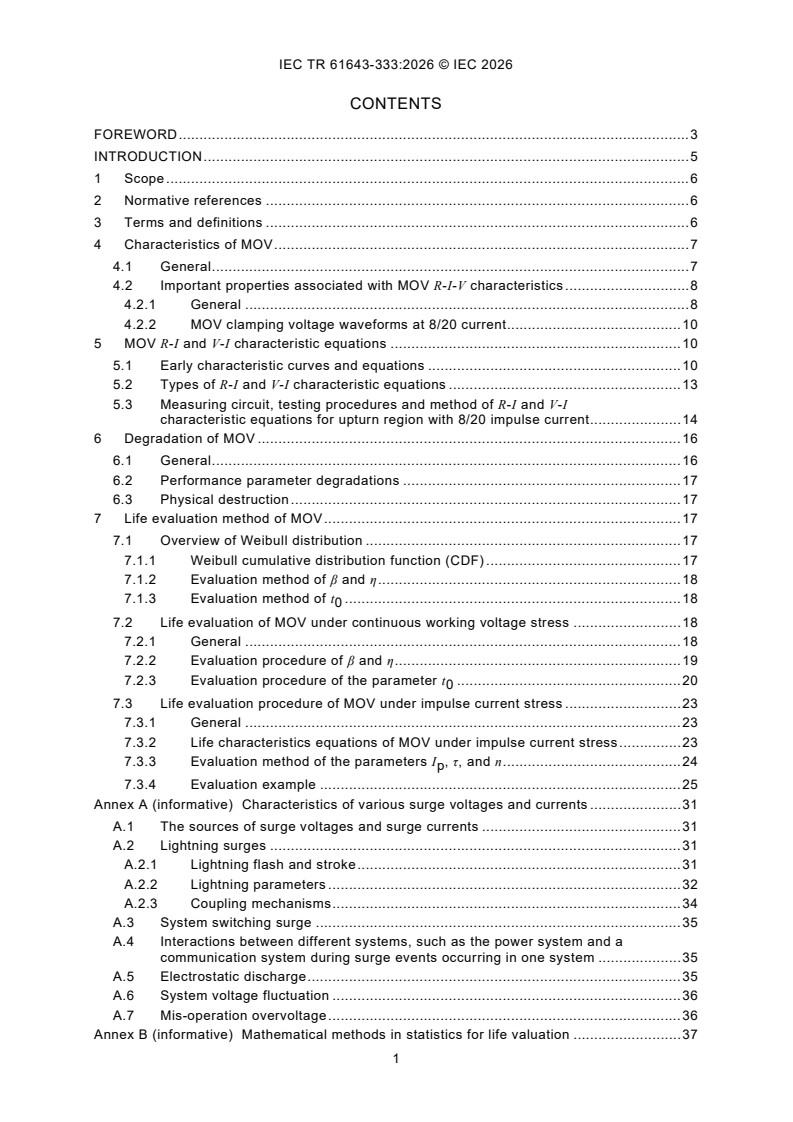
CONTENTS
FOREWORD . 3
INTRODUCTION . 5
1 Scope . 6
2 Normative references . 6
3 Terms and definitions . 6
4 Characteristics of MOV . 7
4.1 General . 7
4.2 Important properties associated with MOV R-I-V characteristics . 8
4.2.1 General . 8
4.2.2 MOV clamping voltage waveforms at 8/20 current . 10
5 MOV R-I and V-I characteristic equations . 10
5.1 Early characteristic curves and equations . 10
5.2 Types of R-I and V-I characteristic equations . 13
5.3 Measuring circuit, testing procedures and method of R-I and V-I
characteristic equations for upturn region with 8/20 impulse current . 14
6 Degradation of MOV . 16
6.1 General . 16
6.2 Performance parameter degradations . 17
6.3 Physical destruction . 17
7 Life evaluation method of MOV . 17
7.1 Overview of Weibull distribution . 17
7.1.1 Weibull cumulative distribution function (CDF) . 17
7.1.2 Evaluation method of β and η . 18
7.1.3 Evaluation method of t . 18
7.2 Life evaluation of MOV under continuous working voltage stress . 18
7.2.1 General . 18
7.2.2 Evaluation procedure of β and η . 19
7.2.3 Evaluation procedure of the parameter t . 20
7.3 Life evaluation procedure of MOV under impulse current stress . 23
7.3.1 General . 23
7.3.2 Life characteristics equations of MOV under impulse current stress . 23
7.3.3 Evaluation method of the parameters I , τ, and n . 24
p
7.3.4 Evaluation example . 25
Annex A (informative) Characteristics of various surge voltages and currents . 31
A.1 The sources of surge voltages and surge currents . 31
A.2 Lightning surges . 31
A.2.1 Lightning flash and stroke . 31
A.2.2 Lightning parameters . 32
A.2.3 Coupling mechanisms . 34
A.3 System switching surge . 35
A.4 Interactions between different systems, such as the power system and a
communication system during surge events occurring in one system . 35
A.5 Electrostatic discharge . 35
A.6 System voltage fluctuation . 36
A.7 Mis-operation overvoltage . 36
Annex B (informative) Mathematical methods in statistics for life valuation . 37
B.1 Best linear unbiased estimate (BLUE) . 37
B.2 Maximum likelihood estimation (MLE) . 38
B.3 Median rank regression estimation (MRRE) . 39
Bibliography . 40
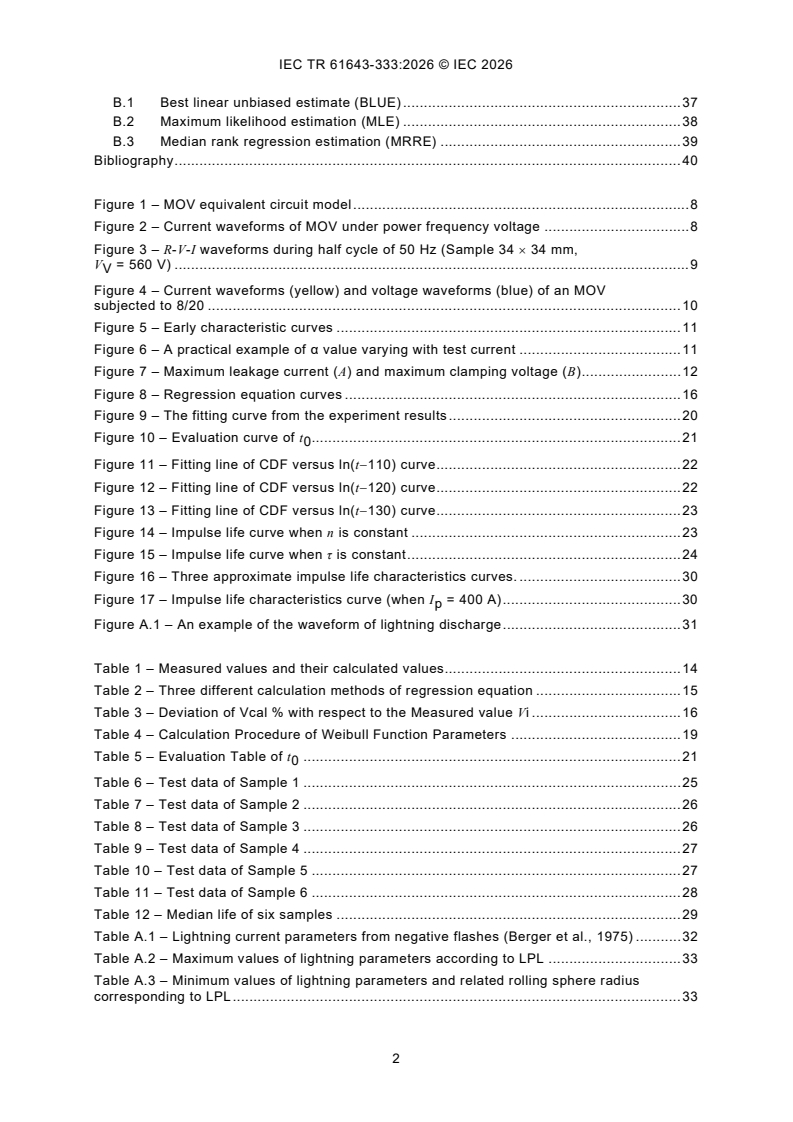
Figure 1 – MOV equivalent circuit model . 8
Figure 2 – Current waveforms of MOV under power frequency voltage . 8
Figure 3 – R-V-I waveforms during half cycle of 50 Hz (Sample 34 × 34 mm,
V = 560 V) . 9
V
Figure 4 – Current waveforms (yellow) and voltage waveforms (blue) of an MOV
subjected to 8/20 . 10
Figure 5 – Early characteristic curves . 11
Figure 6 – A practical example of α value varying with test current . 11
Figure 7 – Maximum leakage current (A) and maximum clamping voltage (B) . 12
Figure 8 – Regression equation curves . 16
Figure 9 – The fitting curve from the experiment results . 20
Figure 10 – Evaluation curve of t . 21
Figure 11 – Fitting line of CDF versus ln(t−110) curve . 22
Figure 12 – Fitting line of CDF versus ln(t−120) curve . 22
Figure 13 – Fitting line of CDF versus ln(t−130) curve . 23
Figure 14 – Impulse life curve when n is constant . 23
Figure 15 – Impulse life curve when τ is constant . 24
Figure 16 – Three approximate impulse life characteristics curves. . 30
Figure 17 – Impulse life characteristics curve (when I = 400 A) . 30
p
Figure A.1 – An example of the waveform of lightning discharge . 31
Table 1 – Measured values and their calculated values. 14
Table 2 – Three different calculation methods of regression equation . 15
Table 3 – Deviation of Vcal % with respect to the Measured value Vi . 16
Table 4 – Calculation Procedure of Weibull Function Parameters . 19
Table 5 – Evaluation Table of t . 21
Table 6 – Test data of Sample 1 . 25
Table 7 – Test data of Sample 2 . 26
Table 8 – Test data of Sample 3 . 26
Table 9 – Test data of Sample 4 . 27
Table 10 – Test data of Sample 5 . 27
Table 11 – Test data of Sample 6 . 28
Table 12 – Median life of six samples . 29
Table A.1 – Lightning current parameters from negative flashes (Berger et al., 1975) . 32
Table A.2 – Maximum values of lightning parameters according to LPL . 33
Table A.3 – Minimum values of lightning parameters and related rolling sphere radius
corresponding to LPL . 33
INTERNATIONAL ELECTROTECHNICAL COMMISSION
____________
Components for low-voltage surge protection -
Part 333: Characteristic equations and life evaluation
for metal oxide varistors (MOV)
FOREWORD
1) The International Electrotechnical Commission (IEC) is a worldwide organization for standardization comprising
all national electrotechnical committees (IEC National Committees). The object of IEC is to promote international
co-operation on all questions concerning standardization in the electrical and electronic fields. To this end and
in addition to other activities, IEC publishes International Standards, Technical Specifications, Technical Reports,
Publicly Available Specifications (PAS) and Guides (hereafter referred to as "IEC Publication(s)"). Their
preparation is entrusted to technical committees; any IEC National Committee interested in the subject dealt with
may participate in this preparatory work. International, governmental and non-governmental organizations liaising
with the IEC also participate in this preparation. IEC collaborates closely with the International Organization for
Standardization (ISO) in accordance with conditions determined by agreement between the two organizations.
2) The formal decisions or agreements of IEC on technical matters express, as nearly as possible, an international
consensus of opinion on the relevant subjects since each technical committee has representation from all
interested IEC National Committees.
3) IEC Publications have the form of recommendations for international use and are accepted by IEC National
Committees in that sense. While all reasonable efforts are made to ensure that the technical content of IEC
Publications is accurate, IEC cannot be held responsible for the way in which they are used or for any
misinterpretation by any end user.
4) In order to promote international uniformity, IEC National Committees undertake to apply IEC Publications
transparently to the maximum extent possible in their national and regional publications. Any divergence between
any IEC Publication and the corresponding national or regional publication shall be clearly indicated in the latter.
5) IEC itself does not provide any attestation of conformity. Independent certification bodies provide conformity
assessment services and, in some areas, access to IEC marks of conformity. IEC is not responsible for any
services carried out by independent certification bodies.
6) All users should ensure that they have the latest edition of this publication.
7) No liability shall attach to IEC or its directors, employees, servants or agents including individual experts and
members of its technical committees and IEC National Committees for any personal injury, property damage or
other damage of any nature whatsoever, whether direct or indirect, or for costs (including legal fees) and
expenses arising out of the publication, use of, or reliance upon, this IEC Publication or any other IEC
Publications.
8) Attention is drawn to the Normative references cited in this publication. Use of the referenced publications is
indispensable for the correct application of this publication.
9) IEC draws attention to the possibility that the implementation of this document may involve the use of (a)
patent(s). IEC takes no position concerning the evidence, validity or applicability of any claimed patent rights in
respect thereof. As of the date of publication of this document, IEC had not received notice of (a) patent(s), which
may be required to implement this document. However, implementers are cautioned that this may not represent
the latest information, which may be obtained from the patent database available at https://patents.iec.ch. IEC
shall not be held responsible for identifying any or all such patent rights.
IEC TR 61643-333 has been prepared by subcommittee 37B: Components for low-voltage
surge protection, of IEC technical committee 37: Surge arresters. It is a Technical Report.
The text of this Technical Report is based on the following documents:
Draft Report on voting
37B/269/DTR 37B/272/RVDTR
Full information on the voting for its approval can be found in the report on voting indicated in
the above table.
The language used for the development of this Technical Report is English.
This document was drafted in accordance with ISO/IEC Directives, Part 2, and developed in
accordance with ISO/IEC Directives, Part 1 and ISO/IEC Directives, IEC Supplement, available
at www.iec.ch/members_experts/refdocs. The main document types developed by IEC are
described in greater detail at www.iec.ch/publications.
A list of all parts in the IEC 61643 series, published under the general title Components for
low-voltage surge protection, can be found on the IEC website.
The committee has decided that the contents of this document will remain unchanged until the
stability date indicated on the IEC website under webstore.iec.ch in the data related to the
specific document. At this date, the document will be
– reconfirmed,
– withdrawn, or
– revised.
INTRODUCTION
Since the invention of metal oxide varistors (MOV) which are also known as zinc oxide non-
linear resistors, in 1968, MOV has become the key surge protection component with the widest
use, largest production and mature technology. In addition, driven by the market demand and
the efforts of researchers, production engineers and field application engineers, people have
further deepened their understanding of it.
Although impulse life characteristic curve and life data under continuous working voltage stress
have been given in current MOV product manuals and related technical data, they are only
empirical and rough estimate. The life value of MOV (average value, median value and minimum
value) is essentially a statistic, which needs to be dealt with by the theory of mathematical
statistics.
Additionally, there is an increasing user's demands in recent years for the MOVs having
estimated lifetime duration. The estimated value is evaluated and tested under continuous
working voltage stress and impulse current stress. Although MOV manufacturers provide the
service life characteristic curves under impulse current stresses, such curves are empirical.
This is the reason why a theoretical approach is provided in this technical report.
1 Scope
This part of IEC 61643, which is a Technical Report, presents the U-I/R-I characteristic
equations and the life evaluation method for MOVs, which are used for applications up to
1 000 V AC or 1 500 V DC in power line, or telecommunication, or signalling circuits. They are
designed to protect apparatus or personnel, or both, from high transient voltages.
This document specifically addresses the zinc-oxide type of MOVs.
2 Normative references
There are no normative references in this document.
3 Terms and definitions
For the purposes of this document, the following terms and definitions apply.
ISO and IEC maintain terminology databases for use in standardization at the following
addresses:
– IEC Electropedia: available at https://www.electropedia.org/
– ISO Online browsing platform: available at https://www.iso.org/obp
3.1
population
totality of items under consideration
[SOURCE: ISO 3534-1, 1.1]
3.2
sampling unit
one of the individual parts into which a population is divided
[SOURCE: ISO 3534-1, 1.2]
3.3
sample
subset of a population made up of one or more sampling units
[SOURCE: ISO 3534-1, 1.3]
3.4
sampling size n
number of sampling units in a sample
[SOURCE: ISO 3534-4, 3.1.9]
3.5
observed value
obtained value of a property associated with one member of a sample (3.3)
[SOURCE: ISO 3534-1, 1.4]
3.6
peak shift
interval time between voltage peak and current peak
3.7
voltage non-linearity index α
ratio of (logI -logI )/(logV -logV ), for a specified current range (I , I ) with corresponding
1 2 1 2 1 2
, V ).
voltage range (V
1 2
Note 1 to entry: If I /I = 10, the index denoted by "α", if I /I = 2, the index denoted by "α ".
2 1 2 1 2I
3.8
B -Life
x
time (or any other usage measure) by which x percent of the population can be expected to fail
Note 1 to entry: x = 10 is commonly used.
Note 2 to entry: B -Life means mission life, i.e., the life time of reliability RL being (1-x) %.
x
Note 3 to entry: For Weibull distribution, the reliability RL is expressed as
β
B x
x
RL B =exp−=1−
( )
x
η 100
3.9
expressions of MOV lifetime
3.9.1
average life
L
ave
length of time a device or other product is expected to last in operation
3.9.2
median life
L
med
length of time at which 50 % of the items fail, the B life is the median time to failure
3.9.3
minimum life
L
min
length of time (or any other usage measure) by which zero percent of the population can be
expected to fail
Note 1 to entry: This can also be referred as guarantee life.
4 Characteristics of MOV
4.1 General
Under electrical stress, the current I flowing through MOV and the voltage V between two
terminals of MOV will present different characteristics from that of linear resistance. These
characteristics are linked by the equation R = V/I.
4.2 Important properties associated with MOV R-I-V characteristics
4.2.1 General
The MOV can be considered as a combination of three components in parallel, which are
capacitance C, non-linear resistance R , and insulation resistance R . see Figure 1. The
V ins
is I and the capacitive current through capacitance C is I .
resistive current through R
V R C
Figure 1 – MOV equivalent circuit model
The equivalent circuit model of the MOV shown in Figure 1 can explain waveforms illustrated
in Figure 2. It shows the variations of the current waveforms of an MOV with the variation of the
applied voltages, when it is powered by 50 Hz voltage source.
a) I I b) II≈ c) II> d) I I
RC RC RC RC
Figure 2 – Current waveforms of MOV under power frequency voltage
Figure 2a) shows that when the peak value of the 50 Hz voltage source V is lower than the
S
varistor voltage V , the nonlinear resistant R is extremely large. Therefore the resistive current
V V
component I is much lower than the capacitive current component I .
R C
Figure 2b) shows that when the peak value of the 50 Hz voltage source V exceeds the varistor
s
voltage V , the nonlinear resistance R is comparable to the capacitive reactance C .
v V v
The resistive current component I flowing through the MOV is also comparable to the
R
capacitive current component I . The current waveform begins to be distorted due to the MOV
C
nonlinearity.
Figure 2c) shows that when the peak value of the 50 Hz voltage source further increases, the
nonlinear resistance R becomes smaller than the capacitive reactance C . Therefore the
V V
resistive current component I flowing through MOV is also larger than the capacitive current
R
component I . The current waveform distorts more due to the MOV increasing nonlinearity.
C
is much higher than
Figure 2d) shows that when the peak value of the 50 Hz voltage source V
S
the varistor voltage V , the nonlinear resistance R is much smaller than the capacitive
V V
reactance C . The resistive current component I flowing through MOV is also much larger than
V R
the capacitive component I . The current waveform distorts greatly due to the MOV nonlinearity.
C
Figure 3 illustrates the waveforms of power source voltage, MOV voltage, MOV current and
MOV equivalent resistance R during half of a period.
Figure 3 – R-V-I waveforms during half cycle of 50 Hz (Sample 34 × 34 mm, V = 560 V)
V
There are two voltages in Figure 3. One is the voltage of power source (V ) and the other is the
S
voltage on MOV (V ). If the power source impedance is Z , then, V = V - I × Z .
MOV S MOV S S S
Figure 3 clearly shows the following properties of MOV:
The point of the peak power source voltage (V ), is located at 4,69 ms. The point of the
S-Max
peak MOV voltage (V ) is about 0,57 ms behind the point of (V ). The point of the
MOV-Max S-Max
peak current (I ) is about 0,36ms behind the peak point of MOV voltage (V ), while
V-Max MOV-Max
the point of resistance valley (R ) is located at the same point as the point of the peak
V-min
current (I ).
V-Max
A characteristic of the current waveforms in Figure 3 indicates the time effect of the MOV.
4.2.2 MOV clamping voltage waveforms at 8/20 current
8/20 impulse current with three different peak values were applied to an MOV sample (Ø14 mm,
V = 220 V), the waveforms of clamping voltage and impulse current were recorded by an
V
oscilloscope, see Figure 4, which shows following properties:
When the peak current of 8/20 is quite small, for example 2,88 A, the clamping voltage starts a
peak (front peak), and then drops continuously, so that the peak displacement ∆t has the
maximum value 10 μs. The peak displacement ∆t refers to the time interval between the
clamping voltage peak and impulse current peak, so that the ∆t value decrease with increasing
current peak. The oscillation at the beginning of the residual voltage waveform is disregarded.
During the time interval ∆t, the voltage value decreases (dv/dt is negative) and the current value
increases (di/dt is positive), so that the incremental resistance of the MOV is negative. It is
noted that in the case of power frequency test, during the ∆t, di/dt is negative, dv/dt is positive,
they are just opposite.
Figure 4 – Current waveforms (yellow) and voltage waveforms (blue)
of an MOV subjected to 8/20
5 MOV R-I and V-I characteristic equations
5.1 Early characteristic curves and equations
Figure 5 is a widely used curve. It approximates the expression of MOV V-I characteristic.
Figure 5 – Early characteristic curves
The relation between V and I:
– It is considered proportional in the leakage and upturn regions.
The proportionality coefficient is consistent with a resistance (V = R × I).
α
– It is given by I = kV in the normal MOV operation region, where α varies with the value of
the current through MOV as shown in Figure 6.
Figure 6 – A practical example of α value varying with test current
Figure 7 is the typical curve found in MOV literature. The region "A" represents the DC V-I
characteristics of the MOV with a V equal to 90 % of the nominal value. Therefore the region
v
"A" is also called "maximum leakage current curve". The region "B" represents the 8/20-limiting
voltage of the MOV, with a V equal to 110 % of the nominal value. Therefore the region "B" is
v
also called "maximum clamping voltage curve". In Figure 7, the maximum clamping voltage
(Region B) starts at 1 mA, which is practically impossible.
Figure 7 – Maximum leakage current (A) and maximum clamping voltage (B)
The V-I equations of MOV in the leakage current region are Equation (5-1) or (5-2). It only
represents a narrow current range.
β
(5-1)
V CI×
α
(5-2)
I AV×
where V is the voltage applied on MOV, I is the current flowing through MOV, β is the non-
linearity current index, α is the non-linearity voltage index. C and A are constants.
1 log II− log
10 1 10 2
α
(5-3)
β log V − log V
10 1 10 2
NOTE α or β refers the average non-linearity over the specified current range (I to I ).
1 2
In recent years, 2-order polynomial regression equations of MOV have been proposed, they
can accurately express the characteristics of MOV, and by applying these equations, many
unsolved practical problems in the past have been solved.
An approximate equation of limiting voltage versus impulse current peak is deduced from
Annex C of IEC 61051-1:2018, as shown below by Equation (5-4):
B
R
(5-4)
R= 10 ,B= A− A×log IA+ × log I
( )
R 0 1 10 2 10
where I is the peak value of the specified impulse current through MOV, A , A and A are
0 1 2
constants.
==
=
=
Since the temperature will influence the characteristic of MOV, so one equation with specific
A , A and A is valid for a given temperature only, e.g. 25 °C.
0 1 2
When the temperature increases, the V/I curve tends to:
– Slightly drift right in the leakage current region.
– Slightly drift up in the surge current region.
Thus it is a combined drifting in 2 perpendicular directions, that results into a sort of slight
"distortion" of the curve.
5.2 Types of R-I and V-I characteristic equations
From the perspective of practicality, the characteristic equation of MOV is written in the
following 5 forms, respectively:
Resistance equation (R-I equation)
B 2
R
(5-5)
R= 10 ,B= A− A×log IA+ ×(log I)
R 0 1 10 2 10
Voltage equation (V-I equation)
B 2
V
(5-6)
V= 10 ,B= A− A×log IA+ ×(log I)
V 0 1 10 2 10
Voltage ratio equation (V -I equation)
R
B
V
V 10
, ( 1) log (log ) (5-7)
V B A− A−× IA+ × I
R V 0 1 10 2 10
VV
VV
Electric field-current density equation (E-J equation)
2 3
(5-8)
log E= C+ C×(log J )+×C (log J )+×C (log J )
10 0 1 10 2 10 3 10
where C , C , C and C are adjustable constants. The values of the constants for each MOV
0 1 2 3
are determined by applying the least-square method to the whole measured characteristic in
the corresponding test range of current.
= = =
5.3 Measuring circuit, testing procedures and method of R-I and V-I characteristic
equations for upturn region with 8/20 impulse current
a) Within the specified test current range, select 5 to 10 current values, which need to be
roughly geometrically equidistant. According to practical application requirement, the
current used can be direct current, power frequency or impulse measurement.
b) Select a sample with a varistor voltage close to the nominal value, add the selected test
current to the sample in order of numerical value from small to large, measure the
corresponding voltage value.
In the 8/20 impulse measurement, ensure that the wave front time of the current wave is
within 8 µs ± 10 %, and the forward and backward measurements need to be made once,
use their average value as the calculated value of the characteristic equation. There needs
to be sufficient recovery time between two measurements to ensure the temperature of
sample to cool to ambient temperature.
c) Calculate the regression equation of 5 to 10 pairs of current/voltage obtained by
measurement in the following order:
Calculate the resistance value (R) according to (voltage/current).
Calculate the logarithm of resistance value (log R) and the logarithm of current (log I).
10 10
Perform quadratic polynomial fitting on the data
(5-9)
log R= A− A×log IA+ ×(log I)
10 0 1 10 2 10
where A , A and A are the constants to be solved.
0 1 2
Experiment: 8/20 impulse current of seven different peak values were applied separately into a
MOV sample (Ø14 mm, varistor voltage V = 220 V, thickness of the ceramic body d = 1,22 mm,
V
area of the silver electrode A = 1,09 cm ), the peak values of current and voltage were
elec
measured and listed in Table 1.
Table 1 – Measured values and their calculated values
Measured values
log I log V log R
Test No. R (Ω)
10 10 10
I (A) V (V)
1 2,88 284 98,611 0,4 594 2,4 533 1,9 939
2 9,92 304 30,645 0,9 965 2,4 829 1,4 864
3 30,6 320 10,458 1,4 857 2,5 051 1,0 194
4 97,6 344 3,525 1,9 894 2,5 366 0,5 472
5 306 392 1,281 2,4 857 2,5 933 0,1 057
6 1 024 472 0,4 609 3,0 103 2,6 739 -0,3 364
7 2 980 632 0,2 121 3,4 742 2,8 007 -0,6 735
Table 2 – Three different calculation methods of regression equation
Method A Method B Method C
Test No.
x = log I y = log R x = log I y = log V x = log V y = log R
10 10 10 10 10 10
1 0,4 594 1,9 939 0,4 594 2,4 533 2,4 533 1,9 939
2 0,9 965 1,4 864 0,9 965 2,4 829 2,4 829 1,4 864
3 1,4 857 1,0 194 1,4 857 2,5 051 2,5 051 1,0 194
4 1,9 894 0,5 472 1,9 894 2,5 366 2,5 366 0,5 472
5 2,4 857 0,1 057 2,4 857 2,5 933 2,5 933 0,1 057
6 3,0 103 -0,3 364 3,0 103 2,6 739 2,6 739 -0,3 364
7 3,4 742 -0,6 735 3,4 742 2,8 007 2,8 007 -0,6 735
The data in Table 2 are used to fit the R-I, V-I and R-V curve. The constants are from the fitting
results.
The constants A , A and A , for the data set of Table 2, and obtained by use of Method A,
0 1 2
Method B and Method C, are as follows:
Method A – use the relationship between current and resistance.
Method B – use the relationship between current and voltage.
Method C – use the relationship between voltage and resistance.
The calculations were performed using the software Origin. The curve corresponding to the
equation is shown in Figure 7.
– Method A – Regression equation, x = log I , y = log R .
10 10
log R= A− A×log IA+ ×(log I)
10 0 1 10 2 10
log R
VI×10
cal i
For the example of Table 2, A = 2,48 031, A = -105 038, A = 003 985.
0 1 2
– Method B – Regression equation,x = log I , y = log R .
10 10
log V= A− A×log IA+ ×(log I)
10 0 1 10 2 10
log V
V = 10
cal
For the example of Table 2, A = 2,47 954, A = -0,04 919, A = 0,03 959.
0 1 2
– Method C – Regression equation, x = log V , y = log R .
10 10
log R= A− A×log VA+ ×(log V )
10 0 1 10 2 10
log V
V = 10
cal
For the example of Table 2, A = 208,42 002, A = -151,51 776, A = 27,44 907.
0 1 2
=
The fitting curves of the three methods are shown in Figure 8.
Figure 8 – Regression equation curves
By fitting the data, we can obtain the constants A , A , and A in the formula, which results in
0 1 2
the R-I, V-I, and R-V curves of the sample. By substituting the test data into the obtained formula,
the calculation error can be obtained. The accuracy of the calculation can be determined.
As described in the example, we use the obtained constants A , A and A to calculate the
0 1 2
calculated voltage values V , and then, the deviation of V % from the measured values V ,
cal cal i
See Table 3.
It is noted from Table 3 that Method A and Method B have better fitting effect.
Table 3 – Deviation of Vcal % with respect to the Measured value Vi
log I Method A Method B Method C
10 i
Test V (V)
i
V V % V V % V V %
(A) cal cal cal cal cal cal
0,4 594 284 292,12 2,86 291,94 2,80 147,93 -47,91
0,9 965 304 294,91 -2,99 295,01 -2,96 430,84 41,72
1,4 857 320 311,49 -2,66 311,78 -2,57 571,36 78,55
1,9 894 344 345,02 0,30 345,44 0,42 461,92 34,28
2,4 857 392 399,32 1,87 399,84 2,00 315,38 -19,55
3,0 103 472 489,52 3,71 490,03 3,82 295,73 -37,34
3,4 742 632 611,35 -3,27 611,64 -3,22 661,54 4,67
6 Degradation of MOV
6.1 General
There are two types of failure criteria adopted for reliability evaluation of an MOV: performance
parameter degradation and physical destruction, when the MOV is subjected to impulse current
stresses, or voltage-temperature (V-T) stresses, or temperature-humidity-voltage (T-H-V)
stresses.
6.2 Performance parameter degradations
a) Varistor voltage decreased by more than specified percent (usually 10 %) with respect to
the initial value.
b) Residual voltage (clamping voltage) increased by more than specified per cent (usually
10 %) with respect to the initial value.
c) The leakage current or power loss drifts upwards beyond specified value.
d) Varistor voltage polarization beyond specified value, that is, varistor voltage difference of
one direction relative to another greater than specified value.
6.3 Physical destruction
The following structural destructions are often observed:
a) Ceramic body
Ceramic body piercing, cracked, shatter into small pieces, or peels off a layer
b) Insulating coating
Insulation coating was cracking, peels off a layer.
c) Metal pin or metal terminal
Metal pin or metal terminal piercing, parting from metal terminal or from ceramic element,
or etched by melting during high impulse current.
d) Electric arcing or flashover along the side surface of the ceramic body
7 Life evaluation method of MOV
7.1 Overview of Weibull distribution
7.1.1 Weibull cumulative distribution function (CDF)
Weibull distribution function is a statistical distribution function proposed by Swedish physicist
W. Weibull in 1951. Because it can easily infer its distribution parameters by using probability
values, it is widely used in reliability engineering, especially in data processing of various life
tests and addressed in IEC 61649:2008.
The Weibull cumulative distribution function (CDF) has an explicit equation as shown in
Equation (7-1):
t−t
β
−()
(7-1)
η
Ft() 1− e
where
F is the probability of component failure from 0 to t, i.e. the probability of life end.
t is the test time or number of test cycles;
t is the "position parameter" of Weibull distribution which indicates the starting point of
Weibull curve, also known as minimum life or guaranteed life. That means failure will not
occur when t < t .
η is the "scale parameter" of Weibull distribution, the larger is the value, the longer is the life;
β is the "shape parameter" of Weibull distribution. Its geometric meaning is the slope of
Weibull straight line. Its physical meaning is the change trend of failure risk with time: when
β > 1, failure risk (instantaneous failure rate) increases with time; when β < 1, failure risk
decreases with time; when β = 1, the instantaneous failure rate is constant and does not
change with time, Weibull distribution becomes exponential distribution.
=
7.1.2 Evaluation method of β and η
In order to determine the two parameters β and η conveniently when assuming t = 0, which
means no sample fails at the beginning, Equation (7-1) is simplified as the reciprocal of both
sides is taken first, and then the logarithm of two times is taken to obtain (7-2):
1
ln ln βtln−β lnη
(7-2)
1− Ft()
1
Let , Xt= ln , then
Y= ln ln
1− Ft()
Y=βX−=β lnη aX+b
(7-3)
where a = β, b = -β lnη. Equation (7-3) is called Weibull distribution linear function. If the Weibull
distribution linear function can be established from the experiment with a batch of samples, the
parameters can be evaluated with the curve fitting method. Then the Weibull cumulative
distribution function can be obtained.
7.1.3 Evaluation method of t
Equation (7-2) is obtained based on the assumption that t = 0. However, qualified MOV
products can guarantee to use for a certain time without any failure. The position parameter t
of Weibull is not zero anymore. At this time, t is the minimum work life of this MOV without any
possibility to fail when t < t . According to the Weibull distribution function established by fitting
the life test data, the values of t cannot be directly calculated. Generally, the "trial method" is
used to determine the values. The trial method is as follows:
Assuming several t values, t , t , ., calculate the corresponding linear fitting equations of
0 01 02
X =ln(t−t ), X =ln(t−t ), ., and Y=F(t ), Y=F(t ), . The equation with the least square error
1 01 2 02 01 02
among these fitting equations is the Weibull distribution function to be found. The three
parameters are to be determined. Finally, the Weibull cumulative distribution function can be
used to evaluate the working life of related components.
7.2 Life evaluation of MOV under continuous working voltage stress
7.2.1 General
The life of MOV under continuous working voltage stress conforms to the Weibull distribution.
For a specific MOV type, the following example illustrate the evaluation procedure of the
parameters β, η and t . With these parameters, the MOV life under continuous working stress
can be evaluated. The evaluation procedures of these three parameters are described with the
following example.
=
7.2.2 Evaluation procedure of β and η
15 samples are selected randomly from a batch of same type 14D561 MOV product from the
sample production line. Those samples are put in an oven with 120 °C and powered with the
voltage 0,95 times of the varistor nominal voltage. The end of life criterion for each sample is
that the leakage current through the sample is more than 2 mA. (the criterion value of leakage
current is upon the agreement of the producer and user). Record the time of the sample when
it reaches the end-of-life criterion as its working life t . For example, the first failed sample
i
reached its end of life at 158,5 h. The failure sequence number is listed in the failure sequence
① of Table 4. The corresponding failure time of the sample is filled in Column ② of
in Column
Table 4. With the median rank regression (MRR) method, see Annex B, the medium rank F(i)
can be calculated and filled in Column ③ of Table 4.
1
At beginning, it is assumed that t = 0 in equation (7-3). So X = lnt and can be
Y= ln ln
0
1− Ft()
calculated directly from the data in Columns ② and ③. The results are recorded in Columns
④ and ⑤, individually.
Table 4 – Calculation Procedure of Weibull Function Parameters
① ② ③ ④ ⑤
median rank
t
Y= ln ln
i X = lnt
F
1− Ft()
(hrs)
i
1 158,5 0,045 5 5,065 8 -3,067 9
2 196,1 0,110 4 5,278 6 -2,145 8
3 267,0 0,175 3 5,587 2 -1,646 3
4 366,4 0,240 3 5,903 7 -1,291 8
5 480,6 0,305 2 6,175 0 -1,010 3
6 481,0 0,370 1 6,175 9 -0,771 7
7 491,7 0,435 1 6,197 9 -0,560 3
8 491,7 0,500 0 6,197 9 -0,366 5
9 498,4 0,564 9 6,211 4 -0,183 6
10 501,8 0,629 9 6,218 2 -0,006 1
11 502,1 0,694 8 6,218 8 0,171 3
12 541,3 0,759 7 6,294 0 0,354 9
13 556,8 0,824 7 6,322 2 0,554 5
14 798,9 0,889 6 6,683 2 0,790 2
15 885,2 0,954 5 6,785 8 1,128 5
Apply the data in Column ⑤ as the Y-axis and the data in Column ④ as the X-axis. Then a
curve of Column ⑤ versus Column ④ is obtained as Figure 11 shows. The data-fitting
technology is used to get a linear fitting curve with the minimum error. The expression of the
linear curve is shown in equation (7-3).
From Figure 9, the gradient of the linear fitting curve is a = 2,37 and b = -14,96. From the
relationship a = β and b = −βlnη, the shape parameter β and the scale parameter η can be
obtained as β = 2,37 and η = 552,4. The Weibull cumulative distribution function for the MOV
product from the experiment is
2,37
t
−
(7-4)
552,4
Ft() 1− e
when t > 0
Equation (7-4) describes the relationship between the cumulative failure rate of the target MOV
product and the working time. If the expected failure rate F is given, the work life t of this
MOV
...