


IEC 61747-5-3:2009
(Main)Liquid crystal display devices - Part 5-3: Environmental, endurance and mechanical test methods - Glass strength and reliability
General Information
- Abstract
IEC 61747-5-3:2009 applies to commercially available liquid crystal displays (LCDs). This standard applies to all LCD types, including transmissive, reflective or transflective liquid crystal display (LCD) modules using either segment, passive or active matrix and achromatic or colour type LCDs that are equipped with their own integrated source of illumination or without their own source of illumination. The objective of this standard is to establish uniform requirements for accurate and reliable measurements of the following LCD parameters:
a) quasistatic strength,
b) quasistatic fatigue.
The methods described in this standard apply to all sizes, small and large, liquid crystal displays.
This publication is to be read in conjunction with IEC 61747-1:1998. The contents of the corrigendum of November 2011 have been included in this copy.
- Status
- Published
- Publication Date
- 19-Apr-2009
- Technical Committee
- TC 110 - Electronic displays
- Drafting Committee
- WG 2 - TC 110/WG 2
- Current Stage
- PPUB - Publication issued
- Start Date
- 20-Apr-2009
- Completion Date
- 15-May-2009
Overview
IEC 61747-5-3:2009 is an international standard developed by the International Electrotechnical Commission (IEC) to provide comprehensive methods for assessing the glass strength and mechanical reliability of liquid crystal display (LCD) devices. The standard applies to all commercially available LCD modules, regardless of their display type-including transmissive, reflective, and transflective technologies-as well as segment, passive, or active matrix screens in both monochrome and color formats. The document also covers modules with or without an integrated illumination source and is designed to be applicable to displays of any size, from compact panels to large-format screens.
The main objective of IEC 61747-5-3:2009 is to ensure accurate, uniform, and reproducible measurements for key LCD parameters, specifically focusing on quasistatic strength and quasistatic fatigue. By establishing unified test conditions and procedures, the standard enables manufacturers and engineers to predict failure probabilities and define safe loading limits for LCD glass, ultimately supporting higher reliability and safety in display applications.
Key Topics
- Scope of Testing: Standardized test methods for evaluating the mechanical strength of both the raw (parent) glass and fully assembled LCD modules.
- Quasistatic Strength: Methods for measuring the resistance of glass and modules to static mechanical loads, both on the surface (biaxial strength) and at the edges.
- Quasistatic Fatigue: Assessment of long-term durability under repeated or sustained loads using fatigue constants.
- Sample Preparation: Requirements for representative sampling sizes and handling to simulate real manufacturing and processing conditions.
- Testing Apparatus: Specifications for test fixtures, such as ring-on-ring and vertical bend test setups, designed to evaluate biaxial and edge strengths.
- Statistical Analysis: Utilization of probabilistic models, including Weibull distribution, to analyze test results and predict reliability and failure rates.
- Reporting Requirements: Clear documentation of specimen type, sample size, testing rates, and environmental conditions for traceability and reproduction.
Applications
IEC 61747-5-3:2009 is critical for organizations involved in the design, manufacturing, and quality assurance of LCD devices. Its application provides several practical benefits:
- Product Development: Ensures that new LCD modules meet global benchmarks for glass strength and mechanical reliability, enabling safer and more durable end products.
- Quality Control: Enables consistent evaluation of raw materials and finished modules during production, reducing the risk of failure in the field.
- Reliability Prediction: Supports the calculation of failure probabilities and maximum safe load levels, vital for designing displays in demanding environments, such as automotive, industrial, and public information systems.
- Market Access: Helps manufacturers meet international requirements, facilitating easier compliance when entering new markets or serving global clients.
- Failure Analysis: Standardized methods aid in root cause analysis when issues arise in service, allowing for targeted improvements in design or process.
Related Standards
For a comprehensive approach to LCD testing and reliability, IEC 61747-5-3:2009 is intended to be used in conjunction with:
- IEC 61747-1: Liquid crystal and solid-state display devices - Part 1: Generic specification
- IEC 61747-5: Part 5: Environmental, endurance, and mechanical test methods
Additional standards relevant to display device reliability and glass testing include:
- ASTM C1368: Standard Test Method for Determination of Slow Crack Growth Parameters of Advanced Ceramics by Constant Stress-Rate Flexural Testing
- Other parts in the IEC 61747 series covering different aspects of LCD device requirements and testing
Adherence to IEC 61747-5-3:2009 ensures that LCD devices are robust and reliable, helping manufacturers deliver products that perform consistently throughout their lifecycle across diverse applications and industries.
Relations
- Effective Date
- 05-Sep-2023
- Effective Date
- 05-Sep-2023
Frequently Asked Questions
IEC 61747-5-3:2009 is a standard published by the International Electrotechnical Commission (IEC). Its full title is "Liquid crystal display devices - Part 5-3: Environmental, endurance and mechanical test methods - Glass strength and reliability". This standard covers: IEC 61747-5-3:2009 applies to commercially available liquid crystal displays (LCDs). This standard applies to all LCD types, including transmissive, reflective or transflective liquid crystal display (LCD) modules using either segment, passive or active matrix and achromatic or colour type LCDs that are equipped with their own integrated source of illumination or without their own source of illumination. The objective of this standard is to establish uniform requirements for accurate and reliable measurements of the following LCD parameters: a) quasistatic strength, b) quasistatic fatigue. The methods described in this standard apply to all sizes, small and large, liquid crystal displays. This publication is to be read in conjunction with IEC 61747-1:1998. The contents of the corrigendum of November 2011 have been included in this copy.
IEC 61747-5-3:2009 applies to commercially available liquid crystal displays (LCDs). This standard applies to all LCD types, including transmissive, reflective or transflective liquid crystal display (LCD) modules using either segment, passive or active matrix and achromatic or colour type LCDs that are equipped with their own integrated source of illumination or without their own source of illumination. The objective of this standard is to establish uniform requirements for accurate and reliable measurements of the following LCD parameters: a) quasistatic strength, b) quasistatic fatigue. The methods described in this standard apply to all sizes, small and large, liquid crystal displays. This publication is to be read in conjunction with IEC 61747-1:1998. The contents of the corrigendum of November 2011 have been included in this copy.
IEC 61747-5-3:2009 is classified under the following ICS (International Classification for Standards) categories: 31.120 - Electronic display devices. The ICS classification helps identify the subject area and facilitates finding related standards.
IEC 61747-5-3:2009 has the following relationships with other standards: It is inter standard links to IEC PAS 61747-5-3:2007, IEC 61747-5-3:2009/COR1:2011. Understanding these relationships helps ensure you are using the most current and applicable version of the standard.
IEC 61747-5-3:2009 is available in PDF format for immediate download after purchase. The document can be added to your cart and obtained through the secure checkout process. Digital delivery ensures instant access to the complete standard document.
Standards Content (Sample)
IEC 61747-5-3 ®
Edition 1.0 2009-04
INTERNATIONAL
STANDARD
NORME
INTERNATIONALE
Liquid crystal display devices –
Part 5-3: Environmental, endurance and mechanical test methods – Glass
strength and reliability
Dispositifs d'affichage à cristaux liquides –
Partie 5-3: Méthodes d’essais d’environnement, d’endurance et mécaniques –
Résistance et fiabilité du verre
All rights reserved. Unless otherwise specified, no part of this publication may be reproduced or utilized in any form or by
any means, electronic or mechanical, including photocopying and microfilm, without permission in writing from either IEC or
IEC's member National Committee in the country of the requester.
If you have any questions about IEC copyright or have an enquiry about obtaining additional rights to this publication,
please contact the address below or your local IEC member National Committee for further information.
Droits de reproduction réservés. Sauf indication contraire, aucune partie de cette publication ne peut être reproduite
ni utilisée sous quelque forme que ce soit et par aucun procédé, électronique ou mécanique, y compris la photocopie
et les microfilms, sans l'accord écrit de la CEI ou du Comité national de la CEI du pays du demandeur.
Si vous avez des questions sur le copyright de la CEI ou si vous désirez obtenir des droits supplémentaires sur cette
publication, utilisez les coordonnées ci-après ou contactez le Comité national de la CEI de votre pays de résidence.
IEC Central Office
3, rue de Varembé
CH-1211 Geneva 20
Switzerland
Email: inmail@iec.ch
Web: www.iec.ch
About the IEC
The International Electrotechnical Commission (IEC) is the leading global organization that prepares and publishes
International Standards for all electrical, electronic and related technologies.
About IEC publications
The technical content of IEC publications is kept under constant review by the IEC. Please make sure that you have the
latest edition, a corrigenda or an amendment might have been published.
ƒ Catalogue of IEC publications: www.iec.ch/searchpub
The IEC on-line Catalogue enables you to search by a variety of criteria (reference number, text, technical committee,…).
It also gives information on projects, withdrawn and replaced publications.
ƒ IEC Just Published: www.iec.ch/online_news/justpub
Stay up to date on all new IEC publications. Just Published details twice a month all new publications released. Available
on-line and also by email.
ƒ Electropedia: www.electropedia.org
The world's leading online dictionary of electronic and electrical terms containing more than 20 000 terms and definitions
in English and French, with equivalent terms in additional languages. Also known as the International Electrotechnical
Vocabulary online.
ƒ Customer Service Centre: www.iec.ch/webstore/custserv
If you wish to give us your feedback on this publication or need further assistance, please visit the Customer Service
Centre FAQ or contact us:
Email: csc@iec.ch
Tel.: +41 22 919 02 11
Fax: +41 22 919 03 00
A propos de la CEI
La Commission Electrotechnique Internationale (CEI) est la première organisation mondiale qui élabore et publie des
normes internationales pour tout ce qui a trait à l'électricité, à l'électronique et aux technologies apparentées.
A propos des publications CEI
Le contenu technique des publications de la CEI est constamment revu. Veuillez vous assurer que vous possédez
l’édition la plus récente, un corrigendum ou amendement peut avoir été publié.
ƒ Catalogue des publications de la CEI: www.iec.ch/searchpub/cur_fut-f.htm
Le Catalogue en-ligne de la CEI vous permet d’effectuer des recherches en utilisant différents critères (numéro de référence,
texte, comité d’études,…). Il donne aussi des informations sur les projets et les publications retirées ou remplacées.
ƒ Just Published CEI: www.iec.ch/online_news/justpub
Restez informé sur les nouvelles publications de la CEI. Just Published détaille deux fois par mois les nouvelles
publications parues. Disponible en-ligne et aussi par email.
ƒ Electropedia: www.electropedia.org
Le premier dictionnaire en ligne au monde de termes électroniques et électriques. Il contient plus de 20 000 termes et
définitions en anglais et en français, ainsi que les termes équivalents dans les langues additionnelles. Egalement appelé
Vocabulaire Electrotechnique International en ligne.
ƒ Service Clients: www.iec.ch/webstore/custserv/custserv_entry-f.htm
Si vous désirez nous donner des commentaires sur cette publication ou si vous avez des questions, visitez le FAQ du
Service clients ou contactez-nous:
Email: csc@iec.ch
Tél.: +41 22 919 02 11
Fax: +41 22 919 03 00
IEC 61747-5-3 ®
Edition 1.0 2009-04
INTERNATIONAL
STANDARD
NORME
INTERNATIONALE
Liquid crystal display devices –
Part 5-3: Environmental, endurance and mechanical test methods – Glass
strength and reliability
Dispositifs d'affichage à cristaux liquides –
Partie 5-3: Méthodes d’essais d’environnement, d’endurance et mécaniques –
Résistance et fiabilité du verre
INTERNATIONAL
ELECTROTECHNICAL
COMMISSION
COMMISSION
ELECTROTECHNIQUE
PRICE CODE
INTERNATIONALE
R
CODE PRIX
ICS 31.120 ISBN 978-2-88910-554-0
– 2 – 61747-5-3 IEC:2009
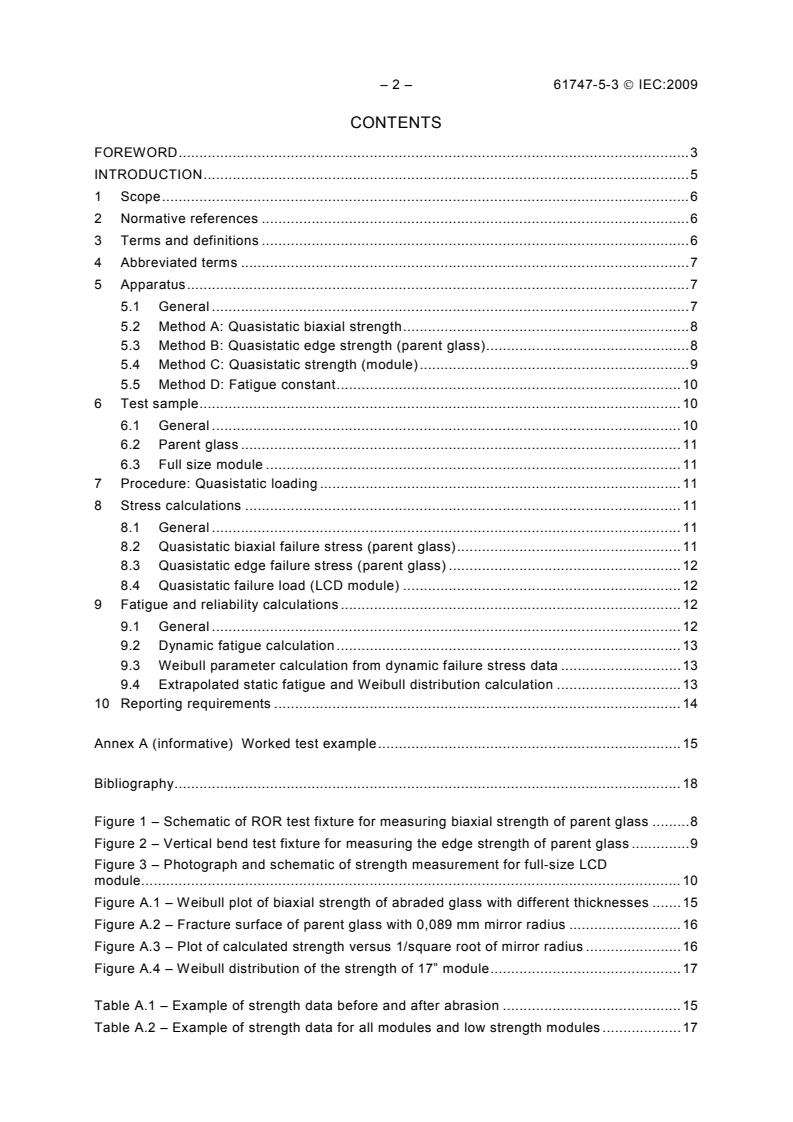
CONTENTS
FOREWORD . 3
INTRODUCTION . 5
1 Scope . 6
2 Normative references . 6
3 Terms and definitions . 6
4 Abbreviated terms . 7
5 Apparatus . 7
5.1 General . 7
5.2 Method A: Quasistatic biaxial strength . 8
5.3 Method B: Quasistatic edge strength (parent glass) . 8
5.4 Method C: Quasistatic strength (module) . 9
5.5 Method D: Fatigue constant . 10
6 Test sample . 10
6.1 General . 10
6.2 Parent glass . 11
6.3 Full size module . 11
7 Procedure: Quasistatic loading . 11
8 Stress calculations . 11
8.1 General . 11
8.2 Quasistatic biaxial failure stress (parent glass) . 11
8.3 Quasistatic edge failure stress (parent glass) . 12
8.4 Quasistatic failure load (LCD module) . 12
9 Fatigue and reliability calculations . 12
9.1 General . 12
9.2 Dynamic fatigue calculation . 13
9.3 Weibull parameter calculation from dynamic failure stress data . 13
9.4 Extrapolated static fatigue and Weibull distribution calculation . 13
10 Reporting requirements . 14
Annex A (informative) Worked test example . 15
Bibliography . 18
Figure 1 – Schematic of ROR test fixture for measuring biaxial strength of parent glass . 8
Figure 2 – Vertical bend test fixture for measuring the edge strength of parent glass . 9
Figure 3 – Photograph and schematic of strength measurement for full-size LCD
module. 10
Figure A.1 – Weibull plot of biaxial strength of abraded glass with different thicknesses . 15
Figure A.2 – Fracture surface of parent glass with 0,089 mm mirror radius . 16
Figure A.3 – Plot of calculated strength versus 1/square root of mirror radius . 16
Figure A.4 – Weibull distribution of the strength of 17” module . 17
Table A.1 – Example of strength data before and after abrasion . 15
Table A.2 – Example of strength data for all modules and low strength modules . 17
61747-5-3 IEC:2009 – 3 –
INTERNATIONAL ELECTROTECHNICAL COMMISSION
___________
LIQUID CRYSTAL DISPLAY DEVICES –
Part 5-3: Environmental, endurance and mechanical test methods –
Glass strength and reliability
FOREWORD
1) The International Electrotechnical Commission (IEC) is a worldwide organization for standardization comprising
all national electrotechnical committees (IEC National Committees). The object of IEC is to promote
international co-operation on all questions concerning standardization in the electrical and electronic fields. To
this end and in addition to other activities, IEC publishes International Standards, Technical Specifications,
Technical Reports, Publicly Available Specifications (PAS) and Guides (hereafter referred to as “IEC
Publication(s)”). Their preparation is entrusted to technical committees; any IEC National Committee interested
in the subject dealt with may participate in this preparatory work. International, governmental and non-
governmental organizations liaising with the IEC also participate in this preparation. IEC collaborates closely
with the International Organization for Standardization (ISO) in accordance with conditions determined by
agreement between the two organizations.
2) The formal decisions or agreements of IEC on technical matters express, as nearly as possible, an international
consensus of opinion on the relevant subjects since each technical committee has representation from all
interested IEC National Committees.
3) IEC Publications have the form of recommendations for international use and are accepted by IEC National
Committees in that sense. While all reasonable efforts are made to ensure that the technical content of IEC
Publications is accurate, IEC cannot be held responsible for the way in which they are used or for any
misinterpretation by any end user.
4) In order to promote international uniformity, IEC National Committees undertake to apply IEC Publications
transparently to the maximum extent possible in their national and regional publications. Any divergence
between any IEC Publication and the corresponding national or regional publication shall be clearly indicated in
the latter.
5) IEC itself does not provide any attestation of conformity. Independent certification bodies provide conformity
assessment services and, in some areas, access to IEC marks of conformity. IEC is not responsible for any
services carried out by independent certification bodies.
6) All users should ensure that they have the latest edition of this publication.
7) No liability shall attach to IEC or its directors, employees, servants or agents including individual experts and
members of its technical committees and IEC National Committees for any personal injury, property damage or
other damage of any nature whatsoever, whether direct or indirect, or for costs (including legal fees) and
expenses arising out of the publication, use of, or reliance upon, this IEC Publication or any other IEC
Publications.
8) Attention is drawn to the Normative references cited in this publication. Use of the referenced publications is
indispensable for the correct application of this publication.
9) Attention is drawn to the possibility that some of the elements of this IEC Publication may be the subject of
patent rights. IEC shall not be held responsible for identifying any or all such patent rights.
International Standard IEC 61747-5-3 has been prepared by IEC technical committee 110:
Flat panel display devices.
This International Standard replaces the IEC/PAS 61747-5-3, published in 2007.
There have been no significant revisions since the publication of the PAS version.
This part of IEC 61747 is a sectional specification for liquid crystal display cells. It is to be
read in conjunction with the IEC 61747-1 to which it refers.
– 4 – 61747-5-3 IEC:2009
The text of this standard is based on the following documents:
FDIS Report on voting
110/169/FDIS 110/177/RVD
Full information on the voting for the approval of this standard can be found in the report on
voting indicated in the above table.
This publication has been drafted in accordance with the ISO/IEC Directives, Part 2.
Future standards in this series will carry the new general title as cited above. Titles of existing
standards in this series will be updated at the time of the next edition.
A list of all parts of the IEC 61747 series, under the general title Liquid crystal display devices,
can be found on the IEC website.
The committee has decided that the contents of this publication will remain unchanged until
the maintenance result date indicated on the IEC web site under "http://webstore.iec.ch" in
the data related to the specific publication. At this date, the publication will be
• reconfirmed;
• withdrawn;
• replaced by a revised edition, or
• amended.
The contents of the corrigendum of November 2011 have been included in this copy.
61747-5-3 IEC:2009 – 5 –
INTRODUCTION
IEC 61747-5-3 facilitates the characterization of mechanical strength properties of LCD
modules and their component glass. Analysis and testing are performed on LCD Module
component glass as well as finished LCD modules. Statistics of mechanical strength of the
modules are determined allowing a prediction of module failure probability at a given stress
level or for a given probability of failure, the maximum recommended safe loading stress for
the module.
– 6 – 61747-5-3 IEC:2009
LIQUID CRYSTAL DISPLAY DEVICES –
Part 5-3: Environmental, endurance and mechanical test methods –
Glass strength and reliability
1 Scope
This part of IEC 61747 applies to commercially available liquid crystal displays (LCDs).
This standard applies to all LCD types, including transmissive, reflective or transflective liquid
crystal display (LCD) modules using either segment, passive or active matrix and achromatic
or colour type LCDs that are equipped with their own integrated source of illumination or
without their own source of illumination.
The objective of this standard is to establish uniform requirements for accurate and reliable
measurements of the following LCD parameters:
a) quasistatic strength,
b) quasistatic fatigue.
The methods described in this standard apply to all sizes, small and large, liquid crystal
displays.
NOTE Methods for measuring the fatigue constant are described in this standard and are taken from the
referenced literature, see [13] to [20]. The primary results are formulae for estimated allowable stress for the
specified lifetime or estimated failure rate for the specified stress level. As an example, limited data for strength
and fatigue behaviour of LCD glass are included in an informative Annex A. Similarly, limited data for static
strength of LCD modules are also included and compared with that of parent glass.
2 Normative references
The following referenced documents are indispensable for the application of this document.
For dated references, only the edition cited applies. For undated references, the latest edition
of the referenced document (including any amendments) applies.
IEC 61747-1, Liquid crystal and solid-state display devices – Part 1: Generic specification
IEC 61747-5:1998, Liquid crystal and solid-state display devices – Part 5: Environmental,
endurance and mechanical test methods
3 Terms and definitions
For the purposes of this document, the following terms and definitions apply.
3.1
strength
stress at which a sample fails for a given loading condition
3.2
LCD surface strength
biaxial strength wherein surface flaws with different orientations are subjected to uniform
tension during measurement
———————
Figures in square brackets refer to the bibliography.
61747-5-3 IEC:2009 – 7 –
NOTE Refer to [1] to [4] in the bibliography for further information.
3.3
LCD edge strength
uniaxial strength wherein edge flaws are subjected to tension during measurement
NOTE Refer to [5] to [8] in the bibliography for further information.
3.4
LCD (mechanical) reliability
either an estimated allowable stress which the LCDs can sustain for a specified period of time
or as an estimated failure rate at a specified stress level
NOTE 1 Both approaches for quantifying the reliability of LCDs use the power law for slow crack growth and
require the knowledge of fatigue constant for the parent glass employed in the LCD displays.
NOTE 2 Refer to [9] to [12] in the bibliography for further information.
3.5
parent glass
sheet glass used as raw material for manufacturing of LCD panels and modules
4 Abbreviated terms
For the purposes of this document, the following abbreviations apply.
FC filled cell
FEA finite element analysis
FPD flat panel display
LCD liquid crystal display
MC mirror constant
MR mirror radius
ROR ring on ring
SCSC stress corrosion susceptibility constant
VBT vertical bend test
5 Apparatus
5.1 General
The parameters in the following figures are used in the stress formulas of Clause 8. The
dimensions are:
load (force), in newtons (N),
dimensions, in millimetres (mm),
stress, in megapascals (MPa).
The standard atmospheric conditions in IEC 61747-5, 1.4.3, shall apply, except that the
relative humidity shall be in excess of 95 % (vapour) unless otherwise specifically agreed
between the customer and the supplier.
NOTE In general, humidity can affect the measured strength, with higher humidity leading to decreased strength
values. For this reason, as well as to ensure consistency and reproducibility, the humidity level is stated at the
highest practical level.
– 8 – 61747-5-3 IEC:2009
5.2 Method A: Quasistatic biaxial strength
The quasistatic biaxial strength of parent glass is measured in the ring on ring (ROR) fixture
as shown in Figure 1. The dimensions of load and support rings are selected so as to
minimize large deflection and the associated membrane stress, especially for ultra-thin glass,
although the effect of such non-linearities on strength can be quantified using finite element
analysis (FEA), see the bibliographical references [21] to [24]. All ring surfaces in contact with
the test specimens should be rounded, with radii of 2 to 3 times the thickness of the glass
specimen. In general, certain trade-offs are necessary in designing the test specimen and
ROR fixture because the key objective is to measure quasistatic strength of as large a test
area as possible without introducing large nonlinearities. Alternatively a large sample quantity
is required to obtain the strength distribution representative of full size module. Since the
strength of glass surface is primarily dictated by the quality of that surface, i.e., surface
defects, it is imperative to measure the biaxial strength of those surfaces that have been
exposed to handling and processing damage during the fabrication of LCD devices. Such data
are then a good representation of LCD module strength.
Load
50 mm × 50 mm
6,25 mm radius
r
specimens
load ring
r
t (thickness)
12,5 mm radius
support ring
r
IEC 545/09
Figure 1 – Schematic of ROR test fixture for measuring biaxial strength of parent glass
For square specimens, the specimen radius, r , is the average of the inscribed and
circumscribed circles.
5.3 Method B: Quasistatic edge strength (parent glass)
Quasistatic strength of the edges of parent glass is measured in the VBT fixture shown in
Figure 2. The dimensions of glass specimen and test fixture are so chosen as to minimize
buckling of the top edge which is in compression during the test because the load is applied
from the top. As in the case of surface strength it is equally imperative that the edges of glass
specimens should have been exposed to handling and processing damage during the
fabrication of LCD devices. In addition the glass specimen should be large enough to
represent the full-size module.
61747-5-3 IEC:2009 – 9 –
L
O
A
D
P/2 P/2
l
t
h
L
P/2 P/2
IEC 546/09
Figure 2 – Vertical bend test fixture for measuring the edge strength of parent glass
5.4 Method C: Quasistatic strength (module)
The quasistatic strength of full size module is measured by supporting it on the mounting
points and loading it at the centre as shown in Figure 3. The loading point of the test fixture is
rounded and may be padded to avoid inducing additional flaws on the glass surface. Several
modules are tested in this manner to obtain a statistically significant strength distribution
representative of surface damage induced by handling, processing and fabrication of LCD
module. These data are also useful for estimating the module strength at orders of magnitude
lower failure probabilities. The same apparatus may also be used for loading the LCD module
off-centre and obtaining its strength at different locations.
– 10 – 61747-5-3 IEC:2009
P
IEC 547/09
Figure 3 – Photograph and schematic of strength measurement for full-size LCD module
5.5 Method D: Fatigue constant
The fatigue constant of parent glass is obtained by measuring its biaxial strength at four, or
more, different stress rates, each successive rate being one order of magnitude lower, using
the ROR fixture shown in Figure 1. A sample quantity of at least 25 specimens shall be used
at each of the stress rates to obtain a reliable value of fatigue constant. The specimens used
for this measurement should also have been exposed to handling and processing damage
representative of manufacturing of FC and LCD modules.
6 Test sample
6.1 General
Samples shall be representative of normal processes. The sample sizes indicated below are
minimal. Larger sample sizes will yield more accurate lifetime estimates.
61747-5-3 IEC:2009 – 11 –
6.2 Parent glass
A sample size of at least 50 specimens, each 50 mm × 50 mm, shall be used for measuring
quasistatic biaxial strength (see 5.2) of parent glass. A similar sample size shall be used for
characterizing abraded glass which simulates handling and processing damage.
The fatigue measurements are also carried out on 50 mm × 50 mm specimens prepared from
abraded glass. A sample size of at least 25 specimens shall be used at each of the stress
rates to obtain a fatigue constant value from regression analysis of strength versus stress rate
data.
6.3 Full size module
Full size modules and filled cells can range small to very large diagonal dimensions. In all
cases a minimum sample quantity of at least 25 filled cells or modules shall be used for
measuring biaxial strength under static loading (see 5.4). Such data then help determine
module strength at orders of magnitude lower failure probabilities.
Similarly, a sample quantity of at least 25 filled cells shall be used for measuring the edge
strength via the apparatus shown in Figure 2
7 Procedure: Quasistatic loading
The loading rate or crosshead speed for measuring the strength of either parent glass or filled
cell or full size module is so chosen as to complete the measurement in 30 s to 45 s. The
loading rate or crosshead speed shall be kept constant during this measurement.
8 Stress calculations
8.1 General
Stress calculations are used to normalize the load at failure to common stress units. This
normalization takes into account differences in glass material, dimensions, and some design
characteristics. For specimens of a common design and dimension, the failure load and
pressure rate can be substituted for failure stress and stress rate formulas of Clause 9.
Poisson’s ratio, ν, is a material property that is normally available from the material supplier,
but may be verified with material tests.
8.2 Quasistatic biaxial failure stress (parent glass)
The strength of 50 mm × 50 mm specimens of parent glass tested in ROR fixture is calculated
from Equation (1).
2 2 2 2
σ = [3P/4πt ]×[2(1+ ν)ln(r /r ) + (1- ν)(r /r ) (1-r /r )] (1)
max 2 1 2 3 1 2
where
σ is the stress at failure,
max
P is the failure load,
t is the glass thickness,
ν is the Poisson’s ratio,
r is the radius of support ring,
r is the radius of the load ring, and
r is the radius of the specimen.
– 12 – 61747-5-3 IEC:2009
8.3 Quasistatic edge failure stress (parent glass)
The edge strength of parent glass specimens is calculated from failure load P and
Equation (2).
σ = 3P(L-l)/(2th ) (2)
e
where
σ is the edge failure stress,
e
h is the height,
t is the thickness,
l is the load span,
L is the support span, and
P is the failure load.
8.4 Quasistatic failure load (LCD module)
For this test, the failure load and load rate are reported. While there are means to calculate
the failure stress, this calculation is very complex and involves design characteristics. The
failure load values from this test may be substituted into the failure stress in the equations of
Clause 9. Because failure load values are not normalized to stress, the results are valid only
for the size and design of module tested.
9 Fatigue and reliability calculations
9.1 General
The strength distribution resulting from tests are done at rates considerably higher than those
that are relevant to normal use. In addition, normal use will often reflect static load conditions
in which the probability of failure at a given time is desired. To link the test loading conditions
to the use conditions, the power law theory of fatigue is used. For tests at rates cited in this
document, the power law fatigue relationship for a single flaw is:
t
F
n n−2
σ (x)dx≈ BS (3)
∫
where
σ(x) is the applied stress over time,
t is the time to failure,
F
S is the initial strength,
n is the fatigue parameter,
B is the strength preservation parameter.
The probability part of the relationship is based on the assumption that the initial strength
values follow a Weibull distribution that is given by
m
S
1− F= exp− (4)
S
61747-5-3 IEC:2009 – 13 –
where
F is failure probability,
S is the scaling parameter,
m is the shape parameter.
NOTE Load and load rate are un-normalized stress values and may be substituted for stress values when the
specimen materials, dimensions, and design are common.
9.2 Dynamic fatigue calculation
The fatigue constant results from testing multiple samples to failure at multiple loading rates.
Let σ represent the median failure stress of the jth rate and let σ represent the jth stress
j j
rate. When the log of these values is plotted, a line is seen. The slope of the line is 1/(n+1).
That is, fit the following linear regression for the parameters, a and b:
ln(σ )= a+ bln(σ )
j j
then n = 1/b – 1 (5)
NOTE Alternative calculation methodologies can be found in ASTM C1368 [30]. However, in all cases, care
should be exercised in the interpretation of bimodal distributions.
9.3 Weibull parameter calculation from dynamic failure stress data
The data for this calculation is usually obtained from an experiment at a single stress rate and
uses the fatigue constant value derived from a different multiple stress rate experiment. The N
failure stress data values are sorted from minimum to maximum and indexed with k (from 1
to N). For each, the effective strength, Seff is calculated as
k
1 n+ 1
ln(Seff )=− ln[σ(n+ 1)]+ ln[σ ] (6)
k k
n− 2 n− 2
The Weibull parameters are found by fitting the following linear regression
k− 0,3
ln− ln 1− = mln(Seff )− mln(Seff ) (7)
k 0
N+ 0,4
NOTE In the context of Equation (4), Seff is the Weibull scaling factor for Seff.
The slope of the regression yields m and the intercept of the regression yields the composite
parameter on the right.
9.4 Extrapolated static fatigue and Weibull distribution calculation
This calculation uses the parameters already determined from 9.2 and 9.3. There are usually
three ways to ask reliability questions:
a) At a given probability of failure and static load what is the time to failure?
b) At a given static load and time to failure, what is the probability of failure?
c) At a given probability of failure and lifetime, what could the applied load be?
All these questions are evaluated using a different formulation for effective strength:
n 1
ln(Seff)= ln(σ )+ ln(t ) (8)
a F
n− 2 n− 2
– 14 – 61747-5-3 IEC:2009
where
σ is the applied load,
a
t is the time to failure.
F
Any of the reliability equations can be evaluated rearranging the elements of the following
equation.
mn m
(9)
ln(− ln(1− F))+ m ln(Seff )= ln(σ )+ ln(t )
a F
n− 2 n− 2
NOTE Equation (9) comes from combining Equations (7) and (8).
10 Reporting requirements
The following parameters shall be reported with the test results:
a) Type of specimens.
b) Sample quantity.
c) Sample size.
d) Testing rates.
e) Testing conditions including relative humidity of samples.
61747-5-3 IEC:2009 – 15 –
Annex A
(informative)
Worked test example
Figure A.1 shows the Weibull distribution [29] of biaxial strength of parent glass with abraded
surface representing handling and processing damage. Both 0,7 mm and 1,1 mm thick
glasses show nearly identical strength distribution, i.e. the strength of glass is dictated by
surface flaws and not by its thickness. The strength data before and after abrasion are
summarized in Table 1. Indeed the handling and processing damage can decrease the
strength of parent glass by 40 % to 50 %.
99,5
Specimen thickness
90 0,7 mm
1,1 mm
Strength (MPa)
IEC 548/09
Figure A.1 – Weibull plot of biaxial strength of abraded glass with different thicknesses
Table A.1 – Example of strength data before and after abrasion
Thickness S
N m
mm MPa
As-received
0,7 30 3,9 404
1,1 50 3,7 460
Abraded
0,7 20 6,4 228
1,1 19 7,3 233
The failure stress value σ can also be estimated by measuring the mirror radius, Rm of the
f
specimen’s fracture surface, as shown in Figures A.2 and A.3, and using Equation (A.1).
Failure probability (%)
– 16 – 61747-5-3 IEC:2009
IEC 549/09
Figure A.2 – Fracture surface of parent glass with 0,089 mm mirror radius
½
Mirror constant = 65,3 ± 0,4 Mpa (mm)
0 1 2 3 4 5
½ –½
1/(Mirror radius) (mm )
IEC 550/09
Figure A.3 – Plot of calculated strength versus 1/square root of mirror radius
σ = A/ , A = 65,3 MPa m (A.1)
R
f
m
NOTE σ is the failure stress value.
f
The biaxial strength data for 17” modules employing 0,7 mm glass are plotted as Weibull
distribution in Figure A.4. A bimodal distribution is obtained indicating two different families of
flaws introduced during fabrication of the modules. Table A.2 summarizes the strength data
and Weibull parameters.
Strength via FEA (MPa)
61747-5-3 IEC:2009 – 17 –
99,5
Strength (MPa)
IEC 551/09
Figure A.4 – Weibull distribution of the strength of 17” module
Table A.2 – Example of strength data for all modules and low strength modules
S
N m
MPa
All modules 23 4,6 582
Low strength modules 3 30,4 345
Failure probability (%)
– 18 – 61747-5-3 IEC:2009
Bibliography
[1] Dumbaugh, W. H. et al. “Glasses for Flat-Panel Displays.” High Performance Glasses.
Glasgow and London: Cable & Parker, Blackie and Son Limited, 1992.
[2] Bocko, P.L. and Allaire, R. A. “Glass Contribution to Robustness of Displays for
Automotive Applications.” SID Symposium on Vehicle Displays, Detroit Metro Chapter.
Ypsilanti, MI: 1995
[3] Gulati, S. T. “Relative Impact of Manufacturing vs. Service Flaws on Design of Glass
Articles.” Ceram. Trans. Vol. 50. 1995: pp. 79-94.
[4] Lapp, J. C. "AMLCD Substrates: Trends in Technology.“ FPD Expo Taiwan. Hsinchu,
Taiwan: 2001
[5] Helfinstine, J. D. and Gulati, S. T. American Ceramic Society, Fall Meeting. Pittsburgh,
PA: 2002.
[6] Nattermann, K. “Edge strength testing for thin glass specimens at Schott Glas.”
International Commission on Glass TC6 Meeting. Prague: 1999.
[7] Cleary, T. and Gulati, S.T., Fractography of Glasses and Ceramics IV. Westerville, OH:
J.R.Varner and G.D.Quinn, American Ceramic Society, 2001.
[8] Akcakaya, R. and Gulati, S.T. International Commission on Glass. Amsterdam: 2000.
[9] Ritter, J.E. et al. "Strength Degradation in Polycrystalline Alumina Due to Sharp-Particle
Impact Damage.“ Journal of the American Ceramic Society, Vol. 71, Iss. 12, 1988:
p.1154.
[10] Evans, A.G. "Slow Crack Growth in Brittle Materials under Dynamic Loading
Conditions." International Journal of Fracture, Vol. 10, No. 2, June 1974: pp.251-259.
[11] Wiederhorn, S.M. et al., Fracture Mechanics of Ceramics. New York: R.C.Bradt, Plenum
Press, 1976.
[12] Wiederhorn, S. M. et al. “Application of Fracture Mechanics to Space-Shuttle
Windows.“ Journal of the American Ceramic Society, Vol. 57, No. 7, 1974: pp. 319-323.
[13] Helfinstine, J. D. "Adding Static and Dynamic Fatigue Effects Directly to the Weibull
Distribution.“ Journal of the American Ceramic Society, Vol. 63, 1980: p.113.
[14] Ritter, J. E., Jakus, K., Batakis, A. And Bandyopadhyay, N. “Appraisal of Biaxial
Strength Testing.“ Journal of Noncrystalline Solids, Vol. 38 & 39, 1980: pp. 419-424.
[15] Ritter, J. E. and Sherburne, C. L. “Dynamic and Static Fatigue of Silicate Glasses,”
Journal of the American Ceramic Society, Vol. 54, Issue 12, 1971: pp.601-605.
[16] Gulati, S. T. “Crack Kinetics during Static and Dynamic Loading.” Journal of Non-
Crystalline Solids, Vol. 38 & 39, Part I, May/June 1980: pp 475-480.
[17] Helfinstine, J. D. and Gulati, S. T. “Fatigue and Aging Behavior of Active Matrix Liquid
Crystal Display Glasses.” SID Conference, Toronto: 1997.
[18] Tummala, R. R. “Stress corrosion resistance compared with thermal expansion and
chemical durability of glass.” Glass Technology, Vol. 17, 1976.
[19] Gulati, S. T. and Helfinstine, J. D. “Long-Term Durability of Flat Panel Displays for
Automotive Applications.” SID Digest, Vol. 27, 1996: pp 49-56.
[20] Gulati, S. T. “Dynamic and Static Fatigue of Silicate Glasses under Biaxial Loading:
th
Application to Space Windows, CRT’s and Telescope Mirrors.” 5 International Otto
Schott Colloquium. Jena, Germany, 11-14 July 1994.
61747-5-3 IEC:2009 – 19 –
[21] ANSYS Inc., Canonsburg, PA.
[22] Gulati, S. T., Hansson, N, Helfinstine, J.D., and Malarkey, C.J. “Ceramic dies for hot
metal extrusion.” Tube International, March & June 1985.
[23] Gulati, S. T., Nolan, D.A., and Janssen, Ch. “Thermal Stresses in Nonuniformly Heated
Glass Panels.” American Ceramic Society Glass Division Fall Meeting. Bedford Springs,
PA: 14-16 October 1981.
[24] Gulati, S. T. and McCartney, J.S. “Experimental Verification of Proof Stress During
Flexure Tests on Space Shuttle Windows,” IASS World Congress on Space Enclosures.
Montreal: July 1976.
[25] Shand, E. B. “Breaking Stress of Glass Determined from Dimensions of Fracture
Mirrors.” Journal of the American Ceramic Society. Vol. 42, Issue 10, October 1959:
pp.474-477.
[26] Krohn, D. A. and Hasselman, D. P. H. “Relation of Flaw Size to Mirror in the Fracture of
Glass.“ Journal of the American Ceramic Society, Vol.54, Issue 8, 1971: p.411.
[27] Mecholsky, J. J. et al. “Prediction of the fracture energy and flaw size in glasses from
the mirror size measurements.” Journal of the American Ceramic Society, Vol. 57,
No.10, 1974: pp.440-443.
[28] Kerper, M. J. and Scuderi, T. G. “Modulus of Rupture in Relation to Fracture Pattern.”
Ceramic Bulletin, Vol. 43, No. 9, 1964.
[29] Weibull, W. "A Statistical Distribution Function of Wide Applicability.“ Journal of Applied
Mechanics, Vol. 18, 1951: pp.293-297.
[30] ASTM C1368, Standard Test Method for Determination of Slow Crack Growth
Parameters of Advanced Ceramics by Constant Stress-Rate Flexural Testing at Ambient
Temperature
______________
– 20 – 61747-5-3 CEI:2009
SOMMAIRE
AVANT-PROPOS . 22
INTRODUCTION . 24
1 Domaine d'application . 25
2 Références normatives . 25
3 Termes et définitions . 25
4 Termes abrégés . 26
5 Appareillage . 26
5.1 Généralités. 26
5.2 Méthode A: Résistance biaxiale quasi statique . 27
5.3 Méthode B: Résistance de bord quasi statique (verre de base) . 28
5.4 Méthode C: Résistance quasi statique (module) . 28
5.5 Méthode D: Constante de fatigue . 29
6 Echantillon d’essai . 30
6.1 Généralités. 30
6.2 Verre de base. 30
6.3 Module pleine dimension . 30
7 Procédure: Charge quasi statique . 30
8 Calculs de contrainte . 30
8.1 Généralités. 30
8.2 Contrainte de défaillance biaxiale quasi statique (verre de base) . 30
8.3 Contrainte de défaillance de bord quasi statique (verre de base) . 31
8.4 Charge de rupture quasi statique (module LCD) . 31
9 Calculs de fatigue et de fiabilité . 31
9.1 Généralités. 31
9.2 Calcul de la fatigue dynamique . 32
9.3 Calcul du paramètre de Weibull à partir des données de contrainte de
rupture dynamique . 32
9.4 Calcul par extrapolation de la fatigue statique et de la distribution de Weibull . 33
10 Exigences relatives au rapport . 33
Annexe A (informative) Exemple d’essai travaillé . 34
Bibliographie . 37
Figure 1 – Schéma d’un dispositif de fixation d’essai ROR pour la mesure
de la résistance biaxiale du verre de base . 27
Figure 2 – Dispositif de fixation d’essai de courbure verticale pour la mesure
de la résistance de bord du verre de base . 28
Figure 3 – Photographie et schéma de la mesure de résistance pour le module LCD
pleine dimension . 29
Figure A.1 – Tracé de Weibull de résistance biaxiale du verre éraillé de différentes
épaisseurs . 34
Figure A.2 – Surface de cassure du verre de base d'un rayon de miroir de 0,089 mm . 35
Figure A.3 – Tracé de la résistance calculée par rapport à 1/racine carrée du rayon
de miroir . 35
61747-5-3 CEI:2009 – 21 –
Figure A.4 – Distribution de Weibull de la résistance du module 17” . 36
Tableau A.1 – Exemples de données de résistance avant et après l’abrasion . 34
Tableau A.2 – Exemple de données de résistance p
...