

IEC 60364-7-710
Electrical installations of buildings - Part 7-710: Requirements for special installations or locations - Medical locations
General Information
- Abstract
Applies to electrical installations in medical locations so as to ensure safety of patients and medical staff. These requirements, in the main, refer to hospitals, private clinics, medical and dental practices, health care centres and dedicated medical rooms in the work place.
- Status
- Not Published
- Technical Committee
- TC 64 - Electrical installations and protection against electric shock
- Current Stage
- PPUB - Publication issued
- Start Date
- 27-Nov-2002
Buy Documents




Overview
IEC 60364-7-710 - Electrical installations of buildings, Part 7-710: Requirements for special installations or locations - Medical locations - sets specific electrical installation requirements for medical environments to ensure the safety of patients and medical staff. It applies to hospitals, clinics, dental practices, health centres and dedicated medical rooms (and where applicable, veterinary clinics). The standard supplements general IEC 60364 rules and aligns with medical equipment standards such as IEC 60601.
Key topics and technical requirements
- Scope & classification: Defines medical locations and classifies areas as Group 0, Group 1 or Group 2 depending on the type of patient contact with applied parts (Group 2 includes intracardiac procedures and life-critical areas).
- System earthing: Prohibits TN‑C systems downstream of the main distribution board in medical buildings; requires selection of suitable earthing (TN, TT, IT) based on risk and continuity needs.
- Power supply & safety services: Requires design for automatic change‑over to an electrical safety source for essential loads to maintain continuity in critical medical areas.
- Protection against electric shock:
- Use of SELV/PELV circuits for patient-contact equipment limited to ≤25 V r.m.s. AC (or 60 V ripple-free DC) with appropriate insulation and barriers.
- Obstacles and placing out of reach are not permitted as protective measures in medical locations - only insulation, barriers/enclosures and equipotential bonding as specified.
- For Group 2, equipotential bonding of exposed conductive parts is required.
- Touch voltage limits: conventional touch voltage shall not exceed 25 V in Group 1 and 2 locations.
- Protection devices & systems: Applies rules for automatic disconnection of supply, insulation monitoring for medical IT systems, and use of isolating transformers where appropriate (see IEC 61558‑2‑15).
- Selection, erection and verification: Covers wiring systems, switchgear, safety services classification, and mandates initial and periodic verification of installations.
Practical applications - who uses this standard
- Electrical designers and consulting engineers for healthcare projects
- Hospital and clinic facility managers and biomedical engineers
- Electrical installers and contractors working on medical rooms and operating theatres
- Safety officers, inspectors and accreditation bodies performing compliance audits
- Manufacturers and integrators of medical electrical systems and building services
Use cases include new-build design, retrofitting existing installations (especially when room usage changes), specifying emergency power and safety circuits, and defining testing/maintenance regimes to protect patients and staff.
Related standards
- IEC 60364 (Parts 1–6) - general electrical installation rules
- IEC 60601 series - safety of medical electrical equipment
- IEC 60601‑1‑1 - medical electrical systems
- IEC 61558‑2‑15 - isolating transformers for medical locations
- IEC 61557‑8 - insulation monitoring devices for IT systems
Keywords: IEC 60364-7-710, medical locations, electrical installations, patient safety, medical IT system, SELV, equipotential bonding, isolating transformer, verification, Group 1 Group 2.
Buy Documents
Get Certified
Connect with accredited certification bodies for this standard

DIBt (Deutsches Institut für Bautechnik)
German Institute for Building Technology.
DIN CERTCO
DIN Group product certification.

IMQ S.p.A. (Certification)
Italian electrical product certification.
Sponsored listings
Frequently Asked Questions
IEC 60364-7-710 is a standard published by the International Electrotechnical Commission (IEC). Its full title is "Electrical installations of buildings - Part 7-710: Requirements for special installations or locations - Medical locations". This standard covers: Applies to electrical installations in medical locations so as to ensure safety of patients and medical staff. These requirements, in the main, refer to hospitals, private clinics, medical and dental practices, health care centres and dedicated medical rooms in the work place.
Applies to electrical installations in medical locations so as to ensure safety of patients and medical staff. These requirements, in the main, refer to hospitals, private clinics, medical and dental practices, health care centres and dedicated medical rooms in the work place.
IEC 60364-7-710 is classified under the following ICS (International Classification for Standards) categories: 29.020 - Electrical engineering in general; 91.140.50 - Electricity supply systems. The ICS classification helps identify the subject area and facilitates finding related standards.
IEC 60364-7-710 is associated with the following European legislation: EU Directives/Regulations: TRRTP129. When a standard is cited in the Official Journal of the European Union, products manufactured in conformity with it benefit from a presumption of conformity with the essential requirements of the corresponding EU directive or regulation.
IEC 60364-7-710 is available in PDF format for immediate download after purchase. The document can be added to your cart and obtained through the secure checkout process. Digital delivery ensures instant access to the complete standard document.
Standards Content (Sample)
NORME CEI
INTERNATIONALE IEC
60364-7-710
INTERNATIONAL
Première édition
STANDARD
First edition
2002-11
Installations électriques des bâtiments –
Partie 7-710:
Règles pour les installations ou emplacements
spéciaux – Locaux à usages médicaux
Electrical installations of buildings –
Part 7-710:
Requirements for special installations
or locations – Medical locations
IEC 2002 Droits de reproduction réservés Copyright - all rights reserved
Aucune partie de cette publication ne peut être reproduite ni No part of this publication may be reproduced or utilized in any
utilisée sous quelque forme que ce soit et par aucun procédé, form or by any means, electronic or mechanical, including
électronique ou mécanique, y compris la photocopie et les photocopying and microfilm, without permission in writing from
microfilms, sans l'accord écrit de l'éditeur. the publisher.
International Electrotechnical Commission, 3, rue de Varembé, PO Box 131, CH-1211 Geneva 20, Switzerland
Telephone: +41 22 919 02 11 Telefax: +41 22 919 03 00 E-mail: inmail@iec.ch Web: www.iec.ch
CODE PRIX
R
Commission Electrotechnique Internationale PRICE CODE
International Electrotechnical Commission
Ме ж д у на р од ная Эл ек т р о т ех ни чес к ая Ко м и с с и я
Pour prix, voir catalogue en vigueur
For price, see current catalogue
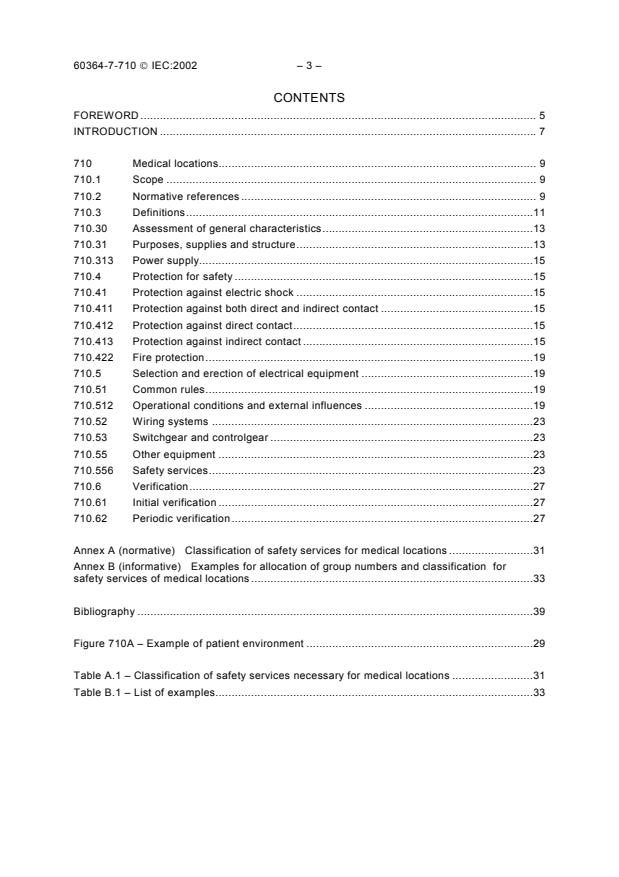
60364-7-710 IEC:2002 – 3 –
CONTENTS
FOREWORD . 5
INTRODUCTION .7
710 Medical locations. 9
710.1 Scope . 9
710.2 Normative references . 9
710.3 Definitions.11
710.30 Assessment of general characteristics.13
710.31 Purposes, supplies and structure.13
710.313 Power supply.15
710.4 Protection for safety .15
710.41 Protection against electric shock .15
710.411 Protection against both direct and indirect contact .15
710.412 Protection against direct contact.15
710.413 Protection against indirect contact .15
710.422 Fire protection.19
710.5 Selection and erection of electrical equipment .19
710.51 Common rules.19
710.512 Operational conditions and external influences .19
710.52 Wiring systems .23
710.53 Switchgear and controlgear .23
710.55 Other equipment .23
710.556 Safety services.23
710.6 Verification.27
710.61 Initial verification .27
710.62 Periodic verification.27
Annex A (normative) Classification of safety services for medical locations .31
Annex B (informative) Examples for allocation of group numbers and classification for
safety services of medical locations .33
Bibliography .39
Figure 710A – Example of patient environment .29
Table A.1 – Classification of safety services necessary for medical locations .31
Table B.1 – List of examples.33
60364-7-710 IEC:2002 – 5 –
INTERNATIONAL ELECTROTECHNICAL COMMISSION
____________
ELECTRICAL INSTALLATIONS OF BUILDINGS –
Part 7-710: Requirements for special installations
or locations – Medical locations
FOREWORD
1) The IEC (International Electrotechnical Commission) is a worldwide organization for standardization comprising
all national electrotechnical committees (IEC National Committees). The object of the IEC is to promote
international co-operation on all questions concerning standardization in the electrical and electronic fields. To
this end and in addition to other activities, the IEC publishes International Standards. Their preparation is
entrusted to technical committees; any IEC National Committee interested in the subject dealt with may
participate in this preparatory work. International, governmental and non-governmental organizations liaising
with the IEC also participate in this preparation. The IEC collaborates closely with the International Organization
for Standardization (ISO) in accordance with conditions determined by agreement between the two
organizations.
2) The formal decisions or agreements of the IEC on technical matters express, as nearly as possible, an
international consensus of opinion on the relevant subjects since each technical committee has representation
from all interested National Committees.
3) The documents produced have the form of recommendations for international use and are published in the form
of standards, technical specifications, technical reports or guides and they are accepted by the National
Committees in that sense.
4) In order to promote international unification, IEC National Committees undertake to apply IEC International
Standards transparently to the maximum extent possible in their national and regional standards. Any
divergence between the IEC Standard and the corresponding national or regional standard shall be clearly
indicated in the latter.
5) The IEC provides no marking procedure to indicate its approval and cannot be rendered responsible for any
equipment declared to be in conformity with one of its standards.
6) Attention is drawn to the possibility that some of the elements of this International Standard may be the subject
of patent rights. The IEC shall not be held responsible for identifying any or all such patent rights.
International Standard IEC 60364-7-710 has been prepared by IEC technical committee 64:
Electrical installations and protection against electric shock.
The text of this standard is based on the following documents:
FDIS Report on voting
64/1268/FDIS 64/1275/RVD
Full information on the voting for the approval of this standard can be found in the report on
voting indicated in the above table.
This publication has been drafted in accordance with the ISO/IEC Directives, Part 2.
The committee has decided that the contents of this publication will remain unchanged until 2007.
At this date, the publication will be
• reconfirmed;
• withdrawn;
• replaced by a revised edition, or
• amended.
60364-7-710 IEC:2002 – 7 –
INTRODUCTION
The requirements of this part of IEC 60364 supplement, modify or replace certain of the
general requirements as contained in parts 1 to 6 of IEC 60364.
The clause numbering following 710 are those of the corresponding parts or clauses from
parts 1 to 6 of IEC 60364.
The absence of reference to a part or a clause means that parts 1 to 6 of IEC 60364 are
applicable.
In medical locations it is necessary to ensure the safety of patients likely to be subjected to the
application of medical electrical equipment. For every activity and function in a medical
location, the particular requirements for safety have to be considered. Safety can be achieved
by ensuring the safety of the installation and the safe operation and maintenance of medical
electrical equipment connected to it. The use of medical electrical equipment on patients
undergoing intensive care (of critical importance) has called for enhanced reliability and safety
of electrical installations in hospitals so as to improve the safety and continuity of supplies
which is met by application of this standard. Variations of the standard to further enhance
safety and reliability are acceptable.
60364-7-710 IEC:2002 – 9 –
ELECTRICAL INSTALLATIONS OF BUILDINGS –
Part 7-710: Requirements for special installations
or locations – Medical locations
710 Medical locations
710.1 Scope
The particular requirements of this part of IEC 60364 apply to electrical installations in medical
locations so as to ensure safety of patients and medical staff. These requirements, in the main,
refer to hospitals, private clinics, medical and dental practices, health care centres and
dedicated medical rooms in the work place.
NOTE 1 It may be necessary to modify the existing electrical installation, in accordance with this standard, when
a change of utilization of the location occurs. Special care should be taken where intracardiac procedures are
performed in existing installations.
NOTE 2 Where applicable this standard can also be used in veterinary clinics. The requirements of this part do
not apply to medical electrical equipment.
NOTE 3 For medical electrical equipment, refer to the IEC 60601 series.
710.2 Normative references
The following referenced documents are indispensable for the application of this document.
For dated references, only the edition cited applies. For undated references, the latest edition
of the referenced document (including any amendments) applies.
IEC 60364-4-41:2001, Electrical installations of buildings – Part 4-41: Protection for safety –
Protection against electric shock
IEC 60364-5-55:2001, Electrical installations of buildings – Part 5-55: Selection and erection of
electrical equipment – Other equipment
IEC 60364-6-61:2001, Electrical installations of buildings – Part 6-61: Verification – Initial
verification
IEC 60601-1:1988, Medical electrical equipment – Part 1: General requirements for safety
Amendment 2 (1995)
IEC 60601-1-1:2000, Medical electrical equipment – Part 1: General requirements for safety –
Collateral standard: Safety requirements for medical electrical systems
IEC 60617-1:1985, Graphical symbols for diagrams – Part 1: General information, general
index – Cross-reference tables
IEC 60617-11(DB) , Graphical symbols for diagrams – Part 11: Architectural and topographical
installation plans and diagrams
IEC 61082-1:1991, Preparation of documents used in electrotechnology – Part 1: General
requirements
___________
DB = Data Base.
60364-7-710 IEC:2002 – 11 –
IEC 61557-8:1997, Electrical safety in low voltage distribution systems up to 1 000 V a.c. and
1 500 V d.c. – Equipment for testing, measuring or monitoring of protective measures – Part 8:
Insulation monitoring devices for IT systems
IEC 61558-2-15:1999, Safety of power transformers, power supply units and similar – Part 2-15:
Particular requirements for isolating transformers for the supply of medical locations
710.3 Definitions
For the purposes of this part of IEC 60364, the following definitions apply.
710.3.1
medical location
location intended for purposes of diagnosis, treatment (including cosmetic treatment),
monitoring and care of patients
NOTE To ensure protection of patients from possible electrical hazards, additional protective measures need to be
applied in medical locations. The type and description of these hazards can vary according to the treatment being
administered. The manner in which a room is to be used necessitates some division into different areas for differing
medical procedures.
710.3.2
patient
living being (person or animal) undergoing medical or dental investigation or treatment
(adapted from 2.12.4 of IEC 60601-1)
NOTE The person under treatment for cosmetic purposes may be considered, as far as this standard is
concerned, as a patient.
710.3.3
medical electrical equipment
electrical equipment, provided with not more than one connection to a particular supply mains
and intended to diagnose, treat or monitor the patient under medical supervision and which
– makes physical or electrical contact with the patient, and/or
– transfers energy to or from the patient, and/or
– detects such energy transfer to or from the patient.
NOTE The equipment includes those accessories defined by the manufacturer as being necessary to enable
normal use of the equipment.
710.3.4
applied part
part of the medical electrical equipment which in normal use
– necessarily comes into physical contact with the patient for the equipment to perform its
function, or
– can be brought into contact with the patient, or
– needs to be touched by the patient
(adapted from 2.1.5 of amendment 2 to IEC 60601-1)
710.3.5
group 0
medical location where no applied parts are intended to be used
710.3.6
group 1
medical location where applied parts are intended to be used as follows:
– externally;
– invasively to any part of the body, except where 710.3.7 applies
60364-7-710 IEC:2002 – 13 –
710.3.7
group 2
medical location where applied parts are intended to be used in applications such as
intracardiac procedures, operating theatres and vital treatment where discontinuity (failure)
of the supply can cause danger to life
NOTE An intracardiac procedure is a procedure whereby an electrical conductor is placed within the heart of a
patient or is likely to come into contact with the heart, such conductor being accessible outside the patient's body.
In this context, an electrical conductor includes insulated wires such as cardiac pacing electrodes or intracardiac
ECG electrodes, or insulated tubes filled with conducting fluids.
710.3.8
medical electrical system
combination of items of equipment, at least one of which is an item of medical electrical
equipment and inter-connected by functional connection or use of a multiple portable socket-
outlet
NOTE The system includes those accessories which are needed for operating the system and are specified by the
manufacturer.
710.3.9
patient environment
any volume in which intentional or unintentional contact can occur between patient and parts of
the system or between patient and other persons touching parts of the system (for illustration
see Figure 710A)
NOTE This applies when the patient’s position is pre-determined, if not, all possible patient positions should be
considered.
710.3.10
main distribution board
board in the building which fulfils all the functions of a main electrical distribution for the supply
building area assigned to it and where the voltage drop is measured for operating the safety
services
710.3.11
medical IT system
IT electrical system having specific requirements for medical applications
710.30 Assessment of general characteristics
The classification of a medical location shall be made in agreement with the medical staff,
health organization concerned or body responsible for the safety of workers in accordance with
national regulations. In order to determine the classification of a medical location, it is
necessary that the medical staff indicate which medical procedures will take place within the
location. Based on the intended use, the appropriate classification for the location shall be
determined (the possibility that certain medical locations may be used for different purposes
which necessitate a higher group should be addressed by risk management).
NOTE 1 Classification of a medical location should be related to the type of contact between applied parts and the
patient, as well as the purpose for which the location is used (see Annex B).
NOTE 2 Applied parts are defined by the particular standards for medical electrical equipment.
710.31 Purposes, supplies and structure
710.312.2 Types of system earthing
The TN-C system is not allowed in medical locations and medical buildings downstream of the
main distribution board.
60364-7-710 IEC:2002 – 15 –
710.313 Power supply
710.313.1 General
In medical locations the distribution system should be designed and installed to facilitate the
automatic change-over from the main distribution network to the electrical safety source
feeding essential loads (according to IEC 60364-5-55, clause 556).
710.4 Protection for safety
710.41 Protection against electric shock
710.411 Protection against both direct and indirect contact
710.411.1 SELV and PELV
When using SELV and/or PELV circuits in medical locations of group 1 and group 2,
the nominal voltage applied to current-using equipment shall not exceed 25 V r.m.s. a.c.
or 60 V ripple free d.c. Protection by insulation of live parts according to 412.1
of IEC 60364-4-41 and by barriers or enclosures according to 412.2 of the same standard
is essential.
In medical locations of group 2, exposed-conductive-parts of equipment (e.g. operating theatre
luminaires), shall be connected to the equipotential bonding conductor.
710.412 Protection against direct contact
710.412.3 Obstacles
Protection by obstacles is not permitted.
710.412.4 Placing out of reach
Protection by placing out of reach is not permitted.
Only protection by insulation of live parts or protection by barriers or enclosures are permitted.
710.413 Protection against indirect contact
710.413.1 Automatic disconnection of supply
710.413.1.1 General
710.413.1.1.1 Disconnection of supply
In medical locations of group 1 and group 2, the following shall apply:
– for IT, TN and TT systems, the conventional touch voltage U shall not exceed 25 V
L
(U ≤ 25 V);
L
– for TN and IT systems, table 41C of IEC 60364-4-41 shall apply.
NOTE Disconnection of supply when overload or short-circuit conditions occur, can be achieved by different
design methods within the procedures of the general rules in order to satisfy the required safety level.
710.413.1.3 TN systems
In final circuits of group 1 rated up to 32 A residual current devices with a maximum residual
operating current of 30 mA shall be used (additional protection).
60364-7-710 IEC:2002 – 17 –
In medical locations of group 2, protection by automatic disconnection of supply by means of
residual current protective devices with the rated residual-operating-current not exceeding
30 mA shall only be used on the following circuits:
– circuits for the supply of operating tables;
– circuits for X-ray units;
NOTE The requirement is mainly applicable to mobile X-ray units brought into group 2 locations.
– circuits for large equipment with a rated power greater than 5 kVA;
– circuits for non-critical electrical equipment (non life support).
Care shall be taken to ensure that simultaneous use of many items of such equipment
connected to the same circuit cannot cause unwanted tripping of the residual current protective
device (RCD).
In medical locations of group 1 and group 2, where RCDs are required by this subclause, only
type A or type B shall be selected, depending on the possible fault-current arising.
NOTE It is recommended that TN-S systems are monitored to ensure the insulation level of all live conductors.
710.413.1.4 TT systems
In medical locations of group 1 and group 2, the requirements of TN systems (see 710.413.1.3)
apply and in all cases residual current protective devices shall be used.
710.413.1.5 Medical IT system
NOTE 1 In the United States such a system is identified as an “Isolated Power System”.
In group 2 medical locations, the medical IT system shall be used for circuits supplying
medical electrical equipment and systems intended for life support, surgical applications and
other electrical equipment located in the "patient environment", excluding equipment listed
in 713.413.1.3.
For each group of rooms serving the same function, at least one separate medical IT system is
necessary. The medical IT system shall be equipped with an insulation monitoring device
in accordance with IEC 61557-8 with the following specific requirements:
– the a.c. internal impedance shall be at least 100 kΩ ;
– the test voltage shall not be greater than 25 V d.c.;
– the injected current, even under fault conditions, shall not be greater than 1 mA peak;
– indication shall take place at the latest when the insulation resistance has decreased to
50 kΩ . A test device shall be provided;
NOTE 2 In Germany, an indication is required if the earth or wiring connection is lost.
NOTE 3 The necessary additional requirements on IMDs given above are at this time not covered in the
equipment standard IEC 61557-8. They will be removed from this publication as soon as they have been treated
in the relevant equipment standard.
For each medical IT system, an acoustic and visual alarm system incorporating the following
components shall be arranged at a suitable place so that it can be permanently monitored
(audible and visual signals) by the medical staff:
– a green signal lamp to indicate normal operation;
– a yellow signal lamp which lights when the minimum value set for the insulation resistance
is reached. It shall not be possible for this light to be cancelled or disconnected;
...
SLOVENSKI SIST IEC 60364-7-710:2006
STANDARD
september 2006
Električne inštalacije zgradb – 7-710. del: Zahteve za posebne inštalacije ali
lokacije – Medicinski prostori
Electrical installations of buildings - Part 7-710: Requirements for special
installations or locations - Medical locations
ICS 11.020; 91.140.50 Referenčna številka
© Standard je založil in izdal Slovenski inštitut za standardizacijo. Razmnoževanje ali kopiranje celote ali delov tega dokumenta ni dovoljeno
NORME CEI
INTERNATIONALE IEC
60364-7-710
INTERNATIONAL
Première édition
STANDARD
First edition
2002-11
Installations électriques des bâtiments –
Partie 7-710:
Règles pour les installations ou emplacements
spéciaux – Locaux à usages médicaux
Electrical installations of buildings –
Part 7-710:
Requirements for special installations
or locations – Medical locations
IEC 2002 Droits de reproduction réservés Copyright - all rights reserved
Aucune partie de cette publication ne peut être reproduite ni No part of this publication may be reproduced or utilized in any
utilisée sous quelque forme que ce soit et par aucun procédé, form or by any means, electronic or mechanical, including
électronique ou mécanique, y compris la photocopie et les photocopying and microfilm, without permission in writing from
microfilms, sans l'accord écrit de l'éditeur. the publisher.
International Electrotechnical Commission, 3, rue de Varembé, PO Box 131, CH-1211 Geneva 20, Switzerland
Telephone: +41 22 919 02 11 Telefax: +41 22 919 03 00 E-mail: inmail@iec.ch Web: www.iec.ch
CODE PRIX
R
Commission Electrotechnique Internationale PRICE CODE
International Electrotechnical Commission
Международная Электротехническая Комиссия
Pour prix, voir catalogue en vigueur
For price, see current catalogue
60364-7-710 IEC:2002 – 3 –
CONTENTS
FOREWORD . 5
INTRODUCTION .7
710 Medical locations. 9
710.1 Scope . 9
710.2 Normative references . 9
710.3 Definitions.11
710.30 Assessment of general characteristics.13
710.31 Purposes, supplies and structure.13
710.313 Power supply.15
710.4 Protection for safety .15
710.41 Protection against electric shock .15
710.411 Protection against both direct and indirect contact .15
710.412 Protection against direct contact.15
710.413 Protection against indirect contact .15
710.422 Fire protection.19
710.5 Selection and erection of electrical equipment .19
710.51 Common rules.19
710.512 Operational conditions and external influences .19
710.52 Wiring systems .23
710.53 Switchgear and controlgear .23
710.55 Other equipment .23
710.556 Safety services.23
710.6 Verification.27
710.61 Initial verification .27
710.62 Periodic verification.27
Annex A (normative) Classification of safety services for medical locations .31
Annex B (informative) Examples for allocation of group numbers and classification for
safety services of medical locations .33
Bibliography .39
Figure 710A – Example of patient environment .29
Table A.1 – Classification of safety services necessary for medical locations .31
Table B.1 – List of examples.33
60364-7-710 IEC:2002 – 5 –
INTERNATIONAL ELECTROTECHNICAL COMMISSION
____________
ELECTRICAL INSTALLATIONS OF BUILDINGS –
Part 7-710: Requirements for special installations
or locations – Medical locations
FOREWORD
1) The IEC (International Electrotechnical Commission) is a worldwide organization for standardization comprising
all national electrotechnical committees (IEC National Committees). The object of the IEC is to promote
international co-operation on all questions concerning standardization in the electrical and electronic fields. To
this end and in addition to other activities, the IEC publishes International Standards. Their preparation is
entrusted to technical committees; any IEC National Committee interested in the subject dealt with may
participate in this preparatory work. International, governmental and non-governmental organizations liaising
with the IEC also participate in this preparation. The IEC collaborates closely with the International Organization
for Standardization (ISO) in accordance with conditions determined by agreement between the two
organizations.
2) The formal decisions or agreements of the IEC on technical matters express, as nearly as possible, an
international consensus of opinion on the relevant subjects since each technical committee has representation
from all interested National Committees.
3) The documents produced have the form of recommendations for international use and are published in the form
of standards, technical specifications, technical reports or guides and they are accepted by the National
Committees in that sense.
4) In order to promote international unification, IEC National Committees undertake to apply IEC International
Standards transparently to the maximum extent possible in their national and regional standards. Any
divergence between the IEC Standard and the corresponding national or regional standard shall be clearly
indicated in the latter.
5) The IEC provides no marking procedure to indicate its approval and cannot be rendered responsible for any
equipment declared to be in conformity with one of its standards.
6) Attention is drawn to the possibility that some of the elements of this International Standard may be the subject
of patent rights. The IEC shall not be held responsible for identifying any or all such patent rights.
International Standard IEC 60364-7-710 has been prepared by IEC technical committee 64:
Electrical installations and protection against electric shock.
The text of this standard is based on the following documents:
FDIS Report on voting
64/1268/FDIS 64/1275/RVD
Full information on the voting for the approval of this standard can be found in the report on
voting indicated in the above table.
This publication has been drafted in accordance with the ISO/IEC Directives, Part 2.
The committee has decided that the contents of this publication will remain unchanged until 2007.
At this date, the publication will be
• reconfirmed;
• withdrawn;
• replaced by a revised edition, or
• amended.
60364-7-710 IEC:2002 – 7 –
INTRODUCTION
The requirements of this part of IEC 60364 supplement, modify or replace certain of the
general requirements as contained in parts 1 to 6 of IEC 60364.
The clause numbering following 710 are those of the corresponding parts or clauses from
parts 1 to 6 of IEC 60364.
The absence of reference to a part or a clause means that parts 1 to 6 of IEC 60364 are
applicable.
In medical locations it is necessary to ensure the safety of patients likely to be subjected to the
application of medical electrical equipment. For every activity and function in a medical
location, the particular requirements for safety have to be considered. Safety can be achieved
by ensuring the safety of the installation and the safe operation and maintenance of medical
electrical equipment connected to it. The use of medical electrical equipment on patients
undergoing intensive care (of critical importance) has called for enhanced reliability and safety
of electrical installations in hospitals so as to improve the safety and continuity of supplies
which is met by application of this standard. Variations of the standard to further enhance
safety and reliability are acceptable.
60364-7-710 IEC:2002 – 9 –
ELECTRICAL INSTALLATIONS OF BUILDINGS –
Part 7-710: Requirements for special installations
or locations – Medical locations
710 Medical locations
710.1 Scope
The particular requirements of this part of IEC 60364 apply to electrical installations in medical
locations so as to ensure safety of patients and medical staff. These requirements, in the main,
refer to hospitals, private clinics, medical and dental practices, health care centres and
dedicated medical rooms in the work place.
NOTE 1 It may be necessary to modify the existing electrical installation, in accordance with this standard, when
a change of utilization of the location occurs. Special care should be taken where intracardiac procedures are
performed in existing installations.
NOTE 2 Where applicable this standard can also be used in veterinary clinics. The requirements of this part do
not apply to medical electrical equipment.
NOTE 3 For medical electrical equipment, refer to the IEC 60601 series.
710.2 Normative references
The following referenced documents are indispensable for the application of this document.
For dated references, only the edition cited applies. For undated references, the latest edition
of the referenced document (including any amendments) applies.
IEC 60364-4-41:2001, Electrical installations of buildings – Part 4-41: Protection for safety –
Protection against electric shock
IEC 60364-5-55:2001, Electrical installations of buildings – Part 5-55: Selection and erection of
electrical equipment – Other equipment
IEC 60364-6-61:2001, Electrical installations of buildings – Part 6-61: Verification – Initial
verification
IEC 60601-1:1988, Medical electrical equipment – Part 1: General requirements for safety
Amendment 2 (1995)
IEC 60601-1-1:2000, Medical electrical equipment – Part 1: General requirements for safety –
Collateral standard: Safety requirements for medical electrical systems
IEC 60617-1:1985, Graphical symbols for diagrams – Part 1: General information, general
index – Cross-reference tables
IEC 60617-11(DB) , Graphical symbols for diagrams – Part 11: Architectural and topographical
installation plans and diagrams
IEC 61082-1:1991, Preparation of documents used in electrotechnology – Part 1: General
requirements
___________
DB = Data Base.
60364-7-710 IEC:2002 – 11 –
IEC 61557-8:1997, Electrical safety in low voltage distribution systems up to 1 000 V a.c. and
1 500 V d.c. – Equipment for testing, measuring or monitoring of protective measures – Part 8:
Insulation monitoring devices for IT systems
IEC 61558-2-15:1999, Safety of power transformers, power supply units and similar – Part 2-15:
Particular requirements for isolating transformers for the supply of medical locations
710.3 Definitions
For the purposes of this part of IEC 60364, the following definitions apply.
710.3.1
medical location
location intended for purposes of diagnosis, treatment (including cosmetic treatment),
monitoring and care of patients
NOTE To ensure protection of patients from possible electrical hazards, additional protective measures need to be
applied in medical locations. The type and description of these hazards can vary according to the treatment being
administered. The manner in which a room is to be used necessitates some division into different areas for differing
medical procedures.
710.3.2
patient
living being (person or animal) undergoing medical or dental investigation or treatment
(adapted from 2.12.4 of IEC 60601-1)
NOTE The person under treatment for cosmetic purposes may be considered, as far as this standard is
concerned, as a patient.
710.3.3
medical electrical equipment
electrical equipment, provided with not more than one connection to a particular supply mains
and intended to diagnose, treat or monitor the patient under medical supervision and which
– makes physical or electrical contact with the patient, and/or
– transfers energy to or from the patient, and/or
– detects such energy transfer to or from the patient.
NOTE The equipment includes those accessories defined by the manufacturer as being necessary to enable
normal use of the equipment.
710.3.4
applied part
part of the medical electrical equipment which in normal use
– necessarily comes into physical contact with the patient for the equipment to perform its
function, or
– can be brought into contact with the patient, or
– needs to be touched by the patient
(adapted from 2.1.5 of amendment 2 to IEC 60601-1)
710.3.5
group 0
medical location where no applied parts are intended to be used
710.3.6
group 1
medical location where applied parts are intended to be used as follows:
– externally;
– invasively to any part of the body, except where 710.3.7 applies
60364-7-710 IEC:2002 – 13 –
710.3.7
group 2
medical location where applied parts are intended to be used in applications such as
intracardiac procedures, operating theatres and vital treatment where discontinuity (failure)
of the supply can cause danger to life
NOTE An intracardiac procedure is a procedure whereby an electrical conductor is placed within the heart of a
patient or is likely to come into contact with the heart, such conductor being accessible outside the patient's body.
In this context, an electrical conductor includes insulated wires such as cardiac pacing electrodes or intracardiac
ECG electrodes, or insulated tubes filled with conducting fluids.
710.3.8
medical electrical system
combination of items of equipment, at least one of which is an item of medical electrical
equipment and inter-connected by functional connection or use of a multiple portable socket-
outlet
NOTE The system includes those accessories which are needed for operating the system and are specified by the
manufacturer.
710.3.9
patient environment
any volume in which intentional or unintentional contact can occur between patient and parts of
the system or between patient and other persons touching parts of the system (for illustration
see Figure 710A)
NOTE This applies when the patient’s position is pre-determined, if not, all possible patient positions should be
considered.
710.3.10
main distribution board
board in the building which fulfils all the functions of a main electrical distribution for the supply
building area assigned to it and where the voltage drop is measured for operating the safety
services
710.3.11
medical IT system
IT electrical system having specific requirements for medical applications
710.30 Assessment of general characteristics
The classification of a medical location shall be made in agreement with the medical staff,
health organization concerned or body responsible for the safety of workers in accordance with
national regulations. In order to determine the classification of a medical location, it is
necessary that the medical staff indicate which medical procedures will take place within the
location. Based on the intended use, the appropriate classification for the location shall be
determined (the possibility that certain medical locations may be used for different purposes
which necessitate a higher group should be addressed by risk management).
NOTE 1 Classification of a medical location should be related to the type of contact between applied parts and the
patient, as well as the purpose for which the location is used (see Annex B).
NOTE 2 Applied parts are defined by the particular standards for medical electrical equipment.
710.31 Purposes, supplies and structure
710.312.2 Types of system earthing
The TN-C system is not allowed in medical locations and medical buildings downstream of the
main distribution board.
60364-7-710 IEC:2002 – 15 –
710.313 Power supply
710.313.1 General
In medical locations the distribution system should be designed and installed to facilitate the
automatic change-over from the main distribution network to the electrical safety source
feeding essential loads (according to IEC 60364-5-55, clause 556).
710.4 Protection for safety
710.41 Protection against electric shock
710.411 Protection against both direct and indirect contact
710.411.1 SELV and PELV
When using SELV and/or PELV circuits in medical locations of group 1 and group 2,
the nominal voltage applied to current-using equipment shall not exceed 25 V r.m.s. a.c.
or 60 V ripple free d.c. Protection by insulation of live parts according to 412.1
of IEC 60364-4-41 and by barriers or enclosures according to 412.2 of the same standard
is essential.
In medical locations of group 2, exposed-conductive-parts of equipment (e.g. operating theatre
luminaires), shall be connected to the equipotential bonding conductor.
710.412 Protection against direct contact
710.412.3 Obstacles
Protection by obstacles is not permitted.
710.412.4 Placing out of reach
Protection by placing out of reach is not permitted.
Only protection by insulation of live parts or protection by barriers or enclosures are permitted.
710.413 Protection against indirect contact
710.413.1 Automatic disconnection of supply
710.413.1.1 General
710.413.1.1.1 Disconnection of supply
In medical locations of group 1 and group 2, the following shall apply:
– for IT, TN and TT systems, the conventional touch voltage U shall not exceed 25 V
L
(U ≤ 25 V);
L
– for TN and IT systems, table 41C of IEC 60364-4-41 shall apply.
NOTE Disconnection of supply when overload or short-circuit conditions occur, can be achieved by different
design methods within the procedures of the general rules in order to satisfy the required safety level.
710.413.1.3 TN systems
In final circuits of group 1 rated up to 32 A residual current devices with a maximum residual
operating current of 30 mA shall be used (additional protection).
60364-7-710 IEC:2002 – 17 –
In medical locations of group 2, protection by automatic disconnection of supply by means of
residual current protective devices with the rated residual-operating-current not exceeding
30 mA shall only be used on the following circuits:
– circuits for the supply of operating tables;
– circuits for X-ray units;
NOTE The requirement is mainly applicable to mobile X-ray units brought into group 2 locations.
– circuits for large equipment with a rated power greater than 5 kVA;
– circuits for non-critical electrical equipment (non life support).
Care shall be taken to ensure that simultaneous use of many items of such equipment
connected to the same circuit cannot cause unwanted tripping of the residual current protective
device (RCD).
In medical locations of group 1 and group 2, where RCDs are required by this subclause, only
type A or type B shall be selected, depending on the possible fault-current arising.
NOTE It is recommended that TN-S systems are monitored to ensure the insulation level of all live conductors.
710.413.1.4 TT systems
In medical locations of group 1 and group 2, the requirements of TN systems (see 710.413.1.3)
apply and in all cases residual current protective devices shall be used.
710.413.1.5 Medical IT system
NOTE 1 In the United States such a system is identified as an “Isolated Power System”.
In group 2 medical locations, the medical IT system shall be used for circuits supplying
medical electrical equipment and systems intended for life support, surgical applications and
other electrical equipment located in the "patient environment", excluding equipment listed
in 713.413.1.3.
For each group of rooms serving the same function, at least one separate medical IT system is
necessary. The medical IT system shall be equipped with an insulation monitoring device
in accordance with IEC 61557-8 with the following specific requirements:
– the a.c. internal impedance shall be at least 100 kΩ;
– the test voltage shall not be greater than 25 V d.c.;
– the injected current, even under fault conditions, shall not be greater than 1 mA peak;
– indication shall take place at the latest when the insulation resistance has decreased to
50 kΩ. A test device shall be provided;
NOTE 2 In Germany, an indication is required if the earth or wiring connection is lost.
NOTE 3 The necessary additional requirements on IMDs given above are at this time not covered in the
equipment standard IEC 61557-8. They will be removed from this publication as soon as they have been treated
in the relevant equipment standard.
For each medical IT system, an acoustic and visual alarm system incorporating the following
components shall be arranged at a suitable place so that it can be permanently monitored
(audible and visual signals) by the medical staff:
– a green signa
...