

IEC 62769-5:2023
(Main)Field Device Integration (FDI®) - Part 5: FDI Information Model
General Information
- Abstract
IEC 62769-5:2023 defines the FDI®[1] Information Model. One of the main tasks of the Information Model is to reflect the topology of the automation system. Therefore, it represents the devices of the automation system as well as the connecting communication networks including their properties, relationships, and the operations that can be performed on them. The types in the AddressSpace of the FDI® Server constitute some kind of catalogue, which is built from FDI® Packages. The fundamental types for the FDI® Information Model are well defined in OPC UA for Devices (IEC 62541‑100). The FDI® Information Model specifies extensions for a few special cases and otherwise explains how these types are used and how the contents are built from elements of DevicePackages.
[1] FDI® is a registered trademark of the non-profit organization Fieldbus Foundation, Inc. This information is given for the convenience of users of this document and does not constitute an endorsement by IEC of the trademark holder or any of its products. Compliance does not require use of the trade name. Use of the trade name requires permission of the trade name holder.
- Status
- Published
- Publication Date
- 04-Apr-2023
- Technical Committee
- SC 65E - Devices and integration in enterprise systems
- Drafting Committee
- WG 7 - TC 65/SC 65E/WG 7
- Current Stage
- PPUB - Publication issued
- Start Date
- 05-Apr-2023
- Completion Date
- 21-Mar-2023
Buy Documents
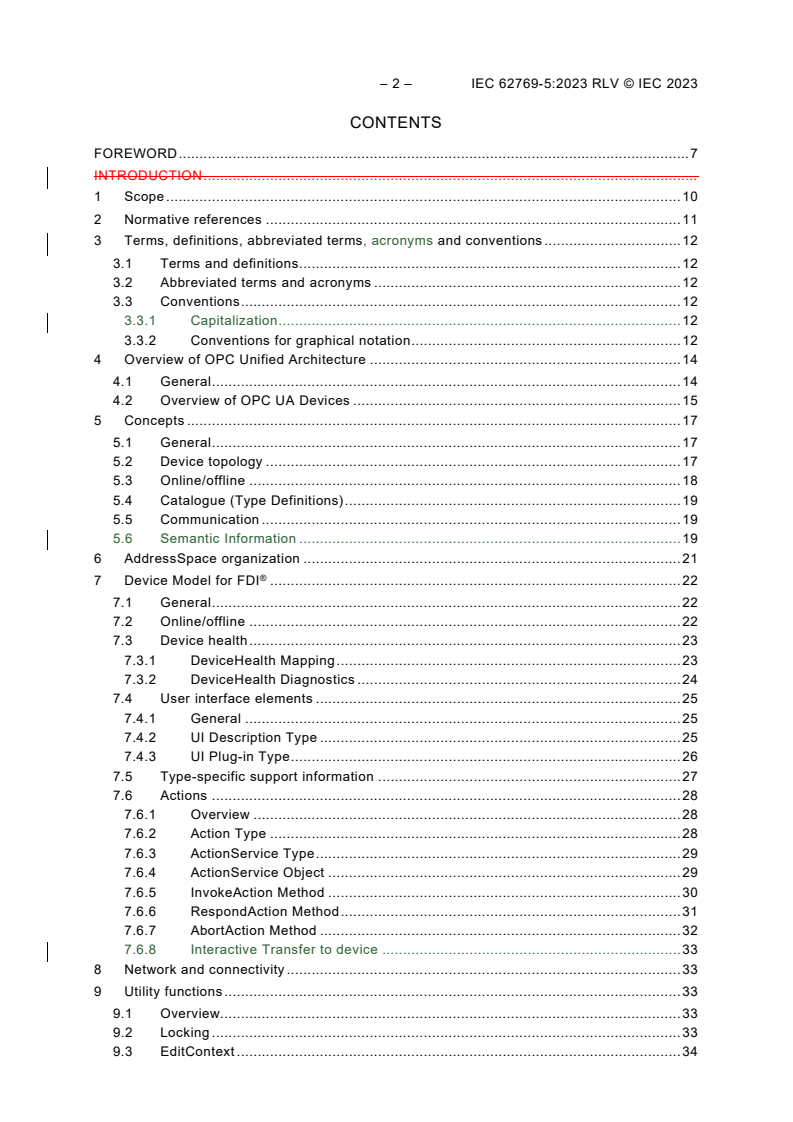
IEC 62769-5:2023 RLV - Field Device Integration (FDI®) - Part 5: FDI Information Model Released:4/5/2023
IEC 62769-5:2023 - Field Device Integration (FDI®) - Part 5: FDI Information Model Released:4/5/2023
Overview
IEC 62769-5:2023 - Field Device Integration (FDI®) – Part 5: FDI Information Model is an International Standard published by the International Electrotechnical Commission (IEC). This standard specifies the FDI Information Model, which is central to representing the topology, devices, and communication networks within industrial automation systems. The purpose of the FDI Information Model is to ensure that devices and their interconnections are modeled in a unified, interoperable manner, supporting robust integration and data exchange in industrial environments.
The FDI Information Model is based on the well-established OPC Unified Architecture for Devices (IEC 62541-100) and extends it where necessary for special cases. The model utilizes various types defined within the OPC UA AddressSpace and builds a structured catalogue from FDI Packages, providing a comprehensive digital representation of the automation system.
Key Topics
Automation System Topology:
The Information Model reflects the complete structure of automation installations, mapping out devices, communication networks, and their relationships.Device Cataloguing:
Types in the AddressSpace of the FDI Server act as a catalogue, compiled from FDI Packages, allowing standardization in device definition and management.OPC UA Integration:
The model aligns with OPC UA for Devices for its fundamental types, ensuring compatibility and extending functionalities for device integration.Device Operations:
Defines the operations that can be performed on devices and networks within the automation system, promoting operational consistency.Extensions for Special Cases:
The standard provides extensions to the base OPC UA device model to accommodate special requirements encountered in field device integration.Mapping to Device Packages:
Details how the contents of the information model are constructed from device package elements, ensuring data integrity and uniform access.
Applications
IEC 62769-5:2023 is significant for a wide range of industrial automation and process control applications. Its core benefits and uses include:
Seamless Device Integration:
Allows automation professionals to integrate multivendor field devices and networks into a central system efficiently and reliably, supporting both legacy and new equipment.Enhanced Interoperability:
Provides a standardized approach for representing devices and network topologies, enabling interoperability between different manufacturers' equipment and software platforms.System Configuration and Engineering:
Essential for engineering tools and FDI Servers to manage, configure, and diagnose field devices within a digital ecosystem.Asset Management:
Supports advanced asset management by delivering a unified view of device properties, status, and communication pathways.Automation System Topology Visualization:
Enables Human Machine Interfaces (HMI) and Supervisory Control and Data Acquisition (SCADA) systems to visualize and operate based on a consistent and accurate model of the automation network.Secure Operations:
Facilitates secure handling of device operations and network topology information, important for modern industrial cybersecurity strategies.
Related Standards
IEC 62769-5:2023 is part of a comprehensive suite of FDI standards and references several key supporting standards:
IEC 62769 Series:
- Part 1: Overview
- Part 2: FDI Client
- Part 3: FDI Server
- Part 4: FDI Packages
- Part 6: FDI Technology Mapping
- Part 7: FDI Communication Devices
OPC UA Standards:
- IEC 62541 Series (including Part 100: OPC UA for Devices)
Fieldbus and EDDL Standards:
- IEC 61784-1: Industrial communication networks - Fieldbus profiles
- IEC 61804-3/-4: Electronic Device Description Language (EDDL)
For professionals working in automation and process industries, IEC 62769-5:2023 serves as a vital reference for implementing standardized, interoperable, and future-proof device information models as part of modern digital industrial systems.
Relations
- Effective Date
- 05-Sep-2023
Buy Documents
IEC 62769-5:2023 RLV - Field Device Integration (FDI®) - Part 5: FDI Information Model Released:4/5/2023
IEC 62769-5:2023 - Field Device Integration (FDI®) - Part 5: FDI Information Model Released:4/5/2023
Get Certified
Connect with accredited certification bodies for this standard

BSI Group
BSI (British Standards Institution) is the business standards company that helps organizations make excellence a habit.

DVS-ZERT GmbH
German welding certification society.
CARES (UK Certification Authority for Reinforcing Steels)
UK certification for reinforcing steels and construction.
Sponsored listings
Frequently Asked Questions
IEC 62769-5:2023 is a standard published by the International Electrotechnical Commission (IEC). Its full title is "Field Device Integration (FDI®) - Part 5: FDI Information Model". This standard covers: IEC 62769-5:2023 defines the FDI®[1] Information Model. One of the main tasks of the Information Model is to reflect the topology of the automation system. Therefore, it represents the devices of the automation system as well as the connecting communication networks including their properties, relationships, and the operations that can be performed on them. The types in the AddressSpace of the FDI® Server constitute some kind of catalogue, which is built from FDI® Packages. The fundamental types for the FDI® Information Model are well defined in OPC UA for Devices (IEC 62541‑100). The FDI® Information Model specifies extensions for a few special cases and otherwise explains how these types are used and how the contents are built from elements of DevicePackages. [1] FDI® is a registered trademark of the non-profit organization Fieldbus Foundation, Inc. This information is given for the convenience of users of this document and does not constitute an endorsement by IEC of the trademark holder or any of its products. Compliance does not require use of the trade name. Use of the trade name requires permission of the trade name holder.
IEC 62769-5:2023 defines the FDI®[1] Information Model. One of the main tasks of the Information Model is to reflect the topology of the automation system. Therefore, it represents the devices of the automation system as well as the connecting communication networks including their properties, relationships, and the operations that can be performed on them. The types in the AddressSpace of the FDI® Server constitute some kind of catalogue, which is built from FDI® Packages. The fundamental types for the FDI® Information Model are well defined in OPC UA for Devices (IEC 62541‑100). The FDI® Information Model specifies extensions for a few special cases and otherwise explains how these types are used and how the contents are built from elements of DevicePackages. [1] FDI® is a registered trademark of the non-profit organization Fieldbus Foundation, Inc. This information is given for the convenience of users of this document and does not constitute an endorsement by IEC of the trademark holder or any of its products. Compliance does not require use of the trade name. Use of the trade name requires permission of the trade name holder.
IEC 62769-5:2023 is classified under the following ICS (International Classification for Standards) categories: 25.040.40 - Industrial process measurement and control; 35.100.05 - Multilayer applications. The ICS classification helps identify the subject area and facilitates finding related standards.
IEC 62769-5:2023 has the following relationships with other standards: It is inter standard links to IEC 62769-5:2021. Understanding these relationships helps ensure you are using the most current and applicable version of the standard.
IEC 62769-5:2023 is available in PDF format for immediate download after purchase. The document can be added to your cart and obtained through the secure checkout process. Digital delivery ensures instant access to the complete standard document.
Standards Content (Sample)
IEC 62769-5 ®
Edition 3.0 2023-04
REDLINE VERSION
INTERNATIONAL
STANDARD
colour
inside
Field device integration (FDI®) –
Part 5: FDI Information Model
All rights reserved. Unless otherwise specified, no part of this publication may be reproduced or utilized in any form
or by any means, electronic or mechanical, including photocopying and microfilm, without permission in writing from
either IEC or IEC's member National Committee in the country of the requester. If you have any questions about IEC
copyright or have an enquiry about obtaining additional rights to this publication, please contact the address below or
your local IEC member National Committee for further information.
IEC Secretariat Tel.: +41 22 919 02 11
3, rue de Varembé info@iec.ch
CH-1211 Geneva 20 www.iec.ch
Switzerland
About the IEC
The International Electrotechnical Commission (IEC) is the leading global organization that prepares and publishes
International Standards for all electrical, electronic and related technologies.
About IEC publications
The technical content of IEC publications is kept under constant review by the IEC. Please make sure that you have the
latest edition, a corrigendum or an amendment might have been published.
IEC publications search - webstore.iec.ch/advsearchform IEC Products & Services Portal - products.iec.ch
The advanced search enables to find IEC publications by a Discover our powerful search engine and read freely all the
variety of criteria (reference number, text, technical publications previews. With a subscription you will always have
committee, …). It also gives information on projects, replaced access to up to date content tailored to your needs.
and withdrawn publications.
Electropedia - www.electropedia.org
IEC Just Published - webstore.iec.ch/justpublished
The world's leading online dictionary on electrotechnology,
Stay up to date on all new IEC publications. Just Published
containing more than 22 300 terminological entries in English
details all new publications released. Available online and once
and French, with equivalent terms in 19 additional languages.
a month by email.
Also known as the International Electrotechnical Vocabulary
(IEV) online.
IEC Customer Service Centre - webstore.iec.ch/csc
If you wish to give us your feedback on this publication or need
further assistance, please contact the Customer Service
Centre: sales@iec.ch.
IEC 62769-5 ®
Edition 3.0 2023-04
REDLINE VERSION
INTERNATIONAL
STANDARD
colour
inside
Field device integration (FDI®) –
Part 5: FDI Information Model
INTERNATIONAL
ELECTROTECHNICAL
COMMISSION
ICS 25.040.40; 35.100.05 ISBN 978-2-8322-6828-5
– 2 – IEC 62769-5:2023 RLV © IEC 2023
CONTENTS
FOREWORD . 7
INTRODUCTION .
1 Scope . 10
2 Normative references . 11
3 Terms, definitions, abbreviated terms, acronyms and conventions . 12
3.1 Terms and definitions . 12
3.2 Abbreviated terms and acronyms . 12
3.3 Conventions . 12
3.3.1 Capitalization . 12
3.3.2 Conventions for graphical notation . 12
4 Overview of OPC Unified Architecture . 14
4.1 General . 14
4.2 Overview of OPC UA Devices . 15
5 Concepts . 17
5.1 General . 17
5.2 Device topology . 17
5.3 Online/offline . 18
5.4 Catalogue (Type Definitions) . 19
5.5 Communication . 19
5.6 Semantic Information . 19
6 AddressSpace organization . 21 ®
7 Device Model for FDI . 22
7.1 General . 22
7.2 Online/offline . 22
7.3 Device health . 23
7.3.1 DeviceHealth Mapping . 23
7.3.2 DeviceHealth Diagnostics . 24
7.4 User interface elements . 25
7.4.1 General . 25
7.4.2 UI Description Type . 25
7.4.3 UI Plug-in Type . 26
7.5 Type-specific support information . 27
7.6 Actions . 28
7.6.1 Overview . 28
7.6.2 Action Type . 28
7.6.3 ActionService Type . 29
7.6.4 ActionService Object . 29
7.6.5 InvokeAction Method . 30
7.6.6 RespondAction Method . 31
7.6.7 AbortAction Method . 32
7.6.8 Interactive Transfer to device . 33
8 Network and connectivity . 33
9 Utility functions . 33
9.1 Overview. 33
9.2 Locking . 33
9.3 EditContext . 34
9.3.1 Overview . 34
9.3.2 EditContext Type . 34
9.3.3 EditContext Object . 34
9.3.4 GetEditContext Method . 35
9.3.5 RegisterNodes Method . 36
9.3.6 Apply Method . 37
9.3.7 Reset Method . 38
9.3.8 Discard Method . 39
9.4 DirectDeviceAccess . 40
9.4.1 General . 40
9.4.2 DirectDeviceAccess Type . 40
9.4.3 DirectDeviceAccess Object . 41
9.4.4 InitDirectAccess Method . 42
9.4.5 EndDirectAccess Method . 42
9.4.6 Transfer Method . 43
10 Parameter Types . 44
10.1 General . 44
10.2 ScalingFactor Property . 45
10.3 Min_Max_Values Property . 45 ®
11 FDI StatusCodes . 46
11.1 General . 46
11.2 Structure of the StatusCode . 46 ®
11.3 FDI specific operation level result codes . 47
12 Specialized topology elements. 50
13 Auditing . 51
13.1 General . 51 ®
13.2 FDI Client-provided context information . 51
13.3 LogAuditTrailMessage Method . 51 ®
14 FDI Server Version . 52
® ®
15 Mapping FDI Package information to the FDI Information Model . 52
15.1 General . 52
15.2 Localization . 53
15.2.1 Localized text . 53
15.2.2 Engineering units . 53
15.3 Device . 53
15.3.1 General . 53
15.3.2 Mapping to Attributes to a specific DeviceType Node . 53
15.3.3 Mapping to Properties . 53
15.3.4 Mapping to ParameterSet . 54
15.3.5 Mapping to Functional Groups . 54
15.3.6 Mapping to DeviceTypeImage . 54
15.3.7 Mapping to Documentation . 54
15.3.8 Mapping to ProtocolSupport . 54
15.3.9 Mapping to ImageSet . 55
15.3.10 Mapping to ActionSet . 55
15.3.11 Mapping to MethodSet . 55
15.4 Modular Device . 55
15.5 Block . 55
– 4 – IEC 62769-5:2023 RLV © IEC 2023
15.5.1 General . 55
15.5.2 Mapping to Attributes . 55
15.5.3 Mapping to ParameterSet . 56
15.5.4 Mapping to Functional Groups . 56
15.5.5 Mapping to ActionSet . 56
15.5.6 Mapping to MethodSet . 56
15.5.7 Instantiation rules . 56
15.6 Parameter . 56
15.6.1 General . 56
15.6.2 Private Parameters . 61
15.6.3 MIN_Value and MAX_Value . 61
15.6.4 Engineering units . 61
15.6.5 Enumerated Parameters . 61
15.6.6 Bit-enumerated Parameters . 61
15.6.7 Representation of records . 62
15.6.8 Representation of arrays, and lists of Parameters with simple data types . 63
15.6.9 Representation of values arrays, and lists of RECORD Parameters . 63
15.6.10 Representation of COLLECTION and REFERENCE ARRAY . 64
15.6.11 SCALING_FACTOR . 64
15.6.12 EDDL CLASS Attributes on Parameters . 64
15.7 Functional Groups. 66
15.8 AXIS elements in UIDs . 66
15.9 Actions . 66
15.10 UIPs . 67
15.11 Protocols, Networks and Connection Points . 67
15.12 Semantic Identifies . 67
15.13 DictionaryIds Property . 68
15.14 MultiStateDictionaryEntryDiscreteType . 68
15.15 GetNodeIdsByDictionaryEntryId . 69
16 Profiles . 70
Annex A (normative) Namespace and Mappings . 71
Bibliography . 72
®
architecture diagram . 11
Figure 1 – FDI
Figure 2 – OPC UA graphical notation for NodeClasses . 13
Figure 3 – OPC UA graphical notation for References . 13
Figure 4 – OPC UA graphical notation example . 14
Figure 5 – Optimized Type Reference . 14
Figure 6 – OPC UA Devices example: Functional Groups . 16
Figure 7 – OPC UA Devices example: Configurable components . 16
Figure 8 – Example of an automation system . 17
Figure 9 – Example of a Device topology . 18
Figure 10 – Example Device Types representing a catalogue . 19
Figure 11 – Example of concrete DictionaryEntryType and Object . 20
Figure 12 – Example of DictionaryEntries . 21
Figure 13 – Online component for access to device data . 22
Figure 14 – Hierarchy of user interface Types . 25
Figure 15 – Integration of Actions within a TopologyElement . 28
Figure 16 – Action Service . 30
Figure 17 – EditContext type and instance . 35
Figure 18 – DirectDeviceAccessType . 40
Figure 19 – DirectDeviceAccess instance . 41
Figure 20 – OPC UA VariableTypes including OPC UA DataAccess . 45
Figure 21 – Example: Complex variable representing a RECORD . 62
Figure 22 – Complex variable representing a VALUE_ARRAY of RECORDs . 63 ®
Figure 23 – Example of EDDL CLASS Attributes in the FDI OPC UA Information
Model . 65
Table 1 – DeviceHealth Mapping . 23
Table 2 – DeviceType definition (excerpt applicable for Subclause 7.3.1) . 23
Table 3 – DeviceType definition with DeviceHealth and DeviceHealthDiagnostics . 24
Table 4 – UIDescriptionType Definition . 25
Table 5 – UIPlugInType Definition . 26
Table 6 – ActionType Definition . 29
Table 7 – ActionServiceType Definition . 29
Table 8 – InvokeAction Method Arguments . 31
Table 9 – InvokeAction Method AddressSpace Definition . 31
Table 10 – RespondAction Method Arguments . 32
Table 11 – RespondAction Method AddressSpace Definition . 32
Table 12 – AbortAction Method Arguments . 32
Table 13 – AbortAction Method AddressSpace Definition . 33
Table 14 – EditContextType Definition . 34
Table 15 – GetEditContext Method Arguments . 35
Table 16 – GetEditContext Method AddressSpace Definition . 36
Table 17 – RegisterNodes Method Arguments . 36
Table 18 – RegisterNodes Method AddressSpace Definition . 36
Table 19 – RegistrationParameters DataType Structure . 37
Table 20 – RegisterNodesResult DataType Structure . 37
Table 21 – Apply Method Arguments . 38
Table 22 – Apply Method AddressSpace Definition . 38
Table 23 – ApplyResult DataType Structure . 38
Table 24 – Reset Method Arguments . 39
Table 25 – Reset Method AddressSpace Definition . 39
Table 26 – Discard Method Arguments . 39
Table 27 – Discard Method AddressSpace Definition . 39
Table 28 – DirectDeviceAccessType Definition . 41
Table 29 – DirectDeviceAccess Instance Definition . 42
Table 30 – InitDirectAccess Method Arguments . 42
Table 31 – InitDirectAccess Method AddressSpace Definition . 42
Table 32 – EndDirectAccess Method Arguments . 43
– 6 – IEC 62769-5:2023 RLV © IEC 2023
Table 33 – EndDirectAccess Method AddressSpace Definition. 43
Table 34 – Transfer Method Arguments . 43
Table 35 – Transfer Method AddressSpace Definition . 44
Table 36 – ScalingFactor Property Definition . 45
Table 37 – Min_Max_Values Property Definition . 46
Table 38 – Variant_Range DataType Structure . 46
Table 39 – Variant_Range Definition . 46
Table 40 – StatusCode Bit Assignments . 47
Table 41 – DataValue InfoBits. 47
Table 42 – Good operation level result codes . 48
Table 43 – Uncertain operation level result codes . 49
Table 44 – Bad operation level result codes . 49
Table 45 – LogAuditTrailMessage Method Arguments . 52
Table 46 – LogAuditTrailMessage Method AddressSpace Definition . 52
Table 47 – FDIServerVersion Property Definition . 52
Table 48 – DeviceType Property Mapping . 54
Table 49 – Setting OPC UA Variable Attributes from EDDL variable attributes . 57
Table 50 – Correspondence between EDDL and OPC UA standard data types . 58
Table 51 – Definition of EddlDictionaryType . 64
Table 52 – Definition of EddlDictionary Object . 64
Table 53 – Definition of Parameter Class Attributes . 65
Table 54 – DictionaryIds Definition. 68
Table 55 – MultiStateDictionaryEntryDiscreteType definition . 68
Table 56 – GetNodeIdsByDictionaryEntryId Method arguments . 69
Table 57 – GetNodeIdsByDictionaryEntryId Method result codes . 69
Table 58 – GetNodeIdsByDictionaryEntryId . 69 ®
Table 59 – FDI Server Facet Definition . 70 ®
Table 60 – FDI Client Facet Definition . 70
INTERNATIONAL ELECTROTECHNICAL COMMISSION
____________ ®
FIELD DEVICE INTEGRATION (FDI ) –
®
Part 5: FDI Information Model
FOREWORD
1) The International Electrotechnical Commission (IEC) is a worldwide organization for standardization comprising
all national electrotechnical committees (IEC National Committees). The object of IEC is to promote international
co-operation on all questions concerning standardization in the electrical and electronic fields. To this end and
in addition to other activities, IEC publishes International Standards, Technical Specifications, Technical Reports,
Publicly Available Specifications (PAS) and Guides (hereafter referred to as "IEC Publication(s)"). Their
preparation is entrusted to technical committees; any IEC National Committee interested in the subject dealt with
may participate in this preparatory work. International, governmental and non-governmental organizations liaising
with the IEC also participate in this preparation. IEC collaborates closely with the International Organization for
Standardization (ISO) in accordance with conditions determined by agreement between the two organizations.
2) The formal decisions or agreements of IEC on technical matters express, as nearly as possible, an international
consensus of opinion on the relevant subjects since each technical committee has representation from all
interested IEC National Committees.
3) IEC Publications have the form of recommendations for international use and are accepted by IEC National
Committees in that sense. While all reasonable efforts are made to ensure that the technical content of IEC
Publications is accurate, IEC cannot be held responsible for the way in which they are used or for any
misinterpretation by any end user.
4) In order to promote international uniformity, IEC National Committees undertake to apply IEC Publications
transparently to the maximum extent possible in their national and regional publications. Any divergence between
any IEC Publication and the corresponding national or regional publication shall be clearly indicated in the latter.
5) IEC itself does not provide any attestation of conformity. Independent certification bodies provide conformity
assessment services and, in some areas, access to IEC marks of conformity. IEC is not responsible for any
services carried out by independent certification bodies.
6) All users should ensure that they have the latest edition of this publication.
7) No liability shall attach to IEC or its directors, employees, servants or agents including individual experts and
members of its technical committees and IEC National Committees for any personal injury, property damage or
other damage of any nature whatsoever, whether direct or indirect, or for costs (including legal fees) and
expenses arising out of the publication, use of, or reliance upon, this IEC Publication or any other IEC
Publications.
8) Attention is drawn to the Normative references cited in this publication. Use of the referenced publications is
indispensable for the correct application of this publication.
9) Attention is drawn to the possibility that some of the elements of this IEC Publication may be the subject of patent
rights. IEC shall not be held responsible for identifying any or all such patent rights.
This redline version of the official IEC Standard allows the user to identify the changes
made to the previous edition IEC 62769-5:2021. A vertical bar appears in the margin
wherever a change has been made. Additions are in green text, deletions are in
strikethrough red text.
– 8 – IEC 62769-5:2023 RLV © IEC 2023
IEC 62769-5 has been prepared by subcommittee 65E: Devices and integration in enterprise
systems, of IEC technical committee 65: Industrial-process measurement, control and
automation. It is an International Standard.
This third edition cancels and replaces the second edition published in 2021. This edition
constitutes a technical revision.
This edition includes the following significant technical changes with respect to the previous
edition:
a) added INTERACTIVE_TRANSFER_TO_DEVICE ACTION.
The text of this International Standard is based on the following documents:
Draft Report on voting
65E/858/CDV 65E/915/RVC
Full information on the voting for its approval can be found in the report on voting indicated in
the above table.
The language used for the development of this International Standard is English.
This document was drafted in accordance with ISO/IEC Directives, Part 2, and developed in
accordance with ISO/IEC Directives, Part 1 and ISO/IEC Directives, IEC Supplement, available
at www.iec.ch/members_experts/refdocs. The main document types developed by IEC are
described in greater detail at www.iec.ch/publications.
A list of all parts in the IEC 62769 series, published under the general title Field device ®
integration (FDI ), can be found on the IEC website.
The committee has decided that the contents of this document will remain unchanged until the
stability date indicated on the IEC website under webstore.iec.ch in the data related to the
specific document. At this date, the document will be
• reconfirmed,
• withdrawn,
• replaced by a revised edition, or
• amended.
IMPORTANT – The "colour inside" logo on the cover page of this document indicates
that it contains colours which are considered to be useful for the correct understanding
of its contents. Users should therefore print this document using a colour printer.
INTRODUCTION
The IEC 62769 series has the general title Field Device Integration (FDI) and the following
parts:
– Part 1: Overview
– Part 2: FDI Client
– Part 3: FDI Server
– Part 4: FDI Packages
– Part 5: FDI Information Model
– Part 6: FDI Technology Mapping
– Part 7: FDI Communication Devices
– Part 100: Profiles – Generic Protocol Extensions
– Part 101-1: Profiles – Foundation Fieldbus H1
– Part 101-2: Profiles – Foundation Fieldbus HSE
– Part 103-1: Profiles – PROFIBUS
– Part 103-4: Profiles – PROFINET
– Part 109-1: Profiles – HART and WirelessHART
– Part 115-2: Profiles – Protocol-specific Definitions for Modbus RTU
– Part 150-1: Profiles – ISA 100.11a
– 10 – IEC 62769-5:2023 RLV © IEC 2023 ®
FIELD DEVICE INTEGRATION (FDI ) –
®
Part 5: FDI Information Model
1 Scope
®1
This part of IEC 62769 defines the FDI Information Model. One of the main tasks of the
Information Model is to reflect the topology of the automation system. Therefore, it represents
the devices of the automation system as well as the connecting communication networks
including their properties, relationships, and the operations that can be performed on them. The ®
types in the AddressSpace of the FDI Server constitute a some kind of catalogue, which is ®
built from FDI Packages. ®
The fundamental types for the FDI Information Model are well defined in OPC UA for Devices ®
(IEC 62541-100). The FDI Information Model specifies extensions for a few special cases and
otherwise explains how these types are used and how the contents are built from elements of
DevicePackages. ®
The overall FDI architecture is illustrated in Figure 1. The architectural components that are
within the scope of this document have been highlighted in this illustration.
___________
1 ®
FDI is a registered trademark of the non-profit organization Fieldbus Foundation, Inc. This information is given
for the convenience of users of this document and does not constitute an endorsement by IEC of the trademark
holder or any of its products. Compliance does not require use of the trade name. Use of the trade name requires
permission of the trade name holder.
®
Figure 1 – FDI architecture diagram
2 Normative references
The following documents are referred to in the text in such a way that some or all of their content
constitutes requirements of this document. For dated references, only the edition cited applies.
For undated references, the latest edition of the referenced document (including any
amendments) applies.
IEC 61784-1, Industrial communication networks – Profiles – Part 1: Fieldbus profiles
IEC 61784-1-3:2023, Industrial networks – Profiles – Part 1-3: Fieldbus profiles –
Communication Profile Family 3
IEC 61804-3, Devices and integration in enterprise systems − Function blocks (FB) for process
control and electronic device description language (EDDL) − Part 3: EDDL syntax and
semantics
IEC 61804-4, Devices and integration in enterprise systems − Function blocks (FB) for process
control and electronic device description language (EDDL) − Part 4: EDD interpretation
IEC 62541-3, OPC Unified Architecture – Part 3: Address Space Model
IEC 62541-4, OPC Unified Architecture – Part 4: Services
IEC 62541-5, OPC Unified Architecture – Part 5: Information Model
– 12 – IEC 62769-5:2023 RLV © IEC 2023
IEC 62541-6, OPC Unified Architecture – Part 6: Mappings
IEC 62541-8, OPC Unified Architecture – Part 8: Data Access
IEC 62541-100, OPC Unified Architecture – Part 100: OPC UA for Devices Device Interface ®
IEC 62769-1, Field Device Integration (FDI ) – Part 1: Overview ®
IEC 62769-2, Field Device Integration (FDI ) – Part 2: FDI Client ®
IEC 62769-3, Field Device Integration (FDI ) – Part 3: Server
® ®
IEC 62769-4, Field Device Integration (FDI ) – Part 4: FDI Packages
® ®
IEC 62769-6, Field Device Integration (FDI ) – Part 6: FDI Technology Mappings ®
IEC 62769-7, Field Device Integration (FDI ) – Part 7: FDI Communication Devices ®
IEC 62769-1xx (all parts), Field Device Integration (FDI ) – Part 1xx-y: Profiles
OPC 10000-19, OPC Unified Architecture – Part 19: Dictionary Reference
3 Terms, definitions, abbreviated terms, acronyms and conventions
3.1 Terms and definitions
For the purposes of this document, the terms and definitions given in IEC 62769-1 and
IEC 62769-3 apply.
ISO and IEC maintain terminology databases for use in standardization at the following
addresses:
• IEC Electropedia: available at https://www.electropedia.org/
• ISO Online browsing platform: available at https://www.iso.org/obp
3.2 Abbreviated terms and acronyms
For the purposes of this document, the abbreviated terms and acronyms given in IEC 62769-1
and the following apply.
HMI Human Machine Interface
SCADA Supervisory Control and Data Acquisition
TCP Transmission Control Protocol
3.3 Conventions
For the purposes of this document, the conventions given in IEC 62769-1 apply.
3.3.1 Capitalization ®
Capitalization of the first letter of words is used in the IEC 62769 series to emphasize an FDI
defined term.
3.3.2 Conventions for graphical notation
OPC UA defines a graphical notation for an OPC UA AddressSpace. It defines graphical
symbols for all NodeClasses and how different types of References between Nodes can be
visualized. Figure 2 shows the symbols for the NodeClasses used in this document.
NodeClasses representing types always have a shadow.
Figure 2 – OPC UA graphical notation for NodeClasses
Figure 3 shows the symbols for the ReferenceTypes used in this document. The Reference
symbol is normally pointing from the source Node to the target Node. The only exception is the
HasSubType Reference. The most important References such as HasComponent, HasProperty,
HasTypeDefinition and HasSubType have special symbols avoiding the name of the Reference.
For other ReferenceTypes or derived ReferenceTypes, the name of the ReferenceType is used
together with the symbol.
Figure 3 – OPC UA graphical notation for References
Figure 4 shows a typical example for the use of the graphical notation. Object_A and Object_B
are instances of the ObjectType_Y indicated by the HasTypeDefinition References. The
ObjectType_Y is derived from ObjectType_X indicated by the HasSubType Reference. The
Object_A has the components Variable_1, Variable_2 and Method_1.
To describe the components of an Object on the ObjectType, the same NodeClasses and
References are used on the Object and on the ObjectType such as for ObjectType_Y in the
example. The Nodes used to describe an ObjectType are instance declaration Nodes.
To provide more detailed information for a Node, a subset or all Attributes and their values can
be added to a graphical symbol (see for example Variable_1, the component of Object_A in
Figure 4).
– 14 – IEC 62769-5:2023 RLV © IEC 2023
Figure 4 – OPC UA graphical notation example
To improve readability, this document frequently includes the type name inside the instance
box rather than displaying both boxes and a reference between them. This optimization is shown
in Figure 5.
Figure 5 – Optimized Type Reference
4 Overview of OPC Unified Architecture
4.1 General
The main use case for OPC standards is the online data exchange between devices and HMI
or SCADA systems. In this use case, the device data is provided by an OPC server and is
consumed by an OPC client integrated into the HMI or SCADA system. OPC provides
functionality to browse through a hierarchical namespace containing data items and to read,
write and monitor these items for data changes. Numeric identifiers for NodeIds are defined in
Annex A.
OPC UA incorporates features like Data Access, Alarms and Historical Data via platform
independent communication mechanisms and generic, extensible and object-oriented modelling
capabilities for the information a system wants to expose.
The current version of OPC UA defines an optimized binary TCP protocol for high performance
intranet communication as well as a mapping to Web Services. The abstract service model does
not depend on a specific protocol mapping and allows adding new protocols in the future.
Features like security, access control and reliability are directly built into the transport
mechanisms. Based on the platform independence of the protocols, OPC UA servers and clients
can be directly integrated into devices and controllers.
The OPC UA information model provides a standard way for Servers to expose Objects to
Clients. Objects in OPC UA terms are composed of other Objects, Variables and Methods. OPC
UA also allows relationships to other Objects to be expressed.
The set of Objects and related information that an OPC UA Server makes available to Clients
is referred to as its AddressSpace. The elements of the OPC UA Object Model are represented
in the AddressSpace as a set of Nodes described by Attributes and interconnected by
References. OPC UA defines various classes of Nodes to represent AddressSpace
components, most importantly Objects, Variables, Methods, ObjectTypes, DataTypes and
ReferenceTypes. Each NodeClass has a defined set of Attributes.
Objects are used to represent components like folders, Devices or Networks. An Object is
associated to a corresponding ObjectType that provides definitions for that Object.
Variables are used to represent values. Two categories of Variables are defined, Properties
and DataVariables.
Properties are Server-defined characteristics of Objects, DataVariables and other Nodes.
Properties are not allowed to have Properties defined for them. An example for Properties of
Objects is the Manufacturer Property of a Device.
DataVariables represent the contents of an Object. DataVariables may can have component
DataVariables. This is typically used by Servers to expose individual elements of arrays and
structures. This document uses DataVariables mainly to represent the Parameters of Devices.
4.2 Overview of OPC UA Devices
The OPC Unified Architecture for Devices (DI) (IEC 62541-10
...
IEC 62769-5 ®
Edition 3.0 2023-04
INTERNATIONAL
STANDARD
NORME
INTERNATIONALE
colour
inside
Field device integration (FDI®) –
Part 5: FDI Information Model
Intégration des appareils de terrain (FDI®) –
Partie 5: Modèle d'Information FDI
All rights reserved. Unless otherwise specified, no part of this publication may be reproduced or utilized in any form
or by any means, electronic or mechanical, including photocopying and microfilm, without permission in writing from
either IEC or IEC's member National Committee in the country of the requester. If you have any questions about IEC
copyright or have an enquiry about obtaining additional rights to this publication, please contact the address below or
your local IEC member National Committee for further information.
Droits de reproduction réservés. Sauf indication contraire, aucune partie de cette publication ne peut être reproduite ni
utilisée sous quelque forme que ce soit et par aucun procédé, électronique ou mécanique, y compris la photocopie et
les microfilms, sans l'accord écrit de l'IEC ou du Comité national de l'IEC du pays du demandeur. Si vous avez des
questions sur le copyright de l'IEC ou si vous désirez obtenir des droits supplémentaires sur cette publication, utilisez
les coordonnées ci-après ou contactez le Comité national de l'IEC de votre pays de résidence.
IEC Secretariat Tel.: +41 22 919 02 11
3, rue de Varembé info@iec.ch
CH-1211 Geneva 20 www.iec.ch
Switzerland
About the IEC
The International Electrotechnical Commission (IEC) is the leading global organization that prepares and publishes
International Standards for all electrical, electronic and related technologies.
About IEC publications
The technical content of IEC publications is kept under constant review by the IEC. Please make sure that you have the
latest edition, a corrigendum or an amendment might have been published.
IEC publications search - webstore.iec.ch/advsearchform IEC Products & Services Portal - products.iec.ch
The advanced search enables to find IEC publications by a Discover our powerful search engine and read freely all the
variety of criteria (reference number, text, technical publications previews. With a subscription you will always have
committee, …). It also gives information on projects, replaced access to up to date content tailored to your needs.
and withdrawn publications.
Electropedia - www.electropedia.org
IEC Just Published - webstore.iec.ch/justpublished
The world's leading online dictionary on electrotechnology,
Stay up to date on all new IEC publications. Just Published
containing more than 22 300 terminological entries in English
details all new publications released. Available online and once
and French, with equivalent terms in 19 additional languages.
a month by email.
Also known as the International Electrotechnical Vocabulary
(IEV) online.
IEC Customer Service Centre - webstore.iec.ch/csc
If you wish to give us your feedback on this publication or need
further assistance, please contact the Customer Service
Centre: sales@iec.ch.
A propos de l'IEC
La Commission Electrotechnique Internationale (IEC) est la première organisation mondiale qui élabore et publie des
Normes internationales pour tout ce qui a trait à l'électricité, à l'électronique et aux technologies apparentées.
A propos des publications IEC
Le contenu technique des publications IEC est constamment revu. Veuillez vous assurer que vous possédez l’édition la
plus récente, un corrigendum ou amendement peut avoir été publié.
Recherche de publications IEC - Découvrez notre puissant moteur de recherche et consultez
webstore.iec.ch/advsearchform gratuitement tous les aperçus des publications. Avec un
La recherche avancée permet de trouver des publications IEC abonnement, vous aurez toujours accès à un contenu à jour
en utilisant différents critères (numéro de référence, texte, adapté à vos besoins.
comité d’études, …). Elle donne aussi des informations sur les
projets et les publications remplacées ou retirées. Electropedia - www.electropedia.org
Le premier dictionnaire d'électrotechnologie en ligne au monde,
IEC Just Published - webstore.iec.ch/justpublished
avec plus de 22 300 articles terminologiques en anglais et en
Restez informé sur les nouvelles publications IEC. Just
français, ainsi que les termes équivalents dans 19 langues
Published détaille les nouvelles publications parues.
additionnelles. Egalement appelé Vocabulaire
Disponible en ligne et une fois par mois par email.
Electrotechnique International (IEV) en ligne.
Service Clients - webstore.iec.ch/csc
Si vous désirez nous donner des commentaires sur cette
publication ou si vous avez des questions contactez-nous:
sales@iec.ch.
IEC Products & Services Portal - products.iec.ch
IEC 62769-5 ®
Edition 3.0 2023-04
INTERNATIONAL
STANDARD
NORME
INTERNATIONALE
colour
inside
Field device integration (FDI®) –
Part 5: FDI Information Model
Intégration des appareils de terrain (FDI®) –
Partie 5: Modèle d'Information FDI
INTERNATIONAL
ELECTROTECHNICAL
COMMISSION
COMMISSION
ELECTROTECHNIQUE
INTERNATIONALE
ICS 25.040.40; 35.100.05 ISBN 978-2-8322-6474-4
– 2 – IEC 62769-5:2023 © IEC 2023
CONTENTS
FOREWORD . 7
1 Scope . 9
2 Normative references . 10
3 Terms, definitions, abbreviated terms, acronyms and conventions . 11
3.1 Terms and definitions . 11
3.2 Abbreviated terms and acronyms . 11
3.3 Conventions . 11
3.3.1 Capitalization . 11
3.3.2 Conventions for graphical notation . 11
4 Overview of OPC Unified Architecture . 13
4.1 General . 13
4.2 Overview of OPC UA Devices . 14
5 Concepts . 16
5.1 General . 16
5.2 Device topology . 16
5.3 Online/offline . 17
5.4 Catalogue (Type Definitions) . 18
5.5 Communication . 18
5.6 Semantic Information . 18
6 AddressSpace organization . 20 ®
7 Device Model for FDI . 21
7.1 General . 21
7.2 Online/offline . 21
7.3 Device health . 22
7.3.1 DeviceHealth Mapping . 22
7.3.2 DeviceHealth Diagnostics . 23
7.4 User interface elements . 24
7.4.1 General . 24
7.4.2 UI Description Type . 24
7.4.3 UI Plug-in Type . 25
7.5 Type-specific support information . 26
7.6 Actions . 27
7.6.1 Overview . 27
7.6.2 Action Type . 27
7.6.3 ActionService Type . 28
7.6.4 ActionService Object . 28
7.6.5 InvokeAction Method . 29
7.6.6 RespondAction Method . 30
7.6.7 AbortAction Method . 31
7.6.8 Interactive Transfer to device . 32
8 Network and connectivity . 32
9 Utility functions . 32
9.1 Overview. 32
9.2 Locking . 32
9.3 EditContext . 33
9.3.1 Overview . 33
9.3.2 EditContext Type . 33
9.3.3 EditContext Object . 33
9.3.4 GetEditContext Method . 34
9.3.5 RegisterNodes Method . 35
9.3.6 Apply Method . 36
9.3.7 Reset Method . 37
9.3.8 Discard Method . 38
9.4 DirectDeviceAccess . 39
9.4.1 General . 39
9.4.2 DirectDeviceAccess Type . 39
9.4.3 DirectDeviceAccess Object . 40
9.4.4 InitDirectAccess Method . 41
9.4.5 EndDirectAccess Method . 41
9.4.6 Transfer Method . 42
10 Parameter Types . 43
10.1 General . 43
10.2 ScalingFactor Property . 44
10.3 Min_Max_Values Property . 44 ®
11 FDI StatusCodes . 45
11.1 General . 45
11.2 Structure of the StatusCode . 45 ®
11.3 FDI specific operation level result codes . 46
12 Specialized topology elements. 49
13 Auditing . 50
13.1 General . 50 ®
13.2 FDI Client-provided context information . 50
13.3 LogAuditTrailMessage Method . 50 ®
14 FDI Server Version . 51
® ®
15 Mapping FDI Package information to the FDI Information Model . 51
15.1 General . 51
15.2 Localization . 52
15.2.1 Localized text . 52
15.2.2 Engineering units . 52
15.3 Device . 52
15.3.1 General . 52
15.3.2 Mapping to Attributes to a specific DeviceType Node . 52
15.3.3 Mapping to Properties . 52
15.3.4 Mapping to ParameterSet . 53
15.3.5 Mapping to Functional Groups . 53
15.3.6 Mapping to DeviceTypeImage . 53
15.3.7 Mapping to Documentation . 53
15.3.8 Mapping to ProtocolSupport . 53
15.3.9 Mapping to ImageSet . 54
15.3.10 Mapping to ActionSet . 54
15.3.11 Mapping to MethodSet . 54
15.4 Modular Device . 54
15.5 Block . 54
15.5.1 General . 54
– 4 – IEC 62769-5:2023 © IEC 2023
15.5.2 Mapping to Attributes . 54
15.5.3 Mapping to ParameterSet . 55
15.5.4 Mapping to Functional Groups . 55
15.5.5 Mapping to ActionSet . 55
15.5.6 Mapping to MethodSet . 55
15.5.7 Instantiation rules . 55
15.6 Parameter . 55
15.6.1 General . 55
15.6.2 Private Parameters . 60
15.6.3 MIN_Value and MAX_Value . 60
15.6.4 Engineering units . 60
15.6.5 Enumerated Parameters . 60
15.6.6 Bit-enumerated Parameters . 60
15.6.7 Representation of records . 61
15.6.8 Representation of arrays, and lists of Parameters with simple data types . 62
15.6.9 Representation of values arrays, and lists of RECORD Parameters . 62
15.6.10 Representation of COLLECTION and REFERENCE ARRAY . 63
15.6.11 SCALING_FACTOR . 63
15.6.12 EDDL CLASS Attributes on Parameters . 63
15.7 Functional Groups. 65
15.8 AXIS elements in UIDs . 65
15.9 Actions . 65
15.10 UIPs . 66
15.11 Protocols, Networks and Connection Points . 66
15.12 Semantic Identifies . 66
15.13 DictionaryIds Property . 67
15.14 MultiStateDictionaryEntryDiscreteType . 67
15.15 GetNodeIdsByDictionaryEntryId . 68
16 Profiles . 69
Annex A (normative) Namespace and Mappings . 70
Bibliography . 71
®
Figure 1 – FDI architecture diagram . 10
Figure 2 – OPC UA graphical notation for NodeClasses . 12
Figure 3 – OPC UA graphical notation for References . 12
Figure 4 – OPC UA graphical notation example . 13
Figure 5 – Optimized Type Reference . 13
Figure 6 – OPC UA Devices example: Functional Groups . 15
Figure 7 – OPC UA Devices example: Configurable components . 15
Figure 8 – Example of an automation system . 16
Figure 9 – Example of a Device topology . 17
Figure 10 – Example Device Types representing a catalogue . 18
Figure 11 – Example of concrete DictionaryEntryType and Object . 19
Figure 12 – Example of DictionaryEntries . 20
Figure 13 – Online component for access to device data . 21
Figure 14 – Hierarchy of user interface Types . 24
Figure 15 – Integration of Actions within a TopologyElement . 27
Figure 16 – Action Service . 29
Figure 17 – EditContext type and instance . 34
Figure 18 – DirectDeviceAccessType . 39
Figure 19 – DirectDeviceAccess instance . 40
Figure 20 – OPC UA VariableTypes including OPC UA DataAccess . 44
Figure 21 – Example: Complex variable representing a RECORD . 61
Figure 22 – Complex variable representing a VALUE_ARRAY of RECORDs . 62 ®
Figure 23 – Example of EDDL CLASS Attributes in the FDI OPC UA Information
Model . 64
Table 1 – DeviceHealth Mapping . 22
Table 2 – DeviceType definition (excerpt applicable for Subclause 7.3.1) . 22
Table 3 – DeviceType definition with DeviceHealth and DeviceHealthDiagnostics . 23
Table 4 – UIDescriptionType Definition . 24
Table 5 – UIPlugInType Definition . 25
Table 6 – ActionType Definition . 28
Table 7 – ActionServiceType Definition . 28
Table 8 – InvokeAction Method Arguments . 30
Table 9 – InvokeAction Method AddressSpace Definition . 30
Table 10 – RespondAction Method Arguments . 31
Table 11 – RespondAction Method AddressSpace Definition . 31
Table 12 – AbortAction Method Arguments . 31
Table 13 – AbortAction Method AddressSpace Definition . 32
Table 14 – EditContextType Definition . 33
Table 15 – GetEditContext Method Arguments . 34
Table 16 – GetEditContext Method AddressSpace Definition . 35
Table 17 – RegisterNodes Method Arguments . 35
Table 18 – RegisterNodes Method AddressSpace Definition . 35
Table 19 – RegistrationParameters DataType Structure . 36
Table 20 – RegisterNodesResult DataType Structure . 36
Table 21 – Apply Method Arguments . 37
Table 22 – Apply Method AddressSpace Definition . 37
Table 23 – ApplyResult DataType Structure . 37
Table 24 – Reset Method Arguments . 38
Table 25 – Reset Method AddressSpace Definition . 38
Table 26 – Discard Method Arguments . 38
Table 27 – Discard Method AddressSpace Definition . 38
Table 28 – DirectDeviceAccessType Definition . 40
Table 29 – DirectDeviceAccess Instance Definition . 41
Table 30 – InitDirectAccess Method Arguments . 41
Table 31 – InitDirectAccess Method AddressSpace Definition . 41
Table 32 – EndDirectAccess Method Arguments . 42
– 6 – IEC 62769-5:2023 © IEC 2023
Table 33 – EndDirectAccess Method AddressSpace Definition. 42
Table 34 – Transfer Method Arguments . 42
Table 35 – Transfer Method AddressSpace Definition . 43
Table 36 – ScalingFactor Property Definition . 44
Table 37 – Min_Max_Values Property Definition . 45
Table 38 – Variant_Range DataType Structure . 45
Table 39 – Variant_Range Definition . 45
Table 40 – StatusCode Bit Assignments . 46
Table 41 – DataValue InfoBits. 46
Table 42 – Good operation level result codes . 47
Table 43 – Uncertain operation level result codes . 48
Table 44 – Bad operation level result codes . 48
Table 45 – LogAuditTrailMessage Method Arguments . 51
Table 46 – LogAuditTrailMessage Method AddressSpace Definition . 51
Table 47 – FDIServerVersion Property Definition . 51
Table 48 – DeviceType Property Mapping . 53
Table 49 – Setting OPC UA Variable Attributes from EDDL variable attributes . 56
Table 50 – Correspondence between EDDL and OPC UA standard data types . 57
Table 51 – Definition of EddlDictionaryType . 63
Table 52 – Definition of EddlDictionary Object . 63
Table 53 – Definition of Parameter Class Attributes . 64
Table 54 – DictionaryIds Definition. 67
Table 55 – MultiStateDictionaryEntryDiscreteType definition . 67
Table 56 – GetNodeIdsByDictionaryEntryId Method arguments . 68
Table 57 – GetNodeIdsByDictionaryEntryId Method result codes . 68
Table 58 – GetNodeIdsByDictionaryEntryId . 68 ®
Table 59 – FDI Server Facet Definition . 69 ®
Table 60 – FDI Client Facet Definition . 69
INTERNATIONAL ELECTROTECHNICAL COMMISSION
____________ ®
FIELD DEVICE INTEGRATION (FDI ) –
®
Part 5: FDI Information Model
FOREWORD
1) The International Electrotechnical Commission (IEC) is a worldwide organization for standardization comprising
all national electrotechnical committees (IEC National Committees). The object of IEC is to promote international
co-operation on all questions concerning standardization in the electrical and electronic fields. To this end and
in addition to other activities, IEC publishes International Standards, Technical Specifications, Technical Reports,
Publicly Available Specifications (PAS) and Guides (hereafter referred to as "IEC Publication(s)"). Their
preparation is entrusted to technical committees; any IEC National Committee interested in the subject dealt with
may participate in this preparatory work. International, governmental and non-governmental organizations liaising
with the IEC also participate in this preparation. IEC collaborates closely with the International Organization for
Standardization (ISO) in accordance with conditions determined by agreement between the two organizations.
2) The formal decisions or agreements of IEC on technical matters express, as nearly as possible, an international
consensus of opinion on the relevant subjects since each technical committee has representation from all
interested IEC National Committees.
3) IEC Publications have the form of recommendations for international use and are accepted by IEC National
Committees in that sense. While all reasonable efforts are made to ensure that the technical content of IEC
Publications is accurate, IEC cannot be held responsible for the way in which they are used or for any
misinterpretation by any end user.
4) In order to promote international uniformity, IEC National Committees undertake to apply IEC Publications
transparently to the maximum extent possible in their national and regional publications. Any divergence between
any IEC Publication and the corresponding national or regional publication shall be clearly indicated in the latter.
5) IEC itself does not provide any attestation of conformity. Independent certification bodies provide conformity
assessment services and, in some areas, access to IEC marks of conformity. IEC is not responsible for any
services carried out by independent certification bodies.
6) All users should ensure that they have the latest edition of this publication.
7) No liability shall attach to IEC or its directors, employees, servants or agents including individual experts and
members of its technical committees and IEC National Committees for any personal injury, property damage or
other damage of any nature whatsoever, whether direct or indirect, or for costs (including legal fees) and
expenses arising out of the publication, use of, or reliance upon, this IEC Publication or any other IEC
Publications.
8) Attention is drawn to the Normative references cited in this publication. Use of the referenced publications is
indispensable for the correct application of this publication.
9) Attention is drawn to the possibility that some of the elements of this IEC Publication may be the subject of patent
rights. IEC shall not be held responsible for identifying any or all such patent rights.
IEC 62769-5 has been prepared by subcommittee 65E: Devices and integration in enterprise
systems, of IEC technical committee 65: Industrial-process measurement, control and
automation. It is an International Standard.
This third edition cancels and replaces the second edition published in 2021. This edition
constitutes a technical revision.
This edition includes the following significant technical changes with respect to the previous
edition:
a) added INTERACTIVE_TRANSFER_TO_DEVICE ACTION.
– 8 – IEC 62769-5:2023 © IEC 2023
The text of this International Standard is based on the following documents:
Draft Report on voting
65E/858/CDV 65E/915/RVC
Full information on the voting for its approval can be found in the report on voting indicated in
the above table.
The language used for the development of this International Standard is English.
This document was drafted in accordance with ISO/IEC Directives, Part 2, and developed in
accordance with ISO/IEC Directives, Part 1 and ISO/IEC Directives, IEC Supplement, available
at www.iec.ch/members_experts/refdocs. The main document types developed by IEC are
described in greater detail at www.iec.ch/publications.
A list of all parts in the IEC 62769 series, published under the general title Field device ®
integration (FDI ), can be found on the IEC website.
The committee has decided that the contents of this document will remain unchanged until the
stability date indicated on the IEC website under webstore.iec.ch in the data related to the
specific document. At this date, the document will be
• reconfirmed,
• withdrawn,
• replaced by a revised edition, or
• amended.
IMPORTANT – The "colour inside" logo on the cover page of this document indicates
that it contains colours which are considered to be useful for the correct understanding
of its contents. Users should therefore print this document using a colour printer.
®
FIELD DEVICE INTEGRATION (FDI ) –
®
Part 5: FDI Information Model
1 Scope
®1
This part of IEC 62769 defines the FDI Information Model. One of the main tasks of the
Information Model is to reflect the topology of the automation system. Therefore, it represents
the devices of the automation system as well as the connecting communication networks
including their properties, relationships, and the operations that can be performed on them. The ®
types in the AddressSpace of the FDI Server constitute some kind of catalogue, which is built ®
from FDI Packages. ®
The fundamental types for the FDI Information Model are well defined in OPC UA for Devices ®
(IEC 62541-100). The FDI Information Model specifies extensions for a few special cases and
otherwise explains how these types are used and how the contents are built from elements of
DevicePackages. ®
The overall FDI architecture is illustrated in Figure 1. The architectural components that are
within the scope of this document have been highlighted in this illustration.
___________
1 ®
FDI is a registered trademark of the non-profit organization Fieldbus Foundation, Inc. This information is given
for the convenience of users of this document and does not constitute an endorsement by IEC of the trademark
holder or any of its products. Compliance does not require use of the trade name. Use of the trade name requires
permission of the trade name holder.
– 10 – IEC 62769-5:2023 © IEC 2023
®
Figure 1 – FDI architecture diagram
2 Normative references
The following documents are referred to in the text in such a way that some or all of their content
constitutes requirements of this document. For dated references, only the edition cited applies.
For undated references, the latest edition of the referenced document (including any
amendments) applies.
IEC 61784-1-3:2023, Industrial networks – Profiles – Part 1-3: Fieldbus profiles –
Communication Profile Family 3
IEC 61804-3, Devices and integration in enterprise systems − Function blocks (FB) for process
control and electronic device description language (EDDL) − Part 3: EDDL syntax and
semantics
IEC 61804-4, Devices and integration in enterprise systems − Function blocks (FB) for process
control and electronic device description language (EDDL) − Part 4: EDD interpretation
IEC 62541-3, OPC Unified Architecture – Part 3: Address Space Model
IEC 62541-4, OPC Unified Architecture – Part 4: Services
IEC 62541-5, OPC Unified Architecture – Part 5: Information Model
IEC 62541-6, OPC Unified Architecture – Part 6: Mappings
IEC 62541-8, OPC Unified Architecture – Part 8: Data Access
IEC 62541-100, OPC Unified Architecture – Part 100: Device Interface ®
IEC 62769-1, Field Device Integration (FDI ) – Part 1: Overview ®
IEC 62769-2, Field Device Integration (FDI ) – Part 2: Client ®
IEC 62769-3, Field Device Integration (FDI ) – Part 3: Server
® ®
) – Part 4: FDI Packages
IEC 62769-4, Field Device Integration (FDI
® ®
IEC 62769-6, Field Device Integration (FDI ) – Part 6: FDI Technology Mappings ®
IEC 62769-7, Field Device Integration (FDI ) – Part 7: Communication Devices ®
IEC 62769-1xx (all parts), Field Device Integration (FDI ) – Part 1xx-y: Profiles
OPC 10000-19, OPC Unified Architecture – Part 19: Dictionary Reference
3 Terms, definitions, abbreviated terms, acronyms and conventions
3.1 Terms and definitions
For the purposes of this document, the terms and definitions given in IEC 62769-1 and
IEC 62769-3 apply.
ISO and IEC maintain terminology databases for use in standardization at the following
addresses:
• IEC Electropedia: available at https://www.electropedia.org/
• ISO Online browsing platform: available at https://www.iso.org/obp
3.2 Abbreviated terms and acronyms
For the purposes of this document, the abbreviated terms and acronyms given in IEC 62769-1
and the following apply.
HMI Human Machine Interface
SCADA Supervisory Control and Data Acquisition
TCP Transmission Control Protocol
3.3 Conventions
3.3.1 Capitalization ®
Capitalization of the first letter of words is used in the IEC 62769 series to emphasize an FDI
defined term.
3.3.2 Conventions for graphical notation
OPC UA defines a graphical notation for an OPC UA AddressSpace. It defines graphical
symbols for all NodeClasses and how different types of References between Nodes can be
visualized. Figure 2 shows the symbols for the NodeClasses used in this document.
NodeClasses representing types always have a shadow.
– 12 – IEC 62769-5:2023 © IEC 2023
Figure 2 – OPC UA graphical notation for NodeClasses
Figure 3 shows the symbols for the ReferenceTypes used in this document. The Reference
symbol is normally pointing from the source Node to the target Node. The only exception is the
HasSubType Reference. The most important References such as HasComponent, HasProperty,
HasTypeDefinition and HasSubType have special symbols avoiding the name of the Reference.
For other ReferenceTypes or derived ReferenceTypes, the name of the ReferenceType is used
together with the symbol.
Figure 3 – OPC UA graphical notation for References
Figure 4 shows a typical example for the use of the graphical notation. Object_A and Object_B
are instances of the ObjectType_Y indicated by the HasTypeDefinition References. The
ObjectType_Y is derived from ObjectType_X indicated by the HasSubType Reference. The
Object_A has the components Variable_1, Variable_2 and Method_1.
To describe the components of an Object on the ObjectType, the same NodeClasses and
References are used on the Object and on the ObjectType such as for ObjectType_Y in the
example. The Nodes used to describe an ObjectType are instance declaration Nodes.
To provide more detailed information for a Node, a subset or all Attributes and their values can
be added to a graphical symbol (see for example Variable_1, the component of Object_A in
Figure 4).
Figure 4 – OPC UA graphical notation example
To improve readability, this document frequently includes the type name inside the instance
box rather than displaying both boxes and a reference between them. This optimization is shown
in Figure 5.
Figure 5 – Optimized Type Reference
4 Overview of OPC Unified Architecture
4.1 General
The main use case for OPC standards is the online data exchange between devices and HMI
or SCADA systems. In this use case, the device data is provided by an OPC server and is
consumed by an OPC client integrated into the HMI or SCADA system. OPC provides
functionality to browse through a hierarchical namespace containing data items and to read,
write and monitor these items for data changes.
OPC UA incorporates features like Data Access, Alarms and Historical Data via platform
independent communication mechanisms and generic, extensible and object-oriented modelling
capabilities for the information a system wants to expose.
The current version of OPC UA defines an optimized binary TCP protocol for high performance
intranet communication as well as a mapping to Web Services. The abstract service model does
not depend on a specific protocol mapping and allows adding new protocols in the future.
Features like security, access control and reliability are directly built into the transport
– 14 – IEC 62769-5:2023 © IEC 2023
mechanisms. Based on the platform independence of the protocols, OPC UA servers and clients
can be directly integrated into devices and controllers.
The OPC UA information model provides a standard way for Servers to expose Objects to
Clients. Objects in OPC UA terms are composed of other Objects, Variables and Methods. OPC
UA also allows relationships to other Objects to be expressed.
The set of Objects and related information
...