

IEC 63211-3-5:2020
(Main)Durability test methods for electronic displays - Part 3-5: Mechanical tests - Surface durability
General Information
- Abstract
IEC 63211-3-5:2020(E) defines common procedures for surface durability mechanical test methods. This document generally describes the test equipment and procedures used for each method when applied on all levels, from parts (i.e. outermost surface parts of products, display panels and modules) to final products (i.e. finished displays or products).
- Status
- Published
- Publication Date
- 24-Sep-2020
- Technical Committee
- TC 110 - Electronic displays
- Drafting Committee
- WG 14 - TC 110/WG 14
- Current Stage
- PPUB - Publication issued
- Start Date
- 25-Sep-2020
- Completion Date
- 23-Oct-2020
Overview
IEC 63211-3-5:2020 - "Durability test methods for electronic displays - Part 3-5: Mechanical tests - Surface durability" defines standardized mechanical surface durability test methods for electronic displays. It describes common procedures, test equipment, specimen preparation and evaluation when tests are applied at all product levels: parts (outer surfaces, display panels, modules) and final products (finished displays or devices). The document is intended as a reference for consistent durability assessment across display technologies.
Key topics and technical requirements
Scope and purpose
- Common procedures for surface durability mechanical tests applicable to electronic displays.
- Intended to be a reference for future standards and revisions.
Standard measuring conditions
- Temperature: 25 °C ± 3 °C
- Relative humidity: 50% ± 10%
- Atmospheric pressure: 86 kPa to 106 kPa
- Any deviations must be reported.
Safety
- Tests and specimen guards in accordance with IEC 62368-1; appropriate personal protective equipment required.
Mechanical test methods covered
- Ball drop test - evaluates resistance to point-impact shocks. Test apparatus requirements include a height adjustment column (drop height at least 180 cm), release mechanism, rigid base and specimen holder, and specified ball properties (steel alloy hardness C60–C67, diameter tolerance ±0.05 mm, sphericity deviation ≤ 0.025 mm, mass tolerance ±2.0%).
- Tapping test - apparatus, specimen preparation and failure criteria defined for repeated localized impacts.
- Scratch tests - includes stylus scratch and pencil hardness methods for evaluating scratch resistance and defining failure criteria.
- Abrasion tests - linear abrader and other abrading methods, specimen mounting, procedure, evaluation and failure criteria.
Specimen preparation and reporting
- Requirements for sample size, mounting, marking pre-existing damage and documenting test point locations and environmental conditions.
Practical applications
- Quality assurance and incoming inspection of display components and finished devices.
- Product design validation and material selection for coatings, cover glasses and outer bezels.
- Comparative benchmarking between display variants and suppliers.
- Compliance testing labs implementing repeatable surface durability, scratch resistance, impact and abrasion protocols for consumer electronics, automotive displays, industrial HMI and mobile devices.
Who should use this standard
- Display manufacturers, module and panel suppliers
- Test laboratories and QA teams
- Product design and reliability engineers
- Certification bodies and standards writers referencing harmonized mechanical durability tests
Related standards
Relevant references cited in IEC 63211-3-5 include:
- IEC 62341-6-3 (OLED image measurement)
- IEC 62368-1 (Safety requirements)
- IEC 62715-5-3 (Flexible display visual assessment)
- IEC 62977-2-2 (Optical characteristics)
- ISO 15184 (Pencil hardness)
- ISO 19252 (Scratch properties)
Keywords: IEC 63211-3-5, surface durability, electronic displays, mechanical tests, ball drop, scratch test, abrasion test, tapping test, durability test methods.
Frequently Asked Questions
IEC 63211-3-5:2020 is a standard published by the International Electrotechnical Commission (IEC). Its full title is "Durability test methods for electronic displays - Part 3-5: Mechanical tests - Surface durability". This standard covers: IEC 63211-3-5:2020(E) defines common procedures for surface durability mechanical test methods. This document generally describes the test equipment and procedures used for each method when applied on all levels, from parts (i.e. outermost surface parts of products, display panels and modules) to final products (i.e. finished displays or products).
IEC 63211-3-5:2020(E) defines common procedures for surface durability mechanical test methods. This document generally describes the test equipment and procedures used for each method when applied on all levels, from parts (i.e. outermost surface parts of products, display panels and modules) to final products (i.e. finished displays or products).
IEC 63211-3-5:2020 is classified under the following ICS (International Classification for Standards) categories: 31.120 - Electronic display devices. The ICS classification helps identify the subject area and facilitates finding related standards.
IEC 63211-3-5:2020 is available in PDF format for immediate download after purchase. The document can be added to your cart and obtained through the secure checkout process. Digital delivery ensures instant access to the complete standard document.
Standards Content (Sample)
IEC 63211-3-5 ®
Edition 1.0 2020-09
INTERNATIONAL
STANDARD
Durability test methods for electronic displays –
Part 3-5: Mechanical tests – Surface durability
All rights reserved. Unless otherwise specified, no part of this publication may be reproduced or utilized in any form
or by any means, electronic or mechanical, including photocopying and microfilm, without permission in writing from
either IEC or IEC's member National Committee in the country of the requester. If you have any questions about IEC
copyright or have an enquiry about obtaining additional rights to this publication, please contact the address below or
your local IEC member National Committee for further information.
IEC Central Office Tel.: +41 22 919 02 11
3, rue de Varembé info@iec.ch
CH-1211 Geneva 20 www.iec.ch
Switzerland
About the IEC
The International Electrotechnical Commission (IEC) is the leading global organization that prepares and publishes
International Standards for all electrical, electronic and related technologies.
About IEC publications
The technical content of IEC publications is kept under constant review by the IEC. Please make sure that you have the
latest edition, a corrigendum or an amendment might have been published.
IEC publications search - webstore.iec.ch/advsearchform Electropedia - www.electropedia.org
The advanced search enables to find IEC publications by a The world's leading online dictionary on electrotechnology,
variety of criteria (reference number, text, technical containing more than 22 000 terminological entries in English
committee,…). It also gives information on projects, replaced and French, with equivalent terms in 16 additional languages.
and withdrawn publications. Also known as the International Electrotechnical Vocabulary
(IEV) online.
IEC Just Published - webstore.iec.ch/justpublished
Stay up to date on all new IEC publications. Just Published IEC Glossary - std.iec.ch/glossary
details all new publications released. Available online and 67 000 electrotechnical terminology entries in English and
once a month by email. French extracted from the Terms and Definitions clause of
IEC publications issued since 2002. Some entries have been
IEC Customer Service Centre - webstore.iec.ch/csc collected from earlier publications of IEC TC 37, 77, 86 and
If you wish to give us your feedback on this publication or CISPR.
need further assistance, please contact the Customer Service
Centre: sales@iec.ch.
IEC 63211-3-5 ®
Edition 1.0 2020-09
INTERNATIONAL
STANDARD
Durability test methods for electronic displays –
Part 3-5: Mechanical tests – Surface durability
INTERNATIONAL
ELECTROTECHNICAL
COMMISSION
ICS 31.120 ISBN 978-2-8322-8899-3
– 2 – IEC 63211-3-5:2020 © IEC 2020
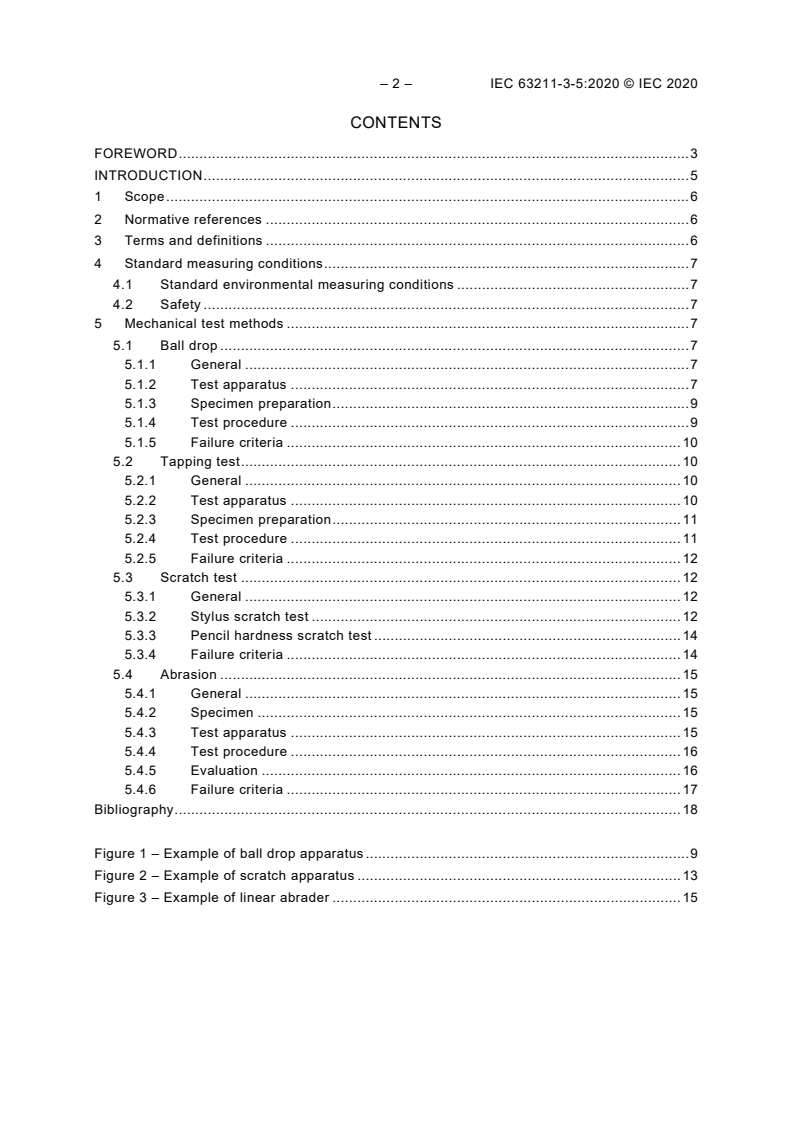
CONTENTS
FOREWORD . 3
INTRODUCTION . 5
1 Scope . 6
2 Normative references . 6
3 Terms and definitions . 6
4 Standard measuring conditions . 7
4.1 Standard environmental measuring conditions . 7
4.2 Safety . 7
5 Mechanical test methods . 7
5.1 Ball drop . 7
5.1.1 General . 7
5.1.2 Test apparatus . 7
5.1.3 Specimen preparation . 9
5.1.4 Test procedure . 9
5.1.5 Failure criteria . 10
5.2 Tapping test . 10
5.2.1 General . 10
5.2.2 Test apparatus . 10
5.2.3 Specimen preparation . 11
5.2.4 Test procedure . 11
5.2.5 Failure criteria . 12
5.3 Scratch test . 12
5.3.1 General . 12
5.3.2 Stylus scratch test . 12
5.3.3 Pencil hardness scratch test . 14
5.3.4 Failure criteria . 14
5.4 Abrasion . 15
5.4.1 General . 15
5.4.2 Specimen . 15
5.4.3 Test apparatus . 15
5.4.4 Test procedure . 16
5.4.5 Evaluation . 16
5.4.6 Failure criteria . 17
Bibliography . 18
Figure 1 – Example of ball drop apparatus . 9
Figure 2 – Example of scratch apparatus . 13
Figure 3 – Example of linear abrader . 15
INTERNATIONAL ELECTROTECHNICAL COMMISSION
____________
DURABILITY TEST METHODS FOR ELECTRONIC DISPLAYS –
Part 3-5: Mechanical tests – Surface durability
FOREWORD
1) The International Electrotechnical Commission (IEC) is a worldwide organization for standardization comprising
all national electrotechnical committees (IEC National Committees). The object of IEC is to promote
international co-operation on all questions concerning standardization in the electrical and electronic fields. To
this end and in addition to other activities, IEC publishes International Standards, Technical Specifications,
Technical Reports, Publicly Available Specifications (PAS) and Guides (hereafter referred to as “IEC
Publication(s)”). Their preparation is entrusted to technical committees; any IEC National Committee interested
in the subject dealt with may participate in this preparatory work. International, governmental and non-
governmental organizations liaising with the IEC also participate in this preparation. IEC collaborates closely
with the International Organization for Standardization (ISO) in accordance with conditions determined by
agreement between the two organizations.
2) The formal decisions or agreements of IEC on technical matters express, as nearly as possible, an international
consensus of opinion on the relevant subjects since each technical committee has representation from all
interested IEC National Committees.
3) IEC Publications have the form of recommendations for international use and are accepted by IEC National
Committees in that sense. While all reasonable efforts are made to ensure that the technical content of IEC
Publications is accurate, IEC cannot be held responsible for the way in which they are used or for any
misinterpretation by any end user.
4) In order to promote international uniformity, IEC National Committees undertake to apply IEC Publications
transparently to the maximum extent possible in their national and regional publications. Any divergence
between any IEC Publication and the corresponding national or regional publication shall be clearly indicated in
the latter.
5) IEC itself does not provide any attestation of conformity. Independent certification bodies provide conformity
assessment services and, in some areas, access to IEC marks of conformity. IEC is not responsible for any
services carried out by independent certification bodies.
6) All users should ensure that they have the latest edition of this publication.
7) No liability shall attach to IEC or its directors, employees, servants or agents including individual experts and
members of its technical committees and IEC National Committees for any personal injury, property damage or
other damage of any nature whatsoever, whether direct or indirect, or for costs (including legal fees) and
expenses arising out of the publication, use of, or reliance upon, this IEC Publication or any other IEC
Publications.
8) Attention is drawn to the Normative references cited in this publication. Use of the referenced publications is
indispensable for the correct application of this publication.
9) Attention is drawn to the possibility that some of the elements of this IEC Publication may be the subject of
patent rights. IEC shall not be held responsible for identifying any or all such patent rights.
International Standard IEC 63211-3-5 has been prepared by IEC technical committee 110:
Electronic displays.
The text of this standard is based on the following documents:
FDIS Report on voting
110/1222/FDIS 110/1244/RVD
Full information on the voting for the approval of this International Standard can be found in
the report on voting indicated in the above table.
This document has been drafted in accordance with the ISO/IEC Directives, Part 2.
A list of all parts in the IEC 63211 series, published under the general title Durability test
methods for electronic displays, can be found on the IEC website.
– 4 – IEC 63211-3-5:2020 © IEC 2020
The committee has decided that the contents of this document will remain unchanged until the
stability date indicated on the IEC website under "http://webstore.iec.ch" in the data related to
the specific document. At this date, the document will be
• reconfirmed,
• withdrawn,
• replaced by a revised edition, or
• amended.
INTRODUCTION
This document relates to the common durability test methods applicable in the field of
electronic displays, which may overlap with some of the parts of existing TC 110 documents
that describe the durability test methods of the individual technologies, such as LCD, OLED,
PDP and others. This document is intended to be used as the reference document in future
standards and in revisions of existing. The existing standards will be revised in their
maintenance time to refer to this document to the largest extent possible.
– 6 – IEC 63211-3-5:2020 © IEC 2020
DURABILITY TEST METHODS FOR ELECTRONIC DISPLAYS –
Part 3-5: Mechanical tests – Surface durability
1 Scope
This part of IEC 63211 defines common procedures for surface durability mechanical test
methods. This document generally describes the test equipment and procedures used for
each method when applied on all levels, from parts (i.e. outermost surface parts of products,
display panels and modules) to final products (i.e. finished displays or products).
2 Normative references
The following documents are referred to in the text in such a way that some or all of their
content constitutes requirements for this document. For dated references, only the edition
cited applies. For undated references, the latest edition of the referenced document (including
any amendments) applies.
IEC 62341-6-3, Organic light emitting diode (OLED) displays – Part 6-3: Measuring methods
of image quality
IEC 62368-1, Audio/video, information and communication technology equipment – Part 1:
Safety requirements
IEC 62715-5-3, Flexible display devices – Part 5-3: Visual assessment of image quality and
defects
IEC 62977-2-2, Electronic displays – Part 2-2: Measurements of optical characteristics –
Ambient performance
ISO 15184, Paints and varnishes – Determination of film hardness by pencil test
ISO 19252, Plastics – Determination of scratch properties
3 Terms and definitions
For the purposes of this document, the following terms and definitions apply.
ISO and IEC maintain terminological databases for use in standardization at the following
addresses:
• IEC Electropedia: available at http://www.electropedia.org/
• ISO Online browsing platform: available at http://www.iso.org/obp
3.1
scratch
mark or groove created by a sharp or pointed object cutting a surface in a single one-
directional lateral movement of the object
3.2
abrasion
process of wearing away or deformation of a surface by repeatedly rubbing the surface
3.3
abrader
equipment for conducting abrasion tests
3.4
steel wool
special alloy steel which is processed into a thin and long fibrous form
Note 1 to entry: The cross section of the steel wool is polyhedral with edges.
Note 2 to entry: Steel wool is generally used as an abrasive.
4 Standard measuring conditions
4.1 Standard environmental measuring conditions
Mechanical and optical measurements shall be carried out under standard environmental
conditions as follows:
• temperature: 25 °C ± 3 °C
• relative humidity: 50% ± 10%
• atmospheric pressure: 86 kPa to 106 kPa
When different environmental conditions are used, they shall be noted in the report.
4.2 Safety
All appropriate safety equipment shall be worn during testing. Guards shall be used to protect
operators from being injured during testing. Specimen devices shall include safeguards in
accordance with IEC 62368-1.
5 Mechanical test methods
5.1 Ball drop
5.1.1 General
This test evaluates the ability of the display surface to resist the point shock stresses that
occur during impact when an object is dropped on it.
5.1.2 Test apparatus
5.1.2.1 Outline
The following components are important characteristics of the test apparatus (see Figure 1).
5.1.2.2 Height adjustment column
The height adjustment column shall be long enough to allow a drop height of at least 180 cm.
An attached scale, or other measurement method, shall be used to measure the drop height
to compensate for specimen thickness. Drop height is the distance from the test surface to the
bottom of the ball when attached to the release mechanism.
– 8 – IEC 63211-3-5:2020 © IEC 2020
5.1.2.3 Release mechanism
The release mechanism shall be attached to a beam that is perpendicular to the height
adjustment column and be able to be repositioned on it. The release mechanism shall be
powered by either an electromagnet, in the case of a steel ball, or a vacuum for any ball
material. The release mechanism shall be actuated remotely via an electrical or pneumatic
switch. The design shall allow free gravitational acceleration of the ball upon release.
5.1.2.4 Specimen holder
The specimen holder shall be made of a rigid material that minimizes damage to specimens
when mounted in it. Flat or flexible specimens shall be allowed to rest securely in the
specimen holder or can be secured using clamps. Specimens with curved backs will need
custom specimen holders that stabilize them when secured to the base to prevent movement
during testing. The use and purpose of other specialized specimen holders shall be stated in
the results.
5.1.2.5 Base
The base shall be a dense rigid plate that is thick enough not to deform during testing and
ensure minimal energy absorption. Steel or cast iron are ideal materials for the base, however,
granite and other stone materials are also acceptable provided they are inspected prior to and
after testing for chips or cracks and replaced if damage is found.
5.1.2.6 Ball
Ball materials shall be rigid materials that do not deform permanently or shatter on impact. A
steel alloy with a hardness of C60 to C67 is the most common material. The diameter
tolerance shall be no greater than ±0,05 mm from nominal, and the deviation from sphericity
shall be no greater than 0,025 mm. The ball mass shall be within ±2,0 % of the specified
value.
Key
A Height adjustment column
B Specimen base
C Specimen holder
D Specimen
E Ball release armature
F Ball release mechanism
G Armature height adjustment
H Ball release controller
I Ball (in freefall)
Figure 1 – Example of ball drop apparatus
5.1.3 Specimen preparation
The sample size shall be great enough to demonstrate repeatability of failure at the minimum
height to induce damage as well as to determine the minimum height to induce damage via
trial and error. Full display assembly specimens are also mounted on the display device. If
damage is localized, multiple areas of a single specimen may be tested. Spe
...