

IEC 61056-1:2012
(Main)General purpose lead-acid batteries (valve-regulated types) - Part 1: General requirements, functional characteristics - Methods of test
General Information
- Abstract
IEC 61056-1:2012 specifies the general requirements, functional characteristics and methods of test for all general purpose lead-acid cells and batteries of the valve-regulated type:
- for either cyclic or float charge application;
- in portable equipment, for instance, incorporated in tools, toys, or in static emergency, or uninterruptible power supply and general power supplies.
This third edition cancels and replaces the second edition of IEC 61056-1 published in 2002. It constitutes a technical revision. The main changes consist in adding new battery designations and an update of the requirements like the one concerning the marking.
- Status
- Published
- Publication Date
- 21-Feb-2012
- Technical Committee
- TC 21 - Secondary cells and batteries
- Drafting Committee
- MT 6 - TC 21/MT 6
- Current Stage
- PPUB - Publication issued
- Start Date
- 22-Feb-2012
- Completion Date
- 15-Mar-2012
Overview
IEC 61056-1:2012 is an international standard published by the International Electrotechnical Commission (IEC) that specifies the general requirements, functional characteristics, and methods of test for general purpose lead-acid batteries of the valve-regulated type. Valve-regulated lead-acid (VRLA) batteries are widely used in various industries due to their safety, reliability, and maintenance-free operation.
This standard applies to VRLA batteries for both cyclic and float charge applications, typically used in portable equipment, power tools, toys, emergency systems, uninterruptible power supplies (UPS), and general power supply applications. The third edition of IEC 61056-1 introduces technical revisions, including new battery designations and updated requirements, particularly concerning battery marking.
Key Topics
- Scope of Application: Covers all general-purpose VRLA cells and batteries not designed for automotive, traction, or stationary power systems.
- Battery Design: Outlines construction requirements, including mandating the use of valve mechanisms for pressure regulation and gas management. Both prismatic and cylindrical battery types are included.
- Performance and Safety: Details requirements for capacity, endurance (cycle and float service), charge retention, permissible currents, and resistance to vibration and shock.
- Marking and Identification: Specifies clear marking of polarity, nominal voltage, manufacturer details, and safety and recycling symbols.
- Testing Methods: Provides standardized methods to evaluate battery parameters such as capacity, endurance, charge retention, gas emission, valve operation, and mechanical robustness.
- Test Conditions: Defines standardized environmental and procedural conditions for testing, ensuring comparability and reliability of results.
- Measurement Accuracy: Specifies the accuracy and suitability of instruments for electrical, temperature, time, dimension, gas volume, and pressure measurements.
Applications
General purpose valve-regulated lead-acid batteries covered by IEC 61056-1:2012 are suited for a broad spectrum of low- and medium-power applications. Typical uses include:
- Uninterruptible power supplies (UPS): Provides backup power to protect critical equipment against power failures.
- Portable equipment: Powers industrial tools, toys, and other small devices where reliable, maintenance-free batteries are essential.
- Emergency systems: Supplies energy for lighting, alarms, and communication devices during mains power interruptions.
- General power supply units: Suits various static power needs in commercial and consumer electronics.
The rigorous testing and marking requirements stipulated ensure that batteries delivered to these applications meet international expectations for quality, safety, and performance. Adherence to IEC 61056-1 also facilitates easier market access and regulatory compliance at the global level.
Related Standards
Manufacturers, engineers, and procurement professionals working with VRLA batteries may also refer to related IEC standards for comprehensive product specification and system integration:
- IEC 61056-2: General purpose lead-acid batteries (valve-regulated types) - Part 2: Dimensions, terminals, and marking
- IEC 60417: Graphical symbols for use on equipment
- IEC 60445: Identification of equipment terminals and conductors
- IEC 61429: Recycling symbol for use on electrical and electronic equipment
For applications not covered by IEC 61056-1, such as vehicle starting (IEC 60095 series), traction (IEC 60254 series), or stationary applications (IEC 60896 series), other standards should be consulted.
By following IEC 61056-1:2012, organizations ensure that their general purpose VRLA batteries deliver reliable performance, safety, and clarity in specification, supporting broad deployment in today’s demanding power environments.
Relations
- Effective Date
- 05-Sep-2023
Get Certified
Connect with accredited certification bodies for this standard

IMQ S.p.A. (Certification)
Italian electrical product certification.

SLG Prüf- und Zertifizierungs GmbH
German testing and certification body.

UL Solutions
Global safety science company with testing, inspection and certification.
Sponsored listings
Frequently Asked Questions
IEC 61056-1:2012 is a standard published by the International Electrotechnical Commission (IEC). Its full title is "General purpose lead-acid batteries (valve-regulated types) - Part 1: General requirements, functional characteristics - Methods of test". This standard covers: IEC 61056-1:2012 specifies the general requirements, functional characteristics and methods of test for all general purpose lead-acid cells and batteries of the valve-regulated type: - for either cyclic or float charge application; - in portable equipment, for instance, incorporated in tools, toys, or in static emergency, or uninterruptible power supply and general power supplies. This third edition cancels and replaces the second edition of IEC 61056-1 published in 2002. It constitutes a technical revision. The main changes consist in adding new battery designations and an update of the requirements like the one concerning the marking.
IEC 61056-1:2012 specifies the general requirements, functional characteristics and methods of test for all general purpose lead-acid cells and batteries of the valve-regulated type: - for either cyclic or float charge application; - in portable equipment, for instance, incorporated in tools, toys, or in static emergency, or uninterruptible power supply and general power supplies. This third edition cancels and replaces the second edition of IEC 61056-1 published in 2002. It constitutes a technical revision. The main changes consist in adding new battery designations and an update of the requirements like the one concerning the marking.
IEC 61056-1:2012 is classified under the following ICS (International Classification for Standards) categories: 29.220.20 - Acid secondary cells and batteries. The ICS classification helps identify the subject area and facilitates finding related standards.
IEC 61056-1:2012 has the following relationships with other standards: It is inter standard links to IEC 61056-1:2002. Understanding these relationships helps ensure you are using the most current and applicable version of the standard.
IEC 61056-1:2012 is available in PDF format for immediate download after purchase. The document can be added to your cart and obtained through the secure checkout process. Digital delivery ensures instant access to the complete standard document.
Standards Content (Sample)
IEC 61056-1 ®
Edition 3.0 2012-02
INTERNATIONAL
STANDARD
NORME
INTERNATIONALE
General purpose lead-acid batteries (valve-regulated types) –
Part 1: General requirements, functional characteristics – Methods of test
Batteries d'accumulateurs au plomb-acide pour usage général (types à
soupapes) –
Partie 1: Exigences générales et caractéristiques fonctionnelles – Méthodes
d'essai
All rights reserved. Unless otherwise specified, no part of this publication may be reproduced or utilized in any form
or by any means, electronic or mechanical, including photocopying and microfilm, without permission in writing from
either IEC or IEC's member National Committee in the country of the requester.
If you have any questions about IEC copyright or have an enquiry about obtaining additional rights to this publication,
please contact the address below or your local IEC member National Committee for further information.
Droits de reproduction réservés. Sauf indication contraire, aucune partie de cette publication ne peut être reproduite ni
utilisée sous quelque forme que ce soit et par aucun procédé, électronique ou mécanique, y compris la photocopie et les
microfilms, sans l'accord écrit de la CEI ou du Comité national de la CEI du pays du demandeur.
Si vous avez des questions sur le copyright de la CEI ou si vous désirez obtenir des droits supplémentaires sur cette
publication, utilisez les coordonnées ci-après ou contactez le Comité national de la CEI de votre pays de résidence.
IEC Central Office Tel.: +41 22 919 02 11
3, rue de Varembé Fax: +41 22 919 03 00
CH-1211 Geneva 20 info@iec.ch
Switzerland www.iec.ch
About the IEC
The International Electrotechnical Commission (IEC) is the leading global organization that prepares and publishes
International Standards for all electrical, electronic and related technologies.
About IEC publications
The technical content of IEC publications is kept under constant review by the IEC. Please make sure that you have the
latest edition, a corrigenda or an amendment might have been published.
Useful links:
IEC publications search - www.iec.ch/searchpub Electropedia - www.electropedia.org
The advanced search enables you to find IEC publications The world's leading online dictionary of electronic and
by a variety of criteria (reference number, text, technical electrical terms containing more than 30 000 terms and
committee,…). definitions in English and French, with equivalent terms in
It also gives information on projects, replaced and additional languages. Also known as the International
withdrawn publications. Electrotechnical Vocabulary (IEV) on-line.
IEC Just Published - webstore.iec.ch/justpublished Customer Service Centre - webstore.iec.ch/csc
Stay up to date on all new IEC publications. Just Published If you wish to give us your feedback on this publication
details all new publications released. Available on-line and or need further assistance, please contact the
also once a month by email. Customer Service Centre: csc@iec.ch.
A propos de la CEI
La Commission Electrotechnique Internationale (CEI) est la première organisation mondiale qui élabore et publie des
Normes internationales pour tout ce qui a trait à l'électricité, à l'électronique et aux technologies apparentées.
A propos des publications CEI
Le contenu technique des publications de la CEI est constamment revu. Veuillez vous assurer que vous possédez
l’édition la plus récente, un corrigendum ou amendement peut avoir été publié.
Liens utiles:
Recherche de publications CEI - www.iec.ch/searchpub Electropedia - www.electropedia.org
La recherche avancée vous permet de trouver des Le premier dictionnaire en ligne au monde de termes
publications CEI en utilisant différents critères (numéro de électroniques et électriques. Il contient plus de 30 000
référence, texte, comité d’études,…). termes et définitions en anglais et en français, ainsi que
Elle donne aussi des informations sur les projets et les les termes équivalents dans les langues additionnelles.
publications remplacées ou retirées. Egalement appelé Vocabulaire Electrotechnique
International (VEI) en ligne.
Just Published CEI - webstore.iec.ch/justpublished
Service Clients - webstore.iec.ch/csc
Restez informé sur les nouvelles publications de la CEI.
Just Published détaille les nouvelles publications parues. Si vous désirez nous donner des commentaires sur
Disponible en ligne et aussi une fois par mois par email. cette publication ou si vous avez des questions
contactez-nous: csc@iec.ch.
IEC 61056-1 ®
Edition 3.0 2012-02
INTERNATIONAL
STANDARD
NORME
INTERNATIONALE
General purpose lead-acid batteries (valve-regulated types) –
Part 1: General requirements, functional characteristics – Methods of test
Batteries d'accumulateurs au plomb-acide pour usage général (types à
soupapes) –
Partie 1: Exigences générales et caractéristiques fonctionnelles – Méthodes
d'essai
INTERNATIONAL
ELECTROTECHNICAL
COMMISSION
COMMISSION
ELECTROTECHNIQUE
PRICE CODE
INTERNATIONALE
S
CODE PRIX
ICS 29.220.20 ISBN 978-2-88912-926-3
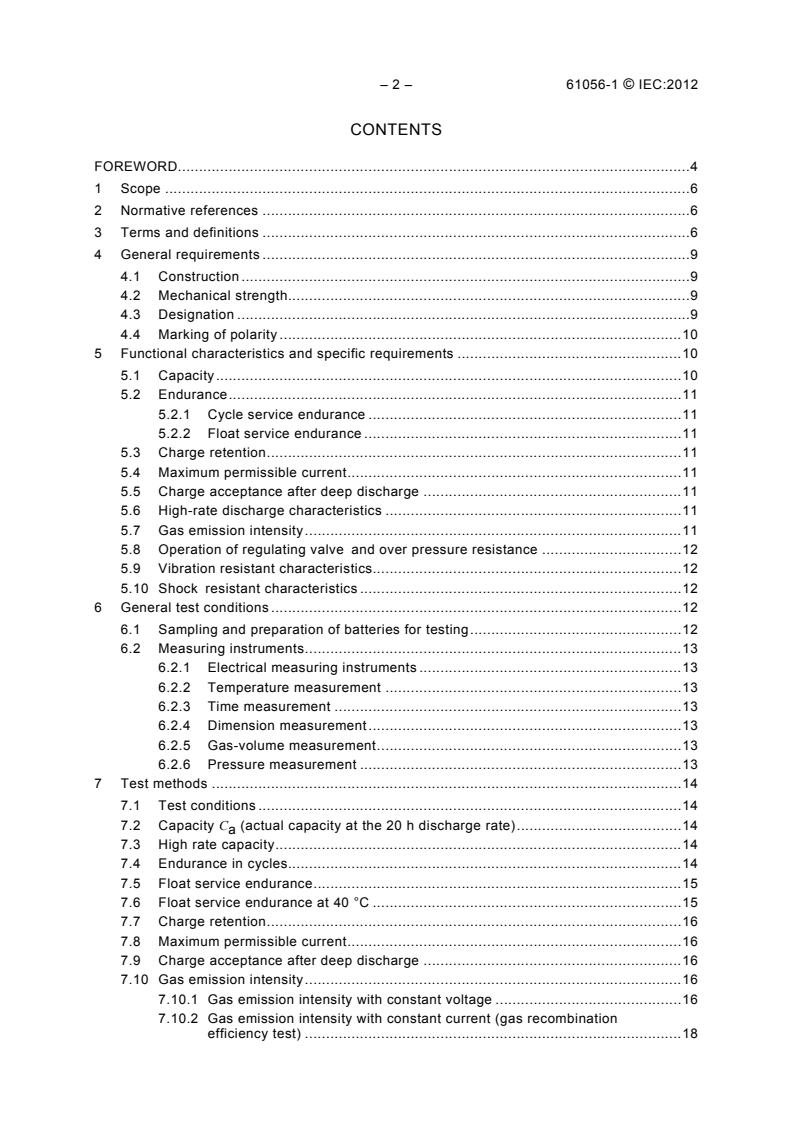
– 2 – 61056-1 © IEC:2012
CONTENTS
FOREWORD. 4
1 Scope . 6
2 Normative references . 6
3 Terms and definitions . 6
4 General requirements . 9
4.1 Construction . 9
4.2 Mechanical strength. 9
4.3 Designation . 9
4.4 Marking of polarity . 10
5 Functional characteristics and specific requirements . 10
5.1 Capacity . 10
5.2 Endurance . 11
5.2.1 Cycle service endurance . 11
5.2.2 Float service endurance . 11
5.3 Charge retention . 11
5.4 Maximum permissible current . 11
5.5 Charge acceptance after deep discharge . 11
5.6 High-rate discharge characteristics . 11
5.7 Gas emission intensity . 11
5.8 Operation of regulating valve and over pressure resistance . 12
5.9 Vibration resistant characteristics. 12
5.10 Shock resistant characteristics . 12
6 General test conditions . 12
6.1 Sampling and preparation of batteries for testing . 12
6.2 Measuring instruments . 13
6.2.1 Electrical measuring instruments . 13
6.2.2 Temperature measurement . 13
6.2.3 Time measurement . 13
6.2.4 Dimension measurement . 13
6.2.5 Gas-volume measurement . 13
6.2.6 Pressure measurement . 13
7 Test methods . 14
7.1 Test conditions . 14
7.2 Capacity C (actual capacity at the 20 h discharge rate) . 14
a
7.3 High rate capacity . 14
7.4 Endurance in cycles . 14
7.5 Float service endurance . 15
7.6 Float service endurance at 40 °C . 15
7.7 Charge retention . 16
7.8 Maximum permissible current . 16
7.9 Charge acceptance after deep discharge . 16
7.10 Gas emission intensity . 16
7.10.1 Gas emission intensity with constant voltage . 16
7.10.2 Gas emission intensity with constant current (gas recombination
efficiency test) . 18
61056-1 © IEC:2012 – 3 –
7.11 Operation of regulating valve and over pressure resistance . 19
7.11.1 Operation of regulating valve . 19
7.11.2 Over pressure resistance . 19
7.12 Vibration resistant characteristics. 19
7.13 Shock resistant characteristics . 19
Bibliography . 20
Figure 1 – Example of gas collection device . 17
– 4 – 61056-1 © IEC:2012
INTERNATIONAL ELECTROTECHNICAL COMMISSION
____________
GENERAL PURPOSE LEAD-ACID BATTERIES
(VALVE-REGULATED TYPES) –
Part 1: General requirements, functional characteristics –
Methods of test
FOREWORD
1) The International Electrotechnical Commission (IEC) is a worldwide organization for standardization comprising
all national electrotechnical committees (IEC National Committees). The object of IEC is to promote
international co-operation on all questions concerning standardization in the electrical and electronic fields. To
this end and in addition to other activities, IEC publishes International Standards, Technical Specifications,
Technical Reports, Publicly Available Specifications (PAS) and Guides (hereafter referred to as “IEC
Publication(s)”). Their preparation is entrusted to technical committees; any IEC National Committee interested
in the subject dealt with may participate in this preparatory work. International, governmental and non-
governmental organizations liaising with the IEC also participate in this preparation. IEC collaborates closely
with the International Organization for Standardization (ISO) in accordance with conditions determined by
agreement between the two organizations.
2) The formal decisions or agreements of IEC on technical matters express, as nearly as possible, an international
consensus of opinion on the relevant subjects since each technical committee has representation from all
interested IEC National Committees.
3) IEC Publications have the form of recommendations for international use and are accepted by IEC National
Committees in that sense. While all reasonable efforts are made to ensure that the technical content of IEC
Publications is accurate, IEC cannot be held responsible for the way in which they are used or for any
misinterpretation by any end user.
4) In order to promote international uniformity, IEC National Committees undertake to apply IEC Publications
transparently to the maximum extent possible in their national and regional publications. Any divergence
between any IEC Publication and the corresponding national or regional publication shall be clearly indicated in
the latter.
5) IEC itself does not provide any attestation of conformity. Independent certification bodies provide conformity
assessment services and, in some areas, access to IEC marks of conformity. IEC is not responsible for any
services carried out by independent certification bodies.
6) All users should ensure that they have the latest edition of this publication.
7) No liability shall attach to IEC or its directors, employees, servants or agents including individual experts and
members of its technical committees and IEC National Committees for any personal injury, property damage or
other damage of any nature whatsoever, whether direct or indirect, or for costs (including legal fees) and
expenses arising out of the publication, use of, or reliance upon, this IEC Publication or any other IEC
Publications.
8) Attention is drawn to the Normative references cited in this publication. Use of the referenced publications is
indispensable for the correct application of this publication.
9) Attention is drawn to the possibility that some of the elements of this IEC Publication may be the subject of
patent rights. IEC shall not be held responsible for identifying any or all such patent rights.
International Standard IEC 61056-1 has been prepared by IEC technical committee 21:
Secondary cells and batteries.
This third edition cancels and replaces the second edition of IEC 61056-1 published in 2002.
It constitutes a technical revision.
The main changes consist in adding new battery designations and an update of the
requirements like the one concerning the marking.
61056-1 © IEC:2012 – 5 –
The text of this standard is based on the following documents:
FDIS Report on voting
21/768/FDIS 21/774/RVD
Full information on the voting for the approval of this standard can be found in the report on
voting indicated in the above table.
This publication has been drafted in accordance with the ISO/IEC Directives, Part 2.
A list of all parts of the IEC 61056 series, published under the general title General purpose
lead-acid batteries (valve-regulated types), can be found on the IEC website.
The committee has decided that the contents of this publication will remain unchanged until
the stability date indicated on the IEC web site under "http://webstore.iec.ch" in the data
related to the specific publication. At this date, the publication will be
• reconfirmed,
• withdrawn,
• replaced by a revised edition, or
• amended.
– 6 – 61056-1 © IEC:2012
GENERAL PURPOSE LEAD-ACID BATTERIES
(VALVE-REGULATED TYPES) –
Part 1: General requirements, functional characteristics –
Methods of test
1 Scope
This Part of IEC 61056 specifies the general requirements, functional characteristics and
methods of test for all general purpose lead-acid cells and batteries of the valve-regulated
type :
• for either cyclic or float charge application;
• in portable equipment, for instance, incorporated in tools, toys, or in static emergency, or
uninterruptible power supply and general power supplies.
The cells of this kind of lead-acid battery may either have flat-plate electrodes in prismatic
containers or have spirally wound pairs of electrodes in cylindrical containers. The sulphuric
acid in these cells is immobilized between the electrodes either by absorption in a micro-
porous structure or in a gelled form.
NOTE The dimensions, terminals and marking of the lead-acid cells and batteries which are applied by this
standard are given in IEC 61056-2.
This part of IEC 61056 does not apply for example to lead-acid cells and batteries used for
• vehicle engine starting applications (IEC 60095 series),
• traction applications (IEC 60254 series), or
• stationary applications (IEC 60896 series).
Conformance to this standard requires that statements and claims of basic performance data
by the manufacturer correspond to these test procedures. The tests may also be used for type
qualification.
2 Normative references
The following documents, in whole or in part, are normatively referenced in this document and
are indispensable for its application. For dated references, only the edition cited applies. For
undated references, the latest edition of the referenced document (including any
amendments) applies.
IEC 60417, Graphical symbols for use on equipment
IEC 60445, Basic and safety principles for man-machine interface, marking and identification
– Identification of equipment terminals, conductor terminations and conductors
IEC 61056-2:2012, General purpose lead-acid batteries (valve-regulated types) – Part 2:
Dimensions, terminals and marking
3 Terms and definitions
For the purposes of this document, the following terms and definitions apply.
61056-1 © IEC:2012 – 7 –
3.1
general purpose lead-acid cells and batteries of the valve-regulated type
cells and batteries which provide the valve mechanism that opens when the internal pressure
of the battery rises and has a function to absorb oxygen at its negative plates
3.2
cell
basic functional unit, consisting of an assembly of electrodes, electrolyte, container, terminals
and usually separators, that is a source of electric energy obtained by direct conversion of
chemical energy
3.3
monobloc battery
battery with multiple separate but electrically connected cell compartments each of which is
designed to house an assembly of electrodes, electrolyte, terminals or interconnections and
possible separators
3.4
nominal voltage
suitable approximate value of the voltage used to designate or identify a cell, a battery or an
electrochemical system
3.5
final voltage
specified voltage of a battery at which the battery discharge is terminated
3.6
discharge current
I
discharge current for which the duration of discharge under the specified conditions is 20 h to
a final voltage of 1,75 V/cell
Note 1 to entry The unit of I shall be ampere (A).
3.7
discharge current
I
discharge current for which the duration of discharge under the specified conditions is 1 h to a
final voltage of 1,60 V/cell
Note 1 to entry The unit of I shall be ampere (A).
3.8
rated capacity
C
quantity of electricity, declared by the manufacturer, which under the specified conditions can
be discharged from the battery at a rate of I to a final voltage of 1,75 V/cell
Note 1 to entry The unit of C shall be ampere hour (Ah).
3.9
rated capacity
C
quantity of electricity, declared by the manufacturer, which under the specified conditions can
be discharged from the battery at a rate of I to a final voltage of 1,60 V/cell
Note 1 to entry The unit of C shall be ampere hour (Ah).
– 8 – 61056-1 © IEC:2012
3.10
actual capacity
C
a
quantity of electricity, which can be discharged from the battery at a specified rate of
discharge to a specified final voltage
Note 1 to entry The unit of C shall be ampere hour (Ah).
a
3.11
DOD
depth of discharge
measure of a battery´s state of discharge, expressed in percent as the ratio between the
discharged capacity and the battery´s rated capacity
3.12
high-rate discharge characteristic
the discharge characteristics of a battery when discharged at a comparatively large current
relative to its capacity
3.13
gas recombination efficiency
the ratio between gas emitted from the cell and the amount of gas produced inside the cell by
the float current
Note 1 to entry Amount of gas = 0,63 L/Ah*cell at normal temperature pressure.
3.14
regulating valve
a valve which operates at a certain internal pressure to exhaust gas but prevents external air
from entering into the battery
3.15
charge retention
ability of a cell or battery to retain capacity on open circuit under specified conditions
3.16
deep discharge
discharge equivalent to the most portion of capacity of a battery
3.17
cyclic application
battery operation characterized by regular discharge followed by recharge
3.18
float application
battery operation where the battery is permanently connected to a d.c. constant voltage
source, keeping the battery fully charged
Note 1 to entry In the case of power outage or surge loads, the battery takes over or supports the load.
61056-1 © IEC:2012 – 9 –
4 General requirements
4.1 Construction
4.1.1 Batteries of this kind are composed of one or more cells. Multicell-batteries may be
supplied either as monobloc batteries (see IEC 60050-482) or as mechanically and electrically
interconnected single cells.
The number of cells connected in series in a battery is designated by the letter “n” throughout
this standard.
4.1.2 Batteries shall be fitted with valves. The valve shall not allow gas (air) to enter into the
cell but shall allow gas to escape from the cell at a certain internal pressure which does not
lead to deformation or other damage of the cell or battery container.
4.1.3 Batteries or cells shall be designed so that neither water nor electrolyte can be added.
They shall be suitable for storage and discharge in any orientation (for example, upside down)
without leakage of liquid from valves and/or terminal seals. They shall also withstand storage
at 20 °C ± 5 K and maximum 80 % relative humidity for one year in inverted orientation
without leakage.
4.1.4 All battery components, for example, terminals, intercell connectors, containers, etc.
shall be designed for current rates as specified in 5.4.
4.1.5 For charging, batteries or cells shall not be installed in any direction beyond 90 ° from
the upright position.
4.2 Mechanical strength
Batteries shall be designed to withstand mechanical stresses, vibrations and shocks occurring
in normal transportation, handling and use.
4.3 Designation
The batteries shall be identified by at least the following information on the surface in durable
printing:
– supplier's or manufacturer's name or trade mark;
– type designation or product name;
– nominal voltage (n × 2,0 V);
– rated capacity C (see 5.1.2);
– polarity;
– date of manufacture, its abbreviation or code;
– safety symbols according to national or international standards;
– recycling symbols (see IEC 61429).
If the values of functional characteristics or specific requirements are different from the values
specified in Clause 5 below, these values shall be supplied with the battery or mentioned in
the battery instructions.
Additional data such as recommended charging voltage U or charging current I , capacity at
c c
other discharge rates, battery weight, etc. shall be supplied with the battery in a suitable way.
– 10 – 61056-1 © IEC:2012
4.4 Marking of polarity
The battery shall carry a marking of polarity of both terminals by the plus symbol +
(60417-5005: Positive polarity) and the minus symbol – (60417-5006: Negative polarity) on
the lid adjacent to the terminals. In the case where the battery carries a marking of polarity of
both terminals by colour it shall be as specified in IEC 60446.The positive terminal shall be
identified with red and the negative terminal with black/blue colour.
5 Functional characteristics and specific requirements
5.1 Capacity
5.1.1 The essential characteristic of a cell or battery is its capacity for the storage of electric
energy. This capacity, expressed in ampere-hours (Ah), varies with the conditions of use
(discharge current, end of discharge voltage, temperature).
5.1.2 The rated capacity C is a reference value, to be declared by the manufacturer, which
is valid for the discharge of a new battery at the reference temperature of 25 °C and
a discharge current:
C
I = (1)
in which discharge time is 20 h, to a final voltage U = n × 1,75 V and
f
where
I is expressed in amperes, and
C is expressed in ampere-hours.
5.1.3 The rated capacity C is a reference value, optionally to be declared by the
manufacturer, valid for the discharge at 25 °C and a discharge current:
C
I = (2)
in which discharge time is 1 h, to a final voltage U = n × 1,60 V and
f
where
I is expressed in amperes, and
C is expressed in ampere-hours.
61056-1 © IEC:2012 – 11 –
5.1.4 The actual capacity C shall be determined by discharging a fully charged battery
a
(see 6.1.3) with constant current I in accordance with 7.2. The resultant value shall be used
for comparison with the reference value C or for control of the state of a battery after long
periods of service.
5.1.5 The determination of the actual capacity C in accordance with 7.2 may also be used
a
for comparison with particular performance data (for example, C ) indicated by the supplier.
In this case, the current I shall be substituted by the particular current corresponding to
the relevant performance data.
5.2 Endurance
5.2.1 Cycle service endurance
The cycle service endurance represents the ability of a battery to perform repeated
discharge/recharge cycles. This performance shall be tested by a series of cycles under
specified conditions with 50 % DOD at I = 3,4 × I or at I = 5 × I after which the actual
20 20
capacity of the battery shall be not less than 50 % of the nominal capacity in ampere-hours
(see 7.4). The number of cycles shall be not less than 200.
5.2.2 Float service endurance
The float service endurance represents the life performance of a battery in float application.
The endurance determined in the test 7.5 and 7.6 shall not be less than two years at 25 °C or
260 days at 40 °C.
5.3 Charge retention
The charge retention is defined as that part of the actual capacity C on discharge with I ,
a 20
expressed as a percentage, which can be discharged with the same current I after storage
on open circuit under specified conditions of temperature and time (see 7.7). Those conditions
provided, the retained charge shall be not less than 75 % of C .
a
5.4 Maximum permissible current
Batteries shall be suitable to maintain a current of I = 40 × I for 300 s and of I = 300 × I
20 20
m h
for 5 s, unless otherwise specified by the manufacturer, without distortion or other damage to
the battery (see 7.8).
5.5 Charge acceptance after deep discharge
Batteries according to this part may be subject to very deep discharge by an unintentional
connection to a load over long periods of time. They shall then be rechargeable with constant
voltage U (for U see 6.1.3) within a period of 48 h (see 7.9).
c c
5.6 High-rate discharge characteristics
The high-rate discharge characteristic of a bettery is its capability to be discharged with high
current relative to its capacity. During discharge with 20 × I , the discharge time shall reach
27 min or more within 5 cycles of charging and discharging.
5.7 Gas emission intensity
This value quantifies the escape of gas from the battery during charge with the manufacturer's
recommended charging method.
When the gas emission intensity is determined during constant voltage float charging
–1 –1 –1
(see 7.10.1), the value G shall not be greater than 0,05 ml × cell × h × Ah . When the
e
– 12 – 61056-1 © IEC:2012
gas emission intensity is determined during constant current charging (see 7.10.2) the gas
recombination efficiency shall not be less than 90 %.
5.8 Operation of regulating valve and over pressure resistance
The two following characteristics shall be checked:
a) Operation of regulating valve: when the test is performed in accordance with 7.11.1, the
operating pressure of vent valve shall be 0,98 kPa to 196,1 kPa.
b) Over pressure resistance: when the test is performed in accordance with 7.11.2, the
battery shall be free from deformations, cracks or liquid leakage, which exceeds the range
of dimensions given in Tables 1 and 2 of IEC 61056-2:2011.
5.9 Vibration resistant characteristics
During the test according to 7.12, terminal voltage shall be not less than nominal voltage. The
battery shall be free from cracks and liquid leakage when inspected visually. The
deformations shall not exceed the range of dimensions given in Table 1 and Table 2 of
IEC 61056-2:2011.
5.10 Shock resistant characteristics
During the test according to 7.13, terminal voltage shall be not less than nominal voltage.
The battery shall be free from cracks and liquid leakage when inspected visually. The
deformations shall not exceed the range of dimensions given in Table 1 and Table 2 of
IEC 61056-2:2011.
6 General test conditions
6.1 Sampling and preparation of batteries for testing
6.1.1 All tests shall be carried out on new, fully charged samples, except when the tests
are used for re-determination of the actual capacity to assess degradation after long periods
of service.
6.1.2 Samples shall be considered as new not later than six months after the date of
manufacture.
6.1.3 Unless otherwise recommended by the manufacturer, the batteries are considered as
fully charged for test purposes after the following procedure.
Batteries shall be charged at an ambient temperature of 25 °C ± 2 K
1) constant voltage charge
– either for a period of 16 h,
– or until the current does not change by more than 0,1 × I within two consecutive
hours.
The constant voltage charge shall take place either
a) from constant voltage, advised by the manufacturer, or, if not available, from
U = n × 2,35 V,
c
or
b) from modified constant voltage (U as in a)) with an initial charging current limitation of
c
I = 6 × I .
max 20
2) constant current charge
61056-1 © IEC:2012 – 13 –
– charge at least 110 % but not more than 150 % of the discharged amperehours,
or
– charge to a charging voltage of 2,4 V per cell, then continue charging with the same
current until at least 0,25 × C but not more than 0,5 × C amperehours have been
20 20
added.
The constant current charge shall be carried out according to the recommendation of the
manufacturer or if not available, with the current in the range of I = 2 × I to 4 × I .
20 20
6.2 Measuring instruments
6.2.1 Electrical measuring instruments
6.2.1.1 Range of measuring instruments
The instruments used shall enable the values of voltage and current to be measured. The
caliber of these instruments and the measuring methods shall be chosen so as to ensure
the accuracy specified for each test.
For analogue instruments this implies that readings shall be taken in the last third of the
graduated scale.
Any other measuring instruments may be used provided they give an equivalent accuracy.
6.2.1.2 Voltage measurement
The instruments used for voltage measurement shall be voltmeters of an accuracy class equal
to 0,5 or better. The internal resistance of the voltmeters used shall be at least 10 kΩ/V.
6.2.1.3 Current measurement
The instruments used for current measurement shall be ammeters of an accuracy class equal
to 0,5 or better. The entire assembly of ammeter, shunt and leads shall be of an accuracy
class of 0,5 or better.
6.2.2 Temperature measurement
The instruments used shall have a resolution of 1 K. The absolute accuracy of the instruments
shall be 1 K or better.
6.2.3 Time measurement
For measurement of time, the instrument's accuracy shall be ± 1 % or better.
6.2.4 Dimension measurement
The instruments used for dimension measurement shall have an accuracy of ± 0,1 % or better.
6.2.5 Gas-volume measurement
For measurement of gas volume the instrument's accuracy shall be ± 2 % or better.
6.2.6 Pressure measurement
For measurement of pressure, the instrument's accuracy shall be ± 1 % or better.
– 14 – 61056-1 © IEC:2012
7 Test methods
7.1 Test conditions
If not otherwise specified, the tests shall be carried out on batteries in the upright position at
an ambient temperature from 15 °C to 35 °C, relative humidity of 25 % to 85 % and
atmospheric pressure of 86 kPa to 106 kPa.
7.2 Capacity C (actual capacity at the 20 h discharge rate)
a
7.2.1 After charging according to 6.1.3, the battery shall be kept on open circuit for 5 h
to 24 h.
7.2.2 Throughout the whole test period the battery shall be kept at an ambient temperature of
25 °C ± 2 K.
7.2.3 The battery shall then be discharged at the same ambient temperature with the current
I (see 5.1.2). This current shall be kept constant to within ± 2 % until the terminal voltage
reaches U = n × 1,75 V. The duration t, of the discharge in hours, shall be recorded.
f
The actual capacity is C = t × I .
a 20
7.2.4 C shall be equal to, or higher than, C . If not, the procedure should be repeated. The
a 20
rated value shall be reached at or before the fifth discharge.
7.3 High rate capacity
7.3.1 After charging according to 6.1.3 the battery shall be kept on open circuit for 5 h
to 24 h.
7.3.2 Throughout the whole test period the battery shall be kept at an ambient temperature of
25 °C ± 2 K.
7.3.3 The battery shall then be discharged with I = 20 × I until the terminal voltage reaches
U = n × 1,60 V.
f
7.4 Endurance in cycles
7.4.1 The test shall be carried out on at least three units (monoblocs or single cells) having
met the requirements of 7.2.4.
7.4.2 Throughout the whole test period the battery shall be kept at an ambient temperature of
25 °C ± 2 K.
7.4.3 The battery shall be connected to a device where it undergoes a continuous series of
cycles, each cycle comprising
– a discharge for 3 h at a current I = 3,4 × I or a discharge for 2 h at a current I = 5 × I
20 20
,
immediately followed by
– a recharge
• for 9 h in case of discharge for 3 h at I = 3,4 × I or
• for 6 h in case of discharge for 2 h at I = 5 × I
at constant voltage U or with constant current I (see 6.1.3)
c c
At the end of each 3 h or 2 h discharge period the on-load voltage U′ shall be recorded
f
automatically or be otherwise measured by suitable means.
61056-1 © IEC:2012 – 15 –
7.4.4 After a series of (50 ± 5) cycles the battery shall be recharged according to 6.1.3. Then
the capacity shall be determined by discharging with I = 3,4 × I or 5 × I until
20 20
U = n × 1,70 V. If the discharge time is greater than 3 h or 2 h respectively, then the battery
f
shall undergo another series of (50 ± 5) cycles according to 7.4.3.
7.4.5 If in the course of this cycling the voltage U′ (see 7.4.3) falls below n × 1,70 V, then
f
cycling shall be interrupted and the battery shall be recharged according to 6.1.3. The
capacity C shall then be determined according to 7.4.4. If the discharge time is less than 3 h
a
or 2 h respectively, then the test shall be terminated.
7.4.6 The endurance is expressed as the total number of cycles according to 7.4.3 to which
the battery can be submitted until the discharge time with I = 3,4 × I is less than 3 h or
discharge time with I = 5 × I is less than 2 h.
7.5 Float service endurance
7.5.1 The test shall be carried out on at least three units (monobloc batteries or single cells).
7.5.2 Throughout the whole test period, the battery shall be kept at an ambient temperature
of 20 °C ± 2 K, or 25 °C ± 2 K. Humidity is not defined.
7.5.3 The battery shall be charged with constant float charge voltage between n × 2,25 V
and n × 2,3 V specified by the manufacturer. The initial current shall be limited to I = 4 × I .
7.5.4 Capacity check: every six months the capacity shall be checked by discharging with
I = 3,4 × I or 5 × I until the final voltage of U = n × 1,70 V.
20 20
7.5.5 The end of life is reached when the remaining capacity has decreased to C < 0,6 × C
tested at I = 3,4 × I , or C < 0,5 × C tested at I = 5 × I
20 20 20
7.6 Float service endurance at 40 °C
7.6.1 The test shall be carried out on at least three units (monobloc batteries or single cells).
7.6.2 The test units shall be checked, before starting the test, an actual capacity C of
a
at least C (3 h –1,75 V/cell) and be fully charged. The initial current shall be limited
rt
to I = 4 × I .
7.6.3 The units shall be placed in a hot air enclosure with the average air temperature such
that the units are held at 40 °C ± 2 K. The air of the chamber shall be no higher than
36 % RH.
7.6.4 The charging condition shall be as specified by the manufacturer. This normally
corresponds to charging at a constant voltage of 2,25 V/cell to 2,30 V/cell and charging
current limitation to 4 × I .
7.6.5 Capacity check: every two months the capacity shall be checked by discharging with
I = 3,4 × I or I = 5 × I until the terminal voltage of U = n × 1,70 V. The capacity check
20 20
f
shall be at 20 °C ± 2 K, or 25 °C ± 2 K.
7.6.6 The end of life is reached when the remaining capacity has decreased to C < 0,6 × C ,
when discharged with I = 3,4 × I or C < 0,5 × C when discharged with I = 5 × I
20 20 20.
– 16 – 61056-1 © IEC:2012
7.7 Charge retention
A battery which has met the requirements of 7.2.4 shall be charged according to 6.1.3. The
surface shall be cleaned and dried. It shall then be stored on an open circuit for 120 days at
an ambient temperature of 20 °C ± 2 K, or 25 °C ± 2 K.
The battery shall then be discharged according to 7.2.3 with the discharge current I .
The duration t of the discharge to U = n × 1,75 V shall be equal to, or higher than, 15 h.
f
7.8 Maximum permissible current
7.8.1 A fully charged battery (6.1.3) shall be kept on open circuit for 5 h to 24 h.
7.8.2 It shall then be discharged with the current I = 40 × I for 300 s.
m 20
7.8.3 The battery shall be recharged according to 6.1.3 and shall be left on open circuit at
25 °C ± 2 K for 16 h to 24 h.
7.8.4 It shall then be discharged with the current I = 300 × I for 5 s.
h 20
7.8.5 Upon inspection, no apparent physical damage from these discharges shall be
observable.
7.8.6 The battery shall be recharged according to 6.1.3 and shall then be discharged with the
current I (see 5.4). The duration t of the discharge to U = n × 1,34 V shall be equal to, or
m f
higher than, 150 s.
7.8.7 If the manufacturer has declared values of I and I other than those in 5.4, the test
m h
currents of 7.8.2 and 7.8.4 shall be amended accordingly.
7.9 Charge acceptance after deep discharge
7.9.1 The test shall be carried out on at least three units (monobloc batteries or single cells).
The battery shall have met the requirements of 7.2.4.
7.9.2 A load resistor is selected so that, from a voltage of n × 2 V, a current of
I = 40 × I ± 10 % results. The resistor shall be connected to the terminals of the battery,
which shall then be stored for 360 h at an ambient temperature of 20 °C ± 2 K or 25 °C ± 2 K.
7.9.3 The load resistor shall then be disconnected from the terminals and the battery shall be
recharged at a constant voltage U (see 6.1.3) for a period of 48 h with an available current
c
between 6 × I and 10 × I .
20 20
7.9.4 At the end of the charging period, the battery shall remain on open circuit at
25 °C ± 5 K for 16 h to 24 h. It shall then be discharged according to 7.2.3.
7.9.5 The resulting capacity in ampere-hours shall be ≥ 0,75 × C (Ah).
7.10 Gas emission intensity
7.10.1 Gas emission intensity with constant voltage
7.10.1.1 The test shall be carried out with six cells or three monobloc batteries connected in
series having undergone no conditioning treatment.
61056-1 © IEC:2012 – 17 –
7.10.1.2 The units shall be maintained at a temperature between 20 °C and 25 °C and fitted
with a gas collection device so that the emitted gas can be collected over several days.
7.10.1.3 The gas collection shall be carried out, for example, with a gas collection device
similar to that shown in Figure 1 with an attention to a leak-free gas transport from the units to
the collection device, an adequate sample volume for long unattended operation and a
maximum hydrostatic head of 20 mm as given by the difference in collection vessel immersion
depth and water level.
X
Distance between maximum water
level underside collection vessel
–
+
15 mm min. to 20 mm max.
Cell
or
monobloc
IEC 2350/02
Figure 1 – Example of gas collection device
7.10.1.4 The units shall have a demonstrated capacity C equal to, or higher than, rated
a
capacity C , be fully charged and float-charged for (72 ± 1) h with the manufacturer's
specified float voltage U .
flo
7.10.1.5 After (72 ± 1) h of float charge, commence the gas collection and continue
collecting gas for further (192 ± 1) h. Record the cumulative total actual gas volume collected
V over the period of (192 ± 1) h, noting the ambient temperature T and the ambient pressure
a a
P at which the determination of the gas volumes were made.
a
7.10.1.6 Calculate the normalized volume of gas V emitted by each unit at 20 °C and
n
101,3 kPa reference pressure or 25 °C and 101,3 kPa reference pressure. Water vapour
pressure shall be disregarded.
V ×T P
a r a
V = × (3)
n
T P
a r
where
V is the normalized gas emitted (ml);
n
V is the cumulative total gas collected (ml);
a
T is the reference temperature (K): 20 °C = 293 K, 25 °C = 298 K;
r
T is the ambient temperature (K): T = 273 + T in °C;
a a
P is the ambient atmospheric pressure (kPa);
a
P is the normalized pressure (kPa): P = 101,3 kPa.
r r
7.10.1.7 Calculate the specific gas emission G per cell at normal float voltage conditions
e
with the formula below:
G = V / (n × t × C ) (4)
e n rt
– 18 – 61056-1 © IEC:2012
where
n is the number of cells from which the gas was collected in the collection vessel;
t is the number of hours during which the gas was collected;
C is the rated 20 h capacity to 1,75 V of the units from which the gas was collected.
pc
rt
7.10.2 Gas emission intensity with constant current (gas recombination efficiency
test)
If constant current charging is recommended, gas emission intensity has to be carried out with
constant current.
7.10.2.1 T
...