

IEC TS 62686-1:2015
(Main)Process management for avionics - Electronic components for aerospace, defence and high performance (ADHP) applications - Part 1: General requirements for high reliability integrated circuits and discrete semiconductors
General Information
- Abstract
IEC TS 62686-1:2015(E) defines the minimum requirements for general purpose "off the shelf" COTS (commercial off-the-shelf) integrated circuits and discrete semiconductors for ADHP (aerospace, defence and high performance) applications. This Technical Specification applies to all components that can be operated in ADHP applications within the manufacturers' publicly available data sheet limits in conjunction with IEC TS 62239-1. It may be used by other high performance and high reliability industries, at their discretion. This new edition includes the following significant technical changes with respect to the previous edition:
- adoption and modification of STACK Specification S/0001 revision 14 notice 3, update of IEC semiconductor test methods;
- update of JEDEC semiconductor test methods;
- including addition of JEP148A, based on the Physics of Failure Risk and Opportunity assessment;
- update of Annex A with additional JEDEC and IEC test information;
- revision of lead-free termination finish requirements.
- Status
- Published
- Publication Date
- 21-Apr-2015
- Technical Committee
- TC 107 - Process management for avionics
- Drafting Committee
- WG 2 - TC 107/WG 2
- Current Stage
- DELPUB - Deleted Publication
- Start Date
- 20-Apr-2020
- Completion Date
- 28-Aug-2026
Buy Documents
IEC TS 62686-1:2015 - Process management for avionics - Electronic components for aerospace, defence and high performance (ADHP) applications - Part 1: General requirements for high reliability integrated circuits and discrete semiconductors Released:4/22/2015
Overview - IEC TS 62686-1:2015 (Process management for avionics / ADHP COTS semiconductors)
IEC TS 62686-1:2015 defines minimum process and product requirements for commercial off-the-shelf (COTS) integrated circuits and discrete semiconductors used in aerospace, defence and high performance (ADHP) applications. The Technical Specification covers general requirements for high-reliability ICs and discrete devices when operated within the manufacturer’s published datasheet limits and in conjunction with IEC TS 62239-1. Edition 2 (2015) updates semiconductor test methods (IEC and JEDEC), adopts and adapts the STACK S/0001 specification, adds JEP148A (Physics of Failure risk and opportunity assessment), revises Annex A test information, and updates lead-free termination finish requirements.
Key topics and technical requirements
- Product/process controls: specification control, product discontinuance procedures, product or process change notification (PCN).
- Traceability & anti-counterfeit: lot and date-code traceability, shipment marking and age-on-delivery controls.
- Electrical & mechanical requirements: electrical testing, parameter assessment, device marking, moisture sensitivity, hermeticity and termination finish guidance.
- Qualification & reliability: qualification methodology, sample/test categories, maintenance of qualification, product monitor programme and accumulated test data.
- Testing and test codes: informative Annex A lists test codes (HTOL, HTRB, HTGB, latch-up, ESD, die shear, autoclave, etc.) and cross-references updated JEDEC and IEC semiconductor test methods.
- Quality, audit & supplier management: internal quality audits, subcontractor oversight, sampling plans, lot acceptance and supplier performance monitoring.
- Environmental, health & safety (EHS): device handling and materials compliance.
- Shipping & ESD controls: packaging, ESD protection, tape-and-reel, trays and magazine reuse rules.
- Single event effects (SEE) & failure analysis: monitoring, corrective action and warranty/suspension procedures.
Practical applications - who uses this standard
- Avionics OEMs and system integrators specifying COTS components for flight hardware.
- Component manufacturers and suppliers establishing ADHP process controls, PCN procedures and qualification evidence.
- Quality, reliability and procurement teams evaluating supplier performance, sampling plans and incoming inspection criteria.
- Test laboratories and failure analysis groups implementing JEDEC/IEC test methods and producing qualification reports.
- Defense and other high‑reliability industries that choose to adopt ADHP-aligned COTS controls.
Related standards and references
- IEC TS 62239-1 (used in conjunction with this TS)
- JEDEC and IEC semiconductor test methods referenced throughout
- STACK Specification S/0001 (adopted and modified in this edition)
- JEDEC JEP148A (Physics of Failure assessment)
Keywords: IEC TS 62686-1:2015, avionics, ADHP, COTS semiconductors, high reliability integrated circuits, qualification, JEDEC, IEC test methods, product monitor, ESD, PCN.
Relations
- Effective Date
- 05-Sep-2023
- Effective Date
- 05-Sep-2023
Buy Documents
IEC TS 62686-1:2015 - Process management for avionics - Electronic components for aerospace, defence and high performance (ADHP) applications - Part 1: General requirements for high reliability integrated circuits and discrete semiconductors Released:4/22/2015
Get Certified
Connect with accredited certification bodies for this standard

BSI Group
BSI (British Standards Institution) is the business standards company that helps organizations make excellence a habit.

Bureau Veritas
Bureau Veritas is a world leader in laboratory testing, inspection and certification services.

DNV
DNV is an independent assurance and risk management provider.
Sponsored listings
Frequently Asked Questions
IEC TS 62686-1:2015 is a technical specification published by the International Electrotechnical Commission (IEC). Its full title is "Process management for avionics - Electronic components for aerospace, defence and high performance (ADHP) applications - Part 1: General requirements for high reliability integrated circuits and discrete semiconductors". This standard covers: IEC TS 62686-1:2015(E) defines the minimum requirements for general purpose "off the shelf" COTS (commercial off-the-shelf) integrated circuits and discrete semiconductors for ADHP (aerospace, defence and high performance) applications. This Technical Specification applies to all components that can be operated in ADHP applications within the manufacturers' publicly available data sheet limits in conjunction with IEC TS 62239-1. It may be used by other high performance and high reliability industries, at their discretion. This new edition includes the following significant technical changes with respect to the previous edition: - adoption and modification of STACK Specification S/0001 revision 14 notice 3, update of IEC semiconductor test methods; - update of JEDEC semiconductor test methods; - including addition of JEP148A, based on the Physics of Failure Risk and Opportunity assessment; - update of Annex A with additional JEDEC and IEC test information; - revision of lead-free termination finish requirements.
IEC TS 62686-1:2015(E) defines the minimum requirements for general purpose "off the shelf" COTS (commercial off-the-shelf) integrated circuits and discrete semiconductors for ADHP (aerospace, defence and high performance) applications. This Technical Specification applies to all components that can be operated in ADHP applications within the manufacturers' publicly available data sheet limits in conjunction with IEC TS 62239-1. It may be used by other high performance and high reliability industries, at their discretion. This new edition includes the following significant technical changes with respect to the previous edition: - adoption and modification of STACK Specification S/0001 revision 14 notice 3, update of IEC semiconductor test methods; - update of JEDEC semiconductor test methods; - including addition of JEP148A, based on the Physics of Failure Risk and Opportunity assessment; - update of Annex A with additional JEDEC and IEC test information; - revision of lead-free termination finish requirements.
IEC TS 62686-1:2015 is classified under the following ICS (International Classification for Standards) categories: 03.100.50 - Production. Production management; 31.020 - Electronic components in general; 49.060 - Aerospace electric equipment and systems. The ICS classification helps identify the subject area and facilitates finding related standards.
IEC TS 62686-1:2015 has the following relationships with other standards: It is inter standard links to IEC TS 62686-1:2012, IEC TS 62686-1:2020. Understanding these relationships helps ensure you are using the most current and applicable version of the standard.
IEC TS 62686-1:2015 is available in PDF format for immediate download after purchase. The document can be added to your cart and obtained through the secure checkout process. Digital delivery ensures instant access to the complete standard document.
Standards Content (Sample)
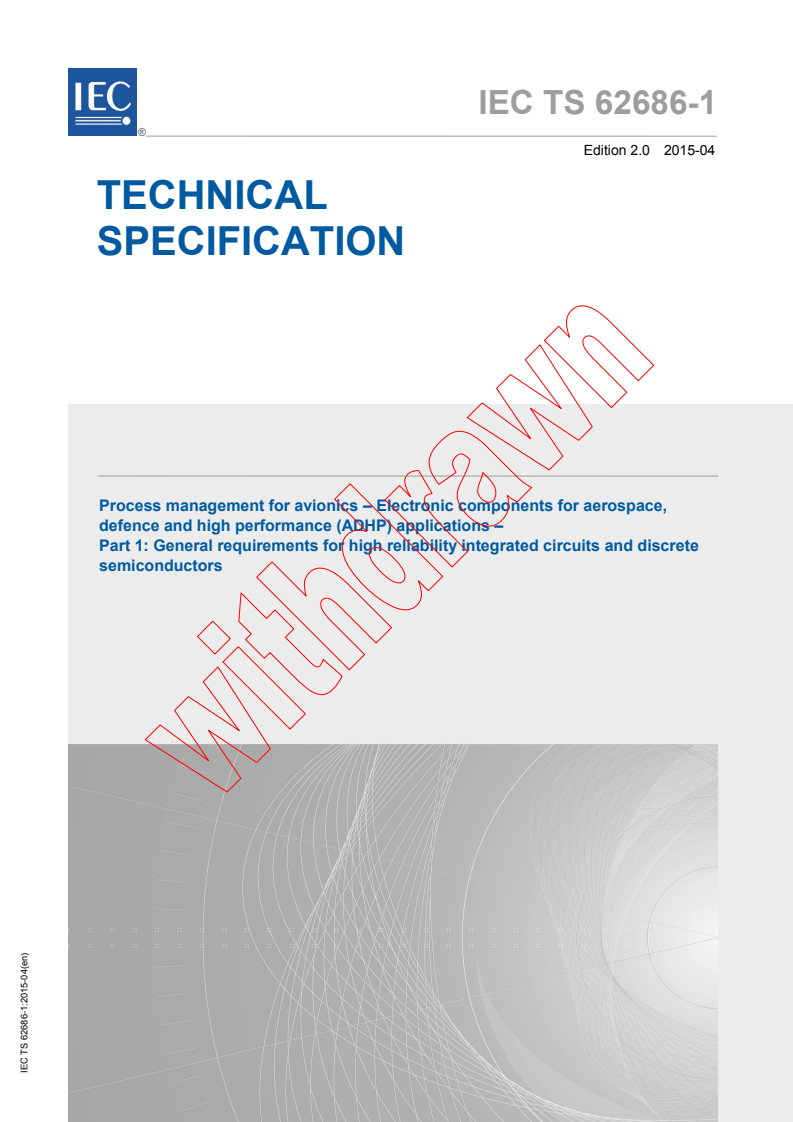
IEC TS 62686-1 ®
Edition 2.0 2015-04
TECHNICAL
SPECIFICATION
Process management for avionics – Electronic components for aerospace,
defence and high performance (ADHP) applications –
Part 1: General requirements for high reliability integrated circuits and discrete
semiconductors
All rights reserved. Unless otherwise specified, no part of this publication may be reproduced or utilized in any form
or by any means, electronic or mechanical, including photocopying and microfilm, without permission in writing from
either IEC or IEC's member National Committee in the country of the requester. If you have any questions about IEC
copyright or have an enquiry about obtaining additional rights to this publication, please contact the address below or
your local IEC member National Committee for further information.
IEC Central Office Tel.: +41 22 919 02 11
3, rue de Varembé Fax: +41 22 919 03 00
CH-1211 Geneva 20 info@iec.ch
Switzerland www.iec.ch
About the IEC
The International Electrotechnical Commission (IEC) is the leading global organization that prepares and publishes
International Standards for all electrical, electronic and related technologies.
About IEC publications
The technical content of IEC publications is kept under constant review by the IEC. Please make sure that you have the
latest edition, a corrigenda or an amendment might have been published.
IEC Catalogue - webstore.iec.ch/catalogue Electropedia - www.electropedia.org
The stand-alone application for consulting the entire The world's leading online dictionary of electronic and
bibliographical information on IEC International Standards, electrical terms containing more than 30 000 terms and
Technical Specifications, Technical Reports and other definitions in English and French, with equivalent terms in 15
documents. Available for PC, Mac OS, Android Tablets and additional languages. Also known as the International
iPad. Electrotechnical Vocabulary (IEV) online.
IEC publications search - www.iec.ch/searchpub IEC Glossary - std.iec.ch/glossary
The advanced search enables to find IEC publications by a More than 60 000 electrotechnical terminology entries in
variety of criteria (reference number, text, technical English and French extracted from the Terms and Definitions
committee,…). It also gives information on projects, replaced clause of IEC publications issued since 2002. Some entries
and withdrawn publications. have been collected from earlier publications of IEC TC 37,
77, 86 and CISPR.
IEC Just Published - webstore.iec.ch/justpublished
Stay up to date on all new IEC publications. Just Published IEC Customer Service Centre - webstore.iec.ch/csc
details all new publications released. Available online and If you wish to give us your feedback on this publication or
also once a month by email. need further assistance, please contact the Customer Service
Centre: csc@iec.ch.
IEC TS 62686-1 ®
Edition 2.0 2015-04
TECHNICAL
SPECIFICATION
Process management for avionics – Electronic components for aerospace,
defence and high performance (ADHP) applications –
Part 1: General requirements for high reliability integrated circuits and discrete
semiconductors
INTERNATIONAL
ELECTROTECHNICAL
COMMISSION
ICS 03.100.50; 31.020; 49.060 ISBN 978-2-8322-2645-2
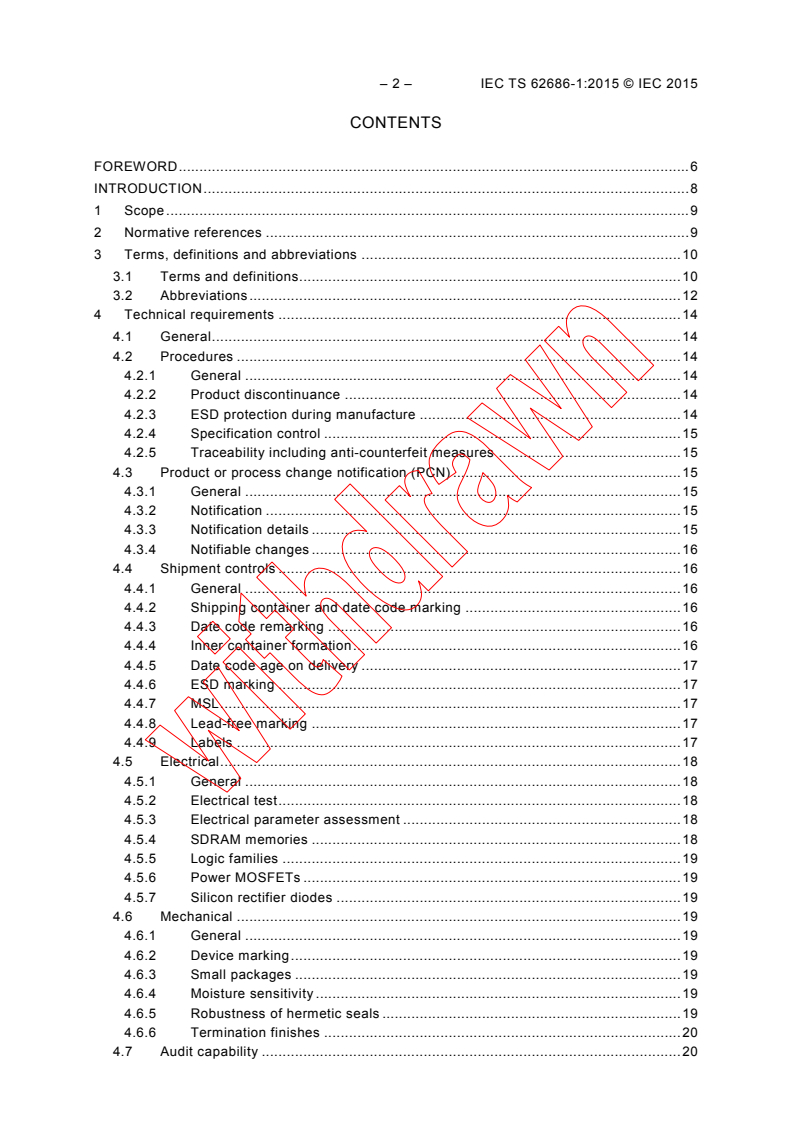
– 2 – IEC TS 62686-1:2015 © IEC 2015
CONTENTS
FOREWORD . 6
INTRODUCTION . 8
1 Scope . 9
2 Normative references . 9
3 Terms, definitions and abbreviations . 10
3.1 Terms and definitions . 10
3.2 Abbreviations . 12
4 Technical requirements . 14
4.1 General . 14
4.2 Procedures . 14
4.2.1 General . 14
4.2.2 Product discontinuance . 14
4.2.3 ESD protection during manufacture . 14
4.2.4 Specification control . 15
4.2.5 Traceability including anti-counterfeit measures . 15
4.3 Product or process change notification (PCN) . 15
4.3.1 General . 15
4.3.2 Notification . 15
4.3.3 Notification details . 15
4.3.4 Notifiable changes . 16
4.4 Shipment controls . 16
4.4.1 General . 16
4.4.2 Shipping container and date code marking . 16
4.4.3 Date code remarking . 16
4.4.4 Inner container formation . 16
4.4.5 Date code age on delivery . 17
4.4.6 ESD marking . 17
4.4.7 MSL . 17
4.4.8 Lead-free marking . 17
4.4.9 Labels . 17
4.5 Electrical . 18
4.5.1 General . 18
4.5.2 Electrical test . 18
4.5.3 Electrical parameter assessment . 18
4.5.4 SDRAM memories . 18
4.5.5 Logic families . 19
4.5.6 Power MOSFETs . 19
4.5.7 Silicon rectifier diodes . 19
4.6 Mechanical . 19
4.6.1 General . 19
4.6.2 Device marking . 19
4.6.3 Small packages . 19
4.6.4 Moisture sensitivity . 19
4.6.5 Robustness of hermetic seals . 19
4.6.6 Termination finishes . 20
4.7 Audit capability . 20
4.7.1 General . 20
4.7.2 Internal quality audits . 20
4.7.3 Subcontract manufacturing . 20
4.8 Quality assurance . 21
4.8.1 General . 21
4.8.2 Quality system . 21
4.8.3 Sampling plans . 21
4.8.4 Failure analysis support . 21
4.8.5 Outgoing quality . 21
4.9 Supplier performance monitoring by the user . 22
4.9.1 General . 22
4.9.2 Lot acceptance . 22
4.9.3 Suspension of deliveries . 23
4.9.4 Loss of approval . 23
4.9.5 AQL figures . 23
4.9.6 100 % screening . 23
4.9.7 Termination determination . 23
4.10 Qualification . 23
4.10.1 General . 23
4.10.2 Methodology . 24
4.10.3 Test samples . 25
4.10.4 Qualification categories . 26
4.10.5 Maintenance of qualification standard . 26
4.10.6 In-process test results . 26
4.10.7 Product monitor results . 30
4.10.8 References . 30
4.10.9 Qualification report . 30
4.10.10 Archiving . 30
4.10.11 Qualification by similarity . 30
4.10.12 Similarity assessment . 30
4.11 Reliability . 31
4.11.1 General . 31
4.11.2 Operating reliability. 31
4.11.3 Failure criteria . 31
4.11.4 Corrective action . 32
4.11.5 Warranty . 32
4.11.6 Suspension of certification . 32
4.11.7 Single event effects (SEE) . 32
4.12 Product monitor . 32
4.12.1 General . 32
4.12.2 Monitor programme . 32
4.12.3 Problem notification . 33
4.12.4 Data reporting. 33
4.12.5 Samples . 33
4.12.6 Corrective action . 33
4.12.7 Product monitor results . 33
4.12.8 Accumulated test data . 33
4.13 Environmental, health and safety (EHS) . 34
4.13.1 General . 34
– 4 – IEC TS 62686-1:2015 © IEC 2015
4.13.2 EHS compliance . 34
4.13.3 Device handling . 34
4.13.4 Device materials . 34
4.14 Shipping containers . 34
4.14.1 General . 34
4.14.2 ESD requirements . 34
4.14.3 Magazine reuse . 36
4.14.4 Tubes . 36
4.14.5 Trays . 36
4.14.6 Tape and reel . 37
4.15 Compliance with internal standards . 37
Annex A (informative) Test code (TC) information . 38
A.1 General . 38
A.2 TC1 – Autoclave (AC) . 38
A.3 TC2 – Bond strength, internal (BS) . 38
A.4 TC3 – Die shear strength (DS) . 38
A.5 TC4 – Electromigration (EM) . 38
A.6 TC5 – Electrostatic discharge (ESD) . 39
A.7 TC6 – Electrical test (ET) . 39
A.8 TC7 – Electrical distributions (ED) . 39
A.9 TC8 – Flammability (FL) . 40
A.10 TC9 – Hot carrier injection (HCI) . 40
A.11 TC10 – Hermeticity (HE) . 40
A.12 TC11 – High temperature bake (HTB) . 40
A.13 TC12 – High temperature blocking bias (HTBB) . 41
A.14 TC13 – High temperature gate bias (HTGB) . 41
A.15 TC14 – High temperature reverse bias (HTRB) . 41
A.16 TC15 – High temperature operating life (HTOL) . 41
A.16.1 General . 41
A.16.2 Qualification conditions . 41
A.16.3 Test results assessment . 41
A.16.4 Temperature acceleration factor . 42
A.16.5 Supply voltage acceleration factor . 42
A.17 TC16 – Latch-up (LU) . 43
A.18 TC17 – Lead integrity (LI) . 43
A.19 TC18 – Lid torque (LT) . 43
A.20 TC19 – Mechanical sequence (MS) . 43
A.20.1 General . 43
A.20.2 Constant acceleration . 44
A.20.3 Vibration (variable frequency) . 44
A.20.4 Mechanical shock . 44
A.21 TC20 – Marking permanency (MP) . 44
A.22 TC21 – Non-volatile memory operating life (NVL) . 44
A.23 TC22 – Time dependent dielectric breakdown (oxide integrity) (OI) . 45
A.24 TC23 – Package dimensions (PD) . 45
A.25 TC24 – Power cycling (PTC) . 45
A.26 TC25 – Resistance to solder heat (RSH) . 45
A.27 TC26 – Solder preconditioning (PC) . 45
A.28 TC27 – Solderability (SD) . 46
A.29 TC28 – Soft error rate (SER). 46
A.30 TC29 – Steady state operating life (SSOL) . 47
A.31 TC30 – Temperature cycling (TC) . 47
A.32 TC31 – Temperature humidity reverse bias (THRB) . 47
A.33 TC32 – Temperature humidity bias (THB or HAST) . 48
A.34 TC33 – Terminal strength (TS) . 48
A.35 TC34 – Thermal resistance (thermal impedance) (TR) . 48
A.36 TC35 – visual inspection (VI) . 48
A.36.1 TC35a – External visual inspection . 48
A.36.2 TC35b – Internal visual inspection . 49
A.37 TC36 – Water vapour content, internal (WV) . 49
A.38 TC37 – X-ray inspection (XR) . 50
A.39 TC38 – Moisture sensitivity level (MSL) . 50
A.40 TC39 – Ball shear test (BST) . 50
A.41 TC40 – Negative bias temperature instability (NBTI) . 50
A.42 TC41 – Accelerated tin whisker test . 50
Annex B (informative) Cross-reference to STACK Specification S/0001 revision 14 . 51
Bibliography . 58
Table 1 – Label requirements. 18
Table 2 – Internal quality audit requirements. 20
Table 3 – Outgoing quality . 22
Table 4 – Incoming test . 23
Table 5 – Technology/family qualification and device qualification . 27
Table 6 – Product monitor tests . 34
Table A.1 – Conditions of the DC over voltage stress method of JP001.01 or
IEC 62416 test . 40
Table A.2 – Examples of temperature acceleration factors . 42
Table A.3 – Dip and look test references. 46
Table A.4 – Parameter values for consideration . 46
Table A.5 – Test conditions. 47
Table A.6 – Test methods . 48
– 6 – IEC TS 62686-1:2015 © IEC 2015
INTERNATIONAL ELECTROTECHNICAL COMMISSION
____________
PROCESS MANAGEMENT FOR AVIONICS –
ELECTRONIC COMPONENTS FOR AEROSPACE, DEFENCE
AND HIGH PERFORMANCE (ADHP) APPLICATIONS –
Part 1: General requirements for high reliability
integrated circuits and discrete semiconductors
FOREWORD
1) The International Electrotechnical Commission (IEC) is a worldwide organization for standardization comprising
all national electrotechnical committees (IEC National Committees). The object of IEC is to promote
international co-operation on all questions concerning standardization in the electrical and electronic fields. To
this end and in addition to other activities, IEC publishes International Standards, Technical Specifications,
Technical Reports, Publicly Available Specifications (PAS) and Guides (hereafter referred to as “IEC
Publication(s)”). Their preparation is entrusted to technical committees; any IEC National Committee interested
in the subject dealt with may participate in this preparatory work. International, governmental and non-
governmental organizations liaising with the IEC also participate in this preparation. IEC collaborates closely
with the International Organization for Standardization (ISO) in accordance with conditions determined by
agreement between the two organizations.
2) The formal decisions or agreements of IEC on technical matters express, as nearly as possible, an international
consensus of opinion on the relevant subjects since each technical committee has representation from all
interested IEC National Committees.
3) IEC Publications have the form of recommendations for international use and are accepted by IEC National
Committees in that sense. While all reasonable efforts are made to ensure that the technical content of IEC
Publications is accurate, IEC cannot be held responsible for the way in which they are used or for any
misinterpretation by any end user.
4) In order to promote international uniformity, IEC National Committees undertake to apply IEC Publications
transparently to the maximum extent possible in their national and regional publications. Any divergence
between any IEC Publication and the corresponding national or regional publication shall be clearly indicated in
the latter.
5) IEC itself does not provide any attestation of conformity. Independent certification bodies provide conformity
assessment services and, in some areas, access to IEC marks of conformity. IEC is not responsible for any
services carried out by independent certification bodies.
6) All users should ensure that they have the latest edition of this publication.
7) No liability shall attach to IEC or its directors, employees, servants or agents including individual experts and
members of its technical committees and IEC National Committees for any personal injury, property damage or
other damage of any nature whatsoever, whether direct or indirect, or for costs (including legal fees) and
expenses arising out of the publication, use of, or reliance upon, this IEC Publication or any other IEC
Publications.
8) Attention is drawn to the Normative references cited in this publication. Use of the referenced publications is
indispensable for the correct application of this publication.
9) Attention is drawn to the possibility that some of the elements of this IEC Publication may be the subject of
patent rights. IEC shall not be held responsible for identifying any or all such patent rights.
The main task of IEC technical committees is to prepare International Standards. In
exceptional circumstances, a technical committee may propose the publication of a technical
specification when
• the required support cannot be obtained for the publication of an International Standard,
despite repeated efforts, or
• the subject is still under technical development or where, for any other reason, there is the
future but no immediate possibility of an agreement on an International Standard.
Technical specifications are subject to review within three years of publication to decide
whether they can be transformed into International Standards.
IEC TS 62686-1, which is a Technical Specification, has been prepared by IEC technical
committee 107: Process management for avionics.
This second edition cancels and replaces the first edition, published in 2012. This edition
constitutes a technical revision.
This edition includes the following significant technical changes with respect to the previous
edition:
a) adoption and modification of STACK Specification S/0001 revision 14 notice 3, General
requirements for integrated circuits and discrete semiconductors;
b) update of IEC semiconductor test methods;
c) update of JEDEC semiconductor test methods; including addition of JEP148A, based on
the Physics of Failure Risk and Opportunity assessment;
d) update of Annex A with additional JEDEC and IEC test information;
e) revision of lead-free termination finish requirements.
The text of this technical specification is based on the following documents:
Enquiry draft Report on voting
107/248/DTS 107/259/RVC
Full information on the voting for the approval of this technical specification can be found in
the report on voting indicated in the above table.
This publication has been drafted in accordance with the ISO/IEC Directives, Part 2.
A list of all the parts in the IEC 62686 series, published under the general title Process
management for avionics – Electronic components for aerospace, defence and high
performance (ADHP) applications, can be found on the IEC website.
The committee has decided that the contents of this publication will remain unchanged until
the stability date indicated on the IEC website under "http://webstore.iec.ch" in the data
related to the specific publication. At this date, the publication will be
• transformed into an International standard,
• reconfirmed,
• withdrawn,
• replaced by a revised edition, or
• amended.
A bilingual version of this publication may be issued at a later date.
– 8 – IEC TS 62686-1:2015 © IEC 2015
INTRODUCTION
This part of IEC 62686 includes all the requirements of STACK Specification S/0001 revision
14 notice 3 and contains revisions for alternative IEC qualification test methods and additional
test information.
This Technical Specification complements IEC TS 62564-1 which is used for ADHP
applications when additional manufacturer’s data is required beyond the publicly available
manufacturer published data sheets (e.g. when additional thermal performance data is
required for thermally challenging applications or when additional verification data are
needed, for example to comply with the requirements of RTCA DO-254/EUROCAE ED-80 for
complex components for flight critical applications, etc.).
This Technical Specification can also be used to comply with the typical qualification
requirements of IEC TS 62564-1. Further guidance is given in IEC TS 62239-1.
NOTE With the adoption of the STACK Specification S/0001 revision 14 notice 3 it will be possible for all existing
STACK certified manufacturers to be audited by IECQ under the new STACK-IECQ joint venture.
PROCESS MANAGEMENT FOR AVIONICS –
ELECTRONIC COMPONENTS FOR AEROSPACE, DEFENCE
AND HIGH PERFORMANCE (ADHP) APPLICATIONS –
Part 1: General requirements for high reliability
integrated circuits and discrete semiconductors
1 Scope
This part of IEC 62686, which is a Technical Specification, defines the minimum requirements
for general purpose "off the shelf" COTS (commercial off-the-shelf) integrated circuits and
discrete semiconductors for ADHP (aerospace, defence and high performance) applications.
This Technical Specification applies to all components that can be operated in ADHP
applications within the manufacturers’ publicly available data sheet limits in conjunction with
IEC TS 62239-1. It may be used by other high performance and high reliability industries, at
their discretion.
ADHP application requirements may not necessarily be fulfilled by this specification alone.
ADHP OEMs (original equipment manufacturers) may need to consider redesigning their
products or conducting further testing to verify suitability in ADHP applications using their
IEC TS 62239-1 ECMP procedures. Alternatively a component in accordance with
IEC TS 62564-1 may be more suitable.
2 Normative references
The following documents, in whole or in part, are normatively referenced in this document and
are indispensable for its application. For dated references, only the edition cited applies. For
undated references, the latest edition of the referenced document (including any
amendments) applies.
ISO 9001, Quality management systems – Requirements
ISO TS 16949, Quality management systems – Particular requirements for the application of
ISO 9001:2008 for automotive production and relevant service part organizations
ANSI/EIA-556, Outer Shipping Container Bar Code Label Standard
ANSI/ESD S541, Packaging Materials Standards for ESD Sensitive Items
AS/EN/JISQ 9100, Aerospace series – Quality management systems – Requirements for
aviation, space and defense organisations
IPC/JEDEC J-STD-020, Moisture/Reflow Sensitivity Classification for Nonhermetic Solid State
Surface Mount Devices
IPC/JEDEC J-STD-033, Handling, Packing, Shipping and Use of Moisture/Reflow Sensitive
Surface Mount Devices
IPC/JEDEC J-STD-609. Marking and Labeling of Components, PCBs and PCBAs to Identify
Lead (Pb), Lead-Free (Pb-Free) and Other Attributes
– 10 – IEC TS 62686-1:2015 © IEC 2015
JEDEC/IPC/ECIA J-STD-048 Notification Standard for Product Discontinuance
JEP130, Guidelines for Packing and Labeling of Integrated Circuits in Unit Container Packing
JESD46, Customer Notification of Product/Process Changes by Solid-State Suppliers
JESD471, Symbol and Label for Electrostatic Sensitive Devices
TL 9000, Quality management system
3 Terms, definitions and abbreviations
For the purposes of this document, the following terms, definitions and abbreviations apply.
3.1 Terms and definitions
3.1.1
calendar days
continuous days, including weekends and holidays
3.1.2
container
outer shipping container consisting of one or more inner containers
3.1.3
customer
user
original equipment manufacturer (OEM) which purchases electronic components, including
integrated circuits and/or semiconductor devices compliant to this technical specification and
uses them to design, produce, and maintain systems
3.1.4
data sheet
document prepared by the manufacturer that describes the electrical, mechanical, and
environmental characteristics of the component
3.1.5
deviation
user agreement to allow the delivery of a shipping lot which does not fully meet the
requirements of this specification
Note 1 to entry: Considered equivalent to concession for the purposes of this document.
3.1.6
device specification
document written by a user and agreed by the supplier or OCM
3.1.7
form
shape, arrangement of parts, visible aspect, mode in which a part exists or manifests itself,
and the material an item is constructed from
___________
For the telecommunications industry.
3.1.8
fit
fitability of an item to physically interface or interconnect with or become an integral part of
another item or assembly
Note 1 to entry: Size and scale are examples of considered characteristics.
3.1.9
function
work that an item is designed to do without degrading reliability
3.1.10
incoming lot
one or more shipments of a device, grouped together for the purpose of incoming inspection
3.1.11
inner container
box or bag containing devices, either in magazines or bulk packaged
3.1.12
magazine
shipping container that feeds into automatic placement machines
Note 1 to entry: Sticks, tubes, matrix trays, tape/reel, etc. are examples of magazine.
3.1.13
microcircuit
component
device
electrical or electronic device that is not subject to disassembly without destruction or
impairment of design use and is a small circuit having a high equivalent circuit element
density
Note 1 to entry: It is considered as a single part composed of interconnected elements on or within a single
substrate to perform an electronic circuit function.
Note 2 to entry: This excludes printed wiring boards/printed circuit boards, circuit card assemblies and modules
composed exclusively of discrete electronic components.
3.1.14
moisture sensitivity level
MSL
rating indicating a component’s susceptibility to damage due to absorbed moisture when
subjected to reflow soldering
3.1.15
original component manufacturer
OCM
company specifying and manufacturing the electronic component
3.1.16
room temperature
temperature identified at 25 °C ± 5 °C in a room
3.1.17
semiconductor device
electronic devices in which the characteristic distinguishing electronic conduction takes place
with a semiconductor
Note 1 to entry: Semiconductor diodes are examples of semiconductor devices having two terminals and
exhibiting a nonlinear voltage-current characteristic.
– 12 – IEC TS 62686-1:2015 © IEC 2015
Note 2 to entry: Transistors are examples of active semiconductor devices capable of providing power
amplification and having three or more terminals.
3.1.18
shipping lot
single lot of one or more containers received by a user
3.1.19
supplier
company which provides to another an electronic component which is identified by the logo or
name marked on the device
Note 1 to entry: A supplier can be the OCM, a franchised distributor or agent, a non-franchised distributor, broker,
reseller, OEM, CEM and EMS etc.
3.1.20
termination
element of a component that connects it electrically and mechanically to the next level of
assembly
3.1.21
triboelectric charge
electrical charge generated by frictional movement or separation of two surfaces
3.2 Abbreviations
AC alternating current
ADHP aerospace, defence and high performance
AOQ average out-going quality
AQEC aerospace qualified electronic component
AQL acceptable quality level
ASIC application specific integrated circuit
BGA ball grid array
BPSG borophosphosilicate glass
CB certification body
CEM contract electronic manufacturer
CFC chlorofluorocarbon
COTS commercial off–the-shelf
CMOS complementary metal oxide semiconductor
D semiconductor device
DC direct current
DRAM dynamic random access memory
DLA Defense Logistics Agency (see http://www.dscc.dla.mil/)
DPM defects per million
ECMP electronic component management plan
EHS Environmental Health and Safety
EMAS Eco-Management and Audit Scheme (established by the European Union)
EMS electronic manufacturing services
ESD electrostatic sensitive damage
FFF form, fit and function
FIT failures in time
h hour
HAST highly accelerated stress test
HCI hot carrier injection
HTGB high temperature gate bias
HTOL high temperature operating life
HTRB high temperature reverse bias
IECQ International Electrotechnical Commission Quality Assessment System for
Electronic Components
IC integrated circuit
I/O input and output
IR infra-red
LTB last time buy
LTPD lot tolerance percent defective
min minute
MSL moisture sensitivity level
NBTI negative bias temperature Instability
NMOS n-type metal oxide-semiconductor (refers to field effect transistors (MOSFETs))
NVL non-volatile memory operating life
OCM original component manufacturer
OEM original equipment manufacturer
PC preconditioning
PCB printed circuit board
PCN product or process change notification
Pkg package
QA quality assurance
SDRAM synchronous dynamic random access memory
SEE single event effect
SEFI single event functional interrupt
SEL single event latchup
SEU single event upset
SER soft error rate
SMD surface mount device
SRAM static random access memory
T ambient temperature
amb
TC test code
THB temperature humidity bias
T minimum operating temperature
opmin
T maximum operating temperature
opmax
UCL upper control limit
VPR vapour
– 14 – IEC TS 62686-1:2015 © IEC 2015
4 Technical requirements
4.1 General
The supplier or original component manufacturer (OCM), as defined in 3.1.19 and 3.1.15
respectively, shall be Third Party ISO 9001 certified and shall provide the following minimum
technical requirements. The OCM may use the test methods and methodologies specified
herein which are based on IEC semiconductor test methods or any other equivalent test
method, for example JEDEC test methods (see 4.10.2.3 and Annex A). Proposed equivalent
test methods, rationale and supporting data shall be reviewed and shall achieve the same end
objectives as specified herein. Use of such equivalent tests shall not be considered to be
deviations or waivers to the requirements of this specification.
Informative annexes are provided at the end of this specification and their content is subject
to change. Users of this specification are encouraged to review the latest data available
whenever referencing the content of these annexes as well as the bibliography:
• Annex A: test code information which summarises all semiconductor test methods
discussed herein;
• Annex B: cross-reference to STACK Specification S/0001 revision 14 notice 3;
• Bibliography.
4.2 Procedures
4.2.1 General
The OCM shall have the following procedures:
• product discontinuance (4.2.2);
• ESD protection during manufacture (4.2.3);
• specification control (4.2.4);
• traceability including anti-counterfeit measures (4.2.5).
4.2.2 Product discontinuance
Notification shall be in accordance with JEDEC/IPC/ECIA J-STD-048 or equivalent with the
exception of timing as described in a) and b) below:
a) the OCM shall provide to the user a notice of last order dates:
– a minimum of 12 months before these dates for single-source devices,
– and 6 months before these dates for multi-sourced devices;
b) the OCM may give less than the specified notice period provided a mutually acceptable
extension (up to the specification limit) is negotiated with any user needing a different
period;
c) for custom ASIC devices, the normal procedure is to include discontinuation notice in the
purchase contract.
4.2.3 ESD protection during manufacture
All integrated circuits and discrete semiconductors are considered to be static sensitive and
shall be protected through the OCM’s manufacturing operation. The OCM shall ensure that
devices are not exposed to static damage and are not degraded or damaged due to static
discharge. IEC 61340-5-1 and JESD625 are examples of suitable standards for ESD
pre
...