

IEC 63045:2020
(Main)Ultrasonics - Non-focusing short pressure pulse sources including ballistic pressure pulse sources - Characteristics of fields
General Information
- Abstract
IEC 63045:2020 is applicable to
– therapy equipment using extracorporeally induced non-focused or weakly focused pressure pulses;
– therapy equipment producing extracorporeally induced non-focused or weakly focused mechanical energy,
where the pressure pulses are released as single events of duration up to 25 µs.
This document does not apply to
– therapy equipment using focusing pressure pulse sources such as extracorporeal lithotripsy equipment;
– therapy equipment using other acoustic waveforms like physiotherapy equipment, low intensity ultrasound equipment and HIFU/HITU equipment.
This document specifies
– measurable parameters which are used in the declaration of the acoustic output of extracorporeal equipment producing a non-focused or weakly focused pressure pulse field,
– methods of measurement and characterization of non-focused or weakly focused pressure pulse fields.
This document has been developed for equipment intended for use in pressure pulse therapy, for example therapy of orthopaedic pain like shoulder pain, tennis elbow pain, heel spur pain, muscular trigger point therapy, lower back pain, etc. It is not intended to be used for extracorporeal lithotripsy equipment (as described in IEC 61846), physiotherapy equipment using other waveforms (as described in IEC 61689) and HIFU/HITU equipment (see IEC 60601 2-62 and IEC TR 62649).
- Status
- Published
- Publication Date
- 24-May-2020
- Technical Committee
- TC 87 - Ultrasonics
- Drafting Committee
- WG 7 - TC 87/WG 7
- Current Stage
- PPUB - Publication issued
- Start Date
- 25-May-2020
- Completion Date
- 12-Jun-2020
Buy Documents
IEC 63045:2020 - Ultrasonics - Non-focusing short pressure pulse sources including ballistic pressure pulse sources - Characteristics of fields Released:5/25/2020
IEC 63045:2020 - Ultrasonics - Non-focusing short pressure pulse sources including ballistic pressure pulse sources - Characteristics of fields Released:5/25/2020
Overview
IEC 63045:2020 defines measurement and declaration requirements for ultrasonic non-focusing short pressure pulse sources, including ballistic pressure pulse sources, used in extracorporeal pressure pulse therapy. The standard covers devices that deliver single, short-duration pressure pulses (up to 25 µs) and specifies the measurable acoustic output parameters, test setups, and measurement procedures. It explicitly excludes focused lithotripsy systems and other acoustic-wave therapies (e.g., physiotherapy waveforms, HIFU/HITU).
Key topics and technical requirements
- Scope and exclusions: Applicable to extracorporeally induced non-focused or weakly focused pressure pulse equipment; excludes focused shock wave lithotripsy (IEC 61846), physiotherapy ultrasonic equipment (IEC 61689) and HIFU/HITU (IEC 60601-2-62, IEC TR 62649).
- Declared acoustic parameters: Defines which measurable parameters vendors must report for acoustic output of pressure pulse devices (see Clause 7 and Annex D).
- Measurement environments:
- Water test chamber - coordinate systems, hydrophone selection and degassing procedures.
- Dry test bench - alternative for field and applicator-mounted measurements.
- Test equipment and probes: Guidance on hydrophones suitable for pressure pulse measurements, oscilloscope/transient recorders, and probe mounting (Clauses 6 and Annex C).
- Measurement procedures:
- Spatial mapping: beam axis, beam width, beam cross-section and volume, beam pressure maximum extent.
- Temporal mapping: pulse waveform capture, peak-positive/peak-negative pressures.
- Energy measures: pulse-pressure-squared integral, pulse-intensity integral and derived acoustic pulse energy.
- Informative annexes: Background on therapy use, transducer types (ballistic, rail-gun, other), positioning/targeting, and example measurement setups.
Applications and users
IEC 63045:2020 is intended for:
- Manufacturers of extracorporeal pressure pulse therapy devices (design verification and product declarations).
- Test laboratories and QA teams performing acoustic output measurements and compliance testing.
- Regulatory and conformity assessment bodies evaluating safety and performance claims.
- Biomedical engineers and R&D teams developing non-focused or weakly focused pulse sources (e.g., treatments for shoulder pain, tennis elbow, heel spur, trigger points, lower back pain).
- Clinical engineers verifying device performance as part of clinical deployment.
Practical benefits include consistent, reproducible acoustic measurement methods, standardized reporting of pulse parameters, and improved comparability across devices and test labs.
Related standards
- IEC 61846 - extracorporeal lithotripsy (focused shock wave systems)
- IEC 61689 - physiotherapy ultrasonic equipment
- IEC 60601‑2‑62 and IEC TR 62649 - HIFU/HITU related guidance
- IEC TC 87 - committee responsible for ultrasonics standards
Keywords: IEC 63045:2020, ultrasonics, pressure pulse therapy, ballistic pressure pulse sources, non-focusing, weakly focused, acoustic output measurement, hydrophone, water test chamber, dry test bench.
Buy Documents
IEC 63045:2020 - Ultrasonics - Non-focusing short pressure pulse sources including ballistic pressure pulse sources - Characteristics of fields Released:5/25/2020
IEC 63045:2020 - Ultrasonics - Non-focusing short pressure pulse sources including ballistic pressure pulse sources - Characteristics of fields Released:5/25/2020
Get Certified
Connect with accredited certification bodies for this standard

BSMI (Bureau of Standards, Metrology and Inspection)
Taiwan's standards and inspection authority.
Sponsored listings
Frequently Asked Questions
IEC 63045:2020 is a standard published by the International Electrotechnical Commission (IEC). Its full title is "Ultrasonics - Non-focusing short pressure pulse sources including ballistic pressure pulse sources - Characteristics of fields". This standard covers: IEC 63045:2020 is applicable to – therapy equipment using extracorporeally induced non-focused or weakly focused pressure pulses; – therapy equipment producing extracorporeally induced non-focused or weakly focused mechanical energy, where the pressure pulses are released as single events of duration up to 25 µs. This document does not apply to – therapy equipment using focusing pressure pulse sources such as extracorporeal lithotripsy equipment; – therapy equipment using other acoustic waveforms like physiotherapy equipment, low intensity ultrasound equipment and HIFU/HITU equipment. This document specifies – measurable parameters which are used in the declaration of the acoustic output of extracorporeal equipment producing a non-focused or weakly focused pressure pulse field, – methods of measurement and characterization of non-focused or weakly focused pressure pulse fields. This document has been developed for equipment intended for use in pressure pulse therapy, for example therapy of orthopaedic pain like shoulder pain, tennis elbow pain, heel spur pain, muscular trigger point therapy, lower back pain, etc. It is not intended to be used for extracorporeal lithotripsy equipment (as described in IEC 61846), physiotherapy equipment using other waveforms (as described in IEC 61689) and HIFU/HITU equipment (see IEC 60601 2-62 and IEC TR 62649).
IEC 63045:2020 is applicable to – therapy equipment using extracorporeally induced non-focused or weakly focused pressure pulses; – therapy equipment producing extracorporeally induced non-focused or weakly focused mechanical energy, where the pressure pulses are released as single events of duration up to 25 µs. This document does not apply to – therapy equipment using focusing pressure pulse sources such as extracorporeal lithotripsy equipment; – therapy equipment using other acoustic waveforms like physiotherapy equipment, low intensity ultrasound equipment and HIFU/HITU equipment. This document specifies – measurable parameters which are used in the declaration of the acoustic output of extracorporeal equipment producing a non-focused or weakly focused pressure pulse field, – methods of measurement and characterization of non-focused or weakly focused pressure pulse fields. This document has been developed for equipment intended for use in pressure pulse therapy, for example therapy of orthopaedic pain like shoulder pain, tennis elbow pain, heel spur pain, muscular trigger point therapy, lower back pain, etc. It is not intended to be used for extracorporeal lithotripsy equipment (as described in IEC 61846), physiotherapy equipment using other waveforms (as described in IEC 61689) and HIFU/HITU equipment (see IEC 60601 2-62 and IEC TR 62649).
IEC 63045:2020 is classified under the following ICS (International Classification for Standards) categories: 17.140.50 - Electroacoustics. The ICS classification helps identify the subject area and facilitates finding related standards.
IEC 63045:2020 is available in PDF format for immediate download after purchase. The document can be added to your cart and obtained through the secure checkout process. Digital delivery ensures instant access to the complete standard document.
Standards Content (Sample)
IEC 63045 ®
Edition 1.0 2020-05
INTERNATIONAL
STANDARD
colour
inside
Ultrasonics – Non-focusing short pressure pulse sources including ballistic
pressure pulse sources – Characteristics of fields
All rights reserved. Unless otherwise specified, no part of this publication may be reproduced or utilized in any form
or by any means, electronic or mechanical, including photocopying and microfilm, without permission in writing from
either IEC or IEC's member National Committee in the country of the requester. If you have any questions about IEC
copyright or have an enquiry about obtaining additional rights to this publication, please contact the address below or
your local IEC member National Committee for further information.
IEC Central Office Tel.: +41 22 919 02 11
3, rue de Varembé info@iec.ch
CH-1211 Geneva 20 www.iec.ch
Switzerland
About the IEC
The International Electrotechnical Commission (IEC) is the leading global organization that prepares and publishes
International Standards for all electrical, electronic and related technologies.
About IEC publications
The technical content of IEC publications is kept under constant review by the IEC. Please make sure that you have the
latest edition, a corrigendum or an amendment might have been published.
IEC publications search - webstore.iec.ch/advsearchform Electropedia - www.electropedia.org
The advanced search enables to find IEC publications by a The world's leading online dictionary on electrotechnology,
variety of criteria (reference number, text, technical containing more than 22 000 terminological entries in English
committee,…). It also gives information on projects, replaced and French, with equivalent terms in 16 additional languages.
and withdrawn publications. Also known as the International Electrotechnical Vocabulary
(IEV) online.
IEC Just Published - webstore.iec.ch/justpublished
Stay up to date on all new IEC publications. Just Published IEC Glossary - std.iec.ch/glossary
details all new publications released. Available online and once 67 000 electrotechnical terminology entries in English and
a month by email. French extracted from the Terms and Definitions clause of IEC
publications issued since 2002. Some entries have been
IEC Customer Service Centre - webstore.iec.ch/csc collected from earlier publications of IEC TC 37, 77, 86 and
If you wish to give us your feedback on this publication or need CISPR.
further assistance, please contact the Customer Service
Centre: sales@iec.ch.
IEC 63045 ®
Edition 1.0 2020-05
INTERNATIONAL
STANDARD
colour
inside
Ultrasonics – Non-focusing short pressure pulse sources including ballistic
pressure pulse sources – Characteristics of fields
INTERNATIONAL
ELECTROTECHNICAL
COMMISSION
ICS 17.140.50 ISBN 978-2-8322-8340-0
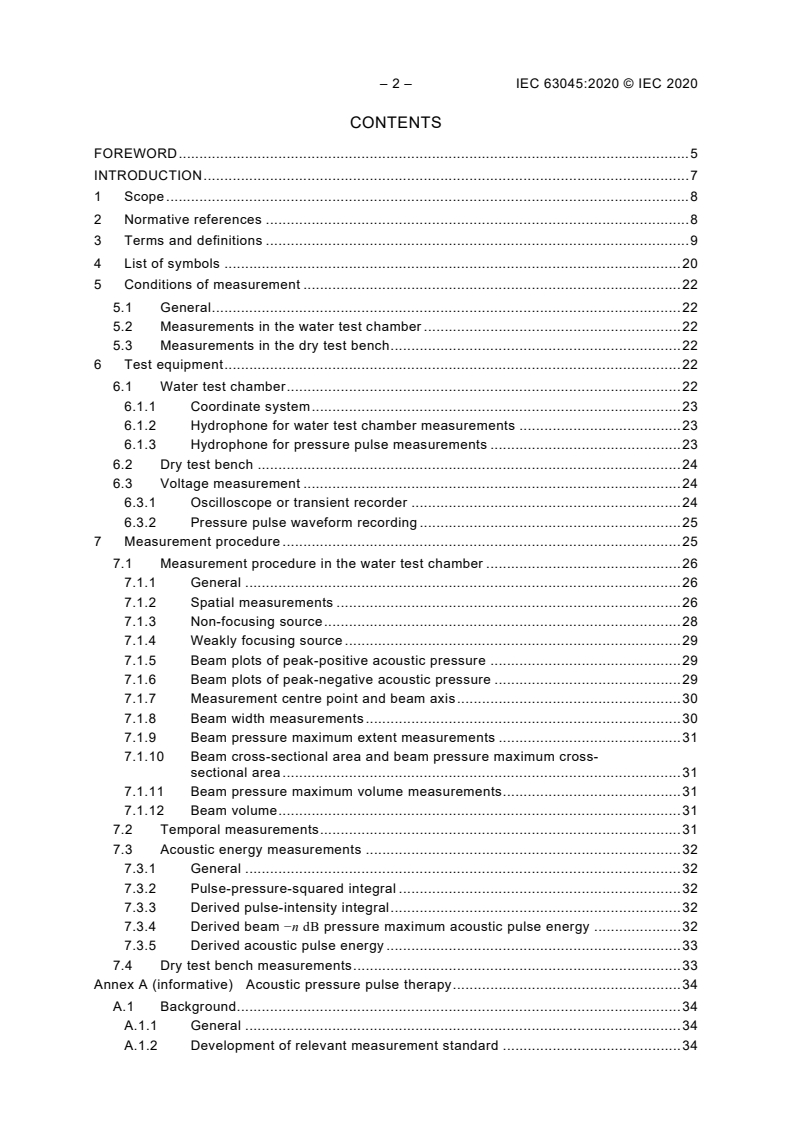
– 2 – IEC 63045:2020 © IEC 2020
CONTENTS
FOREWORD . 5
INTRODUCTION . 7
1 Scope . 8
2 Normative references . 8
3 Terms and definitions . 9
4 List of symbols . 20
5 Conditions of measurement . 22
5.1 General . 22
5.2 Measurements in the water test chamber . 22
5.3 Measurements in the dry test bench . 22
6 Test equipment . 22
6.1 Water test chamber . 22
6.1.1 Coordinate system . 23
6.1.2 Hydrophone for water test chamber measurements . 23
6.1.3 Hydrophone for pressure pulse measurements . 23
6.2 Dry test bench . 24
6.3 Voltage measurement . 24
6.3.1 Oscilloscope or transient recorder . 24
6.3.2 Pressure pulse waveform recording . 25
7 Measurement procedure . 25
7.1 Measurement procedure in the water test chamber . 26
7.1.1 General . 26
7.1.2 Spatial measurements . 26
7.1.3 Non-focusing source . 28
7.1.4 Weakly focusing source . 29
7.1.5 Beam plots of peak-positive acoustic pressure . 29
7.1.6 Beam plots of peak-negative acoustic pressure . 29
7.1.7 Measurement centre point and beam axis . 30
7.1.8 Beam width measurements . 30
7.1.9 Beam pressure maximum extent measurements . 31
7.1.10 Beam cross-sectional area and beam pressure maximum cross-
sectional area . 31
7.1.11 Beam pressure maximum volume measurements . 31
7.1.12 Beam volume . 31
7.2 Temporal measurements . 31
7.3 Acoustic energy measurements . 32
7.3.1 General . 32
7.3.2 Pulse-pressure-squared integral . 32
7.3.3 Derived pulse-intensity integral . 32
7.3.4 Derived beam −n dB pressure maximum acoustic pulse energy . 32
7.3.5 Derived acoustic pulse energy . 33
7.4 Dry test bench measurements . 33
Annex A (informative) Acoustic pressure pulse therapy . 34
A.1 Background. 34
A.1.1 General . 34
A.1.2 Development of relevant measurement standard . 34
A.1.3 Current knowledge on biomedical effects . 34
A.1.4 Availability of clinical and technical data . 34
A.2 Other treatment devices and methods not subject to this document . 35
A.2.1 Percutaneous continuous and modulated wave systems . 35
A.2.2 Extracorporeal shock wave lithotripsy . 35
A.2.3 Further exclusions . 35
Annex B (informative) Types of pressure pulse transducers . 36
B.1 Overview. 36
B.1.1 General . 36
B.1.2 Principle of ballistic pressure pulse sources . 36
B.1.3 Rail gun principle . 36
B.1.4 Further generation principles . 37
B.2 Non-focusing and focusing transducers . 37
B.3 Examples of pressure pulse sources and their parameter sets . 38
B.4 Positioning and targeting methods . 43
Annex C (informative) Field measurement . 44
C.1 Measurement probes and hydrophones . 44
C.2 Water test chamber . 46
C.2.1 General . 46
C.2.2 Degassing procedures . 46
C.3 Dry test bench . 46
C.3.1 General . 46
C.3.2 Selection and attachment of the hydrophone . 48
C.3.3 Attachment of the hand piece . 49
C.3.4 Proof of the similarity of measurements in water and the dry test bench . 49
C.3.5 Special measurements with the dry test bench . 49
C.4 Acoustic pulse energy . 50
C.4.1 General . 50
C.4.2 Extrapolation of the applicator surface pressure value . 51
Annex D (informative) Lists of parameters . 52
Bibliography . 59
Figure 1 – Typical pressure pulse waveform at 2 mm distance from a ballistic pressure
pulse source . 25
Figure 2 – Typical pressure distribution along the beam axis of an non-focusing
pressure pulse source . 27
Figure 3 – Typical pressure distribution along the beam axis of a weakly focusing
pressure pulse source . 28
Figure 4 – Typical lateral pressure distributions of p at the beam pressure maximum
c
of two ballistic pressure pulse sources . 30
Figure B.1 – Applicator directly coupled to the patient . 39
Figure B.2 – Pressure pulse source, non-symmetric (linear), directly coupled to the
patient . 39
Figure B.3 – Pressure pulse source, symmetric, distant from the patient . 40
Figure B.4 – Applicator coupled to patient . 40
Figure B.5 – Non-focused pressure pulse field . 40
Figure B.6 – Non-focused pressure pulse field -n dB parameters (example: n = 6) . 41
Figure B.7 – Non-focused pressure pulse field isobars . 41
– 4 – IEC 63045:2020 © IEC 2020
Figure B.8 – Weakly-focused pressure pulse field −6 dB contour and parameters . 42
Figure B.9 – Weakly-focused pressure pulse field volume and isobar parameters . 42
Figure B.10 – Weakly-focused pressure pulse field parameters . 43
Figure C.1 – Design example of a dry test bench in two views . 47
Figure C.2 – Detail of the measurement chamber item of the dry test bench . 48
Table C.1 – Hydrophone types for pressure pulse measurements . 45
Table C.2 – Measurement techniques and probes for quality assurance purposes . 46
Table D.1 – List of device parameters . 52
Table D.2 – Pressure pulse parameters . 53
Table D.3 – Additional parameters useful for the correlation with biological effects . 55
Table D.4 – Graphical representations of pressure pulse data . 56
Table D.5 – Data of hydrophones and measurement conditions . 57
INTERNATIONAL ELECTROTECHNICAL COMMISSION
____________
ULTRASONICS – NON-FOCUSING SHORT PRESSURE
PULSE SOURCES INCLUDING BALLISTIC
PRESSURE PULSE SOURCES – CHARACTERISTICS OF FIELDS
FOREWORD
1) The International Electrotechnical Commission (IEC) is a worldwide organization for standardization comprising
all national electrotechnical committees (IEC National Committees). The object of IEC is to promote international
co-operation on all questions concerning standardization in the electrical and electronic fields. To this end and
in addition to other activities, IEC publishes International Standards, Technical Specifications, Technical Reports,
Publicly Available Specifications (PAS) and Guides (hereafter referred to as “IEC Publication(s)”). Their
preparation is entrusted to technical committees; any IEC National Committee interested in the subject dealt with
may participate in this preparatory work. International, governmental and non-governmental organizations liaising
with the IEC also participate in this preparation. IEC collaborates closely with the International Organization for
Standardization (ISO) in accordance with conditions determined by agreement between the two organizations.
2) The formal decisions or agreements of IEC on technical matters express, as nearly as possible, an international
consensus of opinion on the relevant subjects since each technical committee has representation from all
interested IEC National Committees.
3) IEC Publications have the form of recommendations for international use and are accepted by IEC National
Committees in that sense. While all reasonable efforts are made to ensure that the technical content of IEC
Publications is accurate, IEC cannot be held responsible for the way in which they are used or for any
misinterpretation by any end user.
4) In order to promote international uniformity, IEC National Committees undertake to apply IEC Publications
transparently to the maximum extent possible in their national and regional publications. Any divergence between
any IEC Publication and the corresponding national or regional publication shall be clearly indicated in the latter.
5) IEC itself does not provide any attestation of conformity. Independent certification bodies provide conformity
assessment services and, in some areas, access to IEC marks of conformity. IEC is not responsible for any
services carried out by independent certification bodies.
6) All users should ensure that they have the latest edition of this publication.
7) No liability shall attach to IEC or its directors, employees, servants or agents including individual experts and
members of its technical committees and IEC National Committees for any personal injury, property damage or
other damage of any nature whatsoever, whether direct or indirect, or for costs (including legal fees) and
expenses arising out of the publication, use of, or reliance upon, this IEC Publication or any other IEC Publications.
8) Attention is drawn to the Normative references cited in this publication. Use of the referenced publications is
indispensable for the correct application of this publication.
9) Attention is drawn to the possibility that some of the elements of this IEC Publication may be the subject of patent
rights. IEC shall not be held responsible for identifying any or all such patent rights.
International Standard IEC 63045 has been prepared by IEC technical committee 87:
Ultrasonics.
The text of this International Standard is based on the following documents:
FDIS Report on voting
87/741/FDIS 87/743/RVD
Full information on the voting for the approval of this International Standard can be found in the
report on voting indicated in the above table.
This document has been drafted in accordance with the ISO/IEC Directives, Part 2.
Words in bold in the text are defined in Clause 3.
– 6 – IEC 63045:2020 © IEC 2020
The committee has decided that the contents of this document will remain unchanged until the
stability date indicated on the IEC website under "http://webstore.iec.ch" in the data related to
the specific document. At this date, the document will be
• reconfirmed,
• withdrawn,
• replaced by a revised edition, or
• amended.
IMPORTANT – The 'colour inside' logo on the cover page of this publication indicates
that it contains colours which are considered to be useful for the correct understanding
of its contents. Users should therefore print this document using a colour printer.
INTRODUCTION
In this document, pressure pulses are single pulses of ultrasonic energy of up to 25 µs duration
which have only one significant positive and one negative peak carrying more than 95 % of the
energy (see definitions). Focused pressure pulses (sometimes called "strongly focused") are
characterized by a peak acoustic pressure in a point in the sound field distant from the source
aperture. Parameters and measurement methods for focusing pressure pulse sources are
described in IEC 61846. The parameters and measurement methods of any other types of
pressure pulses, i.e. weakly focused and non-focused pressure pulses, are described in this
document.
Devices with non-focusing/weakly focusing pressure pulse sources are used for the
extracorporeal treatment of soft tissue pain situations in, for example, the shoulder, the heel
spur or the tennis elbow and for trigger point therapy. Further, still under research are
applications in orthopaedics, pain therapy, treatment of angina pectoris, stem cell therapy of
infarcted cardiac areas, treatment of erectile dysfunction, of cellulitis, and wound repair.
The patients receive between 3 to 5 treatments of 10 min to 20 min duration with approximately
or on average 1 000 pulses. Each pressure pulse consists of one significant compressional
part and a trailing negative part and has an overall duration of less than 25 µs. In present
devices, 1 to 35 pulses per second are released to the target tissue. The pulses are usually
applied to the patient by a manually guided hand piece. Targeting is commonly done by asking
the patient to direct the pulses to the point of maximum pain.
The first use of non-focused/weakly focused pressure pulses to treat soft tissue pain situations
was described in 1999. The first devices used the ballistic principle for the generation of the
pressure pulses, which is based on an "air-gun" like acceleration of a projectile by pressurized
air. The projectile impinges on the rear side of a larger metal applicator, the front side of which
instantly releases one fast pressure pulse to the patient. Today, most of the devices on the
market use this design and often are called “radial shock wave devices” or “ballistic sources”
although a true shock wave is not created. Also, other pulse generating principles are being
applied including variations of common lithotripter sources (electromagnetic, piezoelectric,
electrohydraulic).
Before this first occurrence, focused pressure pulses were used clinically beginning in 1993
for the treatment of shoulder calcifications, tennis elbow pain and heel spur pain, initially using
lithotripter-like electrohydraulic, electromagnetic or piezoelectric sources. These focused
pressure pulses can be characterized by IEC 61846, but the parameters described therein are
not sufficiently applicable to characterize the parameters and fields of weakly focused and non-
focused pressure pulses and their propagation characteristics.
This document specifies methods of measuring and characterizing the acoustic pressure
pulses generated by non-focusing/weakly focusing pressure pulse equipment and their
propagation characteristics.
– 8 – IEC 63045:2020 © IEC 2020
ULTRASONICS – NON-FOCUSING SHORT PRESSURE
PULSE SOURCES INCLUDING BALLISTIC
PRESSURE PULSE SOURCES – CHARACTERISTICS OF FIELDS
1 Scope
This document is applicable to
– therapy equipment using extracorporeally induced non-focused or weakly focused pressure
pulses;
– therapy equipment producing extracorporeally induced non-focused or weakly focused
mechanical energy,
where the pressure pulses are released as single events of duration up to 25 µs.
This document does not apply to
– therapy equipment using focusing pressure pulse sources such as extracorporeal
lithotripsy equipment;
– therapy equipment using other acoustic waveforms like physiotherapy equipment, low
intensity ultrasound equipment and HIFU/HITU equipment.
This document specifies
– measurable parameters which are used in the declaration of the acoustic output of
extracorporeal equipment producing a non-focused or weakly focused pressure pulse
field,
– methods of measurement and characterization of non-focused or weakly focused
pressure pulse fields.
NOTE 1 The parameters defined in this document do not – at the time of publication – allow quantitative statements
to be made about clinical efficacy and possible hazard. In particular, it is not possible to make a statement about the
limits for these effects.
NOTE 2 Figure B.1 to Figure B.10 and Figure 2 to Figure 4 are useful to understand the geometry of the field
applied in this document.
This document has been developed for equipment intended for use in pressure pulse therapy,
for example therapy of orthopaedic pain like shoulder pain, tennis elbow pain, heel spur pain,
muscular trigger point therapy, lower back pain, etc. It is not intended to be used for
extracorporeal lithotripsy equipment (as described in IEC 61846), physiotherapy equipment
using other waveforms (as described in IEC 61689) and HIFU/HITU equipment (see
IEC 60601-2-62 and IEC TR 62649).
2 Normative references
The following documents are referred to in the text in such a way that some or all of their content
constitutes requirements of this document. For dated references, only the edition cited applies.
For undated references, the latest edition of the referenced document (including any
amendments) applies.
IEC 60565-1, Underwater acoustics – Hydrophones – Calibration of hydrophones – Part 1:
Procedures for free-field calibration of hydrophones
IEC 60565-2, Underwater acoustics – Hydrophones – Calibration of hydrophones – Part 2:
Procedures for low frequency pressure calibration
IEC 62127-1:2007, Ultrasonics – Hydrophones – Part 1: Measurement and characterization of
medical ultrasonic fields up to 40 MHz
IEC 62127-1:2007/AMD1:2013
IEC 62127-2:2007, Ultrasonics – Hydrophones – Part 2: Calibration for ultrasonic fields up to
40 MHz
IEC 62127-3, Ultrasonics – Hydrophones – Part 3: Properties of hydrophones for ultrasonic
fields up to 40 MHz
3 Terms and definitions
For the purposes of this document, the following terms and definitions apply.
ISO and IEC maintain terminological databases for use in standardization at the following
addresses:
• IEC Electropedia: available at http://www.electropedia.org/
• ISO Online browsing platform: available at http://www.iso.org/obp
3.1
applicator
part of the ballistic pressure pulse source which emits the pressure pulses to the patient
Note 1 to entry: In the case of a ballistic pressure pulse source, the front side of the applicator is often coupled
to the skin of the patient using an ultrasound coupling gel or other agent and releasing the pressure pulses to the
patient. In this case, the front of the applicator is equal to the source aperture.
Note 2 to entry: Depending on the design of the source, there may be a space between the source emitting the
pressure pulses (e.g. membrane, surface of piezoelectric crystals, spark gap etc.) and the source aperture. Usually,
this space is composed of an acoustically conducting pad coupling material or a fluid, which transmits the pressure
pulses from the source to the source aperture (see 3.48).
3.2
beam −n dB cross-sectional area
A
z,ndB
area enclosed by the peak-positive acoustic pressure contour in any plane perpendicular to
the beam axis, where all points on the contour have a pressure of −n dB relative to the value
at the beam axis in this plane
Note 1 to entry: The value of n and the axial distance z from the measurement centre point shall be stated as
subscript.
Note 2 to entry: Typical values of −n dB are: −3 dB, −6 dB, −10 dB, −12 dB, −20 dB. Reasonable values of n for
clinical approval and communication to the users can be identified by a risk analysis process, by applicable safety
standards, by consulting notified bodies, expert communities (e.g. ISMST – International Society for Medical
Shockwave Treatment) or through literature.
Note 3 to entry: The beam −n dB cross-sectional area is expressed in units of metre squared (m ).
3.3
beam −n dB extent
z
b,ndB
distance along the beam axis from the source aperture to the point where the peak-positive
acoustic pressure has dropped farthest by −n dB relative to the acoustic pressure at the
source aperture
Note 1 to entry: The value of n shall be stated as subscript.
Note 2 to entry: Typical values of −n dB are: −3 dB, −6 dB, −10 dB, −12 dB, −20 dB. Reasonable values of n for
clinical approval and communication to the users can be identified by a risk analysis process, by applicable safety
standards, by consulting notified bodies, expert communities (e.g. ISMST – International Society for Medical
Shockwave Treatment) or through literature.
Note 3 to entry: The beam −n dB extent is expressed in metres (m).
– 10 – IEC 63045:2020 © IEC 2020
3.4
beam −n dB volume
V
b,ndB
volume in space defined by the −n dB (relative to the beam pressure maximum value) peak-
positive acoustic pressure contours measured around the beam axis
Note 1 to entry: It may be difficult to measure −n dB points throughout the volume around the beam. It is reasonable
in practice to approximate the beam -n dB volume from measurements taken in three orthogonal directions: the
beam axis (z axis); and the two orthogonal axes (x,y) which are also orthogonal to the beam axis.
Note 2 to entry: Typical values of −n dB are: −3 dB, −6 dB, −10 dB, −12 dB, −20 dB. Reasonable values of n for
clinical approval and communication to the users can be identified by a risk analysis process, by applicable safety
standards, by consulting notified bodies, expert communities (e.g. ISMST – International Society for Medical
Shockwave Treatment) or through literature.
Note 3 to entry: The beam −n dB volume is expressed in units of metre cubed (m ).
Note 4 to entry: The value of n shall be stated as a subscript.
Note 5 to entry: See IEC 61828.
3.5
beam −n dB width, maximum
w
max,x,z,ndB
around the z
maximum width of the −n dB contour of the peak-positive acoustic pressure p
c
axis in the x-y plane at any distance z
Note 1 to entry: Typical values of −n dB are: −3 dB, −6 dB, −10 dB, −12 dB, −20 dB. Reasonable values of n for
clinical approval and communication to the users can be identified by a risk analysis process, by applicable safety
standards, by consulting notified bodies, expert communities (e.g. ISMST – International Society for Medical
Shockwave Treatment) or through literature.
Note 2 to entry: The beam −n dB width, maximum is expressed in metres (m).
Note 3 to entry: The values of z and n shall be stated as subscripts.
3.6
beam −n dB width, orthogonal
w
max,y,z,ndB
width of the −n dB contour of the peak-positive acoustic pressure p around the beam
c
pressure maximum, in the x-y plane at any distance z, in the direction perpendicular to the
direction of the beam width maximum
Note 1 to entry: Typical values of −n dB are: −3 dB, −6 dB, −10 dB, −12 dB, −20 dB. Reasonable values of n for
clinical approval and communication to the users can be identified by a risk analysis process, by applicable safety
standards, by consulting notified bodies, expert communities (e.g. ISMST – International Society for Medical
Shockwave Treatment) or through literature.
Note 2 to entry: The beam −n dB width, orthogonal is expressed in metres (m).
Note 3 to entry: The values of z and n are stated as subscripts.
3.7
beam axis
line passing through the centre of mass of the source aperture of the pressure pulse
generator and perpendicular to the source aperture surface
Note 1 to entry: This line is taken as the z axis. See 6.1.1 and Clause 7.
Note 2 to entry: For a definition of centre of mass, see IEC 60050-113:2011, 113-03-12.
3.8
beam isobar cross-sectional area
A
nMPa,z
area enclosed by the peak-positive acoustic pressure contour which is delimited by a peak-
positive pressure value n, at any point on the beam axis, and is in the plane, perpendicular to
the beam axis at that point on the beam axis
Note 1 to entry: Typical values of n MPa are: 5 MPa, 3 MPa, 1 MPa. Reasonable values of n for clinical approval
and communication to the users can be identified by a risk analysis process, by applicable safety standards, by
consulting notified bodies, expert communities (e.g. ISMST – International Society for Medical Shockwave Treatment)
or through literature.
Note 2 to entry: This definition helps manufacturers and researchers to define the size of an area, where a certain
peak pressure value is exceeded. This definition is based on the assumption that an observed or estimated
therapeutic effect or side effect can be found inside a region where a certain threshold pressure value (or energy
flux density value) is exceeded. See for example, in Table D.3, the E parameter where n = 5 mm and
nMPa,z,T
z = 10 mm will be written as E .
5MPa,10,T
Note 3 to entry: The beam isobar cross-sectional area is expressed in units of metre squared (m ).
Note 4 to entry: The values of z and n are stated as subscripts.
3.9
beam isobar extent
z
be,nMPa
distance along the beam axis from the source aperture to the point where the peak-positive
acoustic pressure has dropped farthest to a value of n MPa
Note 1 to entry: Typical values of n MPa are: 5 MPa, 3 MPa, 1 MPa. Reasonable values of n for clinical approval
and communication to the users can be identified by a risk analysis process, by applicable safety standards, by
consulting notified bodies, expert communities (e.g. ISMST – International Society for Medical Shockwave Treatment)
or through literature.
Note 2 to entry: The beam isobar extent is expressed in metres (m).
Note 3 to entry: The value of n is stated as a subscript.
3.10
beam isobar volume
V
b,nMPa
volume in space defined by the peak-positive acoustic pressure n MPa isobar contours
measured around the beam axis
Note 1 to entry: The beam isobar volume is expressed in units of metre cubed (m ).
Note 2 to entry: It may be difficult to measure n MPa points throughout the volume around the beam. It is reasonable
in practice to approximate the beam isobar volume from measurements taken in three orthogonal directions: the
beam axis (z axis); and the two orthogonal axes (x,y) which are also orthogonal to the beam axis.
Note 3 to entry: Reasonable values of n MPa for clinical approval and communication to the users can be identified
by a risk analysis process, by applicable safety standards, by consulting notified bodies, expert communities (e.g.
ISMST – International Society for Medical Shockwave Treatment) or through literature.
3.11
beam isobar width, maximum
w
max,x,z,nMPa
maximum width of the contour of the peak-positive acoustic pressure p around the z axis in
c
the x-y plane at any distance z with an acoustic pressure value of n MPa
Note 1 to entry: Typical values of n MPa are: 5 MPa, 3 MPa, 1 MPa. Reasonable values of n for clinical approval
and communication to the users can be identified by a risk analysis process, by applicable safety standards, by
consulting notified bodies, expert communities (e.g. ISMST – International Society for Medical Shockwave Treatment)
or through literature.
Note 2 to entry: The beam isobar width, maximum is expressed in metres (m).
Note 3 to entry: The value of n is stated as a subscript.
– 12 – IEC 63045:2020 © IEC 2020
3.12
beam isobar width, orthogonal
w
max,y,z,nMPa
width of the contour of the peak-positive acoustic pressure p around the z axis in the x-y
c
plane at any distance z, in the direction perpendicular to the direction of the beam isobar width,
maximum with an acoustic pressure value of n MPa
Note 1 to entry: Typical values of n MPa are: 5 MPa, 3 MPa, 1 MPa. Reasonable values of n for clinical approval
and communication to the users can be identified by a risk analysis process, by applicable safety standards, by
consulting notified bodies, expert communities (e.g. ISMST – International Society for Medical Shockwave Treatment)
or through literature.
Note 2 to entry: Beam isobar width, orthogonal is expressed in metres (m).
Note 3 to entry: The values of z and n are stated as subscripts.
3.13
beam pressure maximum
p
c,bpm
peak-positive acoustic pressure amplitude at the beam pressure maximum distance
Note 1 to entry: The beam pressure maximum is expressed in pascals (Pa).
3.14
beam pressure maximum −n dB cross-sectional area
A
bpm,ndB
area enclosed by the peak-positive acoustic pressure contour which is −n dB relative to the
value at the beam pressure maximum distance and is in the plane perpendicular to the beam
axis, which contains the beam pressure maximum
Note 1 to entry: The value of n shall be stated as a subscript.
Note 2 to entry: Typical values of −n dB are: −3 dB, −6 dB, −10 dB, −12 dB, −20 dB. Reasonable values of n for
clinical approval and communication to the users can be identified by a risk analysis process, by applicable safety
standards, by consulting notified bodies, expert communities (e.g. ISMST – International Society for Medical
Shockwave Treatment) or through literature.
Note 3 to entry: The beam pressure maximum −n dB cross-sectional area is expressed in units of metre squared
(m ).
3.15
beam pressure maximum −n dB extent
L
bpm,ndB
distance along the z axis between the −n dB points of the peak-positive acoustic pressure on
either side of the beam pressure maximum
Note 1 to entry: The value of n shall be stated as a subscript.
Note 2 to entry: A beam pressure maximum only exists if the acoustic pressure on the beam axis drops by at
least -n dB in ±z direction as compared to the beam pressure maximum. Otherwise, no beam pressure maximum
−n dB extent exists.
Note 3 to entry: Typical values of −n dB are: −3 dB, −6 dB, −10 dB, −12 dB, −20 dB. Reasonable values of n for
clinical approval and communication to the users can be identified by a risk analysis process, by applicable safety
standards, by consulting notified bodies, expert communities (e.g. ISMST – International Society for Medical
Shockwave Treatment) or through literature.
Note 4 to entry: The beam pressure maximum −n dB extent is expressed in metres (m).
3.16
beam pressure maximum −n dB volume
V
bpm,ndB
volume in space defined by the n dB (relative to the value at the beam pressure maximum)
peak-positive acoustic pressure contours measured around the beam pressure maximum
Note 1 to entry: The value of n shall be stated as a subscript.
Note 2 to entry: It may be difficult to measure −n dB points throughout the volume around the beam pressure
maximum (IEC 61828).
Note 3 to entry: Typical values of −n dB are: −3 dB, −6 dB, −10 dB, −12 dB, −20 dB. Reasonable values of n for
clinical approval and communication to the users can be identified by a risk analysis process, by applicable safety
standards, by consulting notified bodies, expert communities (e.g. ISMST – International Society for Medical
Shockwave Treatment) or through literature.
Note 4 to entry: The beam pressure maximum −n dB volume is expressed in units of metre cubed (m ).
3.17
beam pressure maximum −n dB width, maximum
w
bpm,x,ndB
maximum width of the −n dB contour of the peak-positive acoustic pressure p around the
c
beam pressure maximum in the x- y plane which contains the beam pressure maximum
Note 1 to entry: The value of n shall be stated as subscript.
Note 2 to entry: Typical values of −n dB are: −3 dB, −6 dB, −10 dB, −12 dB, −20 dB. Reasonable values of n for
clinical approval and communication to the users can be identified by a risk analysis process, by applicable safety
standards, by consulting notified bodies, expert communities (e.g. ISMST – International Society for Medical
Shockwave Treatment) or through literature.
Note 3 to entry: The beam pressure maximum −n dB width, maximum is expressed in metres (m).
3.18
beam pressure maximum −n dB width, orthogonal
w
bpm,y,ndB
width of the −n dB contour of the peak-positive acoustic pressure p around the beam
c
pressure maximum, in the x-y plane which contains the beam pressure maximum, in the
direction perpendicular to the direction of the beam pressure maximum width
Note 1 to entry: The value of −n shall be stated as a subscript.
Note 2 to entry: Typical values of −n dB are: −3 dB, −6 dB, −10 dB, −12 dB, −20 dB. Reasonable values of n for
clinical approval and communication to the users can be identified by a risk analysis process, by applicable safety
standards, by consulting notified bodies, expert communities (e.g. ISMST – International Society for Medical
Shockwave Treatment) or through literature.
Note 3 to entry: The beam pressure maximum −n dB width, orthogonal is expressed in metres (m).
3.19
beam pressure maximum isobar cross-sectional area
A
bpm,nMPa
area enclosed by the peak-positive acoustic pressure contour which is delimited by an isobar
of n MPa, where this isobar is in that plane perpendicular to the beam axis, which contains the
beam pressure maximum
Note 1 to entry: Typical values of n MPa are: 5 MPa, 3 MPa, 1 MPa. Reasonable values of n for clinical approval
and communication to the users can be identified by a risk analysis process, by applicable safety standards, by
consulting notified bodies, expert communities (e.g. ISMST – International Society for Medical Shockwave Treatment)
or through literature.
Note 2 to entry: The beam pressure maximum isobar cross-sectional area is expressed in units of metre squared
(m ).
Note 3 to entry: The value of n is given as a subscript.
3.20
beam pressure maximum isobar extent
L
bpm,nMPa
distance along the z axis between the points on either side of the beam pressure maximum of
n MPa
– 14 – IEC 63045:2020 © IEC 2020
Note 1 to entry: A beam pressure maximum isobar extent only exists if the acoustic pressure on the beam axis
drops by n MPa in ±z direction as compared to the peak-positive acoustic pressure at the beam pressure
maximum. Otherwise, no beam pressure maximum isobar extent exists.
Note 2 to entry: Typical values of n MPa are: 5 MPa, 3 MPa, 1 MPa. Reasonable values of n for clinical approval
and communication to the users can be identified by a risk analysis process, by applicable safety standards, by
consulting notified bodies, expert communities (e.g. ISMST – International Society for Medical Shockwave Treatment)
or through literature.
Note 3 to entry: The beam pressure maximum isobar extent is expressed in metres (m).
Note 4 to entry: The value of n is given as a subscript.
3.21
beam pressure maximum isobar volume
V
bpm,nMPa
volume in space defined by the peak-positive acoustic pressure contours which are defined
by an isobar of n MPa, measured around the beam pressure maximum
Note 1 to entry: Typical values of n MPa are: 5 MPa, 3 MPa, 1 MPa. Reasonable values of n for clinical approval
and communication to the users can be identified by a risk analysis process, by applicable safety standards, by
consulting notified bodies, expert communities (e.g. ISMST – International Society for Medical Shockwave Treatment)
or through literature.
Note 2 to entry: The beam pressure maximum isobar volume is expressed in units of metre cubed (m ).
Note 3 to entry: The value of n is given as a subscript.
3.22
beam pressure maximum isobar width, maximum
w
bpm,x,nMPa
around the
maximum width of the n MPa contour of the peak-positive acoustic pressure p
c
beam pressure maximum in the x-y plane which contains the beam pressure maximum
Note 1 to entry: Typical values of n MPa are: 5 MPa, 3 MPa, 1 MPa. Reasonable values of n for clinical approval
and communication to the users can be identified by a risk analysis process, by applicable safety standards, by
consulting notified bodies, expert communities (e.g. ISMST – International Society for Medical Shockwave Treatment)
or through literature.
Note 2 to
...
IEC 63045 ®
Edition 1.0 2020-05
INTERNATIONAL
STANDARD
NORME
INTERNATIONALE
colour
inside
Ultrasonics – Non-focusing short pressure pulse sources including ballistic
pressure pulse sources – Characteristics of fields
Ultrasons – Sources d’impulsions de pression courtes non focalisées y compris
les sources d’impulsions de pression balistiques – Caractéristiques des champs
All rights reserved. Unless otherwise specified, no part of this publication may be reproduced or utilized in any form
or by any means, electronic or mechanical, including photocopying and microfilm, without permission in writing from
either IEC or IEC's member National Committee in the country of the requester. If you have any questions about IEC
copyright or have an enquiry about obtaining additional rights to this publication, please contact the address below or
your local IEC member National Committee for further information.
Droits de reproduction réservés. Sauf indication contraire, aucune partie de cette publication ne peut être reproduite
ni utilisée sous quelque forme que ce soit et par aucun procédé, électronique ou mécanique, y compris la photocopie
et les microfilms, sans l'accord écrit de l'IEC ou du Comité national de l'IEC du pays du demandeur. Si vous avez des
questions sur le copyright de l'IEC ou si vous désirez obtenir des droits supplémentaires sur cette publication, utilisez
les coordonnées ci-après ou contactez le Comité national de l'IEC de votre pays de résidence.
IEC Central Office Tel.: +41 22 919 02 11
3, rue de Varembé info@iec.ch
CH-1211 Geneva 20 www.iec.ch
Switzerland
About the IEC
The International Electrotechnical Commission (IEC) is the leading global organization that prepares and publishes
International Standards for all electrical, electronic and related technologies.
About IEC publications
The technical content of IEC publications is kept under constant review by the IEC. Please make sure that you have the
latest edition, a corrigendum or an amendment might have been published.
IEC publications search - webstore.iec.ch/advsearchform IEC online collection - oc.iec.ch
The advanced search enables to find IEC publications by a Discover our powerful search engine and read freely all the
variety of criteria (reference number, text, technical publications previews. With a subscription you will always
committee, …). It also gives information on projects, replaced have access to up to date content tailored to your needs.
and withdrawn publications.
Electropedia - www.electropedia.org
IEC Just Published - webstore.iec.ch/justpublished
The world's leading online dictionary on electrotechnology,
Stay up to date on all new IEC publications. Just Published
containing more than 22 000 terminological entries in English
details all new publications released. Available online and
and French, with equivalent terms in 18 additional languages.
once a month by email.
Also known as the International Electrotechnical Vocabulary
(IEV) online.
IEC Customer Service Centre - webstore.iec.ch/csc
If you wish to give us your feedback on this publication or
need further assistance, please contact the Customer Service
Centre: sales@iec.ch.
A propos de l'IEC
La Commission Electrotechnique Internationale (IEC) est la première organisation mondiale qui élabore et publie des
Normes internationales pour tout ce qui a trait à l'électricité, à l'électronique et aux technologies apparentées.
A propos des publications IEC
Le contenu technique des publications IEC est constamment revu. Veuillez vous assurer que vous possédez l’édition la
plus récente, un corrigendum ou amendement peut avoir été publié.
Recherche de publications IEC - IEC online collection - oc.iec.ch
webstore.iec.ch/advsearchform Découvrez notre puissant moteur de recherche et consultez
La recherche avancée permet de trouver des publications IEC gratuitement tous les aperçus des publications. Avec un
en utilisant différents critères (numéro de référence, texte, abonnement, vous aurez toujours accès à un contenu à jour
comité d’études, …). Elle donne aussi des informations sur adapté à vos besoins.
les projets et les publications remplacées ou retirées.
Electropedia - www.electropedia.org
IEC Just Published - webstore.iec.ch/justpublished
Le premier dictionnaire d'électrotechnologie en ligne au
Restez informé sur les nouvelles publications IEC. Just
monde, avec plus de 22 000 articles terminologiques en
Published détaille les nouvelles publications parues.
anglais et en français, ainsi que les termes équivalents dans
Disponible en ligne et une fois par mois par email.
16 langues additionnelles. Egalement appelé Vocabulaire
Electrotechnique International (IEV) en ligne.
Service Clients - webstore.iec.ch/csc
Si vous désirez nous donner des commentaires sur cette
publication ou si vous avez des questions contactez-nous:
sales@iec.ch.
IEC 63045 ®
Edition 1.0 2020-05
INTERNATIONAL
STANDARD
NORME
INTERNATIONALE
colour
inside
Ultrasonics – Non-focusing short pressure pulse sources including ballistic
pressure pulse sources – Characteristics of fields
Ultrasons – Sources d’impulsions de pression courtes non focalisées y compris
les sources d’impulsions de pression balistiques – Caractéristiques des champs
INTERNATIONAL
ELECTROTECHNICAL
COMMISSION
COMMISSION
ELECTROTECHNIQUE
INTERNATIONALE
ICS 17.140.50 ISBN 978-2-8322-1007-2
– 2 – IEC 63045:2020 © IEC 2020
CONTENTS
FOREWORD . 5
INTRODUCTION . 7
1 Scope . 8
2 Normative references . 8
3 Terms and definitions . 9
4 List of symbols . 20
5 Conditions of measurement . 22
5.1 General . 22
5.2 Measurements in the water test chamber . 22
5.3 Measurements in the dry test bench . 22
6 Test equipment . 22
6.1 Water test chamber . 22
6.1.1 Coordinate system . 23
6.1.2 Hydrophone for water test chamber measurements . 23
6.1.3 Hydrophone for pressure pulse measurements . 23
6.2 Dry test bench . 24
6.3 Voltage measurement . 24
6.3.1 Oscilloscope or transient recorder . 24
6.3.2 Pressure pulse waveform recording . 25
7 Measurement procedure . 25
7.1 Measurement procedure in the water test chamber . 26
7.1.1 General . 26
7.1.2 Spatial measurements . 26
7.1.3 Non-focusing source . 28
7.1.4 Weakly focusing source . 29
7.1.5 Beam plots of peak-positive acoustic pressure . 29
7.1.6 Beam plots of peak-negative acoustic pressure . 29
7.1.7 Measurement centre point and beam axis . 30
7.1.8 Beam width measurements . 30
7.1.9 Beam pressure maximum extent measurements . 31
7.1.10 Beam cross-sectional area and beam pressure maximum cross-
sectional area . 31
7.1.11 Beam pressure maximum volume measurements . 31
7.1.12 Beam volume . 31
7.2 Temporal measurements . 31
7.3 Acoustic energy measurements . 32
7.3.1 General . 32
7.3.2 Pulse-pressure-squared integral . 32
7.3.3 Derived pulse-intensity integral . 32
7.3.4 Derived beam −n dB pressure maximum acoustic pulse energy . 32
7.3.5 Derived acoustic pulse energy . 33
7.4 Dry test bench measurements . 33
Annex A (informative) Acoustic pressure pulse therapy . 34
A.1 Background. 34
A.1.1 General . 34
A.1.2 Development of relevant measurement standard . 34
A.1.3 Current knowledge on biomedical effects . 34
A.1.4 Availability of clinical and technical data . 34
A.2 Other treatment devices and methods not subject to this document . 35
A.2.1 Percutaneous continuous and modulated wave systems . 35
A.2.2 Extracorporeal shock wave lithotripsy . 35
A.2.3 Further exclusions . 35
Annex B (informative) Types of pressure pulse transducers . 36
B.1 Overview. 36
B.1.1 General . 36
B.1.2 Principle of ballistic pressure pulse sources . 36
B.1.3 Rail gun principle . 36
B.1.4 Further generation principles . 37
B.2 Non-focusing and focusing transducers . 37
B.3 Examples of pressure pulse sources and their parameter sets . 38
B.4 Positioning and targeting methods . 43
Annex C (informative) Field measurement . 44
C.1 Measurement probes and hydrophones . 44
C.2 Water test chamber . 46
C.2.1 General . 46
C.2.2 Degassing procedures . 46
C.3 Dry test bench . 46
C.3.1 General . 46
C.3.2 Selection and attachment of the hydrophone . 48
C.3.3 Attachment of the hand piece . 49
C.3.4 Proof of the similarity of measurements in water and the dry test bench . 49
C.3.5 Special measurements with the dry test bench . 49
C.4 Acoustic pulse energy . 50
C.4.1 General . 50
C.4.2 Extrapolation of the applicator surface pressure value . 51
Annex D (informative) Lists of parameters . 52
Bibliography . 59
Figure 1 – Typical pressure pulse waveform at 2 mm distance from a ballistic pressure
pulse source . 25
Figure 2 – Typical pressure distribution along the beam axis of an non-focusing
pressure pulse source . 27
Figure 3 – Typical pressure distribution along the beam axis of a weakly focusing
pressure pulse source . 28
Figure 4 – Typical lateral pressure distributions of p at the beam pressure maximum
c
of two ballistic pressure pulse sources . 30
Figure B.1 – Applicator directly coupled to the patient . 39
Figure B.2 – Pressure pulse source, non-symmetric (linear), directly coupled to the
patient . 39
Figure B.3 – Pressure pulse source, symmetric, distant from the patient . 40
Figure B.4 – Applicator coupled to patient . 40
Figure B.5 – Non-focused pressure pulse field . 40
Figure B.6 – Non-focused pressure pulse field -n dB parameters (example: n = 6) . 41
Figure B.7 – Non-focused pressure pulse field isobars . 41
– 4 – IEC 63045:2020 © IEC 2020
Figure B.8 – Weakly-focused pressure pulse field −6 dB contour and parameters . 42
Figure B.9 – Weakly-focused pressure pulse field volume and isobar parameters . 42
Figure B.10 – Weakly-focused pressure pulse field parameters . 43
Figure C.1 – Design example of a dry test bench in two views . 47
Figure C.2 – Detail of the measurement chamber item of the dry test bench . 48
Table C.1 – Hydrophone types for pressure pulse measurements . 45
Table C.2 – Measurement techniques and probes for quality assurance purposes . 46
Table D.1 – List of device parameters . 52
Table D.2 – Pressure pulse parameters . 53
Table D.3 – Additional parameters useful for the correlation with biological effects . 55
Table D.4 – Graphical representations of pressure pulse data . 56
Table D.5 – Data of hydrophones and measurement conditions . 57
INTERNATIONAL ELECTROTECHNICAL COMMISSION
____________
ULTRASONICS – NON-FOCUSING SHORT PRESSURE
PULSE SOURCES INCLUDING BALLISTIC
PRESSURE PULSE SOURCES – CHARACTERISTICS OF FIELDS
FOREWORD
1) The International Electrotechnical Commission (IEC) is a worldwide organization for standardization comprising
all national electrotechnical committees (IEC National Committees). The object of IEC is to promote international
co-operation on all questions concerning standardization in the electrical and electronic fields. To this end and
in addition to other activities, IEC publishes International Standards, Technical Specifications, Technical Reports,
Publicly Available Specifications (PAS) and Guides (hereafter referred to as “IEC Publication(s)”). Their
preparation is entrusted to technical committees; any IEC National Committee interested in the subject dealt with
may participate in this preparatory work. International, governmental and non-governmental organizations liaising
with the IEC also participate in this preparation. IEC collaborates closely with the International Organization for
Standardization (ISO) in accordance with conditions determined by agreement between the two organizations.
2) The formal decisions or agreements of IEC on technical matters express, as nearly as possible, an international
consensus of opinion on the relevant subjects since each technical committee has representation from all
interested IEC National Committees.
3) IEC Publications have the form of recommendations for international use and are accepted by IEC National
Committees in that sense. While all reasonable efforts are made to ensure that the technical content of IEC
Publications is accurate, IEC cannot be held responsible for the way in which they are used or for any
misinterpretation by any end user.
4) In order to promote international uniformity, IEC National Committees undertake to apply IEC Publications
transparently to the maximum extent possible in their national and regional publications. Any divergence between
any IEC Publication and the corresponding national or regional publication shall be clearly indicated in the latter.
5) IEC itself does not provide any attestation of conformity. Independent certification bodies provide conformity
assessment services and, in some areas, access to IEC marks of conformity. IEC is not responsible for any
services carried out by independent certification bodies.
6) All users should ensure that they have the latest edition of this publication.
7) No liability shall attach to IEC or its directors, employees, servants or agents including individual experts and
members of its technical committees and IEC National Committees for any personal injury, property damage or
other damage of any nature whatsoever, whether direct or indirect, or for costs (including legal fees) and
expenses arising out of the publication, use of, or reliance upon, this IEC Publication or any other IEC Publications.
8) Attention is drawn to the Normative references cited in this publication. Use of the referenced publications is
indispensable for the correct application of this publication.
9) Attention is drawn to the possibility that some of the elements of this IEC Publication may be the subject of patent
rights. IEC shall not be held responsible for identifying any or all such patent rights.
International Standard IEC 63045 has been prepared by IEC technical committee 87:
Ultrasonics.
The text of this International Standard is based on the following documents:
FDIS Report on voting
87/741/FDIS 87/743/RVD
Full information on the voting for the approval of this International Standard can be found in the
report on voting indicated in the above table.
This document has been drafted in accordance with the ISO/IEC Directives, Part 2.
Words in bold in the text are defined in Clause 3.
– 6 – IEC 63045:2020 © IEC 2020
The committee has decided that the contents of this document will remain unchanged until the
stability date indicated on the IEC website under "http://webstore.iec.ch" in the data related to
the specific document. At this date, the document will be
• reconfirmed,
• withdrawn,
• replaced by a revised edition, or
• amended.
IMPORTANT – The 'colour inside' logo on the cover page of this publication indicates
that it contains colours which are considered to be useful for the correct understanding
of its contents. Users should therefore print this document using a colour printer.
INTRODUCTION
In this document, pressure pulses are single pulses of ultrasonic energy of up to 25 µs duration
which have only one significant positive and one negative peak carrying more than 95 % of the
energy (see definitions). Focused pressure pulses (sometimes called "strongly focused") are
characterized by a peak acoustic pressure in a point in the sound field distant from the source
aperture. Parameters and measurement methods for focusing pressure pulse sources are
described in IEC 61846. The parameters and measurement methods of any other types of
pressure pulses, i.e. weakly focused and non-focused pressure pulses, are described in this
document.
Devices with non-focusing/weakly focusing pressure pulse sources are used for the
extracorporeal treatment of soft tissue pain situations in, for example, the shoulder, the heel
spur or the tennis elbow and for trigger point therapy. Further, still under research are
applications in orthopaedics, pain therapy, treatment of angina pectoris, stem cell therapy of
infarcted cardiac areas, treatment of erectile dysfunction, of cellulitis, and wound repair.
The patients receive between 3 to 5 treatments of 10 min to 20 min duration with approximately
or on average 1 000 pulses. Each pressure pulse consists of one significant compressional
part and a trailing negative part and has an overall duration of less than 25 µs. In present
devices, 1 to 35 pulses per second are released to the target tissue. The pulses are usually
applied to the patient by a manually guided hand piece. Targeting is commonly done by asking
the patient to direct the pulses to the point of maximum pain.
The first use of non-focused/weakly focused pressure pulses to treat soft tissue pain situations
was described in 1999. The first devices used the ballistic principle for the generation of the
pressure pulses, which is based on an "air-gun" like acceleration of a projectile by pressurized
air. The projectile impinges on the rear side of a larger metal applicator, the front side of which
instantly releases one fast pressure pulse to the patient. Today, most of the devices on the
market use this design and often are called “radial shock wave devices” or “ballistic sources”
although a true shock wave is not created. Also, other pulse generating principles are being
applied including variations of common lithotripter sources (electromagnetic, piezoelectric,
electrohydraulic).
Before this first occurrence, focused pressure pulses were used clinically beginning in 1993
for the treatment of shoulder calcifications, tennis elbow pain and heel spur pain, initially using
lithotripter-like electrohydraulic, electromagnetic or piezoelectric sources. These focused
pressure pulses can be characterized by IEC 61846, but the parameters described therein are
not sufficiently applicable to characterize the parameters and fields of weakly focused and non-
focused pressure pulses and their propagation characteristics.
This document specifies methods of measuring and characterizing the acoustic pressure
pulses generated by non-focusing/weakly focusing pressure pulse equipment and their
propagation characteristics.
– 8 – IEC 63045:2020 © IEC 2020
ULTRASONICS – NON-FOCUSING SHORT PRESSURE
PULSE SOURCES INCLUDING BALLISTIC
PRESSURE PULSE SOURCES – CHARACTERISTICS OF FIELDS
1 Scope
This document is applicable to
– therapy equipment using extracorporeally induced non-focused or weakly focused pressure
pulses;
– therapy equipment producing extracorporeally induced non-focused or weakly focused
mechanical energy,
where the pressure pulses are released as single events of duration up to 25 µs.
This document does not apply to
– therapy equipment using focusing pressure pulse sources such as extracorporeal
lithotripsy equipment;
– therapy equipment using other acoustic waveforms like physiotherapy equipment, low
intensity ultrasound equipment and HIFU/HITU equipment.
This document specifies
– measurable parameters which are used in the declaration of the acoustic output of
extracorporeal equipment producing a non-focused or weakly focused pressure pulse
field,
– methods of measurement and characterization of non-focused or weakly focused
pressure pulse fields.
NOTE 1 The parameters defined in this document do not – at the time of publication – allow quantitative statements
to be made about clinical efficacy and possible hazard. In particular, it is not possible to make a statement about the
limits for these effects.
NOTE 2 Figure B.1 to Figure B.10 and Figure 2 to Figure 4 are useful to understand the geometry of the field
applied in this document.
This document has been developed for equipment intended for use in pressure pulse therapy,
for example therapy of orthopaedic pain like shoulder pain, tennis elbow pain, heel spur pain,
muscular trigger point therapy, lower back pain, etc. It is not intended to be used for
extracorporeal lithotripsy equipment (as described in IEC 61846), physiotherapy equipment
using other waveforms (as described in IEC 61689) and HIFU/HITU equipment (see
IEC 60601-2-62 and IEC TR 62649).
2 Normative references
The following documents are referred to in the text in such a way that some or all of their content
constitutes requirements of this document. For dated references, only the edition cited applies.
For undated references, the latest edition of the referenced document (including any
amendments) applies.
IEC 60565-1, Underwater acoustics – Hydrophones – Calibration of hydrophones – Part 1:
Procedures for free-field calibration of hydrophones
IEC 60565-2, Underwater acoustics – Hydrophones – Calibration of hydrophones – Part 2:
Procedures for low frequency pressure calibration
IEC 62127-1:2007, Ultrasonics – Hydrophones – Part 1: Measurement and characterization of
medical ultrasonic fields up to 40 MHz
IEC 62127-1:2007/AMD1:2013
IEC 62127-2:2007, Ultrasonics – Hydrophones – Part 2: Calibration for ultrasonic fields up to
40 MHz
IEC 62127-3, Ultrasonics – Hydrophones – Part 3: Properties of hydrophones for ultrasonic
fields up to 40 MHz
3 Terms and definitions
For the purposes of this document, the following terms and definitions apply.
ISO and IEC maintain terminological databases for use in standardization at the following
addresses:
• IEC Electropedia: available at http://www.electropedia.org/
• ISO Online browsing platform: available at http://www.iso.org/obp
3.1
applicator
part of the ballistic pressure pulse source which emits the pressure pulses to the patient
Note 1 to entry: In the case of a ballistic pressure pulse source, the front side of the applicator is often coupled
to the skin of the patient using an ultrasound coupling gel or other agent and releasing the pressure pulses to the
patient. In this case, the front of the applicator is equal to the source aperture.
Note 2 to entry: Depending on the design of the source, there may be a space between the source emitting the
pressure pulses (e.g. membrane, surface of piezoelectric crystals, spark gap etc.) and the source aperture. Usually,
this space is composed of an acoustically conducting pad coupling material or a fluid, which transmits the pressure
pulses from the source to the source aperture (see 3.48).
3.2
beam −n dB cross-sectional area
A
z,ndB
area enclosed by the peak-positive acoustic pressure contour in any plane perpendicular to
the beam axis, where all points on the contour have a pressure of −n dB relative to the value
at the beam axis in this plane
Note 1 to entry: The value of n and the axial distance z from the measurement centre point shall be stated as
subscript.
Note 2 to entry: Typical values of −n dB are: −3 dB, −6 dB, −10 dB, −12 dB, −20 dB. Reasonable values of n for
clinical approval and communication to the users can be identified by a risk analysis process, by applicable safety
standards, by consulting notified bodies, expert communities (e.g. ISMST – International Society for Medical
Shockwave Treatment) or through literature.
Note 3 to entry: The beam −n dB cross-sectional area is expressed in units of metre squared (m ).
3.3
beam −n dB extent
z
b,ndB
distance along the beam axis from the source aperture to the point where the peak-positive
acoustic pressure has dropped farthest by −n dB relative to the acoustic pressure at the
source aperture
Note 1 to entry: The value of n shall be stated as subscript.
Note 2 to entry: Typical values of −n dB are: −3 dB, −6 dB, −10 dB, −12 dB, −20 dB. Reasonable values of n for
clinical approval and communication to the users can be identified by a risk analysis process, by applicable safety
standards, by consulting notified bodies, expert communities (e.g. ISMST – International Society for Medical
Shockwave Treatment) or through literature.
Note 3 to entry: The beam −n dB extent is expressed in metres (m).
– 10 – IEC 63045:2020 © IEC 2020
3.4
beam −n dB volume
V
b,ndB
volume in space defined by the −n dB (relative to the beam pressure maximum value) peak-
positive acoustic pressure contours measured around the beam axis
Note 1 to entry: It may be difficult to measure −n dB points throughout the volume around the beam. It is reasonable
in practice to approximate the beam -n dB volume from measurements taken in three orthogonal directions: the
beam axis (z axis); and the two orthogonal axes (x,y) which are also orthogonal to the beam axis.
Note 2 to entry: Typical values of −n dB are: −3 dB, −6 dB, −10 dB, −12 dB, −20 dB. Reasonable values of n for
clinical approval and communication to the users can be identified by a risk analysis process, by applicable safety
standards, by consulting notified bodies, expert communities (e.g. ISMST – International Society for Medical
Shockwave Treatment) or through literature.
Note 3 to entry: The beam −n dB volume is expressed in units of metre cubed (m ).
Note 4 to entry: The value of n shall be stated as a subscript.
Note 5 to entry: See IEC 61828.
3.5
beam −n dB width, maximum
w
max,x,z,ndB
around the z
maximum width of the −n dB contour of the peak-positive acoustic pressure p
c
axis in the x-y plane at any distance z
Note 1 to entry: Typical values of −n dB are: −3 dB, −6 dB, −10 dB, −12 dB, −20 dB. Reasonable values of n for
clinical approval and communication to the users can be identified by a risk analysis process, by applicable safety
standards, by consulting notified bodies, expert communities (e.g. ISMST – International Society for Medical
Shockwave Treatment) or through literature.
Note 2 to entry: The beam −n dB width, maximum is expressed in metres (m).
Note 3 to entry: The values of z and n shall be stated as subscripts.
3.6
beam −n dB width, orthogonal
w
max,y,z,ndB
width of the −n dB contour of the peak-positive acoustic pressure p around the beam
c
pressure maximum, in the x-y plane at any distance z, in the direction perpendicular to the
direction of the beam width maximum
Note 1 to entry: Typical values of −n dB are: −3 dB, −6 dB, −10 dB, −12 dB, −20 dB. Reasonable values of n for
clinical approval and communication to the users can be identified by a risk analysis process, by applicable safety
standards, by consulting notified bodies, expert communities (e.g. ISMST – International Society for Medical
Shockwave Treatment) or through literature.
Note 2 to entry: The beam −n dB width, orthogonal is expressed in metres (m).
Note 3 to entry: The values of z and n are stated as subscripts.
3.7
beam axis
line passing through the centre of mass of the source aperture of the pressure pulse
generator and perpendicular to the source aperture surface
Note 1 to entry: This line is taken as the z axis. See 6.1.1 and Clause 7.
Note 2 to entry: For a definition of centre of mass, see IEC 60050-113:2011, 113-03-12.
3.8
beam isobar cross-sectional area
A
nMPa,z
area enclosed by the peak-positive acoustic pressure contour which is delimited by a peak-
positive pressure value n, at any point on the beam axis, and is in the plane, perpendicular to
the beam axis at that point on the beam axis
Note 1 to entry: Typical values of n MPa are: 5 MPa, 3 MPa, 1 MPa. Reasonable values of n for clinical approval
and communication to the users can be identified by a risk analysis process, by applicable safety standards, by
consulting notified bodies, expert communities (e.g. ISMST – International Society for Medical Shockwave Treatment)
or through literature.
Note 2 to entry: This definition helps manufacturers and researchers to define the size of an area, where a certain
peak pressure value is exceeded. This definition is based on the assumption that an observed or estimated
therapeutic effect or side effect can be found inside a region where a certain threshold pressure value (or energy
flux density value) is exceeded. See for example, in Table D.3, the E parameter where n = 5 mm and
nMPa,z,T
z = 10 mm will be written as E .
5MPa,10,T
Note 3 to entry: The beam isobar cross-sectional area is expressed in units of metre squared (m ).
Note 4 to entry: The values of z and n are stated as subscripts.
3.9
beam isobar extent
z
be,nMPa
distance along the beam axis from the source aperture to the point where the peak-positive
acoustic pressure has dropped farthest to a value of n MPa
Note 1 to entry: Typical values of n MPa are: 5 MPa, 3 MPa, 1 MPa. Reasonable values of n for clinical approval
and communication to the users can be identified by a risk analysis process, by applicable safety standards, by
consulting notified bodies, expert communities (e.g. ISMST – International Society for Medical Shockwave Treatment)
or through literature.
Note 2 to entry: The beam isobar extent is expressed in metres (m).
Note 3 to entry: The value of n is stated as a subscript.
3.10
beam isobar volume
V
b,nMPa
volume in space defined by the peak-positive acoustic pressure n MPa isobar contours
measured around the beam axis
Note 1 to entry: The beam isobar volume is expressed in units of metre cubed (m ).
Note 2 to entry: It may be difficult to measure n MPa points throughout the volume around the beam. It is reasonable
in practice to approximate the beam isobar volume from measurements taken in three orthogonal directions: the
beam axis (z axis); and the two orthogonal axes (x,y) which are also orthogonal to the beam axis.
Note 3 to entry: Reasonable values of n MPa for clinical approval and communication to the users can be identified
by a risk analysis process, by applicable safety standards, by consulting notified bodies, expert communities (e.g.
ISMST – International Society for Medical Shockwave Treatment) or through literature.
3.11
beam isobar width, maximum
w
max,x,z,nMPa
maximum width of the contour of the peak-positive acoustic pressure p around the z axis in
c
the x-y plane at any distance z with an acoustic pressure value of n MPa
Note 1 to entry: Typical values of n MPa are: 5 MPa, 3 MPa, 1 MPa. Reasonable values of n for clinical approval
and communication to the users can be identified by a risk analysis process, by applicable safety standards, by
consulting notified bodies, expert communities (e.g. ISMST – International Society for Medical Shockwave Treatment)
or through literature.
Note 2 to entry: The beam isobar width, maximum is expressed in metres (m).
Note 3 to entry: The value of n is stated as a subscript.
– 12 – IEC 63045:2020 © IEC 2020
3.12
beam isobar width, orthogonal
w
max,y,z,nMPa
width of the contour of the peak-positive acoustic pressure p around the z axis in the x-y
c
plane at any distance z, in the direction perpendicular to the direction of the beam isobar width,
maximum with an acoustic pressure value of n MPa
Note 1 to entry: Typical values of n MPa are: 5 MPa, 3 MPa, 1 MPa. Reasonable values of n for clinical approval
and communication to the users can be identified by a risk analysis process, by applicable safety standards, by
consulting notified bodies, expert communities (e.g. ISMST – International Society for Medical Shockwave Treatment)
or through literature.
Note 2 to entry: Beam isobar width, orthogonal is expressed in metres (m).
Note 3 to entry: The values of z and n are stated as subscripts.
3.13
beam pressure maximum
p
c,bpm
peak-positive acoustic pressure amplitude at the beam pressure maximum distance
Note 1 to entry: The beam pressure maximum is expressed in pascals (Pa).
3.14
beam pressure maximum −n dB cross-sectional area
A
bpm,ndB
area enclosed by the peak-positive acoustic pressure contour which is −n dB relative to the
value at the beam pressure maximum distance and is in the plane perpendicular to the beam
axis, which contains the beam pressure maximum
Note 1 to entry: The value of n shall be stated as a subscript.
Note 2 to entry: Typical values of −n dB are: −3 dB, −6 dB, −10 dB, −12 dB, −20 dB. Reasonable values of n for
clinical approval and communication to the users can be identified by a risk analysis process, by applicable safety
standards, by consulting notified bodies, expert communities (e.g. ISMST – International Society for Medical
Shockwave Treatment) or through literature.
Note 3 to entry: The beam pressure maximum −n dB cross-sectional area is expressed in units of metre squared
(m ).
3.15
beam pressure maximum −n dB extent
L
bpm,ndB
distance along the z axis between the −n dB points of the peak-positive acoustic pressure on
either side of the beam pressure maximum
Note 1 to entry: The value of n shall be stated as a subscript.
Note 2 to entry: A beam pressure maximum only exists if the acoustic pressure on the beam axis drops by at
least -n dB in ±z direction as compared to the beam pressure maximum. Otherwise, no beam pressure maximum
−n dB extent exists.
Note 3 to entry: Typical values of −n dB are: −3 dB, −6 dB, −10 dB, −12 dB, −20 dB. Reasonable values of n for
clinical approval and communication to the users can be identified by a risk analysis process, by applicable safety
standards, by consulting notified bodies, expert communities (e.g. ISMST – International Society for Medical
Shockwave Treatment) or through literature.
Note 4 to entry: The beam pressure maximum −n dB extent is expressed in metres (m).
3.16
beam pressure maximum −n dB volume
V
bpm,ndB
volume in space defined by the n dB (relative to the value at the beam pressure maximum)
peak-positive acoustic pressure contours measured around the beam pressure maximum
Note 1 to entry: The value of n shall be stated as a subscript.
Note 2 to entry: It may be difficult to measure −n dB points throughout the volume around the beam pressure
maximum (IEC 61828).
Note 3 to entry: Typical values of −n dB are: −3 dB, −6 dB, −10 dB, −12 dB, −20 dB. Reasonable values of n for
clinical approval and communication to the users can be identified by a risk analysis process, by applicable safety
standards, by consulting notified bodies, expert communities (e.g. ISMST – International Society for Medical
Shockwave Treatment) or through literature.
Note 4 to entry: The beam pressure maximum −n dB volume is expressed in units of metre cubed (m ).
3.17
beam pressure maximum −n dB width, maximum
w
bpm,x,ndB
maximum width of the −n dB contour of the peak-positive acoustic pressure p around the
c
beam pressure maximum in the x- y plane which contains the beam pressure maximum
Note 1 to entry: The value of n shall be stated as subscript.
Note 2 to entry: Typical values of −n dB are: −3 dB, −6 dB, −10 dB, −12 dB, −20 dB. Reasonable values of n for
clinical approval and communication to the users can be identified by a risk analysis process, by applicable safety
standards, by consulting notified bodies, expert communities (e.g. ISMST – International Society for Medical
Shockwave Treatment) or through literature.
Note 3 to entry: The beam pressure maximum −n dB width, maximum is expressed in metres (m).
3.18
beam pressure maximum −n dB width, orthogonal
w
bpm,y,ndB
width of the −n dB contour of the peak-positive acoustic pressure p around the beam
c
pressure maximum, in the x-y plane which contains the beam pressure maximum, in the
direction perpendicular to the direction of the beam pressure maximum width
Note 1 to entry: The value of −n shall be stated as a subscript.
Note 2 to entry: Typical values of −n dB are: −3 dB, −6 dB, −10 dB, −12 dB, −20 dB. Reasonable values of n for
clinical approval and communication to the users can be identified by a risk analysis process, by applicable safety
standards, by consulting notified bodies, expert communities (e.g. ISMST – International Society for Medical
Shockwave Treatment) or through literature.
Note 3 to entry: The beam pressure maximum −n dB width, orthogonal is expressed in metres (m).
3.19
beam pressure maximum isobar cross-sectional area
A
bpm,nMPa
area enclosed by the peak-positive acoustic pressure contour which is delimited by an isobar
of n MPa, where this isobar is in that plane perpendicular to the beam axis, which contains the
beam pressure maximum
Note 1 to entry: Typical values of n MPa are: 5 MPa, 3 MPa, 1 MPa. Reasonable values of n for clinical approval
and communication to the users can be
...