

IEC 60269-1:2006+AMD1:2009 CSV
(Main)Low-voltage fuses - Part 1: General requirements
General Information
- Abstract
IEC 60269-1:2006+A1:2009 is applicable to fuses incorporating enclosed current-limiting fuse-links with rated breaking capacities of not less than 6 kA, intended for protecting power-frequency a.c. circuits of nominal voltages not exceeding 1 000 V or d.c. circuits of nominal voltages not exceeding 1 500 V. Subsequent parts of this standard, referred to herein, cover supplementary requirements for such fuses intended for specific conditions of use or applications. This consolidated version consists of the fourth edition (2006) and its amendment 1 (2009). Therefore, no need to order amendment in addition to this publication.
- Status
- Published
- Publication Date
- 07-Jul-2009
- Technical Committee
- SC 32B - Low-voltage fuses
- Current Stage
- PPUB - Publication issued
- Start Date
- 08-Jul-2009
- Completion Date
- 08-Jul-2009
Overview
IEC 60269-1:2006+AMD1:2009 CSV Low-voltage fuses – Part 1: General requirements, developed by the International Electrotechnical Commission (IEC), provides comprehensive guidance for the specification and performance of low-voltage fuses. This standard is essential for ensuring safety, reliability, and interchangeability in electrical distribution and control systems. It applies to low-voltage fuses with enclosed current-limiting fuse-links, rated for breaking capacities of at least 6 kA and suitable for a.c. circuits up to 1,000 V and d.c. circuits up to 1,500 V.
IEC 60269-1 is the foundational part of the IEC 60269 series, establishing criteria that supplementary parts reference for different applications, including industrial, household, and semiconductor protection.
Key Topics
- Scope and Purpose: Covers low-voltage fuses for both a.c. and d.c. circuits, excluding miniature fuses (see IEC 60127). Sets out requirements for rated values, insulation, thermal performance, power dissipation, time-current characteristics, and breaking capacity.
- Fuse Component Definitions: Clarifies terminology for fuses, fuse-links, fuse-holders, and related components, enabling consistency in design, manufacturing, and testing.
- Operational Conditions: Specifies ambient and installation conditions that affect fuse performance, including temperature, altitude, and atmospheric factors.
- Classification and Characteristics: Details the classification of fuses, rated voltages and currents, power dissipation limits, and time-current characteristics to facilitate selection for diverse applications.
- Testing and Verification: Outlines detailed test procedures for evaluating electrical and mechanical performance, insulation, thermal limits, operation, breaking capacity, and resistance to environmental factors.
- Markings and Identification: Lists mandatory markings for fuse-links and holders, supporting proper installation, maintenance, and traceability in the field.
Applications
IEC 60269-1 is crucial for:
- Electrical Protection in Buildings: Ensuring safe interruption of fault currents in commercial, industrial, and residential installations.
- Industrial Power Distribution: Providing standardized fuse specifications for protection in control panels, machinery, and process equipment.
- Switchgear and Control Assemblies: Supporting fuse-switch combinations in compliance with related standards, improving interchangeability and system reliability.
- Design and Manufacturing: Guiding equipment designers and manufacturers in selecting fuse components that meet international safety and performance requirements.
- Testing and Certification: Serving as the benchmark for laboratories and certifying bodies to assess compliance and quality of low-voltage fuses.
The standard’s focus on interchangeability means that replacement of fuse parts-such as fuse-links or holders-is straightforward when dimensions and specifications align, streamlining maintenance and reducing downtime.
Related Standards
For specialized and supplementary requirements, IEC 60269-1 references several important documents in the IEC 60269 series:
- IEC 60269-2: Supplementary requirements for fuses used by authorized persons, primarily for industrial environments.
- IEC 60269-3: Supplementary requirements for fuses intended for use by unskilled persons (e.g., in household applications).
- IEC 60269-4: Requirements for fuse-links used in the protection of semiconductor devices.
- IEC 60269-5: Guidance on the application and selection of low-voltage fuses.
Other key related standards include:
- IEC 60364 Series: Electrical installations of buildings.
- IEC 60529: Degrees of protection provided by enclosures (IP code).
- IEC 60664-1: Insulation coordination for low-voltage equipment.
Conclusion
Implementing IEC 60269-1:2006+AMD1:2009 CSV ensures that low-voltage fuses meet global safety, compatibility, and performance expectations in various electrical installations. By adhering to these general requirements, professionals can achieve reliable protection for power-frequency circuits, maximize safety, and facilitate seamless integration and maintenance of fuse-based protective devices. For detailed, application-specific requirements, consult the subsequent parts of the IEC 60269 series.
Get Certified
Connect with accredited certification bodies for this standard

IMQ S.p.A. (Certification)
Italian electrical product certification.

SLG Prüf- und Zertifizierungs GmbH
German testing and certification body.

UL Solutions
Global safety science company with testing, inspection and certification.
Sponsored listings
Frequently Asked Questions
IEC 60269-1:2006+AMD1:2009 CSV is a standard published by the International Electrotechnical Commission (IEC). Its full title is "Low-voltage fuses - Part 1: General requirements". This standard covers: IEC 60269-1:2006+A1:2009 is applicable to fuses incorporating enclosed current-limiting fuse-links with rated breaking capacities of not less than 6 kA, intended for protecting power-frequency a.c. circuits of nominal voltages not exceeding 1 000 V or d.c. circuits of nominal voltages not exceeding 1 500 V. Subsequent parts of this standard, referred to herein, cover supplementary requirements for such fuses intended for specific conditions of use or applications. This consolidated version consists of the fourth edition (2006) and its amendment 1 (2009). Therefore, no need to order amendment in addition to this publication.
IEC 60269-1:2006+A1:2009 is applicable to fuses incorporating enclosed current-limiting fuse-links with rated breaking capacities of not less than 6 kA, intended for protecting power-frequency a.c. circuits of nominal voltages not exceeding 1 000 V or d.c. circuits of nominal voltages not exceeding 1 500 V. Subsequent parts of this standard, referred to herein, cover supplementary requirements for such fuses intended for specific conditions of use or applications. This consolidated version consists of the fourth edition (2006) and its amendment 1 (2009). Therefore, no need to order amendment in addition to this publication.
IEC 60269-1:2006+AMD1:2009 CSV is classified under the following ICS (International Classification for Standards) categories: 29.120.50 - Fuses and other overcurrent protection devices. The ICS classification helps identify the subject area and facilitates finding related standards.
IEC 60269-1:2006+AMD1:2009 CSV is available in PDF format for immediate download after purchase. The document can be added to your cart and obtained through the secure checkout process. Digital delivery ensures instant access to the complete standard document.
Standards Content (Sample)
IEC 60269-1 ®
Edition 4.1 2009-07
INTERNATIONAL
STANDARD
NORME
INTERNATIONALE
Low-voltage fuses –
Part 1: General requirements
Fusibles basse tension –
Partie 1: Exigences générales
IEC 60269-1:2006+A1:2009
All rights reserved. Unless otherwise specified, no part of this publication may be reproduced or utilized in any form or by
any means, electronic or mechanical, including photocopying and microfilm, without permission in writing from either IEC or
IEC's member National Committee in the country of the requester.
If you have any questions about IEC copyright or have an enquiry about obtaining additional rights to this publication,
please contact the address below or your local IEC member National Committee for further information.
Droits de reproduction réservés. Sauf indication contraire, aucune partie de cette publication ne peut être reproduite
ni utilisée sous quelque forme que ce soit et par aucun procédé, électronique ou mécanique, y compris la photocopie
et les microfilms, sans l'accord écrit de la CEI ou du Comité national de la CEI du pays du demandeur.
Si vous avez des questions sur le copyright de la CEI ou si vous désirez obtenir des droits supplémentaires sur cette
publication, utilisez les coordonnées ci-après ou contactez le Comité national de la CEI de votre pays de résidence.
IEC Central Office
3, rue de Varembé
CH-1211 Geneva 20
Switzerland
Email: inmail@iec.ch
Web: www.iec.ch
About the IEC
The International Electrotechnical Commission (IEC) is the leading global organization that prepares and publishes
International Standards for all electrical, electronic and related technologies.
About IEC publications
The technical content of IEC publications is kept under constant review by the IEC. Please make sure that you have the
latest edition, a corrigenda or an amendment might have been published.
ƒ Catalogue of IEC publications: www.iec.ch/searchpub
The IEC on-line Catalogue enables you to search by a variety of criteria (reference number, text, technical committee,…).
It also gives information on projects, withdrawn and replaced publications.
ƒ IEC Just Published: www.iec.ch/online_news/justpub
Stay up to date on all new IEC publications. Just Published details twice a month all new publications released. Available
on-line and also by email.
ƒ Electropedia: www.electropedia.org
The world's leading online dictionary of electronic and electrical terms containing more than 20 000 terms and definitions
in English and French, with equivalent terms in additional languages. Also known as the International Electrotechnical
Vocabulary online.
ƒ Customer Service Centre: www.iec.ch/webstore/custserv
If you wish to give us your feedback on this publication or need further assistance, please visit the Customer Service
Centre FAQ or contact us:
Email: csc@iec.ch
Tel.: +41 22 919 02 11
Fax: +41 22 919 03 00
A propos de la CEI
La Commission Electrotechnique Internationale (CEI) est la première organisation mondiale qui élabore et publie des
normes internationales pour tout ce qui a trait à l'électricité, à l'électronique et aux technologies apparentées.
A propos des publications CEI
Le contenu technique des publications de la CEI est constamment revu. Veuillez vous assurer que vous possédez
l’édition la plus récente, un corrigendum ou amendement peut avoir été publié.
ƒ Catalogue des publications de la CEI: www.iec.ch/searchpub/cur_fut-f.htm
Le Catalogue en-ligne de la CEI vous permet d’effectuer des recherches en utilisant différents critères (numéro de référence,
texte, comité d’études,…). Il donne aussi des informations sur les projets et les publications retirées ou remplacées.
ƒ Just Published CEI: www.iec.ch/online_news/justpub
Restez informé sur les nouvelles publications de la CEI. Just Published détaille deux fois par mois les nouvelles
publications parues. Disponible en-ligne et aussi par email.
ƒ Electropedia: www.electropedia.org
Le premier dictionnaire en ligne au monde de termes électroniques et électriques. Il contient plus de 20 000 termes et
définitions en anglais et en français, ainsi que les termes équivalents dans les langues additionnelles. Egalement appelé
Vocabulaire Electrotechnique International en ligne.
ƒ Service Clients: www.iec.ch/webstore/custserv/custserv_entry-f.htm
Si vous désirez nous donner des commentaires sur cette publication ou si vous avez des questions, visitez le FAQ du
Service clients ou contactez-nous:
Email: csc@iec.ch
Tél.: +41 22 919 02 11
Fax: +41 22 919 03 00
IEC 60269-1 ®
Edition 4.1 2009-07
INTERNATIONAL
STANDARD
NORME
INTERNATIONALE
Low-voltage fuses –
Part 1: General requirements
Fusibles basse tension –
Partie 1: Exigences générales
INTERNATIONAL
ELECTROTECHNICAL
COMMISSION
COMMISSION
ELECTROTECHNIQUE
PRICE CODE
INTERNATIONALE
CS
CODE PRIX
ICS 29.120.50 ISBN 978-2-88910-086-6
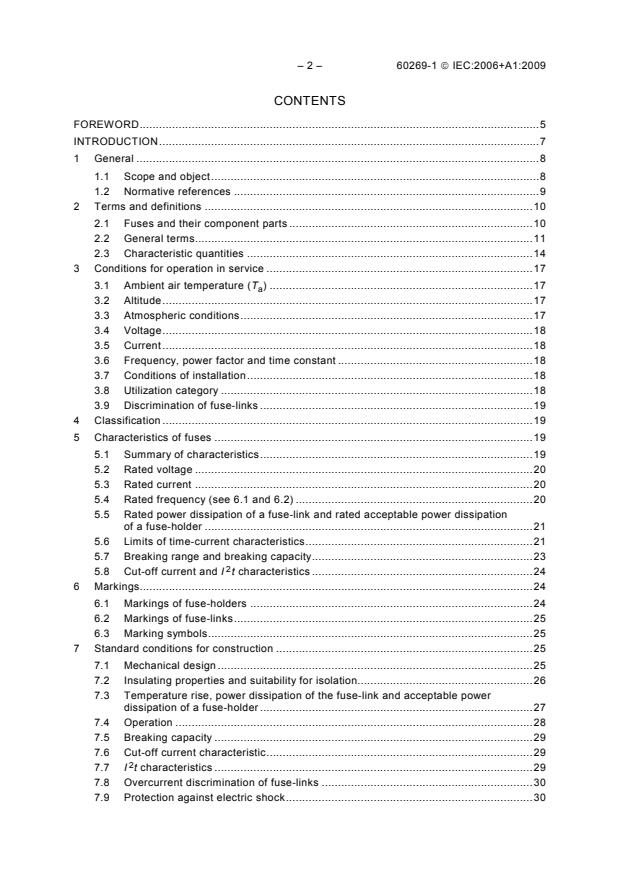
– 2 – 60269-1 © IEC:2006+A1:2009
CONTENTS
FOREWORD.5
INTRODUCTION.7
1 General .8
1.1 Scope and object.8
1.2 Normative references .9
2 Terms and definitions .10
2.1 Fuses and their component parts .10
2.2 General terms.11
2.3 Characteristic quantities .14
3 Conditions for operation in service .17
3.1 Ambient air temperature (T ) .17
a
3.2 Altitude.17
3.3 Atmospheric conditions.17
3.4 Voltage.18
3.5 Current.18
3.6 Frequency, power factor and time constant .18
3.7 Conditions of installation.18
3.8 Utilization category .18
3.9 Discrimination of fuse-links .19
4 Classification .19
5 Characteristics of fuses .19
5.1 Summary of characteristics.19
5.2 Rated voltage .20
5.3 Rated current .20
5.4 Rated frequency (see 6.1 and 6.2) .20
5.5 Rated power dissipation of a fuse-link and rated acceptable power dissipation
of a fuse-holder .21
5.6 Limits of time-current characteristics.21
5.7 Breaking range and breaking capacity.23
5.8 Cut-off current and I t characteristics .24
6 Markings.24
6.1 Markings of fuse-holders .24
6.2 Markings of fuse-links.25
6.3 Marking symbols.25
7 Standard conditions for construction .25
7.1 Mechanical design .25
7.2 Insulating properties and suitability for isolation.26
7.3 Temperature rise, power dissipation of the fuse-link and acceptable power
dissipation of a fuse-holder .27
7.4 Operation .28
7.5 Breaking capacity .29
7.6 Cut-off current characteristic.29
7.7 I t characteristics .29
7.8 Overcurrent discrimination of fuse-links .30
7.9 Protection against electric shock.30
60269-1 © IEC:2006+A1:2009 – 3 –
7.10 Resistance to heat.33
7.11 Mechanical strength.33
7.12 Resistance to corrosion .33
7.13 Resistance to abnormal heat and fire .33
7.14 Electromagnetic compatibility.33
8 Tests .34
8.1 General .34
8.2 Verification of the insulating properties and of the suitability for isolation .39
8.3 Verification of temperature rise and power dissipation.41
8.4 Verification of operation .44
8.5 Verification of the breaking capacity.49
8.6 Verification of the cut-off current characteristics.55
8.7 Verification of I t characteristics and overcurrent discrimination.55
8.8 Verification of the degree of protection of enclosures .56
8.9 Verification of resistance to heat .56
8.10 Verification of non-deterioration of contacts .56
8.11 Mechanical and miscellaneous tests .57
Annex A (informative) Measurement of short-circuit power factor.69
Annex B (informative) Calculation of pre-arcing I t values for "gG", "gM", “gD” and “gN”
fuse-links and calculation of operating I t values at reduced voltage.72
Annex C (informative) Calculation of cut-off current-time characteristic.74
Annex D (informative) Effect of change of ambient temperature and surroundings
on the performance of fuse-links .78
Annex E (normative) Particular requirements for fuse-bases with screwless-type
terminals for external copper conductors .79
Figure 1 – Diagram illustrating the means of verification of the time-current
characteristic, using the results of the tests at the "gate" currents (example).60
Figure 2 – Overload curve and time-current characteristic for "a" fuse-links .61
Figure 3 – Time current zone for aM fuses.62
Figure 4 – General presentation of the cut-off characteristics for a series
of a.c. fuse-links.63
Figure 5 – Typical diagram of the circuit used for breaking capacity test (see 8.5).64
Figure 6 – Interpretation of oscillograms taken during the a.c. breaking-capacity tests
(see 8.5.7) .65
Figure 7 – Interpretation of oscillograms taken during the d.c. breaking-capacity tests
(see 8.5.7) .66
Figure 8 – Glow-wire and position of the thermocouple .67
Figure 9 –Test apparatus (example) .68
Figure A.1 – Determination of circuit-impedance for calculation of power factor
in accordance with method I .71
Figure C.1 – Cut-off current characteristic as a function of actual pre-arcing time .77
Figure E.1 – Connecting samples .84
Figure E.2 – Examples of terminals .85
– 4 – 60269-1 © IEC:2006+A1:2009
Table 1 – Standard values of a.c. rated voltages for fuses .20
Table 2 – Conventional time and current for "gG" and "gM" fuse-links .22
Table 3 – Gates for specified pre-arcing times of "gG" and "gM" fuse-links .22
Table 4 – Gates for "aM ' fuse-links (all rated currents).23
Table 5 – Temperature rise limits ΔT = (T – T ) for contacts and terminals.27
a
Table 6 – Maximum arc voltage.29
Table 7 – Pre-arcing I t values at 0,01 s for "gG" and "gM" fuse-links.30
Table 8 – Rated impulse withstand voltage .31
Table 9 – Minimum clearances in air .31
Table 10 – Minimum creepage distances .32
Table 11 – Survey of complete tests on fuse-links and number of fuse-links to be tested .36
Table 12 – Survey of tests on fuse-links of smallest rated current of homogeneous
series and number of fuse-links to be tested.37
Table 13 – Survey of tests on fuse-links of rated currents between the largest and the
smallest rated current of a homogeneous series and number of fuse-links to be tested .38
Table 14 – Survey of complete tests on fuse-holders and number of fuse-holders
to be tested.38
Table 15 – Test voltage.40
Table 16 – Test voltage across the poles for the verification of the suitability for isolation .41
Table 17 – Cross-sectional area of copper conductors for tests corresponding
to Subclauses 8.3 and 8.4 .43
Table 18 – Cross-section areas of the copper conductors for the test of “aM” fuses .46
Table 19 – Table for test in Subclause 8.4.3.5 .48
Table 20 – Values for breaking-capacity tests on a.c. fuses .51
Table 21 – Values for breaking capacity tests on d.c. fuses .52
Table E.1 – Connectable conductors .81
Table E.2 – Cross-sections of copper conductors connectable to terminals.81
Table E.3 – Pull forces .83
60269-1 © IEC:2006+A1:2009 – 5 –
INTERNATIONAL ELECTROTECHNICAL COMMISSION
___________
LOW-VOLTAGE FUSES –
Part 1: General requirements
FOREWORD
1) The International Electrotechnical Commission (IEC) is a worldwide organization for standardization comprising
all national electrotechnical committees (IEC National Committees). The object of IEC is to promote
international co-operation on all questions concerning standardization in the electrical and electronic fields. To
this end and in addition to other activities, IEC publishes International Standards, Technical Specifications,
Technical Reports, Publicly Available Specifications (PAS) and Guides (hereafter referred to as “IEC
Publication(s)”). Their preparation is entrusted to technical committees; any IEC National Committee interested
in the subject dealt with may participate in this preparatory work. International, governmental and non-
governmental organizations liaising with the IEC also participate in this preparation. IEC collaborates closely
with the International Organization for Standardization (ISO) in accordance with conditions determined by
agreement between the two organizations.
2) The formal decisions or agreements of IEC on technical matters express, as nearly as possible, an international
consensus of opinion on the relevant subjects since each technical committee has representation from all
interested IEC National Committees.
3) IEC Publications have the form of recommendations for international use and are accepted by IEC National
Committees in that sense. While all reasonable efforts are made to ensure that the technical content of IEC
Publications is accurate, IEC cannot be held responsible for the way in which they are used or for any
misinterpretation by any end user.
4) In order to promote international uniformity, IEC National Committees undertake to apply IEC Publications
transparently to the maximum extent possible in their national and regional publications. Any divergence
between any IEC Publication and the corresponding national or regional publication shall be clearly indicated in
the latter.
5) IEC provides no marking procedure to indicate its approval and cannot be rendered responsible for any
equipment declared to be in conformity with an IEC Publication.
6) All users should ensure that they have the latest edition of this publication.
7) No liability shall attach to IEC or its directors, employees, servants or agents including individual experts and
members of its technical committees and IEC National Committees for any personal injury, property damage or
other damage of any nature whatsoever, whether direct or indirect, or for costs (including legal fees) and
expenses arising out of the publication, use of, or reliance upon, this IEC Publication or any other IEC
Publications.
8) Attention is drawn to the Normative references cited in this publication. Use of the referenced publications is
indispensable for the correct application of this publication.
9) Attention is drawn to the possibility that some of the elements of this IEC Publication may be the subject of
patent rights. IEC shall not be held responsible for identifying any or all such patent rights.
International Standard IEC 60269-1 has been prepared by subcommittee 32B: Low-voltage
fuses, of IEC technical committee 32: Fuses.
The general re-organization of the IEC 60269 series has led to the creation of this new edition.
This consolidated version of IEC 60269-1 consists of the fourth edition (2006) [documents
32B/483/FDIS and 32B/490/RVD] and its amendment 1 (2009) [documents 32B/534/FDIS and
32B/540/RVD].
The technical content is therefore identical to the base edition and its amendment and has
been prepared for user convenience.
It bears the edition number 4.1.
A vertical line in the margin shows where the base publication has been modified by
amendment 1.
– 6 – 60269-1 © IEC:2006+A1:2009
IEC 60269 consists of the following parts, under the general title Low-voltage fuses:
Part 1: General requirements
NOTE This part includes IEC 60269-1 (third edition, 1998) and parts of IEC 60269-2 (second edition,
1986) and IEC 60269-3 (second edition, 1987).
Part 2: Supplementary requirements for fuses for use by authorized persons (fuses mainly for
industrial application) – Examples of standardized systems of fuses A to I
NOTE This part includes parts of IEC 60269-2 (second edition, 1986) and all of IEC 60269-2-1 (fourth
edition, 2004).
Part 3: Supplementary requirements for fuses for use by unskilled persons (fuses mainly for
household or similar application) – Examples of standardized systems of fuses A to F
NOTE This part includes parts of IEC 60269-3 (second edition, 1987) and all of IEC 60269-3-1 (second
edition, 2004).
Part 4: Supplementary requirements for fuse-links for the protection of semiconductor devices
NOTE This part includes IEC 60269-4 (third edition, 1986) and IEC 60269-4-1 (first edition, 2002).
Part 5: Guidance for the application of low-voltage fuses
NOTE Currently IEC/TR 61818 (2003).
For reasons of convenience, when a part of this publication has come from other publications,
a remark to this effect has been inserted in the text.
The committee has decided that the contents of the base publication and its amendments will
remain unchanged until the maintenance result date indicated on the IEC web site under
"http://webstore.iec.ch" in the data related to the specific publication. At this date,
the publication will be
• reconfirmed,
• withdrawn,
• replaced by a revised edition, or
• amended.
60269-1 © IEC:2006+A1:2009 – 7 –
INTRODUCTION
A reorganization of the different parts of the IEC 60269 series has been carried out, in order to
simplify its use, especially by the laboratories which test the fuses.
IEC 60269-1, IEC 60269-2, IEC 60269-3 and IEC 60269-3-1 have been integrated into either
the new part 1 or the new parts 2 or 3, according to the subjects considered, so that the
clauses which deal exclusively with “fuses for authorized persons” are separated from the
clauses dealing with “fuses for unauthorized persons”.
As far as IEC 60269-4 and IEC 60269-4-1 are concerned, they have been integrated into the
new part 4 which deals with the fuse-links used for semiconductor protection.
– 8 – 60269-1 © IEC:2006+A1:2009
LOW-VOLTAGE FUSES –
Part 1: General requirements
1 General
1.1 Scope and object
This part of IEC 60269 is applicable to fuses incorporating enclosed current-limiting fuse-links
with rated breaking capacities of not less than 6 kA, intended for protecting power-frequency
a.c. circuits of nominal voltages not exceeding 1 000 V or d.c. circuits of nominal voltages not
exceeding 1 500 V.
Subsequent parts of this standard, referred to herein, cover supplementary requirements for
such fuses intended for specific conditions of use or applications.
Fuse-links intended to be included in fuse-switch combinations according to IEC 60947-3
should also comply with the following requirements.
NOTE 1 For "a" fuse-links, details of performance (see 2.2.4) on d.c. circuits should be subject to agreement
between user and manufacturer.
NOTE 2 Modifications of, and supplements to, this standard required for certain types of fuses for particular
applications – for example, certain fuses for rolling stock, or fuses for high-frequency circuits – will be covered, if
necessary, by separate standards.
NOTE 3 This standard does not apply to miniature fuses, these being covered by IEC 60127.
The object of this standard is to establish the characteristics of fuses or parts of fuses (fuse-
base, fuse-carrier, fuse-link) in such a way that they can be replaced by other fuses or parts of
fuses having the same characteristics provided that they are interchangeable as far as their
dimensions are concerned. For this purpose, this standard refers in particular to
– the following characteristics of fuses:
ƒ their rated values;
ƒ their insulation;
ƒ their temperature rise in normal service;
ƒ their power dissipation and acceptable power dissipation;
ƒ their time/current characteristics;
ƒ their breaking capacity;
ƒ their cut-off current characteristics and their I t characteristics.
– type test for verification of the characteristics of fuses;
– the marking of fuses.
60269-1 © IEC:2006+A1:2009 – 9 –
1.2 Normative references
The following referenced documents are indispensable for the application of this document. For
dated references, only the edition cited applies. For undated references, the latest edition of
the referenced document (including any amendments) applies.
IEC 60038:1983, IEC standard voltages
IEC 60050(441):1984, International Electrotechnical Vocabulary (IEV) – Chapter 441:
Switchgear, controlgear and fuses
Amendment 1 (2000)
IEC 60269-2, Low-voltage fuses – Part 2: Supplementary requirements for fuses for use by
authorized persons (fuses mainly for industrial application) – Examples of standardized
systems of fuses A to I)
IEC 60269-3, Low-voltage fuses – Part 3: Supplementary requirements for fuses for use by
unskilled persons (fuses mainly for household or similar application) – Examples of
standardized systems of fuses A to F
IEC 60269-4, Low-voltage fuses – Part 4: Supplementary requirements for fuse-links for the
protection of semiconductor devices
IEC 60269-5, Low-voltage fuses – Part 5: Guidance for the application of low-voltage fuses
IEC 60364-3:1993, Electrical installations of buildings – Part 3: Assessment of general
characteristics
IEC 60364-5-52:2001, Electrical installations of buildings – Part 5-52: Selection and erection of
electrical equipment – Wiring system
IEC 60529:1989, Degrees of protection provided by enclosures (Code IP)
IEC 60584-1:1995, Thermocouples – Part 1: Reference tables
IEC 60617, Graphical symbols for diagrams
IEC 60664-1:2002, Insulation coordination for equipment within low-voltage systems – Part 1:
Principles, requirements and tests
IEC 60695-2-10:2000, Fire hazard testing – Part 2: Test methods – Section 1/sheet 0: Glow-
wire test methods – General
IEC 60695-2-11:2000, Fire hazard testing – Part 2: Test methods – Section 1/sheet 1: Glow-
wire end-product test and guidance
IEC 60695-2-12:2000, Fire hazard testing – Part 2: Test methods – Section 1/sheet 2: Glow-
wire flammability test on materials
IEC 60695-2-13:2000, Fire hazard testing – Part 2: Test methods – Section 1/sheet 3: Glow-
wire ignitability test on materials
ISO 3:1973, Preferred numbers – Series of preferred numbers
ISO 478:1974, Paper – Untrimmed stock sizes for the ISO-A series – ISO primary range
ISO 593:1974, Paper – Untrimmed stock size for the ISO-A series – ISO supplementary range
ISO 4046:1978, Paper, board, pulp and related terms – Vocabulary – Bilingual edition
– 10 – 60269-1 © IEC:2006+A1:2009
2 Terms and definitions
NOTE For general definitions concerning fuses, see also IEC 60050-441.
For the purposes of this document, the following terms and definitions apply.
2.1 Fuses and their component parts
2.1.1
fuse
device that by the fusing of one or more of its specially designed and proportioned components
opens the circuit in which it is inserted by breaking the current when this exceeds a given value
for a sufficient time. The fuse comprises all the parts that form the complete device
[IEV 441-18-01]
2.1.2
fuse-holder
combination of the fuse-base with its fuse-carrier
NOTE Where, in this standard, the term "fuse-holder" is used, it covers fuse-bases and/or fuse-carriers, if no
clearer distinction is necessary.
[IEV 441-18-14]
2.1.2.1
fuse-base (fuse-mount)
fixed part of a fuse provided with contacts and terminals
[IEV 441-18-02]
NOTE Where applicable, covers are considered as part of the fuse-base.
2.1.2.2
fuse-carrier
movable part of a fuse designed to carry a fuse-link
[IEV 441-18-13]
2.1.3
fuse-link
part of a fuse including the fuse-element(s), intended to be replaced after the fuse has
operated
[IEV 441-18-09]
2.1.4
fuse-contact
two or more conductive parts designed to ensure circuit continuity between a fuse-link and the
corresponding fuse-holder
2.1.5
fuse-element
part of the fuse-link designed to melt under the action of current exceeding some definite value
for a definite period of time
[IEV 441-18-08]
NOTE The fuse-link may comprise several fuse-elements in parallel.
60269-1 © IEC:2006+A1:2009 – 11 –
2.1.6
indicating device (indicator)
part of a fuse provided to indicate whether the fuse has operated
[IEV 441-18-17]
2.1.7
striker
mechanical device forming part of a fuse-link which, when the fuse operates, releases the
energy required to cause operation of other apparatus or indicators or to provide interlocking
[IEV 441-18-18]
2.1.8
terminal
conductive part of a fuse provided for electric connection to external circuits
NOTE Terminals may be distinguished according to the kind of circuits for which they are intended (for example,
main terminal, earth terminal, etc.) and also according to their design (for example, screw terminal, plug terminal,
etc.).
2.1.9
dummy fuse-link
test fuse-link with defined power dissipation and dimensions
2.1.10
test rig
defined test fuse-base
2.1.11
gauge-piece
additional part of a fuse-base intended to achieve a degree of non-interchangeability
2.1.12
linked fuse-carrier
a fuse-carrier which is mechanically linked to the fuse-base and gives a defined insertion and
withdrawal movement to the fuse-link
[This definition was definition 2.1.12 in IEC 60269-2-1, Section I, which has been withdrawn.]
2.2 General terms
2.2.1
enclosed fuse-link
fuse-link in which the fuse-element(s) is (are) totally enclosed, so that during operation within
its rating it cannot produce any harmful external effects, for example, due to development of an
arc, the release of gas or the ejection of flame or metallic particles
[IEV 441-18-12]
2.2.2
current-limiting fuse-link
fuse-link that during and by its operation in a specified current range, limits the current to a
substantially lower value than the peak value of the prospective current
[IEV 441-18-10]
– 12 – 60269-1 © IEC:2006+A1:2009
2.2.3
"g" fuse-link
(full-range breaking-capacity fuse-link, formerly general purpose fuse-link)
current-limiting fuse-link capable of breaking under specified conditions all currents, which
cause melting of the fuse-element up to its rated breaking capacity
2.2.4
"a" fuse-link
(partial-range breaking-capacity fuse-link, formerly back-up fuse-link)
current-limiting fuse-link capable of breaking under specified conditions all currents between
the lowest current indicated on its operating time-current characteristic (k I in Figure 2) and its
2 n
rated breaking capacity
NOTE "a" fuse-links are generally used to provide short-circuit protection. Where protection is required against
over-currents less than k I in Figure 2, they are used in conjunction with another suitable switching device
2 n
designed to interrupt such small overcurrents.
2.2.5
temperatures
2.2.5.1
ambient air temperature
T
a
the temperature of the air surrounding the fuse (at a distance of about 1 m from the fuse or its
enclosure, if any)
2.2.5.2
fluid environment temperature
T
e
temperature of the fluid cooling the fuse-components (contact, terminal, etc.). It is the sum of
the ambient air temperature T and the temperature rise ΔT with respect to the ambient
a e
temperature of the internal fluid in contact with the fuse-components (contact, terminal, etc.) if
the latter is in an enclosure. If it is not in an enclosure, it is assumed that T is equal to T
e a
2.2.5.3
fuse-component temperature
T
fuse-component (contact, terminal, etc.) temperature T is that of the relevant part
2.2.6
overcurrent discrimination
coordination of the relevant characteristics of two or more overcurrent protective devices such
that, on the occurrence of overcurrents within stated limits, the device intended to operate
within these limits does so, while the other(s) do(es) not
2.2.7
fuse system
family of fuses following the same physical design principles with respect to the shape of the
fuse-links, type of contact, etc.
60269-1 © IEC:2006+A1:2009 – 13 –
2.2.8
size
specified set of dimensions of fuses within a fuse system. Each individual size covers a given
range of rated currents for which the specified dimensions of the fuses remain unchanged
2.2.9
homogeneous series of fuse-links
series of fuse-links, within a given size, deviating from each other only in such characteristics
that for a given test, the testing of one or a reduced number of particular fuse-links of that
series may be taken as representative for all the fuse-links of the homogeneous series
NOTE The characteristics by which the fuse-links of a homogeneous series may deviate and details on which of
the fuse-links shall be tested are specified in association with the tests concerned (see Tables 12 and 13).
[IEV 441-18-34, modified]
2.2.10
utilization category (of a fuse-link)
combination of specified requirements related to the conditions in which the fuse-link fulfils its
purpose, selected to represent a characteristic group of practical applications (see 5.7.1)
2.2.11
fuses for use by authorized persons
(formerly called fuses for industrial application)
fuses intended to be used in installations where the fuse-links are accessible to and intended
to be replaced by authorized persons only
NOTE 1 Non-interchangeability and protection against accidental contact with live parts need not necessarily be
ensured by constructional means.
NOTE 2 Authorized person is understood to have the meaning defined for categories BA 4 "instructed" and BA 5
"skilled" in IEC 60364-3.
2.2.12
fuses for use by unskilled persons (formerly called fuses for domestic and similar
applications)
fuses intended to be used in installations where the fuse-links are accessible to, and can be
replaced by, unskilled persons
NOTE For these fuses, protection against direct contact with live parts is recommended and non-interchangeability
may be required, if necessary
2.2.13
non-interchangeability
limitations on shape and/on dimensions with the object of avoiding in a specific fuse-base the
inadvertent use of fuse-links having electrical properties other than those ensuring the desired
degree of protection
[IEV 441-18-33]
___________
Instructed: Persons adequately advised or supervised by skilled persons to enable them to avoid dangers which
electricity may create (operating and maintenance staff).
Skilled: Persons with technical knowledge or sufficient experience to enable them to avoid dangers which
electricity may create (engineers and technicians).
– 14 – 60269-1 © IEC:2006+A1:2009
2.3 Characteristic quantities
2.3.1
rating
general term employed to designate the characteristic values that together define the working
conditions upon which the tests are based and for which the equipment is designed
[IEV 441-18-36]
NOTE Rated values usually stated for low-voltage fuses are: voltage, current, breaking capacity, power dissipation
and acceptable power dissipation, and frequency, where applicable. In the case of a.c., rated voltage and rated
current are stated as r.m.s. symmetrical values; in the case of d.c., when ripple is present, the rated voltage is
stated as a mean value, the rated current as an r.m.s. value. The above applies to any value of voltage and current,
if not indicated otherwise.
2.3.2
prospective current (of a circuit and with respect to a fuse)
current that would flow in the circuit if each pole of the fuse were replaced by a conductor of
negligible impedance.
For a.c., the prospective current is expressed by the r.m.s. value of the a.c. component
NOTE The prospective current is the quantity to which the breaking capacity and characteristics of the fuse are
normally referred, e.g. I t and cut-off current characteristics (see 8.5.7).
[IEV 441-17-01 modified]
2.3.3
gates
limiting values within which the characteristics, for example time-current characteristics, are
obtained
2.3.4
breaking capacity of a fuse
value of prospective current that a fuse is capable of breaking at a stated voltage under
prescribed conditions of use and behaviour
[IEV 441-17-08 modified]
2.3.5
breaking range
breaking range is a range of prospective currents within which the breaking capacity of a fuse-
link is assured
2.3.6
cut-off current
maximum instantaneous value reached by the current during the breaking operation of a fuse-
link when it operates in such a manner as to prevent the current from reaching the otherwise
attainable maximum
2.3.7
cut-off current characteristic; let-through current characteristic
curve giving the cut-off current as a function of the prospective current under stated conditions
of operation
NOTE In the case of a.c., the values of the cut-off currents are the maximum values which can be reached
whatever the degree of asymmetry. In the case of d.c., the values of the cut-off currents are the maximum values
reached related to the time constants as specified.
[IEV 441-17-14]
60269-1 © IEC:2006+A1:2009 – 15 –
2.3.8
peak withstand current (of a fuse-holder)
value of cut-off current that the fuse-holder can withstand
NOTE The peak withstand current is not less than the highest cut-off current of any fuse-link with which the
fuseholder is intended to be associated.
2.3.9
pre-arcing time; melting time
interval of time between the beginning of a current large enough to cause a break in the fuse-
element(s) and the instant when an arc is initiated
[IEV 441-18-21]
2.3.10
arcing time of a fuse
interval of time between the instant of the initiation of the arc in a fuse and the instant of final
arc extinction in that fuse
[IEV 441-17-37 modified]
2.3.11
operating time; total clearing time
sum of the pre-arcing time and the arcing time
[IEV 441-18-22]
2.3.12
I t; Joule integral
integral of the square of the current over a given time interval:
t
2 2
I t = i dt
∫
t
2 2
NOTE 1 The pre-arcing I t is the I t integral extended over the pre-arcing time of the fuse.
2 2
NOTE 2 The operating I t is the I t integral extended over the operating time of the fuse.
NOTE 3 The energy, in joules, released in 1 Ω of resistance in a circuit protected by a fuse is equal to the value of
2 2
the operating I t expressed in A s.
[IEV 441-18-23]
2.3.13
I t characteristic
2 2 2
curve giving I t values (pre-arcing I t and/or operating I t) as a function of prospective current
under stated conditions of operation
2.3.14
I t zone
2 2
range contained by the minimum pre-arcing I t characteristic and the maximum operating I t
characteristic, under specified conditions
2.3.15
rated current of a fuse-link
I
n
value of current that the fuse-link can carry continuously without deterioration under specified
conditions
– 16 – 60269-1 © IEC:2006+A1:2009
2.3.16
time-current characteristic
curve giving the time, e.g. pre-arcing time or operating time as a function of the prospective
current under stated conditions of operation
[IEV 441-17-13]
NOTE For times longer than 0,1 s, for practical purposes the difference between pre-arcing and operating time is
negligible.
2.3.17
time-current zone
range contained by the minimum pre-arcing time-current characteristics and the maximum
operating time-current characteristic, under specified conditions
2.3.18
conventional non-fusing current
I
nf
value of current specified as that which the fuse-link is capable of carrying for a specified time
(conventional time) without melting
[IEV 441-18-27]
2.3.19
conventional fusing current
I
f
value of current specified as that which causes operation of the fuse-link within a specified time
(conventional time)
[IEV 441-18-28]
2.3.20
overload curve of an "a" fuse-link
curve showing the time for which an "a" fuse-link is able to carry the current without
deterioration (see 8.4.3.4 and Figure 2)
2.3.21
power dissipation (in a fuse-link)
power released in a fuse-link carrying a stated value of electric current under prescribed
conditions of use and behaviour
NOTE The prescribed conditions of use and behaviour generally include a constant r.m.s. value of the electric
current after steady-state temperature conditions are reached.
[IEV 441-18-38, modified]
2.3.22
acceptable power dissipation (of a fuse-base or a fuse-holder)
stated value of power dissipation in a fuse-link which a fuse-base or a fuse-holder can accept
under prescribed conditions of use and behaviour
[IEV 441-18-39]
2.3.23
recovery voltage
voltage which appears across the terminals of a pole of a fuse after the breaking of the current
NOTE This voltage may be considered in two successive intervals of time, one during which a transient voltage
exists (see 2.3.23.1) followed by a second one during which only the power frequency or d.c. recovery voltage (see
2.3.23.2) exists.
[IEV 441-17-25, modified]
60269-1 © IEC:2006+A1:2009
...