

IEC 60404-4:1995
(Main)Magnetic materials - Part 4: Methods of measurement of d.c. magnetic properties of iron and steel
General Information
- Abstract
Describes the terminology and two measuring methods, namely: the ring method and the permeameter method. Both methods use a test specimen in a closed magnetic circuit. Description of the test equipment and the electric circuits is given.
- Status
- Published
- Publication Date
- 12-Nov-2008
- Technical Committee
- TC 68 - Magnetic alloys and steels
- Drafting Committee
- WG 2 - TC 68/WG 2
- Current Stage
- PPUB - Publication issued
- Start Date
- 15-Feb-1995
- Completion Date
- 28-Aug-2026
Buy Documents
IEC 60404-4:1995+AMD1:2000 CSV - Magnetic materials - Part 4: Methods of measurement of d.c. magnetic properties of magnetically soft materials Released:11/28/2000
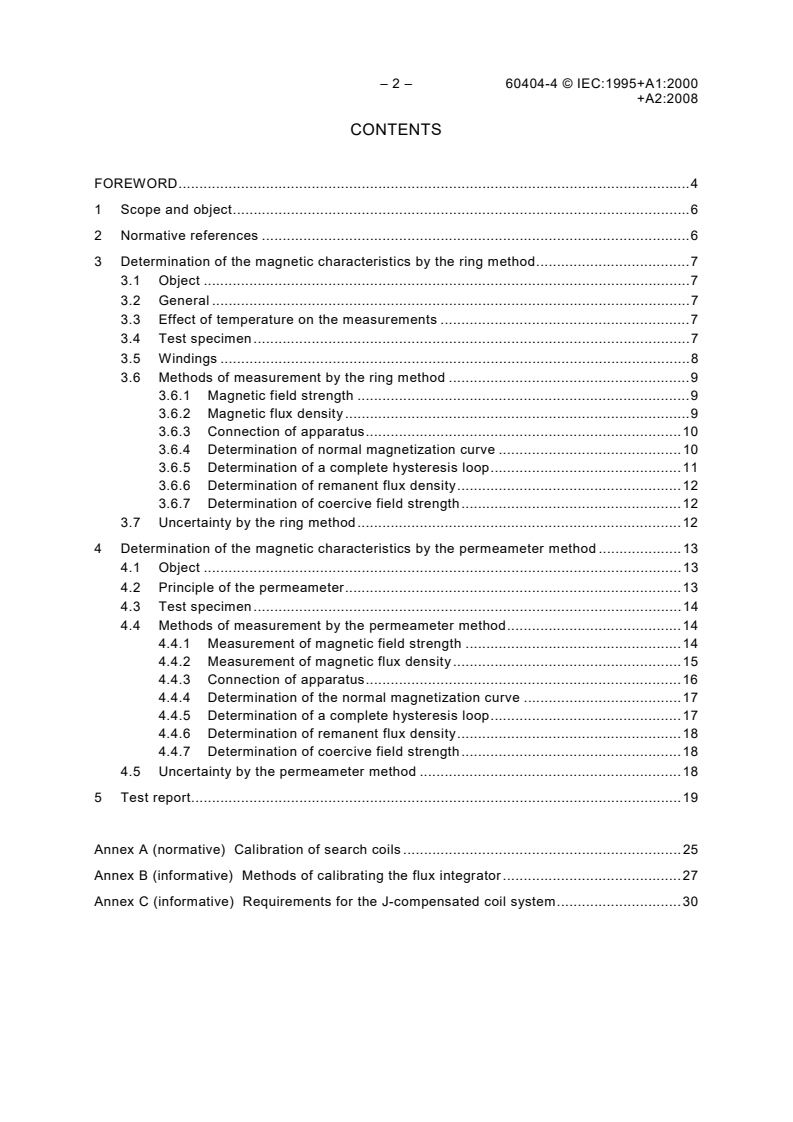
IEC 60404-4:1995+AMD1:2000+AMD2:2008 CSV - Magnetic materials - Part 4: Methods of measurement of d.c. magnetic properties of magnetically soft materials Released:11/13/2008
Overview
IEC 60404-4:1995 - Magnetic Materials – Part 4: Methods of Measurement of d.c. Magnetic Properties of Magnetically Soft Materials is an international standard published by the International Electrotechnical Commission (IEC). This standard provides detailed procedures and terminology for accurately determining the direct current (d.c.) magnetic properties of iron, steel, and other magnetically soft materials. To facilitate uniform testing and reporting across the electrical and electronics industries, it specifies two essential measurement techniques: the ring method and the permeameter method. Both methods utilize test specimens in a closed magnetic circuit, ensuring reliable and comparable results for material characterization and product quality assurance.
Key Topics
- Measurement Methods:
- Ring Method: Used for magnetic field strengths up to 10 kA/m; applicable to laminated, solid, or sintered ring specimens.
- Permeameter Method: Suitable for field strengths from 1 kA/m up to 200 kA/m; involves clamping bar or strip specimens between steel yokes.
- Test Specimens:
- Requirements for homogeneous, unwelded rings, or bars/strips with consistent cross-sections.
- Preparation guidelines to prevent material alteration during machining or winding.
- Test Environments:
- Temperature control is critical; tests must be conducted at 23 ± 5 °C, and specimen temperature should not exceed 50 °C.
- Measurement Parameters:
- Determination of magnetization curves, hysteresis loops, remanent flux density, and coercive field strength.
- Calculation of key metrics such as magnetic field strength (H) and magnetic flux density (B).
- Description and calibration of test equipment, windings, and measurement circuits.
- Uncertainty and Calibration:
- Guidance on minimizing measurement uncertainty (typically within ±2%).
- Requirements for calibration of measurement instruments and circuits.
Applications
IEC 60404-4 is widely used in research, manufacturing, and quality control across industries where magnetic materials play a critical role, including:
- Electrical engineering: Testing and selecting core materials for transformers, inductors, reactors, and magnetic shielding.
- Material development: Characterizing and certifying soft magnetic alloys and steels to ensure performance in electronic components.
- Quality assurance: Standardizing measurement processes for suppliers and customers to ensure global product conformity.
- Academic and industrial research: Studying magnetic properties for innovation in power electronics, automotive electric motors, and renewable energy systems.
By offering standardized testing procedures and clear reporting requirements, IEC 60404-4 helps ensure the reliability, safety, and performance of products utilizing soft magnetic materials.
Related Standards
For comprehensive magnetic materials testing and specification, the following related IEC standards are often referenced alongside IEC 60404-4:
- IEC 60404-7: Method of measurement of coercivity of magnetic materials in an open magnetic circuit.
- IEC 60404-8 Series: Specifications for individual magnetic materials, including cold-rolled magnetic steel (alloyed and non-alloyed), non-oriented and grain-oriented sheet and strip, and soft magnetic metallic materials.
- IEC 60404-2: Measurement of d.c. magnetic properties of sheet and strip by means of the single sheet tester.
Adopting IEC 60404-4 in combination with these related standards enables organizations to achieve full lifecycle control of magnetic material properties, from raw material selection to finished product verification.
Keywords: IEC 60404-4, magnetic materials standard, d.c. magnetic properties, ring method, permeameter method, soft iron measurement, steel magnetic testing, hysteresis loop, magnetization curve, core material testing, electrotechnical standards.
Relations
- Referred By
EN ISO 22068:2014 - Sintered-metal injection-moulded materials - Specifications (ISO 22068:2012) - Effective Date
- 25-Aug-2026
- Effective Date
- 05-Sep-2023
- Effective Date
- 05-Sep-2023
Buy Documents
IEC 60404-4:1995+AMD1:2000 CSV - Magnetic materials - Part 4: Methods of measurement of d.c. magnetic properties of magnetically soft materials Released:11/28/2000
IEC 60404-4:1995+AMD1:2000+AMD2:2008 CSV - Magnetic materials - Part 4: Methods of measurement of d.c. magnetic properties of magnetically soft materials Released:11/13/2008
Get Certified
Connect with accredited certification bodies for this standard

IMQ S.p.A. (Certification)
Italian electrical product certification.

SLG Prüf- und Zertifizierungs GmbH
German testing and certification body.

UL Solutions
Global safety science company with testing, inspection and certification.
Sponsored listings
Frequently Asked Questions
IEC 60404-4:1995 is a standard published by the International Electrotechnical Commission (IEC). Its full title is "Magnetic materials - Part 4: Methods of measurement of d.c. magnetic properties of iron and steel". This standard covers: Describes the terminology and two measuring methods, namely: the ring method and the permeameter method. Both methods use a test specimen in a closed magnetic circuit. Description of the test equipment and the electric circuits is given.
Describes the terminology and two measuring methods, namely: the ring method and the permeameter method. Both methods use a test specimen in a closed magnetic circuit. Description of the test equipment and the electric circuits is given.
IEC 60404-4:1995 is classified under the following ICS (International Classification for Standards) categories: 17.220.20 - Measurement of electrical and magnetic quantities; 29.030 - Magnetic materials. The ICS classification helps identify the subject area and facilitates finding related standards.
IEC 60404-4:1995 has the following relationships with other standards: It is inter standard links to EN ISO 22068:2014, IEC 60404-4:1995/AMD1:2000, IEC 60404-4:1995/AMD2:2008. Understanding these relationships helps ensure you are using the most current and applicable version of the standard.
IEC 60404-4:1995 is available in PDF format for immediate download after purchase. The document can be added to your cart and obtained through the secure checkout process. Digital delivery ensures instant access to the complete standard document.
Standards Content (Sample)
IEC 60404-4
Edition 2.1 2000-11
INTERNATIONAL
STANDARD
NORME
INTERNATIONALE
Magnetic materials –
Part 4: Methods of measurement of d.c. magnetic properties of magnetically soft
materials
Matériaux magnétiques –
Partie 4: Méthodes de mesure en courant continu des propriétés magnétiques
des matériaux magnétiquement doux
All rights reserved. Unless otherwise specified, no part of this publication may be reproduced or utilized in any form or by
any means, electronic or mechanical, including photocopying and microfilm, without permission in writing from either IEC or
IEC's member National Committee in the country of the requester.
If you have any questions about IEC copyright or have an enquiry about obtaining additional rights to this publication,
please contact the address below or your local IEC member National Committee for further information.
Droits de reproduction réservés. Sauf indication contraire, aucune partie de cette publication ne peut être reproduite
ni utilisée sous quelque forme que ce soit et par aucun procédé, électronique ou mécanique, y compris la photocopie
et les microfilms, sans l'accord écrit de la CEI ou du Comité national de la CEI du pays du demandeur.
Si vous avez des questions sur le copyright de la CEI ou si vous désirez obtenir des droits supplémentaires sur cette
publication, utilisez les coordonnées ci-après ou contactez le Comité national de la CEI de votre pays de résidence.
IEC Central Office
3, rue de Varembé
CH-1211 Geneva 20
Switzerland
Email: inmail@iec.ch
Web: www.iec.ch
About the IEC
The International Electrotechnical Commission (IEC) is the leading global organization that prepares and publishes
International Standards for all electrical, electronic and related technologies.
About IEC publications
The technical content of IEC publications is kept under constant review by the IEC. Please make sure that you have the
latest edition, a corrigenda or an amendment might have been published.
ƒ Catalogue of IEC publications: www.iec.ch/searchpub
The IEC on-line Catalogue enables you to search by a variety of criteria (reference number, text, technical committee,…).
It also gives information on projects, withdrawn and replaced publications.
ƒ IEC Just Published: www.iec.ch/online_news/justpub
Stay up to date on all new IEC publications. Just Published details twice a month all new publications released. Available
on-line and also by email.
ƒ Electropedia: www.electropedia.org
The world's leading online dictionary of electronic and electrical terms containing more than 20 000 terms and definitions
in English and French, with equivalent terms in additional languages. Also known as the International Electrotechnical
Vocabulary online.
ƒ Customer Service Centre: www.iec.ch/webstore/custserv
If you wish to give us your feedback on this publication or need further assistance, please visit the Customer Service
Centre FAQ or contact us:
Email: csc@iec.ch
Tel.: +41 22 919 02 11
Fax: +41 22 919 03 00
A propos de la CEI
La Commission Electrotechnique Internationale (CEI) est la première organisation mondiale qui élabore et publie des
normes internationales pour tout ce qui a trait à l'électricité, à l'électronique et aux technologies apparentées.
A propos des publications CEI
Le contenu technique des publications de la CEI est constamment revu. Veuillez vous assurer que vous possédez
l’édition la plus récente, un corrigendum ou amendement peut avoir été publié.
ƒ Catalogue des publications de la CEI: www.iec.ch/searchpub/cur_fut-f.htm
Le Catalogue en-ligne de la CEI vous permet d’effectuer des recherches en utilisant différents critères (numéro de référence,
texte, comité d’études,…). Il donne aussi des informations sur les projets et les publications retirées ou remplacées.
ƒ Just Published CEI: www.iec.ch/online_news/justpub
Restez informé sur les nouvelles publications de la CEI. Just Published détaille deux fois par mois les nouvelles
publications parues. Disponible en-ligne et aussi par email.
ƒ Electropedia: www.electropedia.org
Le premier dictionnaire en ligne au monde de termes électroniques et électriques. Il contient plus de 20 000 termes et
définitions en anglais et en français, ainsi que les termes équivalents dans les langues additionnelles. Egalement appelé
Vocabulaire Electrotechnique International en ligne.
ƒ Service Clients: www.iec.ch/webstore/custserv/custserv_entry-f.htm
Si vous désirez nous donner des commentaires sur cette publication ou si vous avez des questions, visitez le FAQ du
Service clients ou contactez-nous:
Email: csc@iec.ch
Tél.: +41 22 919 02 11
Fax: +41 22 919 03 00
IEC 60404-4
Edition 2.1 2000-11
INTERNATIONAL
STANDARD
NORME
INTERNATIONALE
Magnetic materials –
Part 4: Methods of measurement of d.c. magnetic properties of magnetically soft
materials
Matériaux magnétiques –
Partie 4: Méthodes de mesure en courant continu des propriétés magnétiques
des matériaux magnétiquement doux
INTERNATIONAL
ELECTROTECHNICAL
COMMISSION
COMMISSION
ELECTROTECHNIQUE
PRICE CODE
INTERNATIONALE
CK
CODE PRIX
ICS 17.220.20; 29.030 ISBN 2-8318-5429-6
– 2 – 60404-4 © CEI:1995+A1:2000
SOMMAIRE
Pages
AVANT-PROPOS . 6
Articles
1 Domaine d'application et objet. 8
2 Références normatives. 8
3 Détermination des caractéristiques magnétiques par la méthode du tore . 10
3.1 Objet. 10
3.2 Généralités . 10
3.3 Influence de la température sur les mesures. 10
3.4 Eprouvette . 10
3.5 Enroulements. 12
3.6 Méthodes de mesure par la méthode du tore . 14
3.6.1 Intensité du champ magnétique d'excitation . 14
3.6.2 Induction magnétique. 14
3.6.3 Branchement des appareils. 16
3.6.4 Détermination de la courbe d'aimantation normale . 16
3.6.5 Détermination d'un cycle d'hystérésis complet . 18
3.6.6 Détermination de l'induction rémanente . 20
3.6.7 Détermination du champ coercitif . 20
3.7 Incertitude par la méthode du tore . 22
4 Détermination des caractéristiques magnétiques par la méthode du perméamètre . 22
4.1 Objet. 22
4.2 Principe du perméamètre. 22
4.3 Eprouvette . 24
4.4 Méthodes de mesure par la méthode du perméamètre. 24
4.4.1 Mesure de l'intensité du champ magnétique d'excitation . 24
4.4.2 Mesure de l'induction magnétique . 26
4.4.3 Branchement des appareils. 28
4.4.4 Détermination de la courbe d'aimantation normale . 30
4.4.5 Détermination d'un cycle d'hystérésis complet . 30
4.4.6 Détermination de l'induction rémanente . 32
4.4.7 Détermination du champ coercitif . 32
4.5 Incertitude par la méthode du perméamètre. 34
5 Procès-verbal d'essai . 34
Annex A (normative) Etalonnage des bobines de mesures . 48
Annex B (informative) Méthodes d'étalonnage de l'intégrateur de flux . 52
Annex C (informative) Conditions à remplir par un système de bobines compensées
pour la mesure de J. 58
60404-4 © IEC:1995+A1:2000 – 3 –
CONTENTS
Page
FOREWORD . 7
Clause
1 Scope and object . 9
2 Normative references. 9
3 Determination of the magnetic characteristics by the ring method . 11
3.1 Object. 11
3.2 General. 11
3.3 Effect of temperature on the measurements. 11
3.4 Test specimen . 11
3.5 Windings. 13
3.6 Methods of measurement by the ring method. 15
3.6.1 Magnetic field strength. 15
3.6.2 Magnetic flux density . 15
3.6.3 Connection of apparatus . 17
3.6.4 Determination of normal magnetization curve. 17
3.6.5 Determination of a complete hysteresis loop . 19
3.6.6 Determination of remanent flux density . 21
3.6.7 Determination of coercive field strength . 21
3.7 Uncertainty by the ring method . 23
4 Determination of the magnetic characteristics by the permeameter method. 23
4.1 Object. 23
4.2 Principle of the permeameter . 23
4.3 Test specimen . 25
4.4 Methods of measurement by the permeameter method . 25
4.4.1 Measurement of magnetic field strength. 25
4.4.2 Measurement of magnetic flux density . 27
4.4.3 Connection of apparatus . 29
4.4.4 Determination of the normal magnetization curve. 31
4.4.5 Determination of a complete hysteresis loop . 31
4.4.6 Determination of remanent flux density . 33
4.4.7 Determination of coercive field strength . 33
4.5 Uncertainty by the permeameter method. 35
5 Test report . 35
Annex A (normative) Calibration of search coils . 49
Annex B (informative) Methods of calibrating the flux integrator . 53
Annex C (informative) Requirements for the J-compensated coil system . 59
– 4 – 60404-4 © CEI:1995+A1:2000
Pages
Figure 1 – Circuit pour la détermination des caractéristiques magnétiques par
la méthode du tore . 36
Figure 2 – Cycle d'hystérésis. 36
Figure 3 – Configuration typique d'un perméamètre de type A. 38
Figure 4 – Configuration typique d'un perméamètre de type B. 40
Figure 5 – Configuration des bobines de mesure. 44
Figure 6 – Circuit pour la détermination de la courbe d'aimantation normale et du cycle
d'hystérésis à l'aide d'un perméamètre à double culasse (échantillon en barreau). 46
Figure A.1 – Circuit pour l'étalonnage des bobines de mesure. 50
Figure B.1 – Circuit d'étalonnage de l'intégrateur de flux par la méthode de
la décharge d'un condensateur étalon . 56
Tableau 1 – Séquence des commutations nécessaires au maintien de l'éprouvette
dans un état cyclique stable . 20
60404-4 © IEC:1995+A1:2000 – 5 –
Page
Figure 1 – Circuit for the determination of the magnetic characteristics
by the ring method . 37
Figure 2 – Hysteresis loop. 37
Figure 3 – Typical arrangement of a type A permeameter. 39
Figure 4 – Typical arrangement of a type B permeameter. 41
Figure 5 – Arrangement of search coils . 45
Figure 6 – Circuit for the determination of the normal magnetization curve and
hysteresis loop of bar specimens using a double yoke permeameter . 47
Figure A.1 – Circuit for the calibration of search-coils. 51
Figure B.1 – Circuit for calibration the flux integrator by the capacitor
discharge method. 57
Table 1 – Switching sequence to maintain the test specimen in a steady cyclic state . 21
– 6 – 60404-4 © CEI:1995+A1:2000
COMMISSION ÉLECTROTECHNIQUE INTERNATIONALE
____________
MATÉRIAUX MAGNÉTIQUES –
Partie 4: Méthodes de mesure en courant continu
des propriétés magnétiques des matériaux magnétiquement doux
AVANT-PROPOS
1) La CEI (Commission Électrotechnique Internationale) est une organisation mondiale de normalisation
composée de l'ensemble des comités électrotechniques nationaux (Comités nationaux de la CEI). La CEI a
pour objet de favoriser la coopération internationale pour toutes les questions de normalisation dans les
domaines de l'électricité et de l'électronique. A cet effet, la CEI, entre autres activités, publie des Normes
internationales. Leur élaboration est confiée à des comités d'études, aux travaux desquels tout Comité national
intéressé par le sujet traité peut participer. Les organisations internationales, gouvernementales et non
gouvernementales, en liaison avec la CEI, participent également aux travaux. La CEI collabore étroitement
avec l'Organisation Internationale de Normalisation (ISO), selon des conditions fixées par accord entre les
deux organisations.
2) Les décisions ou accords officiels de la CEI concernant les questions techniques représentent, dans la mesure
du possible, un accord international sur les sujets étudiés, étant donné que les Comités nationaux intéressés
sont représentés dans chaque comité d’études.
3) Les documents produits se présentent sous la forme de recommandations internationales. Ils sont publiés
comme normes, spécifications techniques, rapports techniques ou guides et agréés comme tels par les
Comités nationaux.
4) Dans le but d'encourager l'unification internationale, les Comités nationaux de la CEI s'engagent à appliquer de
façon transparente, dans toute la mesure possible, les Normes internationales de la CEI dans leurs normes
nationales et régionales. Toute divergence entre la norme de la CEI et la norme nationale ou régionale
correspondante doit être indiquée en termes clairs dans cette dernière.
5) La CEI n’a fixé aucune procédure concernant le marquage comme indication d’approbation et sa responsabilité
n’est pas engagée quand un matériel est déclaré conforme à l’une de ses normes.
6) L’attention est attirée sur le fait que certains des éléments de la présente Norme internationale peuvent faire
l’objet de droits de propriété intellectuelle ou de droits analogues. La CEI ne saurait être tenue pour
responsable de ne pas avoir identifié de tels droits de propriété et de ne pas avoir signalé leur existence.
La Norme internationale CEI 60404-4 a été établie par le comité d'études 68 de la CEI:
Matériaux magnétiques tels qu'alliages et aciers.
Cette deuxième édition annule et remplace la première édition parue en 1982 et constitue une
révision technique.
La présente version consolidée de la CEI 60404-4 comprend la deuxième édition (1995)
[documents 68(BC)95 et 68/117/RVD], et son amendement 1 (2000) [documents 68/215/FDIS
et 68/217/RVD].
Le contenu technique de cette version consolidée est donc identique à celui de l'édition de
base et à son amendement; cette version a été préparée par commodité pour l'utilisateur.
Elle porte le numéro d'édition 2.1.
Une ligne verticale dans la marge indique où la publication de base a été modifiée par
l’amendement 1.
L'annexe A fait partie intégrante de cette norme.
Les annexes B et C sont données uniquement à titre d'information.
Le comité a décidé que le contenu de la publication de base et de ses amendements ne sera
pas modifié avant 2009. A cette date, la publication sera
• reconduite;
• supprimée;
• remplacée par une édition révisée, ou
• amendée.
60404-4 © IEC:1995+A1:2000 – 7 –
INTERNATIONAL ELECTROTECHNICAL COMMISSION
____________
MAGNETIC MATERIALS –
Part 4: Methods of measurement of d.c.
magnetic properties of magnetically soft materials
FOREWORD
1) The IEC (International Electrotechnical Commission) is a worldwide organization for standardization comprising
all national electrotechnical committees (IEC National Committees). The object of the IEC is to promote
international co-operation on all questions concerning standardization in the electrical and electronic fields. To
this end and in addition to other activities, the IEC publishes International Standards. Their preparation is
entrusted to technical committees; any IEC National Committee interested in the subject dealt with may
participate in this preparatory work. International, governmental and non-governmental organizations liaising
with the IEC also participate in this preparation. The IEC collaborates closely with the International
Organization for Standardization (ISO) in accordance with conditions determined by agreement between the
two organizations.
2) The formal decisions or agreements of the IEC on technical matters express, as nearly as possible, an
international consensus of opinion on the relevant subjects since each technical committee has representation
from all interested National Committees.
3) The documents produced have the form of recommendations for international use and are published in the form
of standards, technical specifications, technical reports or guides and they are accepted by the National
Committees in that sense.
4) In order to promote international unification, IEC National Committees undertake to apply IEC International
Standards transparently to the maximum extent possible in their national and regional standards. Any
divergence between the IEC Standard and the corresponding national or regional standard shall be clearly
indicated in the latter.
5) The IEC provides no marking procedure to indicate its approval and cannot be rendered responsible for any
equipment declared to be in conformity with one of its standards.
6) Attention is drawn to the possibility that some of the elements of this International Standard may be the subject
of patent rights. The IEC shall not be held responsible for identifying any or all such patent rights.
International Standard IEC 60404-4 has been prepared by IEC technical committee 68:
Magnetic alloys and steels.
This second edition cancels and replaces the first edition published in 1982 and constitutes a
technical revision.
This consolidation version of IEC 60404-4 consists of the second edition (1995) [documents
68(CO)95 and 68/117/RVD], and amendment 1 (2000) [documents 68/215/FDIS and 68/217/RVD].
The technical content is therefore identical to the base edition and its amendment and has
been prepared for user convenience.
It bears the edition number 2.1.
A vertical line in the margin shows where the base publication has been modified by
amendment 1.
Annex A forms an integral part of this standard.
Annexes B and C are for information only.
The committee has decided that the contents of the base publication and its amendments will
remain unchanged until 2009. At this date, the publication will be
• reconfirmed;
• withdrawn;
• replaced by a revised edition, or
• amended.
– 8 – 60404-4 © CEI:1995+A1:2000
MATÉRIAUX MAGNÉTIQUES –
Partie 4: Méthodes de mesure en courant continu
des propriétés magnétiques des matériaux magnétiquement doux
1 Domaine d'application et objet
Cette partie de la CEI 60404 traite des méthodes de mesure en courant continu des pro-
priétés magnétiques des matériaux magnétiquement doux, en circuit magnétique fermé, en
utilisant la méthode du tore ou celle du perméamètre. L’utilisation de la méthode du tore est
adaptée pour les éprouvettes constituées d’un tore monobloc ou formé de feuilles, de même
que pour les éprouvettes constituées d’un tore obtenues par frittage.
Deux méthodes sont utilisées:
a) la méthode du tore, en particulier pour des intensités de champ d'excitation magnétique
pouvant aller jusqu'à 10 kA/m;
b) la méthode du perméamètre pour des intensités de champ d'excitation magnétique allant
de 1 kA/m à 200 kA/m.
NOTE La mesure de la coercitivité en circuit magnétique ouvert fait l'objet de la CEI 60404-7.
2 Références normatives
Les documents normatifs suivants contiennent des dispositions qui, par suite de la référence
qui y est faite, constituent des dispositions valables pour la présente partie de la CEI 60404.
Pour les références datées, les amendements ultérieurs ou les révisions de ces publications
ne s’appliquent pas. Toutefois, les parties prenantes aux accords fondés sur la présente
partie de la CEI 60404 sont invitées à rechercher la possibilité d'appliquer les éditions les
plus récentes des documents normatifs indiqués ci-après. Pour les références non datées, la
dernière édition du document normatif en référence s’applique. Les membres de la CEI et de
l'ISO possèdent le registre des Normes internationales en vigueur.
CEI 60404-7:1982, Matériaux magnétiques – Septième partie: Méthode de mesure du champ
coercitif des matériaux magnétiques en circuit magnétique ouvert
CEI 60404-8-2:1985, Matériaux magnétiques – Huitième partie: Spécifications pour matériaux
particuliers – Section deux: Spécification des bandes magnétiques en acier allié, laminées à
froid et livrées à l'état semi-fini
CEI 60404-8-3:1985, Matériaux magnétiques – Huitième partie: Spécifications pour matériaux
particuliers – Section trois: Spécification des bandes magnétiques en acier non allié, laminées
à froid et livrées à l'état semi-fini
CEI 60404-8-4:1986, Matériaux magnétiques – Huitième partie: Spécifications pour matériaux
particuliers – Section quatre: Spécification des tôles magnétiques en acier à grains non
orientés, laminées à froid
CEI 60404-8-6:1986, Matériaux magnétiques – Huitième partie: Spécifications pour matériaux
particuliers – Section six: Matériaux métalliques magnétiquement doux
Amendement 1 (1992)
60404-4 © IEC:1995+A1:2000 – 9 –
MAGNETIC MATERIALS –
Part 4: Methods of measurement of d.c.
magnetic properties of magnetically soft materials
1 Scope and object
This part of IEC 60404 specifies the methods of measuring the d.c. magnetic properties of
magnetically soft materials in a closed magnetic circuit using either the ring or the permea-
meter methods. The ring method is suitable for use with laminated or solid ring specimens as
well as ring specimens produced by sintering.
Two methods are used:
a) the ring method, particularly for magnetic field strengths of up to 10 kA/m;
b) the permeameter method for magnetic field strengths in the range 1 kA/m to 200 kA/m.
NOTE The measurement of coercivity in an open magnetic circuit is specified in IEC 60404-7.
2 Normative references
The following normative documents contain provisions which, through reference in this text,
constitute provisions of this part of IEC 60404. For dated references, subsequent amend-
ments to, or revisions of, any of these publications do not apply. However, parties to
agreements based on this part of IEC 60404 are encouraged to investigate the possibility of
applying the most recent editions of the normative documents indicated below. For undated
references, the latest edition of the normative document referred to applies. Members of IEC
and ISO maintain registers of currently valid International Standards.
IEC 60404-7:1982, Magnetic materials – Part 7: Method of measurement of the coercivity of
magnetic materials in an open magnetic circuit
IEC 60404-8-2:1985, Magnetic materials – Part 8: Specifications for individual materials –
Section Two: Specification for cold-rolled magnetic alloyed steel strip delivered in the semi-
processed state
IEC 60404-8-3:1985, Magnetic materials – Part 8: Specifications for individual materials –
Section Three: Specification for cold-rolled magnetic non-alloyed steel strip delivered in the
semi-processed state
IEC 60404-8-4:1986, Magnetic materials – Part 8: Specifications for individual materials –
Section Four: Specification for cold-rolled non-oriented magnetic steel sheet and strip
IEC 60404-8-6:1986, Magnetic materials – Part 8: Specifications for individual materials –
Section Six: Soft magnetic metallic materials
Amendment 1 (1992)
– 10 – 60404-4 © CEI:1995+A1:2000
CEI 60404-8-7:1988, Matériaux magnétiques – Huitième partie: Spécifications pour matériaux
particuliers – Section sept: Spécification des tôles magnétiques en acier à grains orientés
Amendement 1 (1991)
CEI 60404-8-8:1991, Matériaux magnétiques – Partie 8: Spécifications pour matériaux
particuliers – Section 8: Spécification des tôles magnétiques extra-minces en acier pour
utilisation à moyennes fréquences
3 Détermination des caractéristiques magnétiques par la méthode du tore
3.1 Objet
Cet article décrit la méthode du tore utilisée pour déterminer la courbe d'aimantation normale
et le cycle d'hystérésis.
3.2 Généralités
Cette méthode est utilisée en particulier pour les intensités du champ magnétique d'excitation
jusqu'à 10 kA/m. Toutefois, à condition de prendre des précautions pour éviter d'échauffer
l'éprouvette, cette méthode reste valable pour des champs magnétiques plus intenses.
3.3 Influence de la température sur les mesures
Des précautions doivent être prises pour éviter tout échauffement excessif de l'éprouvette.
Les mesures doivent être faites à une température ambiante de (23 ± 5) ° C. La température
de l'éprouvette ne doit pas dépasser 50 °C. Elle doit être contrôlée par une sonde de
température.
Pour des matériaux qui sont particulièrement sensibles à la température, les normes de
produits peuvent définir des températures limites de l'éprouvette plus hautes ou plus basses.
3.4 Eprouvette
L'éprouvette est constituée par un tore homogène, sans soudure, de section rectangulaire ou
circulaire. L'aire de la section du tore est déterminée par les dimensions du produit,
l'uniformité de ses propriétés magnétiques, la sensibilité des instruments de mesure, et
2 2
l'espace requis pour les enroulements. Une section comprise entre 100 mm et 500 mm est
utilisée couramment.
Des précautions doivent être prises dans la préparation de l'éprouvette pour éviter un
écrouissage ou un échauffement du matériau qui pourraient en altérer les caractéristiques
magnétiques. L'éprouvette peut être usinée par tournage, suivi d'une légère rectification, avec
assez de liquide de refroidissement pour prévenir tout échauffement du matériau. Les bords
des tores doivent être ébavurés.
Pour limiter l'effet d'une variation radiale de l'intensité du champ magnétique d'excitation, on
doit veiller à satisfaire la relation:
D ≤ 1,1 d (1)
où
D est le diamètre extérieur de l'éprouvette, en mètres;
d est le diamètre intérieur de l'éprouvette, en mètres.
60404-4 © IEC:1995+A1:2000 – 11 –
IEC 60404-8-7:1988, Magnetic materials – Part 8: Specifications for individual materials –
Section Seven: Specification for grain-oriented magnetic steel sheet and strip
Amendment 1 (1991)
IEC 60404-8-8:1991, Magnetic materials – Part 8: Specifications for individual materials –
Section 8: Specification for thin magnetic steel strip for use at medium frequencies
3 Determination of the magnetic characteristics by the ring method
3.1 Object
This clause describes the ring method used to obtain the normal magnetization curve and the
hysteresis loop.
3.2 General
This method is used particularly for magnetic field strengths of up to 10 kA/m. However, if
care is taken to avoid heating the test specimen, this method may be used at higher magnetic
field strengths.
3.3 Effect of temperature on the measurements
Care shall be taken to avoid unduly heating the test specimen. The measurements shall be
made at an ambient temperature of (23 ± 5) °C. The temperature of the test specimen shall
not exceed 50 °C which shall be monitored by means of a temperature sensor.
For materials which are particularly temperature sensitive, product standards may define
lower or higher test specimen temperatures.
3.4 Test specimen
The test specimen is a homogeneous unwelded ring of rectangular or circular cross-section.
The cross-sectional area of the ring is determined by the product dimensions, uniformity of
magnetic properties, instrumentation sensitivity and space required for the test windings.
2 2
Usually the cross-sectional area is in the range of 100 mm to 500 mm .
Care shall be taken in the preparation of the test specimen to avoid work hardening or heating
of the material which might affect the magnetic characteristics. The test specimen can be
prepared by turning and finished by light grinding with sufficient coolant to prevent heating the
material. The edges of the rings shall be deburred.
To reduce the effect of the radial variation of the magnetic field strength, the following
relationship shall apply:
D ≤ 1,1 d (1)
where
D is the outside diameter of test specimen, in metres;
d is the inside diameter of test specimen, in metres.
– 12 – 60404-4 © CEI:1995+A1:2000
La présente relation doit s’appliquer pour les mesures sur les éprouvettes constituées d’un
tore monobloc ou formé de feuilles. Pour les matériaux frittés magnétiquement doux, pour
lesquels les dimensions finies sont généralement petites, la relation suivante peut être
utilisée:
D ≤ 1,4 d (1a)
Dans ce cas, il y aura une plus grande variation radiale du champ magnétique d’excitation.
Les dimensions de l'éprouvette doivent être déterminées par la mesure des diamètres
extérieur et intérieur du tore, ainsi que sa hauteur ou son diamètre, à l'aide d'un micromètre
ou d'une jauge à vernier appropriés. L'aire de la section moyenne doit être calculée avec une
incertitude de ±0,5 % ou meilleure.
La longueur moyenne du circuit magnétique de l'éprouvette doit être également calculée avec
une incertitude de ±0,5 % ou meilleure à partir de la relation:
+
D d
l = π (2)
où
l est la longueur moyenne du circuit magnétique de l'éprouvette, en mètres.
3.5 Enroulements
Avant réalisation des bobinages, une liaison électrique avec l'éprouvette doit être mise en
place afin de vérifier ultérieurement l'isolation des enroulements, une sonde thermique doit
être fixée à l'éprouvette, et ensuite une couche mince d'isolant doit être déposée sur le tore.
En premier lieu, un enroulement secondaire constitué d'un fil de cuivre isolé doit être bobiné
régulièrement tout au long de l'anneau. On doit déterminer les dimensions, et calculer la
section moyenne, A , de cet enroulement secondaire.
c
Un enroulement d'excitation constitué par un fil de section suffisante pour supporter le
courant maximal d'excitation doit être ensuite bobiné régulièrement sur l'anneau, en une ou
plusieurs couches, avec un nombre de spires suffisant pour permettre d'appliquer l'intensité
spécifiée du champ magnétique d'excitation. L'enroulement d'excitation peut comporter:
a) un grand nombre de spires d'un fil unique, disposées au plus près et réparties uniformé-
ment tout au long du tore, ou
b) un nombre de spires plus réduit, d'un câble multifils, ces spires étant disposées au plus
près et réparties uniformément tout au long du tore et les extrémités de chaque fil étant
reliées entre elles de façon à produire l'effet d'un enroulement multicouches, ou
c) un système de conducteurs rigides, ou un système constitué de conducteurs en partie
rigides et en partie flexibles, qui peut être ouvert pour permettre la mise en place du tore
(comportant l'enroulement secondaire et l'isolation) et refermé ensuite pour constituer un
enroulement torique régulièrement réparti.
Si nécessaire, le tore bobiné est immergé dans un bain d'huile ou soumis à un courant d'air
pour assurer son refroidissement.
NOTE Quand on utilise les dispositifs décrits ci-dessus avec un enroulement secondaire uniformément réparti,
une erreur peut être présente dans tout essai sur tore, erreur susceptible d'être amplifiée et de prendre une
importance considérable. Cette erreur provient du fait qu'en bobinant sur un anneau une couche toroïdale, on
ajoute en fait une spire circulaire effective de diamètre égal au diamètre moyen du tore.
60404-4 © IEC:1995+A1:2000 – 13 –
This relationship shall apply for measurements on laminated or solid ring test specimens. For
sintered magnetically soft materials, where the finished dimensions are usually small, the
following relationship can be used:
D ≤ 1,4 d (1a)
In this case there will be a greater radial variation in the magnetic field strength.
The dimensions of the test specimen shall be determined by measuring the outside and inside
diameters of the ring together with the height or diameter using a suitable micrometer
or vernier gauge. The mean cross-sectional area shall be calculated with an uncertainty
of ±0,5 % or better.
The mean magnetic path length of the test specimen shall also be calculated with an
uncertainty of ±0,5 % or better from the relationship:
D + d
l = π (2)
where
l is the mean magnetic path length of test specimen, in metres.
3.5 Windings
Before winding, a connection shall be made to the core in order to check subsequently the
insulation of the windings, a temperature sensor shall be attached to the test specimen and
then the ring shall be overlaid with a thin layer of insulating material.
Firstly, a secondary winding of insulated copper wire shall be wound evenly round the core.
The dimensions of the secondary winding shall be determined and the mean cross-sectional
area, A , of the secondary winding shall be calculated.
c
A magnetizing winding of wire capable of carrying the maximum magnetizing current and of a
sufficient number of turns to produce the maximum required magnetic field strength shall be
evenly wound in one or more layers on the core. The magnetizing winding can consist of:
a) a large number of turns of a single conductor applied closely and uniformly round the
whole ring, or
b) a smaller number of turns of a multicore cable applied closely and uniformly round the
whole ring, the ends of the conductor in the individual cores being interconnected to give
the effect of one multilayer winding, or
c) an arrangement of rigid, or part rigid and part flexible, conductors which can be opened to
admit the ring (carrying the secondary winding and insulation) and then closed to form a
uniformly wound toroid round the ring.
If necessary, the wound ring is immersed in an oil bath or subjected to an air blast in order to
cool it.
NOTE If the above arrangements are used with a uniformly distributed secondary winding, an error, which may be
present in any ring test, is liable to be magnified and to become of considerable importance. This error arises
because, in winding a ring specimen toroidally, an effective circular turn of diameter equal to the mean diameter of
the ring is produced.
– 14 – 60404-4 © CEI:1995+A1:2000
Le flux d'induction mutuelle entre ces spires circulaires effectives qui appartiennent à l'enroulement d'excitation et
à l'enroulement secondaire, et qui circule parallèlement à l'axe du tore, s'ajoute ou se retranche au flux
circonférenciel principal. Quand un câble multiconducteur est utilisé pour l'enroulement d'excitation, le nombre de
spires effectives dans le primaire de l'inductance mutuelle supplémentaire est augmenté proportionnellement au
nombre de conducteurs, et l'erreur qui en résulte peut atteindre plusieurs pour cent, en particulier dans les champs
intenses où la perméabilité de l'éprouvette est réduite. Pour éliminer cette erreur, il convient d'ajouter une spire
appartenant à l'enroulement secondaire en retour le long de la circonférence moyenne du tore, ou, mieux, il
convient que le câble d'excitation soit réparti en un nombre pair de couches alternativement enroulées en tournant
sur l'anneau dans le sens des aiguilles d'une montre et dans le sens contraire.
3.6 Méthodes de mesure par la méthode du tore
3.6.1 Intensité du champ magnétique d'excitation
L'intensité du courant d'excitation doit être mesurée avec une incertitude de ±0,5 % ou
meilleure. L'intensité du champ magnétique d'excitation doit être calculée à partir de la
relation suivante:
N I
H = (3)
l
où
H est l'intensité du champ magnétique d'excitation, en ampères par mètre;
N est le nombre de spires de l'enroulement d'excitation du tore;
l est la longueur moyenne du circuit magnétique, en mètres;
I est l'intensité du courant d'excitation, en ampères.
3.6.2 Induction magnétique
L'enroulement secondaire N (bobine B) doit être relié à un intégrateur de flux (intégrateur
électronique, galvanomètre balistique ou fluxmètre) étalonné en suivant l'une des procédures
définies à l'annexe B avec une incertitude de ±1 % ou meilleure.
Les variations de l'induction magnétique doivent être calculées à partir de la relation suivante:
K .
b b
ΔB = (4)
N A
où
ΔB est la variation mesurée de l'induction magnétique, en teslas;
K est la constante d'étalonnage de l'intégrateur de flux, en volts secondes;
B
α est l'indication de l'intégrateur de flux;
B
N est le nombre de spires de l'enroulement secondaire du tore;
A est la section du tore, en mètres carrés.
Pour obtenir ΔB en lecture directe, l'intégrateur de flux peut être réglé de telle façon que
K /(N A) soit une puissance de 10.
B 2
A condition que l'enroulement secondaire soit bobiné étroitement sur l'éprouvette, le flux
d'induction dans l'air que le bobinage secondaire prend en compte sera négligeable dans la
gamme des champs d'excitation allant de 0 à 4 kA/m et aucune correction n'apparaît
nécessaire. Pour des champs d'excitation plus importants, une correction de flux dans l'air
doit être effectuée selon l'équation (8).
60404-4 © IEC:1995+A1:2000 – 15 –
The flux between the effective mutually inductive circular turns of the magnetizing winding and secondary winding,
associated with flux parallel to the axis of the ring, is added to, or subtracted from the circumferential flux. When a
multiconductor cable is used for the magnetizing winding, the number of turns in the primary of the supplementary
mutual inductance is increased in proportion to the number of cores, and the error from this source, particularly at
high field-strengths where the permeability of the test specimen is reduced, may amount to several per cent. To
eliminate this error a turn should be wound back on the secondary winding along the mean circumference of the
ring, or, preferably, the magnetizing cable should be wound in pairs of layers, alternate layers being wound
clockwise and anti-clockwise around the ring.
3.6 Methods of measurement by the ring method
3.6.1 Magnetic field strength
The magnetizing current shall be measured with an uncertainty of ±0,5 % or better. The
magnetic field strength shall be calculated from the following relationship:
N I
H = (3)
l
where
H is the magnetic field strength, in amperes per metre;
N is the number of turns of magnetizing winding of the ring;
l is the mean magnetic path length, in metres;
I is the magnetizing current, in amperes.
3.6.2 Magnetic flux density
The secondary winding N (B coil) shall be connected to a flux integrator (electronic
integrator, ballistic galvanometer or fluxmeter) the calibration of which shall be established in
accordance with one of the procedures given in annex B with an uncertainty of ±1 % or better.
The changes of the magnetic flux density shall be calculated from the following relationship:
K .
b b
ΔB = (4)
N A
where
ΔB is the measured change of the magnetic flux density, in teslas;
K is the flux integrator calibration constant, in volts seconds;
B
α is the reading of the flux integrator;
B
N is the number of turns on the secondary winding of the ring;
A is the cross-sectional area of the ring, in square metres.
For direct reading of the ΔB, the flux integrator may be adjusted so that K /(N A) becomes a
B 2
power of 10.
Provided that the secondary winding is
...
IEC 60404-4 ®
Edition 2.2 2008-11
CONSOLIDATED VERSION
INTERNATIONAL
STANDARD
NORME
INTERNATIONALE
Magnetic materials –
Part 4: Methods of measurement of d.c. magnetic properties of magnetically soft
materials
Matériaux magnétiques –
Partie 4: Méthodes de mesure en courant continu des propriétés magnétiques
des matériaux magnétiquement doux
All rights reserved. Unless otherwise specified, no part of this publication may be reproduced or utilized in any form
or by any means, electronic or mechanical, including photocopying and microfilm, without permission in writing from
either IEC or IEC's member National Committee in the country of the requester. If you have any questions about IEC
copyright or have an enquiry about obtaining additional rights to this publication, please contact the address below or
your local IEC member National Committee for further information.
Droits de reproduction réservés. Sauf indication contraire, aucune partie de cette publication ne peut être reproduite
ni utilisée sous quelque forme que ce soit et par aucun procédé, électronique ou mécanique, y compris la photocopie
et les microfilms, sans l'accord écrit de l'IEC ou du Comité national de l'IEC du pays du demandeur. Si vous avez des
questions sur le copyright de l'IEC ou si vous désirez obtenir des droits supplémentaires sur cette publication, utilisez
les coordonnées ci-après ou contactez le Comité national de l'IEC de votre pays de résidence.
IEC Central Office Tel.: +41 22 919 02 11
3, rue de Varembé Fax: +41 22 919 03 00
CH-1211 Geneva 20 info@iec.ch
Switzerland www.iec.ch
About the IEC
The International Electrotechnical Commission (IEC) is the leading global organization that prepares and publishes
International Standards for all electrical, electronic and related technologies.
About IEC publications
The technical content of IEC publications is kept under constant review by the IEC. Please make sure that you have the
latest edition, a corrigenda or an amendment might have been published.
IEC Catalogue - webstore.iec.ch/catalogue Electropedia - www.electropedia.org
The stand-alone application for consulting the entire The world's leading online dictionary of electronic and
bibliographical information on IEC International Standards, electrical terms containing 20 000 terms and definitions in
Technical Specifications, Technical Reports and other English and French, with equivalent terms in 15 additional
documents. Available for PC, Mac OS, Android Tablets and languages. Also known as the International Electrotechnical
iPad. Vocabulary (IEV) online.
IEC publications search - www.iec.ch/searchpub IEC Glossary - std.iec.ch/glossary
The advanced search enables to find IEC publications by a 65 000 electrotechnical terminology entries in English and
variety of criteria (reference number, text, technical French extracted from the Terms and Definitions clause of
committee,…). It also gives information on projects, replaced IEC publications issued since 2002. Some entries have been
and withdrawn publications. collected from earlier publications of IEC TC 37, 77, 86 and
CISPR.
IEC Just Published - webstore.iec.ch/justpublished
Stay up to date on all new IEC publications. Just Published IEC Customer Service Centre - webstore.iec.ch/csc
details all new publications released. Available online and If you wish to give us your feedback on this publication or
also once a month by email. need further assistance, please contact the Customer Service
Centre: csc@iec.ch.
A propos de l'IEC
La Commission Electrotechnique Internationale (IEC) est la première organisation mondiale qui élabore et publie des
Normes internationales pour tout ce qui a trait à l'électricité, à l'électronique et aux technologies apparentées.
A propos des publications IEC
Le contenu technique des publications IEC est constamment revu. Veuillez vous assurer que vous possédez l’édition la
plus récente, un corrigendum ou amendement peut avoir été publié.
Catalogue IEC - webstore.iec.ch/catalogue Electropedia - www.electropedia.org
Application autonome pour consulter tous les renseignements
Le premier dictionnaire en ligne de termes électroniques et
bibliographiques sur les Normes internationales,
électriques. Il contient 20 000 termes et définitions en anglais
Spécifications techniques, Rapports techniques et autres
et en français, ainsi que les termes équivalents dans 15
documents de l'IEC. Disponible pour PC, Mac OS, tablettes
langues additionnelles. Egalement appelé Vocabulaire
Android et iPad.
Electrotechnique International (IEV) en ligne.
Recherche de publications IEC - www.iec.ch/searchpub
Glossaire IEC - std.iec.ch/glossary
La recherche avancée permet de trouver des publications IEC
65 000 entrées terminologiques électrotechniques, en anglais
en utilisant différents critères (numéro de référence, texte,
et en français, extraites des articles Termes et Définitions des
comité d’études,…). Elle donne aussi des informations sur les
publications IEC parues depuis 2002. Plus certaines entrées
projets et les publications remplacées ou retirées.
antérieures extraites des publications des CE 37, 77, 86 et
CISPR de l'IEC.
IEC Just Published - webstore.iec.ch/justpublished
Restez informé sur les nouvelles publications IEC. Just Service Clients - webstore.iec.ch/csc
Published détaille les nouvelles publications parues. Si vous désirez nous donner des commentaires sur cette
Disponible en ligne et aussi une fois par mois par email. publication ou si vous avez des questions contactez-nous:
csc@iec.ch.
IEC 60404-4 ®
Edition 2.2 2008-11
CONSOLIDATED VERSION
INTERNATIONAL
STANDARD
NORME
INTERNATIONALE
Magnetic materials –
Part 4: Methods of measurement of d.c. magnetic properties of magnetically
soft materials
Matériaux magnétiques –
Partie 4: Méthodes de mesure en courant continu des propriétés magnétiques
des matériaux magnétiquement doux
INTERNATIONAL
ELECTROTECHNICAL
COMMISSION
COMMISSION
ELECTROTECHNIQUE
INTERNATIONALE
ICS 17.220.20; 29.030 ISBN 978-2-8891-0188-7
– 2 – 60404-4 © IEC:1995+A1:2000
+A2:2008
CONTENTS
FOREWORD.4
1 Scope and object.6
2 Normative references.6
3 Determination of the magnetic characteristics by the ring method.7
3.1 Object.7
3.2 General.7
3.3 Effect of temperature on the measurements .7
3.4 Test specimen.7
3.5 Windings.8
3.6 Methods of measurement by the ring method .9
3.6.1 Magnetic field strength .9
3.6.2 Magnetic flux density.9
3.6.3 Connection of apparatus.10
3.6.4 Determination of normal magnetization curve .10
3.6.5 Determination of a complete hysteresis loop.11
3.6.6 Determination of remanent flux density.12
3.6.7 Determination of coercive field strength.12
3.7 Uncertainty by the ring method.12
4 Determination of the magnetic characteristics by the permeameter method .13
4.1 Object.13
4.2 Principle of the permeameter.13
4.3 Test specimen.14
4.4 Methods of measurement by the permeameter method.14
4.4.1 Measurement of magnetic field strength .14
4.4.2 Measurement of magnetic flux density .15
4.4.3 Connection of apparatus.16
4.4.4 Determination of the normal magnetization curve .17
4.4.5 Determination of a complete hysteresis loop.17
4.4.6 Determination of remanent flux density.18
4.4.7 Determination of coercive field strength.18
4.5 Uncertainty by the permeameter method .18
5 Test report.19
Annex A (normative) Calibration of search coils .25
Annex B (informative) Methods of calibrating the flux integrator.27
Annex C (informative) Requirements for the J-compensated coil system.30
60404-4 © IEC:1995+A1:2000 – 3 –
+A2:2008
Figure 1 – Circuit for the determination of the magnetic characteristics
by the ring method .20
Figure 2 – Hysteresis loop .20
Figure 3 – Typical arrangement of a type A permeameter .21
Figure 4 – Typical arrangement of a type B permeameter .22
Figure 5 – Arrangement of search coils.24
Figure 6 – Circuit for the determination of the normal magnetization curve and
hysteresis loop of bar specimens using a double yoke permeameter.24
Figure A.1 – Circuit for the calibration of search-coils .26
Figure B.1 – Circuit for calibration the flux integrator by the capacitor
discharge method .29
Table 1 – Switching sequence to maintain the test specimen in a steady cyclic state.12
– 4 – 60404-4 © IEC:1995+A1:2000
+A2:2008
INTERNATIONAL ELECTROTECHNICAL COMMISSION
____________
MAGNETIC MATERIALS –
Part 4: Methods of measurement of d.c.
magnetic properties of magnetically soft materials
FOREWORD
1) The International Electrotechnical Commission (IEC) is a worldwide organization for standardization comprising
all national electrotechnical committees (IEC National Committees). The object of IEC is to promote
international co-operation on all questions concerning standardization in the electrical and electronic fields. To
this end and in addition to other activities, IEC publishes International Standards, Technical Specifications,
Technical Reports, Publicly Available Specifications (PAS) and Guides (hereafter referred to as “IEC
Publication(s)”). Their preparation is entrusted to technical committees; any IEC National Committee interested
in the subject dealt with may participate in this preparatory work. International, governmental and non-
governmental organizations liaising with the IEC also participate in this preparation. IEC collaborates closely
with the International Organization for Standardization (ISO) in accordance with conditions determined by
agreement between the two organizations.
2) The formal decisions or agreements of IEC on technical matters express, as nearly as possible, an international
consensus of opinion on the relevant subjects since each technical committee has representation from all
interested IEC National Committees.
3) IEC Publications have the form of recommendations for international use and are accepted by IEC National
Committees in that sense. While all reasonable efforts are made to ensure that the technical content of IEC
Publications is accurate, IEC cannot be held responsible for the way in which they are used or for any
misinterpretation by any end user.
4) In order to promote international uniformity, IEC National Committees undertake to apply IEC Publications
transparently to the maximum extent possible in their national and regional publications. Any divergence
between any IEC Publication and the corresponding national or regional publication shall be clearly indicated in
the latter.
5) IEC provides no marking procedure to indicate its approval and cannot be rendered responsible for any
equipment declared to be in conformity with an IEC Publication.
6) All users should ensure that they have the latest edition of this publication.
7) No liability shall attach to IEC or its directors, employees, servants or agents including individual experts and
m of its technical committees and IEC National Committees for any personal injury, property damage or
embers
other damage of any nature whatsoever, whether direct or indirect, or for costs (including legal fees) and
expenses arising out of the publication, use of, or reliance upon, this IEC Publication or any other IEC
Publications.
8) Attention is drawn to the Normative references cited in this publication. Use of the referenced publications is
indispensable for the correct application of this publication.
9) Attention is drawn to the possibility that some of the elements of this IEC Publication may be the subject of
patent rights. IEC shall not be held responsible for identifying any or all such patent rights.
This consolidated version of the official IEC Standard and its amendments has been
prepared for user convenience.
IEC 60404-4 edition 2.2 contains the second edition (1995) [documents 68(CO)95 and
68/117/RVD], its amendment 1 (2000) [documents 68/215/FDIS and 68/217/RVD] and its
amendment 2 (2008) [documents 68/363/CDV and 68/375/RVC].
A vertical line in the margin shows where the base publication has been modified by
amendments 1 and 2.
International Standard IEC 60404-4 has been prepared by IEC technical committee 68:
Magnetic alloys and steels.
60404-4 © IEC:1995+A1:2000 – 5 –
+A2:2008
Annex A forms an integral part of this standard.
Annexes B and C are for information only.
The committee has decided that the contents of the base publication and its amendments will
remain unchanged until the maintenance result date indicated on the IEC web site under
"http://webstore.iec.ch" in the data related to the specific publication. At this date,
the publication will be
• reconfirmed,
• withdrawn,
• replaced by a revised edition, or
• amended.
– 6 – 60404-4 © IEC:1995+A1:2000
+A2:2008
MAGNETIC MATERIALS –
Part 4: Methods of measurement of d.c.
magnetic properties of magnetically soft materials
1 Scope and object
This part of IEC 60404 specifies the methods of measuring the d.c. magnetic properties of
magnetically soft materials in a closed magnetic circuit using either the ring or the permea-
meter methods. The ring method is suitable for use with laminated or solid ring specimens as
well as ring specimens produced by sintering.
Two methods are used:
a) the ring method, particularly for magnetic field strengths of up to 10 kA/m;
b) the permeameter method for magnetic field strengths in the range 1 kA/m to 200 kA/m.
NOTE The measurement of coercivity in an open magnetic circuit is specified in IEC 60404-7.
2 Normative references
The following referenced documents are indispensable for the application of this document.
For dated references, only the edition cited applies. For undated references, the latest edition
of the referenced document (including any amendments) applies.
IEC 60404-7:1982, Magnetic materials – Part 7: Method of measurement of the coercivity of
magnetic materials in an open magnetic circuit
IEC 60404-8-2:1985, Magnetic materials – Part 8: Specifications for individual materials –
Section Two: Specification for cold-rolled magnetic alloyed steel strip delivered in the semi-
processed state
IEC 60404-8-3:1985, Magnetic materials – Part 8: Specifications for individual materials –
Section Three: Specification for cold-rolled magnetic non-alloyed steel strip delivered in the
semi-processed state
IEC 60404-8-4:1986, Magnetic materials – Part 8: Specifications for individual materials –
Section Four: Specification for cold-rolled non-oriented magnetic steel sheet and strip
IEC 60404-8-6:1986, Magnetic materials – Part 8: Specifications for individual materials –
Section Six: Soft magnetic metallic materials
Amendment 1 (1992)
IEC 60404-8-7:1988, Magnetic materials – Part 8: Specifications for individual materials –
Section Seven: Specification for grain-oriented magnetic steel sheet and strip
Amendment 1 (1991)
IEC 60404-8-8:1991, Magnetic materials – Part 8: Specifications for individual materials –
Section 8: Specification for thin magnetic steel strip for use at medium frequencies
60404-4 © IEC:1995+A1:2000 – 7 –
+A2:2008
3 Determination of the magnetic characteristics by the ring method
3.1 Object
This clause describes the ring method used to obtain the normal magnetization curve and the
hysteresis loop.
3.2 General
This method is used particularly for magnetic field strengths of up to 10 kA/m. However, if
care is taken to avoid heating the test specimen, this method may be used at higher magnetic
field strengths.
3.3 Effect of temperature on the measurements
Care shall be taken to avoid unduly heating the test specimen. The measurements shall be
made at an ambient temperature of (23 ± 5) °C. The temperature of the test specimen shall
not exceed 50 °C which shall be monitored by means of a temperature sensor.
For materials which are particularly temperature sensitive, product standards may define
lower or higher test specimen temperatures.
3.4 Test specimen
The test specimen is a homogeneous unwelded ring of rectangular or circular cross-section.
The cross-sectional area of the ring is determined by the product dimensions, uniformity of
magnetic properties, instrumentation sensitivity and space required for the test windings.
2 2
Usually the cross-sectional area is in the range of 10 mm to 200 mm .
Care shall be taken in the preparation of the test specimen to avoid work hardening or heating
of the material which might affect the magnetic characteristics. The test specimen can be
prepared by turning and finished by light grinding with sufficient coolant to prevent heating the
material. The edges of the rings shall be deburred.
To reduce the effect of radial variation of the magnetic field strength, the ring shall have
dimensions such that the ratio of the outer to inner diameter shall be no greater than 1,4 and
preferably less than 1,25. If the ratio approaches the value 1,4, there will be a greater radial
variation in the magnetic field strength.
For a stack of laminations or a toroidal wound core, the cross-sectional area of the test
specimen shall be calculated from the mass, density and the value of the inner and outer
diameter of the ring. The density can be the conventional density for the material supplied by
the manufacturer. The cross-sectional area shall be calculated from the following equation:
2m
A = (1)
ρ π(D + d)
where
A is the cross-sectional area of the test specimen, in square metres;
D is the outer diameter of the test specimen, in metres;
d is the inner diameter of the test specimen, in metres;
m is the mass of the test specimen, in kilograms;
ρ is the density of the material, in kilograms per cubic metre.
– 8 – 60404-4 © IEC:1995+A1:2000
+A2:2008
The dimensions of the test specimen shall be determined by measuring the outside and inside
diameters of the ring together with the height or diameter using a suitable micrometer
or vernier gauge. The mean cross-sectional area shall be calculated with an uncertainty
of ±0,5 % or better.
The mean magnetic path length of the test specimen shall also be calculated with an
uncertainty of ±0,5 % or better from the relationship:
D + d
l = π (2)
where
l is the mean magnetic path length of test specimen, in metres.
3.5 Windings
Before winding, a connection shall be made to the core in order to check subsequently the
insulation of the windings, a temperature sensor shall be attached to the test specimen and
then the ring shall be overlaid with a thin layer of insulating material.
Firstly, a secondary winding of insulated copper wire shall be wound evenly round the core.
The dimensions of the secondary winding shall be determined and the mean cross-sectional
area, A , of the secondary winding shall be calculated.
c
A magnetizing winding of wire capable of carrying the maximum magnetizing current and of a
sufficient number of turns to produce the maximum required magnetic field strength shall be
evenly wound in one or more layers on the core. The magnetizing winding can consist of:
a) a large number of turns of a single conductor applied closely and uniformly round the
whole ring, or
b) a smaller number of turns of a multicore cable applied closely and uniformly round the
whole ring, the ends of the conductor in the individual cores being interconnected to give
the effect of one multilayer winding, or
c) an arrangement of rigid, or part rigid and part flexible, conductors which can be opened to
admit the ring (carrying the secondary winding and insulation) and then closed to form a
uniformly wound toroid round the ring.
If necessary, the wound ring is immersed in an oil bath or subjected to an air blast in order to
cool it.
NOTE If the above arrangements are used with a uniformly distributed secondary winding, an error, which may be
present in any ring test, is liable to be magnified and to become of considerable importance. This error arises
because, in winding a ring specimen toroidally, an effective circular turn of diameter equal to the mean diameter of
the ring is produced.
The flux between the effective mutually inductive circular turns of the magnetizing winding and secondary winding,
associated with flux parallel to the axis of the ring, is added to, or subtracted from the circumferential flux. When a
multiconductor cable is used for the magnetizing winding, the number of turns in the primary of the supplementary
mutual inductance is increased in proportion to the number of cores, and the error from this source, particularly at
high field-strengths where the permeability of the test specimen is reduced, may amount to several per cent. To
eliminate this error a turn should be wound back on the secondary winding along the mean circumference of the
ring, or, preferably, the magnetizing cable should be wound in pairs of layers, alternate layers being wound
clockwise and anti-clockwise around the ring.
60404-4 © IEC:1995+A1:2000 – 9 –
+A2:2008
3.6 Methods of measurement by the ring method
3.6.1 Magnetic field strength
The magnetizing current shall be measured with an uncertainty of ±0,5 % or better. The
magnetic field strength shall be calculated from the following relationship:
N I
H = (3)
l
where
H is the magnetic field strength, in amperes per metre;
N is the number of turns of magnetizing winding of the ring;
l is the mean magnetic path length, in metres;
I is the magnetizing current, in amperes.
3.6.2 Magnetic flux density
The secondary winding N (B coil) shall be connected to a flux integrator (electronic
integrator, ballistic galvanometer or fluxmeter) the calibration of which shall be established in
accordance with one of the procedures given in annex B with an uncertainty of ±1 % or better.
The changes of the magnetic flux density shall be calculated from the following relationship:
K α
b b
ΔB = (4)
N A
where
ΔB is the measured change of the magnetic flux density, in teslas;
K is the flux integrator calibration constant, in volts seconds;
B
α is the reading of the flux integrator;
B
N is the number of turns on the secondary winding of the ring;
A is the cross-sectional area of the ring, in square metres.
For direct reading of the ΔB, the flux integrator may be adjusted so that K /(N A) becomes a
B 2
power of 10.
Provided that the secondary winding is wound closely on the test specimen, the air flux
included in the secondary winding over the range of magnetic field strength 0 to 4 kA/m will
be insignificant and no correction need be applied. At higher values of magnetic field strength,
an air flux correction shall be applied in accordance with equation (8).
– 10 – 60404-4 © IEC:1995+A1:2000
+A2:2008
3.6.3 Connection of apparatus
The apparatus is connected as shown in figure 1.
A source of direct current E (stabilized d.c. supply with a ripple content of less than 0,1 %, or
a battery) is connected through a current-measuring device A and a reversing switch S to the
magnetizing winding N on the ring specimen. If a bipolar current source is used, reversing
switch S is not required. With switch S closed, the current in the magnetizing circuit is
1 2
controlled by resistor R . If a stabilized supply with a continuously controllable output is used,
resistor R is not required. This is the arrangement of the magnetizing circuit for the
determination of the normal magnetization curve and for the measurement of the tip points of
hysteresis loops. Switch S , together with resistor R are necessary in some arrangements for
2 2
the determination of the complete hysteresis loop. The secondary circuit comprises the
secondary winding N (B coil) connected to the flux integrator.
3.6.4 Determination of normal magnetization curve
The test specimen shall be carefully demagnetized from a magnetic field strength of not less
than 5 kA/m by the repeated reversals of a gradually reducing demagnetizing field. Test
specimens which have been subjected to a higher magnetic field strength shall be
demagnetized from a suitably high field before test (for example, when machined using a
magnetic chuck).
NOTE In order that the magnetic field may completely penetrate the test specimen, the dwell time after each
reversal should be greater than 2 s for a cross-section 10 mm × 10 mm, and 10 s for a cross-section 20 mm × 20 mm.
The flux integrator shall be calibrated by one of the methods described in annex B. With S
closed, the normal magnetization curve shall then be determined by one of the following
methods.
Method A: continuous recording method
To utilize this method, the output from the flux integrator shall be connected to the Y axis of
an X-Y recorder, plotter or computer interface. A low value (e.g. 0,1 Ω or 1 Ω) calibrated
resistor with two current and two voltage terminals shall be connected in series with the
magnetizing winding. The potential terminals of this resistor shall be connected to the X axis
of the recorder, plotter or computer interface. The system can be calibrated overall to give
direct readings of magnetic flux density and magnetic field strength on the recorder, plotter or
computer interface.
The magnetizing current shall be steadily increased from zero to the value to produce the
required maximum magnetic field strength. The magnetization curve is then produced on the
X-Y recorder, plotter or computer interface.
Method B: point-by-point method
A low current corresponding to a low magnetic field strength (see equation 3) shall be passed
through the magnetizing winding N . The current shall be reversed about 10 times by means
of reversing switch S to bring the material into a steady cyclic state. Switch S shall be
1 3
closed during this operation to maintain the flux integrator at zero. With switch S open, the
flux integrator reading corresponding to the reversal of the magnetizing field shall be recorded
and the corresponding magnetic flux density calculated.
By successively increasing the magnetizing current and repeating this procedure,
corresponding values of magnetic field strength and magnetic flux density are obtained from
which the normal magnetization curve can be plotted.
60404-4 © IEC:1995+A1:2000 – 11 –
+A2:2008
The magnetizing current shall never be decreased during the measurements, otherwise the
test specimen shall be demagnetized before resuming measurements.
3.6.5 Determination of a complete hysteresis loop
The test specimen shall be demagnetized in accordance with 3.6.4 and the hysteresis loop
shall be determined by one of the following methods.
Method A: continuous recording method
The additional equipment specified in method A of 3.6.4 is required. The flux integrator shall
be zeroed and then a current of value sufficient to produce the maximum magnetic field
strength required shall be passed through the magnetizing winding N . This current shall be
slowly reduced to zero, reversed, increased to its maximum negative value, reduced to zero,
reversed again and increased to its maximum positive value.
NOTE The cycle should be completed in a time between 30 s to 60 s, although some materials, e.g. pure iron,
may require longer, in order to allow time for the magnetization of the test specimen to follow the applied magnetic
field and yet avoid significant drift of the flux integrator zero with time.
Method B: point-by-point method
The test specimen shall be demagnetized and a current sufficient to produce the maximum
magnetic field strength required shall be passed through the magnetizing winding N . The tip
points of the hysteresis loop shall be determined by measuring the corresponding values of
magnetic field strength and magnetic flux density in accordance with method B of 3.6.4.
Portion PQ of the hysteresis loop (see figure 2) is then determined with switch S closed in
position 1, by opening switch S , and measuring the corresponding magnetic field strength
and change in magnetic flux density. By adjusting resistor R a number of points on the curve
PQ can be obtained. The point Q is obtained with switch S closed and measuring the change
in magnetic flux density when opening switch S .
The value of the magnetic field strength at each point is calculated from the corresponding
measured value of current flowing (see equation (3)).
The value of the magnetic flux density at each point is calculated from the following relation-
ship:
B = B – ΔB (5)
P′ P
where
B is the flux density at the point P′ of curve PQ, in teslas;
P′
B is the magnetic flux density at tip of hysteresis loop, in teslas;
P
ΔB is the change in magnetic flux density measured when switch S is opened, switch S
2 1
being closed in position 1, in teslas.
Portion QS of the hysteresis loop is determined, with switch S open, by closing switch S .
2 1
Changes in magnetic field strength and magnetic flux density are measured starting with
switch S in the open position and closing it to position 2.
The value of the magnetic field strength at each point is calculated from the measured value
of the current flowing when S is closed in position 2 (see equation (3)).
– 12 – 60404-4 © IEC:1995+A1:2000
+A2:2008
The value of the magnetic flux density at each point is calculated from the following
relationship:
B = B – ΔB (6)
Q′ Q
where
B is the magnetic flux density at the point Q′ on curve QS, in teslas;
Q′
B is the magnetic flux density at the point Q, in teslas;
Q
ΔB is the change in magnetic flux density measured when switch S is closed in position 2
with the switch S open, in teslas.
To obtain the complete hysteresis loop, the switching sequence shall be in accordance with
the arrangement given in table 1 to maintain the test specimen in a steady cyclic state.
Table 1 – Switching sequence to maintain the test specimen
in a steady cyclic state
Switch- Switch Point on loop
S S
1 2
Closed P
1 Closed (1)
Open P′
2 Closed (1)
Open Open Q
Closed (2) Open Q′
Closed (2) Closed S
Closed (2) Open S′
Open Open T
Closed (1) Open T′
Closed (1) Closed P
Resistors R and R respectively are adjusted to obtain:
1 2
– resistor R : values of magnetic field strength +H or –H, that is point P or point S on the
loop (figure 2);
– resistor R : values of magnetic field strength +H′ or –H′, that is points P′ and T′ or points
Q′ and S′ on the loop (figure 2).
It is desirable to make measurements on the complete hysteresis loop, to eliminate drift errors
in the flux integrator. However, since portion STUP of the loop is symmetrical with portion
PQRS, measurements may be made for only one-half of the hysteresis loop.
3.6.6 Determination of remanent flux density
For a given hysteresis loop, the remanent flux density of the material is the value of the
magnetic flux density, in teslas, when the magnetic field strength is zero. It shall be
determined from the position of point Q on the hysteresis loop or the symmetrical point T.
3.6.7 Determination of coercive field strength
For a given hysteresis loop, the coercive field strength of the material is the value of the
magnetic field strength, in amperes per metre, when the magnetic flux density is zero. It shall
be determined from point R on the hysteresis loop or the symmetrical point U.
3.7 Uncertainty by the ring method
The total uncertainty in the measurement of the magnetic flux density or the magnetic field
strength normally expected is less than or equal to, ±2 % when using measuring instruments
60404-4 © IEC:1995+A1:2000 – 13 –
+A2:2008
whose estimated uncertainty is less than, or equal to, ±1 % for measurements by the point by
point method. Where a complete magnetization curve or hysteresis loop is determined by the
continuous recording method, the overall uncertainty may be increased by the uncertainty and
resolution of the recorder system or computer interface.
As the result of the measurements is affected by changes in temperature, precautions must
be taken to avoid heating the test specimen (see 3.3).
4 Determination of the magnetic characteristics by the permeameter method
4.1 Object
Clause 4 describes the permeameter method for determining the normal magnetization curve
and the hysteresis loop.
4.2 Principle of the permeameter
The principle of the instrument is illustrated in figures 3 and 4. The test specimen is clamped
between two massive steel yokes which provide a flux closure path for the test specimen. The
yokes are formed from either:
a) two strip-wound C-cores of grain-oriented steel as specified in IEC 60404-8-7, or
b) two strip-wound C-cores of nickel iron as specified in IEC 60404-8-6, or
c) two stacks of laminations cut from electrical steel as specified in IEC 60404-8-2,
IEC 60404-8-3, IEC 60404-8-4, IEC 60404-8-7 or IEC 60404-8-8, or
d) two yokes machined from solid low carbon steel or soft iron.
For tests on round or square bars, pole pieces shall be fabricated from two pairs of low
carbon steel or soft iron blocks, each pair being machined to accommodate the test specimen
to provide as close a fit as possible (see figures 3c and 3d). The pole pieces should have a
permeability sufficiently high to produce a low reluctance path for the magnetic flux passing
between the test specimen and yokes.
Two types of permeameter are shown in figures 3 and 4 having the following properties:
Type A: range of magnetic field strength: 1 kA/m to 200 kA/m;
magnetizing coil: on former around test specimen;
minimum length of test specimen: 250 mm;
H measuring systems: search coil or Hall probe.
Type B: range of magnetic field strength: 1 kA/m to 50 kA/m;
magnetizing coil: wound around yoke;
minimum length of test specimen: 100 mm;
H measuring system: Rogowski-Chattock potentiometer.
The requirements of 3.3 shall also apply to the permeameter methods.
– 14 – 60404-4 © IEC:1995+A1:2000
+A2:2008
4.3 Test specimen
Unless otherwise specified in the product standards, the test specimen shall have a minimum
length of 250 mm for the type A permeameter, or 100 mm for the type B permeameter, a
2 2
minimum cross-sectional area of 10 mm and a maximum cross-sectional area of 500 mm . It
shall consist of either:
a) a round, square, rectangular or hexagonal bar of uniform cross-section.
Where it is necessary to machine the test specimen to minimize the air gap between the
sample and the pole pieces, the surface of the test specimen in contact with the pole
pieces shall be turned or ground using sufficient coolant to prevent heating the material; or
b) for material cut from sheet or coil, one strip of width 30 mm shall be cut parallel to the
direction of rolling and one strip cut at right angles to the direction of rolling, and
measured separately.
The cross-sectional area of the test specimen shall be determined from a number of measure-
ments of each necessary dimension, equally spaced over the test length. The transverse
dimensions shall be measured by means of a micrometer at approximately every 10 mm along
the test length. The mean cross-sectional area shall be computed as the mean of the areas
determined from these measurements with an uncertainty of ±0,5 %. The difference between
the greatest and smallest of the cross-sectional areas shall not exceed 0,5 % of the mean
area.
4.4 Methods of measurement by the permeameter method
4.4.1 Measurement of magnetic field strength
The magnetic field strength shall be measured with an uncertainty of ±1 % or better by one of
the following methods:
Type A permeameters:
a) a search-coil of length between 10 mm and 50 mm (see figure 5c) connected to a
magnetic flux integrator which shall be calibrated in accordance with one of the methods
given in annex B.
The search-coil usually comprises two coils connected in series addition and mounted one
coil on each of two opposite sides of the test specimen or two coils coaxial with the test
specimen wound in series opposition. The coils shall be wound on non-magnetic, non-
conducting formers. The effective area-turns product of the search-coil shall be
determined with an uncertainty of ±0,5 % by one of the methods in annex A;
NOTE The number of turns on the search-coils depends upon the sensitivity of the flux integrator used, and
also upon the range of magnetic field strength to be measured.
b) a Hall effect device or other passive means of directly sensing a magnetic field having an
uncertainty of ±0,5 % or better. These devices can be calibrated either in a suitable
solenoid of known field to current constant or in a uniform magnetic field using an
appropriate nuclear magnetic resonance probe.
Type B permeameters:
c) Using one of the methods described for type A permeameters, provided the variation of
the magnetic field strength in the radial direction can be demonstrated to be insignificant,
or
d) a Rogowski-Chattock potentiometer (a C-shape H-potentiometer coil, see figure 5e) con-
nected to a magnetic flux integrator.
60404-4 © IEC:1995+A1:2000 – 15 –
+A2:2008
The H-potentiometer coil shall comprise a continuously wound coil whose axis lies on a
semicircle of 40 mm maximum diameter or a combination of discrete series connected
coils with their axes arranged similarly but not so as to introduce significant discontinuities
in the integration of the magnetic potential. The end faces of the coil system shall lie
within 0,5 mm of the surface of the test specimen.
The effective area-turns product of the H-coils shall be determined with an uncertainty of
±0,5 % by one of the methods given in annex A.
Using one of the coil arrangements described in a) or d) above, the changes of the magnetic
field strength shall be calculated from the relationship:
K α
H H
ΔH = (7)
μ (NA)
where
ΔH is the change of magnetic field strength, in amperes per metre;
K is the calibration constant of the flux integrator (H), in volts seconds;
H
α is the reading of the flux integrator (H);
H
–7
μ is the magnetic constant (4 π 10 henrys per metre);
(NA) is the effective area turns product of the H-coil, in square metres.
For direct reading of the values, the flux integrator may be adjusted so that K /[μ (NA)]
H 0
becomes a power of 10.
4.4.2 Measurement of magnetic flux density
The magnetic flux density shall be measured with an uncertainty of ±1 % or better by one of
the following methods:
a) a flux-sensing coil (B-coil, see figure 5a), of length between 10 mm and 50 mm, shall be
connected to a flux integrator. The calibration of the flux integrator shall be established by
the method given in annex B.
Depending on the level of the magnetic field strength and the relative cross-sectional
areas of the test specimen and flux-sensing coil, it may be necessary to make a correction
to the magnetic flux density for the air flux enclosed by the flux-sensing coil.
The corrected value of the magnetic flux density is given by the following relationship:
A − A
c
B = B – μ H (8)
corrected 0
A
where
B is the measured value of magnetic flux density, in teslas;
–7
μ is the magnetic constant (4 π 10 henrys per metre);
H is the magnetic field strength, in amperes per metre;
A is the cross-sectional area of the flux-sensing coil, in square metres;
c
A is the cross-sectional area of test specimen, in square metres.
Alternatively, a compensating coil of effective area equivalent to that of the air section
between the winding and the test specimen may be connected in series opposition with the
flux-sensing coil.
– 16 – 60404-4 © IEC:1995+A1:2000
+A2:2008
The changes in magnetic flux density shall be calculated from the relationship:
K α
B B
ΔB = (9)
(N A)
where
ΔB is the change of the magnetic flux density, in teslas;
K is the calibration constant of the flux integrator (B), in volts seconds;
B
α is the reading of the flux integrator (B);
B
N is the number of turns of the flux-sensing coil;
A is the cross-sectional area of the test specimen, in square metres,
b) by measuring the magnetic polarization with an uncertainty of ±1 % or better and
calculating the magnetic flux density from this value and the magnetic field strength from
the
...