


IEC 60747-14-1:2000
(Main)Semiconductor devices - Part 14-1: Semiconductor sensors - General and classification
General Information
- Abstract
Describes general items concerning the specifications for sensors which are basically made of semiconductor materials, but also applicable to sensors using dielectric or ferroelectric materials.
- Status
- Published
- Publication Date
- 26-Oct-2000
- Technical Committee
- SC 47E - Discrete semiconductor devices
- Drafting Committee
- WG 1 - TC 47/SC 47E/WG 1
- Current Stage
- DELPUB - Deleted Publication
- Start Date
- 21-Jan-2010
- Completion Date
- 28-Aug-2026
Overview
IEC 60747-14-1:2000 - part of the IEC 60747 series on semiconductor devices - defines general principles and a classification scheme for semiconductor sensors. The standard establishes common terminology, essential ratings and characteristics, basic measuring-method concepts, and environmental and reliability considerations. Although focused on sensors built from semiconductor materials, its guidance also applies to sensors using dielectric or ferroelectric materials.
Key topics and technical requirements
- Scope and relationship: Intended as the baseline for other parts of IEC 60747 that specify particular sensor types; should be read alongside IEC 60747-1.
- Definitions and symbols: Precise definitions for sensor parameters used in specifications and datasheets, including:
- Full scale span (FSS) and full scale output (FSO)
- Offset, sensitivity (slope of calibration curve, expressed as dy/dx), linearity
- Hysteresis, repeatability, resolution (threshold), selectivity
- Overload/overrange, stability, operating life, time of response
- Ambient conditions allowed (temperature, vibration, humidity, electromagnetic fields)
- Classification of measurands: A comprehensive, alphabetically arranged classification of sensor inputs (measurands) and their spatial/temporal distributions. Major categories include:
- Acoustic, Biological, Chemical, Electrical, Magnetic, Mechanical, Optical, Radiation, Thermal, Humidity, and Other
- Essential ratings and characteristics: Guidance on specifying measurable performance limits and environmental conditions so sensors meet intended tolerances.
- References for environment classification: Normative links to environmental classification standards (e.g., IEC 60721-2-1, IEC 60721-3-0).
Applications and users
IEC 60747-14-1 is practical for:
- Sensor designers and semiconductor device engineers who need standardized terminology and baseline characteristics for product specs
- Test laboratories and QA teams defining measurement, calibration and acceptance criteria
- Component manufacturers and suppliers preparing datasheets and conformity documentation
- System integrators and procurement professionals comparing sensor performance across vendors
- Standards committees and technical writers creating or harmonizing sensor-related standards
Practical benefits include clearer product specifications, consistent performance reporting (linearity, hysteresis, repeatability), and easier cross-vendor comparison.
Related standards
- IEC 60747-1: Semiconductor devices – Discrete devices – General
- IEC 60721-2-1: Classification of environmental conditions - Temperature and humidity
- IEC 60721-3-0: Classification of groups of environmental parameters and their severities
Keywords: IEC 60747-14-1, semiconductor sensors, sensor classification, sensor terminology, sensor specifications, measurands, sensor characteristics, IEC 60747.
Relations
- Effective Date
- 05-Sep-2023
Frequently Asked Questions
IEC 60747-14-1:2000 is a standard published by the International Electrotechnical Commission (IEC). Its full title is "Semiconductor devices - Part 14-1: Semiconductor sensors - General and classification". This standard covers: Describes general items concerning the specifications for sensors which are basically made of semiconductor materials, but also applicable to sensors using dielectric or ferroelectric materials.
Describes general items concerning the specifications for sensors which are basically made of semiconductor materials, but also applicable to sensors using dielectric or ferroelectric materials.
IEC 60747-14-1:2000 is classified under the following ICS (International Classification for Standards) categories: 31.080.01 - Semiconductor devices in general. The ICS classification helps identify the subject area and facilitates finding related standards.
IEC 60747-14-1:2000 has the following relationships with other standards: It is inter standard links to IEC 60747-14-1:2010. Understanding these relationships helps ensure you are using the most current and applicable version of the standard.
IEC 60747-14-1:2000 is available in PDF format for immediate download after purchase. The document can be added to your cart and obtained through the secure checkout process. Digital delivery ensures instant access to the complete standard document.
Standards Content (Sample)
INTERNATIONAL IEC
STANDARD
60747-14-1
First edition
2000-10
Semiconductor devices –
Part 14-1:
Semiconductor sensors –
General and classification
Dispositifs à semiconducteurs –
Partie 14-1:
Capteurs à semiconducteurs –
Généralités et classification
Reference number
Publication numbering
As from 1 January 1997 all IEC publications are issued with a designation in the
60000 series. For example, IEC 34-1 is now referred to as IEC 60034-1.
Consolidated editions
The IEC is now publishing consolidated versions of its publications. For example,
edition numbers 1.0, 1.1 and 1.2 refer, respectively, to the base publication, the
base publication incorporating amendment 1 and the base publication incorporating
amendments 1 and 2.
Further information on IEC publications
The technical content of IEC publications is kept under constant review by the IEC,
thus ensuring that the content reflects current technology. Information relating to
this publication, including its validity, is available in the IEC Catalogue of
publications (see below) in addition to new editions, amendments and corrigenda.
Information on the subjects under consideration and work in progress undertaken
by the technical committee which has prepared this publication, as well as the list
of publications issued, is also available from the following:
• IEC Web Site (www.iec.ch)
• Catalogue of IEC publications
The on-line catalogue on the IEC web site (www.iec.ch/catlg-e.htm) enables
you to search by a variety of criteria including text searches, technical
committees and date of publication. On-line information is also available on
recently issued publications, withdrawn and replaced publications, as well as
corrigenda.
• IEC Just Published
This summary of recently issued publications (www.iec.ch/JP.htm) is also
available by email. Please contact the Customer Service Centre (see below) for
further information.
• Customer Service Centre
If you have any questions regarding this publication or need further assistance,
please contact the Customer Service Centre:
Email: custserv@iec.ch
Tel: +41 22 919 02 11
Fax: +41 22 919 03 00
INTERNATIONAL IEC
STANDARD
60747-14-1
First edition
2000-10
Semiconductor devices –
Part 14-1:
Semiconductor sensors –
General and classification
Dispositifs à semiconducteurs –
Partie 14-1:
Capteurs à semiconducteurs –
Généralités et classification
IEC 2000 Copyright - all rights reserved
No part of this publication may be reproduced or utilized in any form or by any means, electronic or
mechanical, including photocopying and microfilm, without permission in writing from the publisher.
International Electrotechnical Commission 3, rue de Varembé Geneva, Switzerland
Telefax: +41 22 919 0300 e-mail: inmail@iec.ch IEC web site http://www.iec.ch
Commission Electrotechnique Internationale
PRICE CODE
K
International Electrotechnical Commission
For price, see current catalogue
– 2 – 60747-14-1 © IEC:2000(E)
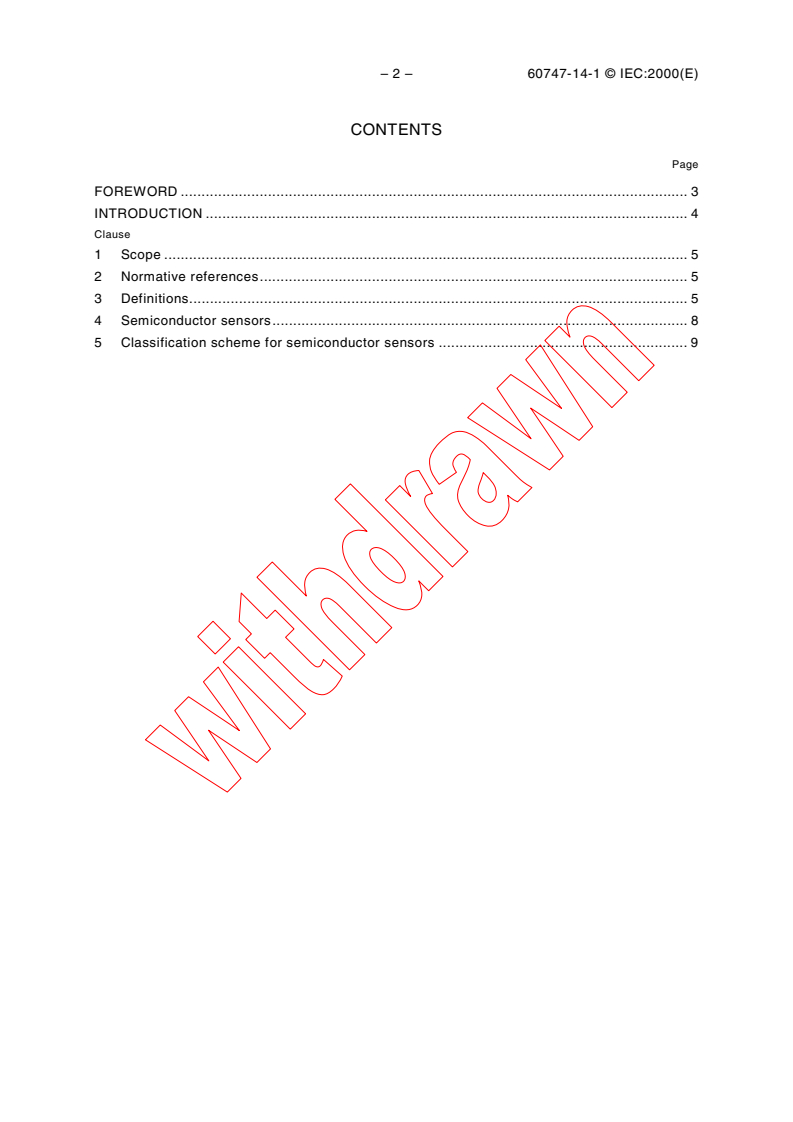
CONTENTS
Page
FOREWORD . 3
INTRODUCTION .4
Clause
1 Scope . 5
2 Normative references. 5
3 Definitions. 5
4 Semiconductor sensors. 8
5 Classification scheme for semiconductor sensors . 9
60747-14-1 © IEC:2000(E) – 3 –
INTERNATIONAL ELECTROTECHNICAL COMMISSION
–––––––––––––
SEMICONDUCTOR DEVICES –
Part 14-1: Semiconductor sensors – General and classification
FOREWORD
1) The IEC (International Electrotechnical Commission) is a worldwide organization for standardization comprising
all national electrotechnical committees (IEC National Committees). The object of the IEC is to promote
international co-operation on all questions concerning standardization in the electrical and electronic fields. To
this end and in addition to other activities, the IEC publishes International Standards. Their preparation is
entrusted to technical committees; any IEC National Committee interested in the subject dealt with may
participate in this preparatory work. International, governmental and non-governmental organizations liaising
with the IEC also participate in this preparation. The IEC collaborates closely with the International
Organization for Standardization (ISO) in accordance with conditions determined by agreement between the
two organizations.
2) The formal decisions or agreements of the IEC on technical matters express, as nearly as possible, an
international consensus of opinion on the relevant subjects since each technical committee has representation
from all interested National Committees.
3) The documents produced have the form of recommendations for international use and are published in the form
of standards, technical specifications, technical reports or guides and they are accepted by the National
Committees in that sense.
4) In order to promote international unification, IEC National Committees undertake to apply IEC International
Standards transparently to the maximum extent possible in their national and regional standards. Any
divergence between the IEC Standard and the corresponding national or regional standard shall be clearly
indicated in the latter.
5) The IEC provides no marking procedure to indicate its approval and cannot be rendered responsible for any
equipment declared to be in conformity with one of its standards.
6) Attention is drawn to the possibility that some of the elements of this International Standard may be the subject
of patent rights. The IEC shall not be held responsible for identifying any or all such patent rights.
International Standard IEC 60747-14-1 has been prepared by subcommittee 47E: Discrete
semiconductor devices, of IEC technical committee 47: Semiconductor devices.
The text of this standard is based on the following documents:
FDIS Report on voting
47E/157/FDIS 47E/170/RVD
Full information on the voting for the approval of this standard can be found in the report on
voting indicated in the above table.
This publication has been drafted in accordance with the ISO/IEC Directives, Part 3.
The committee has decided that the contents of this publication remain unchanged until 2005.
At this date, the publication will be
reconfirmed;
withdrawn;
replaced by a revised edition, or
amended.
A bilingual version of this standard may be issued at a later date.
– 4 – 60747-14-1 © IEC:2000(E)
INTRODUCTION
This part of IEC 60747 should be read in conjunction with IEC 60747-1. It provides basic
information on semiconductor
– terminology;
– letter symbols;
– essential ratings and characteristics;
– measuring methods;
– acceptance and reliability.
60747-14-1 © IEC:2000(E) – 5 –
SEMICONDUCTOR DEVICES –
Part 14-1: Semiconductor sensors – General and classification
1 Scope
This part of IEC 60747-14 describes general items concerning the specifications for sensors,
which are the basis for specfications given in other parts of this series for various types of
sensors. Sensors described in this standard are basically made of semiconductor materials;
however, the statements made in this standard are also applicable to sensors using materials
other than semiconductor, for example dielectric and ferroelectric materials.
2 Normative references
The following normative documents contain provisions which, through reference in this text,
constitute provisions of this part of IEC 60747. For dated references, subsequent
amendments to, or revisions of, any of these publictions do not apply. However, parties to
agreements based on this part of IEC 60747 are encouraged to investigate the possibility of
applying the most recent editions of the normative documents indicated below. For undated
references, the latest edition of the normative document referred to applies. Members of ISO
and IEC maintain registers of currently valid International Standards.
IEC 60721-2-1:1982, Classification of environmental conditions – Part 2: Environmental
conditions appearing in nature – Temperature and humidity
IEC 60721-3-0:1984, Classification of environmental conditions – Part 3: Classification of
groups of environmental parameters and their severities – Introduction
Amendment 1 (1987)
IEC 60747-1:1983, Semiconductor devices – Discrete devices – Part 1: General
3 Definitions
For the purpose of this International Standard, the following definitions apply. This clause
states terms and definitions with letter symbols used for sensors.
3.1
ambient conditions allowed
ambient conditions that may have serious effects on sensor operation such as temperature,
acceleration, vibration, shock, ambient pressure (e.g. high altitudes), moisture, corrosive
mat
...