

IEC 60728-11:2005
(Main)Cable networks for television signals, sound signals and interactive services - Part 11: Safety
General Information
- Abstract
deals with the safety requirements applicable to fixed sited systems and equipment. As far as applicable, it is also valid for mobile and temporarily installed systems, for example, caravans.It provides specifically for the safety of the system, personnel working on it, subscribers and subscriber equipment. It deals only with safety aspects and is not intended to define a standard for the protection of the equipment used in the system.
- Status
- Published
- Publication Date
- 05-Jan-2005
- Technical Committee
- TC 100 - Audio, video and multimedia systems and equipment
- Current Stage
- DELPUB - Deleted Publication
- Start Date
- 29-Jun-2010
- Completion Date
- 28-Aug-2026
Overview
IEC 60728-11:2005 - "Cable networks for television signals, sound signals and interactive services - Part 11: Safety" specifies safety requirements for fixed-site cable distribution systems and associated equipment. It focuses on protecting personnel, subscribers and subscriber equipment from electrical and mechanical hazards. Where applicable, the standard also addresses mobile and temporary installations (for example, caravans). This part of IEC 60728 covers only safety aspects and is not intended as a specification for equipment performance or protection of the equipment itself.
Key topics and requirements
The standard addresses practical safety measures across the lifecycle of cable networks. Major technical topics include:
- General safety and mechanical requirements - construction, accessible parts and protection against mechanical hazards.
- Equipotential bonding and earthing - principles and mechanisms to prevent dangerous potential differences and to ensure safe fault currents.
- Protection against environmental influences - safeguards for moisture, corrosion and other site conditions.
- Mains-supplied and remote-powered equipment - provisions for safely feeding remote amplifiers and line-powered devices (including limits and component requirements).
- Protection from electric power distribution systems - clearances and installation practices where cable networks interact with overhead/house power lines.
- System outlets and transfer points - definitions and safety behaviour of isolated, semi-isolated and non-isolated outlets.
- Protection against atmospheric over-voltages - lightning protection, earthing conductors, bonding and over-voltage protective devices.
- Mechanical stability and mast construction - bending moments, wind loading and documentation data to ensure safe antenna and mast installations.
- Special topics and annexes - use of shield wires for coax protection (Annex A) and conditions for IT power networks (Annex B).
The document includes diagrams, example installations, and a table addressing maximum operation voltages/currents for coaxial cables in network applications.
Applications and who uses it
IEC 60728-11 is used by professionals responsible for the safety of TV/sound/interactive cable networks, including:
- Network designers and system integrators planning headends, distribution and drop installations
- Field installers and maintenance technicians implementing earthing, bonding and mast works
- Equipment manufacturers and remote amplifier vendors ensuring compliance with safety integration
- Utility and safety engineers coordinating cable networks with building electrical systems and lightning protection
- Regulatory bodies and standards committees referencing safety rules for deployed cable infrastructures
Applying IEC 60728-11 helps reduce electrical shock risks, prevent equipment-induced faults, and ensure consistent safety practices across fixed and temporary cable network installations.
Related standards
- IEC 60728 series (Parts 1–12) - performance, EMC, optical and mechanical aspects of cable networks
- Relevant national electrical codes and lightning protection standards (referenced in IEC 60728-11 for local compliance)
Relations
- Revises
IEC 60728-11:1997 - Cabled distribution systems for television and sound signals - Part 11: Safety - Effective Date
- 05-Sep-2023
- Effective Date
- 05-Sep-2023
- Effective Date
- 05-Sep-2023
Get Certified
Connect with accredited certification bodies for this standard

ANCE
Mexican certification and testing association.

Intertek Slovenia
Intertek testing, inspection, and certification services in Slovenia.

LNE (Laboratoire National de Métrologie et d'Essais)
French national laboratory for metrology and testing.
Sponsored listings
Frequently Asked Questions
IEC 60728-11:2005 is a standard published by the International Electrotechnical Commission (IEC). Its full title is "Cable networks for television signals, sound signals and interactive services - Part 11: Safety". This standard covers: deals with the safety requirements applicable to fixed sited systems and equipment. As far as applicable, it is also valid for mobile and temporarily installed systems, for example, caravans.It provides specifically for the safety of the system, personnel working on it, subscribers and subscriber equipment. It deals only with safety aspects and is not intended to define a standard for the protection of the equipment used in the system.
deals with the safety requirements applicable to fixed sited systems and equipment. As far as applicable, it is also valid for mobile and temporarily installed systems, for example, caravans.It provides specifically for the safety of the system, personnel working on it, subscribers and subscriber equipment. It deals only with safety aspects and is not intended to define a standard for the protection of the equipment used in the system.
IEC 60728-11:2005 is classified under the following ICS (International Classification for Standards) categories: 33.060.40 - Cabled distribution systems. The ICS classification helps identify the subject area and facilitates finding related standards.
IEC 60728-11:2005 has the following relationships with other standards: It is inter standard links to IEC 60728-11:1997, IEC 60728-11:1997/AMD1:2000, IEC 60728-11:2010. Understanding these relationships helps ensure you are using the most current and applicable version of the standard.
IEC 60728-11:2005 is available in PDF format for immediate download after purchase. The document can be added to your cart and obtained through the secure checkout process. Digital delivery ensures instant access to the complete standard document.
Standards Content (Sample)
INTERNATIONAL IEC
STANDARD 60728-11
Second edition
2005-01
Cable networks for television signals,
sound signals and interactive services –
Part 11:
Safety
Reference number
Publication numbering
As from 1 January 1997 all IEC publications are issued with a designation in the
60000 series. For example, IEC 34-1 is now referred to as IEC 60034-1.
Consolidated editions
The IEC is now publishing consolidated versions of its publications. For example,
edition numbers 1.0, 1.1 and 1.2 refer, respectively, to the base publication, the
base publication incorporating amendment 1 and the base publication incorporating
amendments 1 and 2.
Further information on IEC publications
The technical content of IEC publications is kept under constant review by the IEC,
thus ensuring that the content reflects current technology. Information relating to
this publication, including its validity, is available in the IEC Catalogue of
publications (see below) in addition to new editions, amendments and corrigenda.
Information on the subjects under consideration and work in progress undertaken
by the technical committee which has prepared this publication, as well as the list
of publications issued, is also available from the following:
x IEC Web Site (www.iec.ch)
x Catalogue of IEC publications
The on-line catalogue on the IEC web site (www.iec.ch/searchpub) enables you to
search by a variety of criteria including text searches, technical committees
and date of publication. On-line information is also available on recently issued
publications, withdrawn and replaced publications, as well as corrigenda.
x IEC Just Published
This summary of recently issued publications (www.iec.ch/online_news/ justpub)
is also available by email. Please contact the Customer Service Centre (see
below) for further information.
x Customer Service Centre
If you have any questions regarding this publication or need further assistance,
please contact the Customer Service Centre:
Email: custserv@iec.ch
Tel: +41 22 919 02 11
Fax: +41 22 919 03 00
INTERNATIONAL IEC
STANDARD 60728-11
Second edition
2005-01
Cable networks for television signals,
sound signals and interactive services –
Part 11:
Safety
IEC 2005 Copyright - all rights reserved
No part of this publication may be reproduced or utilized in any form or by any means, electronic or
mechanical, including photocopying and microfilm, without permission in writing from the publisher.
International Electrotechnical Commission, 3, rue de Varembé, PO Box 131, CH-1211 Geneva 20, Switzerland
Telephone: +41 22 919 02 11 Telefax: +41 22 919 03 00 E-mail: inmail@iec.ch Web: www.iec.ch
PRICE CODE
Commission Electrotechnique Internationale
X
International Electrotechnical Commission
ɆɟɠɞɭɧɚɪɨɞɧɚɹɗɥɟɤɬɪɨɬɟɯɧɢɱɟɫɤɚɹɄɨɦɢɫɫɢɹ
For price, see current catalogue
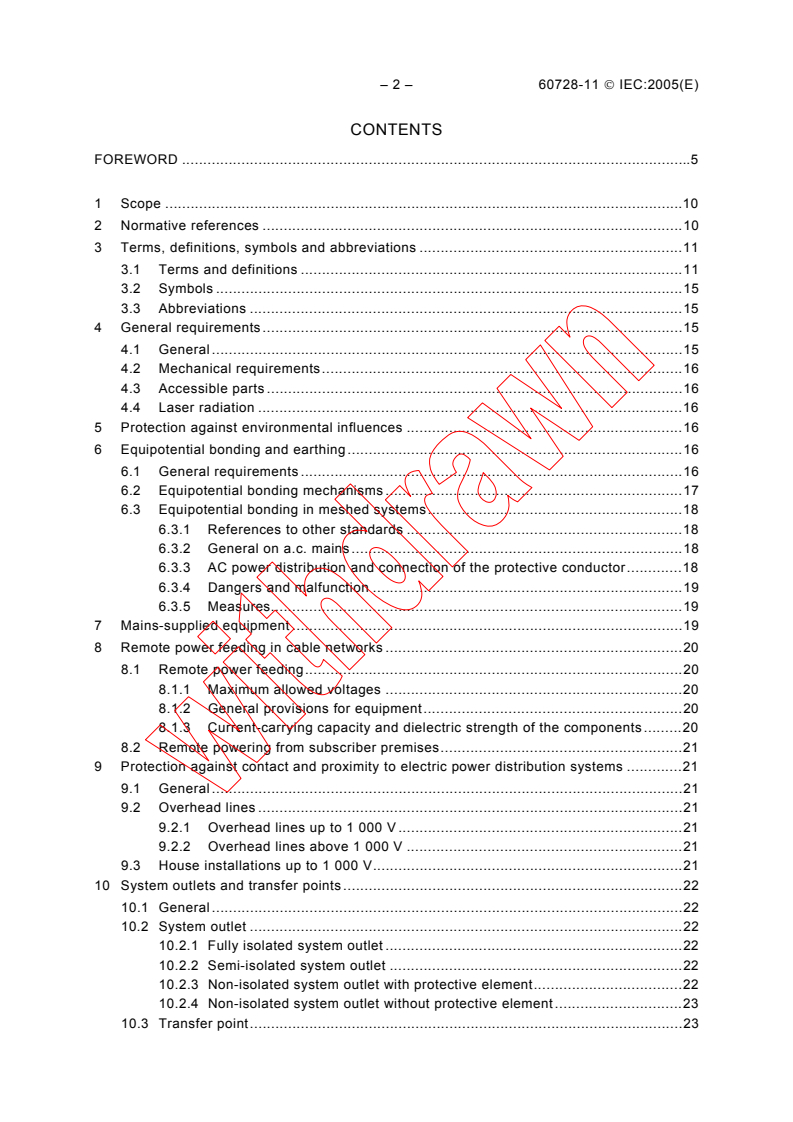
– 2 – 60728-11 IEC:2005(E)
CONTENTS
FOREWORD .5
1 Scope .10
2 Normative references .10
3 Terms, definitions, symbols and abbreviations .11
3.1 Terms and definitions .11
3.2 Symbols .15
3.3 Abbreviations .15
4 General requirements.15
4.1 General .15
4.2 Mechanical requirements.16
4.3 Accessible parts .16
4.4 Laser radiation .16
5 Protection against environmental influences .16
6 Equipotential bonding and earthing.16
6.1 General requirements .16
6.2 Equipotential bonding mechanisms .17
6.3 Equipotential bonding in meshed systems.18
6.3.1 References to other standards .18
6.3.2 General on a.c. mains.18
6.3.3 AC power distribution and connection of the protective conductor.18
6.3.4 Dangers and malfunction .19
6.3.5 Measures.19
7 Mains-supplied equipment .19
8 Remote power feeding in cable networks .20
8.1 Remote power feeding.20
8.1.1 Maximum allowed voltages .20
8.1.2 General provisions for equipment.20
8.1.3 Current-carrying capacity and dielectric strength of the components.20
8.2 Remote powering from subscriber premises.21
9 Protection against contact and proximity to electric power distribution systems .21
9.1 General .21
9.2 Overhead lines .21
9.2.1 Overhead lines up to 1 000 V .21
9.2.2 Overhead lines above 1 000 V .21
9.3 House installations up to 1 000 V.21
10 System outlets and transfer points .22
10.1 General .22
10.2 System outlet .22
10.2.1 Fully isolated system outlet .22
10.2.2 Semi-isolated system outlet .22
10.2.3 Non-isolated system outlet with protective element.22
10.2.4 Non-isolated system outlet without protective element.23
10.3 Transfer point.23
60728-11 IEC:2005(E) – 3 –
11 Protection against atmospheric over-voltages and elimination of potential
differences .23
11.1 General .23
11.2 Protection of the antenna system.23
11.2.1 Building equipped with a lightning protection system (LPS).23
11.2.2 Building not equipped with an LPS .24
11.3 Earthing and bonding of the antenna system.24
11.3.1 Earthing and bonding mechanisms.24
11.3.2 Earth termination system .24
11.3.3 Earthing conductors .24
11.4 Over-voltage protection .25
12 Mechanical stability .25
12.1 General requirements .25
12.2 Bending moment .25
12.3 Wind-pressure values .25
12.4 Mast construction .26
12.5 Data to be published.26
Annex A (informative) Use of shield wires to protect installations with coaxial cables.42
Annex B (informative) Special conditions using IT power line networks.45
Bibliography .50
Figure 1 – Example of equipotential bonding and earthing of a metal enclosure.27
Figure 2 – Example of equipotential bonding and indirect earthing of a metal enclosure
via a voltage-dependent protective device (in case of balancing currents) .28
Figure 3 – Example of equipotential bonding and earthing of a building installation
(underground connection) .29
Figure 4 – Example of equipotential bonding and earthing a building installation
(above ground connection) .30
Figure 5 – Example of equipotential bonding with a galvanic isolated cable entering a
building (underground connection) .31
Figure 6 – Example of maintaining of equipotential bonding whilst a unit is removed.32
Figure 7 – Example of external safety equipotential bonding .33
Figure 8 – Example of equipotential bonding antennas and head ends .34
Figure 9 – Example of antenna-outdoor-mounting on buildings, where earthing is not
required but recommended .35
Figure 10 – Examples of earthing mechanisms.36
Figure 11 – Example of an over-voltage protective device .37
Figure 12 – Example of application of a coaxial over-voltage protective device .38
Figure 13 – Example of bending moment of an antenna mast .39
Figure 14 – Example of the installation of a safety terminal in Japan .40
Figure 15 – Examples of installation of a lightning protection system in Japan .41
Figure 16 – Examples of earth electrodes in Finland .41
Figure A.1 –Principle of Single Shield Wire .43
Figure A.2 –Principle of Two Shield Wires.44
– 4 – 60728-11 IEC:2005(E)
Figure B.1 – IT power distribution systems in Norway.46
Figure B.2 – Installation of a cabinet in the vicinity of the transforming station .46
Figure B.3 – Example of installations located closer than 20 m to a transforming
station .47
Figure B.4 – Installations in a building.47
Figure B.5 – Installations between buildings.48
Figure B.6 – Cabinets for cable network and mains placed less than 2 m apart.48
Figure B.7 – Cabinets for cable network and mains placed more than 2 m apart .49
Table 1 – Maximum operation voltage and maximum currents for coaxial cables in
different cable network applications .20
Table A.1 –Conductivity of different types of soil .42
Table A.2 – Protections factors (K ) of protection measures against direct lightning
p
strokes for buried cables.43
60728-11 IEC:2005(E) – 5 –
INTERNATIONAL ELECTROTECHNICAL COMMISSION
___________
CABLE NETWORKS FOR TELEVISION SIGNALS,
SOUND SIGNALS AND INTERACTIVE SERVICES –
Part 11: Safety
FOREWORD
1) The International Electrotechnical Commission (IEC) is a worldwide organization for standardization comprising
all national electrotechnical committees (IEC National Committees). The object of IEC is to promote
international co-operation on all questions concerning standardization in the electrical and electronic fields. To
this end and in addition to other activities, IEC publishes International Standards, Technical Specifications,
Technical Reports, Publicly Available Specifications (PAS) and Guides (hereafter referred to as “IEC
Publication(s)”). Their preparation is entrusted to technical committees; any IEC National Committee interested
in the subject dealt with may participate in this preparatory work. International, governmental and non-
governmental organizations liaising with the IEC also participate in this preparation. IEC collaborates closely
with the International Organization for Standardization (ISO) in accordance with conditions determined by
agreement between the two organizations.
2) The formal decisions or agreements of IEC on technical matters express, as nearly as possible, an
international consensus of opinion on the relevant subjects since each technical committee has representation
from all interested IEC National Committees.
3) IEC Publications have the form of recommendations for international use and are accepted by IEC National
Committees in that sense. While all reasonable efforts are made to ensure that the technical content of IEC
Publications is accurate, IEC cannot be held responsible for the way in which they are used or for any
misinterpretation by any end user.
4) In order to promote international uniformity, IEC National Committees undertake to apply IEC Publications
transparently to the maximum extent possible in their national and regional publications. Any divergence
between any IEC Publication and the corresponding national or regional publication shall be clearly indicated in
the latter.
5) IEC provides no marking procedure to indicate its approval and cannot be rendered responsible for any
equipment declared to be in conformity with an IEC Publication.
6) All users should ensure that they have the latest edition of this publication.
7) No liability shall attach to IEC or its directors, employees, servants or agents including individual experts and
members of its technical committees and IEC National Committees for any personal injury, property damage or
other damage of any nature whatsoever, whether direct or indirect, or for costs (including legal fees) and
expenses arising out of the publication, use of, or reliance upon, this IEC Publication or any other IEC
Publications.
8) Attention is drawn to the normative references cited in this publication. Use of the referenced publications is
indispensable for the correct application of this publication.
9) Attention is drawn to the possibility that some of the elements of this IEC Publication may be the subject of
patent rights. IEC shall not be held responsible for identifying any or all such patent rights.
International Standard IEC 60728-11 has been prepared by technical area 5: Cable networks
for television signals, sound signals and interactive services, of IEC technical committee 100:
Audio, video and multimedia systems and equipment.
This second edition cancels and replaces the first edition published in 1997 and its
amendment 1 (2000). This edition constitutes a technical revision.
This edition includes the following significant technical changes with respect to the previous
edition:
a) Clause 6, Equipotential bonding and earthing, has been rewritten.
b) Clause 8, Remote power feeding in cable networks, has been rewritten.
c) New informative Annex A: Use of shield wires to protect installations with coaxial cables
d) New informative Annex B: Special conditions using IT power line networks
– 6 – 60728-11 IEC:2005(E)
The text of this standard is based on the following documents:
FDIS Report on voting
100/847A/FDIS 100/896/RVD
Full information on the voting for the approval of this standard can be found in the report on
voting indicated in the above table.
This publication has been drafted in accordance with the ISO/IEC Directives, Part 2.
IEC 60728 consists of the following parts, under the general title Cable networks for
television signals, sound signals and interactive services:
Part 1: Methods of measurement and system performance
Part 2: Electromagnetic compatibility for equipment
Part 3: Active coaxial wideband distribution equipment
Part 4: Passive coaxial wideband distribution equipment
Part 5: Headend equipment
Part 6: Optical equipment
Part 7: Hybrid fibre coax outside plant status monitoring
Part 9: Interfaces of cabled distribution systems for digitally modulated signals
Part 10: System performance of return path
Part 11: Safety (this publication)
Part 12: Electromagnetic compatibility of systems
The following differences exist in some countries.
Clause 6:
• The following parts of the standard cannot be used in areas with an IT power distribution
system:
o Examples of installations inside buildings described in 6.2g) and shown in Figures 3
and 4 cannot be used in areas with an IT-network (Norway).
o Examples of installations inside buildings described in 6.2i) and shown in Figure 6
should be equipped with a galvanic isolator separating local earth from the cable
network distribution lines (Norway).
o Examples of installations inside buildings described in 6.2.11 and shown in Figure 7
should be equipped with a galvanic isolator separating local earth from the cable
network distribution lines (Norway).
o Subclauses 6.3.4, 6.3.4.1, 6.3.4.2 and 6.3.5 have no relevance for cable networks in
areas with an IT power distribution system (Norway).
• Common earthing is not permitted due to electrical earthing conditions (France).
Subclause 6.2:
• Galvanic isolation should withstand a voltage of 1 kV r.m.s. during 1 min (France).
• The equipotential bonding method is not used in Japan (Japan).
• Earthing to gas networks as shown in Figures 3 and 4 is not admitted (Japan, Poland).
60728-11 IEC:2005(E) – 7 –
Subclause 8.1:
• Remote power feeding voltage shall not exceed 90 V AC r.m.s and the line-powering
current shall not exceed 15 A (Japan).
Clause 9:
• The French regulation (arrêté interministériel, 2 April 1991) specifies, among many other
parameters, the minimum distance between electric supply wires (isolated and non-
isolated, low-voltage and high-voltage) and any other installation (for example, buildings,
antennas, telecommunication lines, etc.). The main clauses of this regulation, which
concern the cable networks, are Clauses 12, 25, 26, 33, 33bis, 38, 49, 51, 52 and 63.
Clause 9 of this standard specifies distances of 10 mm (indoors) and 20 mm (outdoors),
and this is not sufficient to cover overhead cables. As an example, the minimum distance
between an overhead telecommunication line and an overhead low-voltage (up to 1 kV)
electricity supply line should be 1 m (Clause 33). This distance may be reduced under
specific conditions (Clauses 51, 52 and 63). This regulation specifies also the minimum
distance from high-voltage lines. This distance varies from 1 m to 4 m depending on the
voltage, on the isolation of the cable and on the location (built-up area or not) (Clauses 33
and 63) (France).
• For antennas in proximity of voltages up to 7 000 V, the following applies in Japan:
1. Low voltage: ≤600 V a.c. or ≤750 V d.c.;
Cable: ≥30 cm distance;
Isolated wire: ≥60 cm distance.
2. High voltage: >600 V a.c. or >750 V d.c.;
Cable: ≥40 cm distance;
Isolated wire: ≥80 cm distance.
Clause 10:
• The resistance to the equipotential point is not applied, because the bonding method is
not used in Japan. Japanese regulations specify applying the safety terminal. The safety
terminal withstands a continuous a.c. test voltage of 1 000 V for a period of not less than
1 min and maintains an insulation resistance of not less than 1,0 MΩ. Installation of a
safety terminal at the junction point between the indoor cabling and the feeder cable of
the distribution system is shown in Figure 14 (Japan).
Clause 11:
• A lightning protection system is applied in Japan for protection against atmospheric over-
voltages and for the elimination of potential differences. In Japan, installation of a
lightning protection system is necessary in the case where the topmost height of the
construction exceeds 20 m, except in those cases where the construction is inside the
safety zone of another lightning protection system (see Figure 15) (Japan).
Subclause 11.1.1:
• An equipotential bonding conductor is not used, because the bonding method is not used
in Japan (Japan).
Subclause 11.2.2:
• An earth termination system is not used in Japan. Only a lightning protection system is
applied (see Figure 15) (Japan).
• As the conductivity of earth in Finland is lower than what is normal in many other
countries, the earthing electrodes in 11.2.2 should be as shown in Figures 16 a), 16 b)
or 16 c) (Finland).
– 8 – 60728-11 IEC:2005(E)
• The earthing conductors have the following requirements (Japan):
a) Conductors for a lightning rod: ≥30 mm Cu.
b) For an earthing resistance of ≤10 Ω, the diameter has to be at least 2,6 mm Cu.
c) For an earthing resistance of ≤100 Ω, indoors, the diameter has to be at least 1,6 mm
Cu or the cross-sectional area has to be at least 2 mm Cu
d) For an earthing resistance of ≤100 Ω, outdoors, the diameter has to be at least 2,6 mm
Cu or the cross-sectional area has to be at least 5,5 mm Cu.
Subclause 12.2:
• The bending moment of a mast up to 6 m is not applied in Japan. In Japan, the mast shall
not be destroyed by the following wind pressures (Japan):
1. For an antenna height h < 16 m, the wind pressure is 60 h , in kg per m .
2. For an antenna height h ≥ 16 m, the wind pressure is 120 h , in kg per m .
Subclause 12.3:
• The required wind pressure value is 700 N/m for buildings up to 30 m (Finland).
The committee has decided that the contents of this publication will remain unchanged until
the maintenance result date indicated on the IEC web site under "http://webstore.iec.ch" in
the data related to the specific publication. At this date, the publication will be
• reconfirmed;
• withdrawn;
• replaced by a revised edition, or
• amended.
60728-11 IEC:2005(E) – 9 –
INTRODUCTION
Standards of the IEC 60728 series deal with cable networks including equipment and
associated methods of measurement for head-end reception, processing and distribution of
television signals, sound signals, interactive multimedia signals, interfaces and their
associated data signals, using all applicable transmission media.
This includes
− CATV networks;
− MATV networks and SMATV networks;
− individual receiving networks;
and all kinds of equipment, systems and installations installed in such networks.
The extent of this standardization work is from the antennas, special signal source inputs to
the head-end or other interface points to the network up to the terminal input.
The standardization of any user terminals (i.e. tuners, receivers, decoders, terminals, etc.) as
well as of any coaxial and optical cables and accessories thereof is excluded.
– 10 – 60728-11 IEC:2005(E)
CABLE NETWORKS FOR TELEVISION SIGNALS,
SOUND SIGNALS AND INTERACTIVE SERVICES –
Part 11: Safety
1 Scope
This part of IEC 60728 deals with the safety requirements applicable to fixed sited systems
and equipment. As far as applicable, it is also valid for mobile and temporarily installed
systems, for example, caravans.
Additional requirements may be applied, for example, referring to
• electrical installations of buildings and overhead lines;
• other telecommunication services distribution systems;
• water distribution systems;
• gas distribution systems;
• lightning systems.
This standard is intended to provide specifically for the safety of the system, personnel
working on it, subscribers and subscriber equipment. It deals only with safety aspects and is
not intended to define a standard for the protection of the equipment used in the system.
2 Normative references
The following referenced documents are indispensable for the application of this document.
For dated references, only the edition cited applies. For undated references, the latest edition
of the referenced document (including any amendments) applies.
IEC 60065:2001, Audio, video and similar electronic apparatus – Safety requirements
IEC 60364 (all parts), Electrical installations of buildings
IEC 60529:2001, Degrees of protection provided by enclosures (IP Code)
IEC 60825-1:2001, Safety of laser products – Part 1: Equipment classification, requirements
and user's guide
IEC 60825-2:2000, Safety of laser products – Part 2: Safety of optical fibre communication
systems (OFCS)
IEC 60950-1:2001, Information technology equipment – Safety – Part 1: General
requirements
IEC 61024-1:1990, Protection of structures against lightning – Part 1: General principles
ISO 3864:2002, Graphical symbols – Safety colours and safety signs – Part 1: Design
principles for safety signs in workplaces and public areas
EN 50117 (all parts), Coaxial cables used in cabled distribution networks
60728-11 IEC:2005(E) – 11 –
3 Terms, definitions, symbols and abbreviations
3.1 Terms and definitions
For the purposes of this document, the following terms and definitions apply.
NOTE Some terms have been taken from IEC 60050-195 and IEC 60050-826.
3.1.1
amplifier
device to compensate for attenuation
3.1.2
attenuation
decibel ratio of the input power to the output power
3.1.3
cable networks (for television signals, sound signals and interactive services)
general overall term used to define CATV-networks, MATV-networks, SMATV-networks and
individual receiving networks; these networks can be used in downstream and upstream
directions
3.1.4
CATV network or community antenna television network
network designed to provide sound and television signals as well as signals for interactive
services to communities
3.1.5
earthing arrangement
all the electric connections and devices involved in the earthing of a system, an installation
and equipment
[IEV 195-02-20]
3.1.6
earthing conductor
protective conductor connecting the main earthing terminal or bar to the earth electrode
[IEV 826-04-07]
3.1.7
earth electrode
conductive part or a group of conductive parts in intimate contact with and providing an
electrical connection with earth
[IEV 826-04-02]
3.1.8
earthing terminal
connection point by means of which the earthing or grounding of a conducting part of an
equipment is accomplished
3.1.9
electric shock
pathophysiological effect resulting from an electric current passing through a human or
animal body
[IEV 826-03-04]
– 12 – 60728-11 IEC:2005(E)
3.1.10
equipotential bonding
electrical connection putting various exposed conductive parts and extraneous conductive
parts at a substantially equal potential
[IEV 826-04-09]
3.1.11
equipotential bonding bar
bar to which, for example, extraneous conductive parts (see IEV 826-03-03), metal sheet of
electrical power and telecommunication cables and other cables can be bonded
3.1.12
equipotential bonding conductor
protective conductor for ensuring equipotential bonding
[IEV 826-04-10]
3.1.13
feeder
transmission path forming part of a cable network. Such a path may consist of a metallic
cable, optical fibre, waveguide or any combination of them. By extension, the term is also
applied to paths containing one or more radio links
3.1.14
galvanic isolator
device providing electrical isolation below a certain frequency range.
3.1.15
hazardous voltage
electrical condition of an object from which a hazardous touch current (electric shock) could
be drawn
[IEC 60065:2001, definition 2.6.10]
3.1.16
head-end
equipment, which is connected between receiving antennas or other signal sources and the
remainder of the cable network, to process the signals to be distributed
3.1.17
individual receiving network
network designed to provide sound and television signals as well as signals for interactive
services to an individual household
3.1.18
lightning protection system (LPS)
complete system used to protect a space against the effects of lightning consisting of both
external and internal lightning protection systems
NOTE In particular cases, an LPS may consist of an external LPS or an internal LPS only (see IEC 61024-1).
3.1.19
main earthing terminal; main earthing bar
terminal or bar provided for the connection of protective conductors, including equipotential
bonding conductors and conductors for functional earthing, if any, to the means of earthing
[IEV 826-04-08]
60728-11 IEC:2005(E) – 13 –
3.1.20
MATV network or master antenna television network
network designed to provide sound and television signals as well as signals for interactive
services to households in one or more buildings
3.1.21
metal installation
extended metal items in the space to be protected which may form a path for lightning
current, such as pipe-work, staircases, elevator guide rails, ventilation, heating and air
conditioning ducts, and interconnected reinforcing steel
[IEC 61024-1:1990, definition 1.2.18]
3.1.22
"natural" component of an LPS
component which performs a lightning protection function but is not installed specifically for
that purpose
NOTE Some examples of the use of this term are as follows:
– "natural" air-termination;
– "natural" down-conductor;
– "natural" earth electrode.
[IEC 61024-1:1990, definition 1.2.17]
3.1.23
network interface unit (NIU)
interface between the cable network and the network inside an apartment
NOTE The network interface unit can contain an over-voltage protective element and/or a galvanic isolation.
3.1.24
neutral conductor (symbol N)
conductor connected to the neutral point of a system and capable of contributing to the
transmission of electrical energy
[IEV 826-01-03]
3.1.25
PEN conductor
earthed conductor combining the functions of both protective conductor and neutral
conductor.
NOTE The acronym PEN results from the combination of both symbols PE for the protective conductor and N for
the neutral conductor.
[IEV 826-04-06]
3.1.26
protective conductor (symbol PE)
conductor required by some measures for protection against electric shock for electrically
connecting any of the following parts:
– exposed conductive parts;
– extraneous conductive parts;
– main earthing terminal;
– earth electrode;
– earthed point of the source or artificial neutral
[IEV 826-04-05]
– 14 – 60728-11 IEC:2005(E)
3.1.27
receiver lead
lead, which connects the system outlet to the subscriber equipment
3.1.28
receiving antenna
device with proper electrical characteristics that intercepts desired signals in the atmosphere
and transfers these to the remainder of the cable network
3.1.29
remote power feeding voltage
voltage for supplying power to network equipment via the cable network or a separate line
3.1.30
safety distance
minimum distance between two conductive parts within the space to be protected between
which no dangerous sparking can occur
[IEC 61024-1:1990, definition 1.2.23]
3.1.31
SMATV network or satellite master antenna television network
network designed to provide sound and television signals as well as signals for interactive
services, received by satellite receiving antenna eventually combined with terrestrial TV
and/or radio signals, to households in one or more buildings
3.1.32
splitter (spur unit)
device in which the signal power at the (input) port is divided equally or unequally between
two or more (output) ports
NOTE Some forms of this device may be used in the reverse direction for combining signal energy.
3.1.33
spur feeder
feeder to which splitters, subscriber taps or looped system outlets are connected
3.1.34
subscriber equipment
equipment at the subscriber premises such as receivers, tuners, decoders, video recorders,
multimedia terminals
3.1.35
subscriber feeder
feeder connecting a subscriber tap to a system outlet or, where the latter is not used, direct
to the subscriber equipment
3.1.36
subscriber tap
device for connecting a subscriber feeder to a spur feeder
3.1.37
surge suppressor
device designed to limit the surge voltage between two parts within the space to be
protected, such as spark gap, surge diverter or semiconductor device
[IEC 61024-1:1990, definition 1.2.24]
60728-11 IEC:2005(E) – 15 –
3.1.38
system outlet
device for interconnecting a subscriber feeder and a receiver lead
3.1.39
transfer point
interface between the cable network and the building's internal network, each of which may
be separately owned and which may contain a voltage-dependent device and/or galvanic
isolator
3.2 Symbols
The following graphical symbols are used in the figures of this standard.
Coaxial conductor Amplifier
[S00011] [S01240]
System outlet Galvanic isolator
Coaxial over-voltage protective
Over-voltage protective device
device
3.3 Abbreviations
a.c. alternating current
AM amplitude modulation
CATV community antenna television (network)
d.c. direct current
IT isolated earth
LPS lightning protection system
MATV master antenna television (network)
N neutral (conductor)
NIU network interface unit
PE protective conductor
PEN PEN conductor
r.f. radio frequency
r.m.s root mean square
SMATV satellite master antenna television (network)
TV Television
4 General requirements
4.1 General
The cable network shall be so designed, constructed and installed as to present no danger,
either under normal condition or abnormal (any single fault) condition, to subscribers,
personnel working on, or externally inspecting, the system, or to any other person, providing
particularly
– 16 – 60728-11 IEC:2005(E)
– personal protection against electric shock;
– personal protection against physical injury;
– protection against fire.
For further details, see the IEC 60364 series.
NOTE The above does not apply to skilled persons working on the equipment, who may be exposed to live parts
of the equipment by the removal of protective covers.
4.2 Mechanical requirements
All parts of the system shall be so constructed that there is no danger of physical injury from
contact with sharp edges or corners.
4.3 Accessible parts
Access to hazardous parts shall not be possible to the general public without first removing a
protective cover by use of a tool. IEC 60065 defines accessible parts and test procedures.
4.4 Laser radiation
If equipment embodying laser products is used, special attention shall be paid to radiation
safety. Refer to IEC 60825-1 and IEC 60825-2 for requirements and recommendations.
5 Protection against environmental influences
All system parts, taking into account external influences to which they might be exposed,
have to be selected and set up in such a way that, when used properly, the effectiveness of
the required protective measures is ensured.
NOTE Special measures are required, for example, for protection against corrosive atmosphere, temperature and
humidity.
6 Equipotential bonding and earthing
6.1 General requirements
The cable network shall be designed and constructed in accordance with the requirements of
the IEC 60364 series so that no hazardous voltages can be present on the outer conductors
of any cable or accessible metalwork of any equipment, including passive items. The require-
ments for the system outlet are specified in Clause 10; the requirements for bonding and
lightning protection of antenna systems are given in Clause 11.
These bonding requirements are intended to protect only the cable network and shall not be
considered to provide protection against electric shock currents from electrical installations.
Earthing arrangements and protective conductors shall be designed and constructed in
accordance with the requirements of IEC 60364-5-54.
Where cable networks are installed outdoors on the same poles as those of the electric
supply, a common earthing may be used.
60728-11 IEC:2005(E) – 17 –
6.2 Equipotential bonding mechanisms
a) In order to prevent potential differences between a cable network and other extraneous
conductive parts, which might do harm to persons or cause damage, for example, by
arcing, the cable network shall be included in the equipotential bonding system of the
building.
NOTE Equipotential bonding between metal installations and electrical systems in and on the building is
generally carried out at the equipotential bonding bar of the building. Multiple, meshed equipotential bonding
increases its effectiveness.
b) Equipotential bonding can be achieved by means of equipotential bonding conductors,
cable shielding or conductive housings or system parts. Heating pipes, water pipes, gas
pipes shall not be used because they do not guarantee permanent equipotential bonding
efficiency.
c) The equipotential bonding conductors connected to earthing terminals shall be
mechanically stable and shall have a minimum cross-sectional area of 4 mm Cu. They
shall comply with IEC 60364-5-54.
d) Metallic enclosures for mains-supplied equipment shall be bonded if they are located
outside buildings. An example of an equipotential bonding connection is shown in Figure
1.
e) Where direct connection to an earthing system is not suitable because high balancing
currents are expected to flow in the outer conductor, for example, in extensive cable
networks, special protection shall be provided.
As shown in Figure 2, this protection can be achieved by
– mounting the equipment within a non-metallic enclosure; or
– connecting an over-voltage protective element between the metallic enclosure and the
earthing connection that hazardous voltages shall be removed from the outer
conductor and accessible metal parts of the system.
The safety sign “Warning about hazardous electrical voltage” according to sign
B.3.6 of ISO 3864 shall be attached to the enclosure.
If balancing currents are expected to exceed the maximum current allowed by the
manufacturer of the cable and/or of the cable connectors, a galvanic isolation may be
used as described hereafter.
f) Where galvanic isolation is provided between sections of the network, to eliminate
balancing currents due to local potential differences, the outer conductors of each
isolated section shall be connected to an earthing system.
NOTE 1 Galvanic isolators, in case of improper design, can radiate or pick up inadmissible high-frequency
energy. Therefore, compliance with the requirements of IEC 60728-2 should be checked carefully.
NOTE 2 Galvanic isolators can be damaged by over-voltages.
g) The outer conductors of coaxial cables entering or leaving a building shall be included in
the equipotential bonding system of the building, either at the equipment or separately.
The subscriber feeder cables need not be bonded if a galvanic isolator or fully isolated
outlets (see Clause 10) or transfer points each with a galvanic isolation for the inner and
the outer conductor are used. Examples are shown in Figures 3, 4 and 5.
h) Where equipotential bonding is not possible and to avoid balancing currents between the
cable network and the building installation, a galvanic isolator shall be used. An example
is shown in Figure 5.
NOTE 1 Galvanic isolators, in case of improper design, can radiate or pick up inadmissible high-frequency
energy. Therefore, compliance with the requirements of IEC 60728-2 should be checked carefully.
NOTE 2 Galvanic isolators can be damaged by over-voltages.
– 18 – 60728-11 IEC:2005(E)
i) When changing or removing equipment or coaxial cable, care shall be taken to avoid
hazardous voltages between the interrupted parts (inner and/or outer conductors) by
opening the loop caused by leakage currents from subscriber equipment. Provision shall
be made to maintain continuity of the outer conductor system while units are changed or
removed to avoid electric shock (shock currents). An example is shown in Figure 6. In
addition, the inner conductors shall be safeguarded against contact.
j) Every connection of an equipotential bonding conductor or an earthing conductor to an
earthing terminal shall be readily accessible and soundly made by the use of crimps,
clamps, weld or hard-soldered joints.
k) All metallic enclosures, housings, mounting bays, racks and mains-supplied equipment,
shall be provided with an external earthing terminal as shown in Figures 7 and 8
complying with IEC 60065 or IEC 60950-1.
NOTE Line-powered amplifiers, taps, splitters and transfer points should also be fitted with earthing
terminals.
l) For antennas, which, according to Clause 11, do not have to be grounded, it is strongly
recommended that at least the outer conductor of the coaxial cable connected to the
antenna should be included in the equipotential bonding. Furthermore, al
...