


IEC 60728-5:2015
(Main)Cable networks for television signals, sound signals and interactive services - Part 5: Headend equipment
Cable networks for television signals, sound signals and interactive services - Part 5: Headend equipment
IEC 60728-5:2015 specifies the characteristics of equipment used in the headends of terrestrial broadcast and satellite receiving systems (without satellite outdoor units and without those broadband amplifiers in the headend as described in IEC 60728-3). It:
- covers the frequency range 5 MHz to 3 000 MHz;
- identifies performance requirements for certain parameters;
- lays down data publication requirements for certain parameters;
- stipulates methods of measurements;
- introduces minimum requirements defining quality grades (Q-grades). This third edition cancels and replaces the second edition published in 2007. This edition constitutes a technical revision. This edition includes the following significant technical changes with respect to the previous edition:
- new text for the introduction, following the scope of IEC TC 100/TA 5;
- introduction of IPTV to the scope;
- headend specification for digital terrestrial TV signals according to the DVB-T2 standard;
- headend specification for digital TV signals in cable networks according to the DVB-S2 standard.
Réseaux de distribution par câbles pour signaux de télévision, signaux de radiodiffusion sonore et services interactifs - Partie 5: Equipements de tête de réseau
L'IEC 60728-5:2015 spécifie les caractéristiques de l'équipement utilisé dans les têtes de réseaux pour la réception de la radiodiffusion terrestre et par satellite (à l'exception des unités extérieures et des amplificateurs large bande situés dans la tête de réseau tels que décrits dans l'IEC 60728-3). Elle:
- couvre la plage de fréquences de 5 MHz à 3 000 MHz;
- identifie les exigences de fonctionnement pour certains paramètres;
- spécifie les exigences relatives à la publication des données pour certains paramètres;
- stipule les méthodes de mesure;
- présente les exigences minimales définissant les classes de qualité (Q). Cette troisième édition annule et remplace la deuxième édition parue en 2007. Cette édition constitue une révision technique. Cette édition inclut les modifications techniques majeures suivantes par rapport à l'édition précédente:
- nouveau texte pour l'introduction suivant le domaine d'application de l'IEC TC 100/TA 5;
- introduction de l'IPTV au domaine d'application;
- spécification relative aux têtes de réseaux pour signaux TV numériques par voie terrestre conformément à la norme DVB-T2;
- spécification relative aux têtes de réseaux pour signaux TV numériques dans des réseaux de distribution par câbles conformément à la norme DVB-S2.
General Information
- Status
- Published
- Publication Date
- 08-Dec-2015
- Technical Committee
- TC 100 - Audio, video and multimedia systems and equipment
- Drafting Committee
- WG 1 - TC 100/TA 5/WG 1
- Current Stage
- PPUB - Publication issued
- Start Date
- 09-Dec-2015
- Completion Date
- 15-Dec-2015
Relations
- Effective Date
- 05-Sep-2023
Overview
IEC 60728-5:2015 is an international standard established by the International Electrotechnical Commission (IEC) that specifies the characteristics and performance requirements for headend equipment used in cable networks. This standard focuses on terrestrial broadcast and satellite receiving systems, excluding satellite outdoor units and certain broadband amplifiers described in IEC 60728-3. It covers a wide frequency range, from 5 MHz to 3,000 MHz, and introduces updated technical provisions in line with modern broadcasting technologies, including IPTV and digital TV signals compliant with DVB-T2 and DVB-S2 standards.
The third edition of IEC 60728-5:2015 replaces the 2007 edition, reflecting significant technological advancements and expanded scope, ensuring compatibility and quality for headend equipment in television, sound, and interactive service networks.
Key Topics
Scope of Headend Equipment
Specifies requirements for equipment at the headend of terrestrial and satellite reception systems, focusing on signal processing for TV and sound.Frequency Range
Defines operation within 5 MHz to 3,000 MHz to encompass cable transmission spectrum needs.Performance Requirements
Details parameters like input/output impedance, return loss, signal-to-noise ratio, carrier-to-spurious signal ratios, phase noise, and frequency stability essential for high-quality signal distribution.Measurement Methods
Describes standardized test procedures for digitally modulated signals, intermodulation distortion, group delay, differential gain/phase, and teletext decoding margin to ensure equipment meets performance specs.Quality Grades (Q-Grades)
Introduces minimum requirements that define quality levels allowing manufacturers and network operators to classify products based on performance.Inclusion of IPTV and Digital TV Standards
Extends specifications to IPTV systems and headend equipment supporting DVB-T2 terrestrial digital TV and DVB-S2 satellite digital TV, reflecting evolving broadcast technologies.Environmental and Safety Compliance
Addresses electromagnetic compatibility, environmental conditions, and safety marks to ensure sustainable and reliable device operation.
Applications
IEC 60728-5:2015 is critical for manufacturers, network operators, and system integrators involved in the design, implementation, and maintenance of:
Cable Television Networks
Ensuring reliable distribution of analogue and digital TV signals within cable headend facilities.Sound Broadcasting Systems
Managing sound signals with required fidelity and minimal interference across broadcast amplifiers and converters.Interactive Services and IPTV
Providing standards compliance for headend equipment included in IP-based content distribution systems.Satellite Receiving Headends
Applying performance criteria for equipment handling DVB-S2 satellite signals within cable infrastructure.Broadcast Quality Assurance
Utilizing standard measurement methods to certify equipment performance, helping maintain optimal signal quality end-to-end.Network Upgrades and Retrofits
Guidance for updating headend equipment to newer digital standards and interoperability requirements.
Related Standards
IEC 60728-3
Specifies requirements for broadband amplifiers in cable television networks, complementary to IEC 60728-5.DVB-T2 and DVB-S2 Standards
Digital video broadcasting standards for terrestrial and satellite signals, which IEC 60728-5 integrates for headend equipment specifications.IEC Electromagnetic Compatibility (EMC) Standards
Ensure equipment complies with EMC regulations for minimal electromagnetic interference.IEC 60728 Series
Encompasses other parts addressing cable networks for TVs and sound signals, including system design and amplifier equipment.
Practical Value
Implementing IEC 60728-5:2015 compliant headend equipment enables:
Optimized Signal Quality
Ensures cable network operators deliver high-fidelity television and audio services.Interoperability and Consistency
Facilitates uniform equipment performance and compatibility across different vendors.Future-Ready Infrastructure
Supports transition to modern digital and IPTV technologies.Reliable Measurement Standards
Allows consistent testing methodologies for quality assurance and troubleshooting.Enhanced Consumer Experience
Contributes to stable reception, clear audio, and interactive content delivery for end-users.
By adhering to IEC 60728-5:2015, stakeholders in the broadcast and cable industry can maintain high standards in network headend design and equipment, driving performance that meets evolving technology demands and regulatory requirements.
Get Certified
Connect with accredited certification bodies for this standard

ANCE
Mexican certification and testing association.

Intertek Slovenia
Intertek testing, inspection, and certification services in Slovenia.

LNE (Laboratoire National de Métrologie et d'Essais)
French national laboratory for metrology and testing.
Sponsored listings
Frequently Asked Questions
IEC 60728-5:2015 is a standard published by the International Electrotechnical Commission (IEC). Its full title is "Cable networks for television signals, sound signals and interactive services - Part 5: Headend equipment". This standard covers: IEC 60728-5:2015 specifies the characteristics of equipment used in the headends of terrestrial broadcast and satellite receiving systems (without satellite outdoor units and without those broadband amplifiers in the headend as described in IEC 60728-3). It: - covers the frequency range 5 MHz to 3 000 MHz; - identifies performance requirements for certain parameters; - lays down data publication requirements for certain parameters; - stipulates methods of measurements; - introduces minimum requirements defining quality grades (Q-grades). This third edition cancels and replaces the second edition published in 2007. This edition constitutes a technical revision. This edition includes the following significant technical changes with respect to the previous edition: - new text for the introduction, following the scope of IEC TC 100/TA 5; - introduction of IPTV to the scope; - headend specification for digital terrestrial TV signals according to the DVB-T2 standard; - headend specification for digital TV signals in cable networks according to the DVB-S2 standard.
IEC 60728-5:2015 specifies the characteristics of equipment used in the headends of terrestrial broadcast and satellite receiving systems (without satellite outdoor units and without those broadband amplifiers in the headend as described in IEC 60728-3). It: - covers the frequency range 5 MHz to 3 000 MHz; - identifies performance requirements for certain parameters; - lays down data publication requirements for certain parameters; - stipulates methods of measurements; - introduces minimum requirements defining quality grades (Q-grades). This third edition cancels and replaces the second edition published in 2007. This edition constitutes a technical revision. This edition includes the following significant technical changes with respect to the previous edition: - new text for the introduction, following the scope of IEC TC 100/TA 5; - introduction of IPTV to the scope; - headend specification for digital terrestrial TV signals according to the DVB-T2 standard; - headend specification for digital TV signals in cable networks according to the DVB-S2 standard.
IEC 60728-5:2015 is classified under the following ICS (International Classification for Standards) categories: 33.060.40 - Cabled distribution systems. The ICS classification helps identify the subject area and facilitates finding related standards.
IEC 60728-5:2015 has the following relationships with other standards: It is inter standard links to IEC 60728-5:2007. Understanding these relationships helps ensure you are using the most current and applicable version of the standard.
IEC 60728-5:2015 is available in PDF format for immediate download after purchase. The document can be added to your cart and obtained through the secure checkout process. Digital delivery ensures instant access to the complete standard document.
Standards Content (Sample)
IEC 60728-5 ®
Edition 3.0 2015-12
INTERNATIONAL
STANDARD
NORME
INTERNATIONALE
Cable networks for television signals, sound signals and interactive services –
Part 5: Headend equipment
Réseaux de distribution par câbles pour signaux de télévision, signaux de
radiodiffusion sonore et services interactifs –
Partie 5: Équipements de tête de réseau
All rights reserved. Unless otherwise specified, no part of this publication may be reproduced or utilized in any form
or by any means, electronic or mechanical, including photocopying and microfilm, without permission in writing from
either IEC or IEC's member National Committee in the country of the requester. If you have any questions about IEC
copyright or have an enquiry about obtaining additional rights to this publication, please contact the address below or
your local IEC member National Committee for further information.
Droits de reproduction réservés. Sauf indication contraire, aucune partie de cette publication ne peut être reproduite
ni utilisée sous quelque forme que ce soit et par aucun procédé, électronique ou mécanique, y compris la photocopie
et les microfilms, sans l'accord écrit de l'IEC ou du Comité national de l'IEC du pays du demandeur. Si vous avez des
questions sur le copyright de l'IEC ou si vous désirez obtenir des droits supplémentaires sur cette publication, utilisez
les coordonnées ci-après ou contactez le Comité national de l'IEC de votre pays de résidence.
IEC Central Office Tel.: +41 22 919 02 11
3, rue de Varembé Fax: +41 22 919 03 00
CH-1211 Geneva 20 info@iec.ch
Switzerland www.iec.ch
About the IEC
The International Electrotechnical Commission (IEC) is the leading global organization that prepares and publishes
International Standards for all electrical, electronic and related technologies.
About IEC publications
The technical content of IEC publications is kept under constant review by the IEC. Please make sure that you have the
latest edition, a corrigenda or an amendment might have been published.
IEC Catalogue - webstore.iec.ch/catalogue Electropedia - www.electropedia.org
The stand-alone application for consulting the entire The world's leading online dictionary of electronic and
bibliographical information on IEC International Standards, electrical terms containing more than 30 000 terms and
Technical Specifications, Technical Reports and other definitions in English and French, with equivalent terms in 15
documents. Available for PC, Mac OS, Android Tablets and additional languages. Also known as the International
iPad. Electrotechnical Vocabulary (IEV) online.
IEC publications search - www.iec.ch/searchpub IEC Glossary - std.iec.ch/glossary
The advanced search enables to find IEC publications by a More than 60 000 electrotechnical terminology entries in
variety of criteria (reference number, text, technical English and French extracted from the Terms and Definitions
committee,…). It also gives information on projects, replaced clause of IEC publications issued since 2002. Some entries
and withdrawn publications. have been collected from earlier publications of IEC TC 37,
77, 86 and CISPR.
IEC Just Published - webstore.iec.ch/justpublished
Stay up to date on all new IEC publications. Just Published IEC Customer Service Centre - webstore.iec.ch/csc
details all new publications released. Available online and If you wish to give us your feedback on this publication or
also once a month by email. need further assistance, please contact the Customer Service
Centre: csc@iec.ch.
A propos de l'IEC
La Commission Electrotechnique Internationale (IEC) est la première organisation mondiale qui élabore et publie des
Normes internationales pour tout ce qui a trait à l'électricité, à l'électronique et aux technologies apparentées.
A propos des publications IEC
Le contenu technique des publications IEC est constamment revu. Veuillez vous assurer que vous possédez l’édition la
plus récente, un corrigendum ou amendement peut avoir été publié.
Catalogue IEC - webstore.iec.ch/catalogue Electropedia - www.electropedia.org
Application autonome pour consulter tous les renseignements
Le premier dictionnaire en ligne de termes électroniques et
bibliographiques sur les Normes internationales,
électriques. Il contient plus de 30 000 termes et définitions en
Spécifications techniques, Rapports techniques et autres
anglais et en français, ainsi que les termes équivalents dans
documents de l'IEC. Disponible pour PC, Mac OS, tablettes
15 langues additionnelles. Egalement appelé Vocabulaire
Android et iPad.
Electrotechnique International (IEV) en ligne.
Recherche de publications IEC - www.iec.ch/searchpub
Glossaire IEC - std.iec.ch/glossary
Plus de 60 000 entrées terminologiques électrotechniques, en
La recherche avancée permet de trouver des publications IEC
en utilisant différents critères (numéro de référence, texte, anglais et en français, extraites des articles Termes et
comité d’études,…). Elle donne aussi des informations sur les Définitions des publications IEC parues depuis 2002. Plus
projets et les publications remplacées ou retirées. certaines entrées antérieures extraites des publications des
CE 37, 77, 86 et CISPR de l'IEC.
IEC Just Published - webstore.iec.ch/justpublished
Service Clients - webstore.iec.ch/csc
Restez informé sur les nouvelles publications IEC. Just
Published détaille les nouvelles publications parues. Si vous désirez nous donner des commentaires sur cette
Disponible en ligne et aussi une fois par mois par email. publication ou si vous avez des questions contactez-nous:
csc@iec.ch.
IEC 60728-5 ®
Edition 3.0 2015-12
INTERNATIONAL
STANDARD
NORME
INTERNATIONALE
Cable networks for television signals, sound signals and interactive services –
Part 5: Headend equipment
Réseaux de distribution par câbles pour signaux de télévision, signaux de
radiodiffusion sonore et services interactifs –
Partie 5: Équipements de tête de réseau
INTERNATIONAL
ELECTROTECHNICAL
COMMISSION
COMMISSION
ELECTROTECHNIQUE
INTERNATIONALE
ICS 33.060.40 ISBN 978-2-8322-3016-9
– 2 – IEC 60728-5:2015 © IEC 2015
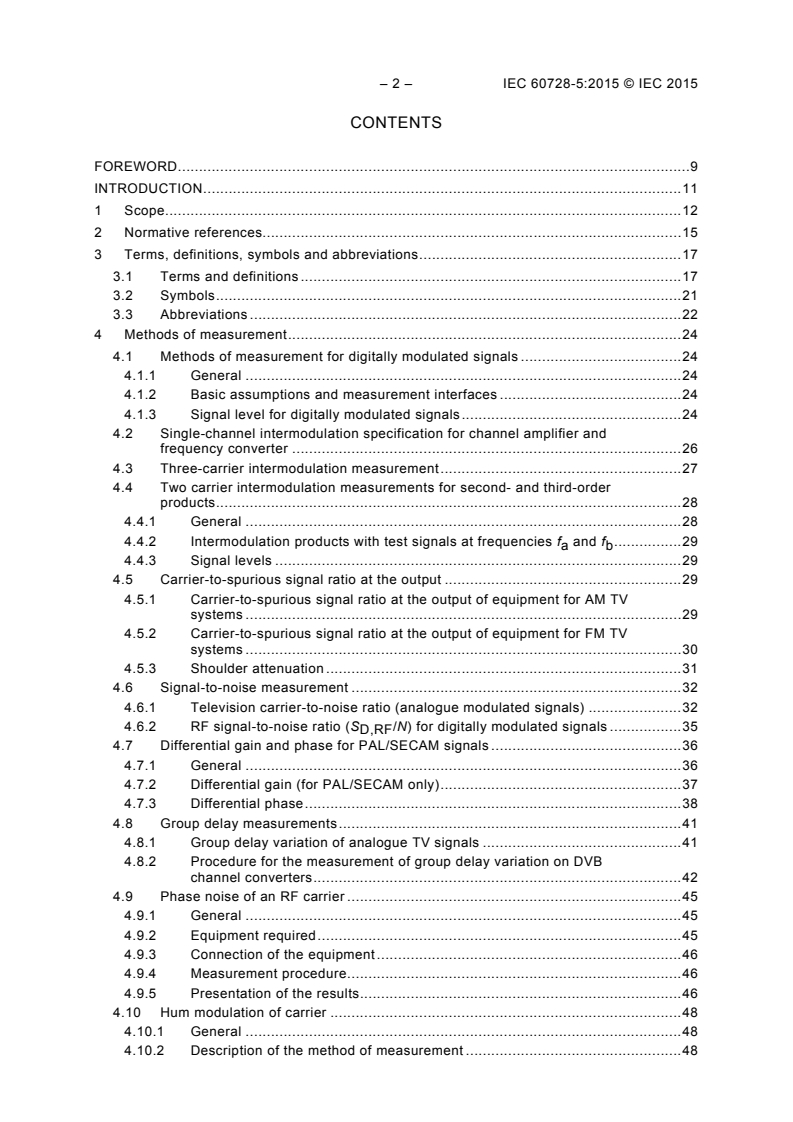
CONTENTS
FOREWORD . 9
INTRODUCTION . 11
1 Scope . 12
2 Normative references. 15
3 Terms, definitions, symbols and abbreviations . 17
3.1 Terms and definitions . 17
3.2 Symbols . 21
3.3 Abbreviations . 22
4 Methods of measurement . 24
4.1 Methods of measurement for digitally modulated signals . 24
4.1.1 General . 24
4.1.2 Basic assumptions and measurement interfaces . 24
4.1.3 Signal level for digitally modulated signals . 24
4.2 Single-channel intermodulation specification for channel amplifier and
frequency converter . 26
4.3 Three-carrier intermodulation measurement . 27
4.4 Two carrier intermodulation measurements for second- and third-order
products . 28
4.4.1 General . 28
4.4.2 Intermodulation products with test signals at frequencies f and f . 29
a b
4.4.3 Signal levels . 29
4.5 Carrier-to-spurious signal ratio at the output . 29
4.5.1 Carrier-to-spurious signal ratio at the output of equipment for AM TV
systems . 29
4.5.2 Carrier-to-spurious signal ratio at the output of equipment for FM TV
systems . 30
4.5.3 Shoulder attenuation . 31
4.6 Signal-to-noise measurement . 32
4.6.1 Television carrier-to-noise ratio (analogue modulated signals) . 32
4.6.2 RF signal-to-noise ratio (S /N) for digitally modulated signals . 35
D,RF
4.7 Differential gain and phase for PAL/SECAM signals . 36
4.7.1 General . 36
4.7.2 Differential gain (for PAL/SECAM only) . 37
4.7.3 Differential phase . 38
4.8 Group delay measurements . 41
4.8.1 Group delay variation of analogue TV signals . 41
4.8.2 Procedure for the measurement of group delay variation on DVB
channel converters . 42
4.9 Phase noise of an RF carrier . 45
4.9.1 General . 45
4.9.2 Equipment required . 45
4.9.3 Connection of the equipment . 46
4.9.4 Measurement procedure . 46
4.9.5 Presentation of the results . 46
4.10 Hum modulation of carrier . 48
4.10.1 General . 48
4.10.2 Description of the method of measurement . 48
4.10.3 Measuring procedure . 49
4.10.4 Calculating the hum modulation ratio . 50
4.11 2T-pulse response, K-factor . 51
4.12 Chrominance-luminance delay inequalities (20T-pulse method) . 52
4.13 Luminance non-linearity . 54
4.14 Intermodulation distortion (FM stereo radio) . 54
4.14.1 General . 54
4.14.2 Equipment required . 55
4.14.3 Connection of equipment . 55
4.14.4 Measurement . 55
4.15 Decoding margin (teletext) . 55
4.15.1 General . 55
4.15.2 Method of measurement and measuring set-up (Figure 31) . 56
4.15.3 Applicability of measuring set-up . 56
5 Performance requirements and recommendations . 56
5.1 Safety . 56
5.2 Electromagnetic compatibility . 56
5.3 Environmental . 56
5.4 Marking . 57
5.4.1 Marking of equipment . 57
5.4.2 Marking of ports . 57
6 Equipment characteristics required to be met . 57
6.1 General . 57
6.2 Power supply voltage . 58
6.3 RF signal requirements . 58
6.3.1 Impedance (input) . 58
6.3.2 Impedance (output) . 58
6.3.3 Return loss (input, output) of equipment . 58
6.3.4 Return loss (output) of headend . 58
6.3.5 Typical back-off for digital against analogue signals . 58
6.3.6 Immunity against other signals in the FM radio and TV range . 59
6.3.7 Carrier-to-spurious-signals ratio at output in the frequency range of
40 MHz to 862 MHz . 59
6.3.8 Image rejection for AM TV and FM radio . 60
6.3.9 Carrier to local oscillator signal ratio at the output for AM TV and FM
radio . 60
6.3.10 Frequency stability . 60
6.3.11 Phase noise of digital modulated signals at the output of the headend . 61
6.3.12 In-channel group delay variation for digital modulated signals . 62
6.3.13 In-channel peak-to-peak amplitude response variation for digitally
modulated signals . 63
6.3.14 Stability of sound intercarrier . 63
6.3.15 Stability of residual carrier amplitude . 63
6.3.16 Frequency stability – SAT IF/IF converter . 63
6.3.17 Typical modulation error ratio (MER) for a QAM signal . 64
6.3.18 Minimum C/N values at the output of the headend . 64
6.4 Composite video signal requirements . 64
6.4.1 Impedance . 64
6.4.2 Return loss . 65
– 4 – IEC 60728-5:2015 © IEC 2015
6.4.3 Signal voltage . 65
6.4.4 Polarity . 65
6.4.5 Offset voltage . 65
6.5 Audio signal requirements . 65
6.5.1 Input impedance . 65
6.5.2 Output impedance . 65
6.5.3 Signal level . 65
6.6 Requirements for decoding margin (teletext) . 66
6.7 IF signal requirements (AM-TV) . 66
6.7.1 Impedance . 66
6.7.2 Return loss . 66
6.8 Antennas for terrestrial reception . 66
6.8.1 Impedance . 66
6.8.2 Return loss . 66
6.9 Antenna amplifier . 66
7 Equipment characteristics required to be published . 67
7.1 General . 67
7.2 Environmental conditions . 67
7.3 Maximum permissible output level . 67
7.4 Operating range for output level . 68
7.5 TV standard . 68
7.6 Clamp . 68
7.7 Noise figure . 68
7.7.1 Equipment without AGC . 68
7.7.2 Equipment with AGC . 69
7.8 Data control signals, description of interface . 69
7.9 Output level stability for TV modulators, TV converters and pilot generators . 69
7.10 Pilot signal . 69
7.11 Differential gain and phase . 70
7.11.1 Differential gain . 70
7.11.2 Differential phase . 70
7.12 Group delay variation for analogue TV signals . 70
7.13 Luminance non-linearity . 70
7.14 2T-pulse . 71
7.15 20T-pulse. 71
7.16 Hum modulation . 71
7.17 Television carrier-to-noise ratio . 71
7.18 Audio in TV . 71
7.19 Processing units for FM radio . 72
7.19.1 Audio input . 72
7.19.2 Stereo crosstalk . 72
7.19.3 Total harmonic distortion . 72
7.19.4 Intermodulation distortion . 72
7.19.5 Deviation, pre-emphasis . 72
7.20 Antennas for terrestrial reception . 72
7.20.1 Antenna gain . 72
7.20.2 Sidelobe suppression . 72
7.20.3 Return loss of antennas . 72
7.21 Control signals for outdoor units . 73
Annex A (normative) Definition of the specified test frequency range for return loss
and noise figure . 74
A.1 Test frequency range for TV channel processor . 74
A.2 Test frequency range for sub-band, full-band and multi-band amplifiers . 74
A.3 Test frequency range for an FM radio channel processor . 74
Annex B (informative) Audio connector for European system according to IEC 60130-9 . 76
B.1 Contact allocation and mechanical dimensions . 76
B.2 Signal-to-pin allocations and applications . 76
Annex C (informative) Selectivity diagram for adjacent channel transmission . 77
C.1 General . 77
C.2 TV modulator for standard PAL B/G with mono or stereo sound . 77
C.3 TV modulator for standard PAL B/G with NICAM 728 in the lower adjacent
channel . 78
C.4 Standard PAL I . 78
C.5 Group delay for the standards B/G, D/D1/K and I . 79
C.6 Group delay pre-correction for TV modulator for standard B/G . 79
C.7 TV modulator for standard SECAM L . 80
C.8 Group delay for TV modulator for standard SECAM L . 80
C.9 TV modulator for standard PAL D/K with mono or stereo sound . 81
Annex D (informative) Differences in some countries . 82
D.1 General . 82
D.2 Finland, Sweden . 82
Annex E (normative) Correction factors for noise . 83
E.1 Signal level measurement . 83
E.2 Noise level measurement . 83
Annex F (informative) Digital signal level and bandwidth . 85
F.1 RF/IF power ("carrier") . 85
F.2 Occupied bandwidth of a digital signal . 85
F.2.1 QAM/QPSK modulation . 85
F.2.2 OFDM modulation . 86
F.3 Noise bandwidth . 86
F.3.1 General . 86
F.3.2 QAM/QPSK/8 PSK modulation . 87
F.3.3 OFDM modulation . 87
F.4 Equivalent signal bandwidth . 87
F.4.1 General . 87
F.4.2 QAM/QPSK/8 PSK modulation . 87
F.4.3 OFDM modulation . 87
F.5 Examples . 87
Annex G (informative) Minimum frequency distance of converted satellite signals in
the IF range . 89
Annex H (informative) Measurement errors which occur due to mismatched equipment . 90
Annex I (normative) Correction factor for spectrum analyser . 91
Bibliography . 92
Figure 1 – Example of headend . 13
Figure 2 – Examples of IP gateways/interfaces at the input of headends . 14
Figure 3 – Examples of IP gateways and interfaces at the output of central headends . 15
– 6 – IEC 60728-5:2015 © IEC 2015
Figure 4 – Frequencies and levels of test carriers . 27
Figure 5 – Test carrier and interfering products in the pass band . 28
Figure 6 – Example showing products formed when 2f > f . 29
a b
Figure 7 – Carrier-to-spurious signal ratio at the output . 30
Figure 8 – Carrier-to spurious signal ratio at the output . 31
Figure 9 – Shoulder attenuation . 31
Figure 10 – Arrangement of test equipment for carrier-to-noise ratio measurement . 32
Figure 11 – Arrangement of test equipment for measurement of differential gain and
phase . 40
Figure 12 – Signal D2 waveform . 40
Figure 13 – Example of modified staircase . 40
Figure 14 – Measuring set-up for determining the group delay variation . 41
Figure 15 – RF signal (time domain) amplitude-modulated with a split-frequency signal . 42
Figure 16 – Spectral presentation of the group delay measurement . 43
Figure 17 – Description of the measuring set-up . 44
Figure 18 – Choices of measuring aperture (value of the split frequency) for various
measurement tests . 44
Figure 19 – Test set-up for phase noise measurement . 46
Figure 20 – Mask for phase noise measurements . 47
Figure 21 – Carrier/hum ratio . 48
Figure 22 – Test set-up for equipment with built-in power supply . 49
Figure 23 – Test set-up for equipment with external power supply . 49
Figure 24 – Oscilloscope display . 50
Figure 25 – K-factor mask for quality grade 2 . 52
Figure 26 – Generation of 20T-pulse . 53
Figure 27 – Example of amplitude and delay error using 20T-pulse . 53
Figure 28 – Staircase signal for measurement of luminance non-linearity before and
after differentiation . 54
Figure 29 – Example of a possible frequency combination displayed on a spectrum
analyser . 54
Figure 30 – Arrangement of test equipment for intermodulation distortion . 55
Figure 31 – Principal measuring set-up for determination of decoding margin . 56
Figure 32 – Example of diagram of NF, C/N or S/N for equipment with AGC . 69
Figure A.1 – Test frequency range for TV channel processors . 74
Figure A.2 – Test frequency range for sub-band, full-band and multi-band amplifiers . 74
Figure A.3 – Test frequency range for an FM radio channel processor . 75
Figure B.1 – Contact allocation and mechanical dimensions . 76
Figure C.1 – Selectivity diagram for PAL B/G with mono or stereo sound . 77
Figure C.2 – Selectivity diagram for PAL B/G with NICAM 728 in the lower adjacent
channel . 78
Figure C.3 – Selectivity diagram for PAL I . 79
Figure C.4 – Group delay mask for the standards B/G, D/D1/K and I . 79
Figure C.5 – Group delay pre-correction diagram for standard B/G . 80
Figure C.6 – Selectivity diagram for SECAM L . 80
Figure C.7 – Group delay mask for SECAM L . 81
Figure C.8 – Selectivity diagram for PAL D/K . 81
Figure E.1 – Noise correction factor CF (dB) versus measured level difference D (dB) . 84
Figure G.1 – Frequency tolerance of converted signals in the IF range . 89
Figure H.1 – Error concerning return loss measurement . 90
Figure H.2 – Maximum ripple . 90
Table 1 – Test signal levels for the different television standards in decibels relative to
reference level . 27
Table 2 – Test signal levels in decibels relative to reference level . 28
Table 3 – Test signal levels for sound and vision carriers in decibels relative to
reference level . 30
Table 4 – Noise bandwidth . 34
Table 5 – Frequency distances for phase noise measurement . 47
Table 6 – Publications for environmental requirements of headend equipment . 57
Table 7 – Return loss (input, output) of equipment . 58
Table 8 – Return loss (output) of headend . 58
Table 9 – Typical levels of digital signals with respect to analogue signals (back-off) . 59
Table 10 – Carrier-to-spurious-signals ratio of digital modulated channel with respect
to the peak level of an analogue TV carrier . 60
Table 11 – Frequency stability for AM TV related to the nominal AM TV frequency . 60
Table 12 – Long-term frequency stability for digital modulated signals . 61
Table 13 – Shoulder attenuation for digital modulated signals . 61
Table 14 – Phase noise of a DVB signal (PSK and QAM) . 62
Table 15 – Phase noise of a DVB signal (OFDM) . 62
Table 16 – In-channel group delay variation for digital modulated signals . 62
Table 17 – In-channel peak-to-peak amplitude response variation of DVB signals . 63
Table 18 – Stability of sound intercarrier . 63
Table 19 – Stability of residual carrier amplitude . 63
Table 20 – Frequency stability – SAT IF/IF converter . 64
Table 21 – Minimum requirements for MER for different QAM modulation schemes . 64
Table 22 – C/N values for converters at the headend output . 64
Table 23 – Return loss . 65
Table 24 – Signal voltage . 65
Table 25 – Signal level . 66
Table 26 – Requirements for decoding margin (Teletext) . 66
Table 27 – Return loss – IF signal . 66
Table 28 – Return loss – Antennas for terrestrial reception . 66
Table 29 – Recommended temperature ranges . 67
Table 30 – Carrier-to-third-order intermodulation ratio for maximum output level of
channel amplifiers/frequency converters . 67
Table 31 – Carrier-to-third-order intermodulation ratio for maximum output level of
sub-band, full band, multi-band amplifiers and multi-channel frequency converters for
AM TV (not for channel amplifier) . 67
Table 32 – Carrier-to-second-order intermodulation ratio for maximum output level of
sub-band, full band, multi-band amplifiers and frequency converters for AM TV or FM
radio (not for channel amplifier) . 68
– 8 – IEC 60728-5:2015 © IEC 2015
Table 33 – Carrier-to-intermodulation ratio for maximum output level of FM-TV
channel amplifiers/frequency converters . 68
Table 34 – Carrier-to-third-order intermodulation ratio for maximum output level of FM
TV full band, sub-band amplifiers . 68
Table 35 – Output level stability for TV modulators, pilot generators and TV converters . 69
Table 36 – Recommendation for differential gain . 70
Table 37 – Recommendation for differential phase . 70
Table 38 – Recommendation for group delay variation . 70
Table 39 – Recommendation for luminance non-linearity . 71
Table 40 – K-factor masks for 2T-pulse responses . 71
Table 41 – Recommendations for sidelobe suppression . 72
Table 42 – Recommendation for return loss of antennas . 72
Table B.1 – Mechanical dimensions . 76
Table B.2 – Signal-to-pin allocation . 76
Table B.3 – Application . 76
Table C.1 – Selectivity table for PAL B/G with mono or stereo sound . 78
Table C.2 – Group delay pre-correction table for standard B/G . 80
Table E.1 – Noise correction factor . 83
Table F.1 – Total number of carriers and channel spacing for the OFDM modes (8 MHz
channel) . 86
Table F.2 – Examples of bandwidths for digital modulation techniques . 88
INTERNATIONAL ELECTROTECHNICAL COMMISSION
____________
CABLE NETWORKS FOR TELEVISION SIGNALS,
SOUND SIGNALS AND INTERACTIVE SERVICES –
Part 5: Headend equipment
FOREWORD
1) The International Electrotechnical Commission (IEC) is a worldwide organization for standardization comprising
all national electrotechnical committees (IEC National Committees). The object of IEC is to promote
international co-operation on all questions concerning standardization in the electrical and electronic fields. To
this end and in addition to other activities, IEC publishes International Standards, Technical Specifications,
Technical Reports, Publicly Available Specifications (PAS) and Guides (hereafter referred to as “IEC
Publication(s)”). Their preparation is entrusted to technical committees; any IEC National Committee interested
in the subject dealt with may participate in this preparatory work. International, governmental and non-
governmental organizations liaising with the IEC also participate in this preparation. IEC collaborates closely
with the International Organization for Standardization (ISO) in accordance with conditions determined by
agreement between the two organizations.
2) The formal decisions or agreements of IEC on technical matters express, as nearly as possible, an international
consensus of opinion on the relevant subjects since each technical committee has representation from all
interested IEC National Committees.
3) IEC Publications have the form of recommendations for international use and are accepted by IEC National
Committees in that sense. While all reasonable efforts are made to ensure that the technical content of IEC
Publications is accurate, IEC cannot be held responsible for the way in which they are used or for any
misinterpretation by any end user.
4) In order to promote international uniformity, IEC National Committees undertake to apply IEC Publications
transparently to the maximum extent possible in their national and regional publications. Any divergence
between any IEC Publication and the corresponding national or regional publication shall be clearly indicated in
the latter.
5) IEC itself does not provide any attestation of conformity. Independent certification bodies provide conformity
assessment services and, in some areas, access to IEC marks of conformity. IEC is not responsible for any
services carried out by independent certification bodies.
6) All users should ensure that they have the latest edition of this publication.
7) No liability shall attach to IEC or its directors, employees, servants or agents including individual experts and
members of its technical committees and IEC National Committees for any personal injury, property damage or
other damage of any nature whatsoever, whether direct or indirect, or for costs (including legal fees) and
expenses arising out of the publication, use of, or reliance upon, this IEC Publication or any other IEC
Publications.
8) Attention is drawn to the Normative references cited in this publication. Use of the referenced publications is
indispensable for the correct application of this
...
Questions, Comments and Discussion
Ask us and Technical Secretary will try to provide an answer. You can facilitate discussion about the standard in here.
Loading comments...