

IEC 60728-11:2010
(Main)Cable networks for television signals, sound signals and interactive services - Part 11: Safety
General Information
- Abstract
IEC 60728-11:2010(E) deals with the safety requirements applicable to fixed sited systems and equipment. As far as applicable, it is also valid for mobile and temporarily installed systems, for example, caravans. Additional requirements may be applied. It is intended to provide specifically for the safety of the system, personnel working on it, subscribers and subscriber equipment. It deals only with safety aspects and is not intended to define a standard for the protection of the equipment used in the system. This third edition cancels and replaces the second edition published in 2005. This edition constitutes a technical revision and includes the following significant technical changes with respect to the previous edition: The list of "differences in some countries" was transferred from the "Foreword" to informative Annex D. Some new terms and definitions were added. All Figures were reworked among other things concerning equipotential bonding and earthing details and were incorporated in the text at the appropriate places. Clause 11 "Protection against atmospheric overvoltages and elimination of potential differences" was completely reworked and re-structured taking into account among other things the provisions and requirements of the IEC 62305 series on "Lightning protection". New informative Annex A on "Earth loop impedance" was added. New informative Annex C on "Examples of calculation of risk due to lightning" was added. Former Annex B on "Special conditions using IT power line networks" was re-worded and incorporated in Annex D as "Difference in Norway".
- Status
- Published
- Publication Date
- 28-Jun-2010
- Technical Committee
- TC 100 - Audio, video and multimedia systems and equipment
- Current Stage
- DELPUB - Deleted Publication
- Start Date
- 24-Mar-2016
- Completion Date
- 28-Aug-2026
Overview
IEC 60728-11:2010 is the safety part of the IEC 60728 family for cable networks carrying television signals, sound signals and interactive services. This third edition (2010) defines safety requirements for fixed-site systems and, where applicable, mobile or temporary installations (for example, caravans). It is focused exclusively on protecting people, personnel and subscriber equipment from electrical and environmental hazards - not on performance or protection of the signal equipment itself.
Key updates in the 2010 edition include reworked figures (equipotential bonding and earthing), a complete revision of the clause on protection against atmospheric overvoltages aligned with IEC 62305 (lightning protection), added informative annexes on earth loop impedance and lightning risk calculation, and relocation of country-specific differences into Annex D.
Key topics and technical requirements
The standard addresses practical safety measures and design principles including:
- Fundamental requirements for mechanical strength, accessible parts and laser safety where applicable.
- Protection against environmental influences (moisture, corrosion, temperature).
- Equipotential bonding and earthing methods for headends, amplifiers, antennas and building installations - including meshed systems and bonding mechanisms.
- Protection against atmospheric overvoltages and lightning-related risks, with selection guidance and examples for antenna systems and buildings.
- Overvoltage protection for coaxial and signal lines, and requirements for earthing conductors and earth termination systems.
- Remote power feeding rules for cable networks: maximum allowed voltages/currents, current-carrying capacity and dielectric strength of components.
- Protection against contact and proximity to power distribution systems, including guidelines for overhead lines and house installations.
- System outlets and transfer points: classifications (fully isolated, semi-isolated, non-isolated) and associated protective elements.
- Mechanical stability of masts and mounting structures, bending moments and wind-load considerations.
- Informative annexes: Earth loop impedance (A), shield-wire usage (B), lightning risk calculation examples (C), and national differences (D).
Practical applications and who uses it
IEC 60728-11 is essential for:
- Cable network designers and engineers creating headends, distribution plants and antenna systems.
- System integrators and field installers ensuring safe bonding, earthing and overvoltage protection on site.
- Cable operators and service providers setting installation policies and remote powering practices.
- Safety engineers and compliance officers verifying installations meet international safety requirements.
- Manufacturers of amplifiers, splitters, surge protectors and coaxial accessories who need to design products to interface safely with cable networks.
Keywords: IEC 60728-11, cable networks safety, equipotential bonding, earthing, lightning protection, overvoltage protection, remote power feeding, coaxial cable, antenna system.
Related standards
- IEC 62305 (series) - lightning protection (referenced and considered in Clause 11).
- Other parts of the IEC 60728 series covering performance and installation practices for cable networks.
Relations
- Effective Date
- 05-Sep-2023
- Effective Date
- 05-Sep-2023
Get Certified
Connect with accredited certification bodies for this standard

ANCE
Mexican certification and testing association.

Intertek Slovenia
Intertek testing, inspection, and certification services in Slovenia.

LNE (Laboratoire National de Métrologie et d'Essais)
French national laboratory for metrology and testing.
Sponsored listings
Frequently Asked Questions
IEC 60728-11:2010 is a standard published by the International Electrotechnical Commission (IEC). Its full title is "Cable networks for television signals, sound signals and interactive services - Part 11: Safety". This standard covers: IEC 60728-11:2010(E) deals with the safety requirements applicable to fixed sited systems and equipment. As far as applicable, it is also valid for mobile and temporarily installed systems, for example, caravans. Additional requirements may be applied. It is intended to provide specifically for the safety of the system, personnel working on it, subscribers and subscriber equipment. It deals only with safety aspects and is not intended to define a standard for the protection of the equipment used in the system. This third edition cancels and replaces the second edition published in 2005. This edition constitutes a technical revision and includes the following significant technical changes with respect to the previous edition: The list of "differences in some countries" was transferred from the "Foreword" to informative Annex D. Some new terms and definitions were added. All Figures were reworked among other things concerning equipotential bonding and earthing details and were incorporated in the text at the appropriate places. Clause 11 "Protection against atmospheric overvoltages and elimination of potential differences" was completely reworked and re-structured taking into account among other things the provisions and requirements of the IEC 62305 series on "Lightning protection". New informative Annex A on "Earth loop impedance" was added. New informative Annex C on "Examples of calculation of risk due to lightning" was added. Former Annex B on "Special conditions using IT power line networks" was re-worded and incorporated in Annex D as "Difference in Norway".
IEC 60728-11:2010(E) deals with the safety requirements applicable to fixed sited systems and equipment. As far as applicable, it is also valid for mobile and temporarily installed systems, for example, caravans. Additional requirements may be applied. It is intended to provide specifically for the safety of the system, personnel working on it, subscribers and subscriber equipment. It deals only with safety aspects and is not intended to define a standard for the protection of the equipment used in the system. This third edition cancels and replaces the second edition published in 2005. This edition constitutes a technical revision and includes the following significant technical changes with respect to the previous edition: The list of "differences in some countries" was transferred from the "Foreword" to informative Annex D. Some new terms and definitions were added. All Figures were reworked among other things concerning equipotential bonding and earthing details and were incorporated in the text at the appropriate places. Clause 11 "Protection against atmospheric overvoltages and elimination of potential differences" was completely reworked and re-structured taking into account among other things the provisions and requirements of the IEC 62305 series on "Lightning protection". New informative Annex A on "Earth loop impedance" was added. New informative Annex C on "Examples of calculation of risk due to lightning" was added. Former Annex B on "Special conditions using IT power line networks" was re-worded and incorporated in Annex D as "Difference in Norway".
IEC 60728-11:2010 is classified under the following ICS (International Classification for Standards) categories: 33.060.40 - Cabled distribution systems. The ICS classification helps identify the subject area and facilitates finding related standards.
IEC 60728-11:2010 has the following relationships with other standards: It is inter standard links to IEC 60728-11:2005, IEC 60728-11:2016. Understanding these relationships helps ensure you are using the most current and applicable version of the standard.
IEC 60728-11:2010 is available in PDF format for immediate download after purchase. The document can be added to your cart and obtained through the secure checkout process. Digital delivery ensures instant access to the complete standard document.
Standards Content (Sample)
IEC 60728-11 ®
Edition 3.0 2010-06
INTERNATIONAL
STANDARD
colour
inside
Cable networks for television signals, sound signals and interactive services –
Part 11: Safety
All rights reserved. Unless otherwise specified, no part of this publication may be reproduced or utilized in any form
or by any means, electronic or mechanical, including photocopying and microfilm, without permission in writing from
either IEC or IEC's member National Committee in the country of the requester.
If you have any questions about IEC copyright or have an enquiry about obtaining additional rights to this publication,
please contact the address below or your local IEC member National Committee for further information.
IEC Central Office
3, rue de Varembé
CH-1211 Geneva 20
Switzerland
Email: inmail@iec.ch
Web: www.iec.ch
About the IEC
The International Electrotechnical Commission (IEC) is the leading global organization that prepares and publishes
International Standards for all electrical, electronic and related technologies.
About IEC publications
The technical content of IEC publications is kept under constant review by the IEC. Please make sure that you have the
latest edition, a corrigenda or an amendment might have been published.
ƒ Catalogue of IEC publications: www.iec.ch/searchpub
The IEC on-line Catalogue enables you to search by a variety of criteria (reference number, text, technical committee,…).
It also gives information on projects, withdrawn and replaced publications.
ƒ IEC Just Published: www.iec.ch/online_news/justpub
Stay up to date on all new IEC publications. Just Published details twice a month all new publications released. Available
on-line and also by email.
ƒ Electropedia: www.electropedia.org
The world's leading online dictionary of electronic and electrical terms containing more than 20 000 terms and definitions
in English and French, with equivalent terms in additional languages. Also known as the International Electrotechnical
Vocabulary online.
ƒ Customer Service Centre: www.iec.ch/webstore/custserv
If you wish to give us your feedback on this publication or need further assistance, please visit the Customer Service
Centre FAQ or contact us:
Email: csc@iec.ch
Tel.: +41 22 919 02 11
Fax: +41 22 919 03 00
IEC 60728-11 ®
Edition 3.0 2010-06
INTERNATIONAL
STANDARD
colour
inside
Cable networks for television signals, sound signals and interactive services –
Part 11: Safety
INTERNATIONAL
ELECTROTECHNICAL
COMMISSION
PRICE CODE
XB
ICS 33.060.40 ISBN 978-2-88910-993-7
– 2 – 60728-11 © IEC:2010(E)
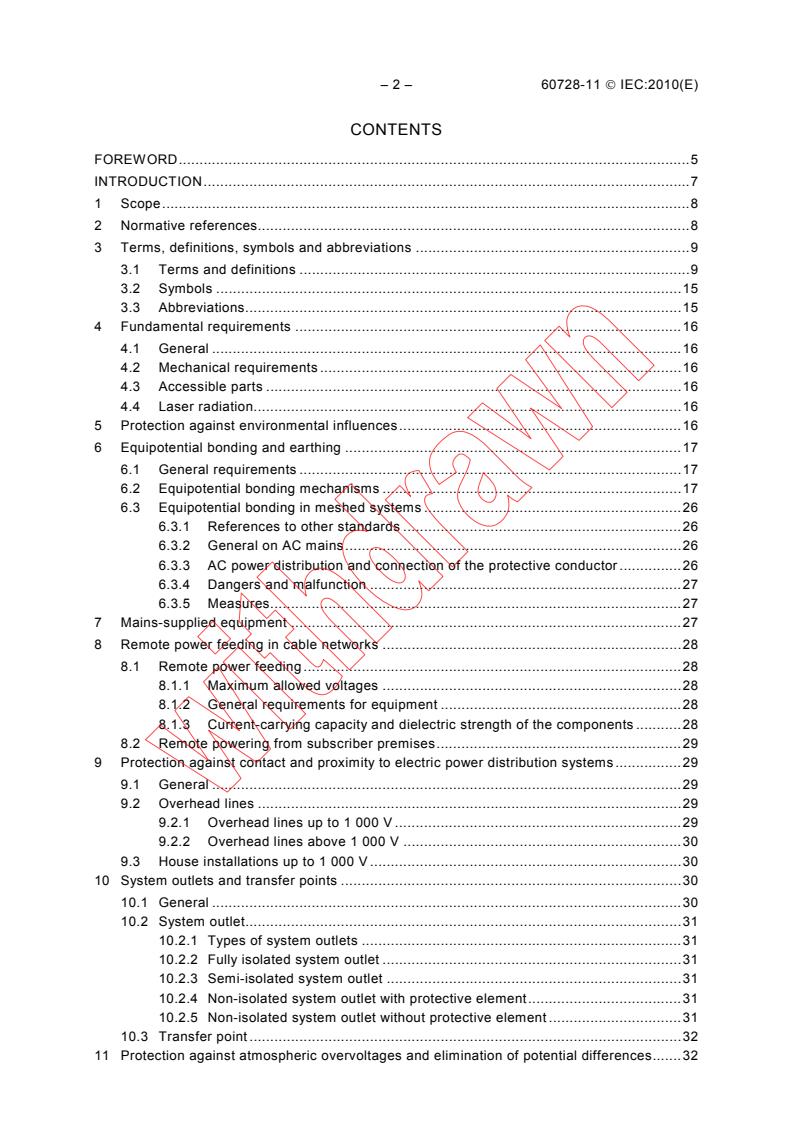
CONTENTS
FOREWORD.5
INTRODUCTION.7
1 Scope.8
2 Normative references.8
3 Terms, definitions, symbols and abbreviations .9
3.1 Terms and definitions .9
3.2 Symbols .15
3.3 Abbreviations.15
4 Fundamental requirements .16
4.1 General .16
4.2 Mechanical requirements .16
4.3 Accessible parts .16
4.4 Laser radiation.16
5 Protection against environmental influences.16
6 Equipotential bonding and earthing .17
6.1 General requirements .17
6.2 Equipotential bonding mechanisms .17
6.3 Equipotential bonding in meshed systems .26
6.3.1 References to other standards .26
6.3.2 General on AC mains.26
6.3.3 AC power distribution and connection of the protective conductor .26
6.3.4 Dangers and malfunction .27
6.3.5 Measures.27
7 Mains-supplied equipment .27
8 Remote power feeding in cable networks .28
8.1 Remote power feeding.28
8.1.1 Maximum allowed voltages .28
8.1.2 General requirements for equipment .28
8.1.3 Current-carrying capacity and dielectric strength of the components .28
8.2 Remote powering from subscriber premises.29
9 Protection against contact and proximity to electric power distribution systems.29
9.1 General .29
9.2 Overhead lines .29
9.2.1 Overhead lines up to 1 000 V .29
9.2.2 Overhead lines above 1 000 V .30
9.3 House installations up to 1 000 V .30
10 System outlets and transfer points .30
10.1 General .30
10.2 System outlet.31
10.2.1 Types of system outlets .31
10.2.2 Fully isolated system outlet .31
10.2.3 Semi-isolated system outlet .31
10.2.4 Non-isolated system outlet with protective element.31
10.2.5 Non-isolated system outlet without protective element .31
10.3 Transfer point .32
11 Protection against atmospheric overvoltages and elimination of potential differences.32
60728-11 © IEC:2010(E) – 3 –
11.1 General .32
11.2 Protection of the antenna system .33
11.2.1 Selection of appropriate methods for protection of antenna systems .33
11.2.2 Building equipped with a lightning protection system (LPS).34
11.2.3 Building not equipped with an LPS .40
11.3 Earthing and bonding of the antenna system .44
11.3.1 Internal protection system .44
11.3.2 Earthing conductors .44
11.3.3 Earth termination system .47
11.4 Overvoltage protection.49
12 Mechanical stability.50
12.1 General requirements .50
12.2 Bending moment.50
12.3 Wind-pressure values .52
12.4 Mast construction .52
12.5 Data to be published.53
Annex A (informative) Earth loop impedance .54
Annex B (informative) Use of shield wires to protect installations with coaxial cables .57
Annex C (informative) Examples of calculation of risk due to lightning .60
Annex D (informative) The following differences exist in some countries .63
Bibliography .74
Figure 1 – Example of equipotential bonding and earthing of a metal enclosure .18
Figure 2 – Example of equipotential bonding .19
Figure 3 – Example of equipotential bonding and indirect earthing of the amplifier and
the cables via a voltage-dependent protective device.20
Figure 4 – Example of equipotential bonding and earthing of a building installation
(underground connection) .21
Figure 5 – Example of equipotential bonding and earthing of a building installation
(above ground connection) .22
Figure 6 – Example of equipotential bonding with a galvanic isolated cable entering a
building (underground connection).23
Figure 7 – Example of maintaining equipotential bonding whilst a unit is removed .25
Figure 8 – Areas of antenna-outdoor-mounting on buildings, where earthing is not
mandatory.33
Figure 9 – Flow chart for selection of the appropriate method for protecting the antenna
system against atmospheric overvoltages.35
Figure 10 – Example of equipotential bonded headends and antennas in a protected
volume of the building LPS.36
Figure 11 – Example of equipotential bonded headends and antennas in a protected
volume of the building LPS.37
Figure 12 – Example of equipotential bonded headends and antennas in a protected
volume of an external isolated ATS .38
Figure 13 – Example of equipotential bonded antennas (not installed in a protected
volume) and headend with direct connection to building LPS.39
Figure 14 – Example of equipotential bonded headend and earthed antennas (building
without LPS) .42
Figure 15 – Example of bonding for antennas and headend (building without LPS and
lightning risk lower than or equal to the tolerable risk).43
– 4 – 60728-11 © IEC:2010(E)
Figure 16 – Example of protecting an antenna system (not installed in a protected
volume) by additional discharge conductors (R > R ) .46
T
Figure 17 – Examples of earthing mechanisms (minimum dimensions) .48
Figure 18 – Example of an overvoltage protective device for single dwelling unit.49
Figure 19 – Example of application of a coaxial overvoltage protective device for
multiple dwelling unit .50
Figure 20 – Example of bending moment of an antenna mast .51
Figure A.1 – Systematic of earth loop resistance .55
Figure B.1 – Principle of single shield wire.59
Figure B.2 – Principle of two shield wires.59
Figure C.1 – Template for calculation of the risk due to lightning (Example No. 1).60
Figure C.2 – Template for calculation of the risk due to lightning (Example No. 2).62
Figure D.1 – IT power distribution system in Norway.64
Figure D.2 – Example of installations located farther than 20 m away from a
transforming station .65
Figure D.3 – Example of installations located closer than 20m from a transforming
station.65
Figure D.4 – Example of cabinets for cable network with locally fed equipment and
mains placed less than 2 m apart .66
Figure D.5 – Example of cabinets for cable network with remotely fed equipment and
mains placed less than 2 m apart .66
Figure D.6 – Example of cabinets for cable network with locally fed equipment and
mains placed more than 2 m apart.67
Figure D.7 – Example of cabinets for cable network with remotely fed equipment and
mains placed more than 2m apart.67
Figure D.8 – Example of an installation placing the amplifier in front of the galvanic
isolator.68
Figure D.9 – Example of protection using a voltage depending device on network
installations on poles.69
Figure D.10 – Example of the installation of a safety terminal in Japan .71
Figure D.11 – Examples of installation of a lightning protection system in Japan .72
Table 1 – Maximum allowed operation voltages and maximum allowed currents for
coaxial cables in different cable network applications .29
Table 2 – Solutions for protection of antenna systems against atmospheric
overvoltages .34
Table B.1 – Conductivity of different types of soil.57
Table B.2 – Protection factors (K ) of protection measures against direct lightning
p
strokes for buried cables .58
60728-11 © IEC:2010(E) – 5 –
INTERNATIONAL ELECTROTECHNICAL COMMISSION
___________
CABLE NETWORKS FOR TELEVISION SIGNALS,
SOUND SIGNALS AND INTERACTIVE SERVICES –
Part 11: Safety
FOREWORD
1) The International Electrotechnical Commission (IEC) is a worldwide organization for standardization comprising
all national electrotechnical committees (IEC National Committees). The object of IEC is to promote
international co-operation on all questions concerning standardization in the electrical and electronic fields. To
this end and in addition to other activities, IEC publishes International Standards, Technical Specifications,
Technical Reports, Publicly Available Specifications (PAS) and Guides (hereafter referred to as “IEC
Publication(s)”). Their preparation is entrusted to technical committees; any IEC National Committee interested
in the subject dealt with may participate in this preparatory work. International, governmental and non-
governmental organizations liaising with the IEC also participate in this preparation. IEC collaborates closely
with the International Organization for Standardization (ISO) in accordance with conditions determined by
agreement between the two organizations.
2) The formal decisions or agreements of IEC on technical matters express, as nearly as possible, an international
consensus of opinion on the relevant subjects since each technical committee has representation from all
interested IEC National Committees.
3) IEC Publications have the form of recommendations for international use and are accepted by IEC National
Committees in that sense. While all reasonable efforts are made to ensure that the technical content of IEC
Publications is accurate, IEC cannot be held responsible for the way in which they are used or for any
misinterpretation by any end user.
4) In order to promote international uniformity, IEC National Committees undertake to apply IEC Publications
transparently to the maximum extent possible in their national and regional publications. Any divergence
between any IEC Publication and the corresponding national or regional publication shall be clearly indicated in
the latter.
5) IEC itself does not provide any attestation of conformity. Independent certification bodies provide conformity
assessment services and, in some areas, access to IEC marks of conformity. IEC is not responsible for any
services carried out by independent certification bodies.
6) All users should ensure that they have the latest edition of this publication.
7) No liability shall attach to IEC or its directors, employees, servants or agents including individual experts and
members of its technical committees and IEC National Committees for any personal injury, property damage or
other damage of any nature whatsoever, whether direct or indirect, or for costs (including legal fees) and
expenses arising out of the publication, use of, or reliance upon, this IEC Publication or any other IEC
Publications.
8) Attention is drawn to the Normative references cited in this publication. Use of the referenced publications is
indispensable for the correct application of this publication.
9) Attention is drawn to the possibility that some of the elements of this IEC Publication may be the subject of
patent rights. IEC shall not be held responsible for identifying any or all such patent rights.
International Standard IEC 60728-11 has been prepared by technical area 5: Cable networks
for television signals, sound signals and interactive services, of IEC technical committee 100:
Audio, video and multimedia systems and equipment.
This third edition cancels and replaces the second edition published in 2005. This edition
constitutes a technical revision.
This edition includes the following significant technical changes with respect to the previous
edition.
• The list of "differences in some countries" was transferred from the "Foreword" to
informative Annex D.
• Some new terms and definitions were added.
• All Figures were reworked among other things concerning equipotential bonding and
earthing details and were incorporated in the text at the appropriate places.
– 6 – 60728-11 © IEC:2010(E)
• Clause 11 "Protection against atmospheric overvoltages and elimination of potential
differences" was completely reworked and re-structured taking into account among other
things the provisions and requirements of the IEC 62305 series on "Lightning protection".
• New informative Annex A on "Earth loop impedance" was added.
• New informative Annex C on "Examples of calculation of risk due to lightning" was added.
• Former Annex B on "Special conditions using IT power line networks" was re-worded and
incorporated in Annex D as "Difference in Norway".
The text of this standard is based on the following documents:
FDIS Report on voting
100/1679/FDIS 100/1708/RVD
Full information on the voting for the approval of this standard can be found in the report on
voting indicated in the above table.
This publication has been drafted in accordance with the ISO/IEC Directives, Part 2.
The list of all the parts of the IEC 60728 series, under the general title Cable networks for
television signals, sound signals and interactive services, can be found on the IEC website.
The committee has decided that the contents of this publication will remain unchanged until the
stability date indicated on the IEC web site under "http://webstore.iec.ch" in the data related to
the specific publication. At this date, the publication will be
• reconfirmed;
• withdrawn;
• replaced by a revised edition, or
• amended.
A bilingual version of this publication may be issued at a later date.
IMPORTANT – The 'colour inside' logo on the cover page of this publication indicates
that it contains colours which are considered to be useful for the correct understanding
of its contents. Users should therefore print this document using a colour printer.
60728-11 © IEC:2010(E) – 7 –
INTRODUCTION
Standards of the IEC 60728 series deal with cable networks including equipment and
associated methods of measurement for headend reception, processing and distribution of
television signals, sound signals and their associated data signals and for processing,
interfacing and transmitting all kinds of signals for interactive services using all applicable
transmission media.
This includes
• CATV networks,
• MATV networks and SMATV networks,
• individual receiving networks
and all kinds of equipment, systems and installations installed in such networks.
NOTE CATV encompasses the Hybrid Fibre Coaxial (HFC) networks used nowadays to provide
telecommunications services, voice, data, audio and video both broadcast and narrowcast.
The extent of this standardization work is from the antennas, special signal source inputs to the
headend or other interface points to the network up to the terminal input.
The standardization of any user terminals (i.e. tuners, receivers, decoders, terminals, etc.) as
well as of any coaxial and optical cables and accessories thereof is excluded.
– 8 – 60728-11 © IEC:2010(E)
CABLE NETWORKS FOR TELEVISION SIGNALS,
SOUND SIGNALS AND INTERACTIVE SERVICES –
Part 11: Safety
1 Scope
This part of IEC 60728 deals with the safety requirements applicable to fixed sited systems and
equipment. As far as applicable, it is also valid for mobile and temporarily installed systems, for
example, caravans.
Additional requirements may be applied, for example, referring to
• electrical installations of buildings and overhead lines,
• other telecommunication services distribution systems,
• water distribution systems,
• gas distribution systems,
• lightning systems.
This standard is intended to provide specifically for the safety of the system, personnel working
on it, subscribers and subscriber equipment. It deals only with safety aspects and is not
intended to define a standard for the protection of the equipment used in the system.
2 Normative references
The following referenced documents are indispensable for the application of this document. For
dated references, only the edition cited applies. For undated references, the latest edition of
the referenced document (including any amendments) applies.
IEC 60065:2001, Audio, video and similar electronic apparatus – Safety requirements
IEC 60364 (all parts), Low-voltage electrical installations
IEC 60364-1, Low-voltage electrical installations – Part 1: Fundamental principles, assessment
of general characteristics, definitions
IEC 60364-5-52, Electrical installations of buildings – Part 5-52: Selection and erection of
electrical equipment – Wiring systems
IEC 60364-5-54, Electrical installations of buildings – Part 5-54: Selection and erection of
electrical equipment – Earthing arrangements, protective conductors and protective bonding
conductors
IEC 60529, Degrees of protection provided by enclosures (IP Code)
IEC 60617, Graphical symbols for diagrams
IEC 60825-1, Safety of laser products – Part 1: Equipment classification and requirements
IEC 60825-2, Safety of laser products – Part 2: Safety of optical fibre communication systems
(OFCS)
60728-11 © IEC:2010(E) – 9 –
IEC 60950-1:2005, Information technology equipment – Safety – Part 1: General requirements
IEC 60990, Methods of measurement of touch current and protective conductor current
IEC 61140:2001, Protection against electric shock – Common aspects for installation and
equipment
IEC 62305 (all parts), Protection against lightning
IEC 62305-2:2006 Protection against lightning – Part 2: Risk management
IEC 62305-3:2006, Protection against lightning – Part 3: Physical damage to structures and life
hazard
IEC 62305-4, Protection against lightning – Part 4: Electrical and electronic systems within
structures
ISO 3864-1:2002, Graphical symbols – Safety colours and safety signs – Part 1: Design
principles for safety signs in workplaces and public areas
EN 50117 (all parts), Coaxial cables
EN 50164-1, Lightning Protection Components (LPC) – Part 1: Requirements for connection
components
EN 50164-2, Lightning Protection Components (LPC) – Part 2: Requirements for conductors
and earth electrodes
EN 50174-2, Information technology – Cabling installation – Part 2: Installation planning and
practices inside buildings
EN 50310, Application of equipotential bonding and earthing in buildings with information
technology equipment
CENELEC R 064-004, Electrical installations of buildings – Protection against electromagnetic
interference (EMI) in installations of buildings
3 Terms, definitions, symbols and abbreviations
3.1 Terms and definitions
For the purposes of this document, the following terms and definitions apply.
NOTE Some terms have been taken from IEC 60050-195, IEC 60050-826 and IEC 60050-851, with the IEV
numbering in square brackets, and from other IEC standards, also referenced to in square brackets.
3.1.1
air termination system
part of an external LPS using metallic elements such as rods, mesh conductors or catenary
wires intended to intercept lightning flashes
[IEC 62305-3:2006, 3.6]
3.1.2
amplifier
device to compensate for attenuation
– 10 – 60728-11 © IEC:2010(E)
3.1.3
attenuation
decibel ratio of the input power to the output power
3.1.4
cable networks (for television signals, sound signals and interactive services)
general overall term used to define CATV-networks, MATV-networks, SMATV-networks and
individual receiving networks; these networks can be used in downstream and upstream
directions
3.1.5
CATV network or community antenna television network
network designed to provide sound and television signals as well as signals for interactive
services to communities
3.1.6
class I equipment
equipment with basic insulation as provision for basic protection and protective bonding as
provision for fault protection, in accordance with IEC 61140:2001, 7.1
[IEC 60050-851:2008, 851-15-10]
3.1.7
class II equipment
equipment with basic insulation as provision for basic protection, and supplementary insulation
as provision for fault protection, or in which basic and fault protection are provided by
reinforced insulation, in accordance with IEC 61140:2001, 7.3
[IEC 60050-851:2008, 851-15-11]
3.1.8
earthing arrangement
all the electric connections and devices involved in the earthing of a system, an installation and
equipment
[IEC 60050-195:1998, 195-02-20]
3.1.9
earthing conductor
conductor which provides a conductive path, or part of the conductive path, between a given
point in a system or in an installation or in equipment and an earth electrode or an earth-
electrode network
NOTE In the electrical installation of a building, the given point is usually the main earthing bar, and the earthing
conductor connects this point to the earth electrode or the earth-electrode network.
[IEC 60050-826:2004, 826-13-12]
3.1.10
earth electrode
conductive part, which may be embedded in the soil or in a specific conductive medium, e.g.
concrete or coke, in electric contact with the Earth
[IEC 60050-826:2004, 826-13-05]
60728-11 © IEC:2010(E) – 11 –
3.1.11
earthing terminal
terminal provided on equipment or on a device and intended for the electric connection with the
earthing arrangement
[IEC 60050-195:1998, 195-02-31]
3.1.12
electric shock
physiological effect resulting from an electric current through a human or animal body
[IEC 60050-826:2004, 826-12-01]
3.1.13
equipotential bonding
provision of electric connections between conductive parts, intended to achieve equipotentiality
[IEC 60050-826:2004, 826-13-19]
3.1.14
equipotential bonding bar
bar which is part of an equipotential bonding system and enables the electric connection of a
number of conductors for equipotential bonding purposes
[IEC 60050-826:2004, 826-13-35, modified]
3.1.15
protective bonding conductor
protective conductor provided for protective-equipotential-bonding
[IEC 60050-826:2004, 826-13-24]
3.1.16
exposed conductive part
conductive part of equipment which can be touched and which is not normally live, but which
can become live when basic insulation fails
[IEC 60050-195:1998, 195-06-10]
3.1.17
extraneous conductive part
conductive part not forming part of the electrical installation and liable to introduce an electric
potential, generally the electric potential of a local earth
[IEC 60050-195:1998, 195-06-11]
3.1.18
feeder
transmission path forming part of a cable network; such a path may consist of a metallic cable,
optical fibre, waveguide or any combination of them
NOTE By extension, the term is also applied to paths containing one or more radio links.
3.1.19
galvanic isolator
device providing electrical isolation below a certain frequency range
– 12 – 60728-11 © IEC:2010(E)
3.1.20
hazardous voltage
electrical condition of an object from which a hazardous touch current (electric shock) could be
drawn
[IEC 60065:2001, 2.6.10, modified]
3.1.21
headend
equipment, which is connected between receiving antennas or other signal sources and the
remainder of the cable network, to process the signals to be distributed
3.1.22
home distributor
HD
physical distribution point within a home where cables terminate
3.1.23
individual receiving network
network designed to provide sound and television signals as well as signals for interactive
services to an individual household
3.1.24
let-go threshold current
maximum value of electric current through the body of a person at which that person can
release himself or herself
[IEC 60050-195:1998, 195-03-09]
3.1.25
lightning protection system
LPS
complete system used to protect a space against the effects of lightning consisting of both
external and internal lightning protection systems
NOTE In particular cases, an LPS may consist of an external LPS or an internal LPS only.
3.1.26
main earthing terminal
main earthing bar
terminal or bar which is part of the earthing arrangement of an installation and enabling the
electric connection of a number of conductors for earthing purposes
[IEC 60050-826:2004, 826-13-15, modified]
3.1.27
MATV network or master antenna television network
network designed to provide sound and television signals as well as signals for interactive
services to households in one or more buildings
3.1.28
metal installation
extended metal items in the structure to be protected which may form a path for lightning
current, such as pipe-work, staircases, elevator guide rails, ventilation, heating and air
conditioning ducts, and interconnected reinforcing steel
[IEC 62305-3:2006, 3.18]
60728-11 © IEC:2010(E) – 13 –
3.1.29
natural component of LPS
conductive component installed not specifically for lightning protection which can be used in
addition to the LPS or in some cases could provide the function of one or more parts of the
LPS
NOTE Examples of the use of this term include:
– natural air-termination;
– natural down-conductor;
– natural earthing electrode.
[IEC 62305-3:2006, 3.15]
3.1.30
network interface unit
NIU
interface between the cable network and the network inside an apartment
NOTE The network interface unit can contain an overvoltage protective element and/or a galvanic isolation.
3.1.31
neutral conductor
identification: N
conductor electrically connected to the neutral point and capable of contributing to the
distribution of electric energy
[IEC 60050-826:2004, 826-14-07]
3.1.32
PEN conductor
conductor combining the functions of both a protective earthing conductor and a neutral
conductor
[IEC 60050-826:2004, 826-13-25]
NOTE The acronym PEN results from the combination of both symbols PE for the protective conductor and N for
neutral conductor.
3.1.33
protective conductor
identification: PE
conductor provided for purposes of safety, for example protection against electric shock
NOTE In an electrical installation, the conductor identified PE is normally also considered as protective earthing
conductor.
[IEC 60050-826:2004, 826-13-22]
3.1.34
receiver lead
lead, which connects the system outlet to the subscriber equipment
3.1.35
receiving antenna
device with proper electrical characteristics that intercepts desired signals in the atmosphere
and transfers these to the remainder of the cable network
– 14 – 60728-11 © IEC:2010(E)
3.1.36
remote power feeding voltage
voltage for supplying power to network equipment via the cable network or a separate line
3.1.37
safety distance
minimum distance between two conductive parts within the space to be protected between
which no dangerous sparking can occur
3.1.38
service person
person having appropriate technical training and experience necessary to be aware of hazards
to which that person may be exposed in performing a task and of measures to minimize the
risks to that person or other persons
[IEC 60950-1:2005, 1.2.13.5]
3.1.39
SMATV network or satellite master antenna television network
network designed to provide sound and television signals as well as signals for interactive
services, received by satellite receiving antenna eventually combined with terrestrial TV and/or
radio signals, to households in one or more buildings
3.1.40
splitter (spur unit)
device in which the signal power at the (input) port is divided equally or unequally between two
or more (output) ports
NOTE Some forms of this device may be used in the reverse direction for combining signal energy.
3.1.41
spur feeder
feeder to which splitters, subscriber taps or looped system outlets are connected
3.1.42
subscriber equipment
equipment at the subscriber premises such as receivers, tuners, decoders, video recorders,
multimedia terminals
3.1.43
subscriber feeder
feeder connecting a subscriber tap to a system outlet or, where the latter is not used, direct to
the subscriber equipment
3.1.44
subscriber tap
device for connecting a subscriber feeder to a spur feeder
3.1.45
surge protective device
device that is intended to limit transient overvoltages and divert surge currents; it contains at
least one non-linear component
3.1.46
surge suppressor
device designed to limit the surge voltage between two parts within the space to be protected,
such as spark gap, surge diverter or semiconductor device
60728-11 © IEC:2010(E) – 15 –
3.1.47
system outlet
device for interconnecting a subscriber feeder and a receiver lead
3.1.48
(effective) touch voltage
voltage between conductive parts when touched simultaneously by a person or an animal
NOTE The value of the effective touch voltage may be appreciably influenced by the impedance of the person or
the animal in electric contact with these conductive parts.
[IEC 60050-826:2004, 826-11-05]
3.1.49
transfer point
interface between the cable network and the building’s internal network, each of which may be
separately owned and which may contain a voltage-dependent device and/or galvanic isolator
3.2 Symbols
The following graphical symbols are used in the figures of this standard. These symbols are
either listed in IEC 60617 or based on symbols defined in IEC 60617.
Coaxial conductor Amplifier
[IEC 60617-S00011 [IEC 60617-S01240
2001-07-01] 2001-07-01]
System outlet Galvanic isolator
Coaxial overvoltage protective
Overvoltage protective device
device
3.3 Abbreviations
AC alternating current
AM amplitude modulation
ATS air termination system
CATV community antenna television (network)
DC direct current
DTH direct to home
HD home distributor
IP international protection (class)
IT isolated earth
LNB low noise block converter
LPS lightning protection system
LSR lightning stroke risk
MATV master antenna television (network)
N neutral (conductor)
NIU network interface unit
NTP Network termination point
PE protective conductor
– 16 – 60728-11 © IEC:2010(E)
PEN PEN conductor
RCD residual current device
RF radio frequency
RMS root mean square
SMATV satellite master antenna television (network)
SPD surge protective device
STB set top box
TV television
4 Fundamental requirements
4.1 General
The cable network shall be so designed, constructed and installed as to present no danger,
either under normal condition or abnormal (any single fault) condition, to subscribers,
personnel working on, or externally inspecting, the system, or to any other person, providing
particularly
• personal protection against electric shock,
• personal protection against physical injury,
• protection against fire.
For further details, see the IEC 60364 series.
The above does not apply to service persons (according to 3.1.38) working on the equipment,
who may be exposed to live parts of the equipment by the removal of protective covers.
4.2 Mechanical requirements
All parts of the system shall be so constructed that there is no danger of physical injury from
contact with sharp edges or corners or from rotating or moving parts.
4.3 Accessible parts
Access to parts presenting hazardous voltages shall not be possible to the general public
without first removing a protective cover by use of a tool or a key. IEC 60065 defines
accessible parts and test procedures.
4.4 Laser radiation
If equipment embodying laser products is used, special attention shall be paid to radiation
safety. Safety information in the product documentation shall be noted. Refer to IEC 60825-1
and IEC 60825-2 for requirements and recommendations.
5 Protection against environmental influences
All system parts, taking into account external influences to which they might be exposed, have
to be selected and set up in such a way that, when used properly, the effectiveness of the
required protective measures is ensured.
NOTE Special measures are required, for example, for protection against corrosive atmosphere, temperature and
humidity.
60728-11 © IEC:2010(E) – 17 –
6 Equipotential bonding and earthing
6.1 General requirements
The cable network shall be designed and constructed in accordance with the requirements of
the IEC 60364 series so that no hazardous voltages can be present on the outer conductors of
any cable or accessible metalwork of any equipment, including passive items. The
requirements for the system outlet are specified in Clause 10 the requirements for
equipotential bonding and lightning protection of antenna systems are given in Clause 11.
These bonding requirements are intended to protect only the cable network and shall not be
considered to provide protection against electric shock currents from electrical installations.
Earthing arrangements and protective conductors shall be designed and constructed in
accordance with the requirements of IEC 60364-5-54.
Where cable networks are installed outdoors on the same poles as those of the electric supply,
a common earthing may be used.
NOTE 1 For requirements in France, see D. 1. 1
NOTE 2 For requirements in Japan, see D. 1. 2
6.2 Equipotential bonding mechanisms
All parts belonging to the equipotential bonding mechanisms shall fulfil the following
requirements:
a) In order to prevent potential differences between a cable network and other extraneous
conductive parts, which might do harm to persons or cause damage (e.g. ignition or failure
of equipment by arcing), the cable network shall be included in the equipotential bonding
system of the building.
NOTE 1 Equipotential bonding between metal installations and electrical systems in and on the building is
generally carried out at the main earthing bar of the building. Multiple, meshed equipotential bonding increases
its effectiveness.
b) Equipotential bonding can be achieved by means of protective bonding conductors, cable
shielding or conductive housings or system parts. Heating pipes, water pipes, gas pipes
shall not be used because they do not guarantee permanent equipotential bonding
efficiency.
c) The protective bonding conductors connected to earthing terminals shall be mechanically
2 2
stable and shall have a minimum cross-sectional area of 2,5 mm Cu (protected) or 4 mm
(not protected). They shall comply with IEC 60364
...