


IEC 62562:2010
(Main)Cavity resonator method to measure the complex permittivity of low-loss dielectric plates
Cavity resonator method to measure the complex permittivity of low-loss dielectric plates
IEC 62562:2010 describes a measurement method of dielectric properties in the planar direction of dielectric plate at microwave frequency, called a cavity resonator method. It has been created in order to develop new materials and to design microwave active and passive devices for which standardization of measurement methods of material properties is more and more important. This first edition cancels and replaces the PAS published in 2008. This bilingual version, published in 2010-05, corresponds to the English version.
This publication contains colours which are considered to be useful for the correct understanding of its contents.
Méthode de la cavité résonante pour mesurer la permittivité complexe des plaques diélectriques à faibles pertes
IEC 62562:2010 décrit une méthode de mesure des propriétés diélectriques en hyperfréquence dans la direction du plan d'une plaque diélectrique. Cette méthode est appelée méthode de la cavité résonante. Elle a été créée pour élaborer de nouveaux matériaux et pour concevoir des dispositifs micro-ondes actifs et passifs pour lesquels la normalisation des méthodes de mesure des propriétés des matériaux est de plus en plus importante. La présente version bilingue, publiée en 2010-05, correspond à la version anglaise.
Cette publication indique qu'elle contient des couleurs qui sont considérées comme utiles à une bonne compréhension de son contenu.
General Information
- Status
- Published
- Publication Date
- 17-Feb-2010
- Technical Committee
- SC 46F - RF and microwave passive components
- Drafting Committee
- PT 62562 - TC 46/SC 46F/PT 62562
- Current Stage
- PPUB - Publication issued
- Start Date
- 18-Feb-2010
- Completion Date
- 31-Mar-2010
Relations
- Effective Date
- 05-Sep-2023
Overview
IEC 62562:2010 - "Cavity resonator method to measure the complex permittivity of low-loss dielectric plates" - is an international standard that defines a nondestructive microwave measurement method for determining the complex permittivity (real part ε' and loss tangent tanδ) of planar dielectric plates. Published by the IEC (Edition 1.0, 2010), the standard specifies a split cylindrical cavity resonator method using the TE011 mode and provides calculation procedures, correction charts and uncertainty estimates to support accurate material characterization at microwave frequencies.
Key topics and technical requirements
- Measurement principle: Place a dielectric plate between two halves of a split cylindrical cavity and determine ε' and tanδ from the measured resonant frequency (f) and unloaded Q-factor (Qu).
- Mode and geometry: Uses the TE011 resonant mode; fringing fields and plate edge effects are corrected using numerically derived charts based on rigorous mode-matching analysis (Ritz–Galerkin method).
- Applicable ranges:
- Frequency: 2 GHz < f < 40 GHz
- Relative permittivity: 2 ≤ ε' ≤ 100
- Loss tangent: 10⁻⁶ ≤ tanδ ≤ 10⁻²
- Measurement performance:
- Typical accuracy: ≈ 0.3% for ε'
- Loss-tangent resolution/accuracy in the low-loss range (example quoted as on the order of 5×10⁻⁶)
- Temperature dependence: Procedures to measure temperature coefficients of permittivity (TCε) and temperature-dependent tanδ, including corrections for thermal expansion and conductor resistivity changes.
- Uncertainty analysis: Formulas and contributors to uncertainty (frequency, thickness, cavity dimensions, Q, conductivity).
Practical applications
- Material R&D: characterizing new low-loss dielectric substrates and ceramics for microwave applications.
- RF/microwave component design: substrate selection and accurate permittivity data for filters, antennas, resonators and passive devices.
- Quality control and production: routine verification of dielectric plates used in PCB and microwave module manufacturing.
- Calibration and metrology: reference method for test laboratories and national metrology institutes needing traceable permittivity measurements.
Who should use this standard
- Microwave materials scientists and engineers
- RF/microwave device and PCB designers
- Test laboratories and accreditation bodies
- Manufacturers of dielectric substrates, ceramics and low-loss materials
- Metrology institutes establishing measurement capability for complex permittivity
Related standards and notes
- IEC 62562 complements other IEC and international documents on RF component measurement and material characterization. Users should consult their national IEC mirror committee for up-to-date references, corrigenda and linked standards when implementing the cavity resonator method.
Keywords: cavity resonator method, complex permittivity, low-loss dielectric plates, loss tangent, relative permittivity, microwave frequency measurement, TE011 mode, permittivity measurement, IEC 62562.
Buy Documents
IEC 62562:2010 - Cavity resonator method to measure the complex permittivity of low-loss dielectric plates Released:2/18/2010 Isbn:9782889107636


IEC 62562:2010 - Cavity resonator method to measure the complex permittivity of low-loss dielectric plates
Get Certified
Connect with accredited certification bodies for this standard

BSMI (Bureau of Standards, Metrology and Inspection)
Taiwan's standards and inspection authority.
Sponsored listings
Frequently Asked Questions
IEC 62562:2010 is a standard published by the International Electrotechnical Commission (IEC). Its full title is "Cavity resonator method to measure the complex permittivity of low-loss dielectric plates". This standard covers: IEC 62562:2010 describes a measurement method of dielectric properties in the planar direction of dielectric plate at microwave frequency, called a cavity resonator method. It has been created in order to develop new materials and to design microwave active and passive devices for which standardization of measurement methods of material properties is more and more important. This first edition cancels and replaces the PAS published in 2008. This bilingual version, published in 2010-05, corresponds to the English version. This publication contains colours which are considered to be useful for the correct understanding of its contents.
IEC 62562:2010 describes a measurement method of dielectric properties in the planar direction of dielectric plate at microwave frequency, called a cavity resonator method. It has been created in order to develop new materials and to design microwave active and passive devices for which standardization of measurement methods of material properties is more and more important. This first edition cancels and replaces the PAS published in 2008. This bilingual version, published in 2010-05, corresponds to the English version. This publication contains colours which are considered to be useful for the correct understanding of its contents.
IEC 62562:2010 is classified under the following ICS (International Classification for Standards) categories: 17.220.01 - Electricity. Magnetism. General aspects. The ICS classification helps identify the subject area and facilitates finding related standards.
IEC 62562:2010 has the following relationships with other standards: It is inter standard links to IEC PAS 62562:2008. Understanding these relationships helps ensure you are using the most current and applicable version of the standard.
IEC 62562:2010 is available in PDF format for immediate download after purchase. The document can be added to your cart and obtained through the secure checkout process. Digital delivery ensures instant access to the complete standard document.
Standards Content (Sample)
IEC 62562 ®
Edition 1.0 2010-02
INTERNATIONAL
STANDARD
colour
inside
Cavity resonator method to measure the complex permittivity of low-loss
dielectric plates
All rights reserved. Unless otherwise specified, no part of this publication may be reproduced or utilized in any form
or by any means, electronic or mechanical, including photocopying and microfilm, without permission in writing from
either IEC or IEC's member National Committee in the country of the requester.
If you have any questions about IEC copyright or have an enquiry about obtaining additional rights to this publication,
please contact the address below or your local IEC member National Committee for further information.
IEC Central Office
3, rue de Varembé
CH-1211 Geneva 20
Switzerland
Email: inmail@iec.ch
Web: www.iec.ch
About the IEC
The International Electrotechnical Commission (IEC) is the leading global organization that prepares and publishes
International Standards for all electrical, electronic and related technologies.
About IEC publications
The technical content of IEC publications is kept under constant review by the IEC. Please make sure that you have the
latest edition, a corrigenda or an amendment might have been published.
ƒ Catalogue of IEC publications: www.iec.ch/searchpub
The IEC on-line Catalogue enables you to search by a variety of criteria (reference number, text, technical committee,…).
It also gives information on projects, withdrawn and replaced publications.
ƒ IEC Just Published: www.iec.ch/online_news/justpub
Stay up to date on all new IEC publications. Just Published details twice a month all new publications released. Available
on-line and also by email.
ƒ Electropedia: www.electropedia.org
The world's leading online dictionary of electronic and electrical terms containing more than 20 000 terms and definitions
in English and French, with equivalent terms in additional languages. Also known as the International Electrotechnical
Vocabulary online.
ƒ Customer Service Centre: www.iec.ch/webstore/custserv
If you wish to give us your feedback on this publication or need further assistance, please visit the Customer Service
Centre FAQ or contact us:
Email: csc@iec.ch
Tel.: +41 22 919 02 11
Fax: +41 22 919 03 00
IEC 62562 ®
Edition 1.0 2010-02
INTERNATIONAL
STANDARD
colour
inside
Cavity resonator method to measure the complex permittivity of low-loss
dielectric plates
INTERNATIONAL
ELECTROTECHNICAL
COMMISSION
PRICE CODE
R
ICS 17.220 ISBN 978-2-88910-763-6
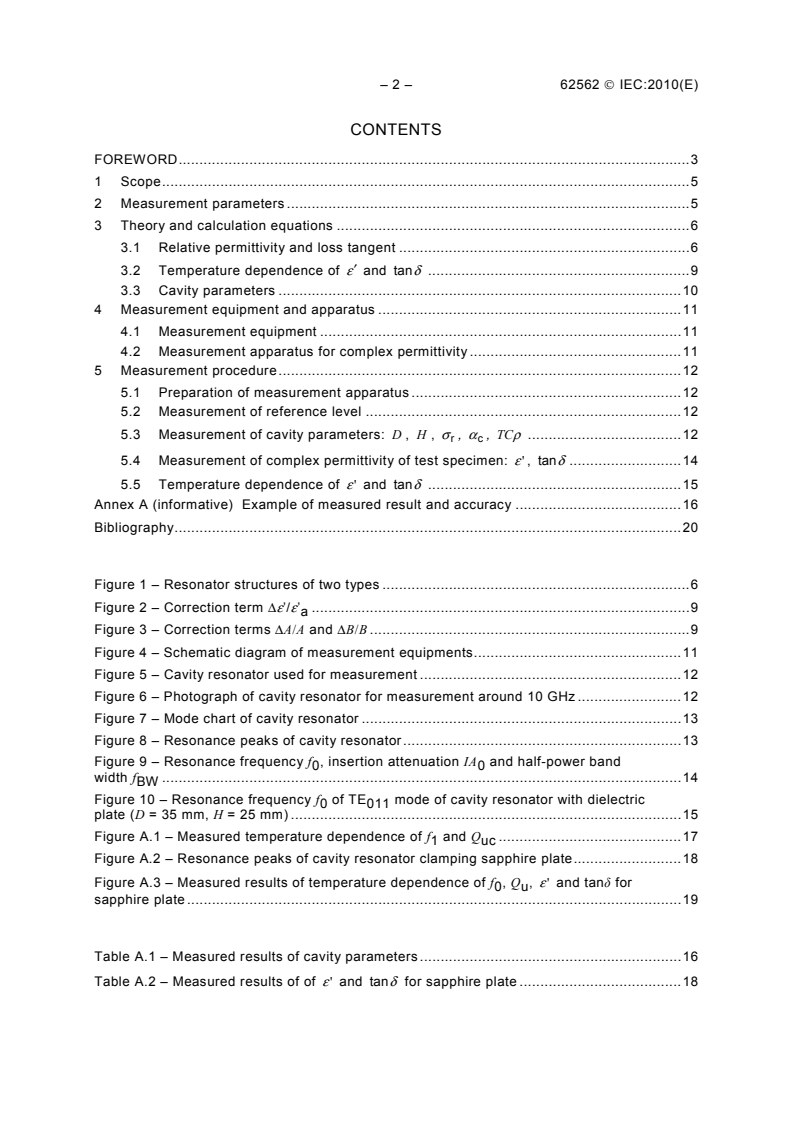
– 2 – 62562 © IEC:2010(E)
CONTENTS
FOREWORD.3
1 Scope.5
2 Measurement parameters .5
3 Theory and calculation equations .6
3.1 Relative permittivity and loss tangent .6
′
3.2 Temperature dependence of ε and tanδ .9
3.3 Cavity parameters .10
4 Measurement equipment and apparatus .11
4.1 Measurement equipment .11
4.2 Measurement apparatus for complex permittivity .11
5 Measurement procedure.12
5.1 Preparation of measurement apparatus .12
5.2 Measurement of reference level .12
5.3 Measurement of cavity parameters: D , H , σ , α , TCρ .12
r c
5.4 Measurement of complex permittivity of test specimen: ε ' , tanδ .14
5.5 Temperature dependence of ε ' and tanδ .15
Annex A (informative) Example of measured result and accuracy .16
Bibliography.20
Figure 1 – Resonator structures of two types .6
Figure 2 – Correction term Δε’/ε’ .9
a
Figure 3 – Correction terms ΔA/A and ΔB/B .9
Figure 4 – Schematic diagram of measurement equipments.11
Figure 5 – Cavity resonator used for measurement .12
Figure 6 – Photograph of cavity resonator for measurement around 10 GHz .12
Figure 7 – Mode chart of cavity resonator .13
Figure 8 – Resonance peaks of cavity resonator.13
Figure 9 – Resonance frequency f , insertion attenuation IA and half-power band
0 0
width f .14
BW
Figure 10 – Resonance frequency f of TE mode of cavity resonator with dielectric
0 011
plate (D = 35 mm, H = 25 mm) .15
Figure A.1 – Measured temperature dependence of f and Q .17
1 uc
Figure A.2 – Resonance peaks of cavity resonator clamping sapphire plate.18
Figure A.3 – Measured results of temperature dependence of f , Q , ε ' and tanδ for
0 u
sapphire plate.19
Table A.1 – Measured results of cavity parameters.16
Table A.2 – Measured results of of ε ' and tanδ for sapphire plate .18
62562 © IEC:2010(E) – 3 –
INTERNATIONAL ELECTROTECHNICAL COMMISION
____________
CAVITY RESONATOR METHOD TO MEASURE THE COMPLEX
PERMITTIVITY OF LOW-LOSS DIELECTRIC PLATES
FOREWORD
1) The International Electrotechnical Commission (IEC) is a worldwide organization for standardization comprising
all national electrotechnical committees (IEC National Committees). The object of IEC is to promote
international co-operation on all questions concerning standardization in the electrical and electronic fields. To
this end and in addition to other activities, IEC publishes International Standards, Technical Specifications,
Technical Reports, Publicly Available Specifications (PAS) and Guides (hereafter referred to as “IEC
Publication(s)”). Their preparation is entrusted to technical committees; any IEC National Committee interested
in the subject dealt with may participate in this preparatory work. International, governmental and non-
governmental organizations liaising with the IEC also participate in this preparation. IEC collaborates closely
with the International Organization for Standardization (ISO) in accordance with conditions determined by
agreement between the two organizations.
2) The formal decisions or agreements of IEC on technical matters express, as nearly as possible, an international
consensus of opinion on the relevant subjects since each technical committee has representation from all
interested IEC National Committees.
3) IEC Publications have the form of recommendations for international use and are accepted by IEC National
Committees in that sense. While all reasonable efforts are made to ensure that the technical content of IEC
Publications is accurate, IEC cannot be held responsible for the way in which they are used or for any
misinterpretation by any end user.
4) In order to promote international uniformity, IEC National Committees undertake to apply IEC Publications
transparently to the maximum extent possible in their national and regional publications. Any divergence
between any IEC Publication and the corresponding national or regional publication shall be clearly indicated in
the latter.
5) IEC itself does not provide any attestation of conformity. Independent certification bodies provide conformity
assessment services and, in some areas, access to IEC marks of conformity. IEC is not responsible for any
services carried out by independent certification bodies.
6) All users should ensure that they have the latest edition of this publication.
7) No liability shall attach to IEC or its directors, employees, servants or agents including individual experts and
members of its technical committees and IEC National Committees for any personal injury, property damage or
other damage of any nature whatsoever, whether direct or indirect, or for costs (including legal fees) and
expenses arising out of the publication, use of, or reliance upon, this IEC Publication or any other IEC
Publications.
8) Attention is drawn to the Normative references cited in this publication. Use of the referenced publications is
indispensable for the correct application of this publication.
9) Attention is drawn to the possibility that some of the elements of this IEC Publication may be the subject of
patent rights. IEC shall not be held responsible for identifying any or all such patent rights.
International Standard IEC 62562 has been prepared by subcommittee 46F: R.F. and
microwave passive components, of IEC technical committee 46: Cables, wires, waveguides,
R.F. connectors, R.F. and microwave passive components and accessories.
This first edition cancels and replaces the PAS published in 2008.
The text of this standard is based on the following documents:
CDV Report on voting
46F/118/CDV 46F/143/RVC
Full information on the voting for the approval of this standard can be found in the report on
voting indicated in the above table.
This publication has been drafted in accordance with the ISO/IEC Directives, Part 2.
– 4 – 62562 © IEC:2010(E)
The committee has decided that the contents of this publication will remain unchanged until
the stability date indicated on the IEC web site under "http://webstore.iec.ch" in the data
related to the specific publication. At this date, the publication will be
• reconfirmed,
• withdrawn,
• replaced by a revised edition, or
• amended.
A bilingual version of this publication may be issued at a later date.
IMPORTANT – The 'colour inside' logo on the cover page of this publication indicates
that it contains colours which are considered to be useful for the correct
understanding of its contents. Users should therefore print this document using a
colour printer.
62562 © IEC:2010(E) – 5 –
CAVITY RESONATOR METHOD TO MEASURE THE COMPLEX
PERMITTIVITY OF LOW-LOSS DIELECTRIC PLATES
1 Scope
The object of this International Standard is to describe a measurement method of dielectric
properties in the planar direction of dielectric plate at microwave frequency. This method is
called a cavity resonator method. It has been created in order to develop new materials and to
design microwave active and passive devices for which standardization of measurement
methods of material properties is more and more important.
This method has the following characteristics:
• the relative permittivity ε ' and loss tangent tanδ values of a dielectric plate sample can be
measured accurately and non-destructively;
• temperature dependence of complex permittivity can be measured;
–6
• the measurement accuracy is within 0,3 % for ε ' and within 5×10 for tanδ ;
• fringing effect is corrected using correction charts calculated on the basis of rigorous
analysis.
This method is applicable for the measurements on the following condition:
– frequency : 2 GHz < f < 40 GHz;
– relative permittivity: 2 < ε ' < 100;
–6 -2
– loss tangent : 10 < tanδ < 10 .
2 Measurement parameters
The measurement parameters are defined as follows:
ε = ε '− jε"= D /(ε E) (1)
r 0
'tanδ = ε" / ε (2)
-
ε ε
T ref 6
–6
TC = ×10 (1×10 /K) (3)
ε
T − T
ε
ref
ref
where
D is the electric flux density;
E is the electric field strength;
ε is the permittivity in a vacuum;
ε ' and ε '' are the real and imaginary components of the complex relative permittivity ε ;
r
TCε is the temperature coefficient of relative permittivity;
ε and ε are the real parts of the complex relative permittivity at temperature T and
T ref
reference temperature T (= 20 °C to 25 °C), respectively.
ref
– 6 – 62562 © IEC:2010(E)
3 Theory and calculation equations
3.1 Relative permittivity and loss tangent
A resonator structure used in the nondestructive measurement of the complex permittivity is
shown in Figure 1a.
A cavity having diameter D and length H = 2M is cut into two halves in the middle of its
length.
A dielectric plate sample having ε ' , tanδ and thickness t is placed between these two halves.
The TE mode, having only the electric field component tangential to the plane of the
sample, is used for the measurement, since air gaps at the plate-cavity interfaces do not
affect the electromagnetic field. Taking account of the fringing field in the plate region outside
diameter of the cavity on the basis of the rigorous mode matching analysis, we determine ε '
and tanδ from the measured values of the resonant frequency f and the unloaded Q-factor
Q . This numerical calculation, however, is rather tedious.
u
Therefore,
a) approximated values ε' and tanδ from the f and Q values by using simple formula for
a a 0 u
a resonator structure shown in Figure 1b, where a fringing effect for Figure 1a is neglected,
will be determined;
b) then, accurate values ε ' and tanδ from ε' and tanδ using charts calculated from the
a a
rigorous analysis will be obtained.
Dielectric plate
DDielecielecttrricic PPlalatete
y
yy
with ε’
wiwitthh εε’’
r rr
HHH
E
EE
EEE
x
xx
ⅠⅡⅠⅡ
MMMMMM MMMMMM
tttt
t t
(a(a)) (b(b))
IEC 127/10 IEC 128/10
Figure 1a – Resonator used in measurement Figure 1b – Resonator to calculate ε’ and tanδ
a a
Figure 1 – Resonator structures of two types
The value of ε' is given by
a
⎧ ⎫
⎛ ⎞
c ⎪ ⎛ t ⎞ ⎪
2 2
⎜ ⎟
ε' = X − Y +1 (4)
⎜ ⎟
⎨ ⎬
a
⎜ ⎟
πt f 2M
⎝ ⎠
⎝ 0⎠ ⎪ ⎪
⎩ ⎭
where c is the velocity of light in a vacuum ( c = 2,997 9 ×10 m/s ) and the first root X is
calculated from a given value Y , using the following simultaneous equations:
D DD==2=2 2RRR
62562 © IEC:2010(E) – 7 –
t
X tan X = Y cot Y (5)
2M
2 2
Y = M k − k = jY' (6)
0 r
with k = 2πf c , k = j' R, and j' = 3,83173 for the TE mode. When k − k < 0 , Y is
0 0 r 01 01 011 0 r
replaced by jY ' .
The value of tanδ is given by
a
A
tanδ = − R B (7)
a s
Q
u
where R is the surface resistance of the conductor of cavity, given by
s
πf μ
R = (1/S), σ = σ σ (S/m) (8)
s 0 r
σ
Here, μ and σ are the permeability and conductivity of the conductor. Furthermore, σ is the
r
relative conductivity and is the conductivity of standard copper. Constants A
σ = 5,8 ×10 S/m
and B are given by
e
W
A = 1+ (9)
e
W
P + P + P
cy1 cy2 end
B = (10)
e
ωR W
s
e e
In the above, W and W are electric field energies stored in the dielectric plate of region 1
1 2
and air of region 2 shown in Figure 1a. Furthermore, P , P and P are the conductor
cy1 cy2
end
loss at the cylindrical wall in the region 1, 2 and at the end wall. These parameters are given
by
π ⎛ sin2X⎞
e 2 2 ' 2 2 '
W = ε ε' μ ω j J ( j )t⎜1+ ⎟ (11)
0 a 01
1 0 01 0
8 2X
⎝ ⎠
π ⎛ sin2Y⎞ cos X
e 2 2 ' 2 2
W = ε μ ω j J ()j' M⎜1− ⎟ (12)
0 01
2 0 01 0
4 2Y
⎝ ⎠
sin Y
π ⎛ sin2X⎞
2 4
P = R J ()j' tRk ⎜1+ ⎟ (13)
cy1 s
01 r
4 2X
⎝ ⎠
π ⎛ sin2Y⎞ cos X
2 4
P = R J ()j' MRk ⎜1− ⎟ (14)
cy2 s
01 r
2 2Y
⎝ ⎠
sin Y
– 8 – 62562 © IEC:2010(E)
π Y cos X
⎛ ⎞
2 2
()
P = R j' J j' ⎜ ⎟ (15)
end s 01
01 0
2 M
⎝ ⎠ sin Y
Then, accurate values of ε ' and tanδ are given by
⎛ ⎞
Δε'
⎜ ⎟
...
IEC 62562 ®
Edition 1.0 2010-02
INTERNATIONAL
STANDARD
NORME
INTERNATIONALE
colour
inside
Cavity resonator method to measure the complex permittivity of low-loss
dielectric plates
Méthode de la cavité résonante pour mesurer la permittivité complexe des
plaques diélectriques à faibles pertes
All rights reserved. Unless otherwise specified, no part of this publication may be reproduced or utilized in any form or by
any means, electronic or mechanical, including photocopying and microfilm, without permission in writing from either IEC or
IEC's member National Committee in the country of the requester.
If you have any questions about IEC copyright or have an enquiry about obtaining additional rights to this publication,
please contact the address below or your local IEC member National Committee for further information.
Droits de reproduction réservés. Sauf indication contraire, aucune partie de cette publication ne peut être reproduite
ni utilisée sous quelque forme que ce soit et par aucun procédé, électronique ou mécanique, y compris la photocopie
et les microfilms, sans l'accord écrit de la CEI ou du Comité national de la CEI du pays du demandeur.
Si vous avez des questions sur le copyright de la CEI ou si vous désirez obtenir des droits supplémentaires sur cette
publication, utilisez les coordonnées ci-après ou contactez le Comité national de la CEI de votre pays de résidence.
IEC Central Office
3, rue de Varembé
CH-1211 Geneva 20
Switzerland
Email: inmail@iec.ch
Web: www.iec.ch
About the IEC
The International Electrotechnical Commission (IEC) is the leading global organization that prepares and publishes
International Standards for all electrical, electronic and related technologies.
About IEC publications
The technical content of IEC publications is kept under constant review by the IEC. Please make sure that you have the
latest edition, a corrigenda or an amendment might have been published.
ƒ Catalogue of IEC publications: www.iec.ch/searchpub
The IEC on-line Catalogue enables you to search by a variety of criteria (reference number, text, technical committee,…).
It also gives information on projects, withdrawn and replaced publications.
ƒ IEC Just Published: www.iec.ch/online_news/justpub
Stay up to date on all new IEC publications. Just Published details twice a month all new publications released. Available
on-line and also by email.
ƒ Electropedia: www.electropedia.org
The world's leading online dictionary of electronic and electrical terms containing more than 20 000 terms and definitions
in English and French, with equivalent terms in additional languages. Also known as the International Electrotechnical
Vocabulary online.
ƒ Customer Service Centre: www.iec.ch/webstore/custserv
If you wish to give us your feedback on this publication or need further assistance, please visit the Customer Service
Centre FAQ or contact us:
Email: csc@iec.ch
Tel.: +41 22 919 02 11
Fax: +41 22 919 03 00
A propos de la CEI
La Commission Electrotechnique Internationale (CEI) est la première organisation mondiale qui élabore et publie des
normes internationales pour tout ce qui a trait à l'électricité, à l'électronique et aux technologies apparentées.
A propos des publications CEI
Le contenu technique des publications de la CEI est constamment revu. Veuillez vous assurer que vous possédez
l’édition la plus récente, un corrigendum ou amendement peut avoir été publié.
ƒ Catalogue des publications de la CEI: www.iec.ch/searchpub/cur_fut-f.htm
Le Catalogue en-ligne de la CEI vous permet d’effectuer des recherches en utilisant différents critères (numéro de référence,
texte, comité d’études,…). Il donne aussi des informations sur les projets et les publications retirées ou remplacées.
ƒ Just Published CEI: www.iec.ch/online_news/justpub
Restez informé sur les nouvelles publications de la CEI. Just Published détaille deux fois par mois les nouvelles
publications parues. Disponible en-ligne et aussi par email.
ƒ Electropedia: www.electropedia.org
Le premier dictionnaire en ligne au monde de termes électroniques et électriques. Il contient plus de 20 000 termes et
définitions en anglais et en français, ainsi que les termes équivalents dans les langues additionnelles. Egalement appelé
Vocabulaire Electrotechnique International en ligne.
ƒ Service Clients: www.iec.ch/webstore/custserv/custserv_entry-f.htm
Si vous désirez nous donner des commentaires sur cette publication ou si vous avez des questions, visitez le FAQ du
Service clients ou contactez-nous:
Email: csc@iec.ch
Tél.: +41 22 919 02 11
Fax: +41 22 919 03 00
IEC 62562 ®
Edition 1.0 2010-02
INTERNATIONAL
STANDARD
NORME
INTERNATIONALE
colour
inside
Cavity resonator method to measure the complex permittivity of low-loss
dielectric plates
Méthode de la cavité résonante pour mesurer la permittivité complexe des
plaques diélectriques à faibles pertes
INTERNATIONAL
ELECTROTECHNICAL
COMMISSION
COMMISSION
ELECTROTECHNIQUE
PRICE CODE
INTERNATIONALE
R
CODE PRIX
ICS 17.220 ISBN 978-2-88910-931-9
– 2 – 62562 © IEC:2010
CONTENTS
FOREWORD.3
1 Scope.5
2 Measurement parameters .5
3 Theory and calculation equations .6
3.1 Relative permittivity and loss tangent .6
′
3.2 Temperature dependence of ε and tanδ .9
3.3 Cavity parameters .9
4 Measurement equipment and apparatus .10
4.1 Measurement equipment .10
4.2 Measurement apparatus for complex permittivity .11
5 Measurement procedure.12
5.1 Preparation of measurement apparatus .12
5.2 Measurement of reference level .12
5.3 Measurement of cavity parameters: D , H , σ , α , TCρ .12
r c
5.4 Measurement of complex permittivity of test specimen: ε ' , tanδ .14
5.5 Temperature dependence of ε ' and tanδ .14
Annex A (informative) Example of measured result and accuracy .15
Bibliography.18
Figure 1 – Resonator structures of two types .6
Figure 2 – Correction term Δε’/ε’ .8
a
Figure 3 – Correction terms ΔA/A and ΔB/B .8
Figure 4 – Schematic diagram of measurement equipments.10
Figure 5 – Cavity resonator used for measurement .11
Figure 6 – Photograph of cavity resonator for measurement around 10 GHz .11
Figure 7 – Mode chart of cavity resonator .12
Figure 8 – Resonance peaks of cavity resonator.13
Figure 9 – Resonance frequency f , insertion attenuation IA and half-power band
0 0
width f .13
BW
Figure 10 – Resonance frequency f of TE mode of cavity resonator with dielectric
0 011
plate (D = 35 mm, H = 25 mm) .14
Figure A.1 – Measured temperature dependence of f and Q .16
1 uc
Figure A.2 – Resonance peaks of cavity resonator clamping sapphire plate.16
Figure A.3 – Measured results of temperature dependence of f , Q , ε′ and tan δ for
0 u
sapphire plate.17
Table A.1 – Measured results of cavity parameters.15
Table A.2 – Measured results of of ε ' and tanδ for sapphire plate .17
62562 © IEC:2010 – 3 –
INTERNATIONAL ELECTROTECHNICAL COMMISION
____________
CAVITY RESONATOR METHOD TO MEASURE THE COMPLEX
PERMITTIVITY OF LOW-LOSS DIELECTRIC PLATES
FOREWORD
1) The International Electrotechnical Commission (IEC) is a worldwide organization for standardization comprising
all national electrotechnical committees (IEC National Committees). The object of IEC is to promote
international co-operation on all questions concerning standardization in the electrical and electronic fields. To
this end and in addition to other activities, IEC publishes International Standards, Technical Specifications,
Technical Reports, Publicly Available Specifications (PAS) and Guides (hereafter referred to as “IEC
Publication(s)”). Their preparation is entrusted to technical committees; any IEC National Committee interested
in the subject dealt with may participate in this preparatory work. International, governmental and non-
governmental organizations liaising with the IEC also participate in this preparation. IEC collaborates closely
with the International Organization for Standardization (ISO) in accordance with conditions determined by
agreement between the two organizations.
2) The formal decisions or agreements of IEC on technical matters express, as nearly as possible, an international
consensus of opinion on the relevant subjects since each technical committee has representation from all
interested IEC National Committees.
3) IEC Publications have the form of recommendations for international use and are accepted by IEC National
Committees in that sense. While all reasonable efforts are made to ensure that the technical content of IEC
Publications is accurate, IEC cannot be held responsible for the way in which they are used or for any
misinterpretation by any end user.
4) In order to promote international uniformity, IEC National Committees undertake to apply IEC Publications
transparently to the maximum extent possible in their national and regional publications. Any divergence
between any IEC Publication and the corresponding national or regional publication shall be clearly indicated in
the latter.
5) IEC itself does not provide any attestation of conformity. Independent certification bodies provide conformity
assessment services and, in some areas, access to IEC marks of conformity. IEC is not responsible for any
services carried out by independent certification bodies.
6) All users should ensure that they have the latest edition of this publication.
7) No liability shall attach to IEC or its directors, employees, servants or agents including individual experts and
members of its technical committees and IEC National Committees for any personal injury, property damage or
other damage of any nature whatsoever, whether direct or indirect, or for costs (including legal fees) and
expenses arising out of the publication, use of, or reliance upon, this IEC Publication or any other IEC
Publications.
8) Attention is drawn to the Normative references cited in this publication. Use of the referenced publications is
indispensable for the correct application of this publication.
9) Attention is drawn to the possibility that some of the elements of this IEC Publication may be the subject of
patent rights. IEC shall not be held responsible for identifying any or all such patent rights.
International Standard IEC 62562 has been prepared by subcommittee 46F: R.F. and
microwave passive components, of IEC technical committee 46: Cables, wires, waveguides,
R.F. connectors, R.F. and microwave passive components and accessories.
This first edition cancels and replaces the PAS published in 2008.
This bilingual version, published in 2010-02, corresponds to the English version.
The text of this standard is based on the following documents:
CDV Report on voting
46F/118/CDV 46F/143/RVC
Full information on the voting for the approval of this standard can be found in the report on
voting indicated in the above table.
The French version of this standard has not been voted upon.
– 4 – 62562 © IEC:2010
This publication has been drafted in accordance with the ISO/IEC Directives, Part 2.
The committee has decided that the contents of this publication will remain unchanged until
the stability date indicated on the IEC web site under "http://webstore.iec.ch" in the data
related to the specific publication. At this date, the publication will be
• reconfirmed,
• withdrawn,
• replaced by a revised edition, or
• amended.
IMPORTANT – The 'colour inside' logo on the cover page of this publication indicates
that it contains colours which are considered to be useful for the correct
understanding of its contents. Users should therefore print this document using a
colour printer.
62562 © IEC:2010 – 5 –
CAVITY RESONATOR METHOD TO MEASURE THE COMPLEX
PERMITTIVITY OF LOW-LOSS DIELECTRIC PLATES
1 Scope
The object of this International Standard is to describe a measurement method of dielectric
properties in the planar direction of dielectric plate at microwave frequency. This method is
called a cavity resonator method. It has been created in order to develop new materials and to
design microwave active and passive devices for which standardization of measurement
methods of material properties is more and more important.
This method has the following characteristics:
• the relative permittivity ε ' and loss tangent tanδ values of a dielectric plate sample can be
measured accurately and non-destructively;
• temperature dependence of complex permittivity can be measured;
–6
• the measurement accuracy is within 0,3 % for ε ' and within 5×10 for tanδ ;
• fringing effect is corrected using correction charts calculated on the basis of rigorous
analysis.
This method is applicable for the measurements on the following condition:
– frequency : 2 GHz < f < 40 GHz;
– relative permittivity: 2 < ε ' < 100;
–6 –2
– loss tangent : 10 < tanδ < 10 .
2 Measurement parameters
The measurement parameters are defined as follows:
ε = ε'− jε"= D /(ε E) (1)
r 0
'tanδ = ε" / ε (2)
-
ε ε
T ref 6
–6
TC = ×10 (1×10 /K) (3)
ε
T − T
ε
ref
ref
where
D is the electric flux density;
E is the electric field strength;
ε is the permittivity in a vacuum;
ε
ε ' and ε '' are the real and imaginary components of the complex relative permittivity ;
r
TCε is the temperature coefficient of relative permittivity;
ε and ε are the real parts of the complex relative permittivity at temperature T and
T ref
reference temperature T (= 20 °C to 25 °C), respectively.
ref
– 6 – 62562 © IEC:2010
3 Theory and calculation equations
3.1 Relative permittivity and loss tangent
A resonator structure used in the nondestructive measurement of the complex permittivity is
shown in Figure 1a.
A cavity having diameter D and length H = 2M is cut into two halves in the middle of its
length.
A dielectric plate sample having ε ' , tanδ and thickness t is placed between these two halves.
The TE mode, having only the electric field component tangential to the plane of the
sample, is used for the measurement, since air gaps at the plate-cavity interfaces do not
affect the electromagnetic field. Taking account of the fringing field in the plate region outside
diameter of the cavity on the basis of the rigorous mode matching analysis, we determine ε '
and tanδ from the measured values of the resonant frequency f and the unloaded Q-factor
Q . This numerical calculation, however, is rather tedious.
u
Therefore,
a) approximated values ε' and tanδ from the f and Q values by using simple formula for
a a 0 u
a resonator structure shown in Figure 1b, where a fringing effect for Figure 1a is neglected,
will be determined;
b) then, accurate values ε ' and tanδ from ε' and tanδ using charts calculated from the
a a
rigorous analysis will be obtained.
Dielectric plate
DDielecielecttrricic PPlalatete
y
yy
with ε’
wiwitthh εε’’
r rr
HHH
E
EE
EEE
x
xx
ⅠⅡⅠⅡ
MMMMMM MMMMMM
tttt
t t
(a(a)) (b(b))
IEC 127/10 IEC 128/10
Figure 1a – Resonator used Figure 1b – Resonator to
in measurement
calculate ε’ and tan δ
a a
Figure 1 – Resonator structures of two types
The value of ε' is given by
a
⎧ ⎫
⎛ ⎞
c ⎪ ⎛ t ⎞ ⎪
2 2
⎜ ⎟
ε' = X − Y +1 (4)
⎜ ⎟
⎨ ⎬
a
⎜ ⎟
πt f 2M
⎝ ⎠
⎝ 0⎠ ⎪ ⎪
⎩ ⎭
where c is the velocity of light in a vacuum ( c = 2,997 9 ×10 m/s ) and the first root X is
calculated from a given value Y , using the following simultaneous equations:
t
X tan X = Y cot Y (5)
2M
D DD==2=2 2RRR
62562 © IEC:2010 – 7 –
2 2
Y = M k − k = jY' (6)
0 r
with k = 2πf c , k = j' R, and j' = 3,83173 for the TE mode. When k − k < 0 , Y is
0 0 r 01 01 011 0 r
replaced by jY ' .
The value of tanδ is given by
a
A
tanδ = − R B (7)
a s
Q
u
where R is the surface resistance of the conductor of cavity, given by
s
πf μ
R = (1/S), σ = σ σ (S/m) (8)
s 0 r
σ
Here, μ and σ are the permeability and conductivity of the conductor. Furthermore, σ is the
r
relative conductivity and is the conductivity of standard copper. Constants A
σ = 5,8 ×10 S/m
and B are given by
e
W
A = 1+ (9)
e
W
P + P + P
cy1 cy2 end
B = (10)
e
ωR W
s
e e
In the above, W and W are electric field energies stored in the dielectric plate of region 1
1 2
and air of region 2 shown in Figure 1a. Furthermore, P , P and P are the conductor
cy1 cy2
end
loss at the cylindrical wall in the region 1, 2 and at the end wall. These parameters are given
by
π ⎛ sin2X⎞
e 2 2 ' 2 2 '
W = ε ε' μ ω j J ( j )t⎜1+ ⎟ (11)
0 a 01
1 0 01 0
8 2X
⎝ ⎠
π ⎛ sin2Y⎞ cos X
e 2 2 ' 2 2
W = ε μ ω j J ()j' M⎜1− ⎟ (12)
0 01
2 0 01 0
4 2Y
⎝ ⎠
sin Y
π ⎛ sin2X⎞
2 4
P = R J ()j' tRk ⎜1+ ⎟ (13)
cy1 s
01 r
4 2X
⎝ ⎠
π ⎛ sin2Y⎞ cos X
2 4
P = R J ()j' MRk ⎜1− ⎟ (14)
cy2 s
01 r
2 2Y
⎝ ⎠
sin Y
π ⎛ Y ⎞ cos X
2 2
P = R j' J ()j' ⎜ ⎟ (15)
end s 01
01 0
2 M
⎝ ⎠
sin Y
Then, accurate values of ε ' and tanδ are given by
⎛ ⎞
Δε'
⎜ ⎟
ε'= ε' 1− (16)
a
⎜ ⎟
ε'
a
⎝ ⎠
– 8 – 62562 © IEC:2010
A ΔA ΔB
⎛ ⎞ ⎛ ⎞
tanδ = ⎜1+ ⎟ − R B⎜1+ ⎟ (17)
s
Q A B
⎝ ⎠ ⎝ ⎠
u
where correction terms due to the fringing field Δε' ε' , ΔA A and ΔB B are calculated
a
numerically on the basis of rigorous mode matching analysis using the Ritz-Galerkin method,
as shown in Figures 2 and 3. It is found from the analysis for a circular dielectric plate with
diameter d that f converges to a constant value for d D > 1,2. The correction terms shown
in Figures 2 and 3 were calculated for d D > 1,5 . Therefore, the correction terms are
applicable to dielectric plates with any shape if d D > 1,2 .
Measurement uncertainties of ε ' and tanδ , Δε ' and Δ tanδ are estimated as the mean
square errors and given respectively by
2 2 2 2 2
(Δε' ) = (Δε' ) + (Δε' ) + (Δε' ) + (Δε' ) (18)
f t D H
2 2 2
(Δ tanδ ) = (Δ tanδ ) + (Δ tanδ ) (19)
Q σ
where Δε ' , Δε ' , Δε ' and Δε ' are the uncertainties of ε ' due to standard deviations of f ,
f
t D H 0
t , D , and H , respectively. Also, Δ tanδ is mainly attributed to measurement errors of Q
u
and σ , and Δ tanδ and Δ tanδ are uncertainties of tanδ due to standard deviations of
r Q σ
them, respectively.
ε’ = 1
–1
t/D
–2
ε’ = 100
–3
TE mode
TE mode
D/H = 1,4
TE mode
TE mode
–4
D/H = 1,4
1 10 100
ε’
a
t/D
IEC 129/10 IEC 130/10
Figure 3 – Correction terms
Figure 2 – Correction term Δε’/ε’
a
ΔA/A and ΔB/B
Δε/ε’
a
ΔB/B ΔA/A
62562 © IEC:2010 – 9 –
3.2 Temperature dependence of ε′ and tanδ
′
Temperature dependence of ε and tanδ also can be measured using this method.
Temperature coefficient of relative permittivity TCε is calculated by equation (3).
′ ′
When the temperature dependences of ε is linear, particularly, ε()T is given by
′ ′
ε()T = ε(T )[]1+ TCε(T − T ) (20)
0 0
where T and T are the temperatures in measurement and the reference temperature,
respectively. In this case, TCε can be determined by the least squares method for many
measurement points against T .
The thermal linear expansion coefficient of the dielectric plate α and that of the conductor
cavity α should be considered in the TCε measurement. Furthermore, the temperature
c
coefficient of resistivity TCρ should be considered in the temperature dependence
measurement of tanδ . Using these parameters, temperature dependent values of t()T , D()T ,
H()T , and ρ()T are given by
t()T = t(T )[]1+ α(T − T ) (21)
0 0
D()T = D(T )[]1+ α (T − T ) (22)
0 c 0
H()T = H(T )[]1+ α (T − T ) (23)
0 c 0
ρ()T = = ρ()T[]1+ TCρ(T − T ) (24)
0 0
σ()T
3.3 Cavity parameters
Cavity parameters such as D , H = 2M , α , σ and TCρ are determined from the
c r
measurements for the TE and TE resonance modes of an empty cavity without a sample,
011 012
in advance of complex permittivity measurements. At first, D and H are determined from two
measured resonant frequencies, f for the TE mode and f for the TE mode, by using
1 011 2 012
cj'
D = (25)
2 2
π
4 f − f
1 2
c 3
H = (26)
2 2
f − f
2 1
which can be derived easily from the resonance condition of the cavity.
Secondly, α is determined from the measurement of temperature dependence of f , by
c 1
using
– 10 – 62562 © IEC:2010
1 Δf
α = − (27)
c
f ΔT
Thirdly, σ is determined from the measured values D , H , f , Q , which is the unloaded
r 1 uc
Q-factor for the TE mode, by the following equation:
⎧ ⎫
⎪ ⎛ D ⎞ ⎪
2 2 2
4πf Q j' +2π
⎜ ⎟
1 uc ⎨ 01 ⎬
2H
⎝ ⎠
⎪ ⎪
⎩ ⎭
σ (28)
=
r
⎧ ⎫
⎪ ⎛ πD⎞ ⎪
σ μ c j' +
⎜ ⎟
⎨ ⎬
0 0 01
2H
⎝ ⎠
⎪ ⎪
⎩ ⎭
Finally, is determined from the measurement of temperature dependence of ρ = σ σ
TCρ
r 0
by using
Δρ
r
TCρ = (29)
ρ ΔT
r
4 Measurement equipment and apparatus
4.1 Measurement equipment
Figure 4 shows a schematic diagram of two equipment systems required for millimetre wave
measurement. For the measurement of dielectric properties, only the information on the
amplitude of transmitted power is needed, that is, the information on the phase of the
transmitted power is not required. Therefore, a scalar network analyzer can be used for the
measurement shown in Figure 4a. However, a vector network analyzer, as shown in Figure 4b,
has an advantage in precision of the measurement data.
Scalar
network
Sweeper
analyzer
Vector
network
analyzer
Detector
Measurement
Power
Detector
Measurement
splitter
apparatus
apparatus
Reference line Reference line
IEC 131/10 IEC 132/10
Figure 4a – Scalar network Figure 4b – Vector network
analyzer system analyzer system
Figure 4 – Schematic diagram of measurement equipments
62562 © IEC:2010 – 11 –
4.2 Measurement apparatus for complex permittivity
The structure of the cavity resonator used in the complex permittivity measurement is shown
in Figure 5. A cylindrical cavity containing two cup-shaped parts is machined from a copper
block. The cavity resonator has D = 35 mm, H = 25 mm and a flange diameter D > 1,5 mm
f
for the measurement around 10 GHz. A specimen with diameter d > 1,2 × D is placed between
the two parts and clamped with clips to fix this structure. This cavity resonator is excited by
the two semi-rigid coaxial cables, each of which has a small loop at the top. The transmission-
type resonator is constituted and under-coupled equally to the input and output loops with
setting S = S . The photograph is shown in Figure 6.
11 22
The resonance frequency f , half-power band width f , and the insertion attenuation IA
0 BW 0
(dB) at f are measured using a network analyzer by means of the swept-frequency method.
The value of Q is given by
u
Q f
L 0
= , = (30)
Q Q
u L
− IA (dB) / 20
0 f
1−10 BW
2M + t
22M M ++tt
CoaCoaxxiaiall
H = 2M
t
tt HH=2=2MM
Coaxial cable
CaCablblee
Dielectric
DiDieelleecctritricc
Conductor
ConCondduucctortor PTFE rPTPTFEFE iRiRing nngg
plate
PlPlatatee
IEC 133/10 IEC 134/10
Figure 5a – Resonator clamping Figure 5b – Empty cavity resonator
dielectric specimen
Figure 5 – Cavity resonator used for measurement
Thermal sensor
Thermal sensor
Cavity resonator
Cavity resonator
CoCaxoiaaxl cial cableable
CCololdd s sttageage
IEC 135/10
Figure 6 – Photograph of cavity resonator for measurement around 10 GHz
D >1,5 × D
DDf >>1.1.5×5×DD
ff
d >1,2 × D
d d >>1.2×1.2×DD
D
DD
TTMM111100
TTMM001100
– 12 – 62562 © IEC:2010
5 Measurement procedure
5.1 Preparation of measurement apparatus
Set up the measurement equipment and apparatus as shown in Figure 4. The cavity resonator
and dielectric specimens shall be kept in a clean and dry state, as high humidity degrades
unloaded Q. The relative humidity shall preferable be less than 60 %.
5.2 Measurement of reference level
The reference level, level of full transmission power, is measured first. Connect the reference
line to the measurement equipment and measure the full transmission power level over the
entire measurement frequency range.
5.3 Measurement of cavity parameters: D , H , σ , α , TCρ
r c
Rough values of f of the TE resonance mode and f of the TE resonance modes can
1 011 2 012
be estimated from the mode chart shown in Figure 7. Resonance peaks of cavity resonator
with 3D =5 mm and H = 25 mm are shown in Figure 8.
5 55
0 00
0 0,5 1,0 1,5 2,0 2,5
0000.511511.522522.55
((D/D/HH))
(D/H)
IEC 136/10
Figure 7 – Mode chart of cavity resonator
TTEE331111
TTEE001111,,TTMM111111
TTEE2211
TTMM001111
TTEE111111
EE
TT 331122
,,TTMM
TTEE001122 111122
TTEE221122
TTMM001122
TTEE111122
TTEE221133
TTMM001133
TTEE111133
11.44 ==11.9966
2 –16 2 2
(f D) 22× 10 -16 -16 (H m22 ) 22
z
((fDfD)) ×1×100 (H(Hzz mm ))
62562 © IEC:2010 – 13 –
–10
-10-10
–20
-20-20
–30
-30-30
–40
-40-40
–50
-50-50
–60
-60-60
-70-70–70
–80
-80-80
10 11 12 13 14 15 16 17
1010 1111 1122 1313 1414 1515 1616 1717
f (GHz)
ff ( (GHGHzz))
IEC 137/10
Figure 8 – Resonance peaks of cavity resonator
Attach PTFE rings to the end plates of the cavity to separate the degenerate TM (ℓ=1, 2)
11ℓ
modes from the TE modes, as shown in Figure 5. Set the empty cavity and adjust the
01ℓ
insertion attenuation IA to be around 30 dB by changing the distance between two semi-rigid
cables, as shown in Figure 9.
-2-2–28 88
f
f f
–30
-3-300 IA
IAIA
3 dB
3d3dBB
-3-3–32 22
–34
-3-344
f f
f BWBW
BW
–36
-3-366
–38
-3-388
12,0444 12,0446 12,0448 12,0450 12,0452
1212.00444444 112.2.04044646 12.12.04044848 1212.045045 112.2.04045252
f (GHz)
FrFreeqquenuencycy ( (GHzGHz))
IEC 138/10
Figure 9 – Resonance frequency f , insertion
attenuation IA and half-power band width f
0 BW
Measure f and Q of the TE resonance mode and measure f of the TE resonance
1 uc 011 2 012
modes. Calculate Q by using equation (30). Calculate the dimensions D , H , and σ of
u1 r
cavity resonator from equations (25), (26) and (28). Since the value of σ degrades due to
r
oxidation of the metal surface, it shall be measured periodically. Next, measure temperature
dependence of f and Q using the cavity placed in a temperature-stabilized oven. Calculate
1 uc
α and from equations (27) and (29).
TCρ
c
Insertion attenuation (dB)
IInnserserttiioon n attenuaattenuatintin ((ddBB)) IA (dB)
IAIA ( (dBdB))
TE
TETE211211211
TMTMTM1111 00
TE , TM
TETE011 ,M,M111
010111 111111
TE
TETE
TMTMTM
TM
TMTM211211
TE
TETE
121 121211
TE , TM
012 112
TETE010122,TM,TM112112
TE
TETE312312312
– 14 – 62562 © IEC:2010
5.4 Measurement of complex permittivity of test specimen: ε ' , tanδ
Place the test specimen between two cylinders and clamp them by clips, as shown in Figure 6.
Estimate a rough value of f of the TE resonance mode from Figure 10. Then, measure
0 011
f and Q values. Calculate ε ' and tanδ values using equations (4) to (17).
0 u
εε’’=2=2
ε’ = 2
7 77
0,0 0,5 1,0 1,5 2,0
0.00.0 0.0.55 1.01.0 1.1.55 22.0.0
t (mm)
tt (m (mm)m)
IEC 139/10
Figure 10 – Resonance frequency f of TE mode of cavity resonator
0 011
with dielectric plate (D = 35 mm, H = 25 mm)
5.5 Temperature dependence of ε ' and tanδ
Place a cavity resonator clamping the dielectric plate in a temperature-stabilized oven, and
measure f and Q as a function of temperature T . Calculate and tanδ values as a function
0 u
, taking account of α , α , and . Then, calculate TCε by using equation (3) or by the
T TCρ
c
least squares method for many measurement points against T .
f (GHz)
ff0 ( (GHz)GHz)
62562 © IEC:2010 – 15 –
Annex A
(informative)
Example of measured result and accuracy
A.1 Cavity parameters
Table A.1 shows measured results of cavity parameters. As shown in this table, D and H can
be determined accurately to μ m order using f and f . The value of σ depends on the
1 2 r
surface roughness and the oxidation of the internal wall of the cavity and is desired to be
higher than 80 % to keep high accuracy in the tanδ measurement.
Table A.1 – Measured results of cavity parameters
f (GHz) f (GHz) Q D H α σ TCρ
1 2 u c r
for TE for TE for TE mm mm ppm/K % 1/K
011 012 011
12,045 6 15,936 24 256 35,053 24,884 15,5 84,4 0,003 4
±0,000 2 ±0,001 ±145 ±0,001 ±0,002 ±0,3 ±1,0 ±0,000 3
Measured results of temperature dependence of f and Q for an empty cavity resonator are
1 uc
shown in Figure A.1. The value of α in Table A.1 was determined from the temperature
c
dependence of f using equation (27). Furthermore, TCρ was determined from the
temperature dependence of Q using equation (29). In these calculations, Δf ΔT and
uc 1
Δρ ΔT were determined by the least squares method. The values of α are nearly equal
r c
)
with nominal value of 16,5 ppm/K of copper. The values of TCρ are around the nominal
value TCρ = 0,003 9 (1/K) of copper at DC.
—————————
)
ppm = parts per million
– 16 – 62562 © IEC:2010
12,046
12.046
12,12.04044 4
12,042
12.042
12,040
12.040
12,12.03038 8
12,12.03036 6
12,034
12.034
24 500
24 000 24000
23 500 23500
23 000 23000
22 500 22500
22 000 22000
21 500 21500
20 30 40 50 60 70 80
20 30 40 50 60 70 80
T (℃)
T (°C)
IEC 140/10
Figure A.1 – Measured temperature dependence of f and Q
1 uc
A.2 Relative permittivity ε ' and tanδ
Figure A.2 shows measured resonance peaks of cavity resonator clamping sapphire plate and
Table A.2 shows measured values of ε ' and tanδ for the sapphire plate with t = 0,958 ±
0,002 mm at room temperature. The values of ε ' are the perpendicular component of relative
permittivity against c-axis. Measurement errors Δε ' and Δ tanδ were calculated by using
equations (18) and (19). A main cause of Δε ' is uncertainty of the sample thickness.
–10
-10-10
-20-20–20
–30
-30-30
–40
-40-40
–50
-50-50
–60
-60-60
–70
-70-70
–80
-80-80
5 6 7 8 9 10
56785678 99 1100
f (GHz)
ff ( (GHGHzz))
IEC 141/10
Figure A.2 – Resonance peaks of cavity resonator clamping sapphire plate
IA (dB)
IAIA ( (dBdB))
Q f (GHz)
uc 1f (GHz)
Q 1
uc
TE
TETE1111111 11
TM
TMTM010100
TETETE
TM
TMTM011
TETETE0101 11
TETETE
62562 © IEC:2010 – 17 –
Table A.2 – Measured results of of ε ' and tanδ for sapphire plate
–5
f (GHz) Q σ (%)
ε ' tanδ (10 )
0 u r
8,754 6 24 043 9,404 0,91 84,4
±0,000 1 ±165 ±0,017 ±0,06 ±1,0
Figure A.3 shows measured results of temperature dependence of , Q , ε ' and tanδ for
f
0 u
the sapphire plate. The value of ε ' decreases linearly and tanδ increases approximately
linearly, with increasing T. Value of TCε was determined to be 92 ppm/K using by the least
squares method from ε ' values against T.
8.768.768,760 00 9,45
9.9.4455
9.9.49,444 44
8.758.758,755 55
9.9.49,443 33
8,750
8.758.7500
9.9.4422
9,42
8.748.748,745 55
9.9.49,441 11
8,740
8.748.7400
9.9.49,444 00
8.738.738,735 55 9,39
9.9.3399
1.61.6
2424000000 1,6
24 000
1.41.4
232323 000 000000 1,4
2222000000 1.21.21,2
22 000
212121 000 000000 1.01.0
1,0
202020 000 000000 0.80.8
0,8
2220 00 303030 404040 50 5500 6660 00 70 7070 80 8080 202020 303030 404040 505050 6660 00 7770 00 8880 00
TTT ( (℃ (℃°C))) T (°C)
TT (℃ (℃))
IEC 142/10
Figure A.3 – Measured results of temperature dependence
of f , Q , ε′ and tan δ for sapphire plate
0 u
A.3 Measurement accuracy
)
By a round robin test [3] for the cavity resonance method, the accuracy of this method was
–4 –6
estimated to be within 0,3 % for ε ' , within 4 % for tanδ of 10 and 20 % for that of 10 . The
measurement resolution of TCε is estimated to be 1 ppm/K for TCε of –10 ppm/K, and to be
3 ppm/K for TCε of 90 ppm/K. This high measurement accuracy and resolution are acceptable
for most practical applications for microwave planar circuits.
—————————
)
Figures in square brackets refer to the Bibliography.
Q
u
QQ f (GHz)
uu ff (G (GHzHz))
–5
-5-5 ε’εε ''
tanδ (10 )
tatannδδ (1 (100 ))
– 18 – 62562 © IEC:2010
Bibliography
[1] KOBAYASHI Y. and SATO J., "Complex permittivity measurement of dielectric plates by
a cavity resonance method", IEICE Technical Report, MW88-40, pp.43-50, Nov. 1988.
[2] KOBAYASHI Y. and SATO J., "Improved cavity resonance method for nondestructive
measurement of complex permittivity of dielectric plate.", 1988 Conf. of Precision
Electromagnetic Measurements, Digest, pp. 147-148, June 1988.
[3] KOBAYASHI Y. and NAKAYAMA A., “Round Robin Test on a Cavity Resonance Method
to Measure Complex Permittivity of Dielectric Plates at Microwave Frequency” IEEE
Trans. Dielectrics and Electrical Insulation, vol 13. pp. 751-759, August 2006.
[4] KENT G., “An evanescent-mode tester for ceramic dielectric substrates,” IEEE Trans.
Microwave Theory Tech., vol 36, pp. 1451-1454, Oct. 1988.
[5] KENT G., “Non destructive permittivity measurement of substrates,” IEEE Trans. Instrum.
Meas., vol. 45, pp. 102-106, Feb. 1996.
[6] KENT G. and BELL S., “The gap correction for the resonant-mode dielectrometer,” IEEE
Trans. Instrum. Meas., vol. 45, pp. 98-101, Feb. 1996.
[7] SHIMIZU T. and KOBAYASHI Y., “Cut-off circular waveguide method for dielectric
substrate measurement in millimeter wave range”, IEICE Trans., Electron., vol. E87-C,
no.5, May 2004.
___________
– 20 – 62562 © CEI:2010
SOMMAIRE
AVANT-PROPOS.21
1 Domaine d'application .23
2 Paramètres de mesure .23
3 Théorie et équations de calcul.24
3.1 Permittivité relative et tangente de l'angle de perte .24
′
3.2 Dépendance vis-à-vis de la température de ε et tanδ .27
3.3 Paramètres de la cavité.28
4 Matériel et appareil de mesure .29
4.1 Matériel de mesure.29
4.2 Appareil de mesure de la permittivité complexe.29
5 Mode opératoire de mesure.30
5.1 Préparation de l'appareil de mesure .30
5.2 Mesure du niveau de référence .31
5.3 Mesure des paramètres de la cavité: D , H , σ , α , TCρ .31
r c
5.4 Mesure de la permittivité complexe de l'éprouvette: ε ' , tanδ .33
5.5 Dépendance de ε ' et de tanδ vis-à-vis de la température .33
Annexe A (informative) Exemple de résultat mesuré et précision .34
Bibliographie.37
Figure 1 – Structures de résonateur de deux types .25
Figure 2 – Terme correctif Δε’/ε’ .27
a
Figure 3 – Termes correctifs ΔA/A et ΔB/B.27
Figure 4 – Dessin schématique du matériel de mesure .29
Figure 5 – Cavité résonante utilisée pour la mesure.30
Figure 6 – Photographie d'une cavité résonante pour des mesures à 10 GHz environ.30
Figure 7 – Abaque des modes de la cavité résonante .31
Figure 8 – Crêtes de résonance de la cavité résonante.32
Figure 9 – Fréquence de résonance f , affaiblissement d'insertion IA et largeur de
0 0
bande à demi-puissance f .32
BW
Figure 10 – Fréquence de résonance f du mode TE de la cavité résonante avec
0 011
plaque diélectrique (D = 35 mm, H = 25 mm) .33
Figure A.1 – Mesure de la dépendance de f et Q vis-à-vis de la température.35
1 uc
Figure A.2 – Crêtes de résonance de la plaque de serrage en saphir de la cavité
résonante .35
Figure A.3 – Résultats mesurés de la dépendance de f , Q , ε’ et tan δ vis-à-vis de la
0 u
température pour la plaque en saphir.36
Tableau A.1 – Résultats mesurés des paramètres de la cavité.34
Tableau A.2 – Résultats mesurés de ε ' et de tanδ pour la plaque en saphir.36
62562 © CEI:2010 – 21 –
COMMISSION ÉLECTROTECHNIQUE INTERNATIONALE
_____________
MÉTHODE DE LA CAVITÉ RÉSONANTE
POUR MESURER LA PERMITTIVITÉ COMPLEXE
DES PLAQUES DIÉLECTRIQUES À FAIBLES PERTES
AVANT-PROPOS
1) La Commission Electrotechnique Internationale (CEI) est une organisation mondiale de normalisation
composée de l'ensemble des comités électrotechniques nationaux (Comités nationaux de la CEI). La CEI a
pour objet de favoriser la coopération internationale pour toutes les questions de normalisation dans les
domaines de l'électricité et de l'électronique. A cet effet, la CEI – entre autres activités – publie des Normes
internationales, des Spécifications techniques, des Rapports techniques, des Spécifications accessibles au
public (PAS) et des Guides (ci-après dénommés "Publication(s) de la CEI"). Leur élaboration est confiée à des
comités d'études, aux travaux desquels tout Comité national intéressé par le sujet traité peut participer. Les
organisations internationales, gouvernementales et non gouvernementales, en liaison avec la CEI, participent
également aux travaux. La CEI collabore étroitement avec l'Organisation Internationale de Normalisation (ISO),
selon des conditions fixées par accord entre les deux organisations.
2) Les décisions ou accords officiels de la CEI concernant les questions techniques représentent, dans la mesure
du possible, un accord international sur les sujets étudiés, étant donné que les Comités nationaux de la CEI
intéressés sont représentés dans chaque comité d’études.
3) Les Publications de la CEI se présentent sous la forme de recommandations internationales et sont agréées
comme telles par les Comités nationaux de la CEI. Tous les efforts raisonnables sont entrepris afin que la CEI
s'assure de l'exactitude du contenu technique de ses publications; la CEI ne peut pas être tenue responsable
de l'éventuelle mauvaise utilisation ou interprétation qui en est faite par un quelconque utilisateur final.
4) Dans le but d'encourager l'uniformité internationale, les Comités nationaux de la CEI s'engagent, dans toute la
mesure possible, à appliquer de façon transparente les Publications de la CEI dans leurs publications
nationales et régionales. Toutes divergences entre toutes Publications de la CEI et toutes publications
nationales ou régionales correspondantes doivent être indiquées en termes clairs dans ces dernières.
5) La CEI elle-même ne fournit aucune attestation de conformité. Des organismes de certification indépendants
fournissent des services d'évaluation de conformité et, dans certains secteurs, accèdent aux marques de
conformité de la CEI. La CEI n'est responsable d'aucun des services effectués par les organismes de
certification indépendants.
6) Tous les utilisateurs doivent s'assurer qu'ils sont en possession de la dernière édition de cette publication.
7) Aucune responsabilité ne doit être imputée à la CEI, à ses administrateurs, employés, auxiliaires ou
mandataires, y compris ses experts particuliers et les membres de ses comités d'études et des Comités
nationaux de la CEI, pour tout préjudice causé en cas de dommages corporels et matériels, ou de tout autre
dommage de quelque nature que ce soit, directe ou indirecte, ou pour supporter les coûts (y compris les frais
de justice) et les dépenses découlant de la publication ou de l'utilisation de cette Publication de la CEI ou de
toute autre Publication de la CEI, ou au cré
...
Questions, Comments and Discussion
Ask us and Technical Secretary will try to provide an answer. You can facilitate discussion about the standard in here.
Loading comments...