

IEC 61606-3:2008
(Main)Audio and audiovisual equipment - Digital audio parts - Basic measurement methods of audio characteristics - Part 3: Professional use
General Information
- Abstract
IEC 61606-3:2008 is applicable to the basic measurement methods of audio equipment for professional use. The definitions, measuring conditions and methods common to both consumer and professional equipment are described in the IEC 61606-1. This standard contains details of definitions and measuring conditions and methods applicable to professional equipment which differ from those described in IEC 61606-1.
This publication is to be read in conjunction with IEC 61606-1:2009.
- Status
- Published
- Publication Date
- 20-Oct-2008
- Technical Committee
- TA 20 - Analogue and digital audio
- Current Stage
- PPUB - Publication issued
- Start Date
- 21-Oct-2008
- Completion Date
- 31-Oct-2008
Buy Documents
IEC 61606-3:2008 - Audio and audiovisual equipment - Digital audio parts - Basic measurement methods of audio characteristics - Part 3: Professional use Released:10/21/2008
IEC 61606-3:2008 - Audio and audiovisual equipment - Digital audio parts - Basic measurement methods of audio characteristics - Part 3: Professional use Released:10/21/2008
Overview
IEC 61606-3:2008 establishes standardized measurement methods for evaluating the audio characteristics of professional digital audio equipment. Developed by the International Electrotechnical Commission (IEC), this standard builds on common definitions and test procedures established in IEC 61606-1, tailoring them to meet the specific requirements of professional audio environments.
IEC 61606-3:2008 focuses on techniques and conditions that differ from consumer audio assessments, ensuring measurements are reliable, repeatable, and suitable for the high performance and critical applications typical in professional audio and audiovisual (AV) industries. This standard is crucial for manufacturers, laboratories, and professionals who need to assess device performance consistently across international markets.
Key Topics
Scope and Purpose
- Applies to basic measurement methods for professional digital audio equipment.
- Excludes low-quality, low bit-rate devices, time/frequency-altering equipment, and analogue-only paths except for general reference.
- Safety and EMC testing are outside its scope.
Fundamental Definitions
- Adopts and extends key terms from IEC 61606-1 such as full-scale amplitude, input/output word lengths, sampling frequency, and jitter susceptibility.
- Defines specific measuring amplitudes (e.g., maximal, normal) and frequencies relevant to professional audio.
Measuring Conditions
- Standardizes environmental conditions for tests (temperature, humidity, air pressure).
- Specifies required accuracy for power supply settings (voltage, frequency) during testing.
- Details signal generator and analyzer requirements, emphasizing accuracy and the appropriate use of filters (band-pass, low/high-pass, weighting).
Measurement Methods
- Provides procedures and diagrams for measuring linearity, noise, distortion, dynamic range, channel separation, and jitter.
- Distinguishes between wideband, in-band, and selective amplitude measurements.
- Outlines the use of dithering in digital test signals to ensure accurate and linearized results.
Applications
IEC 61606-3:2008 is widely applicable in scenarios where precision audio measurement is paramount:
Equipment Manufacturing and Testing
- Used by designers and manufacturers of professional audio interfaces, converters, recorders, and processors to verify product performance.
- Ensures consistency in quality assurance labs.
Broadcast and Studio Engineering
- Supports the qualification of mixing consoles, audio routers, and distribution systems under operational conditions.
Regulatory Compliance
- Provides a recognized basis for certification and market approval of professional audio devices.
- Facilitates comparability and transparency across international suppliers and markets.
R&D and Benchmarking
- Assists audio engineering teams in technical development and performance optimization.
- Enables comparison with competing products and alignment with international best practices.
Related Standards
In professional audio measurement, IEC 61606-3:2008 is closely aligned with and often used alongside:
- IEC 61606-1: General measurement methods and foundational definitions for digital audio parts in both professional and consumer equipment.
- IEC 60268 series: Specifies broader requirements and terminology for sound system equipment.
- IEC 60958-1: Covers digital audio interfaces, essential for compatible measurement setups.
- IEC 61260: Defines standards for octave-band and fractional-octave-band filters, relevant for measurement filtering.
- AES11: An audio engineering society standard for synchronization of digital audio equipment in studios.
Keywords: IEC 61606-3:2008, professional audio measurement, audio characteristics, digital audio equipment, measurement standard, AV equipment, audio testing methods, performance verification, signal analysis, standard compliance.
By implementing IEC 61606-3:2008, professionals ensure accurate, standardized measurement practices-critical for performance-driven audio applications worldwide.
Buy Documents
IEC 61606-3:2008 - Audio and audiovisual equipment - Digital audio parts - Basic measurement methods of audio characteristics - Part 3: Professional use Released:10/21/2008
IEC 61606-3:2008 - Audio and audiovisual equipment - Digital audio parts - Basic measurement methods of audio characteristics - Part 3: Professional use Released:10/21/2008
Get Certified
Connect with accredited certification bodies for this standard

ANCE
Mexican certification and testing association.

Intertek Slovenia
Intertek testing, inspection, and certification services in Slovenia.

LNE (Laboratoire National de Métrologie et d'Essais)
French national laboratory for metrology and testing.
Sponsored listings
Frequently Asked Questions
IEC 61606-3:2008 is a standard published by the International Electrotechnical Commission (IEC). Its full title is "Audio and audiovisual equipment - Digital audio parts - Basic measurement methods of audio characteristics - Part 3: Professional use". This standard covers: IEC 61606-3:2008 is applicable to the basic measurement methods of audio equipment for professional use. The definitions, measuring conditions and methods common to both consumer and professional equipment are described in the IEC 61606-1. This standard contains details of definitions and measuring conditions and methods applicable to professional equipment which differ from those described in IEC 61606-1. This publication is to be read in conjunction with IEC 61606-1:2009.
IEC 61606-3:2008 is applicable to the basic measurement methods of audio equipment for professional use. The definitions, measuring conditions and methods common to both consumer and professional equipment are described in the IEC 61606-1. This standard contains details of definitions and measuring conditions and methods applicable to professional equipment which differ from those described in IEC 61606-1. This publication is to be read in conjunction with IEC 61606-1:2009.
IEC 61606-3:2008 is classified under the following ICS (International Classification for Standards) categories: 33.160.30 - Audio systems. The ICS classification helps identify the subject area and facilitates finding related standards.
IEC 61606-3:2008 is available in PDF format for immediate download after purchase. The document can be added to your cart and obtained through the secure checkout process. Digital delivery ensures instant access to the complete standard document.
Standards Content (Sample)
IEC 61606-3
Edition 1.0 2008-10
INTERNATIONAL
STANDARD
Audio and audiovisual equipment – Digital audio parts – Basic measurement
methods of audio characteristics –
Part 3: Professional use
All rights reserved. Unless otherwise specified, no part of this publication may be reproduced or utilized in any form
or by any means, electronic or mechanical, including photocopying and microfilm, without permission in writing from
either IEC or IEC's member National Committee in the country of the requester.
If you have any questions about IEC copyright or have an enquiry about obtaining additional rights to this publication,
please contact the address below or your local IEC member National Committee for further information.
IEC Central Office
3, rue de Varembé
CH-1211 Geneva 20
Switzerland
Email: inmail@iec.ch
Web: www.iec.ch
About the IEC
The International Electrotechnical Commission (IEC) is the leading global organization that prepares and publishes
International Standards for all electrical, electronic and related technologies.
About IEC publications
The technical content of IEC publications is kept under constant review by the IEC. Please make sure that you have the
latest edition, a corrigenda or an amendment might have been published.
ƒ Catalogue of IEC publications: www.iec.ch/searchpub
The IEC on-line Catalogue enables you to search by a variety of criteria (reference number, text, technical committee,…).
It also gives information on projects, withdrawn and replaced publications.
ƒ IEC Just Published: www.iec.ch/online_news/justpub
Stay up to date on all new IEC publications. Just Published details twice a month all new publications released. Available
on-line and also by email.
ƒ Electropedia: www.electropedia.org
The world's leading online dictionary of electronic and electrical terms containing more than 20 000 terms and definitions
in English and French, with equivalent terms in additional languages. Also known as the International Electrotechnical
Vocabulary online.
ƒ Customer Service Centre: www.iec.ch/webstore/custserv
If you wish to give us your feedback on this publication or need further assistance, please visit the Customer Service
Centre FAQ or contact us:
Email: csc@iec.ch
Tel.: +41 22 919 02 11
Fax: +41 22 919 03 00
IEC 61606-3
Edition 1.0 2008-10
INTERNATIONAL
STANDARD
Audio and audiovisual equipment – Digital audio parts – Basic measurement
methods of audio characteristics –
Part 3: Professional use
INTERNATIONAL
ELECTROTECHNICAL
COMMISSION
PRICE CODE
X
ICS 33.160.30 ISBN 978-2-88910-549-6
– 2 – 61606-3 © IEC:2008(E)
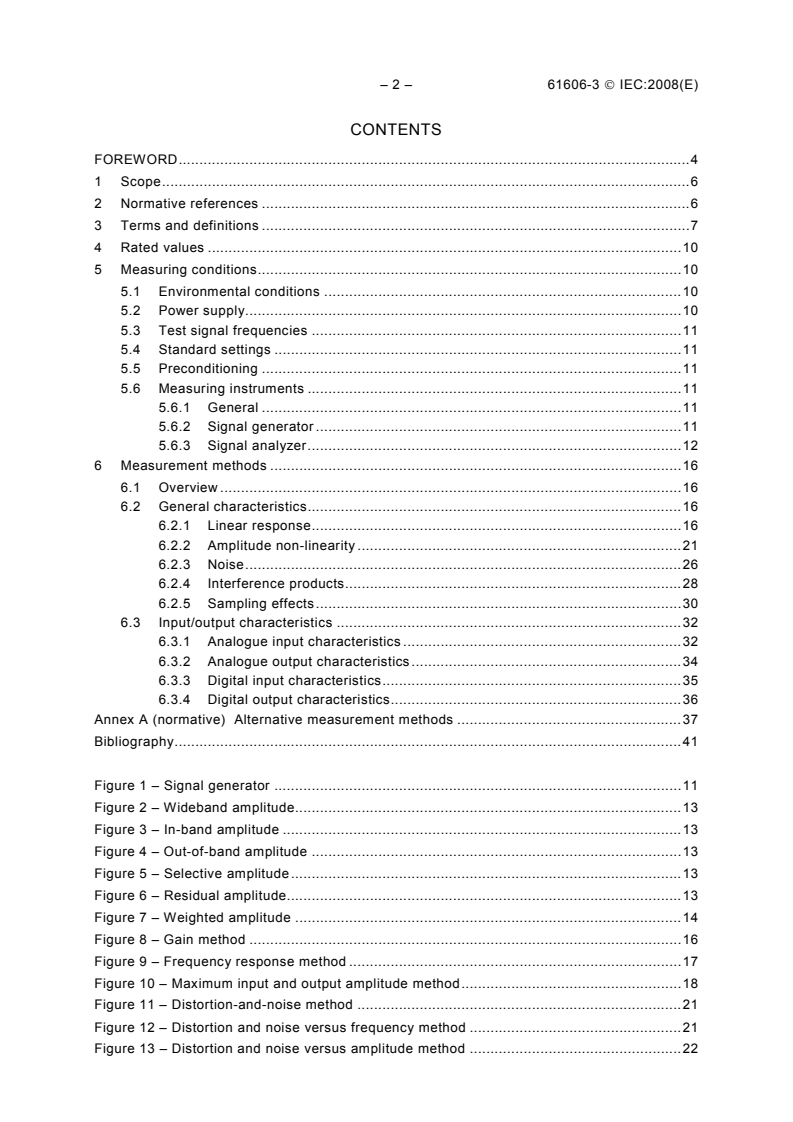
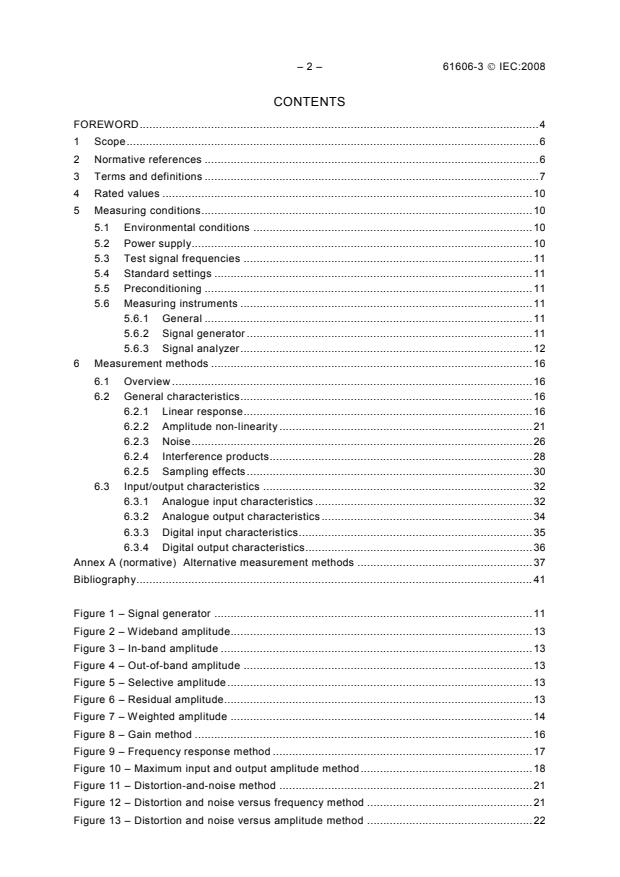
CONTENTS
FOREWORD.4
1 Scope.6
2 Normative references .6
3 Terms and definitions .7
4 Rated values .10
5 Measuring conditions.10
5.1 Environmental conditions .10
5.2 Power supply.10
5.3 Test signal frequencies .11
5.4 Standard settings .11
5.5 Preconditioning .11
5.6 Measuring instruments .11
5.6.1 General .11
5.6.2 Signal generator .11
5.6.3 Signal analyzer.12
6 Measurement methods .16
6.1 Overview .16
6.2 General characteristics.16
6.2.1 Linear response.16
6.2.2 Amplitude non-linearity .21
6.2.3 Noise.26
6.2.4 Interference products.28
6.2.5 Sampling effects.30
6.3 Input/output characteristics .32
6.3.1 Analogue input characteristics .32
6.3.2 Analogue output characteristics.34
6.3.3 Digital input characteristics.35
6.3.4 Digital output characteristics.36
Annex A (normative) Alternative measurement methods .37
Bibliography.41
Figure 1 – Signal generator .11
Figure 2 – Wideband amplitude.13
Figure 3 – In-band amplitude .13
Figure 4 – Out-of-band amplitude .13
Figure 5 – Selective amplitude.13
Figure 6 – Residual amplitude.13
Figure 7 – Weighted amplitude .14
Figure 8 – Gain method .16
Figure 9 – Frequency response method .17
Figure 10 – Maximum input and output amplitude method.18
Figure 11 – Distortion-and-noise method .21
Figure 12 – Distortion and noise versus frequency method .21
Figure 13 – Distortion and noise versus amplitude method .22
61606-3 © IEC:2008(E) – 3 –
Figure 14 – Individual harmonic distortion method .22
Figure 15 – Total harmonic distortion method .22
Figure 16 – Largest spurious signal method.23
Figure 17 – Intermodulation method.23
Figure 18 – Intermodulation method.24
Figure 19 – Amplitude-dependent gain method .25
Figure 20 – Intrinsic signal modulation products method .25
Figure 21 – Low-amplitude noise modulation method.26
Figure 22 – Idle-channel noise method .26
Figure 23 – Idle-channel noise spectrum method .27
Figure 24 – Dynamic range method .27
Figure 25 – Out-of-band noise ratio method .27
Figure 26 – Channel separation method.28
Figure 27 – Non-linear cross-talk method.29
Figure 28 – Power-line (mains) related products method.30
Figure 29 – Suppression of the aliasing components method .30
Figure 30 – Suppression of imaging components method.31
Figure 31 – Sampling jitter susceptibility method .32
Figure 32 – Analogue full-scale input amplitude method .32
Figure 33 – Overload behaviour method .33
Figure 34 – Common-mode rejection ratio method .33
Figure 35 – Analogue full-scale output amplitude method .34
Figure 36 – Output balance method .35
Table A.1 – Stimulus wavetables .38
– 4 – 61606-3 © IEC:2008(E)
INTERNATIONAL ELECTROTECHNICAL COMMISSION
____________
AUDIO AND AUDIOVISUAL EQUIPMENT –
DIGITAL AUDIO PARTS –
BASIC MEASUREMENT METHODS
OF AUDIO CHARACTERISTICS –
Part 3: Professional use
FOREWORD
1) The International Electrotechnical Commission (IEC) is a worldwide organization for standardization comprising
all national electrotechnical committees (IEC National Committees). The object of IEC is to promote
international co-operation on all questions concerning standardization in the electrical and electronic fields. To
this end and in addition to other activities, IEC publishes International Standards, Technical Specifications,
Technical Reports, Publicly Available Specifications (PAS) and Guides (hereafter referred to as “IEC
Publication(s)”). Their preparation is entrusted to technical committees; any IEC National Committee interested
in the subject dealt with may participate in this preparatory work. International, governmental and non-
governmental organizations liaising with the IEC also participate in this preparation. IEC collaborates closely
with the International Organization for Standardization (ISO) in accordance with conditions determined by
agreement between the two organizations.
2) The formal decisions or agreements of IEC on technical matters express, as nearly as possible, an international
consensus of opinion on the relevant subjects since each technical committee has representation from all
interested IEC National Committees.
3) IEC Publications have the form of recommendations for international use and are accepted by IEC National
Committees in that sense. While all reasonable efforts are made to ensure that the technical content of IEC
Publications is accurate, IEC cannot be held responsible for the way in which they are used or for any
misinterpretation by any end user.
4) In order to promote international uniformity, IEC National Committees undertake to apply IEC Publications
transparently to the maximum extent possible in their national and regional publications. Any divergence
between any IEC Publication and the corresponding national or regional publication shall be clearly indicated in
the latter.
5) IEC provides no marking procedure to indicate its approval and cannot be rendered responsible for any
equipment declared to be in conformity with an IEC Publication.
6) All users should ensure that they have the latest edition of this publication.
7) No liability shall attach to IEC or its directors, employees, servants or agents including individual experts and
members of its technical committees and IEC National Committees for any personal injury, property damage or
other damage of any nature whatsoever, whether direct or indirect, or for costs (including legal fees) and
expenses arising out of the publication, use of, or reliance upon, this IEC Publication or any other IEC
Publications.
8) Attention is drawn to the Normative references cited in this publication. Use of the referenced publications is
indispensable for the correct application of this publication.
9) Attention is drawn to the possibility that some of the elements of this IEC Publication may be the subject of
patent rights. IEC shall not be held responsible for identifying any or all such patent rights.
International Standard IEC 61606-3 has been prepared by IEC technical committee 100:Audio,
video and multimedia systems and equipment.
The text of this standard is based on the following documents:
FDIS Report on voting
100/1428/FDIS 100/1453/RVD
Full information on the voting for the approval of this standard can be found in the report on
voting indicated in the above table.
This publication has been drafted in accordance with the ISO/IEC Directives, Part 2.
61606-3 © IEC:2008(E) – 5 –
A list of all parts of the IEC 61606 series, under the general title Audio and audiovisual
equipment – Digital audio parts – Basic measurement methods of audio characteristics, can
be found on the IEC website.
This International Standard is to be used in conjunction with IEC 61606-1.
The committee has decided that the contents of this publication will remain unchanged until
the maintenance result date indicated on the IEC web site under "http://webstore.iec.ch" in
the data related to the specific publication. At this date, the publication will be
• reconfirmed,
• withdrawn,
• replaced by a revised edition, or
• amended.
A bilingual version of this publication may be issued at a later date.
– 6 – 61606-3 © IEC:2008(E)
AUDIO AND AUDIOVISUAL EQUIPMENT –
DIGITAL AUDIO PARTS –
BASIC MEASUREMENT METHODS
OF AUDIO CHARACTERISTICS –
Part 3: Professional use
1 Scope
This part of IEC 61606 is applicable to the basic measurement methods of audio equipment
for professional use.
The definitions, measuring conditions and methods common to both consumer and
professional equipment are described in the IEC 61606-1.
This standard contains details of definitions and measuring conditions and methods applicable
to professional equipment which differ from those described in IEC 61606-1.
This standard excludes consideration of
− measurement of low-quality audio devices,
− measurement of low-bit-rate audio devices (‘sub-band’ or ‘perceptual’ coding devices),
− measurement of devices which significantly modify time or frequency characteristics of the
signal, such as pitch shifters or reverberators,
− measurement of signals from analogue input to analogue output, beyond the most general,
− EMC and safety related testing.
2 Normative references
The following referenced documents are indispensable for the application of this document.
For dated references, only the edition cited applies. For undated references, the latest edition
of the referenced document (including any amendments) applies.
IEC 60268-1, Sound system equipment – Part 1: General
IEC 60268-2, Sound system equipment – Part 2: Explanation of general terms and calculation
methods
IEC 60958-1, Digital audio interface – Part 1: General
IEC 61260, Electroacoustics – Octave-band and fractional-octave-band filters
IEC 61606-1, Audio and audiovisual equipment – Digital audio parts – Basic measurement
methods of audio characteristics – Part 1: General
AES11-2003, AES Recommended Practice for Digital Audio Engineering – Synchronization of
digital audio equipment in studio operations
61606-3 © IEC:2008(E) – 7 –
3 Terms and definitions
For the purposes of this document, the following terms and definitions apply.
3.1
aliasing components
see definition in IEC 61606-1
3.2
analogue full-scale input and output amplitude
when applied to an analogue input of the EUT, it produces digital full-scale amplitude within
the EUT; conversely, the analogue output full-scale amplitude is that which is produced at an
analogue output from the EUT by a digital full-scale amplitude within the EUT
NOTE 1 Sometimes the range of an analogue input or output path may be less than that corresponding to digital
full-scale amplitude. For this reason, analogue full-scale input and output amplitudes are usually inferred by driving
the converters at a lower amplitude (see 6.3.1.1 and 6.3.2.1).
NOTE 2 The ideal values of these amplitudes cannot be defined within the standard since they are different for
different EUTs, and may be modally variable for a single EUT.
NOTE 3 Where these values are unknown for an EUT at the outset of testing, they should generally be
established first (using the methods described in 6.3.1.1 and 6.3.2.1 since it may subsequently be necessary, for
example, to drive an analogue input at –60 dB or to measure an amplitude at an analogue output in dB
FS FS
relative to a digital stimulus.
3.3
coding format
a numerical convention used to represent digital audio data at the inputs or outputs of the
EUT
NOTE This standard is primarily intended to be applied to EUTs which transact digital audio signals expressed as a
stream of LPCM (Linear Pulse Code Modulation) samples; that is, a stream of binary words, directly representing
the amplitudes of successive audio samples quantised at the sampling frequency, and rendered as binary 2's
complement numbers. Positive analogue voltages correspond to positive digital sample values (that is, 2’s
complement numbers whose most-significant bit (MSB) is zero). Many of the methods described in the standard are
applicable to other coding formats.
3.4
decibels full-scale
dB
FS
the r.m.s. amplitude of a sinusoid described in 3.10 is defined as 0 dB , where the amplitude
FS
of any signal can be defined in dB as 20 times the common logarithm of the ratio of the
FS
r.m.s. amplitude of the signal to that of the signal defined in 3.10
NOTE Analogue amplitudes at the input or output of an EUT can be expressed in dB by referring to the
FS
analogue full-scale input or output amplitudes as defined in 3.2.
3.5
digital audio interface
a physical medium upon which digital audio data are transferred into or out of the EUT
NOTE Digital audio interfaces may include packaged media (such as in the case of a CD player) or
radio-frequency (RF) carriers (such as in the case of a set-top-box) as well as conventional copper or optical digital
interconnections.
3.6
digital audio signal
see definition in IEC 61606-1
3.7
digital zero
see definition in IEC 61606-1
– 8 – 61606-3 © IEC:2008(E)
3.8
equipment under test
EUT
see definition in IEC 61606-1
NOTE In structuring an equipment or installation specification, it is important to consider the way in which the
different elements of the equipment might best be segmented for the purposes of the specification or measurement.
A basic D/A converter, for example, would represent a simple EUT with ‘General characteristics’, ‘Digital input
characteristics’ and ‘Analogue output characteristics’. But consider a large studio mixing console, which may have
many different functional blocks, and many different inputs and outputs of different types and in different domains.
Such a mixing console example might be considered as a collection of different elements; for example, ‘analogue
line inputs’, ‘analogue mic inputs’, ‘AES3 inputs’, ‘channel equalizers’, ‘mix bus processors’ etc. Typically, different
measurement criteria are applicable to each different element, and different performance levels might be specified.
In such a case each element or subsystem should, where possible, be considered as a discrete ‘EUT’ and should
be specified and measured individually. In addition, typical signal paths through the entire equipment may also be
specified, and their performance criteria stated as a single EUT.
3.9
folding frequency
half the sampling frequency of the EUT
NOTE 1 Signals above this frequency applied to the EUT are subject to aliasing.
NOTE 2 Complex EUTs may have an input folding frequency and an output folding frequency which are different.
In such cases, where input or output is unspecified, the folding frequency shall refer to the lower frequency.
3.10
full-scale amplitude
FS
amplitude of a 997 Hz sinusoid whose peak positive sample just reaches positive digital full-
scale (in 2’s-complement a binary value of 0111…1111 to make up the word length) and
whose peak negative sample just reaches a value one away from negative digital full-scale
(1000…0001 to make up the word length) leaving the maximum negative code (1000…0000)
unused
3.11
high and low interference frequencies
moderately high and low signal frequencies of 15 kHz and 60 Hz respectively at which certain
interference effects may be quoted if a graphical report is not required
3.12
in-band amplitude
an amplitude measurement incorporating a standard low-pass filter so as to exclude out-of-
band components above the upper band-edge frequency
3.13
in-band frequency range
see definition in IEC 61606-1
3.14
input word length
the maximum audio word length which can be applied to a digital input of the EUT at its
present settings, for which the least significant bit is not ignored
3.15
interface jitter
timing errors in the transitions of a digital audio carrier or reference sync, owing to cabling
effects or jitter in the clock of the sourcing equipment
61606-3 © IEC:2008(E) – 9 –
3.16
jitter susceptibility
the effect on EUT performance as a result of sampling jitter caused by interface jitter on the
incoming reference sync
3.17
maximal measuring amplitude
a signal amplitude of –1 dB , close to (but below) full scale amplitude, which is applied to
FS
the EUT in certain of the described methods
NOTE This definition can apply to either a digital or an analogue signal (see 3.4).
3.18
normal load impedance
required differential input impedance of the analogue measuring equipment defined as 100 kΩ
or more, in parallel with not more than 500 pF in this standard
3.19
normal measuring amplitude
a signal amplitude of −20 dB , representative of a typical operating amplitude, which is
FS
applied to the EUT in certain of the described methods
NOTE This definition can apply to either a digital or an analogue signal (see 3.4).
3.20
normal measuring frequency
a signal frequency of 997 Hz, representative of a typical mid-range frequency, which is
applied to the EUT in certain of the described methods
3.21
normal source impedance
required differential output impedance of the analogue measuring equipment defined as 50 Ω
or less for a balanced output and 25 Ω or less for an unbalanced output in this standard
3.22
out-of-band amplitude
amplitude measurement incorporating a standard out-of-band filter so as to exclude in-band
components below the upper band-edge frequency
3.23
out-of-band frequency range
frequency range from the folding frequency to 192 kHz (or some other stated maximum)
NOTE Signals applied to the EUT input in this frequency range are subject to aliasing.
3.24
output word length
number of significant bits transmitted by a digital output of the EUT at its present settings, of
which none is continuously zero
3.25
residual amplitude
an amplitude measurement incorporating a standard band-reject filter to suppress the effects
of an unwanted frequency, usually the stimulus frequency
3.26
sampling frequency
f
s
the rate at which audio samples are processed within the EUT
– 10 – 61606-3 © IEC:2008(E)
NOTE Complex EUTs may have an input sampling frequency and an output sampling frequency which are
different. In such cases, where input or output is unspecified, the sampling frequency shall refer to the lower
frequency.
3.27
sampling jitter
timing errors in the sampling instants applied by an A/D converter, D/A converter or
asynchronous sample-rate converter which lead to phase modulation of the converted audio
signal
3.28
selective amplitude
amplitude measurement incorporating a standard band-pass filter to suppress the effects of
spurious components and wideband noise
3.29
standard third-octave frequencies
set of measurement frequencies set at one-third-octave intervals, as defined in IEC 61260,
where these frequencies are preferred whenever third-octave analysis is specified
3.30
upper band-edge frequency
see definition in IEC 61606-1
4 Rated values
For a full explanation of these terms, see IEC 60268-2. The followings are rated conditions for
digital audio equipment. They should be specified by the manufacturer.
• rated supply voltage
• rated supply frequency
• rated pre-emphasis and de-emphasis characteristics
• rated digital input word length
• rated sampling frequencies
5 Measuring conditions
5.1 Environmental conditions
Where environmental conditions for EUT operation are specified by the manufacturer,
measurements will be assumed to be valid over the entire range, and shall be so verified. In
the absence of an environmental specification, tests will be performed at a temperature of
25 ˚C ± 10 ˚C, relative humidity of 60 % ± 15 % and air pressure of 96 kPa ± 10 kPa.
5.2 Power supply
Power-line (mains) voltage shall be set within 2 % of the nominal value listed on the panel of
the device being tested. If a range of values is given, the specifications are assumed to be
valid over the entire range and may be so verified.
Power-line (mains) frequency shall be set within 1 % of the nominal value listed on the panel
of the device being tested. If a range of values is given, the specifications are assumed to be
valid over the entire range and shall be so verified.
For dc-powered devices the dc supply voltage shall have a peak-to-peak ripple content of less
than 0,5 % of the nominal supply voltage.
61606-3 © IEC:2008(E) – 11 –
5.3 Test signal frequencies
The test signal frequencies defined in IEC 61606-1 are not especially applicable in the
professional context. Although these frequencies are referenced where possible, in general
this standard specifies directly such frequencies as may be required.
5.4 Standard settings
All controls of the EUT shall be set to the reference positions specified by the manufacturer,
or to their normal operating positions or to those specified in IEC 61606-1 where none is
specified.
5.5 Preconditioning
The EUT shall be preconditioned as described in IEC 61606-1.
5.6 Measuring instruments
5.6.1 General
All measuring instruments specified in this standard shall comply with the instrument
specifications in 4.6 of IEC 61606-1 except for variations and additions to their specifications
as detailed in this document.
In general, equivalent analogue and digital instruments should behave identically except
where detailed.
Digital instruments shall be able to generate and analyze data in whatever digital audio
interface format(s) are supported by the EUT.
Analogue instrument outputs should present the normal source impedance as defined in 3.21;
analogue instrument inputs should present the normal load impedance as defined in 3.18.
5.6.2 Signal generator
5.6.2.1 Generator modes
The methods described in this Clause require a variety of generator modes, which are
detailed below. These are most easily realised using a multi-function generator.
The different generator modes are indicated for each method by a generator block symbol as
shown in Figure 1.
IEC 1824/08
Figure 1 – Signal generator
The lower section of the symbol describes the mode of the generator: its function, amplitude
and frequency settings. Abbreviations are as follows:
Amplitude:
• NRM Normal measuring amplitude
• MAX Maximal measuring amplitude
– 12 – 61606-3 © IEC:2008(E)
• SWP Swept amplitude; the method is repeated at each of a defined series of test
amplitudes
• ADJ Manually adjusted amplitude
Frequency:
• NRM Normal measuring frequency
• UBE Upper band-edge frequency
• SWP Swept frequency
Other settings, as required in various modes, are described in the accompanying text.
If synchronous multi-tone analysis is to be performed, the signal generator shall additionally
have wavetable generation capabilities as described in A.1.
5.6.2.2 Dither
Unless otherwise stated, all stimuli which are used to drive the EUT in the digital domain shall
be dithered with triangular probability-density function (TPDF) white dither at the appropriate
amplitude as determined by the input word length of the EUT.
NOTE This type of dithering precisely linearizes the quantization noise of the test stimuli to finite word lengths. It
is achieved by adding a dither signal to the test stimulus signal prior to its truncation to the input word length of the
EUT. The correct dither signal is a random or pseudo-random sequence having a triangular probability density
function (TPDF), no DC offset, and a peak-to-peak amplitude of two least-significant bits of the EUT input word
length. The amplitude is constant per unit bandwidth (white) up to at least the upper band-edge frequency. TPDF is
achieved by adding pairs of uniformly-distributed random or pseudo-random numbers to form each dither sample;
the generating sequence should be long in duration and maximally random, and the extraction points of the number
pairs should be well separated in order to minimize correlation.
5.6.2.3 Accuracy
Signal generators used for measurements in this standard shall provide control over
frequency with an accuracy of at least ±0,05 %. For analogue signal generators, the
frequency may be measured with a frequency counter and adjusted to be within the required
accuracy. The frequency adjustment resolution shall be adequate to produce the frequencies
specified for each test.
Analogue stimuli shall be generated with an amplitude accuracy of at least ± (0,2 dB + 3 μV)
at the normal measuring frequency, and ±(0,3 dB + 3 μV) from 20 Hz to the upper band-edge
frequency. Digital stimuli shall be generated with an amplitude accuracy of ±(0,01 dB +
0,5 LSB).
5.6.3 Signal analyzer
5.6.3.1 Analyzer modes
The methods described in this Clause require a variety of analyzer modes which are detailed
below. These are most easily realised using a multi-function analyzer. However, individual
filters, meters etc. may be used if required. All amplitude measurements specified in this
standard shall be made with true root-mean-square (r.m.s.) responding meters. Filters are
described in 5.6.3.2.
A wideband amplitude meter, as shown in Figure 2, is a simple r.m.s. amplitude meter with no
pre-metering filters.
61606-3 © IEC:2008(E) – 13 –
IEC 1825/08
Figure 2 – Wideband amplitude
An in-band amplitude meter, as shown in Figure 3, incorporates the low-pass filter as
described in 5.6.3.2.1.
IEC 1826/08
Figure 3 – In-band amplitude
An out-of-band amplitude meter, as shown in Figure 4, incorporates the high-pass filter as
described in 5.6.3.2.2.
IEC 1827/08
Figure 4 – Out-of-band amplitude
A selective amplitude meter, as shown in Figure 5, incorporates the band-pass filter as
described in 5.6.3.2.3 to measure the amplitude of a single frequency component. Unless
otherwise stated, the band-pass filter is auto-tuned to the generator frequency.
IEC 1828/08
Figure 5 – Selective amplitude
A residual amplitude meter, as shown in Figure 6, incorporates the band-reject filter as
5.6.3.2.6 to exclude the effects of a single frequency component, usually the
described in
stimulus frequency. Unless otherwise stated, the band-reject filter is auto-tuned to the
predominant input frequency.
IEC 1829/08
Figure 6 – Residual amplitude
A weighted amplitude meter, as shown in Figure 7, incorporates the weighting filter as
described in 5.6.3.2.9.
– 14 – 61606-3 © IEC:2008(E)
IEC 1830/08
Figure 7 – Weighted amplitude
Where methods require variations on the analyzer modes described, these are detailed in the
accompanying text.
Some analyzer modes require the use of more than one cascaded filter (for example it is
sometimes necessary to exclude out-of-band components from residual measurements); in
these cases, the analyzer block symbol is designated with both filters (for example
A ).
INBAND RESIDUAL
NOTE If synchronous multi-tone analysis is to be performed, a signal analyzer with additional FFT analysis and
computation capabilities is required, as described in Annex A.
5.6.3.2 Filters
5.6.3.2.1 Low-pass filter (in-band filter)
Defined in IEC 61606-1.
5.6.3.2.2 High-pass filter (out-of-band filter)
Defined in IEC 61606-1, except as dictated by the revised out-of-band frequency range or the
sampling frequency.
5.6.3.2.3 Band-pass filter
Unless otherwise specified, band-pass filters shall conform to class II or class III response
limits as outlined in IEC 61260. This provides at least 30 dB of attenuation of signals one
octave away from the filter centre frequency and 60 dB, three octaves away. Such band-pass
filters shall be used where third-octave analysis is described (at the standard third-octave
frequencies), and for all selective amplitude measurements, except where a more selective
filter is specified.
5.6.3.2.4 Narrow band-pass filter
Defined in IEC 61606-1.
5.6.3.2.5 Window-width band-pass filter
A band-pass filter realised in the frequency domain, having an extremely narrow unity-gain
pass-band defined by the sampling frequency, Fast Fourier Transform (FFT) record length
and window function, and extreme attenuation outside that band. The width of the pass-band
is the minimum number of bins required to effectively pass the selected frequency, since the
energy at that frequency is dispersed into a number of adjacent bins dependent on the chosen
window function.
5.6.3.2.6 Band-reject filter
The band-reject filter used by default for residual and Distortion-and-noise measurements
shall have a Q of at least 1 and not more than 5, except where a greater selectivity is
specified.
The band-reject filter may be substituted in residual measurements by sharper (more
selective) band-reject filters, as described below, in certain circumstances.
61606-3 © IEC:2008(E) – 15 –
5.6.3.2.7 Narrow band-reject filter
A band-reject filter with a Q of between 5 and 10.
5.6.3.2.8 Window-width band-reject filter
A band-reject filter realised in the frequency domain, having an extremely narrow stop-band
defined by the sampling frequency, FFT record length and window function, providing extreme
attenuation, and unity gain outside that band. The width of the stop-band is the minimum
number of bins required to effectively exclude the selected frequency, since the energy at that
frequency is dispersed into a number of adjacent bins dependent on the chosen window
function.
5.6.3.2.9 Weighting filter
The weighting filter for all weighted noise measurements shall conform to IEC 60268-1 except
for overall gain. The filter unity-gain frequency shall be 2 kHz. Relative amplitude
measurements, such as signal-to-noise ratio, performed using this recommended standard
weighting filter, shall be abbreviated “dB CCIR-RMS”. Absolute amplitude measurements
performed using this recommended filter shall be denoted by the appropriate quantity
abbreviation followed by “CCIR-RMS”; for example, dB shall be “dB CCIR-RMS” If a
FS FS
standard weighting filter differing from this recommendation is used for a measurement
according to this standard, the filter network – and gain if appropriate – shall be specified.
NOTE The 2 kHz reference in this standard is equivalent to inserting an attenuation of 5,629 dB at all frequencies
when compared with the reference frequency of 1 kHz specified in IEC 60268-1.
5.6.3.3 Absolute and relative amplitude measurements
Absolute amplitude results shall be stated directly in r.m.s. units, for example dB for digital
FS
signals and dB or V for analogue signals.
u rms
Amplitude results may also be stated relative to a reference amplitude, as a ratio in decibels
or percent. Self-relative results should be stated relative to the measured analyzer input
amplitude for the same channel (prior to any filters), for example in the ‘Distortion-and-noise’
method. Channel-relative results shall be stated relative to the analyzer input amplitude of a
reference channel, for example in the cross-talk method.
Multi-function analyzers are generally capable of performing relative measurements directly.
Otherwise, the reference amplitude shall be measured in addition to the desired measurement,
and the relative result computed manually.
5.6.3.4 Accuracy
Unless otherwise specified, equipment used for measurements in this standard shall have an
accuracy in the parameter being measured of at least three times better than the specification
being verified.
All amplitude meters used for measurements in this standard shall be true root-mean-square
(r.m.s.) responding devices with a minimum required accuracy of 0,25 dB (in-band or selective
measurements) or 1,0 dB (residual measurements) over the range from 20 Hz to the upper
band-edge frequency. This accuracy shall be maintained for a signal having a crest factor of 5
or less. RMS. calibrated average or peak-responding devices shall not be used.
Analogue analysis shall apply an additional allowed tolerance of ±3 μV, and digital analysis
shall apply an additional allowed tolerance of ±0,5 LSB.
All amplitude meters used for measurements in this standard shall integrate the signal for a
minimum of 25 ms to ensure an adequate number of codes are exercised in the EUT. For low
– 16 – 61606-3 © IEC:2008(E)
detected signal frequencies the required time shall be increased to ensure that at least one
full cycle of the signal shall be measured.
6 Measurement methods
6.1 Overview
The measurement methods described in ‘General characteristics’ below shall apply to all
EUTs irrespective of their input and output types. In addition, the methods described in
‘analogue input characteristics’, ‘analogue output characteristics’, ‘digital input characteristics’
and ‘digital output characteristics’ shall be applied as dictated by the input and output
domains of the particular EUT.
If the EUT provides two or more channels, the measurements should be repeated for every
channel.
In many cases it will be appropriate to repeat certain measurements for various operating
conditions or control settings; for example, sampling frequency. In such cases, the applied
conditions and settings shall be clearly stated in conjunction with each measurement.
Unless specifically stated, the EUT shall be configured with the standard settings as
described in 5.4. Wherever different settings are employed, these shall be clearly stated.
6.2 General characteristics
6.2.1 Linear response
6.2.1.1 Amplitude related
6.2.1.1.1 Gain
Aim: This test measures the ratio of output amplitude to input amplitude under standard
settings.
Using the method shown in Figure 8, the EUT shall be driven with a sinusoidal stimulus at the
normal measuring amplitude and frequency. The selective amplitude at the output of the EUT
shall be measured, and expressed relative to the normal measuring amplitude, in dB.
IEC 1831/08
Figure 8 – Gain method
NOTE This characteristic applies generally to EUTs with analogue input and analogue output, or with digital input
and digital output. For cross-domain gain characteristics, refer to 6.3.1.1 and 6.3.2.1).
6.2.1.1.2 Gain stability
Aim: This test measures the variation of gain over time.
Using the method shown in Figure 8, the EUT shall be driven with a sinusoidal stimulus at the
normal measuring amplitude and frequency. The selective amplitude at the output of the EUT
shall be measured for a period of at least 1,0 h immediately following preconditioning as
described in 5.5. The gain stability shall be defined as the ratio of the highest to the lowest
amplitude recorded during the period, expressed in dB.
61606-3 © IEC:2008(E) – 17 –
6.2.1.1.3 Gain difference between channels and tracking error
Aim: This test measures the matching of gain between channels.
Where possible, each channel of the EUT shall be simultaneously driven with a sinusoidal
stimulus at the normal measuring amplitude and frequency using the method shown in
Figure 8. The selective amplitude at the output of each EUT channel shall be recorded. The
inter-channel gain matching shall be defined as the ratio of the highest to the lowest channel
amplitude recorded, expressed in dB.
Where a ganged gain control affects all of the EUT channels, the tracking error shall be
defined as the highest inter-channel gain matching result which occurs at any point on the
control. If only a part of the control’s range is to be measured, then that part shall be defined.
The test shall be applied without the signal being clipped within the EUT; it may therefore be
necessary to specify a lower stimulus amplitude if the range of the gain control demands it.
6.2.1.1.4 Frequency response
Aim: This test measures the variation of gain with frequency.
Using the method shown in Figure 9, the frequency response may be measured by applying a
sinusoidal stimulus at the normal measuring amplitude to the input of the EUT, and measuring
the amplitude at the EUT’s output for a range of different stimulus frequencies. The amplitude
measurement should preferably be selective, to prevent the result from being influenced by
the presence of significant noise or spurious components.
IEC 1832/08
Figure 9 – Frequency response method
The measurement frequencies can be freely chosen to suit the particular EUT, sampling
frequency etc., but should preferably be logarithmically spaced. It is suggested that the
frequencies be chosen in accordance with the appropriate Table in IEC 61606-1. In any case,
the frequency range shall include 10 Hz and the upper band-edge frequency.
The response should be presented as a graph with frequency on the X axis (preferably
rendered logarithmically) and
...
IEC 61606-3 ®
Edition 1.0 2008-10
INTERNATIONAL
STANDARD
NORME
INTERNATIONALE
Audio and audiovisual equipment – Digital audio parts – Basic measurement
methods of audio characteristics –
Part 3: Professional use
Équipements audio et audiovisuels – Parties audionumériques – Méthodes
fondamentales pour la mesure des caractéristiques audio –
Partie 3: Usage professionnel
All rights reserved. Unless otherwise specified, no part of this publication may be reproduced or utilized in any form
or by any means, electronic or mechanical, including photocopying and microfilm, without permission in writing from
either IEC or IEC's member National Committee in the country of the requester.
If you have any questions about IEC copyright or have an enquiry about obtaining additional rights to this publication,
please contact the address below or your local IEC member National Committee for further information.
Droits de reproduction réservés. Sauf indication contraire, aucune partie de cette publication ne peut être reproduite ni
utilisée sous quelque forme que ce soit et par aucun procédé, électronique ou mécanique, y compris la photocopie et les
microfilms, sans l'accord écrit de la CEI ou du Comité national de la CEI du pays du demandeur.
Si vous avez des questions sur le copyright de la CEI ou si vous désirez obtenir des droits supplémentaires sur cette
publication, utilisez les coordonnées ci-après ou contactez le Comité national de la CEI de votre pays de résidence.
IEC Central Office Tel.: +41 22 919 02 11
3, rue de Varembé Fax: +41 22 919 03 00
CH-1211 Geneva 20 info@iec.ch
Switzerland www.iec.ch
About the IEC
The International Electrotechnical Commission (IEC) is the leading global organization that prepares and publishes
International Standards for all electrical, electronic and related technologies.
About IEC publications
The technical content of IEC publications is kept under constant review by the IEC. Please make sure that you have the
latest edition, a corrigenda or an amendment might have been published.
Useful links:
IEC publications search - www.iec.ch/searchpub Electropedia - www.electropedia.org
The advanced search enables you to find IEC publications The world's leading online dictionary of electronic and
by a variety of criteria (reference number, text, technical electrical terms containing more than 30 000 terms and
committee,…). definitions in English and French, with equivalent terms in
It also gives information on projects, replaced and additional languages. Also known as the International
withdrawn publications. Electrotechnical Vocabulary (IEV) on-line.
IEC Just Published - webstore.iec.ch/justpublished Customer Service Centre - webstore.iec.ch/csc
Stay up to date on all new IEC publications. Just Published If you wish to give us your feedback on this publication
details all new publications released. Available on-line and or need further assistance, please contact the
also once a month by email. Customer Service Centre: csc@iec.ch.
A propos de la CEI
La Commission Electrotechnique Internationale (CEI) est la première organisation mondiale qui élabore et publie des
Normes internationales pour tout ce qui a trait à l'électricité, à l'électronique et aux technologies apparentées.
A propos des publications CEI
Le contenu technique des publications de la CEI est constamment revu. Veuillez vous assurer que vous possédez
l’édition la plus récente, un corrigendum ou amendement peut avoir été publié.
Liens utiles:
Recherche de publications CEI - www.iec.ch/searchpub Electropedia - www.electropedia.org
La recherche avancée vous permet de trouver des Le premier dictionnaire en ligne au monde de termes
publications CEI en utilisant différents critères (numéro de électroniques et électriques. Il contient plus de 30 000
référence, texte, comité d’études,…). termes et définitions en anglais et en français, ainsi que
Elle donne aussi des informations sur les projets et les les termes équivalents dans les langues additionnelles.
publications remplacées ou retirées. Egalement appelé Vocabulaire Electrotechnique
International (VEI) en ligne.
Just Published CEI - webstore.iec.ch/justpublished
Service Clients - webstore.iec.ch/csc
Restez informé sur les nouvelles publications de la CEI.
Just Published détaille les nouvelles publications parues. Si vous désirez nous donner des commentaires sur
Disponible en ligne et aussi une fois par mois par email. cette publication ou si vous avez des questions
contactez-nous: csc@iec.ch.
IEC 61606-3 ®
Edition 1.0 2008-10
INTERNATIONAL
STANDARD
NORME
INTERNATIONALE
Audio and audiovisual equipment – Digital audio parts – Basic measurement
methods of audio characteristics –
Part 3: Professional use
Équipements audio et audiovisuels – Parties audionumériques – Méthodes
fondamentales pour la mesure des caractéristiques audio –
Partie 3: Usage professionnel
INTERNATIONAL
ELECTROTECHNICAL
COMMISSION
COMMISSION
ELECTROTECHNIQUE
PRICE CODE
INTERNATIONALE
CODE PRIX X
ICS 33.160.30 ISBN 978-2-83220-367-5
– 2 – 61606-3 IEC:2008
CONTENTS
FOREWORD . 4
1 Scope . 6
2 Normative references . 6
3 Terms and definitions . 7
4 Rated values . 10
5 Measuring conditions . 10
5.1 Environmental conditions . 10
5.2 Power supply . 10
5.3 Test signal frequencies . 11
5.4 Standard settings . 11
5.5 Preconditioning . 11
5.6 Measuring instruments . 11
5.6.1 General . 11
5.6.2 Signal generator . 11
5.6.3 Signal analyzer . 12
6 Measurement methods . 16
6.1 Overview . 16
6.2 General characteristics . 16
6.2.1 Linear response . 16
6.2.2 Amplitude non-linearity . 21
6.2.3 Noise . 26
6.2.4 Interference products . 28
6.2.5 Sampling effects . 30
6.3 Input/output characteristics . 32
6.3.1 Analogue input characteristics . 32
6.3.2 Analogue output characteristics . 34
6.3.3 Digital input characteristics . 35
6.3.4 Digital output characteristics . 36
Annex A (normative) Alternative measurement methods . 37
Bibliography . 41
Figure 1 – Signal generator . 11
Figure 2 – Wideband amplitude. 13
Figure 3 – In-band amplitude . 13
Figure 4 – Out-of-band amplitude . 13
Figure 5 – Selective amplitude . 13
Figure 6 – Residual amplitude. 13
Figure 7 – Weighted amplitude . 14
Figure 8 – Gain method . 16
Figure 9 – Frequency response method . 17
Figure 10 – Maximum input and output amplitude method . 18
Figure 11 – Distortion-and-noise method . 21
Figure 12 – Distortion and noise versus frequency method . 21
Figure 13 – Distortion and noise versus amplitude method . 22
61606-3 IEC:2008 – 3 –
Figure 14 – Individual harmonic distortion method . 22
Figure 15 – Total harmonic distortion method . 22
Figure 16 – Largest spurious signal method . 23
Figure 17 – Intermodulation method . 23
Figure 18 – Intermodulation method . 24
Figure 19 – Amplitude-dependent gain method . 25
Figure 20 – Intrinsic signal modulation products method . 25
Figure 21 – Low-amplitude noise modulation method . 26
Figure 22 – Idle-channel noise method . 26
Figure 23 – Idle-channel noise spectrum method . 27
Figure 24 – Dynamic range method . 27
Figure 25 – Out-of-band noise ratio method . 27
Figure 26 – Channel separation method . 28
Figure 27 – Non-linear cross-talk method . 29
Figure 28 – Power-line (mains) related products method . 30
Figure 29 – Suppression of the aliasing components method . 30
Figure 30 – Suppression of imaging components method . 31
Figure 31 – Sampling jitter susceptibility method . 32
Figure 32 – Analogue full-scale input amplitude method . 32
Figure 33 – Overload behaviour method . 33
Figure 34 – Common-mode rejection ratio method . 33
Figure 35 – Analogue full-scale output amplitude method . 34
Figure 36 – Output balance method . 35
Table A.1 – Stimulus wavetables . 38
– 4 – 61606-3 IEC:2008
INTERNATIONAL ELECTROTECHNICAL COMMISSION
____________
AUDIO AND AUDIOVISUAL EQUIPMENT –
DIGITAL AUDIO PARTS –
BASIC MEASUREMENT METHODS
OF AUDIO CHARACTERISTICS –
Part 3: Professional use
FOREWORD
1) The International Electrotechnical Commission (IEC) is a worldwide organization for standardization comprising
all national electrotechnical committees (IEC National Committees). The object of IEC is to promote
international co-operation on all questions concerning standardization in the electrical and electronic fields. To
this end and in addition to other activities, IEC publishes International Standards, Technical Specifications,
Technical Reports, Publicly Available Specifications (PAS) and Guides (hereafter referred to as “IEC
Publication(s)”). Their preparation is entrusted to technical committees; any IEC National Committee interested
in the subject dealt with may participate in this preparatory work. International, governmental and non-
governmental organizations liaising with the IEC also participate in this preparation. IEC collaborates closely
with the International Organization for Standardization (ISO) in accordance with conditions determined by
agreement between the two organizations.
2) The formal decisions or agreements of IEC on technical matters express, as nearly as possible, an international
consensus of opinion on the relevant subjects since each technical committee has representation from all
interested IEC National Committees.
3) IEC Publications have the form of recommendations for international use and are accepted by IEC National
Committees in that sense. While all reasonable efforts are made to ensure that the technical content of IEC
Publications is accurate, IEC cannot be held responsible for the way in which they are used or for any
misinterpretation by any end user.
4) In order to promote international uniformity, IEC National Committees undertake to apply IEC Publications
transparently to the maximum extent possible in their national and regional publications. Any divergence
between any IEC Publication and the corresponding national or regional publication shall be clearly indicated in
the latter.
5) IEC provides no marking procedure to indicate its approval and cannot be rendered responsible for any
equipment declared to be in conformity with an IEC Publication.
6) All users should ensure that they have the latest edition of this publication.
7) No liability shall attach to IEC or its directors, employees, servants or agents including individual experts and
members of its technical committees and IEC National Committees for any personal injury, property damage or
other damage of any nature whatsoever, whether direct or indirect, or for costs (including legal fees) and
expenses arising out of the publication, use of, or reliance upon, this IEC Publication or any other IEC
Publications.
8) Attention is drawn to the Normative references cited in this publication. Use of the referenced publications is
indispensable for the correct application of this publication.
9) Attention is drawn to the possibility that some of the elements of this IEC Publication may be the subject of
patent rights. IEC shall not be held responsible for identifying any or all such patent rights.
International Standard IEC 61606-3 has been prepared by IEC technical committee 100:
Audio, video and multimedia systems and equipment.
This bilingual version (2012-11) corresponds to the monolingual English version, published in
2008-10.
The text of this standard is based on the following documents:
FDIS Report on voting
100/1428/FDIS 100/1453/RVD
Full information on the voting for the approval of this standard can be found in the report on
voting indicated in the above table.
61606-3 IEC:2008 – 5 –
The French version of this standard has not been voted upon.
This publication has been drafted in accordance with the ISO/IEC Directives, Part 2.
A list of all parts of the IEC 61606 series, under the general title Audio and audiovisual
equipment – Digital audio parts – Basic measurement methods of audio characteristics, can
be found on the IEC website.
This International Standard is to be used in conjunction with IEC 61606-1.
The committee has decided that the contents of this publication will remain unchanged until
the maintenance result date indicated on the IEC web site under "http://webstore.iec.ch" in
the data related to the specific publication. At this date, the publication will be
• reconfirmed,
• withdrawn,
• replaced by a revised edition, or
• amended.
– 6 – 61606-3 IEC:2008
AUDIO AND AUDIOVISUAL EQUIPMENT –
DIGITAL AUDIO PARTS –
BASIC MEASUREMENT METHODS
OF AUDIO CHARACTERISTICS –
Part 3: Professional use
1 Scope
This part of IEC 61606 is applicable to the basic measurement methods of audio equipment
for professional use.
The definitions, measuring conditions and methods common to both consumer and
professional equipment are described in the IEC 61606-1.
This standard contains details of definitions and measuring conditions and methods applicable
to professional equipment which differ from those described in IEC 61606-1.
This standard excludes consideration of
– measurement of low-quality audio devices,
– measurement of low-bit-rate audio devices (‘sub-band’ or ‘perceptual’ coding devices),
– measurement of devices which significantly modify time or frequency characteristics of the
signal, such as pitch shifters or reverberators,
– measurement of signals from analogue input to analogue output, beyond the most general,
– EMC and safety related testing.
2 Normative references
The following referenced documents are indispensable for the application of this document.
For dated references, only the edition cited applies. For undated references, the latest edition
of the referenced document (including any amendments) applies.
IEC 60268-1, Sound system equipment – Part 1: General
IEC 60268-2, Sound system equipment – Part 2: Explanation of general terms and calculation
methods
IEC 60958-1, Digital audio interface – Part 1: General
IEC 61260, Electroacoustics – Octave-band and fractional-octave-band filters
IEC 61606-1, Audio and audiovisual equipment – Digital audio parts – Basic measurement
methods of audio characteristics – Part 1: General
AES11-2003, AES Recommended Practice for Digital Audio Engineering – Synchronization of
digital audio equipment in studio operations
61606-3 IEC:2008 – 7 –
3 Terms and definitions
For the purposes of this document, the following terms and definitions apply.
3.1
aliasing components
see definition in IEC 61606-1
3.2
analogue full-scale input and output amplitude
when applied to an analogue input of the EUT, it produces digital full-scale amplitude within
the EUT; conversely, the analogue output full-scale amplitude is that which is produced at an
analogue output from the EUT by a digital full-scale amplitude within the EUT
NOTE 1 Sometimes the range of an analogue input or output path may be less than that corresponding to digital
full-scale amplitude. For this reason, analogue full-scale input and output amplitudes are usually inferred by driving
the converters at a lower amplitude (see 6.3.1.1 and 6.3.2.1).
NOTE 2 The ideal values of these amplitudes cannot be defined within the standard since they are different for
different EUTs, and may be modally variable for a single EUT.
NOTE 3 Where these values are unknown for an EUT at the outset of testing, they should generally be
established first (using the methods described in 6.3.1.1 and 6.3.2.1 since it may subsequently be necessary, for
example, to drive an analogue input at –60 dB or to measure an amplitude at an analogue output in dB
FS FS
relative to a digital stimulus.
3.3
coding format
a numerical convention used to represent digital audio data at the inputs or outputs of the
EUT
NOTE This standard is primarily intended to be applied to EUTs which transact digital audio signals expressed as a
stream of LPCM (Linear Pulse Code Modulation) samples; that is, a stream of binary words, directly representing
the amplitudes of successive audio samples quantised at the sampling frequency, and rendered as binary 2's
complement numbers. Positive analogue voltages correspond to positive digital sample values (that is, 2’s
complement numbers whose most-significant bit (MSB) is zero). Many of the methods described in the standard are
applicable to other coding formats.
3.4
decibels full-scale
dB
FS
, where the amplitude
the r.m.s. amplitude of a sinusoid described in 3.10 is defined as 0 dB
FS
of any signal can be defined in dB as 20 times the common logarithm of the ratio of the
FS
r.m.s. amplitude of the signal to that of the signal defined in 3.10
NOTE Analogue amplitudes at the input or output of an EUT can be expressed in dB by referring to the
FS
analogue full-scale input or output amplitudes as defined in 3.2.
3.5
digital audio interface
a physical medium upon which digital audio data are transferred into or out of the EUT
NOTE Digital audio interfaces may include packaged media (such as in the case of a CD player) or
radio-frequency (RF) carriers (such as in the case of a set-top-box) as well as conventional copper or optical digital
interconnections.
3.6
digital audio signal
see definition in IEC 61606-1
3.7
digital zero
see definition in IEC 61606-1
– 8 – 61606-3 IEC:2008
3.8
equipment under test
EUT
see definition in IEC 61606-1
NOTE In structuring an equipment or installation specification, it is important to consider the way in which the
different elements of the equipment might best be segmented for the purposes of the specification or measurement.
A basic D/A converter, for example, would represent a simple EUT with ‘General characteristics’, ‘Digital input
characteristics’ and ‘Analogue output characteristics’. But consider a large studio mixing console, which may have
many different functional blocks, and many different inputs and outputs of different types and in different domains.
Such a mixing console example might be considered as a collection of different elements; for example, ‘analogue
line inputs’, ‘analogue mic inputs’, ‘AES3 inputs’, ‘channel equalizers’, ‘mix bus processors’ etc. Typically, different
measurement criteria are applicable to each different element, and different performance levels might be specified.
In such a case each element or subsystem should, where possible, be considered as a discrete ‘EUT’ and should
be specified and measured individually. In addition, typical signal paths through the entire equipment may also be
specified, and their performance criteria stated as a single EUT.
3.9
folding frequency
half the sampling frequency of the EUT
NOTE 1 Signals above this frequency applied to the EUT are subject to aliasing.
NOTE 2 Complex EUTs may have an input folding frequency and an output folding frequency which are different.
In such cases, where input or output is unspecified, the folding frequency shall refer to the lower frequency.
3.10
full-scale amplitude
FS
amplitude of a 997 Hz sinusoid whose peak positive sample just reaches positive digital full-
scale (in 2’s-complement a binary value of 0111…1111 to make up the word length) and
whose peak negative sample just reaches a value one away from negative digital full-scale
(1000…0001 to make up the word length) leaving the maximum negative code (1000…0000)
unused
3.11
high and low interference frequencies
moderately high and low signal frequencies of 15 kHz and 60 Hz respectively at which certain
interference effects may be quoted if a graphical report is not required
3.12
in-band amplitude
an amplitude measurement incorporating a standard low-pass filter so as to exclude out-of-
band components above the upper band-edge frequency
3.13
in-band frequency range
see definition in IEC 61606-1
3.14
input word length
the maximum audio word length which can be applied to a digital input of the EUT at its
present settings, for which the least significant bit is not ignored
3.15
interface jitter
timing errors in the transitions of a digital audio carrier or reference sync, owing to cabling
effects or jitter in the clock of the sourcing equipment
61606-3 IEC:2008 – 9 –
3.16
jitter susceptibility
the effect on EUT performance as a result of sampling jitter caused by interface jitter on the
incoming reference sync
3.17
maximal measuring amplitude
a signal amplitude of –1 dB , close to (but below) full scale amplitude, which is applied to
FS
the EUT in certain of the described methods
NOTE This definition can apply to either a digital or an analogue signal (see 3.4).
3.18
normal load impedance
required differential input impedance of the analogue measuring equipment defined as 100 kΩ
or more, in parallel with not more than 500 pF in this standard
3.19
normal measuring amplitude
a signal amplitude of −20 dB , representative of a typical operating amplitude, which is
FS
applied to the EUT in certain of the described methods
NOTE This definition can apply to either a digital or an analogue signal (see 3.4).
3.20
normal measuring frequency
a signal frequency of 997 Hz, representative of a typical mid-range frequency, which is
applied to the EUT in certain of the described methods
3.21
normal source impedance
required differential output impedance of the analogue measuring equipment defined as 50 Ω
or less for a balanced output and 25 Ω or less for an unbalanced output in this standard
3.22
out-of-band amplitude
amplitude measurement incorporating a standard out-of-band filter so as to exclude in-band
components below the upper band-edge frequency
3.23
out-of-band frequency range
frequency range from the folding frequency to 192 kHz (or some other stated maximum)
NOTE Signals applied to the EUT input in this frequency range are subject to aliasing.
3.24
output word length
number of significant bits transmitted by a digital output of the EUT at its present settings, of
which none is continuously zero
3.25
residual amplitude
an amplitude measurement incorporating a standard band-reject filter to suppress the effects
of an unwanted frequency, usually the stimulus frequency
3.26
sampling frequency
f
s
the rate at which audio samples are processed within the EUT
– 10 – 61606-3 IEC:2008
NOTE Complex EUTs may have an input sampling frequency and an output sampling frequency which are
different. In such cases, where input or output is unspecified, the sampling frequency shall refer to the lower
frequency.
3.27
sampling jitter
timing errors in the sampling instants applied by an A/D converter, D/A converter or
asynchronous sample-rate converter which lead to phase modulation of the converted audio
signal
3.28
selective amplitude
amplitude measurement incorporating a standard band-pass filter to suppress the effects of
spurious components and wideband noise
3.29
standard third-octave frequencies
set of measurement frequencies set at one-third-octave intervals, as defined in IEC 61260,
where these frequencies are preferred whenever third-octave analysis is specified
3.30
upper band-edge frequency
see definition in IEC 61606-1
4 Rated values
For a full explanation of these terms, see IEC 60268-2. The followings are rated conditions for
digital audio equipment. They should be specified by the manufacturer.
• rated supply voltage
• rated supply frequency
• rated pre-emphasis and de-emphasis characteristics
• rated digital input word length
• rated sampling frequencies
5 Measuring conditions
5.1 Environmental conditions
Where environmental conditions for EUT operation are specified by the manufacturer,
measurements will be assumed to be valid over the entire range, and shall be so verified. In
the absence of an environmental specification, tests will be performed at a temperature of
25 ˚C ± 10 ˚C, relative humidity of 60 % ± 15 % and air pressure of 96 kPa ± 10 kPa.
5.2 Power supply
Power-line (mains) voltage shall be set within 2 % of the nominal value listed on the panel of
the device being tested. If a range of values is given, the specifications are assumed to be
valid over the entire range and may be so verified.
Power-line (mains) frequency shall be set within 1 % of the nominal value listed on the panel
of the device being tested. If a range of values is given, the specifications are assumed to be
valid over the entire range and shall be so verified.
For dc-powered devices the dc supply voltage shall have a peak-to-peak ripple content of less
than 0,5 % of the nominal supply voltage.
61606-3 IEC:2008 – 11 –
5.3 Test signal frequencies
The test signal frequencies defined in IEC 61606-1 are not especially applicable in the
professional context. Although these frequencies are referenced where possible, in general
this standard specifies directly such frequencies as may be required.
5.4 Standard settings
All controls of the EUT shall be set to the reference positions specified by the manufacturer,
or to their normal operating positions or to those specified in IEC 61606-1 where none is
specified.
5.5 Preconditioning
The EUT shall be preconditioned as described in IEC 61606-1.
5.6 Measuring instruments
5.6.1 General
All measuring instruments specified in this standard shall comply with the instrument
specifications in 4.6 of IEC 61606-1 except for variations and additions to their specifications
as detailed in this document.
In general, equivalent analogue and digital instruments should behave identically except
where detailed.
Digital instruments shall be able to generate and analyze data in whatever digital audio
interface format(s) are supported by the EUT.
Analogue instrument outputs should present the normal source impedance as defined in 3.21;
analogue instrument inputs should present the normal load impedance as defined in 3.18.
5.6.2 Signal generator
5.6.2.1 Generator modes
The methods described in this Clause require a variety of generator modes, which are
detailed below. These are most easily realised using a multi-function generator.
The different generator modes are indicated for each method by a generator block symbol as
shown in Figure 1.
IEC 1824/08
Figure 1 – Signal generator
The lower section of the symbol describes the mode of the generator: its function, amplitude
and frequency settings. Abbreviations are as follows:
Amplitude:
• NRM Normal measuring amplitude
• MAX Maximal measuring amplitude
– 12 – 61606-3 IEC:2008
• SWP Swept amplitude; the method is repeated at each of a defined series of test
amplitudes
• ADJ Manually adjusted amplitude
Frequency:
• NRM Normal measuring frequency
• UBE Upper band-edge frequency
• SWP Swept frequency
Other settings, as required in various modes, are described in the accompanying text.
If synchronous multi-tone analysis is to be performed, the signal generator shall additionally
have wavetable generation capabilities as described in A.1.
5.6.2.2 Dither
Unless otherwise stated, all stimuli which are used to drive the EUT in the digital domain shall
be dithered with triangular probability-density function (TPDF) white dither at the appropriate
amplitude as determined by the input word length of the EUT.
NOTE This type of dithering precisely linearizes the quantization noise of the test stimuli to finite word lengths. It
is achieved by adding a dither signal to the test stimulus signal prior to its truncation to the input word length of the
EUT. The correct dither signal is a random or pseudo-random sequence having a triangular probability density
function (TPDF), no DC offset, and a peak-to-peak amplitude of two least-significant bits of the EUT input word
length. The amplitude is constant per unit bandwidth (white) up to at least the upper band-edge frequency. TPDF is
achieved by adding pairs of uniformly-distributed random or pseudo-random numbers to form each dither sample;
the generating sequence should be long in duration and maximally random, and the extraction points of the number
pairs should be well separated in order to minimize correlation.
5.6.2.3 Accuracy
Signal generators used for measurements in this standard shall provide control over
frequency with an accuracy of at least ±0,05 %. For analogue signal generators, the
frequency may be measured with a frequency counter and adjusted to be within the required
accuracy. The frequency adjustment resolution shall be adequate to produce the frequencies
specified for each test.
Analogue stimuli shall be generated with an amplitude accuracy of at least ± (0,2 dB + 3 µV)
at the normal measuring frequency, and ±(0,3 dB + 3 µV) from 20 Hz to the upper band-edge
frequency. Digital stimuli shall be generated with an amplitude accuracy of ±(0,01 dB +
0,5 LSB).
5.6.3 Signal analyzer
5.6.3.1 Analyzer modes
The methods described in this Clause require a variety of analyzer modes which are detailed
below. These are most easily realised using a multi-function analyzer. However, individual
filters, meters etc. may be used if required. All amplitude measurements specified in this
standard shall be made with true root-mean-square (r.m.s.) responding meters. Filters are
described in 5.6.3.2.
A wideband amplitude meter, as shown in Figure 2, is a simple r.m.s. amplitude meter with no
pre-metering filters.
61606-3 IEC:2008 – 13 –
IEC 1825/08
Figure 2 – Wideband amplitude
An in-band amplitude meter, as shown in Figure 3, incorporates the low-pass filter as
described in 5.6.3.2.1.
IEC 1826/08
Figure 3 – In-band amplitude
An out-of-band amplitude meter, as shown in Figure 4, incorporates the high-pass filter as
described in 5.6.3.2.2.
IEC 1827/08
Figure 4 – Out-of-band amplitude
A selective amplitude meter, as shown in Figure 5, incorporates the band-pass filter as
described in 5.6.3.2.3 to measure the amplitude of a single frequency component. Unless
otherwise stated, the band-pass filter is auto-tuned to the generator frequency.
IEC 1828/08
Figure 5 – Selective amplitude
A residual amplitude meter, as shown in Figure 6, incorporates the band-reject filter as
described in 5.6.3.2.6 to exclude the effects of a single frequency component, usually the
stimulus frequency. Unless otherwise stated, the band-reject filter is auto-tuned to the
predominant input frequency.
IEC 1829/08
Figure 6 – Residual amplitude
A weighted amplitude meter, as shown in Figure 7, incorporates the weighting filter as
described in 5.6.3.2.9.
– 14 – 61606-3 IEC:2008
IEC 1830/08
Figure 7 – Weighted amplitude
Where methods require variations on the analyzer modes described, these are detailed in the
accompanying text.
Some analyzer modes require the use of more than one cascaded filter (for example it is
sometimes necessary to exclude out-of-band components from residual measurements); in
these cases, the analyzer block symbol is designated with both filters (for example
A ).
INBAND RESIDUAL
NOTE If synchronous multi-tone analysis is to be performed, a signal analyzer with additional FFT analysis and
computation capabilities is required, as described in Annex A.
5.6.3.2 Filters
5.6.3.2.1 Low-pass filter (in-band filter)
Defined in IEC 61606-1.
5.6.3.2.2 High-pass filter (out-of-band filter)
Defined in IEC 61606-1, except as dictated by the revised out-of-band frequency range or the
sampling frequency.
5.6.3.2.3 Band-pass filter
Unless otherwise specified, band-pass filters shall conform to class II or class III response
limits as outlined in IEC 61260. This provides at least 30 dB of attenuation of signals one
octave away from the filter centre frequency and 60 dB, three octaves away. Such band-pass
filters shall be used where third-octave analysis is described (at the standard third-octave
frequencies), and for all selective amplitude measurements, except where a more selective
filter is specified.
5.6.3.2.4 Narrow band-pass filter
Defined in IEC 61606-1.
5.6.3.2.5 Window-width band-pass filter
A band-pass filter realised in the frequency domain, having an extremely narrow unity-gain
pass-band defined by the sampling frequency, Fast Fourier Transform (FFT) record length
and window function, and extreme attenuation outside that band. The width of the pass-band
is the minimum number of bins required to effectively pass the selected frequency, since the
energy at that frequency is dispersed into a number of adjacent bins dependent on the chosen
window function.
5.6.3.2.6 Band-reject filter
The band-reject filter used by default for residual and Distortion-and-noise measurements
shall have a Q of at least 1 and not more than 5, except where a greater selectivity is
specified.
The band-reject filter may be substituted in residual measurements by sharper (more
selective) band-reject filters, as described below, in certain circumstances.
61606-3 IEC:2008 – 15 –
5.6.3.2.7 Narrow band-reject filter
A band-reject filter with a Q of between 5 and 10.
5.6.3.2.8 Window-width band-reject filter
A band-reject filter realised in the frequency domain, having an extremely narrow stop-band
defined by the sampling frequency, FFT record length and window function, providing extreme
attenuation, and unity gain outside that band. The width of the stop-band is the minimum
number of bins required to effectively exclude the selected frequency, since the energy at that
frequency is dispersed into a number of adjacent bins dependent on the chosen window
function.
5.6.3.2.9 Weighting filter
The weighting filter for all weighted noise measurements shall conform to IEC 60268-1 except
for overall gain. The filter unity-gain frequency shall be 2 kHz. Relative amplitude
measurements, such as signal-to-noise ratio, performed using this recommended standard
weighting filter, shall be abbreviated “dB CCIR-RMS”. Absolute amplitude measurements
performed using this recommended filter shall be denoted by the appropriate quantity
abbreviation followed by “CCIR-RMS”; for example, dB shall be “dB CCIR-RMS” If a
FS FS
standard weighting filter differing from this recommendation is used for a measurement
according to this standard, the filter network – and gain if appropriate – shall be specified.
NOTE The 2 kHz reference in this standard is equivalent to inserting an attenuation of 5,629 dB at all frequencies
when compared with the reference frequency of 1 kHz specified in IEC 60268-1.
5.6.3.3 Absolute and relative amplitude measurements
Absolute amplitude results shall be stated directly in r.m.s. units, for example dB for digital
FS
signals and dB or V for analogue signals.
u rms
Amplitude results may also be stated relative to a reference amplitude, as a ratio in decibels
or percent. Self-relative results should be stated relative to the measured analyzer input
amplitude for the same channel (prior to any filters), for example in the ‘Distortion-and-noise’
method. Channel-relative results shall be stated relative to the analyzer input amplitude of a
reference channel, for example in the cross-talk method.
Multi-function analyzers are generally capable of performing relative measurements directly.
Otherwise, the reference amplitude shall be measured in addition to the desired measurement,
and the relative result computed manually.
5.6.3.4 Accuracy
Unless otherwise specified, equipment used for measurements in this standard shall have an
accuracy in the parameter being measured of at least three times better than the specification
being verified.
All amplitude meters used for measurements in this standard shall be true root-mean-square
(r.m.s.) responding devices with a minimum required accuracy of 0,25 dB (in-band or selective
measurements) or 1,0 dB (residual measurements) over the range from 20 Hz to the upper
band-edge frequency. This accuracy shall be maintained for a signal having a crest factor of 5
or less. RMS. calibrated average or peak-responding devices shall not be used.
Analogue analysis shall apply an additional allowed tolerance of ±3 µV, and digital analysis
shall apply an additional allowed tolerance of ±0,5 LSB.
All amplitude meters used for measurements in this standard shall integrate the signal for a
minimum of 25 ms to ensure an adequate number of codes are exercised in the EUT. For low
– 16 – 61606-3 IEC:2008
detected signal frequencies the required time shall be increased to ensure that at least one
full cycle of the signal shall be measured.
6 Measurement methods
6.1 Overview
The measurement methods described in ‘General characteristics’ below shall apply to all
EUTs irrespective of their input and output types. In addition, the methods described in
‘analogue input characteristics’, ‘analogue output characteristics’, ‘digital input characteristics’
and ‘digital output characteristics’ shall be applied as dictated by the input and output
domains of the particular EUT.
If the EUT provides two or more channels, the measurements should be repeated for every
channel.
In many cases it will be appropriate to repeat certain measurements for various operating
conditions or control settings; for example, sampling frequency. In such cases, the applied
conditions and settings shall be clearly stated in conjunction with each measurement.
Unless specifically stated, the EUT shall be configured with the standard settings as
described in 5.4. Wherever different settings are employed, these shall be clearly stated.
6.2 General characteristics
6.2.1 Linear response
6.2.1.1 Amplitude related
6.2.1.1.1 Gain
Aim: This test measures the ratio of output amplitude to input amplitude under standard
settings.
Using the method shown in Figure 8, the EUT shall be driven with a sinusoidal stimulus at the
normal measuring amp
...