

IEC 60098:2020
(Main)Analogue audio disk records and reproducing equipment
General Information
- Abstract
IEC 60098:2020 applies to analogue audio disk records and the corresponding professional and domestic reproducing equipment. It excludes amplifiers and loudspeakers, methods of measurement for which can be found in IEC 60268-3, IEC 60268-5, IEC 6026821 and IEC 60268-22.
IEC 60098:2020 specifies the characteristics that are necessary to ensure compatibility between analogue audio disk records and the corresponding reproducing equipment.
It also lists and defines the most important characteristics affecting the performance of reproducing equipment, and establishes agreed methods of measurement for these characteristics.
IEC 60098:2020 cancels and replaces the third edition published in 1987. This edition constitutes a full revision.
This edition includes the following significant technical changes with respect to the previous edition:
a) addition of a tolerance on groove width.
- Status
- Published
- Publication Date
- 09-Jan-2020
- Technical Committee
- TA 20 - Analogue and digital audio
- Drafting Committee
- MT 60098 - TC 100/TA 20/MT 60098
- Current Stage
- PPUB - Publication issued
- Start Date
- 10-Jan-2020
- Completion Date
- 15-Jan-2020
Buy Documents
IEC 60098:2020 - Analogue audio disk records and reproducing equipment Released:1/10/2020
IEC 60098:2020 - Analogue audio disk records and reproducing equipment Released:1/10/2020
Overview
IEC 60098:2020 - Analogue audio disk records and reproducing equipment - is the fourth edition international standard that defines the characteristics and agreed measurement methods necessary to ensure compatibility between analogue audio disk records (vinyl) and their corresponding professional and domestic reproducing equipment (turntables, pickups, cartridges). This 2020 full revision replaces the 1987 third edition and introduces key technical updates, notably the addition of a tolerance on groove width. The standard excludes amplifiers and loudspeakers (see IEC 60268 series for those measurement methods).
Key Topics and Requirements
The standard covers a comprehensive set of technical topics and measurement methods critical for reliable playback and interchangeability:
- Disk types and dimensions (standard record sizes, recorded-surface diameters, unbalance and eccentricity)
- Groove geometry and modulation: groove dimensions, direction of modulation, stereophonic channel arrangement, channel phasing and polarity
- Recording and reproducing characteristics: defined standard curves, tolerances for recording and playback chains, and graphical presentation scales
- Reproducing equipment requirements: speed of rotation, automatic pickup lifting, stylus clearances, included angle and rake for styli, cartridge interchangeability and terminal color coding
- Performance measurements and test methods: wow and flutter, mean deviation from rated speed, signal/rumble ratio, signal/hum ratio, channel sensitivity and unbalance, stereo separation, frequency response, tracking ability
- Test records and measurement conditions: standard test records, environmental/power supply conditions, and test procedures for reproducible results
- Manufacturer information and performance claims: required identification, pickup and drive system data, operational modes and declared performance metrics
Practical Applications
IEC 60098:2020 is a practical tool for ensuring compatibility and quality control across the analogue audio value chain:
- Manufacturers of turntables, tonearms, cartridges and record presses use it for product design, mechanical tolerancing (including the new groove-width tolerance), and interoperability.
- Audio test laboratories and QA teams apply the specified measurement methods and test records to verify compliance with performance claims (e.g., wow and flutter, frequency response, signal/rumble).
- Archivists, restoration engineers and broadcasters rely on the standard to ensure faithful reproduction of archived recordings and consistent playback across equipment.
- OEMs and component suppliers use the styli and cartridge interchangeability guidelines to ensure serviceability and cross-compatibility.
Related Standards
- IEC 60268 series (audio equipment measurement): IEC 60268-3, IEC 60268-5, IEC 60268-21, IEC 60268-22 - referenced for amplifier and loudspeaker measurement methods excluded from IEC 60098.
Keywords: IEC 60098:2020, analogue audio disk records, groove dimensions, tracking ability, frequency response, signal/rumble ratio, stereo separation, test records, reproducing equipment.
Buy Documents
IEC 60098:2020 - Analogue audio disk records and reproducing equipment Released:1/10/2020
IEC 60098:2020 - Analogue audio disk records and reproducing equipment Released:1/10/2020
Get Certified
Connect with accredited certification bodies for this standard

ANCE
Mexican certification and testing association.

Intertek Slovenia
Intertek testing, inspection, and certification services in Slovenia.

LNE (Laboratoire National de Métrologie et d'Essais)
French national laboratory for metrology and testing.
Sponsored listings
Frequently Asked Questions
IEC 60098:2020 is a standard published by the International Electrotechnical Commission (IEC). Its full title is "Analogue audio disk records and reproducing equipment". This standard covers: IEC 60098:2020 applies to analogue audio disk records and the corresponding professional and domestic reproducing equipment. It excludes amplifiers and loudspeakers, methods of measurement for which can be found in IEC 60268-3, IEC 60268-5, IEC 6026821 and IEC 60268-22. IEC 60098:2020 specifies the characteristics that are necessary to ensure compatibility between analogue audio disk records and the corresponding reproducing equipment. It also lists and defines the most important characteristics affecting the performance of reproducing equipment, and establishes agreed methods of measurement for these characteristics. IEC 60098:2020 cancels and replaces the third edition published in 1987. This edition constitutes a full revision. This edition includes the following significant technical changes with respect to the previous edition: a) addition of a tolerance on groove width.
IEC 60098:2020 applies to analogue audio disk records and the corresponding professional and domestic reproducing equipment. It excludes amplifiers and loudspeakers, methods of measurement for which can be found in IEC 60268-3, IEC 60268-5, IEC 6026821 and IEC 60268-22. IEC 60098:2020 specifies the characteristics that are necessary to ensure compatibility between analogue audio disk records and the corresponding reproducing equipment. It also lists and defines the most important characteristics affecting the performance of reproducing equipment, and establishes agreed methods of measurement for these characteristics. IEC 60098:2020 cancels and replaces the third edition published in 1987. This edition constitutes a full revision. This edition includes the following significant technical changes with respect to the previous edition: a) addition of a tolerance on groove width.
IEC 60098:2020 is classified under the following ICS (International Classification for Standards) categories: 33.160.30 - Audio systems. The ICS classification helps identify the subject area and facilitates finding related standards.
IEC 60098:2020 is available in PDF format for immediate download after purchase. The document can be added to your cart and obtained through the secure checkout process. Digital delivery ensures instant access to the complete standard document.
Standards Content (Sample)
IEC 60098 ®
Edition 4.0 2020-01
INTERNATIONAL
STANDARD
Analogue audio disk records and reproducing equipment
All rights reserved. Unless otherwise specified, no part of this publication may be reproduced or utilized in any form
or by any means, electronic or mechanical, including photocopying and microfilm, without permission in writing from
either IEC or IEC's member National Committee in the country of the requester. If you have any questions about IEC
copyright or have an enquiry about obtaining additional rights to this publication, please contact the address below or
your local IEC member National Committee for further information.
IEC Central Office Tel.: +41 22 919 02 11
3, rue de Varembé info@iec.ch
CH-1211 Geneva 20 www.iec.ch
Switzerland
About the IEC
The International Electrotechnical Commission (IEC) is the leading global organization that prepares and publishes
International Standards for all electrical, electronic and related technologies.
About IEC publications
The technical content of IEC publications is kept under constant review by the IEC. Please make sure that you have the
latest edition, a corrigendum or an amendment might have been published.
IEC publications search - webstore.iec.ch/advsearchform Electropedia - www.electropedia.org
The advanced search enables to find IEC publications by a The world's leading online dictionary on electrotechnology,
variety of criteria (reference number, text, technical containing more than 22 000 terminological entries in English
committee,…). It also gives information on projects, replaced and French, with equivalent terms in 16 additional languages.
and withdrawn publications. Also known as the International Electrotechnical Vocabulary
(IEV) online.
IEC Just Published - webstore.iec.ch/justpublished
Stay up to date on all new IEC publications. Just Published IEC Glossary - std.iec.ch/glossary
details all new publications released. Available online and 67 000 electrotechnical terminology entries in English and
once a month by email. French extracted from the Terms and Definitions clause of
IEC publications issued since 2002. Some entries have been
IEC Customer Service Centre - webstore.iec.ch/csc collected from earlier publications of IEC TC 37, 77, 86 and
If you wish to give us your feedback on this publication or CISPR.
need further assistance, please contact the Customer Service
Centre: sales@iec.ch.
IEC 60098 ®
Edition 4.0 2020-01
INTERNATIONAL
STANDARD
Analogue audio disk records and reproducing equipment
INTERNATIONAL
ELECTROTECHNICAL
COMMISSION
ICS 33.160.30 ISBN 978-2-8322-7721-8
– 2 – IEC 60098:2020 © IEC 2020
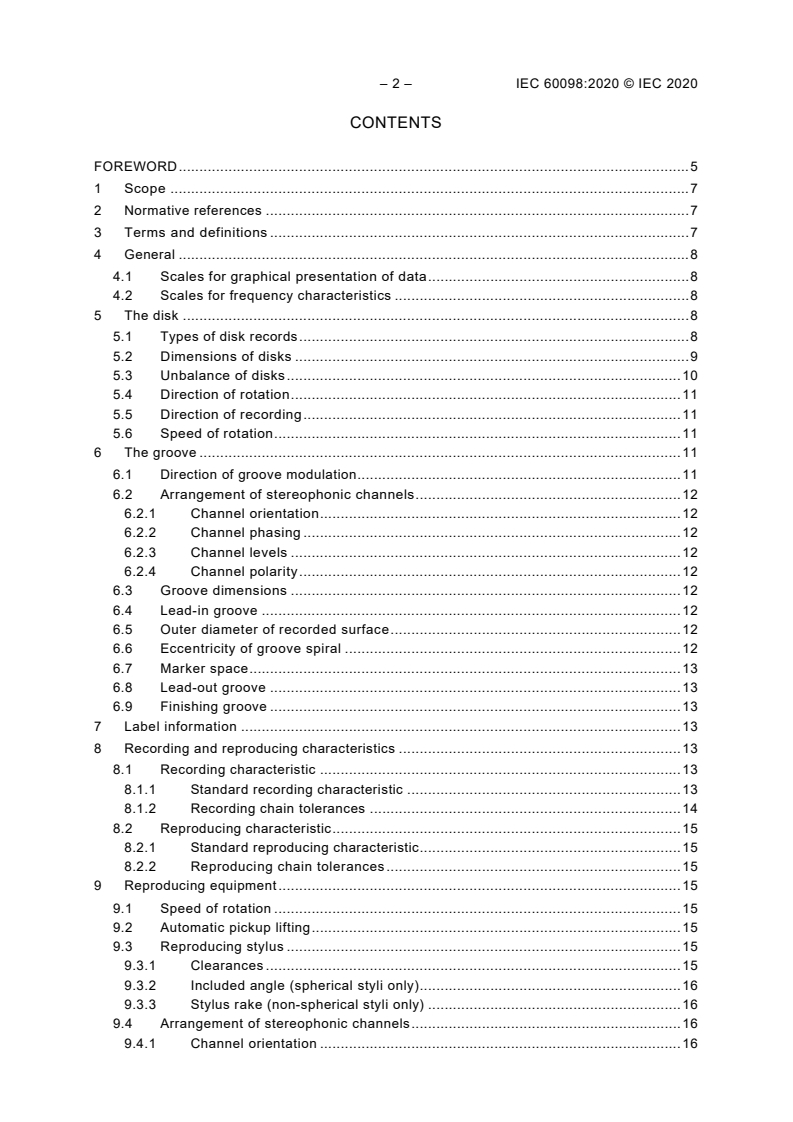
CONTENTS
FOREWORD . 5
1 Scope . 7
2 Normative references . 7
3 Terms and definitions . 7
4 General . 8
4.1 Scales for graphical presentation of data . 8
4.2 Scales for frequency characteristics . 8
5 The disk . 8
5.1 Types of disk records . 8
5.2 Dimensions of disks . 9
5.3 Unbalance of disks . 10
5.4 Direction of rotation . 11
5.5 Direction of recording . 11
5.6 Speed of rotation . 11
6 The groove . 11
6.1 Direction of groove modulation . 11
6.2 Arrangement of stereophonic channels . 12
6.2.1 Channel orientation . 12
6.2.2 Channel phasing . 12
6.2.3 Channel levels . 12
6.2.4 Channel polarity . 12
6.3 Groove dimensions . 12
6.4 Lead-in groove . 12
6.5 Outer diameter of recorded surface . 12
6.6 Eccentricity of groove spiral . 12
6.7 Marker space . 13
6.8 Lead-out groove . 13
6.9 Finishing groove . 13
7 Label information . 13
8 Recording and reproducing characteristics . 13
8.1 Recording characteristic . 13
8.1.1 Standard recording characteristic . 13
8.1.2 Recording chain tolerances . 14
8.2 Reproducing characteristic . 14
8.2.1 Standard reproducing characteristic . 14
8.2.2 Reproducing chain tolerances . 15
9 Reproducing equipment . 15
9.1 Speed of rotation . 15
9.2 Automatic pickup lifting . 15
9.3 Reproducing stylus . 15
9.3.1 Clearances . 15
9.3.2 Included angle (spherical styli only). 15
9.3.3 Stylus rake (non-spherical styli only) . 16
9.4 Arrangement of stereophonic channels . 16
9.4.1 Channel orientation . 16
9.4.2 Channel phasing . 16
9.4.3 Channel gain . 16
9.4.4 Channel polarity . 16
9.5 Interchangeability of pickup cartridges . 16
9.5.1 Dimensions . 16
9.5.2 Colour coding of connecting wires between pickup cartridge and pickup
arm . 17
9.5.3 Colour coding or marking of pickup cartridge terminals . 17
10 Measurements . 17
10.1 Standard measurement conditions . 17
10.1.1 General . 17
10.1.2 Environment . 18
10.1.3 Electric power supply . 18
10.1.4 Pickup operation . 18
10.1.5 Test records . 18
10.2 Methods of measurement . 18
10.2.1 General . 18
10.2.2 Maximum apparent power consumption . 19
10.2.3 Mean deviation from rated speed . 19
10.2.4 Wow and flutter . 20
10.2.5 Maximum start time to reach actual or rated speed . 20
10.2.6 Signal/rumble ratio . 20
10.2.7 Signal/hum ratio . 21
10.2.8 Channel sensitivity at 1 000 Hz . 22
10.2.9 Channel unbalance at 1 000 Hz (stereo use only) . 22
10.2.10 Separation at 1 000 Hz (stereo use only) . 23
10.2.11 Frequency response . 23
10.2.12 Tracking ability . 24
11 Information required from manufacturers of record playing units . 25
11.1 General . 25
11.2 Identification . 25
11.3 Structure . 25
11.3.1 Pickup cartridge . 25
11.3.2 Drive system . 25
11.3.3 Space requirements for unmounted units . 26
11.3.4 Operational modes . 26
12 Performance claims . 26
12.1 General . 26
12.2 Maximum apparent power consumption of the unit . 26
12.3 Speed of rotation . 26
12.4 Signal/rumble ratio . 27
12.5 Signal/hum ratio . 27
12.6 Channel sensitivity at 1 000 Hz . 27
12.7 Channel unbalance at 1 000 Hz (stereo use only) . 27
12.8 Separation at 1 000 Hz (stereo use only) . 27
12.9 Frequency response . 27
12.10 Tracking ability . 27
Annex A (informative) Multipurpose test records . 28
A.1 Available multi-purpose test record . 28
– 4 – IEC 60098:2020 © IEC 2020
A.2 Multi-purpose test record no longer available new but which may still be
used . 28
Annex B (normative) Test records for wow and flutter . 30
Annex C (normative) Measurement of signal/rumble ratio . 31
C.1 Measuring instrument. 31
C.2 Test record . 31
C.3 Attenuation curve . 31
Annex D (informative) Examples of test records for the measurement of channel
sensitivity, channel unbalance, separation, signal response, and separation response . 33
Annex E (informative) Tracking ability . 35
E.1 Test records for tracking ability . 35
E.2 Examples of test records no longer available new but which may still be
used . 35
Figure 1 – Dimensions for record types 30xx and 25xx . 9
Figure 2 – Dimensions for record type 17xx . 10
Figure 3 – Groove . 11
Figure 4 – Recording and reproducing characteristics . 14
Figure 5 – Pickup cartridge . 17
Figure C.1 – Attenuation curve for rumble meter . 32
Table 1 – Standard types of disk . 8
Table 2 – Colour coding of connecting wires . 17
Table 3 – Rated and measured speeds . 19
Table 4 – Relation of time t to actual speed . 20
Table 5 – Identification . 25
Table 6 – Pickup cartridge data . 25
Table 7 – Drive system data . 25
Table 8 – Operational modes . 26
Table B.1 – Examples of test records that may be used . 30
Table C.1 – Test records for measuring signal/rumble ratio . 31
Table D.1 – Examples of test records that may be used . 33
Table E.1 – Low-frequency tracking ability – Method A in 10.2.12 . 35
Table E.2 – Low to middle frequency sweep tracking ability . 35
Table E.3 – High-frequency tracking ability . 35
INTERNATIONAL ELECTROTECHNICAL COMMISSION
____________
ANALOGUE AUDIO DISK RECORDS AND REPRODUCING EQUIPMENT
FOREWORD
1) The International Electrotechnical Commission (IEC) is a worldwide organization for standardization comprising
all national electrotechnical committees (IEC National Committees). The object of IEC is to promote international
co-operation on all questions concerning standardization in the electrical and electronic fields. To this end and
in addition to other activities, IEC publishes International Standards, Technical Specifications, Technical Reports,
Publicly Available Specifications (PAS) and Guides (hereafter referred to as “IEC Publication(s)”). Their
preparation is entrusted to technical committees; any IEC National Committee interested in the subject dealt with
may participate in this preparatory work. International, governmental and non-governmental organizations liaising
with the IEC also participate in this preparation. IEC collaborates closely with the International Organization for
Standardization (ISO) in accordance with conditions determined by agreement between the two organizations.
2) The formal decisions or agreements of IEC on technical matters express, as nearly as possible, an international
consensus of opinion on the relevant subjects since each technical committee has representation from all
interested IEC National Committees.
3) IEC Publications have the form of recommendations for international use and are accepted by IEC National
Committees in that sense. While all reasonable efforts are made to ensure that the technical content of IEC
Publications is accurate, IEC cannot be held responsible for the way in which they are used or for any
misinterpretation by any end user.
4) In order to promote international uniformity, IEC National Committees undertake to apply IEC Publications
transparently to the maximum extent possible in their national and regional publications. Any divergence between
any IEC Publication and the corresponding national or regional publication shall be clearly indicated in the latter.
5) IEC itself does not provide any attestation of conformity. Independent certification bodies provide conformity
assessment services and, in some areas, access to IEC marks of conformity. IEC is not responsible for any
services carried out by independent certification bodies.
6) All users should ensure that they have the latest edition of this publication.
7) No liability shall attach to IEC or its directors, employees, servants or agents including individual experts and
members of its technical committees and IEC National Committees for any personal injury, property damage or
other damage of any nature whatsoever, whether direct or indirect, or for costs (including legal fees) and
expenses arising out of the publication, use of, or reliance upon, this IEC Publication or any other IEC Publications.
8) Attention is drawn to the Normative references cited in this publication. Use of the referenced publications is
indispensable for the correct application of this publication.
9) Attention is drawn to the possibility that some of the elements of this IEC Publication may be the subject of patent
rights. IEC shall not be held responsible for identifying any or all such patent rights.
International Standard IEC 60098 has been prepared by IEC technical committee 100: Audio,
video and multimedia systems and equipment.
This fourth edition cancels and replaces the third edition published in 1987. This edition
constitutes a full revision.
This edition includes the following significant technical changes with respect to the previous
edition:
a) addition of a tolerance on groove width.
The text of this International Standard is based on the following documents:
CDV Report on voting
100/3261/CDV 100/3331/RVC
Full information on the voting for the approval of this International Standard can be found in the
report on voting indicated in the above table.
This document has been drafted in accordance with the ISO/IEC Directives, Part 2.
– 6 – IEC 60098:2020 © IEC 2020
The committee has decided that the contents of this document will remain unchanged until the
stability date indicated on the IEC website under "http://webstore.iec.ch" in the data related to
the specific document. At this date, the document will be
• reconfirmed,
• withdrawn,
• replaced by a revised edition, or
• amended.
A bilingual version of this publication may be issued at a later date.
ANALOGUE AUDIO DISK RECORDS AND REPRODUCING EQUIPMENT
1 Scope
This document applies to analogue audio disk records and the corresponding professional and
domestic reproducing equipment. It excludes amplifiers and loudspeakers, methods of
measurement for which can be found in IEC 60268-3, IEC 60268-5, IEC 60268-21 and
IEC 60268-22 .
This document specifies the characteristics that are necessary to ensure compatibility between
analogue audio disk records and the corresponding reproducing equipment.
It also lists and defines the most important characteristics affecting the performance of
reproducing equipment, and establishes agreed methods of measurement for these
characteristics
2 Normative references
The following documents are referred to in the text in such a way that some or all of their content
constitutes requirements of this document. For dated references, only the edition cited applies.
For undated references, the latest edition of the referenced document (including any
amendments) applies.
IEC 60050-806:1996, International Electrotechnical Vocabulary (IEV) – Part 806: Recording
and reproduction of audio and video
IEC 60050-806:1996/AMD1:2001
IEC 60050-806:1996/AMD2:2018
IEC 60263:1982, Scales and sizes for plotting frequency characteristics and polar diagrams
IEC 60386:1972, Method of measurement of speed fluctuations in sound recording and
reproducing equipment
IEC 60417, Graphical symbols for use on equipment (available at http://www.graphical-
symbols.info/equipment)
Electroacoustics – Sound level meters – Part 1: Specifications
IEC 61672-1:2013,
IEC 62368-1:2018, Audio/video, information and communication technology equipment – Part 1:
Safety requirements
3 Terms and definitions
For the purposes of this document, the terms and definitions given in IEC 60050-806 and the
following apply.
ISO and IEC maintain terminological databases for use in standardization at the following
addresses:
• ISO Online browsing platform: available at https://www.iso.org/obp
__________
Under preparation. Stage at the time of publication: IEC CDV 60268-22:2019.
– 8 – IEC 60098:2020 © IEC 2020
• IEC Electropedia: available at http://www.electropedia.org/
3.1
rated value
value of a quantity used for specification purposes, established for a specified set of operating
conditions of a component, device, equipment, or system
Note 1 to entry: The rated value is normally the value stated by the manufacturer.
[SOURCE: IEC 60050-151:2001, 151-16-08, modified – Note 1 to entry has been added.]
3.2
terminated, adj
connected to a specified impedance required for correct
operation or for specified test conditions
Note 1 to entry: 'Specified test conditions' can include open-circuit and short-circuit.
4 General
4.1 Scales for graphical presentation of data
Linear or logarithmic scales are recommended for graphical presentation. Linear decibel
scales are equivalent to logarithmic scales. Other kinds of scale, such as double logarithmic,
should be avoided. When using decibel scales, the zero reference should, if possible, be the
rated value. In those cases, where each of the scales refers directly to physical units, it is
recommended to avoid a combination of linear and logarithmic scales.
Where quantities represented by the axes are of the same kind, it is recommended that the
same unit length be used for both.
Linear scales with remote zero point should be avoided as far as possible. For further
information, see IEC 60263.
4.2 Scales for frequency characteristics
Graphs should be drawn with frequency in Hz on the x-axis with a logarithmic scale, and the
level expressed in dB on the y-axis with a linear scale. The scale ratio should be such that the
length representing one decade of frequency is the same as the length representing a 25 dB or
a 50 dB difference in level. The preferred length per decade is 50 mm. If the size of the graph
is changed, the scale ratio should be left unaltered.
5 The disk
5.1 Types of disk records
The types of disk record given in Table 1 shall be standard.
Table 1 – Standard types of disk
Type designation Nominal diameter (cm) Nominal speed (rev/min)
3033 30 33⅓
2533 25 33⅓
1733 17 33⅓
3045 30 45
Type designation Nominal diameter (cm) Nominal speed (rev/min)
2545 25 45
1745 17 45
5.2 Dimensions of disks
The dimensions for types 30xx and 25xx are shown in Figure 1.
Dimensions in millimetres
Figure 1 – Dimensions for record types 30xx and 25xx
– 10 – IEC 60098:2020 © IEC 2020
The dimensions for type 17xx are shown in Figure 2.
Dimensions in millimetres
A small centre hole click may have an optional push-out centre that, when removed, leaves the large centre hole
dimensions. Both configurations should fulfil the requirements of the diagram.
An optional push-out centre should have a closed structure within a diameter of 16 mm concentric with the centre
hole.
Figure 2 – Dimensions for record type 17xx
5.3 Unbalance of disks
The centre of gravity of disks having a small centre hole shall lie within an 8 mm diameter circle
concentric with the centre of the centre hole.
5.4 Direction of rotation
The direction of rotation of the disk shall be clockwise when viewed from the side being
reproduced.
5.5 Direction of recording
The direction of recording shall be such that, on reproduction, the pickup shall travel as closely
as possible along a straight radial line towards the centre of the disk.
5.6 Speed of rotation
The speed of rotation during recording shall be within ±0,5 % of the rated recording speed, the
rated recording speed being such as to give the intended musical pitch at one of the following
rated reproducing speeds:
• 33⅓ r/min: for disk record types 3033, 2533 and 1733,
• 45 r/min: for disk record types 3045, 2545 and 1745.
NOTE Verification of reproducing speed by means of stationary stroboscopic bars in countries employing 50 Hz
electric supplies can be made at 45,112 r/min only.
6 The groove
6.1 Direction of groove modulation
The stereophonic groove shall carry two channels of information. The two channels shall be
recorded in such a manner that they can be reproduced by movements of a reproducing stylus
tip in two directions at 90° to each other, and at 45° to a radial line through the stylus tip and
the centre of the record; these movements shall be tangential to, or lie in a plane through the
+5
stylus tip and the record centre, inclined at an angle of 20 ° anticlockwise to the normal to the
record surface through the stylus tip as viewed towards the record centre (vertical tracking
angle). The resulting modulation shall be optimum for reproducing styli having a rake angle of
between 0° and −5° (for detail, see Figure 3).
a) View of groove in direction b) View of groove in plane
from stylus tip to disk centre of stylus tip movements
(see 8.1) (see 8.1)
Figure 3 – Groove
– 12 – IEC 60098:2020 © IEC 2020
The monophonic groove shall carry one channel of information. It shall be recorded on both
groove walls in such a manner that it can be reproduced by lateral movements of a stylus tip
as described above.
6.2 Arrangement of stereophonic channels
6.2.1 Channel orientation
The right-hand channel, as viewed by the audience, shall be recorded on the outer groove wall,
the left-hand channel on the inner groove wall.
6.2.2 Channel phasing
The phasing of the two recorded signals shall be suitable for reproduction on two-channel
equipment so connected that movement of the reproducing stylus tip along the radial line
through stylus tip and disk centre (as with a monophonic record) produces in-phase sound
pressures at the left-hand and right-hand loudspeakers.
6.2.3 Channel levels
The levels of the two recorded signals shall be suitable for reproduction on two-channel
equipment, of identical channel gain, so connected that movement of the reproducing stylus
along the radial line through the stylus tip and disk centre (as with a monophonic record)
produces equal sound pressures at the left-hand and right-hand loudspeakers.
6.2.4 Channel polarity
The polarity of the two recorded signals should preferably be suitable for reproduction on two-
channel equipment so connected that movement of the reproducing stylus tip along the radial
line through stylus tip and disk centre in a direction away from the disk centre shall produce
compression in front of the left and right-hand loudspeakers similar to that produced by the live
programme source.
6.3 Groove dimensions
Instantaneous top width: 30 µm (0,012 in) minimum
Bottom radius: 8 µm (0,000 32 in) maximum
Included angle: (90 ± 5)°
6.4 Lead-in groove
The pitch of the lead-in groove shall be (1,2 ± 0,4) mm. The groove width shall be (60 ± 10) µm.
6.5 Outer diameter of recorded surface
The recorded surface shall start with at least one turn of plain groove and have a maximum
outer diameter of:
• 292,6 mm for types 3033 and 3045;
• 241,8 mm for types 2545 and 2533;
• 168,3 mm for types 1733 and 1745.
6.6 Eccentricity of groove spiral
The distance of the centre of the groove spiral to the centre of the centre hole shall be not
more than 0,2 mm.
6.7 Marker space
The pitch of the lead-over groove in a marker space shall be not greater than 1,6 mm. A marker
space shall not occur at a diameter of less than 127 mm.
6.8 Lead-out groove
The pitch of the lead-out groove shall be 6,4 mm ± 3,2 mm.
The top width of the lead-out groove shall increase to a minimum of 0,075 mm when the pitch
exceeds 6,4 mm.
The lead-out groove shall have at least one turn.
6.9 Finishing groove
The diameter of the finishing groove shall be:
• 106,4 mm ± 0,8 mm for types 3033, 2545 and 2533 and 3045;
• 97,4 mm ± 1,0 mm for types 1733 and 1745.
7 Label information
The label shall give at least the following information:
a) catalogue number;
b) if there is more than one record, side number and total number of sides, for example "Side
5 of 8";
c) programme title;
d) nominal speed of rotation;
e) type of recording.
If stereophonic, it shall be clearly marked with either the word "STEREO" or with the symbol
specified by IEC 60417-5071:2002-10. Word and symbol may be used simultaneously. If
monophonic, it shall be clearly marked with either the word "MONO" or with the symbol specified
by IEC 60417-5070:2002-10. Word and symbol may be used simultaneously.
8 Recording and reproducing characteristics
8.1 Recording characteristic
8.1.1 Standard recording characteristic
The standard recording characteristic shall be a combination of the following three curves:
• one rising with increasing frequency in conformity with the admittance of a parallel
combination of a capacitance and a resistance having a time constant of t = 75 µs;
• one falling with decreasing frequency in conformity with the admittance of a series
combination of a capacitance and a resistance having a time constant of t = 318 µs;
• one rising with decreasing frequency in conformity with the impedance of a series
combination of a capacitance and a resistance having a time constant of t = 3 180 µs.
s
If N is the recorded level in decibels and f is the frequency, the combined curve is defined by:
– 14 – IEC 60098:2020 © IEC 2020
2 2 2
N= 10log 1+−4π f t 10log 1+ +10log 1+
10( 1) 10 10
2 2 2 2 2 2
44π f t π f t
23
This curve and the approximate relative values of recorded levels are shown in Figure 4.
Relative level
Frequency
(dB)
Recorded Reproduced
(Hz)
2 – – 0,1
2,5 – + 1,8
3,15 – + 3,7
4 – + 5,7
5 – + 7,6
6,3 – + 9,4
8 – + 11,2
10 – + 12,7
12,5 – + 14,1
16 – + 15,4
20 – 19,3 + 16,3
25 – 19 + 16,8
31,5 – 18,5 + 17
40 – 17,8 + 16,8
50 – 16,9 + 16,3
63 – 15,9 + 15,4
80 – 14,5 + 14,2
100 – 13,1 + 12,9
125 – 11,6 + 11,5
160 – 9,8 + 9,7
200 – 8,2 + 8,2
250 – 6,7 + 6,7
315 – 5,2 + 5,2
400 – 3,8 + 3,8
500 – 2,6 + 2,6
630 – 1,6 + 1,6
800 – 0,8 + 0,8
1 000 0 0
1 250 + 0,7 – 0,7
1 600 + 1,6 – 1,6
2 000 + 2,6 – 2,6
2 500 + 3,7 – 3,7
3 150 + 5 – 5
4 000 + 6,6 – 6,6
5 000 + 8,2 – 8,2
6 300 + 10 – 10
8 000 + 11,9 – 11,9
10 000 + 13,7 – 13,7
12 500 + 15,6 – 15,6
16 000 + 17,7 – 17,7
20 000 + 19,6 – 19,6
NOTE 1 For recording chain tolerances, see 8.1.2.
NOTE 2 For reproducing chain tolerances, see 8.2.2.
NOTE 3 Corrections of approximately +0,1 dB and −0,1 dB have been applied to the recording and reproducing
characteristics, respectively, in order to obtain zero reference at 1 kHz.
Figure 4 – Recording and reproducing characteristics
8.1.2 Recording chain tolerances
The frequency characteristic of the recording chain shall be a smooth curve lying within ±2 dB
of the standard recording characteristic in the frequency range from 50 Hz to 10 kHz, taking as
reference point the value at 1 kHz.
NOTE When measuring the frequency characteristic of the recording chain by means of a rated reproducing
chain, the rated reproducing characteristic is not a mirror image of the rated recording characteristic at
frequencies below 200 Hz.
On a stereophonic record, the unbalance between stereo channels at 1 kHz should not
exceed 1 dB, while the unbalance at all other frequencies between 50 Hz and 10 kHz should
not exceed 2 dB.
8.2 Reproducing characteristic
8.2.1 Standard reproducing characteristic
The standard reproducing characteristic shall be a combination of the following four curves:
• one falling with increasing frequency in conformity with the impedance of a parallel
combination of a capacitance and a resistance having a time constant of t = 75 µs;
• one rising with decreasing frequency in conformity with the impedance of a series
combination of a capacitance and a resistance having a time constant of t = 318 µs;
• one falling with decreasing frequency in conformity with the admittance of a series
combination of a capacitance and a resistance having a time constant of t = 3 180 µs;
• one falling with decreasing frequency in conformity with the admittance of a series
combination of a capacitance and a resistance having a time constant of t = 7 950 µs.
If N is the output level in decibels and f is the frequency, the combined curve is defined by:
2 2 2
N=−10log 1+ 4π f t +10log 1+ −+10log 1 −+10log 1
( )
10 1 10 10 10
2 2 2 2 2 2 2 2 2
444π f t π f t π f t
23 4
This curve and the approximate relative values of reproduced (output) levels are shown in
Figure 4.
8.2.2 Reproducing chain tolerances
a) 2 Hz to 20 Hz:
The frequency characteristic of the reproducing chain shall be a curve which shall always
lie at or below the standard reproducing characteristic, taking as reference point the value
at 1 kHz.
b) 20 Hz to 20 kHz:
No tolerances are specified for the frequency characteristic of the reproducing chain.
9 Reproducing equipment
9.1 Speed of rotation
The speed of rotation during reproduction shall be within ±2 % of the rated reproducing speeds
of 33⅓ r/min and 45 r/min.
NOTE Verification of the reproducing speed of 45 r/min by means of stationary stroboscopic bars in countries
employing 50 Hz electric supplies can be made at 45,112 r/min only.
9.2 Automatic pickup lifting
When the pickup is in the playing position, the automatic pickup lifting mechanism of a record
player shall not become operative at a diameter of more than 127 mm.
9.3 Reproducing stylus
9.3.1 Clearances
The clearance between the stylus tip and the bottom of the groove shall be 0,002 mm minimum,
and the stylus tip shall not touch the groove's edges.
9.3.2 Included angle (spherical styli only)
The included angle of the reproducing stylus shall not exceed 55°.
– 16 – IEC 60098:2020 © IEC 2020
9.3.3 Stylus rake (non-spherical styli only)
The stylus rake in the direction of groove travel shall lie between +4° and −8° when playing at
the stylus force recommended by the manufacturer (see Figure 3).
9.4 Arrangement of stereophonic channels
9.4.1 Channel orientation
Stereophonic reproducing equipment shall have two channels, and shall be so connected that
the right-hand loudspeaker(s), as viewed from the audience, shall be actuated by the outer wall
of the groove, and the left-hand loudspeaker(s) by the inner wall of the groove.
9.4.2 Channel phasing
Stereophonic reproducing equipment shall be so connected that movement of the reproducing
stylus tip along the radial line through stylus tip and disk centre (as with a monophonic record)
produces in-phase sound pressures at the left-hand and right-hand loudspeakers.
9.4.3 Channel gain
The gains of the two channels of stereophonic reproducing equipment shall be so adjusted that
movement of the reproducing stylus tip along the radial line through stylus tip and disk centre
(as with a monophonic record) produces equal sound pressures at the left-hand and right-hand
loudspeakers.
9.4.4 Channel polarity
Stereophonic reproducing equipment should preferably be so connected that movement of the
reproducing stylus tip along the radial line through stylus tip and disk centre in a direction away
from the disk centre shall produce compression in front of the left-hand and right-hand
loudspeakers similar to that produced by the live programme source.
9.5 Interchangeability of pickup cartridges
9.5.1 Dimensions
Pickup cartridges intended for fixing to pickup arms by means of screws shall have the
dimensions shown in Figure 5. The screws shall be of size M2,5. The mass of such a pickup
cartridge shall not exceed 12 g.
NOTE 1 The spatial arrangement of the connecting pins is left to the designer of the pickup cartridge.
NOTE 2 Formerly, M2,6 screws were permitted, and these can still be found in the field.
Dimensions in millimetres
Figure 5 – Pickup cartridge
9.5.2 Colour coding of connecting wires between pickup cartridge and pickup arm
The colour coding for the connecting wires between the pickup cartridge and the pickup arm
shall be as shown in Table 2.
Table 2 – Colour coding of connecting wires
Pickup cartridge with
Colour Purpose
3 wires 4 wires 5 wires
Red Right-hand channel X X X
Green Right return connection X X
White Left-hand channel X X X
Blue Left return connection X X
Black Return or ground X X
9.5.3 Colour coding or marking of pickup cartridge terminals
Pickup cartridge terminals shall be marked by means of the colour coding given in Table 2, or
by means of suitable letters.
10 Measurements
10.1 Standard measurement conditions
10.1.1 General
The manufacturer shall specify the values of the characteristics listed in 10.1.2 to 10.2.2.
– 18 – IEC 60098:2020 © IEC 2020
10.1.2 Environment
The following information shall be provided:
a) ambient temperature (preferred range: 20 °C to 25 °C);
b) relative humidity (preferred range: 45 % to 75 %);
c) air pressure (preferred range: 86 kPa to 106 kPa);
d) stabilization time of unit after switching on from ambient temperature in min (preferred
maximum 30 min).
10.1.3 Electric power supply
For information and marking requirements, refer to the applicable IEC safety standard, usually
IEC 62368-1.
10.1.4 Pickup operation
The following information shall be provided:
a) stylus force in mN; statement in gm-force may be added;
b) load impedance per channel, expressed as a parallel combination of resistance in kΩ and
capacitance in pF;
c) external correction network (if required);
d) external equalization network (if required).
Before any measurements are taken, the unit shall operate for at least the recommended time
for stabilization and all measuring equipment shall have reached temperature stability.
The output of the unit shall be taken from the correction or equalization network (if any) i.e. the
measurement shall be made at that point where the signal has the characteristic that is to be
reproduced. For stereo pickups, both channels shall be terminated in accordance with item b)
above. Apart from that load, the measuring equipment shall not introduce an additional load
that would significantly affect the characteristics to be measured.
10.1.5 Test records
If a test record is used for any measurement, it shall be identified by catalogue number, name
of manufacturer and country of manufacture.
Information on test records is given in Annex A, Annex B, Annex C, Annex D and Annex E.
NOTE In order to achieve comparable results, test records for a particular purpose should be derived from the
same original recording. However, even given this condition, variations in record manufacture, such as record
material and pressing conditions, can give rise to variations in characteristics such as high-frequency
...
IEC 60098 ®
Edition 4.0 2020-01
INTERNATIONAL
STANDARD
NORME
INTERNATIONALE
Analogue audio disk records and reproducing equipment
Disques audio analogiques et appareils de lecture
All rights reserved. Unless otherwise specified, no part of this publication may be reproduced or utilized in any form
or by any means, electronic or mechanical, including photocopying and microfilm, without permission in writing from
either IEC or IEC's member National Committee in the country of the requester. If you have any questions about IEC
copyright or have an enquiry about obtaining additional rights to this publication, please contact the address below or
your local IEC member National Committee for further information.
Droits de reproduction réservés. Sauf indication contraire, aucune partie de cette publication ne peut être reproduite
ni utilisée sous quelque forme que ce soit et par aucun procédé, électronique ou mécanique, y compris la photocopie
et les microfilms, sans l'accord écrit de l'IEC ou du Comité national de l'IEC du pays du demandeur. Si vous avez des
questions sur le copyright de l'IEC ou si vous désirez obtenir des droits supplémentaires sur cette publication, utilisez
les coordonnées ci-après ou contactez le Comité national de l'IEC de votre pays de résidence.
IEC Central Office Tel.: +41 22 919 02 11
3, rue de Varembé info@iec.ch
CH-1211 Geneva 20 www.iec.ch
Switzerland
About the IEC
The International Electrotechnical Commission (IEC) is the leading global organization that prepares and publishes
International Standards for all electrical, electronic and related technologies.
About IEC publications
The technical content of IEC publications is kept under constant review by the IEC. Please make sure that you have the
latest edition, a corrigendum or an amendment might have been published.
IEC publications search - webstore.iec.ch/advsearchform Electropedia - www.electropedia.org
The advanced search enables to find IEC publications by a The world's leading online dictionary on electrotechnology,
variety of criteria (reference number, text, technical containing more than 22 000 terminological entries in English
committee,…). It also gives information on projects, replaced and French, with equivalent terms in 16 additional languages.
and withdrawn publications. Also known as the International Electrotechnical Vocabulary
(IEV) online.
IEC Just Published - webstore.iec.ch/justpublished
Stay up to date on all new IEC publications. Just Published IEC Glossary - std.iec.ch/glossary
details all new publications released. Available online and 67 000 electrotechnical terminology entries in English and
once a month by email. French extracted from the Terms and Definitions clause of
IEC publications issued since 2002. Some entries have been
IEC Customer Service Centre - webstore.iec.ch/csc collected from earlier publications of IEC TC 37, 77, 86 and
If you wish to give us your feedback on this publication or CISPR.
need further assistance, please contact the Customer Service
Centre: sales@iec.ch.
A propos de l'IEC
La Commission Electrotechnique Internationale (IEC) est la première organisation mondiale qui élabore et publie des
Normes internationales pour tout ce qui a trait à l'électricité, à l'électronique et aux technologies apparentées.
A propos des publications IEC
Le contenu technique des publications IEC est constamment revu. Veuillez vous assurer que vous possédez l’édition la
plus récente, un corrigendum ou amendement peut avoir été publié.
Recherche de publications IEC - Electropedia - www.electropedia.org
webstore.iec.ch/advsearchform Le premier dictionnaire d'électrotechnologie en ligne au
La recherche avancée permet de trouver des publications IEC monde, avec plus de 22 000 articles terminologiques en
en utilisant différents critères (numéro de référence, texte, anglais et en français, ainsi que les termes équivalents dans
comité d’études,…). Elle donne aussi des informations sur les 16 langues additionnelles. Egalement appelé Vocabulaire
projets et les publications remplacées ou retirées. Electrotechnique International (IEV) en ligne.
IEC Just Published - webstore.iec.ch/justpublished Glossaire IEC - std.iec.ch/glossary
Restez informé sur les nouvelles publications IEC. Just 67 000 entrées terminologiques électrotechniques, en anglais
Published détaille les nouvelles publications parues. et en français, extraites des articles Termes et Définitions des
Disponible en ligne et une fois par mois par email. publications IEC parues depuis 2002. Plus certaines entrées
antérieures extraites des publications des CE 37, 77, 86 et
Service Clients - webstore.iec.ch/csc CISPR de l'IEC.
Si vous désirez nous donner des commentaires sur cette
publication ou si vous avez des questions contactez-nous:
sales@iec.ch.
IEC 60098 ®
Edition 4.0 2020-01
INTERNATIONAL
STANDARD
NORME
INTERNATIONALE
Analogue audio disk records and reproducing equipment
Disques audio analogiques et appareils de lecture
INTERNATIONAL
ELECTROTECHNICAL
COMMISSION
COMMISSION
ELECTROTECHNIQUE
INTERNATIONALE
ICS 33.160.30 ISBN 978-2-8322-8098-0
– 2 – IEC 60098:2020 © IEC 2020
CONTENTS
FOREWORD . 5
1 Scope . 7
2 Normative references . 7
3 Terms and definitions . 7
4 General . 8
4.1 Scales for graphical presentation of data . 8
4.2 Scales for frequency characteristics . 8
5 The disk . 8
5.1 Types of disk records . 8
5.2 Dimensions of disks . 9
5.3 Unbalance of disks . 10
5.4 Direction of rotation . 11
5.5 Direction of recording . 11
5.6 Speed of rotation . 11
6 The groove . 11
6.1 Direction of groove modulation . 11
6.2 Arrangement of stereophonic channels . 12
6.2.1 Channel orientation . 12
6.2.2 Channel phasing . 12
6.2.3 Channel levels . 12
6.2.4 Channel polarity . 12
6.3 Groove dimensions . 12
6.4 Lead-in groove . 12
6.5 Outer diameter of recorded surface . 12
6.6 Eccentricity of groove spiral . 12
6.7 Marker space . 13
6.8 Lead-out groove . 13
6.9 Finishing groove . 13
7 Label information . 13
8 Recording and reproducing characteristics . 13
8.1 Recording characteristic . 13
8.1.1 Standard recording characteristic . 13
8.1.2 Recording chain tolerances . 14
8.2 Reproducing characteristic . 15
8.2.1 Standard reproducing characteristic . 15
8.2.2 Reproducing chain tolerances . 15
9 Reproducing equipment . 15
9.1 Speed of rotation . 15
9.2 Automatic pickup lifting . 15
9.3 Reproducing stylus . 15
9.3.1 Clearances . 15
9.3.2 Included angle (spherical styli only). 16
9.3.3 Stylus rake (non-spherical styli only) . 16
9.4 Arrangement of stereophonic channels . 16
9.4.1 Channel orientation . 16
9.4.2 Channel phasing . 16
9.4.3 Channel gain . 16
9.4.4 Channel polarity . 16
9.5 Interchangeability of pickup cartridges . 16
9.5.1 Dimensions . 16
9.5.2 Colour coding of connecting wires between pickup cartridge and pickup
arm . 17
9.5.3 Colour coding or marking of pickup cartridge terminals . 17
10 Measurements . 17
10.1 Standard measurement conditions . 17
10.1.1 General . 17
10.1.2 Environment . 18
10.1.3 Electric power supply . 18
10.1.4 Pickup operation . 18
10.1.5 Test records . 18
10.2 Methods of measurement . 18
10.2.1 General . 18
10.2.2 Maximum apparent power consumption . 19
10.2.3 Mean deviation from rated speed . 19
10.2.4 Wow and flutter . 20
10.2.5 Maximum start time to reach actual or rated speed . 20
10.2.6 Signal/rumble ratio . 20
10.2.7 Signal/hum ratio . 21
10.2.8 Channel sensitivity at 1 000 Hz . 22
10.2.9 Channel unbalance at 1 000 Hz (stereo use only) . 23
10.2.10 Separation at 1 000 Hz (stereo use only) . 23
10.2.11 Frequency response . 23
10.2.12 Tracking ability . 24
11 Information required from manufacturers of record playing units . 25
11.1 General . 25
11.2 Identification . 25
11.3 Structure . 25
11.3.1 Pickup cartridge . 25
11.3.2 Drive system . 25
11.3.3 Space requirements for unmounted units . 26
11.3.4 Operational modes . 26
12 Performance claims . 26
12.1 General . 26
12.2 Maximum apparent power consumption of the unit . 26
12.3 Speed of rotation . 26
12.4 Signal/rumble ratio . 27
12.5 Signal/hum ratio . 27
12.6 Channel sensitivity at 1 000 Hz . 27
12.7 Channel unbalance at 1 000 Hz (stereo use only) . 27
12.8 Separation at 1 000 Hz (stereo use only) . 27
12.9 Frequency response . 27
12.10 Tracking ability . 27
Annex A (informative) Multipurpose test records . 28
A.1 Available multi-purpose test record . 28
– 4 – IEC 60098:2020 © IEC 2020
A.2 Multi-purpose test record no longer available new but which may still be
used . 28
Annex B (normative) Test records for wow and flutter . 30
Annex C (normative) Measurement of signal/rumble ratio . 31
C.1 Measuring instrument. 31
C.2 Test record . 31
C.3 Attenuation curve . 31
Annex D (informative) Examples of test records for the measurement of channel
sensitivity, channel unbalance, separation, signal response, and separation response . 33
Annex E (informative) Tracking ability . 35
E.1 Test records for tracking ability . 35
E.2 Examples of test records no longer available new but which may still be
used . 35
Figure 1 – Dimensions for record types 30xx and 25xx . 9
Figure 2 – Dimensions for record type 17xx . 10
Figure 3 – Groove . 11
Figure 4 – Recording and reproducing characteristics . 14
Figure 5 – Pickup cartridge . 17
Figure C.1 – Attenuation curve for rumble meter . 32
Table 1 – Standard types of disk . 8
Table 2 – Colour coding of connecting wires . 17
Table 3 – Rated and measured speeds . 19
Table 4 – Relation of time t to actual speed . 20
Table 5 – Identification . 25
Table 6 – Pickup cartridge data . 25
Table 7 – Drive system data . 26
Table 8 – Operational modes . 26
Table B.1 – Examples of test records that may be used . 30
Table C.1 – Test records for measuring signal/rumble ratio . 31
Table D.1 – Examples of test records that may be used . 33
Table E.1 – Low-frequency tracking ability – Method A in 10.2.12 . 35
Table E.2 – Low to middle frequency sweep tracking ability . 35
Table E.3 – High-frequency tracking ability . 35
INTERNATIONAL ELECTROTECHNICAL COMMISSION
____________
ANALOGUE AUDIO DISK RECORDS AND REPRODUCING EQUIPMENT
FOREWORD
1) The International Electrotechnical Commission (IEC) is a worldwide organization for standardization comprising
all national electrotechnical committees (IEC National Committees). The object of IEC is to promote international
co-operation on all questions concerning standardization in the electrical and electronic fields. To this end and
in addition to other activities, IEC publishes International Standards, Technical Specifications, Technical Reports,
Publicly Available Specifications (PAS) and Guides (hereafter referred to as “IEC Publication(s)”). Their
preparation is entrusted to technical committees; any IEC National Committee interested in the subject dealt with
may participate in this preparatory work. International, governmental and non-governmental organizations liaising
with the IEC also participate in this preparation. IEC collaborates closely with the International Organization for
Standardization (ISO) in accordance with conditions determined by agreement between the two organizations.
2) The formal decisions or agreements of IEC on technical matters express, as nearly as possible, an international
consensus of opinion on the relevant subjects since each technical committee has representation from all
interested IEC National Committees.
3) IEC Publications have the form of recommendations for international use and are accepted by IEC National
Committees in that sense. While all reasonable efforts are made to ensure that the technical content of IEC
Publications is accurate, IEC cannot be held responsible for the way in which they are used or for any
misinterpretation by any end user.
4) In order to promote international uniformity, IEC National Committees undertake to apply IEC Publications
transparently to the maximum extent possible in their national and regional publications. Any divergence between
any IEC Publication and the corresponding national or regional publication shall be clearly indicated in the latter.
5) IEC itself does not provide any attestation of conformity. Independent certification bodies provide conformity
assessment services and, in some areas, access to IEC marks of conformity. IEC is not responsible for any
services carried out by independent certification bodies.
6) All users should ensure that they have the latest edition of this publication.
7) No liability shall attach to IEC or its directors, employees, servants or agents including individual experts and
members of its technical committees and IEC National Committees for any personal injury, property damage or
other damage of any nature whatsoever, whether direct or indirect, or for costs (including legal fees) and
expenses arising out of the publication, use of, or reliance upon, this IEC Publication or any other IEC Publications.
8) Attention is drawn to the Normative references cited in this publication. Use of the referenced publications is
indispensable for the correct application of this publication.
9) Attention is drawn to the possibility that some of the elements of this IEC Publication may be the subject of patent
rights. IEC shall not be held responsible for identifying any or all such patent rights.
International Standard IEC 60098 has been prepared by IEC technical committee 100: Audio,
video and multimedia systems and equipment.
This fourth edition cancels and replaces the third edition published in 1987. This edition
constitutes a full revision.
This edition includes the following significant technical changes with respect to the previous
edition:
a) addition of a tolerance on groove width.
The text of this International Standard is based on the following documents:
CDV Report on voting
100/3261/CDV 100/3331/RVC
Full information on the voting for the approval of this International Standard can be found in the
report on voting indicated in the above table.
This document has been drafted in accordance with the ISO/IEC Directives, Part 2.
– 6 – IEC 60098:2020 © IEC 2020
The committee has decided that the contents of this document will remain unchanged until the
stability date indicated on the IEC website under "http://webstore.iec.ch" in the data related to
the specific document. At this date, the document will be
• reconfirmed,
• withdrawn,
• replaced by a revised edition, or
• amended.
ANALOGUE AUDIO DISK RECORDS AND REPRODUCING EQUIPMENT
1 Scope
This document applies to analogue audio disk records and the corresponding professional and
domestic reproducing equipment. It excludes amplifiers and loudspeakers, methods of
measurement for which can be found in IEC 60268-3, IEC 60268-5, IEC 60268-21 and
IEC 60268-22 .
This document specifies the characteristics that are necessary to ensure compatibility between
analogue audio disk records and the corresponding reproducing equipment.
It also lists and defines the most important characteristics affecting the performance of
reproducing equipment, and establishes agreed methods of measurement for these
characteristics
2 Normative references
The following documents are referred to in the text in such a way that some or all of their content
constitutes requirements of this document. For dated references, only the edition cited applies.
For undated references, the latest edition of the referenced document (including any
amendments) applies.
IEC 60050-806:1996, International Electrotechnical Vocabulary (IEV) – Part 806: Recording
and reproduction of audio and video
IEC 60050-806:1996/AMD1:2001
IEC 60050-806:1996/AMD2:2018
IEC 60263:1982, Scales and sizes for plotting frequency characteristics and polar diagrams
IEC 60386:1972, Method of measurement of speed fluctuations in sound recording and
reproducing equipment
IEC 60417, Graphical symbols for use on equipment (available at http://www.graphical-
symbols.info/equipment)
Electroacoustics – Sound level meters – Part 1: Specifications
IEC 61672-1:2013,
IEC 62368-1:2018, Audio/video, information and communication technology equipment – Part 1:
Safety requirements
3 Terms and definitions
For the purposes of this document, the terms and definitions given in IEC 60050-806 and the
following apply.
ISO and IEC maintain terminological databases for use in standardization at the following
addresses:
• ISO Online browsing platform: available at https://www.iso.org/obp
• IEC Electropedia: available at http://www.electropedia.org/
__________
Under preparation. Stage at the time of publication: IEC CDV 60268-22:2019.
– 8 – IEC 60098:2020 © IEC 2020
3.1
rated value
value of a quantity used for specification purposes, established for a specified set of operating
conditions of a component, device, equipment, or system
Note 1 to entry: The rated value is normally the value stated by the manufacturer.
[SOURCE: IEC 60050-151:2001, 151-16-08, modified – Note 1 to entry has been added.]
3.2
terminated, adj
connected to a specified impedance required for correct
operation or for specified test conditions
Note 1 to entry: 'Specified test conditions' can include open-circuit and short-circuit.
4 General
4.1 Scales for graphical presentation of data
Linear or logarithmic scales are recommended for graphical presentation. Linear decibel
scales are equivalent to logarithmic scales. Other kinds of scale, such as double logarithmic,
should be avoided. When using decibel scales, the zero reference should, if possible, be the
rated value. In those cases, where each of the scales refers directly to physical units, it is
recommended to avoid a combination of linear and logarithmic scales.
Where quantities represented by the axes are of the same kind, it is recommended that the
same unit length be used for both.
Linear scales with remote zero point should be avoided as far as possible. For further
information, see IEC 60263.
4.2 Scales for frequency characteristics
Graphs should be drawn with frequency in Hz on the x-axis with a logarithmic scale, and the
level expressed in dB on the y-axis with a linear scale. The scale ratio should be such that the
length representing one decade of frequency is the same as the length representing a 25 dB or
a 50 dB difference in level. The preferred length per decade is 50 mm. If the size of the graph
is changed, the scale ratio should be left unaltered.
5 The disk
5.1 Types of disk records
The types of disk record given in Table 1 shall be standard.
Table 1 – Standard types of disk
Type designation Nominal diameter (cm) Nominal speed (rev/min)
3033 30 33⅓
2533 25 33⅓
1733 17 33⅓
3045 30 45
2545 25 45
1745 17 45
5.2 Dimensions of disks
The dimensions for types 30xx and 25xx are shown in Figure 1.
Dimensions in millimetres
Figure 1 – Dimensions for record types 30xx and 25xx
– 10 – IEC 60098:2020 © IEC 2020
The dimensions for type 17xx are shown in Figure 2.
Dimensions in millimetres
A small centre hole click may have an optional push-out centre that, when removed, leaves the large centre hole
dimensions. Both configurations should fulfil the requirements of the diagram.
An optional push-out centre should have a closed structure within a diameter of 16 mm concentric with the centre
hole.
Figure 2 – Dimensions for record type 17xx
5.3 Unbalance of disks
The centre of gravity of disks having a small centre hole shall lie within an 8 mm diameter circle
concentric with the centre of the centre hole.
5.4 Direction of rotation
The direction of rotation of the disk shall be clockwise when viewed from the side being
reproduced.
5.5 Direction of recording
The direction of recording shall be such that, on reproduction, the pickup shall travel as closely
as possible along a straight radial line towards the centre of the disk.
5.6 Speed of rotation
The speed of rotation during recording shall be within ±0,5 % of the rated recording speed, the
rated recording speed being such as to give the intended musical pitch at one of the following
rated reproducing speeds:
• 33⅓ r/min: for disk record types 3033, 2533 and 1733,
• 45 r/min: for disk record types 3045, 2545 and 1745.
NOTE Verification of reproducing speed by means of stationary stroboscopic bars in countries employing 50 Hz
electric supplies can be made at 45,112 r/min only.
6 The groove
6.1 Direction of groove modulation
The stereophonic groove shall carry two channels of information. The two channels shall be
recorded in such a manner that they can be reproduced by movements of a reproducing stylus
tip in two directions at 90° to each other, and at 45° to a radial line through the stylus tip and
the centre of the record; these movements shall be tangential to, or lie in a plane through the
+5
stylus tip and the record centre, inclined at an angle of 20 ° anticlockwise to the normal to the
record surface through the stylus tip as viewed towards the record centre (vertical tracking
angle). The resulting modulation shall be optimum for reproducing styli having a rake angle of
between 0° and −5° (for detail, see Figure 3).
a) View of groove in direction b) View of groove in plane
from stylus tip to disk centre of stylus tip movements
(see 8.1) (see 8.1)
Figure 3 – Groove
– 12 – IEC 60098:2020 © IEC 2020
The monophonic groove shall carry one channel of information. It shall be recorded on both
groove walls in such a manner that it can be reproduced by lateral movements of a stylus tip
as described above.
6.2 Arrangement of stereophonic channels
6.2.1 Channel orientation
The right-hand channel, as viewed by the audience, shall be recorded on the outer groove wall,
the left-hand channel on the inner groove wall.
6.2.2 Channel phasing
The phasing of the two recorded signals shall be suitable for reproduction on two-channel
equipment so connected that movement of the reproducing stylus tip along the radial line
through stylus tip and disk centre (as with a monophonic record) produces in-phase sound
pressures at the left-hand and right-hand loudspeakers.
6.2.3 Channel levels
The levels of the two recorded signals shall be suitable for reproduction on two-channel
equipment, of identical channel gain, so connected that movement of the reproducing stylus
along the radial line through the stylus tip and disk centre (as with a monophonic record)
produces equal sound pressures at the left-hand and right-hand loudspeakers.
6.2.4 Channel polarity
The polarity of the two recorded signals should preferably be suitable for reproduction on two-
channel equipment so connected that movement of the reproducing stylus tip along the radial
line through stylus tip and disk centre in a direction away from the disk centre shall produce
compression in front of the left and right-hand loudspeakers similar to that produced by the live
programme source.
6.3 Groove dimensions
Instantaneous top width: 30 µm (0,012 in) minimum
Bottom radius: 8 µm (0,000 32 in) maximum
Included angle: (90 ± 5)°
6.4 Lead-in groove
The pitch of the lead-in groove shall be (1,2 ± 0,4) mm. The groove width shall be (60 ± 10) µm.
6.5 Outer diameter of recorded surface
The recorded surface shall start with at least one turn of plain groove and have a maximum
outer diameter of:
• 292,6 mm for types 3033 and 3045;
• 241,8 mm for types 2545 and 2533;
• 168,3 mm for types 1733 and 1745.
6.6 Eccentricity of groove spiral
The distance of the centre of the groove spiral to the centre of the centre hole shall be not
more than 0,2 mm.
6.7 Marker space
The pitch of the lead-over groove in a marker space shall be not greater than 1,6 mm. A marker
space shall not occur at a diameter of less than 127 mm.
6.8 Lead-out groove
The pitch of the lead-out groove shall be 6,4 mm ± 3,2 mm.
The top width of the lead-out groove shall increase to a minimum of 0,075 mm when the pitch
exceeds 6,4 mm.
The lead-out groove shall have at least one turn.
6.9 Finishing groove
The diameter of the finishing groove shall be:
• 106,4 mm ± 0,8 mm for types 3033, 2545 and 2533 and 3045;
• 97,4 mm ± 1,0 mm for types 1733 and 1745.
7 Label information
The label shall give at least the following information:
a) catalogue number;
b) if there is more than one record, side number and total number of sides, for example "Side
5 of 8";
c) programme title;
d) nominal speed of rotation;
e) type of recording.
If stereophonic, it shall be clearly marked with either the word "STEREO" or with the symbol
specified by IEC 60417-5071:2002-10. Word and symbol may be used simultaneously. If
monophonic, it shall be clearly marked with either the word "MONO" or with the symbol specified
by IEC 60417-5070:2002-10. Word and symbol may be used simultaneously.
8 Recording and reproducing characteristics
8.1 Recording characteristic
8.1.1 Standard recording characteristic
The standard recording characteristic shall be a combination of the following three curves:
• one rising with increasing frequency in conformity with the admittance of a parallel
combination of a capacitance and a resistance having a time constant of t = 75 µs;
• one falling with decreasing frequency in conformity with the admittance of a series
combination of a capacitance and a resistance having a time constant of t = 318 µs;
• one rising with decreasing frequency in conformity with the impedance of a series
combination of a capacitance and a resistance having a time constant of t = 3 180 µs.
s
– 14 – IEC 60098:2020 © IEC 2020
If N is the recorded level in decibels and f is the frequency, the combined curve is defined by:
2 2 2
N= 10log 1+−4π f t 10log 1+ +10log 1+
( )
10 1 10 10
2 2 2 2 2 2
44π f t π f t
23
This curve and the approximate relative values of recorded levels are shown in Figure 4.
Relative level
Frequency
(dB)
Recorded Reproduced
(Hz)
2 – – 0,1
2,5 – + 1,8
3,15 – + 3,7
4 – + 5,7
5 – + 7,6
6,3 – + 9,4
8 – + 11,2
10 – + 12,7
12,5 – + 14,1
16 – + 15,4
20 – 19,3 + 16,3
25 – 19 + 16,8
31,5 – 18,5 + 17
40 – 17,8 + 16,8
50 – 16,9 + 16,3
63 – 15,9 + 15,4
80 – 14,5 + 14,2
100 – 13,1 + 12,9
125 – 11,6 + 11,5
160 – 9,8 + 9,7
200 – 8,2 + 8,2
250 – 6,7 + 6,7
315 – 5,2 + 5,2
400 – 3,8 + 3,8
500 – 2,6 + 2,6
630 – 1,6 + 1,6
800 – 0,8 + 0,8
1 000 0 0
1 250 + 0,7 – 0,7
1 600 + 1,6 – 1,6
2 000 + 2,6 – 2,6
2 500 + 3,7 – 3,7
3 150 + 5 – 5
4 000 + 6,6 – 6,6
5 000 + 8,2 – 8,2
6 300 + 10 – 10
8 000 + 11,9 – 11,9
10 000 + 13,7 – 13,7
12 500 + 15,6 – 15,6
16 000 + 17,7 – 17,7
20 000 + 19,6 – 19,6
NOTE 1 For recording chain tolerances, see 8.1.2.
NOTE 2 For reproducing chain tolerances, see 8.2.2.
NOTE 3 Corrections of approximately +0,1 dB and −0,1 dB have been applied to the recording and reproducing
characteristics, respectively, in order to obtain zero reference at 1 kHz.
Figure 4 – Recording and reproducing characteristics
8.1.2 Recording chain tolerances
The frequency characteristic of the recording chain shall be a smooth curve lying within ±2 dB
of the standard recording characteristic in the frequency range from 50 Hz to 10 kHz, taking as
reference point the value at 1 kHz.
NOTE When measuring the frequency characteristic of the recording chain by means of a rated reproducing
chain, the rated reproducing characteristic is not a mirror image of the rated recording characteristic at
frequencies below 200 Hz.
On a stereophonic record, the unbalance between stereo channels at 1 kHz should not
exceed 1 dB, while the unbalance at all other frequencies between 50 Hz and 10 kHz should
not exceed 2 dB.
8.2 Reproducing characteristic
8.2.1 Standard reproducing characteristic
The standard reproducing characteristic shall be a combination of the following four curves:
• one falling with increasing frequency in conformity with the impedance of a parallel
combination of a capacitance and a resistance having a time constant of t = 75 µs;
• one rising with decreasing frequency in conformity with the impedance of a series
combination of a capacitance and a resistance having a time constant of t = 318 µs;
• one falling with decreasing frequency in conformity with the admittance of a series
combination of a capacitance and a resistance having a time constant of t = 3 180 µs;
• one falling with decreasing frequency in conformity with the admittance of a series
combination of a capacitance and a resistance having a time constant of t = 7 950 µs.
If N is the output level in decibels and f is the frequency, the combined curve is defined by:
2 2 2
N=−10log 1+ 4π f t +10log 1+ −+10log 1 −+10log 1
10( 1) 10 10 10
2 2 2 2 2 2 2 2 2
444π f t π f t π f t
23 4
This curve and the approximate relative values of reproduced (output) levels are shown in
Figure 4.
8.2.2 Reproducing chain tolerances
a) 2 Hz to 20 Hz:
The frequency characteristic of the reproducing chain shall be a curve which shall always
lie at or below the standard reproducing characteristic, taking as reference point the value
at 1 kHz.
b) 20 Hz to 20 kHz:
No tolerances are specified for the frequency characteristic of the reproducing chain.
9 Reproducing equipment
9.1 Speed of rotation
The speed of rotation during reproduction shall be within ±2 % of the rated reproducing speeds
of 33⅓ r/min and 45 r/min.
NOTE Verification of the reproducing speed of 45 r/min by means of stationary stroboscopic bars in countries
employing 50 Hz electric supplies can be made at 45,112 r/min only.
9.2 Automatic pickup lifting
When the pickup is in the playing position, the automatic pickup lifting mechanism of a record
player shall not become operative at a diameter of more than 127 mm.
9.3 Reproducing stylus
9.3.1 Clearances
The clearance between the stylus tip and the bottom of the groove shall be 0,002 mm minimum,
and the stylus tip shall not touch the groove's edges.
– 16 – IEC 60098:2020 © IEC 2020
9.3.2 Included angle (spherical styli only)
The included angle of the reproducing stylus shall not exceed 55°.
9.3.3 Stylus rake (non-spherical styli only)
The stylus rake in the direction of groove travel shall lie between +4° and −8° when playing at
the stylus force recommended by the manufacturer (see Figure 3).
9.4 Arrangement of stereophonic channels
9.4.1 Channel orientation
Stereophonic reproducing equipment shall have two channels, and shall be so connected that
the right-hand loudspeaker(s), as viewed from the audience, shall be actuated by the outer wall
of the groove, and the left-hand loudspeaker(s) by the inner wall of the groove.
9.4.2 Channel phasing
Stereophonic reproducing equipment shall be so connected that movement of the reproducing
stylus tip along the radial line through stylus tip and disk centre (as with a monophonic record)
produces in-phase sound pressures at the left-hand and right-hand loudspeakers.
9.4.3 Channel gain
The gains of the two channels of stereophonic reproducing equipment shall be so adjusted that
movement of the reproducing stylus tip along the radial line through stylus tip and disk centre
(as with a monophonic record) produces equal sound pressures at the left-hand and right-hand
loudspeakers.
9.4.4 Channel polarity
Stereophonic reproducing equipment should preferably be so connected that movement of the
reproducing stylus tip along the radial line through stylus tip and disk centre in a direction away
from the disk centre shall produce compression in front of the left-hand and right-hand
loudspeakers similar to that produced by the live programme source.
9.5 Interchangeability of pickup cartridges
9.5.1 Dimensions
Pickup cartridges intended for fixing to pickup arms by means of screws shall have the
Figure 5. The screws shall be of size M2,5. The mass of such a pickup
dimensions shown in
cartridge shall not exceed 12 g.
NOTE 1 The spatial arrangement of the connecting pins is left to the designer of the pickup cartridge.
NOTE 2 Formerly, M2,6 screws were permitted, and these can still be found in the field.
Dimensions in millimetres
Figure 5 – Pickup cartridge
9.5.2 Colour coding of connecting wires between pickup cartridge and pickup arm
The colour coding for the connecting wires between the pickup cartridge and the pickup arm
shall be as shown in Table 2.
Table 2 – Colour coding of connecting wires
Pickup cartridge with
Colour Purpose
3 wires 4 wires 5 wires
Red Right-hand channel X X X
Green Right return connection X X
White
...