


IEC 62149-4:2010
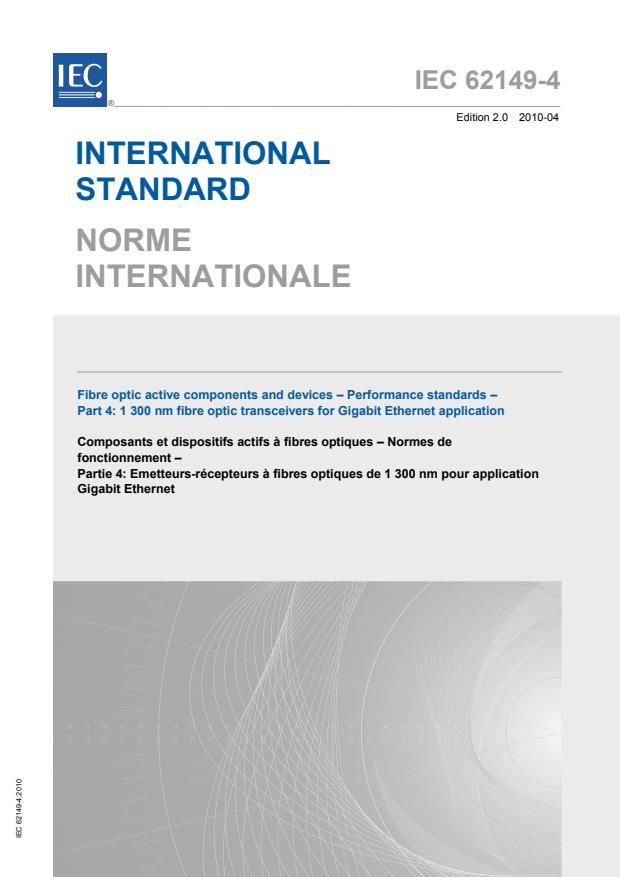
(Main)Fibre optic active components and devices - Performance standards - Part 4: 1 300 nm fibre optic transceivers for Gigabit Ethernet application
Fibre optic active components and devices - Performance standards - Part 4: 1 300 nm fibre optic transceivers for Gigabit Ethernet application
IEC 62149-4:2010 covers the performance specification for 1 300 nm fibre optic transceiver modules used for the ISO/IEC 8802-3 Gigabit Ethernet application. The performance standard contains a definition of the product performance requirements together with a series of sets of tests and measurements with clearly defined conditions, severities, and pass/fail criteria. The tests are intended to be run on a "once-off" basis to prove any product's ability to satisfy the performance standard's requirements. This second edition cancels and replaces the first edition published in 2003. It constitutes a technical revision that includes changes and additions to the performance tables reflecting new technology.
Composants et dispositifs actifs à fibres optiques - Normes de fonctionnement - Partie 4: Emetteurs-récepteurs à fibres optiques de 1 300 nm pour application Gigabit Ethernet
La CEI 62149-4:2010 couvre la spécification de fonctionnement pour les modules d'émetteur-récepteur à fibres optiques de 1 300 nm utilisée pour l'application Gigabit Ethernet de l'ISO/CEI 8802-3. La norme de fonctionnement contient une définition des exigences de fonctionnement de produit ainsi qu'une série de jeux d'essais et de mesures aux conditions, sévérités et critères de succès/défaillances bien définis. Chaque essai est destiné à être effectué une seule fois pour prouver la capacité des produits à satisfaire aux exigences des normes de fonctionnement. Cette deuxième édition annule et remplace la première édition publiée en 2003. Elle constitue une révision technique qui consiste en des modifications et des ajouts aux tableaux décrivant les performances reflétant ainsi les nouvelles technologies.
General Information
- Status
- Published
- Publication Date
- 28-Apr-2010
- Technical Committee
- SC 86C - Fibre optic systems, sensing and active devices
- Current Stage
- DELPUB - Deleted Publication
- Start Date
- 16-Dec-2022
- Completion Date
- 09-Jul-2021
Relations
- Effective Date
- 05-Sep-2023
- Effective Date
- 05-Sep-2023
- Effective Date
- 05-Sep-2023
Overview
IEC 62149-4:2010 is an international performance standard developed by the International Electrotechnical Commission (IEC) that specifies the requirements for 1300 nm fibre optic transceiver modules used in Gigabit Ethernet applications. This standard defines critical product performance parameters and establishes clear testing methodologies and acceptance criteria to ensure reliable operation of transceivers operating at 1.25 Gbit/s in accordance with ISO/IEC 8802-3 Gigabit Ethernet standards.
The 2010 edition represents the second revision, updating performance tables to reflect advances in fibre optic technology. It provides a robust framework for manufacturers and quality assurance teams to validate transceiver devices through prescribed once-off testing, guaranteeing compliance and interoperability in networking environments.
Key Topics
Scope and Application
IEC 62149-4:2010 targets fibre optic active components-specifically 1300 nm wavelength transceivers-designed for Gigabit Ethernet implementations. It outlines performance specifications, covering optical, electrical, environmental, and safety parameters needed for seamless data transmission at gigabit speeds.Product Performance Requirements
The standard specifies absolute limiting ratings, operating environments, electrical and optical functional characteristics, and detailed labeling instructions. Key parameters include:- Operating and storage temperature ranges
- Maximum output currents
- Data input/output voltage levels
- Optical output power and sensitivity
- Extinction ratio and spectral width
Testing Protocols
The document mandates a comprehensive set of characterization and performance tests with explicitly defined testing conditions, severities, and pass/fail criteria. Tests include environmental durability, electromagnetic compatibility, laser safety compliance, and mechanical robustness. Sample size and testing sequences are standardized to ensure repeatability and reliability of results.Safety Requirements
IEC 62149-4 refers to related safety standards including laser equipment safety (IEC 60825-1) and electromagnetic interference suppression measures (IEC 60938-1), ensuring the transceivers meet internationally recognized safety levels.Terminology and Symbols
The standard provides a glossary of symbols and abbreviations (e.g., E for extinction ratio, RH for relative humidity, ESD for electrostatic discharge) to maintain clarity and consistency across testing and documentation.
Applications
IEC 62149-4:2010 is critical for the design, manufacturing, and deployment of fibre optic transceivers in Gigabit Ethernet networks. These devices are widely used in:
- Enterprise and data center networking infrastructure
- Telecommunications networks requiring high-speed data transmission
- Industrial automation systems utilizing fiber networks for reliable communication
- High-performance computing clusters demanding robust optical interconnects
By ensuring compliance with this standard, suppliers and network operators can optimize transceiver reliability, interoperability, and network performance, reducing downtime and maintenance costs while enhancing system scalability.
Related Standards
- ISO/IEC 8802-3:2000 - Specifies the physical layer and media access control for Gigabit Ethernet, establishing data rate and protocol parameters foundational to IEC 62149-4.
- IEC 60068 Series - Environmental testing standards ensuring device resilience to vibration, shock, temperature cycling, humidity, and solder heat.
- IEC 60749 Series - Mechanical and electrostatic discharge test methods for semiconductor components.
- IEC 60825-1 - Safety requirements and classification for laser products used in fibre optic transceivers.
- IEC 60938-1 - Specifications for fixed inductors for electromagnetic interference suppression, relevant for minimizing EMC issues in optical modules.
- IEC 61300-2-47 - Thermal shock testing procedures for fibre optic components.
By adhering to IEC 62149-4:2010, manufacturers and system integrators can ensure that 1300 nm fibre optic transceiver modules meet stringent international performance and safety benchmarks, enabling reliable and efficient Gigabit Ethernet connectivity across diverse applications. This standard is essential for maintaining high-quality optical network infrastructure in an increasingly connected world.
Get Certified
Connect with accredited certification bodies for this standard

TL 9000 QuEST Forum
Telecommunications quality management system.

ANCE
Mexican certification and testing association.

Intertek Slovenia
Intertek testing, inspection, and certification services in Slovenia.
Sponsored listings
Frequently Asked Questions
IEC 62149-4:2010 is a standard published by the International Electrotechnical Commission (IEC). Its full title is "Fibre optic active components and devices - Performance standards - Part 4: 1 300 nm fibre optic transceivers for Gigabit Ethernet application". This standard covers: IEC 62149-4:2010 covers the performance specification for 1 300 nm fibre optic transceiver modules used for the ISO/IEC 8802-3 Gigabit Ethernet application. The performance standard contains a definition of the product performance requirements together with a series of sets of tests and measurements with clearly defined conditions, severities, and pass/fail criteria. The tests are intended to be run on a "once-off" basis to prove any product's ability to satisfy the performance standard's requirements. This second edition cancels and replaces the first edition published in 2003. It constitutes a technical revision that includes changes and additions to the performance tables reflecting new technology.
IEC 62149-4:2010 covers the performance specification for 1 300 nm fibre optic transceiver modules used for the ISO/IEC 8802-3 Gigabit Ethernet application. The performance standard contains a definition of the product performance requirements together with a series of sets of tests and measurements with clearly defined conditions, severities, and pass/fail criteria. The tests are intended to be run on a "once-off" basis to prove any product's ability to satisfy the performance standard's requirements. This second edition cancels and replaces the first edition published in 2003. It constitutes a technical revision that includes changes and additions to the performance tables reflecting new technology.
IEC 62149-4:2010 is classified under the following ICS (International Classification for Standards) categories: 33.180.20 - Fibre optic interconnecting devices. The ICS classification helps identify the subject area and facilitates finding related standards.
IEC 62149-4:2010 has the following relationships with other standards: It is inter standard links to IEC 62149-4:2003, IEC 62149-4:2003/COR1:2003, IEC 62149-4:2022. Understanding these relationships helps ensure you are using the most current and applicable version of the standard.
IEC 62149-4:2010 is available in PDF format for immediate download after purchase. The document can be added to your cart and obtained through the secure checkout process. Digital delivery ensures instant access to the complete standard document.
Standards Content (Sample)
IEC 62149-4 ®
Edition 2.0 2010-04
INTERNATIONAL
STANDARD
NORME
INTERNATIONALE
Fibre optic active components and devices – Performance standards –
Part 4: 1 300 nm fibre optic transceivers for Gigabit Ethernet application
Composants et dispositifs actifs à fibres optiques – Normes de
fonctionnement –
Partie 4: Emetteurs-récepteurs à fibres optiques de 1 300 nm pour application
Gigabit Ethernet
All rights reserved. Unless otherwise specified, no part of this publication may be reproduced or utilized in any form or by
any means, electronic or mechanical, including photocopying and microfilm, without permission in writing from either IEC or
IEC's member National Committee in the country of the requester.
If you have any questions about IEC copyright or have an enquiry about obtaining additional rights to this publication,
please contact the address below or your local IEC member National Committee for further information.
Droits de reproduction réservés. Sauf indication contraire, aucune partie de cette publication ne peut être reproduite
ni utilisée sous quelque forme que ce soit et par aucun procédé, électronique ou mécanique, y compris la photocopie
et les microfilms, sans l'accord écrit de la CEI ou du Comité national de la CEI du pays du demandeur.
Si vous avez des questions sur le copyright de la CEI ou si vous désirez obtenir des droits supplémentaires sur cette
publication, utilisez les coordonnées ci-après ou contactez le Comité national de la CEI de votre pays de résidence.
IEC Central Office
3, rue de Varembé
CH-1211 Geneva 20
Switzerland
Email: 0Hinmail@iec.ch
Web: 1Hwww.iec.ch
About the IEC
The International Electrotechnical Commission (IEC) is the leading global organization that prepares and publishes
International Standards for all electrical, electronic and related technologies.
About IEC publications
The technical content of IEC publications is kept under constant review by the IEC. Please make sure that you have the
latest edition, a corrigenda or an amendment might have been published.
ƒ Catalogue of IEC publications: 2Hwww.iec.ch/searchpub
The IEC on-line Catalogue enables you to search by a variety of criteria (reference number, text, technical committee,…).
It also gives information on projects, withdrawn and replaced publications.
ƒ IEC Just Published: 3Hwww.iec.ch/online_news/justpub
Stay up to date on all new IEC publications. Just Published details twice a month all new publications released. Available
on-line and also by email.
ƒ Electropedia: 4Hwww.electropedia.org
The world's leading online dictionary of electronic and electrical terms containing more than 20 000 terms and definitions
in English and French, with equivalent terms in additional languages. Also known as the International Electrotechnical
Vocabulary online.
ƒ Customer Service Centre: 5Hwww.iec.ch/webstore/custserv
If you wish to give us your feedback on this publication or need further assistance, please visit the Customer Service
Centre FAQ or contact us:
Email: 6Hcsc@iec.ch
Tel.: +41 22 919 02 11
Fax: +41 22 919 03 00
A propos de la CEI
La Commission Electrotechnique Internationale (CEI) est la première organisation mondiale qui élabore et publie des
normes internationales pour tout ce qui a trait à l'électricité, à l'électronique et aux technologies apparentées.
A propos des publications CEI
Le contenu technique des publications de la CEI est constamment revu. Veuillez vous assurer que vous possédez
l’édition la plus récente, un corrigendum ou amendement peut avoir été publié.
ƒ Catalogue des publications de la CEI: 7Hwww.iec.ch/searchpub/cur_fut-f.htm
Le Catalogue en-ligne de la CEI vous permet d’effectuer des recherches en utilisant différents critères (numéro de référence,
texte, comité d’études,…). Il donne aussi des informations sur les projets et les publications retirées ou remplacées.
ƒ Just Published CEI: 8Hwww.iec.ch/online_news/justpub
Restez informé sur les nouvelles publications de la CEI. Just Published détaille deux fois par mois les nouvelles
publications parues. Disponible en-ligne et aussi par email.
ƒ Electropedia: 9Hwww.electropedia.org
Le premier dictionnaire en ligne au monde de termes électroniques et électriques. Il contient plus de 20 000 termes et
définitions en anglais et en français, ainsi que les termes équivalents dans les langues additionnelles. Egalement appelé
Vocabulaire Electrotechnique International en ligne.
ƒ Service Clients: 10Hwww.iec.ch/webstore/custserv/custserv_entry-f.htm
Si vous désirez nous donner des commentaires sur cette publication ou si vous avez des questions, visitez le FAQ du
Service clients ou contactez-nous:
Email: 11Hcsc@iec.ch
Tél.: +41 22 919 02 11
Fax: +41 22 919 03 00
IEC 62149-4 ®
Edition 2.0 2010-04
INTERNATIONAL
STANDARD
NORME
INTERNATIONALE
Fibre optic active components and devices – Performance standards –
Part 4: 1 300 nm fibre optic transceivers for Gigabit Ethernet application
Composants et dispositifs actifs à fibres optiques – Normes de
fonctionnement –
Partie 4: Emetteurs-récepteurs à fibres optiques de 1 300 nm pour application
Gigabit Ethernet
INTERNATIONAL
ELECTROTECHNICAL
COMMISSION
COMMISSION
ELECTROTECHNIQUE
PRICE CODE
INTERNATIONALE
N
CODE PRIX
ICS 33.180.20 ISBN 978-2-88910-633-2
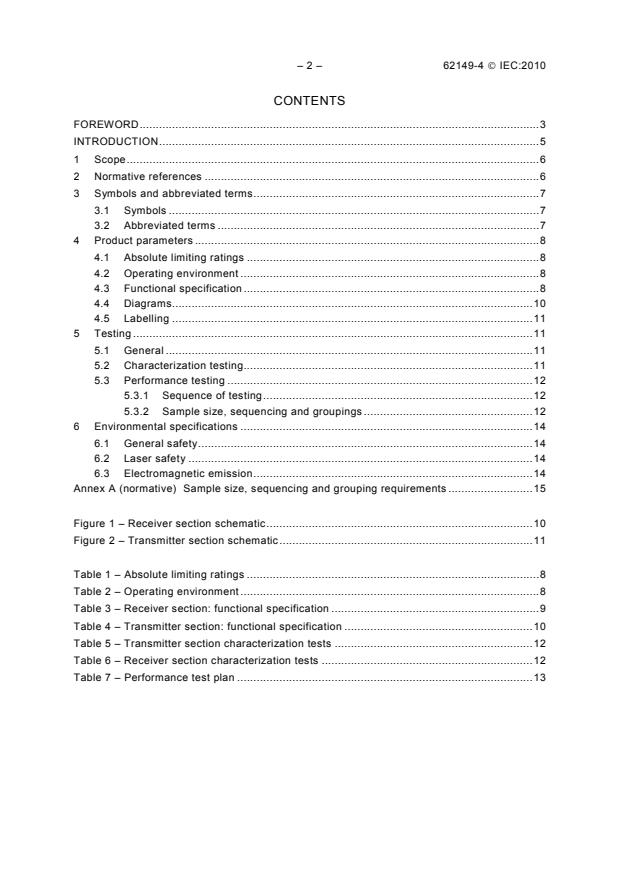
– 2 – 62149-4 © IEC:2010
CONTENTS
FOREWORD.3
INTRODUCTION.5
1 Scope.6
2 Normative references .6
3 Symbols and abbreviated terms.7
3.1 Symbols .7
3.2 Abbreviated terms .7
4 Product parameters .8
4.1 Absolute limiting ratings .8
4.2 Operating environment .8
4.3 Functional specification .8
4.4 Diagrams.10
4.5 Labelling .11
5 Testing .11
5.1 General .11
5.2 Characterization testing.11
5.3 Performance testing .12
5.3.1 Sequence of testing.12
5.3.2 Sample size, sequencing and groupings .12
6 Environmental specifications .14
6.1 General safety.14
6.2 Laser safety .14
6.3 Electromagnetic emission.14
Annex A (normative) Sample size, sequencing and grouping requirements .15
Figure 1 – Receiver section schematic.10
Figure 2 – Transmitter section schematic.11
Table 1 – Absolute limiting ratings .8
Table 2 – Operating environment .8
Table 3 – Receiver section: functional specification .9
Table 4 – Transmitter section: functional specification .10
Table 5 – Transmitter section characterization tests .12
Table 6 – Receiver section characterization tests .12
Table 7 – Performance test plan .13
62149-4 © IEC:2010 – 3 –
INTERNATIONAL ELECTROTECHNICAL COMMISSION
____________
FIBRE OPTIC ACTIVE COMPONENTS AND DEVICES –
PERFORMANCE STANDARDS –
Part 4: 1 300 nm fibre optic transceivers
for Gigabit Ethernet application
FOREWORD
1) The International Electrotechnical Commission (IEC) is a worldwide organization for standardization comprising
all national electrotechnical committees (IEC National Committees). The object of IEC is to promote
international co-operation on all questions concerning standardization in the electrical and electronic fields. To
this end and in addition to other activities, IEC publishes International Standards, Technical Specifications,
Technical Reports, Publicly Available Specifications (PAS) and Guides (hereafter referred to as “IEC
Publication(s)”). Their preparation is entrusted to technical committees; any IEC National Committee interested
in the subject dealt with may participate in this preparatory work. International, governmental and non-
governmental organizations liaising with the IEC also participate in this preparation. IEC collaborates closely
with the International Organization for Standardization (ISO) in accordance with conditions determined by
agreement between the two organizations.
2) The formal decisions or agreements of IEC on technical matters express, as nearly as possible, an international
consensus of opinion on the relevant subjects since each technical committee has representation from all
interested IEC National Committees.
3) IEC Publications have the form of recommendations for international use and are accepted by IEC National
Committees in that sense. While all reasonable efforts are made to ensure that the technical content of IEC
Publications is accurate, IEC cannot be held responsible for the way in which they are used or for any
misinterpretation by any end user.
4) In order to promote international uniformity, IEC National Committees undertake to apply IEC Publications
transparently to the maximum extent possible in their national and regional publications. Any divergence
between any IEC Publication and the corresponding national or regional publication shall be clearly indicated in
the latter.
5) IEC itself does not provide any attestation of conformity. Independent certification bodies provide conformity
assessment services and, in some areas, access to IEC marks of conformity. IEC is not responsible for any
services carried out by independent certification bodies.
6) All users should ensure that they have the latest edition of this publication.
7) No liability shall attach to IEC or its directors, employees, servants or agents including individual experts and
members of its technical committees and IEC National Committees for any personal injury, property damage or
other damage of any nature whatsoever, whether direct or indirect, or for costs (including legal fees) and
expenses arising out of the publication, use of, or reliance upon, this IEC Publication or any other IEC
Publications.
8) Attention is drawn to the Normative references cited in this publication. Use of the referenced publications is
indispensable for the correct application of this publication.
9) Attention is drawn to the possibility that some of the elements of this IEC Publication may be the subject of
patent rights. IEC shall not be held responsible for identifying any or all such patent rights.
International Standard IEC 62149-4 has been prepared by subcommittee 86C: Fibre optic
active devices, of IEC technical committee 86: Fibre optics.
The text of this standard is based on the following documents:
CDV Report on voting
86C/912/CDV 86C/949/RVC
Full information on the voting for the approval of this standard can be found in the report on
voting indicated in the above table.
This second edition cancels and replaces the first edition published in 2003. It constitutes a
technical revision that includes changes and additions to the performance tables reflecting
new technology.
– 4 – 62149-4 © IEC:2010
This publication has been drafted in accordance with the ISO/IEC Directives, Part 2.
A list of all parts of IEC 62149 series, published under the general title Fibre optic active
components and devices – Performance standards, can be found on the IEC website.
The committee has decided that the contents of this publication will remain unchanged until
the stability date indicated on the IEC web site under "http://webstore.iec.ch" in the data
related to the specific publication. At this date, the publication will be
• reconfirmed,
• withdrawn,
• replaced by a revised edition, or
• amended.
62149-4 © IEC:2010 – 5 –
INTRODUCTION
Fibre optic transceivers are used to convert electrical signals into optical signals and vice
versa. This specification covers the performance standard for 1 300 nm fibre optic trans-
ceivers for Gigabit Ethernet application. The ISO/IEC 8802-3 Gigabit Ethernet standard is
used as the basis for determining the optical characteristics of the transceiver, which operates
with a line rate of 1,25 Gbit/s.
– 6 – 62149-4 © IEC:2010
FIBRE OPTIC ACTIVE COMPONENTS AND DEVICES –
PERFORMANCE STANDARDS –
Part 4: 1 300 nm fibre optic transceivers
for Gigabit Ethernet application
1 Scope
This part of IEC 62149 covers the performance specification for 1 300 nm fibre optic
transceiver modules used for the ISO/IEC 8802-3 Gigabit Ethernet application. The perform-
ance standard contains a definition of the product performance requirements together with a
series of sets of tests and measurements with clearly defined conditions, severities, and
pass/fail criteria. The tests are intended to be run on a “once-off” basis to prove any product’s
ability to satisfy the performance standard’s requirements.
A product that has been shown to meet all the requirements of a performance standard can
be declared as complying with the performance standard, but should then be controlled by a
quality assurance/quality conformance program.
2 Normative references
The following referenced documents are indispensable for the application of this document.
For dated references, only the edition cited applies. For undated references, the latest edition
of the referenced document (including any amendments) applies.
IEC 60068-2-6, Environmental testing – Part 2-6: Tests – Test Fc: Vibration (sinusoidal)
IEC 60068-2-20, Environmental testing – Part 2-20: Tests – Test T: Test methods for
solderability and resistance to soldering heat of devices with leads
IEC 60068-2-27, Environmental testing – Part 2-27: Tests – Test Ea and guidance: Shock
IEC 60068-2-38, Environmental testing – Part 2-38: Tests – Test Z/AD: Composite
temperature/humidity cyclic test
IEC 60028-2-78, Environmental testing – Part 2-78: Tests – Test Cab: Damp heat, steady
state
IEC 60749-25, Semiconductor devices – Mechanical and climatic test methods – Part 25:
Temperature cycling
IEC 60749-26, Semiconductor devices – Mechanical and climatic test methods – Part 26:
Electrostatic discharge (ESD) sensitivity testing – Human body model (HBM)
IEC 60825-1, Safety of laser products – Part 1: Equipment classification and requirements
IEC 60938-1, Fixed inductors for electromagnetic interference suppression – Part 1: Generic
specification
IEC 60950-1:2001, Information technology equipment – Safety – Part 1: General requirements
62149-4 © IEC:2010 – 7 –
IEC 61300-2-47, Fibre optic interconnecting devices and passive components – Basic test
and measurement procedures – Part 2-47: Tests – Thermal shocks
ISO/IEC 8802-3:2000, Information technology – Telecommunications and information exchange
between systems – Local and metropolitan area networks – Specific requirements – Part 3:
Carrier sense multiple access with collision detection (CSMA/CD) access method and
physical layer specifications
3 Symbols and abbreviated terms
For the purposes of this document the following symbols and abbreviations apply.
3.1 Symbols
E extinction ratio
r
RH relative humidity
I data input current – low
IL
I data input current – high
IH
I output current
out
P optical output power
o
alarm on level
P
d
P alarm off level
a
data output load
R
DL
S receiver sensitivity
TD transmit disable function
T ambient operating temperature
amb
T storage temperature
stg
T data output fall time
f
T data output rise time
r
V power supply voltage
cc
V –V data input voltage – low
IL CC
V –V data input voltage – high
IH CC
V alarm output high voltage
oh
V alarm output low voltage
ol
V –V data output voltage – low
CC
ol
V –V data output voltage – high
CC
oh
V transmitter differential input voltage swing
pp
λ central wavelength
ce
Δλ spectral width (r.m.s.)
3.2 Abbreviated terms
ESD electrostatic discharge
HBM human body model
– 8 – 62149-4 © IEC:2010
4 Product parameters
4.1 Absolute limiting ratings
Absolute limiting (maximum and/or minimum) ratings, as shown in Table 1, imply that no
catastrophic damage will occur if the product is subjected to these ratings for short periods,
provided each limiting parameter is in isolation and all other parameters have values within
the normal performance parameters. It should not be assumed that limiting values of more
than one parameter can be applied at any one time.
Table 1 – Absolute limiting ratings
Parameter Symbol Minimum Maximum Unit
Storage temperature T –40 +85 °C
stg
Ambient operating temperature T –10 +80 °C
amb
Lead soldering temperature 260/10 °C/s
Output current I 0 50 mA
out
Data input voltage –0,5 V V
cc
Transmitter differential input voltage swing V 0,30 1,40 V
pp
a
Supply voltage –0,5 (V +40 %) V
nom
b
Relative humidity RH 5 85 %
a
Nominal operating voltages (V ) of 5 V and 3,3 V apply. Refer to Annex A for variant references.
nom
b
No condensation allowed.
4.2 Operating environment
The parameters for the operating environment are shown in Table 2.
Table 2 – Operating environment
Parameter Symbol Minimum Maximum Unit
a
Supply voltage V (V – 5 %) (V + 5 %) V
cc nom nom
Ambient operating temperature T 0 70 °C
amb
b
Relative humidity RH 5 85 %
a
Nominal operating voltages (V ) of 5 V. For 3,3 V nominal operating voltage limits are 3,15 V
nom
to 3,45 V.
b
No condensation allowed.
4.3 Functional specification
The specifications in Tables 3 and 4 describe the functional requirements required to meet the
ISO/IEC 8802-3 PHY specifications.
62149-4 © IEC:2010 – 9 –
Table 3 – Receiver section: functional specification
Parameter Symbol Minimum Maximum Unit
a
Receiver sensitivity S -19 dBm
Maximum optical input power –3 dBm
Optical return loss 12 dB
f
Alarm on level P –45 –20 dBm
d
f
Alarm off level P –19 dBm
a
Hysteresis 0,5 4,0 dB
Alarm response time 600 μs
b
Alarm output high voltage (option 1) V –1,1 –0,8 V
oh
b
Alarm output low voltage (option 1) V –2,0 –1,6 V
ol
c
Alarm output high voltage (option 2) V 2 V V
oh CC
c
Alarm output low voltage (option 2) V 0 0,8 V
ol
d
Data output voltage – low V –V –1,950 –1,620 V
OL CC
d
V –V
Data output voltage – high –1,045 –0,740 V
OH CC
e g
Data output load R 50
Ω
DL
NOTE Refer to table 2 for operating environment.
a
Minimum sensitivity and saturation levels for 1E-12 BER measured with a 9 dB extinction ratio
source and (2 – 1) PRBS test signal.
b
These voltages are measured with respect to V .
cc
c
Outputs compatible with TTL and LVTTL inputs.
d
Outputs compatible with 10K, 10KH, 100K ECL and PECL inputs.
e
Outputs terminated to V – 2 V.
CC
f
Alarm triggered when receive sensitivity is below that specified. Hysteresis value specified as
P − P .
a d
g
Basic value.
– 10 – 62149-4 © IEC:2010
Table 4 – Transmitter section: functional specification
Parameter Symbol Minimum Maximum Unit
Central wavelength 1 270 1 355 nm
λ
ce
Spectral width (r.m.s.) Δλ 4 nm
a
Optical output power (singlemode fibre) P –11,0 –3,0 dBm
o
a e
Optical output power (multimode fibre) P –11,5 –3,5 dBm
o
E
Extinction ratio 9 dB
r
e
Optical output rise time (20 % – 80 %) T 0,26 ns
r
e
Optical output fall time (80 % – 20 %) T 0,26 ns
f
b
Output eye
d
Transmit disable function (optional) TD
Data input current – low I –350
μA
IL
Data input current – high I 350
μA
IH
c
Data input voltage – low V −V –1,810 –1,475 V
IL CC
c
Data input voltage – high V −V –1,165 –0,880 V
IH CC
Transmitter differential input voltage swing V 0,3 V
pp
NOTE Refer to Table 2 for operating environment.
a
Output eye is power coupled into a singlemode fibre, 62,5/125 multimode fibre, or 50/125 multimode fibre.
b
Compliant with ISO/IEC 8802-3.
c
Compatible with 10K, 10KH, 100K ECL, and PECL signals.
d
Optional transmit disable function. Normal TTL function. Transmitter output enabled with no signal present.
With logic ‘high’ input, transmitter output is disabled.
e
Measured at the output of a mode conditioning patchcord as specified in ISO/IEC 8802-3, Subclause 38.11.4.
4.4 Diagrams
The diagrams in Figures 1 and 2 are representative examples for the receiver section and
transmitter section.
PIN preamplifier
Limiting
amplifier
Buffer
DATA out
Low
pass
filter
DATA out
Linear
amplifier
Level detector
SD
IEC 697/10
Figure 1 – Receiver section schematic
62149-4 © IEC:2010 – 11 –
Rear facet
Laser
monitor
DATA
photodiode
ECL
Laser
INPUT
modulator
DATA
Laser bias
driver
Laser bias
control
IEC 698/10
Figure 2 – Transmitter section schematic
4.5 Labelling
It is recommended that each transceiver (and supporting documentation) be labelled in a
manner visible to the user with at least the following data:
a) this specification reference, including variant type;
b) applicable safety warnings.
Labelling requirements for class 1 lasers are given in the laser safety standards referenced
in 6.2.
5 Testing
5.1 General
Initial characterization and qualification shall be undertaken when a build standard has been
completed and frozen. Qualification maintenance is carried using periodic testing programs.
Test conditions for all tests unless otherwise stated are 25 °C ± 2 °C.
5.2 Characterization testing
Characterization shall be carried out on at least 20 products taken from at least three different
manufacturing lots. The test and test limits are given in Tables 5 and 6.
– 12 – 62149-4 © IEC:2010
Table 5 – Transmitter section characterization tests
Test conditions
Test limit Test limit
As a minimum 20 devices to be measured at 0 °C,
Parameter Unit
Minimum Maximum
25 °C and 70 °C (±2 °C) and V at (V – 5 %) V
cc nom
and (V ) V and (V + 5 %) V
nom nom
Singlemode fibre, PRBS 2 – 1 at 1,25 Gbit/s
Optical output power –11,0 –3,0 dBm
modulation
Centre wavelength PRBS 2 – 1 at 1,25 Gbit/s modulation 1 270 1 355 nm
Spectral width PRBS 2 – 1 at 1,25 Gbit/s modulation 4 nm
Extinction ratio 250 Mbit/s square wave 9 dB
ANSI × 3,230 filter, PRBS 2 – 1 at 1,25 Gbit/s
Eye mask test No hits No hits
modulation
Relative intensity
ISO/IEC 8802-3ae, Subclause 52.8.5 –120 dB/Hz
noise (RIN)
Rise and fall time 20 % to 80 % 0,26 ns
Table 6 – Receiver section characterization tests
Test conditions
Test limit Test limit
As a minimum 20 devices to be measured at 0 °C,
Parameter Unit
Minimum Maximum
25 °C and 70 °C (±2 °C) and V at (V – 5 %) V
cc nom
and (V ) V and (V + 5 %) V
nom nom
Sensitivity PRBS modulation NRZ at 1,25 Gbit/s assuming 9 dB
–19 dBm
at 1E-12 BER extinction ratio source
Alarm level high TTL/CMOS compatible logic level ‘1’
Alarm level low TTL/CMOS compatible logic level ‘0’
PRBS modulation NRZ at 1,25 Gbit/s assuming 9 dB
Alarm on threshold –20,0 dBm
extinction ratio source
PRBS modulation NRZ at 1,25 Gbit/s assuming 9 dB
Alarm hysteresis 0,5 4 dB
extinction ratio source
Maximum input P set to –2,4 dBm Gate for 3 s using 9 dB
opt
errors extinction ratio source
5.3 Performance testing
5.3.1 Sequence of testing
Performance testing is undertaken when characterization testing is complete.
5.3.2 Sample size, sequencing and groupings
The performance test plan is given in Table 7 and the sample sizes, sequencing and
grouping to be used for the tests are as defined in Annex A. Samples may either be a new
product or sourced from a previous test.
A total of 96 products (95 + 1 control) are required for performance testing. Control devices
are used to determine measurement repeatability.
62149-4 © IEC:2010 – 13 –
Table 7 – Performance test plan
No Test Requirements Max. Min. Unit Details
0 Full E/O testing per Meets specification Tests carried out at 0 °C, 25 °C,
characterization test 70 °C
requirements
1 Solderability EO test 25 °C ΔS +0,7 –0,7 dB IEC 60068-2-20
+0,5 –0,5 dB
ΔP
O
Steam ageing not required
Visual inspection
2 Connector EO test 25 °C ΔS +0,7 –0,7 dB 500 cycles. Clean and measure
mate/demate +0,5 –0,5 dB transmit side every 50 cycles.
ΔP
O
Same connector
3 ESD +0,7 –0,7 dB IEC 60749-26, method HBM
EO test ΔS
+0,5 –0,5 dB 500 V
0 °C, 25 °C, 70 °C ΔP
O
4 Flammability Class UL94-V
5 Mechanical shock EO test 25 °C ΔS +0,7 –0,7 dB IEC 60068-2-27
+0,5 –0,5 dB 1 500 g 1,0 ms 5× per axis
ΔP
O
6 Vibration EO test ΔS +0,7 –0,7 dB IEC 60068-2-6
+0,5 –0,5 dB 20 g 20-2 000 Hz 4 min per
0 °C, 25 °C, 70 °C ΔP
O
cycle, 4 cycles per axis
7 Cyclic moisture +0,7 –0,7 dB IEC 60068-2-38
EO test 25 °C ΔS
+0,5 –0,5 dB 10 cycles
ΔP
O
8 Resistance to +0,7 –0,7 dB IEC 60068-2-20, test Tb, method
EO test 25 °C ΔS
soldering heat +0,5 –0,5 dB 1B, 350 °C 3,5 s
ΔP
O
9 Thermal shock +0,7 –0,7 dB IEC 61300-2-47
EO test 25 °C ΔS
+0,5 –0,5 dB delta temp 100 °C
ΔP
O
10 Fast temperature +0,7 –0,7 dB IEC 60749-25
EO test ΔS
cycle 500 cycles +0,5 –0,5 dB –40 °C/+85 °C 500 cycles
0 °C, 25 °C, 70 °C ΔP
O
11 Fast temperature +0,7 –0,7 dB As test 10, further 500 cycles
EO test ΔS
cycle 1 000 cycles +0,5 –0,5 dB
0 °C, 25 °C, 70 °C ΔP
O
70 °C, V = (V + 5 % V )
12 High temperature EO test 25 °C ΔS +0,7 –0,7 dB
cc op op
endurance 500 h +0,5 –0,5 dB
ΔP
O
13 High temperature EO test ΔS +0,7 –0,7 dB As test 12, further 500 h
endurance 1 000 h +0,5 –0,5 dB
0 °C, 25 °C, 70 °C ΔP
O
14 High temperature EO test ΔS +0,7 –0,7 dB As test 13, further 1 000 h
endurance 2 000 h +0,5 –0,5 dB
0 °C, 25 °C, 70 °C ΔP
O
15 High temperature EO test 0 °C, 25 °C, As test 14, further 3 000 h
endurance 5 000 h 70 °C Information only
16 Cold storage 500 h EO test 25 °C ΔS +0,7 –0,7 dB –40 °C
+0,5 –0,5 dB
ΔP
O
17 Cold storage 1 000 h EO test ΔS +0,7 –0,7 dB As test 16, further 500 h
+0,5 –0,5 dB
0 °C, 25 °C, 70 °C ΔP
O
18 Cold storage 2 000 h EO test ΔS +0,7 –0,7 dB As test 17, further 1 000 h
+0,5 –0,5 dB
0 °C, 25 °C, 70 °C ΔP
O
19 Damp heat 168 h +0,7 –0,7 dB IEC 60068-2-78
EO test 25 °C ΔS
+0,5 –0,5 dB 40 °C/95 %RH
ΔP
O
V = (V + 5 % V )
cc op op
20 Damp heat 500 h +0,7 –0,7 dB As test 19, further 332 h
EO test 25 °C ΔS
+0,5 –0,5 dB
ΔP
O
21 Damp heat 1 000 h +0,7 –0,7 dB As test 20, further 500 h
EO test 25 °C ΔS
+0,5 –0,5 dB
ΔP
O
22 Damp heat 1 344 h +0,7 –0,7 dB As test 21, further 344 h
EO test ΔS
+0,5 –0,5 dB
0 °C, 25 °C, 70 °C ΔP
O
– 14 – 62149-4 © IEC:2010
6 Environmental specifications
6.1 General safety
All transceivers meeting this standard shall conform to IEC 60950-1:2001.
6.2 Laser safety
Fibre optic transceivers shall be class 1 laser certified under any condition of operation. This
includes single fault conditions whether coupled into a fibre or out of an open bore.
Transceivers shall be certified to be in conformance to IEC 60825-1.
Laser safety standards and regulations require that the manufacturer of a laser product
provide information about the product’s laser, safety features, labelling, use, maintenance and
service. This documentation shall explicitly define requirements and usage restrictions on the
host system necessary to meet these safety certifications.
6.3 Electromagnetic emission
Products defined in this specification shall comply with IEC 60938-1 for the limitation of
electromagnetic interference.
62149-4 © IEC:2010 – 15 –
Annex A
(normative)
Sample size, sequencing and grouping requirements
Test Sample size Source
0 Initial testing 95 New
1 Solderability 11 Test 0
2 Connector mate/demate 11 Test 1
3 ESD 6 Test 2
4 Flammability 5 Test 2
5 Mechanical shock 11 Test 0
6 Vibration 11 Test 5
7 Cyclic moisture 11 Test 0
8 Resistance to so
...
Questions, Comments and Discussion
Ask us and Technical Secretary will try to provide an answer. You can facilitate discussion about the standard in here.
Loading comments...