


IEC 62149-4:2022
(Main)Fibre optic active components and devices - Performance standards - Part 4: 1 300 nm fibre optic transceivers for Gigabit Ethernet application
General Information
- Abstract
IEC 62149-4:2022 defines performance specifications for 1 300 nm fibre optic transceiver modules used for the ISO/IEC/IEEE 8802-3 Gigabit Ethernet application. This document contains definitions for product performance requirements as well as a series of tests and measurements, for which clearly defined conditions, severities and pass/fail criteria are provided. The tests are intended to be run on a "once-off" basis to prove any product’s ability to satisfy the performance standard’s requirements. A product that has been shown to meet all the requirements of a performance standard can be declared as complying with the performance standard but will then be controlled by a quality assurance/quality conformance program. This third edition cancels and replaces the second edition published in 2010. This edition constitutes a technical revision. This edition includes the following significant technical changes with respect to the previous edition:
- the normative references are updated;
- the condition "for short periods" in 4.1 is removed;
- the absolute limiting rating for soldering temperature in Table 1 is modified;
- the maximal optical output power (multimode fibre) in Table 4 is increased from −3,5 dBm to −3 dBm, to align value with the referenced document;
- a note is added to Table 7 to clarify that out-of-specification products are not allowed to pass the performance tests.
- Status
- Published
- Publication Date
- 30-Apr-2025
- Technical Committee
- SC 86C - Fibre optic systems, sensing and active devices
- Current Stage
- PPUB - Publication issued
- Start Date
- 16-Dec-2022
- Completion Date
- 16-Jan-2023
Buy Documents
IEC 62149-4:2022 RLV - Fibre optic active components and devices - Performance standards - Part 4: 1 300 nm fibre optic transceivers for Gigabit Ethernet application Released:12/16/2022
IEC 62149-4:2022+AMD1:2025 CSV - Fibre optic active components and devices - Performance standards - Part 4: 1 300 nm fibre optic transceivers for Gigabit Ethernet application Released:5/1/2025
IEC 62149-4:2022 - Fibre optic active components and devices - Performance standards - Part 4: 1 300 nm fibre optic transceivers for Gigabit Ethernet application Released:12/16/2022
Overview
IEC 62149-4:2022 - Fibre optic active components and devices - Performance standards - Part 4: 1300 nm fibre optic transceivers for Gigabit Ethernet application - defines performance specifications, tests and pass/fail criteria for 1300 nm transceiver modules used with ISO/IEC/IEEE 8802-3 Gigabit Ethernet. The standard targets transceivers operating at a line rate of 1.25 Gbit/s and describes the required measurements, environmental limits, and lab test procedures needed to demonstrate a product’s compliance. This third edition (2022) replaces IEC 62149-4:2010 and contains key technical revisions to align with referenced documents and modern test expectations.
Key topics and technical requirements
- Scope and purpose: Defines product performance requirements and a once‑off series of tests and measurements to validate that a product meets the performance standard.
- Functional and environmental parameters: Includes tables for absolute limiting ratings, operating environment, transmitter and receiver functional specifications, labelling and diagrams.
- Characterization and performance testing: Specifies characterization tests and a performance test plan with sample sizes, sequencing and grouping rules (Annex A).
- Pass/fail criteria: Clearly defined conditions, severities and acceptance limits; a note clarifies that out‑of‑specification products are not allowed to pass performance tests.
- Safety and EMC: References laser safety (IEC 60825-1), electromagnetic emission, and general safety requirements.
- Edition 3 technical changes:
- Normative references updated.
- Removal of the phrase “for short periods” from absolute limiting ratings (4.1).
- Modified soldering temperature absolute limit in Table 1.
- Increased maximal optical output power (multimode) from −3.5 dBm to −3 dBm in Table 4.
- Addition of a note in Table 7 disallowing out‑of‑spec products to pass tests.
Practical applications and who uses this standard
IEC 62149-4:2022 is used by:
- Transceiver manufacturers for product design, qualification and documentation of 1300 nm Gigabit Ethernet modules.
- Test laboratories executing the standardized characterization and performance tests.
- Quality and compliance engineers implementing conformance and QA/QC programs after device qualification.
- System integrators and procurement teams requiring validated transceivers for network equipment and datacenter deployments.
- Standards bodies and certification organizations referencing consistent test methods and limits.
Practical applications include validating electrical/optical interfaces, environmental robustness (temperature, humidity, vibration), soldering and assembly limits, and ensuring interoperability with ISO/IEC/IEEE 8802-3 Gigabit Ethernet systems.
Related standards
- ISO/IEC/IEEE 8802-3 (Gigabit Ethernet)
- IEC 60068 series (environmental testing)
- IEC 60825-1 (laser safety)
- IEC 61300-2-47 (thermal shock tests)
Keywords: IEC 62149-4:2022, 1300 nm fibre optic transceivers, Gigabit Ethernet, performance standard, 1.25 Gbit/s, transceiver testing, absolute limiting ratings, optical output power, quality assurance.
Relations
- Effective Date
- 31-May-2024
- Effective Date
- 05-Sep-2023
Buy Documents
IEC 62149-4:2022 RLV - Fibre optic active components and devices - Performance standards - Part 4: 1 300 nm fibre optic transceivers for Gigabit Ethernet application Released:12/16/2022
IEC 62149-4:2022+AMD1:2025 CSV - Fibre optic active components and devices - Performance standards - Part 4: 1 300 nm fibre optic transceivers for Gigabit Ethernet application Released:5/1/2025
IEC 62149-4:2022 - Fibre optic active components and devices - Performance standards - Part 4: 1 300 nm fibre optic transceivers for Gigabit Ethernet application Released:12/16/2022
Get Certified
Connect with accredited certification bodies for this standard

TL 9000 QuEST Forum
Telecommunications quality management system.

ANCE
Mexican certification and testing association.

Intertek Slovenia
Intertek testing, inspection, and certification services in Slovenia.
Sponsored listings
Frequently Asked Questions
IEC 62149-4:2022 is a standard published by the International Electrotechnical Commission (IEC). Its full title is "Fibre optic active components and devices - Performance standards - Part 4: 1 300 nm fibre optic transceivers for Gigabit Ethernet application". This standard covers: IEC 62149-4:2022 defines performance specifications for 1 300 nm fibre optic transceiver modules used for the ISO/IEC/IEEE 8802-3 Gigabit Ethernet application. This document contains definitions for product performance requirements as well as a series of tests and measurements, for which clearly defined conditions, severities and pass/fail criteria are provided. The tests are intended to be run on a "once-off" basis to prove any product’s ability to satisfy the performance standard’s requirements. A product that has been shown to meet all the requirements of a performance standard can be declared as complying with the performance standard but will then be controlled by a quality assurance/quality conformance program. This third edition cancels and replaces the second edition published in 2010. This edition constitutes a technical revision. This edition includes the following significant technical changes with respect to the previous edition: - the normative references are updated; - the condition "for short periods" in 4.1 is removed; - the absolute limiting rating for soldering temperature in Table 1 is modified; - the maximal optical output power (multimode fibre) in Table 4 is increased from −3,5 dBm to −3 dBm, to align value with the referenced document; - a note is added to Table 7 to clarify that out-of-specification products are not allowed to pass the performance tests.
IEC 62149-4:2022 defines performance specifications for 1 300 nm fibre optic transceiver modules used for the ISO/IEC/IEEE 8802-3 Gigabit Ethernet application. This document contains definitions for product performance requirements as well as a series of tests and measurements, for which clearly defined conditions, severities and pass/fail criteria are provided. The tests are intended to be run on a "once-off" basis to prove any product’s ability to satisfy the performance standard’s requirements. A product that has been shown to meet all the requirements of a performance standard can be declared as complying with the performance standard but will then be controlled by a quality assurance/quality conformance program. This third edition cancels and replaces the second edition published in 2010. This edition constitutes a technical revision. This edition includes the following significant technical changes with respect to the previous edition: - the normative references are updated; - the condition "for short periods" in 4.1 is removed; - the absolute limiting rating for soldering temperature in Table 1 is modified; - the maximal optical output power (multimode fibre) in Table 4 is increased from −3,5 dBm to −3 dBm, to align value with the referenced document; - a note is added to Table 7 to clarify that out-of-specification products are not allowed to pass the performance tests.
IEC 62149-4:2022 is classified under the following ICS (International Classification for Standards) categories: 33.180.20 - Fibre optic interconnecting devices. The ICS classification helps identify the subject area and facilitates finding related standards.
IEC 62149-4:2022 has the following relationships with other standards: It is inter standard links to IEC 62149-4:2022/AMD1:2025, IEC 62149-4:2010. Understanding these relationships helps ensure you are using the most current and applicable version of the standard.
IEC 62149-4:2022 is available in PDF format for immediate download after purchase. The document can be added to your cart and obtained through the secure checkout process. Digital delivery ensures instant access to the complete standard document.
Standards Content (Sample)
IEC 62149-4 ®
Edition 3.0 2022-12
REDLINE VERSION
INTERNATIONAL
STANDARD
colour
inside
Fibre optic active components and devices – Performance standards –
Part 4: 1 300 nm fibre optic transceivers for Gigabit Ethernet application
IEC 62149-42022-12 RLV(en)
All rights reserved. Unless otherwise specified, no part of this publication may be reproduced or utilized in any form
or by any means, electronic or mechanical, including photocopying and microfilm, without permission in writing from
either IEC or IEC's member National Committee in the country of the requester. If you have any questions about IEC
copyright or have an enquiry about obtaining additional rights to this publication, please contact the address below or
your local IEC member National Committee for further information.
IEC Secretariat Tel.: +41 22 919 02 11
3, rue de Varembé info@iec.ch
CH-1211 Geneva 20 www.iec.ch
Switzerland
About the IEC
The International Electrotechnical Commission (IEC) is the leading global organization that prepares and publishes
International Standards for all electrical, electronic and related technologies.
About IEC publications
The technical content of IEC publications is kept under constant review by the IEC. Please make sure that you have the
latest edition, a corrigendum or an amendment might have been published.
IEC publications search - webstore.iec.ch/advsearchform IEC Products & Services Portal - products.iec.ch
The advanced search enables to find IEC publications by a Discover our powerful search engine and read freely all the
variety of criteria (reference number, text, technical publications previews. With a subscription you will always
committee, …). It also gives information on projects, replaced have access to up to date content tailored to your needs.
and withdrawn publications.
Electropedia - www.electropedia.org
IEC Just Published - webstore.iec.ch/justpublished
The world's leading online dictionary on electrotechnology,
Stay up to date on all new IEC publications. Just Published
containing more than 22 300 terminological entries in English
details all new publications released. Available online and
and French, with equivalent terms in 19 additional languages.
once a month by email.
Also known as the International Electrotechnical Vocabulary
(IEV) online.
IEC Customer Service Centre - webstore.iec.ch/csc
If you wish to give us your feedback on this publication or
need further assistance, please contact the Customer Service
Centre: sales@iec.ch.
IEC 62149-4 ®
Edition 3.0 2022-12
REDLINE VERSION
INTERNATIONAL
STANDARD
colour
inside
Fibre optic active components and devices – Performance standards –
Part 4: 1 300 nm fibre optic transceivers for Gigabit Ethernet application
INTERNATIONAL
ELECTROTECHNICAL
COMMISSION
ICS 33.180.20 ISBN 978-2-8322-6312-9
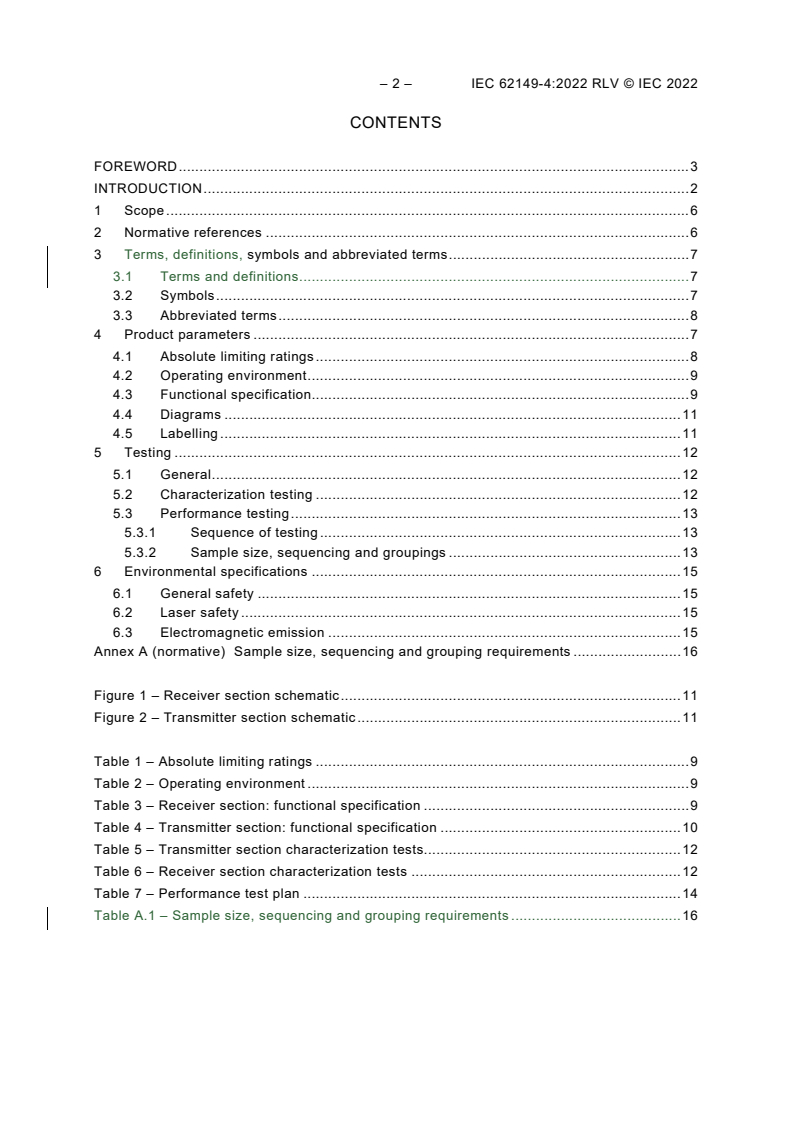
– 2 – IEC 62149-4:2022 RLV © IEC 2022
CONTENTS
FOREWORD . 3
INTRODUCTION . 2
1 Scope . 6
2 Normative references . 6
3 Terms, definitions, symbols and abbreviated terms . 7
3.1 Terms and definitions . 7
3.2 Symbols . 7
3.3 Abbreviated terms . 8
4 Product parameters . 7
4.1 Absolute limiting ratings . 8
4.2 Operating environment . 9
4.3 Functional specification. 9
4.4 Diagrams . 11
4.5 Labelling . 11
5 Testing . 12
5.1 General . 12
5.2 Characterization testing . 12
5.3 Performance testing . 13
5.3.1 Sequence of testing . 13
5.3.2 Sample size, sequencing and groupings . 13
6 Environmental specifications . 15
6.1 General safety . 15
6.2 Laser safety . 15
6.3 Electromagnetic emission . 15
Annex A (normative) Sample size, sequencing and grouping requirements . 16
Figure 1 – Receiver section schematic . 11
Figure 2 – Transmitter section schematic . 11
Table 1 – Absolute limiting ratings . 9
Table 2 – Operating environment . 9
Table 3 – Receiver section: functional specification . 9
Table 4 – Transmitter section: functional specification . 10
Table 5 – Transmitter section characterization tests. 12
Table 6 – Receiver section characterization tests . 12
Table 7 – Performance test plan . 14
Table A.1 – Sample size, sequencing and grouping requirements . 16
INTERNATIONAL ELECTROTECHNICAL COMMISSION
____________
FIBRE OPTIC ACTIVE COMPONENTS AND DEVICES –
PERFORMANCE STANDARDS –
Part 4: 1 300 nm fibre optic transceivers
for Gigabit Ethernet application
FOREWORD
1) The International Electrotechnical Commission (IEC) is a worldwide organization for standardization comprising
all national electrotechnical committees (IEC National Committees). The object of IEC is to promote international
co-operation on all questions concerning standardization in the electrical and electronic fields. To this end and
in addition to other activities, IEC publishes International Standards, Technical Specifications, Technical Reports,
Publicly Available Specifications (PAS) and Guides (hereafter referred to as "IEC Publication(s)"). Their
preparation is entrusted to technical committees; any IEC National Committee interested in the subject dealt with
may participate in this preparatory work. International, governmental and non-governmental organizations liaising
with the IEC also participate in this preparation. IEC collaborates closely with the International Organization for
Standardization (ISO) in accordance with conditions determined by agreement between the two organizations.
2) The formal decisions or agreements of IEC on technical matters express, as nearly as possible, an international
consensus of opinion on the relevant subjects since each technical committee has representation from all
interested IEC National Committees.
3) IEC Publications have the form of recommendations for international use and are accepted by IEC National
Committees in that sense. While all reasonable efforts are made to ensure that the technical content of IEC
Publications is accurate, IEC cannot be held responsible for the way in which they are used or for any
misinterpretation by any end user.
4) In order to promote international uniformity, IEC National Committees undertake to apply IEC Publications
transparently to the maximum extent possible in their national and regional publications. Any divergence between
any IEC Publication and the corresponding national or regional publication shall be clearly indicated in the latter.
5) IEC itself does not provide any attestation of conformity. Independent certification bodies provide conformity
assessment services and, in some areas, access to IEC marks of conformity. IEC is not responsible for any
services carried out by independent certification bodies.
6) All users should ensure that they have the latest edition of this publication.
7) No liability shall attach to IEC or its directors, employees, servants or agents including individual experts and
members of its technical committees and IEC National Committees for any personal injury, property damage or
other damage of any nature whatsoever, whether direct or indirect, or for costs (including legal fees) and
expenses arising out of the publication, use of, or reliance upon, this IEC Publication or any other IEC
Publications.
8) Attention is drawn to the Normative references cited in this publication. Use of the referenced publications is
indispensable for the correct application of this publication.
9) Attention is drawn to the possibility that some of the elements of this IEC Publication may be the subject of patent
rights. IEC shall not be held responsible for identifying any or all such patent rights.
This redline version of the official IEC Standard allows the user to identify the changes made to
the previous edition IEC 62149-4:2010. A vertical bar appears in the margin wherever a change
has been made. Additions are in green text, deletions are in strikethrough red text.
– 4 – IEC 62149-4:2022 RLV © IEC 2022
IEC 62149-4 has been prepared by subcommittee 86C: Fibre optic systems and active devices,
of IEC technical committee 86: Fibre optics. It is an International Standard.
This third edition cancels and replaces the second edition published in 2010. This edition
constitutes a technical revision.
This edition includes the following significant technical changes with respect to the previous
edition:
a) the normative references are updated;
b) the condition "for short periods" in 4.1 is removed;
c) the absolute limiting rating for soldering temperature in Table 1 is modified;
d) the maximal optical output power (multimode fibre) in Table 4 is increased from −3,5 dBm
to −3 dBm, to align value with the referenced document;
e) a note is added to Table 7 to clarify that out-of-specification products are not allowed to
pass the performance tests.
The text of this International Standard is based on the following documents:
Draft Report on voting
86C/1800/CDV 86C/1826/RVC
Full information on the voting for its approval can be found in the report on voting indicated in
the above table.
The language used for the development of this International Standard is English.
This document was drafted in accordance with ISO/IEC Directives, Part 2, and developed in
accordance with ISO/IEC Directives, Part 1 and ISO/IEC Directives, IEC Supplement, available
at www.iec.ch/members_experts/refdocs. The main document types developed by IEC are
described in greater detail at www.iec.ch/publications.
A list of all parts of the IEC 62149 series, published under the general title Fibre optic active
components and devices – Performance standards, can be found on the IEC website.
The committee has decided that the contents of this document will remain unchanged until the
stability date indicated on the IEC website under webstore.iec.ch in the data related to the
specific document. At this date, the document will be
• reconfirmed,
• withdrawn,
• replaced by a revised edition, or
• amended.
IMPORTANT – The "colour inside" logo on the cover page of this document indicates that it
contains colours which are considered to be useful for the correct understanding of its
contents. Users should therefore print this document using a colour printer.
INTRODUCTION
Fibre optic transceivers are used to convert electrical signals into optical signals and vice versa.
This document specifies performance standards for 1 300 nm fibre optic transceivers for Gigabit
Ethernet application. The ISO/IEC/IEEE 8802-3 Gigabit Ethernet standard is used as the basis
for determining the optical characteristics of the transceiver, which operates at a line rate of
1,25 Gbit/s.
– 6 – IEC 62149-4:2022 RLV © IEC 2022
FIBRE OPTIC ACTIVE COMPONENTS AND DEVICES –
PERFORMANCE STANDARDS –
Part 4: 1 300 nm fibre optic transceivers
for Gigabit Ethernet application
1 Scope
This part of IEC 62149 defines performance specifications for 1 300 nm fibre optic transceiver
modules used for the ISO/IEC/IEEE 8802-3 Gigabit Ethernet application. This document
contains definitions for product performance requirements as well as a series of tests and
measurements, for which clearly defined conditions, severities and pass/fail criteria are
provided. The tests are intended to be run on a "once-off" basis to prove any product’s ability
to satisfy the performance standard’s requirements.
A product that has been shown to meet all the requirements of a performance standard can be
declared as complying with the performance standard but should will then be controlled by a
quality assurance/quality conformance program.
2 Normative references
The following documents are referred to in the text in such a way that some or all of their content
constitutes requirements of this document. For dated references, only the edition cited applies.
For undated references, the latest edition of the referenced document (including any
amendments) applies.
IEC 60068-2-6, Environmental testing – Part 2-6: Tests – Test Fc: Vibration (sinusoidal)
IEC 60068-2-20, Environmental testing – Part 2-20: Tests – Test T Ta and Tb: Test methods
for solderability and resistance to soldering heat of devices with leads
IEC 60068-2-27, Environmental testing – Part 2-27: Tests – Test Ea and guidance: Shock
IEC 60068-2-38, Environmental testing – Part 2-38: Tests – Test Z/AD: Composite
temperature/humidity cyclic test
IEC 60028 60068-2-78, Environmental testing – Part 2-78: Tests – Test Cab: Damp heat, steady
state
IEC 60749-25, Semiconductor devices – Mechanical and climatic test methods – Part 25:
Temperature cycling
IEC 60749-26, Semiconductor devices – Mechanical and climatic test methods – Part 26:
Electrostatic discharge (ESD) sensitivity testing – Human body model (HBM)
IEC 60825-1, Safety of laser products – Part 1: Equipment classification and requirements
IEC 60938-1, Fixed inductors for electromagnetic interference suppression – Part 1: Generic
specification
IEC 60950-1:2001, Information technology equipment – Safety – Part 1: General requirements
IEC 61300-2-47, Fibre optic interconnecting devices and passive components – Basic test and
measurement procedures – Part 2-47: Tests – Thermal shocks
ISO/IEC 8802-3:2000, Information technology – Telecommunications and information exchange
between systems – Local and metropolitan area networks – Specific requirements – Part 3:
Carrier sense multiple access with collision detection (CSMA/CD) access method and physical
layer specifications
ISO/IEC/IEEE 8802-3:2021, Telecommunications and exchange between information
technology systems – Requirements for local and metropolitan area networks – Part 3: Standard
for Ethernet
3 Terms, definitions, symbols and abbreviated terms
3.1 Terms and definitions
No terms and definitions are listed in this document.
ISO and IEC maintain terminology databases for use in standardization at the following
addresses:
• IEC Electropedia: available at https://www.electropedia.org/
• ISO Online browsing platform: available at https://www.iso.org/obp
3.2 Symbols
E extinction ratio
r
I I data input current – high
IH ih
I I data input current – low
IL il
I output current
out
P alarm off level
a
P alarm on level
d
P optical output power
o
P optical input power
opt
RH relative humidity
R R data output load
DL dl
S receiver sensitivity
T ambient operating temperature
amb
TD transmit disable function
data optical output fall time
T
f
T data optical output rise time
r
T storage temperature
stg
V power supply voltage
cc
V V – V data input voltage – high
IH
ih cc
V V – V data input voltage – low
IL
il cc
V nominal operating voltage
nom
V alarm output high voltage
oh
– 8 – IEC 62149-4:2022 RLV © IEC 2022
V – V data output voltage – high
oh cc
V alarm output low voltage
ol
V – V data output voltage – low
ol cc
V transmitter differential input voltage swing
pp
ΔP optical output power change from pre-test value to post-test value
o
ΔS receiver sensitivity change from pre-test value to post-test value
Δλ spectral width (RMS)
λ central wavelength
ce
3.3 Abbreviated terms
BER bit error ratio
ECL emitter-coupled logic
EO electro-optical
ESD electrostatic discharge
HBM human body model
LVTTL low voltage transistor-transistor logic
NRZ non-return-to-zero
PECL pseudo emitter-coupled logic
PRBS pseudo random bit sequence
RH relative humidity
SD signal detect
TTL transistor-transistor logic
TTL/CMOS transistor-transistor logic/complementary metal-oxide-semiconductor
4 Product parameters
4.1 Absolute limiting ratings
Absolute limiting (maximum and/or minimum) ratings, as shown in Table 1, imply that no
catastrophic damage will occur if the product is subjected to these ratings for short periods,
provided each limiting parameter is in isolation and all other parameters have values within the
normal performance parameters. It should not be assumed that limiting values of more than one
parameter can be applied at any one time.
Table 1 – Absolute limiting ratings
Parameter Symbol or Minimum Maximum Unit
abbreviated
term
Storage temperature T −40 +85 °C
stg
Ambient operating temperature T
−10 +80 °C
amb
Lead soldering temperature +260/ °C/s
(minimum distance to case specified) (for 10 s)
Output current I 0 50 mA
out
Data input voltage −0,5 V V
cc
Transmitter differential input voltage swing V 0,30 1,40 V
pp
a
−0,5 (V + 40 %) % V
Supply voltage
nom
b
RH 5 85 %
Relative humidity
a
Nominal operating voltages (V ) of 5 V and 3,3 V apply. Refer to Annex A for variant references.
nom
b
No condensation allowed.
4.2 Operating environment
The parameters for the operating environment are shown in Table 2.
Table 2 – Operating environment
Parameter Symbol or Minimum Maximum Unit
abbreviated
term
a
V (V − 5 %) % (V + 5 %) % V
Supply voltage
cc nom nom
Ambient operating temperature T 0 70 °C
amb
b
Relative humidity RH 5 85 %
a
For a nominal operating voltage (V ) of 5 V. For 3,3 V nominal operating voltage limits are, the minimum
nom
value is 3,15 V to and the maximum value is 3,45 V.
b
No condensation allowed.
4.3 Functional specification
The specifications in Table 3 and Table 4 describe the functional requirements required to meet
the ISO/IEC/IEEE 8802-3 PHY specifications.
Table 3 – Receiver section: functional specification
Parameter Symbol Minimum Maximum Unit
a
S −19 dBm
Receiver sensitivity
Maximum optical input power −3 dBm
Optical return loss 12 dB
f
P −45 −20 dBm
Alarm on level
d
f
P
−19 dBm
Alarm off level
a
Hysteresis 0,5 4,0 dB
Alarm response time 600
µs
– 10 – IEC 62149-4:2022 RLV © IEC 2022
Parameter Symbol Minimum Maximum Unit
b
V −1,1 −0,8 V
Alarm output high voltage (option 1)
oh
b
V −2,0 −1,6 V
Alarm output low voltage (option 1)
ol
c
V 2 V V
Alarm output high voltage (option 2)
oh cc
c
V
0 0,8 V
Alarm output low voltage (option 2)
ol
d
V – V −1,950 −1,620 V
Data output voltage – low
ol cc
d
V – V −1,045 −0,740 V
Data output voltage – high
oh cc
e g
R 50 Ω
Data output load
dl
NOTE Refer to Table 2 for operating environment.
a
Minimum sensitivity and saturation levels for 1E-12 BER measured with a 9 dB extinction ratio source and
(2 – 1) PRBS test signal.
b
These voltages are measured with respect to V .
cc
c
Outputs compatible with TTL and LVTTL inputs.
d
Outputs compatible with 10K, 10KH, 100K ECL and PECL inputs.
e
Outputs terminated to V – 2 V.
cc
f
Alarm triggered when receive sensitivity is below that specified. Hysteresis value specified as P − P .
a d
g
Basic value.
Table 4 – Transmitter section: functional specification
Parameter Symbol Minimum Maximum Unit
λ
Central wavelength 1 270 1 355 nm
ce
Spectral width (RMS) Δλ 4 nm
a
P
Optical output power (single-mode fibre) −11,0 −3,0 dBm
o
a e
Optical output power (multimode fibre) P −11,5 −3,5 3,0 dBm
o
Extinction ratio E 9 dB
r
e
T 0,26 ns
Optical output rise time (20 % – 80 %)
r
e
T 0,26 ns
Optical output fall time (80 % – 20 %)
f
b
Output eye
d
TD
Transmit disable function (optional)
Data input current – low I −350
µA
il
Data input current – high I 350
µA
ih
c
Data input voltage – low V − V −1,810 −1,475 V
il cc
c
Data input voltage – high V − V −1,165 −0,880 V
ih cc
Transmitter differential input voltage swing V 0,3 V
pp
NOTE Refer to Table 2 for operating environment.
a
Output eye is power coupled into a single-mode fibre, 62,5/125 multimode fibre, or 50/125 multimode fibre.
b
Compliant with ISO/IEC/IEEE 8802-3.
c
Compatible with 10K, 10KH, 100K ECL, and PECL signals.
d
Optional transmit disable function. Normal TTL function. Transmitter output enabled with no signal present.
With logic "high" input, transmitter output is disabled.
e
Measured at the output of a mode conditioning patchcord as specified in ISO/IEC/IEEE 8802-3:2021, 38.11.4.
4.4 Diagrams
The diagrams in Figure 1 and Figure 2 are representative examples for the receiver section and
transmitter section.
Figure 1 – Receiver section schematic
Figure 2 – Transmitter section schematic
4.5 Labelling
It is recommended that each transceiver (and supporting documentation) be labelled in a
manner visible to the user with at least the following data:
a) this document reference, including variant type;
b) applicable safety warnings.
Labelling requirements for class 1 lasers are given in the laser safety standards referenced
in 6.2.
– 12 – IEC 62149-4:2022 RLV © IEC 2022
5 Testing
5.1 General
Initial characterization and qualification shall be undertaken when a build standard has been
completed and frozen. Qualification maintenance is carried using periodic testing programs.
Test conditions for all tests unless otherwise stated are 25 °C ± 2 °C.
5.2 Characterization testing
Characterization shall be carried out on at least 20 products taken from at least three different
manufacturing lots. The test and test limits are given in Table 5 and Table 6.
Table 5 – Transmitter section characterization tests
a
Test conditions
Test limit Test limit
As a minimum 20 devices to be measured at 0 °C,
Parameter Unit
minimum maximum
25 °C and 70 °C (±2 °C) and V at (V – 5
cc nom
%) V and (V ) V and (V + 5 %) V
nom nom
Optical output
Single-mode fibre, PRBS 2 – 1 at 1,25 Gbit/s
−11,0 −3,0 dBm
power
modulation
Centre wavelength 1 270 1 355 nm
PRBS 2 – 1 at 1,25 Gbit/s modulation
Spectral width PRBS 2 – 1 at 1,25 Gbit/s modulation 4 nm
Extinction ratio 250 Mbit/s square wave 9 dB
ANSI × 3,230 filter, PRBS 2 – 1 at 1,25 Gbit/s
modulation
Eye mask test No hits No hits
ISO/IEC/IEEE 8802-3:2021, 38.6.5
ISO/IEC8802-3ae, Subclause 52.8.5
Relative intensity
−120 dB/Hz
noise (RIN)
ISO/IEC/IEEE 8802-3:2021, 38.6.4
Rise and fall time 20 % to 80 % 0,26 ns
a
A minimum of 20 devices to be measured at T of 0 °C, 25 °C, and 70 °C ± 2 °C and with V set at minimum
amb cc
operating voltage, at nominal operating voltage (V ), and at maximal operating voltage. Refer to Table 2 for
nom
minimum and maximum operating voltages.
Table 6 – Receiver section characterization tests
a
Test conditions
Test limit Test limit
As a minimum 20 devices to be measured at 0 °C,
Parameter Unit
minimum maximum
25 °C and 70 °C (±2 °C) and V at (V – 5 %)
cc nom
V and (V ) V and (V + 5 %) V
nom nom
Sensitivity PRBS modulation NRZ at 1,25 Gbit/s assuming
−19 dBm
at 1E-12 BER 9 dB extinction ratio source
Alarm level high TTL/CMOS compatible logic level "1"
Alarm level low TTL/CMOS compatible logic level "0"
PRBS modulation NRZ at 1,25 Gbit/s assuming
Alarm on threshold −20,0 dBm
9 dB extinction ratio source
PRBS modulation NRZ at 1,25 Gbit/s assuming
Alarm hysteresis 0,5 4 dB
9 dB extinction ratio source
P set to −2,4 dBm gate for 3 s using 9 dB
Maximum input
opt
errors
extinction ratio source
a
A minimum of 20 devices to be measured at T of 0 °C, 25 °C, and 70 °C ± 2 °C and with V set at minimum
amb cc
operating voltage, at nominal operating voltage (V ), and at maximal operating voltage. Refer to Table 2 for
nom
minimum and maximum operating voltages.
5.3 Performance testing
5.3.1 Sequence of testing
Performance testing is undertaken when characterization testing is complete.
5.3.2 Sample size, sequencing and groupings
The performance test plan is given in Table 7 and the sample sizes, sequencing and grouping
to be used for the tests are as defined in Annex A. Samples may either be a new product or
sourced from a previous test.
A total of 96 products (95 + 1 control) are required for performance testing. Control devices are
used to determine measurement repeatability.
– 14 – IEC 62149-4:2022 RLV © IEC 2022
Table 7 – Performance test plan
a
No. Test Test methods and conditions
Requirements
Full EO testing per Tests carried out at 0 °C,
0 Meets specification
characterization test 25 °C, 70 °C
requirements
1 Solderability EO test 25 °C Max. Min. Unit IEC 60068-2-20
ΔS +0,7 −0,7 dB Steam ageing not required
Visual inspection
ΔP +0,5 −0,5 dB
o
2 Connector EO test 25 °C Max. Min. Unit 500 cycles. Clean and measure
mate/demate transmit side every 50 cycles.
ΔS +0,7 −0,7 dB
Same connector
ΔP
+0,5 −0,5 dB
o
3 ESD EO test Max. Min. Unit IEC 60749-26, method HBM
500 V
0 °C, 25 °C, 70 °C
ΔS +0,7 −0,7 dB
ΔP +0,5 −0,5 dB
o
4 Flammability Class UL94-V
5 Mechanical shock EO test 25 °C Max. Min. Unit IEC 60068-2-27
1 500 g
ΔS +0,7 −0,7 dB
15 000 m/s , 1,0 ms, 5 times
ΔP per axis
+0,5 −0,5 dB
o
6 Vibration EO test Max. Min. Unit IEC 60068-2-6
20 g 20-2 000 Hz
0 °C, 25 °C, 70 °C ΔS
+0,7 −0,7 dB
200 m/s , 20 Hz to 2 000 Hz,
ΔP +0,5 −0,5 dB
o
4 min per cycle, 4 cycles per
axis
7 Cyclic moisture EO test 25 °C Max. Min. Unit IEC 60068-2-38
10 cycles
ΔS +0,7 −0,7 dB
ΔP +0,5 −0,5 dB
o
8 Resistance to EO test 25 °C Max. Min. Unit IEC 60068-2-20, test Tb,
soldering heat method 1B 2, 350 °C 3,5 s
ΔS +0,7 −0,7 dB
ΔP
+0,5 −0,5 dB
o
9 Thermal shock EO test 25 °C Max. Min. Unit IEC 61300-2-47
delta temperature 100 °C
ΔS
+0,7 −0,7 dB
ΔP +0,5 −0,5 dB
o
10 Fast temperature EO test Max. Min. Unit IEC 60749-25
cycle 500 cycles lower soak temperature −40 °C,
0 °C, 25 °C, 70 °C ΔS +0,7 −0,7 dB
upper soak temperature +85 °C,
500 cycles
ΔP +0,5 −0,5 dB
o
11 Fast temperature EO test Max. Min. Unit As test 10, further 500 cycles
cycle 1 000 cycles
0 °C, 25 °C, 70 °C
ΔS +0,7 −0,7 dB
ΔP
+0,5 −0,5 dB
o
12 High temperature EO test 25 °C Max. Min. Unit 70 °C, V = (V + 5 % V )
cc op op
endurance 500 h
ΔS +0,7 −0,7 dB
V at maximum operating
cc
voltage (refer to Table 2)
ΔP +0,5 −0,5 dB
o
13 High temperature EO test Max. Min. Unit As test 12, further 500 h
endurance 1 000 h
0 °C, 25 °C, 70 °C
ΔS +0,7 −0,7 dB
ΔP +0,5 −0,5 dB
o
14 High temperature EO test Max. Min. Unit As test 13, further 1 000 h
endurance 2 000 h
0 °C, 25 °C, 70 °C
ΔS +0,7 −0,7 dB
ΔP +0,5 −0,5 dB
o
a
No. Test Test methods and conditions
Requirements
15 High temperature EO test As test 14, further 3 000 h
endurance 5 000 h Information only
0 °C, 25 °C, 70 °C
16 Cold storage 500 h EO test 25 °C Max. Min. Unit −40 °C
ΔS
+0,7 −0,7 dB
ΔP +0,5 −0,5 dB
o
17 Cold storage 1 000 h EO test Max. Min. Unit As test 16, further 500 h
0 °C, 25 °C, 70 °C ΔS +0,7 −0,7 dB
ΔP +0,5 −0,5 dB
o
18 Cold storage 2 000 h EO test Max. Min. Unit As test 17, further 1 000 h
0 °C, 25 °C, 70 °C
ΔS +0,7 −0,7 dB
ΔP
+0,5 −0,5 dB
o
19 Damp heat 168 h EO test 25 °C Max. Min. Unit IEC 60068-2-78
40 °C / 95 % RH
ΔS
+0,7 −0,7 dB
V = (V + 5 % V )
cc op op
ΔP +0,5 −0,5 dB
o
V at maximum operating
cc
voltage (refer to Table 2)
20 Damp heat 500 h EO test 25 °C Max. Min. Unit As test 19, further 332 h
ΔS +0,7 −0,7 dB
ΔP +0,5 −0,5 dB
o
21 Damp heat 1 000 h EO test 25 °C Max. Min. Unit As test 20, further 500 h
ΔS +0,7 −0,7 dB
ΔP +0,5 −0,5 dB
o
22 Damp heat 1 344 h EO test Max. Min. Unit As test 21, further 344 h
0 °C, 25 °C, 70 °C ΔS
+0,7 −0,7 dB
ΔP +0,5 −0,5 dB
o
a
For tests 1 to 22, except for tests 4 and 15, pre- and post-test values of receiver sensitivity (S) and optical
output power (P ) shall meet the characterization test limits specified in Table 5 and Table 6.
o
6 Environmental specifications
6.1 General safety
All transceivers meeting this document shall conform to IEC 60950-1:2001.
6.2 Laser safety
Fibre optic transceivers shall be class 1 laser certified under any condition of operation. This
includes single fault conditions whether coupled into a fibre or out of an open bore. Transceivers
shall be certified to be in conformance to IEC 60825-1.
Laser safety standards and regulations require that the manufacturer of a laser product provide
information about the product’s laser, safety features, labelling, use, maintenance and service.
This documentation shall explicitly define requirements and usage restrictions on the host
system necessary to meet these safety certifications.
6.3 Electromagnetic emission
Products defined in this document shall comply with IEC 60938-1 for the limitation of
electromagnetic interference.
– 16 – IEC 62149-4:2022 RLV © IEC 2022
Annex A
(normative)
Sample size, sequencing and grouping requirements
Table A.1 shows sample size, sequencing and grouping requirements.
Table A.1 – Sample size, sequencing and grouping requirements
Test Sample size Source
0 Initial testing 95 New
1 Solderability 11 Test 0
2 Connector mate/demate 11 Test 1
3 ESD 6 Test 2
4 Flammability 5 Test 2
5 Mechanical shock 11 Test 0
6 Vibration 11 Test 5
7 Cyclic moisture 11 Test 0
8 Resistance to solder heat 11 Test 7
9 Thermal shock 11 Test 8
10 Fast temperature cycle 500 cycles 11 Test 0
11 Fast temperature cycle 1 000 cycles 11 Test 10
12 High temperature endurance 500 h 25 Test 0
13 High temperature endurance 1 000 h 25 Test 12
14 High temperature endurance 2 000 h 25 Test 13
15 High temperature endurance 5 000 h 25 Test 14
16 Cold storage 500 h 11 Test 0
17 Cold storage 1 000 h 11 Test 16
18 Cold storage 2 000 h 11 Test 17
19 Damp heat 168 h 11 Test 0
20 Damp heat 500 h 11 Test 19
21 Damp heat 1 000 h 11 Test 20
22 Damp heat 1 344 h 11 Test 21
The tests of Table A.1 are each intended to be performed individually and in parallel on products,
although products from a previous test may be used if desired. Mechanical tests may also be
carried out on parts of an identical build or structure but intended for use at different bit rates.
___________
IEC 62149-4 ®
Edition 3.0 2022-12
INTERNATIONAL
STANDARD
NORME
INTERNATIONALE
Fibre optic active components and devices – Performance standards –
Part 4: 1 300 nm fibre optic transceivers for Gigabit Ethernet application
Composants et dispositifs actifs fibroniques – Normes de performance –
Partie 4: Émetteurs-récepteurs fibroniques de 1 300 nm pour application Gigabit
Ethernet
– 2 – IEC 62149-4:2022 © IEC 2022
CONTENTS
FOREWORD . 3
INTRODUCTION . 5
1 Scope . 6
2 Normative references . 6
3 Terms, definitions, symbols and abbreviated terms . 7
3.1 Terms and definitions . 7
3.2 Symbols . 7
3.3 Abbreviated terms . 8
4 Product parameters . 8
4.1 Absolute limiting ratings . 8
4.2 Operating environment . 9
4.3 Functional specification. 9
4.4 Diagrams . 10
4.5 Labelling . 11
5 Testing . 11
5.1 General . 11
5.2 Characterization testing . 11
5.3 Performance testing . 12
5.3.1 Sequence of testing . 12
5.3.2 Sample size, sequencing and groupings . 12
6 Environmental specifications . 14
6.1 General safety . 14
6.2 Laser safety . 14
6.3 Electromagnetic emission . 14
Annex A (normative) Sample size, sequencing and grouping requirements . 15
Figure 1 – Receiver section schematic . 10
Figure 2 – Transmitter section schematic . 11
Table 1 – Absolute limiting ratings . 8
Table 2 – Operating environment . 9
Table 3 – Receiver section: functional specification . 9
Table 4 – Transmitter section: functional specification . 10
Table 5 – Transmitter section characterization tests. 12
Table 6 – Receiver section characterization tests . 12
Table 7 – Performance test plan . 13
Table A.1 – Sample size, sequencing and grouping requirements . 15
INTERNATIONAL ELECTROTECHNICAL COMMISSION
____________
FIBRE OPTIC ACTIVE COMPONENTS AND DEVICES –
PERFORMANCE STANDARDS –
Part 4: 1 300 nm fibre optic transceivers
for Gigabit Ethernet application
FOREWORD
1) The International Electrotechnical Commission (IEC) is a worldwide organization for standardization comprising
all national electrotechnical committees (IEC National Committees). The object of IEC is to promote international
co-operation on all questions concerning standardization in the electrical and electronic fields. To this end and
in addition to other activities, IEC publishes International Standards, Technical Specifications, Technical Reports,
Publicly Available Specifications (PAS) and Guides (hereafter referred to as "IEC Publication(s)"). Their
preparation is entrusted to technical committees; any IEC National Committee interested in the subject dealt with
may participate in this preparatory work. International, governmental and non-governmental organizations liaising
with the IEC also participate in this preparation. IEC collaborates closely with the International Organization for
Standardization (ISO) in accordance with conditions determined by agreement between the two organizations.
2) The formal decisions or agreements of IEC on technical matters express, as nearly as possible, an international
consensus of opinion on the relevant subjects since each technical committee has representation from all
interested IEC National Committees.
3) IEC Publications have the form of recommendations for international use and are accepted by IEC National
Committees in that sense. While all reasonable efforts are made to ensure that the technical content of IEC
Publications is accurate, IEC cannot be held responsible for the way in which they are used or for any
misinterpretation by any end user.
4) In order to promote international uniformity, IEC National Committees undertake to apply IEC Publications
transparently to the maximum extent possible in their national and regional publications. Any divergence between
any IEC Publication and the corresponding national or regional publication shall be clearly indicated in the latter.
5) IEC itself does not provide any attestation of conformity. Independent certification bodies provide conformity
assessment services and, in some areas, access to IEC marks of conformity. IEC is not responsible for any
services carried out by independent certification bodies.
6) All users should ensure that they have the latest edition of this publication.
7) No liability shall attach to IEC or its directors, employees, servants or agents including individual experts and
members of its technical committees and IEC National Committees for any personal injury, property damage or
other damage of any nature whatsoever, whether direct or indirect, or for costs (including legal fees) and
expenses arising out of the publication, use of, or reliance upon, this IEC Publication or any other IEC
Publications.
8) Attention is drawn to the Normative references cited in this publication. Use of the referenced publications is
indispensable for the correct application of this publication.
9) Attention is drawn to the possibility that some of the elements of this IEC Publication may be the subject of patent
rights. IEC shall not be held responsible for identifying any or all such patent rights.
IEC 62149-4 has been prepared by subcommittee 86C: Fibre optic systems and active devices,
of IEC technical committee 86: Fibre optics. It is an International Standard.
This third edition cancels and replaces the second edition published in 2010. This edition
constitutes a technical revision.
This edition includes the following significant technical changes with respect to the previous
edition:
a) the normative references are updated;
b) the condition "for short periods" in 4.1 is removed;
c) the absolute limiting rating for soldering temperature in Table 1 is modified;
d) the maximal optical output power (multimode fibre) in Table 4 is increased from −3,5 dBm
to −3 dBm, to align value with the referenced document;
– 4 – IEC 62149-4:2022 © IEC 2022
e) a note is added to Table 7 to clarify that out-of-specification products are not allowed to
pass the performance tests.
The text of this International Standard is based on the following documents:
Draft Report on voting
86C/1800/CDV 86C/1826/RVC
Full information on the voting for its approval can be found in the report on voting indicated in
the above table.
The language used for the development of this International Standard is English.
This document was drafted in accordance with ISO/IEC Directives, Part 2, and developed in
accordance with ISO/IEC Directives, Part 1 and ISO/IEC Directives, IEC Supplement, available
at www.iec.ch/members_experts/refdocs. The main document types developed by IEC are
described in greater detail at www.iec.ch/publications.
A list of all parts of the IEC 62149 series, published under the general title Fibre optic active
components and devices – Performance standards, can be found on the IEC website.
The committee has decided that the contents of this document will remain unchanged until the
stability date indicated on the IEC website under webstore.iec.ch in the data related to the
specific document. At this date, the document will be
• reconfirmed,
• withdrawn,
• replaced by a revised edition, or
• amended.
INTRODUCTION
Fibre o
...
IEC 62149-4 ®
Edition 3.1 2025-05
CONSOLIDATED VERSION
INTERNATIONAL
STANDARD
Fibre optic active components and devices – Performance standards –
Part 4: 1 300 nm fibre optic transceivers for Gigabit Ethernet application
ICS 33.180.20 ISBN 978-2-8327-0413-4
All rights reserved. Unless otherwise specified, no part of this publication may be reproduced or utilized in any form or
by any means, electronic or mechanical, including photocopying and microfilm, without permission in writing from either
IEC or IEC's member National Committee in the country of the requester. If you have any questions about IEC copyright
or have an enquiry about obtaining additional rights to this publication, please contact the address below or your local
IEC member National Committee for further information.
IEC Secretariat Tel.: +41 22 919 02 11
3, rue de Varembé info@iec.ch
CH-1211 Geneva 20 www.iec.ch
Switzerland
About the IEC
The International Electrotechnical Commission (IEC) is the leading global organization that prepares and publishes
International Standards for all electrical, electronic and related technologies.
About IEC publications
The technical content of IEC publications is kept under constant review by the IEC. Please make sure that you have the
latest edition, a corrigendum or an amendment might have been published.
IEC publications search - IEC Products & Services Portal - products.iec.ch
webstore.iec.ch/advsearchform Discover our powerful search engine and read freely all the
The advanced search enables to find IEC publications by a
publications previews, graphical symbols and the glossary.
variety of criteria (reference number, text, technical With a subscription you will always have access to up to date
committee, …). It also gives information on projects, content tailored to your needs.
replaced and withdrawn publications.
Electropedia - www.electropedia.org
IEC Just Published - webstore.iec.ch/justpublished The world's leading online dictionary on electrotechnology,
Stay up to date on all new IEC publications. Just Published containing more than 22 500 terminological entries in English
details all new publications released. Available online and and French, with equivalent terms in 25 additional languages.
once a month by email. Also known as the International Electrotechnical Vocabulary
(IEV) online.
IEC Customer Service Centre - webstore.iec.ch/csc
If you wish to give us your feedback on this publication or
need further assistance, please contact the Customer
Service Centre: sales@iec.ch.
REDLINE VERSION – 2 – IEC 62149-4:2022+AMD1:2025 CSV
© IEC 2025
CONTENTS
FOREWORD . 3
INTRODUCTION . 5
1 Scope . 6
2 Normative references . 6
3 Terms, definitions, symbols and abbreviated terms . 7
3.1 Terms and definitions . 7
3.2 Symbols . 7
3.3 Abbreviated terms . 8
4 Product parameters . 8
4.1 Absolute limiting ratings . 8
4.2 Operating environment . 9
4.3 Functional specification. 9
4.4 Diagrams . 10
4.5 Labelling . 11
5 Testing . 11
5.1 General . 11
5.2 Characterization testing . 11
5.3 Performance testing . 12
5.3.1 Sequence of testing . 12
5.3.2 Sample size, sequencing and groupings . 12
6 Environmental specifications . 14
6.1 General safety . 14
6.2 Laser safety . 14
6.3 Electromagnetic emission . 14
Annex A (normative) Sample size, sequencing and grouping requirements . 15
Figure 1 – Receiver section schematic . 10
Figure 2 – Transmitter section schematic . 11
Table 1 – Absolute limiting ratings . 8
Table 2 – Operating environment . 9
Table 3 – Receiver section: functional specification . 9
Table 4 – Transmitter section: functional specification . 10
Table 5 – Transmitter section characterization tests. 12
Table 6 – Receiver section characterization tests . 12
Table 7 – Performance test plan . 13
Table A.1 – Sample size, sequencing and grouping requirements . 15
© IEC 2025
INTERNATIONAL ELECTROTECHNICAL COMMISSION
____________
FIBRE OPTIC ACTIVE COMPONENTS AND DEVICES –
PERFORMANCE STANDARDS –
Part 4: 1 300 nm fibre optic transceivers for Gigabit Ethernet application
FOREWORD
1) The International Electrotechnical Commission (IEC) is a worldwide organization for standardization comprising
all national electrotechnical committees (IEC National Committees). The object of IEC is to promote international
co-operation on all questions concerning standardization in the electrical and electronic fields. To this end and
in addition to other activities, IEC publishes International Standards, Technical Specifications, Technical Reports,
Publicly Available Specifications (PAS) and Guides (hereafter referred to as “IEC Publication(s)”). Their
preparation is entrusted to technical committees; any IEC National Committee interested in the subject dealt with
may participate in this preparatory work. International, governmental and non-governmental organizations liaising
with the IEC also participate in this preparation. IEC collaborates closely with the International Organization for
Standardization (ISO) in accordance with conditions determined by agreement between the two organizations.
2) The formal decisions or agreements of IEC on technical matters express, as nearly as possible, an international
consensus of opinion on the relevant subjects since each technical committee has representation from all
interested IEC National Committees.
3) IEC Publications have the form of recommendations for international use and are accepted by IEC National
Committees in that sense. While all reasonable efforts are made to ensure that the technical content of IEC
Publications is accurate, IEC cannot be held responsible for the way in which they are used or for any
misinterpretation by any end user.
4) In order to promote international uniformity, IEC National Committees undertake to apply IEC Publications
transparently to the maximum extent possible in their national and regional publications. Any divergence between
any IEC Publication and the corresponding national or regional publication shall be clearly indicated in the latter.
5) IEC itself does not provide any attestation of conformity. Independent certification bodies provide conformity
assessment services and, in some areas, access to IEC marks of conformity. IEC is not responsible for any
services carried out by independent certification bodies.
6) All users should ensure that they have the latest edition of this publication.
7) No liability shall attach to IEC or its directors, employees, servants or agents including individual experts and
members of its technical committees and IEC National Committees for any personal injury, property damage or
other damage of any nature whatsoever, whether direct or indirect, or for costs (including legal fees) and
expenses arising out of the publication, use of, or reliance upon, this IEC Publication or any other IEC
Publications.
8) Attention is drawn to the Normative references cited in this publication. Use of the referenced publications is
indispensable for the correct application of this publication.
9) IEC draws attention to the possibility that the implementation of this document may involve the use of (a)
patent(s). IEC takes no position concerning the evidence, validity or applicability of any claimed patent rights in
respect thereof. As of the date of publication of this document, IEC had not received notice of (a) patent(s), which
may be required to implement this document. However, implementers are cautioned that this may not represent
the latest information, which may be obtained from the patent database available at https://patents.iec.ch. IEC
shall not be held responsible for identifying any or all such patent rights.
This consolidated version of the official IEC Standard and its amendment has been
prepared for user convenience.
IEC 62149-4 edition 3.1 contains the third edition (2022-12) [documents 86C/1800/CDV
and 86C/1826/RVC] and its amendment 1 (2025-05) [documents 86C/1946/CDV and
86C/1962/RVC].
In this Redline version, a vertical line in the margin shows where the technical content is
modified by amendment 1. Additions are in green text, deletions are in strikethrough red
text. A separate Final version with all changes accepted is available in this publication.
REDLINE VERSION – 4 – IEC 62149-4:2022+AMD1:2025 CSV
© IEC 2025
IEC 62149-4 has been prepared by subcommittee 86C: Fibre optic systems and active devices,
of IEC technical committee 86: Fibre optics. It is an International Standard.
This third edition cancels and replaces the second edition published in 2010. This edition
constitutes a technical revision.
This edition includes the following significant technical changes with respect to the previous
edition:
a) the normative references are updated;
b) the condition "for short periods" in 4.1 is removed;
c) the absolute limiting rating for soldering temperature in Table 1 is modified;
d) the maximal optical output power (multimode fibre) in Table 4 is increased from −3,5 dBm
to −3 dBm, to align value with the referenced document;
e) a note is added to Table 7 to clarify that out-of-specification products are not allowed to
pass the performance tests.
The text of this International Standard is based on the following documents:
Draft Report on voting
86C/1800/CDV 86C/1826/RVC
Full information on the voting for its approval can be found in the report on voting indicated in
the above table.
The language used for the development of this International Standard is English.
This document was drafted in accordance with ISO/IEC Directives, Part 2, and developed in
accordance with ISO/IEC Directives, Part 1 and ISO/IEC Directives, IEC Supplement, available
at www.iec.ch/members_experts/refdocs. The main document types developed by IEC are
described in greater detail at www.iec.ch/publications.
A list of all parts of the IEC 62149 series, published under the general title Fibre optic active
components and devices – Performance standards, can be found on the IEC website.
The committee has decided that the contents of this document and its amendment will remain
unchanged until the stability date indicated on the IEC website under webstore.iec.ch in the
data related to the specific document. At this date, the document will be
• reconfirmed,
• withdrawn, or
• revised.
© IEC 2025
INTRODUCTION
Fibre optic transceivers are used to convert electrical signals into optical signals and vice versa.
This document specifies performance standards for 1 300 nm fibre optic transceivers for Gigabit
Ethernet application. The ISO/IEC/IEEE 8802-3 Gigabit Ethernet standard is used as the basis
for determining the optical characteristics of the transceiver, which operates at a line rate of
1,25 Gbit/s.
REDLINE VERSION – 6 – IEC 62149-4:2022+AMD1:2025 CSV
© IEC 2025
FIBRE OPTIC ACTIVE COMPONENTS AND DEVICES –
PERFORMANCE STANDARDS –
Part 4: 1 300 nm fibre optic transceivers
for Gigabit Ethernet application
1 Scope
This part of IEC 62149 defines performance specifications for 1 300 nm fibre optic transceiver
modules used for the ISO/IEC/IEEE 8802-3 Gigabit Ethernet application. This document
contains definitions for product performance requirements as well as a series of tests and
measurements, for which clearly defined conditions, severities and pass/fail criteria are
provided. The tests are intended to be run on a "once-off" basis to prove any product’s ability
to satisfy the performance standard’s requirements.
A product that has been shown to meet all the requirements of a performance standard can be
declared as complying with the performance standard but will then be controlled by a quality
assurance/quality conformance program.
2 Normative references
The following documents are referred to in the text in such a way that some or all of their content
constitutes requirements of this document. For dated references, only the edition cited applies.
For undated references, the latest edition of the referenced document (including any
amendments) applies.
IEC 60068-2-6, Environmental testing – Part 2-6: Tests – Test Fc: Vibration (sinusoidal)
IEC 60068-2-20, Environmental testing – Part 2-20: Tests – Test Ta and Tb: Test methods for
solderability and resistance to soldering heat of devices with leads
IEC 60068-2-27, Environmental testing – Part 2-27: Tests – Test Ea and guidance: Shock
IEC 60068-2-38, Environmental testing – Part 2-38: Tests – Test Z/AD: Composite
temperature/humidity cyclic test
IEC 60068-2-78, Environmental testing – Part 2-78: Tests – Test Cab: Damp heat, steady state
IEC 60749-25, Semiconductor devices – Mechanical and climatic test methods – Part 25:
Temperature cycling
IEC 60749-26, Semiconductor devices – Mechanical and climatic test methods – Part 26:
Electrostatic discharge (ESD) sensitivity testing – Human body model (HBM)
IEC 60825-1, Safety of laser products – Part 1: Equipment classification and requirements
IEC 60938-1, Fixed inductors for electromagnetic interference suppression – Part 1: Generic
specification
IEC 60950-1, Information technology equipment – Safety – Part 1: General requirements
© IEC 2025
IEC 61300-2-47, Fibre optic interconnecting devices and passive components – Basic test and
measurement procedures – Part 2-47: Tests – Thermal shocks
ISO/IEC/IEEE 8802-3:2021, Telecommunications and exchange between information
technology systems – Requirements for local and metropolitan area networks – Part 3: Standard
for Ethernet
3 Terms, definitions, symbols and abbreviated terms
3.1 Terms and definitions
No terms and definitions are listed in this document.
ISO and IEC maintain terminology databases for use in standardization at the following
addresses:
• IEC Electropedia: available at https://www.electropedia.org/
• ISO Online browsing platform: available at https://www.iso.org/obp
3.2 Symbols
E extinction ratio
r
I data input current – high
ih
I data input current – low
il
I output current
out
P alarm off level
a
P alarm on level
d
P optical output power
o
optical input power
P
opt
R data output load
dl
S receiver sensitivity
T ambient operating temperature
amb
TD transmit disable function
T optical output fall time
f
T optical output rise time
r
T storage temperature
stg
V supply voltage
cc
V – V data input voltage – high
ih cc
V – V data input voltage – low
il cc
V nominal operating voltage
nom
V alarm output high voltage
oh
V – V data output voltage – high
oh cc
V alarm output low voltage
ol
V – V data output voltage – low
ol cc
V transmitter differential input voltage swing
pp
REDLINE VERSION – 8 – IEC 62149-4:2022+AMD1:2025 CSV
© IEC 2025
ΔP optical output power change from pre-test value to post-test value
o
ΔS receiver sensitivity change from pre-test value to post-test value
Δλ spectral width (RMS)
λ central wavelength
ce
3.3 Abbreviated terms
BER bit error ratio
ECL emitter-coupled logic
EO electro-optical
ESD electrostatic discharge
HBM human body model
LVTTL low voltage transistor-transistor logic
NRZ non-return-to-zero
PECL pseudo emitter-coupled logic
PRBS pseudo random bit sequence
RH relative humidity
SD signal detect
TTL transistor-transistor logic
TTL/CMOS transistor-transistor logic/complementary metal-oxide-semiconductor
4 Product parameters
4.1 Absolute limiting ratings
Absolute limiting (maximum and/or minimum) ratings, as shown in Table 1, imply that no
catastrophic damage will occur if the product is subjected to these ratings, provided each
limiting parameter is in isolation and all other parameters have values within the normal
performance parameters. It should not be assumed that limiting values of more than one
parameter can be applied at any one time.
Table 1 – Absolute limiting ratings
Parameter Symbol or Minimum Maximum Unit
abbreviated
term
Storage temperature T –40 +85 °C
stg
Ambient operating temperature T –10 +80 °C
amb
Lead soldering temperature +260 °C
(minimum distance to case specified) (for 10 s)
I
Output current 0 50 mA
out
Data input voltage –0,5 V V
cc
Transmitter differential input voltage swing V 0,30 1,40 V
pp
a
–0,5 V + 40 % × 1,4 V
Supply voltage
nom
b
RH 5 85 %
Relative humidity
a
Nominal operating voltages (V ) of 5 V and 3,3 V apply.
nom
b
No condensation allowed.
© IEC 2025
4.2 Operating environment
The parameters for the operating environment are shown in Table 2.
Table 2 – Operating environment
Parameter Symbol or Minimum Maximum Unit
abbreviated
term
a
V V − 5 % × 0,95 V + 5 % × 1,05 V
Supply voltage
cc nom nom
T
Ambient operating temperature 0 70 °C
amb
b
RH 5 85 %
Relative humidity
a
For a nominal operating voltage (V ) of 5 V. For 3,3 V nominal operating voltage, the minimum value is 3,15 V
nom
and the maximum value is 3,45 V.
b
No condensation allowed.
4.3 Functional specification
The specifications in Table 3 and Table 4 describe the functional requirements required to meet
the ISO/IEC/IEEE 8802-3 PHY specifications.
Table 3 – Receiver section: functional specification
Parameter Symbol Minimum Maximum Unit
a
S –19 dBm
Receiver sensitivity
Maximum optical input power −3 dBm
Optical return loss 12 dB
f
P −45 −20 dBm
Alarm on level
d
f
P −19 dBm
Alarm off level
a
Hysteresis 0,5 4,0 dB
Alarm response time 600 μs
b
V −1,1 −0,8 V
Alarm output high voltage (option 1)
oh
b
V −2,0 −1,6 V
Alarm output low voltage (option 1)
ol
c
V V
2 V
Alarm output high voltage (option 2)
oh cc
c
V 0 0,8 V
Alarm output low voltage (option 2)
ol
d
V – V −1,950 −1,620 V
Data output voltage – low
ol cc
d
V – V −1,045 −0,740 V
Data output voltage – high
oh cc
e g
R
50 Ω
Data output load
dl
NOTE Refer to Table 2 for operating environment.
a –12
Minimum sensitivity and saturation levels for 1E-10 BER measured with a 9 dB extinction ratio source and
(2 – 1) PRBS test signal.
b
These voltages are measured with respect to V .
cc
c
Outputs compatible with TTL and LVTTL inputs.
d
Outputs compatible with 10 K, 10 KH, 100 K ECL and PECL inputs.
e
Outputs terminated to V – 2 V.
cc
f
Alarm triggered when receive sensitivity is below that specified. Hysteresis value specified as P − P .
a d
g
Basic value.
REDLINE VERSION – 10 – IEC 62149-4:2022+AMD1:2025 CSV
© IEC 2025
Table 4 – Transmitter section: functional specification
Parameter Symbol Minimum Maximum Unit
Central wavelength λ 1 270 1 355 nm
ce
Spectral width (RMS) Δλ 4 nm
a
P −11,0 −3,0 dBm
Optical output power (single-mode fibre)
o
a e
P −11,5 −3,0 dBm
Optical output power (multimode fibre)
o
E
Extinction ratio 9 dB
r
e
Optical output rise time (20 % – 80 %) T 0,26 ns
r
e
T 0,26 ns
Optical output fall time (80 % – 20 %)
f
b
Output eye
d
Transmit disable function (optional) TD
Data input current – low I −350 µA
il
Data input current – high I 350
µA
ih
c
−1,810 −1,475 V
Data input voltage – low V − V
il cc
c
−1,165 −0,880 V
Data input voltage – high V − V
ih cc
Transmitter differential input voltage swing V 0,3 V
pp
NOTE Refer to Table 2 for operating environment.
a
Output eye is power coupled into a single-mode fibre, 62,5/125 multimode fibre, or 50/125 multimode fibre.
b
Compliant with ISO/IEC/IEEE 8802-3.
c
Compatible with 10K, 10KH, 100K ECL, and PECL signals.
d
Optional transmit disable function. Normal TTL function. Transmitter output enabled with no signal present.
With logic "high" input, transmitter output is disabled.
e
Measured at the output of a mode conditioning patchcord as specified in ISO/IEC/IEEE 8802-3:2021, 38.11.4.
4.4 Diagrams
The diagrams in Figure 1 and Figure 2 are representative examples for the receiver section and
transmitter section.
Figure 1 – Receiver section schematic
© IEC 2025
Figure 2 – Transmitter section schematic
4.5 Labelling
It is recommended that each transceiver (and supporting documentation) be labelled in a
manner visible to the user with at least the following data:
a) this document reference, including variant type;
b) applicable safety warnings.
Labelling requirements for class 1 lasers are given in the laser safety standards referenced
in 6.2.
5 Testing
5.1 General
Initial characterization and qualification shall be undertaken when a build standard has been
completed and frozen. Qualification maintenance is carried using periodic testing programs.
Test conditions for all tests unless otherwise stated are 25 °C ± 2 °C.
5.2 Characterization testing
Characterization shall be carried out on at least 20 products taken from at least three different
manufacturing lots. The test and test limits are given in Table 5 and Table 6.
REDLINE VERSION – 12 – IEC 62149-4:2022+AMD1:2025 CSV
© IEC 2025
Table 5 – Transmitter section characterization tests
Test limit Test limit
a
Parameter Test conditions Unit
minimum maximum
Optical output Single-mode fibre, PRBS 2 – 1 at 1,25 Gbit/s
−11,0 −3,0 dBm
power modulation
Centre wavelength PRBS 2 – 1 at 1,25 Gbit/s modulation 1 270 1 355 nm
Spectral width 4 nm
PRBS 2 – 1 at 1,25 Gbit/s modulation
Extinction ratio 250 Mbit/s square wave 9 dB
PRBS 2 – 1 at 1,25 Gbit/s modulation
Eye mask test No hits No hits
ISO/IEC/IEEE 8802-3:2021, 38.6.5
Relative intensity
ISO/IEC/IEEE 8802-3:2021, 38.6.4 −120 dB/Hz
noise (RIN)
Rise and fall time 20 % to 80 % 0,26 ns
a
A minimum of 20 devices to be measured at T of 0 °C, 25 °C, and 70 °C ± 2 °C and with V set at minimum
amb cc
operating voltage, at nominal operating voltage (V ), and at maximal operating voltage. Refer to Table 2 for
nom
minimum and maximum operating voltages.
Table 6 – Receiver section characterization tests
Test limit Test limit
a
Parameter Unit
Test conditions
minimum maximum
PRBS modulation NRZ at 1,25 Gbit/s
-12
−19 dBm
Sensitivity at 1E-10 BER
assuming 9 dB extinction ratio source
Alarm level high TTL/CMOS compatible logic level "1"
Alarm level low TTL/CMOS compatible logic level "0"
PRBS modulation NRZ at 1,25 Gbit/s
Alarm on threshold −20 dBm
assuming 9 dB extinction ratio source
PRBS modulation NRZ at 1,25 Gbit/s
Alarm hysteresis 0,5 4,0 dB
assuming 9 dB extinction ratio source
P set to −2,4 dBm Gate for 3 s using
opt
Maximum input errors 3
9 dB extinction ratio source
a
A minimum of 20 devices to be measured at T of 0 °C, 25 °C, and 70 °C ± 2 °C and with V set at minimum
amb cc
operating voltage, at nominal operating voltage (V ), and at maximal operating voltage. Refer to Table 2 for
nom
minimum and maximum operating voltages.
5.3 Performance testing
5.3.1 Sequence of testing
Performance testing is undertaken when characterization testing is complete.
5.3.2 Sample size, sequencing and groupings
The performance test plan is given in Table 7 and the sample sizes, sequencing and grouping
to be used for the tests are as defined in Annex A. Samples may either be a new product or
sourced from a previous test.
A total of 96 products (95 + 1 control) are required for performance testing. Control devices are
used to determine measurement repeatability.
© IEC 2025
Table 7 – Performance test plan
a
No. Test Test methods and conditions
Requirements
Full EO testing per Tests carried out at 0 °C,
0 Meets specification
characterization test 25 °C, 70 °C
requirements
1 Solderability EO test 25 °C Max. Min. Unit IEC 60068-2-20
ΔS +0,7 −0,7 dB Steam ageing not required
Visual inspection
ΔP +0,5 −0,5 dB
o
2 Connector EO test 25 °C Max. Min. Unit 500 cycles. Clean and measure
mate/demate transmit side every 50 cycles.
ΔS +0,7 −0,7 dB
Same connector
ΔP
+0,5 −0,5 dB
o
3 ESD EO test Max. Min. Unit IEC 60749-26, method HBM
500 V
0 °C, 25 °C, 70 °C
ΔS +0,7 −0,7 dB
ΔP +0,5 −0,5 dB
o
4 Flammability Class UL94-V
5 Mechanical shock EO test 25 °C Max. Min. Unit IEC 60068-2-27
15 000 m/s , 1,0 ms, 5 times
ΔS +0,7 −0,7 dB
per axis
ΔP
+0,5 −0,5 dB
o
6 Vibration EO test Max. Min. Unit IEC 60068-2-6
200 m/s , 20 Hz to 2 000 Hz,
0 °C, 25 °C, 70 °C ΔS
+0,7 −0,7 dB
4 min per cycle, 4 cycles per
ΔP +0,5 −0,5 dB axis
o
IEC 60068-2-38
7 Cyclic moisture EO test 25 °C Max. Min. Unit
10 cycles
ΔS +0,7 −0,7 dB
ΔP +0,5 −0,5 dB
o
8 Resistance to EO test 25 °C Max. Min. Unit IEC 60068-2-20, test Tb,
soldering heat method 2, 350 °C 3,5 s
ΔS +0,7 −0,7 dB
ΔP
+0,5 −0,5 dB
o
9 Thermal shock EO test 25 °C Max. Min. Unit IEC 61300-2-47
delta temperature 100 °C
ΔS +0,7 −0,7 dB
ΔP +0,5 −0,5 dB
o
10 Fast temperature EO test Max. Min. Unit IEC 60749-25
cycle 500 cycles lower soak temperature −40 °C,
0 °C, 25 °C, 70 °C ΔS +0,7 −0,7 dB
upper soak temperature +85 °C,
500 cycles
ΔP +0,5 −0,5 dB
o
11 Fast temperature EO test Max. Min. Unit As test 10, further 500 cycles
cycle 1 000 cycles
0 °C, 25 °C, 70 °C
ΔS +0,7 −0,7 dB
ΔP +0,5 −0,5 dB
o
12 High temperature EO test 25 °C Max. Min. Unit 70 °C, V at maximum
cc
endurance 500 h
operating voltage (refer to
ΔS +0,7 −0,7 dB
Table 2)
ΔP +0,5 −0,5 dB
o
13 High temperature EO test Max. Min. Unit As test 12, further 500 h
endurance 1 000 h
0 °C, 25 °C, 70 °C ΔS +0,7 −0,7 dB
ΔP +0,5 −0,5 dB
o
14 High temperature EO test Max. Min. Unit As test 13, further 1 000 h
endurance 2 000 h
0 °C, 25 °C, 70 °C
ΔS +0,7 −0,7 dB
ΔP +0,5 −0,5 dB
o
REDLINE VERSION – 14 – IEC 62149-4:2022+AMD1:2025 CSV
© IEC 2025
a
No. Test Test methods and conditions
Requirements
15 High temperature EO test As test 14, further 3 000 h
endurance 5 000 h Information only
0 °C, 25 °C, 70 °C
16 Cold storage 500 h EO test 25 °C Max. Min. Unit −40 °C
ΔS
+0,7 −0,7 dB
ΔP +0,5 −0,5 dB
o
17 Cold storage 1 000 h EO test Max. Min. Unit As test 16, further 500 h
0 °C, 25 °C, 70 °C ΔS +0,7 −0,7 dB
ΔP +0,5 −0,5 dB
o
18 Cold storage 2 000 h EO test Max. Min. Unit As test 17, further 1 000 h
0 °C, 25 °C, 70 °C
ΔS +0,7 −0,7 dB
ΔP
+0,5 −0,5 dB
o
19 Damp heat 168 h EO test 25 °C Max. Min. Unit IEC 60068-2-78
40 °C / 95 % RH
ΔS
+0,7 −0,7 dB
V at maximum operating
cc
ΔP +0,5 −0,5 dB
voltage (refer to Table 2)
o
20 Damp heat 500 h EO test 25 °C Max. Min. Unit As test 19, further 332 h
ΔS +0,7 −0,7 dB
ΔP +0,5 −0,5 dB
o
21 Damp heat 1 000 h EO test 25 °C Max. Min. Unit As test 20, further 500 h
ΔS +0,7 −0,7 dB
ΔP
+0,5 −0,5 dB
o
22 Damp heat 1 344 h EO test Max. Min. Unit As test 21, further 344 h
0 °C, 25 °C, 70 °C ΔS +0,7 −0,7 dB
ΔP +0,5 −0,5 dB
o
a
For tests 1 to 22, except for tests 4 and 15, pre- and post-test values of receiver sensitivity (S) and optical
output power (P ) shall meet the characterization test limits specified in Table 5 and Table 6.
o
6 Environmental specifications
6.1 General safety
All transceivers meeting this document shall conform to IEC 60950-1.
6.2 Laser safety
Fibre optic transceivers shall be class 1 laser certified under any condition of operation. This
includes single fault conditions whether coupled into a fibre or out of an open bore. Transceivers
shall be certified to be in conformance to IEC 60825-1.
Laser safety standards and regulations require that the manufacturer of a laser product provide
information about the product’s laser, safety features, labelling, use, maintenance and service.
This documentation shall explicitly define requirements and usage restrictions on the host
system necessary to meet these safety certifications.
6.3 Electromagnetic emission
Products defined in this document shall comply with IEC 60938-1 for the limitation of
electromagnetic interference.
...
IEC 62149-4 ®
Edition 3.0 2022-12
INTERNATIONAL
STANDARD
NORME
INTERNATIONALE
Fibre optic active components and devices – Performance standards –
Part 4: 1 300 nm fibre optic transceivers for Gigabit Ethernet application
Composants et dispositifs actifs fibroniques – Normes de performance –
Partie 4: Émetteurs-récepteurs fibroniques de 1 300 nm pour application Gigabit
Ethernet
All rights reserved. Unless otherwise specified, no part of this publication may be reproduced or utilized in any form
or by any means, electronic or mechanical, including photocopying and microfilm, without permission in writing from
either IEC or IEC's member National Committee in the country of the requester. If you have any questions about IEC
copyright or have an enquiry about obtaining additional rights to this publication, please contact the address below or
your local IEC member National Committee for further information.
Droits de reproduction réservés. Sauf indication contraire, aucune partie de cette publication ne peut être reproduite
ni utilisée sous quelque forme que ce soit et par aucun procédé, électronique ou mécanique, y compris la photocopie
et les microfilms, sans l'accord écrit de l'IEC ou du Comité national de l'IEC du pays du demandeur. Si vous avez des
questions sur le copyright de l'IEC ou si vous désirez obtenir des droits supplémentaires sur cette publication, utilisez
les coordonnées ci-après ou contactez le Comité national de l'IEC de votre pays de résidence.
IEC Secretariat Tel.: +41 22 919 02 11
3, rue de Varembé info@iec.ch
CH-1211 Geneva 20 www.iec.ch
Switzerland
About the IEC
The International Electrotechnical Commission (IEC) is the leading global organization that prepares and publishes
International Standards for all electrical, electronic and related technologies.
About IEC publications
The technical content of IEC publications is kept under constant review by the IEC. Please make sure that you have the
latest edition, a corrigendum or an amendment might have been published.
IEC publications search - webstore.iec.ch/advsearchform IEC Products & Services Portal - products.iec.ch
The advanced search enables to find IEC publications by a Discover our powerful search engine and read freely all the
variety of criteria (reference number, text, technical publications previews. With a subscription you will always
committee, …). It also gives information on projects, replaced have access to up to date content tailored to your needs.
and withdrawn publications.
Electropedia - www.electropedia.org
IEC Just Published - webstore.iec.ch/justpublished
The world's leading online dictionary on electrotechnology,
Stay up to date on all new IEC publications. Just Published
containing more than 22 300 terminological entries in English
details all new publications released. Available online and
and French, with equivalent terms in 19 additional languages.
once a month by email.
Also known as the International Electrotechnical Vocabulary
(IEV) online.
IEC Customer Service Centre - webstore.iec.ch/csc
If you wish to give us your feedback on this publication or
need further assistance, please contact the Customer Service
Centre: sales@iec.ch.
A propos de l'IEC
La Commission Electrotechnique Internationale (IEC) est la première organisation mondiale qui élabore et publie des
Normes internationales pour tout ce qui a trait à l'électricité, à l'électronique et aux technologies apparentées.
A propos des publications IEC
Le contenu technique des publications IEC est constamment revu. Veuillez vous assurer que vous possédez l’édition la
plus récente, un corrigendum ou amendement peut avoir été publié.
Recherche de publications IEC - IEC Products & Services Portal - products.iec.ch
webstore.iec.ch/advsearchform Découvrez notre puissant moteur de recherche et consultez
La recherche avancée permet de trouver des publications IEC gratuitement tous les aperçus des publications. Avec un
en utilisant différents critères (numéro de référence, texte, abonnement, vous aurez toujours accès à un contenu à jour
comité d’études, …). Elle donne aussi des informations sur adapté à vos besoins.
les projets et les publications remplacées ou retirées.
Electropedia - www.electropedia.org
IEC Just Published - webstore.iec.ch/justpublished
Le premier dictionnaire d'électrotechnologie en ligne au
Restez informé sur les nouvelles publications IEC. Just
monde, avec plus de 22 300 articles terminologiques en
Published détaille les nouvelles publications parues.
anglais et en français, ainsi que les termes équivalents dans
Disponible en ligne et une fois par mois par email.
19 langues additionnelles. Egalement appelé Vocabulaire
Electrotechnique International (IEV) en ligne.
Service Clients - webstore.iec.ch/csc
Si vous désirez nous donner des commentaires sur cette
publication ou si vous avez des questions contactez-nous:
sales@iec.ch.
IEC 62149-4 ®
Edition 3.0 2022-12
INTERNATIONAL
STANDARD
NORME
INTERNATIONALE
Fibre optic active components and devices – Performance standards –
Part 4: 1 300 nm fibre optic transceivers for Gigabit Ethernet application
Composants et dispositifs actifs fibroniques – Normes de performance –
Partie 4: Émetteurs-récepteurs fibroniques de 1 300 nm pour application Gigabit
Ethernet
INTERNATIONAL
ELECTROTECHNICAL
COMMISSION
COMMISSION
ELECTROTECHNIQUE
INTERNATIONALE
ICS 33.180.20 ISBN 978-2-8322-6226-9
– 2 – IEC 62149-4:2022 © IEC 2022
CONTENTS
FOREWORD . 3
INTRODUCTION . 5
1 Scope . 6
2 Normative references . 6
3 Terms, definitions, symbols and abbreviated terms . 7
3.1 Terms and definitions . 7
3.2 Symbols . 7
3.3 Abbreviated terms . 8
4 Product parameters . 8
4.1 Absolute limiting ratings . 8
4.2 Operating environment . 9
4.3 Functional specification. 9
4.4 Diagrams . 10
4.5 Labelling . 11
5 Testing . 11
5.1 General . 11
5.2 Characterization testing . 11
5.3 Performance testing . 12
5.3.1 Sequence of testing . 12
5.3.2 Sample size, sequencing and groupings . 12
6 Environmental specifications . 14
6.1 General safety . 14
6.2 Laser safety . 14
6.3 Electromagnetic emission . 14
Annex A (normative) Sample size, sequencing and grouping requirements . 15
Figure 1 – Receiver section schematic . 10
Figure 2 – Transmitter section schematic . 11
Table 1 – Absolute limiting ratings . 8
Table 2 – Operating environment . 9
Table 3 – Receiver section: functional specification . 9
Table 4 – Transmitter section: functional specification . 10
Table 5 – Transmitter section characterization tests. 12
Table 6 – Receiver section characterization tests . 12
Table 7 – Performance test plan . 13
Table A.1 – Sample size, sequencing and grouping requirements . 15
INTERNATIONAL ELECTROTECHNICAL COMMISSION
____________
FIBRE OPTIC ACTIVE COMPONENTS AND DEVICES –
PERFORMANCE STANDARDS –
Part 4: 1 300 nm fibre optic transceivers
for Gigabit Ethernet application
FOREWORD
1) The International Electrotechnical Commission (IEC) is a worldwide organization for standardization comprising
all national electrotechnical committees (IEC National Committees). The object of IEC is to promote international
co-operation on all questions concerning standardization in the electrical and electronic fields. To this end and
in addition to other activities, IEC publishes International Standards, Technical Specifications, Technical Reports,
Publicly Available Specifications (PAS) and Guides (hereafter referred to as "IEC Publication(s)"). Their
preparation is entrusted to technical committees; any IEC National Committee interested in the subject dealt with
may participate in this preparatory work. International, governmental and non-governmental organizations liaising
with the IEC also participate in this preparation. IEC collaborates closely with the International Organization for
Standardization (ISO) in accordance with conditions determined by agreement between the two organizations.
2) The formal decisions or agreements of IEC on technical matters express, as nearly as possible, an international
consensus of opinion on the relevant subjects since each technical committee has representation from all
interested IEC National Committees.
3) IEC Publications have the form of recommendations for international use and are accepted by IEC National
Committees in that sense. While all reasonable efforts are made to ensure that the technical content of IEC
Publications is accurate, IEC cannot be held responsible for the way in which they are used or for any
misinterpretation by any end user.
4) In order to promote international uniformity, IEC National Committees undertake to apply IEC Publications
transparently to the maximum extent possible in their national and regional publications. Any divergence between
any IEC Publication and the corresponding national or regional publication shall be clearly indicated in the latter.
5) IEC itself does not provide any attestation of conformity. Independent certification bodies provide conformity
assessment services and, in some areas, access to IEC marks of conformity. IEC is not responsible for any
services carried out by independent certification bodies.
6) All users should ensure that they have the latest edition of this publication.
7) No liability shall attach to IEC or its directors, employees, servants or agents including individual experts and
members of its technical committees and IEC National Committees for any personal injury, property damage or
other damage of any nature whatsoever, whether direct or indirect, or for costs (including legal fees) and
expenses arising out of the publication, use of, or reliance upon, this IEC Publication or any other IEC
Publications.
8) Attention is drawn to the Normative references cited in this publication. Use of the referenced publications is
indispensable for the correct application of this publication.
9) Attention is drawn to the possibility that some of the elements of this IEC Publication may be the subject of patent
rights. IEC shall not be held responsible for identifying any or all such patent rights.
IEC 62149-4 has been prepared by subcommittee 86C: Fibre optic systems and active devices,
of IEC technical committee 86: Fibre optics. It is an International Standard.
This third edition cancels and replaces the second edition published in 2010. This edition
constitutes a technical revision.
This edition includes the following significant technical changes with respect to the previous
edition:
a) the normative references are updated;
b) the condition "for short periods" in 4.1 is removed;
c) the absolute limiting rating for soldering temperature in Table 1 is modified;
d) the maximal optical output power (multimode fibre) in Table 4 is increased from −3,5 dBm
to −3 dBm, to align value with the referenced document;
– 4 – IEC 62149-4:2022 © IEC 2022
e) a note is added to Table 7 to clarify that out-of-specification products are not allowed to
pass the performance tests.
The text of this International Standard is based on the following documents:
Draft Report on voting
86C/1800/CDV 86C/1826/RVC
Full information on the voting for its approval can be found in the report on voting indicated in
the above table.
The language used for the development of this International Standard is English.
This document was drafted in accordance with ISO/IEC Directives, Part 2, and developed in
accordance with ISO/IEC Directives, Part 1 and ISO/IEC Directives, IEC Supplement, available
at www.iec.ch/members_experts/refdocs. The main document types developed by IEC are
described in greater detail at www.iec.ch/publications.
A list of all parts of the IEC 62149 series, published under the general title Fibre optic active
components and devices – Performance standards, can be found on the IEC website.
The committee has decided that the contents of this document will remain unchanged until the
stability date indicated on the IEC website under webstore.iec.ch in the data related to the
specific document. At this date, the document will be
• reconfirmed,
• withdrawn,
• replaced by a revised edition, or
• amended.
INTRODUCTION
Fibre optic transceivers are used to convert electrical signals into optical signals and vice versa.
This document specifies performance standards for 1 300 nm fibre optic transceivers for Gigabit
Ethernet application. The ISO/IEC/IEEE 8802-3 Gigabit Ethernet standard is used as the basis
for determining the optical characteristics of the transceiver, which operates at a line rate of
1,25 Gbit/s.
– 6 – IEC 62149-4:2022 © IEC 2022
FIBRE OPTIC ACTIVE COMPONENTS AND DEVICES –
PERFORMANCE STANDARDS –
Part 4: 1 300 nm fibre optic transceivers
for Gigabit Ethernet application
1 Scope
This part of IEC 62149 defines performance specifications for 1 300 nm fibre optic transceiver
modules used for the ISO/IEC/IEEE 8802-3 Gigabit Ethernet application. This document
contains definitions for product performance requirements as well as a series of tests and
measurements, for which clearly defined conditions, severities and pass/fail criteria are
provided. The tests are intended to be run on a "once-off" basis to prove any product’s ability
to satisfy the performance standard’s requirements.
A product that has been shown to meet all the requirements of a performance standard can be
declared as complying with the performance standard but will then be controlled by a quality
assurance/quality conformance program.
2 Normative references
The following documents are referred to in the text in such a way that some or all of their content
constitutes requirements of this document. For dated references, only the edition cited applies.
For undated references, the latest edition of the referenced document (including any
amendments) applies.
IEC 60068-2-6, Environmental testing – Part 2-6: Tests – Test Fc: Vibration (sinusoidal)
IEC 60068-2-20, Environmental testing – Part 2-20: Tests – Test Ta and Tb: Test methods for
solderability and resistance to soldering heat of devices with leads
IEC 60068-2-27, Environmental testing – Part 2-27: Tests – Test Ea and guidance: Shock
IEC 60068-2-38, Environmental testing – Part 2-38: Tests – Test Z/AD: Composite
temperature/humidity cyclic test
IEC 60068-2-78, Environmental testing – Part 2-78: Tests – Test Cab: Damp heat, steady state
IEC 60749-25, Semiconductor devices – Mechanical and climatic test methods – Part 25:
Temperature cycling
IEC 60749-26, Semiconductor devices – Mechanical and climatic test methods – Part 26:
Electrostatic discharge (ESD) sensitivity testing – Human body model (HBM)
IEC 60825-1, Safety of laser products – Part 1: Equipment classification and requirements
IEC 60938-1, Fixed inductors for electromagnetic interference suppression – Part 1: Generic
specification
IEC 60950-1, Information technology equipment – Safety – Part 1: General requirements
IEC 61300-2-47, Fibre optic interconnecting devices and passive components – Basic test and
measurement procedures – Part 2-47: Tests – Thermal shocks
ISO/IEC/IEEE 8802-3:2021, Telecommunications and exchange between information
technology systems – Requirements for local and metropolitan area networks – Part 3: Standard
for Ethernet
3 Terms, definitions, symbols and abbreviated terms
3.1 Terms and definitions
No terms and definitions are listed in this document.
ISO and IEC maintain terminology databases for use in standardization at the following
addresses:
• IEC Electropedia: available at https://www.electropedia.org/
• ISO Online browsing platform: available at https://www.iso.org/obp
3.2 Symbols
E extinction ratio
r
I data input current – high
ih
I data input current – low
il
I output current
out
P alarm off level
a
P alarm on level
d
P optical output power
o
optical input power
P
opt
R data output load
dl
S receiver sensitivity
T ambient operating temperature
amb
TD transmit disable function
T optical output fall time
f
T optical output rise time
r
T storage temperature
stg
V supply voltage
cc
V – V data input voltage – high
ih cc
V – V data input voltage – low
il cc
V nominal operating voltage
nom
V alarm output high voltage
oh
V – V data output voltage – high
oh cc
V alarm output low voltage
ol
V – V data output voltage – low
ol cc
V transmitter differential input voltage swing
pp
– 8 – IEC 62149-4:2022 © IEC 2022
ΔP optical output power change from pre-test value to post-test value
o
ΔS receiver sensitivity change from pre-test value to post-test value
Δλ spectral width (RMS)
λ central wavelength
ce
3.3 Abbreviated terms
BER bit error ratio
ECL emitter-coupled logic
EO electro-optical
ESD electrostatic discharge
HBM human body model
LVTTL low voltage transistor-transistor logic
NRZ non-return-to-zero
PECL pseudo emitter-coupled logic
PRBS pseudo random bit sequence
RH relative humidity
SD signal detect
TTL transistor-transistor logic
TTL/CMOS transistor-transistor logic/complementary metal-oxide-semiconductor
4 Product parameters
4.1 Absolute limiting ratings
Absolute limiting (maximum and/or minimum) ratings, as shown in Table 1, imply that no
catastrophic damage will occur if the product is subjected to these ratings, provided each
limiting parameter is in isolation and all other parameters have values within the normal
performance parameters. It should not be assumed that limiting values of more than one
parameter can be applied at any one time.
Table 1 – Absolute limiting ratings
Parameter Symbol or Minimum Maximum Unit
abbreviated
term
Storage temperature T −40 +85 °C
stg
Ambient operating temperature T −10 +80 °C
amb
Lead soldering temperature +260 °C
(minimum distance to case specified) (for 10 s)
I
Output current 0 50 mA
out
Data input voltage −0,5 V V
cc
Transmitter differential input voltage swing V 0,30 1,40 V
pp
a
−0,5 V + 40 % V
Supply voltage
nom
b
RH 5 85 %
Relative humidity
a
Nominal operating voltages (V ) of 5 V and 3,3 V apply.
nom
b
No condensation allowed.
4.2 Operating environment
The parameters for the operating environment are shown in Table 2.
Table 2 – Operating environment
Parameter Symbol or Minimum Maximum Unit
abbreviated
term
a
V V − 5 % V + 5 % V
Supply voltage
cc nom nom
T
Ambient operating temperature 0 70 °C
amb
b
Relative humidity RH 5 85 %
a
For a nominal operating voltage (V ) of 5 V. For 3,3 V nominal operating voltage, the minimum value is 3,15 V
nom
and the maximum value is 3,45 V.
b
No condensation allowed.
4.3 Functional specification
The specifications in Table 3 and Table 4 describe the functional requirements required to meet
the ISO/IEC/IEEE 8802-3 PHY specifications.
Table 3 – Receiver section: functional specification
Parameter Symbol Minimum Maximum Unit
a
S −19 dBm
Receiver sensitivity
Maximum optical input power −3 dBm
Optical return loss 12 dB
f
P −45 −20 dBm
Alarm on level
d
f
P −19 dBm
Alarm off level
a
Hysteresis 0,5 4,0 dB
Alarm response time 600
µs
b
V
−1,1 −0,8 V
Alarm output high voltage (option 1)
oh
b
V −2,0 −1,6 V
Alarm output low voltage (option 1)
ol
c
V 2 V V
Alarm output high voltage (option 2)
oh cc
c
V 0 0,8 V
Alarm output low voltage (option 2)
ol
d
V – V −1,950 −1,620 V
Data output voltage – low
ol cc
d
V – V −1,045 −0,740 V
Data output voltage – high
oh cc
e g
R 50 Ω
Data output load
dl
NOTE Refer to Table 2 for operating environment.
a
Minimum sensitivity and saturation levels for 1E-12 BER measured with a 9 dB extinction ratio source and
(2 – 1) PRBS test signal.
b
These voltages are measured with respect to V .
cc
c
Outputs compatible with TTL and LVTTL inputs.
d
Outputs compatible with 10K, 10KH, 100K ECL and PECL inputs.
e
Outputs terminated to V – 2 V.
cc
f
Alarm triggered when receive sensitivity is below that specified. Hysteresis value specified as P − P .
a d
g
Basic value.
– 10 – IEC 62149-4:2022 © IEC 2022
Table 4 – Transmitter section: functional specification
Parameter Symbol Minimum Maximum Unit
Central wavelength λ 1 270 1 355 nm
ce
Spectral width (RMS) Δλ 4 nm
a
Optical output power (single-mode fibre) P −11,0 −3,0 dBm
o
a e
P −11,5 −3,0 dBm
Optical output power (multimode fibre)
o
Extinction ratio E 9 dB
r
e
T
Optical output rise time (20 % – 80 %) 0,26 ns
r
e
Optical output fall time (80 % – 20 %) T 0,26 ns
f
b
Output eye
d
TD
Transmit disable function (optional)
I
Data input current – low −350 µA
il
Data input current – high I 350 µA
ih
c
−1,810 −1,475 V
Data input voltage – low V − V
il cc
c
Data input voltage – high V − V −1,165 −0,880 V
ih cc
Transmitter differential input voltage swing V 0,3 V
pp
NOTE Refer to Table 2 for operating environment.
a
Output eye is power coupled into a single-mode fibre, 62,5/125 multimode fibre, or 50/125 multimode fibre.
b
Compliant with ISO/IEC/IEEE 8802-3.
c
Compatible with 10K, 10KH, 100K ECL, and PECL signals.
d
Optional transmit disable function. Normal TTL function. Transmitter output enabled with no signal present.
With logic "high" input, transmitter output is disabled.
e
Measured at the output of a mode conditioning patchcord as specified in ISO/IEC/IEEE 8802-3:2021, 38.11.4.
4.4 Diagrams
The diagrams in Figure 1 and Figure 2 are representative examples for the receiver section and
transmitter section.
Figure 1 – Receiver section schematic
Figure 2 – Transmitter section schematic
4.5 Labelling
It is recommended that each transceiver (and supporting documentation) be labelled in a
manner visible to the user with at least the following data:
a) this document reference, including variant type;
b) applicable safety warnings.
Labelling requirements for class 1 lasers are given in the laser safety standards referenced
in 6.2.
5 Testing
5.1 General
Initial characterization and qualification shall be undertaken when a build standard has been
completed and frozen. Qualification maintenance is carried using periodic testing programs.
Test conditions for all tests unless otherwise stated are 25 °C ± 2 °C.
5.2 Characterization testing
Characterization shall be carried out on at least 20 products taken from at least three different
manufacturing lots. The test and test limits are given in Table 5 and Table 6.
– 12 – IEC 62149-4:2022 © IEC 2022
Table 5 – Transmitter section characterization tests
Test limit Test limit
a
Parameter Test conditions Unit
minimum maximum
Optical output Single-mode fibre, PRBS 2 – 1 at 1,25 Gbit/s
−11,0 −3,0 dBm
power modulation
Centre wavelength PRBS 2 – 1 at 1,25 Gbit/s modulation 1 270 1 355 nm
Spectral width 4 nm
PRBS 2 – 1 at 1,25 Gbit/s modulation
Extinction ratio 250 Mbit/s square wave 9 dB
PRBS 2 – 1 at 1,25 Gbit/s modulation
Eye mask test No hits No hits
ISO/IEC/IEEE 8802-3:2021, 38.6.5
Relative intensity
ISO/IEC/IEEE 8802-3:2021, 38.6.4 −120 dB/Hz
noise (RIN)
Rise and fall time 20 % to 80 % 0,26 ns
a
A minimum of 20 devices to be measured at T of 0 °C, 25 °C, and 70 °C ± 2 °C and with V set at minimum
amb cc
operating voltage, at nominal operating voltage (V ), and at maximal operating voltage. Refer to Table 2 for
nom
minimum and maximum operating voltages.
Table 6 – Receiver section characterization tests
Test limit Test limit
a
Parameter Unit
Test conditions
minimum maximum
Sensitivity PRBS modulation NRZ at 1,25 Gbit/s assuming
−19 dBm
at 1E-12 BER 9 dB extinction ratio source
Alarm level high TTL/CMOS compatible logic level "1"
Alarm level low TTL/CMOS compatible logic level "0"
PRBS modulation NRZ at 1,25 Gbit/s assuming
Alarm on threshold −20,0 dBm
9 dB extinction ratio source
PRBS modulation NRZ at 1,25 Gbit/s assuming
Alarm hysteresis 0,5 4 dB
9 dB extinction ratio source
P set to −2,4 dBm gate for 3 s using 9 dB
Maximum input
opt
errors
extinction ratio source
a
A minimum of 20 devices to be measured at T of 0 °C, 25 °C, and 70 °C ± 2 °C and with V set at minimum
amb cc
operating voltage, at nominal operating voltage (V ), and at maximal operating voltage. Refer to Table 2 for
nom
minimum and maximum operating voltages.
5.3 Performance testing
5.3.1 Sequence of testing
Performance testing is undertaken when characterization testing is complete.
5.3.2 Sample size, sequencing and groupings
The performance test plan is given in Table 7 and the sample sizes, sequencing and grouping
to be used for the tests are as defined in Annex A. Samples may either be a new product or
sourced from a previous test.
A total of 96 products (95 + 1 control) are required for performance testing. Control devices are
used to determine measurement repeatability.
Table 7 – Performance test plan
a
No. Test Test methods and conditions
Requirements
Full EO testing per Tests carried out at 0 °C,
0 Meets specification
characterization test 25 °C, 70 °C
requirements
1 Solderability EO test 25 °C Max. Min. Unit IEC 60068-2-20
ΔS +0,7 −0,7 dB Steam ageing not required
Visual inspection
ΔP +0,5 −0,5 dB
o
2 Connector EO test 25 °C Max. Min. Unit 500 cycles. Clean and measure
mate/demate transmit side every 50 cycles.
ΔS +0,7 −0,7 dB
Same connector
ΔP
+0,5 −0,5 dB
o
3 ESD EO test Max. Min. Unit IEC 60749-26, method HBM
500 V
0 °C, 25 °C, 70 °C
ΔS +0,7 −0,7 dB
ΔP +0,5 −0,5 dB
o
4 Flammability Class UL94-V
5 Mechanical shock EO test 25 °C Max. Min. Unit IEC 60068-2-27
15 000 m/s , 1,0 ms, 5 times
ΔS +0,7 −0,7 dB
per axis
ΔP
+0,5 −0,5 dB
o
6 Vibration EO test Max. Min. Unit IEC 60068-2-6
200 m/s , 20 Hz to 2 000 Hz,
0 °C, 25 °C, 70 °C ΔS
+0,7 −0,7 dB
4 min per cycle, 4 cycles per
ΔP +0,5 −0,5 dB axis
o
IEC 60068-2-38
7 Cyclic moisture EO test 25 °C Max. Min. Unit
10 cycles
ΔS +0,7 −0,7 dB
ΔP +0,5 −0,5 dB
o
8 Resistance to EO test 25 °C Max. Min. Unit IEC 60068-2-20, test Tb,
soldering heat method 2, 350 °C 3,5 s
ΔS +0,7 −0,7 dB
ΔP
+0,5 −0,5 dB
o
9 Thermal shock EO test 25 °C Max. Min. Unit IEC 61300-2-47
delta temperature 100 °C
ΔS +0,7 −0,7 dB
ΔP +0,5 −0,5 dB
o
10 Fast temperature EO test Max. Min. Unit IEC 60749-25
cycle 500 cycles lower soak temperature −40 °C,
0 °C, 25 °C, 70 °C ΔS +0,7 −0,7 dB
upper soak temperature +85 °C,
500 cycles
ΔP +0,5 −0,5 dB
o
11 Fast temperature EO test Max. Min. Unit As test 10, further 500 cycles
cycle 1 000 cycles
0 °C, 25 °C, 70 °C
ΔS +0,7 −0,7 dB
ΔP +0,5 −0,5 dB
o
12 High temperature EO test 25 °C Max. Min. Unit 70 °C, V at maximum
cc
endurance 500 h
operating voltage (refer to
ΔS +0,7 −0,7 dB
Table 2)
ΔP +0,5 −0,5 dB
o
13 High temperature EO test Max. Min. Unit As test 12, further 500 h
endurance 1 000 h
0 °C, 25 °C, 70 °C ΔS +0,7 −0,7 dB
ΔP +0,5 −0,5 dB
o
14 High temperature EO test Max. Min. Unit As test 13, further 1 000 h
endurance 2 000 h
0 °C, 25 °C, 70 °C
ΔS +0,7 −0,7 dB
ΔP +0,5 −0,5 dB
o
– 14 – IEC 62149-4:2022 © IEC 2022
a
No. Test Test methods and conditions
Requirements
15 High temperature EO test As test 14, further 3 000 h
endurance 5 000 h Information only
0 °C, 25 °C, 70 °C
16 Cold storage 500 h EO test 25 °C Max. Min. Unit −40 °C
ΔS
+0,7 −0,7 dB
ΔP +0,5 −0,5 dB
o
17 Cold storage 1 000 h EO test Max. Min. Unit As test 16, further 500 h
0 °C, 25 °C, 70 °C ΔS +0,7 −0,7 dB
ΔP +0,5 −0,5 dB
o
18 Cold storage 2 000 h EO test Max. Min. Unit As test 17, further 1 000 h
0 °C, 25 °C, 70 °C
ΔS +0,7 −0,7 dB
ΔP
+0,5 −0,5 dB
o
19 Damp heat 168 h EO test 25 °C Max. Min. Unit IEC 60068-2-78
40 °C / 95 % RH
ΔS
+0,7 −0,7 dB
V at maximum operating
cc
ΔP +0,5 −0,5 dB
voltage (refer to Table 2)
o
20 Damp heat 500 h EO test 25 °C Max. Min. Unit As test 19, further 332 h
ΔS +0,7 −0,7 dB
ΔP +0,5 −0,5 dB
o
21 Damp heat 1 000 h EO test 25 °C Max. Min. Unit As test 20, further 500 h
ΔS +0,7 −0,7 dB
ΔP
+0,5 −0,5 dB
o
22 Damp heat 1 344 h EO test Max. Min. Unit As test 21, further 344 h
0 °C, 25 °C, 70 °C ΔS +0,7 −0,7 dB
ΔP +0,5 −0,5 dB
o
a
For tests 1 to 22, except for tests 4 and 15, pre- and post-test values of receiver sensitivity (S) and optical
output power (P ) shall meet the characterization test limits specified in Table 5 and Table 6.
o
6 Environmental specifications
6.1 General safety
All transceivers meeting this document shall conform to IEC 60950-1.
6.2 Laser safety
Fibre optic transceivers shall be class 1 laser certified under any condition of operation. This
includes single fault conditions whether coupled into a fibre or out of an open bore. Transceivers
shall be certified to be in conformance to IEC 60825-1.
Laser safety standards and regulations require that the manufacturer of a laser product provide
information about the product’s laser, safety features, labelling, use, maintenance and service.
This documentation shall explicitly define requirements and usage restrictions on the host
system necessary to meet these safety certifications.
6.3 Electromagnetic emission
Products defined in this document shall comply with IEC 60938-1 for the limitation of
electromagnetic interference.
Annex A
(normative)
Sample size, sequencing and grouping requirements
Table A.1 shows sample size, sequencing and grouping requirements.
Table A.1 – Sample size, sequencing and grouping requirements
Test Sample size Source
0 Initial testing 95 New
1 Solderability 11 Test 0
2 Connector mate/demate 11 Test 1
3 ESD 6 Test 2
4 Flammability 5 Test 2
5 Mechanical shock 11 Test 0
6 Vibration 11 Test 5
7 Cyclic moisture 11 Test 0
8 Resistance to solder heat 11 Test 7
9 Thermal shock 11 Test 8
10 Fast temperature cycle 500 cycles 11 Test 0
11 Fast temperature cycle 1 000 cycles 11 Test 10
12 High temperature endurance 500 h 25 Test 0
13 High temperature endurance 1 000 h 25 Test 12
14 High temperature endurance 2 000 h 25 Test 13
15 High temperature endurance 5 000 h 25 Test 14
16 Cold storage 500 h 11 Test 0
17 Cold storage 1 000 h 11 Test 16
18 Cold storage 2 000 h 11 Test 17
19 Damp heat 168 h 11 Test 0
20 Damp heat 500 h 11 Test 19
21 Damp heat 1 000 h 11 Test 20
22 Damp heat 1 344 h 11 Test 21
The tests of Table A.1 are each intended to be performed individually and in parallel on products,
although products from a previous test may be used if desired. Mechanical tests may also be
carried out on parts of an identical build or structure but intended for use at different bit rates.
___________
– 16 – IEC 62149-4:2022 © IEC 2022
SOMMAIRE
AVANT-PROPOS . 17
INTRODUCTION . 19
1 Domaine d’application . 20
2 Références normatives . 20
3 Termes, définitions, symboles et abréviations . 21
3.1 Termes et définitions . 21
3.2 Symboles . 21
3.3 Abréviations . 22
4 Paramètres relatifs au produit . 22
4.1 Valeurs limites absolues . 22
4.2 Environnement de fonctionnement . 23
4.3 Spécification fonctionnelle . 23
4.4 Schémas . 25
4.5 Etiquetage . 26
5 Essais . 26
5.1 Généralités . 26
5.2 Essais de caractérisation . 26
5.3 Essais de performance . 27
5.3.1 Séquence d'essais . 27
5.3.2 Nombre, séquences et groupements d'échantillons . 27
6 Spécifications relatives à l’environnement . 30
6.1 Sécurité générale . 30
6.2 Sécurité du laser . 30
6.3 Emission électromagnétique . 30
Annex A (normative) Exigences relatives aux nombre, séquences et groupements
d'échantillons . 31
Figure 1 – Schéma de section du récepteur . 25
Figure 2 – Schéma de section de l'émetteur. 26
Tableau 1 – Valeurs limites absolues . 23
Tableau 2 – Environnement de fonctionnement . 23
Tableau 3 – Section du récepteur: spécification fonctionnelle . 24
Tableau 4 – Section de l'émetteur: spécification fonctionnelle . 25
Tableau 5 – Essais de caractérisation de la section d'émetteur . 27
Tableau 6 – Essais de caractérisation de la section du récepteur . 27
Tableau 7 – Plan d'essais de performance . 28
Tableau A.1 – Exigences relatives aux nombre, séquences et groupements
d'échantillons . 31
COMMISSION ÉLECTROTECHNIQUE INTERNATIONALE
____________
COMPOSANTS ET DISPOSITIFS ACTIFS FIBRONIQUES –
NORMES DE PERFORMANCE –
Partie 4: Émetteurs-récepteurs fibroniques de 1 300 nm
pour application Gigabit Ethernet
AVANT-PROPOS
1) La Commission Electrotechnique Internationale (IEC) est une organisation mondiale de normalisation composée
de l'ensemble des comités électrotechniques nationaux (Comités nationaux de l’IEC). L’IEC a pour objet de
favoriser la coopération internationale pour toutes les questions de normalisation dans les domaines de
l'électricité et de l'électronique. À cet effet, l’IEC – entre autres activités – publie des Normes internationales,
des Spécifications techniques, des Rapports techniques, des Spécifications accessibles au public (PAS) et des
Guides (ci-après dénommés "Publication(s) de l’IEC"). Leur élaboration est confiée à des comités d'études, aux
travaux desquels tout Comité national intéressé par le sujet traité peut participer. Les organisations
internationales, gouvernementales et non gouvernementales, en liaison avec l’IEC, participent également aux
travaux. L’IEC collabore étroitement avec l'Organisation Internationale de Normalisation (ISO), selon des
conditions fixées par accord entre les deux organisations.
2) Les décisions ou accords officiels de l’IEC concernant les questions techniques représentent, dans la mesure du
possible, un accord international sur les sujets étudiés, étant donné que les Comités nationaux de l’IEC intéressés
sont représentés dans chaque comité d’études.
3) Les Publications de l’IEC se présentent sous la forme de recommandations internationales et sont agréées
comme telles par les Comités nationaux de l’IEC. Tous les efforts raisonnables sont entrepris afin que l’IEC
s'assure de l'exactitude du contenu technique de ses publications; l’IEC ne peut pas être tenue responsable de
l'éventuelle mauvaise utilisation ou interprétation qui en est faite par un quelconque utilisateur final.
4) Dans le but d'encourager l'uniformité internationale, les Comités nationaux de l’IEC s'engagent, dans toute la
mesure possible, à appliquer de façon transparente les Publications de l’IEC dans leurs publications nationales
et régionales. Toutes divergences entre toutes Publications de l’IEC et toutes publications nationales ou
régionales correspondantes doivent être indiquées en termes clairs dans ces dernières.
5) L’IEC elle-même ne fournit aucune attestation de conformité. Des organismes de certification indépendants
fournissent des services d'évaluation de conformité et, dans certains secteurs, accèdent aux marques de
conformité de l’IEC. L’IEC n'est responsable d'aucun des services effectués par les organismes de certification
indépendants.
6) Tous les utilisateurs doivent s'assurer qu'ils sont en possession de la dernière édition de cette publication.
7) Aucune responsabilité ne doit être imputée à l’IEC, à ses administrateurs, employés, auxiliaires ou mandataires,
y compris ses experts particuliers et les membres de ses comités d'études et des Comités nationaux de l’IEC,
pour tout préjudice causé en cas de dommages corporels et matériels, ou de tout autre dommage de quelque
nature que ce soit, directe ou indirecte, ou pour supporter les coûts (y compris les frais de justice) et les dépenses
découlant de la publication ou de l'utilisation de cette Publication de l’IEC ou de toute autre Publication de l’IEC,
ou au crédit qui lui est accordé.
8) L'attention est attirée sur les références normatives citées dans cette publication. L'utilisation de publications
référencées est obligatoire pour une application correcte de la présente publication.
9) L’attention est attirée sur le fait que certains des éléments du présent document de l'IEC peuvent faire l’objet de
droits de brevet. L’IEC ne saurait être tenue pour responsable de ne pas avoir identifié de tels droits de brevets.
L'IEC 62149-4 a été établie par le sous-comité 86C: Systèmes et dispositifs actifs à fibres
optiques, du comité d'études 86 de l’IEC: Fibres optiques. Il s'agit d'une Norme internationale.
Cette troisième édition annule et remplace la deuxième édition parue en 2010. Cette édition
constitue une révision technique.
Cette édition inclut les modifications techniques majeures suivantes par rapport à l'édition
précédente:
a) mise à jour des références normatives;
b) suppression de la condition "pour de courtes périodes" au 4.1;
c) modification des valeurs limites absolues pour la température de brasage au Tableau 1;
– 18 – IEC 62149-4:2022 © IEC 2022
d) augmentation de la puissance de sortie optique maximale (fib
...