


IEC 60141-1:1993/AMD2:1998
(Amendment)Amendment 2 - Tests on oil-filled and gas-pressure cables and their accessories - Part 1: Oil-filled, paper or polypropylene paper laminate insulated, metal-sheathed cables and accessories for alternating voltages up to and including 500 kV
General Information
- Abstract
- Status
- Published
- Publication Date
- 24-Aug-1998
- Technical Committee
- TC 20 - Electric cables
- Drafting Committee
- WG 16 - TC 20/WG 16
- Current Stage
- PPUB - Publication issued
- Start Date
- 25-Aug-1998
- Completion Date
- 30-Sep-1998
Buy Documents

IEC 60141-1:1993/AMD2:1998 - Amendment 2 - Tests on oil-filled and gas-pressure cables and their accessories - Part 1: Oil-filled, paper or polypropylene paper laminate insulated, metal-sheathed cables and accessories for alternating voltages up to and including 500 kV
Overview
IEC 60141-1:1993/AMD2:1998 is Amendment 2 to the international standard covering tests on oil-filled and gas-pressure cables and their accessories. Specifically, this amendment focuses on oil-filled, paper or polypropylene paper laminate insulated, metal-sheathed cables and accessories for alternating voltages up to and including 500 kV. Developed by the IEC Technical Committee 20 (Electric Cables), Subcommittee 20A (High-voltage Cables), the amendment updates key testing procedures and specifications to ensure reliability, safety, and performance of high-voltage power cables operating within designated pressure and voltage limits.
This standard amendment is critical for manufacturers, quality control engineers, and operators in the power transmission sector who work with high-voltage oil-filled cables to maintain consistent testing practices compatible with international requirements.
Key Topics
Scope and Application
Applies to oil-filled cables with paper or polypropylene paper laminate insulation, operating under static pressures from 20 kPa (0.2 bar) to 300 kPa (3.0 bar) minimum, with a maximum static pressure up to 800 kPa (8.0 bar), and suitable for alternating voltage systems up to 500 kV.Dielectric Loss Angle Testing
Defines requirements and limits for dielectric loss angle measurements to assess insulation quality. Separate tables (1a and 1b) specify maximum dielectric loss angle values for paper insulated cables and polypropylene paper laminate insulated cables, factoring in cable screening with carbon black or other materials. These measurements occur under different temperature conditions to simulate operational environments.High-Voltage Testing
Establishes procedures for alternating current (AC) and direct current (DC) high-voltage tests, detailing test voltages relative to nominal cable voltage ratings. For instance, DC test voltages are 2.4 times AC test voltages for cables rated up to 220 kV and 2.0 times for cables rated above 220 kV with testing times set to 15 minutes. The tests ensure insulation integrity without electric breakdown.Insulation Examination
Specifies detailed criteria for inspection of paper tape insulation, including the maximum allowable number of tears and gaps along a 300 mm sample length, and limits on coinciding defects in adjacent tapes. This ensures mechanical and electrical reliability of cable insulation layers.Testing of Cable Accessories
Requires accessories to use the same insulation material as the cables (paper or polypropylene paper laminate) to maintain compatibility, especially important in jointing and terminations to avoid dielectric failures.Updated Test Voltage Values
Provides a comprehensive table of standard system voltages and corresponding AC and DC test voltages recommended for cables operating in three-phase systems, ranging from 30 kV up to 500 kV.
Applications
Power Transmission Networks
Ensures safety and performance of oil-filled high-voltage cables used in overhead and underground transmission lines operating at voltages up to 500 kV.Cable Manufacturing Quality Control
Provides standardized testing methods for dielectric loss, insulation integrity, and high-voltage withstand tests critical for manufacturing acceptance and routine quality verification.Cable Accessories Testing
Guarantees that splices, joints, and terminations meet insulation compatibility and voltage withstand requirements to maintain overall cable system reliability.Asset Management and Condition Monitoring
Allows utilities to assess aging effects and insulation condition through loss angle measurements and voltage tests as part of maintenance strategies.Standardization Compliance
Supports international harmonization of testing procedures to facilitate global trade, certification, and interoperability of high-voltage cable systems.
Related Standards
IEC 60141 (Base Series)
The parent series covering tests on oil-filled and gas-pressure cables including other parts for different cable types and insulation materials.IEC 60183: Insulated Cables - Test Methods
Provides reference values for rated voltages used within the dielectric loss angle and test voltage tables of IEC 60141.IEC 60071: Insulation Co-ordination
Defines insulation levels and coordination relevant to the operating environments and test voltages specified in IEC 60141-1.IEC 60287: Calculation of Continuous Current Rating of Cables
Often used alongside IEC 60141 for cable design validation and performance assessment.
Keywords: IEC 60141-1 amendment 2, oil-filled cables testing, high-voltage cables, dielectric loss angle, polypropylene paper laminate insulation, metal-sheathed cables, cable accessories, high-voltage AC/DC test, cable insulation examination, cable standard IEC, 500 kV cable testing, high voltage cable accessories, power cable quality control, international cable standards.
Buy Documents
IEC 60141-1:1993/AMD2:1998 - Amendment 2 - Tests on oil-filled and gas-pressure cables and their accessories - Part 1: Oil-filled, paper or polypropylene paper laminate insulated, metal-sheathed cables and accessories for alternating voltages up to and including 500 kV
Get Certified
Connect with accredited certification bodies for this standard

IMQ S.p.A. (Certification)
Italian electrical product certification.

SLG Prüf- und Zertifizierungs GmbH
German testing and certification body.

UL Solutions
Global safety science company with testing, inspection and certification.
Sponsored listings
Frequently Asked Questions
IEC 60141-1:1993/AMD2:1998 is a standard published by the International Electrotechnical Commission (IEC). Its full title is "Amendment 2 - Tests on oil-filled and gas-pressure cables and their accessories - Part 1: Oil-filled, paper or polypropylene paper laminate insulated, metal-sheathed cables and accessories for alternating voltages up to and including 500 kV". This standard covers: Amendment 2 - Tests on oil-filled and gas-pressure cables and their accessories - Part 1: Oil-filled, paper or polypropylene paper laminate insulated, metal-sheathed cables and accessories for alternating voltages up to and including 500 kV
Amendment 2 - Tests on oil-filled and gas-pressure cables and their accessories - Part 1: Oil-filled, paper or polypropylene paper laminate insulated, metal-sheathed cables and accessories for alternating voltages up to and including 500 kV
IEC 60141-1:1993/AMD2:1998 is classified under the following ICS (International Classification for Standards) categories: 29.060.20 - Cables. The ICS classification helps identify the subject area and facilitates finding related standards.
IEC 60141-1:1993/AMD2:1998 is available in PDF format for immediate download after purchase. The document can be added to your cart and obtained through the secure checkout process. Digital delivery ensures instant access to the complete standard document.
Standards Content (Sample)
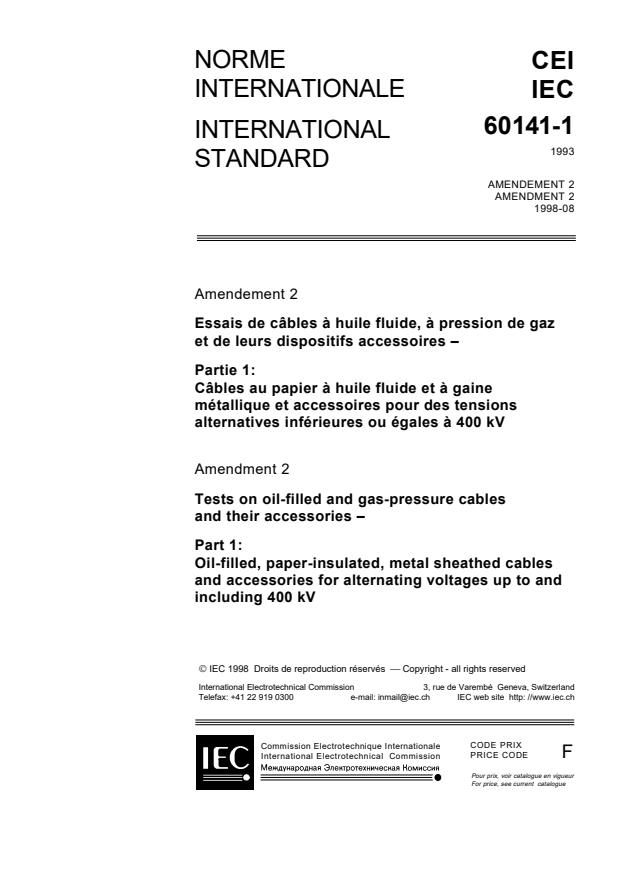
NORME CEI
INTERNATIONALE
IEC
60141-1
INTERNATIONAL
STANDARD
AMENDEMENT 2
AMENDMENT 2
1998-08
Amendement 2
Essais de câbles à huile fluide, à pression de gaz
et de leurs dispositifs accessoires –
Partie 1:
Câbles au papier à huile fluide et à gaine
métallique et accessoires pour des tensions
alternatives inférieures ou égales à 400 kV
Amendment 2
Tests on oil-filled and gas-pressure cables
and their accessories –
Part 1:
Oil-filled, paper-insulated, metal sheathed cables
and accessories for alternating voltages up to and
including 400 kV
IEC 1998 Droits de reproduction réservés Copyright - all rights reserved
International Electrotechnical Commission 3, rue de Varembé Geneva, Switzerland
Telefax: +41 22 919 0300 e-mail: inmail@iec.ch IEC web site http: //www.iec.ch
CODE PRIX
Commission Electrotechnique Internationale
F
PRICE CODE
International Electrotechnical Commission
Pour prix, voir catalogue en vigueur
For price, see current catalogue
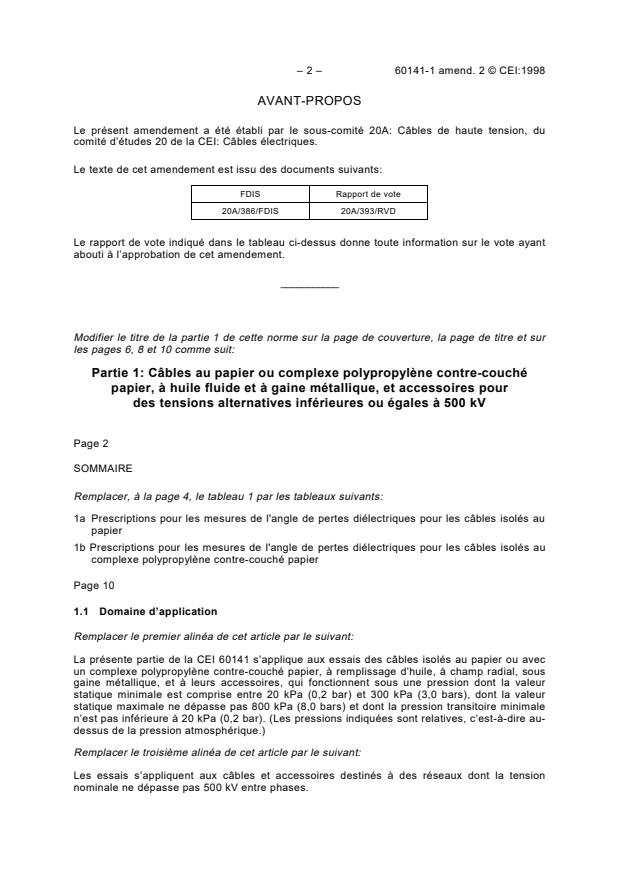
– 2 – 60141-1 amend. 2 © CEI:1998
AVANT-PROPOS
Le présent amendement a été établi par le sous-comité 20A: Câbles de haute tension, du
comité d’études 20 de la CEI: Câbles électriques.
Le texte de cet amendement est issu des documents suivants:
FDIS Rapport de vote
20A/386/FDIS 20A/393/RVD
Le rapport de vote indiqué dans le tableau ci-dessus donne toute information sur le vote ayant
abouti à l’approbation de cet amendement.
___________
Modifier le titre de la partie 1 de cette norme sur la page de couverture, la page de titre et sur
les pages 6, 8 et 10 comme suit:
Partie 1: Câbles au papier ou complexe polypropylène contre-couché
papier, à huile fluide et à gaine métallique, et accessoires pour
des tensions alternatives inférieures ou égales à 500 kV
Page 2
SOMMAIRE
Remplacer, à la page 4, le tableau 1 par les tableaux suivants:
1a Prescriptions pour les mesures de l'angle de pertes diélectriques pour les câbles isolés au
papier
1b Prescriptions pour les mesures de l'angle de pertes diélectriques pour les câbles isolés au
complexe polypropylène contre-couché papier
Page 10
1.1 Domaine d’application
Remplacer le premier alinéa de cet article par le suivant:
La présente partie de la CEI 60141 s’applique aux essais des câbles isolés au papier ou avec
un complexe polypropylène contre-couché papier, à remplissage d’huile, à champ radial, sous
gaine métallique, et à leurs accessoires, qui fonctionnent sous une pression dont la valeur
statique minimale est comprise entre 20 kPa (0,2 bar) et 300 kPa (3,0 bars), dont la valeur
statique maximale ne dépasse pas 800 kPa (8,0 bars) et dont la pression transitoire minimale
n’est pas inférieure à 20 kPa (0,2 bar). (Les pressions indiquées sont relatives, c’est-à-dire au-
dessus de la pression atmosphérique.)
Remplacer le troisième alinéa de cet article par le suivant:
Les essais s’appliquent aux câbles et accessoires destinés à des réseaux dont la tension
nominale ne dépasse pas 500 kV entre phases.
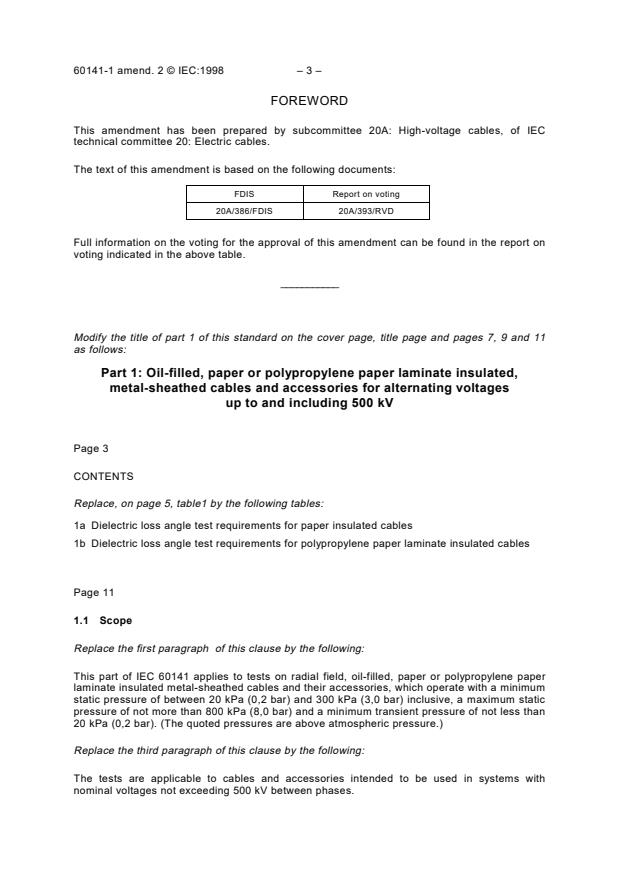
60141-1 amend. 2 © IEC:1998 – 3 –
FOREWORD
This amendment has been prepared by subcommittee 20A: High-voltage cables, of IEC
technical committee 20: Electric cables.
The text of this amendment is based on the following documents:
FDIS Report on voting
20A/386/FDIS 20A/393/RVD
Full information on the voting for the approval of this amendment can be found in the report on
voting indicated in the above table.
___________
Modify the title of part 1 of this standard on the cover page, title page and pages 7, 9 and 11
as follows:
Part 1: Oil-filled, paper or polypropylene paper laminate insulated,
metal-sheathed cables and accessories for alternating voltages
up to and including 500 kV
Page 3
CONTENTS
Replace, on page 5, table1 by the following tables:
1a Dielectric loss angle test requirements for paper insulated cables
1b Dielectric loss angle test requirements for polypropylene paper laminate insulated cables
Page 11
1.1 Scope
Replace the first paragraph of this clause by the following:
This part of IEC 60141 applies to tests on radial field, oil-filled, paper or polypropylene paper
laminate insulated metal-sheathed cables and their accessories, which operate with a minimum
static pressure of between 20 kPa (0,2 bar) and 300 kPa (3,0 bar) inclusive, a maximum static
pressure of not more than 800 kPa (8,0 bar) and a minimum transient pressure of not less than
20 kPa (0,2 bar). (The quoted pressures are above atmospheric pressure.)
Replace the third paragraph of this clause by the following:
The tests are applicable to cables and accessories intended to be used in systems with
nominal voltages not exceeding 500 kV between phases.
– 4 – 60141-1 amend. 2 © CEI:1998
Page 20
2.4 Mesure de l’angle de pertes diélectriques
Remplacer le dernier alinéa de cet article par le suivant:
L’angle de pertes diélectriques et sa variation ne doivent pas dépasser les valeurs indiquées
dans le tableau 1a pour les câbles isolés au papier, ou dans le tableau 1b pour les câbles
isolés avec un complexe polypropylène contre-couché papier, ou les valeurs déclarées si
celles-ci sont inférieures.
2.5 Essai diélectrique
Remplacer le dernier alinéa de cet article par le suivant:
Un essai en courant continu peut être effectué à la place de l’essai en courant alternatif
spécifié ci-dessus, la valeur de la tension d’essai étant
• 2,4 fois celle de la tension alternative d’essai pour les câbles de U inférieure ou égale à
220 kV
• 2,0 fois celle de la tension alternative d’essai pour les câbles de U supérieure à 220 kV
(voir tableau 2)
et la durée de l’essai étant de 15 min. Il ne doit pas se produire de perforation de l’isolation.
Page 28
3.2.4 Examen de l’isolation
Remplacer le second alinéa de ce paragraphe et les points a) et b) par les suivants:
Les rubans isolants doivent être retirés en petit nombre à la fois, et examinés pour leurs
déjoints et leurs déchirures éventuels. Les prescriptions suivantes doivent être respectées:
a) le nombre de rubans isolants qui, sur les 300 mm de l’échantillon, contiennent des
déchirures longitudinales ou sur les bords de plus de 7,5 mm ne doit pas être supérieur à
deux par conducteur, et
b) en aucun point dans l’épaisseur de l'enveloppe isolante il ne doit y avoir plus de
1) deux déchirures en coïncidence, quelle que soit leur longueur, sur deux rubans isolants
adjacents, ou
2) deux déjoints en coïncidence, quelle que soit la longueur de ceux-ci, sur deux rubans
isolants adjacents; cependant, ce nombre maximal admissible de déjoints en
coïncidence est porté à trois pour les zones de changement de sens du rubanage.
Page 30
4.1 Généralités
Ajouter, au paragraphe 4.1.2, à la fin du point a), l’alinéa suivant:
5) même matériau isolant (c’est-à-dire papier ou complexe polypropylène contre-couché
papier).
60141-1 amend. 2 © IEC:1998 – 5 –
Page 21
2.4 Dielectric loss angle test
Replace the last paragraph of this clause by the following:
The dielectric loss angle and the loss-angle difference shall not exceed the appropriate values
given in table 1a for paper-insulated cables or table 1b for polypropylene paper laminate
insulated cables, or the declared values, whichever are the lower.
2.5 High-voltage test
Replace the last paragraph of this clause by the following:
A d.c. test may be applied as an alternative to the a.c. test specified above, the value of the
test voltage being
• 2,4 times the a.c. test voltage for cables with U not exceeding 220 kV
• 2,0 times the a.c. test voltage for cables with U exceeding 220 kV (see table 2)
and the duration of the test being 15 min. No breakdown of the insulation shall occur.
Page 29
3.2.4 Examination of insulation
Replace the second paragraph of this subclause and items a) and b) by the following:
The insulation shall be removed by taking off a small number of tapes at a time, and the tapes
examined for tears and gaps. The following requirements shall be met:
a) the number of insulating tapes which, in the 300 mm length, contain longitudinal or edge
tears exceeding 7,5 mm shall be not more than two per core, and
b) at no point throughout the insulation shall there be more than either
1) two coincidental tears of any length in adjacent insulating tapes, or
2) two coincidental gaps of any length in adjacent insulating tapes, except that the
maximum permissible number of said gaps is three if these coincide with the reversal of
the direction of the lay.
Page 31
4.1 General
Add, in subclause 4.1.2 at the end of item a), the following paragraph:
5) the same type of insulation material (i.e. paper or polypropylene paper laminate).
– 6 – 60141-1 amend. 2 © CEI:1998
Page 32
4.3 Essai de l’angle de pertes diélectriques / température
Remplacer le dernier alinéa de cet article par le suivant:
Pour chacune de ces mesures (aux cinq températures) et pour la tension d’essai U , l’angle de
pe
...