

IEC 60068-2-64:2008
(Main)Environmental testing - Part 2-64: Tests - Test Fh: Vibration, broadband random and guidance
General Information
- Abstract
IEC 60068-2-64:2008 demonstrates the adequacy of specimens to resist dynamic loads without unacceptable degradation of its functional and/or structural integrity when subjected to the specified random vibration test requirements. Broadband random vibration may be used to identify accumulated stress effects and the resulting mechanical weakness and degradation in the specified performance. This information, in conjunction with the relevant specification, may be used to assess the acceptability of specimens. This standard is applicable to specimens which may be subjected to vibration of a stochastic nature resulting from transportation or operational environments, for example in aircraft, space vehicles and land vehicles. It is primarily intended for unpackaged specimens, and for items in their transportation container when the latter may be considered as part of the specimen itself. However, if the item is packaged, then the item itself is referred to as a product and the item and its packaging together are referred to as a test specimen. This standard may be used in conjunction with IEC 60068-2-47:2005, for testing packaged products. If the specimens are subjected to vibration of a combination of random and deterministic nature resulting from transportation or real life environments, for example in aircraft, space vehicles and for items in their transportation container, testing with pure random may not be sufficient. See IEC 60068-3-8:2003 for estimating the dynamic vibration environment of the specimen and based on that, selecting the appropriate test method. The major changes with regard to the previous edition concern the removal of Method 1 and Method 2, replaced by a single method, and replacement of Annex A with suggested test spectra and removal of Annex C. Also included in this revision is the testing of soft packed specimens.
- Status
- Published
- Publication Date
- 08-Oct-2019
- Technical Committee
- TC 104 - Environmental conditions, classification and methods of test
- Drafting Committee
- MT 17 - TC 104/MT 17
- Current Stage
- PPUB - Publication issued
- Start Date
- 29-Apr-2008
- Completion Date
- 31-May-2008
Buy Documents
IEC 60068-2-64:2008 - Environmental testing - Part 2-64: Tests - Test Fh: Vibration, broadband random and guidance Released:4/29/2008

IEC 60068-2-64:2008+AMD1:2019 CSV - Environmental testing - Part 2-64: Tests - Test Fh: Vibration, broadband random and guidance Released:10/9/2019
Overview
IEC 60068-2-64:2008, titled Environmental Testing - Part 2-64: Tests - Test Fh: Vibration, Broadband Random and Guidance, is an international standard published by the International Electrotechnical Commission (IEC). This standard provides a comprehensive methodology for evaluating the ability of specimens-such as electronic equipment and components-to withstand broadband random vibration without unacceptable functional or structural degradation.
The testing simulates dynamic loads typically encountered during transportation or operational environments, including aircraft, space vehicles, and land vehicles. The standard primarily addresses unpackaged specimens, but also extends to items tested within their transportation containers, emphasizing their role as test specimens. For packaged products, it is used alongside IEC 60068-2-47:2005.
Key Topics
Broadband Random Vibration Testing
The core of IEC 60068-2-64 focuses on broadband random vibration, utilized to detect accumulated stress effects that could lead to mechanical weakness or performance degradation.Test Apparatus and Procedures
The standard specifies detailed requirements for test equipment and procedures, including the control of vibration input, measuring systems, cross-axis motion tolerances, and mounting configurations. It underscores the importance of accurate vibration spectral density (ASD) measurements and statistical accuracy.Test Severity and Duration
Guidance is provided on determining vibration severity, incorporating test frequency ranges, root mean square (RMS) acceleration values, and spectral density shapes. Standardized test spectra are also included to represent various environmental profiles such as transportation and stationary installation.Functional Performance Evaluation
The testing process includes preconditioning, initial and final measurements, intermediate functionality assessments, and recovery phases to monitor specimen integrity throughout the test cycle.Non-Gaussian and Modulated Vibration
Although the test centers on Gaussian-distributed vibrations, the standard also offers informative annexes discussing non-Gaussian vibration profiles and testing methods to replicate complex environmental vibrations more realistically.
Applications
IEC 60068-2-64:2008 is critical for industries requiring assurance of equipment durability under real-world vibration stresses, including:
- Aerospace & Space – Validating components and systems for resistance to vibration during launch, flight, and operation.
- Automotive & Land Vehicles – Testing parts and assemblies for transport vibration resilience and operational robustness.
- Electronics Manufacturing – Ensuring reliability of circuit boards, devices, and systems subjected to random vibration environments.
- Packaging Validation – Assessing the protective effect of packaging during shipment and storage when combined with vibration testing.
- Defense and Military – Evaluating ruggedized equipment intended for harsh operational vibration conditions.
This standard helps manufacturers and testing laboratories ensure product reliability, minimize field failures, and improve design robustness by simulating realistic dynamic environments as closely as possible.
Related Standards
- IEC 60068-2-47:2005 – Vibration testing of packaged products often used in conjunction with IEC 60068-2-64.
- IEC 60068-3-8:2003 – Provides methods for estimating combined random and deterministic vibration environments, guiding appropriate test strategy selection.
- IEC 60068 (Series) – A broader set of environmental testing standards covering a variety of mechanical, climatic, and electrical stress tests.
Summary
Adhering to IEC 60068-2-64:2008 enables accurate and reliable testing of specimens exposed to broadband random vibration. By applying controlled stochastic vibration profiles that replicate real-life transport and operational conditions, organizations can confidently assess product durability and performance integrity. Incorporating this standard into environmental testing programs supports robust product development, quality assurance, and compliance with international testing norms, enhancing global market acceptance.
Keywords: IEC 60068-2-64, broadband random vibration, environmental testing standard, vibration testing, dynamic loads, functional integrity, transportation vibration, electronics reliability, aerospace vibration test, packaged product testing.
Relations
- Effective Date
- 06-May-2026
- Effective Date
- 09-Feb-2026
- Effective Date
- 09-Feb-2026
- Effective Date
- 09-Feb-2026
- Effective Date
- 09-Feb-2026
- Effective Date
- 09-Feb-2026
- Effective Date
- 09-Feb-2026
- Effective Date
- 09-Feb-2026
- Effective Date
- 09-Feb-2026
- Effective Date
- 09-Feb-2026
- Effective Date
- 09-Feb-2026
- Effective Date
- 09-Feb-2026
- Effective Date
- 09-Feb-2026
- Effective Date
- 09-Feb-2026
- Effective Date
- 09-Feb-2026
Buy Documents
IEC 60068-2-64:2008 - Environmental testing - Part 2-64: Tests - Test Fh: Vibration, broadband random and guidance Released:4/29/2008
IEC 60068-2-64:2008+AMD1:2019 CSV - Environmental testing - Part 2-64: Tests - Test Fh: Vibration, broadband random and guidance Released:10/9/2019
Get Certified
Connect with accredited certification bodies for this standard

IMP NDT d.o.o.
Non-destructive testing services. Radiography, ultrasonic, magnetic particle, penetrant, visual inspection.
Inštitut za kovinske materiale in tehnologije
Institute of Metals and Technology. Materials testing, metallurgical analysis, NDT.
Q Techna d.o.o.
NDT and quality assurance specialist. 30+ years experience. NDT personnel certification per ISO 9712, nuclear and thermal power plant inspections, QA/
Sponsored listings
Frequently Asked Questions
IEC 60068-2-64:2008 is a standard published by the International Electrotechnical Commission (IEC). Its full title is "Environmental testing - Part 2-64: Tests - Test Fh: Vibration, broadband random and guidance". This standard covers: IEC 60068-2-64:2008 demonstrates the adequacy of specimens to resist dynamic loads without unacceptable degradation of its functional and/or structural integrity when subjected to the specified random vibration test requirements. Broadband random vibration may be used to identify accumulated stress effects and the resulting mechanical weakness and degradation in the specified performance. This information, in conjunction with the relevant specification, may be used to assess the acceptability of specimens. This standard is applicable to specimens which may be subjected to vibration of a stochastic nature resulting from transportation or operational environments, for example in aircraft, space vehicles and land vehicles. It is primarily intended for unpackaged specimens, and for items in their transportation container when the latter may be considered as part of the specimen itself. However, if the item is packaged, then the item itself is referred to as a product and the item and its packaging together are referred to as a test specimen. This standard may be used in conjunction with IEC 60068-2-47:2005, for testing packaged products. If the specimens are subjected to vibration of a combination of random and deterministic nature resulting from transportation or real life environments, for example in aircraft, space vehicles and for items in their transportation container, testing with pure random may not be sufficient. See IEC 60068-3-8:2003 for estimating the dynamic vibration environment of the specimen and based on that, selecting the appropriate test method. The major changes with regard to the previous edition concern the removal of Method 1 and Method 2, replaced by a single method, and replacement of Annex A with suggested test spectra and removal of Annex C. Also included in this revision is the testing of soft packed specimens.
IEC 60068-2-64:2008 demonstrates the adequacy of specimens to resist dynamic loads without unacceptable degradation of its functional and/or structural integrity when subjected to the specified random vibration test requirements. Broadband random vibration may be used to identify accumulated stress effects and the resulting mechanical weakness and degradation in the specified performance. This information, in conjunction with the relevant specification, may be used to assess the acceptability of specimens. This standard is applicable to specimens which may be subjected to vibration of a stochastic nature resulting from transportation or operational environments, for example in aircraft, space vehicles and land vehicles. It is primarily intended for unpackaged specimens, and for items in their transportation container when the latter may be considered as part of the specimen itself. However, if the item is packaged, then the item itself is referred to as a product and the item and its packaging together are referred to as a test specimen. This standard may be used in conjunction with IEC 60068-2-47:2005, for testing packaged products. If the specimens are subjected to vibration of a combination of random and deterministic nature resulting from transportation or real life environments, for example in aircraft, space vehicles and for items in their transportation container, testing with pure random may not be sufficient. See IEC 60068-3-8:2003 for estimating the dynamic vibration environment of the specimen and based on that, selecting the appropriate test method. The major changes with regard to the previous edition concern the removal of Method 1 and Method 2, replaced by a single method, and replacement of Annex A with suggested test spectra and removal of Annex C. Also included in this revision is the testing of soft packed specimens.
IEC 60068-2-64:2008 is classified under the following ICS (International Classification for Standards) categories: 19.040 - Environmental testing. The ICS classification helps identify the subject area and facilitates finding related standards.
IEC 60068-2-64:2008 has the following relationships with other standards: It is inter standard links to EN ISO 80601-2-61:2026, EN ISO 20072:2013, EN ISO 80601-2-85:2021, EN ISO 80601-2-12:2023, EN ISO 4064-2:2025, EN ISO 19014-3:2018, EN ISO 14708-5:2022, EN ISO 21649:2023, EN ISO 80601-2-55:2011, EN ISO 15197:2015, EN ISO 14903:2017, EN ISO 4064-2:2017, EN ISO 15197:2013, EN 16882:2016, EN ISO 80601-2-12:2020. Understanding these relationships helps ensure you are using the most current and applicable version of the standard.
IEC 60068-2-64:2008 is available in PDF format for immediate download after purchase. The document can be added to your cart and obtained through the secure checkout process. Digital delivery ensures instant access to the complete standard document.
Standards Content (Sample)
IEC 60068-2-64
Edition 2.0 2008-04
INTERNATIONAL
STANDARD
NORME
INTERNATIONALE
Environmental testing –
Part 2-64: Tests – Test Fh: Vibration, broadband random and guidance
Essais d’environnement –
Partie 2-64: Essais – Essai Fh: Vibrations aléatoires à large bande et guide
All rights reserved. Unless otherwise specified, no part of this publication may be reproduced or utilized in any form or by
any means, electronic or mechanical, including photocopying and microfilm, without permission in writing from either IEC or
IEC's member National Committee in the country of the requester.
If you have any questions about IEC copyright or have an enquiry about obtaining additional rights to this publication,
please contact the address below or your local IEC member National Committee for further information.
Droits de reproduction réservés. Sauf indication contraire, aucune partie de cette publication ne peut être reproduite
ni utilisée sous quelque forme que ce soit et par aucun procédé, électronique ou mécanique, y compris la photocopie
et les microfilms, sans l'accord écrit de la CEI ou du Comité national de la CEI du pays du demandeur.
Si vous avez des questions sur le copyright de la CEI ou si vous désirez obtenir des droits supplémentaires sur cette
publication, utilisez les coordonnées ci-après ou contactez le Comité national de la CEI de votre pays de résidence.
IEC Central Office
3, rue de Varembé
CH-1211 Geneva 20
Switzerland
Email: inmail@iec.ch
Web: www.iec.ch
About the IEC
The International Electrotechnical Commission (IEC) is the leading global organization that prepares and publishes
International Standards for all electrical, electronic and related technologies.
About IEC publications
The technical content of IEC publications is kept under constant review by the IEC. Please make sure that you have the
latest edition, a corrigenda or an amendment might have been published.
ƒ Catalogue of IEC publications: www.iec.ch/searchpub
The IEC on-line Catalogue enables you to search by a variety of criteria (reference number, text, technical committee,…).
It also gives information on projects, withdrawn and replaced publications.
ƒ IEC Just Published: www.iec.ch/online_news/justpub
Stay up to date on all new IEC publications. Just Published details twice a month all new publications released. Available
on-line and also by email.
ƒ Electropedia: www.electropedia.org
The world's leading online dictionary of electronic and electrical terms containing more than 20 000 terms and definitions
in English and French, with equivalent terms in additional languages. Also known as the International Electrotechnical
Vocabulary online.
ƒ Customer Service Centre: www.iec.ch/webstore/custserv
If you wish to give us your feedback on this publication or need further assistance, please visit the Customer Service
Centre FAQ or contact us:
Email: csc@iec.ch
Tel.: +41 22 919 02 11
Fax: +41 22 919 03 00
A propos de la CEI
La Commission Electrotechnique Internationale (CEI) est la première organisation mondiale qui élabore et publie des
normes internationales pour tout ce qui a trait à l'électricité, à l'électronique et aux technologies apparentées.
A propos des publications CEI
Le contenu technique des publications de la CEI est constamment revu. Veuillez vous assurer que vous possédez
l’édition la plus récente, un corrigendum ou amendement peut avoir été publié.
ƒ Catalogue des publications de la CEI: www.iec.ch/searchpub/cur_fut-f.htm
Le Catalogue en-ligne de la CEI vous permet d’effectuer des recherches en utilisant différents critères (numéro de référence,
texte, comité d’études,…). Il donne aussi des informations sur les projets et les publications retirées ou remplacées.
ƒ Just Published CEI: www.iec.ch/online_news/justpub
Restez informé sur les nouvelles publications de la CEI. Just Published détaille deux fois par mois les nouvelles
publications parues. Disponible en-ligne et aussi par email.
ƒ Electropedia: www.electropedia.org
Le premier dictionnaire en ligne au monde de termes électroniques et électriques. Il contient plus de 20 000 termes et
définitions en anglais et en français, ainsi que les termes équivalents dans les langues additionnelles. Egalement appelé
Vocabulaire Electrotechnique International en ligne.
ƒ Service Clients: www.iec.ch/webstore/custserv/custserv_entry-f.htm
Si vous désirez nous donner des commentaires sur cette publication ou si vous avez des questions, visitez le FAQ du
Service clients ou contactez-nous:
Email: csc@iec.ch
Tél.: +41 22 919 02 11
Fax: +41 22 919 03 00
IEC 60068-2-64
Edition 2.0 2008-04
INTERNATIONAL
STANDARD
NORME
INTERNATIONALE
Environmental testing –
Part 2-64: Tests – Test Fh: Vibration, broadband random and guidance
Essais d’environnement –
Partie 2-64: Essais – Essai Fh: Vibrations aléatoires à large bande et guide
INTERNATIONAL
ELECTROTECHNICAL
COMMISSION
COMMISSION
ELECTROTECHNIQUE
PRICE CODE
INTERNATIONALE
W
CODE PRIX
ICS 19.040 ISBN 2-8318-9745-9
– 2 – 60068-2-64 © IEC:2008
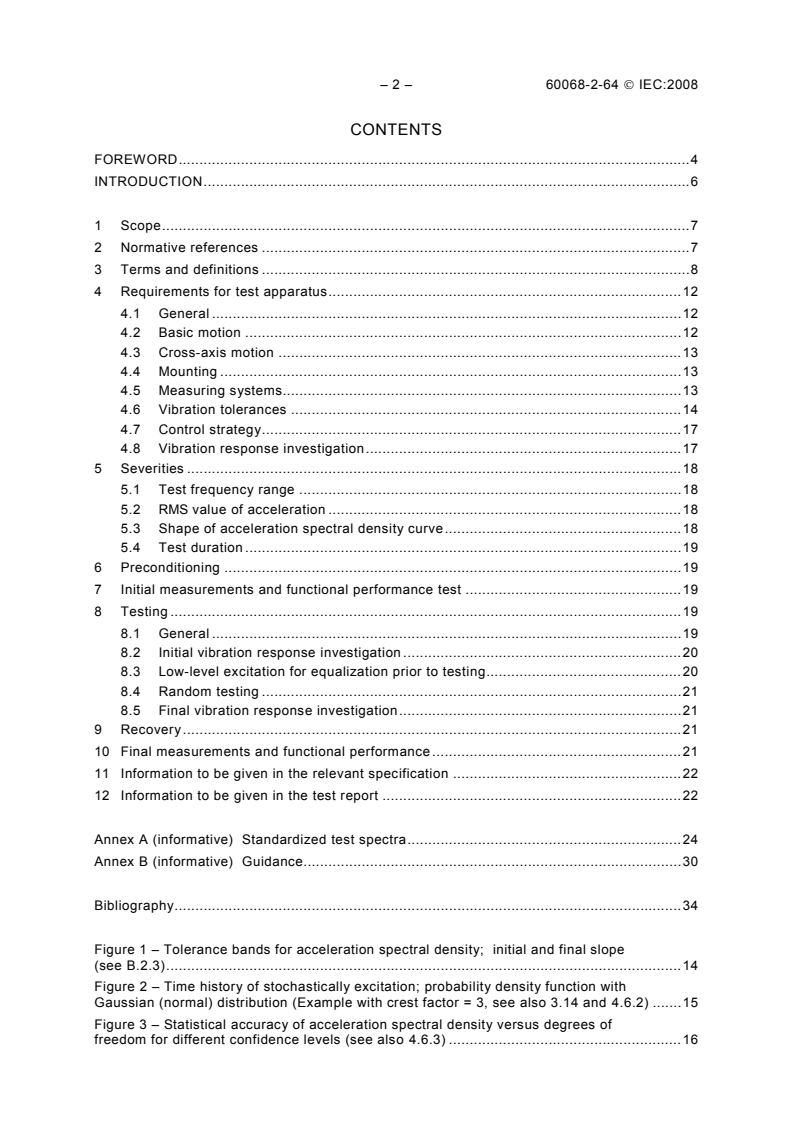
CONTENTS
FOREWORD.4
INTRODUCTION.6
1 Scope.7
2 Normative references .7
3 Terms and definitions .8
4 Requirements for test apparatus.12
4.1 General .12
4.2 Basic motion .12
4.3 Cross-axis motion .13
4.4 Mounting .13
4.5 Measuring systems.13
4.6 Vibration tolerances .14
4.7 Control strategy.17
4.8 Vibration response investigation.17
5 Severities .18
5.1 Test frequency range .18
5.2 RMS value of acceleration .18
5.3 Shape of acceleration spectral density curve.18
5.4 Test duration .19
6 Preconditioning .19
7 Initial measurements and functional performance test .19
8 Testing .19
8.1 General .19
8.2 Initial vibration response investigation .20
8.3 Low-level excitation for equalization prior to testing.20
8.4 Random testing .21
8.5 Final vibration response investigation.21
9 Recovery.21
10 Final measurements and functional performance .21
11 Information to be given in the relevant specification .22
12 Information to be given in the test report .22
Annex A (informative) Standardized test spectra.24
Annex B (informative) Guidance.30
Bibliography.34
Figure 1 – Tolerance bands for acceleration spectral density; initial and final slope
(see B.2.3).14
Figure 2 – Time history of stochastically excitation; probability density function with
Gaussian (normal) distribution (Example with crest factor = 3, see also 3.14 and 4.6.2) .15
Figure 3 – Statistical accuracy of acceleration spectral density versus degrees of
freedom for different confidence levels (see also 4.6.3) .16
60068-2-64 © IEC:2008 – 3 –
Table A.1 – Categories for spectrum: transportation .24
Table A.2 – Break points for spectrum: transportation.25
Table A.3 – Categories for spectrum: stationary installation .25
Table A.4 – Break points for spectrum: stationary installation .26
Table A.5 – Categories for spectrum: equipment in wheeled vehicles .27
Table A.6 – Break points for spectrum: equipment in wheeled vehicles.28
Table A.7 – Categories for spectrum: equipment in airplanes and helicopters .29
Table A.8 – Break points for spectrum: equipment in airplanes and helicopters .29
– 4 – 60068-2-64 © IEC:2008
INTERNATIONAL ELECTROTECHNICAL COMMISSION
____________
ENVIRONMENTAL TESTING –
Part 2-64: Tests – Test Fh: Vibration,
broadband random and guidance
FOREWORD
1) The International Electrotechnical Commission (IEC) is a worldwide organization for standardization comprising
all national electrotechnical committees (IEC National Committees). The object of IEC is to promote
international co-operation on all questions concerning standardization in the electrical and electronic fields. To
this end and in addition to other activities, IEC publishes International Standards, Technical Specifications,
Technical Reports, Publicly Available Specifications (PAS) and Guides (hereafter referred to as “IEC
Publication(s)”). Their preparation is entrusted to technical committees; any IEC National Committee interested
in the subject dealt with may participate in this preparatory work. International, governmental and non-
governmental organizations liaising with the IEC also participate in this preparation. IEC collaborates closely
with the International Organization for Standardization (ISO) in accordance with conditions determined by
agreement between the two organizations.
2) The formal decisions or agreements of IEC on technical matters express, as nearly as possible, an international
consensus of opinion on the relevant subjects since each technical committee has representation from all
interested IEC National Committees.
3) IEC Publications have the form of recommendations for international use and are accepted by IEC National
Committees in that sense. While all reasonable efforts are made to ensure that the technical content of IEC
Publications is accurate, IEC cannot be held responsible for the way in which they are used or for any
misinterpretation by any end user.
4) In order to promote international uniformity, IEC National Committees undertake to apply IEC Publications
transparently to the maximum extent possible in their national and regional publications. Any divergence
between any IEC Publication and the corresponding national or regional publication shall be clearly indicated in
the latter.
5) IEC provides no marking procedure to indicate its approval and cannot be rendered responsible for any
equipment declared to be in conformity with an IEC Publication.
6) All users should ensure that they have the latest edition of this publication.
7) No liability shall attach to IEC or its directors, employees, servants or agents including individual experts and
members of its technical committees and IEC National Committees for any personal injury, property damage or
other damage of any nature whatsoever, whether direct or indirect, or for costs (including legal fees) and
expenses arising out of the publication, use of, or reliance upon, this IEC Publication or any other IEC
Publications.
8) Attention is drawn to the Normative references cited in this publication. Use of the referenced publications is
indispensable for the correct application of this publication.
9) Attention is drawn to the possibility that some of the elements of this IEC Publication may be the subject of
patent rights. IEC shall not be held responsible for identifying any or all such patent rights.
International Standard IEC 60068-2-64 has been prepared by IEC technical committee 104:
Environmental conditions, classification and methods of test.
This second edition cancels and replaces the first edition, published in 1993, and constitutes
a technical revision.
The major changes with regard to the previous edition concern the removal of Method 1 and
Method 2, replaced by a single method, and replacement of Annex A with suggested test
spectra and removal of Annex C.
Also included in this revision is the testing of soft packed specimens.
60068-2-64 © IEC:2008 – 5 –
The text of this standard is based on the following documents:
FDIS Report on voting
104/456/FDIS 104/459/RVD
Full information on the voting for the approval of this standard can be found in the report on
voting indicated in the above table.
This publication has been drafted in accordance with the ISO/IEC Directives, Part 2.
It has the status of a basic safety publication in accordance with IEC Guide 104.
A list of all the parts in the IEC 60068 series, under the general title Environmental testing,
can be found on the IEC website.
The committee has decided that the contents of this publication will remain unchanged until
the maintenance result date indicated on the IEC web site under "http://webstore.iec.ch" in
the data related to the specific publication. At this date, the publication will be
• reconfirmed,
• withdrawn,
• replaced by a revised edition, or
• amended.
– 6 – 60068-2-64 © IEC:2008
INTRODUCTION
This part of IEC 60068 deals with broadband random vibration testing intended for general
application to components, equipment and other products, hereinafter referred to as
”specimens”, that may be subjected to vibrations of a stochastic nature. The methods and
techniques in this standard are based on digital control of random vibration. It permits the
introduction of variations to suit individual cases if these are prescribed by the relevant
specification.
Compared with most other tests, test Fh is not based on deterministic but on statistical
techniques. Broad-band random vibration testing is therefore described in terms of probability
and statistical averages.
It is emphasized that random testing always demands a certain degree of engineering
judgement, and both supplier and purchaser should be fully aware of this fact. The writer of
the relevant specification is expected to select the testing procedure and the values of
severity appropriate to the specimen and its use.
The test method is based primarily on the use of an electrodynamic or a servo-hydraulic
vibration generator with an associated computer based control system used as a vibration
testing system.
Annexes A and B are informative annexes giving examples of test spectra for different
environmental conditions, a list of details to be considered for inclusion in specifications and
guidance.
60068-2-64 © IEC:2008 – 7 –
ENVIRONMENTAL TESTING –
Part 2-64: Tests-Test Fh: Vibration,
broadband random and guidance
1 Scope
This part of IEC 60068 demonstrates the adequacy of specimens to resist dynamic loads
without unacceptable degradation of its functional and/or structural integrity when subjected
to the specified random vibration test requirements.
Broadband random vibration may be used to identify accumulated stress effects and the
resulting mechanical weakness and degradation in the specified performance. This
information, in conjunction with the relevant specification, may be used to assess the
acceptability of specimens.
This standard is applicable to specimens which may be subjected to vibration of a stochastic
nature resulting from transportation or operational environments, for example in aircraft,
space vehicles and land vehicles. It is primarily intended for unpackaged specimens, and for
items in their transportation container when the latter may be considered as part of the
specimen itself. However, if the item is packaged, then the item itself is referred to as a
product and the item and its packaging together are referred to as a test specimen. This
standard may be used in conjunction with IEC 60068-2-47:2005, for testing packaged
products.
If the specimens are subjected to vibration of a combination of random and deterministic
nature resulting from transportation or real life environments, for example in aircraft, space
vehicles and for items in their transportation container, testing with pure random may not be
sufficient. See IEC 60068-3-8:2003 for estimating the dynamic vibration environment of the
specimen and based on that, selecting the appropriate test method.
Although primarily intended for electrotechnical specimens, this standard is not restricted to
them and may be used in other fields where desired (see Annex A).
2 Normative references
The following referenced documents are indispensable for the application of this document.
For dated references, only the edition cited applies. For undated references, the latest edition
of the referenced document (including any amendments) applies.
IEC 60050-300: International Electrotechnical Vocabulary – Electrical and electronic
measurements and measuring instruments – Part 311: General terms relating to
measurements – Part 312: General terms relating to electrical measurements – Part 313:
Types of electrical measuring instruments – Part 314: Specific terms according to the type of
instrument
IEC 60068-1: Environmental testing – Part 1: General and guidance
IEC 60068-2-6: Environmental testing – Part 2-6: Tests – Test Fc: Vibration (sinusoidal)
IEC 60068-2-47:2005, Environmental testing – Part 2-47: Tests – Mounting of specimens for
vibration, impact and similar dynamic tests
– 8 – 60068-2-64 © IEC:2008
IEC 60068-3-8:2003, Environmental testing – Part 3-8: Supporting documentation and
guidance – Selecting amongst vibration tests
IEC 60068-5-2: Environmental testing – Part 5-2: Guide to drafting of test methods – Terms
and definitions
IEC 60721-3 (all parts), Classification of environmental conditions – Part 3: Classification of
groups of environmental parameters and their severities
IEC Guide 104, The preparation of safety publications and the use of basic safety publications
and group safety publications
ISO 2041: Vibration and shock – Vocabulary
3 Terms and definitions
For the purposes of this document, the following terms and definitions apply.
NOTE The terms used are generally defined in IEC 60050-300, IEC 60068-1, IEC 60068-2-6, and IEC 60068-5-2
and ISO 2041. If a definition from one of those sources is included here, the derivation is indicated and departures
from the definitions in those sources are also indicated.
3.1
cross-axis motion
motion not in the direction of the stimulus; generally specified in the two axes orthogonal to
the direction of the stimulus
NOTE The cross-axis motion should be measured close to the fixing points.
3.2
actual motion
motion represented by the wideband signal returned from the reference point transducer
3.3
fixing point
part of the specimen in contact with the fixture or vibration table at a point where the
specimen is normally fastened in service
NOTE If a part of the real mounting structure is used as the fixture, the fixing points are taken as those of the
mounting structure and not of the specimen.
3.4
control methods
3.4.1
single point control
control method using the signal from the transducer at the reference point in order to maintain
this point at the specified vibration level
3.4.2
multipoint control
control method using the signals from each of the transducers at the checkpoints
NOTE The signals are either continuously averaged arithmetically or processed by using comparison techniques,
depending upon the relevant specification. See also 3.13.
3.5
g
n
standard acceleration due to the earth's gravity, which itself varies with altitude and
geographical latitude
60068-2-64 © IEC:2008 – 9 –
NOTE For the purposes of this standard, the value of g is rounded up to the nearest whole number, that is
n
10 m/s .
3.6
measuring points
specific points at which data are gathered for conducting the test
NOTE These points are of three types, as defined in 3.7 to 3.9.
3.7
checkpoint
point located on the fixture, on the vibration table or on the specimen as close as possible to
one of its fixing points, and in any case, rigidly connected to it
NOTE 1 A number of checkpoints are used as a means of ensuring that the test requirements are satisfied.
NOTE 2 If four or fewer fixing points exist, each is used as a checkpoint. For packaged products, where a fixing
point may be interpreted as the packaging surface in contact with the vibration table, one checkpoint may be used,
provided that there are no effects due to resonances of the vibration table or the mounting structure in the
frequency range specified for the test. If this is the case, multipoint control may be necessary, but see also NOTE 3.
If more than four fixing points exist, four representative fixing points will be defined in the relevant specification to
be used as checkpoints.
NOTE 3 In special cases, for example for large or complex specimens, the checkpoints will be prescribed by the
relevant specification if not close to the fixing points.
NOTE 4 Where a large number of small specimens are mounted on one fixture, or in the case of a small specimen
with a number of fixing points, a single checkpoint (that is the reference point) may be selected for the derivation of
the control signal. This signal is then related to the fixture rather than to the fixing points of the specimen(s). This
procedure is only valid when the lowest resonance frequency of the loaded fixture is well above the upper
frequency of the test.
3.8
reference point (single-point control)
point, chosen from amongst the checkpoints, whose signal is used to control the test, such
that the requirements of this standard are satisfied
3.9
fictitious reference point (multipoint control)
point, derived from multiple checkpoints either manually or automatically, the result of which
is used to control the test so that the requirements of this standard are satisfied
3.10
response points
specific points on the specimen from which data is gathered for the purpose of the vibration
response investigation
NOTE These points are not the same as checkpoints or reference points.
3.11
preferred testing axes
three orthogonal axes that correspond to the most vulnerable axes of the specimen
3.12
sampling frequency
number of discrete magnitude values taken per second to record or represent a time-history in
a digital form
3.13
multipoint control strategies
method for calculating the reference control signal when using multipoint control
NOTE Different frequency domain control strategies are discussed to in 4.7.1.
– 10 – 60068-2-64 © IEC:2008
3.14
averaging
process of determining the control acceleration spectral density formed from the arithmetic
average of the acceleration spectral densities at each frequency line of more than one
checkpoint
3.15
extremal (maximum or minimum)
process of determining the control acceleration spectral density formed from the maximum or
minimum acceleration spectral density at each frequency line of more than one checkpoint
3.16
crest factor
ratio of the peak value to the r.m.s. value of the time history
[ISO 2041]
3.17
–3 dB bandwidth
frequency bandwidth between two points in a frequency response function which are at 0,707
of the maximum response when associated with a single resonance peak
3.18
acceleration spectral density
ASD
mean-square value of that part of an acceleration signal passed by a narrow-band filter of a
centre frequency, per unit bandwidth, in the limit as the bandwidth approaches zero and the
averaging time approaches infinity
3.19
control acceleration spectral density
acceleration spectral density measured at the reference point or the fictitious reference point
3.20
control system loop
sum of the following actions:
– digitizing the analogue waveform of the signal derived from the reference point or fictitious
reference point;
– performing the necessary processing;
– producing an updated analogue drive waveform to the vibration system power amplifier
(see Clause B.1.)
3.21
drive signal clipping (see also Figure 1)
limitation of the maximum crest factor of the drive signal effective frequency range
3.22
effective frequency range (see also Figure 1)
frequency range between 0,5 times f and 2,0 times f
1 2
NOTE Due to initial and final slope, the effective frequency range is higher than the test frequency range between
f and f .
1 2
3.23
error acceleration spectral density
difference between the specified acceleration spectral density and the control acceleration
spectral density
60068-2-64 © IEC:2008 – 11 –
3.24
equalization
minimization of the error acceleration spectral density
3.25
final slope (see also Figure 1)
part of the specified acceleration spectral density above f
3.26
frequency resolution
B
e
width of the frequency intervals in the acceleration spectral density in Hertz
NOTE It is equal to the reciprocal of the record block length (T) in digital analysis; the number of frequency lines
is equal to the number of intervals in a given frequency range
3.27
indicated acceleration spectral density
estimate of the true acceleration spectral density read from the analyser presentation
distorted by the instrument error and the random error
3.28
initial slope (see also Figure 1)
part of the specified acceleration spectral density below f
3.29
instrument error
error associated with each analogue item of the input to the control system and control
system analogue items
3.30
random error
error changing from one estimate to another of the acceleration spectral density because of
the limitation of averaging time and filter bandwidth in practice
3.31
record
collection of equally spaced data points in the time domain that are used in the calculation of
the Fast Fourier Transform
3.32
reproducibility
closeness of the agreement between the results of measurements of the same value of the
same quantity, where the individual measurements are made
– by different methods,
– with different measuring instruments,
– by different observers,
– in different laboratories,
– after intervals of time which are long compared with the duration of a single measurement,
– under different customary conditions of use of the instruments employed
NOTE The term “reproducible” also applies to the case where only certain of the preceding conditions are taken
into account.
[IEC 60050-300, modified]
– 12 – 60068-2-64 © IEC:2008
3.33
root-mean-square value (see also Figure 2)
root-mean-square value (r.m.s. value) of a single-valued function over an interval between
two frequencies is the square root of the average of the squared values of all functions over
the total frequency interval f and f
1 2
3.34
standard deviation, σ (see also Figure 2)
in vibration theory, the mean value of vibration is equal to zero; therefore for a random time
history, the standard deviation is equal to the r.m.s. value
3.35
statistical accuracy
ratio of true acceleration spectral density to indicated acceleration spectral density
3.36
statistical degrees of freedom (see also Figure 3)
DOF
for estimation of acceleration spectral density of random data with a time-averaging technique,
the effective number of statistical degrees of freedom is derived from the frequency resolution
and the effective averaging time
3.37
test frequency range
and f (see Figure 1) in which the ASD is constant or shaped as
frequency range between f
1 2
given in the relevant specification
3.38
true acceleration spectral density
acceleration spectral density of the random signal acting on the specimen
4 Requirements for test apparatus
4.1 General
The required characteristics apply to the complete vibration system, which includes the power
amplifier, vibrator, test fixture, specimen and control system when loaded for testing.
The standardized test method consists of the following test sequence normally applied in each
of the mutually perpendicular axes of the test specimen:
1) An initial vibration response investigation, with low level sinusoidal excitation,
or low level random excitation, (see 8.2).
2) The random excitation as the mechanical load or stress test.
3) A final vibration response investigation to compare the results with the initial one and to
detect possible mechanical failures due to a change of the dynamic behaviour (see 8.2
and 8.5).
Where the dynamic behaviour is known, and it is not considered relevant, or sufficient data
can be gathered during the test at full level, the relevant specification may not require pre and
post test vibration response investigations.
4.2 Basic motion
The basic motion of the fixing points of the specimen shall be prescribed by the relevant
specification. The fixing points shall have substantially identical motions in phase and
amplitude and shall be rectilinear relative to the direction of excitation. If substantially
identical motions are difficult to achieve, then multipoint control shall be used.
60068-2-64 © IEC:2008 – 13 –
NOTE For large structures and a high frequency range, for example 20 Hz – 2 000 Hz, the dynamics of the test
specimen is likely to require multipoint control.
4.3 Cross-axis motion
Cross-axis motion should be checked, if required by the relevant specification, either before
the test is applied by conducting a sine or random investigation at a level prescribed by the
relevant specification, or during testing by utilising additional monitoring channels in the two
perpendicular axes.
The ASD value of each frequency at the checkpoints in both axes perpendicular to the
specified axis shall not exceed the specified ASD values above 500 Hz and below 500 Hz
shall not exceed –3 dB of the specified ASD values. The total r.m.s. value of acceleration in
both axes perpendicular to the specified axis shall not exceed 50 % of the r.m.s. value for the
specified axis. For example for a small specimen, the ASD value of the permissible cross axis
motion may be limited such that it does not exceed –3 dB of the basic motion, if so prescribed
by the relevant specification.
At some frequencies or with large-size or high-mass specimens, it may be difficult to achieve
these values. Also, in those cases where the relevant specification requires severities with a
large dynamic range, it may also be difficult to achieve these. In such cases, the relevant
specification shall state which of the following requirements applies:
a) any cross-axis motion in excess of that given above shall be stated in the test report;
b) cross-axis motion which is known to offer no hazard to the specimen need not be
monitored.
4.4 Mounting
The specimen shall be mounted in accordance with IEC 60068-2-47. In any case, the
transmissibility curve chosen from IEC 60068-2-47 must be squared before multiplication with
the ASD spectrum.
4.5 Measuring systems
The characteristics of the measuring system shall be such that it can be determined whether
the true value of the vibration as measured in the intended axis at the reference point is within
the tolerance required for the test.
The frequency response of the overall measuring system, which includes the transducer, the
signal conditioner and the data acquisition and processing device, has a significant effect on
the accuracy of the measurements. The frequency range of the measuring system shall
extend from at least 0,5 times the lowest frequency (f ) to 2,0 times the highest frequency (f )
1 2
of the test frequency range (see Figure 1). The frequency response of the measuring system
shall be flat within ±5 % of the test frequency range. Outside of this range any further
deviation shall be stated in the test report.
– 14 – 60068-2-64 © IEC:2008
+3 dB
–3dB
Initial slope Final slope
normally –24 dB/octave
+6 dB/octave or steeper
0,5f f f f f 2f
1 1 a b 2 2
Frequency (Hz) (log. scale)
IEC 581/08
Figure 1 – Tolerance bands for acceleration spectral density;
initial and final slope (see B.2.3)
4.6 Vibration tolerances
4.6.1 ASD and r.m.s. value
The indicated acceleration spectral density in the required axis at the reference point between
f and f in Figure 1 shall be within ±3 dB, allowing for the instrument and random error,
1 2
referred to the specified acceleration spectral density.
The r.m.s. value of acceleration, computed or measured between f and f , shall not deviate
1 2
more than 10 % from the r.m.s. value associated with the specified acceleration spectral
density. These values are valid for both the reference point and fictitious reference point.
At some frequencies, or with large-size or high-mass specimens, it may be difficult to achieve
these values. In such cases, the relevant specification shall prescribe a wider tolerance.
The initial slope shall not be less than +6 dB/octave and the final slope shall be –24 dB/
octave or steeper (see also B.2.3).
4.6.2 Distribution
The instantaneous acceleration values at the reference point shall have an approximately
normal (Gaussian) distribution as given in Figure 2. If explicitly desired, a validation shall be
performed during normal system calibration (see B.2.2).
The drive signal clipping shall have a value of at least 2,5 (see 3.16). The crest factor of the
acceleration signal at the reference point shall be examined to ensure that the signal contains
peaks of at least 3 times the specified r.m.s. value, unless otherwise prescribed by the
relevant specification.
Acceleration spectral density (dB)
60068-2-64 © IEC:2008 – 15 –
If a fictitious reference point is used for control, the requirement for the crest factor applies to
each individual checkpoint used to form the control acceleration spectral density.
The probability density function shall be computed for the reference point for a duration of
2 min during testing. The admissible deviation from the normal distribution, Figure 2, shall be
prescribed in the relevant specification.
Peak value
3σ
2σ
σ
RMS value
Probability
Time
σ
2σ
Peak value
3σ
IEC 582/08
Figure 2 – Time history of stochastically excitation;
probability density function with Gaussian (normal) distribution
(example with crest factor = 3, see also 3.14 and 4.6.2)
4.6.3 Statistical accuracy
The statistical accuracy is determined from the statistical degrees of freedom N and the
d
confidence level (see also Figure 3). The statistical degrees of freedom are given by:
N = 2B × T (1)
d e a
where
B is the frequency resolution;
e
T is the effective averaging time.
a
N shall not be less than 120 DOF, unless otherwise specified by the relevant
d
specification. If the relevant specification states confidence levels to be met during the
test, Figure 3 should be used to calculate statistical accuracy.
– 16 – 60068-2-64 © IEC:2008
dB %
99 %
Confidence levels
95 %
90 %
50 %
90 50 %
–1
90 %
–2
95 %
99 %
–3
–4 40
30 40 50 60 70 80 90 100 120 200 300 400 500
Statistical degrees of freedom
IEC 629/05
Figure 3 – Statistical accuracy of acceleration spectral density versus
degrees of freedom for different confidence levels
(see also 4.6.3)
4.6.4 Frequency resolution
The frequency resolution B in Hz necessary to minimize the difference between the true and
e
the indicated acceleration spectral density shall be selected by taking the digital controller
frequency range divided by the number of spectral lines (n).
B = f /n (2)
e high
where
f is the frequency range chosen from the options provided by the digital vibration control
high
system in Hertz and should be equal or greater than 2f , that is f ≥ 2f , see Figure 1;
2 high 2
n is the number of spectral lines equally spread over the frequency range to f .
high
The number of spectral lines, n, should be at least 200. Frequency resolution shall be given in
the relevant specification (see also Clause 11, item j)) and stated in the test report.
B shall be chosen such that, as a minimum, a frequency line coincides with the frequency f
e
in Figure 1 and the first frequency line is at 0,5 of f ; also that two frequency lines define the
initial slope. If this gives two different values then the smallest B shall be chosen.
e
NOTE There is a compromise between having a finer B , resulting in a longer loop control time and better
e
definition of the spectrum, or having a coarser B , resulting in a shorter loop control time and worse definition of
e
the spectrum.
Statistical accuracy
60068-2-64 © IEC:2008 – 17 –
4.7 Control strategy
4.7.1 Single/multipoint control
When multipoint control is specified or necessary, the control strategy shall be specified.
The relevant specification shall state whether single point or multipoint control shall be used.
If multipoint control is prescribed, the relevant specification shall state whether the average
value of the signals at the checkpoints or the extremal value out of the signals at the selected
control points shall be controlled to the specified level. For multipoint control, the relevant
specification should state whether an unprocessed spectrum of each of the control channels
contributing to the control spectrum should be added to the test report.
NOTE If it is not possible to achieve single point control, then multipoint control should be used by controlling the
average or extreme value of the signals at the checkpoints. In either of these cases of multipoint control, the point
is a fictitious reference point. The method used should be stated in the test report.
The following strategies are available.
4.7.1.1 Averaging strategy
In this method, the control value is computed from the signals from each checkpoint. A
composite control value is formed by arithmetically averaging the ASD value at each
frequency line from the checkpoints. This arithmetically averaged control value is then
compared with the specified ASD value of each frequency.
4.7.1.2 Weighted averaging strategy
The control ASD of each frequency a is formed by averaging the ASD from the checkpoints
C
a to a according to their weighting w to w :
1 n 1 n
a = (w x a + w x a +….+ w x a ) / (w + w +…+ w )
C 1 1 2 2 n n 1 2 n
This control strategy offers the possibility that different checkpoint signals contribute a
different portion to the control value of each frequency.
4.7.1.3 Extremal strategy
In this method, a composite control ASD is computed from the maximum (MAX) or the
minimum (MIN) extreme ASD values of each frequency line measured at each checkpoint.
This strategy will produce a control value of each frequency that represents the envelope of
the ASD values as a function of frequency from each checkpoint (MAX) or a lower limit of the
ASD values as a function of frequency from each checkpoint (MIN).
4.7.2 Multireference control
If specified by the relevant specification, multiple reference spectra may be defined for
different checkpoints or measuring points or different types of controlled variables, for
example, for force limited vibration testing.
When multireference control is specified, the control strategy shall be either:
Limiting: All control signals shall be beneath their appropriate reference spectrum.
Superseding: All control signals shall be above their appropriate reference spectrum.
4.8 Vibration response investigation
The vibration response investigation is a convenient and sensitive method for the evaluation
of the effects of vibration testing, see IEC 60068-3-8. Aims, purposes and methods for
vibration response investigations with its advantages are explained in IEC 60068-3-8. The
– 18 – 60068-2-64 © IEC:2008
requirements for sinusoidal excitation are given in test Fc (IEC 60068-2-6) and those for random
excitation are given in this standard.
In the case of sinusoidal excitation, it should be remembered that, in the case of non-linear
resonances, the resonance frequencies will change depending on the direction of the
frequency variation during the sweep. For random excitation non linearities can influence the
resonance behaviour. For sinusoidal and random excitation, the amplification at resonances
may be dependent on the magnitude of the input vibration.
For the vibration response investigations of an ‘undefined type’ specimen or package, it may
be necessary to measure different signals such as driving force or velocity. If specified by the
relevant specification, for example, the spectra of the mechanical impedance of the specimen
should be calculated before and after the test.
NOTE Mechanical impedance and other similar terms are defined in ISO 2041.
5 Severities
The test severity is determined by the combination of all the following parameters:
– test frequency range;
– r.m.s. value of acceleration;
– shape of acceleration spectral density;
– duration of testing.
Each parameter shall be prescribed by the relevant specification. They may be:
a) chosen from the values given in 5.1 to 5.4;
b) chosen from the examples in Annex A for different environmental conditions;
c) derived
...
IEC 60068-2-64 ®
Edition 2.1 2019-10
CONSOLIDATED VERSION
INTERNATIONAL
STANDARD
NORME
INTERNATIONALE
colour
inside
Environmental testing –
Part 2-64: Tests – Test Fh: Vibration, broadband random and guidance
Essais d’environnement –
Partie 2-64: Essais – Essai Fh: Vibrations aléatoires à large bande et guide
All rights reserved. Unless otherwise specified, no part of this publication may be reproduced or utilized in any form
or by any means, electronic or mechanical, including photocopying and microfilm, without permission in writing from
either IEC or IEC's member National Committee in the country of the requester. If you have any questions about IEC
copyright or have an enquiry about obtaining additional rights to this publication, please contact the address below or
your local IEC member National Committee for further information.
Droits de reproduction réservés. Sauf indication contraire, aucune partie de cette publication ne peut être reproduite
ni utilisée sous quelque forme que ce soit et par aucun procédé, électronique ou mécanique, y compris la photocopie
et les microfilms, sans l'accord écrit de l'IEC ou du Comité national de l'IEC du pays du demandeur. Si vous avez des
questions sur le copyright de l'IEC ou si vous désirez obtenir des droits supplémentaires sur cette publication, utilisez
les coordonnées ci-après ou contactez le Comité national de l'IEC de votre pays de résidence.
IEC Central Office Tel.: +41 22 919 02 11
3, rue de Varembé info@iec.ch
CH-1211 Geneva 20 www.iec.ch
Switzerland
About the IEC
The International Electrotechnical Commission (IEC) is the leading global organization that prepares and publishes
International Standards for all electrical, electronic and related technologies.
About IEC publications
The technical content of IEC publications is kept under constant review by the IEC. Please make sure that you have the
latest edition, a corrigendum or an amendment might have been published.
IEC publications search - webstore.iec.ch/advsearchform Electropedia - www.electropedia.org
The advanced search enables to find IEC publications by a The world's leading online dictionary on electrotechnology,
variety of criteria (reference number, text, technical containing more than 22 000 terminological entries in English
committee,…). It also gives information on projects, replaced and French, with equivalent terms in 16 additional languages.
and withdrawn publications. Also known as the International Electrotechnical Vocabulary
(IEV) online.
IEC Just Published - webstore.iec.ch/justpublished
Stay up to date on all new IEC publications. Just Published IEC Glossary - std.iec.ch/glossary
details all new publications released. Available online and 67 000 electrotechnical terminology entries in English and
once a month by email. French extracted from the Terms and Definitions clause of
IEC publications issued since 2002. Some entries have been
IEC Customer Service Centre - webstore.iec.ch/csc collected from earlier publications of IEC TC 37, 77, 86 and
If you wish to give us your feedback on this publication or CISPR.
need further assistance, please contact the Customer Service
Centre: sales@iec.ch.
A propos de l'IEC
La Commission Electrotechnique Internationale (IEC) est la première organisation mondiale qui élabore et publie des
Normes internationales pour tout ce qui a trait à l'électricité, à l'électronique et aux technologies apparentées.
A propos des publications IEC
Le contenu technique des publications IEC est constamment revu. Veuillez vous assurer que vous possédez l’édition la
plus récente, un corrigendum ou amendement peut avoir été publié.
Recherche de publications IEC - Electropedia - www.electropedia.org
webstore.iec.ch/advsearchform Le premier dictionnaire d'électrotechnologie en ligne au
La recherche avancée permet de trouver des publications IEC monde, avec plus de 22 000 articles terminologiques en
en utilisant différents critères (numéro de référence, texte, anglais et en français, ainsi que les termes équivalents dans
comité d’études,…). Elle donne aussi des informations sur les 16 langues additionnelles. Egalement appelé Vocabulaire
projets et les publications remplacées ou retirées. Electrotechnique International (IEV) en ligne.
IEC Just Published - webstore.iec.ch/justpublished Glossaire IEC - std.iec.ch/glossary
Restez informé sur les nouvelles publications IEC. Just 67 000 entrées terminologiques électrotechniques, en anglais
Published détaille les nouvelles publications parues. et en français, extraites des articles Termes et Définitions des
Disponible en ligne et une fois par mois par email. publications IEC parues depuis 2002. Plus certaines entrées
antérieures extraites des publications des CE 37, 77, 86 et
Service Clients - webstore.iec.ch/csc CISPR de l'IEC.
Si vous désirez nous donner des commentaires sur cette
publication ou si vous avez des questions contactez-nous:
sales@iec.ch.
IEC 60068-2-64 ®
Edition 2.1 2019-10
CONSOLIDATED VERSION
INTERNATIONAL
STANDARD
NORME
INTERNATIONALE
colour
inside
Environmental testing –
Part 2-64: Tests – Test Fh: Vibration, broadband random and guidance
Essais d’environnement –
Partie 2-64: Essais – Essai Fh: Vibrations aléatoires à large bande et guide
INTERNATIONAL
ELECTROTECHNICAL
COMMISSION
COMMISSION
ELECTROTECHNIQUE
INTERNATIONALE
ICS 19.040 ISBN 978-2-8322-7498-9
IEC 60068-2-64 ®
Edition 2.1 2019-10
CONSOLIDATED VERSION
REDLINE VERSION
VERSION REDLINE
colour
inside
Environmental testing –
Part 2-64: Tests – Test Fh: Vibration, broadband random and guidance
Essais d’environnement –
Partie 2-64: Essais – Essai Fh: Vibrations aléatoires à large bande et guide
– 2 – IEC 60068-2-64:2008+AMD1:2019 CSV
IEC 2019
CONTENTS
FOREWORD . 4
INTRODUCTION . 6
1 Scope . 7
2 Normative references . 7
3 Terms and definitions . 8
4 Requirements for test apparatus . 13
4.1 General . 13
4.2 Basic motion . 14
4.3 Cross-axis motion . 14
4.4 Mounting . 14
4.5 Measuring systems. 14
4.6 Vibration tolerances . 15
4.6.1 ASD and r.m.s. value . 15
4.6.2 Distribution . 15
4.6.3 Statistical accuracy. 16
4.6.4 Frequency resolution . 17
4.7 Control strategy . 18
4.7.1 Single/multipoint control . 18
4.7.2 Multireference control . 18
4.8 Vibration response investigation . 18
5 Severities . 19
5.1 Test frequency range . 19
5.2 RMS value of acceleration . 19
5.3 Shape of acceleration spectral density curve . 20
5.4 Test duration . 20
6 Preconditioning . 20
7 Initial measurements and functional performance test . 20
8 Testing . 20
8.1 General . 20
8.2 Initial vibration response investigation . 21
8.3 Low-level excitation for equalization prior to testing . 22
8.4 Random testing . 22
8.4.1 General . 22
8.4.2 Intermediate measurements and functional performance . 23
8.5 Final vibration response investigation . 23
9 Recovery . 24
10 Final measurements and functional performance . 24
11 Information to be given in the relevant specification . 24
12 Information to be given in the test report . 25
Annex A (informative) Standardized test spectra . 26
Annex B (informative) Guidance. 32
B.1 General introduction . 32
B.2 Requirements for testing . 32
B.2.1 Single-point and multipoint control . 32
IEC 2019
B.2.2 Distribution . 33
B.2.3 Initial and final slope. 34
B.3 Testing procedures . 34
B.4 Equipment normally used with vibration isolators . 35
B.4.1 Transmissibility factors for isolators . 35
B.4.2 Temperature effect . 35
B.5 Test severities . 35
B.6 Equipment performance . 35
B.7 Initial and final measurements . 35
Annex C (informative) Guidance on non-Gaussian distribution/high kurtosis tests . 36
C.1 Non-Gaussian random vibration . 36
C.2 Methods to generate non-Gaussian random vibration . 36
C.2.1 General . 36
C.2.2 Amplitude modulation technique . 37
C.2.3 Phase modification technique . 37
C.2.4 Non-uniform phase technique . 38
C.3 Additional analysis . 38
C.4 Frequency range . 39
Bibliography . 40
Figure 1 – Tolerance bands for acceleration spectral density; initial and final slope
(see B.2.3) . 15
Figure 2 – Time history of stochastically excitation; probability density function with
Gaussian (normal) distribution (example with crest factor = 3, see also 3.14 and 4.6.2) . 16
Figure 3 – Statistical accuracy of acceleration spectral density versus degrees of
freedom for different confidence levels (see also 4.6.3) . 17
Figure 4 – Examples of the beta distribution with different α and β values . 13
Figure 5 – Time history of non-Gaussian excitation – Probability density function
compared with Gaussian (normal) distribution . 23
Figure A.1 – Frequency/amplitude break points – Transportation . 26
Figure A.2 – Stationary installation spectrum – Frequency/amplitude break points . 27
Figure A.3 – Equipment in wheeled vehicles – Frequency/amplitude break points . 29
Figure A.4 – Equipment installed in airplanes and helicopters . 30
Table A.1 – Categories for spectrum – Transportation . 26
Table A.2 – Break points for spectrum: transportation . 27
Table A.3 – Categories for spectrum: stationary installation . 28
Table A.4 – Break points for spectrum: stationary installation . 28
Table A.5 – Categories for spectrum: equipment in wheeled vehicles . 29
Table A.6 – Break points for spectrum: equipment in wheeled vehicles . 30
Table A.7 – Categories for spectrum: equipment in airplanes and helicopters . 31
Table A.8 – Break points for spectrum: equipment in airplanes and helicopters . 31
– 4 – IEC 60068-2-64:2008+AMD1:2019 CSV
IEC 2019
INTERNATIONAL ELECTROTECHNICAL COMMISSION
____________
ENVIRONMENTAL TESTING –
Part 2-64: Tests – Test Fh: Vibration,
broadband random and guidance
FOREWORD
1) The International Electrotechnical Commission (IEC) is a worldwide organization for standardization comprising
all national electrotechnical committees (IEC National Committees). The object of IEC is to promote
international co-operation on all questions concerning standardization in the electrical and electronic fields. To
this end and in addition to other activities, IEC publishes International Standards, Technical Specifications,
Technical Reports, Publicly Available Specifications (PAS) and Guides (hereafter referred to as “IEC
Publication(s)”). Their preparation is entrusted to technical committees; any IEC National Committee interested
in the subject dealt with may participate in this preparatory work. International, governmental and non-
governmental organizations liaising with the IEC also participate in this preparation. IEC collaborates closely
with the International Organization for Standardization (ISO) in accordance with conditions determined by
agreement between the two organizations.
2) The formal decisions or agreements of IEC on technical matters express, as nearly as possible, an international
consensus of opinion on the relevant subjects since each technical committee has representation from all
interested IEC National Committees.
3) IEC Publications have the form of recommendations for international use and are accepted by IEC National
Committees in that sense. While all reasonable efforts are made to ensure that the technical content of IEC
Publications is accurate, IEC cannot be held responsible for the way in which they are used or for any
misinterpretation by any end user.
4) In order to promote international uniformity, IEC National Committees undertake to apply IEC Publications
transparently to the maximum extent possible in their national and regional publications. Any divergence
between any IEC Publication and the corresponding national or regional publication shall be clearly indicated in
the latter.
5) IEC provides no marking procedure to indicate its approval and cannot be rendered responsible for any
equipment declared to be in conformity with an IEC Publication.
6) All users should ensure that they have the latest edition of this publication.
7) No liability shall attach to IEC or its directors, employees, servants or agents including individual experts and
members of its technical committees and IEC National Committees for any personal injury, property damage or
other damage of any nature whatsoever, whether direct or indirect, or for costs (including legal fees) and
expenses arising out of the publication, use of, or reliance upon, this IEC Publication or any other IEC
Publications.
8) Attention is drawn to the Normative references cited in this publication. Use of the referenced publications is
indispensable for the correct application of this publication.
9) Attention is drawn to the possibility that some of the elements of this IEC Publication may be the subject of
patent rights. IEC shall not be held responsible for identifying any or all such patent rights.
This consolidated version of the official IEC Standard and its amendment has been
prepared for user convenience.
IEC 60068-2-64 edition 2.1 contains the second edition (2008-04) [documents 104/456/
FDIS and 104/459/RVD] and its amendment 1 (2019-10) [documents 104/848/FDIS and
104/855/RVD].
In this Redline version, a vertical line in the margin shows where the technical content
is modified by amendment 1. Additions are in green text, deletions are in strikethrough
red text. A separate Final version with all changes accepted is available in this
publication.
IEC 2019
International Standard IEC 60068-2-64 has been prepared by IEC technical committee 104:
Environmental conditions, classification and methods of test.
This second edition constitutes a technical revision.
The major changes with regard to the previous edition concern the removal of Method 1 and
Method 2, replaced by a single method, and replacement of Annex A with suggested test
spectra and removal of Annex C.
Also included in this revision is the testing of soft packed specimens.
This publication has been drafted in accordance with the ISO/IEC Directives, Part 2.
It has the status of a basic safety publication in accordance with IEC Guide 104.
A list of all the parts in the IEC 60068 series, under the general title Environmental testing,
can be found on the IEC website.
The committee has decided that the contents of the base publication and its amendment will
remain unchanged until the stability date indicated on the IEC web site under
"http://webstore.iec.ch" in the data related to the specific publication. At this date, the
publication will be
• reconfirmed,
• withdrawn,
• replaced by a revised edition, or
• amended.
IMPORTANT – The 'colour inside' logo on the cover page of this publication indicates
that it contains colours which are considered to be useful for the correct
understanding of its contents. Users should therefore print this document using a
colour printer.
– 6 – IEC 60068-2-64:2008+AMD1:2019 CSV
IEC 2019
INTRODUCTION
This part of IEC 60068 deals with broadband random vibration testing intended for general
application to components, equipment and other products, hereinafter referred to as
”specimens”, that may be subjected to vibrations of a stochastic nature. The methods and
techniques in this standard are based on digital control of random vibration. It permits the
introduction of variations to suit individual cases if these are prescribed by the relevant
specification.
Compared with most other tests, test Fh is not based on deterministic but on statistical
techniques. Broad-band random vibration testing is therefore described in terms of probability
and statistical averages.
It is emphasized that random testing always demands a certain degree of engineering
judgement, and both supplier and purchaser should be fully aware of this fact. The writer of
the relevant specification is expected to select the testing procedure and the values of
severity appropriate to the specimen and its use.
The test method is based primarily on the use of an electrodynamic or a servo-hydraulic
vibration generator with an associated computer based control system used as a vibration
testing system.
The traditional general purpose broad-band random vibration test utilizes waveforms with a
Gaussian distribution of amplitudes. However, when so specified, this test procedure can also
be utilized with random vibration tests with a non-Gaussian distribution of amplitudes. Such
tests are sometimes alternatively known as high kurtosis tests.
Annexes A and B are informative annexes giving examples of test spectra for different
environmental conditions, a list of details to be considered for inclusion in specifications and
guidance.
Annex C is an informative annex giving information on non-Gaussian distribution/high kurtosis
tests.
IEC 2019
ENVIRONMENTAL TESTING –
Part 2-64: Tests-Test Fh: Vibration,
broadband random and guidance
1 Scope
This part of IEC 60068 demonstrates the adequacy of specimens to resist dynamic loads
without unacceptable degradation of its functional and/or structural integrity when subjected
to the specified random vibration test requirements.
Broadband random vibration may be used to identify accumulated stress effects and the
resulting mechanical weakness and degradation in the specified performance. This
information, in conjunction with the relevant specification, may be used to assess the
acceptability of specimens.
This standard is applicable to specimens which may be subjected to vibration of a stochastic
nature resulting from transportation or operational environments, for example in aircraft,
space vehicles and land vehicles. It is primarily intended for unpackaged specimens, and for
items in their transportation container when the latter may be considered as part of the
specimen itself. However, if the item is packaged, then the item itself is referred to as a
product and the item and its packaging together are referred to as a test specimen. This
standard may be used in conjunction with IEC 60068-2-47:2005, for testing packaged
products.
If the specimens are subjected to vibration of a combination of random and deterministic
nature resulting from transportation or real life environments, for example in aircraft, space
vehicles and for items in their transportation container, testing with pure random may not be
sufficient. See IEC 60068-3-8:2003 for estimating the dynamic vibration environment of the
specimen and based on that, selecting the appropriate test method.
Although primarily intended for electrotechnical specimens, this standard is not restricted to
them and may be used in other fields where desired (see Annex A).
2 Normative references
The following referenced documents are indispensable for the application of this document.
For dated references, only the edition cited applies. For undated references, the latest edition
of the referenced document (including any amendments) applies.
IEC 60050-300: International Electrotechnical Vocabulary – Electrical and electronic
measurements and measuring instruments – Part 311: General terms relating to
measurements – Part 312: General terms relating to electrical measurements – Part 313:
Types of electrical measuring instruments – Part 314: Specific terms according to the type of
instrument
IEC 60068-1: Environmental testing – Part 1: General and guidance
IEC 60068-2-6: Environmental testing – Part 2-6: Tests – Test Fc: Vibration (sinusoidal)
IEC 60068-2-47:2005, Environmental testing – Part 2-47: Tests – Mounting of specimens for
vibration, impact and similar dynamic tests
– 8 – IEC 60068-2-64:2008+AMD1:2019 CSV
IEC 2019
IEC 60068-3-8:2003, Environmental testing – Part 3-8: Supporting documentation and
guidance – Selecting amongst vibration tests
IEC 60068-5-2: Environmental testing – Part 5-2: Guide to drafting of test methods – Terms
and definitions
IEC 60721-3 (all parts), Classification of environmental conditions – Part 3: Classification of
groups of environmental parameters and their severities
IEC Guide 104, The preparation of safety publications and the use of basic safety publications
and group safety publications
ISO 2041: Vibration and shock – Vocabulary
3 Terms and definitions
For the purposes of this document, the following terms and definitions apply.
NOTE The terms used are generally defined in IEC 60050-300, IEC 60068-1, IEC 60068-2-6, and IEC 60068-5-2
and ISO 2041. If a definition from one of those sources is included here, the derivation is indicated and departures
from the definitions in those sources are also indicated.
3.1
cross-axis motion
motion not in the direction of the stimulus; generally specified in the two axes orthogonal to
the direction of the stimulus
NOTE The cross-axis motion should be measured close to the fixing points.
3.2
actual motion
motion represented by the wideband signal returned from the reference point transducer
3.3
fixing point
part of the specimen in contact with the fixture or vibration table at a point where the
specimen is normally fastened in service
NOTE If a part of the real mounting structure is used as the fixture, the fixing points are taken as those of the
mounting structure and not of the specimen.
3.4
control methods
3.4.1
single point control
control method using the signal from the transducer at the reference point in order to maintain
this point at the specified vibration level
3.4.2
multipoint control
control method using the signals from each of the transducers at the checkpoints
NOTE The signals are either continuously averaged arithmetically or processed by using comparison techniques,
depending upon the relevant specification. See also 3.13.
3.5
g
n
standard acceleration due to the earth's gravity, which itself varies with altitude and
geographical latitude
IEC 2019
NOTE For the purposes of this standard, the value of g is rounded up to the nearest whole number, that is
n
10 m/s .
3.6
measuring points
specific points at which data are gathered for conducting the test
NOTE These points are of three types, as defined in 3.7 to 3.9.
3.7
checkpoint
point located on the fixture, on the vibration table or on the specimen as close as possible to
one of its fixing points, and in any case, rigidly connected to it
NOTE 1 A number of checkpoints are used as a means of ensuring that the test requirements are satisfied.
NOTE 2 If four or fewer fixing points exist, each is used as a checkpoint. For packaged products, where a fixing
point may be interpreted as the packaging surface in contact with the vibration table, one checkpoint may be used,
provided that there are no effects due to resonances of the vibration table or the mounting structure in the
frequency range specified for the test. If this is the case, multipoint control may be necessary, but see also NOTE 3.
If more than four fixing points exist, four representative fixing points will be defined in the relevant specification to
be used as checkpoints.
NOTE 3 In special cases, for example for large or complex specimens, the checkpoints will be prescribed by the
relevant specification if not close to the fixing points.
NOTE 4 Where a large number of small specimens are mounted on one fixture, or in the case of a small specimen
with a number of fixing points, a single checkpoint (that is the reference point) may be selected for the derivation of
the control signal. This signal is then related to the fixture rather than to the fixing points of the specimen(s). This
procedure is only valid when the lowest resonance frequency of the loaded fixture is well above the upper
frequency of the test.
3.8
reference point (single-point control)
point, chosen from amongst the checkpoints, whose signal is used to control the test, such
that the requirements of this standard are satisfied
3.9
fictitious reference point (multipoint control)
point, derived from multiple checkpoints either manually or automatically, the result of which
is used to control the test so that the requirements of this standard are satisfied
3.10
response points
specific points on the specimen from which data is gathered for the purpose of the vibration
response investigation
NOTE These points are not the same as checkpoints or reference points.
3.11
preferred testing axes
three orthogonal axes that correspond to the most vulnerable axes of the specimen
3.12
sampling frequency
number of discrete magnitude values taken per second to record or represent a time-history in
a digital form
3.13
multipoint control strategies
method for calculating the reference control signal when using multipoint control
NOTE Different frequency domain control strategies are discussed to in 4.7.1.
– 10 – IEC 60068-2-64:2008+AMD1:2019 CSV
IEC 2019
3.14
averaging
process of determining the control acceleration spectral density formed from the arithmetic
average of the acceleration spectral densities at each frequency line of more than one
checkpoint
3.15
extremal (maximum or minimum)
process of determining the control acceleration spectral density formed from the maximum or
minimum acceleration spectral density at each frequency line of more than one checkpoint
3.16
crest factor
ratio of the peak value to the r.m.s. value of the time history
[ISO 2041]
3.17
–3 dB bandwidth
frequency bandwidth between two points in a frequency response function which are at 0,707
of the maximum response when associated with a single resonance peak
3.18
acceleration spectral density
ASD
mean-square value of that part of an acceleration signal passed by a narrow-band filter of a
centre frequency, per unit bandwidth, in the limit as the bandwidth approaches zero and the
averaging time approaches infinity
3.19
control acceleration spectral density
acceleration spectral density measured at the reference point or the fictitious reference point
3.20
control system loop
sum of the following actions:
– digitizing the analogue waveform of the signal derived from the reference point or fictitious
reference point;
– performing the necessary processing;
– producing an updated analogue drive waveform to the vibration system power amplifier
(see Clause B.1.)
3.21
drive signal clipping (see also Figure 1)
limitation of the maximum crest factor of the drive signal effective frequency range
3.22
effective frequency range (see also Figure 1)
frequency range between 0,5 times f and 2,0 times f
1 2
NOTE Due to initial and final slope, the effective frequency range is higher than the test frequency range between
f and f .
1 2
3.23
error acceleration spectral density
difference between the specified acceleration spectral density and the control acceleration
spectral density
IEC 2019
3.24
equalization
minimization of the error acceleration spectral density
3.25
final slope (see also Figure 1)
part of the specified acceleration spectral density above f
3.26
frequency resolution
B
e
width of the frequency intervals in the acceleration spectral density in Hertz
NOTE It is equal to the reciprocal of the record block length (T) in digital analysis; the number of frequency lines
is equal to the number of intervals in a given frequency range
3.27
indicated acceleration spectral density
estimate of the true acceleration spectral density read from the analyser presentation
distorted by the instrument error and the random error
3.28
initial slope (see also Figure 1)
part of the specified acceleration spectral density below f
3.29
instrument error
error associated with each analogue item of the input to the control system and control
system analogue items
3.30
random error
error changing from one estimate to another of the acceleration spectral density because of
the limitation of averaging time and filter bandwidth in practice
3.31
record
collection of equally spaced data points in the time domain that are used in the calculation of
the Fast Fourier Transform
3.32
reproducibility
closeness of the agreement between the results of measurements of the same value of the
same quantity, where the individual measurements are made
– by different methods,
– with different measuring instruments,
– by different observers,
– in different laboratories,
– after intervals of time which are long compared with the duration of a single measurement,
– under different customary conditions of use of the instruments employed
NOTE The term “reproducible” also applies to the case where only certain of the preceding conditions are taken
into account.
[IEC 60050-300, modified]
– 12 – IEC 60068-2-64:2008+AMD1:2019 CSV
IEC 2019
3.33
root-mean-square value (see also Figure 2)
root-mean-square value (r.m.s. value) of a single-valued function over an interval between
two frequencies is the square root of the average of the squared values of all functions over
the total frequency interval f and f
1 2
3.34
standard deviation, σ (see also Figure 2)
in vibration theory, the mean value of vibration is equal to zero; therefore for a random time
history, the standard deviation is equal to the r.m.s. value
3.35
statistical accuracy
ratio of true acceleration spectral density to indicated acceleration spectral density
3.36
statistical degrees of freedom (see also Figure 3)
DOF
for estimation of acceleration spectral density of random data with a time-averaging technique,
the effective number of statistical degrees of freedom is derived from the frequency resolution
and the effective averaging time
3.37
test frequency range
frequency range between f1 and f2 (see Figure 1) in which the ASD is constant or shaped as
given in the relevant specification
3.38
true acceleration spectral density
acceleration spectral density of the random signal acting on the specimen
3.39
kurtosis
th
4 statistical moment, which provides a measure of the shape of an amplitude distribution
Note 1 to entry: Typically a waveform with Gaussian distribution will have a kurtosis of 3, if considered over an
infinite period.
Note 2 to entry: Kurtosis is given by:
N
kurtosis xx−.
( )
∑ i
N σ
i=1
where:
σ is the standard deviation of the N values which describe the waveform;
x are individual values representing the waveform described by N such values;
i
is the mean value of the N values which describe the waveform.
3.40
skewness
rd
3 statistical moment, which provides a measure of non-symmetry of an amplitude
distribution
Note 1 to entry: Typically a waveform with Gaussian distribution will have a skewness of 0, if considered over an
infinite period.
Note 2 to entry: Skewness is given by:
=
IEC 2019
N
skewness xx−.
( )
∑ i
N σ
i=1
where:
σ is the standard deviation of the N values which describe the waveform;
x are individual values representing the waveform described by N such values;
i
is the mean value of the N values which describe the waveform.
3.41
beta distribution
family of continuous probability distributions defined on the interval [0, 1] parametrized by two
positive shape parameters, denoted by α and β, that appear as exponents of the random
variable and control the shape of the distribution
SEE: Figure 4.
Figure 4 – Examples of the beta distribution with different α and β values
4 Requirements for test apparatus
4.1 General
The required characteristics apply to the complete vibration system, which includes the power
amplifier, vibrator, test fixture, specimen and control system when loaded for testing.
The standardized test method consists of the following test sequence normally applied in each
of the mutually perpendicular axes of the test specimen:
1) An initial vibration response investigation, with low level sinusoidal excitation,
or low level random excitation, (see 8.2).
2) The random excitation as the mechanical load or stress test.
3) A final vibration response investigation to compare the results with the initial one and to
detect possible mechanical failures due to a change of the dynamic behaviour (see 8.2
and 8.5).
=
– 14 – IEC 60068-2-64:2008+AMD1:2019 CSV
IEC 2019
Where the dynamic behaviour is known, and it is not considered relevant, or sufficient data
can be gathered during the test at full level, the relevant specification may not require pre and
post test vibration response investigations.
For non-Gaussian testing, the test apparatus shall be able to produce a signal with a specified
probability distribution and crest factor. Generally, non-Gaussian random vibration testing
requires shaker and amplifier systems that are designed for Gaussian random vibrations but
with increased crest factor capabilities.
4.2 Basic motion
The basic motion of the fixing points of the specimen shall be prescribed by the relevant
specification. The fixing points shall have substantially identical motions in phase and
amplitude and shall be rectilinear relative to the direction of excitation. If substantially
identical motions are difficult to achieve, then multipoint control shall be used.
NOTE For large structures and a high frequency range, for example 20 Hz – 2 000 Hz, the dynamics of the test
specimen is likely to require multipoint control.
4.3 Cross-axis motion
Cross-axis motion should be checked, if required by the relevant specification, either before
the test is applied by conducting a sine or random investigation at a level prescribed by the
relevant specification, or during testing by utilising additional monitoring channels in the two
perpendicular axes.
The ASD value of each frequency at the checkpoints in both axes perpendicular to the
specified axis shall not exceed the specified ASD values above 500 Hz and below 500 Hz
shall not exceed –3 dB of the specified ASD values. The total r.m.s. value of acceleration in
both axes perpendicular to the specified axis shall not exceed 50 % of the r.m.s. value for the
specified axis. For example for a small specimen, the ASD value of the permissible cross axis
motion may be limited such that it does not exceed –3 dB of the basic motion, if so prescribed
by the relevant specification.
At some frequencies or with large-size or high-mass specimens, it may be difficult to achieve
these values. Also, in those cases where the relevant specification requires severities with a
large dynamic range, it may also be difficult to achieve these. In such cases, the relevant
specification shall state which of the following requirements applies:
a) any cross-axis motion in excess of that given above shall be stated in the test report;
b) cross-axis motion which is known to offer no hazard to the specimen need not be
monitored.
4.4 Mounting
The specimen shall be mounted in accordance with IEC 60068-2-47. In any case, the
transmissibility curve chosen from IEC 60068-2-47 must be squared before multiplication with
the ASD spectrum.
4.5 Measuring systems
The characteristics of the measuring system shall be such that it can be determined whether
the true value of the vibration as measured in the intended axis at the reference point is within
the tolerance required for the test.
The frequency response of the overall measuring system, which includes the transducer, the
signal conditioner and the data acquisition and processing device, has a significant effect on
the accuracy of the measurements. The frequency range of the measuring system shall
extend from at least 0,5 times the lowest frequency (f ) to 2,0 times the highest frequency (f )
1 2
of the test frequency range (see Figure 1). The frequency response of the measuring system
IEC 2019
shall be flat within ±5 % of the test frequency range. Outside of this range any further
deviation shall be stated in the test report.
+3 dB
–3 dB
Initial slope Final slope
normally –24 dB/octave
+6 dB/octave or steeper
0,5f f f f f 2f
1 1 a b 2 2
Frequency (Hz) (log. scale)
IEC 581/08
Figure 1 – Tolerance bands for acceleration spectral density;
initial and final slope (see B.2.3)
4.6 Vibration tolerances
4.6.1 ASD and r.m.s. value
The indicated acceleration spectral density in the required axis at the reference point between
f and f in Figure 1 shall be within ±3 dB, allowing for the instrument and random error,
1 2
referred to the specified acceleration spectral density.
The r.m.s. value of acceleration, computed or measured between f and f , shall not deviate
1 2
more than 10 % from the r.m.s. value associated with the specified acceleration spectral
density. These values are valid for both the reference point and fictitious reference point.
At some frequencies, or with large-size or high-mass specimens, it may be difficult to achieve
these values. In such cases, the relevant specification shall
...