

IEC 60747-16-3:2002
(Main)Semiconductor devices - Part 16-3: Microwave integrated circuits - Frequency converters
General Information
- Abstract
IEC 60747-16-3:2002 provides new measuring methods, terminology and letter symbols, as well as essential ratings and characteristics for integrated circuit microwave frequency converters.
- Status
- Published
- Publication Date
- 15-Aug-2017
- Technical Committee
- SC 47E - Discrete semiconductor devices
- Drafting Committee
- WG 2 - TC 47/SC 47E/WG 2
- Current Stage
- PPUB - Publication issued
- Start Date
- 07-May-2002
- Completion Date
- 15-Jun-2002
Buy Documents
IEC 60747-16-3:2002 - Semiconductor devices - Part 16-3: Microwave integrated circuits - Frequency converters Released:5/7/2002

IEC 60747-16-3:2002+AMD1:2009+AMD2:2017 CSV - Semiconductor devices - Part 16-3: Microwave integrated circuits - Frequency converters Released:8/16/2017
IEC 60747-16-3:2002 - Semiconductor devices - Part 16-3: Microwave integrated circuits - Frequency converters Released:5/7/2002

IEC 60747-16-3:2002+AMD1:2009+AMD2:2017 CSV - Semiconductor devices - Part 16-3: Microwave integrated circuits - Frequency converters Released:8/16/2017
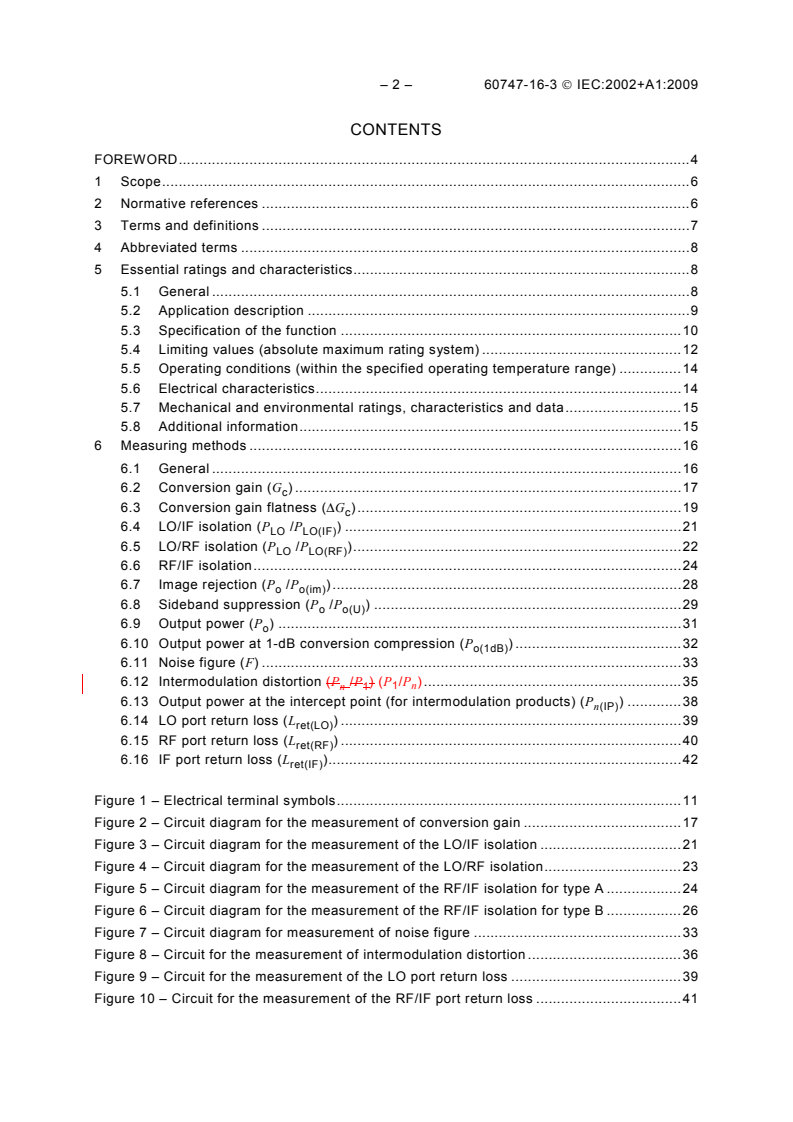
IEC 60747-16-3:2002+AMD1:2009 CSV - Semiconductor devices - Part 16-3: Microwave integrated circuits - Frequency converters Released:4/28/2010
Overview
IEC 60747-16-3:2002 - published by the IEC - defines terminology, letter symbols, measuring methods, and the essential ratings and characteristics for semiconductor microwave integrated circuit frequency converters. It applies to integrated-circuit converters used as down-converters (type A) and up-converters (type B) and is intended to standardize how key RF/microwave converter parameters are specified and measured.
Key topics
The standard organizes required specifications and measurement procedures for microwave frequency converters, including:
- Essential ratings and characteristics: device identification, package information, manufacturing technology (e.g., MMIC, thin-film), application description, and electrical compatibility.
- Measurement parameters and methods (detailed clauses):
- Conversion gain (Gc) and conversion gain flatness (ΔGc)
- LO/IF isolation, LO/RF isolation, RF/IF and IF/RF isolation
- Image rejection and sideband suppression
- Output power (Po) and output power at 1-dB conversion compression (Po(1dB))
- Noise figure (F)
- Intermodulation distortion and intercept point (IP)
- Port return loss for LO, RF and IF ports
- Mechanical and environmental ratings, limiting values and operating conditions, plus recommended terminal symbols and block-diagram conventions.
- Normative references and harmonization with related IEC graphical-symbol and IC standards (e.g., IEC 60617 series, IEC 60747-1, IEC 60748 series).
Applications and users
IEC 60747-16-3 is practical for professionals and organizations involved in:
- RF and microwave IC manufacturers defining product datasheets and QA test plans.
- Test and measurement engineers developing calibration and verification procedures for frequency converters.
- System architects and procurement teams specifying components for applications such as VSAT, DBS receivers, microwave landing systems, satellite communications, radar and other RF front-ends.
- Standards writers and certification bodies ensuring consistent characterization of converter performance (conversion gain, isolation, noise figure, linearity).
By standardizing terminology and measurement methods, the document helps ensure comparability of specs, reliable device selection, and consistent test results across suppliers.
Related standards
Key related IEC documents referenced by IEC 60747-16-3:
- IEC 60747-1 (General semiconductor device rules)
- IEC 60748 series (Integrated circuits)
- IEC 60617-12 / -13 (Graphical symbols for diagrams)
For procurement or compliance, consult the IEC catalogue for the official text, amendments, and the status of IEC 60747-16-3:2002.
Relations
- Effective Date
- 05-Sep-2023
- Effective Date
- 05-Sep-2023
Buy Documents
IEC 60747-16-3:2002 - Semiconductor devices - Part 16-3: Microwave integrated circuits - Frequency converters Released:5/7/2002
IEC 60747-16-3:2002+AMD1:2009+AMD2:2017 CSV - Semiconductor devices - Part 16-3: Microwave integrated circuits - Frequency converters Released:8/16/2017
IEC 60747-16-3:2002 - Semiconductor devices - Part 16-3: Microwave integrated circuits - Frequency converters Released:5/7/2002
IEC 60747-16-3:2002+AMD1:2009+AMD2:2017 CSV - Semiconductor devices - Part 16-3: Microwave integrated circuits - Frequency converters Released:8/16/2017
IEC 60747-16-3:2002+AMD1:2009 CSV - Semiconductor devices - Part 16-3: Microwave integrated circuits - Frequency converters Released:4/28/2010
Frequently Asked Questions
IEC 60747-16-3:2002 is a standard published by the International Electrotechnical Commission (IEC). Its full title is "Semiconductor devices - Part 16-3: Microwave integrated circuits - Frequency converters". This standard covers: IEC 60747-16-3:2002 provides new measuring methods, terminology and letter symbols, as well as essential ratings and characteristics for integrated circuit microwave frequency converters.
IEC 60747-16-3:2002 provides new measuring methods, terminology and letter symbols, as well as essential ratings and characteristics for integrated circuit microwave frequency converters.
IEC 60747-16-3:2002 is classified under the following ICS (International Classification for Standards) categories: 31.080.99 - Other semiconductor devices. The ICS classification helps identify the subject area and facilitates finding related standards.
IEC 60747-16-3:2002 has the following relationships with other standards: It is inter standard links to IEC 60747-16-3:2002/AMD2:2017, IEC 60747-16-3:2002/AMD1:2009. Understanding these relationships helps ensure you are using the most current and applicable version of the standard.
IEC 60747-16-3:2002 is available in PDF format for immediate download after purchase. The document can be added to your cart and obtained through the secure checkout process. Digital delivery ensures instant access to the complete standard document.
Standards Content (Sample)
INTERNATIONAL IEC
STANDARD
60747-16-3
First edition
2002-05
Semiconductor devices –
Part 16-3:
Microwave integrated circuits –
Frequency converters
Dispositifs à semiconducteurs –
Partie 16-3:
Circuits intégrés hyperfréquences –
Convertisseurs de fréquence
Reference number
Publication numbering
As from 1 January 1997 all IEC publications are issued with a designation in the
60000 series. For example, IEC 34-1 is now referred to as IEC 60034-1.
Consolidated editions
The IEC is now publishing consolidated versions of its publications. For example,
edition numbers 1.0, 1.1 and 1.2 refer, respectively, to the base publication, the
base publication incorporating amendment 1 and the base publication incorporating
amendments 1 and 2.
Further information on IEC publications
The technical content of IEC publications is kept under constant review by the IEC,
thus ensuring that the content reflects current technology. Information relating to
this publication, including its validity, is available in the IEC Catalogue of
publications (see below) in addition to new editions, amendments and corrigenda.
Information on the subjects under consideration and work in progress undertaken
by the technical committee which has prepared this publication, as well as the list
of publications issued, is also available from the following:
• IEC Web Site (www.iec.ch)
• Catalogue of IEC publications
The on-line catalogue on the IEC web site (www.iec.ch/catlg-e.htm) enables
you to search by a variety of criteria including text searches, technical
committees and date of publication. On-line information is also available on
recently issued publications, withdrawn and replaced publications, as well as
corrigenda.
• IEC Just Published
This summary of recently issued publications (www.iec.ch/JP.htm) is also
available by email. Please contact the Customer Service Centre (see below) for
further information.
• Customer Service Centre
If you have any questions regarding this publication or need further assistance,
please contact the Customer Service Centre:
Email: custserv@iec.ch
Tel: +41 22 919 02 11
Fax: +41 22 919 03 00
INTERNATIONAL IEC
STANDARD
60747-16-3
First edition
2002-05
Semiconductor devices –
Part 16-3:
Microwave integrated circuits –
Frequency converters
Dispositifs à semiconducteurs –
Partie 16-3:
Circuits intégrés hyperfréquences –
Convertisseurs de fréquence
IEC 2002 Copyright - all rights reserved
No part of this publication may be reproduced or utilized in any form or by any means, electronic or
mechanical, including photocopying and microfilm, without permission in writing from the publisher.
International Electrotechnical Commission, 3, rue de Varembé, PO Box 131, CH-1211 Geneva 20, Switzerland
Telephone: +41 22 919 02 11 Telefax: +41 22 919 03 00 E-mail: inmail@iec.ch Web: www.iec.ch
PRICE CODE
Commission Electrotechnique Internationale
W
International Electrotechnical Commission
Международная Электротехническая Комиссия
For price, see current catalogue
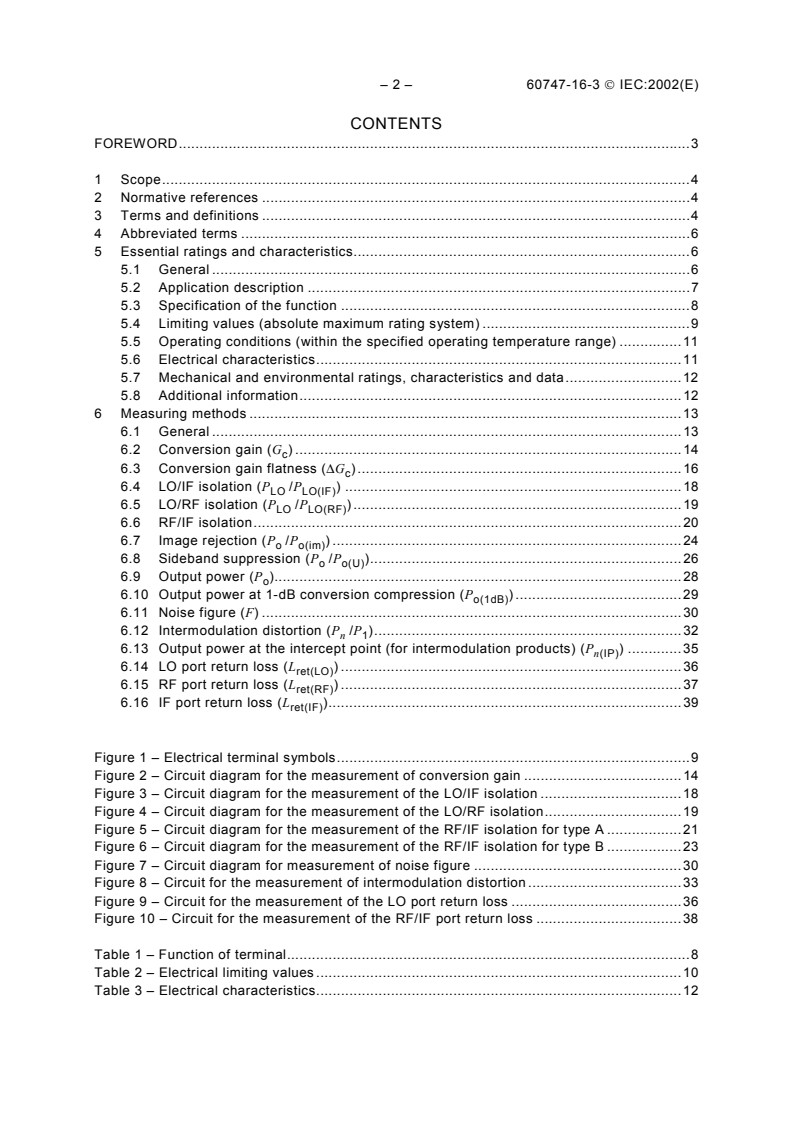
– 2 – 60747-16-3 IEC:2002(E)
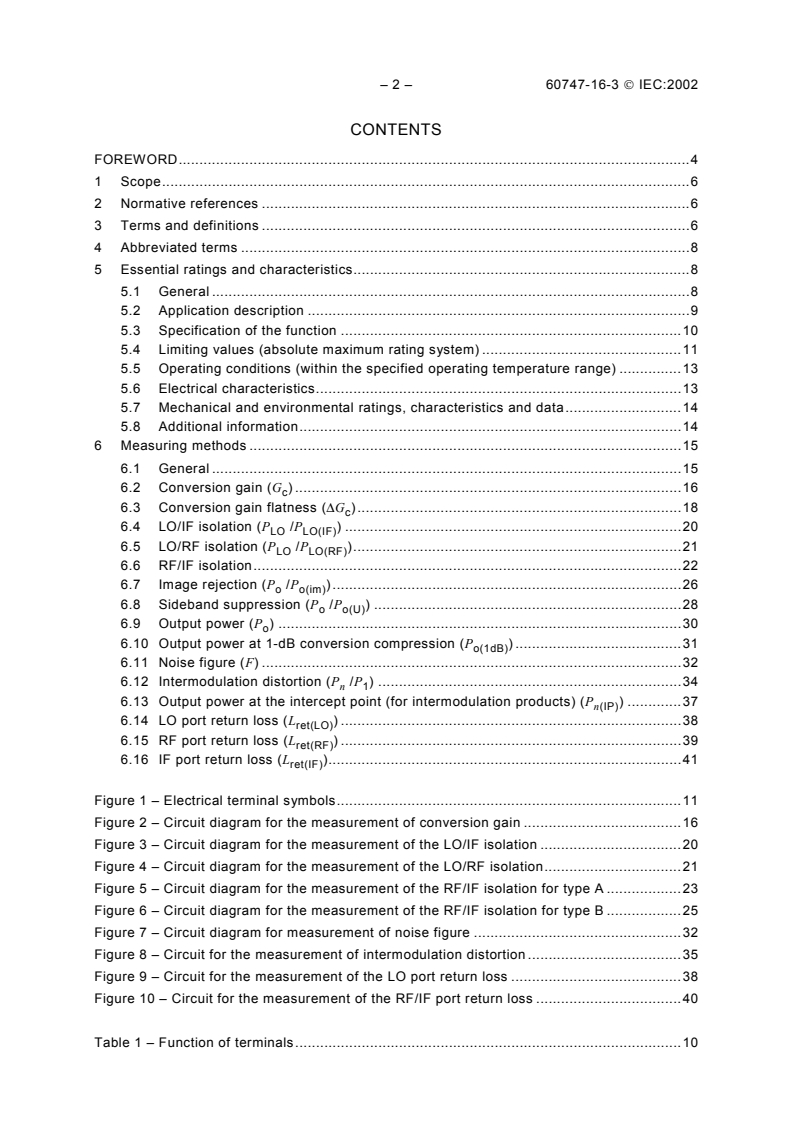
CONTENTS
FOREWORD.3
1 Scope.4
2 Normative references .4
3 Terms and definitions .4
4 Abbreviated terms .6
5 Essential ratings and characteristics.6
5.1 General .6
5.2 Application description .7
5.3 Specification of the function .8
5.4 Limiting values (absolute maximum rating system) .9
5.5 Operating conditions (within the specified operating temperature range) .11
5.6 Electrical characteristics.11
5.7 Mechanical and environmental ratings, characteristics and data.12
5.8 Additional information.12
6 Measuring methods .13
6.1 General .13
6.2 Conversion gain (G ) .14
c
6.3 Conversion gain flatness (ΔG ).16
c
6.4 LO/IF isolation (P /P ) .18
LO LO(IF)
6.5 LO/RF isolation (P /P ) .19
LO LO(RF)
6.6 RF/IF isolation.20
6.7 Image rejection (P /P ) .24
o o(im)
6.8 Sideband suppression (P /P ).26
o o(U)
6.9 Output power (P ).28
o
6.10 Output power at 1-dB conversion compression (P ) .29
o(1dB)
6.11 Noise figure (F) .30
6.12 Intermodulation distortion (P /P ).32
n 1
6.13 Output power at the intercept point (for intermodulation products) (P ) .35
n(IP)
6.14 LO port return loss (L ) .36
ret(LO)
6.15 RF port return loss (L ) .37
ret(RF)
6.16 IF port return loss (L ).39
ret(IF)
Figure 1 – Electrical terminal symbols.9
Figure 2 – Circuit diagram for the measurement of conversion gain .14
Figure 3 – Circuit diagram for the measurement of the LO/IF isolation .18
Figure 4 – Circuit diagram for the measurement of the LO/RF isolation.19
Figure 5 – Circuit diagram for the measurement of the RF/IF isolation for type A .21
Figure 6 – Circuit diagram for the measurement of the RF/IF isolation for type B .23
Figure 7 – Circuit diagram for measurement of noise figure .30
Figure 8 – Circuit for the measurement of intermodulation distortion .33
Figure 9 – Circuit for the measurement of the LO port return loss .36
Figure 10 – Circuit for the measurement of the RF/IF port return loss .38
Table 1 – Function of terminal.8
Table 2 – Electrical limiting values .10
Table 3 – Electrical characteristics.12
60747-16-3 IEC:2002(E) – 3 –
INTERNATIONAL ELECTROTECHNICAL COMMISSION
____________
SEMICONDUCTOR DEVICES –
Part 16-3: Microwave integrated circuits –
Frequency converters
FOREWORD
1) The IEC (International Electrotechnical Commission) is a worldwide organization for standardization comprising
all national electrotechnical committees (IEC National Committees). The object of the IEC is to promote
international co-operation on all questions concerning standardization in the electrical and electronic fields. To
this end and in addition to other activities, the IEC publishes International Standards. Their preparation is
entrusted to technical committees; any IEC National Committee interested in the subject dealt with may
participate in this preparatory work. International, governmental and non-governmental organizations liaising
with the IEC also participate in this preparation. The IEC collaborates closely with the International
Organization for Standardization (ISO) in accordance with conditions determined by agreement between the
two organizations.
2) The formal decisions or agreements of the IEC on technical matters express, as nearly as possible, an
international consensus of opinion on the relevant subjects since each technical committee has representation
from all interested National Committees.
3) The documents produced have the form of recommendations for international use and are published in the form
of standards, technical specifications, technical reports or guides and they are accepted by the National
Committees in that sense.
4) In order to promote international unification, IEC National Committees undertake to apply IEC International
Standards transparently to the maximum extent possible in their national and regional standards. Any
divergence between the IEC Standard and the corresponding national or regional standard shall be clearly
indicated in the latter.
5) The IEC provides no marking procedure to indicate its approval and cannot be rendered responsible for any
equipment declared to be in conformity with one of its standards.
6) Attention is drawn to the possibility that some of the elements of this International Standard may be the subject
of patent rights. The IEC shall not be held responsible for identifying any or all such patent rights.
International Standard IEC 60747-16-3 has been prepared by subcommittee 47E: Discrete
semiconductor devices, of IEC technical committee 47: Semiconductor devices.
The text of this standard is based on the following documents:
FDIS Report on voting
47E/212/FDIS 47E/219/RVD
Full information on the voting for the approval of this standard can be found in the report on
voting indicated in the above table.
This publication has been drafted in accordance with the ISO/IEC Directives, Part 3.
The committee has decided that the contents of this publication will remain unchanged until
2008. At this date, the publication will be
• reconfirmed;
• withdrawn;
• replaced by a revised edition, or
• amended.
– 4 – 60747-16-3 IEC:2002(E)
SEMICONDUCTOR DEVICES –
Part 16-3: Microwave integrated circuits –
Frequency converters
1 Scope
This part of IEC 60747 provides new measuring methods, terminology and letter symbols, as
well as essential ratings and characteristics for integrated circuit microwave frequency
converters.
2 Normative references
The following referenced documents are indispensable for the application of this document.
For dated references, only the edition cited applies. For undated references, the latest edition
of the referenced document (including any amendments) applies.
IEC 60617-12, Graphical symbols for diagrams – Part 12: Binary logic elements
IEC 60617-13, Graphical symbols for diagrams – Part 13: Analogue elements
IEC 60747-1:1983, Semiconductor devices – Discrete devices and integrated circuits – Part 1:
General
IEC 60748-2:1997, Semiconductor devices – Integrated circuits – Part 2: Digital integrated
circuits
IEC 60748-3, Semiconductor devices – Integrated circuits – Part 3: Analogue integrated circuits
IEC 60748-4, Semiconductor devices – Integrated circuits – Part 4: Interface integrated circuits
3 Terms and definitions
For the purpose of this part of IEC 60747, the following terms and definitions apply:
3.1
conversion gain, G
c
ratio of the desired converted output power to the input power
NOTE Usually, the conversion gain is expressed in decibels.
3.2
conversion gain flatness, ΔΔΔΔG
c
difference between the maximum and the minimum conversion gain for a specified input
power in a specified frequency range
3.3
LO/RF isolation, P /P
LO LO(RF)
ratio of the incident local power to the local leakage power at the RF port with the IF port
terminated in a specified impedance
60747-16-3 IEC:2002(E) – 5 –
3.4
LO/IF isolation, P /P
LO LO(IF)
ratio of the incident local power to the local leakage power at the IF port with the RF port
terminated in a specified impedance
3.5
RF/IF isolation, P /P
RF RF(IF)
ratio of the incident RF power to the RF feedthrough power at the IF port for a specified
local power
NOTE Usually, the RF/IF isolation is applied to the down-converter.
3.6
IF/RF isolation, P /P
IF IF(RF)
ratio of the incident IF power to the IF feedthrough power at the RF port for a specified
local power
NOTE Usually, the IF/RF isolation is applied to the up-converter.
3.7
image rejection, P /P
o o(im)
ratio of the output power when the RF signal is applied, to the output power when the image
signal is applied
NOTE Usually, the image rejection is applied to the down-converter.
3.8
sideband suppression, P /P
o o(U)
ratio of the output power of the desired sideband to the output power of the undesired
sideband
NOTE Usually, the sideband suppression is applied to the up-converter.
3.9
LO port return loss, L
ret(LO)
ratio of the specified incident power at the LO port to the reflected power at the LO port, with
the RF port and the IF port terminated in each specified impedance
3.10
RF port return loss, L
ret(RF)
ratio of the incident power at the RF port to the reflected power at the RF port for a specified
local power, with the IF port terminated in a specified impedance
3.11
IF port return loss, L
ret(IF)
ratio of the incident power at the IF port to the reflected power at the IF port for a specified
local power, with the RF port terminated in a specified impedance
3.12
output power, P
o
see IEC 60747-16-2, 3.3
3.13
output power at 1-dB conversion compression, P
o(1dB)
output power where the conversion gain decreases by 1 dB compared with the linear
conversion gain
———————
IEC 60747-16-2:2001, Semiconductor devices – Part 16-2: Microwave integrated circuits – Frequency prescalers
– 6 – 60747-16-3 IEC:2002(E)
3.14
noise figure, F
see IEC 60747-1 Chapter IV, 5.4.4
3.15
intermodulation distortion, P /P
n 1
ratio of the output power of the nth order component to the output power of the fundamental
component, at a specified input power
3.16
output power at the intercept point (for intermodulation products), P
n(IP)
output power at the intersection between the extrapolated output powers of the fundamental
component and the nth order intermodulation components, when the extrapolation is carried
out in a diagram showing the output power of the components (in decibels) as a function of
the input power (in decibels)
4 Abbreviated terms
The abbreviations used in this part of IEC 60747 are as follows:
RF Radio Frequency;
IF Intermediate Frequency;
LO Local Oscillator.
5 Essential ratings and characteristics
5.1 General
This clause gives ratings and characteristics required for specifying integrated circuit
microwave frequency converters.
5.1.1 Circuit identification and types
5.1.1.1 Designation and types
The identification of type (device name), the category of circuit and technology applied shall
be given.
Microwave frequency converters are divided into two categories:
– type A: down-converter;
– type B: up-converter.
5.1.1.2 General function description
A general description shall be made of the function performed by the integrated circuit
microwave frequency converters and the features for the application.
5.1.1.3 Manufacturing technology
The manufacturing technology, for example, semiconductor monolithic integrated circuit, thin
film integrated circuit, micro-assembly, shall be stated. This statement shall include details
of the semiconductor technologies such as Schottoky-barrier diode, MESFET, Si bipolar
transistor, HBT.
60747-16-3 IEC:2002(E) – 7 –
5.1.1.4 Package identification
The following shall be stated:
a) chip or packaged form;
b) IEC and/or national reference number of the outline drawing, or of drawing of non-standard
package including terminal numbering;
c) principal package material, for example, metal, ceramic, plastic;
d) for chip form: outlines, dimensions, pad sizes, contact material, and recommended contact
technologies.
5.1.1.5 Main application
The main application shall be stated if necessary. If the device has restrictive applications,
these too shall be stated here.
5.2 Application description
Information on the application of the integrated circuit and its relation to the associated
devices shall be given.
5.2.1 Conformance to system and/or interface information
It shall be stated whether the integrated circuit conforms to an application system and/or an
interface standard or recommendation.
Detailed information about application systems, equipment and circuits such as VSAT
systems, DBS receivers, microwave landing systems shall also be given.
5.2.2 Overall block diagram
A block diagram of the applied systems shall be given if necessary.
5.2.3 Reference data
The most important properties required to permit comparison between derivative types shall
be given.
5.2.4 Electrical compatibility
It shall be stated whether the integrated circuit is electrically compatible with other particular
integrated circuits or families of integrated circuits, or whether special interfaces are required.
Details shall be given concerning the type of the input and output circuits, for example,
input/output impedances, d.c. block, open-drain.
Interchangeability with other devices, if any, shall be given.
5.2.5 Associated devices
If applicable, mention shall be made here of
– devices necessary for correct operation (list with type number, name, and function);
– peripheral devices with direct interfacing (list with type number, name, and function).
– 8 – 60747-16-3 IEC:2002(E)
5.3 Specification of the function
5.3.1 Detailed block diagram −−−− functional blocks
A detail block diagram or equivalent circuit information of the integrated circuit microwave
frequency converters shall be given. The block diagram shall be composed of the following:
a) functional blocks;
b) mutual interconnections among the functional blocks;
c) individual functional units within the functional blocks;
d) mutual interconnections among the individual functional blocks;
e) function of each external connection;
f) interdependence between the separate functional blocks.
The block diagram shall identify the function of each external connection, and, where no
ambiguity can arise, it can also show the terminal symbols and/or numbers. If the
encapsulation has metallic parts, any connection to them from external terminals shall be
indicated. The connections with any associated external electrical elements shall be stated,
where necessary.
For the purpose of providing additional information, the complete electrical circuit diagram can
be reproduced, though this will not necessarily involve giving indications of the function. Rules
governing such diagrams may be obtained from IEC 60617-12 or IEC 60617-13.
5.3.2 Identification and function of terminals
All terminals shall be identified on the block diagram (supply terminals, input or output
terminals, input/output terminals).
The terminal functions 1) to 4) shall be indicated, as shown in table 1 below.
Table 1 – Function of terminals
1 2 3 4
Terminal Terminal
Terminal Function Input/output Type of input/
number symbol
designation identification output circuits
5.3.2.1 Function 1: Terminal designation
The terminal designation to indicate the terminal function shall be given. Supply terminals,
ground terminals, blank terminals (with abbreviation NC) and non-usable terminals (with
abbreviation NU) shall be distinguished.
5.3.2.2 Function 2: Function
A brief indication of the terminal function shall be given:
– each function of multi-role terminals, i.e. terminals having multiple functions;
– each function of the integrated circuit selected by mutual pin connections, or
programming and/or application of function selection data to the function selection pin
such as mode selection pin.
60747-16-3 IEC:2002(E) – 9 –
5.3.2.3 Function 3: Input/output identification
Input, output, input/output, and multiples of the input/output terminal shall be distinguished.
5.3.2.4 Function 4: Type of input/output circuits
The type of input and output circuits, for example, input/output impedances, with or without
d.c. block, etc., shall be distinguished.
5.3.2.5 Function 5: Type of ground
If the baseplate of the package is used as ground, this shall be stated.
EXAMPLE:
Supply voltage(s)
Integrated
Input(s) NC
circuit
microwave
frequency
NU Output(s)
converter
Ground
IEC 1072/02
Figure 1 – Electrical terminal symbols
5.3.3 Function description
The function performed by the circuit shall be specified, including the following information:
− basic function;
− relation to external terminals;
− operation mode (e.g., set-up method, preference, etc.);
− interruption handling.
5.3.4 Family related characteristics
All family-specific functional descriptions shall be stated (with reference to IEC 60748-2,
IEC 60748-3 and IEC 60748-4).
If ratings, characteristics and function characteristics exist for the family, the relevant part of
IEC 60748 shall be used (for example, for microprocessors, see IEC 60748-2, chapter III,
section 3).
NOTE For each new device family, specific items shall be added to the relevant part of IEC 60748.
5.4 Limiting values (absolute maximum rating system)
The table giving these values shall specify the following:
− any interdependence of limiting conditions;
− if externally connected and/or attached elements, for example heatsinks, have an
influence on the values of the ratings, the ratings shall be prescribed for the integrated
circuit with the elements connected and/or attached;
– 10 – 60747-16-3 IEC:2002(E)
− if limiting values are exceeded for transient overload, the permissible excess and their
durations shall be specified;
− where minimum and maximum values differ during programming of the device, this shall
be stated;
− all voltages referenced to a specified reference terminal (V , GND, etc.);
ss
− in satisfying the following clauses, if maximum and/or minimum values are quoted, the
manufacturer shall indicate whether he refers to the absolute magnitude or to the
algebraic value of the quantity;
− the ratings given shall cover the operation of the multi-function integrated circuit over the
specified range of operating temperatures. Where such ratings are temperature-
dependent, such dependence shall be indicated.
5.4.1 Electrical limiting values
Limiting values shall be specified as follows:
Table 2 – Electrical limiting values
Subclause Parameters Min. Max.
5.4.1.1 Ambient or case temperature + +
5.4.1.2 Storage temperature + +
5.4.1.3 Power supply voltage(s) +
5.4.1.4 Power supply current(s) (where appropriate) +
5.4.1.5 Terminal voltage(s) (where appropriate) + +
5.4.1.6 Terminal current(s) (where appropriate) +
5.4.1.7 Input power +
5.4.1.8 LO input power +
5.4.1.9 Power dissipation +
The detail specification may indicate those values within table 2, including note 1 and note 2.
Parameters (see notes 1 and 2) Symbols Min. Max. Unit
NOTE 1 Where appropriate, in accordance with the type of considered circuit.
NOTE 2 For power supply voltage range:
limiting value(s) of the continuous voltage(s) at the supply terminal(s) with respect to a special
electrical reference point;
where appropriate, limiting value between specified supply terminals;
when more than one voltage supply is required, a statement should be made as to whether the
sequence in which these supplies are applied is significant: if so, the sequence should be stated;
when more than one supply is needed, it may be necessary to state the combinations of ratings for
these supply voltages and currents.
60747-16-3 IEC:2002(E) – 11 –
5.4.2 Temperatures
a) Operating temperature
b) Storage temperature
c) Channel temperature
d) Lead temperature (for soldering)
The detail specification may indicate those values within the table including the note.
Parameters (see note) Symbols Min. Max. Unit
NOTE Where appropriate, in accordance with the type of considered circuit.
5.5 Operating conditions (within the specified operating temperature range)
These are not to be inspected, but may be used for quality assessment purposes.
5.5.1 Power supplies – Positive and/or negative values
5.5.2 Initialization sequences (where appropriate)
If special initialization sequences are necessary, the power supply sequencing and
initialization procedure shall be specified.
5.5.3 Input voltage(s) or input signal (where appropriate)
5.5.4 Output current(s) (where appropriate)
5.5.5 Voltage and/or current of other terminal(s)
5.5.6 External elements (where appropriate)
5.5.7 Operating temperature range
5.6 Electrical characteristics
The characteristics shall apply over the full operating temperature range, unless otherwise
specified.
Each characteristic of 5.6 shall be stated: either
a) over the specified range of operating temperatures, or
b) at a temperature of 25 °C, and at maximum and minimum operating temperatures.
The parameters shall be specified corresponding to the type as shown in table 3 below:
– 12 – 60747-16-3 IEC:2002(E)
Table 3 – Electrical characteristics
Types
Sub-
Parameters Min. Typical* Max.
clause
AB
5.6.1 Operating current + + + +
5.6.2 Conversion gain + + + +
5.6.3 Conversion gain flatness + + + +
5.6.4 LO/RF isolation + + + +
5.6.5 LO/IF isolation (where appropriate) + + + +
5.6.6 RF/IF isolation (where appropriate) + + +
5.6.7 IF/RF isolation (where appropriate) + + +
5.6.8 Image rejection (where appropriate) + + +
5.6.9 Sideband suppression (where appropriate) + + +
5.6.10 Output power at specified input power + + + +
5.6.11 Output power at 1 dB conversion compression + + + +
5.6.12 Noise figure + + +
5.6.13 Intermodulation distortion + + + +
5.6.14 Output power at the intercept point ++ + +
(for intermodulation products)
5.6.15 LO port return loss + + + +
5.6.16 RF port return loss + + + +
5.6.17 IF port return loss + + + +
* Optional.
NOTE Conversion loss and conversion loss flatness can substitute for parameters 5.6.2 and 5.6.3.
The detail specification may indicate these values within the table.
Characteristics Symbols Conditions Min. Typical* Max. Units
* Optional.
5.7 Mechanical and environmental ratings, characteristics and data
Any specific mechanical and environmental ratings applicable shall be stated (see also
IEC 60747-1, chapter VI, clause 7).
5.8 Additional information
Where appropriate, the information detailed in the following subclauses shall be given.
5.8.1 Equivalent input and output circuit
Detail information shall be given regarding the type of input and output circuits, for example,
input/output impedances, d.c. block, open-drain.
60747-16-3 IEC:2002(E) – 13 –
5.8.2 Internal protection
A statement shall be given to indicate whether the integrated circuit contains internal
protection against high static voltages or electrical fields.
5.8.3 Capacitors at terminals
If capacitors for the input/output d.c. block are needed, these capacitances shall be stated.
5.8.4 Thermal resistance
5.8.5 Interconnections to other types of circuit
Where appropriate, details of the interconnections to other circuits shall be given.
5.8.6 Effects of externally connected component(s)
Curves or data indicating the effect of an externally connected component(s) that influence
the characteristics may be given.
5.8.7 Recommendations for any associated device(s)
For example, decoupling of the power supply to a high frequency device shall be stated.
5.8.8 Handling precautions
Where appropriate, handling precautions specific to the circuit shall be stated (see also
IEC 60747-1, chapter IX concerning electrostatic-sensitive devices).
5.8.9 Application data
5.8.10 Other application information
5.8.11 Date of issue of the data sheet
6 Measuring methods
6.1 General
This clause prescribes measuring methods for electrical characteristics of integrated circuit
microwave frequency converters.
6.1.1 General precautions
The general precautions listed in clause 1 of IEC 60747-1, chapter VII, shall be applied. In
addition, special care shall be taken to use low-ripple d.c. supplies and to decouple
adequately all bias supply voltages at the frequency of measurement. Special care concerning
the load impedance of the test circuit shall also be taken to measure the output power.
The input signal (RF for down-converter and IF for up-converter) level shall be a small signal
condition under which the devices exhibit linear characteristics against the input signal,
unless otherwise specified.
6.1.2 Characteristic impedance
The input and output characteristic impedances of the measurement systems, shown in the
circuit in this standard, are 50 Ω. If they are not 50 Ω, they shall be specified.
– 14 – 60747-16-3 IEC:2002(E)
6.1.3 Handling precautions
When handling electrostatic-sensitive devices, the handling precautions given in IEC 60747-1,
chapter IX, clause 1, shall be observed.
6.1.4 Types
The devices in this standard are both package and chip types, measured using suitable test
fixtures.
6.2 Conversion gain (G )
c
6.2.1 Purpose
To measure conversion gain under specified conditions.
6.2.2 Circuit diagram
Power
Frequency
Termination Termination
meter 1
meter 1
f
W
Signal
A
generator 1
Isolator 1
G
f
dB
Variable
attenuator 1
B Power
meter 2
Device
CD
being
W
Bias measured
supply
F
LO
Signal
generator 2
Isolator 2
G
f
dB
Variable
E
attenuator 2
f
W
Frequency
Power
Termination Termination
meter 2 meter 3
IEC 1073/02
.
Figure 2 – Circuit diagram for the measurement of conversion gain
6.2.3 Principle of measurement
The conversion gain G , measured under the specified local oscillator power P , is derived
c LO
from the input power P and the output power P of the device, being measured as follows:
i o
G = P − P (1)
c o i
In the circuit diagram shown in figure 2, P , P and P are derived from the following
i o LO
equations:
P = P − L (2)
i 1 1
P = P + L (3)
o 2 2
P = P − L (4)
LO 3 3
60747-16-3 IEC:2002(E) – 15 –
where
L is the power at point A in dBm, minus the power at point B in dBm;
L is the power at point C in dBm, minus the power at point D in dBm;
L is the power at point E in dBm, minus the power at point F in dBm;
P is the value indicated by power meter 1;
P is the value indicated by power meter 2;
P is the value indicated by power meter 3.
P , P , P , P , and P are expressed in dBm. L , L , and L are expressed in decibels (dB).
i o 1 2 3 1 2 3
The conversion gain G is the power gain measured in the region where the change of output
c
power in dBm is the same as that of the input power.
6.2.4 Circuit description and requirements
The purpose of the isolator is to enable the power level to the device being measured to be
kept constant irrespective of impedance mismatched at its input. The value of L , L , and L
1 2 3
shall be measured beforehand. The filter at the output rejects the undesired frequency band.
6.2.5 Precautions to be observed
Oscillation, which is checked by the spectrum analyzer, shall be eliminated during these
measurements. Terminations shall be capable of handling the power in the test environment.
Harmonics or spurious responses of the signal generator shall be reduced to be negligible.
The conversion gain G shall be measured without the influence of filter impedance at LO and
c
RF ports.
6.2.6 Measurement procedure
The frequency of the signal generator for the input signal shall be set to the specified value.
The frequency of the signal generator for the local signal shall be set to the specified value.
The power level of the local signal shall be adjusted to the specified value.
The bias conditions shall be applied as specified.
An adequate input power shall be applied to the device being measured.
By varying the input power, confirm that a change of output power corresponds to an equal
change in the input power.
The gain measured in this region is the conversion gain G .
c
6.2.7 Specified conditions
− Ambient or reference point temperature
− Bias conditions
− Frequency of local signal
− Incident power of local port
− Input frequency.
– 16 – 60747-16-3 IEC:2002(E)
6.3 Conversion gain flatness (ΔΔΔΔG )
c
6.3.1 Purpose
To measure the conversion gain flatness under specified conditions.
6.3.2 Circuit diagram
See the circuit diagram shown in figure 2.
6.3.3 Principle of measurement
See the principle of measurement of 6.2.3.
The linear gain flatness is derived from following equation
ΔG = G − G (5)
c c(max) c(min)
where G and G are the maximum and the minimum conversion gains in the
c(max) c(min)
specified frequency band at the specified input power, respectively.
There are two kinds of measurement methods of ΔG . One is the measurement under fixed
c
local oscillator frequency and the other is the measurement under constant output frequency.
6.3.4 Circuit description and requirements
See the circuit description and requirements of 6.2.4.
6.3.5 Precaution to be observed
See the precaution to be observed of 6.2.5.
6.3.6 Measurement procedure
6.3.6.1 Conversion gain flatness for constant LO frequency
The frequency of the signal generator for the local signal shall be set to the specified value.
The frequency of the signal generator for the input signal shall be set to the specified value.
The bias conditions shall be applied as specified.
The power level of the local signal shall be adjusted to the specified value.
An adequate input power shall be applied to the device being measured.
By varying the input power, confirm that a change of output power corresponds to an equal
change in the input power.
Decide on the suitable input power level for measuring the conversion gain.
Vary the input frequency in the specified frequency band while keeping the input power level
constant.
Obtain the maximum conversion gain G and the minimum conversion gain G in the
c(max) c(min)
specified frequency band.
The conversion gain flatness ΔG is calculated using equation (5).
c
60747-16-3 IEC:2002(E) – 17 –
6.3.6.2 Conversion gain flatness for constant output frequency
The frequency of the signal generator for the local signal shall be set to obtain the specified
output frequency.
The frequency of the signal generator for the input signal within the specified input frequency
range shall be set to obtain the specified output frequency.
The bias conditions shall be applied as specified.
The power level of the local signal shall be adjusted to the specified value.
An adequate input power shall be applied to the device being measured.
By varying the input power, confirm that a change of output power corresponds to an equal
change in the input power.
Decide on the suitable input power level for measuring the conversion gain.
Vary the input and local frequencies within the specified frequency band at a constant input
power level.
Obtain the maximum conversion gain G and the minimum conversion gain G in the
c(max) c(min)
specified frequency band.
The conversion gain flatness ΔG is calculated using equation (5).
c
6.3.7 Specified conditions
6.3.7.1 Conversion gain flatness for constant LO frequency
− Ambient or reference point temperature
− Bias conditions
− Frequency of local signal
− Incident power of local port
−
Input frequency band.
6.3.7.2 Conversion gain flatness for constant output frequency
− Ambient or reference point temperature
− Bias conditions
− Frequency band of local signal
− Incident power of local port
− Input power
− Input frequency range
−
Output frequency.
– 18 – 60747-16-3 IEC:2002(E)
6.4 LO/IF isolation (P /P )
LO LO(IF)
6.4.1 Purpose
To measure the isolation from the local port to the IF port under specified conditions.
6.4.2 Circuit diagram
Termination
Variable
Signal
attenuator RF
generator Isolator
Device
LO IF
G Spectrum
f
dB
being
analyzer
B
measured
A
Bias
f W
supply
Frequency
Termination Termination Power
meter meter
IEC 1074/02
Figure 3 – Circuit diagram for the measurement of the LO/IF isolation
6.4.3 Principle of measurement
In the circuit diagram shown in figure 3, the input local power P in dBm is derived as
LO
follows:
P = P − L (6)
LO 1 1
where
L is the power at point A in dBm, minus the power at point B in dBm;
P is the value indicated by the power meter in dBm.
P is the local frequency component of the output power at the IF port in dBm when the
LO(IF)
specified P in dBm is applied.
LO
The local port to IF port isolation P /P in decibels (dB) is derived as follows:
LO LO(IF)
P P = P − P (7)
LO LO()IF LO LO()IF
where P is the value indicated by the spectrum analyzer.
LO(IF)
6.4.4 Circuit description and requirements
The purpose of the isolator is to enable the power level to the device being measured to be
kept constant irrespective of impedance mismatches at its local ports.
L shall be measured beforehand.
NOTE The spectrum analyzer can be replaced with a power meter and a filter having proper frequency response
and impedance characteristics. In the case of such a set-up, the filter must reject the undesired frequency
components, and should not change the terminal impedances for frequencies such as RF, LO and IF.
6.4.5 Precautions to be observed
Oscillation, which is checked by the spectrum analyzer, shall be eliminated during the
measurement.
Harmonics or spurious responses of the signal generator shall be reduced so as to be
negligible.
60747-16-3 IEC:2002(E) – 19 –
6.4.6 Measurement procedure
The frequency of the signal generator shall be adjusted to the specified value.
The bias under specified conditions is applied.
The specified local power P , which is given by equation (6), is applied.
LO
The power level of the local frequency component at the IF port P is measured by the
LO(IF)
spectrum analyzer.
The local port to IF port isolation P /P is calculated from equation (7).
LO LO(IF)
6.4.7 Specified conditions
− Ambient or reference point temperature
− Bias conditions
− Frequency of local signal
− Incident power of local port.
6.5 LO/RF isolation (P /P )
LO LO(RF)
6.5.1 Purpose
To measure the isolation from the local port to the RF port under specified conditions.
6.5.2 Circuit diagram
Termination
Variable
Signal
attenuator
IF
generator Isolator
Device
LO RF
G Spectrum
f
dB being
analyzer
B
measured
A
Bias
f W
supply
Frequency
Power
Termination Termination
meter meter
IEC 1075/02
Figure 4 – Circuit diagram for the measurement of the LO/RF isolation
6.5.3 Principle of measurement
In the circuit diagram shown in figure 4, the input local power P in dBm is derived as
LO
follows:
P = P − L (8)
LO 1 1
where
L is the power at point A in dBm, minus the power at point B in dBm;
P is the value indicated by the power meter in dBm.
P is the local frequency component of the output power at the RF port in dBm when the
LO(RF)
specified P in dBm is applied.
LO
– 20 – 60747-16-3 IEC:2002(E)
The local port to RF port isolation P /P in decibels (dB) is derived as follows:
LO LO(RF)
P P = P − P (9)
LO LO()RF LO LO()RF
where P is the value indicated by the spectrum analyzer.
LO(RF)
6.5.4 Circuit description and requirements
See the circuit description and requirements described in 6.4.4.
6.5.5 Precautions to be observed
See the precautions to be observed described in 6.4.5.
6.5.6 Measurement procedure
The frequency of the signal generator shall be adjusted to the specified value.
The bias under specified conditions is applied.
The specified local power, P which is given by equation (8), is applied.
LO,
The power level of the local frequency component at the RF port P is measured by the
LO(RF)
spectrum analyzer.
The local port to RF port isolation P /P is calculated from equation (9).
LO LO(RF)
6.5.7 Specified conditions
− Ambient or reference point temperature
− Bias conditions
− Frequency of local signal
− Incident power of local port
− Termination condition at IF port.
6.6 RF/IF isolation
6.6.1 RF/IF isolation (P /P ) – Type A
RF RF(IF)
6.6.1.1 Purpose
To measure the isolation from the RF port to the IF port under specified conditions.
60747-16-3 IEC:2002(E) – 21 –
6.6.1.2 Circuit diagram
Power
Frequency
Termination Termination
meter 1
meter 1
f
W
Signal
generator 1 Isolator 1
A
G
f
dB
Variable
attenuator 1
B
RF port
Device
C D
Spectrum
being
analyzer
IF port
Bias
measured
supply
F
LO port
Signal
generator 2
Isolator 2
G
f
dB
Variable
E
attenuator 2
f
W
Frequency Power
Termination Termination
meter 2 meter 2
IEC 1076/02
Figure 5 – Circuit diagram for the measurement of the RF/IF isolation for type A
6.6.1.3 Principle of measurement
In the circuit diagram shown in figure 5, the input RF power P and the LO power P are
RF LO
derived as follows:
P = P − L (10)
RF 1 1
P = P − L (11)
LO 2 2
where
L is the power at point A in dBm, minus the power at point B in dBm;
L is the power at point E in dBm, minus the power at point F in dBm;
P is the value indicated by power meter 1 at the RF port in dBm;
P is the value indicated by power meter 2 at the LO port in dBm.
P is the RF frequency component of the output power at the IF port in dBm when the
RF(IF)
specified P and P are applied.
RF LO
The isolation P /P from the RF port to the IF port is derived as follows:
RF RF(IF)
P P = P − P (12)
RF RF()IF RF RF()IF
where P is the value indicated by the spectrum analyzer in dBm.
RF(IF)
– 22 – 60747-16-3 IEC:2002(E)
6.6.1.4 Circuit description and requirements
The purpose of the isolators is to enable the power level to the device being measured to be
kept constant irrespective of impedance mismatches at its RF and LO ports.
L and L shall be measured beforehand.
1 2
6.6.1.5 Precautions to be observed
Oscillation, which is checked by the spectrum analyzer, shall be eliminated during
measurement.
Harmonics or spurious responses of the signal generators shall be reduced so as to be
negligible.
6.6.1.6 Measurement procedure
The frequency of the signal generator 1 for the RF input signal shall be adjusted to the
specified value.
The frequency of the signal generator 2 for the local signal shall be adjusted to the specified
value.
The bias under specified conditions is applied.
The local power P , which is given by equation (11), is applied and adjusted to the specified
LO
value by the variable attenuator 2.
The RF power P , which is given by equation (10), is applied and adjusted to the specified
RF
value by the variable attenuator 1.
The power level of the RF signal component at the IF port P is measured by the
RF(IF)
spectrum analyzer.
The isolation P /P from the RF port to the IF port is calculated from the equation (12).
RF RF(IF)
6.6.1.7 Specified conditions
−
Ambient or reference point temperature
− Bias conditions
−
Local power
...
IEC 60747-16-3 ®
Edition 1.2 2017-08
CONSOLIDATED VERSION
INTERNATIONAL
STANDARD
colour
inside
Semiconductor devices –
Part 16-3: Microwave integrated circuits – Frequency converters
All rights reserved. Unless otherwise specified, no part of this publication may be reproduced or utilized in any form
or by any means, electronic or mechanical, including photocopying and microfilm, without permission in writing from
either IEC or IEC's member National Committee in the country of the requester. If you have any questions about IEC
copyright or have an enquiry about obtaining additional rights to this publication, please contact the address below or
your local IEC member National Committee for further information.
IEC Central Office Tel.: +41 22 919 02 11
3, rue de Varembé Fax: +41 22 919 03 00
CH-1211 Geneva 20 info@iec.ch
Switzerland www.iec.ch
About the IEC
The International Electrotechnical Commission (IEC) is the leading global organization that prepares and publishes
International Standards for all electrical, electronic and related technologies.
About IEC publications
The technical content of IEC publications is kept under constant review by the IEC. Please make sure that you have the
latest edition, a corrigenda or an amendment might have been published.
IEC Catalogue - webstore.iec.ch/catalogue Electropedia - www.electropedia.org
The stand-alone application for consulting the entire The world's leading online dictionary of electronic and
bibliographical information on IEC International Standards, electrical terms containing 20 000 terms and definitions in
Technical Specifications, Technical Reports and other English and French, with equivalent terms in 16 additional
documents. Available for PC, Mac OS, Android Tablets and languages. Also known as the International Electrotechnical
iPad. Vocabulary (IEV) online.
IEC publications search - www.iec.ch/searchpub IEC Glossary - std.iec.ch/glossary
The advanced search enables to find IEC publications by a 65 000 electrotechnical terminology entries in English and
variety of criteria (reference number, text, technical French extracted from the Terms and Definitions clause of
committee,…). It also gives information on projects, replaced IEC publications issued since 2002. Some entries have been
and withdrawn publications. collected from earlier publications of IEC TC 37, 77, 86 and
CISPR.
IEC Just Published - webstore.iec.ch/justpublished
Stay up to date on all new IEC publications. Just Published IEC Customer Service Centre - webstore.iec.ch/csc
details all new publications released. Available online and If you wish to give us your feedback on this publication or
also once a month by email. need further assistance, please contact the Customer Service
Centre: csc@iec.ch.
IEC 60747-16-3 ®
Edition 1.2 2017-08
CONSOLIDATED VERSION
INTERNATIONAL
STANDARD
colour
inside
Semiconductor devices –
Part 16-3: Microwave integrated circuits – Frequency converters
INTERNATIONAL
ELECTROTECHNICAL
COMMISSION
ICS 31.080.99 ISBN 978-2-8322-4749-5
IEC 60747-16-3 ®
Edition 1.2 2017-08
CONSOLIDATED VERSION
REDLINE VERSION
colour
inside
Semiconductor devices –
Part 16-3: Microwave integrated circuits – Frequency converters
– 2 – IEC 60747-16-3:2002+AMD1:2009
+AMD2:2017 CSV © IEC 2017
CONTENTS
FOREWORD . 4
1 Scope . 6
2 Normative references . 6
3 Terms and definitions . 7
4 Abbreviated terms . 8
5 Essential ratings and characteristics . 9
5.1 General . 9
5.2 Application description . 9
5.3 Specification of the function . 10
5.4 Limiting values (absolute maximum rating system) . 12
5.5 Operating conditions (within the specified operating temperature range) . 14
5.6 Electrical characteristics . 14
5.7 Mechanical and environmental ratings, characteristics and data . 15
5.8 Additional information . 15
6 Measuring methods . 16
6.1 General . 16
6.2 Conversion gain (G ) . 17
c
6.3 Conversion gain flatness (∆G ) . 19
c
6.4 LO/IF isolation (P /P ) . 21
LO LO(IF)
6.5 LO/RF isolation (P /P ) . 22
LO LO(RF)
6.6 RF/IF, IF/RF isolation . 24
6.7 Image rejection (P /P ) . 28
o o(im)
6.8 Sideband suppression (P ) . 29
/P
o o(U)
6.9 Output power (P ) . 31
o
6.10 Output power at 1-dB conversion compression (P ) . 32
o(1dB)
6.11 Noise figure (F) . 33
6.12 Intermodulation distortion (P /P ) . 35
n 1
6.13 Output power at the intercept point (for intermodulation products) (P ) . 38
n(IP)
6.14 LO port return loss (L ) . 39
ret(LO)
6.15 RF port return loss (L ) . 40
ret(RF)
6.16 IF port return loss (L ) . 42
ret(IF)
Bibliography . 44
Figure 1 – Electrical terminal symbols . 11
Figure 2 – Circuit diagram for the measurement of conversion gain . 17
Figure 3 – Circuit diagram for the measurement of the LO/IF isolation . 21
Figure 4 – Circuit diagram for the measurement of the LO/RF isolation . 23
Figure 5 – Circuit diagram for the measurement of the RF/IF isolation for type A . 24
Figure 6 – Circuit diagram for the measurement of the RF/IF IF/RF isolation for type B . 26
Figure 7 – Circuit diagram for measurement of noise figure . 33
Figure 8 – Circuit for the measurement of intermodulation distortion . 36
Figure 9 – Circuit for the measurement of the LO port return loss . 39
Figure 10 – Circuit for the measurement of the RF/IF port return loss . 41
+AMD2:2017 CSV © IEC 2017
Table 1 – Function of terminals . 11
Table 2 – Electrical limiting values . 13
Table 3 – Electrical characteristics . 15
– 4 – IEC 60747-16-3:2002+AMD1:2009
+AMD2:2017 CSV © IEC 2017
INTERNATIONAL ELECTROTECHNICAL COMMISSION
____________
SEMICONDUCTOR DEVICES –
Part 16-3: Microwave integrated circuits –
Frequency converters
FOREWORD
1) The International Electrotechnical Commission (IEC) is a worldwide organization for standardization comprising
all national electrotechnical committees (IEC National Committees). The object of IEC is to promote
international co-operation on all questions concerning standardization in the electrical and electronic fields. To
this end and in addition to other activities, IEC publishes International Standards, Technical Specifications,
Technical Reports, Publicly Available Specifications (PAS) and Guides (hereafter referred to as “IEC
Publication(s)”). Their preparation is entrusted to technical committees; any IEC National Committee interested
in the subject dealt with may participate in this preparatory work. International, governmental and non-
governmental organizations liaising with the IEC also participate in this preparation. IEC collaborates closely
with the International Organization for Standardization (ISO) in accordance with conditions determined by
agreement between the two organizations.
2) The formal decisions or agreements of IEC on technical matters express, as nearly as possible, an international
consensus of opinion on the relevant subjects since each technical committee has representation from all
interested IEC National Committees.
3) IEC Publications have the form of recommendations for international use and are accepted by IEC National
Committees in that sense. While all reasonable efforts are made to ensure that the technical content of IEC
Publications is accurate, IEC cannot be held responsible for the way in which they are used or for any
misinterpretation by any end user.
4) In order to promote international uniformity, IEC National Committees undertake to apply IEC Publications
transparently to the maximum extent possible in their national and regional publications. Any divergence
between any IEC Publication and the corresponding national or regional publication shall be clearly indicated in
the latter.
5) IEC itself does not provide any attestation of conformity. Independent certification bodies provide conformity
assessment services and, in some areas, access to IEC marks of conformity. IEC is not responsible for any
services carried out by independent certification bodies.
6) All users should ensure that they have the latest edition of this publication.
7) No liability shall attach to IEC or its directors, employees, servants or agents including individual experts and
members of its technical committees and IEC National Committees for any personal injury, property damage or
other damage of any nature whatsoever, whether direct or indirect, or for costs (including legal fees) and
expenses arising out of the publication, use of, or reliance upon, this IEC Publication or any other IEC
Publications.
8) Attention is drawn to the Normative references cited in this publication. Use of the referenced publications is
indispensable for the correct application of this publication.
9) Attention is drawn to the possibility that some of the elements of this IEC Publication may be the subject of
patent rights. IEC shall not be held responsible for identifying any or all such patent rights.
This consolidated version of the official IEC Standard and its amendments has been prepared
for user convenience.
IEC 60747-16-3 edition 1.2 contains the first edition (2002-05) [documents 47E/212/FDIS and
47E/219/RVD], its amendment 1 (2009-03) [documents 47E/357/CDV and 47E/372/RVC] and its
amendment 2 (2017-08) [documents 47E/545/CDV and 47E/562/RVC].
In this Redline version, a vertical line in the margin shows where the technical
content is modified by amendments 1 and 2. Additions are in green text,
deletions are in strikethrough red text. A separate Final version with all changes
accepted is available in this publication.
+AMD2:2017 CSV © IEC 2017
International Standard IEC 60747-16-3 has been prepared by subcommittee 47E: Discrete
semiconductor devices, of IEC technical committee 47: Semiconductor devices.
The committee has decided that the contents of the base publication and its amendments will
remain unchanged until the maintenance result date indicated on the IEC web site under
"http://webstore.iec.ch" in the data related to the specific publication. At this date,
the publication will be
• reconfirmed,
• withdrawn,
• replaced by a revised edition, or
• amended.
IMPORTANT – The “colour inside” logo on the cover page of this publication indicates
that it contains colours which are considered to be useful for the correct understanding
of its contents. Users should therefore print this publication using a colour printer.
– 6 – IEC 60747-16-3:2002+AMD1:2009
+AMD2:2017 CSV © IEC 2017
SEMICONDUCTOR DEVICES –
Part 16-3: Microwave integrated circuits –
Frequency converters
1 Scope
This part of IEC 60747 provides new measuring methods, terminology and letter symbols, as
well as essential ratings and characteristics for integrated circuit microwave frequency
converters.
2 Normative references
The following referenced documents are indispensable for the application of this document.
For dated references, only the edition cited applies. For undated references, the latest edition
of the referenced document (including any amendments) applies.
IEC 60050-702:1992, International Electrotechnical Vocabulary – Chapter 702: Oscillations,
signals and related devices
IEC 60617-12, Graphical symbols for diagrams – Part 12: Binary logic elements
IEC 60617-13, Graphical symbols for diagrams – Part 13: Analogue elements
IEC 60747-1:1983, Semiconductor devices – Discrete devices and integrated circuits – Part 1:
General
IEC 60747-16-1:2001, Semiconductor devices – Part 16-1: Microwave integrated circuits –
Amplifiers
Amendment 1 (2007)
IEC 60050-702, International Electrotechnical Vocabulary – Chapter 702: Oscillations, signals
and related devices (available at < http://www.electropedia.org/>)
IEC 60617, Graphical symbols for diagrams (available at < http://std.iec.ch/iec60617 >)
IEC 60747-1:2006, Semiconductor devices – Part 1: General
IEC 60747-1:2006/AMD 1:2010
IEC 60748-2:1997, Semiconductor devices – Integrated circuits – Part 2: Digital integrated
circuits
IEC 60748-3, Semiconductor devices – Integrated circuits – Part 3: Analogue integrated circuits
IEC 60748-4, Semiconductor devices – Integrated circuits – Part 4: Interface integrated circuits
———————
There exists a consolidated edition 1.1 published in 2007, including the base publication (2001) and its
Amendment 1 (2007).
+AMD2:2017 CSV © IEC 2017
IEC 61340-5-1:2007, Electrostatics – Part 5-1: Protection of electronic devices from
electrostatic phenomena – General requirements
IEC/TR 61340-5-2:2007, Electrostatics – Part 5-2: Protection of electronic devices from
electrostatic phenomena – User guide
3 Terms and definitions
For the purpose of this part of IEC 60747, the following terms and definitions apply:
3.1
conversion gain, G
c
ratio of the desired converted output power to the input power
NOTE Usually, the conversion gain is expressed in decibels.
3.2
conversion gain flatness, ∆G
c
difference between the maximum and the minimum conversion gain for a specified input
power in a specified frequency range
3.3
LO/RF isolation, P /P
LO LO(RF)
ratio of the incident local power to the local leakage power at the RF port with the IF port
terminated in a specified impedance
3.4
LO/IF isolation, P /P
LO LO(IF)
ratio of the incident local power to the local leakage power at the IF port with the RF port
terminated in a specified impedance
3.5
RF/IF isolation, P /P
RF RF(IF)
ratio of the incident RF power to the RF feedthrough power at the IF port for a specified
local power
NOTE Usually, the RF/IF isolation is applied to the down-converter.
3.6
IF/RF isolation, P /P
IF IF(RF)
ratio of the incident IF power to the IF feedthrough power at the RF port for a specified
local power
NOTE Usually, the IF/RF isolation is applied to the up-converter.
3.7
image rejection, P /P
o o(im)
ratio of the output power when the RF signal is applied, to the output power when the image
signal is applied
NOTE Usually, the image rejection is applied to the down-converter.
3.8
sideband suppression, P /P
o o(U)
ratio of the output power of the desired sideband to the output power of the undesired
sideband
NOTE Usually, the sideband suppression is applied to the up-converter.
– 8 – IEC 60747-16-3:2002+AMD1:2009
+AMD2:2017 CSV © IEC 2017
3.9
LO port return loss, L
ret(LO)
ratio of the specified incident power at the LO port to the reflected power at the LO port, with
the RF port and the IF port terminated in each specified impedance
3.10
RF port return loss, L
ret(RF)
ratio of the incident power at the RF port to the reflected power at the RF port for a specified
local power, with the IF port terminated in a specified impedance
3.11
IF port return loss, L
ret(IF)
ratio of the incident power at the IF port to the reflected power at the IF port for a specified
local power, with the RF port terminated in a specified impedance
3.12
output power
P
o
see IEC 60747-16-2, 3.3 RF power measured at the output port
[SOURCE: IEC 60747-4:2007/AMD1:2017, 7.2.2]
3.13
output power at 1-dB conversion compression, P
o(1dB)
output power where the conversion gain decreases by 1 dB compared with the linear
conversion gain
3.14
noise figure, F
see IEC 60747-1 Chapter IV, 5.4.4 see 702-08-57 of IEC 60050-702
NOTE The term "noise figure" expresses "noise factor" in decibels.
3.15
intermodulation distortion
P /P
n 1
ratio of the output power of the nth order component to the output power of the fundamental
component, at a specified input power
see 3.7 of Amendment 1 of IEC 60747-16-1
ratio of the nth order component of the output power to the fundamental component of the
output power
NOTE The abbreviation “IMD ” is in common use for the nth order intermodulation distortion.
n
[SOURCE: IEC 60747-4:2007/AMD1:2017, 7.2.19]
3.16
output power at the intercept point (for intermodulation products), P
n(IP)
output power at the intersection between the extrapolated output powers of the fundamental
component and the nth order intermodulation components, when the extrapolation is carried
out in a diagram showing the output power of the components (in decibels) as a function of
the input power (in decibels)
4 Abbreviated terms
The abbreviations used in this part of IEC 60747 are as follows:
———————
IEC 60747-16-2:2001, Semiconductor devices – Part 16-2: Microwave integrated circuits – Frequency prescalers
+AMD2:2017 CSV © IEC 2017
RF Radio Frequency;
IF Intermediate Frequency;
LO Local Oscillator.
5 Essential ratings and characteristics
5.1 General
This clause gives ratings and characteristics required for specifying integrated circuit
microwave frequency converters.
5.1.1 Circuit identification and types
5.1.1.1 Designation and types
The identification of type (device name), the category of circuit and technology applied shall
be given.
Microwave frequency converters are divided into two categories:
– type A: down-converter;
– type B: up-converter.
5.1.1.2 General function description
A general description shall be made of the function performed by the integrated circuit
microwave frequency converters and the features for the application.
5.1.1.3 Manufacturing technology
The manufacturing technology, for example, semiconductor monolithic integrated circuit, thin
film integrated circuit, micro-assembly, shall be stated. This statement shall include details
of the semiconductor technologies such as Schottoky-barrier diode, MESFET, Si bipolar
transistor, HBT.
5.1.1.4 Package identification
The following shall be stated:
a) chip or packaged form;
b) IEC and/or national reference number of the outline drawing, or of drawing of non-standard
package including terminal numbering;
c) principal package material, for example, metal, ceramic, plastic;
d) for chip form: outlines, dimensions, pad sizes, contact material, and recommended contact
technologies.
5.1.1.5 Main application
The main application shall be stated if necessary. If the device has restrictive applications,
these too shall be stated here.
5.2 Application description
Information on the application of the integrated circuit and its relation to the associated
devices shall be given.
– 10 – IEC 60747-16-3:2002+AMD1:2009
+AMD2:2017 CSV © IEC 2017
5.2.1 Conformance to system and/or interface information
It shall be stated whether the integrated circuit conforms to an application system and/or an
interface standard or recommendation.
Detailed information about application systems, equipment and circuits such as VSAT
systems, DBS receivers, microwave landing systems shall also be given.
5.2.2 Overall block diagram
A block diagram of the applied systems shall be given if necessary.
5.2.3 Reference data
The most important properties required to permit comparison between derivative types shall
be given.
5.2.4 Electrical compatibility
It shall be stated whether the integrated circuit is electrically compatible with other particular
integrated circuits or families of integrated circuits, or whether special interfaces are required.
Details shall be given concerning the type of the input and output circuits, for example,
input/output impedances, d.c. block, open-drain.
Interchangeability with other devices, if any, shall be given.
5.2.5 Associated devices
If applicable, mention shall be made here of
– devices necessary for correct operation (list with type number, name, and function);
– peripheral devices with direct interfacing (list with type number, name, and function).
5.3 Specification of the function
5.3.1 Detailed block diagram − functional blocks
A detail block diagram or equivalent circuit information of the integrated circuit microwave
frequency converters shall be given. The block diagram shall be composed of the following:
a) functional blocks;
b) mutual interconnections among the functional blocks;
c) individual functional units within the functional blocks;
d) mutual interconnections among the individual functional blocks;
e) function of each external connection;
f) interdependence between the separate functional blocks.
The block diagram shall identify the function of each external connection, and, where no
ambiguity can arise, it can also show the terminal symbols and/or numbers. If the
encapsulation has metallic parts, any connection to them from external terminals shall be
indicated. The connections with any associated external electrical elements shall be stated,
where necessary.
For the purpose of providing additional information, the complete electrical circuit diagram can
be reproduced, though this will not necessarily involve giving indications of the function. Rules
governing such diagrams may be obtained from IEC 60617-12 or IEC 60617-13 IEC 60617.
+AMD2:2017 CSV © IEC 2017
5.3.2 Identification and function of terminals
All terminals shall be identified on the block diagram (supply terminals, input or output
terminals, input/output terminals).
The terminal functions 1) to 4) shall be indicated, as shown in table 1 below.
Table 1 – Function of terminals
1 2 3 4
Terminal Terminal
Terminal Function Input/output Type of input/
number symbol
designation identification output circuits
5.3.2.1 Function 1: Terminal designation
The terminal designation to indicate the terminal function shall be given. Supply terminals,
ground terminals, blank terminals (with abbreviation NC) and non-usable terminals (with
abbreviation NU) shall be distinguished.
5.3.2.2 Function 2: Function
A brief indication of the terminal function shall be given:
– each function of multi-role terminals, i.e. terminals having multiple functions;
– each function of the integrated circuit selected by mutual pin connections, or
programming and/or application of function selection data to the function selection pin
such as mode selection pin.
5.3.2.3 Function 3: Input/output identification
Input, output, input/output, and multiples of the input/output terminal shall be distinguished.
5.3.2.4 Function 4: Type of input/output circuits
The type of input and output circuits, for example, input/output impedances, with or without
d.c. block, etc., shall be distinguished.
5.3.2.5 Function 5: Type of ground
If the baseplate of the package is used as ground, this shall be stated.
EXAMPLE:
Supply voltage(s)
Integrated
Input(s) NC
circuit
microwave
frequency
NU Output(s)
converter
Ground
IEC 1072/02
Figure 1 – Electrical terminal symbols
– 12 – IEC 60747-16-3:2002+AMD1:2009
+AMD2:2017 CSV © IEC 2017
5.3.3 Function description
The function performed by the circuit shall be specified, including the following information:
− basic function;
− relation to external terminals;
− operation mode (e.g., set-up method, preference, etc.);
− interruption handling.
5.3.4 Family related characteristics
All family-specific functional descriptions shall be stated (with reference to IEC 60748-2,
IEC 60748-3 and IEC 60748-4).
If ratings, characteristics and function characteristics exist for the family, the relevant part of
IEC 60748 shall be used (for example, for microprocessors, see IEC 60748-2, chapter III,
section 3).
NOTE For each new device family, specific items shall be added to the relevant part of IEC 60748.
5.4 Limiting values (absolute maximum rating system)
The table giving these values shall specify the following:
− any interdependence of limiting conditions;
− if externally connected and/or attached elements, for example heatsinks, have an
influence on the values of the ratings, the ratings shall be prescribed for the integrated
circuit with the elements connected and/or attached;
− if limiting values are exceeded for transient overload, the permissible excess and their
durations shall be specified;
− where minimum and maximum values differ during programming of the device, this shall
be stated;
− all voltages referenced to a specified reference terminal (V , GND, etc.);
ss
− in satisfying the following clauses, if maximum and/or minimum values are quoted, the
manufacturer shall indicate whether he refers to the absolute magnitude or to the
algebraic value of the quantity;
− the ratings given shall cover the operation of the multi-function integrated circuit over the
specified range of operating temperatures. Where such ratings are temperature-
dependent, such dependence shall be indicated.
+AMD2:2017 CSV © IEC 2017
5.4.1 Electrical limiting values
Limiting values shall be specified as follows:
Table 2 – Electrical limiting values
Subclause Parameters Min. Max.
5.4.1.1 Ambient or case temperature + +
5.4.1.2 Storage temperature + +
5.4.1.3 Power supply voltage(s) +
5.4.1.4 Power supply current(s) (where appropriate) +
5.4.1.5 Terminal voltage(s) (where appropriate) + +
5.4.1.6 Terminal current(s) (where appropriate) +
5.4.1.7 Input power +
5.4.1.8 LO input power +
5.4.1.9 Power dissipation +
5.4.1.1 Power supply voltage(s) +
5.4.1.2 Power supply current(s) (where appropriate) +
5.4.1.3 Terminal voltage(s) (where appropriate) + +
5.4.1.4 Terminal current(s) (where appropriate) +
5.4.1.5 Input power +
5.4.1.6 LO input power +
5.4.1.7 Power dissipation +
The detail specification may indicate those values within table 2, including note 1 and note 2.
Parameters (see notes 1 and 2) Symbols Min. Max. Unit
NOTE 1 Where appropriate, in accordance with the type of considered circuit.
NOTE 2 For power supply voltage range:
limiting value(s) of the continuous voltage(s) at the supply terminal(s) with respect to a special
electrical reference point;
where appropriate, limiting value between specified supply terminals;
when more than one voltage supply is required, a statement should be made as to whether the
sequence in which these supplies are applied is significant: if so, the sequence should be stated;
when more than one supply is needed, it may be necessary to state the combinations of ratings for
these supply voltages and currents.
– 14 – IEC 60747-16-3:2002+AMD1:2009
+AMD2:2017 CSV © IEC 2017
5.4.2 Temperatures
a) Operating temperature (ambient or reference-point temperature)
b) Storage temperature
c) Channel temperature
d) Lead temperature (for soldering)
The detail specification may indicate those values within the table including the note.
Parameters (see note) Symbols Min. Max. Unit
NOTE Where appropriate, in accordance with the type of considered circuit.
5.5 Operating conditions (within the specified operating temperature range)
These are not to be inspected, but may be used for quality assessment purposes.
5.5.1 Power supplies – Positive and/or negative values
5.5.2 Initialization sequences (where appropriate)
If special initialization sequences are necessary, the power supply sequencing and
initialization procedure shall be specified.
5.5.3 Input voltage(s) or input signal (where appropriate)
5.5.4 Output current(s) (where appropriate)
5.5.5 Voltage and/or current of other terminal(s)
5.5.6 External elements (where appropriate)
5.5.7 Operating temperature range
5.6 Electrical characteristics
The characteristics shall apply over the full operating temperature range, unless otherwise
specified.
Each characteristic of 5.6 shall be stated: either
a) over the specified range of operating temperatures, or
b) at a temperature of 25 °C, and at maximum and minimum operating temperatures.
The parameters shall be specified corresponding to the type as shown in Table 3 below:
+AMD2:2017 CSV © IEC 2017
Table 3 – Electrical characteristics
Types
Sub-
Parameters Min. Typical* Max.
clause
A B
5.6.1 Operating current + + + +
5.6.2 Conversion gain + + + +
5.6.3 Conversion gain flatness + + + +
5.6.4 LO/RF isolation + + + +
5.6.5 LO/IF isolation (where appropriate) + + + +
5.6.6 RF/IF isolation (where appropriate) + + +
5.6.7 IF/RF isolation (where appropriate) + + +
5.6.8 Image rejection (where appropriate) + + +
5.6.9 Sideband suppression (where appropriate) + + +
5.6.10 Output power at specified input power + + + +
5.6.11 Output power at 1 dB conversion compression + + + +
5.6.12 Noise figure + + +
5.6.13 Intermodulation distortion + + + + +
5.6.14 Output power at the intercept point + + + +
(for intermodulation products)
5.6.15 LO port return loss + + + +
5.6.16 RF port return loss + + + +
5.6.17 IF port return loss + + + +
* Optional.
NOTE Conversion loss and conversion loss flatness can substitute for parameters 5.6.2 and 5.6.3.
The detail specification may indicate these values within the table.
Characteristics Symbols Conditions Min. Typical* Max. Units
* Optional.
5.7 Mechanical and environmental ratings, characteristics and data
Any specific mechanical and environmental ratings applicable shall be stated (see also 5.10
and 5.11 of IEC 60747-1., Chapter VI, Clause 7).
5.8 Additional information
Where appropriate, the information detailed in the following subclauses shall be given.
5.8.1 Equivalent input and output circuit
Detail information shall be given regarding the type of input and output circuits, for example,
input/output impedances, d.c. block, open-drain.
– 16 – IEC 60747-16-3:2002+AMD1:2009
+AMD2:2017 CSV © IEC 2017
5.8.2 Internal protection
A statement shall be given to indicate whether the integrated circuit contains internal
protection against high static voltages or electrical fields.
5.8.3 Capacitors at terminals
If capacitors for the input/output d.c. block are needed, these capacitances shall be stated.
5.8.4 Thermal resistance
5.8.5 Interconnections to other types of circuit
Where appropriate, details of the interconnections to other circuits shall be given.
5.8.6 Effects of externally connected component(s)
Curves or data indicating the effect of an externally connected component(s) that influence
the characteristics may be given.
5.8.7 Recommendations for any associated device(s)
For example, decoupling of the power supply to a high frequency device shall be stated.
5.8.8 Handling precautions
Where appropriate, handling precautions specific to the circuit shall be stated (see also
IEC 60747-1, chapter IX IEC 61340-5-1 and IEC 61340-5-2 concerning electrostatic-sensitive
devices).
5.8.9 Application data
5.8.10 Other application information
5.8.11 Date of issue of the data sheet
6 Measuring methods
6.1 General
This clause prescribes measuring methods for electrical characteristics of integrated circuit
microwave frequency converters.
6.1.1 General precautions
The general precautions listed in Clause 1 6.3, 6.4 and 6.6 of IEC 60747-1, chapter VII, shall
be applied. In addition, special care shall be taken to use low-ripple d.c. supplies and to
decouple adequately all bias supply voltages at the frequency of measurement. Special care
concerning the load impedance of the test circuit shall also be taken to measure the output
power.
The input signal (RF for down-converter and IF for up-converter) level shall be a small signal
condition under which the devices exhibit linear characteristics against the input signal,
unless otherwise specified.
6.1.2 Characteristic impedance
The input and output characteristic impedances of the measurement systems, shown in the
circuit in this standard, are 50 Ω. If they are not 50 Ω, they shall be specified.
+AMD2:2017 CSV © IEC 2017
6.1.3 Handling precautions
When handling electrostatic-sensitive devices, the handling precautions given in IEC 60747-1,
Chapter IX, Clause 1 IEC 61340-5-1 and IEC 61340-5-2, shall be observed.
6.1.4 Types
The devices in this standard are both package and chip types, measured using suitable test
fixtures.
6.2 Conversion gain (G )
c
6.2.1 Purpose
To measure conversion gain under specified conditions.
6.2.2 Circuit diagram
Power
Frequency
Termination Termination
meter 1
meter 1
f
W
Signal
A
generator 1
Isolator 1
G
f
dB
Variable
attenuator 1
B Power
meter 2
Device
C D
being W
Bias measured
supply
F
LO
Signal
generator 2
Isolator 2
G
f
dB
Variable
E
attenuator 2
f W
Frequency
Power
Termination Termination
meter 2 meter 3
IEC 1073/02
.
Figure 2 – Circuit diagram for the measurement of conversion gain
6.2.3 Principle of measurement
The conversion gain G , measured under the specified local oscillator power P , is derived
c LO
from the input power P and the output power P of the device, being measured as follows:
i o
G = P − P (1)
c o i
In the circuit diagram shown in Figure 2, P , P and P are derived from the following
i o LO
equations:
P = P − L (2)
i 1 1
P = P + L (3)
o 2 2
P = P − L (4)
LO 3 3
– 18 – IEC 60747-16-3:2002+AMD1:2009
+AMD2:2017 CSV © IEC 2017
where
L is the power at point A in dBm, minus the power at point B in dBm;
L is the power at point C in dBm, minus the power at point D in dBm;
L is the power at point E in dBm, minus the power at point F in dBm;
P is the value indicated by power meter 1;
P is the value indicated by power meter 2;
P is the value indicated by power meter 3.
, P , P , P , and P are expressed in dBm. L , L , and L are expressed in decibels (dB).
P
i o 1 2 3 1 2 3
The conversion gain G is the power gain measured in the region where the change of output
c
power in dBm is the same as that of the input power.
6.2.4 Circuit description and requirements
The purpose of the isolator is to enable the power level to the device being measured to be
kept constant irrespective of impedance mismatched at its input. The value of L , L , and L
1 2 3
shall be measured beforehand. The filter at the output rejects the undesired frequency band.
6.2.5 Precautions to be observed
Oscillation, which is checked by the spectrum analyzer, shall be eliminated during these
measurements. Terminations shall be capable of handling the power in the test environment.
Harmonics or spurious responses of the signal generator shall be reduced to be negligible.
The conversion gain G shall be measured without the influence of filter impedance at LO and
c
RF ports.
6.2.6 Measurement procedure
The frequency of the signal generator for the input signal shall be set to the specified value.
The frequency of the signal generator for the local signal shall be set to the specified value.
The power level of the local signal shall be adjusted to the specified value.
The bias conditions shall be applied as specified. The bias under specified conditions is
applied.
An adequate input power shall be applied to the device being measured.
By varying the input power, confirm that a change of output power corresponds to an equal
change in the input power.
The gain measured in this region is the conversion gain G .
c
6.2.7 Specified conditions
– Ambient or reference point temperature
– Bias conditions
– Frequency of local signal
– Incident power of local port
– Input frequency.
+AMD2:2017 CSV © IEC 2017
6.3 Conversion gain flatness (∆G )
c
6.3.1 Purpose
To measure the conversion gain flatness under specified conditions.
6.3.2 Circuit diagram
See the circuit diagram shown in Figure 2.
6.3.3 Principle of measurement
See the principle of measurement of 6.2.3.
The linear gain flatness is derived from following equation
∆G = G − G (5)
c c(max) c(min)
where G and G are the maximum and the minimum conversion gains in the
c(max) c(min)
specified frequency band at the specified input power, respectively.
There are two kinds of measurement methods of ∆G . One is the measurement under fixed
c
local oscillator frequency and the other is the measurement under constant output frequency.
6.3.4 Circuit description and requirements
See the circuit description and requirements of 6.2.4.
6.3.5 Precaution to be observed
See the precaution to be observed of 6.2.5.
6.3.6 Measurement procedure
6.3.6.1 Conversion gain flatness for constant LO frequency
The frequency of the signal generator for the local signal shall be set to the specified value.
The frequency of the signal generator for the input signal shall be set to the specified value.
The bias conditions shall be applied as specified. The bias under specified conditions is
applied.
The power level of the local signal shall be adjusted to the specified value.
An adequate input power shall be applied to the device being measured.
By varying the input power, confirm that a change of output power corresponds to an equal
change in the input power.
Decide on Set the suitable input power level for measuring the conversion gain.
Vary the input frequency in the specified frequency band while keeping the input power level
constant.
Obtain the maximum conversion gain G and the minimum conversion gain G in the
c(max) c(min)
specified frequency band.
The conversion gain flatness ∆G is calculated using equation (5).
c
– 20 – IEC 60747-16-3:2002+AMD1:2009
+AMD2:2017 CSV © IEC 2017
6.3.6.2 Conversion gain flatness for constant output frequency
The frequency of the signal generator for the local signal shall be set to obtain the specified
output frequency.
The frequency of the signal generator for the input signal within the specified input frequency
range shall be set to obtain the specified output frequency.
The bias conditions shall be applied as specified. The bias under specified conditions is
applied.
The power level of the local signal shall be adjusted to the specified value.
An adequate input power shall be applied to the device being measured.
By varying the input power, confirm that a change of output power corresponds to an equal
change in the input power.
Decide on Set the suitable input power level for measuring the conversion gain.
Vary the input and local frequencies within the specified frequency band at a constant input
power level. while keeping the input power level and the local power level constant.
Obtain the maximum conversion gain G and the minimum conversion gain G in the
c(max) c(min)
specified frequency band.
The conversion gain flatness ∆G is calculated using equation (5).
c
6.3.6.3 Conversion gain flatness for constant input frequency
The frequency of the signal generator for the local signal shall be set to the specified value.
The frequency of the signal generator for the input signal shall be set to the specified value.
The bias under specified conditions is applied.
The power level of the local signal shall be adjusted to the specified value.
An adequate input power shall be applied to the device being measured.
By varying the input power, confirm that a change of output power corresponds to an equal
change in the input power.
Set the suitable input power level for measuring the conversion gain.
Vary the local frequency within the specified frequency band while keeping the local power
level constant.
Obtain the maximum conversion gain G and the minimum conversion gain G in the
c(max) c(min)
specified frequency band.
The conversion gain flatness ∆G is calculated using equation (5).
c
6.3.7 Specified conditions
6.3.7.1 Conversion gain flatness for constant LO frequency
– Ambient or reference point temperature
+AMD2:2017 CSV © IEC 2017
– Bias conditions
– Frequency of local signal
– Incident power of local port
– Input frequency band.
6.3.7.2 Conversion gain flatness for constant output frequency
– Ambient or reference point temperature
– Bias cond
...
IEC 60747-16-3 ®
Edition 1.0 2002-05
INTERNATIONAL
STANDARD
NORME
INTERNATIONALE
Semiconductor devices –
Part 16-3: Microwave integrated circuits – Frequency converters
Dispositifs à semiconducteurs –
Partie 16-3: Circuits intégrés hyperfréquences – Convertisseurs de fréquence
All rights reserved. Unless otherwise specified, no part of this publication may be reproduced or utilized in any form or by
any means, electronic or mechanical, including photocopying and microfilm, without permission in writing from either IEC or
IEC's member National Committee in the country of the requester.
If you have any questions about IEC copyright or have an enquiry about obtaining additional rights to this publication,
please contact the address below or your local IEC member National Committee for further information.
Droits de reproduction réservés. Sauf indication contraire, aucune partie de cette publication ne peut être reproduite
ni utilisée sous quelque forme que ce soit et par aucun procédé, électronique ou mécanique, y compris la photocopie
et les microfilms, sans l'accord écrit de la CEI ou du Comité national de la CEI du pays du demandeur.
Si vous avez des questions sur le copyright de la CEI ou si vous désirez obtenir des droits supplémentaires sur cette
publication, utilisez les coordonnées ci-après ou contactez le Comité national de la CEI de votre pays de résidence.
IEC Central Office
3, rue de Varembé
CH-1211 Geneva 20
Switzerland
Email: inmail@iec.ch
Web: www.iec.ch
About the IEC
The International Electrotechnical Commission (IEC) is the leading global organization that prepares and publishes
International Standards for all electrical, electronic and related technologies.
About IEC publications
The technical content of IEC publications is kept under constant review by the IEC. Please make sure that you have the
latest edition, a corrigenda or an amendment might have been published.
ƒ Catalogue of IEC publications: www.iec.ch/searchpub
The IEC on-line Catalogue enables you to search by a variety of criteria (reference number, text, technical committee,…).
It also gives information on projects, withdrawn and replaced publications.
ƒ IEC Just Published: www.iec.ch/online_news/justpub
Stay up to date on all new IEC publications. Just Published details twice a month all new publications released. Available
on-line and also by email.
ƒ Electropedia: www.electropedia.org
The world's leading online dictionary of electronic and electrical terms containing more than 20 000 terms and definitions
in English and French, with equivalent terms in additional languages. Also known as the International Electrotechnical
Vocabulary online.
ƒ Customer Service Centre: www.iec.ch/webstore/custserv
If you wish to give us your feedback on this publication or need further assistance, please visit the Customer Service
Centre FAQ or contact us:
Email: csc@iec.ch
Tel.: +41 22 919 02 11
Fax: +41 22 919 03 00
A propos de la CEI
La Commission Electrotechnique Internationale (CEI) est la première organisation mondiale qui élabore et publie des
normes internationales pour tout ce qui a trait à l'électricité, à l'électronique et aux technologies apparentées.
A propos des publications CEI
Le contenu technique des publications de la CEI est constamment revu. Veuillez vous assurer que vous possédez
l’édition la plus récente, un corrigendum ou amendement peut avoir été publié.
ƒ Catalogue des publications de la CEI: www.iec.ch/searchpub/cur_fut-f.htm
Le Catalogue en-ligne de la CEI vous permet d’effectuer des recherches en utilisant différents critères (numéro de référence,
texte, comité d’études,…). Il donne aussi des informations sur les projets et les publications retirées ou remplacées.
ƒ Just Published CEI: www.iec.ch/online_news/justpub
Restez informé sur les nouvelles publications de la CEI. Just Published détaille deux fois par mois les nouvelles
publications parues. Disponible en-ligne et aussi par email.
ƒ Electropedia: www.electropedia.org
Le premier dictionnaire en ligne au monde de termes électroniques et électriques. Il contient plus de 20 000 termes et
définitions en anglais et en français, ainsi que les termes équivalents dans les langues additionnelles. Egalement appelé
Vocabulaire Electrotechnique International en ligne.
ƒ Service Clients: www.iec.ch/webstore/custserv/custserv_entry-f.htm
Si vous désirez nous donner des commentaires sur cette publication ou si vous avez des questions, visitez le FAQ du
Service clients ou contactez-nous:
Email: csc@iec.ch
Tél.: +41 22 919 02 11
Fax: +41 22 919 03 00
IEC 60747-16-3 ®
Edition 1.0 2002-05
INTERNATIONAL
STANDARD
NORME
INTERNATIONALE
Semiconductor devices –
Part 16-3: Microwave integrated circuits – Frequency converters
Dispositifs à semiconducteurs –
Partie 16-3: Circuits intégrés hyperfréquences – Convertisseurs de fréquence
INTERNATIONAL
ELECTROTECHNICAL
COMMISSION
COMMISSION
ELECTROTECHNIQUE
PRICE CODE
INTERNATIONALE
W
CODE PRIX
ICS 31.080.99 ISBN 978-2-88910-279-2
– 2 – 60747-16-3 © IEC:2002
CONTENTS
FOREWORD.4
1 Scope.6
2 Normative references .6
3 Terms and definitions .6
4 Abbreviated terms .8
5 Essential ratings and characteristics.8
5.1 General .8
5.2 Application description .9
5.3 Specification of the function .10
5.4 Limiting values (absolute maximum rating system) .11
5.5 Operating conditions (within the specified operating temperature range) .13
5.6 Electrical characteristics.13
5.7 Mechanical and environmental ratings, characteristics and data.14
5.8 Additional information.14
6 Measuring methods .15
6.1 General .15
6.2 Conversion gain (G ) .16
c
6.3 Conversion gain flatness (ΔG ).18
c
6.4 LO/IF isolation (P /P ) .20
LO LO(IF)
6.5 LO/RF isolation (P /P ).21
LO LO(RF)
6.6 RF/IF isolation.22
6.7 Image rejection (P /P ).26
o o(im)
6.8 Sideband suppression (P /P ) .28
o o(U)
6.9 Output power (P ) .30
o
6.10 Output power at 1-dB conversion compression (P ) .31
o(1dB)
6.11 Noise figure (F) .32
6.12 Intermodulation distortion (P /P ) .34
n 1
6.13 Output power at the intercept point (for intermodulation products) (P ) .37
n(IP)
6.14 LO port return loss (L ) .38
ret(LO)
6.15 RF port return loss (L ) .39
ret(RF)
6.16 IF port return loss (L ).41
ret(IF)
Figure 1 – Electrical terminal symbols.11
Figure 2 – Circuit diagram for the measurement of conversion gain .16
Figure 3 – Circuit diagram for the measurement of the LO/IF isolation .20
Figure 4 – Circuit diagram for the measurement of the LO/RF isolation.21
Figure 5 – Circuit diagram for the measurement of the RF/IF isolation for type A .23
Figure 6 – Circuit diagram for the measurement of the RF/IF isolation for type B .25
Figure 7 – Circuit diagram for measurement of noise figure .32
Figure 8 – Circuit for the measurement of intermodulation distortion .35
Figure 9 – Circuit for the measurement of the LO port return loss .38
Figure 10 – Circuit for the measurement of the RF/IF port return loss .40
Table 1 – Function of terminals.10
60747-16-3 © IEC:2002 – 3 –
Table 2 – Electrical limiting values .12
Table 3 – Electrical characteristics.14
– 4 – 60747-16-3 © IEC:2002
INTERNATIONAL ELECTROTECHNICAL COMMISSION
____________
SEMICONDUCTOR DEVICES –
Part 16-3: Microwave integrated circuits –
Frequency converters
FOREWORD
1) The International Electrotechnical Commission (IEC) is a worldwide organization for standardization comprising
all national electrotechnical committees (IEC National Committees). The object of IEC is to promote
international co-operation on all questions concerning standardization in the electrical and electronic fields. To
this end and in addition to other activities, IEC publishes International Standards, Technical Specifications,
Technical Reports, Publicly Available Specifications (PAS) and Guides (hereafter referred to as “IEC
Publication(s)”). Their preparation is entrusted to technical committees; any IEC National Committee interested
in the subject dealt with may participate in this preparatory work. International, governmental and non-
governmental organizations liaising with the IEC also participate in this preparation. IEC collaborates closely
with the International Organization for Standardization (ISO) in accordance with conditions determined by
agreement between the two organizations.
2) The formal decisions or agreements of IEC on technical matters express, as nearly as possible, an international
consensus of opinion on the relevant subjects since each technical committee has representation from all
interested IEC National Committees.
3) IEC Publications have the form of recommendations for international use and are accepted by IEC National
Committees in that sense. While all reasonable efforts are made to ensure that the technical content of IEC
Publications is accurate, IEC cannot be held responsible for the way in which they are used or for any
misinterpretation by any end user.
4) In order to promote international uniformity, IEC National Committees undertake to apply IEC Publications
transparently to the maximum extent possible in their national and regional publications. Any divergence
between any IEC Publication and the corresponding national or regional publication shall be clearly indicated in
the latter.
5) IEC itself does not provide any attestation of conformity. Independent certification bodies provide conformity
assessment services and, in some areas, access to IEC marks of conformity. IEC is not responsible for any
services carried out by independent certification bodies.
6) All users should ensure that they have the latest edition of this publication.
7) No liability shall attach to IEC or its directors, employees, servants or agents including individual experts and
members of its technical committees and IEC National Committees for any personal injury, property damage or
other damage of any nature whatsoever, whether direct or indirect, or for costs (including legal fees) and
expenses arising out of the publication, use of, or reliance upon, this IEC Publication or any other IEC
Publications.
8) Attention is drawn to the Normative references cited in this publication. Use of the referenced publications is
indispensable for the correct application of this publication.
9) Attention is drawn to the possibility that some of the elements of this IEC Publication may be the subject of
patent rights. IEC shall not be held responsible for identifying any or all such patent rights.
International Standard IEC 60747-16-3 has been prepared by subcommittee 47E: Discrete
semiconductor devices, of IEC technical committee 47: Semiconductor devices.
This bilingual version, published in 2010-03, corresponds to the English version.
The text of this standard is based on the following documents:
FDIS Report on voting
47E/212/FDIS 47E/219/RVD
Full information on the voting for the approval of this standard can be found in the report on
voting indicated in the above table.
The French version of this standard has not been voted upon.
60747-16-3 © IEC:2002 – 5 –
This publication has been drafted in accordance with the ISO/IEC Directives, Part 3.
The committee has decided that the contents of this publication will remain unchanged until
the stability date indicated on the IEC web site under "http://webstore.iec.ch" in the data
related to the specific publication. At this date, the publication will be
• reconfirmed,
• withdrawn,
• replaced by a revised edition, or
• amended.
– 6 – 60747-16-3 © IEC:2002
SEMICONDUCTOR DEVICES –
Part 16-3: Microwave integrated circuits –
Frequency converters
1 Scope
This part of IEC 60747 provides new measuring methods, terminology and letter symbols, as
well as essential ratings and characteristics for integrated circuit microwave frequency
converters.
2 Normative references
The following referenced documents are indispensable for the application of this document.
For dated references, only the edition cited applies. For undated references, the latest edition
of the referenced document (including any amendments) applies.
IEC 60617-12, Graphical symbols for diagrams – Part 12: Binary logic elements
IEC 60617-13, Graphical symbols for diagrams – Part 13: Analogue elements
IEC 60747-1:1983, Semiconductor devices – Discrete devices and integrated circuits – Part 1:
General
IEC 60748-2:1997, Semiconductor devices – Integrated circuits – Part 2: Digital integrated
circuits
IEC 60748-3, Semiconductor devices – Integrated circuits – Part 3: Analogue integrated circuits
IEC 60748-4, Semiconductor devices – Integrated circuits – Part 4: Interface integrated circuits
3 Terms and definitions
For the purpose of this part of IEC 60747, the following terms and definitions apply:
3.1
conversion gain, G
c
ratio of the desired converted output power to the input power
NOTE Usually, the conversion gain is expressed in decibels.
3.2
conversion gain flatness, ΔG
c
difference between the maximum and the minimum conversion gain for a specified input
power in a specified frequency range
3.3
LO/RF isolation, P /P
LO LO(RF)
ratio of the incident local power to the local leakage power at the RF port with the IF port
terminated in a specified impedance
60747-16-3 © IEC:2002 – 7 –
3.4
LO/IF isolation, P /P
LO LO(IF)
ratio of the incident local power to the local leakage power at the IF port with the RF port
terminated in a specified impedance
3.5
RF/IF isolation, P /P
RF RF(IF)
ratio of the incident RF power to the RF feedthrough power at the IF port for a specified
local power
NOTE Usually, the RF/IF isolation is applied to the down-converter.
3.6
IF/RF isolation, P /P
IF IF(RF)
ratio of the incident IF power to the IF feedthrough power at the RF port for a specified
local power
NOTE Usually, the IF/RF isolation is applied to the up-converter.
3.7
image rejection, P /P
o o(im)
ratio of the output power when the RF signal is applied, to the output power when the image
signal is applied
NOTE Usually, the image rejection is applied to the down-converter.
3.8
sideband suppression, P /P
o o(U)
ratio of the output power of the desired sideband to the output power of the undesired
sideband
NOTE Usually, the sideband suppression is applied to the up-converter.
3.9
LO port return loss, L
ret(LO)
ratio of the specified incident power at the LO port to the reflected power at the LO port, with
the RF port and the IF port terminated in each specified impedance
3.10
RF port return loss, L
ret(RF)
ratio of the incident power at the RF port to the reflected power at the RF port for a specified
local power, with the IF port terminated in a specified impedance
3.11
IF port return loss, L
ret(IF)
ratio of the incident power at the IF port to the reflected power at the IF port for a specified
local power, with the RF port terminated in a specified impedance
3.12
output power, P
o
see IEC 60747-16-2, 3.3
3.13
output power at 1-dB conversion compression, P
o(1dB)
output power where the conversion gain decreases by 1 dB compared with the linear
conversion gain
———————
IEC 60747-16-2:2001, Semiconductor devices – Part 16-2: Microwave integrated circuits – Frequency prescalers
– 8 – 60747-16-3 © IEC:2002
3.14
noise figure, F
see IEC 60747-1 Chapter IV, 5.4.4
3.15
intermodulation distortion, P /P
n 1
ratio of the output power of the nth order component to the output power of the fundamental
component, at a specified input power
3.16
output power at the intercept point (for intermodulation products), P
n(IP)
output power at the intersection between the extrapolated output powers of the fundamental
component and the nth order intermodulation components, when the extrapolation is carried
out in a diagram showing the output power of the components (in decibels) as a function of
the input power (in decibels)
4 Abbreviated terms
The abbreviations used in this part of IEC 60747 are as follows:
RF Radio Frequency;
IF Intermediate Frequency;
LO Local Oscillator.
5 Essential ratings and characteristics
5.1 General
This clause gives ratings and characteristics required for specifying integrated circuit
microwave frequency converters.
5.1.1 Circuit identification and types
5.1.1.1 Designation and types
The identification of type (device name), the category of circuit and technology applied shall
be given.
Microwave frequency converters are divided into two categories:
– type A: down-converter;
– type B: up-converter.
5.1.1.2 General function description
A general description shall be made of the function performed by the integrated circuit
microwave frequency converters and the features for the application.
5.1.1.3 Manufacturing technology
The manufacturing technology, for example, semiconductor monolithic integrated circuit, thin
film integrated circuit, micro-assembly, shall be stated. This statement shall include details
of the semiconductor technologies such as Schottoky-barrier diode, MESFET, Si bipolar
transistor, HBT.
60747-16-3 © IEC:2002 – 9 –
5.1.1.4 Package identification
The following shall be stated:
a) chip or packaged form;
b) IEC and/or national reference number of the outline drawing, or of drawing of non-standard
package including terminal numbering;
c) principal package material, for example, metal, ceramic, plastic;
d) for chip form: outlines, dimensions, pad sizes, contact material, and recommended contact
technologies.
5.1.1.5 Main application
The main application shall be stated if necessary. If the device has restrictive applications,
these too shall be stated here.
5.2 Application description
Information on the application of the integrated circuit and its relation to the associated
devices shall be given.
5.2.1 Conformance to system and/or interface information
It shall be stated whether the integrated circuit conforms to an application system and/or an
interface standard or recommendation.
Detailed information about application systems, equipment and circuits such as VSAT
systems, DBS receivers, microwave landing systems shall also be given.
5.2.2 Overall block diagram
A block diagram of the applied systems shall be given if necessary.
5.2.3 Reference data
The most important properties required to permit comparison between derivative types shall
be given.
5.2.4 Electrical compatibility
It shall be stated whether the integrated circuit is electrically compatible with other particular
integrated circuits or families of integrated circuits, or whether special interfaces are required.
Details shall be given concerning the type of the input and output circuits, for example,
input/output impedances, d.c. block, open-drain.
Interchangeability with other devices, if any, shall be given.
5.2.5 Associated devices
If applicable, mention shall be made here of
– devices necessary for correct operation (list with type number, name, and function);
– peripheral devices with direct interfacing (list with type number, name, and function).
– 10 – 60747-16-3 © IEC:2002
5.3 Specification of the function
5.3.1 Detailed block diagram − functional blocks
A detail block diagram or equivalent circuit information of the integrated circuit microwave
frequency converters shall be given. The block diagram shall be composed of the following:
a) functional blocks;
b) mutual interconnections among the functional blocks;
c) individual functional units within the functional blocks;
d) mutual interconnections among the individual functional blocks;
e) function of each external connection;
f) interdependence between the separate functional blocks.
The block diagram shall identify the function of each external connection, and, where no
ambiguity can arise, it can also show the terminal symbols and/or numbers. If the
encapsulation has metallic parts, any connection to them from external terminals shall be
indicated. The connections with any associated external electrical elements shall be stated,
where necessary.
For the purpose of providing additional information, the complete electrical circuit diagram can
be reproduced, though this will not necessarily involve giving indications of the function. Rules
governing such diagrams may be obtained from IEC 60617-12 or IEC 60617-13.
5.3.2 Identification and function of terminals
All terminals shall be identified on the block diagram (supply terminals, input or output
terminals, input/output terminals).
The terminal functions 1) to 4) shall be indicated, as shown in table 1 below.
Table 1 – Function of terminals
1 2 3 4
Terminal Terminal
Terminal Function Input/output Type of input/
number symbol
designation identification output circuits
5.3.2.1 Function 1: Terminal designation
The terminal designation to indicate the terminal function shall be given. Supply terminals,
ground terminals, blank terminals (with abbreviation NC) and non-usable terminals (with
abbreviation NU) shall be distinguished.
5.3.2.2 Function 2: Function
A brief indication of the terminal function shall be given:
– each function of multi-role terminals, i.e. terminals having multiple functions;
– each function of the integrated circuit selected by mutual pin connections, or
programming and/or application of function selection data to the function selection pin
such as mode selection pin.
60747-16-3 © IEC:2002 – 11 –
5.3.2.3 Function 3: Input/output identification
Input, output, input/output, and multiples of the input/output terminal shall be distinguished.
5.3.2.4 Function 4: Type of input/output circuits
The type of input and output circuits, for example, input/output impedances, with or without
d.c. block, etc., shall be distinguished.
5.3.2.5 Function 5: Type of ground
If the baseplate of the package is used as ground, this shall be stated.
EXAMPLE:
Supply voltage(s)
Integrated
Input(s) NC
circuit
microwave
frequency
NU Output(s)
converter
Ground
IEC 1072/02
Figure 1 – Electrical terminal symbols
5.3.3 Function description
The function performed by the circuit shall be specified, including the following information:
− basic function;
− relation to external terminals;
− operation mode (e.g., set-up method, preference, etc.);
− interruption handling.
5.3.4 Family related characteristics
All family-specific functional descriptions shall be stated (with reference to IEC 60748-2,
IEC 60748-3 and IEC 60748-4).
If ratings, characteristics and function characteristics exist for the family, the relevant part of
IEC 60748 shall be used (for example, for microprocessors, see IEC 60748-2, chapter III,
section 3).
NOTE For each new device family, specific items shall be added to the relevant part of IEC 60748.
5.4 Limiting values (absolute maximum rating system)
The table giving these values shall specify the following:
− any interdependence of limiting conditions;
− if externally connected and/or attached elements, for example heatsinks, have an
influence on the values of the ratings, the ratings shall be prescribed for the integrated
circuit with the elements connected and/or attached;
– 12 – 60747-16-3 © IEC:2002
− if limiting values are exceeded for transient overload, the permissible excess and their
durations shall be specified;
− where minimum and maximum values differ during programming of the device, this shall
be stated;
− all voltages referenced to a specified reference terminal (V , GND, etc.);
ss
− in satisfying the following clauses, if maximum and/or minimum values are quoted, the
manufacturer shall indicate whether he refers to the absolute magnitude or to the
algebraic value of the quantity;
− the ratings given shall cover the operation of the multi-function integrated circuit over the
specified range of operating temperatures. Where such ratings are temperature-
dependent, such dependence shall be indicated.
5.4.1 Electrical limiting values
Limiting values shall be specified as follows:
Table 2 – Electrical limiting values
Subclause Parameters Min. Max.
5.4.1.1 Ambient or case temperature + +
5.4.1.2 Storage temperature + +
5.4.1.3 Power supply voltage(s) +
5.4.1.4 Power supply current(s) (where appropriate) +
5.4.1.5 Terminal voltage(s) (where appropriate) + +
5.4.1.6 Terminal current(s) (where appropriate) +
5.4.1.7 Input power +
5.4.1.8 LO input power +
5.4.1.9 Power dissipation +
The detail specification may indicate those values within table 2, including note 1 and note 2.
Parameters (see notes 1 and 2) Symbols Min. Max. Unit
NOTE 1 Where appropriate, in accordance with the type of considered circuit.
NOTE 2 For power supply voltage range:
limiting value(s) of the continuous voltage(s) at the supply terminal(s) with respect to a special
electrical reference point;
where appropriate, limiting value between specified supply terminals;
when more than one voltage supply is required, a statement should be made as to whether the
sequence in which these supplies are applied is significant: if so, the sequence should be stated;
when more than one supply is needed, it may be necessary to state the combinations of ratings for
these supply voltages and currents.
60747-16-3 © IEC:2002 – 13 –
5.4.2 Temperatures
a) Operating temperature
b) Storage temperature
c) Channel temperature
d) Lead temperature (for soldering)
The detail specification may indicate those values within the table including the note.
Parameters (see note) Symbols Min. Max. Unit
NOTE Where appropriate, in accordance with the type of considered circuit.
5.5 Operating conditions (within the specified operating temperature range)
These are not to be inspected, but may be used for quality assessment purposes.
5.5.1 Power supplies – Positive and/or negative values
5.5.2 Initialization sequences (where appropriate)
If special initialization sequences are necessary, the power supply sequencing and
initialization procedure shall be specified.
5.5.3 Input voltage(s) or input signal (where appropriate)
5.5.4 Output current(s) (where appropriate)
5.5.5 Voltage and/or current of other terminal(s)
5.5.6 External elements (where appropriate)
5.5.7 Operating temperature range
5.6 Electrical characteristics
The characteristics shall apply over the full operating temperature range, unless otherwise
specified.
Each characteristic of 5.6 shall be stated: either
a) over the specified range of operating temperatures, or
b) at a temperature of 25 °C, and at maximum and minimum operating temperatures.
The parameters shall be specified corresponding to the type as shown in Table 3 below:
– 14 – 60747-16-3 © IEC:2002
Table 3 – Electrical characteristics
Types
Sub-
Parameters Min. Typical* Max.
clause
A B
5.6.1 Operating current + + + +
5.6.2 Conversion gain + + + +
5.6.3 Conversion gain flatness + + + +
5.6.4 LO/RF isolation + + + +
5.6.5 LO/IF isolation (where appropriate) + + + +
5.6.6 RF/IF isolation (where appropriate) + + +
5.6.7 IF/RF isolation (where appropriate) + + +
5.6.8 Image rejection (where appropriate) + + +
5.6.9 Sideband suppression (where appropriate) + + +
5.6.10 Output power at specified input power + + + +
5.6.11 Output power at 1 dB conversion compression + + + +
5.6.12 Noise figure + + +
5.6.13 Intermodulation distortion + + + +
5.6.14 + + + +
Output power at the intercept point
(for intermodulation products)
5.6.15 LO port return loss + + + +
5.6.16 RF port return loss + + + +
5.6.17 IF port return loss + + + +
* Optional.
NOTE Conversion loss and conversion loss flatness can substitute for parameters 5.6.2 and 5.6.3.
The detail specification may indicate these values within the table.
Characteristics Symbols Conditions Min. Typical* Max. Units
* Optional.
5.7 Mechanical and environmental ratings, characteristics and data
Any specific mechanical and environmental ratings applicable shall be stated (see also
IEC 60747-1, Chapter VI, Clause 7).
5.8 Additional information
Where appropriate, the information detailed in the following subclauses shall be given.
5.8.1 Equivalent input and output circuit
Detail information shall be given regarding the type of input and output circuits, for example,
input/output impedances, d.c. block, open-drain.
60747-16-3 © IEC:2002 – 15 –
5.8.2 Internal protection
A statement shall be given to indicate whether the integrated circuit contains internal
protection against high static voltages or electrical fields.
5.8.3 Capacitors at terminals
If capacitors for the input/output d.c. block are needed, these capacitances shall be stated.
5.8.4 Thermal resistance
5.8.5 Interconnections to other types of circuit
Where appropriate, details of the interconnections to other circuits shall be given.
5.8.6 Effects of externally connected component(s)
Curves or data indicating the effect of an externally connected component(s) that influence
the characteristics may be given.
5.8.7 Recommendations for any associated device(s)
For example, decoupling of the power supply to a high frequency device shall be stated.
5.8.8 Handling precautions
Where appropriate, handling precautions specific to the circuit shall be stated (see also
IEC 60747-1, chapter IX concerning electrostatic-sensitive devices).
5.8.9 Application data
5.8.10 Other application information
5.8.11 Date of issue of the data sheet
6 Measuring methods
6.1 General
This clause prescribes measuring methods for electrical characteristics of integrated circuit
microwave frequency converters.
6.1.1 General precautions
The general precautions listed in Clause 1 of IEC 60747-1, chapter VII, shall be applied. In
addition, special care shall be taken to use low-ripple d.c. supplies and to decouple
adequately all bias supply voltages at the frequency of measurement. Special care concerning
the load impedance of the test circuit shall also be taken to measure the output power.
The input signal (RF for down-converter and IF for up-converter) level shall be a small signal
condition under which the devices exhibit linear characteristics against the input signal,
unless otherwise specified.
6.1.2 Characteristic impedance
The input and output characteristic impedances of the measurement systems, shown in the
circuit in this standard, are 50 Ω. If they are not 50 Ω, they shall be specified.
– 16 – 60747-16-3 © IEC:2002
6.1.3 Handling precautions
When handling electrostatic-sensitive devices, the handling precautions given in IEC 60747-1,
Chapter IX, Clause 1, shall be observed.
6.1.4 Types
The devices in this standard are both package and chip types, measured using suitable test
fixtures.
6.2 Conversion gain (G )
c
6.2.1 Purpose
To measure conversion gain under specified conditions.
6.2.2 Circuit diagram
Power
Frequency
Termination Termination
meter 1
meter 1
f
W
Signal
A
generator 1
Isolator 1
G
f
dB
Variable
attenuator 1
B Power
meter 2
Device
CD
being
W
Bias measured
supply
F
LO
Signal
generator 2
Isolator 2
G
f
dB
Variable
E
attenuator 2
f
W
Frequency
Power
Termination Termination
meter 2 meter 3
IEC 1073/02
.
Figure 2 – Circuit diagram for the measurement of conversion gain
6.2.3 Principle of measurement
The conversion gain G , measured under the specified local oscillator power P , is derived
c LO
from the input power P and the output power P of the device, being measured as follows:
i o
G = P − P (1)
c o i
In the circuit diagram shown in Figure 2, P , P and P are derived from the following
i o LO
equations:
P = P − L (2)
i 1 1
P = P + L (3)
o 2 2
P = P − L (4)
LO 3 3
60747-16-3 © IEC:2002 – 17 –
where
L is the power at point A in dBm, minus the power at point B in dBm;
L is the power at point C in dBm, minus the power at point D in dBm;
L is the power at point E in dBm, minus the power at point F in dBm;
P is the value indicated by power meter 1;
P is the value indicated by power meter 2;
P is the value indicated by power meter 3.
P , P , P , P , and P are expressed in dBm. L , L , and L are expressed in decibels (dB).
i o 1 2 3 1 2 3
The conversion gain G is the power gain measured in the region where the change of output
c
power in dBm is the same as that of the input power.
6.2.4 Circuit description and requirements
The purpose of the isolator is to enable the power level to the device being measured to be
kept constant irrespective of impedance mismatched at its input. The value of L , L , and L
1 2 3
shall be measured beforehand. The filter at the output rejects the undesired frequency band.
6.2.5 Precautions to be observed
Oscillation, which is checked by the spectrum analyzer, shall be eliminated during these
measurements. Terminations shall be capable of handling the power in the test environment.
Harmonics or spurious responses of the signal generator shall be reduced to be negligible.
The conversion gain G shall be measured without the influence of filter impedance at LO and
c
RF ports.
6.2.6 Measurement procedure
The frequency of the signal generator for the input signal shall be set to the specified value.
The frequency of the signal generator for the local signal shall be set to the specified value.
The power level of the local signal shall be adjusted to the specified value.
The bias conditions shall be applied as specified.
An adequate input power shall be applied to the device being measured.
By varying the input power, confirm that a change of output power corresponds to an equal
change in the input power.
The gain measured in this region is the conversion gain G .
c
6.2.7 Specified conditions
– Ambient or reference point temperature
– Bias conditions
– Frequency of local signal
– Incident power of local port
– Input frequency.
– 18 – 60747-16-3 © IEC:2002
6.3 Conversion gain flatness (ΔG )
c
6.3.1 Purpose
To measure the conversion gain flatness under specified conditions.
6.3.2 Circuit diagram
See the circuit diagram shown in Figure 2.
6.3.3 Principle of measurement
See the principle of measurement of 6.2.3.
The linear gain flatness is derived from following equation
ΔG = G − G (5)
c c(max) c(min)
where G and G are the maximum and the minimum conversion gains in the
c(max) c(min)
specified frequency band at the specified input power, respectively.
There are two kinds of measurement methods of ΔG . One is the measurement under fixed
c
local oscillator frequency and the other is the measurement under constant output frequency.
6.3.4 Circuit description and requirements
See the circuit description and requirements of 6.2.4.
6.3.5 Precaution to be observed
See the precaution to be observed of 6.2.5.
6.3.6 Measurement procedure
6.3.6.1 Conversion gain flatness for constant LO frequency
The frequency of the signal generator for the local signal shall be set to the specified value.
The frequency of the signal generator for the input signal shall be set to the specified value.
The bias conditions shall be applied as specified.
The power level of the local signal shall be adjusted to the specified value.
An adequate input power shall be applied to the device being measured.
By varying the input power, confirm that a change of output power corresponds to an equal
change in the input power.
Decide on the suitable input power level for measuring the conversion gain.
Vary the input frequency in the specified frequency band while keeping the input power level
constant.
Obtain the maximum conversion gain G and the minimum conversion gain G in the
c(max) c(min)
specified frequency band.
The conversion gain flatness ΔG is calculated using equation (5).
c
60747-16-3 © IEC:2002 – 19 –
6.3.6.2 Conversion gain flatness for constant output frequency
The frequency of the signal generator for the local signal shall be set to obtain the specified
output frequency.
The frequency of the signal generator for the input signal within the specified input frequency
range shall be set to obtain the specified output frequency.
The bias conditions shall be applied as specified.
The power level of the local signal shall be adjusted to the specified value.
An adequate input power shall be applied to the device being measured.
By varying the input power, confirm that a change of output power corresponds to an equal
change in the input power.
Decide on the suitable input power level for measuring the conversion gain.
Vary the input and local frequencies within the specified frequency band at a constant input
power level.
Obtain the maximum conversion gain G and the minimum conversion gain G in the
c(max) c(min)
specified frequency band.
The conversion gain flatness ΔG is calculated using equation (5).
c
6.3.7 Specified conditions
6.3.7.1 Conversion gain flatness for constant LO frequency
– Ambient or reference point temperature
– Bias conditions
– Frequency of local signal
– Incident power of local port
– Input frequency band.
6.3.7.2 Conversion gain flatness for constant output frequency
– Ambient or reference point temperature
– Bias conditions
– Frequency band of local signal
– Incident power of local port
– Input power
– Input frequency range
– Output frequency.
– 20 – 60747-16-3 © IEC:2002
6.4 LO/IF isolation (P /P )
LO LO(IF)
6.4.1 Purpose
To measure the isolation from the local port to the IF port under specified conditions.
6.4.2 Circuit diagram
Termination
Variable
Signal
attenuator RF
generator Isolator
Device
LO IF
G Spectrum
f
dB
being
analyzer
B
measured
A
Bias
f W
supply
Frequency
Termination Termination Power
meter
meter
IEC 1074/02
Figure 3 – Circuit diagram for the measurement of the LO/IF isolation
6.4.3 Principle of measurement
In the circuit diagram shown in Figure 3, the input local power P in dBm is derived as
LO
follows:
P = P − L (6)
LO 1 1
where
L is the power at point A in dBm, minus the power at point B in dBm;
P is the value indicated by the power meter in dBm.
P is the local frequency component of the output power at the IF port in dBm when the
LO(IF)
specified P in dBm is applied.
LO
The local port to IF port isolation P /P in decibels (dB) is derived as follows:
LO LO(IF)
P P = P − P (7)
LO LO()IF LO LO()IF
where P is the value indicated by the spectrum analyzer.
LO(IF)
6.4.4 Circuit description and requirements
The purpose of the isolator is to enable the power level to the device being measured to be
kept constant irrespective of impedance mismatches at its local ports.
L shall be measured beforehand.
NOTE The spectrum analyzer can be replaced with a power meter and a filter having proper frequency response
and impedance characteristics. In the case of such a set-up, the filter must reject the undesired frequency
components, and should not change the terminal impedances for frequencies such as RF, LO and IF.
6.4.5 Precautions to be observed
Oscillation, which is checked by the spectrum analyzer, shall be eliminated during the
measurement.
Harmonics or spurious responses of the signal generator shall be reduced so as to be
negligible.
60747-16-3 © IEC:2002 – 21 –
6.4.6 Measurement procedure
The frequency of the signal generator shall be adjusted to the specified value.
The bias under specified conditions is applied.
The specified local power P , which is given by equation (6), is applied.
LO
The power level of the local frequency component at the IF port P is measured by the
LO(IF)
spectrum analyzer.
The local port to IF port isolation P /P is calculated from equation (7).
LO LO(IF)
6.4.7 Specified conditions
– Ambient or reference point temperature
– Bias conditions
– Frequency of local signal
– Incident power of local port.
6.5 LO/RF isolation (P /P )
LO LO(RF)
6.5.1 Purpose
To measure the isolation from the local port to the RF port under specified conditions.
6.5.2 Circuit diagram
Termination
Variable
Signal
attenuator
IF
generator Isolator
Device
LO RF
G Spectrum
f
dB being
analyzer
B
measured
A
Bias
f W
supply
Frequency
Termination Termi
...
IEC 60747-16-3 ®
Edition 1.2 2017-08
CONSOLIDATED
VERSION
VERSION
CONSOLIDÉE
colour
inside
Semiconductor devices –
Part 16-3: Microwave integrated circuits – Frequency converters
Dispositifs à semiconducteurs –
Partie 16-3: Circuits intégrés hyperfréquences – Convertisseurs de fréquence
All rights reserved. Unless otherwise specified, no part of this publication may be reproduced or utilized in any form
or by any means, electronic or mechanical, including photocopying and microfilm, without permission in writing from
either IEC or IEC's member National Committee in the country of the requester. If you have any questions about IEC
copyright or have an enquiry about obtaining additional rights to this publication, please contact the address below or
your local IEC member National Committee for further information.
Droits de reproduction réservés. Sauf indication contraire, aucune partie de cette publication ne peut être reproduite
ni utilisée sous quelque forme que ce soit et par aucun procédé, électronique ou mécanique, y compris la photocopie
et les microfilms, sans l'accord écrit de l'IEC ou du Comité national de l'IEC du pays du demandeur. Si vous avez des
questions sur le copyright de l'IEC ou si vous désirez obtenir des droits supplémentaires sur cette publication, utilisez
les coordonnées ci-après ou contactez le Comité national de l'IEC de votre pays de résidence.
IEC Central Office Tel.: +41 22 919 02 11
3, rue de Varembé info@iec.ch
CH-1211 Geneva 20 www.iec.ch
Switzerland
About the IEC
The International Electrotechnical Commission (IEC) is the leading global organization that prepares and publishes
International Standards for all electrical, electronic and related technologies.
About IEC publications
The technical content of IEC publications is kept under constant review by the IEC. Please make sure that you have the
latest edition, a corrigendum or an amendment might have been published.
IEC publications search - webstore.iec.ch/advsearchform Electropedia - www.electropedia.org
The advanced search enables to find IEC publications by a The world's leading online dictionary on electrotechnology,
variety of criteria (reference number, text, technical containing more than 22 000 terminological entries in English
committee,…). It also gives information on projects, replaced and French, with equivalent terms in 16 additional languages.
and withdrawn publications. Also known as the International Electrotechnical Vocabulary
(IEV) online.
IEC Just Published - webstore.iec.ch/justpublished
Stay up to date on all new IEC publications. Just Published IEC Glossary - std.iec.ch/glossary
details all new publications released. Available online and 67 000 electrotechnical terminology entries in English and
once a month by email. French extracted from the Terms and Definitions clause of
IEC publications issued since 2002. Some entries have been
IEC Customer Service Centre - webstore.iec.ch/csc collected from earlier publications of IEC TC 37, 77, 86 and
If you wish to give us your feedback on this publication or CISPR.
need further assistance, please contact the Customer Service
Centre: sales@iec.ch.
A propos de l'IEC
La Commission Electrotechnique Internationale (IEC) est la première organisation mondiale qui élabore et publie des
Normes internationales pour tout ce qui a trait à l'électricité, à l'électronique et aux technologies apparentées.
A propos des publications IEC
Le contenu technique des publications IEC est constamment revu. Veuillez vous assurer que vous possédez l’édition la
plus récente, un corrigendum ou amendement peut avoir été publié.
Recherche de publications IEC - Electropedia - www.electropedia.org
webstore.iec.ch/advsearchform Le premier dictionnaire d'électrotechnologie en ligne au
La recherche avancée permet de trouver des publications IEC monde, avec plus de 22 000 articles terminologiques en
en utilisant différents critères (numéro de référence, texte, anglais et en français, ainsi que les termes équivalents dans
comité d’études,…). Elle donne aussi des informations sur les 16 langues additionnelles. Egalement appelé Vocabulaire
projets et les publications remplacées ou retirées. Electrotechnique International (IEV) en ligne.
IEC Just Published - webstore.iec.ch/justpublished Glossaire IEC - std.iec.ch/glossary
Restez informé sur les nouvelles publications IEC. Just 67 000 entrées terminologiques électrotechniques, en anglais
Published détaille les nouvelles publications parues. et en français, extraites des articles Termes et Définitions des
Disponible en ligne et une fois par mois par email. publications IEC parues depuis 2002. Plus certaines entrées
antérieures extraites des publications des CE 37, 77, 86 et
Service Clients - webstore.iec.ch/csc CISPR de l'IEC.
Si vous désirez nous donner des commentaires sur cette
publication ou si vous avez des questions contactez-nous:
sales@iec.ch.
IEC 60747-16-3 ®
Edition 1.2 2017-08
CONSOLIDATED
VERSION
VERSION
CONSOLIDÉE
colour
inside
Semiconductor devices –
Part 16-3: Microwave integrated circuits – Frequency converters
Dispositifs à semiconducteurs –
Partie 16-3: Circuits intégrés hyperfréquences – Convertisseurs de fréquence
INTERNATIONAL
ELECTROTECHNICAL
COMMISSION
COMMISSION
ELECTROTECHNIQUE
INTERNATIONALE
ICS 31.080.99 ISBN 978-2-8322-7320-3
IEC 60747-16-3 ®
Edition 1.2 2017-08
REDLINE VERSION
VERSION REDLINE
colour
inside
Semiconductor devices –
Part 16-3: Microwave integrated circuits – Frequency converters
Dispositifs à semiconducteurs –
Partie 16-3: Circuits intégrés hyperfréquences – Convertisseurs de fréquence
– 2 – IEC 60747-16-3:2002+AMD1:2009
+AMD2:2017 CSV © IEC 2017
CONTENTS
FOREWORD . 4
1 Scope . 6
2 Normative references . 6
3 Terms and definitions . 6
4 Abbreviated terms . 8
5 Essential ratings and characteristics . 9
5.1 General . 9
5.2 Application description . 9
5.3 Specification of the function . 10
5.4 Limiting values (absolute maximum rating system) . 12
5.5 Operating conditions (within the specified operating temperature range) . 14
5.6 Electrical characteristics . 14
5.7 Mechanical and environmental ratings, characteristics and data . 15
5.8 Additional information . 15
6 Measuring methods . 16
6.1 General . 16
6.2 Conversion gain (G ) . 17
c
6.3 Conversion gain flatness (∆G ) . 19
c
6.4 LO/IF isolation (P /P ) . 21
LO LO(IF)
6.5 LO/RF isolation (P /P ) . 22
LO LO(RF)
6.6 RF/IF, IF/RF isolation . 24
6.7 Image rejection (P /P ) . 28
o o(im)
6.8 Sideband suppression (P /P ) . 29
o o(U)
6.9 Output power (P ) . 31
o
6.10 Output power at 1-dB conversion compression (P ) . 32
o(1dB)
6.11 Noise figure (F) . 33
6.12 Intermodulation distortion (P /P ) . 35
n 1
6.13 Output power at the intercept point (for intermodulation products) (P ) . 38
n(IP)
6.14 LO port return loss (L ) . 39
ret(LO)
6.15 RF port return loss (L ) . 40
ret(RF)
6.16 IF port return loss (L ) . 42
ret(IF)
Bibliography . 44
Figure 1 – Electrical terminal symbols . 11
Figure 2 – Circuit diagram for the measurement of conversion gain . 17
Figure 3 – Circuit diagram for the measurement of the LO/IF isolation . 21
Figure 4 – Circuit diagram for the measurement of the LO/RF isolation . 23
Figure 5 – Circuit diagram for the measurement of the RF/IF isolation for type A . 24
Figure 6 – Circuit diagram for the measurement of the RF/IF IF/RF isolation for type B . 26
Figure 7 – Circuit diagram for measurement of noise figure . 33
Figure 8 – Circuit for the measurement of intermodulation distortion . 36
Figure 9 – Circuit for the measurement of the LO port return loss . 39
Figure 10 – Circuit for the measurement of the RF/IF port return loss . 41
+AMD2:2017 CSV © IEC 2017
Table 1 – Function of terminals . 11
Table 2 – Electrical limiting values . 13
Table 3 – Electrical characteristics . 15
– 4 – IEC 60747-16-3:2002+AMD1:2009
+AMD2:2017 CSV © IEC 2017
INTERNATIONAL ELECTROTECHNICAL COMMISSION
____________
SEMICONDUCTOR DEVICES –
Part 16-3: Microwave integrated circuits –
Frequency converters
FOREWORD
1) The International Electrotechnical Commission (IEC) is a worldwide organization for standardization comprising
all national electrotechnical committees (IEC National Committees). The object of IEC is to promote
international co-operation on all questions concerning standardization in the electrical and electronic fields. To
this end and in addition to other activities, IEC publishes International Standards, Technical Specifications,
Technical Reports, Publicly Available Specifications (PAS) and Guides (hereafter referred to as “IEC
Publication(s)”). Their preparation is entrusted to technical committees; any IEC National Committee interested
in the subject dealt with may participate in this preparatory work. International, governmental and non-
governmental organizations liaising with the IEC also participate in this preparation. IEC collaborates closely
with the International Organization for Standardization (ISO) in accordance with conditions determined by
agreement between the two organizations.
2) The formal decisions or agreements of IEC on technical matters express, as nearly as possible, an international
consensus of opinion on the relevant subjects since each technical committee has representation from all
interested IEC National Committees.
3) IEC Publications have the form of recommendations for international use and are accepted by IEC National
Committees in that sense. While all reasonable efforts are made to ensure that the technical content of IEC
Publications is accurate, IEC cannot be held responsible for the way in which they are used or for any
misinterpretation by any end user.
4) In order to promote international uniformity, IEC National Committees undertake to apply IEC Publications
transparently to the maximum extent possible in their national and regional publications. Any divergence
between any IEC Publication and the corresponding national or regional publication shall be clearly indicated in
the latter.
5) IEC itself does not provide any attestation of conformity. Independent certification bodies provide conformity
assessment services and, in some areas, access to IEC marks of conformity. IEC is not responsible for any
services carried out by independent certification bodies.
6) All users should ensure that they have the latest edition of this publication.
7) No liability shall attach to IEC or its directors, employees, servants or agents including individual experts and
members of its technical committees and IEC National Committees for any personal injury, property damage or
other damage of any nature whatsoever, whether direct or indirect, or for costs (including legal fees) and
expenses arising out of the publication, use of, or reliance upon, this IEC Publication or any other IEC
Publications.
8) Attention is drawn to the Normative references cited in this publication. Use of the referenced publications is
indispensable for the correct application of this publication.
9) Attention is drawn to the possibility that some of the elements of this IEC Publication may be the subject of
patent rights. IEC shall not be held responsible for identifying any or all such patent rights.
This consolidated version of the official IEC Standard and its amendments has been prepared
for user convenience.
IEC 60747-16-3 edition 1.2 contains the first edition (2002-05) [documents 47E/212/FDIS and
47E/219/RVD], its amendment 1 (2009-03) [documents 47E/357/CDV and 47E/372/RVC] and its
amendment 2 (2017-08) [documents 47E/545/CDV and 47E/562/RVC].
In this Redline version, a vertical line in the margin shows where the technical content is
modified by amendments 1 and 2. Additions are in green text, deletions are in
strikethrough red text. A separate Final version with all changes accepted is available in this
publication.
+AMD2:2017 CSV © IEC 2017
International Standard IEC 60747-16-3 has been prepared by subcommittee 47E: Discrete
semiconductor devices, of IEC technical committee 47: Semiconductor devices.
The committee has decided that the contents of the base publication and its amendments will
remain unchanged until the maintenance result date indicated on the IEC web site under
"http://webstore.iec.ch" in the data related to the specific publication. At this date,
the publication will be
• reconfirmed,
• withdrawn,
• replaced by a revised edition, or
• amended.
IMPORTANT – The “colour inside” logo on the cover page of this publication indicates
that it contains colours which are considered to be useful for the correct understanding
of its contents. Users should therefore print this publication using a colour printer.
– 6 – IEC 60747-16-3:2002+AMD1:2009
+AMD2:2017 CSV © IEC 2017
SEMICONDUCTOR DEVICES –
Part 16-3: Microwave integrated circuits –
Frequency converters
1 Scope
This part of IEC 60747 provides new measuring methods, terminology and letter symbols, as
well as essential ratings and characteristics for integrated circuit microwave frequency
converters.
2 Normative references
The following referenced documents are indispensable for the application of this document.
For dated references, only the edition cited applies. For undated references, the latest edition
of the referenced document (including any amendments) applies.
IEC 60050-702, International Electrotechnical Vocabulary – Chapter 702: Oscillations, signals
and related devices (available at < http://www.electropedia.org/>)
IEC 60617, Graphical symbols for diagrams (available at < http://std.iec.ch/iec60617 >)
IEC 60617-12, Graphical symbols for diagrams – Part 12: Binary logic elements
IEC 60617-13, Graphical symbols for diagrams – Part 13: Analogue elements
IEC 60747-1:1983, Semiconductor devices – Discrete devices and integrated circuits – Part 1:
General
IEC 60747-1:2006, Semiconductor devices – Part 1: General
IEC 60747-1:2006/AMD 1:2010
IEC 60748-2:1997, Semiconductor devices – Integrated circuits – Part 2: Digital integrated
circuits
IEC 60748-3, Semiconductor devices – Integrated circuits – Part 3: Analogue integrated circuits
IEC 60748-4, Semiconductor devices – Integrated circuits – Part 4: Interface integrated circuits
IEC 61340-5-1:2007, Electrostatics – Part 5-1: Protection of electronic devices from
electrostatic phenomena – General requirements
IEC/TR 61340-5-2:2007, Electrostatics – Part 5-2: Protection of electronic devices from
electrostatic phenomena – User guide
3 Terms and definitions
For the purpose of this part of IEC 60747, the following terms and definitions apply:
+AMD2:2017 CSV © IEC 2017
3.1
conversion gain, G
c
ratio of the desired converted output power to the input power
NOTE Usually, the conversion gain is expressed in decibels.
3.2
conversion gain flatness, ∆G
c
difference between the maximum and the minimum conversion gain for a specified input
power in a specified frequency range
3.3
LO/RF isolation, P /P
LO LO(RF)
ratio of the incident local power to the local leakage power at the RF port with the IF port
terminated in a specified impedance
3.4
LO/IF isolation, P /P
LO LO(IF)
ratio of the incident local power to the local leakage power at the IF port with the RF port
terminated in a specified impedance
3.5
RF/IF isolation, P /P
RF RF(IF)
ratio of the incident RF power to the RF feedthrough power at the IF port for a specified
local power
NOTE Usually, the RF/IF isolation is applied to the down-converter.
3.6
IF/RF isolation, P /P
IF IF(RF)
ratio of the incident IF power to the IF feedthrough power at the RF port for a specified
local power
NOTE Usually, the IF/RF isolation is applied to the up-converter.
3.7
image rejection, P /P
o o(im)
ratio of the output power when the RF signal is applied, to the output power when the image
signal is applied
NOTE Usually, the image rejection is applied to the down-converter.
3.8
sideband suppression, P /P
o o(U)
ratio of the output power of the desired sideband to the output power of the undesired
sideband
NOTE Usually, the sideband suppression is applied to the up-converter.
3.9
LO port return loss, L
ret(LO)
ratio of the specified incident power at the LO port to the reflected power at the LO port, with
the RF port and the IF port terminated in each specified impedance
3.10
RF port return loss, L
ret(RF)
ratio of the incident power at the RF port to the reflected power at the RF port for a specified
local power, with the IF port terminated in a specified impedance
– 8 – IEC 60747-16-3:2002+AMD1:2009
+AMD2:2017 CSV © IEC 2017
3.11
IF port return loss, L
ret(IF)
ratio of the incident power at the IF port to the reflected power at the IF port for a specified
local power, with the RF port terminated in a specified impedance
3.12
output power
P
o
see IEC 60747-16-2, 3.3 RF power measured at the output port
[SOURCE: IEC 60747-4:2007/AMD1:2017, 7.2.2]
3.13
output power at 1-dB conversion compression, P
o(1dB)
output power where the conversion gain decreases by 1 dB compared with the linear
conversion gain
3.14
noise figure, F
see IEC 60747-1 Chapter IV, 5.4.4 see 702-08-57 of IEC 60050-702
NOTE The term "noise figure" expresses "noise factor" in decibels.
3.15
intermodulation distortion, P /P
n 1
ratio of the output power of the nth order component to the output power of the fundamental
component, at a specified input power
see 3.7 of Amendment 1 of IEC 60747-16-1
intermodulation distortion
P /P
n 1
ratio of the nth order component of the output power to the fundamental component of the
output power
NOTE The abbreviation “IMD ” is in common use for the nth order intermodulation distortion.
n
[SOURCE: IEC 60747-4:2007/AMD1:2017, 7.2.19]
3.16
output power at the intercept point (for intermodulation products), P
n(IP)
output power at the intersection between the extrapolated output powers of the fundamental
component and the nth order intermodulation components, when the extrapolation is carried
out in a diagram showing the output power of the components (in decibels) as a function of
the input power (in decibels)
4 Abbreviated terms
The abbreviations used in this part of IEC 60747 are as follows:
RF Radio Frequency;
IF Intermediate Frequency;
LO Local Oscillator.
———————
IEC 60747-16-2:2001, Semiconductor devices – Part 16-2: Microwave integrated circuits – Frequency prescalers
+AMD2:2017 CSV © IEC 2017
5 Essential ratings and characteristics
5.1 General
This clause gives ratings and characteristics required for specifying integrated circuit
microwave frequency converters.
5.1.1 Circuit identification and types
5.1.1.1 Designation and types
The identification of type (device name), the category of circuit and technology applied shall
be given.
Microwave frequency converters are divided into two categories:
– type A: down-converter;
– type B: up-converter.
5.1.1.2 General function description
A general description shall be made of the function performed by the integrated circuit
microwave frequency converters and the features for the application.
5.1.1.3 Manufacturing technology
The manufacturing technology, for example, semiconductor monolithic integrated circuit, thin
film integrated circuit, micro-assembly, shall be stated. This statement shall include details
of the semiconductor technologies such as Schottoky-barrier diode, MESFET, Si bipolar
transistor, HBT.
5.1.1.4 Package identification
The following shall be stated:
a) chip or packaged form;
b) IEC and/or national reference number of the outline drawing, or of drawing of non-standard
package including terminal numbering;
c) principal package material, for example, metal, ceramic, plastic;
d) for chip form: outlines, dimensions, pad sizes, contact material, and recommended contact
technologies.
5.1.1.5 Main application
The main application shall be stated if necessary. If the device has restrictive applications,
these too shall be stated here.
5.2 Application description
Information on the application of the integrated circuit and its relation to the associated
devices shall be given.
5.2.1 Conformance to system and/or interface information
It shall be stated whether the integrated circuit conforms to an application system and/or an
interface standard or recommendation.
– 10 – IEC 60747-16-3:2002+AMD1:2009
+AMD2:2017 CSV © IEC 2017
Detailed information about application systems, equipment and circuits such as VSAT
systems, DBS receivers, microwave landing systems shall also be given.
5.2.2 Overall block diagram
A block diagram of the applied systems shall be given if necessary.
5.2.3 Reference data
The most important properties required to permit comparison between derivative types shall
be given.
5.2.4 Electrical compatibility
It shall be stated whether the integrated circuit is electrically compatible with other particular
integrated circuits or families of integrated circuits, or whether special interfaces are required.
Details shall be given concerning the type of the input and output circuits, for example,
input/output impedances, d.c. block, open-drain.
Interchangeability with other devices, if any, shall be given.
5.2.5 Associated devices
If applicable, mention shall be made here of
– devices necessary for correct operation (list with type number, name, and function);
– peripheral devices with direct interfacing (list with type number, name, and function).
5.3 Specification of the function
5.3.1 Detailed block diagram − functional blocks
A detail block diagram or equivalent circuit information of the integrated circuit microwave
frequency converters shall be given. The block diagram shall be composed of the following:
a) functional blocks;
b) mutual interconnections among the functional blocks;
c) individual functional units within the functional blocks;
d) mutual interconnections among the individual functional blocks;
e) function of each external connection;
f) interdependence between the separate functional blocks.
The block diagram shall identify the function of each external connection, and, where no
ambiguity can arise, it can also show the terminal symbols and/or numbers. If the
encapsulation has metallic parts, any connection to them from external terminals shall be
indicated. The connections with any associated external electrical elements shall be stated,
where necessary.
For the purpose of providing additional information, the complete electrical circuit diagram can
be reproduced, though this will not necessarily involve giving indications of the function. Rules
governing such diagrams may be obtained from IEC 60617-12 or IEC 60617-13 IEC 60617.
5.3.2 Identification and function of terminals
All terminals shall be identified on the block diagram (supply terminals, input or output
terminals, input/output terminals).
+AMD2:2017 CSV © IEC 2017
The terminal functions 1) to 4) shall be indicated, as shown in table 1 below.
Table 1 – Function of terminals
1 2 3 4
Terminal Terminal
Terminal Function Input/output Type of input/
number symbol
designation identification output circuits
5.3.2.1 Function 1: Terminal designation
The terminal designation to indicate the terminal function shall be given. Supply terminals,
ground terminals, blank terminals (with abbreviation NC) and non-usable terminals (with
abbreviation NU) shall be distinguished.
5.3.2.2 Function 2: Function
A brief indication of the terminal function shall be given:
– each function of multi-role terminals, i.e. terminals having multiple functions;
– each function of the integrated circuit selected by mutual pin connections, or
programming and/or application of function selection data to the function selection pin
such as mode selection pin.
5.3.2.3 Function 3: Input/output identification
Input, output, input/output, and multiples of the input/output terminal shall be distinguished.
5.3.2.4 Function 4: Type of input/output circuits
The type of input and output circuits, for example, input/output impedances, with or without
d.c. block, etc., shall be distinguished.
5.3.2.5 Function 5: Type of ground
If the baseplate of the package is used as ground, this shall be stated.
EXAMPLE:
Supply voltage(s)
Integrated
Input(s) NC
circuit
microwave
frequency
Output(s)
NU
converter
Ground
IEC 1072/02
Figure 1 – Electrical terminal symbols
– 12 – IEC 60747-16-3:2002+AMD1:2009
+AMD2:2017 CSV © IEC 2017
5.3.3 Function description
The function performed by the circuit shall be specified, including the following information:
− basic function;
− relation to external terminals;
− operation mode (e.g., set-up method, preference, etc.);
− interruption handling.
5.3.4 Family related characteristics
All family-specific functional descriptions shall be stated (with reference to IEC 60748-2,
IEC 60748-3 and IEC 60748-4).
If ratings, characteristics and function characteristics exist for the family, the relevant part of
IEC 60748 shall be used (for example, for microprocessors, see IEC 60748-2, chapter III,
section 3).
NOTE For each new device family, specific items shall be added to the relevant part of IEC 60748.
5.4 Limiting values (absolute maximum rating system)
The table giving these values shall specify the following:
− any interdependence of limiting conditions;
− if externally connected and/or attached elements, for example heatsinks, have an
influence on the values of the ratings, the ratings shall be prescribed for the integrated
circuit with the elements connected and/or attached;
− if limiting values are exceeded for transient overload, the permissible excess and their
durations shall be specified;
− where minimum and maximum values differ during programming of the device, this shall
be stated;
− all voltages referenced to a specified reference terminal (V , GND, etc.);
ss
− in satisfying the following clauses, if maximum and/or minimum values are quoted, the
manufacturer shall indicate whether he refers to the absolute magnitude or to the
algebraic value of the quantity;
− the ratings given shall cover the operation of the multi-function integrated circuit over the
specified range of operating temperatures. Where such ratings are temperature-
dependent, such dependence shall be indicated.
+AMD2:2017 CSV © IEC 2017
5.4.1 Electrical limiting values
Limiting values shall be specified as follows:
Table 2 – Electrical limiting values
Subclause Parameters Min. Max.
5.4.1.1 Ambient or case temperature + +
5.4.1.2 Storage temperature + +
5.4.1.3 Power supply voltage(s) +
5.4.1.4 Power supply current(s) (where appropriate) +
5.4.1.5 Terminal voltage(s) (where appropriate) + +
5.4.1.6 Terminal current(s) (where appropriate) +
5.4.1.7 Input power +
5.4.1.8 LO input power +
5.4.1.9 Power dissipation +
5.4.1.1 Power supply voltage(s) +
5.4.1.2 Power supply current(s) (where appropriate) +
5.4.1.3 Terminal voltage(s) (where appropriate) + +
5.4.1.4 Terminal current(s) (where appropriate) +
5.4.1.5 Input power +
5.4.1.6 LO input power +
5.4.1.7 Power dissipation +
The detail specification may indicate those values within table 2, including note 1 and note 2.
Parameters (see notes 1 and 2) Symbols Min. Max. Unit
NOTE 1 Where appropriate, in accordance with the type of considered circuit.
NOTE 2 For power supply voltage range:
limiting value(s) of the continuous voltage(s) at the supply terminal(s) with respect to a special
electrical reference point;
where appropriate, limiting value between specified supply terminals;
when more than one voltage supply is required, a statement should be made as to whether the
sequence in which these supplies are applied is significant: if so, the sequence should be stated;
when more than one supply is needed, it may be necessary to state the combinations of ratings for
these supply voltages and currents.
– 14 – IEC 60747-16-3:2002+AMD1:2009
+AMD2:2017 CSV © IEC 2017
5.4.2 Temperatures
a) Operating temperature (ambient or reference-point temperature)
b) Storage temperature
c) Channel temperature
d) Lead temperature (for soldering)
The detail specification may indicate those values within the table including the note.
Parameters (see note) Symbols Min. Max. Unit
NOTE Where appropriate, in accordance with the type of considered circuit.
5.5 Operating conditions (within the specified operating temperature range)
These are not to be inspected, but may be used for quality assessment purposes.
5.5.1 Power supplies – Positive and/or negative values
5.5.2 Initialization sequences (where appropriate)
If special initialization sequences are necessary, the power supply sequencing and
initialization procedure shall be specified.
5.5.3 Input voltage(s) or input signal (where appropriate)
5.5.4 Output current(s) (where appropriate)
5.5.5 Voltage and/or current of other terminal(s)
5.5.6 External elements (where appropriate)
5.5.7 Operating temperature range
5.6 Electrical characteristics
The characteristics shall apply over the full operating temperature range, unless otherwise
specified.
Each characteristic of 5.6 shall be stated: either
a) over the specified range of operating temperatures, or
b) at a temperature of 25 °C, and at maximum and minimum operating temperatures.
The parameters shall be specified corresponding to the type as shown in Table 3 below:
+AMD2:2017 CSV © IEC 2017
Table 3 – Electrical characteristics
Types
Sub-
Parameters Min. Typical* Max.
clause
A B
5.6.1 Operating current + + + +
5.6.2 Conversion gain + + + +
5.6.3 Conversion gain flatness + + + +
5.6.4 LO/RF isolation + + + +
5.6.5 LO/IF isolation (where appropriate) + + + +
5.6.6 RF/IF isolation (where appropriate) + + +
5.6.7 IF/RF isolation (where appropriate) + + +
5.6.8 Image rejection (where appropriate) + + +
5.6.9 Sideband suppression (where appropriate) + + +
5.6.10 Output power at specified input power + + + +
5.6.11 Output power at 1 dB conversion compression + + + +
5.6.12 Noise figure + + +
5.6.13 Intermodulation distortion + + + + +
5.6.14 Output power at the intercept point + + + +
(for intermodulation products)
5.6.15 LO port return loss + + + +
5.6.16 RF port return loss + + + +
5.6.17 IF port return loss + + + +
* Optional.
NOTE Conversion loss and conversion loss flatness can substitute for parameters 5.6.2 and 5.6.3.
The detail specification may indicate these values within the table.
Characteristics Symbols Conditions Min. Typical* Max. Units
* Optional.
5.7 Mechanical and environmental ratings, characteristics and data
Any specific mechanical and environmental ratings applicable shall be stated (see also 5.10
and 5.11 of IEC 60747-1., Chapter VI, Clause 7).
5.8 Additional information
Where appropriate, the information detailed in the following subclauses shall be given.
5.8.1 Equivalent input and output circuit
Detail information shall be given regarding the type of input and output circuits, for example,
input/output impedances, d.c. block, open-drain.
– 16 – IEC 60747-16-3:2002+AMD1:2009
+AMD2:2017 CSV © IEC 2017
5.8.2 Internal protection
A statement shall be given to indicate whether the integrated circuit contains internal
protection against high static voltages or electrical fields.
5.8.3 Capacitors at terminals
If capacitors for the input/output d.c. block are needed, these capacitances shall be stated.
5.8.4 Thermal resistance
5.8.5 Interconnections to other types of circuit
Where appropriate, details of the interconnections to other circuits shall be given.
5.8.6 Effects of externally connected component(s)
Curves or data indicating the effect of an externally connected component(s) that influence
the characteristics may be given.
5.8.7 Recommendations for any associated device(s)
For example, decoupling of the power supply to a high frequency device shall be stated.
5.8.8 Handling precautions
Where appropriate, handling precautions specific to the circuit shall be stated (see also
IEC 60747-1, chapter IX IEC 61340-5-1 and IEC 61340-5-2 concerning electrostatic-sensitive
devices).
5.8.9 Application data
5.8.10 Other application information
5.8.11 Date of issue of the data sheet
6 Measuring methods
6.1 General
This clause prescribes measuring methods for electrical characteristics of integrated circuit
microwave frequency converters.
6.1.1 General precautions
The general precautions listed in Clause 1 6.3, 6.4 and 6.6 of IEC 60747-1, chapter VII, shall
be applied. In addition, special care shall be taken to use low-ripple d.c. supplies and to
decouple adequately all bias supply voltages at the frequency of measurement. Special care
concerning the load impedance of the test circuit shall also be taken to measure the output
power.
The input signal (RF for down-converter and IF for up-converter) level shall be a small signal
condition under which the devices exhibit linear characteristics against the input signal,
unless otherwise specified.
6.1.2 Characteristic impedance
The input and output characteristic impedances of the measurement systems, shown in the
circuit in this standard, are 50 Ω. If they are not 50 Ω, they shall be specified.
+AMD2:2017 CSV © IEC 2017
6.1.3 Handling precautions
When handling electrostatic-sensitive devices, the handling precautions given in IEC 60747-1,
Chapter IX, Clause 1 IEC 61340-5-1 and IEC 61340-5-2, shall be observed.
6.1.4 Types
The devices in this standard are both package and chip types, measured using suitable test
fixtures.
6.2 Conversion gain (G )
c
6.2.1 Purpose
To measure conversion gain under specified conditions.
6.2.2 Circuit diagram
Power
Frequency
Termination Termination
meter 1
meter 1
f W
Signal
A
generator 1
Isolator 1
G
f
dB
Variable
attenuator 1
B Power
meter 2
Device
C D
being
W
Bias measured
supply
F
LO
Signal
generator 2
Isolator 2
G
f
dB
Variable
E
attenuator 2
f W
Frequency Power
Termination Termination
meter 2 meter 3
IEC 1073/02
.
Figure 2 – Circuit diagram for the measurement of conversion gain
6.2.3 Principle of measurement
The conversion gain G , measured under the specified local oscillator power P , is derived
c LO
from the input power P and the output power P of the device, being measured as follows:
i o
G = P − P (1)
c o i
In the circuit diagram shown in Figure 2, P , P and P are derived from the following
i o LO
equations:
P = P − L (2)
i 1 1
P = P + L (3)
o 2 2
P = P − L (4)
LO 3 3
– 18 – IEC 60747-16-3:2002+AMD1:2009
+AMD2:2017 CSV © IEC 2017
where
L is the power at point A in dBm, minus the power at point B in dBm;
L is the power at point C in dBm, minus the power at point D in dBm;
L is the power at point E in dBm, minus the power at point F in dBm;
P is the value indicated by power meter 1;
P is the value indicated by power meter 2;
P is the value indicated by power meter 3.
P , P , P , P , and P are expressed in dBm. L , L , and L are expressed in decibels (dB).
i o 1 2 3 1 2 3
The conversion gain G is the power gain measured in the region where the change of output
c
power in dBm is the same as that of the input power.
6.2.4 Circuit description and requirements
The purpose of the isolator is to enable the power level to the device being measured to be
kept constant irrespective of impedance mismatched at its input. The value of L , L , and L
1 2 3
shall be measured beforehand. The filter at the output rejects the undesired frequency band.
6.2.5 Precautions to be observed
Oscillation, which is checked by the spectrum analyzer, shall be eliminated during these
measurements. Terminations shall be capable of handling the power in the test environment.
Harmonics or spurious responses of the signal generator shall be reduced to be negligible.
The conversion gain G shall be measured without the influence of filter impedance at LO and
c
RF ports.
6.2.6 Measurement procedure
The frequency of the signal generator for the input signal shall be set to the specified value.
The frequency of the signal generator for the local signal shall be set to the specified value.
The power level of the local signal shall be adjusted to the specified value.
The bias conditions shall be applied as specified. The bias under specified conditions is
applied.
An adequate input power shall be applied to the device being measured.
By varying the input power, confirm that a change of output power corresponds to an equal
change in the input power.
The gain measured in this region is the conversion gain G .
c
6.2.7 Specified conditions
– Ambient or reference point temperature
– Bias conditions
– Frequency of local signal
– Incident power of local port
– Input frequency.
+AMD2:2017 CSV © IEC 2017
6.3 Conversion gain flatness (∆G )
c
6.3.1 Purpose
To measure the conversion gain flatness under specified conditions.
6.3.2 Circuit diagram
See the circuit diagram shown in Figure 2.
6.3.3 Principle of measurement
See the principle of measurement of 6.2.3.
The linear gain flatness is derived from following equation
∆G = G − G (5)
c c(max) c(min)
where G and G are the maximum and the minimum conversion gains in the
c(max) c(min)
specified frequency band at the specified input power, respectively.
There are two kinds of measurement methods of ∆G . One is the measurement under fixed
c
local oscillator frequency and the other is the measurement under constant output frequency.
6.3.4 Circuit description and requirements
See the circuit description and requirements of 6.2.4.
6.3.5 Precaution to be observed
See the precaution to be observed of 6.2.5.
6.3.6 Measurement procedure
6.3.6.1 Conversion gain flatness for constant LO frequency
The frequency of the signal generator for the local signal shall be set to the specified value.
The frequency of the signal generator for the input signal shall be set to the specified value.
The bias conditions shall be applied as specified. The bias under specified conditions is
applied.
The power level of the local signal shall be adjusted to the specified value.
An adequate input power shall be applied to the device being measured.
By varying the input power, confirm that a change of output power corresponds to an equal
change in the input power.
Decide on Set the suitable input power level for measuring the conversion gain.
Vary the input frequency in the specified frequency band while keeping the input power level
constant.
Obtain the maximum conversion gain G and the minimum conversion gain G in the
c(max) c(min)
specified frequency band.
The conversion gain flatness ∆G is calculated using equation (5).
c
– 20 – IEC 60747-16-3:2002+AMD1:2009
+AMD2:2017 CSV © IEC 2017
6.3.6.2 Conversion gain flatness for constant output frequency
The frequency of the signal generator for the local signal shall be set to obtain the specified
output frequency.
The frequency of the signal generator for the input signal within the specified input frequency
range shall be set to obtain the specified output f
...
IEC 60747-16-3 ®
Edition 1.1 2010-04
INTERNATIONAL
STANDARD
NORME
INTERNATIONALE
colour
inside
Semiconductor devices –
Part 16-3: Microwave integrated circuits – Frequency converters
Dispositifs à semiconducteurs –
Partie 16-3: Circuits intégrés hyperfréquences – Convertisseurs de fréquence
All rights reserved. Unless otherwise specified, no part of this publication may be reproduced or utilized in any form or by
any means, electronic or mechanical, including photocopying and microfilm, without permission in writing from either IEC or
IEC's member National Committee in the country of the requester.
If you have any questions about IEC copyright or have an enquiry about obtaining additional rights to this publication,
please contact the address below or your local IEC member National Committee for further information.
Droits de reproduction réservés. Sauf indication contraire, aucune partie de cette publication ne peut être reproduite
ni utilisée sous quelque forme que ce soit et par aucun procédé, électronique ou mécanique, y compris la photocopie
et les microfilms, sans l'accord écrit de la CEI ou du Comité national de la CEI du pays du demandeur.
Si vous avez des questions sur le copyright de la CEI ou si vous désirez obtenir des droits supplémentaires sur cette
publication, utilisez les coordonnées ci-après ou contactez le Comité national de la CEI de votre pays de résidence.
IEC Central Office
3, rue de Varembé
CH-1211 Geneva 20
Switzerland
Email: inmail@iec.ch
Web: www.iec.ch
About the IEC
The International Electrotechnical Commission (IEC) is the leading global organization that prepares and publishes
International Standards for all electrical, electronic and related technologies.
About IEC publications
The technical content of IEC publications is kept under constant review by the IEC. Please make sure that you have the
latest edition, a corrigenda or an amendment might have been published.
ƒ Catalogue of IEC publications: www.iec.ch/searchpub
The IEC on-line Catalogue enables you to search by a variety of criteria (reference number, text, technical committee,…).
It also gives information on projects, withdrawn and replaced publications.
ƒ IEC Just Published: www.iec.ch/online_news/justpub
Stay up to date on all new IEC publications. Just Published details twice a month all new publications released. Available
on-line and also by email.
ƒ Electropedia: www.electropedia.org
The world's leading online dictionary of electronic and electrical terms containing more than 20 000 terms and definitions
in English and French, with equivalent terms in additional languages. Also known as the International Electrotechnical
Vocabulary online.
ƒ Customer Service Centre: www.iec.ch/webstore/custserv
If you wish to give us your feedback on this publication or need further assistance, please visit the Customer Service
Centre FAQ or contact us:
Email: csc@iec.ch
Tel.: +41 22 919 02 11
Fax: +41 22 919 03 00
A propos de la CEI
La Commission Electrotechnique Internationale (CEI) est la première organisation mondiale qui élabore et publie des
normes internationales pour tout ce qui a trait à l'électricité, à l'électronique et aux technologies apparentées.
A propos des publications CEI
Le contenu technique des publications de la CEI est constamment revu. Veuillez vous assurer que vous possédez
l’édition la plus récente, un corrigendum ou amendement peut avoir été publié.
ƒ Catalogue des publications de la CEI: www.iec.ch/searchpub/cur_fut-f.htm
Le Catalogue en-ligne de la CEI vous permet d’effectuer des recherches en utilisant différents critères (numéro de référence,
texte, comité d’études,…). Il donne aussi des informations sur les projets et les publications retirées ou remplacées.
ƒ Just Published CEI: www.iec.ch/online_news/justpub
Restez informé sur les nouvelles publications de la CEI. Just Published détaille deux fois par mois les nouvelles
publications parues. Disponible en-ligne et aussi par email.
ƒ Electropedia: www.electropedia.org
Le premier dictionnaire en ligne au monde de termes électroniques et électriques. Il contient plus de 20 000 termes et
définitions en anglais et en français, ainsi que les termes équivalents dans les langues additionnelles. Egalement appelé
Vocabulaire Electrotechnique International en ligne.
ƒ Service Clients: www.iec.ch/webstore/custserv/custserv_entry-f.htm
Si vous désirez nous donner des commentaires sur cette publication ou si vous avez des questions, visitez le FAQ du
Service clients ou contactez-nous:
Email: csc@iec.ch
Tél.: +41 22 919 02 11
Fax: +41 22 919 03 00
IEC 60747-16-3 ®
Edition 1.1 2010-04
INTERNATIONAL
STANDARD
NORME
INTERNATIONALE
colour
inside
Semiconductor devices –
Part 16-3: Microwave integrated circuits – Frequency converters
Dispositifs à semiconducteurs –
Partie 16-3: Circuits intégrés hyperfréquences – Convertisseurs de fréquence
INTERNATIONAL
ELECTROTECHNICAL
COMMISSION
COMMISSION
ELECTROTECHNIQUE
PRICE CODE
INTERNATIONALE
CN
CODE PRIX
ICS 31.080.99 ISBN 978-2-88910-282-2
– 2 – 60747-16-3 © IEC:2002+A1:2009
CONTENTS
FOREWORD.4
1 Scope.6
2 Normative references .6
3 Terms and definitions .7
4 Abbreviated terms .8
5 Essential ratings and characteristics.8
5.1 General .8
5.2 Application description .9
5.3 Specification of the function .10
5.4 Limiting values (absolute maximum rating system) .12
5.5 Operating conditions (within the specified operating temperature range) .14
5.6 Electrical characteristics.14
5.7 Mechanical and environmental ratings, characteristics and data.15
5.8 Additional information.15
6 Measuring methods .16
6.1 General .16
6.2 Conversion gain (G ) .17
c
6.3 Conversion gain flatness (ΔG ).19
c
6.4 LO/IF isolation (P /P ) .21
LO LO(IF)
6.5 LO/RF isolation (P /P ).22
LO LO(RF)
6.6 RF/IF isolation.24
6.7 Image rejection (P /P ).28
o o(im)
6.8 Sideband suppression (P /P ) .29
o o(U)
6.9 Output power (P ) .31
o
6.10 Output power at 1-dB conversion compression (P ) .32
o(1dB)
6.11 Noise figure (F) .33
6.12 Intermodulation distortion (P /P ) (P /P ) .35
1 n
n 1
6.13 Output power at the intercept point (for intermodulation products) (P ) .38
n(IP)
6.14 LO port return loss (L ) .39
ret(LO)
6.15 RF port return loss (L ) .40
ret(RF)
6.16 IF port return loss (L ).42
ret(IF)
Figure 1 – Electrical terminal symbols.11
Figure 2 – Circuit diagram for the measurement of conversion gain .17
Figure 3 – Circuit diagram for the measurement of the LO/IF isolation .21
Figure 4 – Circuit diagram for the measurement of the LO/RF isolation.23
Figure 5 – Circuit diagram for the measurement of the RF/IF isolation for type A .24
Figure 6 – Circuit diagram for the measurement of the RF/IF isolation for type B .26
Figure 7 – Circuit diagram for measurement of noise figure .33
Figure 8 – Circuit for the measurement of intermodulation distortion .36
Figure 9 – Circuit for the measurement of the LO port return loss .39
Figure 10 – Circuit for the measurement of the RF/IF port return loss .41
60747-16-3 © IEC:2002+A1:2009 – 3 –
Table 1 – Function of terminals.11
Table 2 – Electrical limiting values .13
Table 3 – Electrical characteristics.15
– 4 – 60747-16-3 © IEC:2002+A1:2009
INTERNATIONAL ELECTROTECHNICAL COMMISSION
____________
SEMICONDUCTOR DEVICES –
Part 16-3: Microwave integrated circuits –
Frequency converters
FOREWORD
1) The International Electrotechnical Commission (IEC) is a worldwide organization for standardization comprising
all national electrotechnical committees (IEC National Committees). The object of IEC is to promote
international co-operation on all questions concerning standardization in the electrical and electronic fields. To
this end and in addition to other activities, IEC publishes International Standards, Technical Specifications,
Technical Reports, Publicly Available Specifications (PAS) and Guides (hereafter referred to as “IEC
Publication(s)”). Their preparation is entrusted to technical committees; any IEC National Committee interested
in the subject dealt with may participate in this preparatory work. International, governmental and non-
governmental organizations liaising with the IEC also participate in this preparation. IEC collaborates closely
with the International Organization for Standardization (ISO) in accordance with conditions determined by
agreement between the two organizations.
2) The formal decisions or agreements of IEC on technical matters express, as nearly as possible, an international
consensus of opinion on the relevant subjects since each technical committee has representation from all
interested IEC National Committees.
3) IEC Publications have the form of recommendations for international use and are accepted by IEC National
Committees in that sense. While all reasonable efforts are made to ensure that the technical content of IEC
Publications is accurate, IEC cannot be held responsible for the way in which they are used or for any
misinterpretation by any end user.
4) In order to promote international uniformity, IEC National Committees undertake to apply IEC Publications
transparently to the maximum extent possible in their national and regional publications. Any divergence
between any IEC Publication and the corresponding national or regional publication shall be clearly indicated in
the latter.
5) IEC itself does not provide any attestation of conformity. Independent certification bodies provide conformity
assessment services and, in some areas, access to IEC marks of conformity. IEC is not responsible for any
services carried out by independent certification bodies.
6) All users should ensure that they have the latest edition of this publication.
7) No liability shall attach to IEC or its directors, employees, servants or agents including individual experts and
members of its technical committees and IEC National Committees for any personal injury, property damage or
other damage of any nature whatsoever, whether direct or indirect, or for costs (including legal fees) and
expenses arising out of the publication, use of, or reliance upon, this IEC Publication or any other IEC
Publications.
8) Attention is drawn to the Normative references cited in this publication. Use of the referenced publications is
indispensable for the correct application of this publication.
9) Attention is drawn to the possibility that some of the elements of this IEC Publication may be the subject of
patent rights. IEC shall not be held responsible for identifying any or all such patent rights.
This consolidated version of IEC 60747-16-3 consists of the first edition (2002)
[documents 47E/212/FDIS and 47E/219/RVD] and its amendment 1 (2009) [documents
47E/357/CDV and 47E/372/RVC]. It bears the edition number 1.1.
The technical content is therefore identical to the base edition and its amendment and
has been prepared for user convenience. A vertical line in the margin shows where the
base publication has been modified by amendment 1. Additions and deletions are
displayed in red, with deletions being struck through.
60747-16-3 © IEC:2002+A1:2009 – 5 –
International Standard IEC 60747-16-3 has been prepared by subcommittee 47E: Discrete
semiconductor devices, of IEC technical committee 47: Semiconductor devices.
This bilingual version, published in 2010-03, corresponds to the English version.
The French version of this standard has not been voted upon.
The committee has decided that the contents of the base publication and its amendments will
remain unchanged until the maintenance result date indicated on the IEC web site under
"http://webstore.iec.ch" in the data related to the specific publication. At this date,
the publication will be
• reconfirmed,
• withdrawn,
• replaced by a revised edition, or
• amended.
IMPORTANT – The “colour inside” logo on the cover page of this publication indicates
that it contains colours which are considered to be useful for the correct understanding
of its contents. Users should therefore print this publication using a colour printer.
– 6 – 60747-16-3 © IEC:2002+A1:2009
SEMICONDUCTOR DEVICES –
Part 16-3: Microwave integrated circuits –
Frequency converters
1 Scope
This part of IEC 60747 provides new measuring methods, terminology and letter symbols, as
well as essential ratings and characteristics for integrated circuit microwave frequency
converters.
2 Normative references
The following referenced documents are indispensable for the application of this document.
For dated references, only the edition cited applies. For undated references, the latest edition
of the referenced document (including any amendments) applies.
IEC 60050-702:1992, International Electrotechnical Vocabulary – Chapter 702: Oscillations,
signals and related devices
IEC 60617-12, Graphical symbols for diagrams – Part 12: Binary logic elements
IEC 60617-13, Graphical symbols for diagrams – Part 13: Analogue elements
IEC 60747-1:1983, Semiconductor devices – Discrete devices and integrated circuits – Part 1:
General
IEC 60617, Graphical symbols for diagrams
IEC 60747-1:2006, Semiconductor devices – Part 1: General
IEC 60747-16-1:2001, Semiconductor devices – Part 16-1: Microwave integrated circuits –
Amplifiers
Amendment 1 (2007)
IEC 60748-2:1997, Semiconductor devices – Integrated circuits – Part 2: Digital integrated
circuits
IEC 60748-3, Semiconductor devices – Integrated circuits – Part 3: Analogue integrated circuits
IEC 60748-4, Semiconductor devices – Integrated circuits – Part 4: Interface integrated circuits
IEC 61340-5-1:2007, Electrostatics – Part 5-1: Protection of electronic devices from
electrostatic phenomena – General requirements
IEC/TR 61340-5-2:2007, Electrostatics – Part 5-2: Protection of electronic devices from
electrostatic phenomena – User guide
———————
There exists a consolidated edition 1.1 published in 2007, including the base publication (2001) and its
Amendment 1 (2007).
60747-16-3 © IEC:2002+A1:2009 – 7 –
3 Terms and definitions
For the purpose of this part of IEC 60747, the following terms and definitions apply:
3.1
conversion gain, G
c
ratio of the desired converted output power to the input power
NOTE Usually, the conversion gain is expressed in decibels.
3.2
conversion gain flatness, ΔG
c
difference between the maximum and the minimum conversion gain for a specified input
power in a specified frequency range
3.3
LO/RF isolation, P /P
LO LO(RF)
ratio of the incident local power to the local leakage power at the RF port with the IF port
terminated in a specified impedance
3.4
LO/IF isolation, P /P
LO LO(IF)
ratio of the incident local power to the local leakage power at the IF port with the RF port
terminated in a specified impedance
3.5
RF/IF isolation, P /P
RF RF(IF)
ratio of the incident RF power to the RF feedthrough power at the IF port for a specified
local power
NOTE Usually, the RF/IF isolation is applied to the down-converter.
3.6
IF/RF isolation, P /P
IF IF(RF)
ratio of the incident IF power to the IF feedthrough power at the RF port for a specified
local power
NOTE Usually, the IF/RF isolation is applied to the up-converter.
3.7
/P
image rejection, P
o o(im)
ratio of the output power when the RF signal is applied, to the output power when the image
signal is applied
NOTE Usually, the image rejection is applied to the down-converter.
3.8
sideband suppression, P /P
o o(U)
ratio of the output power of the desired sideband to the output power of the undesired
sideband
NOTE Usually, the sideband suppression is applied to the up-converter.
3.9
LO port return loss, L
ret(LO)
ratio of the specified incident power at the LO port to the reflected power at the LO port, with
the RF port and the IF port terminated in each specified impedance
– 8 – 60747-16-3 © IEC:2002+A1:2009
3.10
RF port return loss, L
ret(RF)
ratio of the incident power at the RF port to the reflected power at the RF port for a specified
local power, with the IF port terminated in a specified impedance
3.11
IF port return loss, L
ret(IF)
ratio of the incident power at the IF port to the reflected power at the IF port for a specified
local power, with the RF port terminated in a specified impedance
3.12
output power, P
o
see IEC 60747-16-2, 3.3
3.13
output power at 1-dB conversion compression, P
o(1dB)
output power where the conversion gain decreases by 1 dB compared with the linear
conversion gain
3.14
noise figure, F
see IEC 60747-1 Chapter IV, 5.4.4 see 702-08-57 of IEC 60050-702
NOTE The term "noise figure" expresses "noise factor" in decibels.
3.15
intermodulation distortion, P /P P /P
1 n
n 1
ratio of the output power of the nth order component to the output power of the fundamental
component, at a specified input power see 3.7 of Amendment 1 of IEC 60747-16-1
3.16
output power at the intercept point (for intermodulation products), P
n(IP)
output power at the intersection between the extrapolated output powers of the fundamental
component and the nth order intermodulation components, when the extrapolation is carried
out in a diagram showing the output power of the components (in decibels) as a function of
the input power (in decibels)
4 Abbreviated terms
The abbreviations used in this part of IEC 60747 are as follows:
RF Radio Frequency;
IF Intermediate Frequency;
LO Local Oscillator.
5 Essential ratings and characteristics
5.1 General
This clause gives ratings and characteristics required for specifying integrated circuit
microwave frequency converters.
———————
IEC 60747-16-2:2001, Semiconductor devices – Part 16-2: Microwave integrated circuits – Frequency prescalers
60747-16-3 © IEC:2002+A1:2009 – 9 –
5.1.1 Circuit identification and types
5.1.1.1 Designation and types
The identification of type (device name), the category of circuit and technology applied shall
be given.
Microwave frequency converters are divided into two categories:
– type A: down-converter;
– type B: up-converter.
5.1.1.2 General function description
A general description shall be made of the function performed by the integrated circuit
microwave frequency converters and the features for the application.
5.1.1.3 Manufacturing technology
The manufacturing technology, for example, semiconductor monolithic integrated circuit, thin
film integrated circuit, micro-assembly, shall be stated. This statement shall include details
of the semiconductor technologies such as Schottoky-barrier diode, MESFET, Si bipolar
transistor, HBT.
5.1.1.4 Package identification
The following shall be stated:
a) chip or packaged form;
b) IEC and/or national reference number of the outline drawing, or of drawing of non-standard
package including terminal numbering;
c) principal package material, for example, metal, ceramic, plastic;
d) for chip form: outlines, dimensions, pad sizes, contact material, and recommended contact
technologies.
5.1.1.5 Main application
The main application shall be stated if necessary. If the device has restrictive applications,
these too shall be stated here.
5.2 Application description
Information on the application of the integrated circuit and its relation to the associated
devices shall be given.
5.2.1 Conformance to system and/or interface information
It shall be stated whether the integrated circuit conforms to an application system and/or an
interface standard or recommendation.
Detailed information about application systems, equipment and circuits such as VSAT
systems, DBS receivers, microwave landing systems shall also be given.
5.2.2 Overall block diagram
A block diagram of the applied systems shall be given if necessary.
– 10 – 60747-16-3 © IEC:2002+A1:2009
5.2.3 Reference data
The most important properties required to permit comparison between derivative types shall
be given.
5.2.4 Electrical compatibility
It shall be stated whether the integrated circuit is electrically compatible with other particular
integrated circuits or families of integrated circuits, or whether special interfaces are required.
Details shall be given concerning the type of the input and output circuits, for example,
input/output impedances, d.c. block, open-drain.
Interchangeability with other devices, if any, shall be given.
5.2.5 Associated devices
If applicable, mention shall be made here of
– devices necessary for correct operation (list with type number, name, and function);
– peripheral devices with direct interfacing (list with type number, name, and function).
5.3 Specification of the function
5.3.1 Detailed block diagram − functional blocks
A detail block diagram or equivalent circuit information of the integrated circuit microwave
frequency converters shall be given. The block diagram shall be composed of the following:
a) functional blocks;
b) mutual interconnections among the functional blocks;
c) individual functional units within the functional blocks;
d) mutual interconnections among the individual functional blocks;
e) function of each external connection;
f) interdependence between the separate functional blocks.
The block diagram shall identify the function of each external connection, and, where no
ambiguity can arise, it can also show the terminal symbols and/or numbers. If the
encapsulation has metallic parts, any connection to them from external terminals shall be
indicated. The connections with any associated external electrical elements shall be stated,
where necessary.
For the purpose of providing additional information, the complete electrical circuit diagram can
be reproduced, though this will not necessarily involve giving indications of the function. Rules
governing such diagrams may be obtained from IEC 60617-12 or IEC 60617-13 IEC 60617.
5.3.2 Identification and function of terminals
All terminals shall be identified on the block diagram (supply terminals, input or output
terminals, input/output terminals).
The terminal functions 1) to 4) shall be indicated, as shown in table 1 below.
60747-16-3 © IEC:2002+A1:2009 – 11 –
Table 1 – Function of terminals
1 2 3 4
Terminal Terminal
Terminal Function Input/output Type of input/
number symbol
designation identification output circuits
5.3.2.1 Function 1: Terminal designation
The terminal designation to indicate the terminal function shall be given. Supply terminals,
ground terminals, blank terminals (with abbreviation NC) and non-usable terminals (with
abbreviation NU) shall be distinguished.
5.3.2.2 Function 2: Function
A brief indication of the terminal function shall be given:
– each function of multi-role terminals, i.e. terminals having multiple functions;
– each function of the integrated circuit selected by mutual pin connections, or
programming and/or application of function selection data to the function selection pin
such as mode selection pin.
5.3.2.3 Function 3: Input/output identification
Input, output, input/output, and multiples of the input/output terminal shall be distinguished.
5.3.2.4 Function 4: Type of input/output circuits
The type of input and output circuits, for example, input/output impedances, with or without
d.c. block, etc., shall be distinguished.
5.3.2.5 Function 5: Type of ground
If the baseplate of the package is used as ground, this shall be stated.
EXAMPLE:
Supply voltage(s)
Integrated
Input(s) NC
circuit
microwave
frequency
NU Output(s)
converter
Ground
IEC 1072/02
Figure 1 – Electrical terminal symbols
– 12 – 60747-16-3 © IEC:2002+A1:2009
5.3.3 Function description
The function performed by the circuit shall be specified, including the following information:
− basic function;
− relation to external terminals;
− operation mode (e.g., set-up method, preference, etc.);
− interruption handling.
5.3.4 Family related characteristics
All family-specific functional descriptions shall be stated (with reference to IEC 60748-2,
IEC 60748-3 and IEC 60748-4).
If ratings, characteristics and function characteristics exist for the family, the relevant part of
IEC 60748 shall be used (for example, for microprocessors, see IEC 60748-2, chapter III,
section 3).
NOTE For each new device family, specific items shall be added to the relevant part of IEC 60748.
5.4 Limiting values (absolute maximum rating system)
The table giving these values shall specify the following:
− any interdependence of limiting conditions;
− if externally connected and/or attached elements, for example heatsinks, have an
influence on the values of the ratings, the ratings shall be prescribed for the integrated
circuit with the elements connected and/or attached;
− if limiting values are exceeded for transient overload, the permissible excess and their
durations shall be specified;
− where minimum and maximum values differ during programming of the device, this shall
be stated;
− all voltages referenced to a specified reference terminal (V , GND, etc.);
ss
− in satisfying the following clauses, if maximum and/or minimum values are quoted, the
manufacturer shall indicate whether he refers to the absolute magnitude or to the
algebraic value of the quantity;
− the ratings given shall cover the operation of the multi-function integrated circuit over the
specified range of operating temperatures. Where such ratings are temperature-
dependent, such dependence shall be indicated.
60747-16-3 © IEC:2002+A1:2009 – 13 –
5.4.1 Electrical limiting values
Limiting values shall be specified as follows:
Table 2 – Electrical limiting values
Subclause Parameters Min. Max.
5.4.1.1 Ambient or case temperature + +
5.4.1.2 Storage temperature + +
5.4.1.3 Power supply voltage(s) +
5.4.1.4 Power supply current(s) (where appropriate) +
5.4.1.5 Terminal voltage(s) (where appropriate) + +
5.4.1.6 Terminal current(s) (where appropriate) +
5.4.1.7 Input power +
5.4.1.8 LO input power +
5.4.1.9 Power dissipation +
5.4.1.1 Power supply voltage(s) +
5.4.1.2 Power supply current(s) (where appropriate) +
5.4.1.3 Terminal voltage(s) (where appropriate) + +
5.4.1.4 Terminal current(s) (where appropriate) +
5.4.1.5 Input power +
5.4.1.6 LO input power +
5.4.1.7 Power dissipation +
The detail specification may indicate those values within table 2, including note 1 and note 2.
Parameters (see notes 1 and 2) Symbols Min. Max. Unit
NOTE 1 Where appropriate, in accordance with the type of considered circuit.
NOTE 2 For power supply voltage range:
limiting value(s) of the continuous voltage(s) at the supply terminal(s) with respect to a special
electrical reference point;
where appropriate, limiting value between specified supply terminals;
when more than one voltage supply is required, a statement should be made as to whether the
sequence in which these supplies are applied is significant: if so, the sequence should be stated;
when more than one supply is needed, it may be necessary to state the combinations of ratings for
these supply voltages and currents.
– 14 – 60747-16-3 © IEC:2002+A1:2009
5.4.2 Temperatures
a) Operating temperature (ambient or reference-point temperature)
b) Storage temperature
c) Channel temperature
d) Lead temperature (for soldering)
The detail specification may indicate those values within the table including the note.
Parameters (see note) Symbols Min. Max. Unit
NOTE Where appropriate, in accordance with the type of considered circuit.
5.5 Operating conditions (within the specified operating temperature range)
These are not to be inspected, but may be used for quality assessment purposes.
5.5.1 Power supplies – Positive and/or negative values
5.5.2 Initialization sequences (where appropriate)
If special initialization sequences are necessary, the power supply sequencing and
initialization procedure shall be specified.
5.5.3 Input voltage(s) or input signal (where appropriate)
5.5.4 Output current(s) (where appropriate)
5.5.5 Voltage and/or current of other terminal(s)
5.5.6 External elements (where appropriate)
5.5.7 Operating temperature range
5.6 Electrical characteristics
The characteristics shall apply over the full operating temperature range, unless otherwise
specified.
Each characteristic of 5.6 shall be stated: either
a) over the specified range of operating temperatures, or
b) at a temperature of 25 °C, and at maximum and minimum operating temperatures.
The parameters shall be specified corresponding to the type as shown in Table 3 below:
60747-16-3 © IEC:2002+A1:2009 – 15 –
Table 3 – Electrical characteristics
Types
Sub-
Parameters Min. Typical* Max.
clause
A B
5.6.1 Operating current + + + +
5.6.2 Conversion gain + + + +
5.6.3 Conversion gain flatness + + + +
5.6.4 LO/RF isolation + + + +
5.6.5 LO/IF isolation (where appropriate) + + + +
5.6.6 RF/IF isolation (where appropriate) + + +
5.6.7 IF/RF isolation (where appropriate) + + +
5.6.8 Image rejection (where appropriate) + + +
5.6.9 Sideband suppression (where appropriate) + + +
5.6.10 Output power at specified input power + + + +
5.6.11 Output power at 1 dB conversion compression + + + +
5.6.12 Noise figure + + +
5.6.13 Intermodulation distortion + + + + +
5.6.14 + + + +
Output power at the intercept point
(for intermodulation products)
5.6.15 LO port return loss + + + +
5.6.16 RF port return loss + + + +
5.6.17 IF port return loss + + + +
* Optional.
NOTE Conversion loss and conversion loss flatness can substitute for parameters 5.6.2 and 5.6.3.
The detail specification may indicate these values within the table.
Characteristics Symbols Conditions Min. Typical* Max. Units
* Optional.
5.7 Mechanical and environmental ratings, characteristics and data
Any specific mechanical and environmental ratings applicable shall be stated (see also 5.10
and 5.11 of IEC 60747-1., Chapter VI, Clause 7).
5.8 Additional information
Where appropriate, the information detailed in the following subclauses shall be given.
5.8.1 Equivalent input and output circuit
Detail information shall be given regarding the type of input and output circuits, for example,
input/output impedances, d.c. block, open-drain.
– 16 – 60747-16-3 © IEC:2002+A1:2009
5.8.2 Internal protection
A statement shall be given to indicate whether the integrated circuit contains internal
protection against high static voltages or electrical fields.
5.8.3 Capacitors at terminals
If capacitors for the input/output d.c. block are needed, these capacitances shall be stated.
5.8.4 Thermal resistance
5.8.5 Interconnections to other types of circuit
Where appropriate, details of the interconnections to other circuits shall be given.
5.8.6 Effects of externally connected component(s)
Curves or data indicating the effect of an externally connected component(s) that influence
the characteristics may be given.
5.8.7 Recommendations for any associated device(s)
For example, decoupling of the power supply to a high frequency device shall be stated.
5.8.8 Handling precautions
Where appropriate, handling precautions specific to the circuit shall be stated (see also
IEC 60747-1, chapter IX IEC 61340-5-1 and IEC 61340-5-2 concerning electrostatic-sensitive
devices).
5.8.9 Application data
5.8.10 Other application information
5.8.11 Date of issue of the data sheet
6 Measuring methods
6.1 General
This clause prescribes measuring methods for electrical characteristics of integrated circuit
microwave frequency converters.
6.1.1 General precautions
lause 1 6.3, 6.4 and 6.6 of IEC 60747-1, chapter VII, shall
The general precautions listed in C
be applied. In addition, special care shall be taken to use low-ripple d.c. supplies and to
decouple adequately all bias supply voltages at the frequency of measurement. Special care
concerning the load impedance of the test circuit shall also be taken to measure the output
power.
The input signal (RF for down-converter and IF for up-converter) level shall be a small signal
condition under which the devices exhibit linear characteristics against the input signal,
unless otherwise specified.
6.1.2 Characteristic impedance
The input and output characteristic impedances of the measurement systems, shown in the
circuit in this standard, are 50 Ω. If they are not 50 Ω, they shall be specified.
60747-16-3 © IEC:2002+A1:2009 – 17 –
6.1.3 Handling precautions
When handling electrostatic-sensitive devices, the handling precautions given in IEC 60747-1,
Chapter IX, Clause 1 IEC 61340-5-1 and IEC 61340-5-2, shall be observed.
6.1.4 Types
The devices in this standard are both package and chip types, measured using suitable test
fixtures.
6.2 Conversion gain (G )
c
6.2.1 Purpose
To measure conversion gain under specified conditions.
6.2.2 Circuit diagram
Power
Frequency
Termination Termination
meter 1
meter 1
f
W
Signal
A
generator 1
Isolator 1
G
f
dB
Variable
attenuator 1
B Power
meter 2
Device
CD
being
W
Bias measured
supply
F
LO
Signal
generator 2
Isolator 2
G
f
dB
Variable
E
attenuator 2
f
W
Frequency
Power
Termination Termination
meter 2 meter 3
IEC 1073/02
.
Figure 2 – Circuit diagram for the measurement of conversion gain
6.2.3 Principle of measurement
The conversion gain G , measured under the specified local oscillator power P , is derived
c LO
from the input power P and the output power P of the device, being measured as follows:
i o
G = P − P (1)
c o i
In the circuit diagram shown in Figure 2, P , P and P are derived from the following
i o LO
equations:
P = P − L (2)
i 1 1
P = P + L (3)
o 2 2
P = P − L (4)
LO 3 3
– 18 – 60747-16-3 © IEC:2002+A1:2009
where
L is the power at point A in dBm, minus the power at point B in dBm;
L is the power at point C in dBm, minus the power at point D in dBm;
L is the power at point E in dBm, minus the power at point F in dBm;
P is the value indicated by power meter 1;
P is the value indicated by power meter 2;
P is the value indicated by power meter 3.
P , P , P , P , and P are expressed in dBm. L , L , and L are expressed in decibels (dB).
i o 1 2 3 1 2 3
The conversion gain G is the power gain measured in the region where the change of output
c
power in dBm is the same as that of the input power.
6.2.4 Circuit description and requirements
The purpose of the isolator is to enable the power level to the device being measured to be
kept constant irrespective of impedance mismatched at its input. The value of L , L , and L
1 2 3
shall be measured beforehand. The filter at the output rejects the undesired frequency band.
6.2.5 Precautions to be observed
Oscillation, which is checked by the spectrum analyzer, shall be eliminated during these
measurements. Terminations shall be capable of handling the power in the test environment.
Harmonics or spurious responses of the signal generator shall be reduced to be negligible.
The conversion gain G shall be measured without the influence of filter impedance at LO and
c
RF ports.
6.2.6 Measurement procedure
The frequency of the signal generator for the input signal shall be set to the specified value.
The frequency of the signal generator for the local signal shall be set to the specified value.
The power level of the local signal shall be adjusted to the specified value.
The bias conditions shall be applied as specified. The bias under specified conditions is
applied.
An adequate input power shall be applied to the device being measured.
By varying the input power, confirm that a change of output power corresponds to an equal
change in the input power.
The gain measured in this region is the conversion gain G .
c
6.2.7 Specified conditions
– Ambient or reference point temperature
– Bias conditions
– Frequency of local signal
– Incident power of local port
– Input frequency.
60747-16-3 © IEC:2002+A1:2009 – 19 –
6.3 Conversion gain flatness (ΔG )
c
6.3.1 Purpose
To measure the conversion gain flatness under specified conditions.
6.3.2 Circuit diagram
See the circuit diagram shown in Figure 2.
6.3.3 Principle of measurement
See the principle of measurement of 6.2.3.
The linear gain flatness is derived from following equation
ΔG = G − G (5)
c c(max) c(min)
where G and G are the maximum and the minimum conversion gains in the
c(max) c(min)
specified frequency band at the specified input power, respectively.
There are two kinds of measurement methods of ΔG . One is the measurement under fixed
c
local oscillator frequency and the other is the measurement under constant output frequency.
6.3.4 Circuit description and requirements
See the circuit description and requirements of 6.2.4.
6.3.5 Precaution to be observed
See the precaution to be observed of 6.2.5.
6.3.6 Measurement procedure
6.3.6.1 Conversion gain flatness for constant LO frequency
The frequency of the signal generator for the local signal shall be set to the specified value.
The frequency of the signal generator for the input signal shall be set to the specified value.
The bias conditions shall be applied as specified. The bias under specified conditions is
applied.
The power level of the local signal shall be adjusted to the specified value.
An adequate input power shall be applied to the device being measured.
By varying the input power, confirm that a change of output power corresponds to an equal
change in the input power.
Decide on Set the suitable input power level for measuring the conversion gain.
Vary the input frequency in the specified frequency band while keeping the input power level
constant.
Obtain the maximum conversion gain G and the minimum conversion gain G in the
c(max) c(min)
specified frequency band.
The conversion gain flatness ΔG is calculated using equation (5).
c
– 20 – 60747-16-3 © IEC:2002+A1:2009
6.3.6.2 Conversion gain flatness for constant output frequency
The frequency of the signal generator for the local signal shall be set to obtain the specified
output frequency.
The frequency of the signal generator for the input signal within the specified input frequency
range shall be set to obtain the specified output frequency.
The bias conditions shall be applied as specified. The bias under specified conditions is
applied.
The power level of the local signal shall be adjusted to the specified value.
An adequate input power shall be applied to the device being measured.
By varying the input power, confirm that a change of output power corresponds to an equal
change in the input power.
Decide on Set the suitable input power level for measuring the conversion gain.
Vary the input and local frequencies within the specified frequency band at a constant input
power level. while keeping the input power level and the local power level constant.
Obtain the maximum conversion gain G and the minimum conversion gain G in the
c(max) c(min)
specified frequency band.
The conversion gain flatness ΔG is calculated using equation (5).
c
6.3.6.3 Conversion gain flatness for constant input frequency
The frequency of the signal generator for the local signal shall be set to the specified value.
The frequency of the signal generator for the input signal shall be set to the specified value.
The bias under specified conditions is applied.
The power level of the local signal shall be adjusted to the specified value.
An adequate input power shall be applied to the device being measured.
By varying the input power, confirm that a change of output power corresponds to an equal
change in the input power.
Set the suitable input power level for measuring the conversion gain.
Vary the local frequency within the specified frequency band while keeping the local power
level constant.
Obtain the maximum conversion gain G and the minimum conversion gain G in the
c(max) c(min)
specified frequency band.
The conversion gain flatness ΔG is calculated using equation (5).
c
6.3.7 Specified conditions
6.3.7.1 Conversion gain flatness for constant LO frequency
– Ambient or reference point temperature
---------------------- Pa
...