

IEC 61857-22:2008
(Main)Electrical insulation systems - Procedures for thermal evaluation - Part 22: Specific requirements for encapsulated-coil model - Wire-wound electrical insulation system (EIS)
General Information
- Abstract
IEC 61857-22:2008 provides a general-purpose procedure for the evaluation of wire-wound systems using a general purpose encapsulated-coil model (ECM) where the application is unknown. This second edition cancels and replaces the first edition published in 2002, and constitutes editorial revisions to make this standard compatible with Parts 1 and 21.
- Status
- Published
- Publication Date
- 24-Jul-2008
- Technical Committee
- TC 112 - Evaluation and qualification of electrical insulating materials and systems
- Drafting Committee
- WG 6 - TC 112/WG 6
- Current Stage
- PPUB - Publication issued
- Start Date
- 25-Jul-2008
- Completion Date
- 28-Aug-2026
Buy Documents
IEC 61857-22:2008 - Electrical insulation systems - Procedures for thermal evaluation - Part 22: Specific requirements for encapsulated-coil model - Wire-wound electrical insulation system (EIS) Released:7/25/2008
Overview
IEC 61857-22:2008 is an international standard developed by the International Electrotechnical Commission (IEC) for the thermal evaluation of wire-wound electrical insulation systems (EIS) using an encapsulated-coil model (ECM). This standard outlines specific requirements for testing and comparing the thermal durability of electrical insulation systems, especially when the final application of the system is unknown. It ensures a harmonized approach for manufacturers and testing bodies to evaluate and qualify encapsulated wire-wound insulation systems consistently.
This second edition of IEC 61857-22 aligns editorially with Parts 1 and 21 of the IEC 61857 series, bringing it up to date with the most recent methodology and terminology.
Key Topics
Encapsulated-Coil Model (ECM): IEC 61857-22 defines the ECM as a general-purpose test object for evaluating wire-wound electrical insulation systems. The model is constructed using a bobbin, winding wire, wire connectors, and an encapsulant to simulate typical manufacturing and operational stresses.
Thermal Evaluation Procedures: The standard describes a sequence of tests to assess the thermal endurance of EIS, including:
- Initial screening (visual inspection, dielectric, mechanical, thermal shock, and moisture exposure tests)
- Repeated thermal ageing cycles
- Application of mechanical, thermal, and environmental stresses
- Dielectric diagnostic assessments after each cycle
- Defined criteria for end-of-life determination
Comparison of Reference and Candidate Systems: Tests compare a known (reference) EIS with a new (candidate) EIS, requiring physical similarity, especially in wire size and assembly, to ensure valid results.
Reporting and Classification: Results are analyzed, reported, and classified per requirements from IEC 61857-1, ensuring consistent reporting for industry benchmarking and regulatory compliance.
Applications
IEC 61857-22:2008 is crucial for:
- Manufacturers of Electrical Equipment: Enables reliable qualification and comparison of wire-wound insulation systems, helping expedite product development and ensure safety before market release.
- Testing Laboratories: Provides standardized procedures for conducting and certifying performance tests on EIS products.
- Quality Assurance: Ensures that insulation systems perform reliably under thermal stress, reducing the risk of field failures in various electrical equipment.
- Certification and Compliance: Used as a benchmark for third-party certification of insulation systems in motors, transformers, and other wire-wound devices where encapsulation is used but final applications are not predetermined.
The standard is applicable to any unknown end-use product using encapsulated wire-wound insulation systems, thus supporting broad industry needs, including innovation and custom solutions.
Related Standards
- IEC 61857-1: General requirements for procedures in thermal evaluation of EIS (particularly for low-voltage systems).
- IEC 61857-21: Procedures specific to other wire-wound models or parameters.
- IEC 60050-195: International Electrotechnical Vocabulary - covers key terminology related to earthing and protection against electric shock.
Conclusion
IEC 61857-22:2008 provides a globally recognized procedure for the thermal evaluation of encapsulated wire-wound electrical insulation systems. Its adoption helps manufacturers and laboratories ensure product reliability, regulatory compliance, and consistent performance across a diverse range of electrical equipment. Aligning with this IEC standard strengthens product safety, fosters international market acceptance, and supports innovation in electrical insulation technology.
Relations
- Effective Date
- 05-Sep-2023
Buy Documents
IEC 61857-22:2008 - Electrical insulation systems - Procedures for thermal evaluation - Part 22: Specific requirements for encapsulated-coil model - Wire-wound electrical insulation system (EIS) Released:7/25/2008
Get Certified
Connect with accredited certification bodies for this standard

IMQ S.p.A. (Certification)
Italian electrical product certification.

SLG Prüf- und Zertifizierungs GmbH
German testing and certification body.

UL Solutions
Global safety science company with testing, inspection and certification.
Sponsored listings
Frequently Asked Questions
IEC 61857-22:2008 is a standard published by the International Electrotechnical Commission (IEC). Its full title is "Electrical insulation systems - Procedures for thermal evaluation - Part 22: Specific requirements for encapsulated-coil model - Wire-wound electrical insulation system (EIS)". This standard covers: IEC 61857-22:2008 provides a general-purpose procedure for the evaluation of wire-wound systems using a general purpose encapsulated-coil model (ECM) where the application is unknown. This second edition cancels and replaces the first edition published in 2002, and constitutes editorial revisions to make this standard compatible with Parts 1 and 21.
IEC 61857-22:2008 provides a general-purpose procedure for the evaluation of wire-wound systems using a general purpose encapsulated-coil model (ECM) where the application is unknown. This second edition cancels and replaces the first edition published in 2002, and constitutes editorial revisions to make this standard compatible with Parts 1 and 21.
IEC 61857-22:2008 is classified under the following ICS (International Classification for Standards) categories: 29.080.30 - Insulation systems. The ICS classification helps identify the subject area and facilitates finding related standards.
IEC 61857-22:2008 has the following relationships with other standards: It is inter standard links to IEC 61857-22:2002. Understanding these relationships helps ensure you are using the most current and applicable version of the standard.
IEC 61857-22:2008 is available in PDF format for immediate download after purchase. The document can be added to your cart and obtained through the secure checkout process. Digital delivery ensures instant access to the complete standard document.
Standards Content (Sample)
IEC 61857-22
Edition 2.0 2008-07
INTERNATIONAL
STANDARD
NORME
INTERNATIONALE
Electrical insulation systems – Procedures for thermal evaluation –
Part 22: Specific requirements for encapsulated-coil model – Wire-wound
electrical insulation system (EIS)
Systèmes d’isolation électriques – Procédures d’évaluation thermique –
Partie 22: Exigences particulières pour modèle de bobine encapsulée – Système
d’isolation électrique (SIE) à enroulements à fil
All rights reserved. Unless otherwise specified, no part of this publication may be reproduced or utilized in any form or by
any means, electronic or mechanical, including photocopying and microfilm, without permission in writing from either IEC or
IEC's member National Committee in the country of the requester.
If you have any questions about IEC copyright or have an enquiry about obtaining additional rights to this publication,
please contact the address below or your local IEC member National Committee for further information.
Droits de reproduction réservés. Sauf indication contraire, aucune partie de cette publication ne peut être reproduite
ni utilisée sous quelque forme que ce soit et par aucun procédé, électronique ou mécanique, y compris la photocopie
et les microfilms, sans l'accord écrit de la CEI ou du Comité national de la CEI du pays du demandeur.
Si vous avez des questions sur le copyright de la CEI ou si vous désirez obtenir des droits supplémentaires sur cette
publication, utilisez les coordonnées ci-après ou contactez le Comité national de la CEI de votre pays de résidence.
IEC Central Office
3, rue de Varembé
CH-1211 Geneva 20
Switzerland
Email: inmail@iec.ch
Web: www.iec.ch
About the IEC
The International Electrotechnical Commission (IEC) is the leading global organization that prepares and publishes
International Standards for all electrical, electronic and related technologies.
About IEC publications
The technical content of IEC publications is kept under constant review by the IEC. Please make sure that you have the
latest edition, a corrigenda or an amendment might have been published.
ƒ Catalogue of IEC publications: www.iec.ch/searchpub
The IEC on-line Catalogue enables you to search by a variety of criteria (reference number, text, technical committee,…).
It also gives information on projects, withdrawn and replaced publications.
ƒ IEC Just Published: www.iec.ch/online_news/justpub
Stay up to date on all new IEC publications. Just Published details twice a month all new publications released. Available
on-line and also by email.
ƒ Electropedia: www.electropedia.org
The world's leading online dictionary of electronic and electrical terms containing more than 20 000 terms and definitions
in English and French, with equivalent terms in additional languages. Also known as the International Electrotechnical
Vocabulary online.
ƒ Customer Service Centre: www.iec.ch/webstore/custserv
If you wish to give us your feedback on this publication or need further assistance, please visit the Customer Service
Centre FAQ or contact us:
Email: csc@iec.ch
Tel.: +41 22 919 02 11
Fax: +41 22 919 03 00
A propos de la CEI
La Commission Electrotechnique Internationale (CEI) est la première organisation mondiale qui élabore et publie des
normes internationales pour tout ce qui a trait à l'électricité, à l'électronique et aux technologies apparentées.
A propos des publications CEI
Le contenu technique des publications de la CEI est constamment revu. Veuillez vous assurer que vous possédez
l’édition la plus récente, un corrigendum ou amendement peut avoir été publié.
ƒ Catalogue des publications de la CEI: www.iec.ch/searchpub/cur_fut-f.htm
Le Catalogue en-ligne de la CEI vous permet d’effectuer des recherches en utilisant différents critères (numéro de référence,
texte, comité d’études,…). Il donne aussi des informations sur les projets et les publications retirées ou remplacées.
ƒ Just Published CEI: www.iec.ch/online_news/justpub
Restez informé sur les nouvelles publications de la CEI. Just Published détaille deux fois par mois les nouvelles
publications parues. Disponible en-ligne et aussi par email.
ƒ Electropedia: www.electropedia.org
Le premier dictionnaire en ligne au monde de termes électroniques et électriques. Il contient plus de 20 000 termes et
définitions en anglais et en français, ainsi que les termes équivalents dans les langues additionnelles. Egalement appelé
Vocabulaire Electrotechnique International en ligne.
ƒ Service Clients: www.iec.ch/webstore/custserv/custserv_entry-f.htm
Si vous désirez nous donner des commentaires sur cette publication ou si vous avez des questions, visitez le FAQ du
Service clients ou contactez-nous:
Email: csc@iec.ch
Tél.: +41 22 919 02 11
Fax: +41 22 919 03 00
IEC 61857-22
Edition 2.0 2008-07
INTERNATIONAL
STANDARD
NORME
INTERNATIONALE
Electrical insulation systems – Procedures for thermal evaluation –
Part 22: Specific requirements for encapsulated-coil model – Wire-wound
electrical insulation system (EIS)
Systèmes d’isolation électriques – Procédures d’évaluation thermique –
Partie 22: Exigences particulières pour modèle de bobine encapsulée – Système
d’isolation électrique (SIE) à enroulements à fil
INTERNATIONAL
ELECTROTECHNICAL
COMMISSION
COMMISSION
ELECTROTECHNIQUE
PRICE CODE
INTERNATIONALE
M
CODE PRIX
ICS 29.080.30 ISBN 2-8318-9945-1
– 2 – 61857-22 © IEC:2008
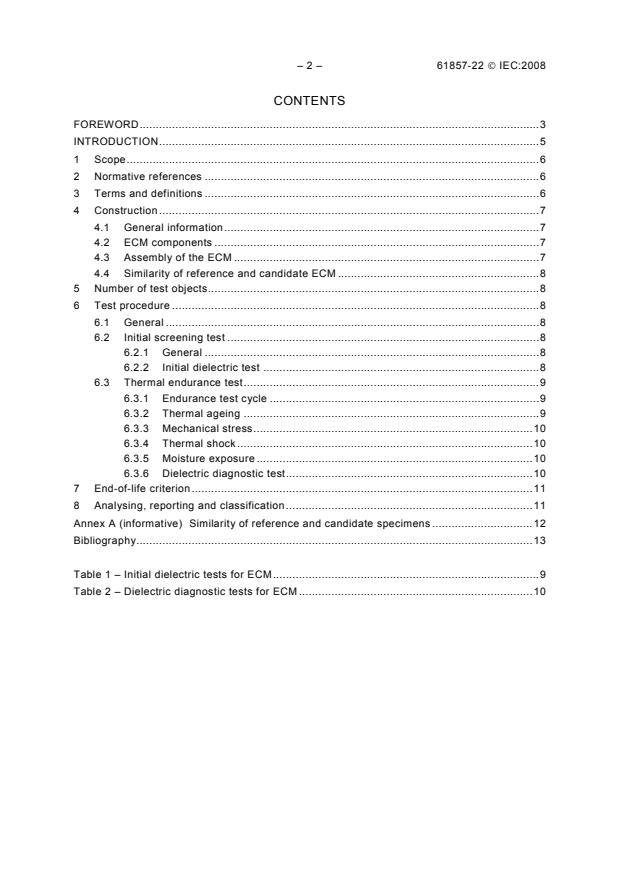
CONTENTS
FOREWORD.3
INTRODUCTION.5
1 Scope.6
2 Normative references .6
3 Terms and definitions .6
4 Construction .7
4.1 General information.7
4.2 ECM components .7
4.3 Assembly of the ECM .7
4.4 Similarity of reference and candidate ECM .8
5 Number of test objects.8
6 Test procedure .8
6.1 General .8
6.2 Initial screening test .8
6.2.1 General .8
6.2.2 Initial dielectric test .8
6.3 Thermal endurance test.9
6.3.1 Endurance test cycle .9
6.3.2 Thermal ageing .9
6.3.3 Mechanical stress.10
6.3.4 Thermal shock.10
6.3.5 Moisture exposure .10
6.3.6 Dielectric diagnostic test.10
7 End-of-life criterion.11
8 Analysing, reporting and classification.11
Annex A (informative) Similarity of reference and candidate specimens .12
Bibliography.13
Table 1 – Initial dielectric tests for ECM.9
Table 2 – Dielectric diagnostic tests for ECM .10
61857-22 © IEC:2008 – 3 –
INTERNATIONAL ELECTROTECHNICAL COMMISSION
____________
ELECTRICAL INSULATION SYSTEMS –
PROCEDURES FOR THERMAL EVALUATION –
Part 22: Specific requirements for encapsulated-coil model –
Wire-wound electrical insulation system (EIS)
FOREWORD
1) The International Electrotechnical Commission (IEC) is a worldwide organization for standardization comprising
all national electrotechnical committees (IEC National Committees). The object of IEC is to promote
international co-operation on all questions concerning standardization in the electrical and electronic fields. To
this end and in addition to other activities, IEC publishes International Standards, Technical Specifications,
Technical Reports, Publicly Available Specifications (PAS) and Guides (hereafter referred to as “IEC
Publication(s)”). Their preparation is entrusted to technical committees; any IEC National Committee interested
in the subject dealt with may participate in this preparatory work. International, governmental and non-
governmental organizations liaising with the IEC also participate in this preparation. IEC collaborates closely
with the International Organization for Standardization (ISO) in accordance with conditions determined by
agreement between the two organizations.
2) The formal decisions or agreements of IEC on technical matters express, as nearly as possible, an international
consensus of opinion on the relevant subjects since each technical committee has representation from all
interested IEC National Committees.
3) IEC Publications have the form of recommendations for international use and are accepted by IEC National
Committees in that sense. While all reasonable efforts are made to ensure that the technical content of IEC
Publications is accurate, IEC cannot be held responsible for the way in which they are used or for any
misinterpretation by any end user.
4) In order to promote international uniformity, IEC National Committees undertake to apply IEC Publications
transparently to the maximum extent possible in their national and regional publications. Any divergence
between any IEC Publication and the corresponding national or regional publication shall be clearly indicated in
the latter.
5) IEC provides no marking procedure to indicate its approval and cannot be rendered responsible for any
equipment declared to be in conformity with an IEC Publication.
6) All users should ensure that they have the latest edition of this publication.
7) No liability shall attach to IEC or its directors, employees, servants or agents including individual experts and
members of its technical committees and IEC National Committees for any personal injury, property damage or
other damage of any nature whatsoever, whether direct or indirect, or for costs (including legal fees) and
expenses arising out of the publication, use of, or reliance upon, this IEC Publication or any other IEC
Publications.
8) Attention is drawn to the Normative references cited in this publication. Use of the referenced publications is
indispensable for the correct application of this publication.
9) Attention is drawn to the possibility that some of the elements of this IEC Publication may be the subject of
patent rights. IEC shall not be held responsible for identifying any or all such patent rights.
International Standard IEC 61857-22 has been prepared by IEC technical committee 112:
Evaluation and qualification of electrical insulating materials and systems.
This second edition cancels and replaces the first edition published in 2002, and constitutes
editorial revisions to make this standard compatible with Parts 1 and 21.
The text of this standard is based on the following documents:
CDV Report on voting
112/91/CDV 112/99/RVC
Full information on the voting for the approval of this standard can be found in the report on
voting indicated in the above table.
This publication has been drafted in accordance with the ISO/IEC Directives, Part 2.
– 4 – 61857-22 © IEC:2008
A list of all the parts in the IEC 61857 series, under the general title Electrical insulation
systems – Procedures for thermal evaluation, can be found on the IEC website.
The committee has decided that the contents of this publication will remain unchanged until
the maintenance result date indicated on the IEC web site under "http://webstore.iec.ch" in
the data related to the specific publication. At this date, the publication will be
• reconfirmed,
• withdrawn,
• replaced by a revised edition, or
• amended.
61857-22 © IEC:2008 – 5 –
INTRODUCTION
A series of parts that will make up IEC 61857 is currently being developed, each of which will
address a specific test object and/or application with an associated test procedure.
Additional parts will be developed in cooperation with IEC technical committees responsible
for equipment.
– 6 – 61857-22 © IEC:2008
ELECTRICAL INSULATION SYSTEMS –
PROCEDURES FOR THERMAL EVALUATION –
Part 22: Specific requirements for encapsulated-coil model –
Wire-wound electrical insulation system (EIS)
1 Scope
This part of IEC 61857 provides a general-purpose procedure for the evaluation of wire-
wound systems using a general purpose encapsulated-coil model (ECM) where the
application is unknown.
2 Normative references
The following referenced documents are indispensable for the application of this document.
For dated references, only the edition cited applies. For undated references, the latest edition
of the referenced document (including any amendments) applies.
IEC 61857-1:2004, Electrical insulation systems – Procedures for thermal evaluation – Part 1:
General requirements – Low-voltage
3 Terms and definitions
For the purposes of this document, the terms and definitions given in IEC 61857-1, as well as
the following definitions, apply.
3.1
encapsulant
electrical insulating material (EIM) that completely encases the coil except for connections to
the exterior, and is part of the electrical insulation system (EIS)
NOTE The encapsulated-coil model (ECM) does not employ a supplemental shell.
3.2
encapsulation
process of applying an encapsulant
NOTE For the purpose of evaluating an electrical insulation system (EIS), the process may consist of injection
moulding, compression moulding, casting or other techniques.
3.3
bobbin
form around which a coil is wound
3.4
coil
continuous winding of insulated wire
3.5
coil-to-coil insulation
electrical insulating material (EIM) between individual coils
61857-22 © IEC:2008 – 7 –
3.6
earth
ground (US)
make an electric connection between a given point in a system or in an installation or in
equipment and a local earth
[IEV 195-01-08]
3.7
earth (ground) insulation
electrical insulating material (EIM) between a coil and earthed metal
4 Construction
4.1 General information
The ECM is useful in evaluating the compatibility of EIM used in a candidate EIS. It is equally
capable of simulating the influences of actual manufacturing processes such as winding
techniques, termination techniques and encapsulation.
The essential parts of the ECM are a bobbin, winding wire, wire connectors and encapsulant.
The winding wires may be connected to binding posts or to lead wires, either of which extends
through the encapsulant wall.
4.2 ECM components
The components of the encapsulated-coil model are as follows:
a) Coil: the coils may be wound with two wires in parallel (bifilar winding) or may be wound
with a single wire.
b) Wire: winding wire, heavy film coated; 0,4 mm to 0,6 mm diameter wire size is preferred.
c) Earth insulation: the EIM used as the bobbin and the EIM used as the encapsulant
function as coil-to-earth insulation. An EIM evaluated only as a coil bobbin shall not also
be used as an encapsulant material. An EIM used as an encapsulant shall be evaluated as
such.
d) Tape: electrical tape may be used but unless electrically stressed and evaluated is not
part of the EIS.
e) Connectors: the winding wires are connected inside the encapsulant to binding posts or
lead wires. These connections are essential parts of the ECM.
f) Electrical impregnating resin/varnish: this may be part of the EIS if applied prior to the
encapsulation process.
NOTE A metal frame or a lamination stack that may be incorporated into the test object is not an essential part of
the test object if it does not function as a fault path.
4.3 Assembly of the ECM
Assemble the ECM as follows:
a) Wind the winding wire over the bobbin using accepted winding techniques.
b) As appropriate, use electrical grade tape or other components to secure the winding wire
in place.
c) Connect the winding wire to the binding posts or lead wires.
d) If part of the candidate EIS, apply impregnating resin/varnish.
e) Apply the encapsulant material.
– 8 – 61857-22 © IEC:2008
4.4 Similarity of reference and candidate ECM
The physical shape and assembly of the reference and candidate ECM must be similar. It is
essential that the size of the winding wire used in the reference and candidate ECM be within
±0,2 mm of each other. Refer to Annex A for more information. Details of the construction of
the reference and candidate ECM shall be reported according to 7.4 of IEC 61857-1:2004.
5 Number of test objects
The minimum number of test objects for each EIS and for each ageing temperature shall be
ten.
6 Test procedure
6.1 General
All test objects shall be subjected to initial screening tests followed by repeated thermal
endurance test cycles in the following order:
a) a thermal ageing subcycle;
b) a subcycle of pre-diagnostic mechanical stress, other pre-diagnostic requirements and
moisture exposure, in that order;
c) a dielectric diagnostic test.
6.2 Initial screening test
6.2.1 General
Prior to exposure to an elevated temperature on the first thermal ageing subcycle, all test
objects shall be subjected to initial screening tests in order to eliminate defective test objects.
The initial screening tests shall consist of the following steps and shall be conducted in the
order given:
a) visual inspection;
b) initial dielectric test (see 6.2.2);
c) mechanical stress (see 6.3.3);
d) thermal shock, as required (see 6.3.4)
e) moisture exposure (see 6.3.5);
f) dielectric diagnostic test (see 6.3.6).
6.2.2 Initial dielectric test
An initial screening test using dielectric techniques shall be performed on each ECM test
object prior to application of other prediagnostic stresses and thermal ageing, see Table 1.
61857-22 © IEC:2008 – 9 –
Table 1 – Initial dielectric tests for ECM
Voltage Acceptance
Test Method
V criteria
Wire in a single Change of Apply a direct current voltage that will result <3 % reduction of
strand coil resistance in a maximum admissible current density at
the resistance for
which the active resistance of the winding can
the coil design
a
be measured.
Wires in bifilar coils Conductor to 0,5 A to 0,75 A
400 ± 40
conductor
Coil-to-coil (for Dielectric
2 000 ± 100 (40 ± 10) mA
multiple coil withstand
constructions)
Earth insulation Dielectric
2 000 ± 100 (40 ± 10) mA
withstand
a 2
Maximum 1 A/mm of cross-section.
The following procedure shall then be followed:
• an initial dielectric test voltage shall be applied for a minimum of 60 s;
• failure shall be current flow as defined above prior to completion of the time period;
• frequency of the test voltage shall be between 48 Hz and 62 Hz.
NOTE Instantaneous application of full voltage is not recommended. It is recommended that surge protectors be
included in the test circuit to eliminate unintended high voltage spikes.
For test objects evaluated by applied voltage, pre-calibrated electromechanical over-current
circuit-breakers with a trip time of 2 s to 3 s have been used successfully to detect failure.
The cause of failure shall be determined. When the failure is within the EIS, it shall eliminate
that ECM from further testing. When the failure is not within the EIS and it can be repaired
without disturbing the EIS, the ECM may be retested and returned to the test programme
if it passes.
6.3 Thermal endurance test
6.3.1 Endurance test cycle
Following the initial screening tests, all test objects shall be subjected to repeated thermal
endurance test cycles in the following order:
a) thermal ageing subcycle;
b) mechanical stress subcycle;
c) thermal shock subcycle;
d) moisture exposure subcycle;
e) dielectric diagnostic test.
6.3.2 Thermal ageing
Thermal ageing, comprising selection of ageing temperature, initial ageing periods and ageing
procedures shall be conducted in accordance with 6.3 of IEC 61857-1:2004.
Ovens shall be used in accordance with 6.3.4 of IEC 61857-1:2004.
– 10 – 61857-22 © IEC:2008
6.3.3 Mechanical stress
Mechanical stress shall be applied by mounting the test objects on a vibration table and
exposing them between 55 min to 65 min of sinusoidal vibration at a frequency between 48 Hz
–2
and 62 Hz, with a constant acceleration of (14,7 ± 3) ms . No voltage shall be applied during
this period.
6.3.4 Thermal shock
Unless agreed to by all interested parties, both the reference and candidate EIS shall be
exposed to a low-temperature thermal shock. Thermal shock shall be applied by placing
ECMs directly from ambient conditions into a low-temperature chamber at (–20 ± 5) °C for at
least 2 h. No voltage shall be applied during this period.
6.3.5 Moisture exposure
Moisture exposure with visible condensation shall be applied in accordance with 6.6 of
IEC 61857-1:2004.
6.3.6 Dielectric diagnostic test
Following each ageing cycle and conditioning described in 6.3.3 through 6.3.5, evaluate the
ECM specimens in accordance with the dielectric diagnostic test given in Table 2.
Table 2 – Dielectric diagnostic tests for ECM
Voltage
Test Method End-of-life
V
Wire in a single Change of Apply a direct current voltage that will result ≥10 % reduction of the
strand coil resistance in a maximum admissible current density at resistance for the coil
which the active resistance of the winding can
design
a
be measured.
Wires in bifilar coils Conductor to 0,5 A to 0,75 A
110 ± 10
conductor
Coil-to-coil (for Dielectric 0,5 A to 0,75 A
600 ± 30
multiple coil withstand
constructions)
Earth insulation Dielectric
2 000 ± 100 (40 ± 10 ) mA
withstand
a 2
Maximum 1 A/mm of cross-section.
The following steps shall then be taken:
• dielectric diagnostic test voltages, except for the change of resistance measurement,
shall be applied for a minimum of 10 min.
• dielectric diagnostic test voltage for the change of resistance shall be applied for a
minimum of 60 s;
• failure shall be current flow as defined above prior to completion of the time period.
• the frequency of the test voltage shall be between 48 Hz and 62 Hz.
NOTE Instantaneous application of full voltage is not recommended. It is recommended that surge protectors be
included in the test circuit to eliminate unintended high voltage spikes.
For test objects evaluated by applied voltage, pre-calibrated electromechanical over-current
circuit breakers with a trip time of 2 s to 3 s have been used successfully to detect failure.
61857-22 © IEC:2008 – 11 –
In order to check the condition of the test objects and determine end-of-life, the dielectric
diagnostic test shall be applied after each successive exposure to moisture, either while the
test objects are still in the condensation chamber or immediately after removal while still wet
with moisture.
7 End-of-life criterion
The end-of-life criterion for individual test specimens shall be failure of an ECM to hold the
applied voltage for the required time period shown in Table 2. The cause of failure shall be
determined. When the failure is within the EIS, it shall eliminate that ECM from further testing.
When the failure is not within the EIS and it can be repaired without disturbing the EIS, the
.
ECM may be returned to the test program
8 Analysing, reporting and classification
Analysing, reporting and classification shall be in accordance with Clause 7 of IEC 61857-
1:2004.
– 12 – 61857-22 © IEC:2008
Annex A
(informative)
Similarity of reference and candidate specimens
Technical committee 98 developed this part of IEC 61857 with a focus on trying to keep an
economical approach to the development of the test objects. A major concern of TC 98 was
the high cost that could result by trying to specify a single or a preferred size for the test
object. Such a proposal would require companies to make a major financial investment for a
mould that would, most likely, only be applicable to the moulding of test objects for the
evaluation of a candidate EIS and not be applicable to end use devices. This seemed to be an
unacceptable approach.
Experience has shown that a company interested in evaluating candidate encapsulated EIS
has moulds that can provide usable and acceptable test objects. In order to maintain
reasonable test costs, TC 98 has recognized and supported flexibility in the design of the test
objects.
In addition, all EIS evaluations in accordance with IEC 61857 are relative comparisons
between a reference EIS and a candidate EIS. I
...