

IEC 60076-10:2001
(Main)Power transformers - Part 10: Determination of sound levels
General Information
- Abstract
Defines sound pressure and sound intensity measurement methods by which sound power levels of transformers, reactors and their associated cooling auxiliaries may be determined. Is applicable to transformers and reactors covered by the IEC 60076 series, IEC 60289, and the IEC 61378 series, without limitation as regards size or voltage and when fitted with their normal cooling auxiliaries.
- Status
- Published
- Publication Date
- 21-May-2001
- Technical Committee
- TC 14 - Power transformers
- Drafting Committee
- WG 25 - TC 14/WG 25
- Current Stage
- DELPUB - Deleted Publication
- Start Date
- 24-Mar-2016
- Completion Date
- 28-Aug-2026
Buy Documents
IEC 60076-10:2001 - Power transformers - Part 10: Determination of sound levels Released:5/22/2001
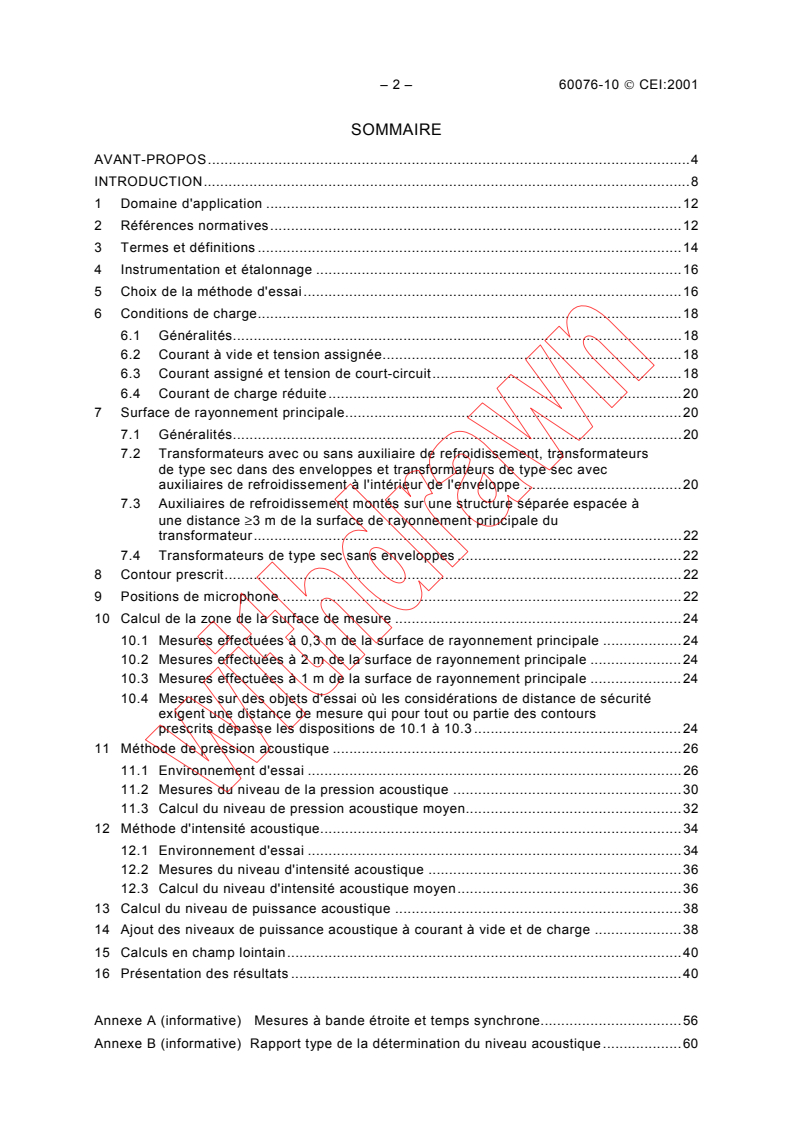
IEC 60076-10:2001 - Power transformers - Part 10: Determination of sound levels Released:5/22/2001
Overview
IEC 60076-10:2001 - Power transformers, Part 10: Determination of sound levels - defines standardized measurement methods for quantifying transformer and reactor noise. The standard specifies both sound pressure and sound intensity techniques to determine sound power levels of transformers, reactors and their normal cooling auxiliaries. It applies to equipment covered by the IEC 60076 series, IEC 60289, IEC 60726 and IEC 61378 series regardless of size or voltage, and is primarily intended for factory testing (with guidance adaptable to on‑site measurements).
Key topics and technical requirements
- Measurement methods: Procedures for sound pressure and sound intensity measurement and calculation of sound power levels.
- Instrumentation & calibration: Requirements for microphones, intensity probes and calibrated instruments compliant with referenced electroacoustic standards.
- Test conditions & load states: Guidance on no‑load, rated load, short‑circuit and reduced‑load conditions and how load current affects radiated sound.
- Geometry & microphone placement: Definition of the principal radiating surface, prescribed contours and standardized microphone positions and measurement distances (factory measurement surfaces).
- Calculation procedures: How to compute average sound pressure/intensity, convert to sound power level, combine no‑load and load contributions, and perform far‑field estimations.
- Environment & background noise: Test environment considerations, corrections for reflections and background noise, and when to prefer intensity over pressure measurements.
- Reporting: Presentation of results and example report formats (informative annexes for narrow‑band and time‑synchronous measurements).
Practical applications
- Design validation: Compare acoustic performance of core, winding and tank designs during development.
- Factory acceptance testing: Provide consistent, repeatable sound power data for quality control and contractual acceptance.
- Siting and environmental assessment: Use sound power data for noise impact assessments and transformer substation siting decisions.
- Noise mitigation: Identify dominant sources (core vs. winding vs. cooling auxiliaries) to guide damping, enclosure or cooler‑design changes.
- Procurement & specification: Specify allowable sound power levels in purchase orders and technical specifications.
Who should use this standard
- Transformer and reactor manufacturers and test laboratories
- Acoustic and mechanical engineers involved in electromagnetic/mechanical noise analysis
- Utility planners, substation designers and environmental/permit specialists
- Procurement teams and standards writers who specify transformer noise performance
Related standards (normative & informative)
- IEC 60076 series (power transformers)
- IEC 60289 (reactors), IEC 60726 (dry‑type transformers), IEC 61378 (converter transformers)
- IEC 60651, IEC 61043 (electroacoustics), ISO 3746, ISO 9614-1 (sound power measurement methods)
Keywords: IEC 60076-10:2001, power transformer sound levels, transformer noise measurement, sound pressure, sound intensity, sound power level, transformer acoustic testing.
Relations
- Effective Date
- 05-Sep-2023
Buy Documents
IEC 60076-10:2001 - Power transformers - Part 10: Determination of sound levels Released:5/22/2001
IEC 60076-10:2001 - Power transformers - Part 10: Determination of sound levels Released:5/22/2001
Get Certified
Connect with accredited certification bodies for this standard

IMQ S.p.A. (Certification)
Italian electrical product certification.

SLG Prüf- und Zertifizierungs GmbH
German testing and certification body.

UL Solutions
Global safety science company with testing, inspection and certification.
Sponsored listings
Frequently Asked Questions
IEC 60076-10:2001 is a standard published by the International Electrotechnical Commission (IEC). Its full title is "Power transformers - Part 10: Determination of sound levels". This standard covers: Defines sound pressure and sound intensity measurement methods by which sound power levels of transformers, reactors and their associated cooling auxiliaries may be determined. Is applicable to transformers and reactors covered by the IEC 60076 series, IEC 60289, and the IEC 61378 series, without limitation as regards size or voltage and when fitted with their normal cooling auxiliaries.
Defines sound pressure and sound intensity measurement methods by which sound power levels of transformers, reactors and their associated cooling auxiliaries may be determined. Is applicable to transformers and reactors covered by the IEC 60076 series, IEC 60289, and the IEC 61378 series, without limitation as regards size or voltage and when fitted with their normal cooling auxiliaries.
IEC 60076-10:2001 is classified under the following ICS (International Classification for Standards) categories: 29.180 - Transformers. Reactors. The ICS classification helps identify the subject area and facilitates finding related standards.
IEC 60076-10:2001 has the following relationships with other standards: It is inter standard links to IEC 60076-10:2016. Understanding these relationships helps ensure you are using the most current and applicable version of the standard.
IEC 60076-10:2001 is available in PDF format for immediate download after purchase. The document can be added to your cart and obtained through the secure checkout process. Digital delivery ensures instant access to the complete standard document.
Standards Content (Sample)
INTERNATIONAL IEC
STANDARD
60076-10
First edition
2001-05
Power transformers –
Part 10:
Determination of sound levels
Transformateurs de puissance –
Partie 10:
Détermination des niveaux de bruit
Reference number
Publication numbering
As from 1 January 1997 all IEC publications are issued with a designation in the
60000 series. For example, IEC 34-1 is now referred to as IEC 60034-1.
Consolidated editions
The IEC is now publishing consolidated versions of its publications. For example,
edition numbers 1.0, 1.1 and 1.2 refer, respectively, to the base publication, the
base publication incorporating amendment 1 and the base publication incorporating
amendments 1 and 2.
Further information on IEC publications
The technical content of IEC publications is kept under constant review by the IEC,
thus ensuring that the content reflects current technology. Information relating to
this publication, including its validity, is available in the IEC Catalogue of
publications (see below) in addition to new editions, amendments and corrigenda.
Information on the subjects under consideration and work in progress undertaken
by the technical committee which has prepared this publication, as well as the list
of publications issued, is also available from the following:
• IEC Web Site (www.iec.ch)
• Catalogue of IEC publications
The on-line catalogue on the IEC web site (www.iec.ch/catlg-e.htm) enables
you to search by a variety of criteria including text searches, technical
committees and date of publication. On-line information is also available on
recently issued publications, withdrawn and replaced publications, as well as
corrigenda.
• IEC Just Published
This summary of recently issued publications (www.iec.ch/JP.htm) is also
available by email. Please contact the Customer Service Centre (see below) for
further information.
• Customer Service Centre
If you have any questions regarding this publication or need further assistance,
please contact the Customer Service Centre:
Email: custserv@iec.ch
Tel: +41 22 919 02 11
Fax: +41 22 919 03 00
INTERNATIONAL IEC
STANDARD
60076-10
First edition
2001-05
Power transformers –
Part 10:
Determination of sound levels
Transformateurs de puissance –
Partie 10:
Détermination des niveaux de bruit
IEC 2001 Copyright - all rights reserved
No part of this publication may be reproduced or utilized in any form or by any means, electronic or
mechanical, including photocopying and microfilm, without permission in writing from the publisher.
International Electrotechnical Commission 3, rue de Varembé Geneva, Switzerland
Telefax: +41 22 919 0300 e-mail: inmail@iec.ch IEC web site http://www.iec.ch
Commission Electrotechnique Internationale
PRICE CODE
Q
International Electrotechnical Commission
For price, see current catalogue
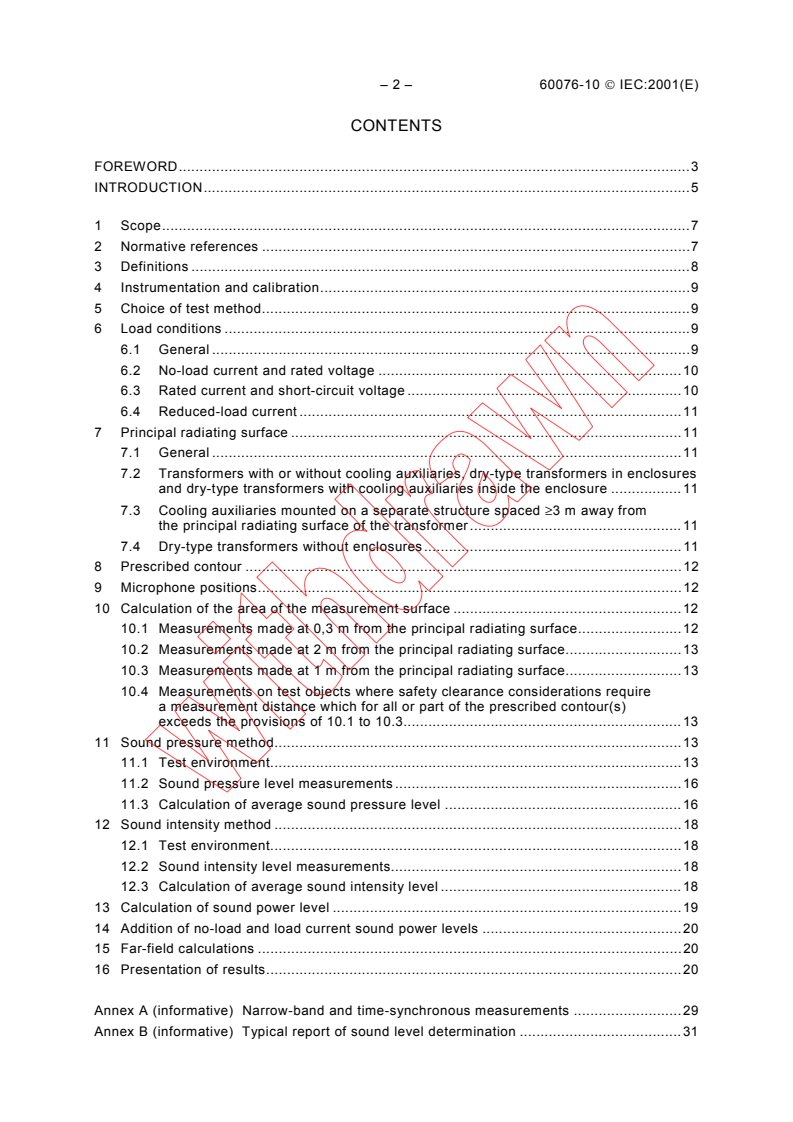
– 2 – 60076-10 IEC:2001(E)
CONTENTS
FOREWORD.3
INTRODUCTION.5
1 Scope.7
2 Normative references .7
3 Definitions .8
4 Instrumentation and calibration.9
5 Choice of test method.9
6 Load conditions .9
6.1 General .9
6.2 No-load current and rated voltage .10
6.3 Rated current and short-circuit voltage .10
6.4 Reduced-load current .11
7 Principal radiating surface .11
7.1 General .11
7.2 Transformers with or without cooling auxiliaries, dry-type transformers in enclosures
and dry-type transformers with cooling auxiliaries inside the enclosure .11
7.3 Cooling auxiliaries mounted on a separate structure spaced ≥3 m away from
the principal radiating surface of the transformer.11
7.4 Dry-type transformers without enclosures.11
8 Prescribed contour .12
9 Microphone positions.12
10 Calculation of the area of the measurement surface .12
10.1 Measurements made at 0,3 m from the principal radiating surface.12
10.2 Measurements made at 2 m from the principal radiating surface.13
10.3 Measurements made at 1 m from the principal radiating surface.13
10.4 Measurements on test objects where safety clearance considerations require
a measurement distance which for all or part of the prescribed contour(s)
exceeds the provisions of 10.1 to 10.3.13
11 Sound pressure method.13
11.1 Test environment.13
11.2 Sound pressure level measurements .16
11.3 Calculation of average sound pressure level .16
12 Sound intensity method .18
12.1 Test environment.18
12.2 Sound intensity level measurements.18
12.3 Calculation of average sound intensity level .18
13 Calculation of sound power level .19
14 Addition of no-load and load current sound power levels .20
15 Far-field calculations .20
16 Presentation of results.20
Annex A (informative) Narrow-band and time-synchronous measurements .29
Annex B (informative) Typical report of sound level determination .31
60076-10 IEC:2001(E) – 3 –
INTERNATIONAL ELECTROTECHNICAL COMMISSION
____________
POWER TRANSFORMERS –
Part 10: Determination of sound levels
FOREWORD
1) The IEC (International Electrotechnical Commission) is a worldwide organization for standardization comprising
all national electrotechnical committees (IEC National Committees). The object of the IEC is to promote
international co-operation on all questions concerning standardization in the electrical and electronic fields. To
this end and in addition to other activities, the IEC publishes International Standards. Their preparation is
entrusted to technical committees; any IEC National Committee interested in the subject dealt with may
participate in this preparatory work. International, governmental and non-governmental organizations liaising
with the IEC also participate in this preparation. The IEC collaborates closely with the International
Organization for Standardization (ISO) in accordance with conditions determined by agreement between the
two organizations.
2) The formal decisions or agreements of the IEC on technical matters express, as nearly as possible, an
international consensus of opinion on the relevant subjects since each technical committee has representation
from all interested National Committees.
3) The documents produced have the form of recommendations for international use and are published in the form
of standards, technical specifications, technical reports or guides and they are accepted by the National
Committees in that sense.
4) In order to promote international unification, IEC National Committees undertake to apply IEC International
Standards transparently to the maximum extent possible in their national and regional standards. Any
divergence between the IEC Standard and the corresponding national or regional standard shall be clearly
indicated in the latter.
5) The IEC provides no marking procedure to indicate its approval and cannot be rendered responsible for any
equipment declared to be in conformity with one of its standards.
6) Attention is drawn to the possibility that some of the elements of this International Standard may be the subject
of patent rights. The IEC shall not be held responsible for identifying any or all such patent rights.
International Standard IEC 60076-10 has been prepared by IEC technical committee 14:
Power transformers.
This first edition of IEC 60076-10 cancels and replaces IEC 60551, published in 1987 and its
amendment 1 (1995), and constitutes a technical revision.
The text of this standard is based on the following documents:
FDIS Report on voting
14/390/FDIS 14/394/RVD
Full information on the voting for the approval of this standard can be found in the report on
voting indicated in the above table.
This publication has been drafted in accordance with the ISO/IEC Directives, Part 3.
Annexes A and B are for information only.
IEC 60076 consists of the following parts, under the general title: Power transformers.
Part 1: General
Part 2: Temperature rise
Part 3: Insulation levels, dielectric tests and external clearances in air
– 4 – 60076-10 IEC:2001(E)
Part 5: Ability to withstand short-circuit
Part 8: Application guide
Part 10: Determination of sound levels
The committee has decided that the contents of this publication will remain unchanged until
2008. At this date, the publication will be
• reconfirmed;
• withdrawn;
• replaced by a revised edition, or
• amended.
A bilingual version of this publication may be issued at a later date.
60076-10 IEC:2001(E) – 5 –
INTRODUCTION
One of the many parameters to be considered when designing and siting transformers,
reactors and their associated cooling equipment is the amount of sound that the equipment is
likely to emit under normal operating conditions on site.
Sources of sound
The audible sound radiated by transformers is generated by a combination of magnetostrictive
deformation of the core and electromagnetic forces in the windings, tank walls and magnetic
shields. Historically, the sound generated by the magnetic field inducing longitudinal
vibrations in the core laminations has been dominant. The amplitude of these vibrations
depends on the flux density in the laminations and the magnetic properties of the core steel,
and is therefore independent of the load current. Recent advances in core design, combined
with the use of low induction levels, have reduced the amount of sound generated in the core
such that the sound caused by the electromagnetic forces may become significant.
Current flowing in the winding conductors produces electromagnetic forces in the windings. In
addition, stray magnetic fields may induce vibrations in structural components. The force (and
therefore the amplitude of the vibrations) is proportional to the square of the current, and the
radiated sound power is proportional to the square of the vibrational amplitude. Consequently,
the radiated sound power is strongly dependent on the load current. Vibrations in core and
winding assemblies can then induce sympathetic vibrations in tank walls, magnetic shields
and air ducts (if present).
In the case of dry-type, air-cored shunt or series reactors, sound is generated by
electromagnetic forces acting on the windings in a similar manner to that described above.
These oscillatory forces cause the reactor to vibrate both axially and radially, and the axial
and radial supports and manufacturing tolerances may result in the excitation of modes in
addition to those of rotational symmetry. In the case of iron-cored reactors, further vibrations
are induced by forces acting in the magnetic circuit.
For all electrical plants, the consequence of the presence of higher harmonics on the power
supply should be understood. Normally, vibrations occur at even harmonics of the power
frequency, with the first harmonic being dominant. If other frequencies are present in the
power supply, other forces may be induced. For certain applications, this may be significant,
particularly because the human ear is more sensitive to these higher frequencies.
Any associated cooling equipment will also generate noise when operating. Fans and pumps
both tend to generate broad-band noise due to the forced flow of air or oil.
Measurement of sound
Sound level measurements have been developed to quantify pressure variations in air that a
human ear can detect. The smallest pressure variation that a healthy human ear can detect is
20 μPa. This is the reference level (0 dB) to which all the other levels are compared. The
perceived loudness of a signal is dependent upon the sensitivity of the human ear to its
frequency spectrum. Modern measuring instruments process sound signals through electronic
networks, the sensitivity of which varies with frequency in a manner similar to the human ear.
This has resulted in a number of internationally standardized weightings of which the A-
weighting network is the most common.
Sound intensity is defined as the rate of energy flow per unit area and is measured in watts
per square metre. It is a vector quantity whereas, sound pressure is a scalar quantity and is
defined only by its magnitude.
– 6 – 60076-10 IEC:2001(E)
Sound power is the parameter which is used for rating and comparing sound sources. It is a
basic descriptor of a source’s acoustic output, and therefore an absolute physical property of
the source alone which is independent of any external factors such as environment and
distance to the receiver.
Sound power can be calculated from sound pressure or sound intensity determinations.
Sound intensity measurements have the following advantages over sound pressure
measurements:
• an intensity meter responds only to the propagating part of a sound field and ignores any
non-propagating part, for example, standing waves and reflections;
• the intensity method reduces the influence of external sound sources, as long as their
sound level is approximately constant.
The sound pressure method takes the above factors into account by correcting for
background noise and reflections.
For a detailed discussion of these measuring techniques, see IEC 60076-10-1, Part 10-1:
Determination of transformer and reactor sound levels – User guide (under consideration)
60076-10 IEC:2001(E) – 7 –
POWER TRANSFORMERS –
Part 10: Determination of sound levels
1 Scope
This part of IEC 60076 defines sound pressure and sound intensity measurement methods by
which sound power levels of transformers, reactors and their associated cooling auxiliaries
may be determined.
NOTE For the purpose of this standard, the term "transformer" means "transformer or reactor".
The methods are applicable to transformers and reactors covered by the IEC 60076 series,
IEC 60289, IEC 60726 and the IEC 61378 series, without limitation as regards size or voltage
and when fitted with their normal cooling auxiliaries.
This standard is primarily intended to apply to measurements made at the factory. Conditions
on-site may be very different because of the proximity of objects, including other trans-
formers. Nevertheless, the same general rules as are given in this standard may be followed
when on-site measurements are made.
2 Normative references
The following normative documents contain provisions which, through reference in this text,
constitute provisions of this part of IEC 60076. For dated references, subsequent
amendments to, or revisions of, any of these publications do not apply. However, parties to
agreements based on this part of IEC 60076 are encouraged to investigate the possibility of
applying the most recent editions of the normative documents indicated below. For undated
references, the latest edition of the normative document referred to applies. Members of IEC
and ISO maintain registers of currently valid International standards.
IEC 60076 (all parts), Power transformers
IEC 60289:1988, Reactors
IEC 60651:1979, Sound level meters
IEC 60726:1982, Dry-type power transformers
IEC 61043:1993, Electroacoustics – Instruments for the measurement of sound intensity –
Measurement with pairs of pressure sensing microphones
IEC 61378 (all parts), Convertor transformers
ISO 3746:1995, Acoustics – Determination of sound power levels of noise sources using
sound pressure – Survey method using an enveloping measurement surface over a reflecting
plane
ISO 9614-1:1993, Acoustics – Determination of sound power levels of noise sources using
sound intensity – Part 1: Measurement at discrete points
– 8 – 60076-10 IEC:2001(E)
3 Definitions
For the purpose of this part of IEC 60076, the definitions in IEC 60076-1, as well as the
following definitions, apply.
3.1
sound pressure, p
fluctuating pressure superimposed on the static pressure by the presence of sound. It is
expressed in pascals
3.2
sound pressure level, L
p
ten times the logarithm to the base 10 of the ratio of the square of the sound pressure to the
–6
square of the reference sound pressure (p = 20 × 10 Pa). It is measured in decibels
p
L = 10 lg (1)
p
p
3.3
sound intensity, I
vector quantity describing the amount and direction of the net flow of sound energy at a given
–2
position. The unit is Wm
3. 4
normal sound intensity, I
n
component of the sound intensity in the direction normal to a measurement surface
3.5
normal sound intensity level, L
I
ten times the logarithm to the base 10 of the ratio of the normal sound intensity to the
–12 –2
reference sound intensity (I = 1 × 10 Wm ). It is expressed in decibels
I
n
L = 10 lg (2)
I
I
NOTE When I is negative, the level is expressed as –XX dB.
n
3.6
sound power, W
rate at which airborne sound energy is radiated by a source. It is expressed in watts
3.7
sound power level, L
W
ten times the logarithm to the base 10 of the ratio of a given sound power to the reference
–12
sound power (W = 1 × 10 W). It is expressed in decibels
W
L = 10 lg (3)
W
W
3.8
principal radiating surface
hypothetical surface surrounding the test object which is assumed to be the surface from
which sound is radiated
60076-10 IEC:2001(E) – 9 –
3.9
prescribed contour
horizontal line on which the measuring positions are located, spaced at a definite horizontal
distance (the "measurement distance") from the principal radiating surface
3.10
measurement distance, X
horizontal distance between the principal radiating surface and the "measurement surface"
3.11
measurement surface
hypothetical surface enveloping the source and on which the measurement points are located
3.12
background noise
A-weighted sound pressure level with the test object inoperative
4 Instrumentation and calibration
Sound pressure measurements shall be made using a type 1 sound level meter complying
with IEC 60651 and calibrated in accordance with 5.2 of ISO 3746.
Sound intensity measurements shall be made using a class 1 sound intensity instrument
complying with IEC 61043 and calibrated in accordance with 6.2 of ISO 9614-1. The
frequency range of the measuring equipment shall be adapted to the frequency spectrum of
the test object, that is, an appropriate microphone spacer system shall be chosen in order to
minimize systematic errors.
The measuring equipment shall be calibrated immediately before and after the measurement
sequence. If the calibration changes by more than 0,3 dB, the measurements shall be
declared invalid and the test repeated.
5 Choice of test method
Either sound pressure or sound intensity measurements may be used to determine the value
of the sound power level. Both methods are valid and either can be used, as agreed between
manufacturer and purchaser at the time of placing the order.
The sound pressure method of measurement described in this standard is in accordance with
ISO 3746. Measurements made in conformity with this standard tend to result in standard
deviations of reproducibility between determinations made in different laboratories which are
less than or equal to 3 dB.
The sound intensity method of measurement described in this standard is in accordance with
ISO 9614-1. Measurements made in conformity with this standard tend to result in standard
deviations of reproducibility between determinations made in different laboratories which are
less than or equal to 3 dB.
6 Load conditions
6.1 General
Load condition(s) shall be agreed between the manufacturer and purchaser at the time of
placing the order. If a transformer has a very low no-load sound level, the sound due to load
current can influence the total sound level in service. The method to be used for summing the
no-load and load current sound levels is given in clause 14.
– 10 – 60076-10 IEC:2001(E)
Current taken by a reactor is dependent on the voltage applied and consequently, a reactor
cannot be tested at no-load. Where sufficient power is available in the factory to permit full
energization of reactors, the methods to be followed are the same as those for transformers.
Alternatively, measurements may be made on-site if conditions are suitable.
Unless otherwise specified, the tests shall be carried out with the tap-changer (if any) on the
principal tapping. However, this tap position may not give the maximum sound level in
service. In addition, when the transformer is in service, a superposition of the flux at no-load
conditions and the stray flux occurs which causes a change in the flux density in certain parts
of the core. Therefore, under special conditions of intended application of a transformer
(particularly variable flux voltage variation), it may be agreed to measure the sound levels on
a tapping other than the principal tapping, or with a voltage other than the rated voltage on an
untapped winding. This shall be clearly indicated in the test report.
6.2 No-load current and rated voltage
For measurements made on the test object with or without its auxiliary cooling plant, the test
object shall be on no-load and excited at the rated voltage of sinusoidal or practically
sinusoidal waveform and rated frequency. The voltage shall be in accordance with 10.5 of
IEC 60076-1. If a transformer is fitted with reactor-type on-load tap-changer equipment where
the reactor may on certain tap-change positions be permanently energized, the measure-
ments shall be made with the transformer on a tapping which involves this condition and
which is as near to the principal tapping as possible. The excitation voltage shall be
appropriate to the tapping in use. This shall be clearly indicated in the test report.
NOTE DC bias currents may cause a significant increase in the measured sound levels. Their presence may be
verified by the existence of odd harmonics of the power frequency in the sound spectrum. The implications of
increased sound levels due to d.c. bias currents should be taken into consideration by both the manufacturer and
purchaser.
For North American applications, the sound level tests shall be made at no-load in
accordance with national requirements.
6.3 Rated current and short-circuit voltage
In order to decide whether it is significant to perform load current sound measurements, the
magnitude of the load current sound power level can be roughly estimated by equation 4:
S
r
L ≈ 39 + 18 lg (4)
WA,IN S
p
where
L is the A-weighted sound power level of the transformer at rated current, rated
WA,IN
frequency and impedance voltage;
S is the rated power in megavolt amperes (MVA);
r
S is the reference power (1 MVA).
p
For auto-transformers and three winding transformers, the two winding rated power, S , is
t
used instead of S .
r
If L is found to be 8 dB or more below the guaranteed sound power level, load current
WA,IN
sound measurements are not appropriate.
When these measurements are required, one winding shall be short-circuited and a sinusoidal
voltage as defined in 10.5 of IEC 60076-1 applied to the other winding at the rated frequency.
The voltage shall be gradually increased until rated current flows in the short-circuited
winding.
60076-10 IEC:2001(E) – 11 –
6.4 Reduced-load current
If the measurements can only be performed at a reduced current, the sound power level at the
rated current shall be calculated by equation (5):
I
N
L = L + 40 lg (5)
WA,IN WA,IT
I
T
where
L is the A-weighted sound power level at rated current;
WA,IN
L is the A-weighted sound power level at reduced current;
WA,IT
I is the rated current;
N
I is the reduced current.
T
The equation is valid for a reduced current of ≥70 % of the rated current.
7 Principal radiating surface
7.1 General
The definition of the principal radiating surface depends on the type of cooling auxiliaries
employed and their position relative to the transformer. For the purpose of this standard,
"cooling auxiliaries" shall include forced air and forced oil cooling auxiliaries and water
cooling equipment, and shall exclude natural air and natural oil cooling.
7.2 Transformers with or without cooling auxiliaries, dry-type transformers in
enclosures and dry-type transformers with cooling auxiliaries inside the
enclosure
The principal radiating surface is the surface obtained by the vertical projection of a string
contour encircling the equipment. The projection runs from the top of the transformer tank
cover (excluding bushings, turrets and other accessories situated above the tank cover) to the
base of the tank. The principal radiating surface shall include cooling auxiliaries located <3 m
away from the transformer tank, tank stiffeners and such auxiliary equipment as cable boxes,
tap-changers, etc. It shall exclude any cooling auxiliaries located ≥3 m away from the
transformer tank. Projections such as bushings, oil pipework and conservators, tank or cooler
underbases, valves, control cubicles and other secondary elements shall also be excluded,
(see figures 1, 2 and 3).
7.3 Cooling auxiliaries mounted on a separate structure spaced ≥≥≥≥3 m away from
the principal radiating surface of the transformer
The principal radiating surface is the surface obtained by the vertical projection of a string
contour encircling the equipment but excluding oil conservators, framework, pipework, valves
and other secondary elements. The vertical projection shall be from the top of the cooler
structure to the base of the active parts, (see figure 4).
7.4 Dry-type transformers without enclosures
The principal radiating surface is the surface obtained by the vertical projection of a string
contour encircling the dry-type transformer excluding framework, external wiring and
connections and attached apparatus not affecting the sound radiation. The vertical projection
shall be from the top of the transformer structure to the base of the active part (see figure 5).
– 12 – 60076-10 IEC:2001(E)
8 Prescribed contour
For measurements made with forced air cooling auxiliaries (if any) out of service, the
prescribed contour shall be spaced 0,3 m away from the principal radiating surface unless, for
safety reasons associated with dry-type units without enclosures, 1 m is chosen.
For measurements made with forced air cooling auxiliaries in service, the prescribed contour
shall be spaced 2 m away from the principal radiating surface.
For transformers with a tank height of <2,5 m, the prescribed contour shall be on a horizontal
plane at half the tank height. For transformers with a tank height ≥2,5 m, two prescribed
contours shall be used which are on horizontal planes at one-third and two-thirds of the tank
height unless, for safety reasons, a lower height is chosen.
For measurements made with the cooling auxiliaries only energized, the prescribed contour
for cooler structures with an overall height of <4 m (excluding oil conservators, pipework, etc.)
shall be on a horizontal plane at half the height. For cooler structures with an overall height of
≥4 m (excluding oil conservators, pipework, etc.), two prescribed contours shall be used which
are on horizontal planes at one-third and two-thirds of the height, unless for safety reasons, a
lower height is chosen.
NOTE It may be necessary to modify the measuring positions for certain test objects on safety grounds, for
example, in the case of transformers with horizontal high voltage bushings, the contour(s) may be confined to the
safe zone.
9 Microphone positions
The microphone positions shall be on the prescribed contour(s), approximately equally
spaced and not more than 1 m apart, (see dimension D in figures 1 to 5). There shall be a
minimum of six microphone positions.
Storage-type measuring equipment with an averaging device may be used. The microphone
shall be moved with approximately constant speed on the prescribed contour(s) around the
test object. The number of samples shall be not less than the number of microphone positions
specified above. Only the energy average shall be recorded in the test report
10 Calculation of the area of the measurement surface
10.1 Measurements made at 0,3 m from the principal radiating surface
The area S of the measurement surface, expressed in square metres, is given by equation (6):
S = 1,25 hl (6)
m
where
h is either the height in metres of the transformer tank (figures 1, 2 or 3) or, for dry-type
transformers without enclosures (figure 5), the height in metres of the core and its
framework;
l is the length in metres of the prescribed contour;
m
1,25 is an empirical factor intended to take account of the sound energy radiated by the
upper part of the test object.
60076-10 IEC:2001(E) – 13 –
10.2 Measurements made at 2 m from the principal radiating surface
The area S of the measurement surface, expressed in square metres, is given by equation (7):
S = (h + 2) l (7)
m
where
h is either the height in metres of the transformer tank (figure 2 or 3), or the height in metres
of the cooling auxiliaries including fans (figure 4);
l is the length in metres of the prescribed contour;
m
2 is the measurement distance in metres.
10.3 Measurements made at 1 m from the principal radiating surface
The area S of the measurement surface, expressed in square metres, is given by equation (8):
S = (h + 1) l (8)
m
where
h is the height in metres of the core with framework (figure 5);
l is the length in metres of the prescribed contour;
m
1 is the measurement distance in metres.
10.4 Measurements on test objects where safety clearance considerations require a
measurement distance which for all or part of the prescribed contour(s) exceeds
the provisions of 10.1 to 10.3
The area S of the measurement surface, expressed in square metres, is calculated by
equation (9):
S = l (9)
m
4 π
where l is the length in metres of the prescribed contour as dictated by safety clearances.
m
11 Sound pressure method
11.1 Test environment
11.1.1 General
An environment providing an approximately free field over a reflecting plane shall be used.
The test environment shall ideally provide a measurement surface which lies inside a sound
field essentially undisturbed by reflections from nearby objects and the environment
boundaries. Therefore, reflecting objects (with the exception of the supporting surface) shall
be removed as far as possible from the test object.
Measurements inside transformer cells or enclosures are not allowed.
For indoor measurements, the requirements of 11.1.2 shall be met. For outdoor measure-
ments in a test area, the requirements of 11.1.3 shall be met.
– 14 – 60076-10 IEC:2001(E)
11.1.2 Conditions for indoor measurements
11.1.2.1 Reflecting planes
The reflecting plane is usually the floor of the room and shall be larger than the projection of
the measurement surface upon it.
NOTE Care should be taken to ensure that the supporting surface does not radiate an appreciable sound energy
due to vibration.
The acoustic absorption coefficient shall preferably be less than 0,1 over the frequency range
concerned. This requirement is usually fulfilled when indoor measurements are made over
concrete, resin, steel or hard tile flooring.
11.1.2.2 Calculation of environmental correction K
The environmental correction K accounts for the influence of undesired sound reflections from
room boundaries and/or reflecting objects near the test object. The magnitude of K depends
principally on the ratio of the sound absorption area of the test room, A, to the area of the
measurement surface, S. The calculated magnitude of K does not depend strongly on the
location of the test object in the test room.
K shall be obtained from equation (10) or figure 6 by entering the abscissa with the
appropriate value of A/S.
K = 10 lg 1 + (10)
A/S
The value of S shall be calculated from the appropriate equation (equation (6), (7), (8) or (9)).
The value of A in square metres is given by equation (11):
A = αS (11)
v
where
α is the average acoustic absorption coefficient (see table 1);
S is the total area of the surface of the test room (walls, ceilings and floors) in square
v
metres.
Table 1 – Approximate values of the average acoustic absorption coefficient
Average acoustic
Description of room
absorption coefficient, α
Nearly empty room with smooth hard walls made of 0,05
concrete, brick, plaster or tile
Partly empty room with smooth walls 0,1
Room with furniture, rectangular machinery room, 0,15
rectangular industrial room
Irregularly shaped room with furniture, irregularly 0,2
shaped machinery room or industrial room
Room with upholstered furniture, machinery or industrial 0,25
room with a small amount of acoustic material (for
example partially absorptive ceiling) on ceiling or walls
Room with acoustic materials on both ceilings and walls 0,35
Room with large amounts of acoustic material on 0,5
ceilings and walls
60076-10 IEC:2001(E) – 15 –
If a measured value of the sound absorption area A is desired, it may be determined by
measuring the reverberation time of the test room which is excited by broad-band sound or an
impulsive sound with A-weighting on the receiving system. The value of A is given in square
metres by equation (12):
A = 0,16 (V/T)(12)
where
V is the volume of the test room in cubic metres;
T is the reverberation time of the test room in seconds.
For a test room to be satisfactory, A/S shall be ≥1. This will give a value for the environmental
correction factor K of ≤7 dB.
For very large rooms. and work spaces which are not totally enclosed, the value of K
approaches 0 dB.
11.1.2.3 Alternative method for calculation of environmental correction K
K may be calculated by determining the apparent sound power level of a reference sound
source which has previously been calibrated in a free field over a reflecting plane. In this
case:
K = L – L (13)
Wm Wr
where
L is the sound power level of the reference sound source, determined according to
Wm
clauses 7 and 8 of ISO 3746 without the environmental correction K, that is, it is initially
assumed that K = 0;
L is the apparent sound power level of the reference sound source.
Wr
11.1.3 Conditions for outdoor measurements
11.1.3.1 Reflecting planes
The reflecting plane shall be either undisturbed earth or an artificial surface such as concrete
or sealed asphalt and shall be larger than the projection of the measurement surface upon it.
The acoustic absorption coefficient shall preferably be less than 0,1 over the frequency range
of interest. This requirement is usually fulfilled when outdoor measurements are made over
concrete, sealed asphalt, sand or stone surfaces.
11.1.3.2 Environmental correction K
For measurements outdoors in a sound field which is essentially undisturbed by reflections
from nearby objects and the environment boundaries, K is approximately equal to zero. If the
sound field is affected by reflections, K shall be determined according to the method
described in 11.1.2.3 or the sound intensity method shall be used.
11.1.3.3 Precautions for outdoor measurements
Measurements shall not be made under extreme meteorological conditions, for example, in
the presence of temperature gradients, wind gradients, precipitation or high humidity.
– 16 – 60076-10 IEC:2001(E)
11.2 Sound pressure level measurements
The measurements shall be taken when the background noise is approximately constant.
The A-weighted sound pressure level of the background noise shall be measured immediately
before the measurements on the test object. The height(s) of the microphone(s) during the
background noise measurements shall be the same as for the measurements of the test
object sound levels; the background noise measurements shall be taken at points on the
prescribed contour(s).
NOTE 1 When the total number of measuring positions exceeds 10, it is permissible to measure the background
noise level at only 10 positions equally distributed around the test object.
NOTE 2 If the background noise pressure level is clearly much lower than the combined sound pressure level of
the background noise and the test object (that is, if the difference is more than 10 dB), measurements of the
background noise may be made at only one of the measuring positions and no correction of the measured sound
level of the equipment is necessary.
The test object shall be energized as agreed by the manufacturer and purchaser. The
permissible combinations are as follows:
a) transformer energized, cooling equipment and any oil-circulating pumps out of service;
b) transformer energized, cooling equipment and any oil-circulating pumps in service;
c) transformer energized, cooling equipment out of service, oil-circulating pumps in service;
d) transformer unenergized, cooling equipment and any oil-circulating pumps in service.
For North American applications, sound levels shall be measured with and without the cooling
equipment in operation.
The A-weighted sound pressure level shall be recorded for each measuring position. The fast
response indication of the meter shall be used to identify and avoid measurement errors due
to transient background noise.
NOTE 3 When the test object is energized, it is advisable to delay sound measurements until a stable condition is
attained. If residual d.c. is present, the sound level may be affected for a few minutes or, in extreme cases, for
several hours. Residual d.c. is indicated by the presence of odd harmonics in the sound spectrum. Once stability
has been reached, it is recommended that the time spent making measurements be minimized to avoid changes in
the sound level caused by changes in transformer temperature.
The test object shall be de-energized and the background noise pressure level measurements
repeated.
11.3 Calculation of average sound pressure level
The uncorrected average A-weighted sound pressure level, L , shall be calculated from the
pA0
A-weighted sound pressure levels, L , measured with the test object energized by using
pAi
equation (14):
N
0,1L
pAi
L = 10 lg 10 (14)
∑
pA0
N
i=1
where N is the total number of measuring positions.
NOTE 1 When the range of values of L does not exceed 5 dB, a simple arithmetical average may be used. This
pAi
average will not differ by more than 0,7 dB from the value calculated using equation (14).
The average A-weighted background noise pressure level, L , shall be calculated
bgA
separately before and after the test sequence using equation (15):
60076-10 IEC:2001(E) – 17 –
M
0,1L
bgAi
L = 10 lg 10 (15)
∑
bgA
M
i=1
where
M is the total number of measuring positions;
L is the measured A-weighted background noise pressure level at the ith measuring
bgAi
position.
If the initial and final average background noise pressure levels differ by more than 3 dB and
the higher value is less than 8 dB lower than the uncorrected average A-weighted sound
pressure level, the measurements shall be declared invalid and the test repeated except in
cases where the uncorrected average A-weighted sound pressure level is less than the
guaranteed value. In this case, the test object shall be considered to have met the guaranteed
level. This condition shall be recorded in the test report.
If the higher of the two average A-weighted background noise pressure levels is less than
3 dB lower than the uncorrected average A-weighted sound pressure level, the measurements
shall be declared invalid and the test repeated except in cases where the uncorrected
average A-weighted sound pressure level is less than the guaranteed value. In this case, the
test object shall be considered to have met the guaranteed level. This condition shall be
recorded in the test report.
NOTE 2 While the standard permits a small difference between the background noise level and the combined
sound level of the background and the test object, every effort should be made to obtain a difference of at least
6 dB.
NOTE 3 When the difference between the background noise level and the combined sound level is less than 3 dB,
consideration should be given to using an alternative measurement method (see clause 12 and annex A).
The above requirements are summarized in table 2.
Table 2 – Test acceptance criteria
Decision
− −
L the higher L Initial L final L
pA0 bgA bgA bgA
– Accept test
≥8 dB
<8 dB <3 dB Accept test
<8 dB >3 dB Repeat test (see note)
<3 dB – Repeat test (see note)
NOTE Unless L is less than the guaranteed value, in which case the test
pA0
object should be considered to have met the guaranteed level. This condition shall
be recorded in the test report.
The corrected average A-weighted sound pressure level, L , shall be calculated by using
pA
equation (16):
0,1L 0,1L
pA0 bgA
L = 10 lg 10 − 10 − K (16)
pA
where L is the lower of the two calculated average A-weighted background noise pressure
bgA
levels.
For the purpose of this standard, the maximum allowable value of the environmental
correction K is 7 dB (see 11.1.2.2).
– 18 – 60076-10 IEC:2001(E)
NOTE 4 Transformers generate pure tones at harmonics of the power frequency. It is therefore possible that
standing waves may influence the measured sound pressure levels. In this case, the application of a single
correction factor does not suffice and measurements should be performed, whenever possible, in surroundings
where environmental correction is not necessary.
12 Sound intensity method
12.1 Test environment
An environment providing an approximately free field over a reflecting plane shall be used.
The test environment shall ideally provide a measurement surfac
...
IEC 60076-10
Edition 1.0 2001-05
INTERNATIONAL
STANDARD
NORME
INTERNATIONALE
Power transformers –
Part 10: Determination of sound levels
Transformateurs de puissance –
Partie 10: Détermination des niveaux de bruit
All rights reserved. Unless otherwise specified, no part of this publication may be reproduced or utilized in any form or by
any means, electronic or mechanical, including photocopying and microfilm, without permission in writing from either IEC or
IEC's member National Committee in the country of the requester.
If you have any questions about IEC copyright or have an enquiry about obtaining additional rights to this publication,
please contact the address below or your local IEC member National Committee for further information.
Droits de reproduction réservés. Sauf indication contraire, aucune partie de cette publication ne peut être reproduite
ni utilisée sous quelque forme que ce soit et par aucun procédé, électronique ou mécanique, y compris la photocopie
et les microfilms, sans l'accord écrit de la CEI ou du Comité national de la CEI du pays du demandeur.
Si vous avez des questions sur le copyright de la CEI ou si vous désirez obtenir des droits supplémentaires sur cette
publication, utilisez les coordonnées ci-après ou contactez le Comité national de la CEI de votre pays de résidence.
IEC Central Office
3, rue de Varembé
CH-1211 Geneva 20
Switzerland
Email: inmail@iec.ch
Web: www.iec.ch
About the IEC
The International Electrotechnical Commission (IEC) is the leading global organization that prepares and publishes
International Standards for all electrical, electronic and related technologies.
About IEC publications
The technical content of IEC publications is kept under constant review by the IEC. Please make sure that you have the
latest edition, a corrigenda or an amendment might have been published.
ƒ Catalogue of IEC publications: www.iec.ch/searchpub
The IEC on-line Catalogue enables you to search by a variety of criteria (reference number, text, technical committee,…).
It also gives information on projects, withdrawn and replaced publications.
ƒ IEC Just Published: www.iec.ch/online_news/justpub
Stay up to date on all new IEC publications. Just Published details twice a month all new publications released. Available
on-line and also by email.
ƒ Electropedia: www.electropedia.org
The world's leading online dictionary of electronic and electrical terms containing more than 20 000 terms and definitions
in English and French, with equivalent terms in additional languages. Also known as the International Electrotechnical
Vocabulary online.
ƒ Customer Service Centre: www.iec.ch/webstore/custserv
If you wish to give us your feedback on this publication or need further assistance, please visit the Customer Service
Centre FAQ or contact us:
Email: csc@iec.ch
Tel.: +41 22 919 02 11
Fax: +41 22 919 03 00
A propos de la CEI
La Commission Electrotechnique Internationale (CEI) est la première organisation mondiale qui élabore et publie des
normes internationales pour tout ce qui a trait à l'électricité, à l'électronique et aux technologies apparentées.
A propos des publications CEI
Le contenu technique des publications de la CEI est constamment revu. Veuillez vous assurer que vous possédez
l’édition la plus récente, un corrigendum ou amendement peut avoir été publié.
ƒ Catalogue des publications de la CEI: www.iec.ch/searchpub/cur_fut-f.htm
Le Catalogue en-ligne de la CEI vous permet d’effectuer des recherches en utilisant différents critères (numéro de référence,
texte, comité d’études,…). Il donne aussi des informations sur les projets et les publications retirées ou remplacées.
ƒ Just Published CEI: www.iec.ch/online_news/justpub
Restez informé sur les nouvelles publications de la CEI. Just Published détaille deux fois par mois les nouvelles
publications parues. Disponible en-ligne et aussi par email.
ƒ Electropedia: www.electropedia.org
Le premier dictionnaire en ligne au monde de termes électroniques et électriques. Il contient plus de 20 000 termes et
définitions en anglais et en français, ainsi que les termes équivalents dans les langues additionnelles. Egalement appelé
Vocabulaire Electrotechnique International en ligne.
ƒ Service Clients: www.iec.ch/webstore/custserv/custserv_entry-f.htm
Si vous désirez nous donner des commentaires sur cette publication ou si vous avez des questions, visitez le FAQ du
Service clients ou contactez-nous:
Email: csc@iec.ch
Tél.: +41 22 919 02 11
Fax: +41 22 919 03 00
IEC 60076-10
Edition 1.0 2001-05
INTERNATIONAL
STANDARD
NORME
INTERNATIONALE
Power transformers –
Part 10: Determination of sound levels
Transformateurs de puissance –
Partie 10: Détermination des niveaux de bruit
INTERNATIONAL
ELECTROTECHNICAL
COMMISSION
COMMISSION
ELECTROTECHNIQUE
PRICE CODE
INTERNATIONALE
V
CODE PRIX
ICS 29.180 ISBN 2-8318-8109-9
– 2 – 60076-10 CEI:2001
SOMMAIRE
AVANT-PROPOS.4
INTRODUCTION.8
1 Domaine d'application .12
2 Références normatives.12
3 Termes et définitions .14
4 Instrumentation et étalonnage .16
5 Choix de la méthode d'essai.16
6 Conditions de charge.18
6.1 Généralités.18
6.2 Courant à vide et tension assignée.18
6.3 Courant assigné et tension de court-circuit.18
6.4 Courant de charge réduite.20
7 Surface de rayonnement principale.20
7.1 Généralités.20
7.2 Transformateurs avec ou sans auxiliaire de refroidissement, transformateurs
de type sec dans des enveloppes et transformateurs de type sec avec
auxiliaires de refroidissement à l'intérieur de l'enveloppe .20
7.3 Auxiliaires de refroidissement montés sur une structure séparée espacée à
une distance ≥3 m de la surface de rayonnement principale du
transformateur.22
7.4 Transformateurs de type sec sans enveloppes .22
8 Contour prescrit.22
9 Positions de microphone .22
10 Calcul de la zone de la surface de mesure .24
10.1 Mesures effectuées à 0,3 m de la surface de rayonnement principale .24
10.2 Mesures effectuées à 2 m de la surface de rayonnement principale .24
10.3 Mesures effectuées à 1 m de la surface de rayonnement principale .24
10.4 Mesures sur des objets d'essai où les considérations de distance de sécurité
exigent une distance de mesure qui pour tout ou partie des contours
prescrits dépasse les dispositions de 10.1 à 10.3 .24
11 Méthode de pression acoustique .26
11.1 Environnement d'essai .26
11.2 Mesures du niveau de la pression acoustique .30
11.3 Calcul du niveau de pression acoustique moyen.32
12 Méthode d'intensité acoustique.34
12.1 Environnement d'essai .34
12.2 Mesures du niveau d'intensité acoustique .36
12.3 Calcul du niveau d'intensité acoustique moyen.36
13 Calcul du niveau de puissance acoustique .38
14 Ajout des niveaux de puissance acoustique à courant à vide et de charge .38
15 Calculs en champ lointain.40
16 Présentation des résultats .40
Annexe A (informative) Mesures à bande étroite et temps synchrone.56
Annexe B (informative) Rapport type de la détermination du niveau acoustique.60
60076-10 IEC:2001 – 3 –
CONTENTS
FOREWORD.5
INTRODUCTION.9
1 Scope.13
2 Normative references .13
3 Terms and definitions .15
4 Instrumentation and calibration.17
5 Choice of test method.17
6 Load conditions .19
6.1 General .19
6.2 No-load current and rated voltage .19
6.3 Rated current and short-circuit voltage .19
6.4 Reduced-load current .21
7 Principal radiating surface .21
7.1 General .21
7.2 Transformers with or without cooling auxiliaries, dry-type transformers in
enclosures and dry-type transformers with cooling auxiliaries inside the
enclosure .21
7.3 Cooling auxiliaries mounted on a separate structure spaced ≥3 m away from
the principal radiating surface of the transformer.23
7.4 Dry-type transformers without enclosures.23
8 Prescribed contour .23
9 Microphone positions.23
10 Calculation of the area of the measurement surface .25
10.1 Measurements made at 0,3 m from the principal radiating surface.25
10.2 Measurements made at 2 m from the principal radiating surface.25
10.3 Measurements made at 1 m from the principal radiating surface.25
10.4 Measurements on test objects where safety clearance considerations require
a measurement distance which for all or part of the prescribed contour(s)
exceeds the provisions of 10.1 to 10.3 .25
11 Sound pressure method.27
11.1 Test environment.27
11.2 Sound pressure level measurements .31
11.3 Calculation of average sound pressure level .33
12 Sound intensity method .35
12.1 Test environment.35
12.2 Sound intensity level measurements .37
12.3 Calculation of average sound intensity level .37
13 Calculation of sound power level .39
14 Addition of no-load and load current sound power levels .39
15 Far-field calculations .41
16 Presentation of results.41
Annex A (informative) Narrow-band and time-synchronous measurements .57
Annex B (informative) Typical report of sound level determination .61
– 4 – 60076-10 © CEI:2001
INTERNATIONAL ELECTROTECHNICAL COMMISSION
____________
TRANSFORMATEURS DE PUISSANCE –
Partie 10: Détermination des niveaux de bruit
AVANT-PROPOS
1) La Commission Electrotechnique Internationale (CEI) est une organisation mondiale de normalisation
composée de l'ensemble des comités électrotechniques nationaux (Comités nationaux de la CEI). La CEI a
pour objet de favoriser la coopération internationale pour toutes les questions de normalisation dans les
domaines de l'électricité et de l'électronique. A cet effet, la CEI – entre autres activités – publie des Normes
internationales, des Spécifications techniques, des Rapports techniques, des Spécifications accessibles au
public (PAS) et des Guides (ci-après dénommés "Publication(s) de la CEI"). Leur élaboration est confiée à des
comités d'études, aux travaux desquels tout Comité national intéressé par le sujet traité peut participer. Les
organisations internationales, gouvernementales et non gouvernementales, en liaison avec la CEI, participent
également aux travaux. La CEI collabore étroitement avec l'Organisation Internationale de Normalisation (ISO),
selon des conditions fixées par accord entre les deux organisations.
2) Les décisions ou accords officiels de la CEI concernant les questions techniques représentent, dans la mesure
du possible, un accord international sur les sujets étudiés, étant donné que les Comités nationaux de la CEI
intéressés sont représentés dans chaque comité d’études.
3) Les Publications de la CEI se présentent sous la forme de recommandations internationales et sont agréées
comme telles par les Comités nationaux de la CEI. Tous les efforts raisonnables sont entrepris afin que la CEI
s'assure de l'exactitude du contenu technique de ses publications; la CEI ne peut pas être tenue responsable
de l'éventuelle mauvaise utilisation ou interprétation qui en est faite par un quelconque utilisateur final.
4) Dans le but d'encourager l'uniformité internationale, les Comités nationaux de la CEI s'engagent, dans toute la
mesure possible, à appliquer de façon transparente les Publications de la CEI dans leurs publications
nationales et régionales. Toutes divergences entre toutes Publications de la CEI et toutes publications
nationales ou régionales correspondantes doivent être indiquées en termes clairs dans ces dernières.
5) La CEI n’a prévu aucune procédure de marquage valant indication d’approbation et n'engage pas sa
responsabilité pour les équipements déclarés conformes à une de ses Publications.
6) Tous les utilisateurs doivent s'assurer qu'ils sont en possession de la dernière édition de cette publication.
7) Aucune responsabilité ne doit être imputée à la CEI, à ses administrateurs, employés, auxiliaires ou
mandataires, y compris ses experts particuliers et les membres de ses comités d'études et des Comités
nationaux de la CEI, pour tout préjudice causé en cas de dommages corporels et matériels, ou de tout autre
dommage de quelque nature que ce soit, directe ou indirecte, ou pour supporter les coûts (y compris les frais
de justice) et les dépenses découlant de la publication ou de l'utilisation de cette Publication de la CEI ou de
toute autre Publication de la CEI, ou au crédit qui lui est accordé.
8) L'attention est attirée sur les références normatives citées dans cette publication. L'utilisation de publications
référencées est obligatoire pour une application correcte de la présente publication.
9) L’attention est attirée sur le fait que certains des éléments de la présente Publication de la CEI peuvent faire
l’objet de droits de propriété intellectuelle ou de droits analogues. La CEI ne saurait être tenue pour
responsable de ne pas avoir identifié de tels droits de propriété et de ne pas avoir signalé leur existence.
La Norme internationale CEI 60076-10 a été établie par le comité d’études 14 de la CEI:
Transformateurs de puissance.
Cette première édition de la CEI 60076-10 annule et remplace la CEI 60551, publiée en 1987
et son amendement 1 (1995) et constitue une révision technique.
Cette version bilingue, publiée en 2005-07, correspond à la version anglaise.
Le texte anglais de cette norme est basé sur les documents 14/390/FDIS et 14/394/RVD. Le
rapport de vote 14/394/RVD donne toute information sur le vote ayant abouti à l’approbation
de cette norme.
60076-10 © IEC:2001 – 5 –
INTERNATIONAL ELECTROTECHNICAL COMMISSION
____________
POWER TRANSFORMERS –
Part 10: Determination of sound levels
FOREWORD
1) The International Electrotechnical Commission (IEC) is a worldwide organization for standardization comprising
all national electrotechnical committees (IEC National Committees). The object of IEC is to promote
international co-operation on all questions concerning standardization in the electrical and electronic fields. To
this end and in addition to other activities, IEC publishes International Standards, Technical Specifications,
Technical Reports, Publicly Available Specifications (PAS) and Guides (hereafter referred to as “IEC
Publication(s)”). Their preparation is entrusted to technical committees; any IEC National Committee interested
in the subject dealt with may participate in this preparatory work. International, governmental and non-
governmental organizations liaising with the IEC also participate in this preparation. IEC collaborates closely
with the International Organization for Standardization (ISO) in accordance with conditions determined by
agreement between the two organizations.
2) The formal decisions or agreements of IEC on technical matters express, as nearly as possible, an international
consensus of opinion on the relevant subjects since each technical committee has representation from all
interested IEC National Committees.
3) IEC Publications have the form of recommendations for international use and are accepted by IEC National
Committees in that sense. While all reasonable efforts are made to ensure that the technical content of IEC
Publications is accurate, IEC cannot be held responsible for the way in which they are used or for any
misinterpretation by any end user.
4) In order to promote international uniformity, IEC National Committees undertake to apply IEC Publications
transparently to the maximum extent possible in their national and regional publications. Any divergence
between any IEC Publication and the corresponding national or regional publication shall be clearly indicated in
the latter.
5) IEC provides no marking procedure to indicate its approval and cannot be rendered responsible for any
equipment declared to be in conformity with an IEC Publication.
6) All users should ensure that they have the latest edition of this publication.
7) No liability shall attach to IEC or its directors, employees, servants or agents including individual experts and
members of its technical committees and IEC National Committees for any personal injury, property damage or
other damage of any nature whatsoever, whether direct or indirect, or for costs (including legal fees) and
expenses arising out of the publication, use of, or reliance upon, this IEC Publication or any other IEC
Publications.
8) Attention is drawn to the Normative references cited in this publication. Use of the referenced publications is
indispensable for the correct application of this publication.
9) Attention is drawn to the possibility that some of the elements of this IEC Publication may be the subject of
patent rights. IEC shall not be held responsible for identifying any or all such patent rights.
International Standard IEC 60076-10 has been prepared by IEC technical committee 14:
Power transformers.
This first edition of IEC 60076-10 cancels and replaces IEC 60551, published in 1987 and its
amendment 1 (1995), and constitutes a technical revision.
This bilingual version, published in 2005-07, corresponds to the English version.
The text of this standard is based on the following documents:
FDIS Report on voting
14/390/FDIS 14/394/RVD
Full information on the voting for the approval of this standard can be found in the report on
voting indicated in the above table.
– 6 – 60076-10 CEI:2001
La version française n’a pas été soumise au vote.
Cette publication a été rédigée selon les Directives ISO/CEI, Partie 2.
La CEI 60076 comprend les parties suivantes, regroupées sous le titre général Transfor-
mateurs de puissance:
Partie 1: Généralités
Partie 2: Echauffement
Partie 3: Niveaux d'isolement, essais diélectriques et distances d'isolement dans l'air
Partie 4: Guide pour les essais au choc de foudre et au choc de manœuvre – Transfor-
mateurs de puissance et bobines d'inductance
Partie 5: Tenue au court-circuit
Partie 6: Reactors
Partie 7: Guide de charge pour transformateurs de puissance immergés dans l'huile
Partie 8: Guide d’application
Partie 10: Détermination des niveaux de bruit
Partie 11: Transformateurs de type sec
Partie 13: Transformateurs auto-protégés à remplissage liquide
Partie 14: Conception et application des transformateurs de puissance immergés dans du
liquide utilisant des matériaux isolants haute température
Le comité a décidé que le contenu de cette publication ne sera pas modifié avant la date de
maintenance indiquée sur le site web de la CEI sous «http://webstore.iec.ch» dans les
données relatives à la publication recherchée. A cette date, la publication sera
• reconduite;
• supprimée;
• remplacée par une édition révisée, ou
• amendée.
60076-10 IEC:2001 – 7 –
The French version of this standard has not been voted upon.
This publication has been drafted in accordance with the ISO/IEC Directives, Part 2.
IEC 60076 consists of the following parts, under the general title Power transformers:
Part 1: General
Part 2: Temperature rise
Part 3: Insulation levels, dielectric tests and external clearances in air
Part 4: Guide to the lightning impulse and switching impulse testing – Power transformers
and reactors
Part 5: Ability to withstand short circuit
Part 6: Reactors
Part 7: Loading guide for oil-immersed power transformers
Part 8: Application guide
Part 10: Determination of sound levels
Part 11: Dry-type transformers
Part 13: Self protected liquid filled transformers
Part 14: Design and application of liquid-immersed power transformers using high-
temperature insulation materials
The committee has decided that the contents of this publication will remain unchanged until
the maintenance result date indicated on the IEC web site under "http://webstore.iec.ch" in
the data related to the specific publication. At this date, the publication will be
• reconfirmed;
• withdrawn;
• replaced by a revised edition, or
• amended.
– 8 – 60076-10 CEI:2001
INTRODUCTION
L'un des nombreux paramètres à prendre en considération lors de la conception et de
l'implantation des transformateurs, des bobines d'inductance et de leur matériel de refroidis-
sement associé est la quantité de son que le matériel est susceptible d'émettre dans des
conditions de fonctionnement normal sur le site.
Sources acoustiques
Le son audible rayonné par des transformateurs est engendré par une combinaison de
déformations à magnétostriction du noyau et des forces électromagnétiques dans les
enroulements, les parois de cuves et les écrans magnétiques. Depuis toujours, le son
engendré par le champ magnétique induisant des vibrations longitudinales dans les tôles de
noyau a été prédominant. L'amplitude de ces vibrations dépend de la densité de flux dans les
tôles et des propriétés magnétiques de l'acier du noyau, et est de ce fait indépendante du
courant de charge. De récents progrès dans la conception de noyau, combinés à l'utilisation
de niveaux d'induction faibles, ont réduit la quantité de son émis dans le noyau de sorte que
le son provoqué par les forces électromagnétiques peut devenir significatif.
L'écoulement de courant dans les conducteurs à enroulement produit des forces électro-
magnétiques dans les enroulements. De plus, les champs magnétiques parasites peuvent
induire des vibrations dans les composants structurels. La force (et par là même, l'amplitude
des vibrations) est proportionnelle au carré du courant, et la puissance acoustique rayonnée
est proportionnelle au carré de l'amplitude vibratoire. Par conséquent, la puissance
acoustique rayonnée est fortement dépendante du courant de charge. Les vibrations dans les
ensembles d'enroulement et de noyaux peuvent alors induire des oscillations de résonance
dans les parois des cuves, les écrans magnétiques et les canalisations d'air (le cas échéant).
Dans le cas de bobines d'inductance séries ou shunt dans l'air, de type sec, le son est
engendré par des forces électromagnétiques agissant sur les enroulements d'une manière
similaire à celle décrite plus haut. Ces forces oscillatoires font vibrer l'inductance de manière
à la fois axiale et radiale; les supports radiaux et axiaux ainsi que les tolérances de
fabrication peuvent aboutir à l'excitation de modes en plus de ceux de symétrie de révolution.
En cas d'inductances à noyau de fer, davantage de vibrations sont induites par des forces
agissant dans le circuit magnétique. En cas d'inductances à noyau de fer, davantage de
vibrations sont induites par des forces agissant dans le circuit magnétique.
Pour toutes usines électriques, il convient de bien saisir la conséquence de la présence
d'harmoniques plus élevées sur l'alimentation électrique. Normalement, des vibrations se
produisent aux harmoniques pairs de la fréquence industrielle, la première harmonique étant
dominante. Si d'autres fréquences sont présentes dans l'alimentation électrique, d'autres
forces peuvent être induites. Pour certaines applications, cela peut être significatif, en
particulier du fait que l'oreille humaine est plus sensible à ces fréquences supérieures.
Tout équipement de refroidissement associé génèrera également du bruit en fonctionnement.
Les ventilateurs et les pompes ont tous deux tendance à générer du bruit à large bande dû au
débit d’air ou d’huile forcé.
Mesure du son
Des mesures de niveau acoustique ont été développées pour quantifier des variations de
pression dans l'air que peut détecter l'oreille humaine. La variation de pression la plus faible
qu'une oreille humaine saine peut détecter est de 20 µPa. Il s'agit du niveau de référence
(0 dB) auquel sont comparés tous les autres niveaux. La sonie perçue d'un signal est
dépendante de la sensibilité de l'oreille humaine à son spectre des fréquences. Les
instruments de mesure modernes traitent des signaux acoustiques à travers les réseaux
électroniques dont la sensibilité varie avec la fréquence d'une manière similaire à l'oreille
humaine. Les instruments de mesure modernes traitent des signaux acoustiques à travers les
réseaux électroniques dont la sensibilité varie avec la fréquence d'une manière similaire à
l'oreille humaine. Cela a eu comme conséquence un certain nombre de pondérations
normalisées sur le plan international desquelles le dispositif de pondération A est le plus
commun.
60076-10 IEC:2001 – 9 –
INTRODUCTION
One of the many parameters to be considered when designing and siting transformers,
reactors and their associated cooling equipment is the amount of sound that the equipment is
likely to emit under normal operating conditions on site.
Sources of sound
The audible sound radiated by transformers is generated by a combination of magnetostrictive
deformation of the core and electromagnetic forces in the windings, tank walls and magnetic
shields. Historically, the sound generated by the magnetic field inducing longitudinal
vibrations in the core laminations has been dominant. The amplitude of these vibrations
depends on the flux density in the laminations and the magnetic properties of the core steel,
and is therefore independent of the load current. Recent advances in core design, combined
with the use of low induction levels, have reduced the amount of sound generated in the core
such that the sound caused by the electromagnetic forces may become significant.
Current flowing in the winding conductors produces electromagnetic forces in the windings. In
addition, stray magnetic fields may induce vibrations in structural components. The force (and
therefore the amplitude of the vibrations) is proportional to the square of the current, and the
radiated sound power is proportional to the square of the vibrational amplitude. Consequently,
the radiated sound power is strongly dependent on the load current. Vibrations in core and
winding assemblies can then induce sympathetic vibrations in tank walls, magnetic shields
and air ducts (if present).
In the case of dry-type, air-cored shunt or series reactors, sound is generated by
electromagnetic forces acting on the windings in a similar manner to that described above.
These oscillatory forces cause the reactor to vibrate both axially and radially, and the axial
and radial supports and manufacturing tolerances may result in the excitation of modes in
addition to those of rotational symmetry. In the case of iron-cored reactors, further vibrations
are induced by forces acting in the magnetic circuit.
For all electrical plants, the consequence of the presence of higher harmonics on the power
supply should be understood. Normally, vibrations occur at even harmonics of the power
frequency, with the first harmonic being dominant. If other frequencies are present in the
power supply, other forces may be induced. For certain applications, this may be significant,
particularly because the human ear is more sensitive to these higher frequencies.
Any associated cooling equipment will also generate noise when operating. Fans and pumps
both tend to generate broad-band noise due to the forced flow of air or oil.
Measurement of sound
Sound level measurements have been developed to quantify pressure variations in air that a
human ear can detect. The smallest pressure variation that a healthy human ear can detect is
20 µPa. This is the reference level (0 dB) to which all the other levels are compared. The
perceived loudness of a signal is dependent upon the sensitivity of the human ear to its
frequency spectrum. Modern measuring instruments process sound signals through electronic
networks, the sensitivity of which varies with frequency in a manner similar to the human ear.
This has resulted in a number of internationally standardized weightings of which the A-
weighting network is the most common.
– 10 – 60076-10 CEI:2001
L'intensité acoustique est définie comme le débit de flux d'énergie par unité de surface et est
mesurée en watts par mètre carré. Il s'agit d'une grandeur vectorielle tandis que la pression
acoustique est une grandeur scalaire et est définie uniquement par son amplitude.
La puissance acoustique est le paramètre qui est utilisé pour évaluer et comparer les sources
acoustiques. Il s'agit d'un descripteur de base d'une puissance acoustique de source et, par
conséquent, d'une propriété physique absolue de la source seule qui est indépendante de
tous facteurs externes tels que l'environnement et la distance au récepteur.
La puissance acoustique peut être calculée à partir des déterminations de pression
acoustique ou d'intensité acoustique. Les mesures de l'intensité acoustique présentent les
avantages suivants comparé aux mesures de la pression acoustique:
• un intensimètre répond seulement à la partie de propagation d'un champ acoustique et
ignore toute partie de non propagation, par exemple les ondes stationnaires et les
réflexions;
• la méthode réduit l'influence des sources acoustiques externes, tant que leur niveau
acoustique est approximativement constant.
La méthode de la pression acoustique prend en compte ces influences par la correction des
réflexions et du bruit de fond.
En vue d'une discussion approfondie de ces techniques de mesure, voir la CEI 60076-10-1:
Détermination des niveaux de bruit – Guide d’application.
60076-10 IEC:2001 – 11 –
Sound intensity is defined as the rate of energy flow per unit area and is measured in watts
per square metre. It is a vector quantity whereas, sound pressure is a scalar quantity and is
defined only by its magnitude.
Sound power is the parameter which is used for rating and comparing sound sources. It is a
basic descriptor of a source’s acoustic output, and therefore an absolute physical property of
the source alone which is independent of any external factors such as environment and
distance to the receiver.
Sound power can be calculated from sound pressure or sound intensity determinations.
Sound intensity measurements have the following advantages over sound pressure
measurements:
• an intensity meter responds only to the propagating part of a sound field and ignores any
non-propagating part, for example, standing waves and reflections;
• the intensity method reduces the influence of external sound sources, as long as their
sound level is approximately constant.
The sound pressure method takes the above factors into account by correcting for
background noise and reflections.
For a detailed discussion of these measuring techniques, see IEC 60076-10-1: Determination
of sound levels – Application guide.
– 12 – 60076-10 CEI:2001
TRANSFORMATEURS DE PUISSANCE –
Partie 10: Détermination des niveaux de bruit
1 Domaine d'application
La présente partie de la CEI 60076 définit les méthodes de mesure de la pression acoustique
et de l'intensité acoustique par lesquelles peuvent être déterminés les niveaux de puissance
acoustique des transformateurs, bobines d'inductance et leurs auxiliaires de refroidissement
associés.
NOTE Pour les besoins de la présente norme, il convient que le terme de « transformateur » soit utilisé dans le
sens « transformateur ou bobine d'inductance ».
Les méthodes sont applicables aux transformateurs et bobines d'inductance couverts par la
série CEI 60076, la CEI 60289, la CEI 60076-11 et la série CEI 61378, sans limite quant à la
taille ou la tension et lorsqu'ils sont adaptés aux auxiliaires de refroidissement normaux.
Cette norme est principalement destinée aux mesures effectuées en usine. Les conditions sur
le site peuvent être très différentes, à cause de la proximité des objets, y compris d'autres
transformateurs. Néanmoins, les mêmes règles générales données dans cette norme peuvent
être suivies lorsque sont effectuées des mesures sur le site.
2 Références normatives
Les documents de référence suivants sont indispensables pour l'application du présent
document. Pour les références datées, seule l'édition citée s'applique. Pour les références
non datées, la dernière édition du document de référence s'applique (y compris les éventuels
amendements).
CEI 60076 (toutes les parties), Transformateurs de puissance
CEI 60076-1:1993, Transformateurs de puissance – Partie 1: Généralités
CEI 60076-11, Transformateurs de puissance – Partie 11: Transformateurs de type sec
CEI 60289:1988, Bobines d’inductance
CEI 61043:1993, Electroacoustique – Instruments pour la mesure de l'intensité acoustique –
Mesure au moyen d’une paire de microphones de pression
CEI 61378 (toutes les parties), Transformateurs de conversion
CEI 61672-1, Electroacoustique – Sonomètres – Partie 1: Spécifications
CEI 61672-2, Electroacoustique – Sonomètres – Partie 2: Essais d'évaluation d'un modèle
ISO 3746:1995, Acoustique – Détermination des niveaux de puissance acoustique émis par
les sources de bruit à partir de la pression acoustique – Méthode de contrôle employant une
surface de mesure enveloppante au-dessus d'un plan réfléchissant
ISO 9614-1:1993, Acoustique – Détermination par intensimétrie des niveaux de puissance
acoustique émis par les sources de bruit – Partie 1: Mesurages par points
60076-10 IEC:2001 – 13 –
POWER TRANSFORMERS –
Part 10: Determination of sound levels
1 Scope
This part of IEC 60076 defines sound pressure and sound intensity measurement methods by
which sound power levels of transformers, reactors and their associated cooling auxiliaries
may be determined.
NOTE For the purpose of this standard, the term "transformer" means "transformer or reactor".
The methods are applicable to transformers and reactors covered by the IEC 60076 series,
IEC 60289, IEC 60076-11 and the IEC 61378 series, without limitation as regards size or
voltage and when fitted with their normal cooling auxiliaries.
This standard is primarily intended to apply to measurements made at the factory. Conditions
on-site may be very different because of the proximity of objects, including other trans-
formers. Nevertheless, the same general rules as are given in this standard may be followed
when on-site measurements are made.
2 Normative references
The following referenced documents are indispensable for the application of this document.
For dated references, only the edition cited applies. For undated references, the latest edition
of the referenced document (including any amendments) applies.
IEC 60076 (all parts), Power transformers
IEC 60076-1:1993, Power transformers – Part 1: General
IEC 60076-11, Power transformers – Part 11: Dry-type transformers
IEC 60289:1988, Reactors
IEC 61043:1993, Electroacoustics – Instruments for the measurement of sound intensity –
Measurement with pairs of pressure sensing microphones
IEC 61378 (all parts), Convertor transformers
IEC 61672-1, Electroacoustics – Sound level meters – Part 1: Specifications
IEC 61672-2, Electroacoustics – Sound level meters – Part 2: Pattern evaluation tests
ISO 3746:1995, Acoustics – Determination of sound power levels of noise sources using
sound pressure – Survey method using an enveloping measurement surface over a reflecting
plane
ISO 9614-1:1993, Acoustics – Determination of sound power levels of noise sources using
sound intensity – Part 1: Measurement at discrete points
– 14 – 60076-10 CEI:2001
3 Termes et définitions
Pour les besoins du présent document, les définitions de la CEI 60076-1 s'appliquent en
complément de celles qui suivent:
3.1
pression acoustique
p
pression fluctuante superposée à la pression statique par la présence de son. Elle est
exprimée en Pascals
3.2
niveau de pression acoustique
L
p
dix fois le logarithme décimal du rapport du carré de la pression acoustique au carré de la
–6
pression acoustique de référence (p = 20 × 10 Pa). Il est mesuré en décibels
p
L = 10 lg (1)
p
p
3.3
intensité acoustique
I
grandeur vectorielle décrivant la quantité et le sens du flux total d'énergie acoustique à une
–2
position donnée. L'unité est Wm
3.4
intensité acoustique normale
I
n
composante de l'intensité acoustique dans le sens perpendiculaire à une surface de mesure
3.5
niveau d'intensité acoustique normale
L
I
dix fois le logarithme décimal du rapport de l'intensité acoustique normale à l'intensité
–12 –2
acoustique de référence (I = 1 × 10 Wm ). Elle est exprimée en décibels
I
n
L = 10 lg (2)
I
I
NOTE Lorsque I est négatif, le niveau est exprimé –XX dB.
n
3.6
puissance acoustique
W
débit auquel l'énergie acoustique aérienne est rayonnée par une source. Elle est exprimée en
watts
3.7
niveau de puissance acoustique
L
W
dix fois le logarithme décimal du rapport d’une puissance acoustique donnée à l'intensité
–12
acoustique de référence (W = 1 × 10 W). Elle est exprimée en décibels
W
L = 10lg (3)
W
W
60076-10 IEC:2001 – 15 –
3 Terms and definitions
For the purpose of this document, the definitions in IEC 60076-1, as well as the following
definitions, apply.
3.1
sound pressure
p
fluctuating pressure superimposed on the static pressure by the presence of sound. It is
expressed in pascals
3.2
sound pressure level
L
p
ten times the logarithm to the base 10 of the ratio of the square of the sound pressure to the
–6
square of the reference sound pressure (p = 20 × 10 Pa). It is measured in decibels
p
L = 10 lg (1)
p
p
3.3
sound intensity
I
vector quantity describing the amount and direction of the net flow of sound energy at a given
–2
position. The unit is Wm
3.4
normal sound intensity
I
n
component of the sound intensity in the direction normal to a measurement surface
3.5
normal sound intensity level
L
I
ten times the logarithm to the base 10 of the ratio of the normal sound intensity to the
–12 –2
reference sound intensity (I = 1 × 10 Wm ). It is expressed in decibels
I
n
L = 10 lg (2)
I
I
NOTE When I is negative, the level is expressed as –XX dB.
n
3.6
sound power
W
rate at which airborne sound energy is radiated by a source. It is expressed in watts
3.7
sound power level
L
W
ten times the logarithm to the b
...