

IEC 60076-19-1:2023
(Main)Power transformers - Part 19 - 1: Rules for the determination of uncertainties in the measurement of the losses of power transformers
General Information
- Abstract
IEC 60076-19-1:2023 defines the procedures that are applied to evaluate the uncertainty affecting the measurements of no-load and load losses during the routine tests on power transformers.
This document centres on measuring systems utilizing digital instruments, although the procedures can be adapted to evaluation of systems with analogue instruments where further uncertainty sources have to be taken into account.
This document specifies how to determine measurement uncertainty and how to apply corrections for known errors in the measurement chain. Information vis-à-vis judgement and traceability are given in IEC 60076-8:1997, 10.1 and 10.2.
- Status
- Published
- Publication Date
- 22-May-2023
- Technical Committee
- TC 14 - Power transformers
- Drafting Committee
- MT 60076-19 - TC 14/MT 60076-19
- Current Stage
- PPUB - Publication issued
- Start Date
- 23-May-2023
- Completion Date
- 16-Jun-2023
Overview
IEC 60076-19-1:2023 is an international standard published by the International Electrotechnical Commission (IEC) that provides comprehensive rules for determining the uncertainties in the measurement of losses in power transformers. This standard is crucial for ensuring accurate and reliable assessment of both no-load and load losses during routine tests on power transformers. It is primarily focused on digital measurement systems but also allows for adaptation to analogue systems, where additional sources of uncertainty must be considered.
Accurate loss measurement is essential in the power transformer industry, influencing contractual obligations, investments, regulatory compliance, and market surveillance. The standard details procedures for evaluating all uncertainties associated with measurement results and defines corrective actions for known errors, supporting data integrity and traceability as per global best practices.
Key Topics
Measurement Uncertainty Evaluation
- Defines how to estimate uncertainties in no-load and load loss measurements.
- Provides guidance for measurement systems using digital and analogue instruments.
- Includes model functions for uncertainty calculation by combining both the test equipment and transformer characteristics.
Correction for Systematic Deviations
- Outlines procedures to identify and correct known systematic errors within measurement chains.
- If systematic errors cannot be corrected, the standard stipulates their inclusion as additional sources of uncertainty.
Traceability and Calibration
- Stresses the importance of using traceably-calibrated measuring equipment.
- Explains the role of calibration certificates and documented, unbroken calibration chains for ensuring measurement integrity.
Uncertainty Budgeting and Reporting
- Specifies methods for calculating combined standard and expanded uncertainties.
- Provides templates for reporting measurement results along with their associated uncertainties, maintaining transparency and quality assurance.
Application to Various Testing Scenarios
- Procedures are suitable not only for type and routine testing but also for prequalification of test facilities, technical enquiries, manufacturer acceptance, and market surveillance.
Applications
IEC 60076-19-1:2023 is widely applicable across the transformer manufacturing, testing, and regulatory sectors:
Power Transformer Manufacturers
- Ensures reliable and standardized assessment of transformer losses, supporting compliance with contractual guarantees and market regulations (such as the EU Ecodesign Directive).
Testing Laboratories and Quality Control
- Enables laboratories to provide reliable uncertainty evaluations, bolstering the credibility of their measurement results.
- Supports adherence to ISO/IEC 17025 requirements for measurement uncertainty.
Certification and Inspection Bodies
- Offers procedures for ensuring transformer loss measurements meet international standards, enabling accurate certification and market surveillance activities.
Customers and End Users
- Allows purchasers to understand the precision and reliability of loss measurements reported by suppliers, supporting informed procurement and operational decisions.
Related Standards
IEC 60076-19-1:2023 references and complements several key international standards, including:
- IEC 60076-1: Power transformers - Part 1: General – Specifies general requirements for power transformers and routine test procedures.
- IEC 60076-2: Power transformers - Part 2: Temperature rise for liquid-immersed transformers – Details temperature measurement protocols.
- IEC 60076-8: Power transformers - Part 8: Application guide – Provides background on test result interpretation, uncertainty, and traceability.
- IEC 60076-11: Power transformers - Part 11: Dry-type transformers – Covers measurement procedures for dry-type units.
- ISO/IEC 17025: General requirements for the competence of testing and calibration laboratories – Referenced for uncertainty evaluation methods.
- ISO/IEC Guide 98-3: Uncertainty of measurement – Guidance on general principles for measurement uncertainty.
Practical Value
Implementing IEC 60076-19-1:2023 enables organizations to:
- Enhance measurement accuracy and confidence in reported transformer losses.
- Meet international regulatory requirements and contractual obligations.
- Demonstrate robust quality assurance through traceable, calibrated measurement systems.
- Support market competitiveness by adhering to state-of-the-art testing methodologies.
By following this standard, stakeholders ensure their power transformer loss measurement processes are transparent, internationally recognized, and fully documented, leading to increased trust and reliability in the global transformer industry.
Get Certified
Connect with accredited certification bodies for this standard

IMQ S.p.A. (Certification)
Italian electrical product certification.

SLG Prüf- und Zertifizierungs GmbH
German testing and certification body.

UL Solutions
Global safety science company with testing, inspection and certification.
Sponsored listings
Frequently Asked Questions
IEC 60076-19-1:2023 is a standard published by the International Electrotechnical Commission (IEC). Its full title is "Power transformers - Part 19 - 1: Rules for the determination of uncertainties in the measurement of the losses of power transformers". This standard covers: IEC 60076-19-1:2023 defines the procedures that are applied to evaluate the uncertainty affecting the measurements of no-load and load losses during the routine tests on power transformers. This document centres on measuring systems utilizing digital instruments, although the procedures can be adapted to evaluation of systems with analogue instruments where further uncertainty sources have to be taken into account. This document specifies how to determine measurement uncertainty and how to apply corrections for known errors in the measurement chain. Information vis-à-vis judgement and traceability are given in IEC 60076-8:1997, 10.1 and 10.2.
IEC 60076-19-1:2023 defines the procedures that are applied to evaluate the uncertainty affecting the measurements of no-load and load losses during the routine tests on power transformers. This document centres on measuring systems utilizing digital instruments, although the procedures can be adapted to evaluation of systems with analogue instruments where further uncertainty sources have to be taken into account. This document specifies how to determine measurement uncertainty and how to apply corrections for known errors in the measurement chain. Information vis-à-vis judgement and traceability are given in IEC 60076-8:1997, 10.1 and 10.2.
IEC 60076-19-1:2023 is classified under the following ICS (International Classification for Standards) categories: 29.180 - Transformers. Reactors. The ICS classification helps identify the subject area and facilitates finding related standards.
IEC 60076-19-1:2023 is available in PDF format for immediate download after purchase. The document can be added to your cart and obtained through the secure checkout process. Digital delivery ensures instant access to the complete standard document.
Standards Content (Sample)
IEC 60076-19-1 ®
Edition 1.0 2023-05
INTERNATIONAL
STANDARD
NORME
INTERNATIONALE
colour
inside
Power transformers –
Part 19-1: Rules for the determination of uncertainties in the measurement of the
losses of power transformers
Transformateurs de puissance –
Partie 19-1: Règles pour la détermination des incertitudes de mesure des pertes
des transformateurs de puissance
All rights reserved. Unless otherwise specified, no part of this publication may be reproduced or utilized in any form
or by any means, electronic or mechanical, including photocopying and microfilm, without permission in writing from
either IEC or IEC's member National Committee in the country of the requester. If you have any questions about IEC
copyright or have an enquiry about obtaining additional rights to this publication, please contact the address below or
your local IEC member National Committee for further information.
Droits de reproduction réservés. Sauf indication contraire, aucune partie de cette publication ne peut être reproduite ni
utilisée sous quelque forme que ce soit et par aucun procédé, électronique ou mécanique, y compris la photocopie et
les microfilms, sans l'accord écrit de l'IEC ou du Comité national de l'IEC du pays du demandeur. Si vous avez des
questions sur le copyright de l'IEC ou si vous désirez obtenir des droits supplémentaires sur cette publication, utilisez
les coordonnées ci-après ou contactez le Comité national de l'IEC de votre pays de résidence.
IEC Secretariat Tel.: +41 22 919 02 11
3, rue de Varembé info@iec.ch
CH-1211 Geneva 20 www.iec.ch
Switzerland
About the IEC
The International Electrotechnical Commission (IEC) is the leading global organization that prepares and publishes
International Standards for all electrical, electronic and related technologies.
About IEC publications
The technical content of IEC publications is kept under constant review by the IEC. Please make sure that you have the
latest edition, a corrigendum or an amendment might have been published.
IEC publications search - webstore.iec.ch/advsearchform IEC Products & Services Portal - products.iec.ch
The advanced search enables to find IEC publications by a Discover our powerful search engine and read freely all the
variety of criteria (reference number, text, technical publications previews. With a subscription you will always have
committee, …). It also gives information on projects, replaced access to up to date content tailored to your needs.
and withdrawn publications.
Electropedia - www.electropedia.org
IEC Just Published - webstore.iec.ch/justpublished
The world's leading online dictionary on electrotechnology,
Stay up to date on all new IEC publications. Just Published
containing more than 22 300 terminological entries in English
details all new publications released. Available online and once
and French, with equivalent terms in 19 additional languages.
a month by email.
Also known as the International Electrotechnical Vocabulary
(IEV) online.
IEC Customer Service Centre - webstore.iec.ch/csc
If you wish to give us your feedback on this publication or need
further assistance, please contact the Customer Service
Centre: sales@iec.ch.
A propos de l'IEC
La Commission Electrotechnique Internationale (IEC) est la première organisation mondiale qui élabore et publie des
Normes internationales pour tout ce qui a trait à l'électricité, à l'électronique et aux technologies apparentées.
A propos des publications IEC
Le contenu technique des publications IEC est constamment revu. Veuillez vous assurer que vous possédez l’édition la
plus récente, un corrigendum ou amendement peut avoir été publié.
Recherche de publications IEC - IEC Products & Services Portal - products.iec.ch
webstore.iec.ch/advsearchform Découvrez notre puissant moteur de recherche et consultez
La recherche avancée permet de trouver des publications IEC gratuitement tous les aperçus des publications. Avec un
en utilisant différents critères (numéro de référence, texte, abonnement, vous aurez toujours accès à un contenu à jour
comité d’études, …). Elle donne aussi des informations sur les adapté à vos besoins.
projets et les publications remplacées ou retirées.
Electropedia - www.electropedia.org
IEC Just Published - webstore.iec.ch/justpublished
Le premier dictionnaire d'électrotechnologie en ligne au monde,
Restez informé sur les nouvelles publications IEC. Just
avec plus de 22 300 articles terminologiques en anglais et en
Published détaille les nouvelles publications parues.
français, ainsi que les termes équivalents dans 19 langues
Disponible en ligne et une fois par mois par email.
additionnelles. Egalement appelé Vocabulaire
Electrotechnique International (IEV) en ligne.
Service Clients - webstore.iec.ch/csc
Si vous désirez nous donner des commentaires sur cette
publication ou si vous avez des questions contactez-nous:
sales@iec.ch.
IEC 60076-19-1 ®
Edition 1.0 2023-05
INTERNATIONAL
STANDARD
NORME
INTERNATIONALE
colour
inside
Power transformers –
Part 19-1: Rules for the determination of uncertainties in the measurement of the
losses of power transformers
Transformateurs de puissance –
Partie 19-1: Règles pour la détermination des incertitudes de mesure des pertes
des transformateurs de puissance
INTERNATIONAL
ELECTROTECHNICAL
COMMISSION
COMMISSION
ELECTROTECHNIQUE
INTERNATIONALE
ICS 29.180 ISBN 978-2-8322-7024-0
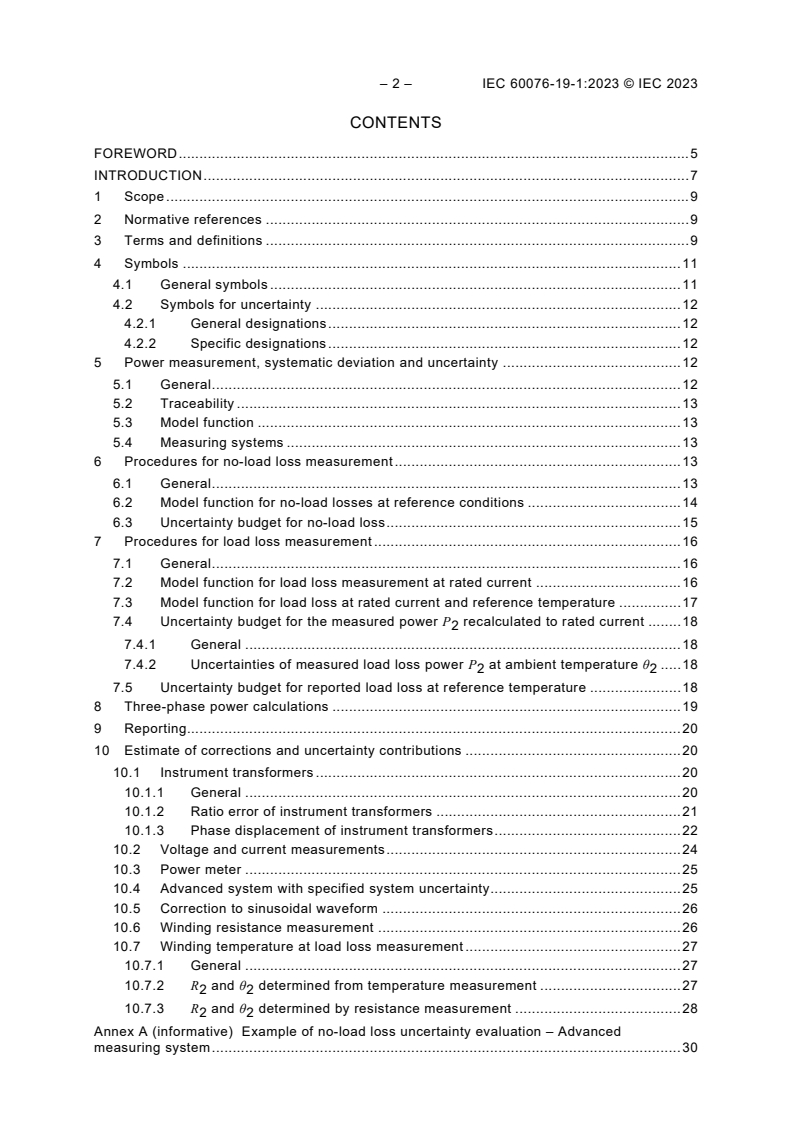
– 2 – IEC 60076-19-1:2023 © IEC 2023
CONTENTS
FOREWORD . 5
INTRODUCTION . 7
1 Scope . 9
2 Normative references . 9
3 Terms and definitions . 9
4 Symbols . 11
4.1 General symbols . 11
4.2 Symbols for uncertainty . 12
4.2.1 General designations . 12
4.2.2 Specific designations . 12
5 Power measurement, systematic deviation and uncertainty . 12
5.1 General . 12
5.2 Traceability . 13
5.3 Model function . 13
5.4 Measuring systems . 13
6 Procedures for no-load loss measurement . 13
6.1 General . 13
6.2 Model function for no-load losses at reference conditions . 14
6.3 Uncertainty budget for no-load loss . 15
7 Procedures for load loss measurement . 16
7.1 General . 16
7.2 Model function for load loss measurement at rated current . 16
7.3 Model function for load loss at rated current and reference temperature . 17
7.4 Uncertainty budget for the measured power P recalculated to rated current . 18
7.4.1 General . 18
7.4.2 Uncertainties of measured load loss power P at ambient temperature θ . 18
2 2
7.5 Uncertainty budget for reported load loss at reference temperature . 18
8 Three-phase power calculations . 19
9 Reporting. 20
10 Estimate of corrections and uncertainty contributions . 20
10.1 Instrument transformers . 20
10.1.1 General . 20
10.1.2 Ratio error of instrument transformers . 21
10.1.3 Phase displacement of instrument transformers . 22
10.2 Voltage and current measurements . 24
10.3 Power meter . 25
10.4 Advanced system with specified system uncertainty . 25
10.5 Correction to sinusoidal waveform . 26
10.6 Winding resistance measurement . 26
10.7 Winding temperature at load loss measurement . 27
10.7.1 General . 27
10.7.2 R and θ determined from temperature measurement . 27
2 2
10.7.3 R and θ determined by resistance measurement . 28
2 2
Annex A (informative) Example of no-load loss uncertainty evaluation – Advanced
measuring system . 30
A.1 General (intent of example) . 30
A.2 Transformer specification . 30
A.3 Measuring system . 30
A.4 Measurements . 31
A.5 Correction of measured values. 31
A.6 Calculation of uncertainty . 31
A.7 Reported loss and uncertainty estimate . 32
Annex B (informative) Example of no-load loss uncertainty evaluation – Calibration
based procedure . 33
B.1 General . 33
B.2 Transformer specification . 33
B.3 Measuring system . 33
B.4 Measurements . 34
B.5 Correction of measured values. 35
B.6 Uncertainty calculation . 35
B.7 Reported loss and uncertainty estimate . 36
Annex C (informative) Example of load loss uncertainty evaluation class index
procedure . 37
C.1 General . 37
C.2 Transformer specification . 37
C.3 Measuring system . 37
C.4 Measurements . 38
C.5 Calculation in accordance with IEC 60076-1 . 39
C.6 Uncertainty calculation . 39
C.7 Reported loss and uncertainty estimate . 41
Annex D (informative) Determination of exponent n in expression for no-load loss . 42
Annex E (informative) Measurement uncertainty and test results . 44
E.1 General . 44
E.2 Test results, guarantees, tolerances, uncertainty limits . 44
E.3 Traceability as tool for quality assurance . 44
E.4 Means and methods to prove uncertainty claims and traceability . 45
E.4.1 Calibration . 45
E.4.2 Calibration certificate . 46
E.4.3 Guidance on scope of a calibration . 47
Annex F (normative) Calculation of uncertainty of losses with different reference
temperatures and/or winding material . 48
Bibliography . 49
Figure D.1 – Evaluation of exponent n from data in Table D.1 . 43
Table 1 – Measured no-load loss uncertainties . 16
Table 2 – Measured load loss uncertainties at ambient temperature . 18
Table 3 – Absolute uncertainty of load losses P reported at reference temperature θ . 19
LL r
Table 4 – Measured no-load loss uncertainties, advanced system . 25
Table 5 – Measured load loss uncertainties at ambient temperature, advanced system . 26
Table A.1 – Three-phase transformer oil immersed transformer . 30
Table A.2 – Uncertainty specification of the power measuring system . 30
– 4 – IEC 60076-19-1:2023 © IEC 2023
Table A.3 – Measured data . 31
Table A.4 – Corrected values . 31
Table A.5 – Uncertainty of no-load loss (according to Table 1) . 32
Table B.1 – Three-phase transformer oil immersed transformer . 33
Table B.2 – Uncertainties of measuring system current and voltage transducers. 34
Table B.3 – Uncertainties of power meter . 34
Table B.4 – Measured data . 34
Table B.5 – Corrected values . 35
Table B.6 – Uncertainty of no-load loss (according to Table 1) . 35
Table C.1 – Three-phase transformer dry type transformer . 37
Table C.2 – Uncertainties of measuring system current and voltage transducers . 38
Table C.3 – Measured data . 38
Table C.4 – Results based on measured data . 39
Table C.5 – Derivation of standard uncertainty contributions . 39
Table C.6 – Uncertainty budget for measured load loss at ambient temperature
(Table 2) . 40
Table C.7 – Uncertainty budget for absolute uncertainty of load loss reported at
reference temperature (Table 3) . 40
Table D.1 – Example of measured no-load loss versus applied voltage . 42
INTERNATIONAL ELECTROTECHNICAL COMMISSION
____________
POWER TRANSFORMERS –
Part 19-1: Rules for the determination of uncertainties in
the measurement of the losses of power transformers
FOREWORD
1) The International Electrotechnical Commission (IEC) is a worldwide organization for standardization comprising
all national electrotechnical committees (IEC National Committees). The object of IEC is to promote international
co-operation on all questions concerning standardization in the electrical and electronic fields. To this end and
in addition to other activities, IEC publishes International Standards, Technical Specifications, Technical Reports,
Publicly Available Specifications (PAS) and Guides (hereafter referred to as "IEC Publication(s)"). Their
preparation is entrusted to technical committees; any IEC National Committee interested in the subject dealt with
may participate in this preparatory work. International, governmental and non-governmental organizations liaising
with the IEC also participate in this preparation. IEC collaborates closely with the International Organization for
Standardization (ISO) in accordance with conditions determined by agreement between the two organizations.
2) The formal decisions or agreements of IEC on technical matters express, as nearly as possible, an international
consensus of opinion on the relevant subjects since each technical committee has representation from all
interested IEC National Committees.
3) IEC Publications have the form of recommendations for international use and are accepted by IEC National
Committees in that sense. While all reasonable efforts are made to ensure that the technical content of IEC
Publications is accurate, IEC cannot be held responsible for the way in which they are used or for any
misinterpretation by any end user.
4) In order to promote international uniformity, IEC National Committees undertake to apply IEC Publications
transparently to the maximum extent possible in their national and regional publications. Any divergence between
any IEC Publication and the corresponding national or regional publication shall be clearly indicated in the latter.
5) IEC itself does not provide any attestation of conformity. Independent certification bodies provide conformity
assessment services and, in some areas, access to IEC marks of conformity. IEC is not responsible for any
services carried out by independent certification bodies.
6) All users should ensure that they have the latest edition of this publication.
7) No liability shall attach to IEC or its directors, employees, servants or agents including individual experts and
members of its technical committees and IEC National Committees for any personal injury, property damage or
other damage of any nature whatsoever, whether direct or indirect, or for costs (including legal fees) and
expenses arising out of the publication, use of, or reliance upon, this IEC Publication or any other IEC
Publications.
8) Attention is drawn to the Normative references cited in this publication. Use of the referenced publications is
indispensable for the correct application of this publication.
9) Attention is drawn to the possibility that some of the elements of this IEC Publication may be the subject of patent
rights. IEC shall not be held responsible for identifying any or all such patent rights.
IEC 60076-19-1 has been prepared by IEC technical committee 14: Power transformers. It is
an International Standard.
The text of this International Standard is based on the following documents:
Draft Report on voting
14/1105/FDIS 14/1107/RVD
Full information on the voting for its approval can be found in the report on voting indicated in
the above table.
The language used for the development of this International Standard is English.
– 6 – IEC 60076-19-1:2023 © IEC 2023
This document was drafted in accordance with ISO/IEC Directives, Part 2, and developed in
accordance with ISO/IEC Directives, Part 1 and ISO/IEC Directives, IEC Supplement, available
at www.iec.ch/members_experts/refdocs. The main document types developed by IEC are
described in greater detail at www.iec.ch/standardsdev/publications.
A list of all parts in the IEC 60076 series, published under the general title Power transformers,
can be found on the IEC website.
The committee has decided that the contents of this document will remain unchanged until the
stability date indicated on the IEC website under webstore.iec.ch in the data related to the
specific document. At this date, the document will be
• reconfirmed,
• withdrawn,
• replaced by a revised edition, or
• amended.
IMPORTANT – The "colour inside" logo on the cover page of this document indicates that it
contains colours which are considered to be useful for the correct understanding of its
contents. Users should therefore print this document using a colour printer.
INTRODUCTION
The losses of power transformers (no-load and load losses) are the object of guarantee and
penalty in many contracts and play an important role in the evaluation of the total (service)
costs and therefore in the investments involved. Furthermore, regional regulations, such as the
Ecodesign Directive of the European Union (Directive 2009/125/EC), can also pose
requirements on the establishment of reliable values for losses.
According to ISO/IEC 17025 and ISO/IEC Guide 98-3, the result of any measurement should
be qualified with the evaluation of its uncertainty. A further requirement of those documents is
that known corrections shall have been applied before evaluation of uncertainty. These
provisions have been applied in this document.
Corrections and uncertainties are also considered in IEC 60076-8 where some general
indications are given for their determination.
This document deals with the measurement of the losses, which from a measuring point of view
consist of the estimate of a measurand and the evaluation of the uncertainty that affects the
measurand itself. The procedures can also be applied to loss measurements of power
transformers:
• as evaluation of the achievable performance of a test facility in the course of prequalification
processes,
• as estimations of achievable uncertainty in the enquiry stage of an order or prior to beginning
final testing at the manufacturer's premises; and for
• evaluations of market surveillance measurements.
Evaluation of uncertainty in testing is often characterized as "top-down" or "bottom-up", where
the first one relies on inter-laboratory comparisons on a circulated test object to estimate the
dispersion and hence the uncertainty. The latter method instead relies on the formulation of a
model function, where the test result y is expressed as a function of input quantities. This
function is often the formula used for the calculation of the result. The "bottom-up" method is
applied in this document.
The uncertainty range depends on the quality of the test installation and measuring system, on
the skill of the staff and on the intrinsic measurement difficulties presented by the tested objects.
The procedures developed in this document for evaluation of measurement uncertainty are
provided as a tool to assess the soundness of results of loss measurements. Uncertainty is
understood as a "parameter, associated with the result of a measurement, that characterizes
the dispersion of the values that could reasonably be attributed to the measurand" [SOURCE:
IEV 311-01-02].
In cases where the losses are required to conform to stated tolerance limits, it is recommended
that measurement systems are of such quality that their estimated uncertainty is less than the
tolerance limit. (As an example, a measurement with a 5 % uncertainty on a test where the
tolerance limit is 5 % is acceptable if the measured value lies within the tolerance limit.) This
situation can occur for example in market surveillance activities. It can be noted that an
uncertainty 3 % is regarded as state-of-the-art for uncertainty of loss.
Treatment of measurement results is defined as follows in IEC 60076-8:1997, 10.1: "The
submitted test result shall contain the most correct estimate that is possible, based on the
measurements that have been carried out. This value shall be accepted as it stands. The
uncertainty margin shall not be involved in the judgement of compliance for guarantees with no
positive tolerance or tolerance ranges for performance data of the test object."
– 8 – IEC 60076-19-1:2023 © IEC 2023
In Annex A to Annex C of this document, examples of uncertainty calculations are reported for
no-load and load loss measurements on large power and distribution transformers. Annex D
provides information on determination of the exponent for applied voltage in no-load loss
measurement. Annex E provides information on uncertainty in measurement. Annex F provides
information on calculation of uncertainty of losses with different reference temperatures and/or
winding material.
International Standards, Technical Reports and Guides which are mentioned in the text of this
document, but which are not indispensable to its application, are listed in the Bibliography at
the end of this document.
Loss of reactors is not within the scope of this document. A separate part of IEC IEC60076-19
to handle loss of reactors is under consideration.
A problem with symbols has been rectified, where the symbol for voltage has been changed
from U to V to avoid confusion with expanded uncertainty. The new symbol is accepted in
IEC 60050-121:2002, 121-11-27 for the case when the corresponding electric field is
irrotational.
POWER TRANSFORMERS –
Part 19-1: Rules for the determination of uncertainties in
the measurement of the losses of power transformers
1 Scope
This part of IEC 60076 defines the procedures that are applied to evaluate the uncertainty
affecting the measurements of no-load and load losses during the routine tests on power
transformers.
This document centres on measuring systems utilizing digital instruments, although the
procedures can be adapted to evaluation of systems with analogue instruments where further
uncertainty sources have to be taken into account.
This document specifies how to determine measurement uncertainty and how to apply
corrections for known errors in the measurement chain. Information vis-à-vis judgement and
traceability are given in IEC 60076-8:1997, 10.1 and 10.2.
2 Normative references
The following documents are referred to in the text in such a way that some or all of their content
constitutes requirements of this document. For dated references, only the edition cited applies.
For undated references, the latest edition of the referenced document (including any
amendments) applies.
IEC 60076-1, Power transformers – Part 1: General
IEC 60076-2, Power transformers – Part 2: Temperature rise for liquid-immersed transformers
IEC 60076-11:2018, Power transformers – Part 11: Dry-type transformers
3 Terms and definitions
For the purposes of this document, the terms and definitions given in IEC 60076-1,
IEC 60076-2, and the following apply.
ISO and IEC maintain terminological databases for use in standardization at the following
addresses:
• IEC Electropedia: available at https://www.electropedia.org/
• ISO Online browsing platform: available at https://www.iso.org/obp
3.1
uncertainty
parameter, associated with the result of a measurement, that characterizes
the dispersion of the values that could reasonably be attributed to the measurand
[SOURCE: ISO/IEC Guide 98-3:2008, 2.2.3, modified – Notes to entry omitted.]
– 10 – IEC 60076-19-1:2023 © IEC 2023
3.2
standard uncertainty
uncertainty of the result of a measurement expressed as a standard deviation
[SOURCE: ISO/IEC Guide 98-3:2008, 2.3.1]
3.3
combined standard uncertainty
standard uncertainty of the result of measurement when that result is obtained from the values
of a number of other quantities, equal to the positive square root of a sum of terms, the terms
being the variances or covariances of these other quantities weighted according to how the
measurement result varies with changes in these quantities
[SOURCE: ISO/IEC Guide 98-3:2008, 2.3.4]
3.4
expanded uncertainty
quantity defining an interval about the result of a measurement that may be expected to
encompass a large fraction of the distribution of values that could reasonably be attributed to
the measurand
[SOURCE: ISO/IEC Guide 98-3:2008, 2.3.5, modified – Notes to entry omitted.]
3.5
coverage factor
numerical factor used as a multiplier of the combined standard uncertainty in order to obtain an
expanded uncertainty
[SOURCE: ISO/IEC Guide 98-3:2008, 2.3.6, modified – Note to entry omitted.]
3.6
traceability
property of a measurement result whereby the result can be related to a reference through a
documented unbroken chain of calibrations, each contributing to the measurement uncertainty
[SOURCE: ISO/IEC Guide 99:2007, 2.41, modified – "metrological" omitted from the term and
notes to entry omitted.]
3.7
accuracy class
class of measuring instruments or measuring systems that meet stated metrological
requirements that are intended to keep measurement errors or instrumental uncertainties within
specified limits under specified operating conditions
[SOURCE: ISO/IEC Guide 99:2007, 4.25, modified – Notes to entry omitted.]
4 Symbols
4.1 General symbols
F
Parameter related to correction of power for phase displacement in measuring circuit
D
I
Current measured by the ammeter
RMS
I
Current measured by an advanced measuring system
S
I
Reference current (normally corresponding to rated current)
N
k
Rated transformation ratio of the current transformer
CN
k
Rated transformation ratio of the voltage transformer
VN
P Power
Power measured at the load loss measurement corrected for known systematic deviations and referred
P
to the reference current I
N
P
Load loss at reference conditions and corrected for known errors in the measurement
LL
P
No-load loss at reference conditions and corrected for known errors in the measurement
NLL
P
Power measured by the power meter
W
P
Power measured by an advanced measuring system
S
P
Additional loss at reference temperature
ar
P Additional loss at temperature θ
a2 2
R Resistance of the windings at temperature θ
1 1
R Resistance of the windings at temperature θ
2 2
R
Resistance of the windings at reference temperature
r
t Parameter related to the thermal coefficient of winding resistance
V
Voltage measured with an instrument having rectified mean response
avg
V
Rated voltage
N
V
Voltage measured using an instrument with true RMS response
RMS
θ Temperature (°C)
θ
Temperature of transformer winding at cold winding resistance test according to IEC 60076-1 (°C)
θ
Temperature of transformer windings during load loss test (°C)
Θ
Reference temperature for transformer windings according to IEC 60076-1 (°C)
r
Δ
Actual phase displacement of the current transformer (rad)
φC
Δ
Actual phase displacement of the voltage transformer (rad)
φV
ε
Actual ratio error of the current transformer (% of nominal ratio)
CT
ε
Actual ratio error of the voltage transformer (% of nominal ratio)
VT
φ Actual phase angle between voltage and current (rad)
φ
Phase angle between voltage and current measured with power meter (rad)
M
– 12 – IEC 60076-19-1:2023 © IEC 2023
4.2 Symbols for uncertainty
4.2.1 General designations
u Relative standard uncertainty
u Absolute standard uncertainty
U Relative expanded uncertainty
Absolute expanded uncertainty
U
4.2.2 Specific designations
u
Uncertainty of current transformer ratio (expressed in percent of the ratio)
CT
u
Uncertainty of current measurement
IRMS
u
Uncertainty of current measured by an advanced measuring system
IS
u
Uncertainty of the load loss
LL
u
Uncertainty of the no-load loss
NLL
u
Uncertainty of P
P2 2
u Uncertainty of term F
FD D
u
Uncertainty of the power indicated by the power meter
PW
u
Uncertainty of the power indicated by an advanced measuring system
PS
u
Uncertainty of the resistance R
R1
u Uncertainty of the resistance R
R2 2
u
Uncertainty of resistance of current shunt
SH
u
Uncertainty of rectified mean voltage measurement
Vavg
u
Uncertainty of RMS voltage measurement
VRMS
u
Uncertainty of voltage transformer ratio
VT
u
Uncertainty of correction to sinusoidal waveform for no-load-loss
WF
u
Uncertainty of phase displacement for complete measuring system
Δφ
u
Uncertainty of current transformer phase displacement
ΔφC
u
Uncertainty of voltage transformer phase displacement
ΔφV
NOTE Specific designations can be identified as relative or absolute as defined in the list of general designations.
5 Power measurement, systematic deviation and uncertainty
5.1 General
In this document, it is assumed that the transformer losses are measured in the conditions
prescribed by IEC 60076-1 by means of digital instruments.
For three-phase transformers, losses are measured using three independent (uncorrelated)
single-phase measuring systems. These systems may comprise separate instruments or be
combined in a three-phase instrument.
In general, losses are measured using current and voltage transformers in conjunction with a
power meter. Voltage and current values can be measured with separate instruments or using
built-in functions of the power meter. Currents are assumed to be measured as line currents
and voltages as line-to-earth voltages.
Any measurement system can be characterised with a systematic deviation (error) and an
uncertainty. When known, the systematic deviation should be corrected. If it cannot be
corrected, it should be considered as an added uncertainty.
Inductive instrument transformers and resistive shunts used to measure current are considered
to have negligible drift and therefore the evaluation of their performance can be appreciably
enhanced by using calibration results to correct for known errors and as the basis for estimation
of uncertainty.
All other measurement devices should be evaluated from their technical specifications (or
accuracy class). Corrections are not applied and uncertainty estimates are based on the
specifications. The residual deviations should be considered in the uncertainty estimations. For
these cases calibration primarily verifies the specification.
Certain advanced measuring systems employ measuring principles that lead to negligible
systematic deviations – but not negligible uncertainties. This should however always be
carefully evaluated.
5.2 Traceability
Measurement devices used to establish losses shall have traceable calibrations.
5.3 Model function
The uncertainty estimation includes uncertainties in the measuring system as well as in the
tested object (transformer).
The model functions presented in 6.2, 7.2 and 7.3 include both the measuring system and the
test object in one equation.
5.4 Measuring systems
Measuring systems can be characterized either by a stated overall uncertainty verified by
system-wide calibration, or by specifications of their components verified by component
calibrations.
This document focuses mainly on uncertainty analysis based on component calibrations.
For systems characterized by an overall uncertainty, simplifications in the uncertainty analysis
are possible, see 10.4.
6 Procedures for no-load loss measurement
6.1 General
The test procedure is given in IEC 60076-1.
The no-load loss measurement shall be performed at rated voltage and frequency and no
corrections are to be applied for deviations from rated voltage in the test as there is no formula
defined by IEC for such correction. A further consequence is that the uncertainty estimated in
this document does not include contributions due to the non-linear behaviour of no-load loss as
a function of test voltage.
– 14 – IEC 60076-19-1:2023 © IEC 2023
The current drawn by the test object is non-sinusoidal, and this may cause a distortion in the
voltage that leads to erroneous values for the losses. A correction for the transformer losses is
prescribed in IEC 60076-1, as well as a limit for the permissible distortion.
6.2 Model function for no-load losses at reference conditions
The single-phase model function used to calculate no-load loss (and to use as the basis for
uncertainty estimation) is given in Formula (1):
n
VV−
cosφ
( ) V
11 avg RMS
N
(1)
Pk ⋅ k ⋅ P ⋅ 1+
NLL CN VN W
εε 1
V
CT VT cosφ + (Δ − Δ)
avg
( )
φφVC
1+ 1+ kV⋅
VN avg
ε
100 100
VT
1+
100
where
is the term combining the nominal ratio k of the current transformer
CN
k
CN
ε (CT) and the correction for the known ratio error ε ;
CT CT
1+
is the term combining the nominal ratio k of the voltage transformer
VN
k
VN
ε (VT) and the correction for the known ratio error ε ;
VT VT
1+
is the term related to the correction for phase displacement (F ) of the
cosφ
( ) D
current and voltage transformers;
cosφ + (Δ − Δ)
( )
φφVC
P is the reading of the wattmeter, and the wattmeter is considered to
W
have no known errors, thus no correction term;
n
is the parameter related to the actual voltage where the exponent n
(taken as 2 in the absence of other information) is related to the
V non-linear behaviour of no-load loss, and since IEC 60076-1 requires
N
that the applied voltage be as close as possible to the nominal voltage,
kV
VN avg
no corrections are to be applied although uncertainty has to be
ε
VT
1+
considered;
is used to compensate for the influence of the distortion on the voltage
VV−
avg RMS
waveform on the no-load loss. V is the indication of a rectified mean
1+
avg
V
avg
value responding instrument and V is the indication of an RMS
RMS
responding instrument (see IEC 60076-1).
NOTE 1 The actual exponent n can be estimated by analysis of measurement of no-load loss at slightly different
voltages, see Annex D.
=
Formula (1) can for the purpose of uncertainty analysis be rearranged as:
n
VV−
V
1 1 cosφ avg RMS
N
Pk ⋅ ⋅ P ⋅ ⋅ 1+
NLL CN W
n−1
ε
VV
CT cosφ + (Δ −Δ )
( ) avg avg
φφVC
1+
(2)
k
VN
ε
VT
1+
100
The true phase angle φ between voltage and current under sinusoidal conditions is obtained by
correcting for the known phase displacement difference between CT and VT (Δ − Δ) :
φφVC
P
W
φφ=−−(Δ Δ )=arccos −−(Δ Δ )
(3)
M φφVC φφVC
I ⋅V
RMS RMS
which is not strictly applicable in many cases for no-load loss where distortion is present, but
still suitable for the purpose of this document.
P
W
The term in Formula (3) is the power factor as measured by the power meter.
I ⋅V
RMS RMS
NOTE 2 It is observed that the formula of the loss determination is expressed only through the product of a number
of factors to facilitate the estimation of the total relative uncertainty of the measurement.
NOTE 3 In Formula (1), some secondary influencing quantities have been disregarded, such as frequency, under
the assumption that the test frequency is close to the rated frequency.
NOTE 4 IEEE C57.123:2019 identifies a small temperature effect on no-load losses and gives −1 % per 15 K
temperature rise. This effect, not well known and not identified within IEC, has been disregarded.
6.3 Uncertainty budget for no-load loss
The uncertainty estimate of no-load loss power is obtained as given in Table 1, having taken
into consideration all possible contributions to uncertainty. Propagation of uncertainties is
estimated from partial derivatives of the model function as defined in ISO Guide 98 3, which
also gives the background for Table 1.
The uncertainty related to the phase displacement can be disregarded when the power factor
is greater than 0,2, which is the normal case for no-load loss.
=
– 16 – IEC 60076-19-1:2023 © IEC 2023
Table 1 – Measured no-load loss uncertainties
Quantity Component Standard Sensitivity Contribution See
uncertainty coefficient to standard subclause
uncertainty
ε u u
CT ratio error 1 10.1.2
CT CT CT
ε u (n – 1)u
VT ratio error (n – 1) 10.1.2
VT VT VT
P u u
Measured power 1 10.3
W PW PW
cos(φ)
≈ 0
u
Phase displacement 1 ≈ 0 10.1.3
Δφ
cos φ +−(Δ Δ)
( )
φφVC
V u n ∙ u
Voltage n 10.2
N Vavg Vavg
V - V
avg RMS
Correction to
1 + u u
1 10.5
WF WF
sinusoidal waveform
V
avg
2 2 2 2 22 2
Combined standard relative uncertainty calculated as: u u+ n− 1⋅ u+ u+ nu⋅ + u
( )
NLL CT VT PW Vavg WF
The expanded relative uncertainty is Uu= 2 , which corresponds to a coverage probability of
NLL NLL
approximately 95 %.
7 Pr
...