

IEC 60076-25:2023
(Main)Power transformers - Part 25: Neutral grounding resistors
General Information
- Abstract
IEC 60076-25:2023 applies to dry type natural air-cooled resistors, for neutral grounding of transformers and generators, in order to limit the earth fault current in power systems by means of metallic resistive elements.
For the purposes of this document, the resistor can be:
used alone or in combination with other electrotechnical products not covered by this document, such as (but not limited to): a step-down single-phase transformer, an open triangle or zig-zag transformer (where the neutral point is not available) and a Petersen coil reactor (in order to increase active power contribution to the fault or reduce time constant for proper protection operation or both);
designed, manufactured and verified on a one-off basis or fully standardized and manufactured in quantity.
Both terms "neutral grounding resistor" (NGR) and "neutral earthing resistor" (NER) can be used. However, for the purposes of this document and in order to avoid any confusion with "neutral earthing reactor" (NER), the term "neutral grounding resistor" (NGR) is used.
This document specifies:
the characteristics of the NGR;
the service conditions requirements for NGRs;
the tests and test methods for confirming that these conditions have been met;
the requirements relating to marking for NGRs.
Annex A provides guidance on how to consider the effect of resistance variation with temperature.
- Status
- Published
- Publication Date
- 22-Feb-2023
- Technical Committee
- TC 14 - Power transformers
- Drafting Committee
- PT 60076-25 - TC 14/PT 60076-25
- Current Stage
- PPUB - Publication issued
- Start Date
- 23-Feb-2023
- Completion Date
- 03-Mar-2023
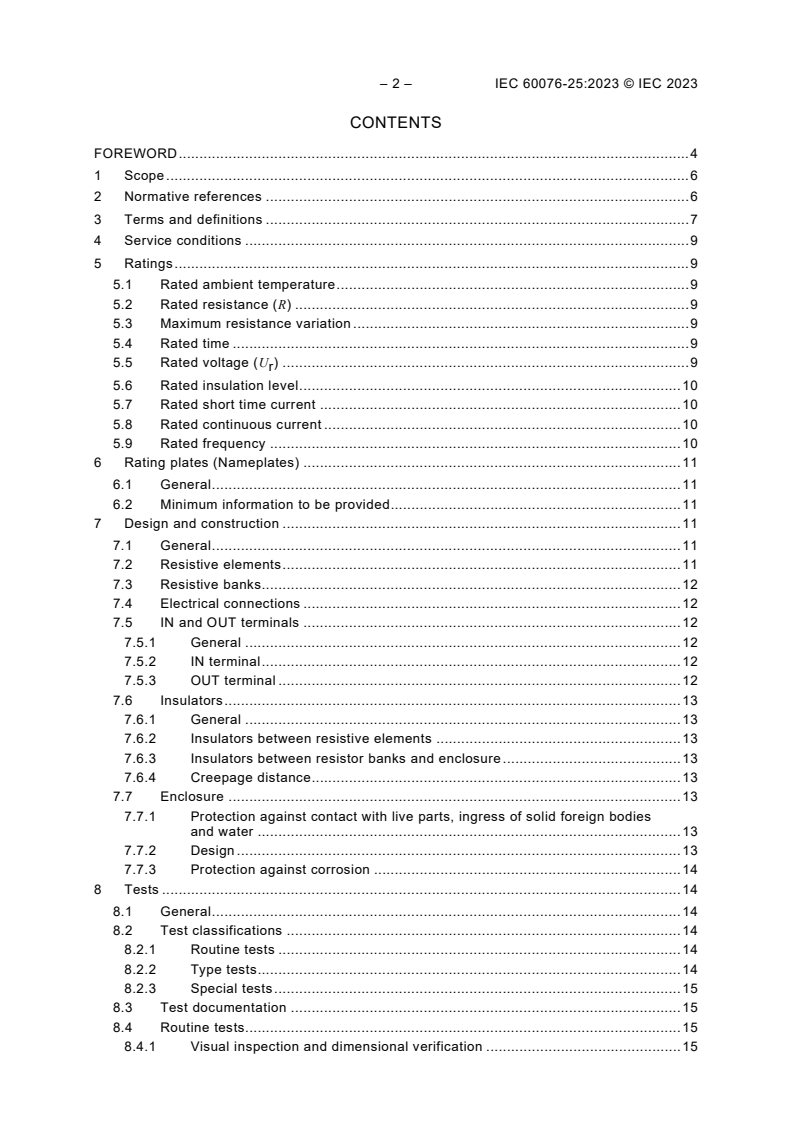
Overview
IEC 60076-25:2023 is an international standard developed by the International Electrotechnical Commission (IEC) outlining the requirements for dry type, natural air-cooled neutral grounding resistors (NGRs) used in the neutral grounding of transformers and generators. The purpose of this standard is to ensure NGRs reliably limit earth fault current in power systems through carefully designed metallic resistive elements. This part of the IEC 60076 series specifies the characteristics, service conditions, testing procedures, and marking requirements for NGRs, providing clear guidance for manufacturers, installers, and users involved in modern power infrastructure.
Key Topics
Scope and Purpose:
IEC 60076-25:2023 applies specifically to dry type natural air-cooled resistors used for neutral grounding, limiting earth fault currents and enhancing the integrity and protection of power systems.Types of Application:
- NGRs may be used standalone or in conjunction with other electrotechnical equipment such as step-down single-phase transformers, open triangle or zig-zag transformers, and Petersen coil reactors, particularly where the neutral point is unavailable.
- Can be custom-designed for unique installations or standardized for serial production.
Service Conditions:
- Standard ambient temperature is 20°C unless specified otherwise.
- Altitude correction is required for installations above 1,000 meters, as referenced in IEC 60071-2.
Ratings and Design Requirements:
- Parameters such as rated resistance, voltage, current (both short time and continuous), frequency, and insulation level are specified, ensuring the NGR meets specific installation requirements.
- The design addresses physical robustness, dielectric strength, proper ventilation, corrosion protection, and safe handling.
Testing and Compliance:
- Routine, type, and special tests verify safety, functionality, and durability.
- Test procedures cover visual inspection, resistance measurement, dielectric withstand, insulation resistance, temperature rise, and environmental protection (IP rating, etc.).
- Annex A provides guidance on resistance variation due to temperature to assist with effective system and protection coordination.
Product Marking:
- Mandatory nameplates must display critical technical and identification information for safe installation and long-term maintenance.
Applications
Neutral grounding resistors are essential in modern medium and high voltage power systems for:
Limiting Earth Fault Currents:
NGRs prevent excessive fault currents through transformer or generator neutrals, thus avoiding equipment damage and enhancing personnel safety.Coordination with Protection Systems:
By managing fault current levels and their duration, NGRs support timely and accurate operation of protective relays and isolation devices.Power System Stability:
Utilization with delta/zig-zag transformer banks or Petersen coils further tailors system grounding to reduce transient over-voltages and enhance network reliability.Versatile Deployment:
- Suitable for installations in substations, generation plants, and industrial environments.
- Standard ensures compatibility with varying system voltages, installation climates, and fault management strategies.
Related Standards
To ensure complete compliance in power transformer projects, IEC 60076-25:2023 should be used in conjunction with other key standards:
- IEC 60076-1: Power transformers - General
- IEC 60076-3: Insulation levels, dielectric tests and external clearances in air
- IEC 60060-1: High voltage test techniques
- IEC 60071-2: Insulation coordination - Application guidelines
- IEC 60529: Degrees of protection provided by enclosures (IP Code)
- IEC 60664-1: Insulation coordination for equipment within low-voltage systems (for system voltages below 1,000 V)
- IEC 62271-1: High-voltage switchgear and controlgear
IEC 60076-25:2023 advances best practices throughout the power industry by ensuring neutral grounding resistors are designed, tested, and implemented according to internationally recognized criteria for safety, reliability, and long lifecycle in evolving energy networks.
Get Certified
Connect with accredited certification bodies for this standard

IMQ S.p.A. (Certification)
Italian electrical product certification.

SLG Prüf- und Zertifizierungs GmbH
German testing and certification body.

UL Solutions
Global safety science company with testing, inspection and certification.
Sponsored listings
Frequently Asked Questions
IEC 60076-25:2023 is a standard published by the International Electrotechnical Commission (IEC). Its full title is "Power transformers - Part 25: Neutral grounding resistors". This standard covers: IEC 60076-25:2023 applies to dry type natural air-cooled resistors, for neutral grounding of transformers and generators, in order to limit the earth fault current in power systems by means of metallic resistive elements. For the purposes of this document, the resistor can be: used alone or in combination with other electrotechnical products not covered by this document, such as (but not limited to): a step-down single-phase transformer, an open triangle or zig-zag transformer (where the neutral point is not available) and a Petersen coil reactor (in order to increase active power contribution to the fault or reduce time constant for proper protection operation or both); designed, manufactured and verified on a one-off basis or fully standardized and manufactured in quantity. Both terms "neutral grounding resistor" (NGR) and "neutral earthing resistor" (NER) can be used. However, for the purposes of this document and in order to avoid any confusion with "neutral earthing reactor" (NER), the term "neutral grounding resistor" (NGR) is used. This document specifies: the characteristics of the NGR; the service conditions requirements for NGRs; the tests and test methods for confirming that these conditions have been met; the requirements relating to marking for NGRs. Annex A provides guidance on how to consider the effect of resistance variation with temperature.
IEC 60076-25:2023 applies to dry type natural air-cooled resistors, for neutral grounding of transformers and generators, in order to limit the earth fault current in power systems by means of metallic resistive elements. For the purposes of this document, the resistor can be: used alone or in combination with other electrotechnical products not covered by this document, such as (but not limited to): a step-down single-phase transformer, an open triangle or zig-zag transformer (where the neutral point is not available) and a Petersen coil reactor (in order to increase active power contribution to the fault or reduce time constant for proper protection operation or both); designed, manufactured and verified on a one-off basis or fully standardized and manufactured in quantity. Both terms "neutral grounding resistor" (NGR) and "neutral earthing resistor" (NER) can be used. However, for the purposes of this document and in order to avoid any confusion with "neutral earthing reactor" (NER), the term "neutral grounding resistor" (NGR) is used. This document specifies: the characteristics of the NGR; the service conditions requirements for NGRs; the tests and test methods for confirming that these conditions have been met; the requirements relating to marking for NGRs. Annex A provides guidance on how to consider the effect of resistance variation with temperature.
IEC 60076-25:2023 is classified under the following ICS (International Classification for Standards) categories: 29.180 - Transformers. Reactors. The ICS classification helps identify the subject area and facilitates finding related standards.
IEC 60076-25:2023 is available in PDF format for immediate download after purchase. The document can be added to your cart and obtained through the secure checkout process. Digital delivery ensures instant access to the complete standard document.
Standards Content (Sample)
IEC 60076-25 ®
Edition 1.0 2023-02
INTERNATIONAL
STANDARD
NORME
INTERNATIONALE
Power transformers –
Part 25: Neutral grounding resistors
Transformateurs de puissance –
Partie 25: Résistances de mise à la terre du neutre
All rights reserved. Unless otherwise specified, no part of this publication may be reproduced or utilized in any form
or by any means, electronic or mechanical, including photocopying and microfilm, without permission in writing from
either IEC or IEC's member National Committee in the country of the requester. If you have any questions about IEC
copyright or have an enquiry about obtaining additional rights to this publication, please contact the address below or
your local IEC member National Committee for further information.
Droits de reproduction réservés. Sauf indication contraire, aucune partie de cette publication ne peut être reproduite ni
utilisée sous quelque forme que ce soit et par aucun procédé, électronique ou mécanique, y compris la photocopie et
les microfilms, sans l'accord écrit de l'IEC ou du Comité national de l'IEC du pays du demandeur. Si vous avez des
questions sur le copyright de l'IEC ou si vous désirez obtenir des droits supplémentaires sur cette publication, utilisez
les coordonnées ci-après ou contactez le Comité national de l'IEC de votre pays de résidence.
IEC Secretariat Tel.: +41 22 919 02 11
3, rue de Varembé info@iec.ch
CH-1211 Geneva 20 www.iec.ch
Switzerland
About the IEC
The International Electrotechnical Commission (IEC) is the leading global organization that prepares and publishes
International Standards for all electrical, electronic and related technologies.
About IEC publications
The technical content of IEC publications is kept under constant review by the IEC. Please make sure that you have the
latest edition, a corrigendum or an amendment might have been published.
IEC publications search - webstore.iec.ch/advsearchform IEC Products & Services Portal - products.iec.ch
The advanced search enables to find IEC publications by a Discover our powerful search engine and read freely all the
variety of criteria (reference number, text, technical publications previews. With a subscription you will always have
committee, …). It also gives information on projects, replaced access to up to date content tailored to your needs.
and withdrawn publications.
Electropedia - www.electropedia.org
IEC Just Published - webstore.iec.ch/justpublished
The world's leading online dictionary on electrotechnology,
Stay up to date on all new IEC publications. Just Published
containing more than 22 300 terminological entries in English
details all new publications released. Available online and once
and French, with equivalent terms in 19 additional languages.
a month by email.
Also known as the International Electrotechnical Vocabulary
(IEV) online.
IEC Customer Service Centre - webstore.iec.ch/csc
If you wish to give us your feedback on this publication or need
further assistance, please contact the Customer Service
Centre: sales@iec.ch.
A propos de l'IEC
La Commission Electrotechnique Internationale (IEC) est la première organisation mondiale qui élabore et publie des
Normes internationales pour tout ce qui a trait à l'électricité, à l'électronique et aux technologies apparentées.
A propos des publications IEC
Le contenu technique des publications IEC est constamment revu. Veuillez vous assurer que vous possédez l’édition la
plus récente, un corrigendum ou amendement peut avoir été publié.
Recherche de publications IEC - Découvrez notre puissant moteur de recherche et consultez
webstore.iec.ch/advsearchform gratuitement tous les aperçus des publications. Avec un
La recherche avancée permet de trouver des publications IEC abonnement, vous aurez toujours accès à un contenu à jour
en utilisant différents critères (numéro de référence, texte, adapté à vos besoins.
comité d’études, …). Elle donne aussi des informations sur les
projets et les publications remplacées ou retirées. Electropedia - www.electropedia.org
Le premier dictionnaire d'électrotechnologie en ligne au monde,
IEC Just Published - webstore.iec.ch/justpublished
avec plus de 22 300 articles terminologiques en anglais et en
Restez informé sur les nouvelles publications IEC. Just
français, ainsi que les termes équivalents dans 19 langues
Published détaille les nouvelles publications parues.
additionnelles. Egalement appelé Vocabulaire
Disponible en ligne et une fois par mois par email.
Electrotechnique International (IEV) en ligne.
Service Clients - webstore.iec.ch/csc
Si vous désirez nous donner des commentaires sur cette
publication ou si vous avez des questions contactez-nous:
sales@iec.ch.
IEC Products & Services Portal - products.iec.ch
IEC 60076-25 ®
Edition 1.0 2023-02
INTERNATIONAL
STANDARD
NORME
INTERNATIONALE
Power transformers –
Part 25: Neutral grounding resistors
Transformateurs de puissance –
Partie 25: Résistances de mise à la terre du neutre
INTERNATIONAL
ELECTROTECHNICAL
COMMISSION
COMMISSION
ELECTROTECHNIQUE
INTERNATIONALE
ICS 29.180 ISBN 978-2-8322-6431-7
– 2 – IEC 60076-25:2023 © IEC 2023
CONTENTS
FOREWORD . 4
1 Scope . 6
2 Normative references . 6
3 Terms and definitions . 7
4 Service conditions . 9
5 Ratings . 9
5.1 Rated ambient temperature . 9
5.2 Rated resistance (R) . 9
5.3 Maximum resistance variation . 9
5.4 Rated time . 9
5.5 Rated voltage (U ) . 9
r
5.6 Rated insulation level . 10
5.7 Rated short time current . 10
5.8 Rated continuous current . 10
5.9 Rated frequency . 10
6 Rating plates (Nameplates) . 11
6.1 General . 11
6.2 Minimum information to be provided . 11
7 Design and construction . 11
7.1 General . 11
7.2 Resistive elements . 11
7.3 Resistive banks. 12
7.4 Electrical connections . 12
7.5 IN and OUT terminals . 12
7.5.1 General . 12
7.5.2 IN terminal . 12
7.5.3 OUT terminal . 12
7.6 Insulators . 13
7.6.1 General . 13
7.6.2 Insulators between resistive elements . 13
7.6.3 Insulators between resistor banks and enclosure . 13
7.6.4 Creepage distance . 13
7.7 Enclosure . 13
7.7.1 Protection against contact with live parts, ingress of solid foreign bodies
and water . 13
7.7.2 Design . 13
7.7.3 Protection against corrosion . 14
8 Tests . 14
8.1 General . 14
8.2 Test classifications . 14
8.2.1 Routine tests . 14
8.2.2 Type tests . 14
8.2.3 Special tests . 15
8.3 Test documentation . 15
8.4 Routine tests. 15
8.4.1 Visual inspection and dimensional verification . 15
8.4.2 Rated resistance measurement. 15
8.4.3 Power frequency withstand voltage test . 15
8.4.4 Insulation resistance . 16
8.5 Temperature rise tests . 17
8.5.1 General . 17
8.5.2 Continuous current duty . 17
8.5.3 Rated time duty . 17
8.5.4 Tolerances . 18
8.5.5 Acceptance criteria . 18
8.6 Special tests . 18
8.6.1 Inductance measurement . 18
8.6.2 Lightning impulse test . 18
8.6.3 Mechanical design verification . 18
8.6.4 Protection degree of enclosure . 19
Annex A (informative) Resistance variation . 20
A.1 General . 20
A.2 Material properties . 20
A.3 Effect of NGR resistance variation . 20
A.4 Rate of variation . 21
A.5 Consecutive faults . 22
A.6 Protection coordination . 22
A.7 System capacitive charging current . 22
A.8 Conclusion . 22
Bibliography . 23
Figure A.1 – Ground fault protection settings example . 21
Table 1 – Rated insulation levels . 10
Table 2 – Maximum temperature rises above ambient for resistive elements. 12
Table 3 – Tests classifications . 14
Table A.1 – Resistance and current change with temperature rise . 21
– 4 – IEC 60076-25:2023 © IEC 2023
INTERNATIONAL ELECTROTECHNICAL COMMISSION
____________
POWER TRANSFORMERS –
Part 25: Neutral grounding resistors
FOREWORD
1) The International Electrotechnical Commission (IEC) is a worldwide organization for standardization comprising
all national electrotechnical committees (IEC National Committees). The object of IEC is to promote international
co-operation on all questions concerning standardization in the electrical and electronic fields. To this end and
in addition to other activities, IEC publishes International Standards, Technical Specifications, Technical Reports,
Publicly Available Specifications (PAS) and Guides (hereafter referred to as “IEC Publication(s)”). Their
preparation is entrusted to technical committees; any IEC National Committee interested in the subject dealt with
may participate in this preparatory work. International, governmental and non-governmental organizations liaising
with the IEC also participate in this preparation. IEC collaborates closely with the International Organization for
Standardization (ISO) in accordance with conditions determined by agreement between the two organizations.
2) The formal decisions or agreements of IEC on technical matters express, as nearly as possible, an international
consensus of opinion on the relevant subjects since each technical committee has representation from all
interested IEC National Committees.
3) IEC Publications have the form of recommendations for international use and are accepted by IEC National
Committees in that sense. While all reasonable efforts are made to ensure that the technical content of IEC
Publications is accurate, IEC cannot be held responsible for the way in which they are used or for any
misinterpretation by any end user.
4) In order to promote international uniformity, IEC National Committees undertake to apply IEC Publications
transparently to the maximum extent possible in their national and regional publications. Any divergence between
any IEC Publication and the corresponding national or regional publication shall be clearly indicated in the latter.
5) IEC itself does not provide any attestation of conformity. Independent certification bodies provide conformity
assessment services and, in some areas, access to IEC marks of conformity. IEC is not responsible for any
services carried out by independent certification bodies.
6) All users should ensure that they have the latest edition of this publication.
7) No liability shall attach to IEC or its directors, employees, servants or agents including individual experts and
members of its technical committees and IEC National Committees for any personal injury, property damage or
other damage of any nature whatsoever, whether direct or indirect, or for costs (including legal fees) and
expenses arising out of the publication, use of, or reliance upon, this IEC Publication or any other IEC
Publications.
8) Attention is drawn to the Normative references cited in this publication. Use of the referenced publications is
indispensable for the correct application of this publication.
9) Attention is drawn to the possibility that some of the elements of this IEC Publication may be the subject of patent
rights. IEC shall not be held responsible for identifying any or all such patent rights.
IEC 60076-25 has been prepared by IEC technical committee 14: Power transformers. It is an
International Standard.
The text of this International Standard is based on the following documents:
Draft Report on voting
14/1097/FDIS 14/1101/RVD
Full information on the voting for its approval can be found in the report on voting indicated in
the above table.
The language used for the development of this International Standard is English.
This document was drafted in accordance with ISO/IEC Directives, Part 2, and developed in
accordance with ISO/IEC Directives, Part 1 and ISO/IEC Directives, IEC Supplement, available
at www.iec.ch/members_experts/refdocs. The main document types developed by IEC are
described in greater detail at www.iec.ch/standardsdev/publications.
A list of all parts in the IEC 60076 series, published under the general title Power transformers,
can be found on the IEC website.
The committee has decided that the contents of this document will remain unchanged until the
stability date indicated on the IEC website under webstore.iec.ch in the data related to the
specific document. At this date, the document will be
• reconfirmed,
• withdrawn,
• replaced by a revised edition, or
• amended.
– 6 – IEC 60076-25:2023 © IEC 2023
POWER TRANSFORMERS –
Part 25: Neutral grounding resistors
1 Scope
This part of IEC 60076 applies to dry type natural air-cooled resistors, for neutral grounding of
transformers and generators, in order to limit the earth fault current in power systems by means
of metallic resistive elements.
For the purposes of this document, the resistor can be:
• used alone or in combination with other electrotechnical products not covered by this
document, such as (but not limited to): a step-down single-phase transformer, an open
triangle or zig-zag transformer (where the neutral point is not available) and a Petersen coil
reactor (in order to increase active power contribution to the fault or reduce time constant
for proper protection operation or both);
• designed, manufactured and verified on a one-off basis or fully standardized and
manufactured in quantity.
Both terms "neutral grounding resistor" (NGR) and "neutral earthing resistor" (NER) can be
used. However, for the purposes of this document and in order to avoid any confusion with
"neutral earthing reactor" (NER), the term "neutral grounding resistor" (NGR) is used.
This document specifies:
• the characteristics of the NGR;
• the service conditions requirements for NGRs;
• the tests and test methods for confirming that these conditions have been met;
• the requirements relating to marking for NGRs.
Annex A provides guidance on how to consider the effect of resistance variation with
temperature.
2 Normative references
The following documents are referred to in the text in such a way that some or all of their content
constitutes requirements of this document. For dated references, only the edition cited applies.
For undated references, the latest edition of the referenced document (including any
amendments) applies.
IEC 60060-1:2010, High voltage test techniques – Part 1: General definitions and test
requirements
IEC 60071-2, Insulation co-ordination – Part 2: Application guidelines
IEC 60076-3:2013, Power transformers – Part 3: Insulation levels, dielectric tests and external
clearances in air
IEC 60076-3:2013/AMD1:2018
IEC 60529, Degrees of protection provided by enclosures (IP Code)
IEC 60529/AMD1:1999
IEC 60529/AMD2:2013
3 Terms and definitions
For the purposes of this document, the following terms and definitions apply.
IEC and ISO maintain terminology databases for use in standardization at the following
addresses:
• IEC Electropedia: available at http://www.electropedia.org/
• ISO Online browsing platform: available at http://www.iso.org/obp
3.1
NGR
neutral grounding resistor
neutral grounding device where the principal element is resistance
3.2
resistive element
unitary current carrying conductor, usually in the form of grids, plates, strips, ribbons or wires
and which can have intermediate tapings
3.3
resistive bank
sub-assembly consisting of one or multiple resistive elements supported by the same structure
Note 1 to entry: One or multiple resistive banks form a complete NGR.
3.4
IN terminal
higher voltage terminal of the NGR, connected to the grounded equipment's neutral terminal
3.5
OUT terminal
lower voltage terminal of the NGR, connected to earth
3.6
rated short time current
I
str
value of the initial RMS current upon the application of the rated voltage
3.7
continuous current
I
r
steady state RMS value of current
3.8
extended time
period of time that is greater than the time required for the temperature rise to become constant
but limited to 90 days of operation per year
3.9
highest voltage for equipment
U
m
highest RMS phase to neutral voltage for which the NGR is designed in respect of its insulation
– 8 – IEC 60076-25:2023 © IEC 2023
3.10
power frequency withstand voltage
U
d
RMS value of sinusoidal power frequency voltage that the insulation of the NGR can withstand
during tests made under specified conditions and for a specified duration
3.11
impulse withstand voltage
U
p
highest peak value of impulse voltage of specified form and polarity which does not cause
breakdown of insulation under specified conditions
3.12
protective earthing terminal
terminal connecting the NGR's enclosure to earth for protective purposes
3.13
working voltage
U
w
highest RMS value of the AC or DC voltage across any particular insulation which can occur
when the equipment is supplied at rated voltage
3.14
temperature coefficient of resistance
parameter describing the change in resistance relative to a given change in temperature
Note 1 to entry: The temperature coefficient of resistance is expressed by:
RR−
α=
(1)
R (θ −θ)
12 1
where
R and R are resistances, in Ω, at temperatures θ and θ , in °C, respectively, and
1 2 1 2
−1
α is the temperature coefficient of resistance, expressed in K , for the temperature variation between θ
and θ .
3.15
uniform insulation
insulation of an NGR where all the active material have the same insulation level towards the
enclosure
3.16
non-uniform insulation
insulation level throughout the NGR construction that is graded based on the rated voltage at
each part of the construction i.e. connections, banks and elements and where the OUT terminal
is intended for direct connection to earth
3.17
duty cycle
specified sequence of ratings, each of them having a different combination of rated time and
rated current or voltage
4 Service conditions
Unless otherwise specified, NGRs conforming to this document are intended for use under the
normal service conditions described in IEC 60076-1.
For installations at an altitude higher than 1 000 m, the required insulation level shall be
corrected using the correction factor provided in IEC 60071-2.
5 Ratings
5.1 Rated ambient temperature
Unless otherwise specified, the rated ambient temperature shall be 20 °C.
5.2 Rated resistance (R)
The rated resistance is the specified resistance between the IN terminal and OUT terminal at
the rated ambient temperature.
Unless otherwise stated, the tolerance of the rated resistance value is ±10 %.
5.3 Maximum resistance variation
The purchaser shall also specify the maximum allowable variation of resistance at the maximum
temperature rise in per cent of rated resistance.
NOTE Certain applications such as high impedance grounding or sensitive networks can require a maximum
variation as low as 10 % whereas others can accept a variation as high as 100 %. See Annex A for guidance.
5.4 Rated time
The rated time is the time the NGR shall withstand the rated voltage and the specified
combination of rated short time current and rated continuous current.
The rated time shall be specified by the purchaser.
Typical rated times are 3 s, 5 s,10 s, 30 s and 60 s, extended time or continuous.
If a duty cycle is to be considered it shall be detailed in the technical specification.
5.5 Rated voltage (U )
r
When the NGR is connected directly between the neutral point and the earth the rated voltage
across the NGR is the phase to neutral voltage and is equal to the nominal system voltage for
which the equipment is designed, divided by the square root of three.
U
U =
(2)
r
In some specific cases, the rated voltage can be different, for example, for resistors installed
on the low voltage side of a step-down transformer or for resistors installed in series or parallel
to a neutral earthing reactor.
In the case of combined equipment, for example neutral grounding resistors and zig zag
transformers, IEC 62271-1 applies.
– 10 – IEC 60076-25:2023 © IEC 2023
NOTE Standard values of system voltages (U) are given in IEC 60071-1 for system voltages above 1 000 V and in
IEC 60664-1 for system voltages below 1 000 V.
5.6 Rated insulation level
The rated voltage U as defined in 5.5 shall be the basis to determine the rated insulation level
r
and clearance distances in air in Table 1 chosen as the next standard value of U equal to or
m
higher than U .
r
Table 1 – Rated insulation levels
Highest voltage for Rated short-duration Rated lightning impulse Minimum air clearance
power-frequency
equipment withstand voltage
withstand voltage
U U U mm
m d p
kV (RMS value) kV (RMS value) kV (peak value) (IEC 60076-3:2013,
Table 4), except for
U = 1kV
m
1,0 2,2 12 14
3,6 10 40 60
7,2 20 60 90
12 28 75 120
17,5 38 95 160
24 50 125 220
36 70 170 320
52 95 250 480
72,5 140 325 630
100 185 450 900
123 230 550 1 100
145 275 650 1 300
170 325 750 1 500
245 460 1 050 2 100
Other rated insulation levels according to national standards may be used if specified by the
purchaser.
5.7 Rated short time current
The rated short time current shall be specified by the purchaser.
5.8 Rated continuous current
The rated continuous current shall be specified by the purchaser.
NOTE The rated continuous current, usually due to imbalances, is an additional rating to a resistor that has a rated
time duty that is not continuous.
5.9 Rated frequency
The rated frequency shall be the system's frequency.
NOTE The standard values of the rated frequency are 50 Hz and 60 Hz.
6 Rating plates (Nameplates)
6.1 General
The NGR shall be provided with a rating plate, fitted in a visible position. It shall be fabricated
with weatherproof materials and be able to withstand the NGR's enclosure temperature. The
entries on the plate shall be indelibly marked (for example by etching, engraving or stamping).
6.2 Minimum information to be provided
a) manufacturer's name;
b) manufacturing location;
c) year of manufacture;
d) type designation or identification number or any other means of identification, making it
possible to obtain relevant information from the manufacturer;
e) number of this standard;
f) rated resistance (R) at ambient temperature;
g) maximum temperature rise;
h) maximum change in resistance (%);
i) ambient temperature;
j) rated voltage (U );
r
k) highest voltage for equipment (U );
m
l) rated power frequency voltage (U );
d
m) rated impulse withstand voltage (U );
p
);
n) rated short time current (I
str
o) rated continuous current (I );
r
p) rated frequency (f );
r
q) rated time (T);
r) total mass;
s) degree of protection.
7 Design and construction
7.1 General
The design and construction of the NGR shall consider the dielectric, thermal and mechanical
effects of its operation and the environmental conditions.
7.2 Resistive elements
The design and materials of resistive elements shall withstand the NGR's operating temperature
range, successive heating-cooling cycles and environmental stresses. The maximum
temperature rises are given in Table 2.
– 12 – IEC 60076-25:2023 © IEC 2023
Table 2 – Maximum temperature rises above ambient for resistive elements
Rated time Maximum temperature rise
K
Equal or less than 60 s 760
Extended time 610
and less than 10 min
Continuous 385
The temperature rise is the difference between the temperature of the resistive elements at the
end of the rated time and the ambient temperature.
NOTE The temperature rise limits given in Table 2 are absolute maximum values, the maximum applicable
temperature rise can be lower depending on the resistive element design.
7.3 Resistive banks
Resistive banks shall have a design capable of withstanding the mechanical and thermal
stresses likely to be encountered during operation.
Appropriate measures shall be taken as to preserve the electrical insulation between elements
and between live parts and support structures and enclosures.
Insulation coordination shall be maintained under the effect of thermal expansion.
7.4 Electrical connections
The connections between resistive elements within the resistive banks shall be appropriate to
ensure adequate current carrying capacity at all operating temperatures.
The connections between resistive elements of different banks and between elements and the
IN and OUT terminals shall have designs capable of withstanding the thermal and mechanical
stresses likely to be encountered within the enclosure.
7.5 IN and OUT terminals
7.5.1 General
The IN and OUT terminals shall be clearly marked and identified.
Insulation materials of wall bushings shall withstand the mechanical and thermal stresses likely
to be encountered during operation.
7.5.2 IN terminal
The IN terminal shall be rated to the NGR's rated insulation level.
7.5.3 OUT terminal
The OUT terminal shall be insulated from the enclosure and from protective earthing terminal.
Unless otherwise specified the NGR shall have an OUT terminal insulated from the enclosure
by a minimum U rating of 1 kV (according to Table 1).
m
7.6 Insulators
7.6.1 General
Insulators shall be able to withstand the mechanical and thermal stresses likely to be
encountered during operation.
7.6.2 Insulators between resistive elements
Insulators between adjacent resistive elements and between resistive elements and any other
part that are in direct contact with the element's surface shall be fabricated with materials
capable of withstanding the NGR's operating temperature range and successive heating-cooling
cycles.
7.6.3 Insulators between resistor banks and enclosure
Insulators between resistor banks and enclosure shall be coordinated with the NGR's rated
insulation level.
7.6.4 Creepage distance
If a specific creepage distance is specified, the creepage distance calculation shall be based
on the working voltage U .
w
NOTE 1 It is common practice to consider the internal insulation of an NGR whose enclosure has a degree of
protection of IP23 or higher as indoor insulation.
NOTE 2 Considering that the insulators are not subject to the same environment load as the outdoor ones, it is
common practice to have a lower creepage distance in indoor insulation.
7.7 Enclosure
7.7.1 Protection against contact with live parts, ingress of solid foreign bodies and
water
The degree of protection provided by the NGR's enclosure against contact with live parts,
ingress of solid foreign bodies and water is indicated by the IP code according to IEC 60529
and verified according to 8.6.4.
The NGR's enclosure shall be suitably ventilated to dissipate the heat generated during
operation.
NOTE The degree of protection IP 23 is considered as an optimum compromise between protection and ventilation
for outdoor installation for most environments.
7.7.2 Design
7.7.2.1 Warning labels
Appropriate warning labels shall be installed, for example "HOT SURFACE" and "HIGH
VOLTAGE" where they are visible and legible when the NGR is installed and operating. They
shall be fabricated with weatherproof materials and be able to withstand the NGR's enclosure
temperature.
7.7.2.2 Handling and lifting
The NGR's enclosure shall be provided with means to facilitate handling and lifting without
compromising its designed voltage withstand capabilities or its degree of protection.
If the NGR's mass is above 25 kg, provision shall be made for mechanical lifting.
– 14 – IEC 60076-25:2023 © IEC 2023
7.7.2.3 Protective earthing terminal
An NGR with an earthed metallic enclosure shall have at least one protective earthing terminal,
with all non-current-carrying parts that are intended to operate at earth potential bonded to the
earthing terminal and shall be clearly marked by the means of a protective earthing sign.
7.7.3 Protection against corrosion
Suitable protection measures against corrosion shall be used considering the high temperature
likely to be encountered during an earth fault event.
If the customer has specific requirements for corrosion protection, they shall be added in the
technical specification.
NOTE Typical corrosion protection measures for the enclosure are galvanization or the use of naturally corrosion
resistant materials, such as stainless steel or aluminium for their good thermal withstand.
8 Tests
8.1 General
The tests listed in Table 3 are applicable to NGRs.
Table 3 – Tests classifications
Test Routine Type Special
Visual inspection and dimensional verification X
Rated resistance measurement X
Power frequency withstand voltage test X
Insulation resistance measurement X
Temperature rise test X
Inductance measurement X
Lightning impulse test X
Mechanical design verification X
Degrees of protection test X
If accepted by the purchaser, the manufacturer can provide the result of the type or special test
of a similar unit or both, together with a declaration stating the similarity between units and the
justification of the applicability.
8.2 Test classifications
8.2.1 Routine tests
Routine verification is intended to detect faults in materials and workmanship and to ascertain
the proper function of the manufactured NGR. The routine test shall be performed on every
NGR. When required and with agreement of the purchaser some routine tests may be performed
at different stages of assembly. The manufacturer shall provide test evidence for all stages.
8.2.2 Type tests
Type testing is intended to verify that the design of the resistor complies with the requirements
of the purchaser and this document. It is carried out on a single unit of a specific rating and
design.
8.2.3 Special tests
Special tests are performed only when explicitly requested by the purchaser. They are carried
out on a single unit, usually the same on which the type tests are carried out, except if otherwise
agreed with the manufacturer.
8.3 Test documentation
All test reports shall contain at a minimum the following information:
• manufacturer;
• unique identification (i.e. serial number);
• general arrangement drawing number reference and revision on date of tests;
• date of tests;
• rated parameters to be tested (i.e. resistance, power frequency voltage, etc.);
• applicable IEC test standard and related test parameters;
• acceptance criteria;
• measured value;
• ambient conditions;
• list of measurement instruments used with manufacturer name, type and serial number;
• temperature coefficient of resistance used for resistance measurement correction.
8.4 Routine tests
8.4.1 Visual inspection and dimensional verification
The construction of the resistor shall be inspected such that it complies with the approved
technical documentation and the relevant points in this document. The following should be
checked at a minimum:
• appropriate air gap clearances;
• labels, terminal markings and rating plates;
• the dimensions of enclosure and interface points match general arrangement drawing.
8.4.2 Rated resistance measurement
The overall resistance shall be measured to verify if it complies with the rated resistance (R)
design value within its tolerance. The resistance shall be measured with direct current.
The measured value shall be corrected to the ambient temperature using the resistive element's
temperature coefficient of resistance.
8.4.3 Power frequency withstand voltage test
8.4.3.1 General
A power frequency withstand voltage test shall be performed across each of the insulation
layers mentioned in 8.4.3.2, 8.4.3.3 and 8.4.3.4.
The power frequency withstand voltage test shall be performed as described in
IEC 60060-1:2010, 6.3.1.
8.4.3.2 Power frequency withstand voltage test within internal assembly
The test shall be performed between each live part of the bank and the bank supporting metallic
structure.
– 16 – IEC 60076-25:2023 © IEC 2023
The test voltage will be determined by the following relation:
Power frequency test voltage U
d
U 2,U25×+ 2kV
(3)
dw
where
U is the working voltage across the insulation layer.
w
In case a functional insulation stage is short-circuited by equipotential bonding connections (in
order to optimize electric potential differences), these connections shall be removed when
testing that particular insulation stage.
8.4.3.3 Power frequency withstand voltage test between resistor banks
With the resistor banks disconnected from each other, the test shall be performed between
support frames of two adjacent banks.
The test voltage shall be determined using Formula (3).
The procedure shall be repeated until all adjacent banks are tested.
8.4.3.4 Power frequency withstand voltage test on complete assembly
8.4.3.4.1 General
Depending on the insulation design across the resistor this test can be carried out in the most
appropriate method of the following ones.
8.4.3.4.2 Uniform insulation
The test shall be performed between the active elements and the enclosure.
The test voltage shall be U .
d
Potential bonding links between the active elements and the enclosure shall be removed for the
duration of these tests.
8.4.3.4.3 Non-uniform insulation
Links between resistor banks connected in series may be removed for the duration of these
tests. The OUT terminal shall be disconnected.
The tests shall be performed between active elements of each bank and the enclosure.
The test voltage U shall be calculated according to Formula (3).
d
8.4.4 Insulation resistance
Insulation resistance shall be measured between the active part and the enclosure at a minimum
of 1 000 V DC. This shall be done after the power frequency withstand voltage test described
in 8.4.3.
=
The minimum acceptable value in factory conditions is 100 MΩ for resistors with U above
m
1 000 V and 10 MΩ for resistors with U up to 1 000 V.
m
Potential bonding links between the active elements and the enclosure, if any, shall be removed
for the duration of these tests.
NOTE Insulation resistance measurement performed on site can vary due to environmental conditions.
8.5 Temperature rise tests
8.5.1 General
The temperature rise test (or heat run test) shall be performed in order to verify that the resistor
elements temperature does not exceed the acceptable temperature in any point.
If the resistor is made of several identical units, each one in a separate enclosure with no
thermal interferences among each other, it is permitted to perform the test on one unit only.
The temperature shall be measured using the direct measurement method of resistive elements,
i.e., temperature sensors applied directly to the resistive elements.
It is acceptable to create holes in the enclosure in order to extract the thermocouples, provided
that the installation of the temperature sensors does not affect the ventilation of the NGR.
Measurement point(s) shall be agreed between purchaser and manufacturer with the aim to
include the closest point to the hot spot.
At least two measurement points shall be provided, one being placed at the top bank close to
the centre.
NOTE 1 Thermocouples welded directly on the active element without additional mass is considered an appropriate
measurement method.
NOTE 2 The certification body or test laboratory can give its advice on the position of the sensors.
8.5.2 Continuous current duty
Where applicable, the rated continuous current shall circulate in the resistor until the resistor
elements temperature stabilizes. It is considered to have stabilized when three consecutive
temperature readings at 10 min intervals do not vary by more than 3 K.
8.5.3 Rated time duty
The rated voltage shall be applied over the rated time.
If the rated time is specified as continuous, the voltage shall be applied until the resistive
element's temperature stabilizes. It is considered to have stabilized when three consecutive
temperature readings at 10 min intervals do not vary by more than 1 %.
If the test is performed on one enclosure out of multiple ones, the voltage to be applied during
the test shall be the rated voltage divided by the number of enclosures connected in series.
If the rated voltage exceeds the laboratory limitations, the resistor connections can be arranged
in order to have the pro rata of the rated voltage applied on each bank provided that the energy
injected in the resistor is the same.
------------------
...