

IEC 62529:2007
(Main)Standard for Signal and Test Definition
General Information
- Abstract
Provides the means to define and describe signals used in testing. It also provides a set of common basic siginals, mathematically underpinned so that siginals can be combined to form complex signals usable across all test platforms.
- Status
- Published
- Publication Date
- 06-Nov-2007
- Technical Committee
- TC 91 - Electronics assembly technology
- Drafting Committee
- WG 15 - TC 91/WG 15
- Current Stage
- DELPUB - Deleted Publication
- Start Date
- 21-Jun-2012
- Completion Date
- 28-Aug-2026
Overview
IEC 62529:2007 - titled Standard for Signal and Test Definition (published jointly with IEEE Std 1641‑2004) defines a language and framework for describing test signals in a machine‑readable, mathematically rigorous way. The standard provides a set of common basic signals and composition rules so signals can be combined into complex, reusable test stimuli that work across test platforms and automated test equipment (ATE).
Key Topics
- Signal Modeling Language (SML) - a formal language for defining physical signal types, pure signals (periodic and non‑periodic), transformations, sampling and digital patterns.
- Basic Signal Components (BSC) - standardized building blocks (sources, conditioners, sensors, digital components, connections) with defined interfaces and attributes.
- Test Signal Framework (TSF) - packaged signal types and models (examples include AC, AM, DC, digital serial/parallel) for practical reuse, including ATLAS examples.
- Test Procedure Language (TPL) - constructs for integrating signal definitions into test procedures and automated sequences.
- Dynamic signal descriptions and IDL components - normative annexes covering runtime resource management, dynamic signal objects and IDL libraries for implementation portability.
- Mathematical underpinning - signal definitions and combining mechanisms (sums, products, piecewise signals, transforms) are expressed so they are unambiguous and implementable.
Applications
- Create portable, platform‑independent test stimuli for lab equipment, production testers, and automated test systems.
- Develop reusable signal libraries (analog and digital) that ensure consistent behavior across instruments and test frameworks.
- Enable automated test procedure generation where signal definitions are embedded in TPL statements for deterministic execution.
- Support interoperability between toolchains and vendors by using the SML/BSC/TSF model to exchange signal definitions and IDL interfaces.
- Provide reference examples (TSF for ATLAS) for industries needing standardized signal models.
Who uses this standard
- Test engineers and system integrators defining and automating functional or verification tests.
- ATE manufacturers and instrument vendors implementing signal libraries and interfaces.
- Test software developers, laboratory automation teams, and standards bodies seeking consistent signal definitions.
Related Standards
- IEEE Std 1641‑2004 - the corresponding IEEE publication (equivalent content).
- Useful alongside standards for test automation and ATE interfaces (implementation context depends on project).
IEC 62529 is essential for anyone who needs precise, interoperable, and mathematically defined test signals for automated testing, signal generation, or cross‑platform test reuse.
Relations
- Effective Date
- 05-Sep-2023
Get Certified
Connect with accredited certification bodies for this standard

BSI Group
BSI (British Standards Institution) is the business standards company that helps organizations make excellence a habit.

DVS-ZERT GmbH
German welding certification society.
CARES (UK Certification Authority for Reinforcing Steels)
UK certification for reinforcing steels and construction.
Sponsored listings
Frequently Asked Questions
IEC 62529:2007 is a standard published by the International Electrotechnical Commission (IEC). Its full title is "Standard for Signal and Test Definition". This standard covers: Provides the means to define and describe signals used in testing. It also provides a set of common basic siginals, mathematically underpinned so that siginals can be combined to form complex signals usable across all test platforms.
Provides the means to define and describe signals used in testing. It also provides a set of common basic siginals, mathematically underpinned so that siginals can be combined to form complex signals usable across all test platforms.
IEC 62529:2007 is classified under the following ICS (International Classification for Standards) categories: 25.040.01 - Industrial automation systems in general; 35.060 - Languages used in information technology. The ICS classification helps identify the subject area and facilitates finding related standards.
IEC 62529:2007 has the following relationships with other standards: It is inter standard links to IEC 62529:2012. Understanding these relationships helps ensure you are using the most current and applicable version of the standard.
IEC 62529:2007 is available in PDF format for immediate download after purchase. The document can be added to your cart and obtained through the secure checkout process. Digital delivery ensures instant access to the complete standard document.
Standards Content (Sample)
IEC 62529
Edition 1.0 2007-11
™
IEEE 1641
INTERNATIONAL
STANDARD
Standard for Signal and Test Definition
All rights reserved. IEEE is a registered trademark in the U.S. Patent & Trademark Office, owned by the Institute of
Electrical and Electronics Engineers, Inc.
Unless otherwise specified, no part of this publication may be reproduced or utilized in any form or by any means,
electronic or mechanical, including photocopying and microfilm, without permission in writing from the IEC Central Office.
Any questions about IEEE copyright should be addressed to the IEEE. Enquiries about obtaining additional rights
to this publication and other information requests should be addressed to the IEC or your local IEC member National
Committee.
IEC Central Office The Institute of Electrical and Electronics Engineers, Inc
3, rue de Varembé 3 Park Avenue
CH-1211 Geneva 20 US-New York, NY10016-5997
Switzerland USA
Email: inmail@iec.ch Email: stds-info@ieee.org
Web: www.iec.ch Web: www.ieee.org
About the IEC
The International Electrotechnical Commission (IEC) is the leading global organization that prepares and publishes
International Standards for all electrical, electronic and related technologies.
About IEC publications
The technical content of IEC publications is kept under constant review by the IEC. Please make sure that you have the
latest edition, a corrigenda or an amendment might have been published.
ƒ Catalogue of IEC publications: www.iec.ch/searchpub
The IEC on-line Catalogue enables you to search by a variety of criteria (reference number, text, technical committee,…).
It also gives information on projects, withdrawn and replaced publications.
ƒ IEC Just Published: www.iec.ch/online_news/justpub
Stay up to date on all new IEC publications. Just Published details twice a month all new publications released. Available
on-line and also by email.
ƒ Electropedia: www.electropedia.org
The world's leading online dictionary of electronic and electrical terms containing more than 20 000 terms and definitions
in English and French, with equivalent terms in additional languages. Also known as the International Electrotechnical
Vocabulary online.
ƒ Customer Service Centre: www.iec.ch/webstore/custserv
If you wish to give us your feedback on this publication or need further assistance, please visit the Customer Service
Centre FAQ or contact us:
Email: csc@iec.ch
Tel.: +41 22 919 02 11
Fax: +41 22 919 03 00
IEC 62529
Edition 1.0 2007-11
™
IEEE 1641
INTERNATIONAL
STANDARD
Standard for signal and test definition
INTERNATIONAL
ELECTROTECHNICAL
COMMISSION
PRICE CODE
XH
ICS 25.040 ISBN 2-8318-9482-4
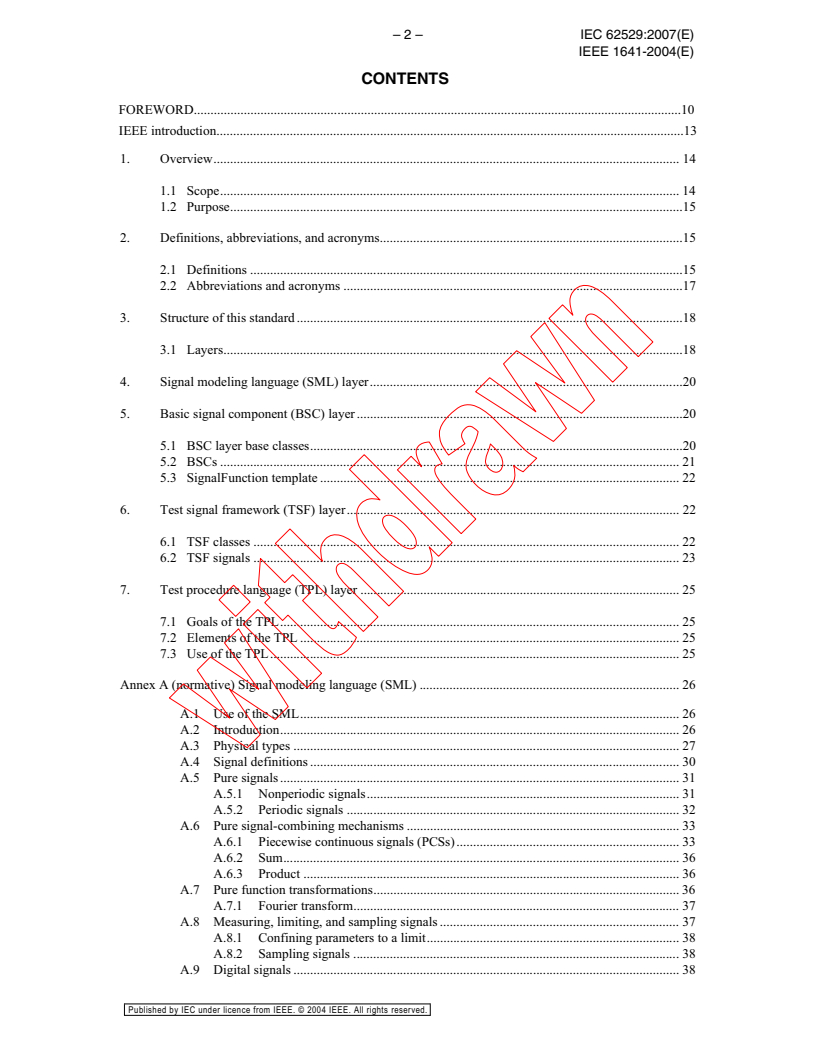
– 2 –
IEEE 1641-2004(E)
CONTENTS
FOREWORD.10
IEEE introduction.13
1. Overview. 14
1.1 Scope. 14
1.2 Purpose.15
2. Definitions, abbreviations, and acronyms.15
2.1 Definitions .15
2.2 Abbreviations and acronyms .17
3. Structure of this standard .18
3.1 Layers.18
4. Signal modeling language (SML) layer.20
5. Basic signal component (BSC) layer .20
5.1 BSC layer base classes.20
5.2 BSCs . 21
5.3 SignalFunction template . 22
6. Test signal framework (TSF) layer. 22
6.1 TSF classes . 22
6.2 TSF signals . 23
7. Test procedure language (TPL) layer . 25
7.1 Goals of the TPL. 25
7.2 Elements of the TPL . 25
7.3 Use of the TPL. 25
Annex A (normative) Signal modeling language (SML) . 26
A.1 Use of the SML. 26
A.2 Introduction. 26
A.3 Physical types . 27
A.4 Signal definitions . 30
A.5 Pure signals . 31
A.5.1 Nonperiodic signals. 31
A.5.2 Periodic signals . 32
A.6 Pure signal-combining mechanisms . 33
A.6.1 Piecewise continuous signals (PCSs). 33
A.6.2 Sum. 36
A.6.3 Product . 36
A.7 Pure function transformations. 36
A.7.1 Fourier transform. 37
A.8 Measuring, limiting, and sampling signals . 37
A.8.1 Confining parameters to a limit. 38
A.8.2 Sampling signals . 38
A.9 Digital signals . 38
Published by IEC under licence from IEEE. © 2004 IEEE. All rights reserved.
– 3 –
IEEE 1641-2004(E)
A.9.1 Defining Digital. 39
A.9.2 Defining DigitalSignal . 39
A.9.3 Conversion routines. 40
A.9.4 Patterns . 41
A.10 Basic component SML. 42
A.10.1 Source ::SignalFunction . 42
A.10.2 Conditioner ::SignalFunction . 44
A.10.3 EventFunction ::SignalFunction. 47
A.10.4 Sensor ::SignalFunction . 50
A.10.5 Digital ::SignalFunction . 50
A.10.6 Connection ::SignalFunction. 51
Annex B (normative) Basic signal component (BSC) layer. 53
B.1 BSC layer base classes. 53
B.2 BSC subclasses . 53
B.3 Description of a BSC . 58
B.3.1 Diagrammatic representation of a BSC. 58
B.3.2 BSC interfaces. 59
B.3.3 Types of BSCs. 60
B.3.4 BSC attribute default values. 61
B.3.5 BSC subclass descriptions. 61
B.4 Physical class . 63
B.4.1 Permissible physical types and their units. 65
B.4.2 Unit prefixes. 69
B.5 PulseDefns class . 70
B.5.1 PulseDefn class . 71
B.6 SignalFunction class . 71
B.6.1 Source ::SignalFunction . 72
B.6.2 Conditioner ::SignalFunction . 80
B.6.3 EventFunction ::SignalFunction. 94
B.6.4 Sensor ::SignalFunction .100
B.6.5 Digital ::SignalFunction .106
B.6.6 Connection ::SignalFunction.108
Annex C (normative) Dynamic signal descriptions.112
C.1 Introduction. 112
C.2 Basic classes . 113
C.2.1 ResourceManager. 113
C.2.2 Signal. 114
C.2.3 BSCs. 116
C.3 Dynamic signal goals and use cases . 118
Annex D (normative) IDL basic components. 119
D.1 Introduction. 119
D.2 IDL BSC library.119
Annex E (informative) Test signal framework (TSF) for ATLAS. 161
E.1 Introduction. 161
E.2 AC_SIGNAL . 161
E.2.1 Definition . 161
E.2.2 Interface properties. 162
Published by IEC under licence from IEEE. © 2004 IEEE. All rights reserved.
– 4 – IEC 62529:2007(E)
IEEE 1641-2004(E)
E.2.3 Notes. 162
E.2.4 Model description. 162
E.2.5 Rules. 162
E.2.6 Example. 163
E.3 AM_SIGNAL .163
E.3.1 Definition . 163
E.3.2 Interface properties. 164
E.3.3 Notes. 164
E.3.4 Model description. 164
E.3.5 Rules. 165
E.3.6 Example. 165
E.4 DC_SIGNAL . 165
E.4.1 Definition . 165
E.4.2 Interface properties. 166
E.4.3 Notes. 166
E.4.4 Model description. 166
E.4.5 Rules. 167
E.4.6 Example. 167
E.5 DIGITAL_PARALLEL . 168
E.5.1 Definition . 168
E.5.2 Interface properties. 168
E.5.3 Notes. 168
E.5.4 Model description. 169
E.5.5 Rules. 169
E.5.6 Example. 169
E.6 DIGITAL_SERIAL . 170
E.6.1 Definition . 170
E.6.2 Interface properties. 171
E.6.3 Notes. 171
E.6.4 Model description. 171
E.6.5 Rules. 171
E.6.6 Example. 172
E.7 DME_INTERROGATION . 172
E.7.1 Definition . 172
E.7.2 Interface properties. 173
E.7.3 Notes. 173
E.7.4 Model description. 174
E.7.5 Rules. 164
E.7.6 Example. 174
E.8 DME_RESPONSE . 175
E.8.1 Definition . 175
E.8.2 Interface properties. 176
E.8.3 Notes. 177
E.8.4 Model description. 177
E.8.5 Rules. 179
E.8.6 Example. 179
E.9 FM_SIGNAL . 180
E.9.1 Definition . 180
E.9.2 Interface properties. 180
E.9.3 Notes. 180
E.9.4 Model description. 180
E.9.5 Rules. 181
E.9.6 Example. 181
E.10 ILS_GLIDE_SLOPE . 182
Published by IEC under licence from IEEE. © 2004 IEEE. All rights reserved.
IEEE 1641-2004(E)
E.10.1 Definition . 182
E.10.2 Interface properties. 183
E.10.3 Notes. 184
E.10.4 Model description. 184
E.10.5 Rules. 185
E.10.6 Example. 185
E.11 ILS_LOCALIZER . 186
E.11.1 Definition . 186
E.11.2 Interface properties. 186
E.11.3 Notes. 187
E.11.4 Model description. 187
E.11.5 Rules. 188
E.11.6 Example. 188
E.12 ILS_MARKER . 189
E.12.1 Definition . 189
E.12.2 Interface properties. 190
E.12.3 Notes. 190
E.12.4 Model description. 190
E.12.5 Rules. 191
E.12.6 Example. 191
E.13 PM_SIGNAL .191
E.13.1 Definition . 191
E.13.2 Interface properties. 192
E.13.3 Notes. 192
E.13.4 Model description. 192
E.13.5 Rules. 193
E.13.6 Example. 193
E.14 PULSED_AC_SIGNAL . 194
E.14.1 Definition . 194
E.14.2 Interface properties. 194
E.14.3 Notes. 194
E.14.4 Model description. 195
E.14.5 Rules. 195
E.14.6 Example. 195
E.15 PULSED_AC_TRAIN . 196
E.15.1 Definition . 196
E.15.2 Interface properties. 196
E.15.3 Notes. 197
E.15.4 Model description. 197
E.15.5 Rules. 197
E.15.6 Example. 198
E.16 PULSED_DC_SIGNAL . 198
E.16.1 Definition . 198
E.16.2 Interface properties. 199
E.16.3 Notes. 199
E.16.4 Model description. 199
E.16.5 Rules. 200
E.16.6 Example. 200
E.17 PULSED_DC_TRAIN . 201
E.17.1 Definition . 201
E.17.2 Interface properties. 201
E.17.3 Notes. 201
E.17.4 Model description. 202
E.17.5 Rules. 202
Published by IEC under licence from IEEE. © 2004 IEEE. All rights reserved.
– 6 – IEC 62529:2007(E)
IEEE 1641-2004(E)
E.17.6 Example. 202
E.18 RADAR_RX_SIGNAL . 203
E.18.1 Definition . 203
E.18.2 Interface properties. 203
E.18.3 Notes. 204
E.18.4 Model description. 204
E.18.5 Rules. 205
E.18.6 Example. 205
E.19 RADAR_TX_SIGNAL . 206
E.19.1 Definition . 206
E.19.2 Interface properties. 206
E.19.3 Notes. 207
E.19.4 Model description. 207
E.19.5 Rules. 207
E.19.6 Example. 207
E.20 RAMP_SIGNAL . 208
E.20.1 Definition . 208
E.20.2 Interface properties. 209
E.20.3 Notes. 209
E.20.4 Model description. 209
E.20.5 Rules. 209
E.20.6 Example. 210
E.21 RANDOM_NOISE . 210
E.21.1 Definition . 210
E.21.2 Interface properties. 210
E.21.3 Notes. 211
E.21.4 Model description. 211
E.21.5 Rules. 211
E.21.6 Example. 211
E.22 RESOLVER . 212
E.22.1 Definition . 212
E.22.2 Interface properties. 213
E.22.3 Notes. 213
E.22.4 Model description. 213
E.22.5 Rules. 214
E.22.6 Example. 215
E.23 RS_232. 215
E.23.1 Definition . 215
E.23.2 Interface properties. 215
E.23.3 Notes. 216
E.23.4 Model description. 216
E.23.5 Rules. 216
E.24 SQUARE_WAVE . 216
E.24.1 Definition . 216
E.24.2 Interface properties. 217
E.24.3 Notes. 217
E.24.4 Model description. 217
E.24.5 Rules. 218
E.24.6 Example. 218
E.25 SSR_INTERROGATION . 219
E.25.1 Definition . 219
E.25.2 Interface properties. 219
E.25.3 Notes. 220
E.25.4 Model description. 221
Published by IEC under licence from IEEE. © 2004 IEEE. All rights reserved.
IEEE 1641-2004(E)
E.25.5 Rules. 221
E.25.6 Example. 221
E.26 SSR_RESPONSE . 222
E.26.1 Definition . 222
E.26.2 Interface properties. 222
E.26.3 Notes. 223
E.26.4 Model description. 224
E.26.5 Rules. 225
E.26.6 Example. 225
E.27 STEP_SIGNAL . 226
E.27.1 Definition . 226
E.27.2 Interface properties. 226
E.27.3 Notes. 227
E.27.4 Model description. 227
E.27.5 Rules. 227
E.27.6 Example. 227
E.28 SUP_CAR_SIGNAL . 228
E.28.1 Definition . 228
E.28.2 Interface properties. 228
E.28.3 Notes. 229
E.28.4 Model description. 229
E.28.5 Rules. 230
E.28.6 Example. 230
E.29 SYNCHRO .230
E.29.1 Definition . 230
E.29.2 Interface properties. 231
E.29.3 Notes. 232
E.29.4 Model description. 232
E.29.5 Rules. 233
E.29.6 Example. 233
E.30 TACAN . 234
E.30.1 Definition . 234
E.30.2 Interface properties. 235
E.30.3 Notes. 236
E.30.4 Model description. 236
E.30.5 Rules. 238
E.30.6 Example. 238
E.31 TRIANGULAR_WAVE_SIGNAL . 239
E.31.1 Definition . 239
E.31.2 Interface properties. 239
E.31.3 Notes. 240
E.31.4 Model description. 240
E.31.5 Rules. 240
E.31.6 Example. 240
E.32 VOR . 241
E.32.1 Definition . 241
E.32.2 Interface properties. 242
E.32.3 Notes. 242
E.32.4 Model description. 243
E.32.5 Rules. 244
E.32.6 Example. 244
Annex F (informative) IDL for TSF for ATLAS .245
Published by IEC under licence from IEEE. © 2004 IEEE. All rights reserved.
– 8 – IEC 62529:2007(E)
IEEE 1641-2004(E)
F.1 Introduction. 245
F.2 IDL for TSF for ATLAS library . 245
Annex G (normative) Carrier language requirements . 265
G.1 Carrier language requirements. 265
G.1.1 General requirements . 265
G.1.2 Human interface and communication. 265
G.2 IDL. 265
G.3 Data types . 265
G.3.1 Enumeration data type. 266
G.3.2 Integer data type . 266
G.3.3 Real data type . 266
G.3.4 Character data type. 267
G.3.5 Boolean data type . 267
G.3.6 File data type . 267
G.3.7 Array data type . 267
G.3.8 Record data type. 267
G.3.9 Variables and constants. 267
G.4 Data-processing requirements.
...