


IEC 62756-1:2015
(Main)Digital load side transmission lighting control (DLT) - Part 1: Basic requirements
Digital load side transmission lighting control (DLT) - Part 1: Basic requirements
IEC 62756-1:2015 specifies a protocol, electrical interface and test procedures for control of electronic lighting equipment by digital signals over the load side mains wiring. Safety requirements are not covered by this standard.
Commande d'éclairage par transmission numérique côté charge (DLT) - Partie 1: Exigences de base
L'IEC 62756-1:2015 spécifie un protocole, une interface électrique et des procédures d'essai pour la commande des équipements d'éclairage électronique par signaux numériques sur le câblage secteur côté charge. Les exigences de sécurité ne sont pas couvertes par la présente Norme.
General Information
- Status
- Published
- Publication Date
- 26-May-2015
- Technical Committee
- SC 34C - Auxiliaries for lamps
- Current Stage
- PPUB - Publication issued
- Start Date
- 27-May-2015
- Completion Date
- 15-Sep-2015
Overview
IEC 62756-1:2015 - Digital load side transmission lighting control (DLT) - Part 1: Basic requirements specifies a digital control protocol, the electrical interface and required test procedures for sending digital control signals over the load-side mains wiring to electronic lighting equipment. The standard defines how control devices (masters) communicate with control gear (slaves) via telegrams carried on the mains. Safety requirements are explicitly not covered by this part.
Keywords: IEC 62756-1:2015, DLT, digital load side transmission, lighting control protocol, mains communication.
Key topics and technical requirements
- Scope and architecture
- Defines a master–slave structure for DLT systems and general specification overview.
- Electrical specification
- Requirements for voltage rating, frequency rating, wiring methods and wiring diagrams.
- Block diagrams for control devices and control gear and electrical characteristics across mains waveform periods.
- Data and signal timing
- Detailed timing rules for information bits, permissible frames and rise/fall times at the control interface.
- Telegram structure and types
- A structured set of telegrams for common lighting commands:
- Brightness (dimming)
- Colour control
- Colour temperature (CCT) control
- Commissioning / group number assignment
- Manufacturer-specific and extended telegrams
- A structured set of telegrams for common lighting commands:
- Method of operation
- Behavioural requirements: response time, light output level, start-up and colour gamut considerations.
- Test procedures
- Test methods covering electrical characteristic tests for control devices and control gear, data timing tests, telegram structure and content tests, plus commissioning examples in an informative annex.
Practical applications and users
IEC 62756-1:2015 is applicable where digital lighting control is required over existing mains conductors (load-side communication). Typical users include:
- Luminaire and LED driver manufacturers implementing DLT-compatible control gear.
- Lighting control system designers and integrators creating master/control-device hardware.
- Building automation and energy-management specifiers seeking retrofit control solutions without new data cabling.
- Test laboratories and compliance engineers executing the standardized test procedures and verifying telegram conformance.
- Installers and commissioning engineers using group-number commissioning and commissioning procedures defined in the annex.
Benefits: enables interoperable dimming, color and CCT control over mains wiring, simplifies retrofit installations, and standardizes test/commissioning practices for reliable operation.
Related standards and considerations
- IEC 62756-1 is focused on protocol, interface and test methods; safety and installation regulations remain governed by separate national and IEC safety standards.
- For systems comparison or integration, consider other lighting control families (for example DALI/IEC 62386) and applicable wiring codes when planning deployment.
For manufacturers and specifiers, IEC 62756-1:2015 is a primary reference for designing and validating DLT-compatible lighting products and systems.
IEC 62756-1:2015 - Digital load side transmission lighting control (DLT) - Part 1: Basic requirements Released:5/27/2015 Isbn:9782832227114
IEC 62756-1:2015 - Digital load side transmission lighting control (DLT) - Part 1: Basic requirements
Frequently Asked Questions
IEC 62756-1:2015 is a standard published by the International Electrotechnical Commission (IEC). Its full title is "Digital load side transmission lighting control (DLT) - Part 1: Basic requirements". This standard covers: IEC 62756-1:2015 specifies a protocol, electrical interface and test procedures for control of electronic lighting equipment by digital signals over the load side mains wiring. Safety requirements are not covered by this standard.
IEC 62756-1:2015 specifies a protocol, electrical interface and test procedures for control of electronic lighting equipment by digital signals over the load side mains wiring. Safety requirements are not covered by this standard.
IEC 62756-1:2015 is classified under the following ICS (International Classification for Standards) categories: 29.140.99 - Other standards related to lamps. The ICS classification helps identify the subject area and facilitates finding related standards.
IEC 62756-1:2015 is available in PDF format for immediate download after purchase. The document can be added to your cart and obtained through the secure checkout process. Digital delivery ensures instant access to the complete standard document.
Standards Content (Sample)
IEC 62756-1 ®
Edition 1.0 2015-05
INTERNATIONAL
STANDARD
colour
inside
Digital load side transmission lighting control (DLT) –
Part 1: Basic requirements
All rights reserved. Unless otherwise specified, no part of this publication may be reproduced or utilized in any form
or by any means, electronic or mechanical, including photocopying and microfilm, without permission in writing from
either IEC or IEC's member National Committee in the country of the requester. If you have any questions about IEC
copyright or have an enquiry about obtaining additional rights to this publication, please contact the address below or
your local IEC member National Committee for further information.
IEC Central Office Tel.: +41 22 919 02 11
3, rue de Varembé Fax: +41 22 919 03 00
CH-1211 Geneva 20 info@iec.ch
Switzerland www.iec.ch
About the IEC
The International Electrotechnical Commission (IEC) is the leading global organization that prepares and publishes
International Standards for all electrical, electronic and related technologies.
About IEC publications
The technical content of IEC publications is kept under constant review by the IEC. Please make sure that you have the
latest edition, a corrigenda or an amendment might have been published.
IEC Catalogue - webstore.iec.ch/catalogue Electropedia - www.electropedia.org
The stand-alone application for consulting the entire The world's leading online dictionary of electronic and
bibliographical information on IEC International Standards, electrical terms containing more than 30 000 terms and
Technical Specifications, Technical Reports and other definitions in English and French, with equivalent terms in 15
documents. Available for PC, Mac OS, Android Tablets and additional languages. Also known as the International
iPad. Electrotechnical Vocabulary (IEV) online.
IEC publications search - www.iec.ch/searchpub IEC Glossary - std.iec.ch/glossary
The advanced search enables to find IEC publications by a More than 60 000 electrotechnical terminology entries in
variety of criteria (reference number, text, technical English and French extracted from the Terms and Definitions
committee,…). It also gives information on projects, replaced clause of IEC publications issued since 2002. Some entries
and withdrawn publications. have been collected from earlier publications of IEC TC 37,
77, 86 and CISPR.
IEC Just Published - webstore.iec.ch/justpublished
Stay up to date on all new IEC publications. Just Published IEC Customer Service Centre - webstore.iec.ch/csc
details all new publications released. Available online and If you wish to give us your feedback on this publication or
also once a month by email. need further assistance, please contact the Customer Service
Centre: csc@iec.ch.
IEC 62756-1 ®
Edition 1.0 2015-05
INTERNATIONAL
STANDARD
colour
inside
Digital load side transmission lighting control (DLT) –
Part 1: Basic requirements
INTERNATIONAL
ELECTROTECHNICAL
COMMISSION
ICS 29.140.99 ISBN 978-2-8322-2711-4
– 2 – IEC 62756-1:2015 © IEC 2015
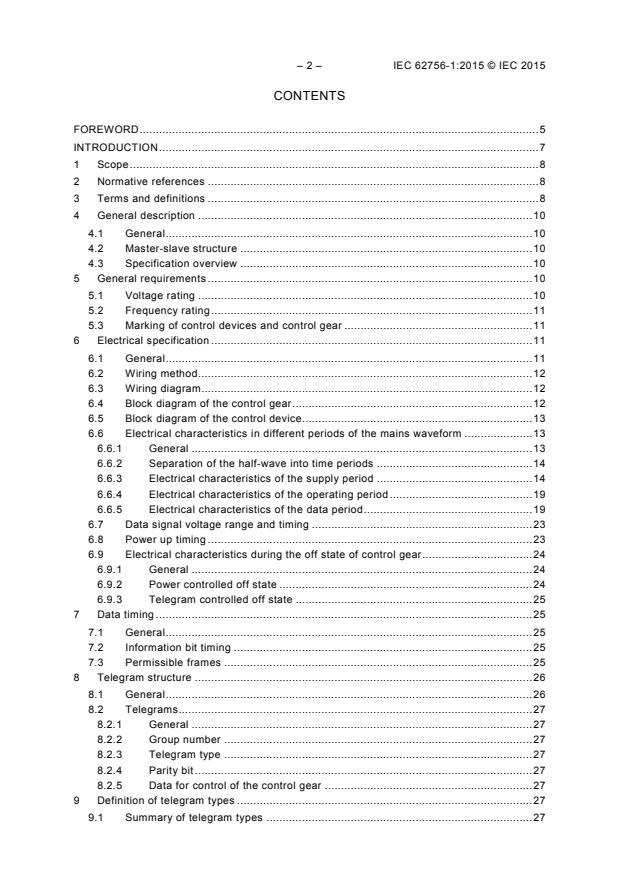
CONTENTS
FOREWORD . 5
INTRODUCTION . 7
1 Scope . 8
2 Normative references . 8
3 Terms and definitions . 8
4 General description . 10
4.1 General . 10
4.2 Master-slave structure . 10
4.3 Specification overview . 10
5 General requirements . 10
5.1 Voltage rating . 10
5.2 Frequency rating . 11
5.3 Marking of control devices and control gear . 11
6 Electrical specification . 11
6.1 General . 11
6.2 Wiring method . 12
6.3 Wiring diagram . 12
6.4 Block diagram of the control gear . 12
6.5 Block diagram of the control device . 13
6.6 Electrical characteristics in different periods of the mains waveform . 13
6.6.1 General . 13
6.6.2 Separation of the half-wave into time periods . 14
6.6.3 Electrical characteristics of the supply period . 14
6.6.4 Electrical characteristics of the operating period . 19
6.6.5 Electrical characteristics of the data period . 19
6.7 Data signal voltage range and timing . 23
6.8 Power up timing . 23
6.9 Electrical characteristics during the off state of control gear . 24
6.9.1 General . 24
6.9.2 Power controlled off state . 24
6.9.3 Telegram controlled off state . 25
7 Data timing . 25
7.1 General . 25
7.2 Information bit timing . 25
7.3 Permissible frames . 25
8 Telegram structure . 26
8.1 General . 26
8.2 Telegrams . 27
8.2.1 General . 27
8.2.2 Group number . 27
8.2.3 Telegram type . 27
8.2.4 Parity bit . 27
8.2.5 Data for control of the control gear . 27
9 Definition of telegram types . 27
9.1 Summary of telegram types . 27
9.2 Telegram type 0: Brightness . 28
9.3 Telegram type 1: Colour control . 28
9.4 Telegram type 2: Colour temperature control . 29
9.5 Telegram type 3 . 29
9.6 Telegram type 4 . 29
9.7 Telegram type 5: commissioning: Group number assignment . 29
9.8 Telegram type 6: Manufacturer specific . 30
9.9 Telegram type 7: extended telegram . 30
10 Method of operation . 30
10.1 General . 30
10.2 Brightness . 31
10.2.1 General . 31
10.2.2 Response time . 31
10.2.3 Light output level . 31
10.2.4 Start-up . 31
10.3 Colour control . 31
10.3.1 General . 31
10.3.2 Colour (x, y) . 31
10.3.3 Response time . 32
10.3.4 Colour gamut . 32
10.3.5 Start-up . 32
10.4 Colour temperature control . 33
10.4.1 General . 33
10.4.2 CCT (correlated colour temperature) . 33
10.4.3 Response time . 33
10.4.4 Start-up . 33
10.5 Telegram controlled group number assignment . 33
10.6 Manufacturer specific telegram . 34
11 Test procedures . 34
11.1 General . 34
11.2 Electrical characteristics tests . 35
11.2.1 General . 35
11.2.2 Test of control device . 35
11.2.3 Test of control gear . 38
11.3 Test of data timing . 41
11.4 Test of telegram structure . 41
11.4.1 Test of control device . 41
11.4.2 Test of control gear . 41
11.5 Test of telegram types . 42
11.5.1 General . 42
11.5.2 Rejection of unsupported telegram types . 42
11.5.3 Test of telegram type 0: brightness . 42
11.5.4 Test of telegram type 1: colour control . 42
11.5.5 Test of telegram type 2: colour temperature control . 43
11.5.6 Test of telegram type 5: commissioning . 43
11.5.7 Test of telegram type 6: manufacturer specific . 43
11.6 Test of method of operation . 43
11.6.1 General . 43
11.6.2 Group number operation . 43
– 4 – IEC 62756-1:2015 © IEC 2015
Annex A (informative) Examples of procedures for telegram controlled group number
commissioning . 47
A.1 Telegram controlled group number assignment of a new system . 47
A.2 Telegram controlled group number assignment of replacement control gear . 47
A.3 Telegram controlled changing of group numbers . 48
Figure 1 – Example wiring diagram . 12
Figure 2 – Example of block diagram of control gear . 13
Figure 3 – Example of block diagram of control device . 13
Figure 4 – Time periods of each half-wave . 14
Figure 5 – Timing of supply period . 15
Figure 6 – Timing data period . 20
Figure 7 – Rise time and fall time at the control interface . 23
Figure 8 – Transmission of “start of telegram” . 25
Figure 9 – Transmission of first bit 0, second bit 0 . 25
Figure 10 – Transmission of first bit 0, second bit 1 . 26
Figure 11 – Transmission of first bit 1, second bit 0 . 26
Figure 12 – Transmission of first bit 1, second bit 1 . 26
Figure 13 – Brightness telegram . 28
Figure 14 – Colour control telegram . 28
Figure 15 – Colour temperature telegram . 29
Figure 16 – Group number assignment telegram . 29
Figure 17 – Manufacturer specific telegram. 30
Figure 18 – The CIE 1931 colour space chromaticity diagram . 32
Figure 19 – Test Circuit for testing the Control Device . 35
Figure 20 – Test Circuit for testing the Control Gear . 38
Figure 21 – Voltage applied to control gear for test procedure . 39
Table 1 – Nominal mains voltage 100 V, frequency 50 Hz or 60 Hz . 17
Table 2 – Nominal mains voltage 120 V; frequency 50 Hz or 60 Hz . 17
Table 3 – Nominal mains voltage 200 V; frequency 50 Hz or 60 Hz . 18
Table 4 – Nominal mains voltage 230 V; frequency 50 Hz or 60 Hz . 18
Table 5 – Nominal mains voltage 277 V; frequency 50 Hz or 60 Hz . 19
Table 6 – Nominal mains voltage 100 V; frequency 50 Hz or 60 Hz . 21
Table 7 – Nominal mains voltage 120 V; frequency 50 Hz or 60 Hz . 21
Table 8 – Nominal mains voltage 200 V; frequency 50 Hz or 60 Hz . 21
Table 9 – Nominal mains voltage 230 V; frequency 50 Hz or 60 Hz . 22
Table 10 – Nominal mains voltage 277 V; frequency 50 Hz or 60 Hz . 22
Table 11 – Electrical characteristics of the data signal . 23
Table 12 – Currents and Voltages for control gear during the power controlled off state . 24
Table 13 – Telegram types . 28
Table 14 – Dimming characteristic . 31
Table 15 – Parameters for testing purposes . 35
Table 16 – Group number test telegram sequence . 44
INTERNATIONAL ELECTROTECHNICAL COMMISSION
____________
DIGITAL LOAD SIDE TRANSMISSION LIGHTING CONTROL (DLT) –
Part 1: Basic requirements
FOREWORD
1) The International Electrotechnical Commission (IEC) is a worldwide organization for standardization comprising
all national electrotechnical committees (IEC National Committees). The object of IEC is to promote
international co-operation on all questions concerning standardization in the electrical and electronic fields. To
this end and in addition to other activities, IEC publishes International Standards, Technical Specifications,
Technical Reports, Publicly Available Specifications (PAS) and Guides (hereafter referred to as “IEC
Publication(s)”). Their preparation is entrusted to technical committees; any IEC National Committee interested
in the subject dealt with may participate in this preparatory work. International, governmental and non-
governmental organizations liaising with the IEC also participate in this preparation. IEC collaborates closely
with the International Organization for Standardization (ISO) in accordance with conditions determined by
agreement between the two organizations.
2) The formal decisions or agreements of IEC on technical matters express, as nearly as possible, an international
consensus of opinion on the relevant subjects since each technical committee has representation from all
interested IEC National Committees.
3) IEC Publications have the form of recommendations for international use and are accepted by IEC National
Committees in that sense. While all reasonable efforts are made to ensure that the technical content of IEC
Publications is accurate, IEC cannot be held responsible for the way in which they are used or for any
misinterpretation by any end user.
4) In order to promote international uniformity, IEC National Committees undertake to apply IEC Publications
transparently to the maximum extent possible in their national and regional publications. Any divergence
between any IEC Publication and the corresponding national or regional publication shall be clearly indicated in
the latter.
5) IEC itself does not provide any attestation of conformity. Independent certification bodies provide conformity
assessment services and, in some areas, access to IEC marks of conformity. IEC is not responsible for any
services carried out by independent certification bodies.
6) All users should ensure that they have the latest edition of this publication.
7) No liability shall attach to IEC or its directors, employees, servants or agents including individual experts and
members of its technical committees and IEC National Committees for any personal injury, property damage or
other damage of any nature whatsoever, whether direct or indirect, or for costs (including legal fees) and
expenses arising out of the publication, use of, or reliance upon, this IEC Publication or any other IEC
Publications.
8) Attention is drawn to the Normative references cited in this publication. Use of the referenced publications is
indispensable for the correct application of this publication.
9) Attention is drawn to the possibility that some of the elements of this IEC Publication may be the subject of
patent rights. IEC shall not be held responsible for identifying any or all such patent rights.
International Standard IEC 62756-1 has been prepared by subcommittee 34C: Auxiliaries for
lamps, of IEC technical committee 34: Lamps and related equipment.
The text of this standard is based on the following documents:
CDV Report on voting
34C/1054/CDV 34C/1081B/RVC
Full information on the voting for the approval of this standard can be found in the report on
voting indicated in the above table.
This publication has been drafted in accordance with the ISO/IEC Directives, Part 2.
A list of all parts in the IEC 62756 series, published under the general title Digital load side
transmission lighting control (DLT), can be found on the IEC website.
– 6 – IEC 62756-1:2015 © IEC 2015
The committee has decided that the contents of this publication will remain unchanged until
the stability date indicated on the IEC website under "http://webstore.iec.ch" in the data
related to the specific publication. At this date, the publication will be
• reconfirmed,
• withdrawn,
• replaced by a revised edition, or
• amended.
A bilingual version of this publication may be issued at a later date.
IMPORTANT – The 'colour inside' logo on the cover page of this publication indicates
that it contains colours which are considered to be useful for the correct
understanding of its contents. Users should therefore print this document using a
colour printer.
INTRODUCTION
This standard concerning Digital Load Side Transmission Lighting Control (DLT) describes a
protocol for simple control of brightness, colour, colour temperature, and other parameters for
the purpose of controlling lighting sources such as CFLi, LED light engines, electronic control
gear and any other light source with integrated or external control gear.
This protocol uses existing wiring and allows easy retrofit of standard switches, dimmers and
lamps with the new devices described in this standard, with little or no configuration.
The following standards contain safety requirements for control devices and control gear:
– IEC 60669-2-1, Switches for household and similar fixed electrical installations – Part 2-1:
Particular requirements – Electronic switches,
– IEC 61347, Lamp control gear,
– IEC 60968, Self-ballasted lamps for general lighting services – Safety requirements,
– IEC 62560, Self-ballasted LED-lamps for general lighting services by voltage > 50 V –
Safety specifications.
– 8 – IEC 62756-1:2015 © IEC 2015
DIGITAL LOAD SIDE TRANSMISSION LIGHTING CONTROL (DLT) –
Part 1: Basic requirements
1 Scope
This International Standard specifies a protocol, electrical interface and test procedures for
control of electronic lighting equipment by digital signals over the load side mains wiring.
Safety requirements are not covered by this standard.
2 Normative references
The following documents, in whole or in part, are normatively referenced in this document and
are indispensable for its application. For dated references, only the edition cited applies. For
undated references, the latest edition of the referenced document (including any
amendments) applies.
IEC 60364 (all parts), Low-voltage electrical installations
IEC 60038, IEC standard voltages
3 Terms and definitions
For the purposes of this document, the following terms and definitions apply.
3.1
load side
wire from the output of the control device to the supply input of one or more control gear
3.2
interface
wires used for both supply of AC mains power and data transfer
3.3
control device
device that is connected to the interface and sends commands to at least one control gear
[SOURCE: IEC 62386-101:2009, 3.1, modified — "in order to control other devices (for
example lamp control gear) connected to the same interface" has been replaced by "to at
least one control gear"]
3.4
control gear
one or more components between the supply and one or more lamps which may serve to
transform the supply voltage, limit the current of the lamp(s) to the required value, provide
starting voltage and preheating current, prevent cold starting, correct power factor or reduce
radio interference.
Note 1 to entry: Lamps may have an integrated control gear such as an integrated compact fluorescent lamp or
integrated LED lamp. Any references to control gear will include any such integrated lamps.
[SOURCE: IEC 62386-101:2009, 3.2]
3.5
master
device that initiates transmission of data on the interface
3.6
slave
device that reacts to data on the interface
3.7
supply period
time period during which power is supplied to a control device
3.8
operating period
time period during which power is supplied to a control gear
3.9
data period
time period during which data is transmitted
3.10
brightness
lumen output of the light source
3.11
frame
sequence of consecutive bits
3.12
telegram
complete sequence of consecutive frames causing a reaction in the slave
3.13
group number
number used to address a collection of control gear
3.14
response time
time taken from the end of a telegram to the reaction of a control gear
3.15
half wave
positive or negative 180° of an a.c. sine wave starting and ending at the zero crossing point
3.16
lighting system
combination of a control device and one or more control gear
3.17
telegram type
specific content of the telegram defining the message transmitted
3.18
two-wire device
control device where the current for the internal power supply flows through the control gear
– 10 – IEC 62756-1:2015 © IEC 2015
3.19
three-wire device
control device where the current for the internal power supply is supplied directly from the
mains
3.20
transmission signal
difference of the voltage across the control device between logical states during the data
period
3.21
start-up
transition from zero light output to a state with greater than zero light output
4 General description
4.1 General
The standardization of the control protocol for control of electronic lighting equipment by load
side digital signals is intended to achieve multi-vendor interoperabilityy between control
devices and control gear, including but not limited to: CFL integrated lamps, LED integrated
lamps and light sources with external control gear.
4.2 Master-slave structure
The control gear operates in slave mode only. Consequently the control gear receives
information only.
The control device operates in master mode only. Consequently the control device transmits
information only.
NOTE Bi-directional communication could be introduced in future parts or editions of this standard.
4.3 Specification overview
Below is a list of key capabilities of this protocol:
– Only one control device on the interface operates as a master.
– The control gear operates as a slave.
– The maximum number of control gear on one interface is limited only by the capabilities of
the control device.
– The capabilities of a control device include the maximum permissible power of total
connected control gear and the maximum permissible number of connected control gear.
– The maximum number of individual groups addressable on one interface is three.
– Bi-phase coding (Manchester coding) with error detection.
– Effective transmission rate: 200 bit/s at 50 Hz and 240 bit/s at 60 Hz.
– Compatible with mains voltages 100 V to 277 V.
– Supply of power to two-wire control devices is provided.
5 General requirements
5.1 Voltage rating
This standard applies to one or more of the following mains voltages: 100 V, 120 V, 200 V,
230 V, 277 V, according to IEC 60038.
5.2 Frequency rating
This standard applies to one or more of the following mains frequencies: 50 Hz, 60 Hz,
according to IEC 60038.
5.3 Marking of control devices and control gear
The following information shall be provided by the manufacturer.
Supported telegram types.
Indication if a control gear does not support group number assignment.
Factory assigned group number for control gear with a fixed factory group assignment other
than group 0.
Maximum number of group number assignments for control gear with limited number of group
number assignments.
Required minimum number of connected control gear for control devices requiring more than
one control gear to be connected.
NOTE Two-wire control devices could need a supply current that exceeds the current-carrying capability provided
by a single control gear.
6 Electrical specification
6.1 General
To describe the electrical characteristics of the interface, the following abbreviations are
used:
V Mains voltage (rated nominal value)
M
V (t) Instantaneous value of V
M M
V Peak voltage of V
Pk M
V Voltage between the line side (L) and load side terminals of the control device (see
CD
Figure 1)
I Current through the load side terminal of the control device (see Figure 1)
CD
Z Impedance between the line side (L) and load side terminals of the control device
CD
V Voltage across the input terminals of the control gear (see Figure 1)
CG
I Current through the input terminals of the control gear (see Figure 1)
CG
Z Impedance across the input terminals of the control gear
CG
P Rated input power of the control gear
CG
n Number of control gear connected with one control device
V Voltage across the input terminals of the control gear at the time that leads to
SW
disabling (supply period) or enabling (data period) the bypass
V Voltage between the line side (L) and load side terminals of the control device
Data
during the data period (see 6.7)
V Transmission voltage, difference of the voltage between the line side (L) and load
TS
side terminals of the control device between logical states; signal amplitude of the
transmission signal
V Voltage between the line side (L) and load side terminals of the control device when
CDmin
its impedance Z is minimal
CD
– 12 – IEC 62756-1:2015 © IEC 2015
I Current-carrying capability of the control gear during the low current intervals and
CG_LC
the data period
I Current-carrying capability of the control gear during the high current interval
CG_HC
V Maximum value for V during the high current phase with I = I
CG_HC CG CG CG_HC
I Limit for current I during the high current interval, defined by the control device
CD_HC CD
t Period time of one half-bit (see Figure 7)
HB
t Time needed to increase the voltage between the line side (L) and load side
rise
terminals of the control device (V ) from V + 0,1× V to V + 0,9×V
Data CDmin TS CDmin TS
t Time needed to decrease the voltage between the line side (L) and load side
fall
terminals of the control device (V ) from V + 0,9×V to V + 0,1×V
Data CDmin TS CDmin TS
t Time after zero crossing when the control device stops applying voltage to the
CD_S
control gear
I Lower most level for current carrying capability of the control gear during power
PO_low
controlled off state
I Upper most level for current carrying capability of the control gear during power
PO_high
controlled off state
V Lower limit for voltage across the input terminals of the control gear to provide a
PO_low
current carrying capability IPO_ during power controlled off state
low
V Upper limit for voltage across the input terminals of the control gear to provide a
PO_high
current carrying capability IPO_ during power controlled off state
high
6.2 Wiring method
The wiring of the devices is in accordance with the installation rules given in the IEC 60364
series, and also with the national wiring rules applicable in the country where the devices are
installed.
6.3 Wiring diagram
The wiring of the lighting system uses the traditional method of breaking the control device
into the mains connection to the control gear. Figure 1 is an example of a lighting system with
one control device and one or two control gear.
L
N
I
CD
V I V I V
CD
CG CG CG CG
Control gear Control gear
Control device
IEC
Figure 1 – Example wiring diagram
6.4 Block diagram of the control gear
For the DLT function, in addition to the parts usually used in a control gear, the following may
be required (see Figure 2):
• a rectifier unit for rectifying the mains voltage;
• a bypass that is able to carry specified currents as defined for different periods;
• a decoupling unit that decouples the transmitted data from the mains and forwards the
transmission signal to a processing unit;
• a processing unit that acts on the received telegram to drive the lamp controller;
• a lamp controller to supply light emitting elements, such as low pressure discharge lamps
or LEDs;
• a decoupling diode if the input capacitance of the lamp controller would disturb the
reception of the transmission signal.
L
∼
+
Lamp
Bypass Decoupling Processing
controller
N
∼ –
IEC
Figure 2 – Example of block diagram of control gear
6.5 Block diagram of the control device
A control device (see Figure 3) comprises an electronic power switch with integrated logic and
zero crossing detection to control the supply period, the operating period and the data period.
For proper operation, a power supply with an integrated current limiter is necessary for driving
the circuitry of the control device. The power required by the control device depends on the
design of the user interface.
A data modulator provides the data for the control gear.
L
Power supply
with integrated current limiter
Zero crossing detection
Load
line
User
interface
Data modulator
Logic
with timing control,
data processing/data output
IEC
Figure 3 – Example of block diagram of control device
6.6 Electrical characteristics in different periods of the mains waveform
6.6.1 General
All values in this subclause are relevant for both 2-wire and 3-wire control devices.
– 14 – IEC 62756-1:2015 © IEC 2015
6.6.2 Separation of the half-wave into time periods
All information given in this standard is related to a half-wave of the mains. Due to the polarity
change between subsequent half-waves, all values are regarded as absolute values.
Each half wave is divided into three periods: Supply period, operating period and data period,
as described in Figure 4 and 6.6.3 to 6.6.5.
V
mains
V
sw
Supply Operating Data t
period period period
IEC
Figure 4 – Time periods of each half-wave
6.6.3 Electrical characteristics of the supply period
6.6.3.1 General
During the supply period the control gear has to be able to conduct a current, which allows
the supply of power to the control device even in a two-wire installation.
The supply period is divided into 3 intervals; first low current interval, high current interval and
second low current interval (see Figure 5).
During all three intervals, the control device and the control gear shall comply with the
electrical characteristics listed in 6.6.3.2. to 6.6.3.4.
The control gear may deactivate its current-carrying capability during the supply period after it
has not received a valid telegram for two minutes.
NOTE This is for reducing power losses in case a control gear is used without a control device.
V
SW
t
I
CG_HC
I
CG_LC
t
I
CD_HC
I
CD_LC
t
t1 t2 t3 t4 t5
IEC
Figure 5 – Timing of supply period
6.6.3.2 First low current interval
The purpose of the first low current interval is that the control gear provides defined
impedance starting from the zero crossing of the mains, enabling the zero crossing detection
in the control device. This makes synchronization with the phase of the mains possible.
This interval starts with the zero crossing of the mains and ends at time t1.
During this interval, the control gear shall provide a current path with a minimum current-
carrying capability of I . The current I may be carried through the bypass circuitry
CG_LC CG_LC
and/or through the lamp controller of the control gear (see Figure 2). At small input voltages
of the control gear when I cannot be reached due to the characteristics of its input
CG_LC
circuitry (e.g. inrush current limiting elements), only its impedance Z is defined.
CG
During this interval, the instantaneous value of the current I shall not exceed I (t) as
CG CG
given in Tables 1 to 5.
At small input voltages of the control gear when I cannot be reached due to the
CG_LC
characteristics of its input circuitry (e.g. inrush current limiting elements), its impedance and
current-carrying capability are defined as listed in Tables 1 to 5.
I I V
CD CG mains
– 16 – IEC 62756-1:2015 © IEC 2015
6.6.3.3 High current interval
The purpose of the high current interval is to supply power to the control device.
This interval starts at time t1 and ends at time t3.
From time t1 to time t2, the control gear shall provide a current path with a minimum current-
carrying capability of I . The current I may be carried through the bypass circuitry
CG_HC CG_HC
and/or through the lamp controller of the control gear (see Figure 2). The impedance of the
control gear shall be low enough that the voltage drop does not exceed V when current
CG_HC
I is lower than or equal to I
CG CD_HC.
The control gear may reduce its current-carrying capability to I when the voltage V
CG_LC CG
across its terminals exceeds V .
CG_HC
From time t1 to time t2, the control device shall limit the current I through its terminals to
CD
I .
CD_HC
From time t2 to time t3, the control gear shall reduce the current-carrying capability of its
to I .
current path from I
CG_HC CG_LC
It is recommended that the control device limits the current I through its terminals from time
CD
t2 to time t3 as listed in tables 1 to 5.
6.6.3.4 Second low current interval
The purpose of the second low current interval is to provide a low current path to allow the
control device to reduce the voltage V across its terminals with a defined slew rate.
CD
From time t3 to time t4, the control gear shall provide a current path with a minimum current-
carrying capability of I . The current I may be carried through the bypass circuitry
CG_LC CG_LC
and/or through the lamp controller of the control gear (see Figure 2). During this interval, the
instantaneous value of the current I shall not exceed I (t) as given in Tables 1 to 5 except
CG CG
for a single small overshoot which has a maximum length of 10µs and a maximum amplitude
of I (t) * 1,5.
CG
Time t4 is when the input voltage of the control gear V exceeds the value V .
CG SW
From time t4 on, the impedance of the control gear is no longer defined; the bypass may be
deactivated.
From time t3 to time t5, the control device shall decrease its impedance Z The voltage V
CD. CD
across the control device is V from the time t5 at the latest.
CDmin
Table 1 – Nominal mains voltage 100 V, frequency 50 Hz or 60 Hz
Control gear: Control device:
Time related to previous zero
current, voltage and current, voltage and
crossing of mains voltage
impedance limits impedance limits
≤ 3 V: Z not
0 V ≤ V
CG CG
defined
3 V < V ≤ 6 V: Z ≤ 330 Ω
CG CG
First low
I and Z not defined
CD CD
current 0 µs to t1 = 520 µs
V > 6 V: I ≥ 18 mA
CG CG_LC
I < 18 mA recommended
CD
interval
V (t) ⋅ P
M CG
I (t) ≤ + 25 mA
CG
V
M
I ≥ 550 mA;
CG_HC
High
t1 = 520 µs to t2 = 790 µs I ≤ 500 mA
V ≤ V = 15 V if CD_HC
CG CG_HC
current
I ≤ 550 mA
CG
interval
t2 = 790 µs to t3 = 860 µs 18 mA ≤ I ≤ 550 mA I < 18 mA recommended
CG CD
I ≥ 18 mA
CG_LC
V (t) ⋅ P
M CG
Z decreases monotonically
t3 = 860 µs to t4;
Second I (t) ≤ + 25 mA CD
CG
to minimum
low
V
M
V = 55 V (-0 / +5 V)
SW
current
V decreases monotonically
CD
interval See Cl 6.6.3.4 for
to V
CDmin
overshoot.detail.
t4 to t5 = 1 200 µs
I and Z not defined
Operating CG CG
t > t5 = 1 200 µs Z = Minimum; V = V
CD CD CDmin
period
Table 2 – Nominal mains voltage 120 V; frequency 50 Hz or 60 Hz
Control gear: Control device:
Time related to previous zero
current, voltage and current, voltage and
crossing of mains voltage
impedance limits impedance limits
0 V ≤ V ≤ 3 V: Z not
CG CG
defined
3 V < V ≤ 6 V: Z ≤ 330 Ω
CG CG
First low
I and Z not defined
CD CD
current 0 µs to t1 = 500 µs
V > 6 V: I ≥ 18 mA
CG CG_LC I < 18 mA recommended
CD
interval
V (t) ⋅ P
M CG
I (t) ≤ + 25 mA
CG
V
M
I ≥ 550 mA;
CG_HC
High
t1 = 500 µs to t2 = 790 µs I ≤ 500 mA
V ≤ V = 15 V if CD_HC
CG CG_HC
current
I ≤ 550 mA
CG
interval
t2 = 790 µs to t3 = 860 µs 18 mA ≤ I ≤ 550 mA I < 18 mA recommended
CG CD
I ≥ 18 mA
CG_LC
V (t) ⋅ P Z decreases monotonically
t3 = 860 µs to t4; M CG
Second CD
I (t) ≤ + 25 mA
CG
to minimum
l
...
IEC 62756-1 ®
Edition 1.0 2015-05
INTERNATIONAL
STANDARD
NORME
INTERNATIONALE
colour
inside
Digital load side transmission lighting control (DLT) –
Part 1: Basic requirements
Commande d’éclairage par transmission numérique côté charge (DLT) –
Partie 1: Exigences de base
All rights reserved. Unless otherwise specified, no part of this publication may be reproduced or utilized in any form
or by any means, electronic or mechanical, including photocopying and microfilm, without permission in writing from
either IEC or IEC's member National Committee in the country of the requester. If you have any questions about IEC
copyright or have an enquiry about obtaining additional rights to this publication, please contact the address below or
your local IEC member National Committee for further information.
Droits de reproduction réservés. Sauf indication contraire, aucune partie de cette publication ne peut être reproduite
ni utilisée sous quelque forme que ce soit et par aucun procédé, électronique ou mécanique, y compris la photocopie
et les microfilms, sans l'accord écrit de l'IEC ou du Comité national de l'IEC du pays du demandeur. Si vous avez des
questions sur le copyright de l'IEC ou si vous désirez obtenir des droits supplémentaires sur cette publication, utilisez
les coordonnées ci-après ou contactez le Comité national de l'IEC de votre pays de résidence.
IEC Central Office Tel.: +41 22 919 02 11
3, rue de Varembé Fax: +41 22 919 03 00
CH-1211 Geneva 20 info@iec.ch
Switzerland www.iec.ch
About the IEC
The International Electrotechnical Commission (IEC) is the leading global organization that prepares and publishes
International Standards for all electrical, electronic and related technologies.
About IEC publications
The technical content of IEC publications is kept under constant review by the IEC. Please make sure that you have the
latest edition, a corrigenda or an amendment might have been published.
IEC Catalogue - webstore.iec.ch/catalogue Electropedia - www.electropedia.org
The stand-alone application for consulting the entire The world's leading online dictionary of electronic and
bibliographical information on IEC International Standards, electrical terms containing more than 30 000 terms and
Technical Specifications, Technical Reports and other definitions in English and French, with equivalent terms in 15
documents. Available for PC, Mac OS, Android Tablets and additional languages. Also known as the International
iPad. Electrotechnical Vocabulary (IEV) online.
IEC publications search - www.iec.ch/searchpub IEC Glossary - std.iec.ch/glossary
The advanced search enables to find IEC publications by a More than 60 000 electrotechnical terminology entries in
variety of criteria (reference number, text, technical English and French extracted from the Terms and Definitions
committee,…). It also gives information on projects, replaced clause of IEC publications issued since 2002. Some entries
and withdrawn publications. have been collected from earlier publications of IEC TC 37,
77, 86 and CISPR.
IEC Just Published - webstore.iec.ch/justpublished
Stay up to date on all new IEC publications. Just Published IEC Customer Service Centre - webstore.iec.ch/csc
details all new publications released. Available online and If you wish to give us your feedback on this publication or
also once a month by email. need further assistance, please contact the Customer Service
Centre: csc@iec.ch.
A propos de l'IEC
La Commission Electrotechnique Internationale (IEC) est la première organisation mondiale qui élabore et publie des
Normes internationales pour tout ce qui a trait à l'électricité, à l'électronique et aux technologies apparentées.
A propos des publications IEC
Le contenu technique des publications IEC est constamment revu. Veuillez vous assurer que vous possédez l’édition la
plus récente, un corrigendum ou amendement peut avoir été publié.
Catalogue IEC - webstore.iec.ch/catalogue Electropedia - www.electropedia.org
Application autonome pour consulter tous les renseignements
Le premier dictionnaire en ligne de termes électroniques et
bibliographiques sur les Normes internationales,
électriques. Il contient plus de 30 000 termes et définitions en
Spécifications techniques, Rapports techniques et autres
anglais et en français, ainsi que les termes équivalents dans
documents de l'IEC. Disponible pour PC, Mac OS, tablettes
15 langues additionnelles. Egalement appelé Vocabulaire
Android et iPad.
Electrotechnique International (IEV) en ligne.
Recherche de publications IEC - www.iec.ch/searchpub
Glossaire IEC - std.iec.ch/glossary
Plus de 60 000 entrées terminologiques électrotechniques, en
La recherche avancée permet de trouver des publications IEC
en utilisant différents critères (numéro de référence, texte, anglais et en français, extraites des articles Termes et
comité d’études,…). Elle donne aussi des informations sur les Définitions des publications IEC parues depuis 2002. Plus
projets et les publications remplacées ou retirées. certaines entrées antérieures extraites des publications des
CE 37, 77, 86 et CISPR de l'IEC.
IEC Just Published - webstore.iec.ch/justpublished
Service Clients - webstore.iec.ch/csc
Restez informé sur les nouvelles publications IEC. Just
Published détaille les nouvelles publications parues. Si vous désirez nous donner des commentaires sur cette
Disponible en ligne et aussi une fois par mois par email. publication ou si vous avez des questions contactez-nous:
csc@iec.ch.
IEC 62756-1 ®
Edition 1.0 2015-05
INTERNATIONAL
STANDARD
NORME
INTERNATIONALE
colour
inside
Digital load side transmission lighting control (DLT) –
Part 1: Basic requirements
Commande d’éclairage par transmission numérique côté charge (DLT) –
Partie 1: Exigences de base
INTERNATIONAL
ELECTROTECHNICAL
COMMISSION
COMMISSION
ELECTROTECHNIQUE
INTERNATIONALE
ICS 29.140.99 ISBN 978-2-8322-3038-1
– 2 – IEC 62756-1:2015 © IEC 2015
CONTENTS
FOREWORD . 5
INTRODUCTION . 7
1 Scope . 8
2 Normative references . 8
3 Terms and definitions . 8
4 General description . 10
4.1 General . 10
4.2 Master-slave structure . 10
4.3 Specification overview . 10
5 General requirements . 10
5.1 Voltage rating . 10
5.2 Frequency rating . 11
5.3 Marking of control devices and control gear . 11
6 Electrical specification . 11
6.1 General . 11
6.2 Wiring method . 12
6.3 Wiring diagram . 12
6.4 Block diagram of the control gear . 12
6.5 Block diagram of the control device . 13
6.6 Electrical characteristics in different periods of the mains waveform . 13
6.6.1 General . 13
6.6.2 Separation of the half-wave into time periods . 14
6.6.3 Electrical characteristics of the supply period . 14
6.6.4 Electrical characteristics of the operating period . 19
6.6.5 Electrical characteristics of the data period . 19
6.7 Data signal voltage range and timing . 23
6.8 Power up timing . 23
6.9 Electrical characteristics during the off state of control gear . 24
6.9.1 General . 24
6.9.2 Power controlled off state . 24
6.9.3 Telegram controlled off state . 25
7 Data timing . 25
7.1 General . 25
7.2 Information bit timing . 25
7.3 Permissible frames . 25
8 Telegram structure . 26
8.1 General . 26
8.2 Telegrams . 27
8.2.1 General . 27
8.2.2 Group number . 27
8.2.3 Telegram type . 27
8.2.4 Parity bit . 27
8.2.5 Data for control of the control gear . 27
9 Definition of telegram types . 27
9.1 Summary of telegram types . 27
9.2 Telegram type 0: Brightness . 28
9.3 Telegram type 1: Colour control . 28
9.4 Telegram type 2: Colour temperature control . 29
9.5 Telegram type 3 . 29
9.6 Telegram type 4 . 29
9.7 Telegram type 5: commissioning: Group number assignment . 29
9.8 Telegram type 6: Manufacturer specific . 30
9.9 Telegram type 7: extended telegram . 30
10 Method of operation . 30
10.1 General . 30
10.2 Brightness . 31
10.2.1 General . 31
10.2.2 Response time . 31
10.2.3 Light output level . 31
10.2.4 Start-up . 31
10.3 Colour control . 31
10.3.1 General . 31
10.3.2 Colour (x, y) . 31
10.3.3 Response time . 32
10.3.4 Colour gamut . 32
10.3.5 Start-up . 32
10.4 Colour temperature control . 33
10.4.1 General . 33
10.4.2 CCT (correlated colour temperature) . 33
10.4.3 Response time . 33
10.4.4 Start-up . 33
10.5 Telegram controlled group number assignment . 33
10.6 Manufacturer specific telegram . 34
11 Test procedures . 34
11.1 General . 34
11.2 Electrical characteristics tests . 35
11.2.1 General . 35
11.2.2 Test of control device . 35
11.2.3 Test of control gear . 38
11.3 Test of data timing . 41
11.4 Test of telegram structure . 41
11.4.1 Test of control device . 41
11.4.2 Test of control gear . 41
11.5 Test of telegram types . 42
11.5.1 General . 42
11.5.2 Rejection of unsupported telegram types . 42
11.5.3 Test of telegram type 0: brightness . 42
11.5.4 Test of telegram type 1: colour control . 42
11.5.5 Test of telegram type 2: colour temperature control . 43
11.5.6 Test of telegram type 5: commissioning . 43
11.5.7 Test of telegram type 6: manufacturer specific . 43
11.6 Test of method of operation . 43
11.6.1 General . 43
11.6.2 Group number operation . 43
– 4 – IEC 62756-1:2015 © IEC 2015
Annex A (informative) Examples of procedures for telegram controlled group number
commissioning . 47
A.1 Telegram controlled group number assignment of a new system . 47
A.2 Telegram controlled group number assignment of replacement control gear . 47
A.3 Telegram controlled changing of group numbers . 48
Figure 1 – Example wiring diagram . 12
Figure 2 – Example of block diagram of control gear . 13
Figure 3 – Example of block diagram of control device . 13
Figure 4 – Time periods of each half-wave . 14
Figure 5 – Timing of supply period . 15
Figure 6 – Timing data period . 20
Figure 7 – Rise time and fall time at the control interface . 23
Figure 8 – Transmission of “start of telegram” . 25
Figure 9 – Transmission of first bit 0, second bit 0 . 25
Figure 10 – Transmission of first bit 0, second bit 1 . 26
Figure 11 – Transmission of first bit 1, second bit 0 . 26
Figure 12 – Transmission of first bit 1, second bit 1 . 26
Figure 13 – Brightness telegram . 28
Figure 14 – Colour control telegram . 28
Figure 15 – Colour temperature telegram . 29
Figure 16 – Group number assignment telegram . 29
Figure 17 – Manufacturer specific telegram. 30
Figure 18 – The CIE 1931 colour space chromaticity diagram . 32
Figure 19 – Test Circuit for testing the Control Device . 35
Figure 20 – Test Circuit for testing the Control Gear . 38
Figure 21 – Voltage applied to control gear for test procedure . 39
Table 1 – Nominal mains voltage 100 V, frequency 50 Hz or 60 Hz . 17
Table 2 – Nominal mains voltage 120 V; frequency 50 Hz or 60 Hz . 17
Table 3 – Nominal mains voltage 200 V; frequency 50 Hz or 60 Hz . 18
Table 4 – Nominal mains voltage 230 V; frequency 50 Hz or 60 Hz . 18
Table 5 – Nominal mains voltage 277 V; frequency 50 Hz or 60 Hz . 19
Table 6 – Nominal mains voltage 100 V; frequency 50 Hz or 60 Hz . 21
Table 7 – Nominal mains voltage 120 V; frequency 50 Hz or 60 Hz . 21
Table 8 – Nominal mains voltage 200 V; frequency 50 Hz or 60 Hz . 21
Table 9 – Nominal mains voltage 230 V; frequency 50 Hz or 60 Hz . 22
Table 10 – Nominal mains voltage 277 V; frequency 50 Hz or 60 Hz . 22
Table 11 – Electrical characteristics of the data signal . 23
Table 12 – Currents and Voltages for control gear during the power controlled off state . 24
Table 13 – Telegram types . 28
Table 14 – Dimming characteristic . 31
Table 15 – Parameters for testing purposes . 35
Table 16 – Group number test telegram sequence . 44
INTERNATIONAL ELECTROTECHNICAL COMMISSION
____________
DIGITAL LOAD SIDE TRANSMISSION LIGHTING CONTROL (DLT) –
Part 1: Basic requirements
FOREWORD
1) The International Electrotechnical Commission (IEC) is a worldwide organization for standardization comprising
all national electrotechnical committees (IEC National Committees). The object of IEC is to promote
international co-operation on all questions concerning standardization in the electrical and electronic fields. To
this end and in addition to other activities, IEC publishes International Standards, Technical Specifications,
Technical Reports, Publicly Available Specifications (PAS) and Guides (hereafter referred to as “IEC
Publication(s)”). Their preparation is entrusted to technical committees; any IEC National Committee interested
in the subject dealt with may participate in this preparatory work. International, governmental and non-
governmental organizations liaising with the IEC also participate in this preparation. IEC collaborates closely
with the International Organization for Standardization (ISO) in accordance with conditions determined by
agreement between the two organizations.
2) The formal decisions or agreements of IEC on technical matters express, as nearly as possible, an international
consensus of opinion on the relevant subjects since each technical committee has representation from all
interested IEC National Committees.
3) IEC Publications have the form of recommendations for international use and are accepted by IEC National
Committees in that sense. While all reasonable efforts are made to ensure that the technical content of IEC
Publications is accurate, IEC cannot be held responsible for the way in which they are used or for any
misinterpretation by any end user.
4) In order to promote international uniformity, IEC National Committees undertake to apply IEC Publications
transparently to the maximum extent possible in their national and regional publications. Any divergence
between any IEC Publication and the corresponding national or regional publication shall be clearly indicated in
the latter.
5) IEC itself does not provide any attestation of conformity. Independent certification bodies provide conformity
assessment services and, in some areas, access to IEC marks of conformity. IEC is not responsible for any
services carried out by independent certification bodies.
6) All users should ensure that they have the latest edition of this publication.
7) No liability shall attach to IEC or its directors, employees, servants or agents including individual experts and
members of its technical committees and IEC National Committees for any personal injury, property damage or
other damage of any nature whatsoever, whether direct or indirect, or for costs (including legal fees) and
expenses arising out of the publication, use of, or reliance upon, this IEC Publication or any other IEC
Publications.
8) Attention is drawn to the Normative references cited in this publication. Use of the referenced publications is
indispensable for the correct application of this publication.
9) Attention is drawn to the possibility that some of the elements of this IEC Publication may be the subject of
patent rights. IEC shall not be held responsible for identifying any or all such patent rights.
International Standard IEC 62756-1 has been prepared by subcommittee 34C: Auxiliaries for
lamps, of IEC technical committee 34: Lamps and related equipment.
This bilingual version (2015-12) corresponds to the English version, published in 2015-05.
The text of this standard is based on the following documents:
CDV Report on voting
34C/1054/CDV 34C/1081B/RVC
Full information on the voting for the approval of this standard can be found in the report on
voting indicated in the above table.
The French version of this standard has not been voted upon.
– 6 – IEC 62756-1:2015 © IEC 2015
This publication has been drafted in accordance with the ISO/IEC Directives, Part 2.
A list of all parts in the IEC 62756 series, published under the general title Digital load side
transmission lighting control (DLT), can be found on the IEC website.
The committee has decided that the contents of this publication will remain unchanged until
the stability date indicated on the IEC website under "http://webstore.iec.ch" in the data
related to the specific publication. At this date, the publication will be
• reconfirmed,
• withdrawn,
• replaced by a revised edition, or
• amended.
IMPORTANT – The 'colour inside' logo on the cover page of this publication indicates
that it contains colours which are considered to be useful for the correct
understanding of its contents. Users should therefore print this document using a
colour printer.
INTRODUCTION
This standard concerning Digital Load Side Transmission Lighting Control (DLT) describes a
protocol for simple control of brightness, colour, colour temperature, and other parameters for
the purpose of controlling lighting sources such as CFLi, LED light engines, electronic control
gear and any other light source with integrated or external control gear.
This protocol uses existing wiring and allows easy retrofit of standard switches, dimmers and
lamps with the new devices described in this standard, with little or no configuration.
The following standards contain safety requirements for control devices and control gear:
– IEC 60669-2-1, Switches for household and similar fixed electrical installations – Part 2-1:
Particular requirements – Electronic switches,
– IEC 61347, Lamp control gear,
– IEC 60968, Self-ballasted lamps for general lighting services – Safety requirements,
– IEC 62560, Self-ballasted LED-lamps for general lighting services by voltage > 50 V –
Safety specifications.
– 8 – IEC 62756-1:2015 © IEC 2015
DIGITAL LOAD SIDE TRANSMISSION LIGHTING CONTROL (DLT) –
Part 1: Basic requirements
1 Scope
This International Standard specifies a protocol, electrical interface and test procedures for
control of electronic lighting equipment by digital signals over the load side mains wiring.
Safety requirements are not covered by this standard.
2 Normative references
The following documents, in whole or in part, are normatively referenced in this document and
are indispensable for its application. For dated references, only the edition cited applies. For
undated references, the latest edition of the referenced document (including any
amendments) applies.
IEC 60364 (all parts), Low-voltage electrical installations
IEC 60038, IEC standard voltages
3 Terms and definitions
For the purposes of this document, the following terms and definitions apply.
3.1
load side
wire from the output of the control device to the supply input of one or more control gear
3.2
interface
wires used for both supply of AC mains power and data transfer
3.3
control device
device that is connected to the interface and sends commands to at least one control gear
[SOURCE: IEC 62386-101:2009, 3.1, modified — "in order to control other devices (for
example lamp control gear) connected to the same interface" has been replaced by "to at
least one control gear"]
3.4
control gear
one or more components between the supply and one or more lamps which may serve to
transform the supply voltage, limit the current of the lamp(s) to the required value, provide
starting voltage and preheating current, prevent cold starting, correct power factor or reduce
radio interference.
Note 1 to entry: Lamps may have an integrated control gear such as an integrated compact fluorescent lamp or
integrated LED lamp. Any references to control gear will include any such integrated lamps.
[SOURCE: IEC 62386-101:2009, 3.2]
3.5
master
device that initiates transmission of data on the interface
3.6
slave
device that reacts to data on the interface
3.7
supply period
time period during which power is supplied to a control device
3.8
operating period
time period during which power is supplied to a control gear
3.9
data period
time period during which data is transmitted
3.10
brightness
lumen output of the light source
3.11
frame
sequence of consecutive bits
3.12
telegram
complete sequence of consecutive frames causing a reaction in the slave
3.13
group number
number used to address a collection of control gear
3.14
response time
time taken from the end of a telegram to the reaction of a control gear
3.15
half wave
positive or negative 180° of an a.c. sine wave starting and ending at the zero crossing point
3.16
lighting system
combination of a control device and one or more control gear
3.17
telegram type
specific content of the telegram defining the message transmitted
3.18
two-wire device
control device where the current for the internal power supply flows through the control gear
– 10 – IEC 62756-1:2015 © IEC 2015
3.19
three-wire device
control device where the current for the internal power supply is supplied directly from the
mains
3.20
transmission signal
difference of the voltage across the control device between logical states during the data
period
3.21
start-up
transition from zero light output to a state with greater than zero light output
4 General description
4.1 General
The standardization of the control protocol for control of electronic lighting equipment by load
side digital signals is intended to achieve multi-vendor interoperability between control
devices and control gear, including but not limited to: CFL integrated lamps, LED integrated
lamps and light sources with external control gear.
4.2 Master-slave structure
The control gear operates in slave mode only. Consequently the control gear receives
information only.
The control device operates in master mode only. Consequently the control device transmits
information only.
NOTE Bi-directional communication could be introduced in future parts or editions of this standard.
4.3 Specification overview
Below is a list of key capabilities of this protocol:
– Only one control device on the interface operates as a master.
– The control gear operates as a slave.
– The maximum number of control gear on one interface is limited only by the capabilities of
the control device.
– The capabilities of a control device include the maximum permissible power of total
connected control gear and the maximum permissible number of connected control gear.
– The maximum number of individual groups addressable on one interface is three.
– Bi-phase coding (Manchester coding) with error detection.
– Effective transmission rate: 200 bit/s at 50 Hz and 240 bit/s at 60 Hz.
– Compatible with mains voltages 100 V to 277 V.
– Supply of power to two-wire control devices is provided.
5 General requirements
5.1 Voltage rating
This standard applies to one or more of the following mains voltages: 100 V, 120 V, 200 V,
230 V, 277 V, according to IEC 60038.
5.2 Frequency rating
This standard applies to one or more of the following mains frequencies: 50 Hz, 60 Hz,
according to IEC 60038.
5.3 Marking of control devices and control gear
The following information shall be provided by the manufacturer.
Supported telegram types.
Indication if a control gear does not support group number assignment.
Factory assigned group number for control gear with a fixed factory group assignment other
than group 0.
Maximum number of group number assignments for control gear with limited number of group
number assignments.
Required minimum number of connected control gear for control devices requiring more than
one control gear to be connected.
NOTE Two-wire control devices could need a supply current that exceeds the current-carrying capability provided
by a single control gear.
6 Electrical specification
6.1 General
To describe the electrical characteristics of the interface, the following abbreviations are
used:
V Mains voltage (rated nominal value)
M
V (t) Instantaneous value of V
M M
V Peak voltage of V
Pk M
V Voltage between the line side (L) and load side terminals of the control device (see
CD
Figure 1)
I Current through the load side terminal of the control device (see Figure 1)
CD
Z Impedance between the line side (L) and load side terminals of the control device
CD
V Voltage across the input terminals of the control gear (see Figure 1)
CG
I Current through the input terminals of the control gear (see Figure 1)
CG
Z Impedance across the input terminals of the control gear
CG
P Rated input power of the control gear
CG
n Number of control gear connected with one control device
V Voltage across the input terminals of the control gear at the time that leads to
SW
disabling (supply period) or enabling (data period) the bypass
V Voltage between the line side (L) and load side terminals of the control device
Data
during the data period (see 6.7)
V Transmission voltage, difference of the voltage between the line side (L) and load
TS
side terminals of the control device between logical states; signal amplitude of the
transmission signal
V Voltage between the line side (L) and load side terminals of the control device when
CDmin
its impedance Z is minimal
CD
– 12 – IEC 62756-1:2015 © IEC 2015
I Current-carrying capability of the control gear during the low current intervals and
CG_LC
the data period
I Current-carrying capability of the control gear during the high current interval
CG_HC
V Maximum value for V during the high current phase with I = I
CG_HC CG CG CG_HC
I Limit for current I during the high current interval, defined by the control device
CD_HC CD
t Period time of one half-bit (see Figure 7)
HB
t Time needed to increase the voltage between the line side (L) and load side
rise
terminals of the control device (V ) from V + 0,1× V to V + 0,9×V
Data CDmin TS CDmin TS
t Time needed to decrease the voltage between the line side (L) and load side
fall
terminals of the control device (V ) from V + 0,9×V to V + 0,1×V
Data CDmin TS CDmin TS
t Time after zero crossing when the control device stops applying voltage to the
CD_S
control gear
I Lower most level for current carrying capability of the control gear during power
PO_low
controlled off state
I Upper most level for current carrying capability of the control gear during power
PO_high
controlled off state
V Lower limit for voltage across the input terminals of the control gear to provide a
PO_low
current carrying capability IPO_ during power controlled off state
low
V Upper limit for voltage across the input terminals of the control gear to provide a
PO_high
current carrying capability IPO_ during power controlled off state
high
6.2 Wiring method
The wiring of the devices is in accordance with the installation rules given in the IEC 60364
series, and also with the national wiring rules applicable in the country where the devices are
installed.
6.3 Wiring diagram
The wiring of the lighting system uses the traditional method of breaking the control device
into the mains connection to the control gear. Figure 1 is an example of a lighting system with
one control device and one or two control gear.
L
N
I
CD
V I V I V
CD
CG CG CG CG
Control gear Control gear
Control device
IEC
Figure 1 – Example wiring diagram
6.4 Block diagram of the control gear
For the DLT function, in addition to the parts usually used in a control gear, the following may
be required (see Figure 2):
• a rectifier unit for rectifying the mains voltage;
• a bypass that is able to carry specified currents as defined for different periods;
• a decoupling unit that decouples the transmitted data from the mains and forwards the
transmission signal to a processing unit;
• a processing unit that acts on the received telegram to drive the lamp controller;
• a lamp controller to supply light emitting elements, such as low pressure discharge lamps
or LEDs;
• a decoupling diode if the input capacitance of the lamp controller would disturb the
reception of the transmission signal.
L
∼
+
Lamp
Bypass Decoupling Processing
controller
N
∼ –
IEC
Figure 2 – Example of block diagram of control gear
6.5 Block diagram of the control device
A control device (see Figure 3) comprises an electronic power switch with integrated logic and
zero crossing detection to control the supply period, the operating period and the data period.
For proper operation, a power supply with an integrated current limiter is necessary for driving
the circuitry of the control device. The power required by the control device depends on the
design of the user interface.
A data modulator provides the data for the control gear.
L
Power supply
with integrated current limiter
Zero crossing detection
Load
line
User
interface
Data modulator
Logic
with timing control,
data processing/data output
IEC
Figure 3 – Example of block diagram of control device
6.6 Electrical characteristics in different periods of the mains waveform
6.6.1 General
All values in this subclause are relevant for both 2-wire and 3-wire control devices.
– 14 – IEC 62756-1:2015 © IEC 2015
6.6.2 Separation of the half-wave into time periods
All information given in this standard is related to a half-wave of the mains. Due to the polarity
change between subsequent half-waves, all values are regarded as absolute values.
Each half wave is divided into three periods: Supply period, operating period and data period,
as described in Figure 4 and 6.6.3 to 6.6.5.
V
mains
V
sw
Supply Operating Data t
period period period
IEC
Figure 4 – Time periods of each half-wave
6.6.3 Electrical characteristics of the supply period
6.6.3.1 General
During the supply period the control gear has to be able to conduct a current, which allows
the supply of power to the control device even in a two-wire installation.
The supply period is divided into 3 intervals; first low current interval, high current interval and
second low current interval (see Figure 5).
During all three intervals, the control device and the control gear shall comply with the
electrical characteristics listed in 6.6.3.2. to 6.6.3.4.
The control gear may deactivate its current-carrying capability during the supply period after it
has not received a valid telegram for two minutes.
NOTE This is for reducing power losses in case a control gear is used without a control device.
V
SW
t
I
CG_HC
I
CG_LC
t
I
CD_HC
I
CD_LC
t
t1 t2 t3 t4 t5
IEC
Figure 5 – Timing of supply period
6.6.3.2 First low current interval
The purpose of the first low current interval is that the control gear provides defined
impedance starting from the zero crossing of the mains, enabling the zero crossing detection
in the control device. This makes synchronization with the phase of the mains possible.
This interval starts with the zero crossing of the mains and ends at time t1.
During this interval, the control gear shall provide a current path with a minimum current-
carrying capability of I . The current I may be carried through the bypass circuitry
CG_LC CG_LC
and/or through the lamp controller of the control gear (see Figure 2). At small input voltages
of the control gear when I cannot be reached due to the characteristics of its input
CG_LC
circuitry (e.g. inrush current limiting elements), only its impedance Z is defined.
CG
During this interval, the instantaneous value of the current I shall not exceed I (t) as
CG CG
given in Tables 1 to 5.
At small input voltages of the control gear when I cannot be reached due to the
CG_LC
characteristics of its input circuitry (e.g. inrush current limiting elements), its impedance and
current-carrying capability are defined as listed in Tables 1 to 5.
I I V
CD CG mains
– 16 – IEC 62756-1:2015 © IEC 2015
6.6.3.3 High current interval
The purpose of the high current interval is to supply power to the control device.
This interval starts at time t1 and ends at time t3.
From time t1 to time t2, the control gear shall provide a current path with a minimum current-
carrying capability of I . The current I may be carried through the bypass circuitry
CG_HC CG_HC
and/or through the lamp controller of the control gear (see Figure 2). The impedance of the
control gear shall be low enough that the voltage drop does not exceed V when current
CG_HC
I is lower than or equal to I
CG CD_HC.
The control gear may reduce its current-carrying capability to I when the voltage V
CG_LC CG
across its terminals exceeds V .
CG_HC
From time t1 to time t2, the control device shall limit the current I through its terminals to
CD
I .
CD_HC
From time t2 to time t3, the control gear shall reduce the current-carrying capability of its
...
Questions, Comments and Discussion
Ask us and Technical Secretary will try to provide an answer. You can facilitate discussion about the standard in here.
Loading comments...