


IEC 61019-1:2004
(Main)Surface acoustic wave (SAW) resonators - Part 1: Generic specification
General Information
- Abstract
IEC 61019-1:2004 specifies the methods of test and general requirements for SAW resonators using either capability approval or qualification approval procedures of the IECQ system. This first edition of IEC 61019-1 cancels and replaces the first edition of IEC 61019-1-1 published in 1990 and the first edition of IEC 61019-1-2 published in 1993. It constitutes a technical revision.
- Status
- Published
- Publication Date
- 01-Nov-2004
- Technical Committee
- TC 49 - Piezoelectric, dielectric and electrostatic devices and associated materials for frequency control, selection and detection
- Drafting Committee
- WG 10 - TC 49/WG 10
- Current Stage
- PPUB - Publication issued
- Start Date
- 02-Nov-2004
- Completion Date
- 28-Feb-2005
Buy Documents
IEC 61019-1:2004 - Surface acoustic wave (SAW) resonators - Part 1: Generic specification Released:11/2/2004
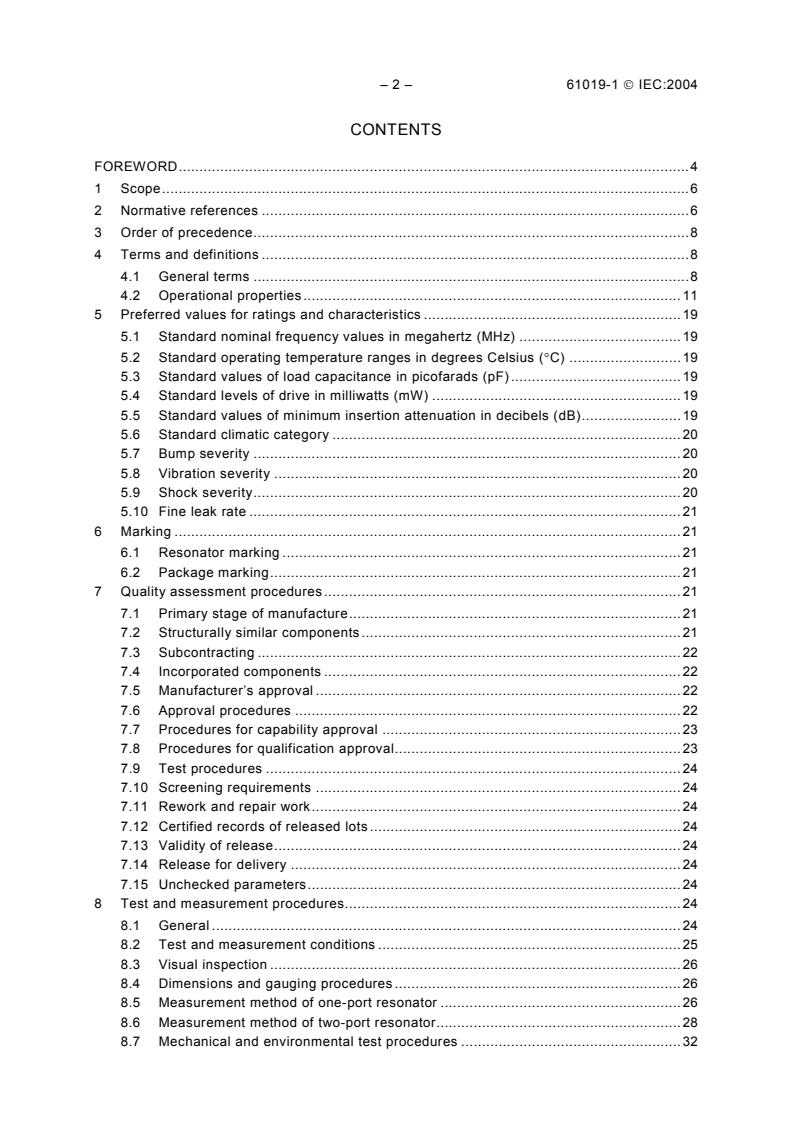
IEC 61019-1:2004 - Surface acoustic wave (SAW) resonators - Part 1: Generic specification Released:11/2/2004
Overview
IEC 61019-1:2004 - Surface acoustic wave (SAW) resonators - Part 1: Generic specification - is the IEC generic specification that defines the methods of test and general requirements for SAW resonators intended for IECQ capability approval or qualification approval. This 2004 first edition consolidates and replaces earlier Part‑1-1 (1990) and Part‑1-2 (1993) documents and serves as the baseline for manufacturers, test laboratories and purchasers of SAW components.
Key Topics and Technical Requirements
This standard covers the essential technical and quality topics needed to assess SAW resonator performance and reliability, including:
- Terms and definitions for SAW devices (one‑port and two‑port resonators, operational properties).
- Preferred values and ratings (standard nominal frequencies, operating temperature ranges, load capacitances, drive levels, minimum insertion attenuation, climatic categories).
- Marking and package identification requirements for traceability.
- Quality assessment procedures aligned with the IECQ system - capability approval and qualification approval, manufacturer’s approval, subcontracting and screening.
- Test and measurement procedures:
- Measurement methods for one‑port and two‑port SAW resonators (reflection and transmission measurements).
- Visual inspection, dimensional gauging and equivalent circuit characterization.
- Mechanical and environmental tests (vibration, shock, bump, temperature cycling, damp heat, solderability, sealing, free fall, salt mist, etc.) referenced to IEC 60068 series.
- Endurance and screening tests and rules for rework/repair and release of lots.
- Figures and diagrams such as equivalent circuits and vector admittance plots to guide measurement and interpretation.
Applications and Who Uses This Standard
IEC 61019-1:2004 is intended for:
- SAW resonator manufacturers for product specification, testing and IECQ approvals.
- Component and RF design engineers integrating SAW resonators into oscillators, filters, timing devices and wireless front-ends.
- Qualification and QA teams in electronics and telecommunications to verify environmental robustness and performance.
- Test labs and procurement specialists who require standardized acceptance criteria and repeatable measurement methods.
Using the standard helps ensure reliable SAW components, consistent measurements, and compliance with IECQ capability or qualification approval procedures - critical for mobile, IoT, RF, and precision timing applications.
Related Standards
- IEC 61019-2: Guide to the use (SAW)
- IEC 61019-3: Standard outlines and lead connections
- IEC 60068 series: Environmental testing (referenced tests)
- IEC 60122-1, IEC 60444: Related frequency-control component specifications and measurements
- IECQ QC 0010xx documents: IECQ quality assessment procedures
Keywords: IEC 61019-1:2004, SAW resonators, surface acoustic wave, IECQ, test methods, qualification approval, one-port resonator, two-port resonator, environmental testing.
Buy Documents
IEC 61019-1:2004 - Surface acoustic wave (SAW) resonators - Part 1: Generic specification Released:11/2/2004
IEC 61019-1:2004 - Surface acoustic wave (SAW) resonators - Part 1: Generic specification Released:11/2/2004
Frequently Asked Questions
IEC 61019-1:2004 is a standard published by the International Electrotechnical Commission (IEC). Its full title is "Surface acoustic wave (SAW) resonators - Part 1: Generic specification". This standard covers: IEC 61019-1:2004 specifies the methods of test and general requirements for SAW resonators using either capability approval or qualification approval procedures of the IECQ system. This first edition of IEC 61019-1 cancels and replaces the first edition of IEC 61019-1-1 published in 1990 and the first edition of IEC 61019-1-2 published in 1993. It constitutes a technical revision.
IEC 61019-1:2004 specifies the methods of test and general requirements for SAW resonators using either capability approval or qualification approval procedures of the IECQ system. This first edition of IEC 61019-1 cancels and replaces the first edition of IEC 61019-1-1 published in 1990 and the first edition of IEC 61019-1-2 published in 1993. It constitutes a technical revision.
IEC 61019-1:2004 is classified under the following ICS (International Classification for Standards) categories: 31.140 - Piezoelectric devices. The ICS classification helps identify the subject area and facilitates finding related standards.
IEC 61019-1:2004 is available in PDF format for immediate download after purchase. The document can be added to your cart and obtained through the secure checkout process. Digital delivery ensures instant access to the complete standard document.
Standards Content (Sample)
INTERNATIONAL IEC
STANDARD 61019-1
First edition
2004-11
Surface acoustic wave (SAW) resonators –
Part 1:
Generic specification
Reference number
Publication numbering
As from 1 January 1997 all IEC publications are issued with a designation in the
60000 series. For example, IEC 34-1 is now referred to as IEC 60034-1.
Consolidated editions
The IEC is now publishing consolidated versions of its publications. For example,
edition numbers 1.0, 1.1 and 1.2 refer, respectively, to the base publication, the
base publication incorporating amendment 1 and the base publication incorporating
amendments 1 and 2.
Further information on IEC publications
The technical content of IEC publications is kept under constant review by the IEC,
thus ensuring that the content reflects current technology. Information relating to
this publication, including its validity, is available in the IEC Catalogue of
publications (see below) in addition to new editions, amendments and corrigenda.
Information on the subjects under consideration and work in progress undertaken
by the technical committee which has prepared this publication, as well as the list
of publications issued, is also available from the following:
• IEC Web Site (www.iec.ch)
• Catalogue of IEC publications
The on-line catalogue on the IEC web site (www.iec.ch/searchpub) enables you to
search by a variety of criteria including text searches, technical committees
and date of publication. On-line information is also available on recently issued
publications, withdrawn and replaced publications, as well as corrigenda.
• IEC Just Published
This summary of recently issued publications (www.iec.ch/online_news/ justpub)
is also available by email. Please contact the Customer Service Centre (see
below) for further information.
• Customer Service Centre
If you have any questions regarding this publication or need further assistance,
please contact the Customer Service Centre:
Email: custserv@iec.ch
Tel: +41 22 919 02 11
Fax: +41 22 919 03 00
INTERNATIONAL IEC
STANDARD 61019-1
First edition
2004-11
Surface acoustic wave (SAW) resonators –
Part 1:
Generic specification
IEC 2004 Copyright - all rights reserved
No part of this publication may be reproduced or utilized in any form or by any means, electronic or
mechanical, including photocopying and microfilm, without permission in writing from the publisher.
International Electrotechnical Commission, 3, rue de Varembé, PO Box 131, CH-1211 Geneva 20, Switzerland
Telephone: +41 22 919 02 11 Telefax: +41 22 919 03 00 E-mail: inmail@iec.ch Web: www.iec.ch
PRICE CODE
Commission Electrotechnique Internationale W
International Electrotechnical Commission
МеждународнаяЭлектротехническаяКомиссия
For price, see current catalogue
– 2 – 61019-1 IEC:2004(E)
CONTENTS
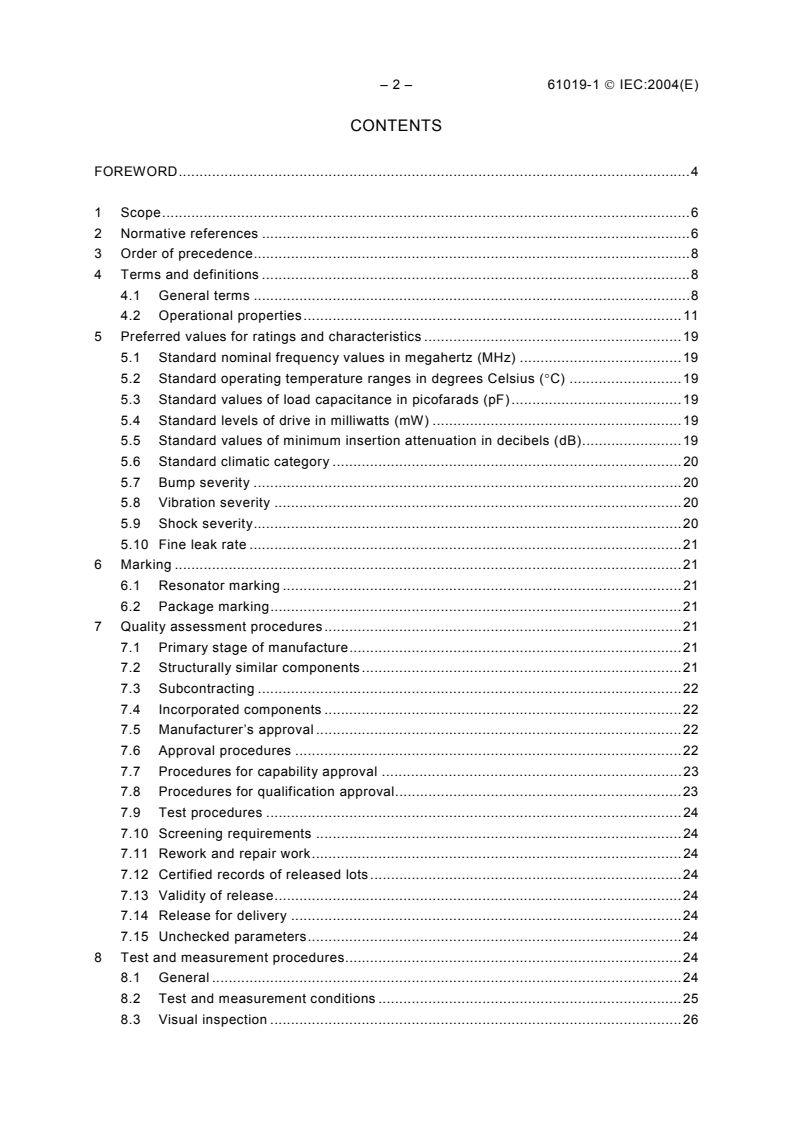
FOREWORD.4
1 Scope.6
2 Normative references .6
3 Order of precedence.8
4 Terms and definitions .8
4.1 General terms .8
4.2 Operational properties.11
5 Preferred values for ratings and characteristics .19
5.1 Standard nominal frequency values in megahertz (MHz) .19
5.2 Standard operating temperature ranges in degrees Celsius (°C) .19
5.3 Standard values of load capacitance in picofarads (pF).19
5.4 Standard levels of drive in milliwatts (mW) .19
5.5 Standard values of minimum insertion attenuation in decibels (dB).19
5.6 Standard climatic category .20
5.7 Bump severity .20
5.8 Vibration severity .20
5.9 Shock severity.20
5.10 Fine leak rate .21
6 Marking .21
6.1 Resonator marking .21
6.2 Package marking.21
7 Quality assessment procedures.21
7.1 Primary stage of manufacture.21
7.2 Structurally similar components.21
7.3 Subcontracting .22
7.4 Incorporated components .22
7.5 Manufacturer’s approval .22
7.6 Approval procedures .22
7.7 Procedures for capability approval .23
7.8 Procedures for qualification approval.23
7.9 Test procedures .24
7.10 Screening requirements .24
7.11 Rework and repair work.24
7.12 Certified records of released lots.24
7.13 Validity of release.24
7.14 Release for delivery .24
7.15 Unchecked parameters.24
8 Test and measurement procedures.24
8.1 General .24
8.2 Test and measurement conditions .25
8.3 Visual inspection .26
61019-1 IEC:2004(E) – 3 –
8.4 Dimensions and gauging procedures .26
8.5 Measurement method of one-port resonator .26
8.6 Measurement method of two-port resonator.28
8.7 Mechanical and environmental test procedures .32
8.8 Endurance test procedure .37
Figure 1 – Basic configurations of SAW resonators.9
Figure 2 – One-port resonator equivalent circuit .12
Figure 3 – Vector admittance diagram of a one-port SAW resonator .14
Figure 4 – Typical frequency characteristics of a one-port SAW resonator inserted into
a transmission line in series (see 4.2.10.2.1 and 4.2.10.3.1).14
Figure 5 – Resonance and anti-resonance frequencies .15
Figure 6 – Two-port resonator equivalent circuits.17
Figure 7 – Typical frequency characteristics of a two-port resonator .18
Figure 8 – Reflection measurement .27
Figure 9 – Transmission measurement .29
– 4 – 61019-1 IEC:2004(E)
INTERNATIONAL ELECTROTECHNICAL COMMISSION
___________
SURFACE ACOUSTIC WAVE (SAW) RESONATORS –
Part 1: Generic specification
FOREWORD
1) The International Electrotechnical Commission (IEC) is a worldwide organization for standardization comprising
all national electrotechnical committees (IEC National Committees). The object of IEC is to promote
international co-operation on all questions concerning standardization in the electrical and electronic fields. To
this end and in addition to other activities, IEC publishes International Standards, Technical Specifications,
Technical Reports, Publicly Available Specifications (PAS) and Guides (hereafter referred to as “IEC
Publication(s)”). Their preparation is entrusted to technical committees; any IEC National Committee interested
in the subject dealt with may participate in this preparatory work. International, governmental and non-
governmental organizations liaising with the IEC also participate in this preparation. IEC collaborates closely
with the International Organization for Standardization (ISO) in accordance with conditions determined by
agreement between the two organizations.
2) The formal decisions or agreements of IEC on technical matters express, as nearly as possible, an international
consensus of opinion on the relevant subjects since each technical committee has representation from all
interested IEC National Committees.
3) IEC Publications have the form of recommendations for international use and are accepted by IEC National
Committees in that sense. While all reasonable efforts are made to ensure that the technical content of IEC
Publications is accurate, IEC cannot be held responsible for the way in which they are used or for any
misinterpretation by any end user.
4) In order to promote international uniformity, IEC National Committees undertake to apply IEC Publications
transparently to the maximum extent possible in their national and regional publications. Any divergence
between any IEC Publication and the corresponding national or regional publication shall be clearly indicated in
the latter.
5) IEC provides no marking procedure to indicate its approval and cannot be rendered responsible for any
equipment declared to be in conformity with an IEC Publication.
6) All users should ensure that they have the latest edition of this publication.
7) No liability shall attach to IEC or its directors, employees, servants or agents including individual experts and
members of its technical committees and IEC National Committees for any personal injury, property damage or
other damage of any nature whatsoever, whether direct or indirect, or for costs (including legal fees) and
expenses arising out of the publication, use of, or reliance upon, this IEC Publication or any other IEC
Publications.
8) Attention is drawn to the Normative references cited in this publication. Use of the referenced publications is
indispensable for the correct application of this publication.
9) Attention is drawn to the possibility that some of the elements of this IEC Publication may be the subject of
patent rights. IEC shall not be held responsible for identifying any or all such patent rights.
International Standard IEC 61019-1 has been prepared by IEC technical committee 49:
Piezoelectric and dielectric devices for frequency control and selection.
This first edition of IEC 61019-1 cancels and replaces the first edition of IEC 61019-1-1
published in 1990 and the first edition of IEC 61019-1-2 published in 1993. It constitutes a
technical revision.
The text of this standard is based on the following documents:
FDIS Report on voting
49/689FDIS 49/698/RVD
Full information on the voting for the approval of this standard can be found in the report on
voting indicated in the above table.
This publication has been drafted in accordance with the ISO IEC Directives, Part 2.
61019-1 IEC:2004(E) – 5 –
IEC 61019 consists of the following parts under the general title Surface acoustic wave (SAW)
resonators:
Part 1: Generic specification
Part 2: Guide to the use (at present under revision)
Part 3: Standard outlines and lead connections
The committee has decided that the contents of this publication will remain unchanged until
the maintenance result date indicated on the IEC web site under "http://webstore.iec.ch" in
the data related to the specific publication. At this date, the publication will be
• reconfirmed;
• withdrawn;
• replaced by a revised edition, or
• amended.
A bilingual version of this publication may be issued at a later date.
– 6 – 61019-1 IEC:2004(E)
SURFACE ACOUSTIC WAVE (SAW) RESONATORS –
Part 1: Generic specification
1 Scope
This part of IEC 61019 specifies the methods of test and general requirements for SAW
resonators using either capability approval or qualification approval procedures of the IECQ
system.
2 Normative references
The following referenced documents are indispensable for the application of this document.
For dated references, only the edition cited applies. For undated references, the latest edition
of the referenced document (including any amendments) applies.
IEC 60027 (all parts), Letter symbols to be used in electrical technology
IEC 60050-561:1991, International Electrotechnical Vocabulary (IEC) – Chapter 561: Piezo-
electric devices for frequency control and selection
IEC 60068-1:1988, Environmental testing – Part 1: General and guidance
IEC 60068-2-1:1990, Environmental testing – Part 2: Tests – Tests A: Cold
IEC 60068-2-2:1974, Environmental testing – Part 2: Tests – Tests B: Dry heat
IEC 60068-2-6:1995, Environmental testing – Part 2: Tests – Test Fc: Vibration (sinusoidal)
IEC 60068-2-7:1983, Environmental testing – Part 2: Tests – Test Ga and guidance:
Acceleration, steady state
IEC 60068-2-13:1983, Environmental testing – Part 2: Tests – Test M: Low air pressure
IEC 60068-2-14:1984, Environmental testing – Part 2: Tests – Test N: Change of temperature
IEC 60068-2-17:1994, Environmental testing – Part 2: Tests – Test Q: Sealing
IEC 60068-2-20:1979, Environmental testing – Part 2: Tests – Test T: Soldering
IEC 60068-2-21:1999, Environmental testing – Part 2-21: Tests – Test U: Robustness of
terminations and integral mounting devices
IEC 60068-2-27:1987, Environmental testing – Part 2: Tests – Test Ea and guidance: Shock
IEC 60068-2-29:1987, Environmental testing – Part 2: Tests – Test Eb and guidance: Bump
IEC 60068-2-30:1980, Environmental testing – Part 2: Tests – Test Db and guidance: Damp
heat, cyclic (12 + 12-hour cycle)
61019-1 IEC:2004(E) – 7 –
IEC 60068-2-32:1975, Environmental testing – Part 2: Tests – Test Ed: Free fall
IEC 60068-2-45:1980, Environmental testing – Part 2: Tests – Test XA and guidance:
Immersion in cleaning solvents
IEC 60068-2-52:1996, Environmental testing – Part 2: Tests – Test Kb: Salt mist, cyclic
(sodium chloride solution)
IEC 60068-2-58:1999, Environmental testing – Part 2-58: Tests – Test Td: Test methods for
solderability, resistance to dissolution of metallization and to soldering heat of surface
mounting devices (SMD)
IEC 60068-2-64:1993, Environmental testing – Part 2: Tests – Test Fh: Vibration, broad-band
random (digital control) and guidance
IEC 60068-2-78:2001, Environmental testing – Part 2-78: Tests – Test Cab: Damp heat,
steady state
IEC 60617 – DB:2001 Graphical symbols for diagrams
IEC 60122-1:2002, Quartz crystal units of assessed quality – Part 1: Generic specification
IEC 60444 (all parts), Measurement of quartz crystal unit parameters
IEC 61000-4-2:1995, Electromagnetic compatibility (EMC) – Part 4: Testing and measurement
techniques – Section 2: Electrostatic discharge immunity test. Basic EMC Publication
IEC 61019-2:1995, Surface acoustic wave (SAW) resonators – Part 2: Guide to the use
IEC 61019-3:1991, Surface acoustic wave (SAW) resonators – Part 3: Standard outlines and
lead connections
QC 001001:2002, IEC Quality Assessment System for Electronic Components (IECQ) – Basic
Rules
QC 001002-2:1998, IEC Quality Assessment System for Electronic Components (IECQ) –
Rules of Procedure – Part 2: Documentation
QC 001002-3:1998, IEC Quality Assessment System for Electronic Components (IECQ) –
Rules of Procedure – Part 3: Approval procedures
QC 001005:2003, IEC Quality Assessment System for Electronic Components (IECQ) –
Register of Firms, Products and Services approved under the IECQ System, including
ISO 9000
ISO 1000:1992, SI units and recommendations for the use of their multiples and of certain
other units
———————
DB refers to the IEC on-line database.
– 8 – 61019-1 IEC:2004(E)
3 Order of precedence
Where any discrepancies occur for any reason, documents shall rank in the following order of
precedence:
– the detail specification;
– the sectional specification;
– the generic specification;
– any other international document (for example, of the IEC) to which reference is made.
The same order of precedence shall apply to equivalent national documents.
4 Terms and definitions
For the purposes of this document, the following terms and definitions apply.
Units, graphical symbols, letter symbols and terminology shall, wherever possible, be taken
from the following standards: IEC 60027, IEC 60050-561, IEC 60122-1, IEC 60617, IEC 60642,
ISO 1000.
4.1 General terms
4.1.1
surface acoustic wave (SAW)
acoustic wave, propagating along the surface of an elastic substrate, whose amplitude decays
exponentially with substrate depth
4.1.2
surface acoustic wave resonator (SAW resonator or SAWR)
resonator using multiple reflections of surface acoustic waves
4.1.3
one-port resonator
SAW resonator having a pair of terminals (see 4.2.10 and Figure 1)
4.1.4
two-port resonator
SAW resonator having input and output ports (see 4.2.11 and Figure 1)
61019-1 IEC:2004(E) – 9 –
IEC 1440/04
a) One-port resonator with opened arrays
IEC 1441/04
b) Two-port resonator with shorted arrays
Figure 1 – Basic configurations of SAW resonators
4.1.5
SAW resonator oscillator
oscillator that uses a SAW resonator as the main frequency controlling element
4.1.6
interdigital transducer (IDT)
SAW transducer made of a comb-like conductive structure deposited on a piezoelectric
substrate transforming electrical energy into acoustic energy or vice versa
4.1.7
finger
element of the IDT comb electrode
4.1.8
dummy finger
passive finger which may be included in order to suppress wave-front distortion
4.1.9
bus bar
common electrode which connects individual fingers together and also connects the resonator
to an external circuit
4.1.10
shorting bar
common electrode which interconnects individual metal strips (see Figure 1)
– 10 – 61019-1 IEC:2004(E)
4.1.11
apodization (spurious suppression for SAW resonator)
weighting produced by the change in finger overlap over the length of the IDT to suppress the
transverse spurious modes
4.1.12
SAW coupling coefficient
k
S
SAW electromechanical coupling coefficient is defined as follows:
k = 2 Δv /v
S
where Δv/v is the relative velocity change produced by short-circuiting the surface potential
from the open-circuit condition
4.1.13
grating reflector
SAW reflecting array that normally makes use of the periodic discontinuity provided by metal
strips, grooves or ridges
4.1.14
metal strip array
periodic discontinuity realised by electrically short- or open-circuit metal strips providing
electrical and mass-loaded perturbations
4.1.15
grooved array
periodic discontinuity realized by topographic perturbation on a surface having shallow
grooves
4.1.16
ridge array
periodic discontinuity realized by the mass-loaded perturbation of the surface having thin
layer strips
4.1.17
shorted array
metal strip array interconnected with a shorting bar (see Figure 1b))
4.1.18
opened array
metal strip array without a metal strip array interconnection (see Figure 1a))
4.1.19
mass loading
perturbation in the SAW propagation caused by the mass of an overlay on the substrate
surface
4.1.20
IDT aperture
maximum IDT finger overlap length which approximately corresponds to the SAW beamwidth,
where the aperture may be expressed in length units or normalized term of wavelength
61019-1 IEC:2004(E) – 11 –
4.2 Operational properties
4.2.1
nominal frequency
frequency given by the manufacturer or the specification to identify the resonator
4.2.2
working frequency
f
w
operational frequency of the resonator together with its associated circuits
4.2.3
frequency tolerance
4.2.3.1
overall tolerance
maximum permissible deviation of the working frequency from the nominal frequency due to a
specific cause or a combination of causes
4.2.3.2
adjustment tolerance
permissible deviation of the working frequency from the nominal frequency at the reference
temperature under specified conditions
4.2.3.3
ageing tolerance
permissible deviation due to time under specified conditions
4.2.3.4
tolerance over the temperature range
permissible deviation over the temperature range with respect to the frequency at the
specified reference temperature
4.2.3.5
tolerance due to level of drive variation
permissible deviation due to the level of drive variation
4.2.4
operating temperature range
range of temperatures as measured on the enclosure over which the resonator must function
within the specified tolerances
4.2.4.1
operable temperature range
range of temperatures as measured on the enclosure over which the resonator must function
though not necessarily within the specified tolerances
4.2.4.2
storage temperature range
range of temperatures over which the resonator can be stored without causing permanent
change in the performance beyond the specified tolerances
4.2.4.3
reference temperature
temperature at which certain resonator measurements are made. For controlled temperature
resonators, the reference temperature is the mid-point of the controlled temperature range.
For non-controlled temperature resonators, the reference temperature is normally 25 °C ± 2 °C
– 12 – 61019-1 IEC:2004(E)
4.2.5
spurious resonance
state of resonance of a resonator other than that frequency associated with the working
frequency
4.2.6
transverse spurious resonance
spurious resonance caused by excitation of higher order transverse modes which appear at
slightly higher frequencies. It is desirable to apodize the interdigital transducer to match the
desired transverse mode profile
4.2.7
level of drive
measure of the operating conditions imposed upon the resonator expressed in terms of power
dissipated
NOTE In special cases the level of drive may be specified in terms of resonator current or voltage.
4.2.8
d.c. breakdown voltage
lowest d.c. voltage which causes the destruction of the resonator
4.2.9
ageing (long-term parameter variation)
relationship which exists between any parameter (for example, resonance frequency) and
time
NOTE Such a parameter variation is due to long-term changes in the resonator and is usually expressed in
fractional parts per period of time.
4.2.10
one-port SAW resonator
4.2.10.1
one-port resonator equivalent circuit
electrical circuit which has the same impedance as the resonator in the immediate neighbour-
hood of resonance. It is usually represented by a parallel capacitance shunted by a motional
(series) arm. The motional (series) arm, in its turn, is represented by an inductance,
capacitance and resistance in series. The parameters of the motional (series) arm of induct-
ance, capacitance and resistance are usually given by L , C and R respectively. The shunt
1 1 1
capacitance is given by C (see Figure 2)
NOTE The characteristic frequencies which occur in the resonance neighbourhood can be completely defined by
considering the resistance and the reactance of the resonator as a function of frequency and from the impedance
and admittance diagrams described in Figure 3, and IEC 60122-1, to which reference should be made.
L R
1 C 1
C
IEC 1442/04
Figure 2 – One-port resonator equivalent circuit
61019-1 IEC:2004(E) – 13 –
4.2.10.2
resonance frequencies
4.2.10.2.1
frequency of maximum admittance (minimum impedance)
f
m
frequency at which the resonator exhibits a maximum admittance in the immediate neighbour-
hood of resonance (see Figures 3 and 4)
4.2.10.2.2
motional (series) resonance frequency
f
s
resonance frequency of the motional (series) arm of the equivalent circuit of the resonator
(see Figure 3)
4.2.10.2.3
resonance frequency of zero susceptance
f
r
lower of the two frequencies of the resonator alone, under specified conditions at which the
electrical impedance of the resonator is resistive (see Figure 3)
4.2.10.3
anti-resonance frequencies
4.2.10.3.1
frequency of minimum admittance (maximum impedance)
f
n
frequency at which the resonator exhibits a minimum admittance in the immediate neighbour-
hood of resonance (see Figures 3 and 4)
4.2.10.3.2
parallel resonance frequency (lossless)
f
p
frequency of parallel resonance of the motional (series) arm and the shunt capacitance (see
Figure 3)
4.2.10.3.3
anti-resonance frequency of zero susceptance
f
a
higher of the two frequencies of a resonator alone, under specified conditions at which the
electrical impedance of the resonator is resistive (see Figure 3)
4.2.10.4
motional resistance
R
resistance of the motional (series) arm of the equivalent circuit (see Figure 2)
4.2.10.5
motional capacitance
C
capacitance of the motional (series) arm of the equivalent circuit (see Figure 2)
4.2.10.6
motional inductance
L
inductance of the motional (series) arm of the equivalent circuit (see Figure 2)
– 14 – 61019-1 IEC:2004(E)
4.2.10.7
shunt capacitance
C
capacitance which shunts the motional (series) arm of the equivalent circuit of the resonator
(see Figure 2)
4.2.10.8
quality factor
Q
quality factor for the resonator which is given by 2πf L /R . The value of Q is limited by the
s 1 1
SAW propagation loss, the electrical resistance of the electrodes, the mode conversion loss,
etc.
Frequency
f
m
f
s
f
n
f
s Conductance
f
r
f
p
IEC 1443/04
Figure 3 – Vector admittance diagram of a one-port SAW resonator
Spurious
resonance
Frequency Frequency
of maximum of minimum
admittance (f ) admittance (f )
m n
Frequency MHz
IEC 1444/04
Figure 4 – Typical frequency characteristics of a one-port SAW resonator
inserted into a transmission line in series (see 4.2.10.2.1 and 4.2.10.3.1)
Attenuation dB
Susceptance
61019-1 IEC:2004(E) – 15 –
+
SAWR
Frequency MHz
f f
r a
– IEC 1445/04
Figure 5a) Reactance curve of one-port SAW resonator
+
SAWR
Frequency MHz
f f
L a
C
L
IEC 1446/04
−
Figure 5b) Reactance curve of one-port SAW resonator with serial load capacitance
+
SAWR
Frequency MHz
f f
r L
C
L
IEC 1447/04
–
Figure 5c) Reactance curve of one-port SAW resonator with parallel load capacitance
NOTE The values of load capacitances C shown in Figures 5b) and 5c) are equal.
L
Figure 5 – Resonance and anti-resonance frequencies
(see 4.2.10.2.3, 4.2.10.3.3, 4.2.10.11 and 4.2.10.13)
Reactance
Reactance
Reactance
– 16 – 61019-1 IEC:2004(E)
4.2.10.9
capacitance ratio
r
ratio of the shunt capacitance (C ) to the motional capacitance (C )
0 1
4.2.10.10
figure of merit
M
value given by Q/r which indicates the activity of the resonator
4.2.10.11
load capacitance
C
L
effective external capacitance associated with the resonator which determines the load
resonance frequency f (see Figure 5)
L
4.2.10.12
load resonance resistance
R
L
resistance of the resonator in series with a stated external capacitance at the load resonance
frequency f
L
NOTE The value of R is related to the value of R by
L 1
R = R ( 1 +C / C )
L 1 0 L
4.2.10.13
load resonance frequency
f
L
one of the two frequencies of a resonator in association with a series or parallel load
capacitance, under specified conditions, at which the electrical impedance of the combination
is resistive. This frequency is the lower of the two frequencies when the load capacitance is in
series and the higher when it is in parallel (see Figure 5)
For a given value of load capacitance (C ), these frequencies are identical for all practical
L
purposes and are given by
1 L C (C +C )
1 1 0 L
= 2π
f C +C +C
L 1 0 L
NOTE The frequencies defined in 4.2.10.2 and 4.2.10.3 are listed as being the terms most commonly used.
The frequencies associated with a resonator are numerous and, for a full explanation, IEC 60122-1 should be
consulted. When higher accuracies are required or secondary data (for example, values of the resonator motional
parameters) are to be derived from the frequency measurements, then IEC 60122-1 and IEC 60444 should be
consulted.
4.2.11
two-port SAW resonator
4.2.11.1
two-port resonator equivalent circuit
electrical circuit which has the same impedance as the resonator in the immediate
neighbourhood of resonance. It is usually represented by a two-port network constructed by
the motional (series) arm of inductance, capacitance and resistance in series, parallel
capacitances shunting the input and output ports, and an ideal transformer. The parameters
of the motional inductance, motional capacitance and motional resistance in the motional
(series) arm are also given by L , C and R respectively. The parallel (input/output)
1 1 1
capacitances are given by C and C . The turns ratio of the ideal transformer given by Φ is
IN OUT
derived from the input and output transducer structures. When both structures are the same.
the value of Φ is unity (see Figure 6).
61019-1 IEC:2004(E) – 17 –
C C
1 1 R
L R L
1 1
1 1
1:Φ 1:Φ
C C C C
IN OUT IN OUT
IEC 1448/04 IEC 1449/04
°
a) Zero-phase shift type b) 180 phase-shift type
Figure 6 – Two-port resonator equivalent circuits
4.2.11.2
input capacitance
C
IN
capacitance which shunts the input port of the resonator equivalent circuit (see Figure 6)
4.2.11.3
output capacitance
C
OUT
capacitance which shunts the output port of the resonator equivalent circuit (see Figure 6)
4.2.11.4
series (motional) resonance frequency for two-port resonator
f
s
resonance frequency of the series (motional) arm of the two-port resonator equivalent circuit
4.2.11.5
unloaded quality factor
Q
U
quality factor for the resonator alone given by 2πf L /R
s 1 1
4.2.11.6
loaded quality factor
Q
L
quality factor for the resonator connected with the external circuit, defined as the ratio of
centre frequency to the 3 dB bandwidth
4.2.11.7
insertion attenuation (for two-port SAW resonator)
logarithmic ratio of the power delivered to the load impedance before and after insertion of the
resonator
4.2.11.8
minimum insertion attenuation (for two-port SAW resonator)
minimum insertion attenuation value in the vicinity of the nominal frequency (see Figure 7)
4.2.11.9
centre frequency (for two-port SAW resonator)
f
c
arithmetic mean of two frequencies at which the attenuation relative to the minimum insertion
attenuation reaches a specified value
– 18 – 61019-1 IEC:2004(E)
4.2.11.10
spurious resonance rejection
difference between the maximum level of spurious resonances and the minimum insertion
attenuation (see Figure 7)
4.2.11.11
operating phase shift
phase shift between input and output terminals at the centre frequency. SAW resonators can
be designed to provide a nominal zero or 180° phase shift
4.2.11.12
tuning inductance
inductance which is attached at the input or output terminal for tuning at the desired
oscillation frequency
Minimum insertion
attenuation
Spurious
response
rejection
Centre frequency
Frequency MHz
IEC 1450/04
Figure 7 – Typical frequency characteristics of a two-port resonator
Attenuation dB
61019-1 IEC:2004(E) – 19 –
5 Preferred values for ratings and characteristics
5.1 Standard nominal frequency values in megahertz (MHz)
5.1.1 Standard nominal frequency values for use in video r.f. converters
46,25 55,25 57,25 61,25
62,25 64,25 67,25 77,25
83,25 86,25 91,25 95,25
97,25 103,25 171,25 175,25
176,25 177,25 183,25 184,25
189,25 199,25 211,25 471,25
559,25 591,25 623,25
5.1.2 Standard nominal frequency values for use in CATV converters
567 666 668 672
674 678 680 688
5.1.3 Standard nominal frequency values for use in remote keyless entry systems
315 418 433,92 868,30
5.2 Standard operating temperature ranges in degrees Celsius (°°°°C)
–20 to +70 –20 to +50 –10 to +60 0 to +60
–25 to +55 –15 to +45
5.3 Standard values of load capacitance in picofarads (pF)
1 2 5 7,5 10 15 20
5.4 Standard levels of drive in milliwatts (mW)
0,001 0,01 0,05 0,1 0,2 0,5
1 2 5 10 20 30
5.5 Standard values of minimum insertion attenuation in decibels (dB)
3 6 10 15
– 20 – 61019-1 IEC:2004(E)
5.6 Standard climatic category
For metal, glass and ceramic enclosures, the standard climatic category is 40/085/56.
For requirements where the operating temperature range of the SAW resonator is greater
than –40 °C to +85 °C, a climatic category consistent with the operating temperature range
shall be specified.
For plastic enclosures, the standard climatic category is 20/085/21.
5.7 Bump severity
4 000 ± 10 bumps at 400 m/s peak acceleration in each direction along three mutually
perpendicular axes (see 8.7.6)
Pulse duration 6 ms.
5.8 Vibration severity
Sinusoidal
10 Hz to 55 Hz
0,75 mm displacement amplitude
30 min in each of 3
(peak value)
mutually perpendicular
55 Hz to 500 Hz or 55 Hz to 2 000 Hz
axes (see 8.7.7)
100 m/s acceleration amplitude
(peak value)
or
10 Hz to 55 Hz
1,5 mm displacement amplitude
30 min in each of 3
(peak value)
mutually perpendicular
55 Hz to 2 000 Hz
axes (see 8.7.7)
200 m/s acceleration amplitude
(peak value)
Random
2 2
19,2 (m/s ) /Hz between 30 min in each of 3
20 Hz and 2 000 Hz mutually perpendicular
acceleration axes (see 8.7.7)
196 m/s
or
2 2
48 (m/s ) /Hz between 30 min in each of 3
20 Hz and 2 000 Hz mutually perpendicular
314 m/s acceleration axes (see 8.7.7)
or
2 2
19,2 (m/s ) /Hz between 30 min in each of 3
20 Hz and 2 000 Hz mutually perpendicular
62 m/s acceleration axes (see 8.7.7)
5.9 Shock severity
1 000 m/s peak acceleration for 6 ms duration; three shocks in each direction along three
mutually perpendicular axes (see 8.7.8) half-sine pulse, unless otherwise stated in the detail
specification.
61019-1 IEC:2004(E) – 21 –
5.10 Fine leak rate
–4 3 –9 3
10 Pa × cm /s (10 bar cm /s)
–3 3 –8 3
10 Pa × cm /s (10 bar cm /s)
–2 3 –7 3
10 Pa × cm /s (10 bar cm /s)
–1 3 –6 3
10 Pa × cm /s (10 bar cm /s)
6 Marking
6.1 Resonator marking
Surface acoustic wave resonators shall be clearly and durably marked (see 8.7.18) with items
a) to c) in the order given below and with as many possible of the remaining items as
considered necessary.
a) Type designation as defined in the detail specification.
b) Year and week (or month) of manufacture (or production lot number).
c) Manufacturer’s name or trade mark.
d) Terminal identification (if applicable).
e) Mark of conformity (unless a certificate of conformity used).
f) Designation of electrical connections (if applicable).
g) Serial number (if applicable).
h) Surface mounted device classification (if applicable).
i) Nominal frequency in kilohertz or megahertz (if applicable).
j) Factory identification code (if applicable).
Where the available surface area of miniature SAW resonators imposes practical limits on the
amount of marking, instructions on the marking to be applied shall be given in the detail
specification
6.2 Package marking
The primary packaging containing the SAW resonators(s) shall be clearly marked with the
information listed in 6.1 except item g) and electrostatic sensitive device (ESD) identification
where necessary.
7 Quality assessment procedures
7.1 Primary stage of manufacture
The primary stage of manufacture for a SAW resonator, in accordance with 4.2.1.2 of
QC 001002-3 is the final surface cleaning of the substrates.
7.2 Structurally similar components
The grouping of structurally similar SAW resonators for the purpose of qualification approval,
capability approval and quality conformance inspection shall be prescribed in the relevant
sectional specification.
– 22 – 61019-1 IEC:2004(E)
7.3 Subcontracting
These procedures shall be in accordance with 3.1.2 of QC 001002-3.
However, the final surface cleaning of the substrate and all subsequent processes shall be
carried out by the manufacturer to whom approval has been granted.
7.4 Incorporated components
Where the final component contains components of a type covered by an IEC generic
specification , these shall be produced using the normal IEC procedures.
7.5 Manufacturer’s approval
To obtain the manufacturer’s approval, the manufacturer shall meet the requirements of
Clause 2 of QC 001002-3.
7.6 Approval procedures
7.6.1 General
To qualify a SAW resonator, either capability approval or qualification approval procedures
may be used. These procedures conform to those stated in QC 001001 and QC 001002-3.
7.6.2 Capability approval
Capability approval is appropriate when structurally similar SAW resonators based on
common design rules are fabricated by a group of common processes.
Under capability approval detail specifications fall into the following three categories.
a) Capability qualifying components (CQCs)
A detail specification shall be prepared for each CQC as agreed with the National
Supervising Inspectorate (NSI). It shall identify the purpose of the CQC and include all
relevant stress levels and test limits.
b) Standard catalogue items
When a component covered by the capability approval procedure is intended to be offered
as a standard catalogue item, a detail specification complying with the blank detail
specification shall be prepared. Such specifications shall be registered by IECQ and the
component may be listed in QC 001005.
c) Custom-built SAW resonators
The content of the detail specification shall be by agreement between the manufacturer
and the customer in accordance with 4.3 of QC 001002-3.
Further information on the detail specification is contained in the sectional specification
(under consideration).
The product and capability qualifying components (CQCs) are tested in combination and
approval given to a manufacturing facility on the basis of validated design rules, processes
and quality control procedures. Further information is given in 7.7 and in the sectional
specification (under consideration).
61019-1 IEC:2004(E) – 23 –
7.6.3 Qualification approval
Qualification approval is appropriate for components manufactured to a standard design and
established production process and conforming to a published detail specification.
The programme of tests defined in the detail specification for the appropriate assessment and
severity level applies directly to the SAW resonator to be qualified, as prescribed in 7.8 and
the sectional specification (under consideration).
7.7 Procedures for capability approval
7.7.1 General
The procedures for capability approval shall be in accordance with QC 001002-3.
7.7.2 Eligibility for capability approval
The manufacturer shall comply with the requirements of 4.2.1 of QC 001002-3 and the
primary stage of manufacture as defined in 7.1 of this generic specification.
7.7.3 Application for capability approval
In order to obtain capability approval the manufacturer shall apply the rules of procedure
given in Clause 4 of QC 001002-2.
7.7.4 Granting of capability approval
Capability approval shall be granted when the procedures in accordance with Clause 4 of
QC 001002-3 have been successfully completed.
7.7.5 Capability manual
Capability manual shall be in accordance with the requirements of the sectional specification.
The NSI shall treat the description of capability as a confidential document. The manufacturer
may, if he so wishes, disclose part or all of it to a third party.
7.8 Procedures for qualification approval
7.8.1 General
The procedures for qualification approval shall be in accordance with Clause 3 of QC 001002-3.
7.8.2 Eligibility for qualification approval
The manufacturer shall comply with the requirements of 3.1.1 of QC 001002-3 and the
primary stage of manufacture as defined in 7.1 of this generic specification.
7.8.3 Application for qualification approval
In order to obtain qualification approval the manufacturer shall apply the rules of procedure
given in 3.1.3 of QC 001002-3.
7.8.4 Granting of qualification approval
Qualification approval shall be granted when the procedures in accordance with 3.1.5 of
QC 001002-3 have been successfully completed.
– 24 – 61019-1 IEC:2004(E)
7.8.5 Quality conformance inspection
The blank detail specification associated with the sectional specification shall prescribe the
test schedule for quality conformance inspection.
7.9 Test procedures
The test procedures to be used shall be selected from this generic specification. If any
required test is not included then it shall be defined in the detail specification.
7.10 Screening requirements
Where screening is required by the customer for SAW resonators this shall be specified in the
detail specification.
7.11 Rework and repair work
7.11.1 Rework
Rework is the rectification of processing errors and shall not be car
...
IEC 61019-1 ®
Edition 1.0 2004-11
INTERNATIONAL
STANDARD
NORME
INTERNATIONALE
Surface acoustic wave (SAW) resonators –
Part 1: Generic specification
Résonateurs à ondes acoustiques de surface (OAS) –
Partie 1: Spécification générique
All rights reserved. Unless otherwise specified, no part of this publication may be reproduced or utilized in any form or by
any means, electronic or mechanical, including photocopying and microfilm, without permission in writing from either IEC or
IEC's member National Committee in the country of the requester.
If you have any questions about IEC copyright or have an enquiry about obtaining additional rights to this publication,
please contact the address below or your local IEC member National Committee for further information.
Droits de reproduction réservés. Sauf indication contraire, aucune partie de cette publication ne peut être reproduite
ni utilisée sous quelque forme que ce soit et par aucun procédé, électronique ou mécanique, y compris la photocopie
et les microfilms, sans l'accord écrit de la CEI ou du Comité national de la CEI du pays du demandeur.
Si vous avez des questions sur le copyright de la CEI ou si vous désirez obtenir des droits supplémentaires sur cette
publication, utilisez les coordonnées ci-après ou contactez le Comité national de la CEI de votre pays de résidence.
IEC Central Office
3, rue de Varembé
CH-1211 Geneva 20
Switzerland
Email: inmail@iec.ch
Web: www.iec.ch
About the IEC
The International Electrotechnical Commission (IEC) is the leading global organization that prepares and publishes
International Standards for all electrical, electronic and related technologies.
About IEC publications
The technical content of IEC publications is kept under constant review by the IEC. Please make sure that you have the
latest edition, a corrigenda or an amendment might have been published.
Catalogue of IEC publications: www.iec.ch/searchpub
The IEC on-line Catalogue enables you to search by a variety of criteria (reference number, text, technical committee,…).
It also gives information on projects, withdrawn and replaced publications.
IEC Just Published: www.iec.ch/online_news/justpub
Stay up to date on all new IEC publications. Just Published details twice a month all new publications released. Available
on-line and also by email.
Electropedia: www.electropedia.org
The world's leading online dictionary of electronic and electrical terms containing more than 20 000 terms and definitions
in English and French, with equivalent terms in additional languages. Also known as the International Electrotechnical
Vocabulary online.
Customer Service Centre: www.iec.ch/webstore/custserv
If you wish to give us your feedback on this publication or need further assistance, please visit the Customer Service
Centre FAQ or contact us:
Email: csc@iec.ch
Tel.: +41 22 919 02 11
Fax: +41 22 919 03 00
A propos de la CEI
La Commission Electrotechnique Internationale (CEI) est la première organisation mondiale qui élabore et publie des
normes internationales pour tout ce qui a trait à l'électricité, à l'électronique et aux technologies apparentées.
A propos des publications CEI
Le contenu technique des publications de la CEI est constamment revu. Veuillez vous assurer que vous possédez
l’édition la plus récente, un corrigendum ou amendement peut avoir été publié.
Catalogue des publications de la CEI: www.iec.ch/searchpub/cur_fut-f.htm
Le Catalogue en-ligne de la CEI vous permet d’effectuer des recherches en utilisant différents critères (numéro de référence,
texte, comité d’études,…). Il donne aussi des informations sur les projets et les publications retirées ou remplacées.
Just Published CEI: www.iec.ch/online_news/justpub
Restez informé sur les nouvelles publications de la CEI. Just Published détaille deux fois par mois les nouvelles
publications parues. Disponible en-ligne et aussi par email.
Electropedia: www.electropedia.org
Le premier dictionnaire en ligne au monde de termes électroniques et électriques. Il contient plus de 20 000 termes et
définitions en anglais et en français, ainsi que les termes équivalents dans les langues additionnelles. Egalement appelé
Vocabulaire Electrotechnique International en ligne.
Service Clients: www.iec.ch/webstore/custserv/custserv_entry-f.htm
Si vous désirez nous donner des commentaires sur cette publication ou si vous avez des questions, visitez le FAQ du
Service clients ou contactez-nous:
Email: csc@iec.ch
Tél.: +41 22 919 02 11
Fax: +41 22 919 03 00
IEC 61019-1 ®
Edition 1.0 2004-11
INTERNATIONAL
STANDARD
NORME
INTERNATIONALE
Surface acoustic wave (SAW) resonators –
Part 1: Generic specification
Résonateurs à ondes acoustiques de surface (OAS) –
Partie 1: Spécification générique
INTERNATIONAL
ELECTROTECHNICAL
COMMISSION
COMMISSION
ELECTROTECHNIQUE
PRICE CODE
INTERNATIONALE
CODE PRIX W
ICS 31.140 ISBN 978-2-88912-596-8
– 2 – 61019-1 IEC:2004
CONTENTS
FOREWORD . 4
1 Scope . 6
2 Normative references . 6
3 Order of precedence . 8
4 Terms and definitions . 8
4.1 General terms . 8
4.2 Operational properties . 11
5 Preferred values for ratings and characteristics . 19
5.1 Standard nominal frequency values in megahertz (MHz) . 19
5.2 Standard operating temperature ranges in degrees Celsius (°C) . 19
5.3 Standard values of load capacitance in picofarads (pF) . 19
5.4 Standard levels of drive in milliwatts (mW) . 19
5.5 Standard values of minimum insertion attenuation in decibels (dB) . 19
5.6 Standard climatic category . 20
5.7 Bump severity . 20
5.8 Vibration severity . 20
5.9 Shock severity . 20
5.10 Fine leak rate . 21
6 Marking . 21
6.1 Resonator marking . 21
6.2 Package marking . 21
7 Quality assessment procedures . 21
7.1 Primary stage of manufacture . 21
7.2 Structurally similar components . 21
7.3 Subcontracting . 22
7.4 Incorporated components . 22
7.5 Manufacturer’s approval . 22
7.6 Approval procedures . 22
7.7 Procedures for capability approval . 23
7.8 Procedures for qualification approval . 23
7.9 Test procedures . 24
7.10 Screening requirements . 24
7.11 Rework and repair work . 24
7.12 Certified records of released lots . 24
7.13 Validity of release . 24
7.14 Release for delivery . 24
7.15 Unchecked parameters . 24
8 Test and measurement procedures . 24
8.1 General . 24
8.2 Test and measurement conditions . 25
8.3 Visual inspection . 26
8.4 Dimensions and gauging procedures . 26
8.5 Measurement method of one-port resonator . 26
8.6 Measurement method of two-port resonator . 28
8.7 Mechanical and environmental test procedures . 32
61019-1 IEC:2004 – 3 –
8.8 Endurance test procedure . 37
Figure 1 – Basic configurations of SAW resonators . 9
Figure 2 – One-port resonator equivalent circuit . 12
Figure 3 – Vector admittance diagram of a one-port SAW resonator . 14
Figure 4 – Typical frequency characteristics of a one-port SAW resonator inserted into
a transmission line in series (see 4.2.10.2.1 and 4.2.10.3.1) . 14
Figure 5 – Resonance and anti-resonance frequencies . 15
Figure 6 – Two-port resonator equivalent circuits . 17
Figure 7 – Typical frequency characteristics of a two-port resonator . 18
Figure 8 – Reflection measurement . 27
Figure 9 – Transmission measurement . 29
– 4 – 61019-1 IEC:2004
INTERNATIONAL ELECTROTECHNICAL COMMISSION
___________
SURFACE ACOUSTIC WAVE (SAW) RESONATORS –
Part 1: Generic specification
FOREWORD
1) The International Electrotechnical Commission (IEC) is a worldwide organization for standardization comprising
all national electrotechnical committees (IEC National Committees). The object of IEC is to promote
international co-operation on all questions concerning standardization in the electrical and electronic fields. To
this end and in addition to other activities, IEC publishes International Standards, Technical Specifications,
Technical Reports, Publicly Available Specifications (PAS) and Guides (hereafter referred to as “IEC
Publication(s)”). Their preparation is entrusted to technical committees; any IEC National Committee interested
in the subject dealt with may participate in this preparatory work. International, governmental and non-
governmental organizations liaising with the IEC also participate in this preparation. IEC collaborates closely
with the International Organization for Standardization (ISO) in accordance with conditions determined by
agreement between the two organizations.
2) The formal decisions or agreements of IEC on technical matters express, as nearly as possible, an international
consensus of opinion on the relevant subjects since each technical committee has representation from all
interested IEC National Committees.
3) IEC Publications have the form of recommendations for international use and are accepted by IEC National
Committees in that sense. While all reasonable efforts are made to ensure that the technical content of IEC
Publications is accurate, IEC cannot be held responsible for the way in which they are used or for any
misinterpretation by any end user.
4) In order to promote international uniformity, IEC National Committees undertake to apply IEC Publications
transparently to the maximum extent possible in their national and regional publications. Any divergence
between any IEC Publication and the corresponding national or regional publication shall be clearly indicated in
the latter.
5) IEC itself does not provide any attestation of conformity. Independent certification bodies provide conformity
assessment services and, in some areas, access to IEC marks of conformity. IEC is not responsible for any
services carried out by independent certification bodies.
6) All users should ensure that they have the latest edition of this publication.
7) No liability shall attach to IEC or its directors, employees, servants or agents including individual experts and
members of its technical committees and IEC National Committees for any personal injury, property damage or
other damage of any nature whatsoever, whether direct or indirect, or for costs (including legal fees) and
expenses arising out of the publication, use of, or reliance upon, this IEC Publication or any other IEC
Publications.
8) Attention is drawn to the Normative references cited in this publication. Use of the referenced publications is
indispensable for the correct application of this publication.
9) Attention is drawn to the possibility that some of the elements of this IEC Publication may be the subject of
patent rights. IEC shall not be held responsible for identifying any or all such patent rights.
International Standard IEC 61019-1 has been prepared by IEC technical committee 49:
Piezoelectric and dielectric devices for frequency control and selection.
This first edition of IEC 61019-1 cancels and replaces the first edition of IEC 61019-1-1
published in 1990 and the first edition of IEC 61019-1-2 published in 1993. It constitutes a
technical revision.
This bilingual version (2011-07) replaces the English version.
The text of this standard is based on the following documents:
FDIS Report on voting
49/689/FDIS 49/698/RVD
Full information on the voting for the approval of this standard can be found in the report on
voting indicated in the above table.
61019-1 IEC:2004 – 5 –
The French version of this standard has not been voted upon.
This publication has been drafted in accordance with the ISO IEC Directives, Part 2.
IEC 61019 consists of the following parts under the general title Surface acoustic wave (SAW)
resonators:
Part 1: Generic specification
Part 2: Guide to the use (at present under revision)
Part 3: Standard outlines and lead connections
The committee has decided that the contents of this publication will remain unchanged until
the stability date indicated on the IEC web site under "http://webstore.iec.ch" in the data
related to the specific publication. At this date, the publication will be
• reconfirmed,
• withdrawn,
• replaced by a revised edition, or
• amended.
– 6 – 61019-1 IEC:2004
SURFACE ACOUSTIC WAVE (SAW) RESONATORS –
Part 1: Generic specification
1 Scope
This part of IEC 61019 specifies the methods of test and general requirements for SAW
resonators using either capability approval or qualification approval procedures of the IECQ
system.
2 Normative references
The following referenced documents are indispensable for the application of this document.
For dated references, only the edition cited applies. For undated references, the latest edition
of the referenced document (including any amendments) applies.
IEC 60027 (all parts), Letter symbols to be used in electrical technology
IEC 60050-561:1991, International Electrotechnical Vocabulary (IEC) – Chapter 561: Piezo-
electric devices for frequency control and selection
IEC 60068-1:1988, Environmental testing – Part 1: General and guidance
IEC 60068-2-1:1990, Environmental testing – Part 2: Tests – Tests A: Cold
IEC 60068-2-2:1974, Environmental testing – Part 2: Tests – Tests B: Dry heat
IEC 60068-2-6:1995, Environmental testing – Part 2: Tests – Test Fc: Vibration (sinusoidal)
IEC 60068-2-7:1983, Environmental testing – Part 2: Tests – Test Ga and guidance:
Acceleration, steady state
IEC 60068-2-13:1983, Environmental testing – Part 2: Tests – Test M: Low air pressure
IEC 60068-2-14:1984, Environmental testing – Part 2: Tests – Test N: Change of temperature
IEC 60068-2-17:1994, Environmental testing – Part 2: Tests – Test Q: Sealing
IEC 60068-2-20:1979, Environmental testing – Part 2: Tests – Test T: Soldering
IEC 60068-2-21:1999, Environmental testing – Part 2-21: Tests – Test U: Robustness of
terminations and integral mounting devices
IEC 60068-2-27:1987, Environmental testing – Part 2: Tests – Test Ea and guidance: Shock
IEC 60068-2-29:1987, Environmental testing – Part 2: Tests – Test Eb and guidance: Bump
IEC 60068-2-30:1980, Environmental testing – Part 2: Tests – Test Db and guidance: Damp
heat, cyclic (12 + 12-hour cycle)
IEC 60068-2-32:1975, Environmental testing – Part 2: Tests – Test Ed: Free fall
61019-1 IEC:2004 – 7 –
IEC 60068-2-45:1980, Environmental testing – Part 2: Tests – Test XA and guidance:
Immersion in cleaning solvents
IEC 60068-2-52:1996, Environmental testing – Part 2: Tests – Test Kb: Salt mist, cyclic
(sodium chloride solution)
IEC 60068-2-58:1999, Environmental testing – Part 2-58: Tests – Test Td: Test methods for
solderability, resistance to dissolution of metallization and to soldering heat of surface
mounting devices (SMD)
IEC 60068-2-64:1993, Environmental testing – Part 2: Tests – Test Fh: Vibration, broad-band
random (digital control) and guidance
IEC 60068-2-78:2001, Environmental testing – Part 2-78: Tests – Test Cab: Damp heat,
steady state
IEC 60617 – DB:2001 Graphical symbols for diagrams
IEC 60122-1:2002, Quartz crystal units of assessed quality – Part 1: Generic specification
IEC 60444 (all parts), Measurement of quartz crystal unit parameters
IEC 61000-4-2:1995, Electromagnetic compatibility (EMC) – Part 4: Testing and measurement
techniques – Section 2: Electrostatic discharge immunity test – Basic EMC Publication
IEC 61019-2:1995, Surface acoustic wave (SAW) resonators – Part 2: Guide to the use
IEC 61019-3:1991, Surface acoustic wave (SAW) resonators – Part 3: Standard outlines and
lead connections
QC 001001:2002, IEC Quality Assessment System for Electronic Components (IECQ) – Basic
Rules
QC 001002-2:1998, IEC Quality Assessment System for Electronic Components (IECQ) –
Rules of Procedure – Part 2: Documentation
QC 001002-3:1998, IEC Quality Assessment System for Electronic Components (IECQ) –
Rules of Procedure – Part 3: Approval procedures
QC 001005:2003, IEC Quality Assessment System for Electronic Components (IECQ) –
Register of Firms, Products and Services approved under the IECQ System, including
ISO 9000
ISO 1000:1992, SI units and recommendations for the use of their multiples and of certain
other units
———————
DB refers to the IEC on-line database.
– 8 – 61019-1 IEC:2004
3 Order of precedence
Where any discrepancies occur for any reason, documents shall rank in the following order of
precedence:
– the detail specification;
– the sectional specification;
– the generic specification;
– any other international document (for example, of the IEC) to which reference is made.
The same order of precedence shall apply to equivalent national documents.
4 Terms and definitions
For the purposes of this document, the following terms and definitions apply.
Units, graphical symbols, letter symbols and terminology shall, wherever possible, be taken
from the following standards: IEC 60027, IEC 60050-561, IEC 60122-1, IEC 60617, IEC 60642,
ISO 1000.
4.1 General terms
4.1.1
surface acoustic wave (SAW)
acoustic wave, propagating along the surface of an elastic substrate, whose amplitude decays
exponentially with substrate depth
4.1.2
surface acoustic wave resonator (SAW resonator or SAWR)
resonator using multiple reflections of surface acoustic waves
4.1.3
one-port resonator
SAW resonator having a pair of terminals (see 4.2.10 and Figure 1)
4.1.4
two-port resonator
SAW resonator having input and output ports (see 4.2.11 and Figure 1)
61019-1 IEC:2004 – 9 –
IEC 1440/04
a) One-port resonator with opened arrays
IEC 1441/04
b) Two-port resonator with shorted arrays
Figure 1 – Basic configurations of SAW resonators
4.1.5
SAW resonator oscillator
oscillator that uses a SAW resonator as the main frequency controlling element
4.1.6
interdigital transducer (IDT)
SAW transducer made of a comb-like conductive structure deposited on a piezoelectric
substrate transforming electrical energy into acoustic energy or vice versa
4.1.7
finger
element of the IDT comb electrode
4.1.8
dummy finger
passive finger which may be included in order to suppress wave-front distortion
4.1.9
bus bar
common electrode which connects individual fingers together and also connects the resonator
to an external circuit
4.1.10
shorting bar
common electrode which interconnects individual metal strips (see Figure 1)
– 10 – 61019-1 IEC:2004
4.1.11
apodization (spurious suppression for SAW resonator)
weighting produced by the change in finger overlap over the length of the IDT to suppress the
transverse spurious modes
4.1.12
SAW coupling coefficient
k
S
SAW electromechanical coupling coefficient is defined as follows:
k = 2 ∆v /v
S
where ∆v/v is the relative velocity change produced by short-circuiting the surface potential
from the open-circuit condition
4.1.13
grating reflector
SAW reflecting array that normally makes use of the periodic discontinuity provided by metal
strips, grooves or ridges
4.1.14
metal strip array
periodic discontinuity realised by electrically short- or open-circuit metal strips providing
electrical and mass-loaded perturbations
4.1.15
grooved array
periodic discontinuity realized by topographic perturbation on a surface having shallow
grooves
4.1.16
ridge array
periodic discontinuity realized by the mass-loaded perturbation of the surface having thin
layer strips
4.1.17
shorted array
metal strip array interconnected with a shorting bar (see Figure 1b))
4.1.18
opened array
metal strip array without a metal strip array interconnection (see Figure 1a))
4.1.19
mass loading
perturbation in the SAW propagation caused by the mass of an overlay on the substrate
surface
4.1.20
IDT aperture
maximum IDT finger overlap length which approximately corresponds to the SAW beamwidth,
where the aperture may be expressed in length units or normalized term of wavelength
61019-1 IEC:2004 – 11 –
4.2 Operational properties
4.2.1
nominal frequency
frequency given by the manufacturer or the specification to identify the resonator
4.2.2
working frequency
f
w
operational frequency of the resonator together with its associated circuits
4.2.3
frequency tolerance
4.2.3.1
overall tolerance
maximum permissible deviation of the working frequency from the nominal frequency due to a
specific cause or a combination of causes
4.2.3.2
adjustment tolerance
permissible deviation of the working frequency from the nominal frequency at the reference
temperature under specified conditions
4.2.3.3
ageing tolerance
permissible deviation due to time under specified conditions
4.2.3.4
tolerance over the temperature range
permissible deviation over the temperature range with respect to the frequency at the
specified reference temperature
4.2.3.5
tolerance due to level of drive variation
permissible deviation due to the level of drive variation
4.2.4
operating temperature range
range of temperatures as measured on the enclosure over which the resonator must function
within the specified tolerances
4.2.4.1
operable temperature range
range of temperatures as measured on the enclosure over which the resonator must function
though not necessarily within the specified tolerances
4.2.4.2
storage temperature range
range of temperatures over which the resonator can be stored without causing permanent
change in the performance beyond the specified tolerances
4.2.4.3
reference temperature
temperature at which certain resonator measurements are made. For controlled temperature
resonators, the reference temperature is the mid-point of the controlled temperature range.
For non-controlled temperature resonators, the reference temperature is normally 25 °C ± 2 °C
– 12 – 61019-1 IEC:2004
4.2.5
spurious resonance
state of resonance of a resonator other than that frequency associated with the working
frequency
4.2.6
transverse spurious resonance
spurious resonance caused by excitation of higher order transverse modes which appear at
slightly higher frequencies. It is desirable to apodize the interdigital transducer to match the
desired transverse mode profile
4.2.7
level of drive
measure of the operating conditions imposed upon the resonator expressed in terms of power
dissipated
NOTE In special cases the level of drive may be specified in terms of resonator current or voltage.
4.2.8
d.c. breakdown voltage
lowest d.c. voltage which causes the destruction of the resonator
4.2.9
ageing (long-term parameter variation)
relationship which exists between any parameter (for example, resonance frequency) and
time
NOTE Such a parameter variation is due to long-term changes in the resonator and is usually expressed in
fractional parts per period of time.
4.2.10
one-port SAW resonator
4.2.10.1
one-port resonator equivalent circuit
electrical circuit which has the same impedance as the resonator in the immediate neighbour-
hood of resonance. It is usually represented by a parallel capacitance shunted by a motional
(series) arm. The motional (series) arm, in its turn, is represented by an inductance,
capacitance and resistance in series. The parameters of the motional (series) arm of induct-
ance, capacitance and resistance are usually given by L , C and R respectively. The shunt
1 1 1
capacitance is given by C (see Figure 2)
NOTE The characteristic frequencies which occur in the resonance neighbourhood can be completely defined by
considering the resistance and the reactance of the resonator as a function of frequency and from the impedance
and admittance diagrams described in Figure 3, and IEC 60122-1, to which reference should be made.
L R
1 C 1
C
IEC 1442/04
Figure 2 – One-port resonator equivalent circuit
61019-1 IEC:2004 – 13 –
4.2.10.2
resonance frequencies
4.2.10.2.1
frequency of maximum admittance (minimum impedance)
f
m
frequency at which the resonator exhibits a maximum admittance in the immediate neighbour-
hood of resonance (see Figures 3 and 4)
4.2.10.2.2
motional (series) resonance frequency
f
s
resonance frequency of the motional (series) arm of the equivalent circuit of the resonator
(see Figure 3)
4.2.10.2.3
resonance frequency of zero susceptance
f
r
lower of the two frequencies of the resonator alone, under specified conditions at which the
electrical impedance of the resonator is resistive (see Figure 3)
4.2.10.3
anti-resonance frequencies
4.2.10.3.1
frequency of minimum admittance (maximum impedance)
f
n
frequency at which the resonator exhibits a minimum admittance in the immediate neighbour-
hood of resonance (see Figures 3 and 4)
4.2.10.3.2
parallel resonance frequency (lossless)
f
p
frequency of parallel resonance of the motional (series) arm and the shunt capacitance (see
Figure 3)
4.2.10.3.3
anti-resonance frequency of zero susceptance
f
a
higher of the two frequencies of a resonator alone, under specified conditions at which the
electrical impedance of the resonator is resistive (see Figure 3)
4.2.10.4
motional resistance
R
resistance of the motional (series) arm of the equivalent circuit (see Figure 2)
4.2.10.5
motional capacitance
C
capacitance of the motional (series) arm of the equivalent circuit (see Figure 2)
4.2.10.6
motional inductance
L
inductance of the motional (series) arm of the equivalent circuit (see Figure 2)
– 14 – 61019-1 IEC:2004
4.2.10.7
shunt capacitance
C
capacitance which shunts the motional (series) arm of the equivalent circuit of the resonator
(see Figure 2)
4.2.10.8
quality factor
Q
quality factor for the resonator which is given by 2πf L /R . The value of Q is limited by the
s 1 1
SAW propagation loss, the electrical resistance of the electrodes, the mode conversion loss,
etc.
Frequency
f
m
f
s
f
n
f
Conductance
s
f
r
f
p
IEC 1443/04
Figure 3 – Vector admittance diagram of a one-port SAW resonator
Spurious
resonance
Frequency Frequency
of maximum of minimum
admittance (f ) admittance (f )
m n
Frequency MHz
IEC 1444/04
Figure 4 – Typical frequency characteristics of a one-port SAW resonator
inserted into a transmission line in series (see 4.2.10.2.1 and 4.2.10.3.1)
Attenuation dB
Susceptance
61019-1 IEC:2004 – 15 –
+
SAWR
Frequency MHz
f f
r a
– IEC 1445/04
Figure 5a) Reactance curve of one-port SAW resonator
+
SAWR
Frequency MHz
f f
L a
C
L
IEC 1446/04
−
Figure 5b) Reactance curve of one-port SAW resonator with serial load capacitance
+
SAWR
Frequency MHz
f f
r L
C
L
– IEC 1447/04
Figure 5c) Reactance curve of one-port SAW resonator with parallel load capacitance
NOTE The values of load capacitances C shown in Figures 5b) and 5c) are equal.
L
Figure 5 – Resonance and anti-resonance frequencies
(see 4.2.10.2.3, 4.2.10.3.3, 4.2.10.11 and 4.2.10.13)
Reactance
Reactance
Reactance
– 16 – 61019-1 IEC:2004
4.2.10.9
capacitance ratio
r
ratio of the shunt capacitance (C ) to the motional capacitance (C )
0 1
4.2.10.10
figure of merit
M
value given by Q/r which indicates the activity of the resonator
4.2.10.11
load capacitance
C
L
effective external capacitance associated with the resonator which determines the load
resonance frequency f (see Figure 5)
L
4.2.10.12
load resonance resistance
R
L
resistance of the resonator in series with a stated external capacitance at the load resonance
frequency f
L
NOTE The value of R is related to the value of R by
L 1
R = R ( 1 +C / C )
L 1 0 L
4.2.10.13
load resonance frequency
f
L
one of the two frequencies of a resonator in association with a series or parallel load
capacitance, under specified conditions, at which the electrical impedance of the combination
is resistive. This frequency is the lower of the two frequencies when the load capacitance is in
series and the higher when it is in parallel (see Figure 5)
For a given value of load capacitance (C ), these frequencies are identical for all practical
L
purposes and are given by
1 L C (C +C )
1 1 0 L
= 2π
f C +C +C
L 1 0 L
NOTE The frequencies defined in 4.2.10.2 and 4.2.10.3 are listed as being the terms most commonly used.
The frequencies associated with a resonator are numerous and, for a full explanation, IEC 60122-1 should be
consulted. When higher accuracies are required or secondary data (for example, values of the resonator motional
parameters) are to be derived from the frequency measurements, then IEC 60122-1 and IEC 60444 should be
consulted.
4.2.11
two-port SAW resonator
4.2.11.1
two-port resonator equivalent circuit
electrical circuit which has the same impedance as the resonator in the immediate
neighbourhood of resonance. It is usually represented by a two-port network constructed by
the motional (series) arm of inductance, capacitance and resistance in series, parallel
capacitances shunting the input and output ports, and an ideal transformer. The parameters
of the motional inductance, motional capacitance and motional resistance in the motional
(series) arm are also given by L , C and R respectively. The parallel (input/output)
1 1 1
capacitances are given by C and C . The turns ratio of the ideal transformer given by Φ is
IN OUT
derived from the input and output transducer structures. When both structures are the same.
the value of Φ is unity (see Figure 6).
61019-1 IEC:2004 – 17 –
C C
L 1 R L 1 R
1 1
1 1
1:Φ 1:Φ
C C C C
IN OUT IN OUT
IEC 1448/04 IEC 1449/04
°
a) Zero-phase shift type b) 180 phase-shift type
Figure 6 – Two-port resonator equivalent circuits
4.2.11.2
input capacitance
C
IN
capacitance which shunts the input port of the resonator equivalent circuit (see Figure 6)
4.2.11.3
output capacitance
C
OUT
capacitance which shunts the output port of the resonator equivalent circuit (see Figure 6)
4.2.11.4
series (motional) resonance frequency for two-port resonator
f
s
resonance frequency of the series (motional) arm of the two-port resonator equivalent circuit
4.2.11.5
unloaded quality factor
Q
U
quality factor for the resonator alone given by 2πf L /R
s 1 1
4.2.11.6
loaded quality factor
Q
L
quality factor for the resonator connected with the external circuit, defined as the ratio of
centre frequency to the 3 dB bandwidth
4.2.11.7
insertion attenuation (for two-port SAW resonator)
logarithmic ratio of the power delivered to the load impedance before and after insertion of the
resonator
4.2.11.8
minimum insertion attenuation (for two-port SAW resonator)
minimum insertion attenuation value in the vicinity of the nominal frequency (see Figure 7)
4.2.11.9
centre frequency (for two-port SAW resonator)
f
c
arithmetic mean of two frequencies at which the attenuation relative to the minimum insertion
attenuation reaches a specified value
– 18 – 61019-1 IEC:2004
4.2.11.10
spurious resonance rejection
difference between the maximum level of spurious resonances and the minimum insertion
attenuation (see Figure 7)
4.2.11.11
operating phase shift
phase shift between input and output terminals at the centre frequency. SAW resonators can
be designed to provide a nominal zero or 180° phase shift
4.2.11.12
tuning inductance
inductance which is attached at the input or output terminal for tuning at the desired
oscillation frequency
Minimum insertion
attenuation
Spurious
response
rejection
Centre frequency
Frequency MHz
IEC 1450/04
Figure 7 – Typical frequency characteristics of a two-port resonator
Attenuation dB
61019-1 IEC:2004 – 19 –
5 Preferred values for ratings and characteristics
5.1 Standard nominal frequency values in megahertz (MHz)
5.1.1 Standard nominal frequency values for use in video r.f. converters
46,25 55,25 57,25 61,25
62,25 64,25 67,25 77,25
83,25 86,25 91,25 95,25
97,25 103,25 171,25 175,25
176,25 177,25 183,25 184,25
189,25 199,25 211,25 471,25
559,25 591,25 623,25
5.1.2 Standard nominal frequency values for use in CATV converters
567 666 668 672
674 678 680 688
5.1.3 Standard nominal frequency values for use in remote keyless entry systems
315 418 433,92 868,30
5.2 Standard operating temperature ranges in degrees Celsius (°C)
–20 to +70 –20 to +50 –10 to +60 0 to +60
–25 to +55 –15 to +45
5.3 Standard values of load capacitance in picofarads (pF)
1 2 5 7,5 10 15 20
5.4 Standard levels of drive in milliwatts (mW)
0,001 0,01 0,05 0,1 0,2 0,5
1 2 5 10 20 30
5.5 Standard values of minimum insertion attenuation in decibels (dB)
3 6 10 15
– 20 – 61019-1 IEC:2004
5.6 Standard climatic category
For metal, glass and ceramic enclosures, the standard climatic category is 40/085/56.
For requirements where the operating temperature range of the SAW resonator is greater
than –40 °C to +85 °C, a climatic category consistent with the operating temperature range
shall be specified.
For plastic enclosures, the standard climatic category is 20/085/21.
5.7 Bump severity
4 000 ± 10 bumps at 400 m/s peak acceleration in each direction along three mutually
perpendicular axes (see 8.7.6)
Pulse duration 6 ms.
5.8 Vibration severity
Sinusoidal
10 Hz to 55 Hz
0,75 mm displacement amplitude
30 min in each of 3
(peak value)
mutually perpendicular
55 Hz to 500 Hz or 55 Hz to 2 000 Hz
axes (see 8.7.7)
100 m/s acceleration amplitude
(peak value)
or
10 Hz to 55 Hz
1,5 mm displacement amplitude
30 min in each of 3
(peak value)
mutually perpendicular
55 Hz to 2 000 Hz
axes (see 8.7.7)
200 m/s acceleration amplitude
(peak value)
Random
2 2
19,2 (m/s ) /Hz between 30 min in each of 3
20 Hz and 2 000 Hz mutually perpendicular
196 m/s acceleration axes (see 8.7.7)
or
2 2
48 (m/s ) /Hz between 30 min in each of 3
20 Hz and 2 000 Hz mutually perpendicular
314 m/s acceleration axes (see 8.7.7)
or
2 2
19,2 (m/s ) /Hz between 30 min in each of 3
20 Hz and 2 000 Hz mutually perpendicular
62 m/s acceleration axes (see 8.7.7)
5.9 Shock severity
1 000 m/s peak acceleration for 6 ms duration; three shocks in each direction along three
mutually perpendicular axes (see 8.7.8) half-sine pulse, unless otherwise stated in the detail
specification.
61019-1 IEC:2004 – 21 –
5.10 Fine leak rate
–4 3 –9 3
10 Pa × cm /s (10 bar cm /s)
–3 3 –8 3
10 Pa × cm /s (10 bar cm /s)
–2 3 –7 3
10 Pa × cm /s (10 bar cm /s)
–1 3 –6 3
10 Pa × cm /s (10 bar cm /s)
6 Marking
6.1 Resonator marking
Surface acoustic wave resonators shall be clearly and durably marked (see 8.7.18) with items
a) to c) in the order given below and with as many possible of the remaining items as
considered necessary.
a) Type designation as defined in the detail specification.
b) Year and week (or month) of manufacture (or production lot number).
c) Manufacturer’s name or trade mark.
d) Terminal identification (if applicable).
e) Mark of conformity (unless a certificate of conformity used).
f) Designation of electrical connections (if applicable).
g) Serial number (if applicable).
h) Surface mounted device classification (if applicable).
i) Nominal frequency in kilohertz or megahertz (if applicable).
j) Factory identification code (if applicable).
Where the available surface area of miniature SAW resonators imposes practical limits on the
amount of marking, instructions on the marking to be applied shall be given in the detail
specification
6.2 Package marking
The primary packaging containing the SAW resonators(s) shall be clearly marked with the
information listed in 6.1 except item g) and electrostatic sensitive device (ESD) identification
where necessary.
7 Quality assessment procedures
7.1 Primary stage of manufacture
The primary stage of manufacture for a SAW resonator, in accordance with 4.2.1.2 of
QC 001002-3 is the final surface cleaning of the substrates.
7.2 Structurally similar components
The grouping of structurally similar SAW resonators for the purpose of qualification approval,
capability approval and quality conformance inspection shall be prescribed in the relevant
sectional specification.
– 22 – 61019-1 IEC:2004
7.3 Subcontracting
These procedures shall be in accordance with 3.1.2 of QC 001002-3.
However, the final surface cleaning of the substrate and all subsequent processes shall be
carried out by the manufacturer to whom approval has been granted.
7.4 Incorporated components
Where the final component contains components of a type covered by an IEC generic
specification , these shall be produced using the normal IEC procedures.
7.5 Manufacturer’s approval
To obtain the manufacturer’s approval, the manufacturer shall meet the requirements of
Clause 2 of QC 001002-3.
7.6 Approval procedures
7.6.1 General
To qualify a SAW resonator, either capability approval or qualification approval procedures
may be used. These procedures conform to those stated in QC 001001 and QC 001002-3.
7.6.2 Capability approval
Capability approval is appropriate when structurally similar SAW resonators based on
common design rules are fabricated by a group of common processes.
Under capability approval detail specifications fall into the following three categories.
a) Capability qualifying components (CQCs)
A detail specification shall be prepared for each CQC as agreed with the National
Supervising Inspectorate (NSI). It shall identify the purpose of the CQC and include all
relevant stress levels and test limits.
b) Standard catalogue items
When a component covered by the capability approval procedure is intended to be offered
as a standard catalogue item, a detail specification complying with the blank detail
specification shall be prepared. Such specifications shall be registered by IECQ and the
component may be listed in QC 001005.
c) Custom-built SAW resonators
The content of the detail specification shall be by agreement between the manufacturer
and the customer in accordance with 4.3 of QC 001002-3.
Further information on the detail specification is contained in the sectional specification
(under consideration).
The product and capability qualifying components (CQCs) are tested in combination and
approval given to a manufacturing facility on the basis of validated design rules, processes
and quality control procedures. Further information is given in 7.7 and in the sectional
specification (under consideration).
7.6.3 Qualification approval
Qualification approval is appropriate for components manufactured to a standard design and
established production process and conforming to a published detail specification.
61019-1 IEC:2004 – 23 –
The programme of tests defined in the detail specification for the appr
...