

IEC TR 62296:2003
(Main)Considerations of unaddressed safety aspects in the Second Edition of IEC 60601-1 and proposals for new requirements
General Information
- Abstract
This Technical Report contains a series of recommendations developed by an expert working group of IEC subcommittee 62A in response to questions of interpretation of the second edition of IEC 60601-1. This Technical Report is primarily intended to be used by: - manufacturers of medical electrical equippment; - test houses and others responsible for assessment of compliance with IEC 60601-1, and - those developing subsequent editions of IEC 60601-1. The recommendations in the first edition of IEC/TR 62296 have been considered in preparing the third edition of IEC 60601-1. If and when additional recommendations are developed by IEC/SC 62A/WG 14 and published as amendments to this technical report, these will also be considered for incorporation into the third edition through the amendment/revision process.
- Status
- Published
- Publication Date
- 17-Mar-2003
- Technical Committee
- SC 62A - Common aspects of medical equipment, software, and systems
- Current Stage
- DELPUB - Deleted Publication
- Start Date
- 22-Jan-2009
- Completion Date
- 28-Aug-2026
Overview
IEC TR 62296:2003 is a Technical Report from the IEC that compiles expert recommendations addressing safety aspects not fully resolved by the Second Edition of IEC 60601-1 (medical electrical equipment - basic safety and essential performance). Developed by IEC SC 62A/WG 14, the report consolidates interpretations and proposals intended to help manufacturers, test houses and standards developers interpret ambiguous requirements, improve compliance testing, and inform revisions incorporated into later editions of IEC 60601-1.
Key topics
This Technical Report organizes practical recommendations covering a broad range of electrical safety topics, including:
- Separation, creepage distances and air clearances - guidance where geometric/insulation values are unclear or need interpretation.
- Dielectric strength and leakage current - testing considerations and single-fault scenarios for medical equipment.
- Mains supply transformers and SMPSU testing - overload, short-circuit and dielectric tests specific to medical power supplies.
- Battery safety and internal power sources - special considerations for lithium and rechargeable batteries used in equipment not serviced by operators.
- Protective earthing and enclosure requirements - integrity of earth connections, enclosures, cord anchors and protective covers (including mobile and ambulance use).
- Temperature, humidity and environmental conditioning - preconditioning, ambient temperature limits and thermal testing methods.
- Component reliability, measurement uncertainty and test sequencing - recommendations for evidence of component reliability, how to handle measurement uncertainty in tests, and logical test order.
- Marking, documentation and accompanying files - expectations for fuse marking, user information and electronic delivery of documentation.
Applications and practical value
- Helps manufacturers interpret IEC 60601-1 when designing medical electrical equipment to meet safety and regulatory expectations.
- Guides test houses and conformity assessors on consistent application of tests (dielectric, leakage, temperature, etc.) and on how to treat ambiguous clauses.
- Informs standards developers and working groups when drafting new editions or amendments (many recommendations were considered in preparing the Third Edition of IEC 60601-1).
- Useful to safety engineers, regulatory affairs specialists and clinical engineers who need practical interpretation for risk mitigation, product certification and clinical deployment.
Related standards
- IEC 60601-1 (Second Edition - subject of the TR; recommendations considered for the Third Edition)
- Other IEC technical reports and committee guidance from IEC SC 62A on medical electrical equipment safety
Keywords: IEC TR 62296, IEC 60601-1, medical electrical equipment safety, dielectric strength, creepage distances, leakage current, lithium batteries, SMPSU, conformity assessment, IEC SC 62A WG14.
Relations
- Effective Date
- 05-Sep-2023
Get Certified
Connect with accredited certification bodies for this standard

BSI Group
BSI (British Standards Institution) is the business standards company that helps organizations make excellence a habit.

TÜV Rheinland
TÜV Rheinland is a leading international provider of technical services.

TÜV SÜD
TÜV SÜD is a trusted partner of choice for safety, security and sustainability solutions.
Sponsored listings
Frequently Asked Questions
IEC TR 62296:2003 is a technical report published by the International Electrotechnical Commission (IEC). Its full title is "Considerations of unaddressed safety aspects in the Second Edition of IEC 60601-1 and proposals for new requirements". This standard covers: This Technical Report contains a series of recommendations developed by an expert working group of IEC subcommittee 62A in response to questions of interpretation of the second edition of IEC 60601-1. This Technical Report is primarily intended to be used by: - manufacturers of medical electrical equippment; - test houses and others responsible for assessment of compliance with IEC 60601-1, and - those developing subsequent editions of IEC 60601-1. The recommendations in the first edition of IEC/TR 62296 have been considered in preparing the third edition of IEC 60601-1. If and when additional recommendations are developed by IEC/SC 62A/WG 14 and published as amendments to this technical report, these will also be considered for incorporation into the third edition through the amendment/revision process.
This Technical Report contains a series of recommendations developed by an expert working group of IEC subcommittee 62A in response to questions of interpretation of the second edition of IEC 60601-1. This Technical Report is primarily intended to be used by: - manufacturers of medical electrical equippment; - test houses and others responsible for assessment of compliance with IEC 60601-1, and - those developing subsequent editions of IEC 60601-1. The recommendations in the first edition of IEC/TR 62296 have been considered in preparing the third edition of IEC 60601-1. If and when additional recommendations are developed by IEC/SC 62A/WG 14 and published as amendments to this technical report, these will also be considered for incorporation into the third edition through the amendment/revision process.
IEC TR 62296:2003 is classified under the following ICS (International Classification for Standards) categories: 11.040.01 - Medical equipment in general. The ICS classification helps identify the subject area and facilitates finding related standards.
IEC TR 62296:2003 has the following relationships with other standards: It is inter standard links to IEC TR 62296:2009. Understanding these relationships helps ensure you are using the most current and applicable version of the standard.
IEC TR 62296:2003 is available in PDF format for immediate download after purchase. The document can be added to your cart and obtained through the secure checkout process. Digital delivery ensures instant access to the complete standard document.
Standards Content (Sample)
TECHNICAL IEC
REPORT
TR 62296
First edition
2003-03
Considerations of unaddressed safety aspects
in the Second Edition of IEC 60601-1
and proposals for new requirements
Etudes des aspects de sécurité non énoncés
dans la seconde édition de la CEI 60601-1
et propositions de nouvelles prescriptions
Reference number
IEC/TR 62296:2003(E)
Publication numbering
As from 1 January 1997 all IEC publications are issued with a designation in the
60000 series. For example, IEC 34-1 is now referred to as IEC 60034-1.
Consolidated editions
The IEC is now publishing consolidated versions of its publications. For example,
edition numbers 1.0, 1.1 and 1.2 refer, respectively, to the base publication, the
base publication incorporating amendment 1 and the base publication incorporating
amendments 1 and 2.
Further information on IEC publications
The technical content of IEC publications is kept under constant review by the IEC,
thus ensuring that the content reflects current technology. Information relating to
this publication, including its validity, is available in the IEC Catalogue of
publications (see below) in addition to new editions, amendments and corrigenda.
Information on the subjects under consideration and work in progress undertaken
by the technical committee which has prepared this publication, as well as the list
of publications issued, is also available from the following:
• IEC Web Site (www.iec.ch)
• Catalogue of IEC publications
The on-line catalogue on the IEC web site (http://www.iec.ch/searchpub/cur_fut.htm)
enables you to search by a variety of criteria including text searches, technical
committees and date of publication. On-line information is also available on
recently issued publications, withdrawn and replaced publications, as well as
corrigenda.
• IEC Just Published
This summary of recently issued publications (http://www.iec.ch/online_news/
justpub/jp_entry.htm) is also available by email. Please contact the Customer
Service Centre (see below) for further information.
• Customer Service Centre
If you have any questions regarding this publication or need further assistance,
please contact the Customer Service Centre:
Email: custserv@iec.ch
Tel: +41 22 919 02 11
Fax: +41 22 919 03 00
TECHNICAL IEC
REPORT
TR 62296
First edition
2003-03
Considerations of unaddressed safety aspects
in the Second Edition of IEC 60601-1
and proposals for new requirements
Etudes des aspects de sécurité non énoncés
dans la seconde édition de la CEI 60601-1
et propositions de nouvelles prescriptions
IEC 2003 Copyright - all rights reserved
No part of this publication may be reproduced or utilized in any form or by any means, electronic or
mechanical, including photocopying and microfilm, without permission in writing from the publisher.
International Electrotechnical Commission, 3, rue de Varembé, PO Box 131, CH-1211 Geneva 20, Switzerland
Telephone: +41 22 919 02 11 Telefax: +41 22 919 03 00 E-mail: inmail@iec.ch Web: www.iec.ch
PRICE CODE
Commission Electrotechnique Internationale
XB
International Electrotechnical Commission
Международная Электротехническая Комиссия
For price, see current catalogue
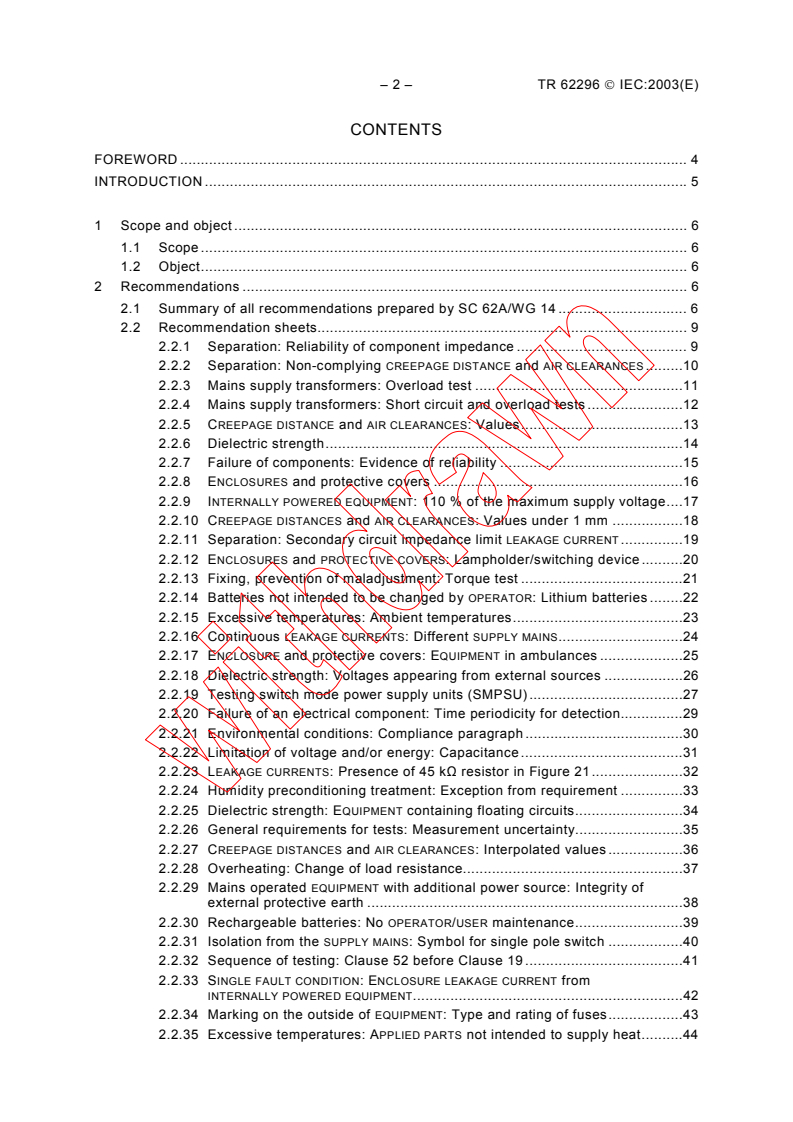
– 2 – TR 62296 IEC:2003(E)
CONTENTS
FOREWORD . 4
INTRODUCTION .5
1 Scope and object . 6
1.1 Scope . 6
1.2 Object. 6
2 Recommendations . 6
2.1 Summary of all recommendations prepared by SC 62A/WG 14 . 6
2.2 Recommendation sheets. 9
2.2.1 Separation: Reliability of component impedance . 9
2.2.2 Separation: Non-complying CREEPAGE DISTANCE and AIR CLEARANCES .10
2.2.3 Mains supply transformers: Overload test .11
2.2.4 Mains supply transformers: Short circuit and overload tests .12
2.2.5 CREEPAGE DISTANCE and AIR CLEARANCES: Values.13
2.2.6 Dielectric strength.14
2.2.7 Failure of components: Evidence of reliability .15
2.2.8 ENCLOSURES and protective covers .16
2.2.9 INTERNALLY POWERED EQUIPMENT: 110 % of the maximum supply voltage.17
2.2.10 CREEPAGE DISTANCES and AIR CLEARANCES: Values under 1 mm .18
2.2.11 Separation: Secondary circuit impedance limit LEAKAGE CURRENT .19
2.2.12 ENCLOSURES and PROTECTIVE COVERS: Lampholder/switching device .20
2.2.13 Fixing, prevention of maladjustment: Torque test .21
2.2.14 Batteries not intended to be changed by OPERATOR: Lithium batteries .22
2.2.15 Excessive temperatures: Ambient temperatures.23
2.2.16 Continuous LEAKAGE CURRENTS: Different SUPPLY MAINS.24
2.2.17 ENCLOSURE and protective covers: EQUIPMENT in ambulances .25
2.2.18 Dielectric strength: Voltages appearing from external sources .26
2.2.19 Testing switch mode power supply units (SMPSU) .27
2.2.20 Failure of an electrical component: Time periodicity for detection.29
2.2.21 Environmental conditions: Compliance paragraph .30
2.2.22 Limitation of voltage and/or energy: Capacitance .31
2.2.23 LEAKAGE CURRENTS: Presence of 45 kΩ resistor in Figure 21.32
2.2.24 Humidity preconditioning treatment: Exception from requirement .33
2.2.25 Dielectric strength: EQUIPMENT containing floating circuits.34
2.2.26 General requirements for tests: Measurement uncertainty.35
2.2.27 CREEPAGE DISTANCES and AIR CLEARANCES: Interpolated values .36
2.2.28 Overheating: Change of load resistance.37
2.2.29 Mains operated EQUIPMENT with additional power source: Integrity of
external protective earth .38
2.2.30 Rechargeable batteries: No OPERATOR/USER maintenance.39
2.2.31 Isolation from the SUPPLY MAINS: Symbol for single pole switch .40
2.2.32 Sequence of testing: Clause 52 before Clause 19 .41
2.2.33 SINGLE FAULT CONDITION: ENCLOSURE LEAKAGE CURRENT from
INTERNALLY POWERED EQUIPMENT.42
2.2.34 Marking on the outside of EQUIPMENT: Type and rating of fuses.43
2.2.35 Excessive temperatures: APPLIED PARTS not intended to supply heat.44
TR 62296 IEC:2003(E) – 3 –
2.2.36 Mains supply transformers: Use of PTCs as protective devices.45
2.2.37 Components and general assembly: Reliability of components.46
2.2.38 Definition of APPLIED PART: EQUIPMENT worn by PATIENTS.47
2.2.39 Construction: Triple insulated winding wire .48
2.2.40 CREEPAGE DISTANCES and AIR CLEARANCES: Dielectric strength test
versus CREEPAGE DISTANCES and AIR CLEARANCES.49
2.2.41 Cord anchorages/ Cord guards: In mobile unit with APPLIANCE
COUPLER.50
2.2.42 ACCOMPANYING DOCUMENTS: on CD-ROM or Electronic File Format .51
2.2.43 INTERNAL ELECTRICAL POWER SOURCE: Requirements for lithium
batteries .52
2.2.44 Dielectric strength: Differences between B-d and B-e.53
2.2.45 Excessive temperatures: Thermocouple instead of resistance method .54
2.2.46 Mains fuses and OVER-CURRENT RELEASEs: Fuses in CLASS II
EQUIPMENT .55
2.2.47 Plug top power supply.56
2.2.48 Connecting cords between EQUIPMENT parts: Other applications .57
2.2.49 MULTIPLE PORTABLE SOCKET-OUTLET .58
2.2.50 Separation, DEFIBRILLATION-PROOF APPLIED PART: multiple APPLIED
PARTS.59
2.2.51 Separation, APPLIED PART: Hand held flexible shafts .60
2.2.52 Protective earthing: No-load voltage of 6 V maximum .61
2.2.53 Foot-operated control devices: Protection against entry of liquids .62
2.2.54 Mains supply transformers .63
2.2.55 Dielectric strength: Reliability of components to bridge A-a and B-a .64
2.2.56 Dielectric strength: A-e in switch mode power supply units (SMPSU) .65
Bibliography.66
Index of defined terms.67
– 4 – TR 62296 IEC:2003(E)
INTERNATIONAL ELECTROTECHNICAL COMMISSION
____________
CONSIDERATIONS OF UNADDRESSED SAFETY ASPECTS
IN THE SECOND EDITION OF IEC 60601-1 AND
PROPOSALS FOR NEW REQUIREMENTS
FOREWORD
1) The IEC (International Electrotechnical Commission) is a worldwide organization for standardization comprising
all national electrotechnical committees (IEC National Committees). The object of the IEC is to promote
international co-operation on all questions concerning standardization in the electrical and electronic fields. To
this end and in addition to other activities, the IEC publishes International Standards. Their preparation is
entrusted to technical committees; any IEC National Committee interested in the subject dealt with may
participate in this preparatory work. International, governmental and non-governmental organizations liaising
with the IEC also participate in this preparation. The IEC collaborates closely with the International
Organization for Standardization (ISO) in accordance with conditions determined by agreement between the
two organizations.
2) The formal decisions or agreements of the IEC on technical matters express, as nearly as possible, an
international consensus of opinion on the relevant subjects since each technical committee has representation
from all interested National Committees.
3) The documents produced have the form of recommendations for international use and are published in the form
of standards, technical specifications, technical reports or guides and they are accepted by the National
Committees in that sense.
4) In order to promote international unification, IEC National Committees undertake to apply IEC International
Standards transparently to the maximum extent possible in their national and regional standards. Any
divergence between the IEC Standard and the corresponding national or regional standard shall be clearly
indicated in the latter.
5) The IEC provides no marking procedure to indicate its approval and cannot be rendered responsible for any
equipment declared to be in conformity with one of its standards.
6) Attention is drawn to the possibility that some of the elements of this technical report may be the subject of
patent rights. The IEC shall not be held responsible for identifying any or all such patent rights.
The main task of IEC technical committees is to prepare International Standards. However,
a technical committee may propose the publication of a technical report when it has collected
data of a different kind from that which is normally published as an International Standard, for
example “state of the art”.
IEC 62296, which is a technical report, has been prepared by subcommittee 62A: Common
aspects of electrical equipment used in medical practice, of IEC technical committee 62:
Electrical equipment in medical practice.
The text of this technical report is based on the following documents:
Enquiry draft Report on voting
62A/398/CDV 62A/414/RVC
Full information on the voting for the approval of this technical report can be found in the
report on voting indicated in the above table.
This publication has been drafted in accordance with the ISO/IEC Directives, Part 2.
The committee has decided that the contents of this publication will remain unchanged
until 2005. At this date, the publication will be
• reconfirmed;
• withdrawn;
• replaced by a revised edition, or
• amended.
TR 62296 IEC:2003(E) – 5 –
INTRODUCTION
At the Sydney meeting in August 1994, IEC subcommittee (SC) 62A established a procedure
under which working group (WG) 14 would develop recommendations regarding problems of
interpretation or application of IEC 60601-1. WG 14 is made up of experts with particular
expertise in testing according to the requirements of IEC 60601-1. Many of the experts on
WG 14 are employed by test houses with a long history of applying IEC 60601-1 to MEDICAL
ELECTRICAL EQUIPMENT. While the National Committee members of SC 62A nominate these
experts, their recommendations were not to be formally adopted through any official voting
procedure. To reinforce this process, the Subcommittee specifically directed that the
following note appear on every page of the resulting informational circular:
IMPORTANT NOTE: Per the 62A decision at Sydney (see RM3755/SC62A,
August 1994), the 62A Secretary is circulating this recommendation, prepared
by 62A/WG14, regarding problems of interpretation or application of IEC
60601-1 to all P-Member NC’s.
This recommendation/interpretation is the result of considerations by a group
of nominated experts and has not been formally adopted through any NC
voting procedure. Distribution is only for information.
The plan approved in Sydney called for the 62A Secretary to circulate these recommendations
to the member National Committees via an informational (INF) document. At the time this
Technical Report was prepared, three documents containing 56 recommendations had been
circulated (documents 62A/221/INF, 62A/264/INF and 62A/284/INF).
While the quality of the technical work of WG 14 is widely recognized and applauded, the
overall process has achieved less than originally hoped. The INF documents have not proved
a particularly successful way of getting this information to those who could use it most. The
WG 14 recommendations are largely unknown beyond the people actively involved in the work
of SC 62A. Several alternatives have been explored. These include making the individual
recommendation sheets available on the Internet either through the IEC Web Site, the web
site of a participating National Committee, or the web site of an interested third party.
However, concerns over intellectual property and control of distribution have proved extremely
difficult to overcome.
At the November 2000, meeting of SC 62A in Tokyo, the subcommittee discussed ways and
means for achieving a wider distribution of the WG 14 recommendations. At the conclusion of
this discussion, the subcommittee instructed the Secretariat to develop a Technical Report
(TR) based on the published recommendations of WG 14. This Technical Report is intended
to convey the results of WG 14's work to interested parties such as manufacturers and test
houses while retaining the informative nature of the material.
This Technical Report may be amended from time to time as WG 14 prepares additional
recommendations.
– 6 – TR 62296 IEC:2003(E)
CONSIDERATIONS OF UNADDRESSED SAFETY ASPECTS
IN THE SECOND EDITION OF IEC 60601-1
AND PROPOSALS FOR NEW REQUIREMENTS
1 Scope and object
1.1 Scope
This Technical Report contains a series of recommendations developed by an expert working
group of IEC subcommittee 62A in response to questions of interpretation of the second
edition of IEC 60601-1.
This Technical Report is primarily intended to be used by:
– manufacturers of MEDICAL ELECTRICAL EQUIPMENT;
– test houses and others responsible for assessment of compliance with IEC 60601-1, and
– those developing subsequent editions of IEC 60601-1.
The recommendations in the first edition of IEC/TR 62296 have been considered in preparing
the third edition of IEC 60601-1. If and when additional recommendations are developed by
IEC/SC 62A/WG 14 and published as amendments to this technical report, these will also be
considered for incorporation into the third edition through the amendment/revision process.
1.2 Object
The object of this Technical Report is to make the recommendations/interpretations
developed by the experts in IEC/SC 62A/WG 14 available to those interested in the appli-
cation of the Second Edition of IEC 60601-1.
The reader is reminded that, although a majority of the National Committee members of
IEC/SC 62A have approved publication of this Technical Report, the contents remain
the opinion of the expert members of WG 14. These recommendations/interpretations
are the result of considerations by this group of nominated experts and has not been
formally adopted through any National Committee voting procedure. Distribution is only
for information.
2 Recommendations
2.1 Summary of all recommendations prepared by SC 62A/WG 14
Subclause
nd Recom-
of the 2
mendation Contents Page
edition of
number
IEC 60601-1
2.1.5 Definition of APPLIED PART: EQUIPMENT worn by PATIENTS 47
3.6 f) 020 Failure of an electrical component: Time periodicity for detection 29
4 026 General requirements for tests: Measurement uncertainty 35
4.10 024 Humidity preconditioning treatment: Exception from requirement 33
6.1 n) 034 Marking on the outside of EQUIPMENT: Type and rating of fuses 43
6.2 d) 014 Batteries not intended to be changed by OPERATOR: Lithium batteries 22
6.8.1 042 ACCOMPANYING DOCUMENTS: On CD-ROM or electronic file format 51
6.8.2 e) 029 Mains operated EQUIPMENT with additional power source: Integrity of external 38
protective earth
TR 62296 IEC:2003(E) – 7 –
Subclause
Recom-
nd
of the 2
mendation Contents Page
edition of
number
IEC 60601-1
6.8.2 g) 030 Rechargeable batteries: No OPERATOR/USER maintenance 39
10 Environmental conditions: Compliance paragraph 30
15 b) Limitation of voltage and/or energy: Capacitance 31
16 ENCLOSURES and protective covers: Accessibility of SIP/SOPs 16
16 017 ENCLOSURE and protective covers: EQUIPMENT in ambulances 25
16 d) 012 ENCLOSURES and PROTECTIVE COVERS: Lampholder/switching device 20
17 a) 002 Separation: Non-complying CREEPAGE DISTANCES and AIR CLEARANCES 10
17 a)+g) 5) 001 Separation: Reliability of component impedance 9
17 c) 051 Separation, APPLIED PART: Hand held flexible shafts 60
17 g) 011 Separation: secondary circuit impedance limit LEAKAGE CURRENT 19
17 h) 050 Separation, DEFIBRILLATION-PROOF APPLIED PART: Multiple APPLIED PARTS 59
18 f) 052 Protective earthing: No-load voltage of 6 V maximum 61
19 023 LEAKAGE CURRENTS: Presence of 45 kΩ resistor in Figure 21 32
19.1 016 Continuous LEAKAGE CURRENTS: Different SUPPLY MAINS 24
19.2 c) 033 SINGLE FAULT CONDITION: ENCLOSURE LEAKAGE CURRENT from INTERNALLY 42
POWERED EQUIPMENT
19.4 h 7) / 8) 009 Internally powered equipment: 110 % of the maximum supply voltage 17
20.1 056 Dielectric strength: A-e in switch mode power supply units (SMPSU) 65
20.1 A-k 018 Dielectric strength: Voltages appearing from external sources 26
20.1 A-a1 006 Dielectric strength: Intermediate circuits 14
20.2 044 Dielectric strength: Differences between B-d and B-e 53
20.2 055 Dielectric strength: Reliability of components to bridge A-a and B-a 64
20.2 B-e 025 Dielectric strength: EQUIPMENT containing floating circuits 34
42.2 015 Excessive temperatures: Ambient temperatures 23
42.3 035 Excessive temperatures: APPLIED PARTS not intended to supply heat 44
42.3 045 Excessive temperatures: Thermocouple instead of resistance method 54
52.5.9 Failure of components: Evidence of reliability 15
56.1 b) Components and general assembly: reliability of components 46
56.10 b) Fixing, prevention of maladjustment: torque test 21
56.11 d) 053 Foot-operated control devices: protection against entry of liquids 62
56.7 043 INTERNAL ELECTRICAL POWER SOURCE: Requirements for lithium batteries 52
57.1 a) 031 Isolation from the SUPPLY MAINS: Symbol for single pole switch 40
57.10 027 CREEPAGE DISTANCES and AIR CLEARANCES: Interpolated values 36
57.10 a) 005 CREEPAGE DISTANCES and AIR CLEARANCES: Values for material 13
57.10 d) 010 CREEPAGE DISTANCES and AIR CLEARANCES: Values under 1 mm 18
57.10 d) 040 CREEPAGE DISTANCES and AIR CLEARANCES: Dielectric strength test versus 49
CREEPAGE DISTANCES and AIR CLEARANCES
a
57.2.201 049 MULTIPLE PORTABLE SOCKET-OUTLET 58
57.4 a) b) 041 Cord anchorages/ Cord guards: In mobile unit with APPLIANCE COUPLER 50
57.6 046 Mains fuses and OVER-CURRENT RELEASEs: Fuses in CLASS II EQUIPMENT 55
57.9 019 Testing switch mode power supply units (SMPSU) 27
57.9 047 Plug top power supply 56
– 8 – TR 62296 IEC:2003(E)
Subclause
Recom-
nd
of the 2
mendation Contents Page
edition of
number
IEC 60601-1
57.9 054 Mains supply transformers 63
57.9 b) Mains supply transformers: Use of PTCs as protective devices 45
57.9.1 Mains supply transformers: Short circuit and overload tests 12
57.9.1 Overheating: Change of load resistance 37
57.9.1 b) 003 Mains supply transformers: Overload test 11
57.9.4 039 Construction: Triple insulated winding wire 48
59.1 f) 048 Connecting cords between EQUIPMENT parts: Other applications 57
Appendix C 032 Sequence of testing: Clause 52 before Clause 19 41
a
This recommendation relates to a subclause of IEC 60601-1-1:2000.
TR 62296 IEC:2003(E) – 9 –
2.2 Recommendation sheets
2.2.1 Separation: Reliability of component impedance
IEC/SC 62A/WG 14 Recommendation No. 1
Problem raised in: SC 62A/WG 14(Canada)1 and 3
Requirement, clause no. 17 Separation.
a) APPLIED PARTS shall be electrically separated from LIVE parts of EQUIPMENT in
NORMAL CONDITION and in SINGLE FAULT CONDITION (see 3.6), in such a way that
allowable LEAKAGE CURRENTS (see Clause 19) are not exceeded.
g) ACCESSIBLE PARTS not being an APPLIED PART shall be electrically separated
from LIVE parts of EQUIPMENT in NORMAL CONDITION and in SINGLE FAULT CONDITION
(see 3.6) in such a way that allowable LEAKAGE CURRENTS are not exceeded (see
Clause 19).
This requirement may be fulfilled by one of the following methods:
17 a) 5) Impedances of components prevent the flow to the APPLIED PART of a
PATIENT LEAKAGE CURRENT and PATIENT AUXILIARY CURRENT exceeding the
allowable values.
17 g) 5) Impedances of components prevent the flow to the ACCESSIBLE PART of an
ENCLOSURE LEAKAGE CURRENT exceeding the allowable values.
Test clause no. Compliance with items a) and g) of Clause 17 is checked by inspection and
measurement.
If the CREEPAGE DISTANCE and/or AIR CLEARANCE between the APPLIED PART and
LIVE parts does not comply with the requirements of 57.10, such CREEPAGE
DISTANCE and/or AIR CLEARANCE shall be short-circuited.
The PATIENT LEAKAGE CURRENT and the PATIENT AUXILIARY CURRENT are measured
as described in 19.4 and shall not exceed the limits for NORMAL CONDITION given in
Table IV.
Source/problem SC 62A/WG 14(Canada)1
Component impedance is generally unreliable. Components certified to IEC
60384-14 etc. can be considered of high integrity. Is the impedance of a
component sufficient? Does investigation of the product require further review of
AIR CLEARANCE and CREEPAGE DISTANCE for such a component? Does this
subclause mean that further component review is not required?
Discussion/comment Subclause 52.5.9 requires that failure of components shall be investigated and
especially those components which provide protective means. Exempted are
capacitors (X1 and X2) complying with IEC 60384-14 connected between parts of
opposite polarity of the supply mains. The short-circuit of inadequate AIR
CLEARANCE and CREEPAGE DISTANCE is a NORMAL CONDITION.
WG 14 recommendation Secondary circuits providing protective means after short-circuiting of inadequate
AIR CLEARANCE and CREEPAGE DISTANCE shall be investigated. Failure of
components in these circuits shall be investigated as a SINGLE FAULT CONDITION.
This recommendation/interpretation was prepared by 62A/WG 14 regarding problems of interpretation
nd
of the application of the 2 edition of IEC 60601-1. This recommendation/interpretation is the result of
consideration by this group of nominated experts and has not been formally adopted through any
National Committee voting procedure. Publication is only for information.
– 10 – TR 62296 IEC:2003(E)
2.2.2 Separation: Non-complying CREEPAGE DISTANCE and AIR CLEARANCES
IEC/SC 62A/WG 14 Recommendation No. 2
Problem raised in: SC 62A/WG 14(Canada)2
Requirement, clause no. 17 a) Separation.
a) APPLIED PARTS shall be electrically separated from LIVE parts of EQUIPMENT in
NORMAL CONDITION and in SINGLE FAULT CONDITION (see 3.6), in such a way that
allowable LEAKAGE CURRENTS (see Clause 19) are not exceeded.
This requirement may be fulfilled by one of the following methods:
5) Impedances of components prevent the flow to the APPLIED PART of a PATIENT
LEAKAGE CURRENT and PATIENT AUXILIARY CURRENT exceeding the allowable
values
Test clause no. Compliance with item a) of Clause 17 is checked by inspection and
measurement.
If the CREEPAGE DISTANCE and/or AIR CLEARANCE between the APPLIED PART and
LIVE parts does not comply with the requirements of 57.10, such CREEPAGE
DISTANCE and/or AIR CLEARANCE shall be short-circuited.
The PATIENT LEAKAGE CURRENT and the PATIENT AUXILIARY CURRENT are measured
as described in 19.4 and shall not exceed the limits for NORMAL CONDITION given
in Table IV.
Source/problem SC 62A/WG 14(Canada)2
Assume mains to floating APPLIED PART does not comply with AIR CLEARANCE and
CREEPAGE DISTANCE requirements. Mains to floating APPLIED PART isolation is
short-circuited.
If secondary circuit impedances limit the LEAKAGE CURRENT, is further
investigation of secondary circuits required?
Discussion/comment
Since in this case the short-circuit of the AIR CLEARANCE and CREEPAGE DISTANCE
is a NORMAL CONDITION, the remaining circuits and any protective means must be
investigated under SINGLE FAULT CONDITION and for compliance with AIR
CLEARANCE and CREEPAGE DISTANCE requirements. Since these remaining
circuits are stressed to MAINS VOLTAGE under NORMAL CONDITION this must be
taken into account.
WG 14 recommendation Secondary circuits providing protective means after short-circuiting of inadequate
AIR CLEARANCE and CREEPAGE DISTANCE shall be investigated. Failure of
components in these circuits shall be investigated as a SINGLE FAULT CONDITION.
This recommendation/interpretation was prepared by 62A/WG 14 regarding problems of interpretation
nd
of the application of the 2 edition of IEC 60601-1. This recommendation/interpretation is the result of
consideration by this group of nominated experts and has not been formally adopted through any
National Committee voting procedure. Publication is only for information.
TR 62296 IEC:2003(E) – 11 –
2.2.3 Mains supply transformers: Overload test
IEC/SC 62A/WG14 Recommendation No. 3.
Problem raised in: SC 62A/WG 14(Canada)8
Requirement, clause no. 57.9.1 b) Mains supply transformers: Overload test
Test clause no.
Source/problem SC 62A/WG 14(Canada)8
Normal product investigation requires dielectric strength test after transformer
overload test. Does the overload test alone verify that no SAFETY HAZARD exists?
Discussion/comment
WG 14 recommendation The overload test alone verifies that no SAFETY HAZARD exists, but if the integrity of
the insulation is in doubt (regarding temperature limits), a repeated dielectric
strength test should be carried out after the overload test.
This recommendation/interpretation was prepared by 62A/WG 14 regarding problems of interpretation
nd
of the application of the 2 edition of IEC 60601-1. This recommendation/interpretation is the result of
consideration by this group of nominated experts and has not been formally adopted through any
National Committee voting procedure. Publication is only for information.
– 12 – TR 62296 IEC:2003(E)
2.2.4 Mains supply transformers: Short circuit and overload tests
IEC/SC 62A/WG14 Recommendation No. 4.
Problem raised in: SC 62A/WG 14(Canada)9
Requirement, clause no. 57.9.1 Mains supply transformers: Short Circuit and Overload tests.
Test clause no.
Source/problem SC 62A/WG 14(Canada)9
Secondary circuit over-current protection is the first active component on the
secondary side of a mains supply transformer. Is the overload test performed
before or after the fuse?
Insufficient transformer winding crossover insulation and secondary circuit
CREEPAGE DISTANCES and AIR CLEARANCES causes transformer winding to short-
circuit and exceed allowable temperatures.
Discussion/comment
Inspection of the transformer arrangements will be necessary to determine the
likelihood of a short-circuit before the over-current protection.
WG 14 recommendation If the possibility of a short-circuit exists before the secondary over-current
protection device (e.g. failure of basic insulation between winding or detachment of
the wiring) the short circuit test should be conducted at the exit of the wiring from
the transformer.
(N.B. Similar recommendations can be made for batteries and their protective
devices)
The overload test however shall always be conducted after any secondary over-
current protection device providing that the conditions of 57.9.1. second dash are
fulfilled.
This recommendation/interpretation was prepared by 62A/WG 14 regarding problems of interpretation
nd
of the application of the 2 edition of IEC 60601-1. This recommendation/interpretation is the result of
consideration by this group of nominated experts and has not been formally adopted through any
National Committee voting procedure. Publication is only for information.
TR 62296 IEC:2003(E) – 13 –
2.2.5 CREEPAGE DISTANCE and AIR CLEARANCES: Values
IEC/SC 62A/“ Recommendation No. 5.
Problem raised in: SC 62A/WG 14(Canada)10
Requirement, clause no. 57.10 a) CREEPAGE DISTANCES and AIR CLEARANCES: Values
Test clause no.
Source/problem SC 62A/WG 14(Canada)10
There appears no specific means of investigating opto-couplers, multi-layer printed
circuit boards, d.c. to d.c. converters and secondary transformers for CREEPAGE
DISTANCES and AIR CLEARANCES. Can we apply distance through insulation
concepts?
Discussion/comment At present the concept of distance through insulation (e.g. in an opto-coupler or
between a multilayer printed circuit board) is not applied.
Could be addressed in the third edition.
WG 14 recommendation No recommendation
This recommendation/interpretation was prepared by 62A/WG 14 regarding problems of interpretation
nd
of the application of the 2 edition of IEC 60601-1. This recommendation/interpretation is the result of
consideration by this group of nominated experts and has not been formally adopted through any
National Committee voting procedure. Publication is only for information.
– 14 – TR 62296 IEC:2003(E)
2.2.6 Dielectric strength
IEC/SC 62A/WG14 Recommendation No. 6.
Problem raised in: Fax from M.M. Stuchi (IMQ)
Requirement, clause no. 20 Dielectric strength.
20.1 A-a1) Between LIVE parts and accessible metal parts which are protectively
earthed.
The insulation shall be basic insulation.
Test clause no.
Source/problem Fax from M.M. Stuchi (IMQ)
This requirement would appear to apply also to intermediate circuits which may or
may not remain live after interruption of the protective earth conductor.
Should A-a1) be applied also in those cases where the intermediate circuit ceases
to be live after interruption of the protective earth conductor?
Discussion/comment Insulation requirements are intended to provide protection for circuits which could
be hazardous in single fault condition.
WG 14 recommendation Requirements for BASIC INSULATION A-a1) should be applied only to those
intermediate circuits which may be hazardous in SINGLE FAULT CONDITION.
Refer also to SC 62A/WG 14(Sec)18, p 3 of 14 : proposal for definition of “LIVE”,
which clarifies the situation.
This recommendation/interpretation was prepared by 62A/WG 14 regarding problems of interpretation
nd
of the application of the 2 edition of IEC 60601-1. This recommendation/interpretation is the result of
consideration by this group of nominated experts and has not been formally adopted through any
National Committee voting procedure. Publication is only for information.
TR 62296 IEC:2003(E) – 15 –
2.2.7 Failure of components: Evidence of reliability
IEC/SC 62A/WG14 Recommendation No. 7.
Problem raised in: SC 62A/WG 14(Sweden)13
Requirement, clause no. 52.5 The following SINGLE FAULT CONDITIONS are the subject of specific
requirements and tests.
52.5.9 Failure of components: Failure of one component at a time, which failure
could cause a SAFETY HAZARD as mentioned in 52.4, is simulated.
This requirement and relevant tests shall not be applied to failures of DOUBLE or
REINFORCED INSULATION.
Rationale 57.7: Interference suppressors may be connected on the SUPPLY MAINS
side of an EQUIPMENT mains switch or on the SUPPLY MAINS side of any mains fuse
or OVER-CURRENT RELEASE.
Test clause no.
Source/problem SC 62A/WG 14(Sweden)13
The Rationale to 57.7 is in contradiction with the requirement in 52.5.9. For
instance, any capacitor connected on the SUPPLY MAINS side of mains fuses would,
in the case of short-circuit fault, imply that the safety depends on safety devices
external to the EQUIPMENT in which the capacitor is mounted.
What shall be required of components connected on the SUPPLY MAINS side of any
mains fuse or OVER-CURRENT RELEASE? For instance, shall capacitors complying
with IEC 60384-14 be accepted?
Discussion/comment Amendment 2 answers the capacitor problem, however it does not deal with other
components e.g. discharge resistors.
WG 14 recommendation For these components, compliance with a relevant IEC standard should be sought.
If no suitable standard exists, examination of characteristics and evidence of
reliability should be researched as 3.4 suggests (equivalent degree of safety).
This recommendation/interpretation was prepared by 62A/WG 14 regarding problems of interpretation
nd
of the application of the 2 edition of IEC 60601-1. This recommendation/interpretation is the result of
consideration by this group of nominated experts and has not been formally adopted through any
National Committee voting procedure. Publication is only for information.
– 16 – TR 62296 IEC:2003(E)
2.2.8 ENCLOSURES and protective covers
IEC/SC 62A/WG 14 Recommendation No. 8.
Problem raised in: SC 62A/WG 14(Sweden)14
Requirement, clause no. 16 ENCLOSURES and protective covers
Test clause no.
Source/problem SC 62A/WG 14(Sweden)14
In practice, many standard SIP/SOPs are constructed so that LIVE parts of the
SIP/SOPs are accessible with the standard test finger or, alternatively, the AIR
CLEARANCES and/or CREEPAGE DISTANCES between these live parts and the
standard test finger are too short. This means that these LIVE parts of SIP/SOPs
are to be considered as part of the ENCLOSURE and therefore the corresponding
ENCLOSURE LEAKAGE CURRENT shall be measured. As a consequence, many
existing standard SIP/SOPs fail to comply with the standard.
Should, for instance, concession be granted for SIP/SOPs with accessible LIVE
parts with a voltage (to earth) not exceeding 25 V a.c. or 60 V d.c.?
Discussion/comment For the operator, access to parts at potentials not exceeding 25 V a.c. or 60 V d.c.
is considered not to present a hazard, provided that simultaneous contact between
operator and patient is avoided.
Probability of simultaneous contact between patient and SIP/SOPs is considered
very low during treatment.
WG 14 recommendation SIP/SOPs with OPERATOR accessible LIVE parts and which are SAFETY EXTRA-LOW
VOLTAGE (SELV) shall be accepted if the instructions for use instruct the OPERATOR
not to touch such parts and the PATIENT simultaneously.
This recommendation/interpretation was prepared by 62A/WG 14 regarding problems of interpretation
nd
of the application of the 2 edition of IEC 60601-1. This recommendation/interpretation is the result of
consideration by this group of nominated experts and has not been formally adopted through any
National Committee voting procedure. Publication is only for information.
TR 62296 IEC:2003(E) – 17 –
2.2.9 INTERNALLY POWERED EQUIPMENT: 110 % of the maximum supply voltage
IEC/SC 62A/WG 14 Recommendation No. 9.
Problem raised in: SC 62A/WG 14(Sweden)15
Requirement, clause no. 19.4 h) Measurement of PATIENT LEAKAGE CURRENT
Test clause no. 19.4 h) 7) and 8) for INTERNALLY POWERED EQUIPMENT
Source/problem Both these tests are required to be conducted at 250 V at the supply frequency.
Discussion/comment SC 62A/WG 14(Sweden)15
Since some INTERNALLY POWERED EQUIPMENT is provided with a means of
connection to a SUPPLY MAINS, should not these tests be carried out at more than
110 % of the maximum RATED supply voltage?
Some INTERNALLY POWERED EQUIPMENT may be designated for use in areas with
specific maximum supply voltages less than 230 V.
WG 14 recommendation INTERNALLY POWERED EQUIPMENT provided with a means of connection to a supply
mains shall be tested at 110 % of the maximum RATED supply voltage.
INTERNALLY POWERED EQUIPMENT designated for use in areas with specific
maximum supply voltages, e.g. North America, should also be tested at 110 % of
the maximum supply voltage. If in doubt 230 V should be taken as the maximum
supply voltage.
This recommendation/interpretation was prepared by 62A/WG 14 regarding problems of interpretation
nd
of the application of the 2 edition of IEC 60601-1. This recommendation/interpretation is the result of
consideration by this group of nominated experts and has not been formally adopted through any
National Committee voting procedure. Publication is only for information.
– 18 – TR 62296 IEC:2003(E)
2.2.10 CREEPAGE DISTANCES and AIR CLEARANCES: Values under 1 mm
IEC/SC 62A/WG 14 Recommendation No. 10.
Problem raised in: SC 62A/WG 14(Sweden)16
Requirement, clause no. 57.10. CREEPAGE DISTANCES and AIR CLEARANCES
Test clause no. 57.10 d)
Source/problem SC 62A/WG 14(Sweden)16
For values of AIR CLEARANCE under 1 mm in Table XVI, it is difficult to apply rules
to evaluate clearance and creepage according to Figures 39 to 47 since creepage
= clearance.
Discussion/comment Either Table XVI is wrong or the rules of measurement are wrong.
WG 14 recommendation Await correction in 3rd edition of IEC 60601-1
This recommendation/interpretation was prepared by 62A/WG 14 regarding problems of interpretation
nd
of the application of the 2 edition of IEC 60601-1. This recommendation/interpretation is the result of
consideration by this group of nominated experts and has not been formally adopted through any
National Committee voting procedure. Publication is only for information.
TR 62296 IEC:2003(E) – 19 –
2.2.11 Separation: Secondary circuit impedance limit LEAKAGE CURRENT
IEC/SC 62A/WG 14 Recommendation No. 11.
Problem raised in: SC 62A/WG 14(Canada)4
Requirement, clause no. 17 g) Separation.
g) ACCESSIBLE PARTS not being an APPLIED PART shall be electrically separated
from LIVE parts of EQUIPMENT in NORMAL CONDITION and in SINGLE FAULT CONDITION
(see 3.6) in such a way that allowable LEAKAGE CURRENTS are not exceeded (see
Clause 19).
This requirement may be fulfilled by one of the following methods:
17 a) 5) Impedances of components prevent the flow to the APPLIED PART of a
PATIENT LEAKAGE CURRENT and PATIENT AUXILIARY CURRENT exceeding the allowable
values.
17 g) 5) Impedances of components prevent the flow to the ACCESSIBLE PART of an
ENCLOSURE LEAKAGE CURRENT exceeding the allowable values.
Test clause no. Compliance with item a) of Clause 17 is checked by inspection of the required
separation in order to find out where an insulation failure might cause a SAFETY
HAZARD.
If the CREEPAGE DISTANCE and/or AIR CLEARANCE between an ACCESSIBLE PART and
LIVE parts does not comply with the requirements of 57.10, such CREEPAGE
DISTANCE and AIR CLEARANCE shall be short-circuited.
The ENCLOSURE LEAKAGE CURRENT shall subsequently be measured as described in
19.4 and shall not exceed the limits for NORMAL CONDITION given in Table IV.
Source/problem SC 62A/WG 14(Canada)4
If secondary circuit impedances limit the leakage current, is further investigation of
secondary circuits required? (Refer to 52.5.)
Discussion/comment Any such components should be treated in the same way as any other component,
i.e. subject to the requirements for correct rating, subject to simulated failure under
SINGLE FAULT CONDITION and compliance with AIR CLEARANCE and CREEPAGE
DISTANCE requirements.
WG 14 recommendation Secondary circuits providing protective means after short-circuiting of inadequate
AIR CLEARANCE and CREEPAGE DISTANCE shall be investigated. Failure of
components in these circuits shall be investigated as a SINGLE FAULT CONDITION.
This recommendation/interpretation was prepared by 62A/WG 14 regarding problems of interpretation
nd
of the application of the 2 edition of IEC 60601-1. This recommendation/interpretation is the result of
consideration by this group of nominated experts and has not been formally adopted through any
National Committee voting procedure. Publication is only for information.
– 20 – TR 62296 IEC:2003(E)
2.2.12 ENCLOSURES and PROTECTIVE COVERS: Lampholder/switching device
IEC/SC 62A/WG 14 Recommendation No. 12.
Problem raised in: SC 62A/WG 14(Germany)1
Requirement, clause no. 16 d) ENCLOSURES and protective covers.
Parts within the ENCLOSURE of EQUIPMENT with a circuit voltage exceeding 25 V a.c.
or 60 V d.c. which cannot be disconnected from the supply by an external mains
switch or a plug device that is accessible at all times (for example, in circuits for
room lighting, remote control of the main switch etc.) shall be protect
...