

IEC TR 62649:2010
(Main)Requirements for measurement standards for high intensity therapeutic ultrasound (HITU) devices
General Information
- Abstract
IEC/TR 62649:2010(E) is relevant to the measurement and specification of ultrasound fields intended for medical therapeutic purposes. Lithotripsy and physiotherapy are excluded, since there are existing International Standards for these applications. IEC/TR 62649:2010 establishes:
- topics where there is a consensus that the development of International Standards would benefit the industries and/or patients;
- topics where the writing of standards should start immediately;
- topics where the writing of technical specifications should start immediately in order to gain practical experience and establish consensus prior to standardisation;
- topics which require future standardisation but where further research is required before initiating the writing of standards or technical specifications. IEC/TR 62649:2010 addresses primarily the requirements for measurement standards related to high intensity therapeutic ultrasound (HITU) [also known as high intensity focused ultrasound (HIFU)] fields which are both high intensity and focused and where the main mechanism for action is thermal. However, aspects of the discussion, conclusions and any resulting standards or technical specifications may also be relevant to therapeutic applications which are either focused or high intensity or where the main mechanism is not thermal. Scientific literature has been reviewed and responses to a questionnaire which was sent to experts around the world are reported.
- Status
- Published
- Publication Date
- 27-Apr-2010
- Technical Committee
- TC 87 - Ultrasonics
- Drafting Committee
- WG 6 - TC 87/WG 6
- Current Stage
- PPUB - Publication issued
- Start Date
- 28-Apr-2010
- Completion Date
- 30-Jun-2010
Overview - IEC TR 62649:2010 (HITU / HIFU)
IEC TR 62649:2010 provides guidance on measurement standards for high intensity therapeutic ultrasound (HITU) - also known as high intensity focused ultrasound (HIFU) - used primarily for thermal tissue ablation. The technical report (TC 87, Ultrasonics) reviews scientific literature and global expert responses to identify gaps and priorities for international standardization of the acoustic and safety measurements needed for HITU devices. Lithotripsy and physiotherapy are explicitly excluded because separate standards exist for those applications.
Key topics and technical requirements covered
The report does not prescribe a single measurement method but identifies what measurement standards or technical specifications are needed. Major technical topics and requirements include:
- Measurement of total output power (recommendation to develop as an International Standard or amendment to IEC 61161)
- Specification and measurement of field parameters related to pressure and intensity distributions for focused, high‑intensity fields
- Robust point pressure measurement methods (hydrophone/scanning challenges are discussed)
- Direct and indirect measurement of intensity and relevant parameters for HITU dose control
- Measurement of temperature rise and temperature distribution and thermal dose for thermal ablation applications
- Detection and specification of cavitation activity and nonlinear acoustic effects at very high pressures/intensities
- Registration of the HITU acoustic field with targeting/monitoring systems (treatment alignment)
- Tissue‑mimicking materials for QA and engineering evaluation to simulate in‑vivo response
- Electrical properties of therapeutic transducers, treatment monitoring, equipment safety and essential performance
- Identification of topics that need immediate standard development, near‑term work (≤5 years), and areas requiring further research
The report also reviews limitations of existing measurement methods in high‑intensity, strongly focused and nonlinear acoustic regimes, and includes illustrative measurement setups (e.g., radiation force balance, hydrophone scanning).
Practical applications & who uses this standard
IEC TR 62649:2010 is a resource for stakeholders involved in HITU/HIFU device development and clinical deployment, including:
- Medical device manufacturers (design validation, QA, regulatory submissions)
- Test laboratories and calibration facilities (developing reliable measurement procedures)
- Regulators and conformity assessment bodies (defining essential performance and safety criteria)
- Clinical researchers and hospitals (treatment planning, monitoring, and performance verification)
- Standards developers (prioritizing standardization work and drafting technical specifications)
Related standards
- IEC 61161 (acoustic power measurement) - proposed as a candidate for amendment for HITU power methods
- IEC 60601 series - for equipment safety and essential performance (HITU particular standard recommended)
Keywords: IEC TR 62649:2010, HITU, HIFU, measurement standards, therapeutic ultrasound, acoustic field, thermal dose, hydrophone, radiation force balance, cavitation, QA.
Get Certified
Connect with accredited certification bodies for this standard

BSMI (Bureau of Standards, Metrology and Inspection)
Taiwan's standards and inspection authority.
Sponsored listings
Frequently Asked Questions
IEC TR 62649:2010 is a technical report published by the International Electrotechnical Commission (IEC). Its full title is "Requirements for measurement standards for high intensity therapeutic ultrasound (HITU) devices". This standard covers: IEC/TR 62649:2010(E) is relevant to the measurement and specification of ultrasound fields intended for medical therapeutic purposes. Lithotripsy and physiotherapy are excluded, since there are existing International Standards for these applications. IEC/TR 62649:2010 establishes: - topics where there is a consensus that the development of International Standards would benefit the industries and/or patients; - topics where the writing of standards should start immediately; - topics where the writing of technical specifications should start immediately in order to gain practical experience and establish consensus prior to standardisation; - topics which require future standardisation but where further research is required before initiating the writing of standards or technical specifications. IEC/TR 62649:2010 addresses primarily the requirements for measurement standards related to high intensity therapeutic ultrasound (HITU) [also known as high intensity focused ultrasound (HIFU)] fields which are both high intensity and focused and where the main mechanism for action is thermal. However, aspects of the discussion, conclusions and any resulting standards or technical specifications may also be relevant to therapeutic applications which are either focused or high intensity or where the main mechanism is not thermal. Scientific literature has been reviewed and responses to a questionnaire which was sent to experts around the world are reported.
IEC/TR 62649:2010(E) is relevant to the measurement and specification of ultrasound fields intended for medical therapeutic purposes. Lithotripsy and physiotherapy are excluded, since there are existing International Standards for these applications. IEC/TR 62649:2010 establishes: - topics where there is a consensus that the development of International Standards would benefit the industries and/or patients; - topics where the writing of standards should start immediately; - topics where the writing of technical specifications should start immediately in order to gain practical experience and establish consensus prior to standardisation; - topics which require future standardisation but where further research is required before initiating the writing of standards or technical specifications. IEC/TR 62649:2010 addresses primarily the requirements for measurement standards related to high intensity therapeutic ultrasound (HITU) [also known as high intensity focused ultrasound (HIFU)] fields which are both high intensity and focused and where the main mechanism for action is thermal. However, aspects of the discussion, conclusions and any resulting standards or technical specifications may also be relevant to therapeutic applications which are either focused or high intensity or where the main mechanism is not thermal. Scientific literature has been reviewed and responses to a questionnaire which was sent to experts around the world are reported.
IEC TR 62649:2010 is classified under the following ICS (International Classification for Standards) categories: 17.140.50 - Electroacoustics. The ICS classification helps identify the subject area and facilitates finding related standards.
IEC TR 62649:2010 is available in PDF format for immediate download after purchase. The document can be added to your cart and obtained through the secure checkout process. Digital delivery ensures instant access to the complete standard document.
Standards Content (Sample)
IEC/TR 62649 ®
Edition 1.0 2010-04
TECHNICAL
REPORT
Requirements for measurement standards for high intensity therapeutic
ultrasound (HITU) devices
IEC/TR 62649:2010(E)
All rights reserved. Unless otherwise specified, no part of this publication may be reproduced or utilized in any form or by
any means, electronic or mechanical, including photocopying and microfilm, without permission in writing from either IEC or
IEC's member National Committee in the country of the requester.
If you have any questions about IEC copyright or have an enquiry about obtaining additional rights to this publication,
please contact the address below or your local IEC member National Committee for further information.
Droits de reproduction réservés. Sauf indication contraire, aucune partie de cette publication ne peut être reproduite
ni utilisée sous quelque forme que ce soit et par aucun procédé, électronique ou mécanique, y compris la photocopie
et les microfilms, sans l'accord écrit de la CEI ou du Comité national de la CEI du pays du demandeur.
Si vous avez des questions sur le copyright de la CEI ou si vous désirez obtenir des droits supplémentaires sur cette
publication, utilisez les coordonnées ci-après ou contactez le Comité national de la CEI de votre pays de résidence.
IEC Central Office
3, rue de Varembé
CH-1211 Geneva 20
Switzerland
Email: inmail@iec.ch
Web: www.iec.ch
About IEC publications
The technical content of IEC publications is kept under constant review by the IEC. Please make sure that you have the
latest edition, a corrigenda or an amendment might have been published.
ƒ Catalogue of IEC publications: www.iec.ch/searchpub
The IEC on-line Catalogue enables you to search by a variety of criteria (reference number, text, technical committee,…).
It also gives information on projects, withdrawn and replaced publications.
ƒ IEC Just Published: www.iec.ch/online_news/justpub
Stay up to date on all new IEC publications. Just Published details twice a month all new publications released. Available
on-line and also by email.
ƒ Electropedia: www.electropedia.org
The world's leading online dictionary of electronic and electrical terms containing more than 20 000 terms and definitions
in English and French, with equivalent terms in additional languages. Also known as the International Electrotechnical
Vocabulary online.
ƒ Customer Service Centre: www.iec.ch/webstore/custserv
If you wish to give us your feedback on this publication or need further assistance, please visit the Customer Service
Centre FAQ or contact us:
Email: csc@iec.ch
Tel.: +41 22 919 02 11
Fax: +41 22 919 03 00
IEC/TR 62649 ®
Edition 1.0 2010-04
TECHNICAL
REPORT
Requirements for measurement standards for high intensity therapeutic
ultrasound (HITU) devices
INTERNATIONAL
ELECTROTECHNICAL
COMMISSION
PRICE CODE
XD
ICS 17.140.50 ISBN 978-2-88910-922-7
– 2 – TR 62649 © IEC:2010(E)
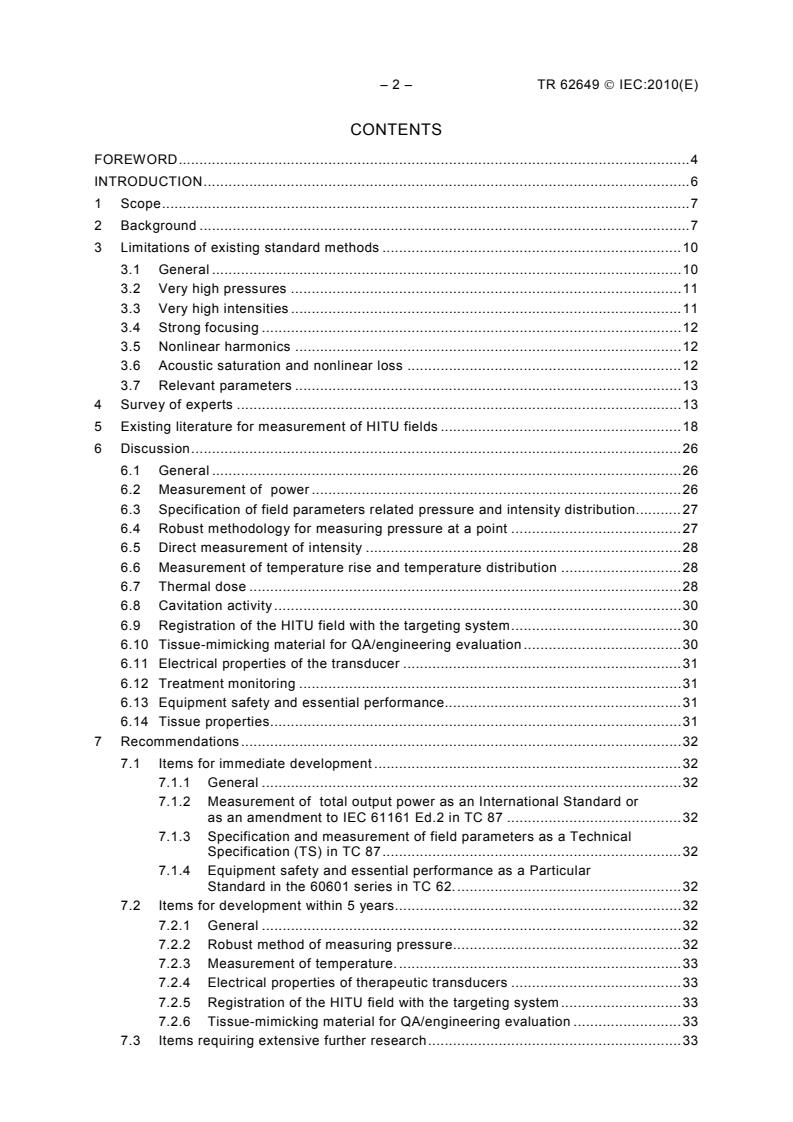
CONTENTS
FOREWORD.4
INTRODUCTION.6
1 Scope.7
2 Background .7
3 Limitations of existing standard methods .10
3.1 General .10
3.2 Very high pressures .11
3.3 Very high intensities .11
3.4 Strong focusing .12
3.5 Nonlinear harmonics .12
3.6 Acoustic saturation and nonlinear loss .12
3.7 Relevant parameters .13
4 Survey of experts .13
5 Existing literature for measurement of HITU fields .18
6 Discussion.26
6.1 General .26
6.2 Measurement of power .26
6.3 Specification of field parameters related pressure and intensity distribution.27
6.4 Robust methodology for measuring pressure at a point .27
6.5 Direct measurement of intensity .28
6.6 Measurement of temperature rise and temperature distribution .28
6.7 Thermal dose .28
6.8 Cavitation activity.30
6.9 Registration of the HITU field with the targeting system.30
6.10 Tissue-mimicking material for QA/engineering evaluation .30
6.11 Electrical properties of the transducer .31
6.12 Treatment monitoring .31
6.13 Equipment safety and essential performance.31
6.14 Tissue properties.31
7 Recommendations.32
7.1 Items for immediate development .32
7.1.1 General .32
7.1.2 Measurement of total output power as an International Standard or
as an amendment to IEC 61161 Ed.2 in TC 87 .32
7.1.3 Specification and measurement of field parameters as a Technical
Specification (TS) in TC 87.32
7.1.4 Equipment safety and essential performance as a Particular
Standard in the 60601 series in TC 62.32
7.2 Items for development within 5 years.32
7.2.1 General .32
7.2.2 Robust method of measuring pressure.32
7.2.3 Measurement of temperature.33
7.2.4 Electrical properties of therapeutic transducers .33
7.2.5 Registration of the HITU field with the targeting system .33
7.2.6 Tissue-mimicking material for QA/engineering evaluation .33
7.3 Items requiring extensive further research.33
TR 62649 © IEC:2010(E) – 3 –
Annex A (informative) Detailed responses to questionnaire.34
Annex B (informative) Definitions in selected ultrasound standards.54
Annex C (informative) Chinese national standard.67
Bibliography.87
Figure 1 – Radiation force balance system using absorbing target (upward beam).77
Figure 2 – Radiation force balance system using different measuring system
(downward beam) .78
Figure 3 – Hydrophone scanning configuration for measuring HIFU acoustic field
(upward beam).78
Figure 4 – Hydrophone scanning measurement configuration for measuring HIFU
acoustic field (downward beam).79
Figure 5 – Correction factor of plane wave for the acoustic field of a circular plane
piston ultrasonic transducer .82
Table 1 – General characteristics of ultrasound used for different therapeutic
applications .8
Table 2 – International standards and related documents for the measurement of
medical ultrasound fields .9
Table 3 – Questions and summarised answers .14
– 4 – TR 62649 © IEC:2010(E)
INTERNATIONAL ELECTROTECHNICAL COMMISSION
____________
REQUIREMENTS FOR MEASUREMENT STANDARDS
FOR HIGH INTENSITY THERAPEUTIC ULTRASOUND (HITU) DEVICES
FOREWORD
1) The International Electrotechnical Commission (IEC) is a worldwide organization for standardization comprising
all national electrotechnical committees (IEC National Committees). The object of IEC is to promote
international co-operation on all questions concerning standardization in the electrical and electronic fields. To
this end and in addition to other activities, IEC publishes International Standards, Technical Specifications,
Technical Reports, Publicly Available Specifications (PAS) and Guides (hereafter referred to as “IEC
Publication(s)”). Their preparation is entrusted to technical committees; any IEC National Committee interested
in the subject dealt with may participate in this preparatory work. International, governmental and non-
governmental organizations liaising with the IEC also participate in this preparation. IEC collaborates closely
with the International Organization for Standardization (ISO) in accordance with conditions determined by
agreement between the two organizations.
2) The formal decisions or agreements of IEC on technical matters express, as nearly as possible, an international
consensus of opinion on the relevant subjects since each technical committee has representation from all
interested IEC National Committees.
3) IEC Publications have the form of recommendations for international use and are accepted by IEC National
Committees in that sense. While all reasonable efforts are made to ensure that the technical content of IEC
Publications is accurate, IEC cannot be held responsible for the way in which they are used or for any
misinterpretation by any end user.
4) In order to promote international uniformity, IEC National Committees undertake to apply IEC Publications
transparently to the maximum extent possible in their national and regional publications. Any divergence
between any IEC Publication and the corresponding national or regional publication shall be clearly indicated in
the latter.
5) IEC itself does not provide any attestation of conformity. Independent certification bodies provide conformity
assessment services and, in some areas, access to IEC marks of conformity. IEC is not responsible for any
services carried out by independent certification bodies.
6) All users should ensure that they have the latest edition of this publication.
7) No liability shall attach to IEC or its directors, employees, servants or agents including individual experts and
members of its technical committees and IEC National Committees for any personal injury, property damage or
other damage of any nature whatsoever, whether direct or indirect, or for costs (including legal fees) and
expenses arising out of the publication, use of, or reliance upon, this IEC Publication or any other IEC
Publications.
8) Attention is drawn to the Normative references cited in this publication. Use of the referenced publications is
indispensable for the correct application of this publication.
9) Attention is drawn to the possibility that some of the elements of this IEC Publication may be the subject of
patent rights. IEC shall not be held responsible for identifying any or all such patent rights.
The main task of IEC technical committees is to prepare International Standards. However, a
technical committee may propose the publication of a technical report when it has collected
data of a different kind from that which is normally published as an International Standard, for
example "state of the art".
IEC 62649, which is a technical report, has been prepared by committee TC 87: Ultrasonics.
The text of this technical report is based on the following documents:
Enquiry draft Report on voting
87/420/DTR 87/428/RVC
Full information on the voting for the approval of this technical report can be found in the
report on voting indicated in the above table.
This publication has been drafted in accordance with the ISO/IEC Directives, Part 2.
TR 62649 © IEC:2010(E) – 5 –
The committee has decided that the contents of this publication will remain unchanged until
the stability date indicated on the IEC web site under "http://webstore.iec.ch" in the data
related to the specific publication. At this date, the publication will be
• reconfirmed,
• withdrawn,
• replaced by a revised edition, or
• amended.
A bilingual version of this publication may be issued at a later date.
– 6 – TR 62649 © IEC:2010(E)
INTRODUCTION
This Technical Report is concerned with standards for high intensity therapeutic ultrasound
(HITU) and concentrates on applications that destroy tissue by heating which may or may not
be accompanied by acoustic cavitation and other mechanisms. The purpose of the report is to
identify topics where there is a consensus that the development of international standards
would benefit the industries and/or patients involved with these forms of therapeutic
ultrasound. The shortcomings of existing standards as they may be related to the applications
of interest are reviewed. It is not its purpose to propose or evaluate specific alternative
measurement methods which may be more reliably applied to HITU or other therapeutic
equipment. Physiotherapy and lithotripsy are excluded as there are existing standards for
these established uses. Lower intensity applications such as enhanced bone healing or
ultrasound-induced gene therapy are not explicitly considered.
The use of HITU has advanced to the point where systems have achieved clinical approval for
general use in several countries. Medical applications and product development are
continuing rapidly. The corresponding products of many companies have been approved for
marketing and clinical applications. Fast development in preclinical medicine, clinic medicine,
and product manufacture has created an urgent need to standardize measurements of the
basic acoustic parameters and the field characteristics of HITU. In order to promote the
further development of HITU and to ensure its safe and effective use, international standards
are required.
TR 62649 © IEC:2010(E) – 7 –
REQUIREMENTS FOR MEASUREMENT STANDARDS
FOR HIGH INTENSITY THERAPEUTIC ULTRASOUND (HITU) DEVICES
1 Scope
This technical report is relevant to the measurement and specification of ultrasound fields
intended for medical therapeutic purposes. Lithotripsy and physiotherapy are excluded, since
there are existing International Standards for these applications.
It establishes:
• topics where there is a consensus that the development of International Standards would
benefit the industries and/or patients;
• topics where the writing of standards should start immediately;
• topics where the writing of technical specifications should start immediately in order to
gain practical experience and establish consensus prior to standardisation;
• topics which require future standardisation but where further research is required before
initiating the writing of standards or technical specifications.
This report addresses primarily the requirements for measurement standards related to high
intensity therapeutic ultrasound (HITU) [also known as high intensity focused ultrasound
(HIFU)] fields which are both high intensity and focused and where the main mechanism for
action is thermal. However, aspects of the discussion, conclusions and any resulting
standards or technical specifications may also be relevant to therapeutic applications which
are either focused or high intensity or where the main mechanism is not thermal.
Scientific literature has been reviewed and responses to a questionnaire which was sent to
experts around the world are reported.
2 Background
Recent years have seen a dramatic rise in interest in using ultrasound as a surgical and
therapeutic tool in its own right. Much of this growth has been due to the use of High Intensity
Therapeutic Ultrasound (HITU) for tissue ablation in the treatment of cancers and conditions
such as benign prostate hyperplasia (BPH). Here, ultrasound is brought to a focus within
tissue with the intention of generating intensity levels sufficient to raise the local tissue
temperature above 55 °C. Like so much in ultrasound, this technique was first tested many
years ago (Lynn et al, 1942; Wall et al, 1951, Fry et al, 1954), but recent materials, computing
and other technological advances have allowed it to come close to the medical mainstream.
The ability to generate such high temperatures within tissue brings with it the absolute
requirement to ensure that the treatment is delivered to the correct level and at the correct
site. This in turn means that accurate methods of predicting the dose and monitoring
performance are required. Consequently, reliable measurement and characterisation methods
are needed for this application above all others.
However, HITU is not the only therapeutic application. Ultrasound physiotherapy, of course,
has been widely used since the 1950s (Imig et al, 1954; Gersten, 1955) and lithotripsy since
1980 (Chaussy et al) for the destruction of kidney stones. More experimental applications
include treatment of tendon injuries using lithotripter-like devices, stimulation of bone repair
by low intensity ultrasound, ultrasound-induced haemostasis, and the targeted delivery of
drugs through the localised destruction of carrier particles by ultrasound. Typical
characteristics of ultrasound used for these different applications are described in general
terms in Table 1.
– 8 – TR 62649 © IEC:2010(E)
Table 1 – General characteristics of ultrasound used
for different therapeutic applications
–2
Physiotherapy
1 MHz; 1 W cm ; <0,5 MPa
Lithotripsy 0,5 MHz; very low, >20 MPa
a
Soft tissue lithotripsy 0,25 MHz; very low, 5 to 30 MPa
a –2 –2
HITU 0,5 MHz to 5 MHz; 1 000 W cm to 10 000 W cm ; 10 MPa
a –2 –2
Haemostasis 1 MHz to 10 MHz; 100 W cm to 5 000 W cm
–2
Bone growth stimulation 1,5 MHz; 30 mW cm ; 50 kPa
a
Drug delivery Up to 2 MHz; various; 0,2 MPa to 8 MPa
a
Experimental techniques: limited information or wide range of characteristics under investigation.
Acoustic parameters shown are a strong function of treatment duration or dose time and other factors.
Medical ultrasound fields in the MHz frequency range are typically characterised in water by
measuring the spatial and temporal distribution of pressure using a piezoelectric hydrophone,
and by measuring the radiation force on a target which intercepts the entire field. International
standards directly relevant to the measurement of medical ultrasound fields generally are
given in Table 2; national standards are generally identical to international standards or
specify parameters which are very similar. A range of terms defined in selected IEC standards
(which are identical to the equivalently numbered British Standards) are given in Appendix B.
Measurement aspects are also included in many textbooks on medical ultrasound and are the
specific subject of Preston (1991), Ziskin and Lewin (1992), and Harris (2005), amongst
others.
TR 62649 © IEC:2010(E) – 9 –
Table 2 – International standards and related documents for the measurement
of medical ultrasound fields
Number Title Relevance
IEC 60500:1974 IEC standard hydrophone L
IEC 60565:2006 Underwater acoustics – Hydrophones – Calibration in the L
frequency range 0,01 Hz to 1 MHz
IEC/TR 60854:1986 Methods of measuring the performance of ultrasonic pulse-echo H
diagnostic equipment
IEC 60866:1987 (withdrawn) Characteristics and calibration of hydrophones for operation in L
the frequency range 0,5 MHz to 15 MHz
IEC 61101:1991 (withdrawn) The absolute calibration of hydrophones using the planar L
scanning technique in the frequency range 0,5 MHz to 15 MHz
IEC 61102:1991 (withdrawn): Measurement and characterisation of ultrasonic fields using H
hydrophones in the frequency range 0,5 MHz to 15 MHz
IEC 61102-am1:1993 Amendment 1 – Measurement and characterisation of ultrasonic H
(withdrawn) fields using hydrophones in the frequency range 0,5 MHz to
15 MHz
IEC 61157:2007 Standard means for the reporting of the acoustic output of M
medical diagnostic ultrasonic equipment
IEC 61161:2006 Ultrasonics – Power measurement – Radiation force balances
H
and performance requirements
IEC 61205:1993 Ultrasonics – Dental descaler systems – Measurement and L
declaration of the output characteristics
IEC/TR 61206:1993 Ultrasonics – Continuous-wave Doppler systems – Test L
procedures
IEC/TS 61220:1993 Ultrasonics – Fields – Guidance for the measurement and H
(withdrawn) characterization of ultrasonic fields generated by medical
ultrasonic equipment using hydrophones in the frequency range
0,5 to 15 MHz
IEC 61266:1994 Ultrasonics – Hand-held probe Doppler foetal heartbeat L
detectors – Performance requirements and methods of
measurement and reporting
IEC/TS 61390:1996 Ultrasonics – Real-time pulse-echo systems – Test procedures L
to determine performance specifications
IEC 61685:2001 Ultrasonics – Flow measurement systems – Flow test object L
IEC 61689:2007 Ultrasonics – Physiotherapy systems Field specifications and M
methods of measurement in the frequency range 0,5 MHz to
5 MHz
IEC 61828:2001 Ultrasonics – Focusing transducers – Definitions and H
measurement methods for the transmitted fields
IEC 61846:1998 Ultrasonics – Pressure pulse lithotripters – Characteristics of M
fields
IEC 61847:1998 Ultrasonics – Surgical systems – Measurement and declaration L
of the basic output characteristics
IEC/TS 61895:1999 Ultrasonics – Pulsed Doppler diagnostic systems – Test L
procedures to determine performance
IEC 61949:2007 Ultrasonics – Field characterization – In-situ exposure H
estimation in finite-amplitude ultrasonic beams
IEC 62092:2001 (withdrawn) Ultrasonics – Hydrophones – Characteristics and calibration in H
the frequency range from 15 MHz to 40 MHz
IEC 62126 Ed. 1.0 (in Ultrasonics – Fields: Methods for computing temperature rise in H
preparation) homogeneous soft tissue for diagnostic ultrasonic fields
IEC 62127-1:2007 Ultrasonics – Hydrophones – Part 1: Measurement and
H
characterization of medical ultrasonic fields up to 40 MHz
IEC 62127-2:2007 Ultrasonics – Hydrophones – Part 2: Calibration for ultrasonic
H
fields up to 40 MHz
– 10 – TR 62649 © IEC:2010(E)
Number Title Relevance
IEC 62127-3:2007 Ultrasonics – Hydrophones – Part 3: Properties of hydrophones
H
for ultrasonic fields up to 40 MHz
IEC 62359:2005 Ultrasonics – Field characterization – Test methods for the L
determination of thermal and mechanical indices related to
medical diagnostic ultrasonic fields
IEC/TS 62462:2007 Ultrasonics – Output test – Guide for the maintenance of
L
ultrasound physiotherapy systems
IEC 60601-2-5:2009 Medical electrical equipment – Particular requirements for the H
basic safety and essential performance of ultrasonic
physiotherapy equipment
IEC 60601-2-36:1997 Medical electrical equipment – Particular requirements for the M
safety of equipment for extracorporeally induced lithotripsy
IEC 60601-2-37:2007 Medical electrical equipment: Particular requirements for the H
basic safety and essential performance of ultrasonic medical
diagnostic and monitoring equipment
In normal practice, no attempt is made to measure intensity (or the distribution of intensity)
directly but it is derived from the measurement of pressure by assuming that the local
pressure and particle velocity are in phase and therefore that the intensity is proportional to
pressure squared (a ‘plane-wave’ assumption). Ultrasound power is not directly measured
either but is derived either by integrating the derived intensity over a plane which intersects
the field, or by measuring the radiation force experienced by a target and assuming that
power is proportional to the radiation force and that the constant of proportionality can be
determined from the acoustic and geometric properties of the target (another ‘plane-wave’
assumption). Geometric properties of the field (for example, focal distance and beamwidth)
can be defined in terms of either pressure or derived intensity: most commonly, derived
intensity (or, equivalently, pressure-squared integral) is used.
Although these measurement standards are well established and the measurement
procedures laid down in them are widely practised, there are known limitations with both the
measurement devices and the procedures. These limitations introduce uncertainties in
attempting to characterise the true acoustic field. In addition, the existing defined terms may
not be the most appropriate for characterising HITU fields, especially when attempting to
compare their probable therapeutic effectiveness.
There is, however, a National Standard from China which relates specifically to
characterisation of HITU transducers. An English translation of this standard is included in
Appendix C. In brief, the approach is to characterise the field with a hydrophone at a low
output setting using the techniques of the IEC standards for diagnostic fields. In addition,
power is measured with a radiation force balance over a wider range of output settings. Some
electrical characteristics of the transducer are also determined.
The standards listed in Table 2 have been reviewed for their relevance (L = Low, M =
Medium, and H = High) as annotated above. It is possible that parts of relevant standards
may be adapted for therapeutic applications; however, most standards are not directly
applicable to HIFU and related applications. These shortcomings and limitations are the
subject of the next section.
3 Limitations of existing standard methods
3.1 General
It can be difficult or inaccurate to apply many of the standard measurement methods to HITU
fields, either due to fundamental measurement issues or to practical problems.
For radiation force balances, the major problems relate to:
TR 62649 © IEC:2010(E) – 11 –
• shielding by bubbles:
• thermal damage of target;
• force dependence on field geometry, not just on power;
• measurements away from the focal plane;
• extreme nonlinear effects including shock loss.
For hydrophone measurements, the major problems relate to:
• shielding by bubbles;
• thermal or cavitation damage;
• non-ideal frequency response;
• non-ideal directional response/spatial-averaging;
• high pressure levels;
• high harmonic content;
• off-axis measurements.
Some of the causes of these difficulties and inaccuracies are introduced in the following
subsections.
3.2 Very high pressures
Pressures above the cavitation threshold for the measurement medium (usually water) can
produce bubbles as dissolved gas is drawn out of solution. Three main problems may then
arise: first, the bubbles formed may partly shield the sensor from the ultrasound field;
secondly, violent bubble activity can damage or destroy the sensor. The occurrence of both of
these effects can be minimised by removing dissolved gas and particulate matter from the
measurement medium, but it may be difficult to maintain sufficient purity for a prolonged
period. Thirdly, because of the high pressure levels involved, a proportionately larger fraction
of the pressure spectrum is distributed into higher harmonics compared to a bubble-less
medium.
There is also the risk of direct mechanical effects on the sensor itself due to large
compressional and tensional forces. This is most likely to be a problem when there are weak
points between different components of the sensor (for instance, if there is delamination of
the glue layer in a bilaminar hydrophone).
3.3 Very high intensities
Energy absorbed from the ultrasound beam heats the sensor and this may affect its
performance or even destroy it. For instance, the sensitivity of a membrane hydrophone can
change if it is heated close to its Curie temperature. For polyvinylidenefluoride (pvdf), the
most widely used hydrophone material, depolarisation occurs progressively with time at
temperatures above about 70 °C and almost immediately at 110 °C. The thinness of
membrane hydrophones will offer some protection against thermal damage because heat is
very quickly lost to the surrounding medium. However, the sensitivity of pvdf hydrophones is
temperature dependent and this change will be an additional source of uncertainty. Probe
hydrophones may face greater risk and absorbing radiation force balance targets will certainly
be damaged unless great care is taken to dissipate the absorbed energy. Heating can be
reduced by generating low duty cycle toneburst ultrasound rather than continuous-wave.
However, HITU transducers are generally only weakly damped and, consequently, may take
many acoustic cycles for the pressure ‘ring-up’ at the start of the toneburst; there is an
equivalent ‘ring-down’ at the end of the toneburst. This must be accounted for by scaling
results from toneburst to the c.w. situation. In addition, since typically 30-50 % of the
electrical energy is dissipated within the transducer, its temperature and properties will
change with time during operation. Using toneburst mode will reduce this self-heating and
may lead to significant differences in acoustic output compared to the c.w. case.
– 12 – TR 62649 © IEC:2010(E)
3.4 Strong focusing
In a focused field, two important plane-wave assumptions are not valid. Firstly, the particle
velocity is not strictly in phase with the pressure, meaning that the local intensity is not truly
proportional to the square of the pressure; hence, there is an increased uncertainty when
deriving the intensity from a pressure measurement with a hydrophone. Secondly, the
radiation force on a target placed in the field is no longer determined solely by the properties
of the target and the total ultrasound power. The geometry of the field also plays a role,
especially for the widely-used conical reflecting targets; absorbing targets are preferable
provided that they are not damaged by excessive heating.
There is also a third effect which relates to the directional response of a hydrophone. In a
plane wave, the hydrophone can be aligned so that the wave is incident in the preferred
direction for the hydrophone (usually perpendicular to the plane of the sensing element). In a
focused field, the pressure at the hydrophone can be considered as the superposition of
wavelets with a relative phase and an angular distribution which are determined by the
transducer geometry and its distance from the hydrophone. An ideal hydrophone would
respond equally to wavelets from any direction and the output signal would be proportional to
the sum of the wavelets. A real hydrophone, on the other hand, has a sensitivity which
depends on the angle of incidence of the wavefront and the output voltage therefore depends
on a weighted summation of the wavelets. This means that the output voltage waveform is
different in magnitude and shape from the pressure waveform. This distortion increases with
the large physical apertures and short focal lengths frequently used for therapeutic
applications. Furthermore, the non-ideal nature of real transducers which have amplitude and
phase variations across their apertures introduce additional complexities into the
measurement process. There is no information available on the measurement uncertainties in
cases where the field is generated by two or more widely separated transducers, or where the
point of measurement lies within or close to the volume defined by the surface of the
transducer or transducers.
In other therapeutic applications, the transducer is nonfocusing, or it operates over short
distances or it has an unusual geometry. In these cases, existing measurement standards
cannot be applied.
3.5 Nonlinear harmonics
Hydrophones have a frequency dependent amplitude and phase response. Consequently, in
any ultrasound field where the acoustic spectrum at the point of measurement contains a
significant spread of frequencies, the output voltage waveform (which is the acoustic
spectrum convolved with the complex frequency response of the measurement system) will
differ in shape from the true pressure waveform. In general, membrane hydrophones have a
smoother frequency response (particularly in the low MHz region) and will give a closer
representation of the pressure waveform. However, when the acoustic spectrum contains
many high harmonics (as are generated by nonlinear propagation of high pressure fields), the
output signal from the hydrophone can still be very different from the acoustic pressure
waveform because the thickness resonance of the membrane typically results in a sensitivity
which is 6 dB to 8 dB higher at the resonance frequency than at 1 MHz. Pulses of sufficiently
high amplitude can achieve ‘full-shock’ conditions in which several hundred harmonics can be
present with a relative amplitude proportional to 1/N, where N is the harmonic number. This
problem is well recognised in the measurement of diagnostic ultrasound pulses and research
is being carried out on the determination of the complex frequency response of hydrophones
and the best method for deconvolving this response. So far, it seems that deconvolution to
determine temporal-average intensity is relatively straightforward because it requires
knowledge only of the amplitude response. The problem of determining peak negative and,
particularly, peak positive pressures has not yet been solved with accuracy since it requires
phase response data up to high frequencies.
3.6 Acoustic saturation and nonlinear loss
High amplitude acoustic pulses propagate nonlinearly in water, which results in a distortion of
the wave and the generation of harmonics. Since the acoustic attenuation coefficient of water
TR 62649 © IEC:2010(E) – 13 –
is proportional to frequency squared, these harmonics are absorbed more quickly than the
fundamental, leading to ‘nonlinear loss’ and eventually to ‘acoustic saturation’, where any
change in the acoustic pressure generated at the transducer is not seen at the measurement
point in the field. For radiation force balance measurements, nonlinear loss can mean that the
incident power is strongly dependent on the distance at which the measurement is made. It
can also mean that there is significant streaming in the water path and this also results in a
force on the target. Determining the output power of the transducer is therefore subject to
greater uncertainties.
For hydrophone measurements, acoustic saturation and nonlinear loss can be problematic
when making measurements in water. Unlike diagnostic pressure levels measured in water,
which fall within a prescribed range, the high pressures and extended pulse lengths for
therapeutics can contain a significantly more extended and higher harmonic spectrum and this
places a more stringent requirements on the frequency response of the measurement system.
NOTE The amplitude of a narrowband spectrum at the fundamental from a tone burst is proportional to the
number of cycles; therefore, the harmonics also increase under high drive pressures. Acoustic saturation will be
more pronounced at these levels. In addition, a problem arises when extrapolating from measurements in water to
anticipated values in tissue, where the nonlinear properties and attenuation coefficients are significantly different.
This is being addressed for diagnostic ultrasound by an IEC project which specifies a parameter and associated
threshold that guarantees ‘quasi-linear’ conditions. To ensure quasi-linear conditions, the transducer output is
reduced until nonlinear propagation processes transfer less than 10 % of the energy flux through any point in the
field to the higher harmonics; it is believed that extrapolation from water values to tissue values can be better
made by making measurements under these quasi-linear conditions.
3.7 Relevant parameters
Parameters for ultrasonic fields in existing standards have been defined primarily to compare
fields propagating in water near the acoustic axis. A selection of these parameters taken from
IEC standards current in 2005 is given in Annex B. Whilst these are still relevant to the
description of HITU and other therapeutic fields, it may be possible to define a different set of
parameters which can be related more closely either to therapeutic effect or to safety. For
instance, it may be helpful to integrate intensity over a fixed area, to average pressure or
intensity over a fixed area, or to determine a thermal dose or cavitation volume according to a
specified protocol. While most previous measurements were near an acoustic axis, for
therapeutic applications, a more complete regional measurement may be necessary to
determine localized contributions to heating.
In addition, most existing defined parameters rely on either hydrophone or radiation force
measurements. It may be possible to use alternative sensors to measure different quantities
directly: for instance, intensity, temperature distribution, or cavitation activity.
4 Survey of experts
To establish the views of experts around the world as to where standards would be of benefit,
a questionnaire was prepared and sent initially to attendees of the 2003 International Society
of Therapeutic Ultrasound (ISTU) meeting which was held on Lyon, France. Further to this
circulation, the questionnaire was handed out at the 2004 ISTU meeting in Kyoto, Japan, and
at the 2004 meeting of Technical Committee 87 (Ultrasonics) of the International
Electrotechnical Commission (IEC) held in Hangzhou, China.
The questions related to three different topics and are given with summarised responses in
Table 3. A total of 26 replies were received and are given in full in Annex A.
– 14 – TR 62649 © IEC:2010(E)
Table 3 – Questions and summarised answers
A. YOUR APPLICATION
A1 What is your current ESWL [3]
involvement in Thermal ablation [7]
therapeutic Fundamental research [3]
ultrasound? Equipment manufacturers [4]
Haemostasis [2]
Clinical [3]
A2 What is the Cavitation [8]
therapeutic Heat [14]
mechanism (eg Radiation force [1]
cavitation, Bubble mediated heating [1]
thermal…)? “Other” [2]
A3 What ultrasonic Power 0 W – 500 W
–2
power level range Intensity range “mW” – 2 500 W cm
are you interested
in?
A4 What frequency 0,2 MHz – 20 MHz
range are you
interested in?
A5 What acoustic 40 Pa – 100 MPa
pressure range are
you interested in?
A6 What exposure mode Cw [12]
are you interested “Pulse” [8]
in? E.g. pulse “Tone burst” [6] 1-20s
length, tone burst,
cw.
A7 What transducer size Focal length 2 cm – 25 cm
and f-number or focal Transducer diameter 0,4 cm – 25 cm
length are you f-number 0,75 – 2
interested in?
A8 Is there a particular No [3]
exposure geometry Trans-rectal probes
that makes High pressure and intensity
calibration difficult in Multiple independent beams
your application? In vivo [4]
“The small transducers are difficult to measure output power from. At lower
frequencies the beam becomes divergent and it is difficult to achieve
repeatable measurements.”
B. YOUR EXISTING MEASUREMENTS
B1 How do you routinely Force balance [7]
test that your Pressure measurement [2]
equipment is working Hydrophone [4]
properly? Water fountain [2]
Schlieren [1]
Thermocouple [1]
MR thermometry [2]
Impedance spectrum [3]
Cymometer [1]
Melting a plastic cup [1]
Not [1]
B2 How do you currently US imaging [3]
determine the MRI [4]
effectiveness of the Thermometry [2]
therapy in your Macroscopic visualisation [3]
TR 62649 © IEC:2010(E) – 15 –
B. YOUR EXISTING MEASUREMENTS
application? Gels [3]
In vivo [5]
MR thermometry [1]
SWR [2]
B3 Which parameters do Pressure [5]
you generally quote Frequency [5]
to describe your Intensity [8]
fields? Pulse parameters [4]
Transducer dimensions [2]
Exposure time [3]
Power [5]
Beam shape [5]
Focal spot size [5]
Transducer efficiency
B4 Do you currently use Stone model [1]
a phantom? If so, Rubber [1]
what type of phantom Abattoir liver [2]
and for what Gels [6]
purpose? Liquid crystal [1]
Acrylic [1]
No [5]
B5 Briefly describe the Needle hydrophone [11]
equipment and Membrane hydrophone [6]
method you use to Force balance [9]
measure pressure, Extrapolation from theory [2]
intensity or power. “The acoustic pressure cannot be measured directly by hydrophone under
high power output. So we use a hydrophone to measure the acoustic pressure
under the low power output to get the distribution of the acoustic field.
A full-scale absorption method is used to measure the ultrasonic radiation
force of the running transducer, and the acoustic power and intensity are
drawn by theoretical deduction.”
“We use a pvdf membrane hydrophone and short pulses (low duty cycle) in a
water bath. We do not exceed a peak positive pressure of 3 MPa during
calibration. We assume electromechanical linearity thereafter and use a
propagation code to account for nonlinearity”
B6 Briefly describe the Microscope [2]
equipment and Thermocouple [9]
method you use to Liquid crystal [1]
measure heating, Thermal camera [1]
cavitation or other MR [2]
relevant effect. PCD [6]
ACD [4
High speed cine [1]
Hydrophone + frequency spectrum analyser [1]
Sonochemistry [1]
Luminescence [1]
Force balance [1]
C. YOUR PERCEIVED NEEDS
C1 W
...