

IEC 61260-3:2016
(Main)Electroacoustics - Octave-band and fractional-octave-band filters - Part 3: Periodic tests
General Information
- Abstract
IEC 61260-3:2016 describes procedures for periodic testing of octave-band and fractional-octave-band filters that were designed to conform to the class 1 or class 2 specifications given in IEC 61260-1:2014. The aim of this standard is to ensure that periodic testing is performed in a consistent manner by all laboratories. This first edition of IEC 61260-3 (together with IEC 61260-1:2014 and IEC 61260-2:2016), cancels and replaces the first edition of IEC 61260 published in 1995 and its Amendment 1 published in 2001. This edition constitutes a technical revision.
- Status
- Published
- Publication Date
- 22-Mar-2016
- Technical Committee
- TC 29 - Electroacoustics
- Drafting Committee
- MT 19 - TC 29/MT 19
- Current Stage
- PPUB - Publication issued
- Start Date
- 23-Mar-2016
- Completion Date
- 31-May-2016
Overview
IEC 61260-3:2016 is an international standard published by the International Electrotechnical Commission (IEC) that focuses on the periodic testing of octave-band and fractional-octave-band filters used in electroacoustics. It defines rigorous procedures to verify that these filters continue to meet class 1 or class 2 performance specifications originally described in IEC 61260-1:2014. This periodic verification ensures consistent filter accuracy, reliability, and conformity over time across different testing laboratories worldwide.
As part of the IEC 61260 series-which also includes specifications (Part 1) and pattern evaluation tests (Part 2)-this third part emphasizes standardized periodic tests to maintain high quality in octave-band filter applications. It supersedes the earlier 1995 edition and its 2001 amendment through technical revisions refining test methods, environmental conditions, measurement uncertainties, and acceptance limits.
Key Topics
- Scope and Purpose: IEC 61260-3:2016 sets out methods for periodic conformity tests on class 1 and 2 octave-band filters to ensure ongoing compliance with original design specs.
- Test Procedures: Includes guidelines on preliminary inspections, power supply conditions, environmental requirements, and mandatory test instruments.
- Relative Attenuation Testing: Defines how to measure relative attenuation at midband frequencies and determine the effective bandwidth deviation for each filter.
- Linear Operating Range: Procedures to verify filter behavior under different signal levels, measuring linearity and overload indicators.
- Uncertainty and Acceptance Criteria: Introduces acceptance limits and maximum permitted measurement uncertainties to guarantee reliable and reproducible results.
- Documentation: Specifies necessary reporting protocols for test outcomes and conformity evidence.
- Environmental Conditions: Tests must be performed under controlled temperature (23°C) and humidity (50% RH) to minimize variation.
- Standardized Test Signals: Use of sinusoidal sweeps and exponential sweeps for characterization and uncertainty analysis.
By harmonizing these test requirements, IEC 61260-3 ensures that laboratory assessments of octave-band filters remain trustworthy and traceable, minimizing the risk of inaccurate acoustic measurements due to filter degradation or malfunction.
Applications
IEC 61260-3:2016 is essential wherever octave-band and fractional-octave-band filters are used for:
- Acoustic measurements and analysis: Ensuring precise frequency band filtering in sound level meters, noise monitoring systems, and acoustic research instruments.
- Electroacoustic device calibration: Supporting periodic verification protocols to maintain compliance with international performance standards.
- Environmental noise assessment: Pollutant noise control and regulatory compliance rely on stable filter characteristics through periodic testing.
- Product quality assurance: Manufacturers and testing laboratories use the standard for routine monitoring of filter performance in production and service environments.
- Audiology and hearing devices: Certifying band-pass filters used in hearing aids or auditory testing equipment.
Regular application of IEC 61260-3 enhances confidence in octave-band filter accuracy, contributing to reliable acoustic measurement outcomes across industrial, environmental, and scientific sectors.
Related Standards
- IEC 61260-1:2014 – Electroacoustics – Octave-band and fractional-octave-band filters – Part 1: Specifications: Defines the technical performance requirements and design goals for class 1 and class 2 filters.
- IEC 61260-2:2016 – Electroacoustics – Octave-band and fractional-octave-band filters – Part 2: Pattern evaluation tests: Covers initial pattern evaluation and production testing methodologies.
- ISO/IEC Directives, Part 2 – Provides the framework for drafting and maintaining IEC international standards.
- Relevant IEC Glossaries and Electropedia – Offer standardized terminology and definitions critical for understanding electroacoustic filtering concepts.
Adherence to IEC 61260-3:2016 alongside these complementary standards supports a comprehensive quality management system in electroacoustic filter measurement and verification.
Keywords: IEC 61260-3, periodic testing, octave-band filters, fractional-octave filters, electroacoustics, filter calibration, measurement uncertainty, acoustic measurement standards, IEC standards, class 1 filters, class 2 filters, sound analysis, noise monitoring, filter verification.
Relations
- Effective Date
- 05-Sep-2023
- Effective Date
- 25-Aug-2026
- Effective Date
- 25-Aug-2026
- Effective Date
- 25-Aug-2026
- Effective Date
- 25-Aug-2026
- Effective Date
- 24-Jun-2026
- Effective Date
- 27-May-2026
- Effective Date
- 15-Apr-2026
Get Certified
Connect with accredited certification bodies for this standard

BSMI (Bureau of Standards, Metrology and Inspection)
Taiwan's standards and inspection authority.
Sponsored listings
Frequently Asked Questions
IEC 61260-3:2016 is a standard published by the International Electrotechnical Commission (IEC). Its full title is "Electroacoustics - Octave-band and fractional-octave-band filters - Part 3: Periodic tests". This standard covers: IEC 61260-3:2016 describes procedures for periodic testing of octave-band and fractional-octave-band filters that were designed to conform to the class 1 or class 2 specifications given in IEC 61260-1:2014. The aim of this standard is to ensure that periodic testing is performed in a consistent manner by all laboratories. This first edition of IEC 61260-3 (together with IEC 61260-1:2014 and IEC 61260-2:2016), cancels and replaces the first edition of IEC 61260 published in 1995 and its Amendment 1 published in 2001. This edition constitutes a technical revision.
IEC 61260-3:2016 describes procedures for periodic testing of octave-band and fractional-octave-band filters that were designed to conform to the class 1 or class 2 specifications given in IEC 61260-1:2014. The aim of this standard is to ensure that periodic testing is performed in a consistent manner by all laboratories. This first edition of IEC 61260-3 (together with IEC 61260-1:2014 and IEC 61260-2:2016), cancels and replaces the first edition of IEC 61260 published in 1995 and its Amendment 1 published in 2001. This edition constitutes a technical revision.
IEC 61260-3:2016 is classified under the following ICS (International Classification for Standards) categories: 17.140.50 - Electroacoustics. The ICS classification helps identify the subject area and facilitates finding related standards.
IEC 61260-3:2016 has the following relationships with other standards: It is inter standard links to IEC 61260:1995/AMD1:2001, EN ISO 2922:2020, EN ISO 16283-2:2018, EN ISO 3743-2:2019, EN ISO 16283-2:2020, EN ISO 10848-1:2017, EN ISO 3095:2025, EN ISO 3744:2026. Understanding these relationships helps ensure you are using the most current and applicable version of the standard.
IEC 61260-3:2016 is available in PDF format for immediate download after purchase. The document can be added to your cart and obtained through the secure checkout process. Digital delivery ensures instant access to the complete standard document.
Standards Content (Sample)
IEC 61260-3 ®
Edition 1.0 2016-03
INTERNATIONAL
STANDARD
NORME
INTERNATIONALE
Electroacoustics – Octave-band and fractional-octave-band filters –
Part 3: Periodic tests
Électroacoustique – Filtres de bande d'octave et de bande d'une fraction
d'octave –
Partie 3: Essais périodiques
All rights reserved. Unless otherwise specified, no part of this publication may be reproduced or utilized in any form
or by any means, electronic or mechanical, including photocopying and microfilm, without permission in writing from
either IEC or IEC's member National Committee in the country of the requester. If you have any questions about IEC
copyright or have an enquiry about obtaining additional rights to this publication, please contact the address below or
your local IEC member National Committee for further information.
Droits de reproduction réservés. Sauf indication contraire, aucune partie de cette publication ne peut être reproduite
ni utilisée sous quelque forme que ce soit et par aucun procédé, électronique ou mécanique, y compris la photocopie
et les microfilms, sans l'accord écrit de l'IEC ou du Comité national de l'IEC du pays du demandeur. Si vous avez des
questions sur le copyright de l'IEC ou si vous désirez obtenir des droits supplémentaires sur cette publication, utilisez
les coordonnées ci-après ou contactez le Comité national de l'IEC de votre pays de résidence.
IEC Central Office Tel.: +41 22 919 02 11
3, rue de Varembé Fax: +41 22 919 03 00
CH-1211 Geneva 20 info@iec.ch
Switzerland www.iec.ch
About the IEC
The International Electrotechnical Commission (IEC) is the leading global organization that prepares and publishes
International Standards for all electrical, electronic and related technologies.
About IEC publications
The technical content of IEC publications is kept under constant review by the IEC. Please make sure that you have the
latest edition, a corrigenda or an amendment might have been published.
IEC Catalogue - webstore.iec.ch/catalogue Electropedia - www.electropedia.org
The stand-alone application for consulting the entire The world's leading online dictionary of electronic and
bibliographical information on IEC International Standards, electrical terms containing 20 000 terms and definitions in
Technical Specifications, Technical Reports and other English and French, with equivalent terms in 15 additional
documents. Available for PC, Mac OS, Android Tablets and languages. Also known as the International Electrotechnical
iPad. Vocabulary (IEV) online.
IEC publications search - www.iec.ch/searchpub IEC Glossary - std.iec.ch/glossary
The advanced search enables to find IEC publications by a 65 000 electrotechnical terminology entries in English and
variety of criteria (reference number, text, technical French extracted from the Terms and Definitions clause of
committee,…). It also gives information on projects, replaced IEC publications issued since 2002. Some entries have been
and withdrawn publications. collected from earlier publications of IEC TC 37, 77, 86 and
CISPR.
IEC Just Published - webstore.iec.ch/justpublished
Stay up to date on all new IEC publications. Just Published IEC Customer Service Centre - webstore.iec.ch/csc
details all new publications released. Available online and If you wish to give us your feedback on this publication or
also once a month by email. need further assistance, please contact the Customer Service
Centre: csc@iec.ch.
A propos de l'IEC
La Commission Electrotechnique Internationale (IEC) est la première organisation mondiale qui élabore et publie des
Normes internationales pour tout ce qui a trait à l'électricité, à l'électronique et aux technologies apparentées.
A propos des publications IEC
Le contenu technique des publications IEC est constamment revu. Veuillez vous assurer que vous possédez l’édition la
plus récente, un corrigendum ou amendement peut avoir été publié.
Catalogue IEC - webstore.iec.ch/catalogue Electropedia - www.electropedia.org
Application autonome pour consulter tous les renseignements
Le premier dictionnaire en ligne de termes électroniques et
bibliographiques sur les Normes internationales,
électriques. Il contient 20 000 termes et définitions en anglais
Spécifications techniques, Rapports techniques et autres
et en français, ainsi que les termes équivalents dans 15
documents de l'IEC. Disponible pour PC, Mac OS, tablettes
langues additionnelles. Egalement appelé Vocabulaire
Android et iPad.
Electrotechnique International (IEV) en ligne.
Recherche de publications IEC - www.iec.ch/searchpub
Glossaire IEC - std.iec.ch/glossary
La recherche avancée permet de trouver des publications IEC 65 000 entrées terminologiques électrotechniques, en anglais
en utilisant différents critères (numéro de référence, texte, et en français, extraites des articles Termes et Définitions des
comité d’études,…). Elle donne aussi des informations sur les publications IEC parues depuis 2002. Plus certaines entrées
projets et les publications remplacées ou retirées. antérieures extraites des publications des CE 37, 77, 86 et
CISPR de l'IEC.
IEC Just Published - webstore.iec.ch/justpublished
Service Clients - webstore.iec.ch/csc
Restez informé sur les nouvelles publications IEC. Just
Published détaille les nouvelles publications parues. Si vous désirez nous donner des commentaires sur cette
Disponible en ligne et aussi une fois par mois par email. publication ou si vous avez des questions contactez-nous:
csc@iec.ch.
IEC 61260-3 ®
Edition 1.0 2016-03
INTERNATIONAL
STANDARD
NORME
INTERNATIONALE
Electroacoustics – Octave-band and fractional-octave-band filters –
Part 3: Periodic tests
Électroacoustique – Filtres de bande d'octave et de bande d'une fraction
d'octave –
Partie 3: Essais périodiques
INTERNATIONAL
ELECTROTECHNICAL
COMMISSION
COMMISSION
ELECTROTECHNIQUE
INTERNATIONALE
ICS 17.140.50 ISBN 978-2-8322-3246-0
– 2 – IEC 61260-3:2016 © IEC 2016
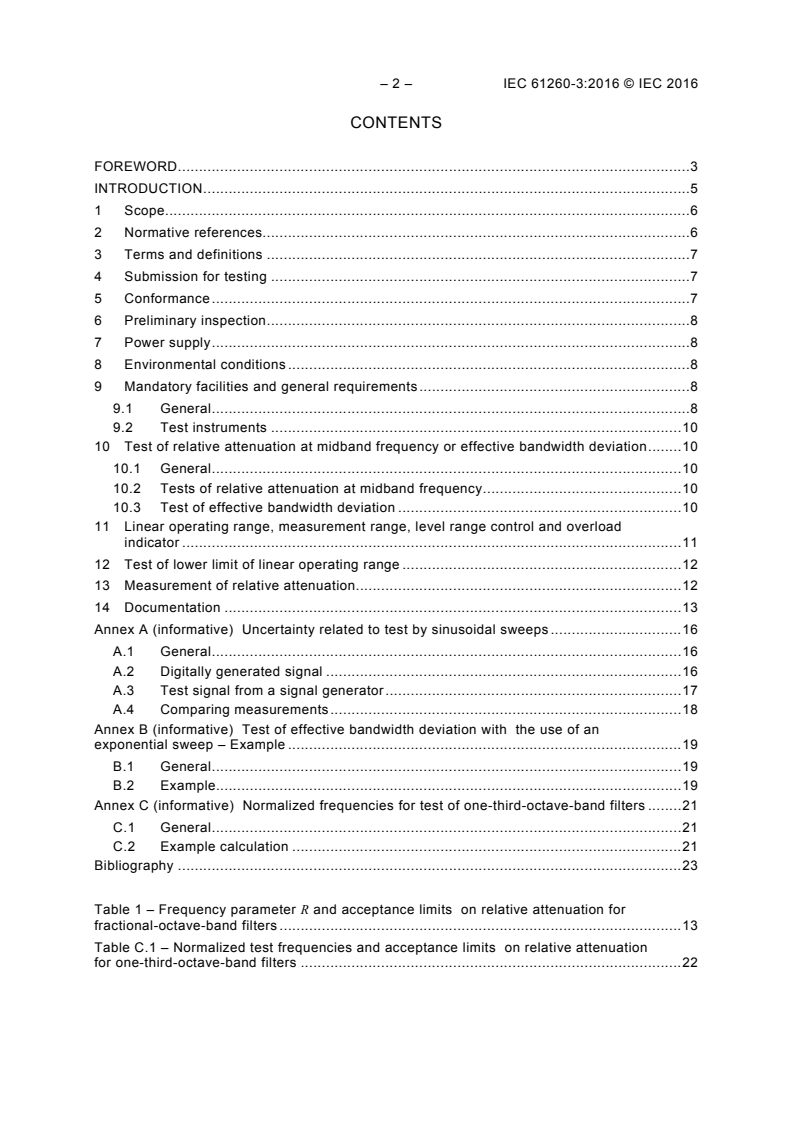
CONTENTS
FOREWORD . 3
INTRODUCTION . 5
1 Scope . 6
2 Normative references. 6
3 Terms and definitions . 7
4 Submission for testing . 7
5 Conformance . 7
6 Preliminary inspection . 8
7 Power supply . 8
8 Environmental conditions . 8
9 Mandatory facilities and general requirements . 8
9.1 General . 8
9.2 Test instruments . 10
10 Test of relative attenuation at midband frequency or effective bandwidth deviation . 10
10.1 General . 10
10.2 Tests of relative attenuation at midband frequency . 10
10.3 Test of effective bandwidth deviation . 10
11 Linear operating range, measurement range, level range control and overload
indicator . 11
12 Test of lower limit of linear operating range . 12
13 Measurement of relative attenuation . 12
14 Documentation . 13
Annex A (informative) Uncertainty related to test by sinusoidal sweeps . 16
A.1 General . 16
A.2 Digitally generated signal . 16
A.3 Test signal from a signal generator . 17
A.4 Comparing measurements . 18
Annex B (informative) Test of effective bandwidth deviation with the use of an
exponential sweep – Example . 19
B.1 General . 19
B.2 Example. 19
Annex C (informative) Normalized frequencies for test of one-third-octave-band filters . 21
C.1 General . 21
C.2 Example calculation . 21
Bibliography . 23
Table 1 – Frequency parameter R and acceptance limits on relative attenuation for
fractional-octave-band filters . 13
Table C.1 – Normalized test frequencies and acceptance limits on relative attenuation
for one-third-octave-band filters . 22
INTERNATIONAL ELECTROTECHNICAL COMMISSION
____________
ELECTROACOUSTICS – OCTAVE-BAND
AND FRACTIONAL-OCTAVE-BAND FILTERS –
Part 3: Periodic tests
FOREWORD
1) The International Electrotechnical Commission (IEC) is a worldwide organization for standardization comprising
all national electrotechnical committees (IEC National Committees). The object of IEC is to promote
international co-operation on all questions concerning standardization in the electrical and electronic fields. To
this end and in addition to other activities, IEC publishes International Standards, Technical Specifications,
Technical Reports, Publicly Available Specifications (PAS) and Guides (hereafter referred to as “IEC
Publication(s)”). Their preparation is entrusted to technical committees; any IEC National Committee interested
in the subject dealt with may participate in this preparatory work. International, governmental and non-
governmental organizations liaising with the IEC also participate in this preparation. IEC collaborates closely
with the International Organization for Standardization (ISO) in accordance with conditions determined by
agreement between the two organizations.
2) The formal decisions or agreements of IEC on technical matters express, as nearly as possible, an international
consensus of opinion on the relevant subjects since each technical committee has representation from all
interested IEC National Committees.
3) IEC Publications have the form of recommendations for international use and are accepted by IEC National
Committees in that sense. While all reasonable efforts are made to ensure that the technical content of IEC
Publications is accurate, IEC cannot be held responsible for the way in which they are used or for any
misinterpretation by any end user.
4) In order to promote international uniformity, IEC National Committees undertake to apply IEC Publications
transparently to the maximum extent possible in their national and regional publications. Any divergence
between any IEC Publication and the corresponding national or regional publication shall be clearly indicated in
the latter.
5) IEC itself does not provide any attestation of conformity. Independent certification bodies provide conformity
assessment services and, in some areas, access to IEC marks of conformity. IEC is not responsible for any
services carried out by independent certification bodies.
6) All users should ensure that they have the latest edition of this publication.
7) No liability shall attach to IEC or its directors, employees, servants or agents including individual experts and
members of its technical committees and IEC National Committees for any personal injury, property damage or
other damage of any nature whatsoever, whether direct or indirect, or for costs (including legal fees) and
expenses arising out of the publication, use of, or reliance upon, this IEC Publication or any other IEC
Publications.
8) Attention is drawn to the Normative references cited in this publication. Use of the referenced publications is
indispensable for the correct application of this publication.
9) Attention is drawn to the possibility that some of the elements of this IEC Publication may be the subject of
patent rights. IEC shall not be held responsible for identifying any or all such patent rights.
International Standard IEC 61260-3 has been prepared by IEC technical committee 29:
Electroacoustics.
This first edition of IEC 61260-3 (together with IEC 61260-1:2014 and IEC 61260-2:2016),
cancels and replaces the first edition of IEC 61260 published in 1995 and its Amendment 1
published in 2001. This edition constitutes a technical revision.
This edition includes the following significant technical changes with respect to IEC 61260.
a) The single document in the first edition of IEC 61260:1995 is now separated into three
parts of IEC 61260 covering: specifications, pattern evaluation tests and periodic tests;
b) IEC 61260:1995 specified three performance categories: class 0, 1 and 2 while the
IEC 61260 series specifies requirements for class 1 and 2;
c) In IEC 61260:1995, the design goals for the specification can be based on base-2 or base-
10 design. In the IEC 61260 series only base-10 is specified;
– 4 – IEC 61260-3:2016 © IEC 2016
d) The reference environmental conditions have been changed from 20 °C/65 % RH to
23 °C/50 % RH;
e) IEC 61260:1995 specified tolerance limits without considering the uncertainty of
measurement for verification of the specifications while the IEC 61260 series specifies
acceptance limits for the observed values and maximum-permitted uncertainty of
measurements for laboratories testing conformance to specifications in the standard.
The text of this standard is based on the following documents:
CDV Report on voting
29/846/CDV 29/882A/RVC
Full information on the voting for the approval of this standard can be found in the report on
voting indicated in the above table.
This publication has been drafted in accordance with the ISO/IEC Directives, Part 2.
A list of all the parts of the IEC 61260 series, published under the general title
Electroacoustics – Octave-band and fractional-octave-band filters can be found on the IEC
website.
The committee has decided that the contents of this publication will remain unchanged until
the stability date indicated on the IEC website under "http://webstore.iec.ch" in the data
related to the specific publication. At this date, the publication will be
• reconfirmed,
• withdrawn,
• replaced by a revised edition, or
• amended.
INTRODUCTION
IEC 61260:1995 and IEC 61260:1995/AMD 1:2001 are now separated into the following three
parts of IEC 61260 series:
• Part 1: Specifications
• Part 2: Pattern evaluation tests
• Part 3: Periodic tests
For assessments of conformance to performance specifications, IEC 61260-1 uses different
criteria than were used for the IEC 61260:1995 edition.
IEC 61260:1995 did not provide any requirements or recommendations to account for the
uncertainty of measurement in assessments of conformance to specifications. This absence
of requirements or recommendations to account for uncertainty of measurement created
ambiguity in determinations of conformance to specifications for situations where a measured
deviation from a design goal was close to the limit of the allowed deviation. If conformance
was determined based on whether a measured deviation did or did not exceed the limits, the
end-user of the octave-band and fractional-octave-band filters incurred the risk that the true
deviation from a design goal exceeded the limits.
To remove this ambiguity, IEC Technical Committee 29, at its meeting in 1996, adopted a
policy to account for measurement uncertainty in assessments of conformance in International
Standards that it prepares.
This edition of IEC 61260-3 uses an amended criterion for assessing conformance to a
specification. Conformance is demonstrated when (a) measured deviations from design goals
do not exceed the applicable acceptance limits and (b) the uncertainty of measurement does
not exceed the corresponding maximum-permitted uncertainty. Acceptance limits are
analogous to the tolerance limits allowances for design and manufacturing implied in the
IEC 61260:1995.
Actual and maximum-permitted uncertainties of measurement are determined for a coverage
probability of 95 %. Unless more specific information is available, the evaluation of the
contribution of a specific filter or filter set to a total measurement uncertainty can be based on
the acceptance limits and maximum-permitted uncertainties specified in this standard.
– 6 – IEC 61260-3:2016 © IEC 2016
ELECTROACOUSTICS – OCTAVE-BAND
AND FRACTIONAL-OCTAVE-BAND FILTERS –
Part 3: Periodic tests
1 Scope
1.1 This part of IEC 61260 describes procedures for periodic testing of octave-band and
fractional-octave-band filters that were designed to conform to the class 1 or class 2
specifications given in IEC 61260-1:2014. The aim of this standard is to ensure that periodic
testing is performed in a consistent manner by all laboratories.
1.2 The purpose of periodic testing is to assure the user that the performance of an octave-
band and fractional-octave-band filter conforms to the applicable specifications of IEC 61260-
1 for a limited set of key tests and for the environmental conditions under which the tests
were performed.
1.3 The extent of the tests in this standard is deliberately restricted to the minimum
considered necessary for periodic tests.
1.4 Periodic tests described in this standard apply to filters for which the manufacturer
claims conformance to the specifications in IEC 61260-1:2014. Periodic tests in this standard
apply to filters for which the model has been, or has not been, pattern approved by an
independent testing organization responsible for pattern approvals in accordance with the test
procedures of IEC 61260-2.
1.5 Because of the limited extent of the periodic tests, if evidence of pattern approval is not
publicly available, no general conclusion about conformance to the specifications of
IEC 61260-1 can be made, even if the results of the periodic tests conform to all applicable
requirements of this standard.
2 Normative references
The following documents, in whole or in part, are normatively referenced in this document and
are indispensable for its application. For dated references, only the edition cited applies. For
undated references, the latest edition of the referenced document (including any
amendments) applies.
IEC 61260-1:2014, Electroacoustics – Octave-band and fractional-octave-band filters – Part 1:
Specifications
IEC 61260-2:2016, Electroacoustics – Octave-band and fractional-octave-band filters – Part 2:
Pattern-evaluation tests
IEC 61672-1, Electroacoustics – Sound level meters – Part 1: Specifications
ISO/IEC Guide 98-3, Uncertainty of measurement – Part 3: Guide to the expression of
uncertainty in measurement (GUM:1995)
ISO/IEC Guide 98-4, Uncertainty of measurement – Part 4: Role of measurement uncertainty
in conformity assessment
3 Terms and definitions
For the purposes of this document, the terms and definitions given in IEC 61260-1,
ISO/IEC Guide 98-3 and ISO/IEC Guide 98-4 apply.
4 Submission for testing
4.1 An instruction manual applicable to the model and version of the filter shall be available
in order to perform periodic tests of a filter. If an applicable instruction manual is not
submitted along with the filter, nor available at the calibration laboratory, nor publicly
accessible from the Internet web site of the manufacturer or supplier of the filter, then no
periodic tests shall be performed.
4.2 The source for the instruction manual shall be described in the documentation for the
periodic tests.
4.3 All items or accessories for the filter that are necessary for periodic testing shall
accompany the filter when it is submitted for testing.
4.4 Periodic tests as described in this standard shall not be performed unless the markings
on the filter are as required by IEC 61260-1 or there is evidence that the filter was originally
so marked. At least the serial number and the model designation shall be visible on the filter
or instrument containing the filter.
4.5 Data required to perform the periodic tests shall be available, and the source of the
data shall be recorded and reported by the laboratory. The data shall include all relevant
information required by IEC 61260-1.
5 Conformance
5.1 Conformance to a performance specification is demonstrated when the following criteria
are both satisfied:
a) a measured deviation from a design goal does not exceed the applicable acceptance limit
and;
b) the corresponding uncertainty of measurement does not exceed the corresponding
maximum-permitted uncertainty of measurement given in IEC 61260-1 for the same
coverage probability of 95 %.
IEC 61260-1:2014 gives example assessments of conformance using these criteria.
5.2 Laboratories performing periodic tests shall calculate all uncertainties of measurements
in accordance with the guidelines of ISO/IEC Guide 98-3. Actual measurement uncertainties
shall be calculated for a coverage probability of 95 %. Calculation of the actual measurement
uncertainty for a particular test should consider at least the following components, as
applicable:
• the uncertainty attributed to calibration of the individual instruments and equipment used
to perform the test;
• the uncertainty resulting from environmental effects or adjustments;
• the uncertainty resulting from errors that may be present in the applied signals;
• the uncertainty attributed to effects associated with the repeatability of the results of the
measurements. When a laboratory is only required to perform a single measurement, it is
necessary for the laboratory to make an estimate of the contribution of random effects to
the total uncertainty. The estimate should be determined from an evaluation of several
measurement results previously obtained for a similar filter and parameter;
– 8 – IEC 61260-3:2016 © IEC 2016
• the uncertainty associated with the resolution of the applied display device. For digital
display devices that indicate signal levels with a resolution of 0,1 dB, the uncertainty
component should be taken as a rectangular distribution with semi-range of 0,05 dB; and
• the uncertainty associated with each correction applied to the measurement data.
5.3 If an actual uncertainty of measurement for a test performed by the laboratory exceeds
the corresponding maximum-permitted uncertainty, the result of the test shall not be used to
evaluate conformance to this standard for periodic testing.
6 Preliminary inspection
Prior to any measurements, the filter and all accessories shall be visually inspected to ensure
that the filter is in normal working order. All relevant controls shall be operated to ensure that
they are in working order. If the controls or other essential elements are not in proper working
order, no periodic tests shall be performed.
7 Power supply
For all tests, the filter shall be powered from its preferred supply or a suitable alternative.
Before and after conducting the set of tests, the power supply for the filter shall be checked
by the method stated in the instruction manual to ensure that it is within the specified
operating limits. If the voltage or the equivalent indication of the status of the power supply is
not within the operating limits and the reason cannot be attributed to partially discharged
batteries or an incorrect selection of the voltage of the public power supply, then no periodic
tests shall be performed as a malfunction is indicated.
8 Environmental conditions
8.1 Periodic tests shall be performed within the following ranges of environmental
conditions: 20 °C to 26 °C for air temperature, and 25 % to 70 % for relative humidity.
8.2 As a minimum, the air temperature and the relative humidity shall be measured and
recorded at the start and end of periodic testing. The recorded values expanded with the
actual expanded uncertainty of measurement shall not exceed the limits in 8.1.
9 Mandatory facilities and general requirements
9.1 General
9.1.1 No test specified in this standard shall be omitted unless the bandpass filter does not
possess the feature described for the test.
9.1.2 If the filter does not possess the mandatory features listed in IEC 61260-1, including
an overload indicator and means to check that the power supply is adequate for battery
powered instruments which contain the filter, the filter does not conform to the specifications
of IEC 61260-1, and no periodic tests shall be performed.
9.1.3 If, for an instrument containing filters with more than one bandwidth, the supplier
claims conformance to IEC 61260-1, each bandwidth for which the supplier claims
conformance shall demonstrate conformance to the specifications in this standard, otherwise
the instrument does not conform to the requirement in this standard.
9.1.4 For all periodic tests, the configuration of the filter shall be as specified in the
instruction manual for one of the normal modes of operation, including required accessories.
The input and output terminals shall be terminated with the impedances specified by the
supplier, if appropriate.
9.1.5 For filters enclosed in a sound level meter with detachable preamplifier, the signal
input to the filter may be, as specified by the supplier, the input of the preamplifier through a
suitable input device replacing the microphone, or the terminal where the signal from the
preamplifier normally is connected.
9.1.6 For filters with digital readout devices, or with an output that is available in a
manufacturer-specified digital format (for example over a digital interface connection), the
level of the output should be determined from the numeric readout or via the digital output to
a suitable display or recording device.
9.1.7 If the filter is enclosed in an instrument containing a level detector and a display
device for displaying the level of the filtered signal with a resolution of at least 0,1 dB, the
displayed value from this display device shall be used for testing. If an electrical output is
provided corresponding to the displayed value and the testing laboratory intends to utilize the
electrical output instead of the display device, the laboratory shall verify that changes in the
levels of applied electrical input signals produce corresponding changes in the signal levels
indicated on the display device and at the electrical output that are in accordance with the
specifications of IEC 61260-1. Where multiple outputs are present, if an output is specified in
the instruction manual for testing, this output should be used for the periodic tests.
9.1.8 For filters that are designed to operate with measuring devices that comply with the
requirements for sound level meters as specified in IEC 61672-1, the display indicator of this
device shall be used to measure the level of the output signal from the filter.
9.1.9 If the instruction manual specifies a procedure for adjusting the filter, e.g. sensitivity
adjustment, this procedure shall be followed before any measurements are performed.
9.1.10 The filter shall be allowed to reach equilibrium with the prevailing environmental
conditions before switching on the power to perform a test.
9.1.11 As appropriate, the laboratory shall utilize the recommendations given in the
instruction manual for performing the periodic tests.
9.1.12 If the filter has more than one signal-processing channel, periodic tests shall be
performed for each channel that utilizes unique signal processing techniques. For multi-
channel systems with the same functional equivalence in all channels, the number of
channels to be tested may be less than the total number of channels, at the discretion of the
testing laboratory.
9.1.13 The number of channels tested may also be limited by the customer. In this case, the
test report, and possibly any calibration marks on the instrument, shall clearly indicate that
the reported results are only valid for the channels tested.
9.1.14 During periodic tests, as described in this standard, extensive tests are only
performed on a limited number of filters in a set of filters. Should any test not meet the
requirements of this standard, the set of filters does not conform to the specifications of
IEC 61260-1.
9.1.15 If, during testing, the test laboratory uncovers evidence that the set of filters do not
comply with the requirements of IEC 61260-1 in general, even if all tests carried out as
specified in this standard do meet the requirements of IEC 61260-1, the filter set shall be
reported as having passed all tests specified in this standard, but with a note detailing where
the filter set does not conform to IEC 61260-1 and making it clear the filter set overall does
not comply with IEC 61260-1.
– 10 – IEC 61260-3:2016 © IEC 2016
9.2 Test instruments
9.2.1 The laboratory shall use instruments that have been calibrated for the appropriate
quantities at appropriate intervals. As required, the calibrations shall be traceable to national
measurement standards.
9.2.2 Most of the required tests utilize steady sinusoidal signals of various frequencies and
signal levels. Sinusoidal signals for testing filter attenuation shall have a total distortion
including noise of not more than 0,01 % for class 1 filters and not more than 0,03 % for
class 2 filters. The total distortion for other sinusoidal signals shall not exceed 0,3 %.
9.2.3 Measurement of the effective bandwidth deviation may use a constant amplitude
sinusoidal signal the frequency of which is varied, or swept, at an exponential rate. The
uncertainty of the measured deviation due to the uncertainty in the amplitude and sweep-rate
shall be calculated. The expanded uncertainty shall not exceed the limits given in IEC 61260-
1 for test of time invariant operation.
NOTE See Annex B for an example of measuring effective bandwidth using an exponential swept sine. See
Annex A for information regarding the computation of uncertainty due to using a swept sine as input.
9.2.4 Instruments for measuring the environmental conditions during the tests shall have
an uncertainty appropriate to ensure that the requirements in 8.1 are maintained.
10 Test of relative attenuation at midband frequency or effective bandwidth
deviation
10.1 General
10.1.1 The purpose of the tests in Clause 10 is to demonstrate that every filter in a set of
filters is in working order since more extensive tests are only performed on a limited number
of filters in a set of filters.
10.1.2 The test may either be performed as the measurement of the relative attenuation at
the midband frequency of every filter in a set, or alternatively, by measurement of the
response to an exponential, sinusoidal sweep covering all filters in a set. For time invariant
filters, the response to an exponential sweep corresponds to a measurement of the effective
bandwidth deviation. The tests are described in 10.2 and 10.3 respectively. For time invariant
filters, testing may be made using either the tests in 10.2 or 10.3, at the choice of the testing
laboratory. For filters not being time invariant, only tests in 10.2 apply.
10.2 Tests of relative attenuation at midband frequency
10.2.1 The relative attenuation at the exact midband frequency shall be measured for every
filter in a set of filters. The relative attenuation ∆A(Ω) at any midband frequency is determined
from Formula (8) given in IEC 61260-1:2014. The reference level range shall be selected for
the test. The level of the test signal shall be equal to the reference input signal level.
10.2.2 The measured relative attenuation shall not exceed the acceptance limits ± 0,4 dB
for Class 1 filters or ± 0,6 dB for class 2 filters as specified in 5.10 in IEC 61260-1:2014.
10.3 Test of effective bandwidth deviation
10.3.1 The effective bandwidth deviation of each filter in a set of filters shall be measured
by a swept-frequency test as described in 5.14 in IEC 61260-1:2014 for the test for time-
invariant operation. The test shall be conducted on the reference level range. The level of the
input signals shall be (3 ± 0,1) dB less than the upper boundary of the linear operating range
on the reference level range.
10.3.2 The sweep shall start at the frequency, f , being lower than the lowest bandedge
start
frequency for the filter with the lowest midband frequency in the filter set and where the
relative attenuation for this filter is at least 55 dB. The sweep shall end at a frequency, f ,
end
higher than the highest bandedge frequency for the filter with the highest midband frequency
in the filter set, and where the relative attenuation is at least 55 dB.
10.3.3 The sweep shall have constant amplitude, and the frequency of the signal shall be
increased at a constant exponential rate as described in Annex G of IEC 61260-1:2014. The
sweep rate shall correspond to one decade in frequency in not less than 2 s.
10.3.4 The time-averaged level of the output signal is measured for an averaging time, T ,
avg
which starts no later than the time when the sweep frequency is less than the lowest midband
frequency and where the relative attenuation of a filter is at least 55 dB, and ends at a time
not less than when the sweep frequency is greater than the highest midband frequency where
the relative attenuation of the filter is again at least 55 dB.
The averaging time shall be sufficiently long to also contain parts of the output signal delayed
by the operation of the filter. See Annex G in IEC 61260-1:2014 for more information. Annex B
gives an example of how the test may be performed.
10.3.5 The measured time-average or equivalent-continuous output signal level for each
, given in Formula (17) in
filter in the set shall be compared with the calculated value, L
c
IEC 61260-1:2014.
10.3.6 For each filter in a filter set, the acceptance limits for the deviation of a measured
time-averaged output signal level, L , from the corresponding constant theoretical time-
out
averaged output signal level, L, as determined according to Formula (17) in
c
IEC 61260-1:2014, are ± 0,4 dB for class 1 filters and ± 0,6 dB for class 2 filters.
10.3.7 Both the amplitude and the sweep-rate shall be considered when the uncertainty of
measurement is calculated.
NOTE See Annex A for further information about uncertainties related to tests by sinusoidal sweeps.
11 Linear operating range, measurement range, level range control and
overload indicator
11.1 Linearity of the response of a filter resulting from changes in the level of the signal at
the input shall be tested with steady sinusoidal signals with specified level and frequency. The
linearity shall be measured at the exact midband frequency. The level linearity deviation shall
be determined in accordance with 5.13 in IEC 61260-1:2014.
11.2 For an input signal at midband frequency and reference input signal level, the level
linearity deviation is zero on the reference level range.
11.3 The level linearity shall be tested for three filters in a set of filters. The filters for the
test shall be selected by the laboratory performing the test, if not required otherwise. The
filters selected shall represent filters in the lower, in the middle and in the higher range of
midband frequencies for the set of filters. For a set of filters covering the audible range of
frequencies, it is recommended to test filters with frequencies close to 31,5 Hz,1 kHz and
16 kHz.
11.4 The level range control shall be set to select the reference level range. The level of the
input signal shall first be set to the specified reference input signal level. The corresponding
output level shall be used for calculating the level linearity deviation for all input levels at any
level range for the particular filter.
– 12 – IEC 61260-3:2016 © IEC 2016
11.5 The test shall be performed on the reference level range for levels from the specified
lower boundary of the specified linear operating range up to a level where the overload
indicator displays an overload. Adjust the level of the input signal with steps that are not
greater than 5 dB. The difference between successive steps of the input signal level shall be
reduced to 1 dB when the distance to the lower or upper boundaries of a linear operating
range is less than 5 dB and when the level is above the upper boundary. The boundaries are
as stated in the instruction manual for the filter. If no overload is displayed, the filter does not
conform to the requirements.
11.6 The averaging time during a measurement shall be long enough to establish a stable
indication considering the actual frequency and the influence of internally generated noise at
low input signal levels.
11.7 The measured level linearity deviation shall not exceed the acceptance limits given in
5.13 in IEC 61260-1:2014 for all measured levels between the lower boundary of the linear
operating range, as stated in the instruction manual for the filter, and up to the highest level,
measured as described above, without an overload indication.
11.8 An overload shall not be indicated if the level of the input signal is below the stated
upper boundary of each appropriate linear operating range.
11.9 For the same three filters as selected above, test each available level range in the
following way: based on the same reference level, adjust the input level to be 30 dB below
upper boundary of the linear operating range for each of the selected range settings. The
measured level linearity deviation shall not exceed the acceptance limits given in 5.13.3 and
5.13.4 of IEC 61260-1:2014.
12 Test of lower limit of linear operating range
12.1 The test in Clause 12 is an abbreviated test to verify that the self-generated noise in
the filter is lower than the lower limit of the linear operating range. The test shall be performed
on the reference level range and on the level range with the highest sensitivity.
12.2 Short-circuit the input terminal or use similar means to ensure that the level of the input
signal is below the lower limit of the specified linear operating range. Record the output level
from each filter in the set. The output level shall not exceed the specified lower limit for the
appropriate filter and range.
13 Measurement of relative attenuation
13.1 The relative attenuation on the reference level range shall be tested for the same three
filters as selected in Clause 11.
13.2 The measurements of relative attenuation are made as the response to constant
amplitude sinusoidal signals at various frequencies. The level of the input signals shall be
(1 ± 0,1) dB below the specified upper boundary of the linear operating range.
13.3 The normalized frequency Ω = f /f , of the sinusoidal test signal for each filter with
k k m
midband frequency, f , shall be calculated by the following formula:
m
1/(2b)
G −1
(1)
Ω=1+−(R 1)
kk
1/2
G −1
where
G is the octave frequency ratio;
b is the inverse of the bandwidth designator;
R is a frequency parameter defined in Table 1;
k
k is a whole number in the range 0, 1,.7
The list of normalized frequencies for test shall be extended by:
Ω = 1/Ω (2)
–k k
Where Ω and Ω have the same acceptance limits on relative attenuation.
k –k
NOTE 1 The specifications in this clause are an abbreviation of the general requirements in 5.10 and Table 1 of
IEC 61260-1:2014.
NOTE 2 For octave-band filters, Ω = R .
k k
NOTE 3 Annex C shows an example calculation for one-third-octave-band filters.
Table 1 – Frequency parameter R and acceptance limits
on relative attenuation for fractional-octave-band filters
Frequency Minimum; maximum acceptance limits on relative attenuation
Index
parameter dB
k
Class 1 Class 2
R
k
0 G = 1 -0,4; +0,4 -0,6; +0,6
1/8
G -0,4; +0,5 -0,6; +0,7
1/4
2 G -0,4; +0,7 -0,6; +0,9
3/8
3 G
-0,4; +1,4 -0,6; +1,7
4 G +16,6; +∞ +15,6; +∞
5 G +40,5; +∞ +39,5; +∞
6 G
+60; +∞ +54; +∞
7 G +70; +∞ +60; +∞
13.4 Each of the filters selected for test of relative attenuation shall be tested with the
normalized frequency as specified in 13.3 for k in the range −7, −6.7 as long as the
frequencies applied are above 0,5 times the exact midband frequency of the filter in the set
with the lowest midband frequency, and below 1,5 times the midband frequency of the filter in
the set with the highest midband frequency for all filters in the filter set.
13.5 Deviation between actual and requested frequency shall be considered when stating
the uncertainty for testing of relative attenuation. The expanded uncertainty of measurement
shall not exceed the corresponding maximum-permitted uncertainty of measurement given in
Annex B of IEC 61260-1:2014.
13.6 The measured relative attenuation shall not exceed the acceptance limits given in
Table 1 for the appropriate class of filter.
14 Documentation
The documentation of the periodic test shall contain at least the following information, as
applicable, unless national regulations require otherwise:
a) the date(s) when the periodic tests were performed;
– 14 – IEC 61260-3:2016 © IEC 2016
b) the statement: ‘
...