

IEC 60286-3:2007
(Main)Packaging of components for automatic handling - Part 3: Packaging of surface mount components on continuous tapes
General Information
- Abstract
IEC 60286-3:2007 is applicable to the tape packaging of electronic components without leads or with lead stumps which are intended to be connected to electronic circuits. It includes only those dimensions that are essential for the taping of components intended for the above-mentioned purposes. This fourth edition cancels and replaces the third edition issued in 1997. It constitutes a technical revision. It contains the following significant technical changes with respect to the previous edition:
a) implementation of Type IV (adhesive-backed punched plastic carrier tape for singulated bare die and other surface mount components);
b) minor revisions related to tables, figures and references.
- Status
- Published
- Publication Date
- 05-Jun-2007
- Technical Committee
- TC 40 - Capacitors and resistors for electronic equipment
- Drafting Committee
- MT 60286-3 - TC 40/MT 60286-3
- Current Stage
- DELPUB - Deleted Publication
- Start Date
- 17-May-2013
- Completion Date
- 28-Aug-2026
Buy Documents
IEC 60286-3:2007 - Packaging of components for automatic handling - Part 3: Packaging of surface mount components on continuous tapes Released:6/6/2007
IEC 60286-3:2007 - Packaging of components for automatic handling - Part 3: Packaging of surface mount components on continuous tapes Released:6/6/2007
Overview
IEC 60286-3:2007 - "Packaging of components for automatic handling - Part 3: Packaging of surface mount components on continuous tapes" defines tape packaging formats, essential dimensions and handling requirements for surface-mount devices (SMDs), singulated die and other leadless or lead-stub components intended for automatic assembly. This fourth edition (2007) is a technical revision of the 1997 edition and introduces Type IV adhesive-backed punched carrier tape for bare die and similar products. The standard focuses on dimensions and packaging features that ensure reliable feeding into automatic placement machines and protection during storage and transport.
Key topics
- Tape types and dimensions
- Type I: Punched carrier tape with top and bottom cover tape (commonly 8 mm and 12 mm).
- Type II: Blister carrier tape with single sprocket holes (8, 12, 16, 24 mm).
- Type III: Blister carrier tape with double sprocket holes (32 mm to 200 mm).
- Type IV: Adhesive-backed punched plastic carrier tape for singulated bare die and other SMDs (8–24 mm).
- Component positioning and orientation
- Target position referencing, allowable tilt, rotation and lateral displacement tolerances to support automatic pick-and-place accuracy.
- Tape and cover-tape requirements
- Fixing methods, peel force for cover tape, break force and minimum bending radius to ensure consistent machine feed and component retention.
- Packing and reels
- Leader/trailer specifications, reel dimensions and reel-hole presentations for compatibility with standard feeders.
- Specifics for die products
- Cleanliness, tape design and reduced lateral movement requirements for bare die and flip-chip components.
- Documentation and marking
- Labeling, bar-code symbology guidance and traceability recommendations.
- Safety and handling
- References to ESD protection and good handling practice for semiconductor die.
Applications
IEC 60286-3 is used by:
- SMT manufacturers and contract assemblers to ensure tape-fed components are compatible with pick-and-place equipment.
- Component and packaging suppliers designing carrier tapes, cover tapes and reels.
- Test houses and component distributors packaging devices for shipment and in-line testing.
- Quality and process engineers implementing tape specification checks, incoming inspection and automated feeder configuration.
Benefits include improved feeder reliability, fewer placement errors, better protection for fragile die products, and standardization that simplifies global sourcing and automation.
Related standards
- IEC 60191-2 (mechanical dimensions of semiconductor devices)
- IEC 61340-5-1 / IEC 61340-5-2 (electrostatics / ESD protection)
- IEC 62258-3 (handling, packing and storage of semiconductor die)
- ISO/IEC 16388 (Code 39 bar-code symbology)
- ISO 11469 (plastic identification and marking)
Keywords: IEC 60286-3, tape packaging, surface mount components, carrier tape, adhesive-backed tape, Type IV, SMT, automatic placement machines, blister tape, punched tape, reel dimensions, cover tape peel force.
Relations
- Effective Date
- 05-Sep-2023
- Effective Date
- 05-Sep-2023
Buy Documents
IEC 60286-3:2007 - Packaging of components for automatic handling - Part 3: Packaging of surface mount components on continuous tapes Released:6/6/2007
IEC 60286-3:2007 - Packaging of components for automatic handling - Part 3: Packaging of surface mount components on continuous tapes Released:6/6/2007
Frequently Asked Questions
IEC 60286-3:2007 is a standard published by the International Electrotechnical Commission (IEC). Its full title is "Packaging of components for automatic handling - Part 3: Packaging of surface mount components on continuous tapes". This standard covers: IEC 60286-3:2007 is applicable to the tape packaging of electronic components without leads or with lead stumps which are intended to be connected to electronic circuits. It includes only those dimensions that are essential for the taping of components intended for the above-mentioned purposes. This fourth edition cancels and replaces the third edition issued in 1997. It constitutes a technical revision. It contains the following significant technical changes with respect to the previous edition: a) implementation of Type IV (adhesive-backed punched plastic carrier tape for singulated bare die and other surface mount components); b) minor revisions related to tables, figures and references.
IEC 60286-3:2007 is applicable to the tape packaging of electronic components without leads or with lead stumps which are intended to be connected to electronic circuits. It includes only those dimensions that are essential for the taping of components intended for the above-mentioned purposes. This fourth edition cancels and replaces the third edition issued in 1997. It constitutes a technical revision. It contains the following significant technical changes with respect to the previous edition: a) implementation of Type IV (adhesive-backed punched plastic carrier tape for singulated bare die and other surface mount components); b) minor revisions related to tables, figures and references.
IEC 60286-3:2007 is classified under the following ICS (International Classification for Standards) categories: 31.020 - Electronic components in general; 31.240 - Mechanical structures for electronic equipment. The ICS classification helps identify the subject area and facilitates finding related standards.
IEC 60286-3:2007 has the following relationships with other standards: It is inter standard links to IEC 60286-3:2013, IEC 60286-3:1997. Understanding these relationships helps ensure you are using the most current and applicable version of the standard.
IEC 60286-3:2007 is available in PDF format for immediate download after purchase. The document can be added to your cart and obtained through the secure checkout process. Digital delivery ensures instant access to the complete standard document.
Standards Content (Sample)
INTERNATIONAL IEC
STANDARD 60286-3
Fourth edition
2007-06
Packaging of components for automatic handling –
Part 3:
Packaging of surface mount components
on continuous tapes
Reference number
All rights reserved. Unless otherwise specified, no part of this publication may be reproduced or utilized in any form
or by any means, electronic or mechanical, including photocopying and microfilm, without permission in writing from
either IEC or IEC's member National Committee in the country of the requester.
If you have any questions about IEC copyright or have an enquiry about obtaining additional rights to this publication,
please contact the address below or your local IEC member National Committee for further information.
IEC Central Office
3, rue de Varembé
CH-1211 Geneva 20
Switzerland
Email: inmail@iec.ch
Web: www.iec.ch
About the IEC
The International Electrotechnical Commission (IEC) is the leading global organization that prepares and publishes
International Standards for all electrical, electronic and related technologies.
About IEC publications
The technical content of IEC publications is kept under constant review by the IEC. Please make sure that you have the
latest edition, a corrigenda or an amendment might have been published.
ƒ Catalogue of IEC publications: www.iec.ch/searchpub
The IEC on-line Catalogue enables you to search by a variety of criteria (reference number, text, technical committee,…).
It also gives information on projects, withdrawn and replaced publications.
ƒ IEC Just Published: www.iec.ch/online_news/justpub
Stay up to date on all new IEC publications. Just Published details twice a month all new publications released. Available
on-line and also by email.
ƒ Customer Service Centre: www.iec.ch/webstore/custserv
If you wish to give us your feedback on this publication or need further assistance, please visit the Customer Service
Centre FAQ or contact us:
Email:
csc@iec.ch
Tel.: +41 22 919 02 11
Fax: +41 22 919 03 00
INTERNATIONAL IEC
STANDARD 60286-3
Fourth edition
2007-06
Packaging of components for automatic handling –
Part 3:
Packaging of surface mount components
on continuous tapes
PRICE CODE
Commission Electrotechnique Internationale U
International Electrotechnical Commission
МеждународнаяЭлектротехническаяКомиссия
For price, see current catalogue
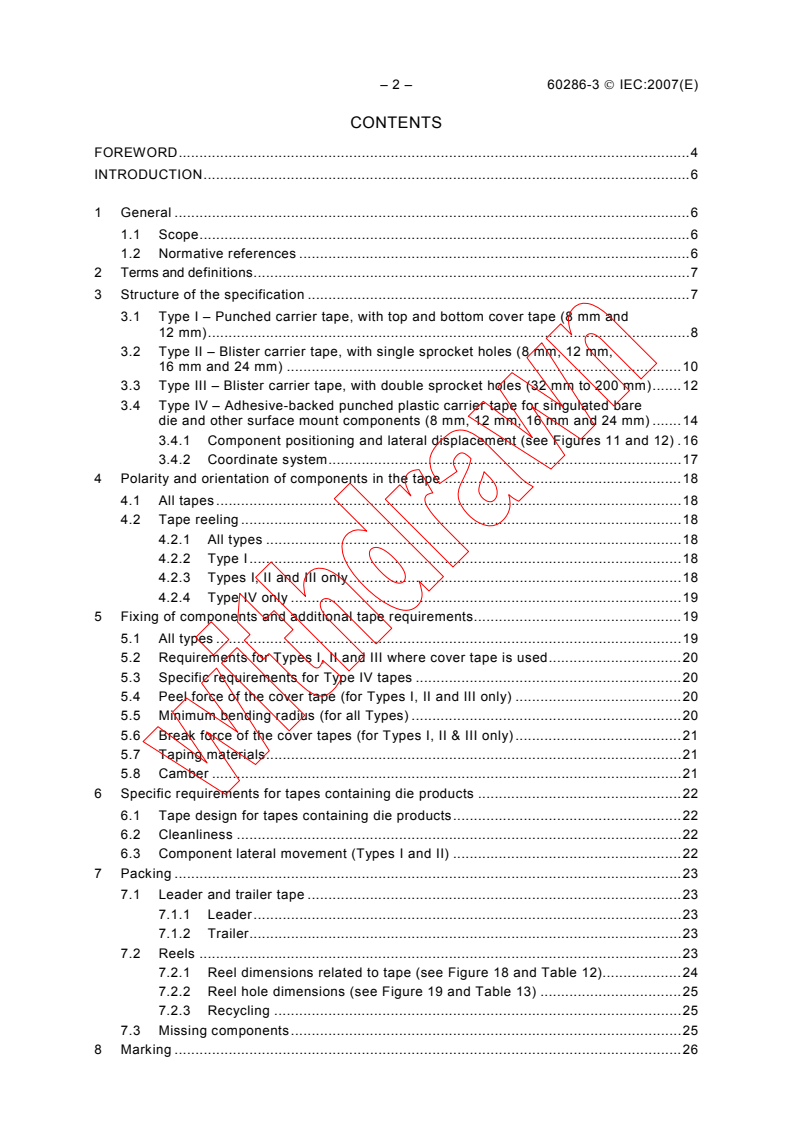
– 2 – 60286-3 © IEC:2007(E)
CONTENTS
FOREWORD.4
INTRODUCTION.6
1 General .6
1.1 Scope.6
1.2 Normative references .6
2 Terms and definitions.7
3 Structure of the specification .7
3.1 Type I – Punched carrier tape, with top and bottom cover tape (8 mm and
12 mm).8
3.2 Type II – Blister carrier tape, with single sprocket holes (8 mm, 12 mm,
16 mm and 24 mm) .10
3.3 Type III – Blister carrier tape, with double sprocket holes (32 mm to 200 mm).12
3.4 Type IV – Adhesive-backed punched plastic carrier tape for singulated bare
die and other surface mount components (8 mm, 12 mm, 16 mm and 24 mm) .14
3.4.1 Component positioning and lateral displacement (see Figures 11 and 12) .16
3.4.2 Coordinate system.17
4 Polarity and orientation of components in the tape .18
4.1 All tapes.18
4.2 Tape reeling .18
4.2.1 All types .18
4.2.2 Type I.18
4.2.3 Types I, II and III only.18
4.2.4 Type IV only .19
5 Fixing of components and additional tape requirements.19
5.1 All types .19
5.2 Requirements for Types I, II and III where cover tape is used.20
5.3 Specific requirements for Type IV tapes .20
5.4 Peel force of the cover tape (for Types I, II and III only) .20
5.5 Minimum bending radius (for all Types) .20
5.6 Break force of the cover tapes (for Types I, II & III only) .21
5.7 Taping materials.21
5.8 Camber .21
6 Specific requirements for tapes containing die products .22
6.1 Tape design for tapes containing die products.22
6.2 Cleanliness .22
6.3 Component lateral movement (Types I and II) .22
7 Packing .23
7.1 Leader and trailer tape .23
7.1.1 Leader.23
7.1.2 Trailer.23
7.2 Reels .23
7.2.1 Reel dimensions related to tape (see Figure 18 and Table 12).24
7.2.2 Reel hole dimensions (see Figure 19 and Table 13) .25
7.2.3 Recycling .25
7.3 Missing components.25
8 Marking .26
60286-3 © IEC:2007(E) – 3 –
Table 1 – Constant dimensions of 8 mm and 12 mm punched carrier tape .9
Table 2 – Variable dimensions of 8 mm and 12 mm punched carrier tape .9
Table 3 – Constant dimensions of 8 mm to 24 mm blister carrier tape.11
Table 4 – Variable dimensions of 8 mm to 24 mm blister carrier tape.11
Table 5 – Constant dimensions of 32 mm to 200 mm blister carrier tape .13
Table 6 – Variable dimensions of 32 mm to 200 mm blister carrier tape .13
Table 7 – Constant dimensions of adhesive backed punched carrier tape .15
Table 8 – Variable dimensions of adhesive-backed punched carrier tape.15
Table 9 – Absolute referencing data for component target position .17
Table 10 – Peel force.20
Table 11 – Minimum bending radius.21
Table 12 – Reel dimensions.24
Table 13 – Reel hole dimensions .25
Figure 1 – 8 mm and 12 mm punched carrier-tape dimensions.8
Figure 2 – Illustration of 2 mm cavity pitch .8
Figure 3 – Maximum component tilt, rotation and lateral movement .8
Figure 4 – Blister carrier tape dimensions (8 mm, 12 mm, 16 mm and 24 mm).10
Figure 5 – Illustration of 2 mm cavity pitch .10
Figure 6 – Maximum component tilt, rotation and lateral movement .10
Figure 7 – Blister carrier tape .12
Figure 8 – Maximum component tilt, rotation and lateral movement .12
Figure 9 – Adhesive-backed punched carrier-tape dimensions (4 mm compartment pitch) .14
Figure 10 – Illustration of 2 mm compartment pitch .14
Figure 11 – Component clearance and positioning method .16
Figure 12 – Maximum component tilt and lateral displacement.16
Figure 13 – Type IV coordinate system .17
Figure 14 – Tape reeling and label area on the reel .19
Figure 15 – Bending radius .21
Figure 16 – Camber (top view).22
Figure 17 – Leader and trailer.23
Figure 18 – Reel dimensions.24
Figure 19 – Reel hole presentation .25
– 4 – 60286-3 © IEC:2007(E)
INTERNATIONAL ELECTROTECHNICAL COMMISSION
____________
PACKAGING OF COMPONENTS FOR AUTOMATIC HANDLING –
Part 3: Packaging of surface mount components
on continuous tapes
FOREWORD
1) The International Electrotechnical Commission (IEC) is a worldwide organization for standardization comprising
all national electrotechnical committees (IEC National Committees). The object of IEC is to promote
international co-operation on all questions concerning standardization in the electrical and electronic fields. To
this end and in addition to other activities, IEC publishes International Standards, Technical Specifications,
Technical Reports, Publicly Available Specifications (PAS) and Guides (hereafter referred to as “IEC
Publication(s)”). Their preparation is entrusted to technical committees; any IEC National Committee interested
in the subject dealt with may participate in this preparatory work. International, governmental and non-
governmental organizations liaising with the IEC also participate in this preparation. IEC collaborates closely
with the International Organization for Standardization (ISO) in accordance with conditions determined by
agreement between the two organizations.
2) The formal decisions or agreements of IEC on technical matters express, as nearly as possible, an international
consensus of opinion on the relevant subjects since each technical committee has representation from all
interested IEC National Committees.
3) IEC Publications have the form of recommendations for international use and are accepted by IEC National
Committees in that sense. While all reasonable efforts are made to ensure that the technical content of IEC
Publications is accurate, IEC cannot be held responsible for the way in which they are used or for any
misinterpretation by any end user.
4) In order to promote international uniformity, IEC National Committees undertake to apply IEC Publications
transparently to the maximum extent possible in their national and regional publications. Any divergence
between any IEC Publication and the corresponding national or regional publication shall be clearly indicated in
the latter.
5) IEC provides no marking procedure to indicate its approval and cannot be rendered responsible for any
equipment declared to be in conformity with an IEC Publication.
6) All users should ensure that they have the latest edition of this publication.
7) No liability shall attach to IEC or its directors, employees, servants or agents including individual experts and
members of its technical committees and IEC National Committees for any personal injury, property damage or
other damage of any nature whatsoever, whether direct or indirect, or for costs (including legal fees) and
expenses arising out of the publication, use of, or reliance upon, this IEC Publication or any other IEC
Publications.
8) Attention is drawn to the Normative references cited in this publication. Use of the referenced publications is
indispensable for the correct application of this publication.
9) Attention is drawn to the possibility that some of the elements of this IEC Publication may be the subject of
patent rights. IEC shall not be held responsible for identifying any or all such patent rights.
International Standard IEC 60286-3 has been prepared by IEC technical committee 40:
Capacitors and resistors for electronic equipment.
This fourth edition cancels and replaces the third edition issued in 1997. It constitutes a
technical revision.
This edition contains the following significant technical changes with respect to the previous
edition:
a) implementation of Type IV (adhesive-backed punched plastic carrier tape for singulated
bare die and other surface mount components);
b) minor revisions related to tables, figures and references.
60286-3 © IEC:2007(E) – 5 –
The text of this standard is based on the following documents:
FDIS Report on voting
40/1838/FDIS 40/1847/RVD
Full information on the voting for the approval of this standard can be found in the report on
voting indicated in the above table.
This publication has been drafted in accordance with the ISO/IEC Directives, Part 2.
The list of all the parts of the IEC 60286 series, under the general title Packaging of
components for automatic handling, can be found on the IEC website.
The committee has decided that the contents of this publication will remain unchanged until
the maintenance result date indicated on the IEC web site under "http://webstore.iec.ch" in
the data related to the specific publication. At this date, the publication will be
• reconfirmed,
• withdrawn,
• replaced by a revised edition, or
• amended.
A bilingual version of this publication may be issued at a later date
– 6 – 60286-3 © IEC:2007(E)
PACKAGING OF COMPONENTS FOR AUTOMATIC HANDLING –
Part 3: Packaging of surface mount components
on continuous tapes
INTRODUCTION
Tape packaging meets the requirements of automatic component placement machines and
also covers the use of tape packaging for components for test purposes and other operations.
1 General
1.1 Scope
This part of IEC 60286 is applicable to the tape packaging of electronic components without
leads or with lead stumps which are intended to be connected to electronic circuits. It includes
only those dimensions that are essential for the taping of components intended for the above-
mentioned purposes.
This standard also includes requirements related to the packaging of singulated die products
including bare die and bumped die (flip chips).
1.2 Normative references
The following referenced documents are indispensable for the application of this document.
For dated references, only the edition cited applies. For undated references, the latest edition
of the referenced document (including any amendments) applies.
IEC 60191-2:1966, Mechanical standardization of semiconductor devices – Part 2:
Dimensions
IEC 61340-5-1:1998, Electrostatics – Part 5-1: Protection of electronic devices from
electrostatic phenomena – General requirements
IEC 61340-5-2:1999, Electrostatics – Part 5-2: Protection of electronic devices from
electrostatic phenomena – User guide
IEC 62258-3:2005, Semiconductor die products – Part 3: Recommendations for good practice
in handling, packing and storage
ISO/IEC 16388:1999, Information technology – Automatic identification and data capture
techniques – Bar code symbology specifications – Code 39
ISO 11469:2000, Plastics – Generic identification and marking of plastics products
60286-3 © IEC:2007(E) – 7 –
2 Terms and definitions
For the purposes of this document, the following terms and definitions apply.
2.1
packaging
product made of any material of any nature to be used for the containment, protection,
structured alignment for automatic assembly, handling and delivery
3 Structure of the specification
The various types of tapes are as follows.
Type I - Punched carrier tape, with top and bottom cover tape (8 mm and 12 mm)
Type II - Blister carrier tape, with single sprocket holes (8 mm, 12 mm, 16 mm and
24 mm)
Type III - Blister carrier tape, with double sprocket holes (32 mm to 200 mm)
Type IV - Adhesive-backed punched plastic carrier tape for singulated bare die and
other surface mount components
Type V - Continuous pressed carrier tapes (in development)
Type VI - Blister carrier tapes 4 mm in width (in development)
All dimensions in the tables are in millimetres.
– 8 – 60286-3 © IEC:2007(E)
3.1 Type I – Punched carrier tape, with top and bottom cover tape (8 mm and 12 mm)
P
T
D P
0 2
Top Bottom
cover cover
E
tape tape
F
W
E
B
T
T
G
A P
0 1
Direction of unreeling
IEC 625/07
Figure 1 – 8 mm and 12 mm punched carrier-tape dimensions
P
P
P
Pocket off-set: 0,05 mm max.
IEC 629/07
Figure 2 – Illustration of 2 mm cavity pitch
0,3 mm max. (P = 2 )
20° max.
0,5 mm max. (P ≥ 4 )
See also Table 2, Note d
Typical
cavity
centre line
(design value)
10° max.
B
Typical
component
centre line
A
Component tilt Component planar Component lateral
movements
rotation
Side or front
sectional view Top view
Top view
Sketch A Sketch B
Sketch C
IEC 627/07
Figure 3 – Maximum component tilt, rotation and lateral movement
60286-3 © IEC:2007(E) – 9 –
Table 1 – Constant dimensions of 8 mm and 12 mm punched carrier tape
Tape size D E P P G T T Cumulative
0 1 0 2 min max 1max
pitch (over
10 pitches)
+0,1
1,5
8 and 12 1,75 ± 0,1 4,0 ± 0,1 2,0 ± 0,05 0,75 1,1 paper 0,1 ± 0,2
(P ≥ 4)
1,6 non-
4,0 ± 0,05
paper
(P = 2)
Table 2 – Variable dimensions of 8 mm and 12 mm punched carrier tape
Tape size E F P W A , B , T
2 min 1 0 0
+0,3
8 6,25 3,5 ± 0,05 4,0 ± 0,1 See note
8,0
−0,1
(P ≥ 4)
2,0 ± 0,05
(P = 2)
+0,3
4,0 ± 0,1
12 10,25 5,5 ± 0,05 12,0
−0,1
(P ≥ 4)
2,0 ± 0,05
(P = 2)
NOTE The nominal dimensions of the component compartment should be derived from the relevant component
specification. The tolerances on the nominal dimensions of the compartment should be chosen so that the
components cannot change their orientation within the tape and can be easily removed from the tape, with the
following characteristics.
There shall be sufficient clearance surrounding the component so that
a) the component does not protrude beyond either surface of the carrier tape;
b) the component can be removed from the cavity in a vertical direction without mechanical restriction
after the top cover tape has been removed;
c) the rotation of the component is limited to a 10° max. tilt (see Figure 3, sketch A) and a 20°
max. planar rotation (see Figure 3, sketch B);
d) the lateral movement of the component is restricted to 0,5 mm max.(P ≥ 4), 0,3 mm max.(P = 2)
1 1
(see Figure 3, sketch C).
For components with either length or width dimensions of less than 1,2 mm, market trends are towards a planar
rotation limit of 10° max. and a lateral movement of 0,2 mm max. and a component rotation depends on the
agreement between suppliers and users. See also Clause 6 for die products.
For defined component positioning, the pocket positions should be defined to an origin point; in this case, the
index hole. Pockets should be positioned relative to this hole.
Preferred dimensions for components should be taken from the relevant IEC specifications.
Dimensions A ≤ B .
0 0
– 10 – 60286-3 © IEC:2007(E)
3.2 Type II – Blister carrier tape, with single sprocket holes (8 mm, 12 mm, 16 mm
and 24 mm)
P
T
D P
0 2
E
Cover
tape
F
W
E
B
B
G
T
D
1 1
T
2 G
P
K
A
Direction of unreeling
IEC 628/07
Figure 4 – Blister carrier tape dimensions (8 mm, 12 mm, 16 mm and 24 mm)
P
P
P
Pocket off-set: 0,05 mm max.
IEC 629/07
Figure 5 – Illustration of 2 mm cavity pitch
20° max.
(W = 8 mm and 12 mm)
10° max. (W > 12 mm)
See also Table 2, Note d
Typical
cavity
centre line
10° max.
B
Typical
component
centre line
A
Component tilt Component planar Component lateral
rotation movements
Side or front
sectional view Top view
Top view
Sketch D Sketch E
Sketch F
IEC 630/07
Figure 6 – Maximum component tilt, rotation and lateral movement
60286-3 © IEC:2007(E) – 11 –
Table 3 – Constant dimensions of 8 mm to 24 mm blister carrier tape
Tape size D E G P T T Cumulative pitch
0 1 min 0 max 1max
(over 10 pitches)
+0,1
1,5
8 to 24 1,75 ± 0,1 0,75 4,0 ± 0,1 0,6 0,1 ±0,2
(P ≥ 4)
4,0 ± 0,05
(P = 2)
Table 4 – Variable dimensions of 8 mm to 24 mm blister carrier tape
a
Tape B1max. E2 min F P1 P2 T2 max W A0, B0,
D
1 min
size K
+0,3
4,35 0,3 6,25 3,5 ± 0,05 2,0 ± 0,05 2,0 ± 0,05 3,5 8,0 see
−0,1
4,0 ± 0,1 Note
+0,3
12 8,2 1,5 10,25 5,5 ± 0,05 2,0 ± 0,05 2,0 ± 0,05 6,5
12,0
−0,1
4,0 ± 0,1 or
12,0 ± 0,1 in
4,0 increments
+0,3
16 12,1 1,5 14,25 7,5 ± 0,1 4,0 ± 0,1 to 2,0 ± 0,1 9,5 16,0
−0,1
16,0 ± 0,1 in
4,0 increments
+0,3
24 20,1 1,5 22,25 11,5 ± 0,1 4,0 ± 0,1 to 2,0 ± 0,1 12,5 24,0
−0,1
24,0 ± 0,1 in
4,0 increments
NOTE The nominal dimensions of the component compartment should be derived from the relevant component
specification. The tolerances on the nominal sizes of the compartment should be selected so that the
components cannot change their orientation within the tape and can be easily removed from the tape, with the
following characteristics.
There shall be sufficient clearance surrounding the component so that
a) the component does not protrude above the top surface of the carrier tape;
b) the component can be removed from the cavity in a vertical direction without mechanical restriction after the
top cover tape has been removed;
c) the rotation of the component is limited to a 10° max. tilt (see Figure 6, sketch D), a 20° max. planar rotation
for W = 8 mm and 12 mm and a 10° max. planar rotation for W = 16 mm and 24 mm (see Figure 6, sketch E);
d) the lateral movement of the component is restricted to 0,5 mm max. (see Figure 6, sketch F).
For components with either length or width dimensions of less than 1,2 mm, market trends are towards a planar
rotation limit of 10° max. and lateral movements of 0,2 mm max. See also Clause 6 for die products.
The centre of the component compartment is defined by P and F, relative to the sprocket holes, as shown in
Figure 4 with tolerances given in the table above. The centre of the index hole is defined by P and F, relative to
the sprocket holes, as shown in Figure 4 with the tolerances given in the table above.
Preferred dimensions for components shall be taken from the relevant IEC specifications.
Dimensions A ≤ B .
0 0
Dimension K should comply with the component tilt in Sketch D.
In the case of P1 = 2 mm, the off-set between the centre of the component compartment and the centre of the
sprocket hole should not be more than 0,05 mm (see Figure 5).
a
Optionally, for easy and reliable removal of the component, or for component inspection or for any applicable
application, the cavity may have a hole in the centre of the bottom.
– 12 – 60286-3 © IEC:2007(E)
3.3 Type III – Blister carrier tape, with double sp
...
IEC 60286-3
Edition 4.0 2007-06
INTERNATIONAL
STANDARD
NORME
INTERNATIONALE
Packaging of components for automatic handling –
Part 3: Packaging of surface mount components on continuous tapes
Emballage de composants pour opérations automatisées –
Partie 3: Emballage des composants appropriés au montage en surface en
bandes continues
All rights reserved. Unless otherwise specified, no part of this publication may be reproduced or utilized in any form or by
any means, electronic or mechanical, including photocopying and microfilm, without permission in writing from either IEC or
IEC's member National Committee in the country of the requester.
If you have any questions about IEC copyright or have an enquiry about obtaining additional rights to this publication,
please contact the address below or your local IEC member National Committee for further information.
Droits de reproduction réservés. Sauf indication contraire, aucune partie de cette publication ne peut être reproduite
ni utilisée sous quelque forme que ce soit et par aucun procédé, électronique ou mécanique, y compris la photocopie
et les microfilms, sans l'accord écrit de la CEI ou du Comité national de la CEI du pays du demandeur.
Si vous avez des questions sur le copyright de la CEI ou si vous désirez obtenir des droits supplémentaires sur cette
publication, utilisez les coordonnées ci-après ou contactez le Comité national de la CEI de votre pays de résidence.
IEC Central Office
3, rue de Varembé
CH-1211 Geneva 20
Switzerland
Email: inmail@iec.ch
Web: www.iec.ch
About the IEC
The International Electrotechnical Commission (IEC) is the leading global organization that prepares and publishes
International Standards for all electrical, electronic and related technologies.
About IEC publications
The technical content of IEC publications is kept under constant review by the IEC. Please make sure that you have the
latest edition, a corrigenda or an amendment might have been published.
ƒ Catalogue of IEC publications: www.iec.ch/searchpub
The IEC on-line Catalogue enables you to search by a variety of criteria (reference number, text, technical committee,…).
It also gives information on projects, withdrawn and replaced publications.
ƒ IEC Just Published: www.iec.ch/online_news/justpub
Stay up to date on all new IEC publications. Just Published details twice a month all new publications released. Available
on-line and also by email.
ƒ Electropedia: www.electropedia.org
The world's leading online dictionary of electronic and electrical terms containing more than 20 000 terms and definitions
in English and French, with equivalent terms in additional languages. Also known as the International Electrotechnical
Vocabulary online.
ƒ Customer Service Centre: www.iec.ch/webstore/custserv
If you wish to give us your feedback on this publication or need further assistance, please visit the Customer Service
Centre FAQ or contact us:
Email: csc@iec.ch
Tel.: +41 22 919 02 11
Fax: +41 22 919 03 00
A propos de la CEI
La Commission Electrotechnique Internationale (CEI) est la première organisation mondiale qui élabore et publie des
normes internationales pour tout ce qui a trait à l'électricité, à l'électronique et aux technologies apparentées.
A propos des publications CEI
Le contenu technique des publications de la CEI est constamment revu. Veuillez vous assurer que vous possédez
l’édition la plus récente, un corrigendum ou amendement peut avoir été publié.
ƒ Catalogue des publications de la CEI: www.iec.ch/searchpub/cur_fut-f.htm
Le Catalogue en-ligne de la CEI vous permet d’effectuer des recherches en utilisant différents critères (numéro de référence,
texte, comité d’études,…). Il donne aussi des informations sur les projets et les publications retirées ou remplacées.
ƒ Just Published CEI: www.iec.ch/online_news/justpub
Restez informé sur les nouvelles publications de la CEI. Just Published détaille deux fois par mois les nouvelles
publications parues. Disponible en-ligne et aussi par email.
ƒ Electropedia: www.electropedia.org
Le premier dictionnaire en ligne au monde de termes électroniques et électriques. Il contient plus de 20 000 termes et
définitions en anglais et en français, ainsi que les termes équivalents dans les langues additionnelles. Egalement appelé
Vocabulaire Electrotechnique International en ligne.
ƒ Service Clients: www.iec.ch/webstore/custserv/custserv_entry-f.htm
Si vous désirez nous donner des commentaires sur cette publication ou si vous avez des questions, visitez le FAQ du
Service clients ou contactez-nous:
Email: csc@iec.ch
Tél.: +41 22 919 02 11
Fax: +41 22 919 03 00
IEC 60286-3
Edition 4.0 2007-06
INTERNATIONAL
STANDARD
NORME
INTERNATIONALE
Packaging of components for automatic handling –
Part 3: Packaging of surface mount components on continuous tapes
Emballage de composants pour opérations automatisées –
Partie 3: Emballage des composants appropriés au montage en surface en
bandes continues
INTERNATIONAL
ELECTROTECHNICAL
COMMISSION
COMMISSION
ELECTROTECHNIQUE
PRICE CODE
INTERNATIONALE
U
CODE PRIX
ICS 31.020; 31.240 ISBN 2-8318-9920-6
– 2 – 60286-3 © IEC:2007
CONTENTS
FOREWORD.4
INTRODUCTION.6
1 General .6
1.1 Scope.6
1.2 Normative references .6
2 Terms and definitions .7
3 Structure of the specification .7
3.1 Type I – Punched carrier tape, with top and bottom cover tape (8 mm and
12 mm).8
3.2 Type II – Blister carrier tape, with single sprocket holes (8 mm, 12 mm,
16 mm and 24 mm) .10
3.3 Type III – Blister carrier tape, with double sprocket holes (32 mm to 200 mm).12
3.4 Type IV – Adhesive-backed punched plastic carrier tape for singulated bare
die and other surface mount components (8 mm, 12 mm, 16 mm and 24 mm) .14
3.4.1 Component positioning and lateral displacement (see Figures 11 and 12) .16
3.4.2 Coordinate system.17
4 Polarity and orientation of components in the tape .18
4.1 All tapes.18
4.2 Tape reeling .18
4.2.1 All types .18
4.2.2 Type I.18
4.2.3 Types I, II and III only.18
4.2.4 Type IV only .19
5 Fixing of components and additional tape requirements.19
5.1 All types .19
5.2 Requirements for Types I, II and III where cover tape is used.20
5.3 Specific requirements for Type IV tapes .20
5.4 Peel force of the cover tape (for Types I, II and III only) .20
5.5 Minimum bending radius (for all types) .20
5.6 Break force of the cover tapes (for Types I, II and III only) .21
5.7 Taping materials.21
5.8 Camber .21
6 Specific requirements for tapes containing die products .22
6.1 Tape design for tapes containing die products.22
6.2 Cleanliness .22
6.3 Component lateral movement (Types I and II) .22
7 Packing .23
7.1 Leader and trailer tape (see Figure 17) .23
7.1.1 Leader.23
7.1.2 Trailer.23
7.2 Reels .23
7.2.1 Reel dimensions related to tape (see Figure 18 and Table 12).24
7.2.2 Reel hole dimensions (see Figure 19 and Table 13) .25
7.2.3 Recycling .25
7.3 Missing components.25
8 Marking .26
60286-3 © IEC:2007 – 3 –
Figure 1 – 8 mm and 12 mm punched carrier-tape dimensions.8
Figure 2 – Illustration of 2 mm cavity pitch .8
Figure 3 – Maximum component tilt, rotation and lateral movement .8
Figure 4 – Blister carrier tape dimensions (8 mm, 12 mm, 16 mm and 24 mm).10
Figure 5 – Illustration of 2 mm cavity pitch .10
Figure 6 – Maximum component tilt, rotation and lateral movement .10
Figure 7 – Blister carrier tape .12
Figure 8 – Maximum component tilt, rotation and lateral movement .12
Figure 9 – Adhesive-backed punched carrier-tape dimensions (4 mm compartment
pitch) .14
Figure 10 – Illustration of 2 mm compartment pitch .14
Figure 11 – Component clearance and positioning method .16
Figure 12 – Maximum component tilt and lateral displacement.16
Figure 13 – Type IV coordinate system .17
Figure 14 – Tape reeling and label area on the reel .19
Figure 15 – Bending radius .21
Figure 16 – Camber (top view).22
Figure 17 – Leader and trailer.23
Figure 18 – Reel dimensions.24
Figure 19 – Reel hole presentation .25
Table 1 – Constant dimensions of 8 mm and 12 mm punched carrier tape .9
Table 2 – Variable dimensions of 8 mm and 12 mm punched carrier tape .9
Table 3 – Constant dimensions of 8 mm to 24 mm blister carrier tape.11
Table 4 – Variable dimensions of 8 mm to 24 mm blister carrier tape.11
Table 5 – Constant dimensions of 32 mm to 200 mm blister carrier tape .13
Table 6 – Variable dimensions of 32 mm to 200 mm blister carrier tape .13
Table 7 – Constant dimensions of adhesive backed punched carrier tape .15
Table 8 – Variable dimensions of adhesive-backed punched carrier tape.15
Table 9 – Absolute referencing data for component target position .17
Table 10 – Peel force.20
Table 11 – Minimum bending radius.21
Table 12 – Reel dimensions.24
Table 13 – Reel hole dimensions .25
– 4 – 60286-3 © IEC:2007
INTERNATIONAL ELECTROTECHNICAL COMMISSION
____________
PACKAGING OF COMPONENTS FOR AUTOMATIC HANDLING –
Part 3: Packaging of surface mount components
on continuous tapes
FOREWORD
1) The International Electrotechnical Commission (IEC) is a worldwide organization for standardization comprising
all national electrotechnical committees (IEC National Committees). The object of IEC is to promote
international co-operation on all questions concerning standardization in the electrical and electronic fields. To
this end and in addition to other activities, IEC publishes International Standards, Technical Specifications,
Technical Reports, Publicly Available Specifications (PAS) and Guides (hereafter referred to as “IEC
Publication(s)”). Their preparation is entrusted to technical committees; any IEC National Committee interested
in the subject dealt with may participate in this preparatory work. International, governmental and non-
governmental organizations liaising with the IEC also participate in this preparation. IEC collaborates closely
with the International Organization for Standardization (ISO) in accordance with conditions determined by
agreement between the two organizations.
2) The formal decisions or agreements of IEC on technical matters express, as nearly as possible, an international
consensus of opinion on the relevant subjects since each technical committee has representation from all
interested IEC National Committees.
3) IEC Publications have the form of recommendations for international use and are accepted by IEC National
Committees in that sense. While all reasonable efforts are made to ensure that the technical content of IEC
Publications is accurate, IEC cannot be held responsible for the way in which they are used or for any
misinterpretation by any end user.
4) In order to promote international uniformity, IEC National Committees undertake to apply IEC Publications
transparently to the maximum extent possible in their national and regional publications. Any divergence
between any IEC Publication and the corresponding national or regional publication shall be clearly indicated in
the latter.
5) IEC provides no marking procedure to indicate its approval and cannot be rendered responsible for any
equipment declared to be in conformity with an IEC Publication.
6) All users should ensure that they have the latest edition of this publication.
7) No liability shall attach to IEC or its directors, employees, servants or agents including individual experts and
members of its technical committees and IEC National Committees for any personal injury, property damage or
other damage of any nature whatsoever, whether direct or indirect, or for costs (including legal fees) and
expenses arising out of the publication, use of, or reliance upon, this IEC Publication or any other IEC
Publications.
8) Attention is drawn to the Normative references cited in this publication. Use of the referenced publications is
indispensable for the correct application of this publication.
9) Attention is drawn to the possibility that some of the elements of this IEC Publication may be the subject of
patent rights. IEC shall not be held responsible for identifying any or all such patent rights.
International Standard IEC 60286-3 has been prepared by IEC technical committee 40:
Capacitors and resistors for electronic equipment.
This fourth edition cancels and replaces the third edition issued in 1997. It constitutes a
technical revision.
This edition contains the following significant technical changes with respect to the previous
edition:
a) implementation of Type IV (adhesive-backed punched plastic carrier tape for singulated
bare die and other surface mount components);
b) minor revisions related to tables, figures and references.
60286-3 © IEC:2007 – 5 –
This bilingual version, published in 2008-08, corresponds to the English version.
The text of this standard is based on the following documents:
FDIS Report on voting
40/1838/FDIS 40/1847/RVD
Full information on the voting for the approval of this standard can be found in the report on
voting indicated in the above table.
The French version of this standard has not been voted upon.
This publication has been drafted in accordance with the ISO/IEC Directives, Part 2.
The list of all the parts of the IEC 60286 series, under the general title Packaging of
components for automatic handling, can be found on the IEC website.
The committee has decided that the contents of this publication will remain unchanged until
the maintenance result date indicated on the IEC web site under "http://webstore.iec.ch" in
the data related to the specific publication. At this date, the publication will be
• reconfirmed,
• withdrawn,
• replaced by a revised edition, or
• amended.
– 6 – 60286-3 © IEC:2007
PACKAGING OF COMPONENTS FOR AUTOMATIC HANDLING –
Part 3: Packaging of surface mount components
on continuous tapes
INTRODUCTION
Tape packaging meets the requirements of automatic component placement machines and
also covers the use of tape packaging for components for test purposes and other operations.
1 General
1.1 Scope
This part of IEC 60286 is applicable to the tape packaging of electronic components without
leads or with lead stumps which are intended to be connected to electronic circuits. It includes
only those dimensions that are essential for the taping of components intended for the above-
mentioned purposes.
This standard also includes requirements related to the packaging of singulated die products
including bare die and bumped die (flip chips).
1.2 Normative references
The following referenced documents are indispensable for the application of this document.
For dated references, only the edition cited applies. For undated references, the latest edition
of the referenced document (including any amendments) applies.
IEC 60191-2:1966, Mechanical standardization of semiconductor devices – Part 2:
Dimensions
IEC 61340-5-1:1998, Electrostatics – Part 5-1: Protection of electronic devices from
)
electrostatic phenomena – General requirements
IEC 61340-5-2:1999, Electrostatics – Part 5-2: Protection of electronic devices from
1)
electrostatic phenomena – User guide
IEC 62258-3:2005, Semiconductor die products – Part 3: Recommendations for good practice
in handling, packing and storage
ISO/IEC 16388:1999, Information technology – Automatic identification and data capture
1)
techniques – Bar code symbology specifications – Code 39
ISO 11469:2000, Plastics – Generic identification and marking of plastics products
___________
)
A new edition of this publication exists.
60286-3 © IEC:2007 – 7 –
2 Terms and definitions
For the purposes of this document, the following terms and definitions apply.
2.1
packaging
product made of any material of any nature to be used for the containment, protection,
structured alignment for automatic assembly, handling and delivery
3 Structure of the specification
The various types of tapes are as follows.
Type I - Punched carrier tape, with top and bottom cover tape (8 mm and 12 mm)
Type II - Blister carrier tape, with single sprocket holes (8 mm, 12 mm, 16 mm and
24 mm)
Type III - Blister carrier tape, with double sprocket holes (32 mm to 200 mm)
Type IV - Adhesive-backed punched plastic carrier tape for singulated bare die and
other surface mount components
Type V - Continuous pressed carrier tapes (in development)
Type VI - Blister carrier tapes 4 mm in width (in development)
All dimensions in the tables are in millimetres.
– 8 – 60286-3 © IEC:2007
3.1 Type I – Punched carrier tape, with top and bottom cover tape (8 mm and 12 mm)
P
T
D P
0 2
Top Bottom
cover cover
E
tape tape
F
W
E
B
T
T
G
A P
0 1
Direction of unreeling
IEC 625/07
Figure 1 – 8 mm and 12 mm punched carrier-tape dimensions
P
P
P
Pocket off-set: 0,05 mm max.
IEC 629/07
Figure 2 – Illustration of 2 mm cavity pitch
0,3 mm max. (P = 2 )
20° max.
0,5 mm max. (P ≥ 4 )
See also Table 2, Note d
Typical
cavity
centre line
(design value)
10° max.
B
Typical
component
centre line
A
Component tilt Component planar Component lateral
movements
rotation
Side or front
sectional view Top view
Top view
Sketch A Sketch B
Sketch C
IEC 627/07
Figure 3 – Maximum component tilt, rotation and lateral movement
60286-3 © IEC:2007 – 9 –
Table 1 – Constant dimensions of 8 mm and 12 mm punched carrier tape
Tape size D E P P G T T Cumulative
0 1 0 2 min max 1max
pitch (over
10 pitches)
+0,1
1,5
8 and 12 0,75 1,1 paper 0,1
0 1,75 ± 0,1 4,0 ± 0,1 2,0 ± 0,05 ± 0,2
(P ≥ 4)
1,6 non-
4,0 ± 0,05
paper
(P = 2)
Table 2 – Variable dimensions of 8 mm and 12 mm punched carrier tape
Tape size E F P W A , B , T
2 min 1 0 0
+0,3
4,0 ± 0,1
8 6,25 3,5 ± 0,05 8,0 See note
−0,1
(P ≥ 4)
2,0 ± 0,05
(P = 2)
+0,3
12 10,25 4,0 ± 0,1
5,5 ± 0,05 12,0
−0,1
(P ≥ 4)
2,0 ± 0,05
(P = 2)
NOTE The nominal dimensions of the component compartment should be derived from the relevant component
specification. The tolerances on the nominal dimensions of the compartment should be chosen so that the
components cannot change their orientation within the tape and can be easily removed from the tape, with the
following characteristics.
There shall be sufficient clearance surrounding the component so that
a) the component does not protrude beyond either surface of the carrier tape;
b) the component can be removed from the cavity in a vertical direction without mechanical restriction after the
top cover tape has been removed;
c) the rotation of the component is limited to a 10° max. tilt (see Figure 3, sketch A) and a 20° max. planar
rotation (see Figure 3, sketch B);
d) the lateral movement of the component is restricted to 0,5 mm max.(P ≥ 4), 0,3 mm max.(P = 2) (see Figure 3,
1 1
sketch C).
For components with either length or width dimensions of less than 1,2 mm, market trends are towards a planar
rotation limit of 10° max. and a lateral movement of 0,2 mm max. and a component rotation depends on the
agreement between suppliers and users. See also Clause 6 for die products.
For defined component positioning, the pocket positions should be defined to an origin point; in this case, the
index hole. Pockets should be positioned relative to this hole.
Preferred dimensions for components should be taken from the relevant IEC specifications.
Dimensions A ≤ B .
0 0
– 10 – 60286-3 © IEC:2007
3.2 Type II – Blister carrier tape, with single sprocket holes (8 mm, 12 mm, 16 mm
and 24 mm)
P
T
D P
0 2
E
Cover
tape
F
W
E
B
B
G
T
D
1 1
T
2 G
P
K
A
Direction of unreeling
IEC 628/07
Figure 4 – Blister carrier tape dimensions (8 mm, 12 mm, 16 mm and 24 mm)
P
P
P
Pocket off-set: 0,05 mm max.
IEC 629/07
Figure 5 – Illustration of 2 mm cavity pitch
20° max.
(W = 8 mm and 12 mm)
10° max. (W > 12 mm)
See also Table 2, Note d
Typical
cavity
centre line
10° max.
B
Typical
component
centre line
A
Component tilt Component planar Component lateral
rotation movements
Side or front
sectional view Top view
Top view
Sketch D Sketch E
Sketch F
IEC 630/07
Figure 6 – Maximum component tilt, rotation and lateral movement
60286-3 © IEC:2007 – 11 –
Table 3 – Constant dimensions of 8 mm to 24 mm blister carrier tape
Tape size D E G P T T Cumulative pitch
0 1 min 0 max 1max
(over 10 pitches)
+0,1
1,5
8 to 24 1,75 ± 0,1 0,75 4,0 ± 0,1 0,6 0,1 ±0,2
(P ≥ 4)
4,0 ± 0,05
(P = 2)
Table 4 – Variable dimensions of 8 mm to 24 mm blister carrier tape
a
Tape B E F P P T W A , B ,
1max. 2 min 1 2 2 max 0 0
D
1 min
size K
+0,3
8 4,35 0,3 6,25 3,5 8,0 See
3,5 ± 0,05 2,0 ± 0,05 2,0 ± 0,05
−0,1
Note
4,0 ± 0,1
+0,3
12 8,2 1,5 10,25 6,5 12,0
5,5 ± 0,05 2,0 ± 0,05 2,0 ± 0,05
−0,1
4,0 ± 0,1 or
12,0 ± 0,1 in
4,0 increments
+0,3
16 12,1 1,5 14,25 9,5 16,0
7,5 ± 0,1 4,0 ± 0,1 to 2,0 ± 0,1
−0,1
16,0 ± 0,1 in
4,0 increments
+0,3
24 20,1 1,5 22,25 12,5 24,0
11,5 ± 0,1 4,0 ± 0,1 to 2,0 ± 0,1
−0,1
24,0 ± 0,1 in
4,0 increments
NOTE The nominal dimensions of the component compartment should be derived from the relevant component
specification. The tolerances on the nominal sizes of the compartment should be selected so that the
components cannot change their orientation within the tape and can be easily removed from the tape, with the
following characteristics.
There shall be sufficient clearance surrounding the component so that
a) the component does not protrude above the top surface of the carrier tape;
b) the component can be removed from the cavity in a vertical direction without mechanical restriction after the
top cover tape has been removed;
c) the rotation of the component is limited to a 10° max. tilt (see Figure 6, sketch D), a 20° max. planar rotation
for W = 8 mm and 12 mm and a 10° max. planar rotation for W = 16 mm and 24 mm (see Figure 6, sketch E);
d) the lateral movement of the component is restricted to 0,5 mm max. (see Figure 6, sketch F).
For components with either length or width dimensions of less than 1,2 mm, market trends are towards a planar
rotation limit of 10° max. and lateral movements of 0,2 mm max. See also Clause 6 for die products.
The centre of the component compartment is defined by P and F, relative to the sprocket holes, as shown in
Figure 4 with tolerances given in the table above. The centre of the index hole is defined by P and F, relative to
the sprocket holes, as shown in Figure 4 with the tolerances given in the table above.
Preferred dimensions for components shall be taken from the relevant IEC specifications.
Dimensions A ≤ B .
0 0
Dimension K should comply with the component tilt in sketch D.
In the case of P = 2 mm, the off-set between the centre of the component compartment and the centre of the
sprocket hole should not be more than 0,05 mm (see Figure 5).
a
Optionally, for easy and reliable removal of the component, or for component inspection or for any applicable
application, the cavity may have a hole in the centre of the bottom.
– 12 – 60286-3 © IEC:2007
3.3 Type III – Blister carrier tape, with double sprocket holes (32 mm to 200 mm)
P
T
D P
0 2
E
Cover
tape
F
W
B B
S
d
D
T 0
D
T
Skew
K
A P
Direction of unreeling
IEC 631/07
Figure 7 – Blister carrier tape
10° max.
1,0 mm max.
Typical
cavity
centre line
10° max. (32 mm to 56 mm tape)
5° max. (72 mm to 200 mm tape)
Design value
B
Typical
component
centre line
A
Component lateral
Component tilt Component planar
rotation movements
Side or front
sectional view Top view
Top view
Sketch D
Sketch E
Sketch F
IEC 632/07
Figure 8 – Maximum component tilt, rotation and lateral movement
60286-3 © IEC:2007 – 13 –
Table 5 – Constant dimensions of 32 mm to 200 mm blister carrier tape
a
Tape size D D d E P T T Cumulative
0 1 min 0 max 1 max
pitch (over
10 pitches)
+0,1
1,5
32 to 200
0 2,0 1,0 0,1
0,2 ± 0,05 1,75 ± 0,1 4,0 ± 0,1 ±0,2
a
Optionally, for easy and reliable removal of the component from the compartment of the tape by
automatic pick-up equipment, the cavity may have a hole in the centre of the bottom.
Table 6 – Variable dimensions of 32 mm to 200 mm blister carrier tape
Tape B F P P S Skew T W A , B ,
1 max 1 2 2 max 0 0
size max. K
32 23,0 0,05 12,5 See
14,2 ± 0,1 4,0 ± 0,1 2,0 ± 0,1 28,4 ± 0,1 32,0 ± 0,3
note
to 32,0 ± 0,1
in 4,0 increments
44 35,0 16,0
20,2 ± 0,1 4,0 ± 0,1 2,0 ± 40,4 ± 0,1 44,0 ± 0,3
0,15
to 44,0 ± 0,1
in 4,0 increments
46,0 26,2 ± 0,1 4,0 ± 0,1 2,0 ± 52,4 ± 0,1 20,0 56,0 ± 0,3
0,15
to 56,0 ± 0,1
in 4,0 increments
72 60,0 34,2 ± 0,30 4,0 ± 0,15 2,0 ± 0,2 68,4 ± 0,1 0,1 30,0 72,0
- 0,3/ +0,4
to 72,0 ± 0,15
in 4,0 increments
88 76,0 42,2 ± 0,30 84,4 ± 0,1 88,0
- 0,3/ +0,4
104 91,0 50,2 ± 0,35 4,0 ± 0,20 2,0 ± 100,4 ± 0,2 0,15 35,0 104,0
0,25 - 0,3/ +0,5
to 72,0 ± 0,20
in 4,0 increments
107,0 58,2 ± 0,35 116,4 ± 0,2 40,0 120,0
- 0,3/ +0,5
136 123,0 136,0
66,2 ± 0,40 4,0 ± 0,25 2,0 ± 0,3 132,4 ± 0,2
- 0,3/ +0,5
to 72,0 ± 0,25
in 4,0 increments
152 139,0 152,0
74,2 ± 0,40 148,4 ± 0,3
- 0,3/ +0,6
168 153,0 0,2 168,0
82,2 ± 0,45 4,0 ± 0,30 2,0 ± 164,4 ± 0,3
- 0,3/ +0,6
0,35
to 72,0 ± 0,30
in 4,0 increments
184 169,0 184,0
90,2 ± 0,45 180,4 ± 0,3
- 0,3/ +0,6
200 185,0 200,0
98,2 ± 0,50 4,0 ± 0,35 2,0 ± 0,4 196,4 ± 0,3
- 0,3/ +0,6
to 72,0 ± 0,35
in 4,0 increments
NOTE The nominal dimension of the component compartment should be derived from the relevant component
specification. The tolerances on the nominal sizes of the compartment should be selected so that the components
cannot change their orientation within the tape and can be easily removed from the tape, with the following
characteristics.
There shall be sufficient clearance surrounding the component so that
a) the component does not protrude above the top surface of the carrier tape;
b) the component can be removed from the cavity in a vertical direction without mechanical restriction after the top
cover tape has been removed;
c) the rotation of the component is limited to 10° max. (see Figure 8, sketches D and E);
d) the lateral movement of the component is restricted to 1,0 mm max. (see Figure 8, sketch F).
Preferred dimensions for components shall be taken from the relevant IEC specifications.
Dimensions A ≤ B .
0 0
Dimension K should comply with the component tilt in sketch D.
R for 72 mm to 200 mm tape: 75.
min
The centre of the component compartment is defined by P and F, relative to the sprocket holes, as shown in Figure 6
with the tolerances given in the table above. The centre of the index hole is defined by P and F, relative to the sprocket
holes, as shown in Figure 6 with the tolerances given in the table above.
– 14 – 60286-3 © IEC:2007
3.4 Type IV – Adhesive-backed punched plastic carrier tape for singulated bare die
and other surface mount components (8 mm, 12 mm, 16 mm and 24 mm)
Type IV requires some explanation of the coordinate system and tape parameters. It is similar
to Type I, but, whereas Type I has cavities sized to the component dimensions, Type IV uses
a standard compartment size much larger than the component, the orientation and
displacement of which is fixed by being placed on a backing of adhesive film.
Component placement accuracy is determined during component taping, when the component
is placed into the tape. Therefore, parameters P and F are absolute when determining the
2A A
displacement of the component in the tape relative to the drive sprocket hole (see 3.4.1 and
Table 9).
P
T
D
0 P
Adhesive
E
tape
F
W
V
T
V P
1 G
Direction of unreeling
IEC 633/07
Figure 9 – Adhesive-backed punched carrier-tape dimensions
(4 mm compartment pitch)
P
V
V P
1 1
IEC 634/07
Figure 10 – Illustration of 2 mm compartment pitch
60286-3 © IEC:2007 – 15 –
Table 7 – Constant dimensions of adhesive backed punched carrier tape
Tape size D E P P T G T
o 1 o 2 1 max min max
2,0 ± 0,05
(W = 8 and 12)
+0,05
8 to 24
1,5 1,75 ± 0,05 4,0 ± 0,025 0,1 0,75 1,1
0 2,0 ± 0,1
(W = 16 and
24)
Table 8 – Variable dimensions of adhesive-backed punched carrier tape
Tape size F P V V W
1 1 2
1,5 3,1
2,0 ± 0,05
3,50 ± 0,05 8,1 ± 0,1
4,0 ± 0,1
3,1 3,1
1,5 6,35
2,0 ± 0,05
4,0 ± 0,1 to
12 5,50 ± 0,05 3,1 6,35 12,1 ± 0,1
12,0 ± 0,1 in
4,0 increments
6,35 6,35
4,0 ± 0,1 to
6,35 10,2
16 7,50 ± 0,05 16,1 ± 0,1
16,0 ± 0,1 in
4,0 increments 10,2 10,2
4,0 ± 0,1 to
10,2 17,3
11,50 ± 0,05 24,0 ± 0,1 in 24,1 ± 0,1
14,0 17,3
4,0 increments
NOTE 1 The virtual boundary (comprising an area of maximum size, irrespective of component size)
is defined by V , V , and T. These dimensions should be selected to provide sufficient clearance
1 2
surrounding the component so that
a) the component does not protrude beyond the top of the carrier tape;
b) the component can be removed from the compartment in a vertical direction by vacuum pick-up or
by non-surface contact means;
c) the component may be precisely positioned laterally and rotationally at the target coordinates and
remain immobilized when affixed to the adhesive backing.
NOTE 2 The minimum bending radius for the tape with components is proportional to the component
dimension in the V direction of the carrier tape compartment. A minimum bending radius of 100 mm is
recommended for 24 mm tapes containing singulated bare die when the component/compartment pitch
P (Figure 9) is 16 mm. When required, a length of carrier tape trailer can be spooled on the reel to
increase effective reel hub diameter (N, Figure 18).
NOTE 3 Dimension E , as defined in 3.1, is for Type IV tape minimum value only but can be derived
as a reference dimension by subtracting E from W .
1 max
– 16 – 60286-3 © IEC:2007
P
2A
Punched tape thickness T >
component thickness Z
F
A
Z < T
Virtual component Centroid of component is
boundary (ref.) targeted on centre of
Not to be used as
abscissa and ordinate, F
A
a datum for component
and P
2A
placement
Side or front Component
sectional view location
Sketch A Sketch B
Direction of reeling during
component placement into
tape
IEC 635/07
Figure 11 – Component clearance and positioning method
P P
2A 2A
± 0,05 mm (P = 2)
± 0,1 mm (P = 4)
5° max.
F
A
F
A
Typical component
centre lines
Component planar
Component lateral
rotation displacement
(top view)
(top view)
Direction of reeling during
component placement into
Sketch C
Sketch D
tape
IEC 636/07
Figure 12 – Maximum component tilt and lateral displacement
3.4.1 Component positioning and lateral displacement (see Figures 11 and 12)
The component position in Type IV tape is not measured with respect to the compartment, as
in Types I, II and III, but relative to a virtual target point at an absolute position given by P
2A
and F . Table 9 gives the absolute position of this target point relative to the sprocket-hole
A
centroid for different tape sizes.
The maximum displacement of the actual component position from this target location is
shown in sketch D of Figure 12 and may be negative or positive. This displacement is a
function of the accuracy of the component placement system and not the tape.
It is normal for the user drawing to specify the maximum component rotational and lateral
displacement of the component when delivered in Type IV, which may have a tighter tolerance
60286-3 © IEC:2007 – 17 –
than that shown in sketches C and D, where the repeatability of the component position at the
pick point is critical.
Table 9 – Absolute referencing data for component target position
Tape size F P
A 2A
3,5 2,0
12 5,5 2,0
16 7,5 2,0
24 11,5 2,0
Punched plastic
Sprocket drive
Ordinates
carrier tape
holes
P
2A Pressure-sensitive
adhesive tape
F
A
Abscissa
Virtual boundary
Target centre point
compartments
for components
IEC 637/07
Figure 13 – Type IV coordinate system
3.4.2 Coordinate system
3.4.2.1 The coordinate system shown in Figure 13 is established to define carrier tape
dimensioning together with components placements on adhesive-backed punched plastic
carrier tapes.
3.4.2.2 The abscissa is a 0-0 datum straight line of infinite length to align the centres of a
plurality of sprocket drive holes throughout the entire length of the continuous tapes.
3.4.2.3 Ordinates are lines at right angles to the abscissa and uniformly spaced along its
length to position the centre of each sprocket drive hole aligned along the abscissa.
3.4.2.4 Compartments within the punched plastic carrier tape comprise virtual boundaries for
the placement of components at predetermined pitch intervals throughout the length of the
carrier tape.
3.4.2.5 Horizontal and vertical coordinates dimensioned from the abscissa and ordinates
establish target location centre points for the planar centroids of the components placed
within each virtual boundary. See 3.4.2.6 and 3.4.2.7.
3.4.2.6 The centre of the components shall be located within a 0,2 mm diameter of the target
centerpoints within the virtual boundaries. See Figures 11 and 13.
3.4.2.7 Component rotation shall be limited to 5° from the abscissa axis centre line of the
sprocket drive holes (see Figure 12).
– 18 – 60286-3 © IEC:2007
3.4.2.8 Adherence to the tolerances defined in Figure 9 and Table 8 ensures that the
following critical criteria are maintained:
a) precise alignment of all sprocket drive hole centres along abscissa;
b) consistent pitch of sprocket holes throughout the entire length of the tape;
c) uniform diameters of all sprocket drive holes;
d) polarity and orientation of components in the tape.
4 Polarity and orientation of components in the tape
4.1 All tapes
All polarized components shall be oriented in one direction. For components with two
terminations, the cathode side shall be either adjacent to the sprocket hole or the last one to
leave the package, unless otherwise specified in the detail specification.
For components in flat packages (for example, chip carriers and SO-packages) with more
than two terminations, termination No. 1 shall be adjacent to the round sprocket hole, unless
otherwise specified in the detail specification.
For die products (bare die or bumped die) with more than two pads or terminations, pad No. 1
shall be located on the side adjacent to the round sprocket hole, unless otherwise specified in
the detail specification.
For components with a lead configuration corresponding to IEC 60191-2, the component side
from which one single termination emerges shall be at the compartment side closest to the
sprocket holes in the tape and the mounting side shall face the bottom of the component
compartment.
For quartz-crystal units with two terminations located on one side of the package, the
terminations shall be located at the sprocket hole side.
The polarity or orientation of components with other shapes or termination configurations shall
be stated in the detail specification.
4.2 Tape reeling
4.2.1 All types
Tape with components ready for assembly placement shall be spooled in such a way that the
sprocket drive holes shall be on the left-hand side as the tape enters the feeder as viewed
from the back of the feeder looking towards the bed of the assembly machine.
4.2.2 Type I
Type I has effectively a cover tape on either side. Therefore, components may be placed with
the mounting side orientated to the bottom or the top side of the tape. If the mounting side
needs to be reversed (as is the case for some surface mounted components), then the tape is
re-spooled and the alternate cover tape removed, effectively inverting the component.
4.2.3 Types I, II and III only
The mounting side of the components shall be oriented to the bottom side of the tape. The
bottom side is defined as the invisible side of the tape when reeled (see Figure 14).
60286-3 © IEC:2007 – 19 –
Tape
Label
upper side
Tape bottom side
Direction of unreeling
Reel
IEC 638/07
Figure 14 – Tape reeling and label area on the reel
4.2.4 Type IV only
The non-active side of the component is always placed to the bottom side of the tape, i.e.
affixed to the adhesive layer. In the case of flip-chips, the component is placed ‘bumps up’ on
the tape, the reel is then re-spooled and the tape fed into the assembly placement feeder with
the component on the bottom side of the tape, now effectively in the ‘bumps down’ orientation.
5 Fixing of components and additional tape requirements
5.1 All types
5.1.1 Components shall be prevented from falling out of the component window of the tape.
This is normally done by cover tapes on one (blister-tape) or both (punched-tape) sides of the
carrier tape. Requirements for Types I, II and III, which use cover tapes, are listed in 5.2.
Type IV does not require a cover tape, because components are affixed to the adhesive
backing when taped and are held in position.
5.1.2 Tapes in adjacent layers shall not stick together, when wound on the reel.
5.1.3 The tapes shall be suitable to withstand storage of the taped components without
danger of migration of the terminations or the giving off of vapours which would make
soldering difficult or deteriorate the component properties or terminations by chemical action.
5.1.4 The carrier tape material shall not age and lose strength so that it breaks on unreeling
when the taped components are fed from the package by hand into the assembly machines.
Carrier materials shall not delaminate in a manner that would prevent proper delivery of the
component in the assembly process.
5.1.5 The break force of the tape in the direction of unreeling shall be at least 10 N.
Properties of the splice tape should be such that it can be attached to the surface of the
carrier tape and cover tape an
...