

IEC 60079-29-1:2016
(Main)Explosive atmospheres - Part 29-1: Gas detectors - Performance requirements of detectors for flammable gases
General Information
- Abstract
IEC 60079-29-1:2016 specifies general requirements for construction, testing and performance, and describes the test methods that apply to portable, transportable and fixed equipment for the detection and measurement of flammable gas or vapour concentrations with air. The equipment, or parts thereof, is intended for use in explosive atmospheres and in mines susceptible to firedamp. This second edition of IEC 60079-29-1 cancels and replaces the first edition of IEC 60079-29-1:2007 series and constitutes a technical revision. Refer to the Forward of the document for a listing of the extensive changes between this edition and the previous edition. Keywords: detection and measurement of flammable gas or vapour concentrations with air, explosive atmospheres, mines susceptible to firedamp, explosion hazard
The contents of the interpretation sheets 1 and 2 (2019-04) have been included in this copy.
- Status
- Replaced
- Publication Date
- 23-Mar-2020
- Technical Committee
- TC 31 - Equipment for explosive atmospheres
- Drafting Committee
- MT 60079-29 - TC 31/MT 60079-29
Buy Documents
IEC 60079-29-1:2016 - Explosive atmospheres - Part 29-1: Gas detectors - Performance requirements of detectors for flammable gases Released:7/21/2016
IEC 60079-29-1:2016 - Explosive atmospheres - Part 29-1: Gas detectors - Performance requirements of detectors for flammable gases Released:7/21/2016

IEC 60079-29-1:2016+AMD1:2020 CSV - Explosive atmospheres - Part 29-1: Gas detectors - Performance requirements of detectors for flammable gases Released:3/24/2020
Overview
IEC 60079-29-1:2016 - "Explosive atmospheres - Part 29-1: Gas detectors - Performance requirements of detectors for flammable gases" sets out performance, construction, and testing requirements for portable, transportable and fixed gas detection equipment intended for use in explosive atmospheres and in mines susceptible to firedamp. Edition 2.0 (2016) is a technical revision that cancels and replaces the 2007 edition. This copy includes Interpretation Sheets 1 and 2 (2019-04) clarifying test interpretations such as air-velocity assessment and multi‑gas testing requirements.
Key topics
The standard defines the practical and testable requirements for detectors used in the detection and measurement of flammable gas or vapour concentrations with air, covering:
- General construction and marking - manufacturer claims, ratings, indicating devices, alarms, fault signals and instruction manuals.
- Performance and test methods - procedures and acceptance criteria for calibration, short‑term stability, alarm set points, warm-up, and time of response.
- Environmental and mechanical tests - temperature, pressure, humidity, air velocity, vibration, orientation, drop tests and power-supply variations.
- Sampling methods - requirements for aspirated (sampled) and diffusion-type detectors, including probe additions and flow-rate considerations.
- Electrical and software considerations - battery-powered equipment, EMC, software-controlled functions and separate transmitter/control unit configurations.
- Test regimen and gases - use of methane plus propane or butane for general-purpose evaluations (two-gas testing required unless otherwise specified).
Applications
IEC 60079-29-1:2016 is used to ensure reliable performance of gas detectors in environments where an explosion hazard is a risk. Typical applications include:
- Fixed and portable gas detection systems in oil & gas facilities, chemical plants and refineries.
- Underground and surface mines where firedamp (methane) is present.
- Safety system specification, procurement and acceptance testing for hazardous-area monitoring.
- Laboratory testing, type-approval and conformity assessment of detector products.
Who uses this standard
- Gas detector manufacturers and design engineers
- Test laboratories and certification bodies
- Process safety and asset integrity engineers
- Mine safety managers and operators
- Procurement and compliance teams specifying detectors for explosive atmospheres
Related standards
IEC 60079-29-1 is part of the broader IEC 60079 series for equipment in explosive atmospheres. Users typically reference other parts of IEC 60079 and related IEC publications for area classification, installation, and specific detector technologies.
Keywords: IEC 60079-29-1:2016, gas detectors, performance requirements, explosive atmospheres, detection and measurement of flammable gas or vapour concentrations with air, mines susceptible to firedamp, explosion hazard.
Relations
- Effective Date
- 05-Dec-2025
- Effective Date
- 16-Sep-2026
- Effective Date
- 11-Mar-2026
- Effective Date
- 09-Feb-2026
- Effective Date
- 09-Feb-2026
- Effective Date
- 09-Feb-2026
- Effective Date
- 09-Feb-2026
- Effective Date
- 05-Sep-2023
- Effective Date
- 05-Sep-2023
- Effective Date
- 05-Sep-2023
- Effective Date
- 05-Sep-2023
- Effective Date
- 05-Sep-2023
Buy Documents
IEC 60079-29-1:2016 - Explosive atmospheres - Part 29-1: Gas detectors - Performance requirements of detectors for flammable gases Released:7/21/2016
IEC 60079-29-1:2016 - Explosive atmospheres - Part 29-1: Gas detectors - Performance requirements of detectors for flammable gases Released:7/21/2016
IEC 60079-29-1:2016+AMD1:2020 CSV - Explosive atmospheres - Part 29-1: Gas detectors - Performance requirements of detectors for flammable gases Released:3/24/2020
Get Certified
Connect with accredited certification bodies for this standard

IMQ S.p.A. (Certification)
Italian electrical product certification.

SLG Prüf- und Zertifizierungs GmbH
German testing and certification body.

UL Solutions
Global safety science company with testing, inspection and certification.
Sponsored listings
Frequently Asked Questions
IEC 60079-29-1:2016 is a standard published by the International Electrotechnical Commission (IEC). Its full title is "Explosive atmospheres - Part 29-1: Gas detectors - Performance requirements of detectors for flammable gases". This standard covers: IEC 60079-29-1:2016 specifies general requirements for construction, testing and performance, and describes the test methods that apply to portable, transportable and fixed equipment for the detection and measurement of flammable gas or vapour concentrations with air. The equipment, or parts thereof, is intended for use in explosive atmospheres and in mines susceptible to firedamp. This second edition of IEC 60079-29-1 cancels and replaces the first edition of IEC 60079-29-1:2007 series and constitutes a technical revision. Refer to the Forward of the document for a listing of the extensive changes between this edition and the previous edition. Keywords: detection and measurement of flammable gas or vapour concentrations with air, explosive atmospheres, mines susceptible to firedamp, explosion hazard The contents of the interpretation sheets 1 and 2 (2019-04) have been included in this copy.
IEC 60079-29-1:2016 specifies general requirements for construction, testing and performance, and describes the test methods that apply to portable, transportable and fixed equipment for the detection and measurement of flammable gas or vapour concentrations with air. The equipment, or parts thereof, is intended for use in explosive atmospheres and in mines susceptible to firedamp. This second edition of IEC 60079-29-1 cancels and replaces the first edition of IEC 60079-29-1:2007 series and constitutes a technical revision. Refer to the Forward of the document for a listing of the extensive changes between this edition and the previous edition. Keywords: detection and measurement of flammable gas or vapour concentrations with air, explosive atmospheres, mines susceptible to firedamp, explosion hazard The contents of the interpretation sheets 1 and 2 (2019-04) have been included in this copy.
IEC 60079-29-1:2016 is classified under the following ICS (International Classification for Standards) categories: 29.260.20 - Electrical apparatus for explosive atmospheres. The ICS classification helps identify the subject area and facilitates finding related standards.
IEC 60079-29-1:2016 has the following relationships with other standards: It is inter standard links to IEC 60079-29-0:2025, EN ISO 16924:2026, EN ISO 16923:2026, EN ISO 20257-1:2020, EN 17893:2024, EN ISO 22734-1:2025, EN ISO 21789:2022, IEC 60079-29-1:2016/AMD1:2020, IEC 60079-29-1:2016/ISH1:2019, IEC 60079-29-1:2016/ISH2:2019, IEC 60079-29-1:2007/ISH1:2009, IEC 60079-29-1:2007. Understanding these relationships helps ensure you are using the most current and applicable version of the standard.
IEC 60079-29-1:2016 is available in PDF format for immediate download after purchase. The document can be added to your cart and obtained through the secure checkout process. Digital delivery ensures instant access to the complete standard document.
Standards Content (Sample)
IEC 60079-29-1 ®
Edition 2.0 2016-07
INTERNATIONAL
STANDARD
Explosive atmospheres –
Part 29-1: Gas detectors – Performance requirements of detectors for flammable
gases
All rights reserved. Unless otherwise specified, no part of this publication may be reproduced or utilized in any form
or by any means, electronic or mechanical, including photocopying and microfilm, without permission in writing from
either IEC or IEC's member National Committee in the country of the requester. If you have any questions about IEC
copyright or have an enquiry about obtaining additional rights to this publication, please contact the address below or
your local IEC member National Committee for further information.
IEC Central Office Tel.: +41 22 919 02 11
3, rue de Varembé Fax: +41 22 919 03 00
CH-1211 Geneva 20 info@iec.ch
Switzerland www.iec.ch
About the IEC
The International Electrotechnical Commission (IEC) is the leading global organization that prepares and publishes
International Standards for all electrical, electronic and related technologies.
About IEC publications
The technical content of IEC publications is kept under constant review by the IEC. Please make sure that you have the
latest edition, a corrigenda or an amendment might have been published.
IEC Catalogue - webstore.iec.ch/catalogue Electropedia - www.electropedia.org
The stand-alone application for consulting the entire The world's leading online dictionary of electronic and
bibliographical information on IEC International Standards, electrical terms containing 20 000 terms and definitions in
Technical Specifications, Technical Reports and other English and French, with equivalent terms in 15 additional
documents. Available for PC, Mac OS, Android Tablets and languages. Also known as the International Electrotechnical
iPad. Vocabulary (IEV) online.
IEC publications search - www.iec.ch/searchpub IEC Glossary - std.iec.ch/glossary
The advanced search enables to find IEC publications by a 65 000 electrotechnical terminology entries in English and
variety of criteria (reference number, text, technical French extracted from the Terms and Definitions clause of
committee,…). It also gives information on projects, replaced IEC publications issued since 2002. Some entries have been
and withdrawn publications. collected from earlier publications of IEC TC 37, 77, 86 and
CISPR.
IEC Just Published - webstore.iec.ch/justpublished
Stay up to date on all new IEC publications. Just Published IEC Customer Service Centre - webstore.iec.ch/csc
details all new publications released. Available online and If you wish to give us your feedback on this publication or
also once a month by email. need further assistance, please contact the Customer Service
Centre: csc@iec.ch.
IEC 60079-29-1 ®
Edition 2.0 2016-07
INTERNATIONAL
STANDARD
Explosive atmospheres –
Part 29-1: Gas detectors – Performance requirements of detectors for flammable
gases
INTERNATIONAL
ELECTROTECHNICAL
COMMISSION
ICS 29.260.20 ISBN 978-2-8322-3539-3
IEC 2019
INTERNATIONAL ELECTROTECHNICAL COMMISSION
____________
IEC 60079-29-1
Edition 2.0 2016-07
EXPLOSIVE ATMOSPHERES –
Part 29-1: Gas detectors –
Performance requirements of detectors for flammable gases
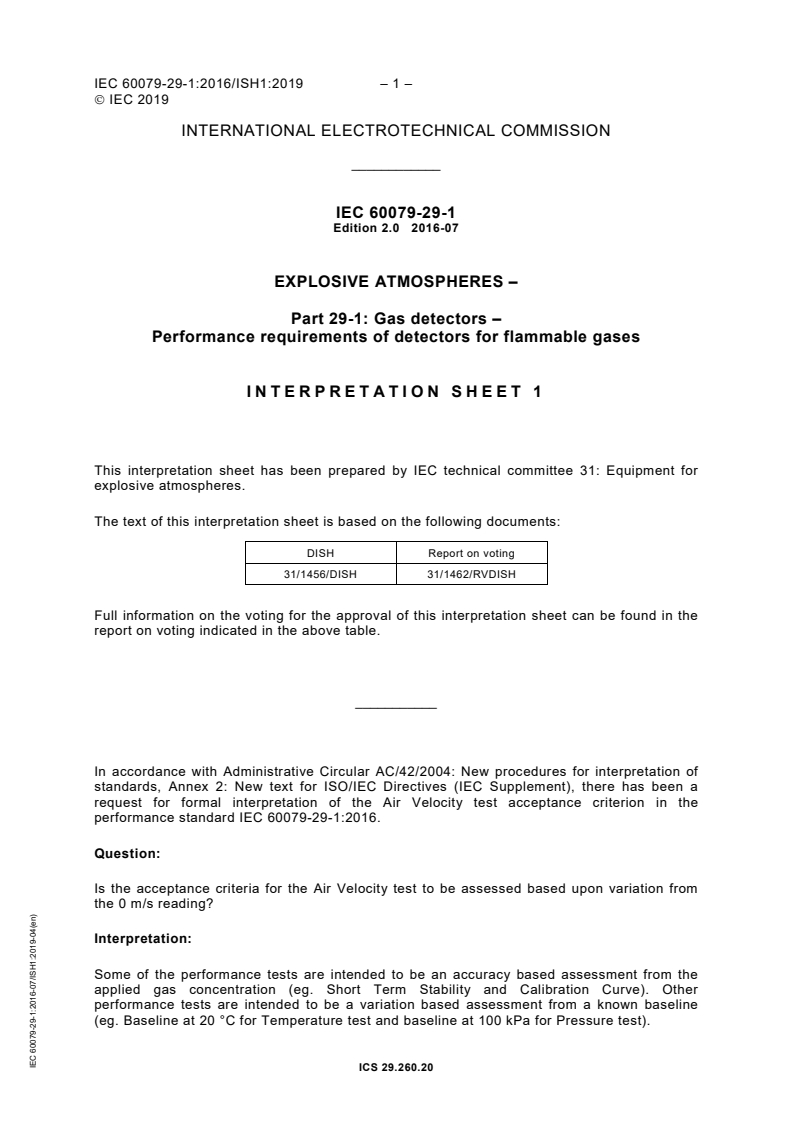
INTERPRETATION SHEET 1
This interpretation sheet has been prepared by IEC technical committee 31: Equipment for
explosive atmospheres.
The text of this interpretation sheet is based on the following documents:
DISH Report on voting
31/1456/DISH 31/1462/RVDISH
Full information on the voting for the approval of this interpretation sheet can be found in the
report on voting indicated in the above table.
___________
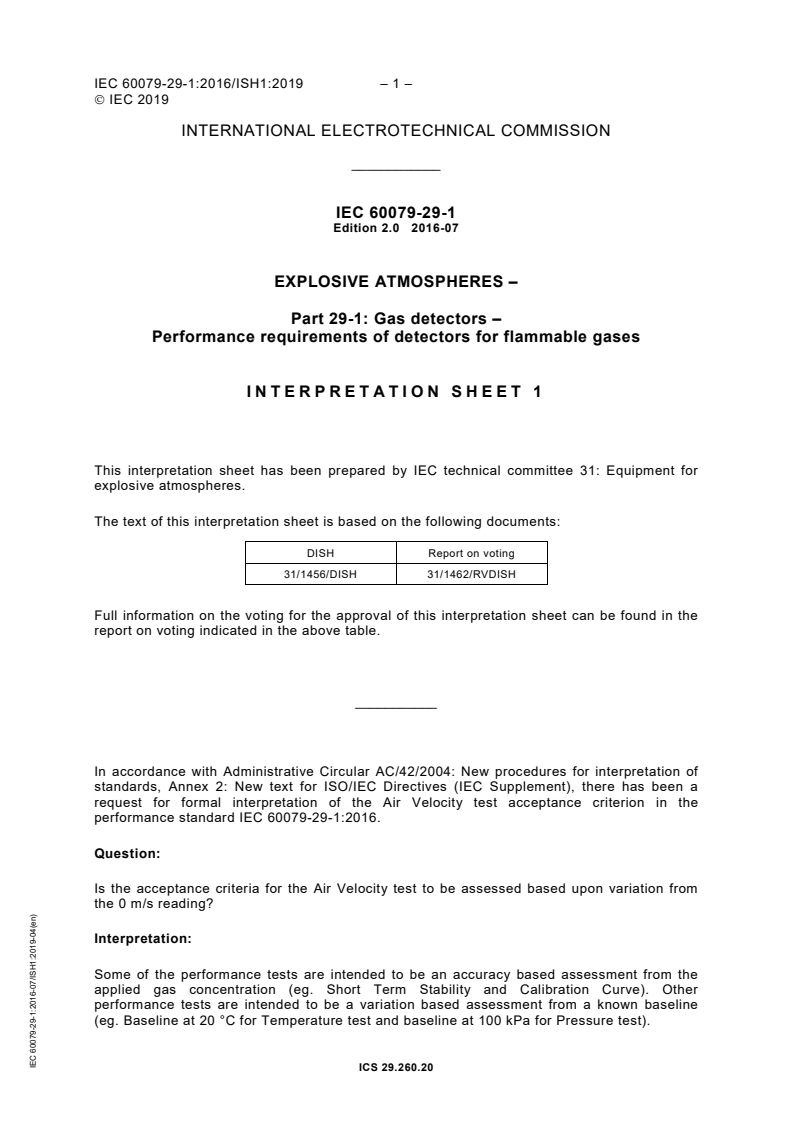
In accordance with Administrative Circular AC/42/2004: New procedures for interpretation of
standards, Annex 2: New text for ISO/IEC Directives (IEC Supplement), there has been a
request for formal interpretation of the Air Velocity test acceptance criterion in the
performance standard IEC 60079-29-1:2016.
Question:
Is the acceptance criteria for the Air Velocity test to be assessed based upon variation from
the 0 m/s reading?
Interpretation:
Some of the performance tests are intended to be an accuracy based assessment from the
applied gas concentration (eg. Short Term Stability and Calibration Curve). Other
performance tests are intended to be a variation based assessment from a known baseline
(eg. Baseline at 20 °C for Temperature test and baseline at 100 kPa for Pressure test).
ICS 29.260.20
– 2 – IEC 60079-29-1:2016/ISH1:2019
IEC 2019
In review of the air velocity acceptance criteria, the format is the same as the Short Term
Stability and Calibration Curve and therefore this is intended to be an accuracy based
assessment.
IEC 2019
INTERNATIONAL ELECTROTECHNICAL COMMISSION
____________
IEC 60079-29-1
Edition 2.0 2016-07
EXPLOSIVE ATMOSPHERES –
Part 29-1: Gas detectors –
Performance requirements of detectors for flammable gases
INTERPRETATION SHEET 2
This interpretation sheet has been prepared by IEC technical committee 31: Equipment for
explosive atmospheres.
The text of this interpretation sheet is based on the following documents:
DISH Report on voting
31/1457/DISH 31/1467/RVDISH
Full information on the voting for the approval of this interpretation sheet can be found in the
report on voting indicated in the above table.
___________
In accordance with Administrative Circular AC/42/2004: New procedures for Interpretation of
standards, Annex 2: New text for ISO/IEC Directives (IEC Supplement), there has been a
request for formal interpretation of the required testing for each general purpose test gas for
performance standard IEC 60079-29-1:2016, Subclause 5.3.2 (c), by the Australian National
Committee. The requirement is stated as follows:
c) Methane, and propane or butane for equipment intended for general purpose flammable
gas detection (in order to get representative results, e.g. concerning sensitivity, response
times and drift).
Question:
Is the interpretation of this text that propane or butane required tests are only Calibration and
adjustment (5.4.3), Short-term stability (5.4.4.2), and Time of response (5.4.15)?
ICS 29.260.20
– 2 – IEC 60079-29-1:2016/ISH2:2019
IEC 2019
Interpretation:
No, for general purpose equipment evaluation to two gases is essential in order to get
representative test results. Therefore, all tests need to be conducted for the two gases unless
otherwise specified (e.g. EMC as outlined in IEC 60079-29-1/AMD1:— ).
____________
Under preparation. Stage at the time of publication: IEC/CCDV 60079-29-1/AMD1:2019.
– 2 – IEC 60079-29-1:2016 © IEC 2016
CONTENTS
FOREWORD. 4
INTRODUCTION . 8
1 Scope . 9
2 Normative references . 10
3 Terms and definitions . 10
4 General requirements . 15
4.1 Overview . 15
4.1.1 Manufacturer claims . 15
4.1.2 Equipment ratings . 16
4.2 Construction . 16
4.2.1 General . 16
4.2.2 Indicating devices . 16
4.2.3 Alarm signals . 18
4.2.4 Fault signals . 18
4.2.5 Adjustments . 19
4.2.6 Battery-powered equipment . 19
4.2.7 Gas detection transmitter for use with separate gas detection control
units . 19
4.2.8 Separate gas detection control units for use with gas detection
transmitter(s) . 19
4.2.9 Software-controlled equipment . 20
4.3 Marking . 21
4.4 Instruction manual . 21
5 Test methods. 23
5.1 Overview . 23
5.2 General requirements for tests . 24
5.2.1 General . 24
5.2.2 Samples and sequence of tests . 24
5.2.3 Preparation of equipment before testing . 24
5.2.4 Mask for calibration and tests . 25
5.3 Normal conditions for test . 25
5.3.1 General . 25
5.3.2 Test gas(es) . 25
5.3.3 Standard test gas . 26
5.3.4 Flow rate for test gases . 26
5.3.5 Voltage . 26
5.3.6 Temperature . 26
5.3.7 Pressure . 27
5.3.8 Humidity . 27
5.3.9 Acclimation time . 27
5.3.10 Orientation . 27
5.3.11 Communications options . 27
5.3.12 Gas detection equipment as part of systems . 27
5.4 Test methods . 27
5.4.1 General . 27
5.4.2 Unpowered storage . 28
5.4.3 Calibration and adjustment . 28
5.4.4 Stability . 29
5.4.5 Alarm set point(s) . 30
5.4.6 Temperature . 30
5.4.7 Pressure . 31
5.4.8 Humidity of test gas . 31
5.4.9 Air velocity . 31
5.4.10 Flow rate for aspirated equipment . 32
5.4.11 Orientation . 32
5.4.12 Vibration . 32
5.4.13 Drop test for portable and transportable equipment . 33
5.4.14 Warm-up time . 33
5.4.15 Time of response . 34
5.4.16 High gas concentration operation above the measuring range . 34
5.4.17 Battery capacity . 34
5.4.18 Power supply variations . 35
5.4.19 Addition of sampling probe . 35
5.4.20 Other gases and poisons . 35
5.4.21 Electromagnetic compatibility . 36
5.4.22 Field calibration kit . 36
5.4.23 Software function . 36
Annex A (normative) Performance requirements . 37
Annex B (informative) Determination of time of response . 43
B.1 Aspirated equipment . 43
B.1.1 Test rig . 43
B.1.2 Equipment without internal pump . 43
B.1.3 Equipment with internal pump. 43
B.2 Equipment that samples by diffusion . 44
B.2.1 Calibration mask method . 44
B.2.2 Diffusion or flow methods . 44
Bibliography . 45
Figure 1 – Warm-up time in clean air (typical) . 15
Figure 2 – Warm-up time in standard test gas (typical) . 15
Figure B.1 – Schematic example of test rig for use with aspirated equipment . 44
Table A.1 – Performance requirements (1 of 6). 37
– 4 – IEC 60079-29-1:2016 © IEC 2016
INTERNATIONAL ELECTROTECHNICAL COMMISSION
____________
EXPLOSIVE ATMOSPHERES –
Part 29-1: Gas detectors – Performance requirements
of detectors for flammable gases
FOREWORD
1) The International Electrotechnical Commission (IEC) is a worldwide organization for standardization comprising
all national electrotechnical committees (IEC National Committees). The object of IEC is to promote
international co-operation on all questions concerning standardization in the electrical and electronic fields. To
this end and in addition to other activities, IEC publishes International Standards, Technical Specifications,
Technical Reports, Publicly Available Specifications (PAS) and Guides (hereafter referred to as “IEC
Publication(s)”). Their preparation is entrusted to technical committees; any IEC National Committee interested
in the subject dealt with may participate in this preparatory work. International, governmental and non-
governmental organizations liaising with the IEC also participate in this preparation. IEC collaborates closely
with the International Organization for Standardization (ISO) in accordance with conditions determined by
agreement between the two organizations.
2) The formal decisions or agreements of IEC on technical matters express, as nearly as possible, an international
consensus of opinion on the relevant subjects since each technical committee has representation from all
interested IEC National Committees.
3) IEC Publications have the form of recommendations for international use and are accepted by IEC National
Committees in that sense. While all reasonable efforts are made to ensure that the technical content of IEC
Publications is accurate, IEC cannot be held responsible for the way in which they are used or for any
misinterpretation by any end user.
4) In order to promote international uniformity, IEC National Committees undertake to apply IEC Publications
transparently to the maximum extent possible in their national and regional publications. Any divergence
between any IEC Publication and the corresponding national or regional publication shall be clearly indicated in
the latter.
5) IEC itself does not provide any attestation of conformity. Independent certification bodies provide conformity
assessment services and, in some areas, access to IEC marks of conformity. IEC is not responsible for any
services carried out by independent certification bodies.
6) All users should ensure that they have the latest edition of this publication.
7) No liability shall attach to IEC or its directors, employees, servants or agents including individual experts and
members of its technical committees and IEC National Committees for any personal injury, property damage or
other damage of any nature whatsoever, whether direct or indirect, or for costs (including legal fees) and
expenses arising out of the publication, use of, or reliance upon, this IEC Publication or any other IEC
Publications.
8) Attention is drawn to the Normative references cited in this publication. Use of the referenced publications is
indispensable for the correct application of this publication.
9) Attention is drawn to the possibility that some of the elements of this IEC Publication may be the subject of
patent rights. IEC shall not be held responsible for identifying any or all such patent rights.
International Standard IEC 60079-29-1 has been prepared by IEC technical committee 31:
Equipment for explosive atmospheres.
This second edition of IEC 60079-29-1 cancels and replaces the first edition of
IEC 60079-29-1:2007 series and constitutes a technical revision.
The contents of the interpretation sheets 1 and 2 (2019-04) have been included in this copy.
Significant technical changes between IEC 60079-29-1, Edition 1 (2007), and
IEC 60079-29-1, Edition 2 (2016), is as listed below:
Significant changes with respect to IEC 60079-29-1:2007
Type
Changes Clause Minor and Extension Major
editorial technical
changes changes
Measuring range up to 20 %LEL All X
(Modified requirements)
Definitions 3 X
(Additional clarifications)
Manufacturer’s claims 4.1.1 X
(special applications requirements)
General construction 4.2.1 C1
(Malfunction effects on safety related function)
General indicating devices 4.2.2.1 C2
(portable equipment with visual and audible indication)
Suppression of indication and measured values below zero 4.2.2.5 C3
(functional limits)
Fault signals 4.2.4 C4
(Fault indication below minimum voltage limit, sensor
disconnection and zero drift condition)
Adjustments 4.2.5 C5
(Zero and sensitivity adjustments)
Marking 4.3 X
(Portable equipment protective case)
Instruction Manual 4.4 C6
(Additions and clarifications)
Samples and sequence of tests 5.2.2 X
(Optical filter special sensitivity limits, and modification
considerations)
Preparation of equipment before testing 5.2.3 X
(separate gas detection control units)
Test gas 5.3.2 C7
(methane, and propane or butane for general purpose gas
detector)
General test methods 5.4.1 X
(selectable range and wiring worst case conditions)
Calibration curve 5.4.3.2 C8
(fixed volume fractions)
Response to different gases 5.4.3.3 C9
(semiconductor and catalytic high gas concentration
exposure)
Stability 5.4.4 X
(duration of test method)
Alarm set point(s) 5.4.5 X
(alarm set point test method)
Temperature (portable) 5.4.6 C10
(temperature range and stabilization period)
Temperature (all other equipment) 5.4.6 X
(temperature range and stabilization period)
Pressure 5.4.7 X
(tolerance on pressure measurement)
Humidity of test gas 5.4.8 X
(test method clarification)
Air velocity 5.4.9 X
(test method clarification)
Flow rate for aspirated equipment 5.4.10 X
(test method clarification)
Vibration 5.4.12 X
(test method clarification)
– 6 – IEC 60079-29-1:2016 © IEC 2016
Type
Changes Clause Minor and Extension Major
editorial technical
changes changes
Drop test for portable and transportable equipment 5.4.13 X
(Automatic re-starting or shut-down requirement
clarification)
Warm-up time 5.4.14 C11
(user prompt requirement)
High gas concentration operation above the measuring 5.4.16 X
range
(test method and requirement clarification)
Battery capacity 5.4.17 X
(test method clarification)
Power supply variation 5.4.18 C12
(minimum supply voltage fault limit)
Poisons (applicable only to Group I apparatus with catalytic 5.4.20.2 X
or semiconductor sensors)
(test method clarification)
Electromagnetic compatibility 5.4.21 C13
(test methods and requirements)
Field calibration kit 5.4.22 X
(test method clarification)
Software function 5.4.23 X
(supporting documentation)
Determination of time of response Annex B X
(test method clarification)
NOTE 1 The technical changes referred to include the significance of technical changes in the revised IEC
Standard, but they do not form an exhaustive list of all modifications from the previous version. More guidance may
be found by referring to the Redline Version of the standard.
Explanations:
A) Definitions
Minor and editorial changes
Clarification decrease of technical requirements minor technical change editorial
corrections.
These are changes which modify requirements in an editorial or a minor technical way.
They include changes of the wording to clarify technical requirements without any
technical change, or a reduction in level of existing requirement.
Extension
Addition of technical options
These are changes which add new or modify existing technical requirements, in a way that
new options are given, but without increasing requirements for equipment that was fully
compliant with the previous standard. Therefore, these will not have to be considered for
products in conformity with the preceding edition.
Major technical changes
Addition of technical requirements increase of technical requirements.
These are changes to technical requirements (addition, increase of the level or removal)
made in a way that a product conforming to the preceding edition will not always be able
to fulfil the requirements given in the later edition. These changes have to be considered
for products conforming to the preceding edition. For these changes additional information
is provided in B) below.
NOTE 2 These changes represent current technological knowledge. However, these changes should not
normally have an influence on equipment already placed on the market.
B) Information about the background of ‘Major technical changes’
C1 Addition of malfunction effects not adversely affecting the safety related function
(4.2.1).
C2 Addition of visual and audible indication for portable equipment (4.2.2.1).
C3 Addition of functional limits for suppression of indication and for measured values
below zero (4.2.2.5).
C4 Addition of requirements for fault indication below minimum voltage limit, sensor
disconnection and zero drift condition (4.2.4).
C5 Addition of requirements for zero and sensitivity adjustments (4.2.5).
C6 Addition and clarification requirements for inclusion within the instruction manual
(4.4).
C7 Addition of methane and propane or butane as required test gases for general
purpose gas detector (5.3.2).
C8 Specification of fixed volume fractions which are expressed as a percentage of the
measuring range (5.4.3.2).
C9 Addition of requirement for semiconductor and catalytic sensors to be exposed to
high gas concentration on response to different gases (5.4.3.3).
C10 Addition of temperature range and stabilization period (5.4.6).
C11 Addition of requirement where equipment prompts the user (5.4.14).
C12 Addition of requirement for output functionality above the minimum supply voltage
fault limit (5.4.18).
C13 Addition of test methods and requirements for electromagnetic compatibility tests
(5.4.21).
The text of this standard is based on the following documents:
FDIS Report on voting
31/1257/FDIS 31/1266/RVD
Full information on the voting for the approval of this standard can be found in the report on
voting indicated in the above table.
This publication has been drafted in accordance with the ISO/IEC Directives, Part 2.
A list of all parts of the IEC 60079 series, under the general title Explosive atmospheres, can
be found on the IEC website.
The committee has decided that the contents of this publication will remain unchanged until
the stability date indicated on the IEC website under "http://webstore.iec.ch" in the data
related to the specific publication. At this date, the publication will be
• reconfirmed,
• withdrawn,
• replaced by a revised edition, or
• amended.
A bilingual version of this publication may be issued at a later date.
– 8 – IEC 60079-29-1:2016 © IEC 2016
INTRODUCTION
This part of IEC 60079-29 specifies general requirements for construction, testing and
performance, and describes the test methods that apply to portable, transportable and fixed
equipment for the detection and measurement of flammable gas or vapour concentrations with
air.
Guidance for the selection, installation, use and maintenance of gas detecting equipment is
set out in IEC 60079-29-2: Explosive atmospheres – Part 29-2: Gas detectors – Selection,
installation, use and maintenance of detectors for flammable gases and oxygen.
Guidance for functional safety of fixed gas detection systems is set out in IEC 60079-29-3:
Explosive atmospheres – Part 29-3: Gas detectors – Guidance on functional safety of fixed
gas detection systems.
General requirements for construction, testing and performance of open path detectors for
flammable gases are set out in IEC 60079-29-4: Explosive atmospheres – Part 29-4: Gas
detectors – Performance requirements of open path detectors for flammable gases.
EXPLOSIVE ATMOSPHERES –
Part 29-1: Gas detectors – Performance requirements
of detectors for flammable gases
1 Scope
This part of IEC 60079-29 specifies general requirements for construction, testing and
performance, and describes the test methods that apply to portable, transportable and fixed
equipment for the detection and measurement of flammable gas or vapour concentrations with
air. The equipment, or parts thereof, is intended for use in explosive atmospheres and in
mines susceptible to firedamp.
This part of IEC 60079-29 is applicable to flammable gas detection equipment with a
measuring range up to any volume fraction as declared by the manufacturer, and which is
intended to provide an indication, alarm or other output function; the purpose of which is to
indicate a potential explosion hazard and in some cases, to initiate automatic or manual
protective action(s).
For the purposes of this part of IEC 60079-29, the term “indicating up to a volume fraction of
X % or X %LFL” includes equipment with an upper limit of the measuring range equal to or
less than X % or X %LFL.
This part of IEC 60079-29 is applicable to equipment, including the integral sampling systems
of aspirated equipment, intended to be used for commercial, industrial and non-residential
safety applications.
This part of IEC 60079-29 does not apply to external sampling systems, or to equipment of
laboratory or scientific type, or to equipment used only for process monitoring and/or control
purposes. It also does not apply to open path (line of sight) detectors which are within the
scope of IEC 60079-29-4. Only equipment with very short optical paths intended for use
where the concentration is uniform over the optical path are within the scope of this standard.
For equipment used for sensing the presence of multiple gases, this part of IEC 60079-29
applies only to the detection of flammable gas or vapour.
This part of IEC 60079-29 supplements and modifies the general requirements of
IEC 60079-0. Where a requirement of this standard conflicts with a requirement of
IEC 60079-0, the requirement of IEC 60079-29-1 takes precedence.
NOTE 1 IEC 60079-29-1 is intended to provide for the supply of equipment giving a level of safety and
performance suitable for general purpose applications. However, for specific applications, a prospective purchaser
(or an appropriate authority) can additionally require the equipment to be submitted to particular tests or approval.
For example, Group I equipment (i.e. equipment to be used in mines susceptible to firedamp) might not be
permitted to be used without the additional, prior approval of the relevant authority in mines under its jurisdiction.
Such particular tests/approval are to be regarded as additional to and separate from the provisions of the
standards referred to above and do not preclude certification to or compliance with these standards.
NOTE 2 All equipment calibrated on specific gases or vapours can not be expected to correctly indicate on other
gases or vapours.
For the purposes of this standard, the terms "lower flammable limit (LFL)" and "lower
explosive limit (LEL)" are deemed to be synonymous, and likewise the terms "upper
flammable limit (UFL)" and "upper explosive limit (UEL)" are deemed to be synonymous. For
ease of reference, the two abbreviations LFL and UFL may be used hereinafter to denote
these two sets of terms. It should be recognized that particular authorities having jurisdiction
– 10 – IEC 60079-29-1:2016 © IEC 2016
may have overriding requirements that dictate the use of one of these sets of terms and not
the other.
NOTE 3 Indication of concentration in %(v/v) or vol ppm can also be available for equipment which measures up
to 100 %LFL or 20 %LFL. In that case, units of measurement might need to be selected in agreement with the
manufacturer when verifying the performance requirements of Annex A.
2 Normative references
The following documents, in whole or in part, are normatively referenced in this document and
are indispensable for its application. For dated references, only the edition cited applies. For
undated references, the latest edition of the referenced document (including any
amendments) applies.
IEC 60050-426, International Electrotechnical Vocabulary – Part 426: Equipment for explosive
atmospheres
IEC 60079-0, Explosive atmospheres – Part 0: Equipment – General requirements
IEC 60068-2-6, Environmental testing – Part 2-6: Tests – Test Fc: Vibration (sinusoidal)
IEC 60079-20-1, Explosive atmospheres – Part 20-1: Material characteristics for gas and
vapour classification – Test methods and data
IEC 61326-1:2012, Electrical equipment for measurement, control and laboratory use – EMC
requirements – Part 1: General requirements
3 Terms and definitions
For the purposes of this document, the terms and definitions given in IEC 60079-0 and the
following apply. Additional definitions applicable to explosive atmospheres can be found in
IEC 60050-426.
3.1
gas properties
3.1.1
ambient air
normal atmosphere surrounding the equipment
3.1.2
clean air
air that is free of gases or vapours which the sensor is sensitive to or which influence the
performance of the sensor
3.1.3
flammable gas
gas or vapour which, when mixed with air in a certain proportion, will form an explosive
atmosphere
Note 1 to entry: For the purposes of this part of IEC 60079-29, the term "flammable gas" includes flammable
vapours.
Note 2 to entry: For the purposes of this part of IEC 60079-29, the terms "combustible gas" and "flammable gas"
are equivalent.
3.1.4
lower flammable limit
LFL
concentration of flammable gas or vapour in air, below which an explosive gas atmosphere
does not form
Note 1 to entry: This is also known as lower explosive limit (LEL).
Note 2 to entry: The concentration may be expressed as either a volume fraction or a mass per unit volume.
3.1.5
poisons
substances that lead to temporary or permanent change of
performance, particularly loss of sensitivity of the sensing element
3.1.6
upper flammable limit
UFL
concentration of of flammable gas or vapour in air, above which an explosive gas atmosphere
does not form
Note 1 to entry: This is also known as upper explosive limit (UEL).
Note 2 to entry: The concentration may be expressed as either a volume fraction or a mass per unit volume.
3.1.7
volume fraction
v/v
quotient of the volume of a specified component and the sum of the volumes of all
components of a gas mixture before mixing, all volumes referring to the pressure and the
temperature of the gas mixture
Note 1 to entry: The volume fraction and volume concentration take the same value if, at the same state
conditions, the sum of the component volumes before mixing and the volume of the mixture are equal. However,
because the mixing of two or more gases at the same state conditions is usually accompanied by a slight
contraction or, less frequently, a slight expansion, this is not generally the case.
3.1.8
zero gas
gas recommended by the manufacturer, which is free of flammable gases and interfering and
contaminating substances, the purpose of which is calibration/adjustment of the equipment
zero
3.1.9
standard test gas
test gas with a composition specified for each item of equipment and gas and/or vapour to be
used for all tests unless otherwise stated
3.2
types of equipment
3.2.1
alarm-only equipment
equipment with an alarm but not having an indication of measured value
3.2.2
aspirated equipment
equipment that samples the gas by drawing it to the gas sensor
Note 1 to entry: A hand operated or electric pump is often used to draw gas to the sensor.
3.2.3
automatically aspirated equipment
aspirated equipment with an integral pump or separate pump, which is connected directly to
the equipment
– 12 – IEC 60079-29-1:2016 © IEC 2016
3.2.4
continuous duty equipment
equipment that is powered for long periods of time, but may have either continuous or
intermittent sensing
Note 1 to entry: For this edition of the standard, all equipment is regarded as continuous duty.
3.2.5
diffusion equipment
equipment in which the transfer of gas from the atmosphere to the sensor takes place without
aspirated flow
3.2.6
equipment, fixed
equipment fastened to a support, or otherwise secured in a specific location when energized
3.2.7
Group I equipment
equipment for mines susceptible to firedamp
3.2.8
Group II equipment
equipment for places with an explosive gas atmosphere, other than mines susceptible to
firedamp
3.2.9
equipment, portable
equipment intended to be carried by a person during operation
Note 1 to entry: A portable equipment is battery powered and includes, but is not limited to
a) a hand-held equipment, typically less than 1 kg, which requires use of only one hand to operate,
b) personal monitors, similar in size and mass to the hand-held equipment, that are continuously operating (but
not necessarily continuously sensing) while they are attached to the user, and
c) larger equipment that can be operated by the user while it is carried either by hand, by a shoulder strap or
carrying harness and which may or may not have a hand directed probe.
3.2.10
equipment, transportable
equipment not intended to be carried by a person during operation, nor intended for fixed
installation
3.2.11
gas detection transmitter
fixed gas detection equipment that provide a conditioned electronic signal or output indication
to a generally accepted industry standard (such as 4 to 20 mA), intended to be utilized with
separate gas detection control units or signal processing data acquisition, central monitoring
and similar systems, which typically process information from various locations and sources
including, but not limited to gas detection equipment
3.2.12
gas detection control unit
equipment intended to provide display indication, alarm functions, output contacts and/or
alarm signal outputs or any combinations when operated with remote sensor(s)
3.2.13
separate gas detection control unit
equipment intended to provide display indication, alarm functions, output contacts or alarm
signal outputs or any combination when operated with gas detection transmitter(s)
3.2.14
equipment with integral sensor(s)
equipment that provides display indication, alarm functions, output contacts and/or alarm
signal outputs using a sensor which is within or directly mounted to the equipment housing
3.2.15
accessory
component which can be fitted to the equipment for special purpose
EXAMPLE External gas pump, sampling probe, hoses, collecting cone, weather protection device
3.3
sensors
3.3.1
sensing element
part of the sensor which is sensitive to the gas/vapour to be measured
3.3.2
sensor
assembly in which the sensing element is housed and that may also contain associated circuit
components
3.3.3
integral sensor
sensor which is within or directly mounted to the equipment housing
3.3.4
remote sensor
sensor that is separated from the equipment body and is connected to a gas detection control
unit or to a gas detection transmitter.
3.4
supply of gas to equipment
3.4.1
sample line
means by which the gas being sampled is conveyed to the sensor
Note 1 to entry: Accessories such as filter or water trap are often included in the sample line.
3.4.2
sampling probe
separate accessory sample line which is optionally attached to the equipment
Note 1 to entry: It is usually short (e.g. of the order of 1 m) and rigid, although it can be telescopic. In some cases
it is connected by a flexible tube to the equipment.
3.4.3
field calibration kit
means of presenting test gas to the equipment for the purpose of calibrating/adjusting or
verifying the operation of the equipment
Note 1 to entry: The field calibration kit can be used for verifying the operation of the alarms if the concentration
of the test gas is above the alarm set-point.
Note 2 to entry: A mask for calibration and test (see 3.4.4) is an example of a field calibration kit.
3.4.4
mask for calibration and test
device that can be attached to the equipment to present a test gas to the sensor in a
reproducible manner
– 14 – IEC 60079-29-1:2016 © IEC 2016
3.5
signals and alarms
3.5.1
alarm set point
setting of the equipment at which the measured concentration will cause the equipment to
initiate an indication, alarm or other output function
3.5.2
latching alarm
alarm that, once activated, requires deliberate action to be deactivated
3.5.3
fault signal
audible, visible or other type of output, different from the alarm signal, permitting, directly or
indirectly, a warning or indication that the equipment is not working satisfactorily
3.5.4
special state
any state of the equipment other than those in which monitoring of gas concentration and/or
alarming is the intent
Note 1 to entry: Special state includes warm-up, calibration mode or fault condition.
3.6
times
3.6.1
drift
variation in the equipment indication over time at any fixed gas volume fraction (including
clean air) under constant ambient conditions
3.6.2
final indication
indication given by the equipment after stabilization
3.6.3
stabilization
state when three successive readings of an equipment at a constant gas volume fraction,
taken at 2 min intervals or twice the respective t(90), whichever is less, indicates no changes
greater than ±1 % of the measuring range
3.6.4
time of response
t(x)
time interval, with the equipment in a warmed-up condition, between the time when an
instantaneous change between clean air and the standard test gas, or vice versa, is produced
at the equipment inlet, and the time when the response reaches a stated percentage (x) of the
stabilized signal on the standard test gas
3.6.5
warm-up time
time interval, with the equipment in a stated atmosphere, between the time when the
equipment is switched on and the time when the indication reaches and remains within the
stated tolerances
Note 1 to entry: See Figure 1 and Figure 2.
Power off in Power on in
clean air clean air
Specified
Equipment
tolerance band
zero
on zero indication
Time
Warm-up time
(see 3.6.5)
IEC
Figure 1 – Warm-up time in clean air (typical)
Power off Power on
in standard in standard
test gas test gas
Specified
Volume
tolerances of
fraction
the indication
of standard
test gas
Zero in
clean air
Time
Warm-up time
(see 3.6.5)
IEC
Figure 2 – Warm-up time in standard test gas (typical)
...
IEC 60079-29-1 ®
Edition 2.0 2016-07
INTERNATIONAL
STANDARD
NORME
INTERNATIONALE
Explosive atmospheres –
Part 29-1: Gas detectors – Performance requirements of detectors for flammable
gases
Atmosphères explosives –
Partie 29-1: Détecteurs de gaz – Exigences d’aptitude à la fonction des
détecteurs de gaz inflammables
All rights reserved. Unless otherwise specified, no part of this publication may be reproduced or utilized in any form
or by any means, electronic or mechanical, including photocopying and microfilm, without permission in writing from
either IEC or IEC's member National Committee in the country of the requester. If you have any questions about IEC
copyright or have an enquiry about obtaining additional rights to this publication, please contact the address below or
your local IEC member National Committee for further information.
Droits de reproduction réservés. Sauf indication contraire, aucune partie de cette publication ne peut être reproduite
ni utilisée sous quelque forme que ce soit et par aucun procédé, électronique ou mécanique, y compris la photocopie
et les microfilms, sans l'accord écrit de l'IEC ou du Comité national de l'IEC du pays du demandeur. Si vous avez des
questions sur le copyright de l'IEC ou si vous désirez obtenir des droits supplémentaires sur cette publication, utilisez
les coordonnées ci-après ou contactez le Comité national de l'IEC de votre pays de résidence.
IEC Central Office Tel.: +41 22 919 02 11
3, rue de Varembé Fax: +41 22 919 03 00
CH-1211 Geneva 20 info@iec.ch
Switzerland www.iec.ch
About the IEC
The International Electrotechnical Commission (IEC) is the leading global organization that prepares and publishes
International Standards for all electrical, electronic and related technologies.
About IEC publications
The technical content of IEC publications is kept under constant review by the IEC. Please make sure that you have the
latest edition, a corrigenda or an amendment might have been published.
IEC Catalogue - webstore.iec.ch/catalogue Electropedia - www.electropedia.org
The stand-alone application for consulting the entire The world's leading online dictionary of electronic and
bibliographical information on IEC International Standards, electrical terms containing 20 000 terms and definitions in
Technical Specifications, Technical Reports and other English and French, with equivalent terms in 16 additional
documents. Available for PC, Mac OS, Android Tablets and languages. Also known as the International Electrotechnical
iPad. Vocabulary (IEV) online.
IEC publications search - www.iec.ch/searchpub IEC Glossary - std.iec.ch/glossary
The advanced search enables to find IEC publications by a 65 000 electrotechnical terminology entries in English and
variety of criteria (reference number, text, technical French extracted from the Terms and Definitions clause of
committee,…). It also gives information on projects, replaced IEC publications issued since 2002. Some entries have been
and withdrawn publications. collected from earlier publications of IEC TC 37, 77, 86 and
CISPR.
IEC Just Published - webstore.iec.ch/justpublished
Stay up to date on all new IEC publications. Just Published IEC Customer Service Centre - webstore.iec.ch/csc
details all new publications released. Available online and If you wish to give us your feedback on this publication or
also once a month by email. need further assistance, please contact the Customer Service
Centre: csc@iec.ch.
A propos de l'IEC
La Commission Electrotechnique Internationale (IEC) est la première organisation mondiale qui élabore et publie des
Normes internationales pour tout ce qui a trait à l'électricité, à l'électronique et aux technologies apparentées.
A propos des publications IEC
Le contenu technique des publications IEC est constamment revu. Veuillez vous assurer que vous possédez l’édition la
plus récente, un corrigendum ou amendement peut avoir été publié.
Catalogue IEC - webstore.iec.ch/catalogue Electropedia - www.electropedia.org
Application autonome pour consulter tous les renseignements
Le premier dictionnaire en ligne de termes électroniques et
bibliographiques sur les Normes internationales,
électriques. Il contient 20 000 termes et définitions en anglais
Spécifications techniques, Rapports techniques et autres
et en français, ainsi que les termes équivalents dans 16
documents de l'IEC. Disponible pour PC, Mac OS, tablettes
langues additionnelles. Egalement appelé Vocabulaire
Android et iPad.
Electrotechnique International (IEV) en ligne.
Recherche de publications IEC - www.iec.ch/searchpub
Glossaire IEC - std.iec.ch/glossary
65 000 entrées terminologiques électrotechniques, en anglais
La recherche avancée permet de trouver des publications IEC
en utilisant différents critères (numéro de référence, texte, et en français, extraites des articles Termes et Définitions des
comité d’études,…). Elle donne aussi des informations sur les publications IEC parues depuis 2002. Plus certaines entrées
projets et les publications remplacées ou retirées. antérieures extraites des publications des CE 37, 77, 86 et
CISPR de l'IEC.
IEC Just Published - webstore.iec.ch/justpublished
Service Clients - webstore.iec.ch/csc
Restez informé sur les nouvelles publications IEC. Just
Published détaille les nouvelles publications parues. Si vous désirez nous donner des commentaires sur cette
Disponible en ligne et aussi une fois par mois par email. publication ou si vous avez des questions contactez-nous:
csc@iec.ch.
IEC 60079-29-1 ®
Edition 2.0 2016-07
INTERNATIONAL
STANDARD
NORME
INTERNATIONALE
Explosive atmospheres –
Part 29-1: Gas detectors – Performance requirements of detectors for flammable
gases
Atmosphères explosives –
Partie 29-1: Détecteurs de gaz – Exigences d’aptitude à la fonction des
détecteurs de gaz inflammables
INTERNATIONAL
ELECTROTECHNICAL
COMMISSION
COMMISSION
ELECTROTECHNIQUE
INTERNATIONALE
ICS 29.260.20 ISBN 978-2-8322-5030-3
IEC 2019
INTERNATIONAL ELECTROTECHNICAL COMMISSION
____________
IEC 60079-29-1
Edition 2.0 2016-07
EXPLOSIVE ATMOSPHERES –
Part 29-1: Gas detectors –
Performance requirements of detectors for flammable gases
INTERPRETATION SHEET 1
This interpretation sheet has been prepared by IEC technical committee 31: Equipment for
explosive atmospheres.
The text of this interpretation sheet is based on the following documents:
DISH Report on voting
31/1456/DISH 31/1462/RVDISH
Full information on the voting for the approval of this interpretation sheet can be found in the
report on voting indicated in the above table.
___________
In accordance with Administrative Circular AC/42/2004: New procedures for interpretation of
standards, Annex 2: New text for ISO/IEC Directives (IEC Supplement), there has been a
request for formal interpretation of the Air Velocity test acceptance criterion in the
performance standard IEC 60079-29-1:2016.
Question:
Is the acceptance criteria for the Air Velocity test to be assessed based upon variation from
the 0 m/s reading?
Interpretation:
Some of the performance tests are intended to be an accuracy based assessment from the
applied gas concentration (eg. Short Term Stability and Calibration Curve). Other
performance tests are intended to be a variation based assessment from a known baseline
(eg. Baseline at 20 °C for Temperature test and baseline at 100 kPa for Pressure test).
ICS 29.260.20
– 2 – IEC 60079-29-1:2016/ISH1:2019
IEC 2019
In review of the air velocity acceptance criteria, the format is the same as the Short Term
Stability and Calibration Curve and therefore this is intended to be an accuracy based
assessment.
IEC 2019
INTERNATIONAL ELECTROTECHNICAL COMMISSION
____________
IEC 60079-29-1
Edition 2.0 2016-07
EXPLOSIVE ATMOSPHERES –
Part 29-1: Gas detectors –
Performance requirements of detectors for flammable gases
INTERPRETATION SHEET 2
This interpretation sheet has been prepared by IEC technical committee 31: Equipment for
explosive atmospheres.
The text of this interpretation sheet is based on the following documents:
DISH Report on voting
31/1457/DISH 31/1467/RVDISH
Full information on the voting for the approval of this interpretation sheet can be found in the
report on voting indicated in the above table.
___________
In accordance with Administrative Circular AC/42/2004: New procedures for Interpretation of
standards, Annex 2: New text for ISO/IEC Directives (IEC Supplement), there has been a
request for formal interpretation of the required testing for each general purpose test gas for
performance standard IEC 60079-29-1:2016, Subclause 5.3.2 (c), by the Australian National
Committee. The requirement is stated as follows:
c) Methane, and propane or butane for equipment intended for general purpose flammable
gas detection (in order to get representative results, e.g. concerning sensitivity, response
times and drift).
Question:
Is the interpretation of this text that propane or butane required tests are only Calibration and
adjustment (5.4.3), Short-term stability (5.4.4.2), and Time of response (5.4.15)?
ICS 29.260.20
– 2 – IEC 60079-29-1:2016/ISH2:2019
IEC 2019
Interpretation:
No, for general purpose equipment evaluation to two gases is essential in order to get
representative test results. Therefore, all tests need to be conducted for the two gases unless
otherwise specified (e.g. EMC as outlined in IEC 60079-29-1/AMD1:— ).
____________
Under preparation. Stage at the time of publication: IEC/CCDV 60079-29-1/AMD1:2019.
– 2 – IEC 60079-29-1:2016 © IEC 2016
CONTENTS
FOREWORD . 4
INTRODUCTION . 8
1 Scope . 9
2 Normative references . 10
3 Terms and definitions . 10
4 General requirements . 15
4.1 Overview . 15
4.1.1 Manufacturer claims . 15
4.1.2 Equipment ratings . 16
4.2 Construction . 16
4.2.1 General . 16
4.2.2 Indicating devices . 16
4.2.3 Alarm signals . 18
4.2.4 Fault signals . 18
4.2.5 Adjustments . 19
4.2.6 Battery-powered equipment . 19
4.2.7 Gas detection transmitter for use with separate gas detection control
units . 19
4.2.8 Separate gas detection control units for use with gas detection
transmitter(s) . 19
4.2.9 Software-controlled equipment . 20
4.3 Marking . 21
4.4 Instruction manual . 21
5 Test methods . 23
5.1 Overview . 23
5.2 General requirements for tests . 24
5.2.1 General . 24
5.2.2 Samples and sequence of tests . 24
5.2.3 Preparation of equipment before testing . 24
5.2.4 Mask for calibration and tests . 25
5.3 Normal conditions for test . 25
5.3.1 General . 25
5.3.2 Test gas(es) . 25
5.3.3 Standard test gas . 26
5.3.4 Flow rate for test gases . 26
5.3.5 Voltage . 26
5.3.6 Temperature . 26
5.3.7 Pressure . 27
5.3.8 Humidity . 27
5.3.9 Acclimation time . 27
5.3.10 Orientation. 27
5.3.11 Communications options . 27
5.3.12 Gas detection equipment as part of systems . 27
5.4 Test methods . 27
5.4.1 General . 27
5.4.2 Unpowered storage . 28
5.4.3 Calibration and adjustment . 28
5.4.4 Stability . 29
5.4.5 Alarm set point(s) . 30
5.4.6 Temperature . 30
5.4.7 Pressure . 31
5.4.8 Humidity of test gas . 31
5.4.9 Air velocity . 31
5.4.10 Flow rate for aspirated equipment . 32
5.4.11 Orientation. 32
5.4.12 Vibration . 32
5.4.13 Drop test for portable and transportable equipment . 33
5.4.14 Warm-up time . 33
5.4.15 Time of response . 34
5.4.16 High gas concentration operation above the measuring range . 34
5.4.17 Battery capacity . 34
5.4.18 Power supply variations . 35
5.4.19 Addition of sampling probe . 35
5.4.20 Other gases and poisons . 35
5.4.21 Electromagnetic compatibility . 36
5.4.22 Field calibration kit . 36
5.4.23 Software function . 36
Annex A (normative) Performance requirements . 37
Annex B (informative) Determination of time of response . 43
B.1 Aspirated equipment . 43
B.1.1 Test rig . 43
B.1.2 Equipment without internal pump . 43
B.1.3 Equipment with internal pump . 43
B.2 Equipment that samples by diffusion . 44
B.2.1 Calibration mask method . 44
B.2.2 Diffusion or flow methods . 44
Bibliography . 45
Figure 1 – Warm-up time in clean air (typical) . 15
Figure 2 – Warm-up time in standard test gas (typical) . 15
Figure B.1 – Schematic example of test rig for use with aspirated equipment . 44
Table A.1 – Performance requirements (1 of 6) . 37
– 4 – IEC 60079-29-1:2016 © IEC 2016
INTERNATIONAL ELECTROTECHNICAL COMMISSION
____________
EXPLOSIVE ATMOSPHERES –
Part 29-1: Gas detectors – Performance requirements
of detectors for flammable gases
FOREWORD
1) The International Electrotechnical Commission (IEC) is a worldwide organization for standardization comprising
all national electrotechnical committees (IEC National Committees). The object of IEC is to promote
international co-operation on all questions concerning standardization in the electrical and electronic fields. To
this end and in addition to other activities, IEC publishes International Standards, Technical Specifications,
Technical Reports, Publicly Available Specifications (PAS) and Guides (hereafter referred to as “IEC
Publication(s)”). Their preparation is entrusted to technical committees; any IEC National Committee interested
in the subject dealt with may participate in this preparatory work. International, governmental and non-
governmental organizations liaising with the IEC also participate in this preparation. IEC collaborates closely
with the International Organization for Standardization (ISO) in accordance with conditions determined by
agreement between the two organizations.
2) The formal decisions or agreements of IEC on technical matters express, as nearly as possible, an international
consensus of opinion on the relevant subjects since each technical committee has representation from all
interested IEC National Committees.
3) IEC Publications have the form of recommendations for international use and are accepted by IEC National
Committees in that sense. While all reasonable efforts are made to ensure that the technical content of IEC
Publications is accurate, IEC cannot be held responsible for the way in which they are used or for any
misinterpretation by any end user.
4) In order to promote international uniformity, IEC National Committees undertake to apply IEC Publications
transparently to the maximum extent possible in their national and regional publications. Any divergence
between any IEC Publication and the corresponding national or regional publication shall be clearly indicated in
the latter.
5) IEC itself does not provide any attestation of conformity. Independent certification bodies provide conformity
assessment services and, in some areas, access to IEC marks of conformity. IEC is not responsible for any
services carried out by independent certification bodies.
6) All users should ensure that they have the latest edition of this publication.
7) No liability shall attach to IEC or its directors, employees, servants or agents including individual experts and
members of its technical committees and IEC National Committees for any personal injury, property damage or
other damage of any nature whatsoever, whether direct or indirect, or for costs (including legal fees) and
expenses arising out of the publication, use of, or reliance upon, this IEC Publication or any other IEC
Publications.
8) Attention is drawn to the Normative references cited in this publication. Use of the referenced publications is
indispensable for the correct application of this publication.
9) Attention is drawn to the possibility that some of the elements of this IEC Publication may be the subject of
patent rights. IEC shall not be held responsible for identifying any or all such patent rights.
International Standard IEC 60079-29-1 has been prepared by IEC technical committee 31:
Equipment for explosive atmospheres.
This second edition of IEC 60079-29-1 cancels and replaces the first edition of
IEC 60079-29-1:2007 series and constitutes a technical revision.
The contents of the interpretation sheets 1 and 2 (2019-04) have been included in this copy.
Significant technical changes between IEC 60079-29-1, Edition 1 (2007), and
IEC 60079-29-1, Edition 2 (2016), is as listed below:
Significant changes with respect to IEC 60079-29-1:2007
Type
Changes Clause Minor and Extension Major
editorial technical
changes changes
Measuring range up to 20 % LEL All X
(Modified requirements)
Definitions 3 X
(Additional clarifications)
Manufacturer’s claims 4.1.1 X
(special applications requirements)
General construction 4.2.1 C1
(Malfunction effects on safety related function)
General indicating devices 4.2.2.1 C2
(portable equipment with visual and audible indication)
Suppression of indication and measured values below zero 4.2.2.5 C3
(functional limits)
Fault signals 4.2.4 C4
(Fault indication below minimum voltage limit, sensor
disconnection and zero drift condition)
Adjustments 4.2.5 C5
(Zero and sensitivity adjustments)
Marking 4.3 X
(Portable equipment protective case)
Instruction Manual 4.4 C6
(Additions and clarifications)
Samples and sequence of tests 5.2.2 X
(Optical filter special sensitivity limits, and modification
considerations)
Preparation of equipment before testing 5.2.3 X
(separate gas detection control units)
Test gas 5.3.2 C7
(methane, and propane or butane for general purpose gas
detector)
General test methods 5.4.1 X
(selectable range and wiring worst case conditions)
Calibration curve 5.4.3.2 C8
(fixed volume fractions)
Response to different gases 5.4.3.3 C9
(semiconductor and catalytic high gas concentration
exposure)
Stability 5.4.4 X
(duration of test method)
Alarm set point(s) 5.4.5 X
(alarm set point test method)
Temperature (portable) 5.4.6 C10
(temperature range and stabilization period)
Temperature (all other equipment) 5.4.6 X
(temperature range and stabilization period)
Pressure 5.4.7 X
(tolerance on pressure measurement)
Humidity of test gas 5.4.8 X
(test method clarification)
Air velocity 5.4.9 X
(test method clarification)
Flow rate for aspirated equipment 5.4.10 X
(test method clarification)
Vibration 5.4.12 X
(test method clarification)
– 6 – IEC 60079-29-1:2016 © IEC 2016
Type
Changes Clause Minor and Extension Major
editorial technical
changes changes
Drop test for portable and transportable equipment 5.4.13 X
(Automatic re-starting or shut-down requirement
clarification)
Warm-up time 5.4.14 C11
(user prompt requirement)
High gas concentration operation above the measuring 5.4.16 X
range
(test method and requirement clarification)
Battery capacity 5.4.17 X
(test method clarification)
Power supply variation 5.4.18 C12
(minimum supply voltage fault limit)
Poisons (applicable only to Group I apparatus with catalytic 5.4.20.2 X
or semiconductor sensors)
(test method clarification)
Electromagnetic compatibility 5.4.21 C13
(test methods and requirements)
Field calibration kit 5.4.22 X
(test method clarification)
Software function 5.4.23 X
(supporting documentation)
Determination of time of response Annex B X
(test method clarification)
NOTE 1 The technical changes referred to include the significance of technical changes in the revised IEC
Standard, but they do not form an exhaustive list of all modifications from the previous version. More guidance may
be found by referring to the Redline Version of the standard.
Explanations:
A) Definitions
Minor and editorial changes
Clarification decrease of technical requirements minor technical change editorial
corrections.
These are changes which modify requirements in an editorial or a minor technical way.
They include changes of the wording to clarify technical requirements without any
technical change, or a reduction in level of existing requirement.
Extension
Addition of technical options
These are changes which add new or modify existing technical requirements, in a way that
new options are given, but without increasing requirements for equipment that was fully
compliant with the previous standard. Therefore, these will not have to be considered for
products in conformity with the preceding edition.
Major technical changes
Addition of technical requirements increase of technical requirements.
These are changes to technical requirements (addition, increase of the level or removal)
made in a way that a product conforming to the preceding edition will not always be able
to fulfil the requirements given in the later edition. These changes have to be considered
for products conforming to the preceding edition. For these changes additional information
is provided in B) below.
NOTE 2 These changes represent current technological knowledge. However, these changes should not
normally have an influence on equipment already placed on the market.
B) Information about the background of ‘Major technical changes’
C1 Addition of malfunction effects not adversely affecting the safety related function
(4.2.1).
C2 Addition of visual and audible indication for portable equipment (4.2.2.1).
C3 Addition of functional limits for suppression of indication and for measured values
below zero (4.2.2.5).
C4 Addition of requirements for fault indication below minimum voltage limit, sensor
disconnection and zero drift condition (4.2.4).
C5 Addition of requirements for zero and sensitivity adjustments (4.2.5).
C6 Addition and clarification requirements for inclusion within the instruction manual
(4.4).
C7 Addition of methane and propane or butane as required test gases for general
purpose gas detector (5.3.2).
C8 Specification of fixed volume fractions which are expressed as a percentage of the
measuring range (5.4.3.2).
C9 Addition of requirement for semiconductor and catalytic sensors to be exposed to
high gas concentration on response to different gases (5.4.3.3).
C10 Addition of temperature range and stabilization period (5.4.6).
C11 Addition of requirement where equipment prompts the user (5.4.14).
C12 Addition of requirement for output functionality above the minimum supply voltage
fault limit (5.4.18).
C13 Addition of test methods and requirements for electromagnetic compatibility tests
(5.4.21).
This bilingual version (2017-12) corresponds to the monolingual English version, published in
2016-07.
The text of this standard is based on the following documents:
FDIS Report on voting
31/1257/FDIS 31/1266/RVD
Full information on the voting for the approval of this standard can be found in the report on
voting indicated in the above table.
The French version of this standard has not been voted upon.
This publication has been drafted in accordance with the ISO/IEC Directives, Part 2.
A list of all parts of the IEC 60079 series, under the general title Explosive atmospheres, can
be found on the IEC website.
The committee has decided that the contents of this publication will remain unchanged until
the stability date indicated on the IEC website under "http://webstore.iec.ch" in the data
related to the specific publication. At this date, the publication will be
• reconfirmed,
• withdrawn,
• replaced by a revised edition, or
• amended.
– 8 – IEC 60079-29-1:2016 © IEC 2016
INTRODUCTION
This part of IEC 60079-29 specifies general requirements for construction, testing and
performance, and describes the test methods that apply to portable, transportable and fixed
equipment for the detection and measurement of flammable gas or vapour concentrations with
air.
Guidance for the selection, installation, use and maintenance of gas detecting equipment is
set out in IEC 60079-29-2: Explosive atmospheres – Part 29-2: Gas detectors – Selection,
installation, use and maintenance of detectors for flammable gases and oxygen.
Guidance for functional safety of fixed gas detection systems is set out in IEC 60079-29-3:
Explosive atmospheres – Part 29-3: Gas detectors – Guidance on functional safety of fixed
gas detection systems.
General requirements for construction, testing and performance of open path detectors for
flammable gases are set out in IEC 60079-29-4: Explosive atmospheres – Part 29-4: Gas
detectors – Performance requirements of open path detectors for flammable gases.
EXPLOSIVE ATMOSPHERES –
Part 29-1: Gas detectors – Performance requirements
of detectors for flammable gases
1 Scope
This part of IEC 60079-29 specifies general requirements for construction, testing and
performance, and describes the test methods that apply to portable, transportable and fixed
equipment for the detection and measurement of flammable gas or vapour concentrations with
air. The equipment, or parts thereof, is intended for use in explosive atmospheres and in
mines susceptible to firedamp.
This part of IEC 60079-29 is applicable to flammable gas detection equipment with a
measuring range up to any volume fraction as declared by the manufacturer, and which is
intended to provide an indication, alarm or other output function; the purpose of which is to
indicate a potential explosion hazard and in some cases, to initiate automatic or manual
protective action(s).
For the purposes of this part of IEC 60079-29, the term “indicating up to a volume fraction of
X % or X %LFL” includes equipment with an upper limit of the measuring range equal to or
less than X % or X %LFL.
This part of IEC 60079-29 is applicable to equipment, including the integral sampling systems
of aspirated equipment, intended to be used for commercial, industrial and non-residential
safety applications.
This part of IEC 60079-29 does not apply to external sampling systems, or to equipment of
laboratory or scientific type, or to equipment used only for process monitoring and/or control
purposes. It also does not apply to open path (line of sight) detectors which are within the
scope of IEC 60079-29-4. Only equipment with very short optical paths intended for use
where the concentration is uniform over the optical path are within the scope of this standard.
For equipment used for sensing the presence of multiple gases, this part of IEC 60079-29
applies only to the detection of flammable gas or vapour.
This part of IEC 60079-29 supplements and modifies the general requirements of
IEC 60079-0. Where a requirement of this standard conflicts with a requirement of
IEC 60079-0, the requirement of IEC 60079-29-1 takes precedence.
NOTE 1 IEC 60079-29-1 is intended to provide for the supply of equipment giving a level of safety and
performance suitable for general purpose applications. However, for specific applications, a prospective purchaser
(or an appropriate authority) can additionally require the equipment to be submitted to particular tests or approval.
For example, Group I equipment (i.e. equipment to be used in mines susceptible to firedamp) might not be
permitted to be used without the additional, prior approval of the relevant authority in mines under its jurisdiction.
Such particular tests/approval are to be regarded as additional to and separate from the provisions of the
standards referred to above and do not preclude certification to or compliance with these standards.
NOTE 2 All equipment calibrated on specific gases or vapours can not be expected to correctly indicate on other
gases or vapours.
For the purposes of this standard, the terms "lower flammable limit (LFL)" and "lower
explosive limit (LEL)" are deemed to be synonymous, and likewise the terms "upper
flammable limit (UFL)" and "upper explosive limit (UEL)" are deemed to be synonymous. For
ease of reference, the two abbreviations LFL and UFL may be used hereinafter to denote
these two sets of terms. It should be recognized that particular authorities having jurisdiction
may have overriding requirements that dictate the use of one of these sets of terms and not
the other.
– 10 – IEC 60079-29-1:2016 © IEC 2016
NOTE 3 Indication of concentration in %(v/v) or vol ppm can also be available for equipment which measures up
to 100 %LFL or 20 %LFL. In that case, units of measurement might need to be selected in agreement with the
manufacturer when verifying the performance requirements of Annex A.
2 Normative references
The following documents, in whole or in part, are normatively referenced in this document and
are indispensable for its application. For dated references, only the edition cited applies. For
undated references, the latest edition of the referenced document (including any
amendments) applies.
IEC 60050-426, International Electrotechnical Vocabulary – Part 426: Equipment for explosive
atmospheres
IEC 60079-0, Explosive atmospheres – Part 0: Equipment – General requirements
IEC 60068-2-6, Environmental testing – Part 2-6: Tests – Test Fc: Vibration (sinusoidal)
IEC 60079-20-1, Explosive atmospheres – Part 20-1: Material characteristics for gas and
vapour classification – Test methods and data
IEC 61326-1:2012, Electrical equipment for measurement, control and laboratory use – EMC
requirements – Part 1: General requirements
3 Terms and definitions
For the purposes of this document, the terms and definitions given in IEC 60079-0 and the
following apply. Additional definitions applicable to explosive atmospheres can be found in
IEC 60050-426.
3.1
gas properties
3.1.1
ambient air
normal atmosphere surrounding the equipment
3.1.2
clean air
air that is free of gases or vapours which the sensor is sensitive to or which influence the
performance of the sensor
3.1.3
flammable gas
gas or vapour which, when mixed with air in a certain proportion, will form an explosive
atmosphere
Note 1 to entry: For the purposes of this part of IEC 60079-29, the term "flammable gas" includes flammable
vapours.
Note 2 to entry: For the purposes of this part of IEC 60079-29, the terms "combustible gas" and "flammable gas"
are equivalent.
3.1.4
lower flammable limit
LFL
concentration of flammable gas or vapour in air, below which an explosive gas atmosphere
does not form
Note 1 to entry: This is also known as lower explosive limit (LEL).
Note 2 to entry: The concentration may be expressed as either a volume fraction or a mass per unit volume.
3.1.5
poisons
substances that lead to temporary or permanent change of
performance, particularly loss of sensitivity of the sensing element
3.1.6
upper flammable limit
UFL
concentration of of flammable gas or vapour in air, above which an explosive gas atmosphere
does not form
Note 1 to entry: This is also known as upper explosive limit (UEL).
Note 2 to entry: The concentration may be expressed as either a volume fraction or a mass per unit volume.
3.1.7
volume fraction
v/v
quotient of the volume of a specified component and the sum of the volumes of all
components of a gas mixture before mixing, all volumes referring to the pressure and the
temperature of the gas mixture
Note 1 to entry: The volume fraction and volume concentration take the same value if, at the same state
conditions, the sum of the component volumes before mixing and the volume of the mixture are equal. However,
because the mixing of two or more gases at the same state conditions is usually accompanied by a slight
contraction or, less frequently, a slight expansion, this is not generally the case.
3.1.8
zero gas
gas recommended by the manufacturer, which is free of flammable gases and interfering and
contaminating substances, the purpose of which is calibration/adjustment of the equipment
zero
3.1.9
standard test gas
test gas with a composition specified for each item of equipment and gas and/or vapour to be
used for all tests unless otherwise stated
3.2
types of equipment
3.2.1
alarm-only equipment
equipment with an alarm but not having an indication of measured value
3.2.2
aspirated equipment
equipment that samples the gas by drawing it to the gas sensor
Note 1 to entry: A hand operated or electric pump is often used to draw gas to the sensor.
3.2.3
automatically aspirated equipment
aspirated equipment with an integral pump or separate pump, which is connected directly to
the equipment
3.2.4
continuous duty equipment
equipment that is powered for long periods of time, but may have either continuous or
intermittent sensing
– 12 – IEC 60079-29-1:2016 © IEC 2016
Note 1 to entry: For this edition of the standard, all equipment is regarded as continuous duty.
3.2.5
diffusion equipment
equipment in which the transfer of gas from the atmosphere to the sensor takes place without
aspirated flow
3.2.6
equipment, fixed
equipment fastened to a support, or otherwise secured in a specific location when energized
3.2.7
Group I equipment
equipment for mines susceptible to firedamp
3.2.8
Group II equipment
equipment for places with an explosive gas atmosphere, other than mines susceptible to
firedamp
3.2.9
equipment, portable
equipment intended to be carried by a person during operation
Note 1 to entry: A portable equipment is battery powered and includes, but is not limited to
a) a hand-held equipment, typically less than 1 kg, which requires use of only one hand to operate,
b) personal monitors, similar in size and mass to the hand-held equipment, that are continuously operating (but
not necessarily continuously sensing) while they are attached to the user, and
c) larger equipment that can be operated by the user while it is carried either by hand, by a shoulder strap or
carrying harness and which may or may not have a hand directed probe.
3.2.10
equipment, transportable
equipment not intended to be carried by a person during operation, nor intended for fixed
installation
3.2.11
gas detection transmitter
fixed gas detection equipment that provide a conditioned electronic signal or output indication
to a generally accepted industry standard (such as 4 to 20 mA), intended to be utilized with
separate gas detection control units or signal processing data acquisition, central monitoring
and similar systems, which typically process information from various locations and sources
including, but not limited to gas detection equipment
3.2.12
gas detection control unit
equipment intended to provide display indication, alarm functions, output contacts and/or
alarm signal outputs or any combinations when operated with remote sensor(s)
3.2.13
separate gas detection control unit
equipment intended to provide display indication, alarm functions, output contacts or alarm
signal outputs or any combination when operated with gas detection transmitter(s)
3.2.14
equipment with integral sensor(s)
equipment that provides display indication, alarm functions, output contacts and/or alarm
signal outputs using a sensor which is within or directly mounted to the equipment housing
3.2.15
accessory
component which can be fitted to the equipment for special purpose
EXAMPLE External gas pump, sampling probe, hoses, collecting cone, weather protection device
3.3
sensors
3.3.1
sensing element
part of the sensor which is sensitive to the gas/vapour to be measured
3.3.2
sensor
assembly in which the sensing element is housed and that may also contain associated circuit
components
3.3.3
integral sensor
sensor which is within or directly mounted to the equipment housing
3.3.4
remote sensor
sensor that is separated from the equipment body and is connected to a gas detection control
unit or to a gas detection transmitter.
3.4
supply of gas to equipment
3.4.1
sample line
means by which the gas being sampled is conveyed to the sensor
Note 1 to entry: Accessories such as filter or water trap are often included in
...
IEC 60079-29-1 ®
Edition 2.1 2020-03
CONSOLIDATED VERSION
INTERNATIONAL
STANDARD
NORME
INTERNATIONALE
colour
inside
Explosive atmospheres –
Part 29-1: Gas detectors – Performance requirements of detectors for flammable
gases
Atmosphères explosives –
Partie 29-1: Détecteurs de gaz – Exigences d’aptitude à la fonction des
détecteurs de gaz inflammables
All rights reserved. Unless otherwise specified, no part of this publication may be reproduced or utilized in any form
or by any means, electronic or mechanical, including photocopying and microfilm, without permission in writing from
either IEC or IEC's member National Committee in the country of the requester. If you have any questions about IEC
copyright or have an enquiry about obtaining additional rights to this publication, please contact the address below or
your local IEC member National Committee for further information.
Droits de reproduction réservés. Sauf indication contraire, aucune partie de cette publication ne peut être reproduite
ni utilisée sous quelque forme que ce soit et par aucun procédé, électronique ou mécanique, y compris la photocopie
et les microfilms, sans l'accord écrit de l'IEC ou du Comité national de l'IEC du pays du demandeur. Si vous avez des
questions sur le copyright de l'IEC ou si vous désirez obtenir des droits supplémentaires sur cette publication, utilisez
les coordonnées ci-après ou contactez le Comité national de l'IEC de votre pays de résidence.
IEC Central Office Tel.: +41 22 919 02 11
3, rue de Varembé info@iec.ch
CH-1211 Geneva 20 www.iec.ch
Switzerland
About the IEC
The International Electrotechnical Commission (IEC) is the leading global organization that prepares and publishes
International Standards for all electrical, electronic and related technologies.
About IEC publications
The technical content of IEC publications is kept under constant review by the IEC. Please make sure that you have the
latest edition, a corrigendum or an amendment might have been published.
IEC publications search - webstore.iec.ch/advsearchform Electropedia - www.electropedia.org
The advanced search enables to find IEC publications by a The world's leading online dictionary on electrotechnology,
variety of criteria (reference number, text, technical containing more than 22 000 terminological entries in English
committee,…). It also gives information on projects, replaced and French, with equivalent terms in 16 additional languages.
and withdrawn publications. Also known as the International Electrotechnical Vocabulary
(IEV) online.
IEC Just Published - webstore.iec.ch/justpublished
Stay up to date on all new IEC publications. Just Published IEC Glossary - std.iec.ch/glossary
details all new publications released. Available online and 67 000 electrotechnical terminology entries in English and
once a month by email. French extracted from the Terms and definitions clause of
IEC publications issued between 2002 and 2015. Some
IEC Customer Service Centre - webstore.iec.ch/csc entries have been collected from earlier publications of IEC
If you wish to give us your feedback on this publication or TC 37, 77, 86 and CISPR.
need further assistance, please contact the Customer Service
Centre: sales@iec.ch.
A propos de l'IEC
La Commission Electrotechnique Internationale (IEC) est la première organisation mondiale qui élabore et publie des
Normes internationales pour tout ce qui a trait à l'électricité, à l'électronique et aux technologies apparentées.
A propos des publications IEC
Le contenu technique des publications IEC est constamment revu. Veuillez vous assurer que vous possédez l’édition la
plus récente, un corrigendum ou amendement peut avoir été publié.
Recherche de publications IEC - Electropedia - www.electropedia.org
webstore.iec.ch/advsearchform Le premier dictionnaire d'électrotechnologie en ligne au
La recherche avancée permet de trouver des publications IEC monde, avec plus de 22 000 articles terminologiques en
en utilisant différents critères (numéro de référence, texte, anglais et en français, ainsi que les termes équivalents dans
comité d’études,…). Elle donne aussi des informations sur les 16 langues additionnelles. Egalement appelé Vocabulaire
projets et les publications remplacées ou retirées. Electrotechnique International (IEV) en ligne.
IEC Just Published - webstore.iec.ch/justpublished Glossaire IEC - std.iec.ch/glossary
Restez informé sur les nouvelles publications IEC. Just 67 000 entrées terminologiques électrotechniques, en anglais
Published détaille les nouvelles publications parues. et en français, extraites des articles Termes et définitions des
Disponible en ligne et une fois par mois par email. publications IEC parues entre 2002 et 2015. Plus certaines
entrées antérieures extraites des publications des CE 37, 77,
Service Clients - webstore.iec.ch/csc 86 et CISPR de l'IEC.
Si vous désirez nous donner des commentaires sur cette
publication ou si vous avez des questions contactez-nous:
sales@iec.ch.
IEC 60079-29-1 ®
Edition 2.1 2020-03
CONSOLIDATED VERSION
INTERNATIONAL
STANDARD
NORME
INTERNATIONALE
colour
inside
Explosive atmospheres –
Part 29-1: Gas detectors – Performance requirements of detectors for flammable
gases
Atmosphères explosives –
Partie 29-1: Détecteurs de gaz – Exigences d’aptitude à la fonction des
détecteurs de gaz inflammables
INTERNATIONAL
ELECTROTECHNICAL
COMMISSION
COMMISSION
ELECTROTECHNIQUE
INTERNATIONALE
ICS 29.260.20 ISBN 978-2-8322-8063-8
IEC 60079-29-1 ®
Edition 2.1 2020-03
CONSOLIDATED VERSION
REDLINE VERSION
VERSION REDLINE
colour
inside
Explosive atmospheres –
Part 29-1: Gas detectors – Performance requirements of detectors for flammable
gases
Atmosphères explosives –
Partie 29-1: Détecteurs de gaz – Exigences d’aptitude à la fonction des
détecteurs de gaz inflammables
IEC 2019
INTERNATIONAL ELECTROTECHNICAL COMMISSION
____________
IEC 60079-29-1
Edition 2.0 2016-07
EXPLOSIVE ATMOSPHERES –
Part 29-1: Gas detectors –
Performance requirements of detectors for flammable gases
INTERPRETATION SHEET 1
This interpretation sheet has been prepared by IEC technical committee 31: Equipment for
explosive atmospheres.
The text of this interpretation sheet is based on the following documents:
DISH Report on voting
31/1456/DISH 31/1462/RVDISH
Full information on the voting for the approval of this interpretation sheet can be found in the
report on voting indicated in the above table.
___________
In accordance with Administrative Circular AC/42/2004: New procedures for interpretation of
standards, Annex 2: New text for ISO/IEC Directives (IEC Supplement), there has been a
request for formal interpretation of the Air Velocity test acceptance criterion in the
performance standard IEC 60079-29-1:2016.
Question:
Is the acceptance criteria for the Air Velocity test to be assessed based upon variation from
the 0 m/s reading?
Interpretation:
Some of the performance tests are intended to be an accuracy based assessment from the
applied gas concentration (eg. Short Term Stability and Calibration Curve). Other
performance tests are intended to be a variation based assessment from a known baseline
(eg. Baseline at 20 °C for Temperature test and baseline at 100 kPa for Pressure test).
ICS 29.260.20
– 2 – IEC 60079-29-1:2016/ISH2:2019
IEC 2019
Interpretation:
No, for general purpose equipment evaluation to two gases is essential in order to get
representative test results. Therefore, all tests need to be conducted for the two gases unless
otherwise specified (e.g. EMC as outlined in IEC 60079-29-1/AMD1:— ).
____________
Under preparation. Stage at the time of publication: IEC/CCDV 60079-29-1/AMD1:2019.
IEC 2019
INTERNATIONAL ELECTROTECHNICAL COMMISSION
____________
IEC 60079-29-1
Edition 2.0 2016-07
EXPLOSIVE ATMOSPHERES –
Part 29-1: Gas detectors –
Performance requirements of detectors for flammable gases
INTERPRETATION SHEET 2
This interpretation sheet has been prepared by IEC technical committee 31: Equipment for
explosive atmospheres.
The text of this interpretation sheet is based on the following documents:
DISH Report on voting
31/1457/DISH 31/1467/RVDISH
Full information on the voting for the approval of this interpretation sheet can be found in the
report on voting indicated in the above table.
___________
In accordance with Administrative Circular AC/42/2004: New procedures for Interpretation of
standards, Annex 2: New text for ISO/IEC Directives (IEC Supplement), there has been a
request for formal interpretation of the required testing for each general purpose test gas for
performance standard IEC 60079-29-1:2016, Subclause 5.3.2 (c), by the Australian National
Committee. The requirement is stated as follows:
c) Methane, and propane or butane for equipment intended for general purpose flammable
gas detection (in order to get representative results, e.g. concerning sensitivity, response
times and drift).
Question:
Is the interpretation of this text that propane or butane required tests are only Calibration and
adjustment (5.4.3), Short-term stability (5.4.4.2), and Time of response (5.4.15)?
ICS 29.260.20
– 2 – IEC 60079-29-1:2016/ISH1:2019
IEC 2019
In review of the air velocity acceptance criteria, the format is the same as the Short Term
Stability and Calibration Curve and therefore this is intended to be an accuracy based
assessment.
– 2 – IEC 60079-29-1:2016+AMD1:2020 CSV
© IEC 2020
CONTENTS
FOREWORD . 4
INTRODUCTION . 9
1 Scope . 10
2 Normative references . 11
3 Terms and definitions . 11
4 General requirements . 16
4.1 Overview . 16
4.1.1 Manufacturer claims . 16
4.1.2 Equipment ratings . 17
4.2 Construction . 17
4.2.1 General . 17
4.2.2 Indicating devices . 17
4.2.3 Alarm signals . 19
4.2.4 Fault signals . 19
4.2.5 Adjustments . 20
4.2.6 Battery-powered equipment . 20
4.2.7 Gas detection transmitter for use with separate gas detection control
units . 20
4.2.8 Separate gas detection control units for use with gas detection
transmitter(s) . 20
4.2.9 Software-controlled equipment . 21
4.3 Marking . 22
4.4 Instruction manual . 22
5 Test methods . 24
5.1 Overview . 24
5.2 General requirements for tests . 25
5.2.1 General . 25
5.2.2 Samples and sequence of tests . 25
5.2.3 Preparation of equipment before testing . 26
5.2.4 Mask for calibration and tests . 26
5.3 Normal conditions for test . 27
5.3.1 General . 27
5.3.2 Test gas(es) . 27
5.3.3 Standard test gas . 27
5.3.4 Flow rate for test gases . 27
5.3.5 Voltage . 28
5.3.6 Temperature . 28
5.3.7 Pressure . 28
5.3.8 Humidity . 28
5.3.9 Acclimation time . 28
5.3.10 Orientation. 28
5.3.11 Communications options . 28
5.3.12 Gas detection equipment as part of systems . 28
5.4 Test methods . 29
5.4.1 General . 29
5.4.2 Unpowered storage . 29
© IEC 2020
5.4.3 Calibration and adjustment . 29
5.4.4 Stability . 30
5.4.5 Alarm set point(s) . 31
5.4.6 Temperature . 32
5.4.7 Pressure . 32
5.4.8 Humidity of test gas . 32
5.4.9 Air velocity . 32
5.4.10 Flow rate for aspirated equipment . 33
5.4.11 Orientation. 33
5.4.12 Vibration . 33
5.4.13 Drop test for portable and transportable equipment . 34
5.4.14 Warm-up time . 35
5.4.15 Time of response . 35
5.4.16 High gas concentration operation above the measuring range . 35
5.4.17 Battery capacity . 35
5.4.18 Power supply variations . 36
5.4.19 Addition of sampling probe . 36
5.4.20 Other gases and poisons . 36
5.4.21 Electromagnetic compatibility . 37
5.4.22 Field calibration kit . 38
5.4.23 Software function . 38
Annex A (normative) Performance requirements . 39
Annex B (informative) Determination of time of response . 45
B.1 Aspirated equipment . 45
B.1.1 Test rig . 45
B.1.2 Equipment without internal pump . 45
B.1.3 Equipment with internal pump . 45
B.2 Equipment that samples by diffusion . 46
B.2.1 Calibration mask method . 46
B.2.2 Diffusion or flow methods . 46
Bibliography . 47
Figure 1 – Warm-up time in clean air (typical) . 16
Figure 2 – Warm-up time in standard test gas (typical) . 16
Figure B.1 – Schematic example of test rig for use with aspirated equipment . 46
Table A.1 – Performance requirements (1 of 6) . 39
– 4 – IEC 60079-29-1:2016+AMD1:2020 CSV
© IEC 2020
INTERNATIONAL ELECTROTECHNICAL COMMISSION
____________
EXPLOSIVE ATMOSPHERES –
Part 29-1: Gas detectors – Performance requirements
of detectors for flammable gases
FOREWORD
1) The International Electrotechnical Commission (IEC) is a worldwide organization for standardization comprising
all national electrotechnical committees (IEC National Committees). The object of IEC is to promote
international co-operation on all questions concerning standardization in the electrical and electronic fields. To
this end and in addition to other activities, IEC publishes International Standards, Technical Specifications,
Technical Reports, Publicly Available Specifications (PAS) and Guides (hereafter referred to as “IEC
Publication(s)”). Their preparation is entrusted to technical committees; any IEC National Committee interested
in the subject dealt with may participate in this preparatory work. International, governmental and non-
governmental organizations liaising with the IEC also participate in this preparation. IEC collaborates closely
with the International Organization for Standardization (ISO) in accordance with conditions determined by
agreement between the two organizations.
2) The formal decisions or agreements of IEC on technical matters express, as nearly as possible, an international
consensus of opinion on the relevant subjects since each technical committee has representation from all
interested IEC National Committees.
3) IEC Publications have the form of recommendations for international use and are accepted by IEC National
Committees in that sense. While all reasonable efforts are made to ensure that the technical content of IEC
Publications is accurate, IEC cannot be held responsible for the way in which they are used or for any
misinterpretation by any end user.
4) In order to promote international uniformity, IEC National Committees undertake to apply IEC Publications
transparently to the maximum extent possible in their national and regional publications. Any divergence
between any IEC Publication and the corresponding national or regional publication shall be clearly indicated in
the latter.
5) IEC itself does not provide any attestation of conformity. Independent certification bodies provide conformity
assessment services and, in some areas, access to IEC marks of conformity. IEC is not responsible for any
services carried out by independent certification bodies.
6) All users should ensure that they have the latest edition of this publication.
7) No liability shall attach to IEC or its directors, employees, servants or agents including individual experts and
members of its technical committees and IEC National Committees for any personal injury, property damage or
other damage of any nature whatsoever, whether direct or indirect, or for costs (including legal fees) and
expenses arising out of the publication, use of, or reliance upon, this IEC Publication or any other IEC
Publications.
8) Attention is drawn to the Normative references cited in this publication. Use of the referenced publications is
indispensable for the correct application of this publication.
9) Attention is drawn to the possibility that some of the elements of this IEC Publication may be the subject of
patent rights. IEC shall not be held responsible for identifying any or all such patent rights.
This consolidated version of the official IEC Standard and its amendment has been
prepared for user convenience.
IEC 60079-29-1 edition 2.1 contains the second edition (2016-07) [documents
31/1257/FDIS and 31/1266/RVD], the contents of the interpretation sheets 1 and 2 (2019-
04), and its amendment 1 (2020-03) [documents 31/1525/FDIS and 31/1533/RVD].
In this Redline version, a vertical line in the margin shows where the technical content
is modified by amendment 1. Additions are in green text, deletions are in strikethrough
red text. A separate Final version with all changes accepted is available in this
publication.
© IEC 2020
International Standard IEC 60079-29-1 has been prepared by IEC technical committee 31:
Equipment for explosive atmospheres.
This second edition of IEC 60079-29-1 constitutes a technical revision.
Significant technical changes between IEC 60079-29-1, Edition 1 (2007), and
IEC 60079-29-1, Edition 2 (2016), is as listed below:
Significant changes with respect to IEC 60079-29-1:2007:
Type
Changes Clause Minor and Extension Major
editorial technical
changes changes
Measuring range up to 20 % LEL All X
(Modified requirements)
Definitions 3 X
(Additional clarifications)
Manufacturer’s claims 4.1.1 X
(special applications requirements)
General construction 4.2.1 C1
(Malfunction effects on safety related function)
General indicating devices 4.2.2.1 C2
(portable equipment with visual and audible indication)
Suppression of indication and measured values below zero 4.2.2.5 C3
(functional limits)
Fault signals 4.2.4 C4
(Fault indication below minimum voltage limit, sensor
disconnection and zero drift condition)
Adjustments 4.2.5 C5
(Zero and sensitivity adjustments)
Marking 4.3 X
(Portable equipment protective case)
Instruction Manual 4.4 C6
(Additions and clarifications)
Samples and sequence of tests
5.2.2 X
(Optical filter special sensitivity limits, and modification
considerations)
Preparation of equipment before testing 5.2.3 X
(separate gas detection control units)
Test gas 5.3.2 C7
(methane, and propane or butane for general purpose gas
detector)
General test methods 5.4.1 X
(selectable range and wiring worst case conditions)
Calibration curve 5.4.3.2 C8
(fixed volume fractions)
Response to different gases 5.4.3.3 C9
(semiconductor and catalytic high gas concentration
exposure)
Stability
5.4.4 X
(duration of test method)
Alarm set point(s) 5.4.5 X
(alarm set point test method)
Temperature (portable) 5.4.6 C10
(temperature range and stabilization period)
Temperature (all other equipment) 5.4.6 X
(temperature range and stabilization period)
– 6 – IEC 60079-29-1:2016+AMD1:2020 CSV
© IEC 2020
Type
Changes Clause Minor and Extension Major
editorial technical
changes changes
Pressure 5.4.7 X
(tolerance on pressure measurement)
Humidity of test gas 5.4.8 X
(test method clarification)
Air velocity 5.4.9 X
(test method clarification)
Flow rate for aspirated equipment 5.4.10 X
(test method clarification)
Vibration 5.4.12 X
(test method clarification)
Drop test for portable and transportable equipment 5.4.13 X
(Automatic re-starting or shut-down requirement
clarification)
Warm-up time 5.4.14 C11
(user prompt requirement)
High gas concentration operation above the measuring 5.4.16 X
range
(test method and requirement clarification)
Battery capacity 5.4.17 X
(test method clarification)
Power supply variation 5.4.18 C12
(minimum supply voltage fault limit)
Poisons (applicable only to Group I apparatus with catalytic 5.4.20.2 X
or semiconductor sensors)
(test method clarification)
Electromagnetic compatibility 5.4.21 C13
(test methods and requirements)
Field calibration kit 5.4.22 X
(test method clarification)
Software function 5.4.23 X
(supporting documentation)
Determination of time of response
Annex B X
(test method clarification)
NOTE 1 The technical changes referred to include the significance of technical changes in the revised IEC
Standard, but they do not form an exhaustive list of all modifications from the previous version. More guidance may
be found by referring to the Redline Version of the standard.
Explanations:
A) Definitions
Minor and editorial changes
Clarification decrease of technical requirements minor technical change editorial
corrections.
These are changes which modify requirements in an editorial or a minor technical way.
They include changes of the wording to clarify technical requirements without any
technical change, or a reduction in level of existing requirement.
Extension
Addition of technical options
These are changes which add new or modify existing technical requirements, in a way that
new options are given, but without increasing requirements for equipment that was fully
compliant with the previous standard. Therefore, these will not have to be considered for
products in conformity with the preceding edition.
© IEC 2020
Major technical changes
Addition of technical requirements increase of technical requirements.
These are changes to technical requirements (addition, increase of the level or removal)
made in a way that a product conforming to the preceding edition will not always be able
to fulfil the requirements given in the later edition. These changes have to be considered
for products conforming to the preceding edition. For these changes additional information
is provided in B) below.
NOTE 2 These changes represent current technological knowledge. However, these changes should not
normally have an influence on equipment already placed on the market.
B) Information about the background of ‘Major technical changes’
C1 Addition of malfunction effects not adversely affecting the safety related function
(4.2.1).
C2 Addition of visual and audible indication for portable equipment (4.2.2.1).
C3 Addition of functional limits for suppression of indication and for measured values
below zero (4.2.2.5).
C4 Addition of requirements for fault indication below minimum voltage limit, sensor
disconnection and zero drift condition (4.2.4).
C5 Addition of requirements for zero and sensitivity adjustments (4.2.5).
C6 Addition and clarification requirements for inclusion within the instruction manual
(4.4).
C7 Addition of methane and propane or butane as required test gases for general
purpose gas detector (5.3.2).
C8 Specification of fixed volume fractions which are expressed as a percentage of the
measuring range (5.4.3.2).
C9 Addition of requirement for semiconductor and catalytic sensors to be exposed to
high gas concentration on response to different gases (5.4.3.3).
C10 Addition of temperature range and stabilization period (5.4.6).
C11 Addition of requirement where equipment prompts the user (5.4.14).
C12 Addition of requirement for output functionality above the minimum supply voltage
fault limit (5.4.18).
C13 Addition of test methods and requirements for electromagnetic compatibility tests
(5.4.21).
This publication has been drafted in accordance with the ISO/IEC Directives, Part 2.
A list of all parts of the IEC 60079 series, under the general title Explosive atmospheres, can
be found on the IEC website.
– 8 – IEC 60079-29-1:2016+AMD1:2020 CSV
© IEC 2020
The committee has decided that the contents of the base publication and its amendment will
remain unchanged until the stability date indicated on the IEC web site under
"http://webstore.iec.ch" in the data related to the specific publication. At this date, the
publication will be
• reconfirmed,
• withdrawn,
• replaced by a revised edition, or
• amended.
IMPORTANT – The 'colour inside' logo on the cover page of this publication indicates
that it contains colours which are considered to be useful for the correct
understanding of its contents. Users should therefore print this document using a
colour printer.
© IEC 2020
INTRODUCTION
This part of IEC 60079-29 specifies general requirements for construction, testing and
performance, and describes the test methods that apply to portable, transportable and fixed
equipment for the detection and measurement of flammable gas or vapour concentrations with
air.
Guidance for the selection, installation, use and maintenance of gas detecting equipment is
set out in IEC 60079-29-2: Explosive atmospheres – Part 29-2: Gas detectors – Selection,
installation, use and maintenance of detectors for flammable gases and oxygen.
Guidance for functional safety of fixed gas detection systems is set out in IEC 60079-29-3:
Explosive atmospheres – Part 29-3: Gas detectors – Guidance on functional safety of fixed
gas detection systems.
General requirements for construction, testing and performance of open path detectors for
flammable gases are set out in IEC 60079-29-4: Explosive atmospheres – Part 29-4: Gas
detectors – Performance requirements of open path detectors for flammable gases.
– 10 – IEC 60079-29-1:2016+AMD1:2020 CSV
© IEC 2020
EXPLOSIVE ATMOSPHERES –
Part 29-1: Gas detectors – Performance requirements
of detectors for flammable gases
1 Scope
This part of IEC 60079-29 specifies general requirements for construction, testing and
performance, and describes the test methods that apply to portable, transportable and fixed
equipment for the detection and measurement of flammable gas or vapour concentrations with
air. The equipment, or parts thereof, is intended for use in explosive atmospheres and in
mines susceptible to firedamp.
This part of IEC 60079-29 is applicable to flammable gas detection equipment with a
measuring range up to any volume fraction as declared by the manufacturer, and which is
intended to provide an indication, alarm or other output function; the purpose of which is to
indicate a potential explosion hazard and in some cases, to initiate automatic or manual
protective action(s).
For the purposes of this part of IEC 60079-29, the term “indicating up to a volume fraction of
X % or X %LFL” includes equipment with an upper limit of the measuring range equal to or
less than X % or X %LFL.
This part of IEC 60079-29 is applicable to equipment, including the integral sampling systems
of aspirated equipment, intended to be used for commercial, industrial and non-residential
safety applications.
This part of IEC 60079-29 does not apply to external sampling systems, or to equipment of
laboratory or scientific type, or to equipment used only for process monitoring and/or control
purposes. It also does not apply to open path (line of sight) detectors which are within the
scope of IEC 60079-29-4. Only equipment with very short optical paths intended for use
where the concentration is uniform over the optical path are within the scope of this standard.
For equipment used for sensing the presence of multiple gases, this part of IEC 60079-29
applies only to the detection of flammable gas or vapour.
This part of IEC 60079-29 supplements and modifies the general requirements of
IEC 60079-0. Where a requirement of this standard conflicts with a requirement of
IEC 60079-0, the requirement of IEC 60079-29-1 takes precedence.
NOTE 1 IEC 60079-29-1 is intended to provide for the supply of equipment giving a level of safety and
performance suitable for general purpose applications. However, for specific applications, a prospective purchaser
(or an appropriate authority) can additionally require the equipment to be submitted to particular tests or approval.
For example, Group I equipment (i.e. equipment to be used in mines susceptible to firedamp) might not be
permitted to be used without the additional, prior approval of the relevant authority in mines under its jurisdiction.
Such particular tests/approval are to be regarded as additional to and separate from the provisions of the
standards referred to above and do not preclude certification to or compliance with these standards.
NOTE 2 All equipment calibrated on specific gases or vapours can not be expected to correctly indicate on other
gases or vapours.
For the purposes of this standard, the terms "lower flammable limit (LFL)" and "lower
explosive limit (LEL)" are deemed to be synonymous, and likewise the terms "upper
flammable limit (UFL)" and "upper explosive limit (UEL)" are deemed to be synonymous. For
ease of reference, the two abbreviations LFL and UFL may be used hereinafter to denote
these two sets of terms. It should be recognized that particular authorities having jurisdiction
may have overriding requirements that dictate the use of one of these sets of terms and not
the other.
© IEC 2020
NOTE 3 Indication of concentration in %(v/v) or vol ppm can also be available for equipment which measures up
to 100 %LFL or 20 %LFL. In that case, units of measurement might need to be selected in agreement with the
manufacturer when verifying the performance requirements of Annex A.
2 Normative references
The following documents, in whole or in part, are normatively referenced in this document and
are indispensable for its application. For dated references, only the edition cited applies. For
undated references, the latest edition of the referenced document (including any
amendments) applies.
IEC 60050-426, International Electrotechnical Vocabulary – Part 426: Equipment for explosive
atmospheres
IEC 60079-0, Explosive atmospheres – Part 0: Equipment – General requirements
IEC 60068-2-6, Environmental testing – Part 2-6: Tests – Test Fc: Vibration (sinusoidal)
IEC 60079-20-1, Explosive atmospheres – Part 20-1: Material characteristics for gas and
vapour classification – Test methods and data
IEC 61326-1:2012, Electrical equipment for measurement, control and laboratory use – EMC
requirements – Part 1: General requirements
3 Terms and definitions
For the purposes of this document, the terms and definitions given in IEC 60079-0 and the
following apply. Additional definitions applicable to explosive atmospheres can be found in
IEC 60050-426.
3.1
gas properties
3.1.1
ambient air
normal atmosphere surrounding the equipment
3.1.2
clean air
air that is free of gases or vapours which the sensor is sensitive to or which influence the
performance of the sensor
3.1.3
flammable gas
gas or vapour which, when mixed with air in a certain proportion, will form an explosive
atmosphere
Note 1 to entry: For the purposes of this part of IEC 60079-29, the term "flammable gas" includes flammable
vapours.
Note 2 to entry: For the purposes of this part of IEC 60079-29, the terms "combustible gas" and "flammable gas"
are equivalent.
3.1.4
lower flammable limit
LFL
concentration of flammable gas or vapour in air, below which an explosive gas atmosphere
does not form
Note 1 to entry: This is also known as lower explosive limit (LEL).
– 12 – IEC 60079-29-1:2016+AMD1:2020 CSV
© IEC 2020
Note 2 to entry: The concentration may be expressed as either a volume fraction or a mass per unit volume.
3.1.5
poisons
substances that lead to temporary or permanent change of
performance, particularly loss of sensitivity of the sensing element
3.1.6
upper flammable limit
UFL
concentration of of flammable gas or vapour in air, above which an explosive gas atmosphere
does not form
Note 1 to entry: This is also known as upper explosive limit (UEL).
Note 2 to entry: The concentration may be expressed as either a volume fraction or a mass per unit volume.
3.1.7
volume fraction
v/v
quotient of the volume of a specified component and the sum of the volumes of all
components of a gas mixture before mixing, all volumes referring to the pressure and the
temperature of the gas mixture
Note 1 to entry: The volume fraction and volume concentration take the same value if, at the same state
conditions, the sum of the component volumes before mixing and the volume of the mixture are equal. However,
because the mixing of two or more gases at the same state conditions is usually accompanied by a slight
contraction or, less frequently, a slight expansion, this is not generally the case.
3.1.8
zero gas
gas recommended by the manufacturer, which is free of flammable gases and interfering and
contaminating substances, the purpose of which is calibration/adjustment of the equipment
zero
3.1.9
standard test gas
test gas with a composition specified for each item of equipment and gas and/or vapour to be
used for all tests unless otherwise stated
3.2
types of equipment
3.2.1
alarm-only equipment
equipment with an alarm but not having an indication of measured value
3.2.2
aspirated equipment
equipment that samples the gas by drawing it to the gas sensor
Note 1 to entry: A hand operated or electric pump is often used to draw gas to the sensor.
3.2.3
automatically aspirated equipment
aspirated equipment with an integral pump or separate pump, which is connected directly to
the equipment
3.2.4
continuous duty equipment
equipment that is powered for long periods of time, but may have either continuous or
intermittent sensing
© IEC 2020
Note 1 to entry: For this edition of the standard, all equipment is regarded as continuous duty.
3.2.5
diffusion equipment
equipment in which the transfer of gas from the atmosphere to the sensor takes place without
aspirated flow
3.2.6
equipment, fixed
equipment fastened to a support, or otherwise secured in a specific location when energized
3.2.7
Group I equipment
equipment for mines susceptible to firedamp
3.2.8
Group II equipment
equipment for places with an explosive gas atmosphere, other than mines susceptible to
firedamp
3.2.9
equipment, portable
equipment intended to be carried by a person during operation
Note 1 to entry: A portable equipment is battery powered and includes, but is not limited to
a) a hand-held equipment, typically less than 1 kg, which requires use of only one hand to operate,
b) personal monitors, similar in size and mass to the hand-held equipment, that are continuously operating (but
not necessarily continuously sensing) while they are attached to the user, and
c) larger equipment that can be operated by the user while it is carried either by hand, by a shoulder strap or
carrying harness and which may or may not have a hand directed probe.
3.2.10
equipment, transportable
equipment not intended to be carried by a person during operation, nor intended for fixed
installation
3.2.11
gas detection transmitter
fixed gas detection equipment that provide a conditioned electronic signal or output indication
to a generally accepted industry standard (such as 4 to 20 mA), intended to be utilized with
separate gas detection control units or signal processing data acquisition, central monitoring
and similar systems, which typically process information from various locations and sources
including, but not limited to gas detection equipment
3.2.12
gas detection control unit
equipment intended to provide display indication, alarm functions, output contacts and/or
alarm signal outputs or any combinations when operated with remote sensor(s)
3.2.13
separate gas detection control unit
equipment intended to provide display indication, alarm functions, output contacts or alarm
signal outputs or any combination when operated with gas detection transmitter(s)
3.2.14
equipment with integral sensor(s)
equipment that provides display indication, alarm functions, output contacts and/or alarm
signal outputs using a sensor which is within or directly mounted to the equipment housing
– 14 – IEC 60079-29-1:2016+AMD1:2020 CSV
© IEC 2020
3.2.15
accessory
component which can be fitted to the equipment for special purpose
EXAMPLE External gas pump, sampling probe, hoses, collecting cone, weather protection device
3.3
sensors
3.3.1
sensing element
part of the
...