


IEC 61858:2008
(Main)Electrical insulation systems - Thermal evaluation of modifications to an established wire-wound EIS
General Information
- Abstract
IEC 61858:2008 lists the required test procedures for qualification of modifications of an established electrical insulation system (EIS) with respect to its thermal classification. This standard is applicable to EIS used in wire-wound electrotechnical devices. The test procedures are comparative in that the performance of a candidate EIS is compared to that of a reference EIS, which has proven service experience in accordance with IEC 60505 or has been evaluated by one of the procedures given in the IEC 61857 series. This third edition cancels and replaces the second edition, published in 2004 by IEC TC 98: Electrical insulation systems (EIS). It constitutes an editorial revision.
- Status
- Replaced
- Publication Date
- 24-Jul-2008
- Technical Committee
- TC 112 - Evaluation and qualification of electrical insulating materials and systems
- Drafting Committee
- WG 6 - TC 112/WG 6
- Current Stage
- DELPUB - Deleted Publication
- Start Date
- 12-Feb-2014
- Completion Date
- 28-Aug-2026
Relations
- Effective Date
- 05-Sep-2023
- Effective Date
- 05-Sep-2023
Get Certified
Connect with accredited certification bodies for this standard

IMQ S.p.A. (Certification)
Italian electrical product certification.

SLG Prüf- und Zertifizierungs GmbH
German testing and certification body.

UL Solutions
Global safety science company with testing, inspection and certification.
Sponsored listings
Frequently Asked Questions
IEC 61858:2008 is a standard published by the International Electrotechnical Commission (IEC). Its full title is "Electrical insulation systems - Thermal evaluation of modifications to an established wire-wound EIS". This standard covers: IEC 61858:2008 lists the required test procedures for qualification of modifications of an established electrical insulation system (EIS) with respect to its thermal classification. This standard is applicable to EIS used in wire-wound electrotechnical devices. The test procedures are comparative in that the performance of a candidate EIS is compared to that of a reference EIS, which has proven service experience in accordance with IEC 60505 or has been evaluated by one of the procedures given in the IEC 61857 series. This third edition cancels and replaces the second edition, published in 2004 by IEC TC 98: Electrical insulation systems (EIS). It constitutes an editorial revision.
IEC 61858:2008 lists the required test procedures for qualification of modifications of an established electrical insulation system (EIS) with respect to its thermal classification. This standard is applicable to EIS used in wire-wound electrotechnical devices. The test procedures are comparative in that the performance of a candidate EIS is compared to that of a reference EIS, which has proven service experience in accordance with IEC 60505 or has been evaluated by one of the procedures given in the IEC 61857 series. This third edition cancels and replaces the second edition, published in 2004 by IEC TC 98: Electrical insulation systems (EIS). It constitutes an editorial revision.
IEC 61858:2008 is classified under the following ICS (International Classification for Standards) categories: 29.080.30 - Insulation systems. The ICS classification helps identify the subject area and facilitates finding related standards.
IEC 61858:2008 has the following relationships with other standards: It is inter standard links to IEC 61858-1:2014, IEC 61858:2004. Understanding these relationships helps ensure you are using the most current and applicable version of the standard.
IEC 61858:2008 is available in PDF format for immediate download after purchase. The document can be added to your cart and obtained through the secure checkout process. Digital delivery ensures instant access to the complete standard document.
Standards Content (Sample)
IEC 61858
Edition 3.0 2008-07
INTERNATIONAL
STANDARD
NORME
INTERNATIONALE
Electrical insulation systems – Thermal evaluation of modifications to an
established wire-wound EIS
Systèmes d’isolation électriques – Evaluation thermique des modifications
apportées à un système d’isolation électrique éprouvé à enroulements à fil
All rights reserved. Unless otherwise specified, no part of this publication may be reproduced or utilized in any form or by
any means, electronic or mechanical, including photocopying and microfilm, without permission in writing from either IEC or
IEC's member National Committee in the country of the requester.
If you have any questions about IEC copyright or have an enquiry about obtaining additional rights to this publication,
please contact the address below or your local IEC member National Committee for further information.
Droits de reproduction réservés. Sauf indication contraire, aucune partie de cette publication ne peut être reproduite
ni utilisée sous quelque forme que ce soit et par aucun procédé, électronique ou mécanique, y compris la photocopie
et les microfilms, sans l'accord écrit de la CEI ou du Comité national de la CEI du pays du demandeur.
Si vous avez des questions sur le copyright de la CEI ou si vous désirez obtenir des droits supplémentaires sur cette
publication, utilisez les coordonnées ci-après ou contactez le Comité national de la CEI de votre pays de résidence.
IEC Central Office
3, rue de Varembé
CH-1211 Geneva 20
Switzerland
Email: inmail@iec.ch
Web: www.iec.ch
About the IEC
The International Electrotechnical Commission (IEC) is the leading global organization that prepares and publishes
International Standards for all electrical, electronic and related technologies.
About IEC publications
The technical content of IEC publications is kept under constant review by the IEC. Please make sure that you have the
latest edition, a corrigenda or an amendment might have been published.
ƒ Catalogue of IEC publications: www.iec.ch/searchpub
The IEC on-line Catalogue enables you to search by a variety of criteria (reference number, text, technical committee,…).
It also gives information on projects, withdrawn and replaced publications.
ƒ IEC Just Published: www.iec.ch/online_news/justpub
Stay up to date on all new IEC publications. Just Published details twice a month all new publications released. Available
on-line and also by email.
ƒ Electropedia: www.electropedia.org
The world's leading online dictionary of electronic and electrical terms containing more than 20 000 terms and definitions
in English and French, with equivalent terms in additional languages. Also known as the International Electrotechnical
Vocabulary online.
ƒ Customer Service Centre: www.iec.ch/webstore/custserv
If you wish to give us your feedback on this publication or need further assistance, please visit the Customer Service
Centre FAQ or contact us:
Email: csc@iec.ch
Tel.: +41 22 919 02 11
Fax: +41 22 919 03 00
A propos de la CEI
La Commission Electrotechnique Internationale (CEI) est la première organisation mondiale qui élabore et publie des
normes internationales pour tout ce qui a trait à l'électricité, à l'électronique et aux technologies apparentées.
A propos des publications CEI
Le contenu technique des publications de la CEI est constamment revu. Veuillez vous assurer que vous possédez
l’édition la plus récente, un corrigendum ou amendement peut avoir été publié.
ƒ Catalogue des publications de la CEI: www.iec.ch/searchpub/cur_fut-f.htm
Le Catalogue en-ligne de la CEI vous permet d’effectuer des recherches en utilisant différents critères (numéro de référence,
texte, comité d’études,…). Il donne aussi des informations sur les projets et les publications retirées ou remplacées.
ƒ Just Published CEI: www.iec.ch/online_news/justpub
Restez informé sur les nouvelles publications de la CEI. Just Published détaille deux fois par mois les nouvelles
publications parues. Disponible en-ligne et aussi par email.
ƒ Electropedia: www.electropedia.org
Le premier dictionnaire en ligne au monde de termes électroniques et électriques. Il contient plus de 20 000 termes et
définitions en anglais et en français, ainsi que les termes équivalents dans les langues additionnelles. Egalement appelé
Vocabulaire Electrotechnique International en ligne.
ƒ Service Clients: www.iec.ch/webstore/custserv/custserv_entry-f.htm
Si vous désirez nous donner des commentaires sur cette publication ou si vous avez des questions, visitez le FAQ du
Service clients ou contactez-nous:
Email: csc@iec.ch
Tél.: +41 22 919 02 11
Fax: +41 22 919 03 00
IEC 61858
Edition 3.0 2008-07
INTERNATIONAL
STANDARD
NORME
INTERNATIONALE
Electrical insulation systems – Thermal evaluation of modifications to an
established wire-wound EIS
Systèmes d’isolation électriques – Evaluation thermique des modifications
apportées à un système d’isolation électrique éprouvé à enroulements à fil
INTERNATIONAL
ELECTROTECHNICAL
COMMISSION
COMMISSION
ELECTROTECHNIQUE
PRICE CODE
INTERNATIONALE
R
CODE PRIX
ICS 29.080.30 ISBN 2-8318-9946-X
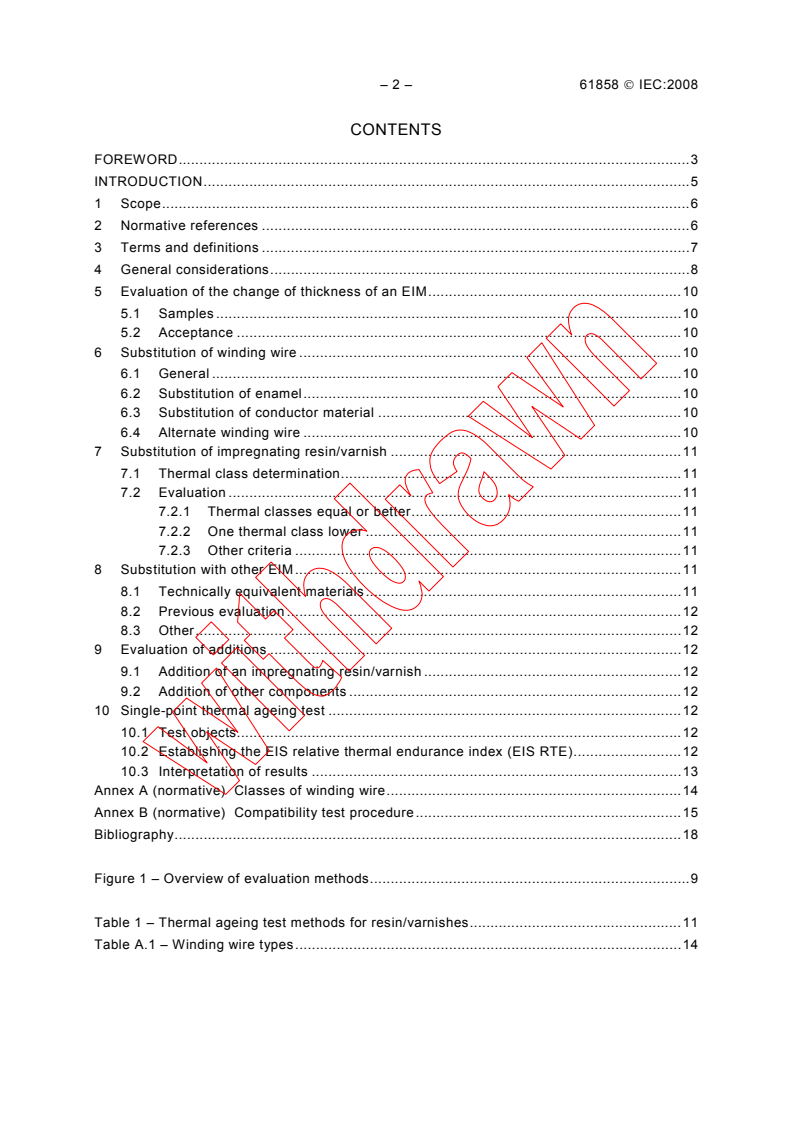
– 2 – 61858 © IEC:2008
CONTENTS
FOREWORD.3
INTRODUCTION.5
1 Scope.6
2 Normative references .6
3 Terms and definitions .7
4 General considerations.8
5 Evaluation of the change of thickness of an EIM.10
5.1 Samples .10
5.2 Acceptance .10
6 Substitution of winding wire .10
6.1 General .10
6.2 Substitution of enamel.10
6.3 Substitution of conductor material .10
6.4 Alternate winding wire .10
7 Substitution of impregnating resin/varnish .11
7.1 Thermal class determination.11
7.2 Evaluation .11
7.2.1 Thermal classes equal or better.11
7.2.2 One thermal class lower .11
7.2.3 Other criteria .11
8 Substitution with other EIM.11
8.1 Technically equivalent materials.11
8.2 Previous evaluation .12
8.3 Other.12
9 Evaluation of additions .12
9.1 Addition of an impregnating resin/varnish .12
9.2 Addition of other components .12
10 Single-point thermal ageing test .12
10.1 Test objects.12
10.2 Establishing the EIS relative thermal endurance index (EIS RTE).12
10.3 Interpretation of results .13
Annex A (normative) Classes of winding wire.14
Annex B (normative) Compatibility test procedure.15
Bibliography.18
Figure 1 – Overview of evaluation methods.9
Table 1 – Thermal ageing test methods for resin/varnishes.11
Table A.1 – Winding wire types.14
61858 © IEC:2008 – 3 –
INTERNATIONAL ELECTROTECHNICAL COMMISSION
____________
ELECTRICAL INSULATION SYSTEMS –
THERMAL EVALUATION OF MODIFICATIONS TO
AN ESTABLISHED WIRE-WOUND EIS
FOREWORD
1) The International Electrotechnical Commission (IEC) is a worldwide organization for standardization comprising
all national electrotechnical committees (IEC National Committees). The object of IEC is to promote
international co-operation on all questions concerning standardization in the electrical and electronic fields. To
this end and in addition to other activities, IEC publishes International Standards, Technical Specifications,
Technical Reports, Publicly Available Specifications (PAS) and Guides (hereafter referred to as “IEC
Publication(s)”). Their preparation is entrusted to technical committees; any IEC National Committee interested
in the subject dealt with may participate in this preparatory work. International, governmental and non-
governmental organizations liaising with the IEC also participate in this preparation. IEC collaborates closely
with the International Organization for Standardization (ISO) in accordance with conditions determined by
agreement between the two organizations.
2) The formal decisions or agreements of IEC on technical matters express, as nearly as possible, an international
consensus of opinion on the relevant subjects since each technical committee has representation from all
interested IEC National Committees.
3) IEC Publications have the form of recommendations for international use and are accepted by IEC National
Committees in that sense. While all reasonable efforts are made to ensure that the technical content of IEC
Publications is accurate, IEC cannot be held responsible for the way in which they are used or for any
misinterpretation by any end user.
4) In order to promote international uniformity, IEC National Committees undertake to apply IEC Publications
transparently to the maximum extent possible in their national and regional publications. Any divergence
between any IEC Publication and the corresponding national or regional publication shall be clearly indicated in
the latter.
5) IEC provides no marking procedure to indicate its approval and cannot be rendered responsible for any
equipment declared to be in conformity with an IEC Publication.
6) All users should ensure that they have the latest edition of this publication.
7) No liability shall attach to IEC or its directors, employees, servants or agents including individual experts and
members of its technical committees and IEC National Committees for any personal injury, property damage or
other damage of any nature whatsoever, whether direct or indirect, or for costs (including legal fees) and
expenses arising out of the publication, use of, or reliance upon, this IEC Publication or any other IEC
Publications.
8) Attention is drawn to the Normative references cited in this publication. Use of the referenced publications is
indispensable for the correct application of this publication.
9) Attention is drawn to the possibility that some of the elements of this IEC Publication may be the subject of
patent rights. IEC shall not be held responsible for identifying any or all such patent rights.
International Standard IEC 61858 has been prepared by IEC technical committee 112:
Evaluation and qualification of electrical insulating materials and systems.
This third edition cancels and replaces the second edition, published in 2004 by IEC TC 98:
Electrical insulation systems (EIS). It constitutes an editorial revision.
The text of this standard is based on the following documents:
CDV Report on voting
112/90/CDV 112/98/RVC
Full information on the voting for the approval of this standard can be found in the report on
voting indicated in the above table.
This publication has been drafted in accordance with the ISO/IEC Directives, Part 2.
– 4 – 61858 © IEC:2008
The committee has decided that the contents of this publication will remain unchanged until
the maintenance result date indicated on the IEC web site under "http://webstore.iec.ch" in
the data related to the specific publication. At this date, the publication will be
• reconfirmed,
• withdrawn,
• replaced by a revised edition, or
• amended.
61858 © IEC:2008 – 5 –
INTRODUCTION
This International Standard describes procedures for the evaluation of changes to an
established electrical insulation system (EIS) for wire-wound electrotechnical devices and the
effect of these changes on the thermal classification of the established EIS.
General principles for evaluation and qualification of EIS can be found in IEC 60505. Unless
the procedures of this standard indicate otherwise, the principles of IEC 60505 should be
followed.
The thermal classification of an EIS is established either by known service life, in accordance
with IEC 60505, or evaluated in accordance with IEC 61857 (all parts).
– 6 – 61858 © IEC:2008
ELECTRICAL INSULATION SYSTEMS –
THERMAL EVALUATION OF MODIFICATIONS TO
AN ESTABLISHED WIRE-WOUND EIS
1 Scope
This International Standard lists the required test procedures for qualification of modifications
of an established electrical insulation system (EIS) with respect to its thermal classification.
This standard is applicable to EIS used in wire-wound electrotechnical devices. The test
procedures are comparative in that the performance of a candidate EIS is compared to that of
a reference EIS, which has proven service experience in accordance with IEC 60505 or has
been evaluated by one of the procedures given in the IEC 61857 series.
2 Normative references
The following referenced documents are indispensable for the application of this document.
For dated references, only the edition cited applies. For undated references, the latest edition
of the referenced document (including any amendments) applies.
IEC 60085:2007, Electrical insulation – Thermal evaluation and designation
IEC 60172, Test procedure for the determination of the temperature index of enamelled
winding wires
IEC 60216-5, Electrical insulating materials – Thermal endurance properties – Part 5:
Determination of relative thermal endurance index (RTE) of an insulating material
IEC 60317-3, Specifications for particular types of winding wires – Part 3: Polyester
enamelled round aluminium wire, class 155
IEC 60317-4, Specifications for particular types of winding wires – Part 4: Solderable
polyurethane enamelled round copper wire, class 130
IEC 60317-7, Specifications for particular types of winding wires – Part 7: Polyimide
enamelled round copper wire, class 220
IEC 60317-8, Specifications for particular types of winding wires – Part 8: Polyesterimide
enamelled round copper wire, class 180
IEC 60317-13, Specifications for particular types of winding wires – Part 13: Polyester or
polyesterimide overcoated with polyamide-imide enamelled round copper wire, class 200
IEC 60317-15, Specifications for particular types of winding wires – Part 15: Polyesterimide
enamelled round aluminium wire, class 180
IEC 60317-16, Specifications for particular types of winding wires – Part 16: Polyester
enamelled rectangular copper wire, class 155
IEC 60317-19, Specifications for particular types of winding wires – Part 19: Solderable
polyurethane enamelled round copper wire, overcoated with polyamide, class 130
61858 © IEC:2008 – 7 –
IEC 60317-20, Specifications for particular types of winding wires – Part 20: Solderable
polyurethane enamelled round copper wire, class 155
IEC 60317-21, Specifications for particular types of winding wires – Part 21: Solderable
polyurethane enamelled round copper wire overcoated with polyamide, class 155
IEC 60317-22, Specifications for particular types of winding wires – Part 22: Polyester or
polyesterimide enamelled round copper wire overcoated with polyamide, class 180
IEC 60317-23, Specifications for particular types of winding wires – Part 23: Solderable
polyesterimide enamelled round copper wire, class 180
IEC 60317-25, Specifications for particular types of winding wires – Part 25: Polyester or
polyesterimide overcoated with polyamide-imide enamelled round aluminium wire, class 200
IEC 60317-29, Specifications for particular types of winding wires – Part 29: Polyester or
polyesterimide overcoated with polyamide-imide enamelled rectangular copper wire, class 200
IEC 60317-30, Specifications for particular types of winding wires – Part 30: Polyimide
enamelled rectangular copper wire, class 220
IEC 60317-34, Specifications for particular types of winding wires – Part 34: Polyester
enamelled round copper wire, class 130 L
IEC 60317-42, Specifications for particular types of winding wires – Part 42: Polyester-amide-
imide enamelled round copper wire, class 200
IEC 60317-46, Specifications for particular types of winding wires – Part 46: Aromatic
polyimide enamelled round copper wire, class 240
IEC 60317-47, Specifications for particular types of winding wires – Part 47: Aromatic
polyimide enamelled rectangular copper wire, class 240
IEC 60317-51, Specifications for particular types of winding wires – Part 51: Solderable
polyurethane enamelled round copper wire, class 180
IEC 60505, Evaluation and qualification of electrical insulation systems
IEC 61033, Test methods for the determination of bond strength of impregnating agents to an
enamelled wire substrate
IEC 61857 (all parts), Electrical insulation systems – Procedures for thermal evaluation
IEC 61857-1, Electrical insulation systems – Procedures for thermal evaluation – Part 1:
General requirements – Low voltage
3 Terms and definitions
For the purposes of this document, the following terms and definitions apply.
3.1
electrical insulation system
EIS
insulating structure containing one or more electrical insulating materials (EIM) together with
associated conducting parts employed in an electrotechnical device
– 8 – 61858 © IEC:2008
3.2
electrical insulating material
EIM
material with negligibly low electric conductivity, used to separate conducting parts at different
electrical potentials
3.3
candidate EIS
EIS under evaluation to determine its service capability (thermal)
3.4
reference EIS
established EIS evaluated on the basis of either a known service experience record or a
known comparative functional evaluation
3.5
EIS assessed thermal endurance index
EIS ATE
numerical value of temperature in degrees Celsius for the reference EIS as derived from
known service experience or a known comparative functional evaluation
3.6
EIS relative thermal endurance index
EIS RTE
numerical value of the temperature in degrees Celsius of the candidate EIS which is relative
to the known EIS ATE of a reference EIS, when both EIS are subjected to the same ageing
and diagnostic procedures in a comparative test
4 General considerations
This standard provides relatively low cost and short-time methods by which the user can
make modifications to an established EIS by evaluating
a) the impact on the thermal life of the EIS if the thickness of an EIM is changed,
b) the compatibility, under thermal stress, of a substituted EIM,
c) the compatibility, under thermal stress, of other components used in intimate contact with
an established EIS.
EIM having different temperature indices (ATE/RTE) according to IEC 60216-5, may be
combined to form an EIS having a thermal class that may be higher or lower than that of any
of the individual components according to IEC 60505.
There may be more than one EIS in a particular apparatus. These EIS may have different
thermal classes.
The following overview (Figure 1) is a flow chart for guidance in selecting the proper clauses
for evaluation.
61858 © IEC:2008 – 9 –
Established EIS per IEC 60791
or IEC 61857-1
EIM modification of established EIS Evaluation of additions to
established EIS
Addition of Addition
Change of
Substitution of EIM component
impregnating resin/ of other
thickness
varnish components
(5)
(9.1) (9.2)
Impregnating
Winding
resin/varnish Other EIM(8)
Wire (6)
(7)
Compare Substitution Substitution Substitution
thermal allowed? (8.2) allowed? (8.1) allowed? (6.1)
classes (7.1)
Yes No
No
Yes
Yes Acceptable?
No
per IEC 60172
Equal or
greater than?
Yes
No
Yes
No
Test per
Test per Annex B
Annex B
Acceptable
results?
No
Yes
Single temperature Acceptable
aging test results?
(10)
No
Yes
Acceptable
Can use in Can not use
results?
EIS in EIS
No
Yes
Modified EIS is acceptable
Test as new EIS according to IEC 61857-1
IEC 1473/04
Figure 1 – Overview of evaluation methods
– 10 – 61858 © IEC:2008
5 Evaluation of the change of thickness of an EIM
5.1 Samples
Representative samples of the established EIS (the reference EIS) and of the EIS with
reduced EIM thickness(es) (the candidate EIS) shall be evaluated in accordance with
Clause 10.
5.2 Acceptance
A candidate EIS that meets the acceptance criteria according to Clause 10 shall be assigned
the same thermal class as the established EIS.
If the results of the candidate EIS testing are outside the acceptance criteria according to
Clause 10, then full thermal ageing in accordance with IEC 61857-1 shall be conducted in
order to establish its thermal class.
NOTE Full thermal ageing may be accomplished by testing at additional temperatures, according to IEC 61857-1.
6 Substitution of winding wire
6.1 General
Substitution of a winding wire evaluated in the established EIS can be made without additional
testing when one or more of the following conditions have been met:
a) the winding wire conforms to an IEC 60317 specification having the same chemical
composition, according to the Annex A groupings, as the winding wire evaluated in the
established EIS but is of a different size or shape;
b) the winding wire conforms to an IEC 60317 specification having the same chemical
composition, according to the Annex A groupings, as the winding wire evaluated in the
established EIS and has an equal or higher thermal class;
c) the winding wire is a bare conductor insulated with one of the EIM evaluated as part of the
established EIS in accordance with IEC 61857-1. The thickness to be used shall be such
that the electrical stress per unit thickness is not greater than the stress to which the EIM
was subjected during the ageing test.
NOTE For substitution of an alternate EIM, refer to Clause 8.
6.2 Substitution of enamel
For chemical composition substitution criteria, refer to Annex A.
6.3 Substitution of conductor material
An established EIS, which has been evaluated with copper as the conductor, may use either
copper or aluminium conductor.
An established EIS, which has been evaluated with aluminium as the conductor, may use
either aluminium or copper conductor, provided the thermal performance of the substitute
winding wire has been established to be equal to or better than the winding wire evaluated.
6.4 Alternate winding wire
Winding wires that do not meet the criteria in 6.1 or 6.2 shall be evaluated in accordance with
IEC 61857-1.
Examples would include either bondable winding wire, conductor insulated with an EIM not
included in the established EIS, or lead wire used as an alternate winding wire.
61858 © IEC:2008 – 11 –
7 Substitution of impregnating resin/varnish
7.1 Thermal class determination
The thermal classes of both the candidate resin/varnish and the resin/varnish used in the
established EIS shall be determined by comparison of the manufacturer’s thermal ageing data
using the test methods in Table 1. Both tests shall be conducted.
Table 1 – Thermal ageing test methods for resin/varnishes
Test IEC designation
method
Twisted pair IEC 60172 specifying the specific resin/varnish winding wire combination
Helical coil IEC 61033 specifying the specific resin/varnish winding wire combination. Use 22 N as the
value which specifies the end of life at each ageing temperature. A minimum of three ageing
temperatures; the average life at the highest ageing temperature being a minimum of 100 h and
the average life at the lowest ageing temperature being a minimum of 5 000 h. The temperature
index value is defined as the temperature intercept for the time of 20 000 h. The helical-coil
thermal class assigned to the resin/varnish winding wire combination shall be equal to or less
than the temperature index (see IEC 60085:2007, Table 1, Thermal class assignment).
7.2 Evaluation
7.2.1 Thermal classes equal or better
When both thermal classes of the candidate impregnating resin/varnish (twisted pair and
helical coil) are equal to or higher than the thermal classes of the impregnating resin/varnish
in the established EIS, then substitution is allowed:
a) based on acceptable results when tested for compatibility using the procedure from
Annex B, or
b) based on acceptable results when tested according to Clause 10.
7.2.2 One thermal class lower
If one or both of the thermal classes of the candidate impregnating resin/varnish (twisted pair
and/or helical coil) are no more than one thermal class lower than the thermal classes of the
impregnating resin/varnish of the established EIS, then substitution is allowed based on
acceptable results when tested in accordance with Clause 10.
NOTE If the established EIS has received its thermal class rating without the inclusion of an impregnating
resin/varnish, refer to 9.1 for addition of an impregnating resin/varnish.
7.2.3 Other criteria
A resin/varnish not meeting the above criteria shall be evaluated according to
IEC 61857-1.
8 Substitution with other EIM
8.1 Technically equivalent materials
Substitution with EIM, which have an identical chemical composition, is acceptable with no
additional testing. Substitution or addition of select additives in an EIM may be allowed with
reduced or no additional testing (if agreed upon by all interested parties).
– 12 – 61858 © IEC:2008
8.2 Previous evaluation
An EIM evaluated as part of the established EIS, used in combination with another EIM or
other component, may be used based upon acceptable results when tested for compatibility
according to Annex B. The thickness of the EIM shall not be less than that which was
evaluated in the established EIS.
8.3 Other
Substitution with or addition of any other EIM shall require full thermal evaluation per
IEC 61857-1.
9 Evaluation of additions
9.1 Addition of an impregnating resin/varnish
An impregnating resin/varnish may be added to an established unvarnished EIS if the
following conditions are met:
a) the impregnating resin/varnish shall be evaluated with the specific winding wire according
to IEC 60172 and the resultant thermal class shall be not more than one thermal class
below that of the unvarnished winding wire;
b) the candidate impregnating resin/varnish shall meet the criteria of 9.2.
9.2 Addition of other components
Other components that are to be used in conjunction with an established EIS shall be allowed
based on acceptable results when tested for compatibility using the procedure from Annex B.
NOTE Such materials are typically used for mechanical, heat transfer, decoration, or other non-electrically
stressed functions.
10 Single-point thermal ageing test
10.1 Test objects
Representative test objects of the established EIS (reference EIS) and the candidate EIS shall
be constructed and tested in accordance with IEC 61857-1 with the following exceptions:
a) the reference and candidate EIS shall be concurrently tested at the same temperature;
b) the ageing temperature should be selected from the full thermal ageing programme of the
established EIS to give an expected test life of between 1 000 h to 2 000 h;
c) when an EIM, evaluated in the established EIS with multiple EIM, is no longer available,
the reference test objects shall be constructed with all remaining materials.
10.2 Establishing the EIS relative thermal endurance index (EIS RTE)
The EIS RTE of the candidate EIS shall be established by comparing the original regression
slope of the reference EIS with the time–temperature data point for the candidate EIS (refer to
IEC 61857-1, Figure 1). The comparison shall be made using the correlation time established
according to:
Correlation time
⎛ ⎞
M M
⎜ ⎟
−
⎜ ⎟
⎜ T + 273,15 T + 273,15⎟
⎝ R A ⎠
t = t × e
x R
61858 © IEC:2008 – 13 –
EIS RTE of the candidate EIS
⎛ ⎞
⎜ ⎟
⎜ ⎟
M
T = − 273,15
⎜ ⎟
c
⎛ t ⎞
M
⎜ ⎟
x
⎜ ⎟
ln +
⎜ ⎜ ⎟ ⎟
t T + 273,15
c A
⎝ ⎠
⎝ ⎠
where
M is the slope of the reference EIS regression equation;
T is the EIS ATE of the reference EIS, in degrees Celsius (°C);
R
T is the ageing temperature in degrees Celsius (°C);
A
T is the EIS RTE of the candidate system in degrees Celsius (°C);
c
t is the life of the reference EIS in hours (h);
R
t is the life of the candidate EIS in hours (h);
c
t is the correlation time in hours (h).
x
10.3 Interpretation of results
The candidate EIS shall be assigned the same thermal class rating as the reference EIS if the
EIS RTE value, derived in 10.2, is within ±5 K of the EIS ATE value of the reference EIS.
If the EIS RTE value of the candidate EIS is not within ±5 K of the EIS ATE value of the
reference EIS, no thermal class rating shall be assigned to the candidate EIS. The candidate
EIS can be aged at additional temperatures in accordance with IEC 61857-1 in order to
establish the thermal class.
– 14 – 61858 © IEC:2008
Annex A
(normative)
Classes of winding wire
Various types of commonly used enamelled winding wire, constructed in accordance with the
IEC 60317 series, are presented in Table A.1. The accepted practice for substitution of
winding wire is as follows:
a) winding wires of the same chemical composition with a thermal class equal to or higher
than the type of wire evaluated in the established EIS may be substituted into the
established EIS without additional testing;
b) winding wire of a chemical composition not evaluated in the established EIS shall not be
substituted;
c) winding wire of the same chemical composition having a thermal classification lower than
the thermal class of the wire type(s) evaluated in the established EIS shall not be
substituted;
d) winding wire substitutions not permitted under either b) or c) shall be tested according
to IEC 61857-1.
Table A.1 – Winding wire types
Thermal IEC
Chemical composition of enamel(s)
classes designation
Solderable polyurethane 130 60317-4
Solderable polyurethane/polyamide overcoat 130 60317-19
Solderable polyurethane 155 60317-20
Solderable polyurethane/polyamide overcoat 155 60317-21
Solderable polyurethane 180 60317-51
Non-solderable polyester 130 60317-34
Non-solderable polyester 155 60317-3
Non-solderable polyester (rectangular) 155 60317-16
Non-solderable polyesterimide 180 60317-8
Non-solderable polyesterimide (aluminium) 180 60317-15
Non-solderable polyester or polyesterimide/polyamide overcoat 180 60317-22
Non-solderable polyester or polyesterimide/polyamide overcoat (aluminium) 180 60317-24
Non-solderable polyester or polyesterimide/polyamide-imide overcoat 200 60317-13
Non-solderable polyester or polyesterimide/polyamide-imide overcoat (aluminium)
Non-solderable polyester or polyesterimide/polyamide-imide overcoat 200 60317-25
(rectangular)
Non-solderable polyester-amide-imide 200
60317-29
200 60317-42
Solderable polyester 130 60317-41
Solderable polyesterimide 180 60317-23
Non-solderable polyimide 220 60317-7
Non-solderable polyimide (rectangular) 220 60317-30
Non-solderable polyimide 240 60317-46
Non-solderable polyimide (rectangular) 240 60317-47
NOTE Unless otherwise noted, IEC designations represent round, copper wire.
———————
IEC 60317-24:1997 has been withdrawn, but may apply to reference EIS.
61858 © IEC:2008 – 15 –
Annex B
(normative)
Compatibility test procedure
B.1 General
This test procedure is useful for evaluating the chemical compatibility of a combination of
materials for use in conjunction with an EIS. A specific combination of materials is sealed in a
glass tube, subjected to a specified thermal ageing cycle and then subjected to a dielectric
test. Candidate tube test results are then compared to the reference tube test results for
qualification of the acceptability of the candidate EIS.
B.2 Construction
B.2.1 Test apparatus
The test apparatus shall consist of the following:
a) glass tubes with inside volume not exceeding 900 ml and a minimum length of 300 mm:
1) flanged high-temperature glass tubes which are designed to be sealed with metal rings
and gaskets are preferred;
2) glass tubes which can be fusion sealed after the addition of all materials are an
acceptable alternative;
b) gasket material for use with flanged high-temperature glass tubes:
1) type TFE or FEP fluorocarbon;
2) hexafluoropropylene-vinylidene fluoride elastomer for exposure temperatures not
exceeding 155 °C.
B.2.2 Material specimens
The samples of material specimens that are to be placed in each tube shall include the
following:
a) winding wire specimens; samples of twisted pair winding wire formed and tested in
accordance with IEC 60172; a minimum of five winding wire samples shall be evaluated
for each tube;
NOTE Winding wire covered with fibrous material should be tested in 230 mm straight lengths.
b) representative samples of the EIM qualified for use in the established EIS, such as
impregnating varnish and ground insulation; sheet material shall have a surface area not
2 3
less than 645 mm ; moulding compounds shall have a minimum volume of 800 mm ;
impregnating varnish, if included in the EIS, shall be applied to the winding wire samples
and cured in accordance with the manufacturer’s specifications;
c) other non-metallic component samples intended for use in conjunction with the EIS such
as lead cable, sheet insulation, tie cord, tape, sleeving and tubing, potting compounds and
encapsulants; sheet material shall have a surface area not less than 645 mm ; potting
; lead cable,
compounds and encapsulants shall have a minimum volume of 800 mm
sleeving, tubing and tie cord shall have a minimum length of 25,4 mm.
– 16 – 61858 © IEC:2008
B.2.3 Contents of tube
The contents of the tubes shall be as follows:
a) reference tube – shall contain only materials which were qualified in the original aging to
establish EIS;
b) candidate tubes – each candidate tube shall contain the alternate materials in addition to
all the materials qualified in the established EIS. Alternate materials which are not usually
or cannot be used in conjunction with each other, such as alternate varnishes, shall each
be tested in a separate candidate tube.
B.3 Test procedure
B.3.1 Preparation of tubes
The preparation of the tube assemblies shall be as follows:
a) The tubes shall be filled with an effective solvent, such as acetone, for 24 h or longer,
scrubbed well with detergent and a test tube brush, rinsed thoroughly twice with tap water
and then with distilled water, and finally dried.
b) The tubes, gaskets, taps, nuts and bolts shall be conditioned for at least 1 h in an oven
maintained at 105 °C ± 2 K, and shall then be removed from the oven and the samples
immediately inserted.
c) The twisted pairs of wire shall be prepared in accordance with B.2.2 a) and proof-tested
electrically according to IEC 60172 before insertion in tubes. The other materials shall
then be positioned inside the tubes, avoiding contact with the twisted pairs if possible, so
that there is no sticking during the ageing period. Open glass tubes shall be sealed at one
end before being filled.
d) After the tubes are filled, the tube, gaskets, taps, nuts and bolts shall be dried for at least
1 h in an oven maintained at 105 °C ± 2 K. If open glass tubes are used, the oven
temperature shall be 135 °C ± 2 K. Certain materials may require additional conditioning
to remove all moisture; if agreed upon by interested parties, higher temperatures and
times may be used to condition these materials prior to insertion in the tubes. The bolts,
threads, and the underside of the top shall be lightly coated with silicone grease before
being placed in the oven, and these parts shall be kept away from the gasket material and
tubes.
e) Immediately upon removal from the oven, the gasket and clamp shall be assembled to the
tube using protective gloves. Each bolt shall be torqued in a clockwise direction in
increments of 0,5 Nm until a torque of 3,5 Nm is attained. If open glass tubes are used,
the open end shall be fused.
NOTE Unless open glass tubes are used, the still warm assembly should be inverted in room temperature
water to reduce the likelihood of shock and breakage. The assembly should remain in the water and cool for a
minimum of 5 min. The cooling creates a vacuum in the tube that will draw in water if a leak is present. If open
glass tubes are used, each tube should be returned to the oven which should then be turned off and allowed to
cool to room temperature. The tubes should be removed and allowed to cool to room temperature and
examined for possible leakage as evidenced by condensation on the inner walls of the tubes.
f) Tubes shall be placed in the pre-heated thermal conditioning oven. The thermal
conditioning oven should not be opened during the conditioning cycle as this can effect
the thermal ageing of the EIS under evaluation.
B.3.2 Thermal conditioning
The samples shall be conditioned for 336 h ± 2 h (14 days) at a temperature equal to the
thermal class of the established EIS plus 25 K; for example, the conditioning temperature of a
Class 130 (B) EIS would be 155 °C.
61858 © IEC:2008 – 17 –
B.3.3 Opening procedure
After thermal conditioning of the tubes as described in B.3.2, the oven shall be turned off and
allowed to cool to room temperature before the tubes are removed. Tubes shall remained
sealed prior to evaluation, which is not to be delayed for more than three days. The tubes
shall then be opened and the winding wire samples carefully removed and separated so as to
reduce mechanical damage.
B.3.4 Evaluation of samples
The winding wire samples shall be evaluated as follows:
a) Twisted pairs shall be dielectrically stressed until breakdown by increasing the test voltage
at a rate of 500 V/s, 48 Hz to 62 Hz, a.c. Winding wire covered with fibrous material shall
be tested by applying the test voltage between the conductor and metallic foil, over a
length of 100 mm, wrapped around the straight central portion of the specimen.
b) The average breakdown voltage for the winding wire samples from the candidate tube
shall be compared to the average breakdown voltage for the winding wire samples from
the reference tube. At least five test values are required for each set of winding wire
samples; the criteria to be used for eliminating any one test value from the calculation of
the average shall be determined by agreement between interested parties prior to testing.
c) The combination of materials in the candidate tube shall be considered compatible and
qualified for use in the specific EIS tested if the average electric strength of the winding
wire samples from the candidate tube is not less than 50 % of that of the winding wire
samples from the reference tube.
NOTE The 50 % criterion has been found to be adequate, since the breakdown voltage drops drastically if
incompatibility occurs between materials in the individual tubes.
– 18 – 61858 © IEC:2008
Bibliography
IEC 60317-24, Specifications for particular types of winding wires – Part 24: Polyester or
polyesterimide enamelled round aluminium wire overcoated with polyamide, class 180
(withdrawn 2003)
IEC 60317-41, Specifications for particular types of winding wires – Part 41: Solderable
polyester enamelled round copper wire, class 130L
(withdrawn 2003)
___________
– 20 – 61858 © CEI:2008
SOMMAIRE
AVANT-PROPOS.21
INTRODUCTION.23
1 Domaine d’application .24
2 Références normatives.24
3 Termes et définitions .26
4 Considérations générales .26
5 Evaluation de la modification d’épaisseur d’un matériau d’isolation électrique .29
5.1 Echantillons.29
5.2 Acceptation .29
6 Substitution d’un enroulement à fil.29
6.1 Généralités.29
6.2 Substitution de l’émail .29
6.3 Substitution du matériau conducteur.29
6.4 Fil de bobinage de remp
...