

IEC 63453:2025
(Main)Railway applications - Current collection systems - Validation of simulation of the dynamic interaction between pantograph and overhead contact line
General Information
- Abstract
IEC 63453:2025 specifies functional requirements for the validation of simulation techniques and tools used to assess the dynamic interaction between overhead contact lines and pantographs, as part of the prediction of current collection quality, to ensure confidence in, and mutual acceptance of the results of the simulations.
This document deals with:
- input and output parameters of the simulation;
- comparison with line test measurements, and the characteristics of those line tests;
- validation of pantograph models;
- comparison between different simulation tools;
- limits of application of validated methods to assessments of pantographs and overhead contact lines.
This document applies to the current collection from an overhead contact line by pantographs mounted on railway vehicles. It does not apply to trolley bus systems.
- Status
- Published
- Publication Date
- 28-Jan-2025
- Technical Committee
- TC 9 - Electrical equipment and systems for railways
- Drafting Committee
- PT 63453 - TC 9/PT 63453
- Current Stage
- PPUB - Publication issued
- Start Date
- 29-Jan-2025
- Completion Date
- 10-Jan-2025
Buy Documents
IEC 63453:2025 - Railway applications - Current collection systems - Validation of simulation of the dynamic interaction between pantograph and overhead contact line Released:1/29/2025
IEC 63453:2025 - Applications ferroviaires - Systèmes de captage du courant - Validation des simulations de l'interaction dynamique entre le pantographe et la caténaire/29/2025

IEC 63453:2025 - Railway applications - Current collection systems - Validation of simulation of the dynamic interaction between pantograph and overhead contact line/29/2025
Overview - IEC 63453:2025 (Railway current collection simulation validation)
IEC 63453:2025 specifies functional requirements for the validation of simulation techniques and tools that predict the dynamic interaction between a pantograph and the overhead contact line (OCL). Its purpose is to ensure confidence in, and mutual acceptance of, simulation results used to assess current collection quality in railway applications. The standard applies to pantographs mounted on railway vehicles and explicitly does not apply to trolley bus systems.
Key topics and technical requirements
Validation scope
- Defines required input and output parameters for simulations, including static and dynamic quantities.
- Specifies how to compare simulation results with line test measurements and the required characteristics of those tests.
Pantograph and OCL modelling
- Requirements for different pantograph model types (lumped mass–spring–damper, multi‑body, transfer‑function, hardware‑in‑the‑loop) and their input data.
- Requirements for modelling overhead contact line geometry, elasticity, droppers and static checks of OCL models.
Simulation parameters and outputs
- Lists key simulation parameters and expected outputs such as contact force, contact wire displacement and pantograph displacement.
- Includes accuracy requirements (see tables for required static and dynamic accuracy levels).
Validation process and limits of application
- Procedures for validating pantograph models against measured values, comparison criteria and limits for applying validated methods to other pantograph/OCL configurations.
- Guidance on permissible changes to pantograph, OCL and simulation parameters and on inter-tool comparisons.
Reference and supporting data
- Normative annexes provide reference model specifications, measured datasets for validation (AC/DC, simple and stitched OCL), and example assessment processes (Annex C) plus a national annex (Japan).
Practical applications - who uses IEC 63453:2025
- Railway vehicle manufacturers and pantograph designers validating new designs.
- Infrastructure managers and OCL designers assessing new or modified overhead line layouts.
- Simulation tool developers and testing laboratories seeking mutual acceptance of simulation results.
- Certification bodies and interoperability assessors using validated simulation evidence to reduce onsite testing.
Benefits include improved confidence in current‑collection predictions, reduced field testing, more consistent acceptance criteria across stakeholders, and support for interoperability assessments.
Related standards and context
- IEC 63453:2025 complements other railway electrification and interoperability standards addressing current collection quality and infrastructure requirements. Users should consult relevant IEC and national railway standards when applying validation results to certification and deployment.
Keywords: IEC 63453:2025, pantograph, overhead contact line, OCL, current collection simulation, validation, railway applications, dynamic interaction, simulation tools, model validation.
Buy Documents
IEC 63453:2025 - Railway applications - Current collection systems - Validation of simulation of the dynamic interaction between pantograph and overhead contact line Released:1/29/2025
IEC 63453:2025 - Applications ferroviaires - Systèmes de captage du courant - Validation des simulations de l'interaction dynamique entre le pantographe et la caténaire/29/2025
IEC 63453:2025 - Railway applications - Current collection systems - Validation of simulation of the dynamic interaction between pantograph and overhead contact line/29/2025
Get Certified
Connect with accredited certification bodies for this standard

IRIS Certification (UNIFE)
International Railway Industry Standard certification.

TÜV SÜD Rail GmbH
TÜV SÜD railway certification services.

Bureau Veritas Railway Certification
Railway and transportation certification.
Sponsored listings
Frequently Asked Questions
IEC 63453:2025 is a standard published by the International Electrotechnical Commission (IEC). Its full title is "Railway applications - Current collection systems - Validation of simulation of the dynamic interaction between pantograph and overhead contact line". This standard covers: IEC 63453:2025 specifies functional requirements for the validation of simulation techniques and tools used to assess the dynamic interaction between overhead contact lines and pantographs, as part of the prediction of current collection quality, to ensure confidence in, and mutual acceptance of the results of the simulations. This document deals with: - input and output parameters of the simulation; - comparison with line test measurements, and the characteristics of those line tests; - validation of pantograph models; - comparison between different simulation tools; - limits of application of validated methods to assessments of pantographs and overhead contact lines. This document applies to the current collection from an overhead contact line by pantographs mounted on railway vehicles. It does not apply to trolley bus systems.
IEC 63453:2025 specifies functional requirements for the validation of simulation techniques and tools used to assess the dynamic interaction between overhead contact lines and pantographs, as part of the prediction of current collection quality, to ensure confidence in, and mutual acceptance of the results of the simulations. This document deals with: - input and output parameters of the simulation; - comparison with line test measurements, and the characteristics of those line tests; - validation of pantograph models; - comparison between different simulation tools; - limits of application of validated methods to assessments of pantographs and overhead contact lines. This document applies to the current collection from an overhead contact line by pantographs mounted on railway vehicles. It does not apply to trolley bus systems.
IEC 63453:2025 is classified under the following ICS (International Classification for Standards) categories: 45.060.01 - Railway rolling stock in general. The ICS classification helps identify the subject area and facilitates finding related standards.
IEC 63453:2025 is available in PDF format for immediate download after purchase. The document can be added to your cart and obtained through the secure checkout process. Digital delivery ensures instant access to the complete standard document.
Standards Content (Sample)
IEC 63453 ®
Edition 1.0 2025-01
INTERNATIONAL
STANDARD
Railway applications – Current collection systems – Validation of simulation of
the dynamic interaction between pantograph and overhead contact line
All rights reserved. Unless otherwise specified, no part of this publication may be reproduced or utilized in any form
or by any means, electronic or mechanical, including photocopying and microfilm, without permission in writing from
either IEC or IEC's member National Committee in the country of the requester. If you have any questions about IEC
copyright or have an enquiry about obtaining additional rights to this publication, please contact the address below or
your local IEC member National Committee for further information.
IEC Secretariat Tel.: +41 22 919 02 11
3, rue de Varembé info@iec.ch
CH-1211 Geneva 20 www.iec.ch
Switzerland
About the IEC
The International Electrotechnical Commission (IEC) is the leading global organization that prepares and publishes
International Standards for all electrical, electronic and related technologies.
About IEC publications
The technical content of IEC publications is kept under constant review by the IEC. Please make sure that you have the
latest edition, a corrigendum or an amendment might have been published.
IEC publications search - webstore.iec.ch/advsearchform IEC Products & Services Portal - products.iec.ch
The advanced search enables to find IEC publications by a Discover our powerful search engine and read freely all the
variety of criteria (reference number, text, technical publications previews, graphical symbols and the glossary.
committee, …). It also gives information on projects, replaced With a subscription you will always have access to up to date
and withdrawn publications. content tailored to your needs.
IEC Just Published - webstore.iec.ch/justpublished
Electropedia - www.electropedia.org
Stay up to date on all new IEC publications. Just Published
The world's leading online dictionary on electrotechnology,
details all new publications released. Available online and once
containing more than 22 500 terminological entries in English
a month by email.
and French, with equivalent terms in 25 additional languages.
Also known as the International Electrotechnical Vocabulary
IEC Customer Service Centre - webstore.iec.ch/csc
(IEV) online.
If you wish to give us your feedback on this publication or need
further assistance, please contact the Customer Service
Centre: sales@iec.ch.
IEC 63453 ®
Edition 1.0 2025-01
INTERNATIONAL
STANDARD
Railway applications – Current collection systems – Validation of simulation of
the dynamic interaction between pantograph and overhead contact line
INTERNATIONAL
ELECTROTECHNICAL
COMMISSION
ICS 45.060.01 ISBN 978-2-8327-0095-2
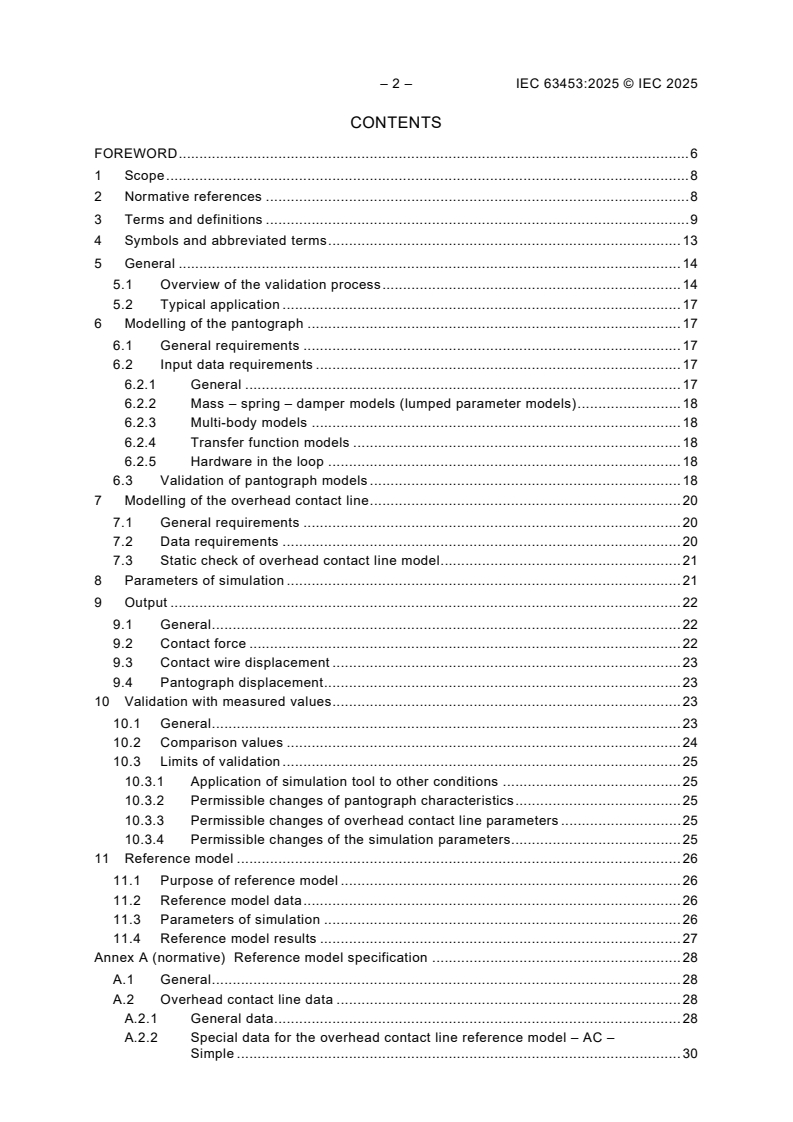
– 2 – IEC 63453:2025 © IEC 2025
CONTENTS
FOREWORD . 6
1 Scope . 8
2 Normative references . 8
3 Terms and definitions . 9
4 Symbols and abbreviated terms . 13
5 General . 14
5.1 Overview of the validation process . 14
5.2 Typical application . 17
6 Modelling of the pantograph . 17
6.1 General requirements . 17
6.2 Input data requirements . 17
6.2.1 General . 17
6.2.2 Mass – spring – damper models (lumped parameter models) . 18
6.2.3 Multi-body models . 18
6.2.4 Transfer function models . 18
6.2.5 Hardware in the loop . 18
6.3 Validation of pantograph models . 18
7 Modelling of the overhead contact line . 20
7.1 General requirements . 20
7.2 Data requirements . 20
7.3 Static check of overhead contact line model. 21
8 Parameters of simulation . 21
9 Output . 22
9.1 General . 22
9.2 Contact force . 22
9.3 Contact wire displacement . 23
9.4 Pantograph displacement . 23
10 Validation with measured values . 23
10.1 General . 23
10.2 Comparison values . 24
10.3 Limits of validation . 25
10.3.1 Application of simulation tool to other conditions . 25
10.3.2 Permissible changes of pantograph characteristics . 25
10.3.3 Permissible changes of overhead contact line parameters . 25
10.3.4 Permissible changes of the simulation parameters. 25
11 Reference model . 26
11.1 Purpose of reference model . 26
11.2 Reference model data . 26
11.3 Parameters of simulation . 26
11.4 Reference model results . 27
Annex A (normative) Reference model specification . 28
A.1 General . 28
A.2 Overhead contact line data . 28
A.2.1 General data. 28
A.2.2 Special data for the overhead contact line reference model – AC –
Simple . 30
A.2.3 Special data for the reference model of overhead contact line AC –
Stitched . 31
A.2.4 Special data for the reference model of overhead contact line DC –
Simple . 32
A.3 Pantograph data . 33
A.4 Results of simulations for reference models . 34
Annex B (normative) Model specifications and measurement results for validation . 37
B.1 Measurement results of simple AC high speed overhead contact line . 37
B.1.1 Simulation data for overhead contact line model . 37
B.1.2 Pantograph model . 47
B.1.3 Measured data of dynamic interaction for validation. 47
B.2 Measurement results of a stitched AC high speed overhead contact line . 48
B.2.1 General . 48
B.2.2 Simulation data for overhead contact line model . 48
B.2.3 Pantograph data . 59
B.2.4 Calculated and measured data of OCL-rest position for validation . 60
B.2.5 Measuring data of dynamic interaction for validation . 60
B.3 Measurement results of simple DC high speed overhead contact line . 61
B.3.1 General . 61
B.3.2 Simulation data for overhead contact line model . 61
B.3.3 Pantograph data . 75
B.3.4 Measured data of dynamic interaction for validation. 75
Annex C (informative) Assessment process example for dynamic interaction between
"new" OCL design or "new" pantograph design for interoperability purpose . 77
Annex D (informative) National annex for Japan – Permissible changes of the
simulation parameters . 81
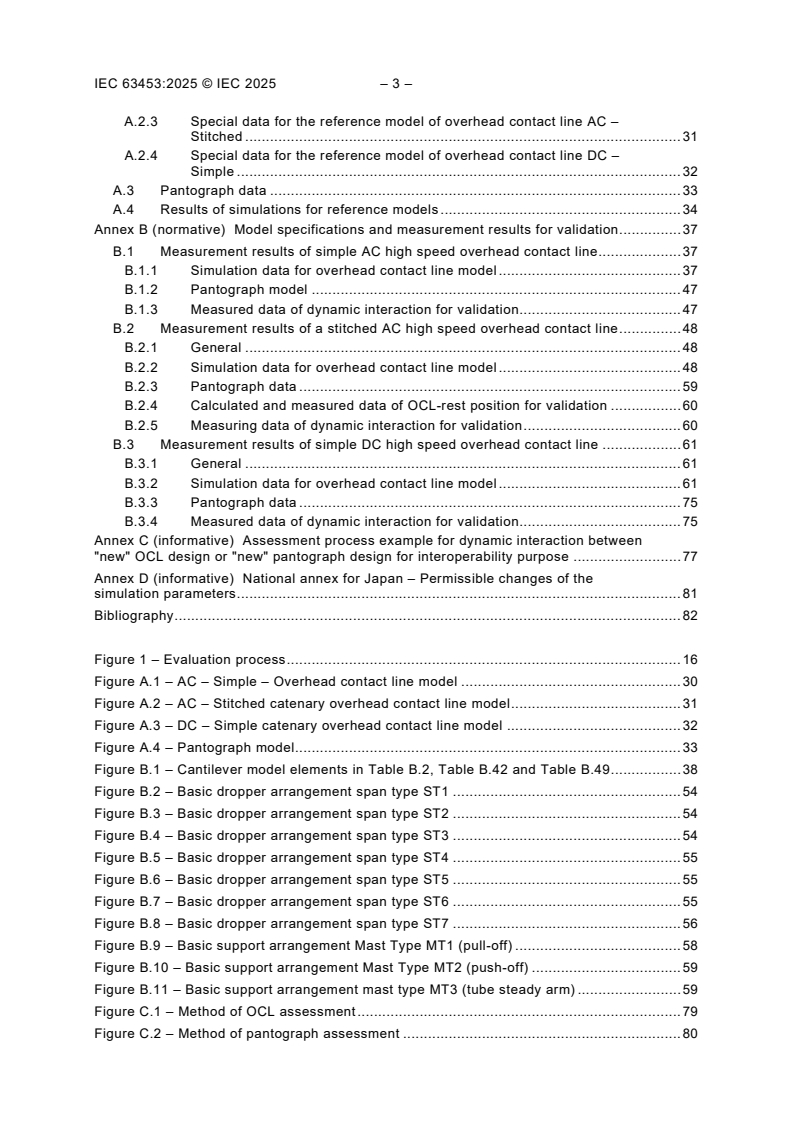
Bibliography . 82
Figure 1 – Evaluation process . 16
Figure A.1 – AC – Simple – Overhead contact line model . 30
Figure A.2 – AC – Stitched catenary overhead contact line model . 31
Figure A.3 – DC – Simple catenary overhead contact line model . 32
Figure A.4 – Pantograph model. 33
Figure B.1 – Cantilever model elements in Table B.2, Table B.42 and Table B.49 . 38
Figure B.2 – Basic dropper arrangement span type ST1 . 54
Figure B.3 – Basic dropper arrangement span type ST2 . 54
Figure B.4 – Basic dropper arrangement span type ST3 . 54
Figure B.5 – Basic dropper arrangement span type ST4 . 55
Figure B.6 – Basic dropper arrangement span type ST5 . 55
Figure B.7 – Basic dropper arrangement span type ST6 . 55
Figure B.8 – Basic dropper arrangement span type ST7 . 56
Figure B.9 – Basic support arrangement Mast Type MT1 (pull-off) . 58
Figure B.10 – Basic support arrangement Mast Type MT2 (push-off) . 59
Figure B.11 – Basic support arrangement mast type MT3 (tube steady arm) . 59
Figure C.1 – Method of OCL assessment . 79
Figure C.2 – Method of pantograph assessment . 80
– 4 – IEC 63453:2025 © IEC 2025
Table 1 – Required accuracy of simulated static values . 21
Table 2 – Required accuracy of simulated dynamic values . 24
Table 3 – Combinations of OCL and pantograph reference models . 26
Table A.1 – Data for reference overhead contact lines . 29
Table A.2 – AC – Simple – Overhead contact line model – Geometry and elasticity of
droppers . 31
Table A.3 – AC – Stitched catenary overhead contact line model – Geometry and
elasticity of droppers . 32
Table A.4 – DC – Simple catenary overhead contact line model – Geometry and
elasticity of overhead contact line . 33
Table A.5 – Pantograph model parameters . 34
Table A.6 – Ranges of results from reference model AC simple . 35
Table A.7 – Ranges of results from reference model AC stitched . 35
Table A.8 – Ranges of results from reference model DC simple . 36
Table B.1 – Mechanical values of wires . 37
Table B.2 – Mechanical values of clamps and other OCL-components . 37
Table B.3 – Pre-sag information in open route and overlap . 38
Table B.4 – Cantilever information in open route and overlap: steady arm geometry . 38
Table B.5 – Span definition of tension length 1 . 39
Table B.6 – Span definition of tension length 2 . 39
Table B.7 – Span definition of tension length 3 . 39
Table B.8 – Support definition of tension length 1 . 40
Table B.9 – Support definition of tension length 2 . 41
Table B.10 – Support definition of tension length 3 . 42
Table B.11 – Span length = 44,7 m . 42
Table B.12 – Span length = 45,3 m . 43
Table B.13 – Span length = 45,5 m . 43
Table B.14 – Span length = 45 m . 43
Table B.15 – Span length = 49,5 m . 43
Table B.16 – Span length = 50 m . 43
Table B.17 – Span length = 49,8 m . 43
Table B.18 – Span length = 49,2 m . 43
Table B.19 – Span length = 49,2 m . 44
Table B.20 – Span length = 49,8 m . 44
Table B.21 – Span length = 50 m . 44
Table B.22 – Span length = 48,5 m . 44
Table B.23 – Span length = 49,5 m . 44
Table B.24 – Span length = 54 m . 44
Table B.25 – Span length = 50 m . 45
Table B.26 – Span length = 49,8 m . 45
Table B.27 – Span length = 49,2 m . 45
Table B.28 – Span length = 49,2 m . 45
Table B.29 – Span length = 49,8 m . 45
Table B.30 – Span length = 41 m . 45
Table B.31 – Span length = 38 m . 46
Table B.32 – Span length = 45 m . 46
Table B.33 – Span length = 40 m . 46
Table B.34 – Span length = 47,5 m . 46
Table B.35 – Span length = 49,5 m . 46
Table B.36 – Span length = 54 m . 46
Table B.37 – Span length = 49,8 m . 46
Table B.38 – Span length = 49,2 m . 47
Table B.39 – Pantograph model parameters . 47
Table B.40 – Measurement result from line test . 47
Table B.41 – Mechanical values of wires and tubes . 48
Table B.42 – Mechanical values of clamps and other OCL-components . 49
Table B.43 – Position of droppers and CW-height at dropper . 50
Table B.44 – Data of supports . 56
Table B.45 – Pantograph model parameters . 60
Table B.46 – Dropper length and system elasticity . 60
Table B.47 – Measurement result from line test . 61
Table B.48 – Mechanical values of wires . 62
Table B.49 – Mechanical values of clamps and other OCL-components . 62
Table B.50 – Position of droppers and CW-height at dropper . 63
Table B.51 – Data of supports . 73
Table B.52 – Pantograph model parameters . 75
Table B.53 – Measurement result from line test . 76
– 6 – IEC 63453:2025 © IEC 2025
INTERNATIONAL ELECTROTECHNICAL COMMISSION
____________
RAILWAY APPLICATIONS – CURRENT COLLECTION SYSTEMS –
VALIDATION OF SIMULATION OF THE DYNAMIC INTERACTION
BETWEEN PANTOGRAPH AND OVERHEAD CONTACT LINE
FOREWORD
1) The International Electrotechnical Commission (IEC) is a worldwide organization for standardization comprising
all national electrotechnical committees (IEC National Committees). The object of IEC is to promote international
co-operation on all questions concerning standardization in the electrical and electronic fields. To this end and
in addition to other activities, IEC publishes International Standards, Technical Specifications, Technical Reports,
Publicly Available Specifications (PAS) and Guides (hereafter referred to as “IEC Publication(s)”). Their
preparation is entrusted to technical committees; any IEC National Committee interested in the subject dealt with
may participate in this preparatory work. International, governmental and non-governmental organizations liaising
with the IEC also participate in this preparation. IEC collaborates closely with the International Organization for
Standardization (ISO) in accordance with conditions determined by agreement between the two organizations.
2) The formal decisions or agreements of IEC on technical matters express, as nearly as possible, an international
consensus of opinion on the relevant subjects since each technical committee has representation from all
interested IEC National Committees.
3) IEC Publications have the form of recommendations for international use and are accepted by IEC National
Committees in that sense. While all reasonable efforts are made to ensure that the technical content of IEC
Publications is accurate, IEC cannot be held responsible for the way in which they are used or for any
misinterpretation by any end user.
4) In order to promote international uniformity, IEC National Committees undertake to apply IEC Publications
transparently to the maximum extent possible in their national and regional publications. Any divergence between
any IEC Publication and the corresponding national or regional publication shall be clearly indicated in the latter.
5) IEC itself does not provide any attestation of conformity. Independent certification bodies provide conformity
assessment services and, in some areas, access to IEC marks of conformity. IEC is not responsible for any
services carried out by independent certification bodies.
6) All users should ensure that they have the latest edition of this publication.
7) No liability shall attach to IEC or its directors, employees, servants or agents including individual experts and
members of its technical committees and IEC National Committees for any personal injury, property damage or
other damage of any nature whatsoever, whether direct or indirect, or for costs (including legal fees) and
expenses arising out of the publication, use of, or reliance upon, this IEC Publication or any other IEC
Publications.
8) Attention is drawn to the Normative references cited in this publication. Use of the referenced publications is
indispensable for the correct application of this publication.
9) IEC draws attention to the possibility that the implementation of this document may involve the use of (a)
patent(s). IEC takes no position concerning the evidence, validity or applicability of any claimed patent rights in
respect thereof. As of the date of publication of this document, IEC had not received notice of (a) patent(s), which
may be required to implement this document. However, implementers are cautioned that this may not represent
the latest information, which may be obtained from the patent database available at https://patents.iec.ch. IEC
shall not be held responsible for identifying any or all such patent rights.
IEC 63453 has been prepared by IEC technical committee 9: Electrical equipment and systems
for railways. It is an International Standard.
The text of this International Standard is based on the following documents:
Draft Report on voting
9/3145/FDIS 9/3163/RVD
Full information on the voting for its approval can be found in the report on voting indicated in
the above table.
The language used for the development of this International Standard is English.
This document was drafted in accordance with ISO/IEC Directives, Part 2, and developed in
accordance with ISO/IEC Directives, Part 1 and ISO/IEC Directives, IEC Supplement, available
at www.iec.ch/members_experts/refdocs. The main document types developed by IEC are
described in greater detail at www.iec.ch/publications.
The committee has decided that the contents of this document will remain unchanged until the
stability date indicated on the IEC website under webstore.iec.ch in the data related to the
specific document. At this date, the document will be
• reconfirmed,
• withdrawn, or
• revised.
IMPORTANT – The "colour inside" logo on the cover page of this document indicates
that it contains colours which are considered to be useful for the correct understanding
of its contents. Users should therefore print this document using a colour printer.
– 8 – IEC 63453:2025 © IEC 2025
RAILWAY APPLICATIONS – CURRENT COLLECTION SYSTEMS –
VALIDATION OF SIMULATION OF THE DYNAMIC INTERACTION
BETWEEN PANTOGRAPH AND OVERHEAD CONTACT LINE
1 Scope
Simulation techniques are used to assess the dynamic interaction between overhead contact
lines and pantographs, as part of the prediction of current collection quality. This document
specifies functional requirements for the validation of such simulation tools to ensure
confidence in, and mutual acceptance of the results of the simulations.
This document deals with:
– input and output parameters of the simulation;
– comparison with line test measurements, and the characteristics of those line tests;
– validation of pantograph models;
– comparison between different simulation tools;
– limits of application of validated methods to assessments of pantographs and overhead
contact lines.
This document applies to the current collection from an overhead contact line by pantographs
mounted on railway vehicles. It does not apply to trolley bus systems.
2 Normative references
The following documents are referred to in the text in such a way that some or all of their content
constitutes requirements of this document. For dated references, only the edition cited applies.
For undated references, the latest edition of the referenced document (including any
amendments) applies.
IEC 60494-1:2013, Railway applications – Rolling stock – Pantographs – Characteristics and
tests – Part 1: Pantographs for main line vehicles
IEC 60913:2024, Railway applications – Fixed installations – Electric traction overhead contact
line systems
IEC 62846:2016, Railway applications – Current collection systems – Requirements for and
validation of measurements of the dynamic interaction between pantograph and overhead
contact line
IEC 62486:2017, Railway applications – Current collection systems – Technical criteria for the
interaction between pantograph and overhead contactline (to achieve free access)
3 Terms and definitions
For the purposes of this document, the following terms and definitions apply.
ISO and IEC maintain terminology databases for use in standardization at the following
addresses:
• IEC Electropedia: available at https://www.electropedia.org/
• ISO Online browsing platform: available at https://www.iso.org/obp
3.1
contact point
location of mechanical contact between a pantograph contact strip and a
contact wire
3.2
contact force
F
vertical force applied by a pantograph to the overhead contact line
Note 1 to entry: The contact force is the sum of forces of all contact points of one pantograph.
3.3
static contact force
vertical force exerted upward by the collector head on the overhead contact line system at
standstill
[SOURCE: IEC 60494-1:2013, 3.3.5]
3.4
aerodynamic force
additional vertical force applied by the pantograph as a result of air flow around the pantograph
assembly
3.5
mean contact force
F
m
statistical mean value of the contact force
Note 1 to entry: Fm is formed by the static and aerodynamic components of the pantograph contact force.
[SOURCE: IEC 62486:2017, 3.11]
3.6
standard deviation
square root of the sum of the squared sample variance divided by the number
of output values minus 1
3.7
skewness
sk
parameter that quantifies the symmetry of the shape of a data distribution
– 10 – IEC 63453:2025 © IEC 2025
F− F
( )
m
∑
n
sk =
(1)
2
F− F
( )
m
∑
n
3.8
excess of kurtosis
ek
parameter that quantifies whether the shape of the data distribution matches the Gaussian
distribution
F− F
( )
m
∑
n
ek − 3
(2)
F− F
( )
m
∑
n
3.9
minimum contact force
minimum value of the contact force while the pantograph passes over the analysis section
3.10
maximum contact force
maximum value of the contact force while the pantograph passes over the analysis section
3.11
contact loss
condition where the contact force is zero
Note 1 to entry: Contact loss surely induces arcing except in the case of coasting. However, if two or more
pantographs are connected electrically each other, arc will immediately disappear and then the condition will shift to
"current loss".
[SOURCE: IEC 62486:2017, 3.22]
3.12
simulation method
numerical method that uses a fixed set of input parameters describing a system (e.g.
pantograph and overhead contact line system) to calculate a set of output values representative
of the dynamic behaviour of this system
3.13
simulation tool
software implementing one or more simulation methods
3.14
pantograph model
mathematical model in a one- or more-dimensional geometry describing the dynamic
characteristics of the pantograph
=
3.15
mass–spring–damper model
lumped parameter model
method representing a dynamic mechanical system (e.g. pantograph) as a series of discrete
concentrated masses connected together by spring and damper elements
3.16
transfer function
ratio of an applied input on pantograph head to the response of the
pantograph, depending on frequency
3.17
apparent mass
transfer function describing the relation between applied contact force and
resulting acceleration at the contact point for the frequency range of interest
3.18
hardware in the loop
hybrid method (simulation and dynamic laboratory test), where a real pantograph responds
interacting with a simulation model of the overhead contact line
3.19
multi-body model
method representing a dynamic mechanical system (e.g. pantograph) based on interconnected
rigid or flexible bodies
3.20
pantograph head
pantograph pan
part of the pantograph comprising the contact strips and their mountings, horns and possibly a
suspension
[SOURCE: IEC 60050-811:2017, 811-32-05]
3.21
overhead contact line model
mathematical model in a two- or three-dimensional geometry describing the characteristics of
an overhead contact line for interaction with pantographs
3.22
compound catenary
overhead contact line with one or two contact wires suspended from an auxiliary messenger
wire which is suspended from the main messenger wire
[SOURCE: IEC 60050-811:2017, 811-33-12 modified: catenary wire to messenger wire,
deleted: equipment]
3.23
messenger wire
longitudinal cable supporting the contact wire or wires either directly or indirectly
[SOURCE: IEC 60050-811:2017, 811-33-06, deleted: catenary wire]
3.24
wave propagation velocity
speed of a transversal wave, which runs along the contact wire
– 12 – IEC 63453:2025 © IEC 2025
3.25
contact wire height
distance from the top of the rail to the lower face of the contact wire at rest position without
pantograph contacted
Note 1 to entry: The contact wire height is measured perpendicular to the track.
[SOURCE: IEC 60050-811:2017, 811-33-62 modified; added: at rest position; deleted: (or road
surface for overhead contact line system for trolleybus applications)]
3.26
maximum uplift at the support
maximum value of the vertical uplift of the contact wire at a support
3.27
analysis section
subset of the total overhead contact line model length over which the simulation will be
evaluated
3.28
frequency range of interest
frequency range within which the dynamic performance of the overhead contact line and
pantograph system is considered
Note 1 to entry: For validation with measurements this range correlates with the frequency range defined in
IEC 62846.
3.29
dynamic interaction
behaviour between pantograph(s) and overhead contact line when in contact, described by
contact forces and vertical displacements of contact point(s)
3.30
frequency band analysis
analysis inside a frequency range of interest using subranges of frequencies to study special
topics
3.31
elasticity of overhead contact line
uplift divided by the force applied to the contact wire in a static state
3.32
range of vertical position of the point of contact
difference between maximum and minimum dynamic height of the contact point, relative to the
track, during dynamic interaction between the pantograph and the contact wire
3.33
operation height
vertical distance between actual operating position of the pantograph and pantograph’s housed
height
3.34
active pantograph
pantograph fitted with any type of active control system which enhances or alters its dynamic
response
4 Symbols and abbreviated terms
For the purpose of this document, the following symbols and abbreviated terms apply.
Abbreviated
terms:
AC Pertaining to alternating electric quantities such as voltage or current, to
devices operated with these, or to quantities associated with these devices
CT Centre of the track
CW Contact wire
CWH Contact wire height
CW1H Height of contact wire 1
CW2H Height of contact wire 2
DC Pertaining to time-independent electric quantities such as voltage or
current, to devices operated with direct voltage and current, or to quantities
associated with these devices
FFT Fast Fourier transformation
HIL Hardware in the loop
MT Mast type
MW Messenger wire
Mxx Support or mast number
OCL Overhead contact line
ROCL Rigid overhead contact line
SDx Number of dropper to stitch wire
STx Span type number as reference to figure span number
SW Stitch wire
Symbols:
a Measured vertical acceleration at the contact point
cp,meas
a Simulated vertical acceleration at the contact point
cp,model
C Structural damping matrix
s
c Damping of element n
n
Dx Dropper number
E Modulus of elasticity
e Elasticity of overhead contact line
ek Excess of kurtosis of contact force
F Contact force
F Measured vertical force applied at the contact point
applied,meas
F Simulated vertical force applied at the contact point
applied,model
F Mean contact force
m
F Lateral force at steady arm
sa
f Actual frequency
i
f Maximum frequency
n
– 14 – IEC 63453:2025 © IEC 2025
Symbols:
f Minimum frequency
K Stiffness matrix
k Stiffness of element n
n
L Dropper length
dr
Lx Dropper length (for CW no. x)
dr
L Length of steady arm
sa
M Mass matrix
m Measured apparent mass
app,meas
m Apparent mass of the model
app,model
m Mass of element n
n
n Number of contact force values
Q Accuracy of the pantograph simulation model
sk Skewness of contact force
X Distance between left mast and dropper no. x
α, β Proportional damping coefficients
σ Standard deviation of contact force
5 General
5.1 Overview of the validation process
The theoretical study of the dynamic interaction between pantograph and overhead contact line
by computer simulation makes it possible to obtain much information about the system and to
minimize the costs of line tests.
To be used with confidence the simulation tool shall be validated. The validation for a simulation
tool shall be done in a process described in Figure 1.
A simulation tool validated according to this document, shall be considered for application to
overhead contact line/pantograph combinations and conditions only within the limits of validity
defined in 10.3.
A new validation shall be made when the conditions to apply simulation are outside the
limitations defined in 10.3 for existing validations.
The validation for a simulation tool shall be done with the steps which are shown in Figure 1.
The steps are:
1) A first validation step shall be done by a "desktop assessment" in accordance with
Clause 11. The most relevant reference model data shall be chosen from the reference
models in Annex A for the conditions for which validation is required.
NOTE 1 This desktop assessment will improve the confidence in the simulation tool. As Annex A cannot cover
all possible solutions and combinations, a choice from this subset is possible.
For validation of simulation tools implemented for new technologies in ways that are totally
different from the current state of the art, and which are not able to use models with the data
according to Annex A, the "desktop assessment" may be omitted.
NOTE 2 Typically, all simulation tools for OCL from type "Flexible overhead contact line" according to
IEC 60913 can use models with data according to Annex A.
2) The final assessment shall be done by a "line test data validation" based on test results
according to 10.1 to demonstrate the accuracy of simulation according to 10.2.
Annex B provides data sets from line test measurements in accordance with IEC 62846 to
allow for a validation for a given model within the limitations according to 10.3.
If the accuracy according to either 10.2 or to 11.4 cannot be achieved, then the simulation tool
shall be improved according to 6.3 for pantograph model adjustments and according to 7.3 for
overhead contact line model before revalidation.
– 16 – IEC 63453:2025 © IEC 2025
Figure 1 – Evaluation process
5.2 Typical application
The main purpose of the application of this document is to inform the process for seeking
authorization for an OCL or pantograph design in the context of dynamic interaction.
Annex C shows examples for an assessment process of the elements OCL and pantograph,
using simulation of interaction in the framework of interoperability.
NOTE 1 Examples in Annex C are derived from the authorization process used in Europe for information.
NOTE 2 Other applications, not related to authorizations (e.g., research, technical development), can require a
different process.
6 Modelling of the pantograph
6.1 General requirements
A pantograph model shall describe the dynamic characteristics of a pantograph, regarding
interaction with overhead contact lines, in the frequency range of interest.
Commonly used pantograph models are:
• mass – spring – damper models (lumped parameter models);
• transfer function models;
• multi-body models;
• physical pantographs, when hardware in the loop (HIL) is adopted.
The pantograph may be modelled with one or more dimensional geometry, depending on the
phenomena to be investigated.
For the modelling of active pantographs, the characteristics of control and the dynamic
characteristics shall be available.
Aerodynamic effects on the pantograph shall as a minimum be considered by adjusting the
mean contact force as a function of speed.
6.2 Input data requirements
6.2.1 General
Depending on the modelling method and the individual pantograph characteristics, the relevant
parameters appropriate to fully describe the pantograph shall be available for simulation.
These parameters shall take into account other dependencies (operation height, contact wire
height, stagger, nonlinearities, frequency), as required.
Common parameters of pantographs are:
– kinematics;
– transfer function;
– natural frequencies;
– mass distribution;
– degree of freedom of joints;
– damping characteristics;
– spring characteristics;
– friction values;
– 18 – IEC 63453:2025 © IEC 2025
– stiffness;
– bump stops;
– location of application of the static contact force;
– location of application of the aerodynamic forces.
NOTE Aerodynamic forces usually depend on the running direction of the pantograph, operation height, contact
wire height and position of the pantograph and the type of train and the line conditions as open section/tunnel section.
6.2.2 Mass – spring – damper models (lumped parameter models)
For mass – spring – damper – models (lumped parameter models), the following input is
required:
• mass values of discrete mass element(s);
• stiffness characteristics of joints connecting the discrete masses, including any nonlinearity
(if applicable);
• damping characteristics of joints connecting the discrete masses, including any nonlinearity
(if applicable);
• friction values (if applicable);
• bump stops (if applicable).
NOTE The number of mass elements are in line with the degree of freedom of the system in the frequency range
of interest.
6.2.3 Multi-body models
For multi-body models, the input set out in 6.2.2 and the following additional input is required:
– definition of all parts of the model including mass distributions, inertia characteristics,
flexibility (if applicable);
– kinematics, describing transmission of movements, kinds of joints and their position and
limitations (if applicable);
– internal forces applied to the system and their application points for springs, dampers and
friction elements.
6.2.4 Transfer function models
Transfer function models require as input an analytical definition of the Laplace t
...
IEC 63453 ®
Edition 1.0 2025-01
NORME
INTERNATIONALE
Applications ferroviaires - Systèmes de captage du courant - Validation des
simulations de l'interaction dynamique entre le pantographe et la caténaire
ICS 45.060.01 ISBN 978-2-8327-0809-5
Droits de reproduction réservés. Sauf indication contraire, aucune partie de cette publication ne peut être reproduite ni
utilisée sous quelque forme que ce soit et par aucun procédé, électronique ou mécanique, y compris la photocopie et
les microfilms, sans l'accord écrit de l'IEC ou du Comité national de l'IEC du pays du demandeur. Si vous avez des
questions sur le copyright de l'IEC ou si vous désirez obtenir des droits supplémentaires sur cette publication, utilisez
les coordonnées ci-après ou contactez le Comité national de l'IEC de votre pays de résidence.
IEC Secretariat Tel.: +41 22 919 02 11
3, rue de Varembé info@iec.ch
CH-1211 Geneva 20 www.iec.ch
Switzerland
A propos de l'IEC
La Commission Electrotechnique Internationale (IEC) est la première organisation mondiale qui élabore et publie des
Normes internationales pour tout ce qui a trait à l'électricité, à l'électronique et aux technologies apparentées.
A propos des publications IEC
Le contenu technique des publications IEC est constamment revu. Veuillez vous assurer que vous possédez l’édition la
plus récente, un corrigendum ou amendement peut avoir été publié.
Recherche de publications IEC - IEC Products & Services Portal - products.iec.ch
webstore.iec.ch/advsearchform Découvrez notre puissant moteur de recherche et consultez
La recherche avancée permet de trouver des publications gratuitement tous les aperçus des publications, symboles
IEC en utilisant différents critères (numéro de référence, graphiques et le glossaire. Avec un abonnement, vous aurez
texte, comité d’études, …). Elle donne aussi des toujours accès à un contenu à jour adapté à vos besoins.
informations sur les projets et les publications remplacées
ou retirées. Electropedia - www.electropedia.org
Le premier dictionnaire d'électrotechnologie en ligne au
IEC Just Published - webstore.iec.ch/justpublished monde, avec plus de 22 500 articles terminologiques en
Restez informé sur les nouvelles publications IEC. Just anglais et en français, ainsi que les termes équivalents
dans 25 langues additionnelles. Egalement appelé
Published détaille les nouvelles publications parues.
Disponible en ligne et une fois par mois par email. Vocabulaire Electrotechnique International (IEV) en ligne.
Service Clients - webstore.iec.ch/csc
Si vous désirez nous donner des commentaires sur cette
publication ou si vous avez des questions contactez-
nous: sales@iec.ch.
– 84 – IEC 63453:2025 © IEC 2025
SOMMAIRE
AVANT-PROPOS . 89
1 Domaine d’application . 91
2 Références normatives . 91
3 Termes et définitions . 92
4 Symboles et abréviations . 96
5 Généralités . 97
5.1 Présentation du processus de validation . 97
5.2 Application type . 100
6 Modélisation du pantographe . 100
6.1 Exigences générales . 100
6.2 Exigences relatives aux données d'entrée . 100
6.2.1 Généralités . 100
6.2.2 Modèles masse-ressort-amortisseur (modèles à paramètres concentrés) . 101
6.2.3 Modèles multicorps . 101
6.2.4 Modèles de fonction de transfert . 101
6.2.5 Simulation HIL . 101
6.3 Validation des modèles de pantographes . 101
7 Modélisation de la caténaire . 103
7.1 Exigences générales . 103
7.2 Exigences relatives aux données . 103
7.3 Contrôle statique du modèle de caténaire . 104
8 Paramètres de simulation . 105
9 Résultats . 105
9.1 Généralités . 105
9.2 Force de contact . 106
9.3 Déplacement du fil de contact . 106
9.4 Déplacement du pantographe . 106
10 Validation avec les valeurs mesurées . 106
10.1 Généralités . 106
10.2 Valeurs de comparaison . 107
10.3 Limites de la validation . 108
10.3.1 Application de l'outil de simulation à d'autres conditions . 108
10.3.2 Modifications autorisées des caractéristiques des pantographes . 108
10.3.3 Modifications autorisées des caractéristiques des caténaires . 108
10.3.4 Modifications autorisées des paramètres de simulation . 109
11 Modèle de référence . 109
11.1 Objet du modèle de référence . 109
11.2 Données du modèle de référence . 109
11.3 Paramètres de simulation . 109
11.4 Résultats du modèle de référence . 110
Annexe A (normative) Spécification du modèle de référence . 111
A.1 Généralités . 111
A.2 Données de la caténaire . 111
A.2.1 Données générales . 111
A.2.2 Données particulières pour le modèle de référence de caténaire CA simple . 113
A.2.3 Données particulières pour le modèle de référence de caténaire CA avec
suspension Y . 114
A.2.4 Données particulières pour le modèle de référence de caténaire CC simple . 115
A.3 Données du pantographe. 116
A.4 Résultats des simulations pour les modèles de référence . 117
Annexe B (normative) Spécifications de modèle et résultats de mesure pour validation . 120
B.1 Résultats de mesure d'une caténaire à grande vitesse CA simple . 120
B.1.1 Données de simulation du modèle de caténaire . 120
B.1.1.1 Généralités . 120
B.1.1.2 Paramètres de simulation . 120
B.1.1.3 Paramètres du modèle et caractéristiques mécaniques de la caténaire . 120
B.1.1.4 Données géométriques de la caténaire . 122
B.1.1.5 Définition des portées . 122
B.1.1.6 Définition des supports . 123
B.1.1.7 Pendules . 125
B.1.2 Modèle de pantographe . 130
B.1.3 Données d'interaction dynamique mesurées pour validation. 130
B.2 Résultats de mesure d'une caténaire à grande vitesse CA avec suspension Y. 131
B.2.1 Généralités . 131
B.2.2 Données de simulation du modèle de caténaire . 131
B.2.2.1 Paramètres de simulation . 131
B.2.2.2 Paramètres du modèle et caractéristiques mécaniques de la caténaire . 131
B.2.2.3 Données géométriques de la caténaire . 132
B.2.2.4 Données de support . 139
B.2.3 Données du pantographe . 142
B.2.4 Données de position calculées et mesurées de la caténaire au repos pour
validation . 143
B.2.5 Mesure des données d'interaction dynamique pour validation . 144
B.3 Résultats de mesure d'une caténaire à grande vitesse CC simple . 144
B.3.1 Généralités . 144
B.3.2 Données de simulation du modèle de caténaire . 144
B.3.2.1 Paramètres de simulation . 144
B.3.2.2 Paramètres du modèle et caractéristiques mécaniques de la caténaire . 145
B.3.2.3 Données géométriques de la caténaire . 145
B.3.2.4 Données de support . 158
B.3.3 Données du pantographe . 160
B.3.4 Données d'interaction dynamique mesurées pour validation. 161
Annexe C (informative) Exemple de processus d'évaluation de l'interaction dynamique
entre une « nouvelle » conception de caténaire ou une « nouvelle » conception de
pantographe dans le cadre de l'interopérabilité . 162
Annexe D (informative) Annexe nationale pour le Japon – Modifications autorisées
des paramètres de simulation . 166
Bibliographie . 167
– 86 – IEC 63453:2025 © IEC 2025
Figure 1 – Processus d'évaluation . 99
Figure A.1 – Modèle de caténaire CA simple. 113
Figure A.2 – Modèle de caténaire CA avec suspension Y . 114
Figure A.3 – Modèle de caténaire CC simple . 115
Figure A.4 – Modèle de pantographe . 116
Figure B.1 – Éléments du modèle de console définis dans les Tableau B.2,
Tableau B.42 et Tableau B.49 . 121
Figure B.2 – Configuration de base des pendules – Portée de type ST1 . 137
Figure B.3 – Configuration de base des pendules – Portée de type ST2 . 137
Figure B.4 – Configuration de base des pendules – Portée de type ST3 . 137
Figure B.5 – Configuration de base des pendules – Portée de type ST4 . 138
Figure B.6 – Configuration de base des pendules – Portée de type ST5 . 138
Figure B.7 – Configuration de base des pendules – Portée de type ST6 . 138
Figure B.8 – Configuration de base des pendules – Portée de type ST7 . 139
Figure B.9 – Configuration de base des supports – Armement de type MT1
(antibalançant en traction) . 141
Figure B.10 – Configuration de base des supports – Armement de type MT2
(antibalançant en compression) . 142
Figure B.11 – Configuration de base des supports – Armement de type MT3 (tube de
bras de rappel) . 142
Figure C.1 – Processus d’évaluation d’une caténaire . 164
Figure C.2 – Processus d'évaluation d'un pantographe . 165
Tableau 1 – Précision exigée pour les valeurs statiques simulées . 104
Tableau 2 – Précision exigée pour les valeurs dynamiques simulées . 108
Tableau 3 – Combinaisons de modèles de référence de caténaires et de pantographes . 110
Tableau A.1 – Données relatives aux caténaires de référence . 112
Tableau A.2 – Modèle de caténaire CA simple – Géométrie et élasticité des pendules. 114
Tableau A.3 – Modèle de caténaire CA avec suspension Y – Géométrie et élasticité
des pendules . 115
Tableau A.4 – Modèle de caténaire CC simple – Géométrie et élasticité de la caténaire . 116
Tableau A.5 – Paramètres du modèle de pantographe . 117
Tableau A.6 – Plages de résultats issus du modèle de référence CA simple . 118
Tableau A.7 – Plages des résultats issus du modèle de référence CA avec suspension Y . 118
Tableau A.8 – Plages des résultats issus du modèle de référence CC simple . 119
Tableau B.1 – Caractéristiques mécaniques des conducteurs . 120
Tableau B.2 – Caractéristiques mécaniques des griffes et autres composants de la
caténaire . 121
Tableau B.3 – Caractéristiques de la flèche initiale en plein canton et sectionnement . 121
Tableau B.4 – Caractéristiques de la console en plein canton et sectionnement –
Géométrie du bras de rappel. 122
Tableau B.5 – Définition des portées du canton 1 . 122
Tableau B.6 – Définition des portées du canton 2 . 122
Tableau B.7 – Définition des portées du canton 3 . 123
Tableau B.8 – Définition des supports du canton 1 . 123
Tableau B.9 - Définition des supports du canton 2 . 124
Tableau B.10 – Définition des supports du canton 3 . 125
Tableau B.11 – Longueur de portée = 44,7 m . 125
Tableau B.12 – Longueur de portée = 45,3 m . 126
Tableau B.13 – Longueur de portée = 45,5 m . 126
Tableau B.14 – Longueur de portée = 45 m . 126
Tableau B.15 – Longueur de portée = 49,5 m . 126
Tableau B.16 – Longueur de portée = 50 m . 126
Tableau B.17 – Longueur de portée = 49,8 m . 126
Tableau B.18 – Longueur de portée = 49,2 m . 126
Tableau B.19 – Longueur de portée = 49,2 m . 127
Tableau B.20 – Longueur de portée = 49,8 m . 127
Tableau B.21 – Longueur de portée = 50 m . 127
Tableau B.22 – Longueur de portée = 48,5 m . 127
Tableau B.23 – Longueur de portée = 49,5 m . 127
Tableau B.24 – Longueur de portée = 54 m . 127
Tableau B.25 – Longueur de portée = 50 m . 128
Tableau B.26 – Longueur de portée = 49,8 m . 128
Tableau B.27 – Longueur de portée = 49,2 m . 128
Tableau B.28 – Longueur de portée = 49,2 m . 128
Tableau B.29 – Longueur de portée = 49,8 m . 128
Tableau B.30 – Longueur de portée = 41 m . 128
Tableau B.31 – Longueur de portée = 38 m . 129
Tableau B.32 – Longueur de portée = 45 m . 129
Tableau B.33 – Longueur de portée = 40 m . 129
Tableau B.34 – Longueur de portée = 47,5 m . 129
Tableau B.35 – Longueur de portée = 49,5 m . 129
Tableau B.36 – Longueur de portée = 54 m . 129
Tableau B.37 – Longueur de portée = 49,8 m . 129
Tableau B.38 – Longueur de portée = 49,2 m . 130
Tableau B.39 –Paramètres du modèle de pantographe . 130
Tableau B.40 – Résultats de mesure des essais en ligne . 130
Tableau B.41 – Caractéristiques mécaniques des conducteurs et des tubes . 131
Tableau B.42 – Caractéristiques mécaniques des griffes et autres composants de la
caténaire . 132
Tableau B.43 – Position des pendules et hauteur du fil de contact au niveau de chaque
pendule . 133
Tableau B.44 – Données relatives aux supports . 139
Tableau B.45 –Paramètres du modèle de pantographe . 143
Tableau B.46 – Longueur des pendules et élasticité du système . 143
Tableau B.47 – Résultats de mesure des essais en ligne . 144
Tableau B.48 – Caractéristiques mécaniques des conducteurs . 145
Tableau B.49 – Caractéristiques mécaniques des griffes et autres composants de la
caténaire . 145
– 88 – IEC 63453:2025 © IEC 2025
Tableau B.50 – Position des pendules et hauteur du fil de contact au niveau de chaque
pendule . 146
Tableau B.51 – Données relatives aux supports . 158
Tableau B.52 –Paramètres du modèle de pantographe . 160
Tableau B.53 – Résultats de mesure des essais en ligne . 161
COMMISSION ÉLECTROTECHNIQUE INTERNATIONALE
____________
APPLICATIONS FERROVIAIRES – SYSTÈMES DE CAPTAGE DU
COURANT – VALIDATION DES SIMULATIONS DE L'INTERACTION
DYNAMIQUE ENTRE LE PANTOGRAPHE ET LA CATÉNAIRE
AVANT-PROPOS
1) La Commission Électrotechnique Internationale (IEC) est une organisation mondiale de normalisation composée
de l'ensemble des comités électrotechniques nationaux (Comités nationaux de l'IEC). L'IEC a pour objet de
favoriser la coopération internationale pour toutes les questions de normalisation dans les domaines de
l'électricité et de l'électronique. À cet effet, l'IEC – entre autres activités – publie des Normes internationales,
des Spécifications techniques, des Rapports techniques, des Spécifications accessibles au public (PAS) et des
Guides (ci-après dénommés « Publication(s) de l'IEC »). Leur préparation est confiée à des comités techniques;
tout comité national de l’IEC intéressé par le sujet traité peut participer à ces travaux préparatoires. Les
organisations internationales, gouvernementales et non gouvernementales, en liaison avec l'IEC, participent
également aux travaux. L’IEC collabore étroitement avec l'Organisation internationale de normalisation (ISO)
selon des conditions déterminées par accord entre les deux organisations.
2) Les décisions ou accords officiels de l'IEC concernant les questions techniques représentent, dans la mesure du
possible, un accord international sur les sujets étudiés, étant donné que les Comités nationaux de l'IEC intéressés
sont représentés dans chaque comité d'études.
3) Les Publications de l'IEC se présentent sous la forme de recommandations internationales et sont agréées
comme telles par les Comités nationaux de l'IEC. Tous les efforts raisonnables sont entrepris afin que l'IEC
s'assure de l'exactitude du contenu technique de ses publications; l'IEC ne peut pas être tenue responsable de
l'éventuelle mauvaise utilisation ou interprétation qui en est faite par un quelconque utilisateur final.
4) Dans le but d'encourager l'uniformité internationale, les Comités nationaux de l'IEC s'engagent, dans toute la
mesure possible, à appliquer de façon transparente les Publications de l'IEC dans leurs publications nationales
et régionales. Toutes divergences entre toutes Publications de l'IEC et toutes publications nationales ou
régionales correspondantes doivent être indiquées en termes clairs dans ces dernières.
5) L'IEC elle-même ne fournit aucune attestation de conformité. Des organismes de certification indépendants
fournissent des services d'évaluation de conformité et, dans certains secteurs, accèdent aux marques de
conformité de l'IEC. L'IEC n'est pas responsable des services fournis par des organismes de certification
indépendants.
6) Tous les utilisateurs doivent s'assurer qu'ils sont en possession de la dernière édition de cette publication.
7) Aucune responsabilité ne doit être imputée à l'IEC, à ses administrateurs, employés, auxiliaires ou mandataires,
y compris ses experts particuliers et les membres de ses comités d'études et des Comités nationaux de l'IEC,
pour tout préjudice causé en cas de dommages corporels et matériels, ou de tout autre dommage de quelque
nature que ce soit, directe ou indirecte, ou pour supporter les coûts (y compris les frais de justice) et les dépenses
découlant de la publication ou de l'utilisation de cette Publication de l'IEC ou de toute autre Publication de l'IEC,
ou au crédit qui lui est accordé.
8) L'attention est attirée sur les références normatives citées dans cette publication. L'utilisation de publications
référencées est obligatoire pour une application correcte de la présente publication.
9) L'IEC attire l’attention sur le fait que la mise en application du présent document peut entraîner l’utilisation d’un
ou de plusieurs brevets. L’IEC ne prend pas position quant à la preuve, à la validité et à l’applicabilité de tout
droit de brevet revendiqué à cet égard. À la date de publication du présent document, l’IEC n'avait pas reçu
notification qu’un ou plusieurs brevets pouvaient être nécessaires à sa mise en application. Toutefois, il y a lieu
d’avertir les responsables de la mise en application du présent document que des informations plus récentes
sont susceptibles de figurer dans la base de données de brevets, disponible à l'adresse https://patents.iec.ch.
L'IEC ne saurait être tenue pour responsable de ne pas avoir identifié de tels droits de propriété et averti de leur
existence.
L'IEC 63453 a été établie par le comité d'études 9 de l'IEC : Matériels et systèmes électriques
ferroviaires. Il s’agit d’une Norme internationale.
La présente version bilingue (2025-11) correspond à la version anglaise monolingue publiée en
2025-01.
La version française de cette norme n'a pas été soumise au vote.
La langue utilisée pour l'élaboration de cette Norme internationale est l’anglais.
– 90 – IEC 63453:2025 © IEC 2025
Le présent document a été rédigé selon les Directives ISO/IEC, Partie 2, et élaboré selon les
Directives ISO/IEC, Partie 1 et aux Directives ISO/IEC, Supplément IEC, disponibles à l'adresse
suivante : www.iec.ch/members_experts/refdocs. Les principaux types de documents élaborés
par l'IEC sont décrits plus en détail sur le site internet : www.iec.ch/publications.
Le comité a décidé que le contenu du présent document ne sera pas modifié avant la date de
maintenance indiquée sur le site internet de l’IEC à l'adresse suivante : webstore.iec.ch, dans
les données relatives au document spécifique. À cette date, le document sera :
• reconduit,
• supprimé, ou
• révisé.
IMPORTANT – Le logo « colour inside » qui se trouve sur la page de couverture de cette
publication indique qu'elle contient des couleurs qui sont considérées comme utiles à
une bonne compréhension de son contenu. Les utilisateurs devraient, par conséquent,
imprimer cette publication en utilisant une imprimante couleur.
APPLICATIONS FERROVIAIRES – SYSTÈMES DE CAPTAGE DU
COURANT – VALIDATION DES SIMULATIONS DE L'INTERACTION
DYNAMIQUE ENTRE LE PANTOGRAPHE ET LA CATÉNAIRE
1 Domaine d’application
Des techniques de simulation sont appliquées pour évaluer l'interaction dynamique entre les
caténaires et les pantographes dans le cadre de la détermination de la qualité du captage de
courant. Le présent document spécifie les exigences fonctionnelles relatives à la validation de
ces outils de simulation afin de garantir la fiabilité et l'acceptation mutuelle des résultats de ces
simulations.
Le présent document porte sur :
– les paramètres d'entrée et de sortie de la simulation ;
– la comparaison des résultats de simulation par rapport aux données mesurées lors des
essais en ligne et les caractéristiques de ces essais ;
– la validation des modèles de pantographes ;
– la comparaison entre les différents outils de simulation existants ;
– les limites d'application relatives aux méthodes validées pour l'évaluation des pantographes
et des caténaires.
Le présent document s'applique au captage du courant d'une caténaire par les pantographes
des véhicules ferroviaires. Il ne s'applique pas aux trolleybus.
2 Références normatives
Les documents suivants sont cités dans le texte de sorte qu'ils constituent, pour tout ou partie
de leur contenu, des exigences du présent document. Pour les références datées, seule
l'édition citée s'applique. Pour les références non datées, la dernière édition du document de
référence s'applique (y compris les éventuels amendements).
IEC 60494-1:2013, Applications ferroviaires — Matériel roulant — Pantographes —
Caractéristiques et essais — Partie 1 : Pantographes pour véhicules grandes lignes
IEC 60913:2024, Applications ferroviaires — Installations fixes — Lignes aériennes de contact
pour la traction électrique
IEC 62846:2016, Applications ferroviaires — Systèmes de captage de courant — Exigences et
validation des mesures de l'interaction dynamique entre le pantographe et la caténaire
IEC 62486:2017, Applications ferroviaires — Systèmes de captage de courant — Critères
techniques d'interaction entre le pantographe et la ligne aérienne de contact (réalisation du
libre accès)
– 92 – IEC 63453:2025 © IEC 2025
3 Termes et définitions
Pour les besoins du présent document, les termes et définitions suivants s’appliquent.
L'ISO et l'IEC tiennent à jour des bases de données terminologiques destinées à être utilisées
en normalisation, consultables aux adresses suivantes :
• IEC Electropedia : disponible à l'adresse https://www.electropedia.org/
• ISO Online browsing platform : disponible à l’adresse https://www.iso.org/obp
3.1
point de contact
point de contact mécanique entre une bande de frottement et un fil de
contact
3.2
force de contact
F
force verticale exercée par un pantographe sur la ligne aérienne de
contact (caténaire)
Note 1 à l’article: La force de contact est la somme des forces de tous les points de contact d'un pantographe.
3.3
force de contact statique
force verticale ascendante exercée par la tête de captage sur le matériel de ligne aérienne à
l'arrêt
[SOURCE : IEC 60494-1:2013, 3.3.5]
3.4
force aérodynamique
force verticale supplémentaire exercée par le pantographe en raison de l'écoulement d'air
autour des éléments du pantographe
3.5
force moyenne de contact
F
m
valeur moyenne statistique de la force de contact
Note 1 à l’article: Fm est formée par les composantes statiques et aérodynamiques de la force de contact du
pantographe.
[SOURCE : IEC 62486:2017, 3.11]
3.6
écart-type
racine carrée de la somme de la variance de l'échantillon au carré
divisé par le nombre de valeurs moins 1
3.7
dissymétrie
sk
paramètre qui quantifie la symétrie de la forme d'une distribution de données
F− F
( )
m
∑
n
sk =
(1)
2
F− F
( )
m
∑
n
3.8
excès d'aplatissement
ek
paramètre qui quantifie si la forme d'une distribution de données suit la loi gaussienne
F− F
( )
m
∑
n
ek − 3
(2)
F− F
( )
m
∑
n
3.9
minimum de la force de contact
valeur minimale de la force de contact lors du passage du pantographe sur la section d'analyse
3.10
maximum de la force de contact
valeur maximale de la force de contact maximale lors du passage du pantographe sur la section
d'analyse
3.11
perte de contact
condition où la force de contact est zéro
Note 1 à l’article: Une perte de contact induit sûrement de l'arc sauf dans le cas de marche sur l'erre. Cependant,
si deux pantographes ou plus sont connectés électriquement entre eux, l'arc disparaîtra immédiatement et la
condition deviendra « perte de courant ».
[SOURCE : IEC 62486:2017, 3.22]
3.12
méthode de simulation
méthode numérique qui utilise un ensemble déterminé de paramètres d'entrée décrivant un
système (par exemple, système pantographe/caténaire) pour calculer un ensemble de
paramètres de sortie représentatif du comportement dynamique de ce système
3.13
outil de simulation
logiciel réalisant une ou plusieurs méthodes de simulation
3.14
modèle de pantographe
modèle mathématique géométrique à une ou plusieurs dimensions décrivant les
caractéristiques dynamiques du pantographe
=
– 94 – IEC 63453:2025 © IEC 2025
3.15
modèle masse-ressort-amortisseur
modèle à paramètres concentrés
méthode représentant un système mécanique dynamique (par exemple, pantographe) comme
une série de masses concentrées distinctes reliées ensemble par des éléments ressorts et
amortisseurs
3.16
fonction de transfert
rapport d'une contrainte appliquée sur l'archet à la réponse du
pantographe, en fonction de la fréquence
3.17
masse apparente
fonction de transfert décrivant la relation entre la force de contact
appliquée et l'accélération résultante au point de contact pour la gamme de fréquences
considérée
3.18
simulation HIL
(de l'anglais « Hardware In the Loop ») méthode de mesure hybride par simulation/banc
d'essai, où un pantographe réel interagit avec le modèle de simulation de la caténaire
3.19
modèle multicorps
méthode représentant un système mécanique dynamique (par exemple, pantographe) reposant
sur des corps rigides ou flexibles interconnectés
3.20
tête de captage
archet
partie du pantographe supportée par le cadre qui inclut les bandes de frottement, les cornes et
peut inclure une suspension
[SOURCE : IEC 60050-811:2017, 811-32-05]
3.21
modèle de caténaire
modèle mathématique géométrique à deux ou trois dimensions décrivant les caractéristiques
d'une caténaire pour l'interaction avec des pantographes
3.22
caténaire composée
ligne aérienne de contact comportant un ou deux fils de contact suspendus au câble porteur
auxiliaire, cet ensemble étant supporté par le câble porteur principal
[SOURCE : IEC 60050-811:2017, 811-33-12, modifiée : « porteur » a été remplacé par « câble
porteur », le mot « suspension » a été supprimé]
3.23
câble porteur
câble longitudinal supportant soit directement, soit indirectement, le ou les fils de contact
[SOURCE : IEC 60050-811:2017, 811-33-06, le synonyme « catenary wire » supprimé]
3.24
vitesse de propagation des ondes
vitesse d'une onde transversale se propageant le long du fil de contact
3.25
hauteur du fil de contact
distance entre le dessus du rail et la face inférieure du fil de contact en position de repos sans
pantographe connecté
Note 1 à l’article: La hauteur du fil de contact est mesurée perpendiculairement à la voie.
[SOURCE : IEC 60050-811:2017, 811-33-62, modifiée – les mots « en position de repos » ont
été ajoutés, les mots « ou la surface de la route pour les trolleybus » ont étés supprimés]
3.26
soulèvement maximal au niveau du support
valeur maximale des soulèvements verticaux du fil de contact au niveau d'un support 3.25
3.27
section d'analyse
sous-ensemble de la longueur totale du modèle de caténaire sur lequel sera évaluée la
simulation
3.28
gamme de fréquences considérée
gamme de fréquences dans laquelle est considéré le fonctionnement dynamique du système
pantographe/caténaire
Note 1 à l’article: Pour la validation avec mesures, cette gamme correspond à la gamme de fréquences définie
dans l'IEC 62846.
3.29
interaction dynamique
comportement entre le ou les pantographes et la ligne aérienne de contact lorsqu'ils sont en
contact, qui est défini par les forces de contact et les déplacements verticaux du ou des points
de contact
3.30
analyse des bandes de fréquences
analyse à l'intérieur d'une gamme de fréquences considérée au moyen de sous-gammes de
fréquences en vue d'étudier des caractéristiques particulières
3.31
élasticité de la caténaire
soulèvement divisé par la force exercée sur le fil de contact à l'état statique
3.32
plage de position verticale du point de contact
différence entre la hauteur dynamique maximale et minimale du point de contact, par rapport à
la voie, pendant l'interaction dynamique entre le pantographe et le fil de contact
3.33
hauteur de service
distance verticale entre la position de travail réelle du pantographe et la hauteur du pantographe
en position de repos
3.34
pantographe actif
pantographe équipé de tout type de système de commande actif qui améliore ou modifie sa
réponse dynamique
– 96 – IEC 63453:2025 © IEC 2025
4 Symboles et abréviations
Pour les besoins du présent document, les symboles et abréviations suivants s'appliquent.
Abréviations :
CA (Courant concerne les quantités électriques alternatives telles que la tension ou
alternatif) le courant, les dispositifs opérés à l’aide de ceux-ci, ou les quantités
associées avec ces dispositifs
CT (Centre of the centre de la voie
Track)
CW (Contact Wire) fil de contact
CWH (Contact Wire hauteur du fil de contact
Height)
CW1H hauteur du fil de contact 1
CW2H hauteur du fil de contact 2
CC (Courant concerne les quantités électriques indépendantes du temps telles que
continu) la tension ou le courant, les dispositifs opérés à l’aide de la tension et
du courant continus, ou les quantités associées avec ces dispositifs
FFT (Fast Fourier transformée de Fourier rapide
Transformation)
HIL (Hardware In simulation HIL
the Loop)
MT (Material Type) type d'armement
MW (Messenger câble porteur (longitudinal)
Wire)
Mxx numéro de support ou de poteau
OCL (Overhead ligne aérienne de contact (caténaire)
Contact Line)
ROCL (Rigid ligne aérienne de contact rigide
Overhead Contact
Line)
SDx numéro de pendule sur suspension Y
STx numéro de type de portée en référence au numéro de la Figure
SW (Stitch Wire) suspension Y
Symboles :
a accélération verticale mesurée au point de contact
cp,meas
a accélération verticale simulée au point de contact
cp,model
C matrice d'amortissement structurel
s
c amortissement de l'élément n
n
Dx numéro de pendule
E module de Young
e élasticité de la caténaire
ek excès d'aplatissement de la force de contact
F force de contact
F force verticale mesurée appliquée au point de contact
applied,meas
F force verticale simulée appliquée au point de contact
applied,model
F force moyenne de contact
m
F force latérale au niveau du bras de rappel
sa
f fréquence réelle
i
f fréquence maximale
n
f fréquence minimale
K matrice de raideur
k raideur de l'élément n
n
L longueur du pendule
dr
Lx longueur du pendule (pour le fil de contact n° x)
dr
L longueur du bras de rappel
sa
M matrice de masse
m masse apparente mesurée
app,meas
m masse apparente du modèle
app,model
m masse de l'élément n
n
n nombre de valeurs de la force de contact
Q précision du modèle de simulation de pantographe
sk dissymétrie de la force de contact
X distance entre le support gauche et le pendule n° x
α, β coefficients d'amortissement proportionnel
σ écart-type de la force de contact
5 Généralités
5.1 Présentation du processus de validation
L'étude théorique par simulation numérique de l'interaction dynamique entre le pantographe et
la caténaire permet d'obtenir des renseignements sur le système tout en diminuant le coût des
essais en ligne.
Afin de garantir un haut niveau de confiance des résultats, l'outil de simulation doit être validé.
La validation d'un outil de simulation doit être réalisée conformément au processus représenté
à la Figure 1.
Un outil de simulation validé selon la présente norme doit être envisagé pour l'application à des
combinaisons caténaire/pantographe, et dans les limites de validité définies en 10.3.
Une nouvelle validation doit être effectuée lorsque les conditions d'application de la simulation
sont en dehors des limitations définies en 10.3 pour les validations existantes.
– 98 – IEC 63453:2025 © IEC 2025
La validation d'un outil de simulation doit être réalisée conformément au processus représenté
à la Figure 1. Ce processus comprend les étapes suivantes :
1) La première étape de validation doit être une « évaluation par ordinateur » conformément à
l'Article 11. Les données les plus pertinentes du modèle de référence doivent être choisies
parmi les modèles de référence de l'Annexe A pour les conditions requises par la validation.
NOTE 1 Cette évaluation par ordinateur permet d'améliorer la fiabilité de l'outil de simulation. Étant donné que
l'Annexe A ne peut pas couvrir toutes les solutions et combinaisons possibles, il est possible de faire un choix
parmi ce sous-ensemble.
Pour la validation des outils de simulation mis en œuvre dans le cadre de nouvelles
technologies qui diffèrent de l'état de l'art actuel et qui ne peuvent pas utiliser de modèles
avec les données selon l'Annexe A, l'« évaluation par ordinateur » peut être omise.
NOTE 2 Habituellement, tous les outils de simulation pour les caténaires de type « ligne aérienne de contact
souple (FOCL) » définies dans l'IEC 60913 peuvent utiliser des modèles avec des données conformes à
l'Annexe A.
2) L'évaluation finale doit être effectuée par une « validation des données de l'essai en ligne »
à partir des résultats d'essai obtenus selon 10.1 afin de démontrer la précision de la
simulation selon 10.2.
L'Annexe B fournit des jeux de données issus des mesures d'essai en ligne effectuées
conformément à l'IEC 62846 afin de permettre la validation d'un modèle donné dans les
limi
...
IEC 63453 ®
Edition 1.0 2025-01
INTERNATIONAL
STANDARD
NORME
INTERNATIONALE
Railway applications - Current collection systems - Validation of simulation of
the dynamic interaction between pantograph and overhead contact line
Applications ferroviaires - Systèmes de captage du courant - Validation des
simulations de l'interaction dynamique entre le pantographe et la caténaire
ICS 45.060.01 ISBN 978-2-8327-0809-5
All rights reserved. Unless otherwise specified, no part of this publication may be reproduced or utilized in any form or
by any means, electronic or mechanical, including photocopying and microfilm, without permission in writing from either
IEC or IEC's member National Committee in the country of the requester. If you have any questions about IEC copyright
or have an enquiry about obtaining additional rights to this publication, please contact the address below or your local
IEC member National Committee for further information.
Droits de reproduction réservés. Sauf indication contraire, aucune partie de cette publication ne peut être reproduite ni
utilisée sous quelque forme que ce soit et par aucun procédé, électronique ou mécanique, y compris la photocopie et
les microfilms, sans l'accord écrit de l'IEC ou du Comité national de l'IEC du pays du demandeur. Si vous avez des
questions sur le copyright de l'IEC ou si vous désirez obtenir des droits supplémentaires sur cette publication, utilisez
les coordonnées ci-après ou contactez le Comité national de l'IEC de votre pays de résidence.
IEC Secretariat Tel.: +41 22 919 02 11
3, rue de Varembé info@iec.ch
CH-1211 Geneva 20 www.iec.ch
Switzerland
About the IEC
The International Electrotechnical Commission (IEC) is the leading global organization that prepares and publishes
International Standards for all electrical, electronic and related technologies.
About IEC publications
The technical content of IEC publications is kept under constant review by the IEC. Please make sure that you have the
latest edition, a corrigendum or an amendment might have been published.
IEC publications search - IEC Products & Services Portal - products.iec.ch
webstore.iec.ch/advsearchform Discover our powerful search engine and read freely all the
The advanced search enables to find IEC publications by a publications previews, graphical symbols and the glossary.
variety of criteria (reference number, text, technical With a subscription you will always have access to up to date
committee, …). It also gives information on projects, content tailored to your needs.
replaced and withdrawn publications.
Electropedia - www.electropedia.org
IEC Just Published - webstore.iec.ch/justpublished The world's leading online dictionary on electrotechnology,
Stay up to date on all new IEC publications. Just Published containing more than 22 500 terminological entries in English
details all new publications released. Available online and and French, with equivalent terms in 25 additional languages.
once a month by email. Also known as the International Electrotechnical Vocabulary
(IEV) online.
IEC Customer Service Centre - webstore.iec.ch/csc
If you wish to give us your feedback on this publication or
need further assistance, please contact the Customer
Service Centre: sales@iec.ch.
A propos de l'IEC
La Commission Electrotechnique Internationale (IEC) est la première organisation mondiale qui élabore et publie des
Normes internationales pour tout ce qui a trait à l'électricité, à l'électronique et aux technologies apparentées.
A propos des publications IEC
Le contenu technique des publications IEC est constamment revu. Veuillez vous assurer que vous possédez l’édition la
plus récente, un corrigendum ou amendement peut avoir été publié.
Recherche de publications IEC - IEC Products & Services Portal - products.iec.ch
webstore.iec.ch/advsearchform Découvrez notre puissant moteur de recherche et consultez
La recherche avancée permet de trouver des publications gratuitement tous les aperçus des publications, symboles
IEC en utilisant différents critères (numéro de référence, graphiques et le glossaire. Avec un abonnement, vous aurez
texte, comité d’études, …). Elle donne aussi des toujours accès à un contenu à jour adapté à vos besoins.
informations sur les projets et les publications remplacées
ou retirées. Electropedia - www.electropedia.org
Le premier dictionnaire d'électrotechnologie en ligne au
IEC Just Published - webstore.iec.ch/justpublished monde, avec plus de 22 500 articles terminologiques en
Restez informé sur les nouvelles publications IEC. Just anglais et en français, ainsi que les termes équivalents
Published détaille les nouvelles publications parues. dans 25 langues additionnelles. Egalement appelé
Disponible en ligne et une fois par mois par email. Vocabulaire Electrotechnique International (IEV) en ligne.
Service Clients - webstore.iec.ch/csc
Si vous désirez nous donner des commentaires sur cette
publication ou si vous avez des questions contactez-
nous: sales@iec.ch.
– 2 – IEC 63453:2025 © IEC 2025
CONTENTS
FOREWORD . 6
1 Scope . 8
2 Normative references . 8
3 Terms and definitions . 9
4 Symbols and abbreviated terms . 13
5 General . 14
5.1 Overview of the validation process . 14
5.2 Typical application . 17
6 Modelling of the pantograph . 17
6.1 General requirements . 17
6.2 Input data requirements . 17
6.2.1 General . 17
6.2.2 Mass – spring – damper models (lumped parameter models) . 18
6.2.3 Multi-body models . 18
6.2.4 Transfer function models . 18
6.2.5 Hardware in the loop . 18
6.3 Validation of pantograph models . 18
7 Modelling of the overhead contact line . 20
7.1 General requirements . 20
7.2 Data requirements . 20
7.3 Static check of overhead contact line model. 21
8 Parameters of simulation . 21
9 Output . 22
9.1 General . 22
9.2 Contact force . 22
9.3 Contact wire displacement . 23
9.4 Pantograph displacement . 23
10 Validation with measured values . 23
10.1 General . 23
10.2 Comparison values . 24
10.3 Limits of validation . 25
10.3.1 Application of simulation tool to other conditions . 25
10.3.2 Permissible changes of pantograph characteristics . 25
10.3.3 Permissible changes of overhead contact line parameters . 25
10.3.4 Permissible changes of the simulation parameters. 25
11 Reference model . 26
11.1 Purpose of reference model . 26
11.2 Reference model data . 26
11.3 Parameters of simulation . 26
11.4 Reference model results . 27
Annex A (normative) Reference model specification . 28
A.1 General . 28
A.2 Overhead contact line data . 28
A.2.1 General data. 28
A.2.2 Special data for the overhead contact line reference model – AC –
Simple . 30
A.2.3 Special data for the reference model of overhead contact line AC –
Stitched . 31
A.2.4 Special data for the reference model of overhead contact line DC –
Simple . 32
A.3 Pantograph data . 33
A.4 Results of simulations for reference models . 34
Annex B (normative) Model specifications and measurement results for validation . 37
B.1 Measurement results of simple AC high speed overhead contact line . 37
B.1.1 Simulation data for overhead contact line model . 37
B.1.2 Pantograph model . 47
B.1.3 Measured data of dynamic interaction for validation. 47
B.2 Measurement results of a stitched AC high speed overhead contact line . 48
B.2.1 General . 48
B.2.2 Simulation data for overhead contact line model . 48
B.2.3 Pantograph data . 59
B.2.4 Calculated and measured data of OCL-rest position for validation . 60
B.2.5 Measuring data of dynamic interaction for validation . 60
B.3 Measurement results of simple DC high speed overhead contact line . 61
B.3.1 General . 61
B.3.2 Simulation data for overhead contact line model . 61
B.3.3 Pantograph data . 75
B.3.4 Measured data of dynamic interaction for validation. 75
Annex C (informative) Assessment process example for dynamic interaction between
"new" OCL design or "new" pantograph design for interoperability purpose . 77
Annex D (informative) National annex for Japan – Permissible changes of the
simulation parameters . 81
Bibliography . 82
Figure 1 – Evaluation process . 16
Figure A.1 – AC – Simple – Overhead contact line model . 30
Figure A.2 – AC – Stitched catenary overhead contact line model . 31
Figure A.3 – DC – Simple catenary overhead contact line model . 32
Figure A.4 – Pantograph model. 33
Figure B.1 – Cantilever model elements in Table B.2, Table B.42 and Table B.49 . 38
Figure B.2 – Basic dropper arrangement span type ST1 . 54
Figure B.3 – Basic dropper arrangement span type ST2 . 54
Figure B.4 – Basic dropper arrangement span type ST3 . 54
Figure B.5 – Basic dropper arrangement span type ST4 . 55
Figure B.6 – Basic dropper arrangement span type ST5 . 55
Figure B.7 – Basic dropper arrangement span type ST6 . 55
Figure B.8 – Basic dropper arrangement span type ST7 . 56
Figure B.9 – Basic support arrangement Mast Type MT1 (pull-off) . 58
Figure B.10 – Basic support arrangement Mast Type MT2 (push-off) . 59
Figure B.11 – Basic support arrangement mast type MT3 (tube steady arm) . 59
Figure C.1 – Method of OCL assessment . 79
Figure C.2 – Method of pantograph assessment . 80
– 4 – IEC 63453:2025 © IEC 2025
Table 1 – Required accuracy of simulated static values . 21
Table 2 – Required accuracy of simulated dynamic values . 24
Table 3 – Combinations of OCL and pantograph reference models . 26
Table A.1 – Data for reference overhead contact lines . 29
Table A.2 – AC – Simple – Overhead contact line model – Geometry and elasticity of
droppers . 31
Table A.3 – AC – Stitched catenary overhead contact line model – Geometry and
elasticity of droppers . 32
Table A.4 – DC – Simple catenary overhead contact line model – Geometry and
elasticity of overhead contact line . 33
Table A.5 – Pantograph model parameters . 34
Table A.6 – Ranges of results from reference model AC simple . 35
Table A.7 – Ranges of results from reference model AC stitched . 35
Table A.8 – Ranges of results from reference model DC simple . 36
Table B.1 – Mechanical values of wires . 37
Table B.2 – Mechanical values of clamps and other OCL-components . 37
Table B.3 – Pre-sag information in open route and overlap . 38
Table B.4 – Cantilever information in open route and overlap: steady arm geometry . 38
Table B.5 – Span definition of tension length 1 . 39
Table B.6 – Span definition of tension length 2 . 39
Table B.7 – Span definition of tension length 3 . 39
Table B.8 – Support definition of tension length 1 . 40
Table B.9 – Support definition of tension length 2 . 41
Table B.10 – Support definition of tension length 3 . 42
Table B.11 – Span length = 44,7 m . 42
Table B.12 – Span length = 45,3 m . 43
Table B.13 – Span length = 45,5 m . 43
Table B.14 – Span length = 45 m . 43
Table B.15 – Span length = 49,5 m . 43
Table B.16 – Span length = 50 m . 43
Table B.17 – Span length = 49,8 m . 43
Table B.18 – Span length = 49,2 m . 43
Table B.19 – Span length = 49,2 m . 44
Table B.20 – Span length = 49,8 m . 44
Table B.21 – Span length = 50 m . 44
Table B.22 – Span length = 48,5 m . 44
Table B.23 – Span length = 49,5 m . 44
Table B.24 – Span length = 54 m . 44
Table B.25 – Span length = 50 m . 45
Table B.26 – Span length = 49,8 m . 45
Table B.27 – Span length = 49,2 m . 45
Table B.28 – Span length = 49,2 m . 45
Table B.29 – Span length = 49,8 m . 45
Table B.30 – Span length = 41 m . 45
Table B.31 – Span length = 38 m . 46
Table B.32 – Span length = 45 m . 46
Table B.33 – Span length = 40 m . 46
Table B.34 – Span length = 47,5 m . 46
Table B.35 – Span length = 49,5 m . 46
Table B.36 – Span length = 54 m . 46
Table B.37 – Span length = 49,8 m . 46
Table B.38 – Span length = 49,2 m . 47
Table B.39 – Pantograph model parameters . 47
Table B.40 – Measurement result from line test . 47
Table B.41 – Mechanical values of wires and tubes . 48
Table B.42 – Mechanical values of clamps and other OCL-components . 49
Table B.43 – Position of droppers and CW-height at dropper . 50
Table B.44 – Data of supports . 56
Table B.45 – Pantograph model parameters . 60
Table B.46 – Dropper length and system elasticity . 60
Table B.47 – Measurement result from line test . 61
Table B.48 – Mechanical values of wires . 62
Table B.49 – Mechanical values of clamps and other OCL-components . 62
Table B.50 – Position of droppers and CW-height at dropper . 63
Table B.51 – Data of supports . 73
Table B.52 – Pantograph model parameters . 75
Table B.53 – Measurement result from line test . 76
– 6 – IEC 63453:2025 © IEC 2025
INTERNATIONAL ELECTROTECHNICAL COMMISSION
____________
RAILWAY APPLICATIONS – CURRENT COLLECTION SYSTEMS –
VALIDATION OF SIMULATION OF THE DYNAMIC INTERACTION
BETWEEN PANTOGRAPH AND OVERHEAD CONTACT LINE
FOREWORD
1) The International Electrotechnical Commission (IEC) is a worldwide organization for standardization comprising
all national electrotechnical committees (IEC National Committees). The object of IEC is to promote international
co-operation on all questions concerning standardization in the electrical and electronic fields. To this end and
in addition to other activities, IEC publishes International Standards, Technical Specifications, Technical Reports,
Publicly Available Specifications (PAS) and Guides (hereafter referred to as “IEC Publication(s)”). Their
preparation is entrusted to technical committees; any IEC National Committee interested in the subject dealt with
may participate in this preparatory work. International, governmental and non-governmental organizations liaising
with the IEC also participate in this preparation. IEC collaborates closely with the International Organization for
Standardization (ISO) in accordance with conditions determined by agreement between the two organizations.
2) The formal decisions or agreements of IEC on technical matters express, as nearly as possible, an international
consensus of opinion on the relevant subjects since each technical committee has representation from all
interested IEC National Committees.
3) IEC Publications have the form of recommendations for international use and are accepted by IEC National
Committees in that sense. While all reasonable efforts are made to ensure that the technical content of IEC
Publications is accurate, IEC cannot be held responsible for the way in which they are used or for any
misinterpretation by any end user.
4) In order to promote international uniformity, IEC National Committees undertake to apply IEC Publications
transparently to the maximum extent possible in their national and regional publications. Any divergence between
any IEC Publication and the corresponding national or regional publication shall be clearly indicated in the latter.
5) IEC itself does not provide any attestation of conformity. Independent certification bodies provide conformity
assessment services and, in some areas, access to IEC marks of conformity. IEC is not responsible for any
services carried out by independent certification bodies.
6) All users should ensure that they have the latest edition of this publication.
7) No liability shall attach to IEC or its directors, employees, servants or agents including individual experts and
members of its technical committees and IEC National Committees for any personal injury, property damage or
other damage of any nature whatsoever, whether direct or indirect, or for costs (including legal fees) and
expenses arising out of the publication, use of, or reliance upon, this IEC Publication or any other IEC
Publications.
8) Attention is drawn to the Normative references cited in this publication. Use of the referenced publications is
indispensable for the correct application of this publication.
9) IEC draws attention to the possibility that the implementation of this document may involve the use of (a)
patent(s). IEC takes no position concerning the evidence, validity or applicability of any claimed patent rights in
respect thereof. As of the date of publication of this document, IEC had not received notice of (a) patent(s), which
may be required to implement this document. However, implementers are cautioned that this may not represent
the latest information, which may be obtained from the patent database available at https://patents.iec.ch. IEC
shall not be held responsible for identifying any or all such patent rights.
IEC 63453 has been prepared by IEC technical committee 9: Electrical equipment and systems
for railways. It is an International Standard.
The text of this International Standard is based on the following documents:
Draft Report on voting
9/3145/FDIS 9/3163/RVD
Full information on the voting for its approval can be found in the report on voting indicated in
the above table.
The language used for the development of this International Standard is English.
This document was drafted in accordance with ISO/IEC Directives, Part 2, and developed in
accordance with ISO/IEC Directives, Part 1 and ISO/IEC Directives, IEC Supplement, available
at www.iec.ch/members_experts/refdocs. The main document types developed by IEC are
described in greater detail at www.iec.ch/publications.
The committee has decided that the contents of this document will remain unchanged until the
stability date indicated on the IEC website under webstore.iec.ch in the data related to the
specific document. At this date, the document will be
• reconfirmed,
• withdrawn, or
• revised.
IMPORTANT – The "colour inside" logo on the cover page of this document indicates
that it contains colours which are considered to be useful for the correct understanding
of its contents. Users should therefore print this document using a colour printer.
– 8 – IEC 63453:2025 © IEC 2025
RAILWAY APPLICATIONS – CURRENT COLLECTION SYSTEMS –
VALIDATION OF SIMULATION OF THE DYNAMIC INTERACTION
BETWEEN PANTOGRAPH AND OVERHEAD CONTACT LINE
1 Scope
Simulation techniques are used to assess the dynamic interaction between overhead contact
lines and pantographs, as part of the prediction of current collection quality. This document
specifies functional requirements for the validation of such simulation tools to ensure
confidence in, and mutual acceptance of the results of the simulations.
This document deals with:
– input and output parameters of the simulation;
– comparison with line test measurements, and the characteristics of those line tests;
– validation of pantograph models;
– comparison between different simulation tools;
– limits of application of validated methods to assessments of pantographs and overhead
contact lines.
This document applies to the current collection from an overhead contact line by pantographs
mounted on railway vehicles. It does not apply to trolley bus systems.
2 Normative references
The following documents are referred to in the text in such a way that some or all of their content
constitutes requirements of this document. For dated references, only the edition cited applies.
For undated references, the latest edition of the referenced document (including any
amendments) applies.
IEC 60494-1:2013, Railway applications – Rolling stock – Pantographs – Characteristics and
tests – Part 1: Pantographs for main line vehicles
IEC 60913:2024, Railway applications – Fixed installations – Electric traction overhead contact
line systems
IEC 62846:2016, Railway applications – Current collection systems – Requirements for and
validation of measurements of the dynamic interaction between pantograph and overhead
contact line
IEC 62486:2017, Railway applications – Current collection systems – Technical criteria for the
interaction between pantograph and overhead contactline (to achieve free access)
3 Terms and definitions
For the purposes of this document, the following terms and definitions apply.
ISO and IEC maintain terminology databases for use in standardization at the following
addresses:
• IEC Electropedia: available at https://www.electropedia.org/
• ISO Online browsing platform: available at https://www.iso.org/obp
3.1
contact point
location of mechanical contact between a pantograph contact strip and a
contact wire
3.2
contact force
F
vertical force applied by a pantograph to the overhead contact line
Note 1 to entry: The contact force is the sum of forces of all contact points of one pantograph.
3.3
static contact force
vertical force exerted upward by the collector head on the overhead contact line system at
standstill
[SOURCE: IEC 60494-1:2013, 3.3.5]
3.4
aerodynamic force
additional vertical force applied by the pantograph as a result of air flow around the pantograph
assembly
3.5
mean contact force
F
m
statistical mean value of the contact force
Note 1 to entry: Fm is formed by the static and aerodynamic components of the pantograph contact force.
[SOURCE: IEC 62486:2017, 3.11]
3.6
standard deviation
square root of the sum of the squared sample variance divided by the number
of output values minus 1
3.7
skewness
sk
parameter that quantifies the symmetry of the shape of a data distribution
– 10 – IEC 63453:2025 © IEC 2025
F− F
( )
m
∑
n
sk =
(1)
2
F− F
( )
m
∑
n
3.8
excess of kurtosis
ek
parameter that quantifies whether the shape of the data distribution matches the Gaussian
distribution
F− F
( )
m
∑
n
ek − 3
(2)
F− F
( )
m
∑
n
3.9
minimum contact force
minimum value of the contact force while the pantograph passes over the analysis section
3.10
maximum contact force
maximum value of the contact force while the pantograph passes over the analysis section
3.11
contact loss
condition where the contact force is zero
Note 1 to entry: Contact loss surely induces arcing except in the case of coasting. However, if two or more
pantographs are connected electrically each other, arc will immediately disappear and then the condition will shift to
"current loss".
[SOURCE: IEC 62486:2017, 3.22]
3.12
simulation method
numerical method that uses a fixed set of input parameters describing a system (e.g.
pantograph and overhead contact line system) to calculate a set of output values representative
of the dynamic behaviour of this system
3.13
simulation tool
software implementing one or more simulation methods
3.14
pantograph model
mathematical model in a one- or more-dimensional geometry describing the dynamic
characteristics of the pantograph
=
3.15
mass–spring–damper model
lumped parameter model
method representing a dynamic mechanical system (e.g. pantograph) as a series of discrete
concentrated masses connected together by spring and damper elements
3.16
transfer function
ratio of an applied input on pantograph head to the response of the
pantograph, depending on frequency
3.17
apparent mass
transfer function describing the relation between applied contact force and
resulting acceleration at the contact point for the frequency range of interest
3.18
hardware in the loop
hybrid method (simulation and dynamic laboratory test), where a real pantograph responds
interacting with a simulation model of the overhead contact line
3.19
multi-body model
method representing a dynamic mechanical system (e.g. pantograph) based on interconnected
rigid or flexible bodies
3.20
pantograph head
pantograph pan
part of the pantograph comprising the contact strips and their mountings, horns and possibly a
suspension
[SOURCE: IEC 60050-811:2017, 811-32-05]
3.21
overhead contact line model
mathematical model in a two- or three-dimensional geometry describing the characteristics of
an overhead contact line for interaction with pantographs
3.22
compound catenary
overhead contact line with one or two contact wires suspended from an auxiliary messenger
wire which is suspended from the main messenger wire
[SOURCE: IEC 60050-811:2017, 811-33-12 modified: catenary wire to messenger wire,
deleted: equipment]
3.23
messenger wire
longitudinal cable supporting the contact wire or wires either directly or indirectly
[SOURCE: IEC 60050-811:2017, 811-33-06, deleted: catenary wire]
3.24
wave propagation velocity
speed of a transversal wave, which runs along the contact wire
– 12 – IEC 63453:2025 © IEC 2025
3.25
contact wire height
distance from the top of the rail to the lower face of the contact wire at rest position without
pantograph contacted
Note 1 to entry: The contact wire height is measured perpendicular to the track.
[SOURCE: IEC 60050-811:2017, 811-33-62 modified; added: at rest position; deleted: (or road
surface for overhead contact line system for trolleybus applications)]
3.26
maximum uplift at the support
maximum value of the vertical uplift of the contact wire at a support
3.27
analysis section
subset of the total overhead contact line model length over which the simulation will be
evaluated
3.28
frequency range of interest
frequency range within which the dynamic performance of the overhead contact line and
pantograph system is considered
Note 1 to entry: For validation with measurements this range correlates with the frequency range defined in
IEC 62846.
3.29
dynamic interaction
behaviour between pantograph(s) and overhead contact line when in contact, described by
contact forces and vertical displacements of contact point(s)
3.30
frequency band analysis
analysis inside a frequency range of interest using subranges of frequencies to study special
topics
3.31
elasticity of overhead contact line
uplift divided by the force applied to the contact wire in a static state
3.32
range of vertical position of the point of contact
difference between maximum and minimum dynamic height of the contact point, relative to the
track, during dynamic interaction between the pantograph and the contact wire
3.33
operation height
vertical distance between actual operating position of the pantograph and pantograph’s housed
height
3.34
active pantograph
pantograph fitted with any type of active control system which enhances or alters its dynamic
response
4 Symbols and abbreviated terms
For the purpose of this document, the following symbols and abbreviated terms apply.
Abbreviated
terms:
AC Pertaining to alternating electric quantities such as voltage or current, to
devices operated with these, or to quantities associated with these devices
CT Centre of the track
CW Contact wire
CWH Contact wire height
CW1H Height of contact wire 1
CW2H Height of contact wire 2
DC Pertaining to time-independent electric quantities such as voltage or
current, to devices operated with direct voltage and current, or to quantities
associated with these devices
FFT Fast Fourier transformation
HIL Hardware in the loop
MT Mast type
MW Messenger wire
Mxx Support or mast number
OCL Overhead contact line
ROCL Rigid overhead contact line
SDx Number of dropper to stitch wire
STx Span type number as reference to figure span number
SW Stitch wire
Symbols:
a Measured vertical acceleration at the contact point
cp,meas
a Simulated vertical acceleration at the contact point
cp,model
C Structural damping matrix
s
c Damping of element n
n
Dx Dropper number
E Modulus of elasticity
e Elasticity of overhead contact line
ek Excess of kurtosis of contact force
F Contact force
F Measured vertical force applied at the contact point
applied,meas
F Simulated vertical force applied at the contact point
applied,model
F Mean contact force
m
F Lateral force at steady arm
sa
f Actual frequency
i
f Maximum frequency
n
– 14 – IEC 63453:2025 © IEC 2025
Symbols:
f Minimum frequency
K Stiffness matrix
k Stiffness of element n
n
L Dropper length
dr
Lx Dropper length (for CW no. x)
dr
L Length of steady arm
sa
M Mass matrix
m Measured apparent mass
app,meas
m Apparent mass of the model
app,model
m Mass of element n
n
n Number of contact force values
Q Accuracy of the pantograph simulation model
sk Skewness of contact force
X Distance between left mast and dropper no. x
α, β Proportional damping coefficients
σ Standard deviation of contact force
5 General
5.1 Overview of the validation process
The theoretical study of the dynamic interaction between pantograph and overhead contact line
by computer simulation makes it possible to obtain much information about the system and to
minimize the costs of line tests.
To be used with confidence the simulation tool shall be validated. The validation for a simulation
tool shall be done in a process described in Figure 1.
A simulation tool validated according to this document, shall be considered for application to
overhead contact line/pantograph combinations and conditions only within the limits of validity
defined in 10.3.
A new validation shall be made when the conditions to apply simulation are outside the
limitations defined in 10.3 for existing validations.
The validation for a simulation tool shall be done with the steps which are shown in Figure 1.
The steps are:
1) A first validation step shall be done by a "desktop assessment" in accordance with
Clause 11. The most relevant reference model data shall be chosen from the reference
models in Annex A for the conditions for which validation is required.
NOTE 1 This desktop assessment will improve the confidence in the simulation tool. As Annex A cannot cover
all possible solutions and combinations, a choice from this subset is possible.
For validation of simulation tools implemented for new technologies in ways that are totally
different from the current state of the art, and which are not able to use models with the data
according to Annex A, the "desktop assessment" may be omitted.
NOTE 2 Typically, all simulation tools for OCL from type "Flexible overhead contact line" according to
IEC 60913 can use models with data according to Annex A.
2) The final assessment shall be done by a "line test data validation" based on test results
according to 10.1 to demonstrate the accuracy of simulation according to 10.2.
Annex B provides data sets from line test measurements in accordance with IEC 62846 to
allow for a validation for a given model within the limitations according to 10.3.
If the accuracy according to either 10.2 or to 11.4 cannot be achieved, then the simulation tool
shall be improved according to 6.3 for pantograph model adjustments and according to 7.3 for
overhead contact line model before revalidation.
– 16 – IEC 63453:2025 © IEC 2025
Figure 1 – Evaluation process
5.2 Typical application
The main purpose of the application of this document is to inform the process for seeking
authorization for an OCL or pantograph design in the context of dynamic interaction.
Annex C shows examples for an assessment process of the elements OCL and pantograph,
using simulation of interaction in the framework of interoperability.
NOTE 1 Examples in Annex C are derived from the authorization process used in Europe for information.
NOTE 2 Other applications, not related to authorizations (e.g., research, technical development), can require a
different process.
6 Modelling of the pantograph
6.1 General requirements
A pantograph model shall describe the dynamic characteristics of a pantograph, regarding
interaction with overhead contact lines, in the frequency range of interest.
Commonly used pantograph models are:
• mass – spring – damper models (lumped parameter models);
• transfer function models;
• multi-body models;
• physical pantographs, when hardware in the loop (HIL) is adopted.
The pantograph may be modelled with one or more dimensional geometry, depending on the
phenomena to be investigated.
For the modelling of active pantographs, the characteristics of control and the dynamic
characteristics shall be available.
Aerodynamic effects on the pantograph shall as a minimum be considered by adjusting the
mean contact force as a function of speed.
6.2 Input data requirements
6.2.1 General
Depending on the modelling method and the individual pantograph characteristics, the relevant
parameters appropriate to fully describe the pantograph shall be availab
...