

IEC 61375-2-5:2014
(Main)Electronic railway equipment - Train communication network (TCN) - Part 2-5: Ethernet train backbone
General Information
- Abstract
IEC 61375-2-5:2014 defines Ethernet Train Backbone (ETB) requirements to fulfil open train data communication system based on Ethernet technology. Respect of this standard ensures interoperability between local Consist subnets whatever Consist network technology (see IEC 61375-1 for more details). All Consist network definitions should take into account this standard to preserve interoperability. This standard may be additionally applicable to closed trains and multiple-unit trains when so agreed between purchaser and supplier.
- Status
- Published
- Publication Date
- 24-Aug-2014
- Technical Committee
- TC 9 - Electrical equipment and systems for railways
- Drafting Committee
- WG 43 - TC 9/WG 43
- Current Stage
- PPUB - Publication issued
- Start Date
- 25-Aug-2014
- Completion Date
- 31-Aug-2014


Overview
IEC 61375-2-5:2014 is an international standard developed by the International Electrotechnical Commission (IEC) that defines the requirements for the Ethernet Train Backbone (ETB) within the Train Communication Network (TCN). This standard ensures an open train data communication system based on Ethernet technology, enabling interoperability between local Consist subnets, regardless of the specific Consist network technology used.
By adhering to IEC 61375-2-5, manufacturers and operators can guarantee seamless integration and communication within various train configurations, including closed trains and multiple-unit trains, when such arrangements are agreed upon. The standard covers physical layer characteristics, data link and network layers, addressing schemes, redundancy mechanisms, and quality of service provisions, providing a comprehensive framework for Ethernet-based train communication backbones.
Key Topics
Ethernet Train Backbone (ETB) Architecture: Defines physical and logical layers of the ETB, including intra-car, inter-car, and inter-Consist physical layers, with specific requirements to ensure reliable train-wide data communication.
Physical Layer Requirements: Details the characteristics of wiring, connectors, and mechanical interfaces for intra and inter-car segments, including Power over Ethernet (PoE) provisions.
Data Link and Network Layers: Specifies Ethernet switching protocols, link aggregation architectures, and IPv4 subnet structures tailored for train environments, optimizing data flow and network segmentation across train elements.
IP Addressing and Routing: Provides guidance on the IPv4 address mapping for global and train-local subnets, including multicast group addresses critical for efficient network communication.
Train Topology Discovery and Management: Introduces the Train Topology Discovery Protocol (TTDP) that governs the detection, configuration, and management of ETB nodes to maintain an accurate, updated network topology.
Redundancy and Reliability: Establishes methods for redundant Ethernet train backbone nodes (ETBNs) to enhance communication reliability and fault tolerance within the train network.
Quality of Service (QoS): Defines frame priority, switching rates, ingress rate limiting, and egress rate shaping to ensure critical train data traffic is transmitted with high priority and minimal latency.
Management and Monitoring Interfaces: Details application interfaces for monitoring, managing, and diagnosing ETB operation to support maintenance and operational efficiency.
Applications
IEC 61375-2-5:2014 is essential for railway manufacturers, system integrators, and operators who need to implement Ethernet-based communication networks in modern trains. Practical applications include:
Train Communication Systems: Developing reliable and interoperable train-wide data networks that support control, diagnostics, passenger information, and entertainment systems.
Closed and Multiple-Unit Trains: Establishing consistent Ethernet backbones across coupled trains or units to allow seamless data exchange.
Interoperability Assurance: Ensuring compatibility between different Consist subnet technologies by adhering to a standardized Ethernet backbone specification.
Network Management: Implementing robust topology discovery and network management tools to maintain system integrity and quickly react to faults.
Redundancy Implementation: Designing redundant network architectures for mission-critical train communication to enhance safety and availability.
IEC 61375-2-5 facilitates enhanced digital communication infrastructures within the railway industry, supporting the transition towards intelligent trains equipped with advanced network and data capabilities.
Related Standards
IEC 61375-1: Defines the general train communication network reference architecture and provides foundational concepts that complement the Ethernet backbone specifications in IEC 61375-2-5.
IEEE 802.3: Establishes Ethernet physical and data link layer standards, which IEC 61375-2-5 builds upon specifically for railway applications.
IEC 61375-2-3: Covers Wire Train Bus (WTB) technology used within Consist networks, often integrated with the Ethernet Train Backbone as per IEC 61375-2-5.
IEC 62280: Focuses on Railway Rolling Stock Safety, encompassing safety aspects that may influence communication network design.
By aligning with IEC 61375-2-5 and related IEC standards, railway stakeholders can ensure cohesive, interoperable, and future-proof train communication systems built on Ethernet technology.
For more detailed information on the Ethernet Train Backbone and related train communication systems, refer to the IEC official publications on www.iec.ch and the IEC webstore.
Get Certified
Connect with accredited certification bodies for this standard

IRIS Certification (UNIFE)
International Railway Industry Standard certification.

TÜV SÜD Rail GmbH
TÜV SÜD railway certification services.

Bureau Veritas Railway Certification
Railway and transportation certification.
Sponsored listings
Frequently Asked Questions
IEC 61375-2-5:2014 is a standard published by the International Electrotechnical Commission (IEC). Its full title is "Electronic railway equipment - Train communication network (TCN) - Part 2-5: Ethernet train backbone". This standard covers: IEC 61375-2-5:2014 defines Ethernet Train Backbone (ETB) requirements to fulfil open train data communication system based on Ethernet technology. Respect of this standard ensures interoperability between local Consist subnets whatever Consist network technology (see IEC 61375-1 for more details). All Consist network definitions should take into account this standard to preserve interoperability. This standard may be additionally applicable to closed trains and multiple-unit trains when so agreed between purchaser and supplier.
IEC 61375-2-5:2014 defines Ethernet Train Backbone (ETB) requirements to fulfil open train data communication system based on Ethernet technology. Respect of this standard ensures interoperability between local Consist subnets whatever Consist network technology (see IEC 61375-1 for more details). All Consist network definitions should take into account this standard to preserve interoperability. This standard may be additionally applicable to closed trains and multiple-unit trains when so agreed between purchaser and supplier.
IEC 61375-2-5:2014 is classified under the following ICS (International Classification for Standards) categories: 45.060.01 - Railway rolling stock in general. The ICS classification helps identify the subject area and facilitates finding related standards.
IEC 61375-2-5:2014 is available in PDF format for immediate download after purchase. The document can be added to your cart and obtained through the secure checkout process. Digital delivery ensures instant access to the complete standard document.
Standards Content (Sample)
IEC 61375-2-5 ®
Edition 1.0 2014-08
INTERNATIONAL
STANDARD
NORME
INTERNATIONALE
colour
inside
Electronic railway equipment – Train communication network (TCN) –
Part 2-5: Ethernet train backbone
Matériel électronique ferroviaire – Réseau embarqué de train (TCN) –
Partie 2-5: Réseau central de train Ethernet
All rights reserved. Unless otherwise specified, no part of this publication may be reproduced or utilized in any form
or by any means, electronic or mechanical, including photocopying and microfilm, without permission in writing from
either IEC or IEC's member National Committee in the country of the requester. If you have any questions about IEC
copyright or have an enquiry about obtaining additional rights to this publication, please contact the address below or
your local IEC member National Committee for further information.
Droits de reproduction réservés. Sauf indication contraire, aucune partie de cette publication ne peut être reproduite
ni utilisée sous quelque forme que ce soit et par aucun procédé, électronique ou mécanique, y compris la photocopie
et les microfilms, sans l'accord écrit de l'IEC ou du Comité national de l'IEC du pays du demandeur. Si vous avez des
questions sur le copyright de l'IEC ou si vous désirez obtenir des droits supplémentaires sur cette publication, utilisez
les coordonnées ci-après ou contactez le Comité national de l'IEC de votre pays de résidence.
IEC Central Office Tel.: +41 22 919 02 11
3, rue de Varembé Fax: +41 22 919 03 00
CH-1211 Geneva 20 info@iec.ch
Switzerland www.iec.ch
About the IEC
The International Electrotechnical Commission (IEC) is the leading global organization that prepares and publishes
International Standards for all electrical, electronic and related technologies.
About IEC publications
The technical content of IEC publications is kept under constant review by the IEC. Please make sure that you have the
latest edition, a corrigenda or an amendment might have been published.
IEC Catalogue - webstore.iec.ch/catalogue Electropedia - www.electropedia.org
The stand-alone application for consulting the entire The world's leading online dictionary of electronic and
bibliographical information on IEC International Standards, electrical terms containing more than 30 000 terms and
Technical Specifications, Technical Reports and other definitions in English and French, with equivalent terms in 14
documents. Available for PC, Mac OS, Android Tablets and additional languages. Also known as the International
iPad. Electrotechnical Vocabulary (IEV) online.
IEC publications search - www.iec.ch/searchpub IEC Glossary - std.iec.ch/glossary
The advanced search enables to find IEC publications by a More than 55 000 electrotechnical terminology entries in
variety of criteria (reference number, text, technical English and French extracted from the Terms and Definitions
committee,…). It also gives information on projects, replaced clause of IEC publications issued since 2002. Some entries
and withdrawn publications. have been collected from earlier publications of IEC TC 37,
77, 86 and CISPR.
IEC Just Published - webstore.iec.ch/justpublished
Stay up to date on all new IEC publications. Just Published IEC Customer Service Centre - webstore.iec.ch/csc
details all new publications released. Available online and If you wish to give us your feedback on this publication or
also once a month by email. need further assistance, please contact the Customer Service
Centre: csc@iec.ch.
A propos de l'IEC
La Commission Electrotechnique Internationale (IEC) est la première organisation mondiale qui élabore et publie des
Normes internationales pour tout ce qui a trait à l'électricité, à l'électronique et aux technologies apparentées.
A propos des publications IEC
Le contenu technique des publications IEC est constamment revu. Veuillez vous assurer que vous possédez l’édition la
plus récente, un corrigendum ou amendement peut avoir été publié.
Catalogue IEC - webstore.iec.ch/catalogue Electropedia - www.electropedia.org
Application autonome pour consulter tous les renseignements
Le premier dictionnaire en ligne de termes électroniques et
bibliographiques sur les Normes internationales,
électriques. Il contient plus de 30 000 termes et définitions en
Spécifications techniques, Rapports techniques et autres
anglais et en français, ainsi que les termes équivalents dans
documents de l'IEC. Disponible pour PC, Mac OS, tablettes
14 langues additionnelles. Egalement appelé Vocabulaire
Android et iPad.
Electrotechnique International (IEV) en ligne.
Recherche de publications IEC - www.iec.ch/searchpub
Glossaire IEC - std.iec.ch/glossary
La recherche avancée permet de trouver des publications IEC Plus de 55 000 entrées terminologiques électrotechniques, en
en utilisant différents critères (numéro de référence, texte, anglais et en français, extraites des articles Termes et
comité d’études,…). Elle donne aussi des informations sur les Définitions des publications IEC parues depuis 2002. Plus
projets et les publications remplacées ou retirées. certaines entrées antérieures extraites des publications des
CE 37, 77, 86 et CISPR de l'IEC.
IEC Just Published - webstore.iec.ch/justpublished
Service Clients - webstore.iec.ch/csc
Restez informé sur les nouvelles publications IEC. Just
Published détaille les nouvelles publications parues. Si vous désirez nous donner des commentaires sur cette
Disponible en ligne et aussi une fois par mois par email. publication ou si vous avez des questions contactez-nous:
csc@iec.ch.
IEC 61375-2-5 ®
Edition 1.0 2014-08
INTERNATIONAL
STANDARD
NORME
INTERNATIONALE
colour
inside
Electronic railway equipment – Train communication network (TCN) –
Part 2-5: Ethernet train backbone
Matériel électronique ferroviaire – Réseau embarqué de train (TCN) –
Partie 2-5: Réseau central de train Ethernet
INTERNATIONAL
ELECTROTECHNICAL
COMMISSION
COMMISSION
ELECTROTECHNIQUE
PRICE CODE
INTERNATIONALE
XF
CODE PRIX
ICS 45.060 ISBN 978-2-8322-1772-6
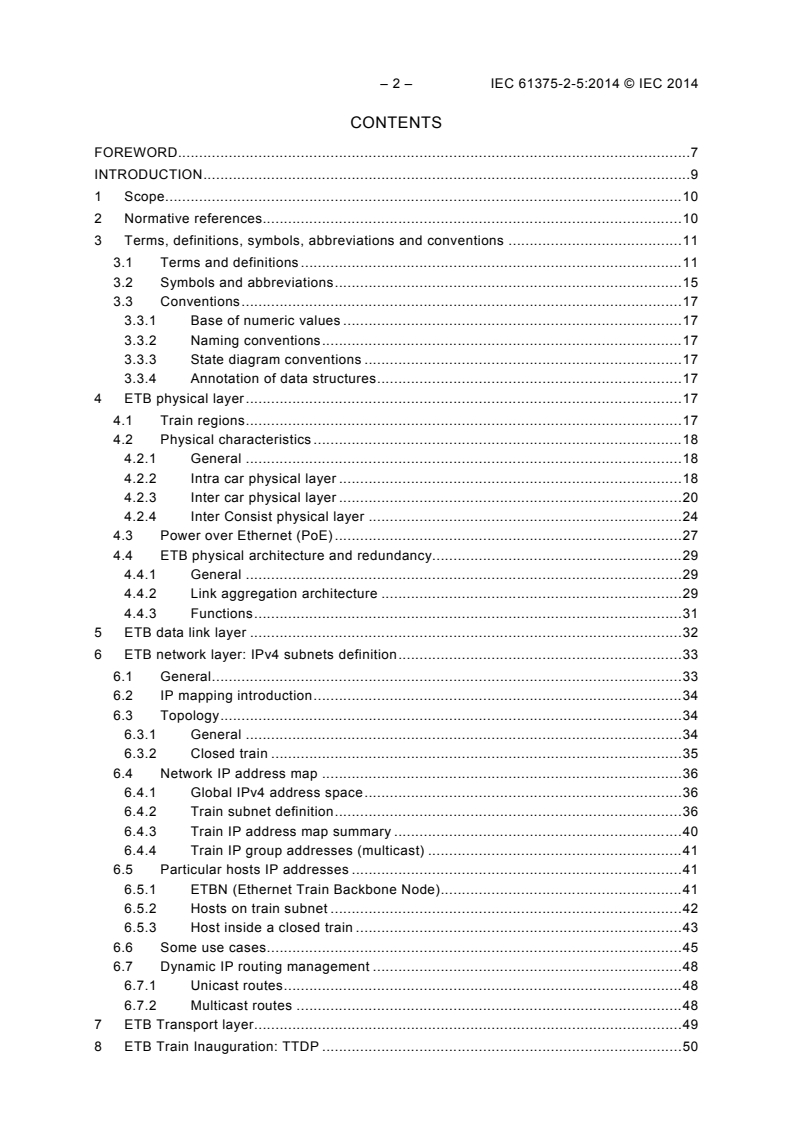
– 2 – IEC 61375-2-5:2014 © IEC 2014
CONTENTS
FOREWORD . 7
INTRODUCTION . 9
1 Scope . 10
2 Normative references. 10
3 Terms, definitions, symbols, abbreviations and conventions . 11
3.1 Terms and definitions . 11
3.2 Symbols and abbreviations . 15
3.3 Conventions . 17
3.3.1 Base of numeric values . 17
3.3.2 Naming conventions . 17
3.3.3 State diagram conventions . 17
3.3.4 Annotation of data structures . 17
4 ETB physical layer . 17
4.1 Train regions . 17
4.2 Physical characteristics . 18
4.2.1 General . 18
4.2.2 Intra car physical layer . 18
4.2.3 Inter car physical layer . 20
4.2.4 Inter Consist physical layer . 24
4.3 Power over Ethernet (PoE) . 27
4.4 ETB physical architecture and redundancy. 29
4.4.1 General . 29
4.4.2 Link aggregation architecture . 29
4.4.3 Functions . 31
5 ETB data link layer . 32
6 ETB network layer: IPv4 subnets definition . 33
6.1 General . 33
6.2 IP mapping introduction . 34
6.3 Topology . 34
6.3.1 General . 34
6.3.2 Closed train . 35
6.4 Network IP address map . 36
6.4.1 Global IPv4 address space . 36
6.4.2 Train subnet definition . 36
6.4.3 Train IP address map summary . 40
6.4.4 Train IP group addresses (multicast) . 41
6.5 Particular hosts IP addresses . 41
6.5.1 ETBN (Ethernet Train Backbone Node) . 41
6.5.2 Hosts on train subnet . 42
6.5.3 Host inside a closed train . 43
6.6 Some use cases . 45
6.7 Dynamic IP routing management . 48
6.7.1 Unicast routes . 48
6.7.2 Multicast routes . 48
7 ETB Transport layer . 49
8 ETB Train Inauguration: TTDP . 50
8.1 Contents of this clause . 50
8.2 Objectives and assumptions . 50
8.2.1 Goals . 50
8.2.2 Out of scope . 51
8.2.3 Assumptions . 51
8.3 ETBN settings . 52
8.3.1 ETB switch port states . 52
8.3.2 Node settings . 52
8.4 General behaviour . 54
8.5 ETBN Inauguration state diagram . 54
8.5.1 General . 54
8.5.2 Actions . 55
8.5.3 Transitions . 57
8.6 ETBN peers discovery . 58
8.6.1 Internal peers detection . 58
8.6.2 External peers detection . 58
8.6.3 Switch port states handling. 59
8.6.4 ETB lines statuses . 59
8.7 TTDP messages description . 61
8.7.1 General . 61
8.7.2 Convention . 61
8.7.3 TTDP frame tagging . 61
8.7.4 Transport and addressing . 61
8.7.5 TTDP HELLO frame . 62
8.7.6 TTDP TOPOLOGY frame . 66
8.8 TTDP data structures . 72
8.8.1 Connectivity Vector . 72
8.8.2 ETBN Vector . 73
8.8.3 Connectivity Table . 73
8.8.4 Connectivity Table CRC . 74
8.8.5 Train network directory . 76
8.8.6 Train network directory CRC (Topology Counter) . 78
8.8.7 Corrected topology . 78
8.9 TTDP frames timing . 79
8.9.1 TTDP HELLO . 79
8.9.2 TTDP TOPOLOGY . 81
8.10 Inauguration Train Application interface . 83
8.11 Degraded modes . 83
8.11.1 Late insertion ETBN . 83
8.11.2 Losing ETBN . 84
8.11.3 End ETBN failure and partial topology counter . 84
8.12 Some discovery timing . 85
8.12.1 ETBN wakeup . 85
8.12.2 ETBN failure . 86
8.12.3 Consist coupling . 87
9 ETB ETBN redundancy . 88
10 ETB physical train naming convention (optional) . 89
10.1 General . 89
10.2 ETB Train domain . 89
– 4 – IEC 61375-2-5:2014 © IEC 2014
10.3 Hostname . 90
11 ETB Quality of Service . 91
11.1 Contents of this clause . 91
11.2 Frame forwarding . 91
11.2.1 ETBN switching rate . 91
11.2.2 No Head-of-Line blocking . 91
11.2.3 Switching priorities . 91
11.2.4 Switching queuing scheme . 92
11.3 Priority of Inauguration frames . 92
11.4 ETB ingress rate limiting . 92
11.5 ETB egress rate shaping . 92
11.6 ETB data classes . 92
12 ETB Management and monitoring . 93
13 ETB Application interface . 93
13.1 Contents of this clause . 93
13.2 Abstract communication model . 93
13.3 ETB Process Data and Message Data protocols . 94
13.4 ETB protocol transparency . 94
13.5 ETBN interfaces . 94
13.5.1 Application . 94
13.5.2 Maintenance and monitoring . 95
14 ETB conformity statement . 96
Annex A (normative) Summary of ETB sizing parameters. 97
Annex B (normative) Physical topology building algorithm . 98
Annex C (normative) TTDP MIB definition . 101
Bibliography . 121
Figure 1 – ETB train regions . 18
Figure 2 – ETB Inter car at same potential . 23
Figure 3 – ETB Inter car not at the same potential . 24
Figure 4 – ETB Consist reversing . 26
Figure 5 – ETB Inter Consist segment . 27
Figure 6 – ETBN PSE PoE use case . 27
Figure 7 – ETBN PD PoE use case . 28
Figure 8 – PoE in inter-Consist. 28
Figure 9 – PoE PSE alternative A . 29
Figure 10 – Redundant train backbone architecture . 29
Figure 11 – Link aggregation model . 30
Figure 12 – Link aggregation group . 31
Figure 13 – Conversations over LAG . 31
Figure 14 – Hierarchical Consist topology . 35
Figure 15 – Closed train . 36
Figure 16 – "Subnet Id" with single Consist Network . 38
Figure 17 – "Subnet Id" with two single Consist Networks . 38
Figure 18 – Multiple Consist Networks, without fault tolerance . 39
Figure 19 – "Subnet Id" with ETBN redundancy . 39
Figure 20 – "Subnet Id" in multiple units with ETBN redundancy . 40
Figure 21 – IP train address space summary . 40
Figure 22 – Relative addressing example . 45
Figure 23 – Train composed of a single Consist Network . 46
Figure 24 – Train composed of two single Consist Networks . 46
Figure 25 – Train composed of single Consist Network with ETBN redundancy . 47
Figure 26 – Train composed of two Consist Networks with ETBN redundancy . 47
Figure 27 – Train with two Consist Networks in single Consist . 48
Figure 28 – ETBN top node reference . 51
Figure 29 – ETBN orientation capability . 52
Figure 30 – ETB switch in passive bypass setting . 53
Figure 31 – ETB switch in intermediate setting . 53
Figure 32 – ETB switch in End Node Setting . 54
Figure 33 – ETBN Inauguration state diagram . 55
Figure 34 – Switch port state diagram . 59
Figure 35 – ETBN physical line state machine . 60
Figure 36 – TTDP HELLO frame LLDPDU structure . 62
Figure 37 – LLDP organizationally TLV structure . 62
Figure 38 – TTDP HELLO frame structure . 66
Figure 39 – TTDP specific HELLO TLV structure . 66
Figure 40 – TTDP TOPOLOGY frame structure . 71
Figure 41 – TTDP TOPOLOGY specific ETB TLV structure . 72
Figure 42 – TTDP TOPOLOGY specific CN TLV structure . 72
Figure 43 – Train composition for TNDir example . 77
Figure 44 – TTDP HELLO normal mode and recovery timing . 80
Figure 45 – TTDP HELLO failure timing . 81
Figure 46 – TTDP TOPOLOGY frames handling . 82
Figure 47 – TTDP ETBNs wake up timing . 85
Figure 48 – TTDP ETBN failure timing . 86
Figure 49 – TTDP Consist coupling timing . 87
Figure 50 – Example of ETBN IP routing table without redundancy . 88
Figure 51 – Example of ETBN IP routing table with redundancy . 88
Figure 52 – ETB train domain defintion . 90
Figure 53 – Abstract communication model for ETB communication . 94
Figure B.1 – Physical topology building . 98
Figure C.1 – TTDP MIB tree view . 103
Table 1 – ETB Intra car physical layer interface . 19
Table 2 – ETB Inter car physical layer interface . 21
Table 3 – ETB Inter consist physical layer interface . 25
Table 4 – ETB Switch data link layer interface . 32
Table 5 – ETB OSI Network layer . 33
– 6 – IEC 61375-2-5:2014 © IEC 2014
Table 6 – Train subnet definition . 36
Table 7 – Train subnet decomposition . 37
Table 8 – Train IP group addresses reserved range . 41
Table 9 – ETBN ETB IP address . 42
Table 10 – Hosts IP on train subnet . 43
Table 11 – Application ED common interface . 50
Table 12 – ETB switch port states . 52
Table 13 – TTDP destination MAC addresses . 62
Table 14 – Connectivity Vector . 73
Table 15 – Connectivity Vector Fields . 73
Table 16 – ETBN Vector . 73
Table 17 – ETBN Vector Fields . 73
Table 18 – Connectivity Table . 74
Table 19 – Connectivity Table fields . 74
Table 20 – Train network directory . 76
Table 21 – Train network directory fields . 76
Table 22 – Train network directory (example) . 78
Table 23 – DSCP field mapping . 91
Table 24 – ETB Switching Priorities . 92
Table 25 – Train Topology Discovery Object . 95
Table A.1 – ETB sizing parameters . 97
INTERNATIONAL ELECTROTECHNICAL COMMISSION
____________
ELECTRONIC RAILWAY EQUIPMENT –
TRAIN COMMUNICATION NETWORK (TCN) –
Part 2-5: Ethernet train backbone
FOREWORD
1) The International Electrotechnical Commission (IEC) is a worldwide organization for standardization comprising
all national electrotechnical committees (IEC National Committees). The object of IEC is to promote
international co-operation on all questions concerning standardization in the electrical and electronic fields. To
this end and in addition to other activities, IEC publishes International Standards, Technical Specifications,
Technical Reports, Publicly Available Specifications (PAS) and Guides (hereafter referred to as “IEC
Publication(s)”). Their preparation is entrusted to technical committees; any IEC National Committee interested
in the subject dealt with may participate in this preparatory work. International, governmental and non-
governmental organizations liaising with the IEC also participate in this preparation. IEC collaborates closely
with the International Organization for Standardization (ISO) in accordance with conditions determined by
agreement between the two organizations.
2) The formal decisions or agreements of IEC on technical matters express, as nearly as possible, an international
consensus of opinion on the relevant subjects since each technical committee has representation from all
interested IEC National Committees.
3) IEC Publications have the form of recommendations for international use and are accepted by IEC National
Committees in that sense. While all reasonable efforts are made to ensure that the technical content of IEC
Publications is accurate, IEC cannot be held responsible for the way in which they are used or for any
misinterpretation by any end user.
4) In order to promote international uniformity, IEC National Committees undertake to apply IEC Publications
transparently to the maximum extent possible in their national and regional publications. Any divergence
between any IEC Publication and the corresponding national or regional publication shall be clearly indicated in
the latter.
5) IEC itself does not provide any attestation of conformity. Independent certification bodies provide conformity
assessment services and, in some areas, access to IEC marks of conformity. IEC is not responsible for any
services carried out by independent certification bodies.
6) All users should ensure that they have the latest edition of this publication.
7) No liability shall attach to IEC or its directors, employees, servants or agents including individual experts and
members of its technical committees and IEC National Committees for any personal injury, property damage or
other damage of any nature whatsoever, whether direct or indirect, or for costs (including legal fees) and
expenses arising out of the publication, use of, or reliance upon, this IEC Publication or any other IEC
Publications.
8) Attention is drawn to the Normative references cited in this publication. Use of the referenced publications is
indispensable for the correct application of this publication.
9) Attention is drawn to the possibility that some of the elements of this IEC Publication may be the subject of
patent rights. IEC shall not be held responsible for identifying any or all such patent rights.
International Standard IEC 61375-2-5 has been prepared by IEC technical committee 9:
Electrical equipment and systems for railways.
The text of this standard is based on the following documents:
FDIS Report on voting
9/1933/FDIS 9/1961/RVD
Full information on the voting for the approval of this standard can be found in the report on
voting indicated in the above table.
This publication has been drafted in accordance with the ISO/IEC Directives, Part 2.
– 8 – IEC 61375-2-5:2014 © IEC 2014
A list of all parts in the IEC 61375 series, published under the general title Electronic railway
equipment – Train communication network (TCN), can be found on the IEC website.
The committee has decided that the contents of this publication will remain unchanged until
the stability date indicated on the IEC web site under "http://webstore.iec.ch" in the data
related to the specific publication. At this date, the publication will be
• reconfirmed,
• withdrawn,
• replaced by a revised edition, or
• amended.
IMPORTANT – The 'colour inside' logo on the cover page of this publication indicates
that it contains colours which are considered to be useful for the correct
understanding of its contents. Users should therefore print this document using a
colour printer.
INTRODUCTION
IEC 61375-2-5 defines the Ethernet Train Backbone so as to achieve interoperability between
Consists of different types when coupled in the same train composition.
The standard follows the ISO-OSI model and specifies the whole protocols stack from the
physical layer up to the application layer.
A Protocol Implementation Conformance Statement (PICS) pro-forma allows suppliers to state
their conformity to this standard. The PICS pro-forma specification and the related conformity
test are not in the scope of this standard.
– 10 – IEC 61375-2-5:2014 © IEC 2014
ELECTRONIC RAILWAY EQUIPMENT –
TRAIN COMMUNICATION NETWORK (TCN) –
Part 2-5: Ethernet train backbone
1 Scope
This part of IEC 61375 defines Ethernet Train Backbone (ETB) requirements to fulfil open
train data communication system based on Ethernet technology.
Respect of this standard ensures interoperability between local Consist subnets whatever
Consist network technology (see IEC 61375-1 for more details).
All Consist network definitions should take into account this standard to preserve
interoperability.
This standard may be additionally applicable to closed trains and multiple-unit trains when so
agreed between purchaser and supplier.
2 Normative references
The following documents, in whole or in part, are normatively referenced in this document and
are indispensable for its application. For dated references, only the edition cited applies. For
undated references, the latest edition of the referenced document (including any
amendments) applies.
IEC 61076-2-101:2012, Connectors for electronic equipment – Product requirements –
Part 2-101: Circular connectors – Detail specification for M12 connectors with screw-locking
IEC 61156 (all parts), Multicore and symmetrical pair/quad cables for digital communications
IEC 61156-1:2007, Multicore and symmetrical pair/quad cables for digital communications –
Part 1: Generic specification
IEC 61156-5, Multicore and symmetrical pair/quad cables for digital communications – Part 5:
Symmetrical pair/quad cables with transmission characteristics up to 1 000 MHz – Horizontal
floor wiring – Sectional specification
IEC 61375-1:2012, Electronic railway equipment – Train communication network (TCN) –
Part 1: General architecture
IEC 61375-2-3, Electronic railway equipment – Train communication network (TCN) –
Part 2-3: TCN communication profile (to be published)
IEC 61375-3-4, Electronic railway equipment – Train communication network (TCN) –
Part 3-4: Ethernet Consist Network (ECN)
IEC 62236-3-2, Railway applications – Electromagnetic compatibility – Part 3-2: Rolling stock
– Apparatus
ISO/IEC 7498 (all parts), Information technology – Open System Interconnection – Basic
Reference Model
ISO/IEC 8824 (all parts), Information technology – Abstract Syntax Notation One (ASN.1)
ISO/IEC 9646 (all parts), Information technology – Open Systems Interconnection –
Conformance testing methodology and framework
ISO/IEC 11801:2002, Information technology – Generic cabling for customer premises
IEEE 802.1AB, IEEE Standard for Local and metropolitan area networks – Station and Media
Access Control Connectivity Discovery
IEEE 802.1AX:2008, IEEE Standard for Local and metropolitan area networks – Link
Aggregation
IEEE 802.1D:2012, IEEE Standard for Local and metropolitan area networks – Media Access
Control (MAC) Bridges
IEEE 802.1Q, IEEE Standard for Local and metropolitan area networks – Virtual Bridged
Local Area Networks
IEEE 802.2, IEEE Standard for Information technology – Telecommunications and information
exchange between systems – Local and metropolitan area networks – Specific requirements –
Part 2: Logical Link Control
IEEE 802.3:2012, IEEE Standard for Information technology – Telecommunications and
information exchange between systems – Local and metropolitan area networks – Specific
requirements – Part 3: Carrier sense multiple access with collision detection (CSMA/CD)
access method and physical layer specifications
3 Terms, definitions, symbols, abbreviations and conventions
3.1 Terms and definitions
For the purposes of this document, the following terms and definitions apply.
3.1.1
application layer
upper layer in the OSI model, interfacing directly to the Application
3.1.2
application process
element within a real open system which performs the information processing for a particular
application
3.1.3
bridge
device which stores and forwards frames from one bus to another on the base of their Link
Layer addresses
3.1.4
broadcast
nearly simultaneous transmission of the same information to several destinations
Note 1 to entry: Broadcast in the TCN is not considered reliable, i.e. some destinations may receive the
information and others not.
– 12 – IEC 61375-2-5:2014 © IEC 2014
3.1.5
bus
communication medium which broadcasts the same information to all attached participants at
nearly the same time, allowing all devices to obtain the same sight of its state, at least for the
purpose of arbitration
3.1.6
closed train
train composed of one or a set of Consists, where the configuration does not change during
normal operation, for instance metro, sub-urban train, or high speed train units
3.1.7
communication devices
devices connected to Consist Network or Train Backbone with the ability to source and sink
data
3.1.8
composition
number and characteristics of the vehicles forming a train
3.1.9
configuration
definition of the topology of a network, the devices connected to it, their capabilities and the
traffic they produce; by extension, the operation of loading the devices with the configuration
information before going to regular operation
3.1.10
consist
train set
rake of coaches
single vehicle or a group of vehicles which are not separated during normal operation. A
Consist contains no, one or several Consist networks.
3.1.11
Consist Network
CN
communication network interconnecting communication devices in one Consist
3.1.12
End Device
ED
unit connected to one Consist Network or to one set of Consist Networks prepared for
redundancy reasons
3.1.13
end node
node which terminates the Train Backbone
3.1.14
function
Application Process which exchanges messages with another Application Process
3.1.15
gateway
connection between different communication technologies
3.1.16
group address
address of a multicast group to which a device belongs
3.1.17
host
any addressable unit connected to the network: End Devices, Network Devices, etc.
3.1.18
inauguration
operation executed in case of composition change, which gives all Nodes of the Train
Backbone their Train Backbone address, their orientation and information about all named
Nodes on the same backbone
3.1.19
integrity
property of a system to recognize and to reject wrong data in case of malfunction of its parts
3.1.20
intermediate node
node which establishes continuity between two bus sections connected to it, but does not
terminate them
3.1.21
linear topology
topology where the nodes are connected in series, with two nodes each connected to only
one other node and all others each connected to two other nodes (that is, connected in the
shape of a line)
3.1.22
Local Area Network
part of a network characterized by a common medium access and address space
3.1.23
Medium Access Control
sublayer of the Link Layer, which controls the access to the medium (arbitration, mastership
transfer, polling)
3.1.24
medium
physical carrier of the signal: electrical wires, optical fibers, etc.
3.1.25
message
data item transmitted in one or several packets
3.1.26
Mobile Train Unit
part of a train which shall be uniquely addressable from ground. A mobile train unit provides
one active mobile communication gateway for train to ground communication.
3.1.27
multicast
transmission of the same message to a group of receivers, identified by their Group Address
Note 1 to entry: The word "multicast" is used even if the group includes all receivers.
– 14 – IEC 61375-2-5:2014 © IEC 2014
3.1.28
network
set of possibly different communication systems which interchange information in a commonly
agreed way
3.1.29
network address
address which identifies a communication device on network layer
...