

IEC TR 80001-2-2:2012
(Main)Application of risk management for IT-networks incorporating medical devices - Part 2-2: Guidance for the disclosure and communication of medical device security needs, risks and controls
General Information
- Abstract
IEC/TR 80001-2-2:2012(E), which is a technical report, creates a framework for the disclosure of security-related capabilities and risks necessary for managing the risk in connecting medical devices to IT-networks and for the security dialog that surrounds the IEC 80001-1 risk management of IT-network connection. This security report presents an informative set of common, high-level security-related capabilities useful in understanding the user needs, the type of security controls to be considered and the risks that lead to the controls. Intended use and local factors determine which exact capabilities will be useful in the dialog about risk. The capability descriptions in this report are intended to supply health delivery organizations (HDOs), medical device manufacturers (MDMs), and IT vendors with a basis for discussing risk and their respective roles and responsibilities toward its management. This discussion among the risk partners serves as the basis for one or more responsibility agreements as specified in IEC 80001-1.
- Status
- Replaced
- Publication Date
- 09-Jul-2012
- Technical Committee
- SC 62A - Common aspects of medical equipment, software, and systems
- Drafting Committee
- JWG 7 - TC 62/SC 62A/JWG 7
- Current Stage
- DELPUB - Deleted Publication
- Start Date
- 01-Oct-2025
- Completion Date
- 28-Aug-2026
Buy Documents
IEC TR 80001-2-2:2012 - Application of risk management for IT-networks incorporating medical devices - Part 2-2: Guidance for the disclosure and communication of medical device security needs, risks and controls Released:7/10/2012
Overview
IEC TR 80001-2-2:2012 is an informative technical report that complements IEC 80001-1 by providing a practical framework for the disclosure and communication of medical device security needs, risks and controls when medical devices are connected to IT‑networks. It defines a common set of high‑level security capabilities to guide dialogues among Health Delivery Organizations (HDOs), Medical Device Manufacturers (MDMs) and IT vendors, and to support the creation of responsibility agreements required by IEC 80001-1. The report is intended as a communication and risk‑management aid rather than a prescriptive certification standard.
Key topics and technical focus
The report organizes and explains security‑related capabilities and how they relate to risk management. Key technical topics include:
- Security capability disclosure framework - a structured entry format and guidance for how capabilities should be described and used in risk processes.
- Mapping IT security to medical device risk management - relationship between ISO 14971-style device risk concepts and IT security terminology.
- Informative list of SECURITY CAPABILITIES, for example:
- Automatic logoff (ALOF) and Audit controls (AUDT)
- Authorization (AUTH) and Person/Node authentication (PAUT/NAUT)
- Transmission confidentiality/integrity (TXCF/TXIG) and HEALTH DATA storage confidentiality (STCF)
- Malware detection/protection (MLDP) and System/application hardening (SAHD)
- Data backup and disaster recovery (DTBK) and Emergency access (EMRG)
- Security guides (SGUD) and third‑party component roadmaps (RDMP)
- Guidance for stakeholder communication - how to use capability descriptions to define roles, responsibilities and security dialog that underpin responsibility agreements.
- Scalability and site specificity - capabilities are high‑level and intended to be elaborated with site‑ or product‑specific controls and standards as needed.
Practical applications and who uses it
IEC TR 80001-2-2 is used to facilitate secure integration of medical devices into healthcare IT systems and to clarify security responsibilities across stakeholders:
- Health Delivery Organizations (HDOs) use it to gather device security information, assess network risk and define required controls before device integration.
- Medical Device Manufacturers (MDMs) use it to disclose security capabilities and limitations, and to support procurement and integration discussions.
- IT vendors and integrators use it to align network and device controls, plan mitigations, and draft responsibility agreements.
- Project teams and procurement use the framework to structure RFPs, security questionnaires or device security disclosure documents (e.g., MDS2-style outputs).
Related standards
IEC TR 80001-2-2 is intended to work alongside and map to other normative guidance and standards, including:
- IEC 80001-1 (risk management for IT‑networks incorporating medical devices)
- ISO 14971 (medical device risk management)
- ISO/IEC 27001 / 27002 / 27005 (information security management and risk)
- ISO 27799 (health information security)
- ISO/IEC 15408 (Common Criteria) - for assurance frameworks
By providing a common vocabulary of security capabilities, IEC TR 80001-2-2 improves risk communication, supports procurement and integration decisions, and helps healthcare stakeholders manage cybersecurity risks for networked medical devices.
Relations
- Effective Date
- 26-Oct-2025
Buy Documents
IEC TR 80001-2-2:2012 - Application of risk management for IT-networks incorporating medical devices - Part 2-2: Guidance for the disclosure and communication of medical device security needs, risks and controls Released:7/10/2012
Get Certified
Connect with accredited certification bodies for this standard

BSI Group
BSI (British Standards Institution) is the business standards company that helps organizations make excellence a habit.

TÜV Rheinland
TÜV Rheinland is a leading international provider of technical services.

TÜV SÜD
TÜV SÜD is a trusted partner of choice for safety, security and sustainability solutions.
Sponsored listings
Frequently Asked Questions
IEC TR 80001-2-2:2012 is a technical report published by the International Electrotechnical Commission (IEC). Its full title is "Application of risk management for IT-networks incorporating medical devices - Part 2-2: Guidance for the disclosure and communication of medical device security needs, risks and controls". This standard covers: IEC/TR 80001-2-2:2012(E), which is a technical report, creates a framework for the disclosure of security-related capabilities and risks necessary for managing the risk in connecting medical devices to IT-networks and for the security dialog that surrounds the IEC 80001-1 risk management of IT-network connection. This security report presents an informative set of common, high-level security-related capabilities useful in understanding the user needs, the type of security controls to be considered and the risks that lead to the controls. Intended use and local factors determine which exact capabilities will be useful in the dialog about risk. The capability descriptions in this report are intended to supply health delivery organizations (HDOs), medical device manufacturers (MDMs), and IT vendors with a basis for discussing risk and their respective roles and responsibilities toward its management. This discussion among the risk partners serves as the basis for one or more responsibility agreements as specified in IEC 80001-1.
IEC/TR 80001-2-2:2012(E), which is a technical report, creates a framework for the disclosure of security-related capabilities and risks necessary for managing the risk in connecting medical devices to IT-networks and for the security dialog that surrounds the IEC 80001-1 risk management of IT-network connection. This security report presents an informative set of common, high-level security-related capabilities useful in understanding the user needs, the type of security controls to be considered and the risks that lead to the controls. Intended use and local factors determine which exact capabilities will be useful in the dialog about risk. The capability descriptions in this report are intended to supply health delivery organizations (HDOs), medical device manufacturers (MDMs), and IT vendors with a basis for discussing risk and their respective roles and responsibilities toward its management. This discussion among the risk partners serves as the basis for one or more responsibility agreements as specified in IEC 80001-1.
IEC TR 80001-2-2:2012 is classified under the following ICS (International Classification for Standards) categories: 11.040.01 - Medical equipment in general. The ICS classification helps identify the subject area and facilitates finding related standards.
IEC TR 80001-2-2:2012 has the following relationships with other standards: It is inter standard links to IEC TS 81001-2-2:2025. Understanding these relationships helps ensure you are using the most current and applicable version of the standard.
IEC TR 80001-2-2:2012 is available in PDF format for immediate download after purchase. The document can be added to your cart and obtained through the secure checkout process. Digital delivery ensures instant access to the complete standard document.
Standards Content (Sample)
IEC/TR 80001-2-2
Edition 1.0 2012-07
TECHNICAL
REPORT
colour
inside
Application of risk management for IT-networks incorporating medical devices –
Part 2-2: Guidance for the disclosure and communication of medical device
security needs, risks and controls
IEC/TR 80001-2-2:2012(E)
All rights reserved. Unless otherwise specified, no part of this publication may be reproduced or utilized in any form
or by any means, electronic or mechanical, including photocopying and microfilm, without permission in writing from
either IEC or IEC's member National Committee in the country of the requester.
If you have any questions about IEC copyright or have an enquiry about obtaining additional rights to this publication,
please contact the address below or your local IEC member National Committee for further information.
IEC Central Office Tel.: +41 22 919 02 11
3, rue de Varembé Fax: +41 22 919 03 00
CH-1211 Geneva 20 info@iec.ch
Switzerland www.iec.ch
About the IEC
The International Electrotechnical Commission (IEC) is the leading global organization that prepares and publishes
International Standards for all electrical, electronic and related technologies.
About IEC publications
The technical content of IEC publications is kept under constant review by the IEC. Please make sure that you have the
latest edition, a corrigenda or an amendment might have been published.
Useful links:
IEC publications search - www.iec.ch/searchpub Electropedia - www.electropedia.org
The advanced search enables you to find IEC publications The world's leading online dictionary of electronic and
by a variety of criteria (reference number, text, technical electrical terms containing more than 30 000 terms and
committee,…). definitions in English and French, with equivalent terms in
It also gives information on projects, replaced and additional languages. Also known as the International
withdrawn publications. Electrotechnical Vocabulary (IEV) on-line.
IEC Just Published - webstore.iec.ch/justpublished Customer Service Centre - webstore.iec.ch/csc
Stay up to date on all new IEC publications. Just Published If you wish to give us your feedback on this publication
details all new publications released. Available on-line and or need further assistance, please contact the
also once a month by email. Customer Service Centre: csc@iec.ch.
IEC/TR 80001-2-2
Edition 1.0 2012-07
TECHNICAL
REPORT
colour
inside
Application of risk management for IT-networks incorporating medical devices –
Part 2-2: Guidance for the disclosure and communication of medical device
security needs, risks and controls
INTERNATIONAL
ELECTROTECHNICAL
COMMISSION
PRICE CODE
XA
ICS 11.040.01 ISBN 978-2-83220-202-9
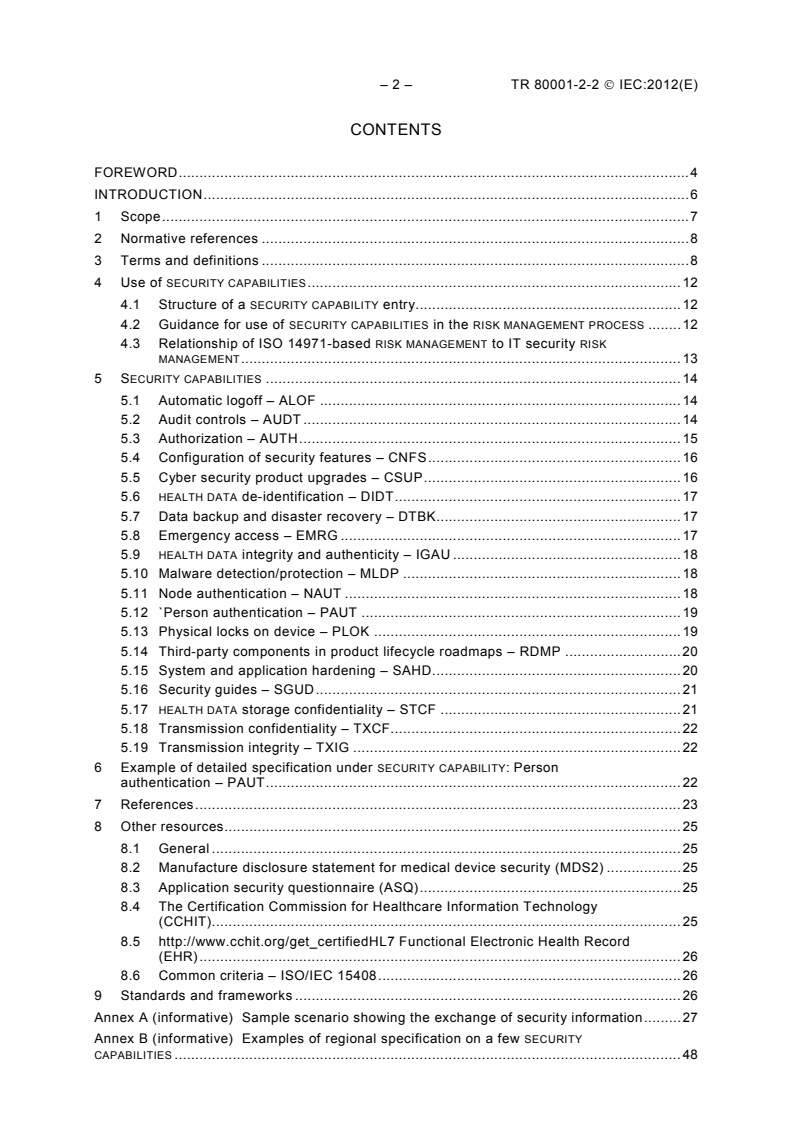
– 2 – TR 80001-2-2 IEC:2012(E)
CONTENTS
FOREWORD . 4
INTRODUCTION . 6
1 Scope . 7
2 Normative references . 8
3 Terms and definitions . 8
4 Use of SECURITY CAPABILITIES . 12
4.1 Structure of a SECURITY CAPABILITY entry. 12
4.2 Guidance for use of SECURITY CAPABILITIES in the RISK MANAGEMENT PROCESS . 12
4.3 Relationship of ISO 14971-based RISK MANAGEMENT to IT security RISK
MANAGEMENT . 13
5 SECURITY CAPABILITIES . 14
5.1 Automatic logoff – ALOF . 14
5.2 Audit controls – AUDT . 14
5.3 Authorization – AUTH . 15
5.4 Configuration of security features – CNFS . 16
5.5 Cyber security product upgrades – CSUP . 16
5.6 HEALTH DATA de-identification – DIDT . 17
5.7 Data backup and disaster recovery – DTBK . 17
5.8 Emergency access – EMRG . 17
5.9 HEALTH DATA integrity and authenticity – IGAU . 18
5.10 Malware detection/protection – MLDP . 18
5.11 Node authentication – NAUT . 18
5.12 `Person authentication – PAUT . 19
5.13 Physical locks on device – PLOK . 19
5.14 Third-party components in product lifecycle roadmaps – RDMP . 20
5.15 System and application hardening – SAHD . 20
5.16 Security guides – SGUD . 21
5.17 HEALTH DATA storage confidentiality – STCF . 21
5.18 Transmission confidentiality – TXCF. 22
5.19 Transmission integrity – TXIG . 22
6 Example of detailed specification under SECURITY CAPABILITY: Person
authentication – PAUT . 22
7 References . 23
8 Other resources . 25
8.1 General . 25
8.2 Manufacture disclosure statement for medical device security (MDS2) . 25
8.3 Application security questionnaire (ASQ) . 25
8.4 The Certification Commission for Healthcare Information Technology
(CCHIT). 25
8.5 http://www.cchit.org/get_certifiedHL7 Functional Electronic Health Record
(EHR) . 26
8.6 Common criteria – ISO/IEC 15408 . 26
9 Standards and frameworks . 26
Annex A (informative) Sample scenario showing the exchange of security information . 27
Annex B (informative) Examples of regional specification on a few SECURITY
CAPABILITIES . 48
TR 80001-2-2 IEC:2012(E) – 3 –
Annex C (informative) SECURITY CAPABILITY mapping to C-I-A-A . 52
Bibliography . 53
Table 1 – Relationship of IT security and ISO 14971-based terminology . 13
Table C.1 – Sample mapping by a hypothetical HDO . 52
– 4 – TR 80001-2-2 IEC:2012(E)
INTERNATIONAL ELECTROTECHNICAL COMMISSION
____________
APPLICATION OF RISK MANAGEMENT FOR
IT-NETWORKS INCORPORATING MEDICAL DEVICES –
Part 2-2: Guidance for the disclosure and communication of medical
device security needs, risks and controls
FOREWORD
1) The International Electrotechnical Commission (IEC) is a worldwide organization for standardization comprising
all national electrotechnical committees (IEC National Committees). The object of IEC is to promote
international co-operation on all questions concerning standardization in the electrical and electronic fields. To
this end and in addition to other activities, IEC publishes International Standards, Technical Specifications,
Technical Reports, Publicly Available Specifications (PAS) and Guides (hereafter referred to as “IEC
Publication(s)”). Their preparation is entrusted to technical committees; any IEC National Committee interested
in the subject dealt with may participate in this preparatory work. International, governmental and non-
governmental organizations liaising with the IEC also participate in this preparation. IEC collaborates closely
with the International Organization for Standardization (ISO) in accordance with conditions determined by
agreement between the two organizations.
2) The formal decisions or agreements of IEC on technical matters express, as nearly as possible, an international
consensus of opinion on the relevant subjects since each technical committee has representation from all
interested IEC National Committees.
3) IEC Publications have the form of recommendations for international use and are accepted by IEC National
Committees in that sense. While all reasonable efforts are made to ensure that the technical content of IEC
Publications is accurate, IEC cannot be held responsible for the way in which they are used or for any
misinterpretation by any end user.
4) In order to promote international uniformity, IEC National Committees undertake to apply IEC Publications
transparently to the maximum extent possible in their national and regional publications. Any divergence
between any IEC Publication and the corresponding national or regional publication shall be clearly indicated in
the latter.
5) IEC itself does not provide any attestation of conformity. Independent certification bodies provide conformity
assessment services and, in some areas, access to IEC marks of conformity. IEC is not responsible for any
services carried out by independent certification bodies.
6) All users should ensure that they have the latest edition of this publication.
7) No liability shall attach to IEC or its directors, employees, servants or agents including individual experts and
members of its technical committees and IEC National Committees for any personal injury, property damage or
other damage of any nature whatsoever, whether direct or indirect, or for costs (including legal fees) and
expenses arising out of the publication, use of, or reliance upon, this IEC Publication or any other IEC
Publications.
8) Attention is drawn to the Normative references cited in this publication. Use of the referenced publications is
indispensable for the correct application of this publication.
9) Attention is drawn to the possibility that some of the elements of this IEC Publication may be the subject of
patent rights. IEC shall not be held responsible for identifying any or all such patent rights.
The main task of IEC technical committees is to prepare International Standards. However, a
technical committee may propose the publication of a technical report when it has collected
data of a different kind from that which is normally published as an International Standard, for
example "state of the art".
IEC 80001-2-2, which is a technical report, has been prepared a Joint Working Group of
subcommittee 62A: Common aspects of electrical equipment used in medical practice, of
IEC technical committee 62: Electrical equipment in medical practice and ISO technical
committee 215: Health informatics.
TR 80001-2-2 IEC:2012(E) – 5 –
The text of this technical report is based on the following documents:
Enquiry draft Report on voting
62A/783/DTR 62A/807/RVC
Full information on the voting for the approval of this technical report can be found in the
report on voting indicated in the above table.
This publication has been drafted in accordance with the ISO/IEC Directives, Part 2.
Terms used throughout this technical report that have been defined in Clause 3 appear in
SMALL CAPITALS.
The committee has decided that the contents of this publication will remain unchanged until
the stability date indicated on the IEC web site under "http://webstore.iec.ch" in the data
related to the specific publication. At this date, the publication will be
• reconfirmed,
• withdrawn,
• replaced by a revised edition, or
• amended.
A bilingual version of this publication may be issued at a later date.
IMPORTANT – The 'colour inside' logo on the cover page of this publication indicates
that it contains colours which are considered to be useful for the correct
understanding of its contents. Users should therefore print this document using a
colour printer.
– 6 – TR 80001-2-2 IEC:2012(E)
INTRODUCTION
IEC 80001-1, which deals with the application of RISK MANAGEMENT to IT-networks
incorporating medical devices, provides the roles, responsibilities and activities necessary for
RISK MANAGEMENT. This technical report provides additional guidance in how SECURITY
CAPABILITIES might be referenced (disclosed and discussed) in both the RISK MANAGEMENT
PROCESS and stakeholder communications and agreements.
The informative set of common, high-level SECURITY CAPABILITIES presented here i intended to
be the starting point for a security-centric discussion between vendor and purchaser or among
a larger group of stakeholders involved in a MEDICAL DEVICE IT-NETWORK project. Scalability is
possible across a range of different sized RESPONSIBLE ORGANIZATIONS as each evaluates RISK
under the capabilities and decides what to include or not include according to its RISK
tolerance and resource planning. This technical report might be used in the preparation of
documentation designed to communicate product SECURITY CAPABILITIES and options. This
documentation could be used by the RESPONSIBLE ORGANIZATION as input to their IEC 80001
PROCESS or to form the basis of RESPONSIBILITY AGREEMENTS among stakeholders. Other IEC-
80001-1 technical reports will provide step-by-step guidance in the RISK MANAGEMENT
PROCESS. Furthermore, the SECURITY CAPABILITIES encourage the disclosure of more detailed
security controls – perhaps those specified in one or more security standards as followed by
the RESPONSIBLE ORGANIZATION or the MEDICAL-DEVICE manufacturer (for example,
ISO 27799:2008, ISO/IEC 27001:2005, ISO/IEC 27002:2005, ISO/IEC 27005:2011, the
ISO 22600 series, the ISO 13606 series, and ISO/HL7 10781:2009, which covers the
Electronic Health Record System Functional Model). This report remains agnostic as to the
underlying controls framework; it only proposes a structure for the disclosure and
communication among the RESPONSIBLE ORGANIZATION (here called the healthcare delivery
organization – HDO), the MEDICAL DEVICE manufacturer (MDM) and the IT-vendor.
The capabilities outlined here comprise a disclosure set of controls which support the
maintenance of confidentiality and the protection from malicious intrusion that might lead to
compromises in integrity or system/data availability. Capabilities can be added to or further
elaborated as the need arises. Controls are intended to protect both data and systems but
special attention is given to the protection of both PRIVATE DATA and its subset called HEALTH
DATA. Both of these special terms have been defined to carefully avoid any law-specific
references (e.g., EC Sensitive Data or USA ePHI).
TR 80001-2-2 IEC:2012(E) – 7 –
APPLICATION OF RISK MANAGEMENT FOR
IT-NETWORKS INCORPORATING MEDICAL DEVICES –
Part 2-2: Guidance for the disclosure and communication of medical
device security needs, risks and controls
1 Scope
This part of IEC 80001 creates a framework for the disclosure of security-related capabilities
and RISKS necessary for managing the RISK in connecting MEDICAL DEVICES to IT-NETWORKS
and for the security dialog that surrounds the IEC 80001-1 RISK MANAGEMENT of IT-NETWORK
connection. This security report presents an informative set of common, high-level security-
related capabilities useful in understanding the user needs, the type of security controls to be
considered and the RISKS that lead to the controls. INTENDED USE and local factors determine
which exact capabilities will be useful in the dialog about RISK.
The capability descriptions in this report are intended to supply:
a) health delivery organizations (HDOs),
b) MEDICAL DEVICE manufacturers (MDMs), and
c) IT vendors
with a basis for discussing RISK and their respective roles and responsibilities toward its
management. This discussion among the RISK partners serves as the basis for one or more
RESPONSIBILITY AGREEMENTS as specified in IEC 80001-1.
The present report provides broad descriptions of the security-related capabilities with the
intent that any particular device or use of a device will have to have at least one additional
level of specification detail under each capability. This will often be site and application-
specific and may invoke RISK and security controls standards as applicable.
At this introductory stage of IEC 80001-1 standardization, the SECURITY CAPABILITIES in this
report provide a common, simple classification of security controls particularly suited to
MEDICAL IT NETWORKS and the incorporated devices. The list is not intended to constitute or to
support rigorous IT security standards-based controls and associated programs of certification
and assurance such as might be found in other ISO standards (e.g., ISO/IEC 15408 with its
Common Criteria for Information Technology Security Evaluation). The present report does
not contain sufficient detail for exact specification of requirements in a request for proposal or
product security disclosure sheet. However, the classification and structure can be used to
organize such requirements with underlying detail sufficient for communication during the
purchase and integration PROCESS for a MEDICAL DEVICE or IT equipment component. Again,
this report is intended to act as a basis for discussion and agreement sufficient to initial
integration project RISK MANAGEMENT. Additionally, security only exists in the context of the
organizational security policies. Both:
a) the security policies of the healthcare delivery organization (HDO), and
b) the product and services security policies of the MEDICAL DEVICE manufacturer (MDM)
are outside of the scope of this report. In addition, the Technical Report does not address
clinical studies where there is a need for securing the selective disclosure of PRIVATE DATA or
HEALTH DATA.
– 8 – TR 80001-2-2 IEC:2012(E)
2 Normative references
The following documents, in whole or in part, are normatively referenced in this document and
are indispensable for its application. For dated references, only the edition cited applies. For
undated references, the latest edition of the referenced document (including any
amendments) applies.
IEC 80001-1:2010, Application of risk management for IT-networks incorporating medical
devices – Part 1: Roles, responsibilities and activities
3 Terms and definitions
3.1
DATA AND SYSTEMS SECURITY
operational state of a MEDICAL IT-NETWORK in which information assets (data and systems) are
reasonably protected from degradation of confidentiality, integrity, and availability
[SOURCE: IEC 80001-1:2010, definition 2.5, modified — two notes integral to understanding
the scope of the original definition have been deleted.]
3.2
EFFECTIVENESS
ability to produce the intended result for the patient and the RESPONSIBLE ORGANIZATION
[SOURCE: IEC 80001-1:2010, definition 2.6]
3.3
EVENT MANAGEMENT
PROCESS that ensures that all events that can or might negatively impact the operation of the
IT-NETWORK are captured, assessed, and managed in a controlled manner
[SOURCE: IEC 80001-1:2010, definition 2.7]
3.4
HARM
physical injury or damage to the health of people, or damage to property or the environment,
or reduction in EFFECTIVENESS, or breach of DATA AND SYSTEM SECURITY
[SOURCE: IEC 80001-1:2010, definition 2.8]
3.5
HAZARD
potential source of HARM
[SOURCE: IEC 80001-1:2010, definition 2.9]
3.6
HAZARDOUS SITUATION
circumstance in which people, property, or the environment are exposed to one or more
HAZARD(s)
[SOURCE: ISO 14971:2007, definition 2.4]
TR 80001-2-2 IEC:2012(E) – 9 –
3.7
HEALTH DATA
PRIVATE DATA that indicates physical or mental health
Note 1 to entry: This generically defines PRIVATE DATA and it subset, HEALTH DATA, within this document to permit
users of this document to adapt it easily to different privacy compliance laws and regulations. For example, in
Europe, the requirements might be taken and references changed to “Personal Data” and “Sensitive Data”; in the
USA, HEALTH DATA might be changed to “Protected Health Information (PHI)” while making adjustments to text as
necessary.
3.8
INTENDED USE
INTENDED PURPOSE
use for which a product, PROCESS or service is intended according to the specifications,
instructions and information provided by the manufacturer
[SOURCE: IEC 80001-1:2010, definition 2.10]
3.9
INTEROPERABILITY
a property permitting diverse systems or components to work together for a specified purpose
[SOURCE: IEC 80001-1:2010, definition 2.11]
3.10
IT-NETWORK
INFORMATION TECHNOLOGY NETWORK
a system or systems composed of communicating nodes and transmission links to provide
physically linked or wireless transmission between two or more specified communication
nodes
[SOURCE: IEC 80001-1:2010, definition 2.12, modified – the two notes to the original
definition have not been retained.]
3.11
KEY PROPERTIES
three RISK managed characteristics (SAFETY, EFFECTIVENESS, and DATA AND SYSTEMS SECURITY)
of MEDICAL IT-NETWORKS
[SOURCE: IEC 80001-1:2010, definition 2.13]
3.12
MEDICAL DEVICE
means any instrument, apparatus, implement, machine, appliance, implant, in vitro reagent or
calibrator, software, material or other similar or related article:
a) intended by the manufacturer to be used, alone or in combination, for human beings for
one or more of the specific purpose(s) of:
– diagnosis, prevention, monitoring, treatment or alleviation of disease,
– diagnosis, monitoring, treatment, alleviation of or compensation for an injury,
– investigation, replacement, modification, or support of the anatomy or of a
physiological process,
– supporting or sustaining life,
– control of conception,
– disinfection of MEDICAL DEVICES,
– providing information for medical or diagnostic purposes by means of in vitro
examination of specimens derived from the human body; and
– 10 – TR 80001-2-2 IEC:2012(E)
b) which does not achieve its primary intended action in or on the human body by
pharmacological, immunological or metabolic means, but which may be assisted in its
intended function by such means.
Note 1 to entry: The definition of a device for in vitro examination includes, for example, reagents, calibrators,
sample collection and storage devices, control materials, and related instruments or apparatus. The information
provided by such an in vitro diagnostic device may be for diagnostic, monitoring or compatibility purposes. In some
jurisdictions, some in vitro diagnostic devices, including reagents and the like, may be covered by separate
regulations.
Note 2 to entry: Products which may be considered to be MEDICAL DEVICES in some jurisdictions but for which
there is not yet a harmonized approach, are:
– aids for disabled/handicapped people;
– devices for the treatment/diagnosis of diseases and injuries in animals;
– accessories for MEDICAL DEVICES (see Note 3);
– disinfection substances;
– devices incorporating animal and human tissues which may meet the requirements of the above definition but
are subject to different controls.
Note 3 to entry: Accessories intended specifically by manufacturers to be used together with a ‘parent’ MEDICAL
DEVICE to enable that MEDICAL DEVICE to achieve its INTENDED PURPOSE should be subject to the same GHTF
procedures as apply to the MEDICAL DEVICE itself. For example, an accessory will be classified as though it is a
MEDICAL DEVICE in its own right. This may result in the accessory having a different classification than the ‘parent’
device.
Note 4 to entry: Components to MEDICAL DEVICES are generally controlled through the manufacturer’s quality
management system and the conformity assessment procedures for the device. In some jurisdictions, components
are included in the definition of a ‘medical device’.
[SOURCE: IEC 80001-1:2010, definition 2.14]
3.13
MEDICAL IT-NETWORK
IT-NETWORK that incorporates at least one MEDICAL DEVICE
[SOURCE: IEC 80001-1:2010, definition 2.16]
3.14
OPERATOR
person handling equipment
[SOURCE: IEC 80001-1:2010, definition 2.18]
3.15
PRIVATE DATA
any information relating to an identified or identifiable person
3.16
PROCESS
set of interrelated or interacting activities which transforms inputs into outputs
[SOURCE: IEC 80001-1:2010, definition 2.19]
3.17
RESIDUAL RISK
RISK remaining after RISK CONTROL measures have been taken
[SOURCE: IEC 80001-1:2010, definition 2.20]
TR 80001-2-2 IEC:2012(E) – 11 –
3.18
RESPONSIBILITY AGREEMENT
one or more documents that together fully define the responsibilities of all relevant
stakeholders
[SOURCE: IEC 80001-1:2010, definition 2.21, modified – a note to the original definition,
containg examples, has not been retained.]
3.19
RESPONSIBLE ORGANIZATION
entity accountable for the use and maintenance of a MEDICAL IT-NETWORK
Note 1 to entry: In this Technical Report, to avoid confusion associated with the notion of security responsibility,
the RESPONSIBLE ORGANIZATION of IEC 80001-1 is given the name healthcare delivery organization (HDO).
[SOURCE: IEC 80001-1:2010, definition 2.22, modified — a note to the original definition,
containing examples, has not been retained; a note to entry has been added.]
3.20
RISK
combination of the probability of occurrence of HARM and the severity of that HARM
[SOURCE: IEC 80001-1:2010, definition 2.23]
3.21
RISK ANALYSIS
systematic use of available information to identify HAZARDS and to estimate the RISK
[SOURCE: IEC 80001-1:2010, definition 2.24]
3.22
RISK ASSESSMENT
overall PROCESS comprising a RISK ANALYSIS and a RISK EVALUATION
[SOURCE: IEC 80001-1:2010, definition 2.25]
3.23
RISK CONTROL
PROCESS in which decisions are made and measures implemented by which RISKS are reduced
to, or maintained within, specified levels
[SOURCE: IEC 80001-1:2010, definition 2.26]
3.24
RISK EVALUATION
PROCESS of comparing the estimated RISK against given RISK criteria to determine the
acceptability of the RISK
[SOURCE: IEC 80001-1:2010, definition 2.27]
3.25
RISK MANAGEMENT
systematic application of management policies, procedures and practices to the tasks of
analyzing, evaluating, controlling, and monitoring RISK
[SOURCE: IEC 80001-1:2010, definition 2.28]
– 12 – TR 80001-2-2 IEC:2012(E)
3.26
SAFETY
freedom from unacceptable RISK of physical injury or damage to the health of people or
damage to property or the environment
[SOURCE: IEC 80001-1:2010, definition 2.30]
3.27
SECURITY CAPABILITY
broad category of technical, administrative or organizational controls to manage RISKS to
confidentiality, integrity, availability and accountability of data and systems
3.28
VERIFICATION
confirmation through provision of objective evidence that specified requirements have been
fulfilled
[SOURCE: IEC 80001-1:2010, definition 2.32, modified – three notes to the original definition
have not been retained.]
4 Use of SECURITY CAPABILITIES
4.1 Structure of a SECURITY CAPABILITY entry
The SECURITY CAPABILITIES clause below (Clause 5) itemizes the common SECURITY
CAPABILITIES that can be included in a MEDICAL DEVICE or IT component. Four letter
abbreviations are suggested for each capability as a convenience to reference and tabulation.
Each section provides a broad view of a potentially applicable security control or PROCESS
category. Each capability description contains:
– references to source material that informs the capability (i.e., applicable standards,
policies and reference materials – here, the HDO and MDM should consider international
security standards as well as applicable country-based standards such as the security
elements present in NIST 800-39/53/66/. (US), NEN 7510 (NL), ASIP requirements (FR),
Personal Information Protection Law & Guideline for Medical Information System Safety
Management (JP), etc.);
– the fundamental security goal of the capability (i.e., requirement goal); and
– a statement of user (healthcare provider) need for the capability.
Often, the listed SECURITY CAPABILITIES form the basis for discussion among RESPONSIBILITY
AGREEMENT participants. This discussion and eventual agreement(s) are intended to address
features, roles, and responsibilities among stakeholders regarding security RISKS.
4.2 Guidance for use of SECURITY CAPABILITIES in the RISK MANAGEMENT PROCESS
All SECURITY CAPABILITIES are potential security RISK CONTROL options. The selection of a
security RISK CONTROL option follows after identifying the need for mitigation of a security RISK.
See IEC/TR 80001-2-1:2012, for step-by-step details of the RISK MANAGEMENT PROCESS where
the selection, implementation and VERIFICATION of RISK CONTROLS are performed from steps 6
though to 8.
SECURITY CAPABILITIES address security RISK CONTROL options as follows:
The
– The ‘requirement goal’ lists the potential security RISKS that can be addressed using that
SECURITY CAPABILITY.
– The ‘user need’ section contains information on possible aspects that need to be
considered when using this SECURITY CAPABILITY
TR 80001-2-2 IEC:2012(E) – 13 –
It is essential that the reader understand that a specific security solution developed for a
particular device in one use scenario might be inappropriate in another. The INTENDED USE of
the MEDICAL DEVICE when incorporated into the MEDICAL IT-NETWORK informs the selection of
which capabilities and at what level they should be supported. Sometimes this leads to
important inclusion of SECURITY CAPABILITIES, for example, the use of user names and
passwords on network-connected devices that contain patient data. Other times, the context
of the INTENDED USE excludes a whole class of security controls; for example, a small,
embedded software device like a SPO monitor has little use for embedded security audit
trails on the device itself. Security requirements applicable in the context of a specific
INTENDED USE and in a specific environment should never be adopted without consideration of
their potential impact on SAFETY and EFFECTIVENESS of the product.
4.3 Relationship of ISO 14971-based RISK MANAGEMENT to IT security RISK MANAGEMENT
For information on applying security RISK MANAGEMENT at the organizational level see ISO/IEC
27001:2005, ISO/IEC 27002:2005, ISO/IEC 27799:2008. For the incorporation of a MEDICAL
DEVICE onto an IT-NETWORK, some may choose to use ISO/IEC 27005:2011 for IT security
RISK MANAGEMENT PROCESSES that can be adapted to complement the ISO 14971-based RISK
MANAGEMENT PROCESS in IEC 80001-1:2010 (i.e., SAFETY, EFFECTIVENESS, and DATA AND
SYSTEMS SECURITY). See the step-by-step technical report IEC/TR 80001-2-1:2012 for more
detail on how to carry out RISK MANAGEMENT.
IEC 80001-1:2010 includes in the definition of HARM the KEY PROPERTIES of SAFETY,
EFFECTIVENESS, and the breach of DATA AND SYSTEMS SECURITY. The HARM qualifying phrase
“…breach of DATA AND SYSTEMS SECURITY” is equivalent to an executed exploit in the domain
of IT security (e.g., cyber security). In the treatment of HAZARDS in IT security, a system
vulnerability may lead to a breach event (via an exploit). In similar manner, a threat is
anything that poses danger to DATA AND SYSTEMS SECURITY. This parallels a HAZARD as a
potential source of HARM. Simply put, threats utilize vulnerabilities that can result in an exploit
(known potential for HARM) or as noted in ISO/IEC 27005:2011, “Information security RISK is
associated with the potential that threats will exploit vulnerabilities of an information asset or
group of information assets and thereby cause HARM to an organization.”
This technical report uses security and RISK-related terms from both the IT and the traditional
MEDICAL DEVICE (ISO 14971-based) RISK MANAGEMENT worlds. Table 1 can be used to relate
both the IT security and ISO 14971-based terminology – it is inexact but aligns the concepts.
Table 1 – Relationship of IT security and ISO 14971-based terminology
IT security RISK MANAGEMENT ISO 14971-based RISK MANAGEMENT
Vulnerability – recognized exposure that, in An attribute of a system that creates the potential for HARM
the presence of a threat, can lead to a (specifically to data and systems), i.e., a HAZARD arising from
reduction of data or systems information an attribute that is demonstrably exploitable (in IT terms).
assurance
Threat – something (either intentional or A circumstance or event that could lead to HARM, i.e., a HAZARD
accidental) that can cause HARM to systems arising from a vulnerability plus the potentially activating
and organizations. circumstance or event (in IT, often involving a threat agent).
Exposure – situation that can cause HARM HAZARDOUS SITUATION
Exploit (noun) – software or command(s) that instance of HARM
breaches security
Threat + Vulnerability + ”activation” HARM HAZARD+ HAZARDOUS SITUATION + ”sequence of events” HARM
RISK – effect of uncertainty on objectives RISK – combination of the probability of occurrence of HARM and
[ISO/IEC 27005:2011] the severity of that HARM [ISO 14971:2007]
Countermeasures, safeguards, security RISK CONTROL options (in IT, sometimes called mitigations in
controls when rationalized by RISK ANALYSIS)
Compromise to confidentiality, integrity, or HARM
availability of systems or data (includes
privacy breach)
– 14 – TR 80001-2-2 IEC:2012(E)
5 SECURITY CAPABILITIES
5.1 Automatic logoff – ALOF
Applicable: Standard: N/A
Policies: Local HDO IT Policies
Reference material: N/A
Requirement goal: Reduce the RISK of unauthorized access to HEALTH DATA from an
unattended workspot.
Prevent misuse by other users if a system or workspot is left idle for
a period of time.
User need: Unauthorized users are not able to access HEALTH DATA at an
unattended workspot.
Authorized user sessions need to automatically terminate or lock
after a pre-set period of time. This reduces the RISK of unauthorized
access to HEALTH DATA when an authorized user left the workspot
without logging off or locking the display or room.
Automatic log off needs to include a clearing of HEALTH DATA from all
displays as appropriate.
The local authorized IT administrator needs to be able to disable the
function and set the expiration time (including screen saver)
A screen saver with short inactivity time or manually enabled by a
shortcut key might be an additional feature. This HEALTH DATA display
clearing could be invoked when no key is pressed for some short
period (e.g. 15 s to several minutes). This would not log out the user
but would reduce RISK of casual viewing of information.
It is desirable that clinical users should not lose uncommitted work
due to automatic logoff. Consider detailing characteristics under
ALOF that distinguish between (a) logoff and (b) screen locking with
resumption of session.
5.2 Audit controls – AUDT
Applicable: Profile: IHE ATNA profile (Audit Trail and Node Authentication
Integration Profile)
IHE Radiology Technical Framework
Policies: Local HDO IT Policies
Reference material: NEMA: S&P Auditing
Requirement goal: Define harmonized approach towards reliably auditing who is doing
what with HEALTH DATA, allowing HDO IT to monitor this using public
frameworks, standards and technology.
Our industry agreed upon and HDO IT strongly prefers IHE audit trail
profile support.
Audit goal (from IHE): To allow a security officer in an institution to
audit activities, to assess compliance with a secure domain’s
policies, to detect instances of non-compliant behaviour, and to
facilitate detection of improper creation, access, modification and
deletion of Protected Health Information (PHI).
User need: Capability to record and examine system activity by creating audit
trails on a device to track system and HEALTH DATA access,
modification, or deletion.
Support for use either as a stand-alone repository (logging audit files
TR 80001-2-2 IEC:2012(E) – 15 –
in its own file system) or, when configured as such, will send logged
information to a separate, HDO-managed central repository.
Audit creation and maintenance supported by appropriate audit
review tools.
Securing of audit data as appropriate (especially if they contain
personal data themselves).
Audit data that cannot be edited or deleted.
Audit data likely contains personal data and/or HEALTH DATA and all
processing (e.g., access, storage and transfer) should have
appropriate controls.
5.3 Authorization – AUTH
NOTE 1 Based on, but not to be confused with authenticating users.
Applicable:
Standard: ANSI/INCITS 359-2004 Role-Based Access Control
There are some frameworks that might prove useful
here:
IHE IT Infrastructure Technical Framework – Audit
Trail and Node Authentication (ATNA) / Enterprise
User Authentication (EUA) / Cross-Enterprise User
Assertion (XUA)
IETF: Transport Layer Security (TLS) 1.2 (RFC 5246)
ITU-T: Recommendation X.509. “Information
technology - Open Systems Interconnection - The
directory: Public-key and attribute certificate
frameworks
Policies: Local HDO IT Policies
Reference material: IHE White Paper – Access Control
IHE IT Infrastructure Technical Framework – Audit Trail and Node
Authentication
ISO/TS 22600-1:2006 Health informatics -- Privilege management
and access control – Part 1: Overview and policy management
ISO/TS 13606-4:2009 Health informatics -- Electronic health record
communication – Part 4: Security
Requirement goal: Following the principle of data minimization, provide control of
access to HEALTH DATA and functions only as necessary to perform
the tasks required by the HDO consistent with the INTENDED USE.
User need: Avoiding unauthorized access to data and functions in order to (1)
preserve system and data confidentiality, integrity and availability
and (2) remain within permitted uses of data and systems.
As defined by the HDO’S IT Policy and based on the authenticated
individual user’s identification, the authorization capability allows
each user to only access approved data and only perform approved
functions on the device.
Authorized users include HDO and service staff as defined by that
policy.
MEDICAL DEVICES typically support a permissions-based system
providing access to system functions and data appropriate to the
role(s) of the individual in the HDO (role-based access control,
RBAC). For example:
– OPERATORS can perform their assigned tasks using all appropriate
– 16 – TR 80001-2-2 IEC:2012(E)
device functions (e.g., monitor or scan patients).
– Quality staff (e.g., medical physicist) can engage in all
appropriate quality and assurance testing activities.
– Service staff can access the system in a manner that supports
their preventive maintenance, problem investigation, and problem
elimination activities.
Authorization permits the HDO to effectively deliver healthcare while
(1) maintaining system and data security and (2) following the
principle of appropriate data access minimization. Authorization may
be managed locally or enterprise-wide (e.g., via centralized
directory).
NOTE 2 Where INTENDED USE does not permit the time necessary for logging onto
and off of a device (e.g., high-throughput use), the local IT Policy can permit
reduced authorization controls presuming adequacy of controlled and restricted
physical access.
5.4 Configuration of security features – CNFS
Applicable: Standard: N/A
Policies: Local HDO IT Policies
Reference material: N/A
Requirement goal: To allow the HDO to determine how to utilize the product SECURITY
CAPABILITIES to meet their needs for policy and/or workflow.
User need: The local authorized IT administrator needs to be able to select the
use of the product SECURITY CAPABILITIES or not to use the product
SECURITY CAPABILITIES. This can include aspects of privilege
management interacting with SECURITY CAPABILITY control.
5.5 Cyber security product upgrades – CSUP
Applicable: Guideline: OIS Guidelines for Security Vulnerability Reporting
and Response V2.0 1 September 2004
Policies: Local HDO IT Policies
Reference material: NEMA SPC Patching off-the-shelf software used in medical
information systems. October 2004.
Requirement goal: Create a unified way of working. Installation / Upgrade of product
security patches by on-site service staff, remote service staff, and
possibly authorized HDO staff (downloadable patches).
User need: Installation of third party security patches on medical products as
soon as possible in accordance with regulations requiring:
• Highest priority is given to patches that address high-RISK
vulnerabilities as judged by objective, authoritative, documented,
MDM vulnerability RISK EVALUATION.
• The medical product vendor and the healthcare provider are
required to assure continued safe and effective clinical
functionality of their products. Understanding of local MEDICAL
DEVICE regulation (in general, MEDICAL DEVICES should not be
patched or modified without explicit written instructions from the
MDM).
• Adequate testing has to be done to discover any unanticipated
side effects of the patch on the medical product (performance or
functionality) that might endanger a PATIENT.
• User, especially HDO IT staff and HDO service, requires
TR 80001-2-2 IEC:2012(E) – 17 –
proactive information on assessed/validated patches.
5.6 HEALTH DATA de-identification – DIDT
Applicable: Standard: NEMA DICOM Supplement 142: Clinical Trial De-
identification Profiles.
NEMA DIC
...