

IEC 61992-2:2006/AMD1:2014
(Amendment)Amendment 1 - Railway applications - Fixed installations - DC switchgear - Part 2: DC circuit-breakers
General Information
- Abstract
- Status
- Published
- Publication Date
- 28-Apr-2014
- Technical Committee
- TC 9 - Electrical equipment and systems for railways
- Current Stage
- PPUB - Publication issued
- Start Date
- 29-Apr-2014
- Completion Date
- 15-Jun-2014
Overview
IEC 61992-2:2006/AMD1:2014 is an important amendment to the international standard for railway applications, specifically addressing fixed installations of DC switchgear-part 2, which covers DC circuit-breakers. Developed by the International Electrotechnical Commission (IEC) Technical Committee 9, this document updates and refines requirements for the design, testing, and classification of DC circuit-breakers used in railway power systems. It ensures the safe, reliable interruption of direct current in railway fixed installations, contributing to enhanced operational safety and infrastructure longevity.
Key Topics
Circuit-Breaker Classifications and Characteristics:
The amendment introduces clear classifications of DC circuit-breakers based on their breaking characteristics:- H (High speed current limiting): Opening time ≤ 5 ms, total break time ≤ 20 ms, suitable for fault currents with high rates of rise.
- V (Very-high speed current limiting): Total break time ≤ 2 ms, regardless of other parameters.
- S (Semi-high speed): Opening time ≤ 15 ms, total break time ≤ 30 ms for moderate fault currents.
- C (Cut-off current limiting): Limits current rise before fault current peaks; applicable for nominal voltages up to 1500 V, includes air and hybrid circuit-breakers.
Duties and Test Cycles:
Defined test duties such as maximum fault, maximum energy, distant fault, low current, and short-time current are specified with accompanying test cycles to verify circuit-breaker performance under various operational scenarios. Notable features include:- Detailed test current and time constant parameters for each duty.
- Test duty cycles ensuring circuit-breakers meet durability and operational criteria including opening and closing operations under fault conditions.
Testing Procedures and Compliance:
The amendment specifies rigorous testing requirements including:- Verification of making and breaking capacities under short-circuit conditions for all classes (H, V, S, and C).
- Dielectric withstand tests, mechanical and electrical endurance tests, and temperature-rise assessments.
- Calibration protocols and test circuit configurations to simulate actual field conditions, including use of enclosures reflective of real operating environments.
- Guidelines ensuring repeatability and reliability of test results with acceptable tolerance levels.
Circuit-Time Constant and Current Rise Limits:
The document dictates limits on the initial rate of current rise, particularly for Class C circuit-breakers, providing tables for maximum cut-off current based on rated short-circuit current and emphasizing the use of smoothing reactors for substation installations.
Applications
IEC 61992-2:2006/AMD1:2014 is essential for engineers and safety professionals involved in:
- Railway Power Distribution: Ensuring the selection, installation, and testing of DC circuit-breakers in traction power substations and fixed installations.
- Electrical Safety in Rail Infrastructure: Protecting equipment and personnel by guaranteeing reliable interruption during fault conditions on DC railway networks.
- Equipment Manufacturing and Compliance: Guiding manufacturers of DC circuit-breakers to design products that meet stringent international safety and performance standards.
- Maintenance and Testing: Providing maintenance teams with standardized procedures for periodic testing and verification of DC switchgear to ensure long-term reliability.
Related Standards
Professionals working with IEC 61992-2:2006/AMD1:2014 may also reference:
- IEC 61992-1:2006 and its amendments – General requirements and definitions for DC switchgear in railway applications.
- IEC 60947 Series – Standards covering low-voltage switchgear and controlgear, useful for complementary components.
- IEC 61373 – Railway applications – Rolling stock equipment – Shock and vibration tests, relevant for equipment durability.
- International Electrotechnical Vocabulary (Electropedia) – For standard electrical and electronic terminology supporting clear communication.
By adhering to IEC 61992-2:2006/AMD1:2014, railway industry stakeholders can enhance system reliability, improve safety, and ensure international compliance in the management of DC circuit-breakers for fixed railway installations. This amendment supports the evolving needs of modern rail infrastructure requiring rapid, effective fault interruption in DC power systems.
Relations
- Effective Date
- 05-Sep-2023
Get Certified
Connect with accredited certification bodies for this standard

IRIS Certification (UNIFE)
International Railway Industry Standard certification.

TÜV SÜD Rail GmbH
TÜV SÜD railway certification services.

Bureau Veritas Railway Certification
Railway and transportation certification.
Sponsored listings
Frequently Asked Questions
IEC 61992-2:2006/AMD1:2014 is a standard published by the International Electrotechnical Commission (IEC). Its full title is "Amendment 1 - Railway applications - Fixed installations - DC switchgear - Part 2: DC circuit-breakers". This standard covers: Amendment 1 - Railway applications - Fixed installations - DC switchgear - Part 2: DC circuit-breakers
Amendment 1 - Railway applications - Fixed installations - DC switchgear - Part 2: DC circuit-breakers
IEC 61992-2:2006/AMD1:2014 is classified under the following ICS (International Classification for Standards) categories: 45.060.01 - Railway rolling stock in general. The ICS classification helps identify the subject area and facilitates finding related standards.
IEC 61992-2:2006/AMD1:2014 has the following relationships with other standards: It is inter standard links to IEC 61992-2:2006. Understanding these relationships helps ensure you are using the most current and applicable version of the standard.
IEC 61992-2:2006/AMD1:2014 is available in PDF format for immediate download after purchase. The document can be added to your cart and obtained through the secure checkout process. Digital delivery ensures instant access to the complete standard document.
Standards Content (Sample)
IEC 61992-2 ®
Edition 2.0 2014-04
INTERNATIONAL
STANDARD
NORME
INTERNATIONALE
A MENDMENT 1
AM ENDEMENT 1
Railway applications – Fixed installations – DC switchgear –
Part 2: DC circuit-breakers
Applications ferroviaires – Installations fixes – Appareillage à courant continu –
Partie 2: Disjoncteurs en courant continu
IEC 61992-2:2006-02/AMD1:2014-04(en-fr)
All rights reserved. Unless otherwise specified, no part of this publication may be reproduced or utilized in any form
or by any means, electronic or mechanical, including photocopying and microfilm, without permission in writing from
either IEC or IEC's member National Committee in the country of the requester. If you have any questions about IEC
copyright or have an enquiry about obtaining additional rights to this publication, please contact the address below or
your local IEC member National Committee for further information.
Droits de reproduction réservés. Sauf indication contraire, aucune partie de cette publication ne peut être reproduite
ni utilisée sous quelque forme que ce soit et par aucun procédé, électronique ou mécanique, y compris la photocopie
et les microfilms, sans l'accord écrit de l'IEC ou du Comité national de l'IEC du pays du demandeur. Si vous avez des
questions sur le copyright de l'IEC ou si vous désirez obtenir des droits supplémentaires sur cette publication, utilisez
les coordonnées ci-après ou contactez le Comité national de l'IEC de votre pays de résidence.
IEC Central Office Tel.: +41 22 919 02 11
3, rue de Varembé Fax: +41 22 919 03 00
CH-1211 Geneva 20 info@iec.ch
Switzerland www.iec.ch
About the IEC
The International Electrotechnical Commission (IEC) is the leading global organization that prepares and publishes
International Standards for all electrical, electronic and related technologies.
About IEC publications
The technical content of IEC publications is kept under constant review by the IEC. Please make sure that you have the
latest edition, a corrigenda or an amendment might have been published.
IEC Catalogue - webstore.iec.ch/catalogue Electropedia - www.electropedia.org
The stand-alone application for consulting the entire The world's leading online dictionary of electronic and
bibliographical information on IEC International Standards, electrical terms containing more than 30 000 terms and
Technical Specifications, Technical Reports and other definitions in English and French, with equivalent terms in 14
documents. Available for PC, Mac OS, Android Tablets and additional languages. Also known as the International
iPad. Electrotechnical Vocabulary (IEV) online.
IEC publications search - www.iec.ch/searchpub IEC Glossary - std.iec.ch/glossary
The advanced search enables to find IEC publications by a More than 55 000 electrotechnical terminology entries in
variety of criteria (reference number, text, technical English and French extracted from the Terms and Definitions
committee,…). It also gives information on projects, replaced clause of IEC publications issued since 2002. Some entries
and withdrawn publications. have been collected from earlier publications of IEC TC 37,
77, 86 and CISPR.
IEC Just Published - webstore.iec.ch/justpublished
Stay up to date on all new IEC publications. Just Published IEC Customer Service Centre - webstore.iec.ch/csc
details all new publications released. Available online and If you wish to give us your feedback on this publication or
also once a month by email. need further assistance, please contact the Customer Service
Centre: csc@iec.ch.
A propos de l'IEC
La Commission Electrotechnique Internationale (IEC) est la première organisation mondiale qui élabore et publie des
Normes internationales pour tout ce qui a trait à l'électricité, à l'électronique et aux technologies apparentées.
A propos des publications IEC
Le contenu technique des publications IEC est constamment revu. Veuillez vous assurer que vous possédez l’édition la
plus récente, un corrigendum ou amendement peut avoir été publié.
Catalogue IEC - webstore.iec.ch/catalogue Electropedia - www.electropedia.org
Application autonome pour consulter tous les renseignements
Le premier dictionnaire en ligne de termes électroniques et
bibliographiques sur les Normes internationales,
électriques. Il contient plus de 30 000 termes et définitions en
Spécifications techniques, Rapports techniques et autres
anglais et en français, ainsi que les termes équivalents dans
documents de l'IEC. Disponible pour PC, Mac OS, tablettes
14 langues additionnelles. Egalement appelé Vocabulaire
Android et iPad.
Electrotechnique International (IEV) en ligne.
Recherche de publications IEC - www.iec.ch/searchpub
Glossaire IEC - std.iec.ch/glossary
Plus de 55 000 entrées terminologiques électrotechniques, en
La recherche avancée permet de trouver des publications IEC
en utilisant différents critères (numéro de référence, texte, anglais et en français, extraites des articles Termes et
comité d’études,…). Elle donne aussi des informations sur les Définitions des publications IEC parues depuis 2002. Plus
projets et les publications remplacées ou retirées. certaines entrées antérieures extraites des publications des
CE 37, 77, 86 et CISPR de l'IEC.
IEC Just Published - webstore.iec.ch/justpublished
Service Clients - webstore.iec.ch/csc
Restez informé sur les nouvelles publications IEC. Just
Published détaille les nouvelles publications parues. Si vous désirez nous donner des commentaires sur cette
Disponible en ligne et aussi une fois par mois par email. publication ou si vous avez des questions contactez-nous:
csc@iec.ch.
IEC 61992-2 ®
Edition 2.0 2014-04
INTERNATIONAL
STANDARD
NORME
INTERNATIONALE
A MENDMENT 1
AM ENDEMENT 1
Railway applications – Fixed installations – DC switchgear –
Part 2: DC circuit-breakers
Applications ferroviaires – Installations fixes – Appareillage à courant continu –
Partie 2: Disjoncteurs en courant continu
INTERNATIONAL
ELECTROTECHNICAL
COMMISSION
COMMISSION
ELECTROTECHNIQUE
PRICE CODE
INTERNATIONALE
CODE PRIX M
ICS 45.060 ISBN 978-2-8322-1527-2
– 2 – IEC 61992-2:2006/AMD1:2014
© IEC 2014
FOREWORD
This amendment has been prepared by IEC technical committee 9: Electrical equipment and
systems for railways.
The text of this amendment is based on the following documents:
CDV Report on voting
9/1791/CDV 9/1851/RVC
Full information on the voting for the approval of this amendment can be found in the report
on voting indicated in the above table.
The committee has decided that the contents of this amendment and the base publication will
remain unchanged until the stability date indicated on the IEC web site under
"http://webstore.iec.ch" in the data related to the specific publication. At this date, the
publication will be
• reconfirmed,
• withdrawn,
• replaced by a revised edition, or
• amended.
_____________
2 Normative references
Add "+ A1:2014" to IEC 61992-1:2006
5.2 Type of circuit-breaker
Replace 5.2 b) by:
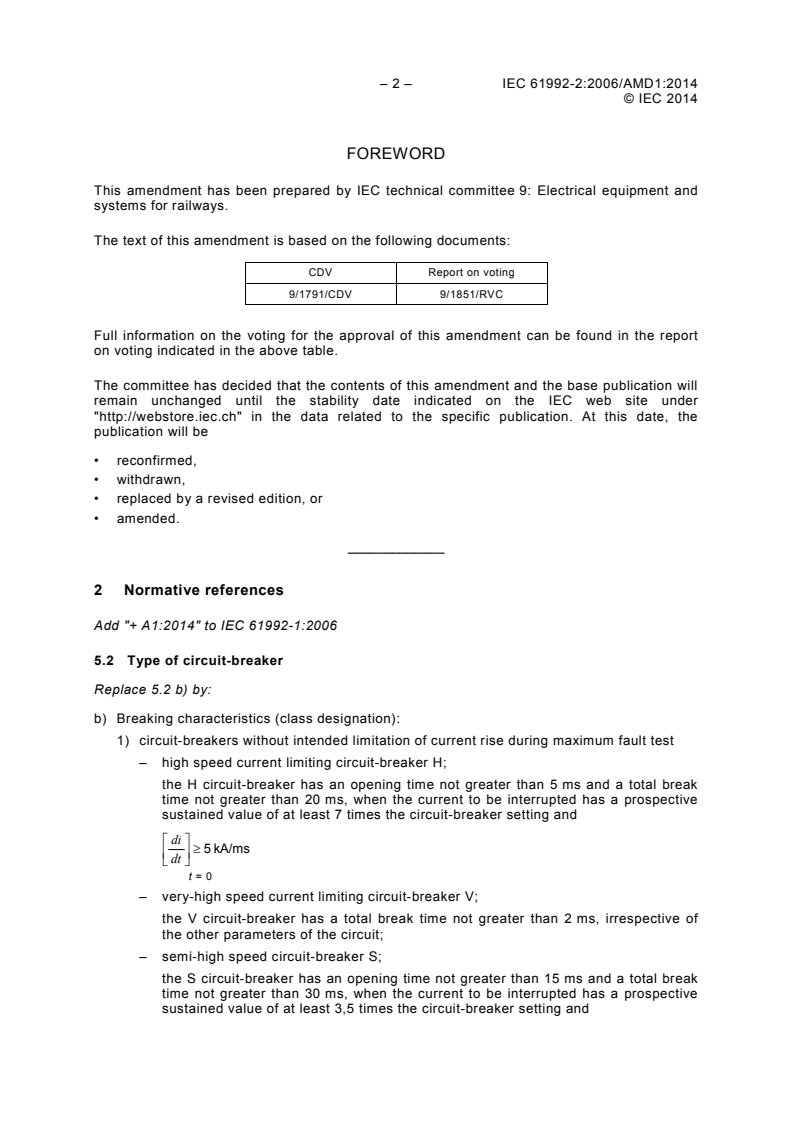
b) Breaking characteristics (class designation):
1) circuit-breakers without intended limitation of current rise during maximum fault test
– high speed current limiting circuit-breaker H;
the H circuit-breaker has an opening time not greater than 5 ms and a total break
time not greater than 20 ms, when the current to be interrupted has a prospective
sustained value of at least 7 times the circuit-breaker setting and
di
≥ 5 kA/ms
dt
t = 0
– very-high speed current limiting circuit-breaker V;
the V circuit-breaker has a total break time not greater than 2 ms, irrespective of
the other parameters of the circuit;
– semi-high speed circuit-breaker S;
the S circuit-breaker has an opening time not greater than 15 ms and a total break
time not greater than 30 ms, when the current to be interrupted has a prospective
sustained value of at least 3,5 times the circuit-breaker setting and
© IEC 2014
di
≥ 1,7 kA/ms
dt
t = 0
2) circuit-breakers with intended limitation of current rise during maximum fault test
– cut-off current limiting circuit-breaker C;
the C circuit-breaker limits the cut-off current before the short-circuit current to be
interrupted reaches its maximum value; the C circuit breaker can be an air circuit
breaker or a hybrid circuit breaker;
Table 6 gives the maximum values of the cut-off current depending on the preferred
values of rated short-circuit current together with the maximum allowable value of
initial current rise;
Table 6 applies to C circuit-breakers for nominal voltages up to and including
1 500 V.
Table 6 – Limits of the cut-off current of C circuit-breakers during maximum fault test
Short circuit current characteristics Maximum cut-off current
Rated short-circuit Initial rate of rise Circuit time Class C1 Class C2
current constant
I
Nss
kA kA/ms ms kA kA
20 1,5 13,3 15 17
50 3 16,7 25 30
75 10 7,5 50 60
100 10 10,0 55 70
Smoothing reactors should be installed for substations in order to realize an initial rate of rise
equal to or less than the applicable value given in Table 6.
– 4 – IEC 61992-2:2006/AMD1:2014
© IEC 2014
Replace existing Table 1 by the following new Table 1:
Table 1 – Shortened type designation
a a
Items above b) c) d) h)
Options H I
U O
V L
U E
S R
B P
C
Examples H/L/B/E
V/I/P S/R/O
b
H/R and L/U2
NOTE When a circuit-breaker is not suitable to perform all duties as given in 5.3.4.2, this fact will be indicated
by means of the lower case letter(s) designating actual capability according to Table 2, first column (for example
H1/I ff, fr/P).
a
Optional designations.
b
When a circuit-breaker is or shall be suitable for multiple alternate functions, the indication of these functions
shall be preceded by an “and”.
5.3.4.1 Rated short-circuit breaking and making capacities
Replace, in the first paragraph, "designation H or V or S" by "designation H, V, S or C".
Replace the 4th paragraph by the following:
H, V and S circuit breakers having a breaking capacity at a rated track time constant T are
Nc
. For
capable of the same breaking capacity at all lower values of circuit time constant t
c
Type C circuit breakers the initial rate of rise shall not exceed the limits given in Table 6.
5.3.4.2 Duties and test duty cycles
Add, in the last sentence of the Note,“duty 3” as follows:” (duty 1, or duty 2, or duty 3)”.
© IEC 2014
Replace existing Table 2 by the following new Table 2:
Table 2 – Circuit-breaker duties
Duty Use Conditions Test current Prospective peak Time constant
f L Maximum fault I Type H, V and S: By consequence of
Nss
other circuit
≥1,42 × I
Nss parameters
Type C: ≥ I See Table 6
Nss
a
e L Maximum energy 0,5 × I By consequence of 0,5 × T
Nss Nc
other circuit
parameters
d L Distant fault 2 × I By consequence of T
Ne Nc
other circuit
parameters
l L Low current I Not applicable
≅0,01 s
c
ff I Maximum fault I Type H, V and S: By consequence of
Nss
forward other circuit
≥1,42 × I
Nss parameters
See Table 6
Type C: ≥ I
Nss
fr I Maximum fault I Type H, V and S: By consequence of
Nss
reverse other circuit
≥1,42 × I
Nss parameters
Type C: ≥ I See Table 6
Nss
I
lr I Forward low current Not applicable ≅0,01 s
c
after reverse short
b
R
circuit
c
r R Maximum fault I ≥1,42 × I
Nss Nss
reverse with
paralleled converters
c
s R Short time current I
≥1,42 × I
Ncw
Ncw
forward
NOTE 1 For substations equipped with smoothing reactors of high value, the maximum energy condition may
correspond to the maximum fault condition.
NOTE 2 I is to be determined for each type of actual circuit situation. Therefore, I may be different for
Nss Nss
Line L, Interconnector I and Rectifier R circuit-breakers.
a
The factor affecting both I and T for maximum energy fault position is taken for practical reasons as
Nss Nc
0,5. For low values of T , see Table 2 of IEC 61992-1.
Nc
b
R only when explicitly required by the purchaser.
c
The coefficient is 1 with regard to the C circuit-breaker.
– 6 – IEC 61992-2:2006/AMD1:2014
© IEC 2014
Replace existing Table 3 by the following new Table 3:
Table 3 – Test duty cycles
Duty Breaking Test cycle
characteristics
a
f, e, d H,V,S Duty 1 O – 15 s – CO – 15 s – CO – 60 s – CO
Duty 2 O – 7 s – CO – 10 s – CO – 60 s – CO
b c
C Duty 3 O – 10 s – CO
ff, fr, r H,V,S,C O – 15s – CO
l, lr H,V,S,C 10 times (O – 120 s – CO)
s H,V,S,C Carrying for 0,25 s
NOTE 1 O = opening operation, CO = closing operation.
NOTE 2 First opening is made on a short circuit being established.
a
The choice of Duty 1 or 2 is left to the purchaser. If no choice is made, then the duty cycle required is Duty 1.
b
In the case of C, the test cycle of duty e and d are subject to agreement between purchaser and supplier.
c
The standard duty is O – 10 s – CO. However, if AC short-circuit test method is applied, the duration
between O and CO may be reduced to less than 10 s.
8.2 Applicable tests and test sequence
Replace existing Table 4 by the following new Table 4:
Table 4 – List of applicable tests and sequence
Reference to
Group Test description Kind
subclause
General operating characteristics
Verification of conformity to the manufacturing drawings Type and routine 8.3.1
and to characteristics of the circuit-breaker
Mechanical operation Type and routine 8.3.2
Dielectric withstand Type and routine 8.3.3
Temperature-rise Type 8.3.4
Verification of the adjustment of the relays and releases Routine 8.3.5
Electrical endurance Type 8.3.6
Mechanical endurance Type 8.3.7
Short circuit behaviour
Verification of the H, V or S characteristic Type 8.3.8.1
Verification of the C characteristic Type 8.3.8.9
Verification of the short-time withstand current of rectifier Type 8.3.9
circuit-breakers R
Verification of the adjustment of the relays and releases Type 8.3.5
3 Search for critical currents and low current test duty Type 8.3.10
8.3.8 Verification of the making and breaking capacity in short-circuit conditions and
of the H, V or S characteristic
Replace the title of subclause 8.3.8 by:
© IEC 2014
8.3.8 Verification of the making and breaking capacity in short-circuit conditions
8.3.8.1 Tolerances on the test values
Replace the title of subclause 8.3.8.1 by:
8.3.8.1 Verification of the H, V or S characteristic
Add new subclause 8.3.8.9, between 8.3.8.1 and 8.3.8.2:
8.3.8.9 Verification of the making and breaking capacity in short-circuit conditions
and of the C characteristic
8.3.8.9.1 Tolerances on the test values
This test is carried out at the values indicated by the manufacturer in 5.3.1 to 5.3.3 in
accordance with 5.3.4. The test is considered valid if the reported values differ from stated
values within the limits stated in Table 6 of IEC 61992-1:2006 except for the time constant.
The tolerances of the initial rate of rise shall be 0 ~ +30 % and as a consequence the
tolerances for the time constant are –30 % ~ 0.
For laboratory reasons, these tolerances may be revised by mutual agreement.
8.3.8.9.2 Test conditions
The circuit-breaker shall be a complete assembly. The control device, except for control
motors, shall be supplied at its minimum voltage value, as stated in 5.4.
The circuit-breaker should be tested in an enclosure having the minimum volume and
dimensions as declared by the manufacturer, or in open air when intended for cell use, using
screens to simulate the closest proximity of cell walls and ceiling. These screens or cubicle
shall be metal and connected to the circuit-breaker earthed frame. Screens and cubicles may
be lined with insulation if this is the manner in which the circuit-breaker operates in service.
8.3.8.9.3 Procedure
The test, as specified in 5.3.4, consists of a number of duties particular to a class of circuit-
breaker with an appropriate duty cycle and release setting. Each duty cycle is required to be
performed once and, because of the severe nature of the test, the circuit-breaker may be
maintained between duty cycles.
In the case of adopting Duty 3 in Table 3, test cycle O – 10 s – CO shall be carried out once.
For laboratory reasons, the time between O and CO may be shorter than 10 s by mutual
agreement (See Table 3, note b).
Where a circuit-breaker can have applications of either of its primary terminals connected to
the positive supply, then the test duties f), e) and d) (see Table 3) shall be repeated for both
connections.
After each test duty, a dielectric test is required in accordance with 7.6.3 of IEC 61992-1:2006.
8.3.8.9.4 Test circuit
A typical arrangement of the test circuit is shown in Annex A of IEC 61992-1:2006.
Details of the test circuit are given in 7.6.1 of IEC 61992-1:2006.
For laboratory reasons, the AC short-circuit test method may be applied by mutual agreement
(see Annex B).
– 8 – IEC 61992-2:2006/AMD1:2014
© IEC 2014
For test duties e) and d), where insufficient impedance can be added to the load side, then
the test duty shall be repeated with the live connection to the opposite terminal. Thus both
terminals of the circuit-breaker are stressed to earth during extinguishing of arc.
8.3.8.9.5 Time constant of the test circuit
The test circuit time constant is as follows (see Table 2).
a) For the maximum fault test the circuit time constant shall be the value given in Table 6.
b) For the maximum energy, the circuit time constant shall be equal to or higher than half of
the rated time constant T (For the actual value see 5.1.1.3 of IEC 61992-1:2006).
Nc
c) For the distant fault, the circuit time constant t should be equal to the rated time constant
c
T .
Nc
d) For the electrical endurance test, the circuit time constant t should be set at 0,01 s.
c
e) For the critical current test, the circuit time constant t should be as close to 0,01 s as
c
possible.
When calibrating each test, the test circuit time constant or the initial rate of rise shall be
measured. The time constant is taken from the test current. (See the calibration waveform 2 in
IEC 61992-1:2006, Table A.2.)
In the case of adopting the AC short-circuit test method, Annex B should be referred.
8.3.8.9.6 Recovery voltage
For the test, the average value of the recovery voltage shall be not lower than the rated
voltage U . In the case of adopting the AC short-circuit test the test conditions given in
Ne
Clause B.3 may apply.
8.3.8.9.7 Details for conducting the tests
8.3.8.9.7.1 Calibration of the test circuit
The test shall be performed at the rated voltage U , calibrated with the test unit A replaced
Ne
by a provisional connection B of negligible impedance in respect to the test circuit.
Adjust resistors R and reactors L in order to obtain both the sustained short-circuit current
and the rated time constant. These values are for the prospective current and shall be those
declared by the manufacturer, within the tolerances stated in 7.2 of IEC 61992-1:2006 (see
8.3.8.1 ).
In the case of adopting the AC short-circuit test method, Annex B should be referred.
8.3.8.9.7.2 Performance of the tests
Replace the provisional connection B by the test unit A, with the terminals of the circuit-
breaker connected as required by the test duty. The tests shall comply with 8.3.8.3 and with
the conditions specified in 7.6.2 of IEC 61992-1:2006.
After the current interruption, the recovery voltage shall be maintained for 0,1 s.
If the test is performed as AC test the recovery voltage time may be less than 0,1 s by mutual
agreement.
© IEC 2014
8.3.8.9.7.3 Behaviour of the circuit-breaker during the making and breaking short
circuit tests
During the test the circuit-breaker shall break the short-circuit current; there shall be no re-
ignition after current zero. The short-circuit current shall be the rated short-circuit current.
The circuit-breaker shall achieve the values given in Table 7.
Table 7 – Verification of the behaviour of the circuit-breaker
when performing test duties f, ff and fr
Type Opening time Total break time Current setting Initial rate of rise Cut off current
ms ms kA kA/ms kA
C Not applicable Not applicable Maximum value Equal to or higher Equal to or less
than the value than the value
given in Table 6 given in Table 6
The fuse element in the protection device D shall not blow during the test.
The cut-off current shall be verified.
8.3.8.9.7.4 Conditions of the circuit-breaker after the above test
These shall be in accordance with the conditions specified in 7.6.3 of IEC 61992-1:2006.
8.3.8.9.8 Verification of the C characteristic for test duties f, ff and fr
During the maximum fault test for test duties f, ff and fr, the behaviour of the circuit-breaker in
meeting its class designation of C shall be verified only if the test currents and settings are as
given in Table 7.
The cut-off current of the circuit-breaker shall be as given in Table 7.
8.3.10 Searching for critical currents and performing test duty l) and lr)
Replace the third paragraph by:
For L circuit-breakers test duty l is performed at the value of critical current I determined for
c
unidirectional circuit-breakers U and U as described in Clause C.2 of IEC 61992-1:2006 for
1 2
bidirectional circuit-breakers B as described in Clause C.3 of IEC 61992-1:2006.
Delete Note 1.
Replace the fourth paragraph by:
For R and I circuit-breakers test duty lr is performed at the value of critical current I
c
determined as described in Clause C.3 of IEC 61992-1:2006.
Add the following new Annex B:
– 10 – IEC 61992-2:2006/AMD1:2014
© IEC 2014
Annex B
(normative)
AC short-circuit test method
B.1 General
For circuit-breaker C, this annex gives the alternative AC method for the making and breaking
short circuit tests specified in 8.3.8.9.
B.2 Test circuit
The conditions of the AC short-circuit test corresponding to the DC short-circuit test are as
follows (see Figure B.1).
Making switch For protection L R
Circuit-breaker
under test
Power supply
IEC 1399/14
Key
L circuit inductance
R circuit resistance
Figure B.1 – Test circuit
Typical voltage and current waveforms of the AC short-circuit test are as follows (see
Figure B.2):
© IEC 2014
φ
U
U MAX
Power supply voltage
U
r
Û
Voltage between poles arc
I
cut off
Current
IEC 1400/14
Key
f Test frequency Û Maximum arc voltage
arc
U Peak value of voltage I Cut off current
max cut off
U Supply voltage ϕ Making phase angle
U Recovery voltage
r
Figure B.2 – Typical voltage and current waveforms of the AC short-circuit test
B.3 Test conditions
The conditions of the AC short-circuit test are as follows:
Supply voltage U
The voltage U at opening of the circuit-breaker contact shall be equal to or greater than
the rated voltage U .
Ne
Recovery voltage U
r
The recovery voltage U shall be equal to or greater than the rated voltage U .
r Ne
Circuit resistance R
The circuit resistance R shall be equal to or less than U / I + 5
...