

IEC 61850-4:2002
(Main)Communication networks and systems in substations - Part 4: System and project management
General Information
- Abstract
Describes the requirements of the system and project management process and of special supporting tools for engineering and testing.
This publication is of core relevance for Smart Grid.
- Status
- Published
- Publication Date
- 16-Jan-2002
- Technical Committee
- TC 57 - Power systems management and associated information exchange
- Drafting Committee
- WG 10 - TC 57/WG 10
- Current Stage
- DELPUB - Deleted Publication
- Start Date
- 11-Apr-2011
- Completion Date
- 28-Aug-2026
Overview
IEC 61850-4:2002 is a critical international standard published by the International Electrotechnical Commission (IEC) focusing on communication networks and systems in substations, specifically addressing system and project management. This part of the IEC 61850 suite outlines the essential requirements for managing the engineering, implementation, and testing of communication systems within electrical substations. It offers comprehensive guidance on project lifecycle management, ensuring consistency, scalability, and quality assurance in substation automation systems (SAS).
Highly relevant for the evolving Smart Grid landscape, IEC 61850-4:2002 supports the seamless integration, operation, and maintenance of intelligent digital substation solutions. It enables utilities and system integrators to manage complex projects efficiently while maintaining system reliability and compliance with international best practices.
Key Topics
Engineering Requirements
Covers categories and types of parameters for configuring communication networks and intelligent electronic devices (IEDs), supported by specialized engineering tools. Emphasizes flexibility, extensibility, and scalability in system design.System Life Cycle Management
Addresses product versioning, the announcement process for product discontinuation, and support mechanisms after the end of product manufacture. Focuses on ensuring consistent updates and lifecycle transparency.Project Documentation
Promotes automatic and standardized documentation generation for substations, facilitating integration and providing clear, comprehensive project reporting.Quality Assurance
Specifies the division of responsibilities between manufacturers and system integrators. Details testing equipment requirements and classification of quality tests, including system tests, type tests, routine tests, and site acceptance tests.Support for System Integrators
Provides guidance to support integrators throughout the project execution phase, improving coordination and reducing project risks.Process Definitions
Defines processes for engineering, system configuration, testing, and validation to guarantee system interoperability and reliability.
Applications
IEC 61850-4:2002 is applicable in various practical contexts within the energy sector, especially:
Digital Substation Automation
Assists in managing the complex engineering tasks, parameter setting, and project workflows needed for implementing IEC 61850-compliant digital substations.Smart Grid Infrastructure
Facilitates reliable communication network and system management crucial for modern grid automation and integration of renewable energy sources.Electrical Utilities Project Management
Supports utilities in executing large-scale substation projects with consistent documentation, lifecycle control, and defined quality assurance methodologies.System Integration and Testing
Enables efficient coordination between device manufacturers and system integrators during system acceptance and commissioning, ensuring regulatory compliance.Maintenance and Upgrade Planning
Provides a structured approach to managing system updates, product discontinuations, and long-term operational support for communication networks within substations.
Related Standards
IEC 61850-4:2002 complements other parts of the IEC 61850 family, which together define standards for communication protocols and system functionalities in substations:
- IEC 61850-1: Introduction and overview of digital substations and communication systems
- IEC 61850-7-x: Specific communication service models, data models, and abstract communication service interface
- IEC 61850-8-1: Specific communication protocols including MMS (Manufacturing Message Specification)
- IEC 61850-9-x: Sampled values and time synchronization aspects
These interconnected standards collectively establish a comprehensive framework for communication networks and systems in substations, ensuring interoperability, reliability, and scalability-key for evolving Smart Grid and utility automation solutions.
Keywords: IEC 61850-4, system management, project management, substation communication networks, Smart Grid, substation automation system (SAS), engineering tools, quality assurance, lifecycle management, IEC standards, electrical utilities, system integrator support, digital substations.
Relations
- Effective Date
- 05-Sep-2023
Get Certified
Connect with accredited certification bodies for this standard

ANCE
Mexican certification and testing association.

Intertek Slovenia
Intertek testing, inspection, and certification services in Slovenia.

LNE (Laboratoire National de Métrologie et d'Essais)
French national laboratory for metrology and testing.
Sponsored listings
Frequently Asked Questions
IEC 61850-4:2002 is a standard published by the International Electrotechnical Commission (IEC). Its full title is "Communication networks and systems in substations - Part 4: System and project management". This standard covers: Describes the requirements of the system and project management process and of special supporting tools for engineering and testing. This publication is of core relevance for Smart Grid.
Describes the requirements of the system and project management process and of special supporting tools for engineering and testing. This publication is of core relevance for Smart Grid.
IEC 61850-4:2002 is classified under the following ICS (International Classification for Standards) categories: 33.200 - Telecontrol. Telemetering. The ICS classification helps identify the subject area and facilitates finding related standards.
IEC 61850-4:2002 has the following relationships with other standards: It is inter standard links to IEC 61850-4:2011. Understanding these relationships helps ensure you are using the most current and applicable version of the standard.
IEC 61850-4:2002 is available in PDF format for immediate download after purchase. The document can be added to your cart and obtained through the secure checkout process. Digital delivery ensures instant access to the complete standard document.
Standards Content (Sample)
NORME CEI
INTERNATIONALE IEC
61850-4
INTERNATIONAL
Première édition
STANDARD
First edition
2002-01
Réseaux et systèmes de communication
dans les postes –
Partie 4:
Gestion du système et gestion de projet
Communication networks and systems
in substations –
Part 4:
System and project management
Numéro de référence
Reference number
CEI/IEC 61850-4:2002
Numérotation des publications Publication numbering
Depuis le 1er janvier 1997, les publications de la CEI As from 1 January 1997 all IEC publications are
sont numérotées à partir de 60000. Ainsi, la CEI 34-1 issued with a designation in the 60000 series. For
devient la CEI 60034-1. example, IEC 34-1 is now referred to as IEC 60034-1.
Editions consolidées Consolidated editions
Les versions consolidées de certaines publications de la The IEC is now publishing consolidated versions of its
CEI incorporant les amendements sont disponibles. Par publications. For example, edition numbers 1.0, 1.1
exemple, les numéros d’édition 1.0, 1.1 et 1.2 indiquent and 1.2 refer, respectively, to the base publication,
respectivement la publication de base, la publication de the base publication incorporating amendment 1 and
base incorporant l’amendement 1, et la publication de the base publication incorporating amendments 1
base incorporant les amendements 1 et 2. and 2.
Informations supplémentaires Further information on IEC publications
sur les publications de la CEI
Le contenu technique des publications de la CEI est The technical content of IEC publications is kept
constamment revu par la CEI afin qu'il reflète l'état under constant review by the IEC, thus ensuring that
actuel de la technique. Des renseignements relatifs à the content reflects current technology. Information
cette publication, y compris sa validité, sont dispo- relating to this publication, including its validity, is
nibles dans le Catalogue des publications de la CEI available in the IEC Catalogue of publications
(voir ci-dessous) en plus des nouvelles éditions, (see below) in addition to new editions, amendments
amendements et corrigenda. Des informations sur les and corrigenda. Information on the subjects under
sujets à l’étude et l’avancement des travaux entrepris consideration and work in progress undertaken by the
par le comité d’études qui a élaboré cette publication, technical committee which has prepared this
ainsi que la liste des publications parues, sont publication, as well as the list of publications issued,
également disponibles par l’intermédiaire de: is also available from the following:
• Site web de la CEI (www.iec.ch) • IEC Web Site (www.iec.ch)
• Catalogue des publications de la CEI • Catalogue of IEC publications
Le catalogue en ligne sur le site web de la CEI The on-line catalogue on the IEC web site
(www.iec.ch/catlg-f.htm) vous permet de faire des (www.iec.ch/catlg-e.htm) enables you to search
recherches en utilisant de nombreux critères, by a variety of criteria including text searches,
comprenant des recherches textuelles, par comité technical committees and date of publication. On-
d’études ou date de publication. Des informations line information is also available on recently
en ligne sont également disponibles sur les issued publications, withdrawn and replaced
nouvelles publications, les publications rempla- publications, as well as corrigenda.
cées ou retirées, ainsi que sur les corrigenda.
• IEC Just Published
• IEC Just Published
Ce résumé des dernières publications parues
This summary of recently issued publications
(www.iec.ch/JP.htm) est aussi disponible par
(www.iec.ch/JP.htm) is also available by email.
courrier électronique. Veuillez prendre contact
Please contact the Customer Service Centre (see
avec le Service client (voir ci-dessous) pour plus
below) for further information.
d’informations.
• Service clients
• Customer Service Centre
Si vous avez des questions au sujet de cette
If you have any questions regarding this
publication ou avez besoin de renseignements
publication or need further assistance, please
supplémentaires, prenez contact avec le Service
contact the Customer Service Centre:
clients:
Email: custserv@iec.ch
Email: custserv@iec.ch
Tél: +41 22 919 02 11
Tel: +41 22 919 02 11
Fax: +41 22 919 03 00
Fax: +41 22 919 03 00
.
NORME CEI
INTERNATIONALE IEC
61850-4
INTERNATIONAL
Première édition
STANDARD
First edition
2002-01
Réseaux et systèmes de communication
dans les postes –
Partie 4:
Gestion du système et gestion de projet
Communication networks and systems
in substations –
Part 4:
System and project management
IEC 2002 Droits de reproduction réservés Copyright - all rights reserved
Aucune partie de cette publication ne peut être reproduite ni No part of this publication may be reproduced or utilized in
utilisée sous quelque forme que ce soit et par aucun procédé, any form or by any means, electronic or mechanical,
électronique ou mécanique, y compris la photocopie et les including photocopying and microfilm, without permission in
microfilms, sans l'accord écrit de l'éditeur. writing from the publisher.
International Electrotechnical Commission 3, rue de Varembé Geneva, Switzerland
Telefax: +41 22 919 0300 e-mail: inmail@iec.ch IEC web site http://www.iec.ch
CODE PRIX
Commission Electrotechnique Internationale
U
PRICE CODE
International Electrotechnical Commission
Pour prix, voir catalogue en vigueur
For price, see current catalogue
– 2 – 61850-4 CEI:2002
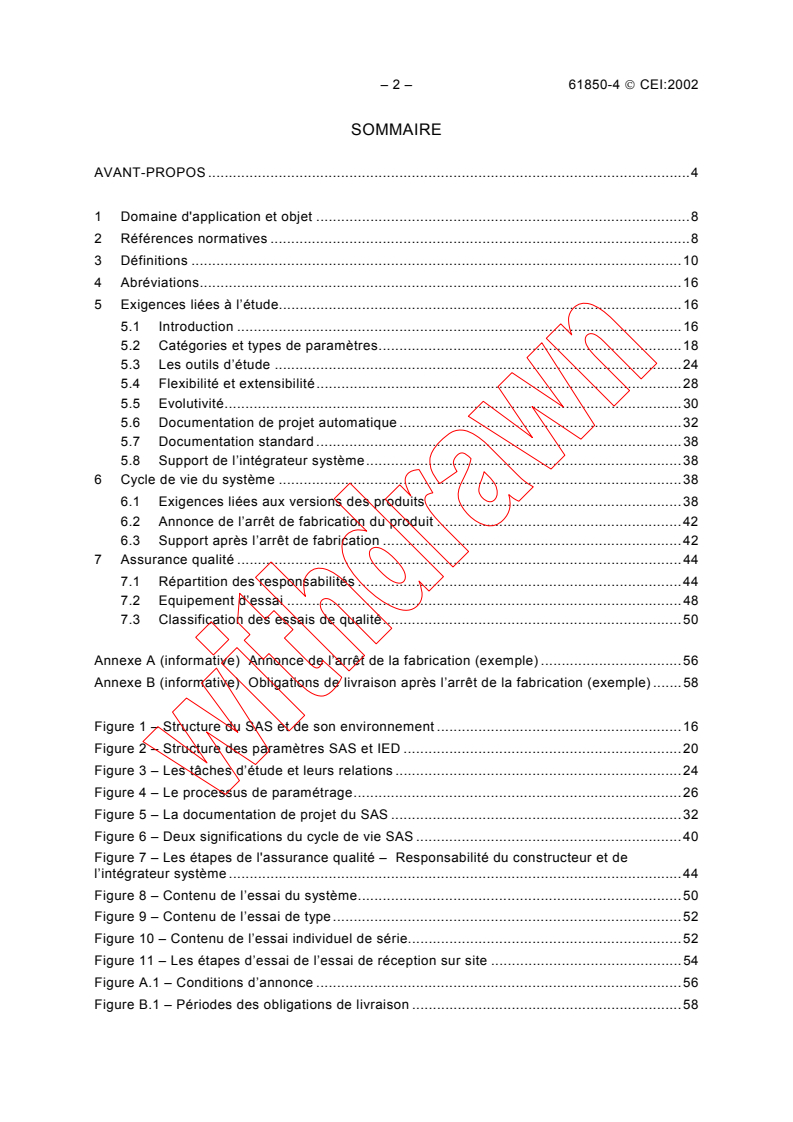
SOMMAIRE
AVANT-PROPOS .4
1 Domaine d'application et objet .8
2 Références normatives .8
3 Définitions .10
4 Abréviations.16
5 Exigences liées à l’étude.16
5.1 Introduction .16
5.2 Catégories et types de paramètres.18
5.3 Les outils d’étude .24
5.4 Flexibilité et extensibilité.28
5.5 Evolutivité.30
5.6 Documentation de projet automatique .32
5.7 Documentation standard .38
5.8 Support de l’intégrateur système.38
6 Cycle de vie du système .38
6.1 Exigences liées aux versions des produits .38
6.2 Annonce de l’arrêt de fabrication du produit .42
6.3 Support après l’arrêt de fabrication .42
7 Assurance qualité .44
7.1 Répartition des responsabilités .44
7.2 Equipement d’essai .48
7.3 Classification des essais de qualité.50
Annexe A (informative) Annonce de l’arrêt de la fabrication (exemple) .56
Annexe B (informative) Obligations de livraison après l’arrêt de la fabrication (exemple) .58
Figure 1 – Structure du SAS et de son environnement .16
Figure 2 – Structure des paramètres SAS et IED .20
Figure 3 – Les tâches d’étude et leurs relations .24
Figure 4 – Le processus de paramétrage.26
Figure 5 – La documentation de projet du SAS .32
Figure 6 – Deux significations du cycle de vie SAS .40
Figure 7 – Les étapes de l'assurance qualité – Responsabilité du constructeur et de
l’intégrateur système .44
Figure 8 – Contenu de l’essai du système.50
Figure 9 – Contenu de l’essai de type.52
Figure 10 – Contenu de l’essai individuel de série.52
Figure 11 – Les étapes d’essai de l’essai de réception sur site .54
Figure A.1 – Conditions d’annonce .56
Figure B.1 – Périodes des obligations de livraison .58
61850-4 IEC:2002 – 3 –
CONTENTS
FOREWORD.5
1 Scope and object .9
2 Normative references.9
3 Definitions .11
4 Abbreviations.17
5 Engineering requirements .17
5.1 Introduction .17
5.2 Categories and types of parameters.19
5.3 Engineering tools.25
5.4 Flexibility and expandability .29
5.5 Scalability.31
5.6 Automatic project documentation .33
5.7 Standard documentation .39
5.8 System integrator's support .39
6 System life cycle.39
6.1 Requirements of product versions.39
6.2 Announcement of product discontinuation .43
6.3 Support after discontinuation .43
7 Quality assurance .45
7.1 Division of responsibility .45
7.2 Test equipment.49
7.3 Classification of quality tests.51
Annex A (informative) Announcement of discontinuation (example).57
Annex B (informative) Delivery obligations after discontinuation (example).59
Figure 1 – Structure of the SAS and its environment.17
Figure 2 – Structure of SAS and IED parameters .21
Figure 3 – Engineering tasks and their relationship.25
Figure 4 – Parameterization process .27
Figure 5 – Project related documentation of SAS.33
Figure 6 – Two meanings of the SAS life cycle .41
Figure 7 – Stages of quality assurance – Responsibility of manufacturer
and system integrator.45
Figure 8 – Contents of system test .51
Figure 9 – Contents of type test.53
Figure 10 – Contents of routine test.53
Figure 11 – Testing stages for site acceptance test .55
Figure A.1 – Announcement conditions.57
Figure B.1 – Periods for delivery obligations .59
– 4 – 61850-4 CEI:2002
COMMISSION ÉLECTROTECHNIQUE INTERNATIONALE
____________
RÉSEAUX ET SYSTÈMES DE COMMUNICATION
DANS LES POSTES –
Partie 4: Gestion du système et gestion de projet
AVANT-PROPOS
1) La CEI (Commission Électrotechnique Internationale) est une organisation mondiale de normalisation composée
de l'ensemble des comités électrotechniques nationaux (Comités nationaux de la CEI). La CEI a pour objet de
favoriser la coopération internationale pour toutes les questions de normalisation dans les domaines de
l'électricité et de l'électronique. A cet effet, la CEI, entre autres activités, publie des Normes internationales.
Leur élaboration est confiée à des comités d'études, aux travaux desquels tout Comité national intéressé par le
sujet traité peut participer. Les organisations internationales, gouvernementales et non gouvernementales, en
liaison avec la CEI, participent également aux travaux. La CEI collabore étroitement avec l'Organisation
Internationale de Normalisation (ISO), selon des conditions fixées par accord entre les deux organisations.
2) Les décisions ou accords officiels de la CEI concernant les questions techniques représentent, dans la mesure
du possible, un accord international sur les sujets étudiés, étant donné que les Comités nationaux intéressés
sont représentés dans chaque comité d’études.
3) Les documents produits se présentent sous la forme de recommandations internationales. Ils sont publiés
comme normes, spécifications techniques, rapports techniques ou guides et agréés comme tels par les Comités
nationaux.
4) Dans le but d'encourager l'unification internationale, les Comités nationaux de la CEI s'engagent à appliquer de
façon transparente, dans toute la mesure possible, les Normes internationales de la CEI dans leurs normes
nationales et régionales. Toute divergence entre la norme de la CEI et la norme nationale ou régionale
correspondante doit être indiquée en termes clairs dans cette dernière.
5) La CEI n’a fixé aucune procédure concernant le marquage comme indication d’approbation et sa responsabilité
n’est pas engagée quand un matériel est déclaré conforme à l’une de ses normes.
6) L’attention est attirée sur le fait que certains des éléments de la présente Norme internationale peuvent faire
l’objet de droits de propriété intellectuelle ou de droits analogues. La CEI ne saurait être tenue pour
responsable de ne pas avoir identifié de tels droits de propriété et de ne pas avoir signalé leur existence.
La Norme internationale CEI 61850-4 a été établie par le comité d'études 57 de la CEI:
Conduite des systèmes de puissance et communications associées.
Le texte de cette norme est issu des documents suivants:
FDIS Rapport de vote
57/558/FDIS 57/573/RVD
Le rapport de vote indiqué dans le tableau ci-dessus donne toute information sur le vote ayant
abouti à l'approbation de cette norme.
Cette publication a été rédigée selon les Directives ISO/CEI, Partie 3.
Les annexes A et B sont données uniquement à titre d’information.
La CEI 61850 comprend les parties suivantes, présentées sous le titre général: Réseaux et
systèmes de communication dans les postes:
Partie 1: Introduction et vue générale
___________
l’étude.
61850-4 IEC:2002 – 5 –
INTERNATIONAL ELECTROTECHNICAL COMMISSION
____________
COMMUNICATION NETWORKS AND SYSTEMS
IN SUBSTATIONS –
Part 4: System and project management
FOREWORD
1) The IEC (International Electrotechnical Commission) is a worldwide organization for standardization comprising
all national electrotechnical committees (IEC National Committees). The object of the IEC is to promote
international co-operation on all questions concerning standardization in the electrical and electronic fields. To
this end and in addition to other activities, the IEC publishes International Standards. Their preparation is
entrusted to technical committees; any IEC National Committee interested in the subject dealt with may
participate in this preparatory work. International, governmental and non-governmental organizations liaising
with the IEC also participate in this preparation. The IEC collaborates closely with the International Organization
for Standardization (ISO) in accordance with conditions determined by agreement between the two
organizations.
2) The formal decisions or agreements of the IEC on technical matters express, as nearly as possible, an
international consensus of opinion on the relevant subjects since each technical committee has representation
from all interested National Committees.
3) The documents produced have the form of recommendations for international use and are published in the form
of standards, technical specifications, technical reports or guides and they are accepted by the National
Committees in that sense.
4) In order to promote international unification, IEC National Committees undertake to apply IEC International
Standards transparently to the maximum extent possible in their national and regional standards. Any
divergence between the IEC Standard and the corresponding national or regional standard shall be clearly
indicated in the latter.
5) The IEC provides no marking procedure to indicate its approval and cannot be rendered responsible for any
equipment declared to be in conformity with one of its standards.
6) Attention is drawn to the possibility that some of the elements of this International Standard may be the subject
of patent rights. The IEC shall not be held responsible for identifying any or all such patent rights.
International Standard IEC 61850-4 has been prepared by IEC technical committee 57: Power
system control and associated communications
The text of this standard is based on the following documents:
FDIS Report on voting
57/558/FDIS 57/573/RVD
Full information on the voting for the approval of this standard can be found in the report on
voting indicated in the above table.
This publication has been drafted in accordance with the ISO/IEC Directives, Part 3.
Annexes A and B are for information only.
IEC 61850 consists of the following parts, under the general title: Communication networks and
systems in substations:
Part 1: Introduction and overview
___________
Under consideration.
– 6 – 61850-4 CEI:2002
Partie 2: Glossary
Partie 3: Prescriptions générales
Partie 4: Gestion du système et gestion de projet
Partie 5: Communication requirements for functions and device models
Partie 6: Substation automation system configuration description language
Partie 7-1: Basic communication structure for substation and feeder equipment – Principles
and models
Partie 7-2: Basic communication structure for substation and feeder equipment – Abstract
communication service interface (ACSI)
Partie 7-3: Basic communication structure for substation and feeder equipment – Common
data classes
Partie 7-4: Basic communication structure for substation and feeder equipment – Compatible
logical node classes and data classes
Partie 8-1: Specific communication service mapping (SCSM) – Mapping to MMS (ISO/IEC 9506
Part 1 and Part 2)
Partie 9-1: Specific communication service mapping (SCSM) – Serial unidirectional multidrop
point to point link
Partie 9-2: Specific communication service mapping (SCSM) – Mapping on a IEEE 802.3 based
process bus
Partie 10: Conformance testing
Le comité a décidé que le contenu de cette publication ne sera pas modifié avant 2004. A cette
date, la publication sera
• reconduite;
• supprimée;
• remplacée par une édition révisée, ou
• amendée.
___________
A l'étude.
61850-4 IEC:2002 – 7 –
Part 2: Glossary
Part 3: General requirements
Part 4: System and project management
Part 5: Communication requirements for functions and device models
Part 6: Substation automation system configuration description language
Part 7-1: Basic communication structure for substation and feeder equipment – Principles and
models
Part 7-2: Basic communication structure for substation and feeder equipment – Abstract
communication service interface (ACSI)
Part 7-3: Basic communication structure for substation and feeder equipment – Common data
classes
Part 7-4: Basic communication structure for substation and feeder equipment – Compatible
logical node classes and data classes
Part 8-1: Specific communication service mapping (SCSM) – Mapping to MMS (ISO/IEC 9506
Part 1 and Part 2)
Part 9-1: Specific communication service mapping (SCSM) – Serial unidirectional multidrop
point to point link
Part 9-2: Specific communication service mapping (SCSM) – Mapping on a IEEE 802.3 based
process bus
Part 10: Conformance testing
The committee has decided that the contents of this publication will remain unchanged until
2004. At this date, the publication will be
• reconfirmed;
• withdrawn;
• replaced by a revised edition, or
• amended.
___________
Under consideration.
– 8 – 61850-4 CEI:2002
RÉSEAUX ET SYSTÈMES DE COMMUNICATION
DANS LES POSTES –
Partie 4: Gestion du système et gestion de projet
1 Domaine d'application et objet
Cette partie de la CEI 61850 s'applique aux systèmes d'automatisation de poste (SAS). Elle
définit la communication entre les dispositifs électroniques intelligents (IED) dans le poste ainsi
que les exigences concernant les systèmes associés.
Les spécifications contenues dans cette partie se rapportent à la gestion du système et à la
gestion de projet en ce qui concerne:
– le processus d’étude et les outils de support associés;
– le cycle de vie du système global et de ses IED;
– l'assurance qualité, de l’étape de développement jusqu'à l'arrêt de fabrication et la mise
hors service du SAS et de ses IED.
Les exigences du processus de gestion du système et de gestion de projet ainsi que celles des
outils de support spécifiques pour l’étude et les essais sont décrites.
2 Références normatives
Les documents normatifs suivants contiennent des dispositions qui, par suite de la référence
qui y est faite, constituent des dispositions valables pour la présente partie de la CEI 61850.
Pour les références datées, les amendements ultérieurs ou les révisions de ces publications ne
s’appliquent pas. Toutefois, les parties prenantes aux accords fondés sur la présente partie de
la CEI 61850 sont invitées à rechercher la possibilité d'appliquer les éditions les plus récentes
des documents normatifs indiqués ci-après. Pour les références non datées, la dernière édition
du document normatif en référence s’applique. Les membres de la CEI et de l'ISO possèdent
le registre des Normes internationales en vigueur.
CEI 60848:1988, Etablissement des diagrammes fonctionnels pour systèmes de commande
CEI 61082 (toutes les parties), Etablissement des documents utilisés en électrotechnique
CEI 61175:1993, Désignations des signaux et connexions
CEI 61346 (toutes les parties), Systèmes industriels, installations et appareils, et produits
industriels – Principes de structuration et désignations de référence
ISO 9001:1994, Systèmes qualité – Modèle pour l'assurance de la qualité en conception,
développement, production, installation et prestations associées (en anglais seulement)
61850-4 IEC:2002 – 9 –
COMMUNICATION NETWORKS AND SYSTEMS
IN SUBSTATIONS –
Part 4: System and project management
1 Scope and object
This part of IEC 61850 applies to substation automation systems (SAS). It defines the com-
munication between intelligent electronic devices (IEDs) in the substation and the related
system requirements.
The specifications of this part pertain to the system and project management with respect to:
– the engineering process and its supporting tools;
– the life cycle of the overall system and its IEDs;
– the quality assurance beginning with the development stage and ending with discon-
tinuation and decommissioning of the SAS and its IEDs.
The requirements of the system and project management process and of special supporting
tools for engineering and testing are described.
2 Normative references
The following normative documents contain provisions which, through reference in this text,
constitute provisions of this part of IEC 61850. For dated references, subsequent amendments
to, or revisions of, any of these publications do not apply. However, parties to agreements
based on this part of IEC 61850 are encouraged to investigate the possibility of applying the
most recent editions of the normative documents indicated below. For undated references, the
latest edition of the normative document referred to applies. Members of IEC and ISO maintain
registers of currently valid International Standards.
IEC 60848:1988, Preparation of function charts for control systems
IEC 61082 (all parts), Preparation of documents used in the electrotechnology
IEC 61175:1993, Designations for signals and connections
IEC 61346 (all parts), Industrial systems, installations and equipment and industrial products –
Structuring principles and reference designations
ISO 9001:1994, Quality systems – Model for quality assurance in design, development,
production, installation and servicing
– 10 – 61850-4 CEI:2002
3 Définitions
Pour les besoins de la présente partie de la CEI 61850, les définitions suivantes s'appliquent:
3.1
outils de support
outils qui servent de support à l'utilisateur dans l'étude, l'exploitation et la gestion du SAS et de
ses IED. Les outils de support permettent de réaliser les tâches suivantes:
– l'étude;
– la gestion de projet;
– la modification de paramètre(s);
– le diagnostic;
– les essais;
– la documentation;
– d'autres services.
NOTE En général, les outils de support font partie du SAS.
3.1.1
outils d’étude
outils qui permettent la création et la documentation des conditions nécessaires pour adapter
un SAS aux besoins spécifiques du poste et du client. Les outils d’étude se répartissent en
outils de gestion de projet, outils de paramétrage et outils de documentation.
3.2
extensibilité
critère qui caractérise la capacité d'extension efficace d'un SAS (matériel et fonctionnel) à
l’aide des outils d’étude.
3.3
flexibilité
critère qui caractérise la mise en œuvre rapide et efficace de modifications fonctionnelles, y
compris celles du matériel
3.4
évolutivité
critère d’un SAS économique qui reconnaît tout de même une variété de fonctionnalités, de
IED, de tailles de postes et de plages de tensions de poste
3.5
paramètres
variables qui définissent le comportement des fonctions du SAS et de ses IED à l'intérieur
d'une plage de valeurs donnée
3.5.1
paramètres système
données qui définissent l'interaction des IED au sein du SAS. Ils sont particulièrement
importants pour:
– la configuration du SAS;
– la communication entre les IED;
– la répartition des données entre les IED;
– le traitement et la visualisation des données provenant d'autres IED, par exemple au niveau
du poste
61850-4 IEC:2002 – 11 –
3 Definitions
For the purpose of this part of IEC 61850, the following definitions apply:
3.1
supporting tools
those that support the user in the engineering, the operation and the management of the SAS
and its IEDs. The following tasks can be implemented:
– engineering;
– project management;
– parameter change(s);
– diagnostics;
– testing;
– documentation;
– other services.
NOTE The tools are usually part of the SAS.
3.1.1
engineering tools
those tools that support the creation and documentation of the conditions for adapting an SAS
to the specific substation and customer requirements. They are divided into project manage-
ment, parameterization and documentation tools.
3.2
expandability
the criteria for the efficient extension of an SAS (hardware and functional) by use of the
engineering tools
3.3
flexibility
the criteria for the fast and efficient implementation of functional changes including hardware
3.4
scalability
the criteria for a cost effective SAS while recognizing various functionalities, various IEDs,
substation sizes and substation voltage ranges
3.5
parameters
variables which define the behaviour of functions of the SAS and its IEDs within a given range
of values
3.5.1
system parameters
data which define the interaction of IEDs in the SAS. They are especially important in the:
– configuration of the SAS;
– communication between IEDs;
– marshalling of data between IEDs;
– processing and visualization of data from other IEDs (for example, at the station level)
– 12 – 61850-4 CEI:2002
3.6
jeu de paramètres IED
toutes les valeurs de paramètres nécessaires à la définition du comportement du IED et à son
adaptation aux conditions du poste. Lorsque le IED doit fonctionner de façon autonome, le jeu
de paramètres IED peut être généré, sans les paramètres système, à l’aide d’un outil de
paramétrage spécifique au IED. Lorsque le IED fait partie du SAS, le jeu de paramètres IED
peut comprendre des paramètres système, qu’il convient de coordonner par un outil de
paramétrage général au niveau du SAS
3.7
jeu de paramètres SAS
toutes les valeurs de paramètres nécessaires à la définition du comportement du SAS global et
à son adaptation aux conditions du poste. Le jeu de paramètres SAS comprend les jeux de
paramètres IED de tous les IED concernés
3.8
RTU (Remote Terminal Unit = terminal à distance)
un RTU est utilisé typiquement comme poste à distance dans un système de télésurveillance et
d’acquisition de données (SCADA). Le RTU peut servir d'interface entre le réseau de
communication et l'appareillage du poste. La fonction du RTU peut résider dans un seul IED ou
être distribuée
3.9
famille de produits SAS
ensemble de différents IED d'un même constructeur qui ont des fonctionnalités différentes et
peuvent servir à la réalisation de systèmes d'automatisation de sous-station. Les IED d'une
même famille de produits sont homogènes sur le plan de la conception, du traitement
opérationnel et des conditions de montage et de câblage, et ils utilisent des outils de support
communs ou coordonnés
3.10
installation SAS
réalisation concrète d'un système d'automatisation de poste à partir d'un ensemble de IED
interopérables, issus d'un ou plusieurs constructeurs
3.11
liste de configuration
identification de toutes les versions compatibles du matériel et des logiciels des composants et
des IED, y compris les versions logicielles des outils de support concernés qui fonctionnent
ensemble dans une famille de produits SAS. La liste de configuration contient également
l'identification des protocoles de transmission supportés pour la communication avec des IED
d'autres constructeurs
3.12
constructeur
fabricant des IED et/ou des outils de support. Un constructeur peut réaliser un SAS en utilisant
ses propres IED et outils de support (famille de produits SAS)
3.13
intégrateur système
fournisseur d'installations SAS clé en main. La responsabilité de l'intégrateur système
comprend l'étude, la livraison et le montage de tous les IED concernés, les essais de réception
usine et de réception sur site, et les essais d'exploitation. Il convient que l'assurance qualité,
les obligations de maintenance et de livraison de pièces de rechange ainsi que la garantie
soient approuvées dans le contrat entre l'intégrateur système et le client
61850-4 IEC:2002 – 13 –
3.6
IED-parameter set
all parameter values needed for the definition of the behaviour of the IED and its adaptation to
the substation conditions. Where the IED has to operate autonomously, the parameter-set can
be generated without system parameters using an IED-specific parameterization tool. Where
the IED is a part of the SAS the parameter set may include system parameters, which should
be coordinated by a general parameterization tool at the SAS level
3.7
SAS-parameter set
all parameter values needed for the definition of the behaviour of the overall SAS and its
adaptation to the substation conditions. The parameter set includes the IED-parameter sets of
all participating IEDs
3.8
remote terminal unit (RTU)
typically used as an outstation in a Supervisory Control and Data Acquisition (SCADA) system.
An RTU may act as an interface between the communication network and the substation
equipment. The function of an RTU may reside in one IED or may be distributed
3.9
SAS product family
different IEDs of one manufacturer with various functionalities and with the ability to perform
substation automation systems. The IEDs of a product family are unified in relation to the
design, the operational handling, the mounting and wiring conditions and they use common or
coordinated supporting tools
3.10
SAS installation
the concrete instance of a substation automation system consisting of multiple interoperable
IEDs of one or more manufacturers
3.11
configuration list
an overview of all compatible hardware and software versions of components and IEDs
including the software versions of relevant supporting tools operating together in an SAS-
product family. Additionally, the configuration list contains the supported transmission protocols
for communication with IEDs of other manufacturers
3.12
manufacturer
the producer of IEDs and/or supporting tools. A manufacturer may be able to deliver an SAS
solely by use of his own IEDs and supporting tools (SAS product family)
3.13
system integrator
a turnkey deliverer of SAS installations. The responsibility of system integration includes the
engineering, the delivery and mounting of all participating IEDs, the factory and site acceptance
tests and the trial operation. The quality assurance, the maintenance and spare delivery
obligations and the warranty shall be agreed in the contract between the system integrator and
the customer
– 14 – 61850-4 CEI:2002
3.14
cycle de vie du système
le terme a deux significations distinctes:
a) pour le constructeur, c'est la période entre le démarrage de la fabrication d'une famille de
produits SAS nouvellement développée, et l'arrêt du support des IED concernés;
b) pour le client, c'est la période entre la mise en service de l'installation SAS basée
principalement sur une famille de produits SAS, et la mise hors service de la dernière
installation SAS de cette même famille
3.15
équipement d’essai
tous les outils et instruments qui simulent et vérifient les entrées/sorties de l'environnement de
fonctionnement du SAS tels que l'appareillage, les transformateurs, les centres de commande
du réseau ou les dispositifs de télécommunication connexes d'une part, et les voies de
communication entre les IED du SAS d'autre part
3.16
essai de conformité
contrôle du flux de données sur les voies de communication selon les conditions définies par la
norme en ce qui concerne l'organisation d'accès, les formats et les séquences de bits, la
synchronisation temporelle, le temps de transmission, la forme et le niveau du signal et la
réaction aux erreurs. L'essai de conformité peut être réalisé et certifié pour les parties
standards ou les parties spécifiques décrites par la norme. Il convient que l'essai de conformité
soit réalisé par un organisme ou un intégrateur système certifié ISO 9001
3.17
essai du système
contrôle du bon comportement des IED et du SAS global dans diverses conditions d'applica-
tion. L’essai du système marque l'étape finale du développement des IED en tant que
composants d'une famille de produits SAS
3.18
essai de type
vérification du bon comportement des IED du SAS, en utilisant le logiciel ayant subi l’essai du
système, dans les conditions d'essai de l'environnement correspondant aux données
techniques. L'essai de type marque l'étape finale du développement matériel et est le préalable
au démarrage de la production. Cet essai doit être réalisé en utilisant des IED fabriqués
pendant le cycle de production normal
3.19
essai de réception usine (ERU)
essais fonctionnels, approuvés par le client, de l'installation SAS spécialement fabriquée, ou de
ses composants, en utilisant le jeu de paramètres pour l'application prévue. Il convient que cet
essai soit réalisé à l'usine de l'intégrateur système, en utilisant un équipement d'essai
simulateur de procédé
3.20
essai de réception sur site (ERS)
vérification de chaque valeur mesurée et de chaque point de contrôle, ainsi que de la bonne
fonctionnalité au sein du SAS et entre le SAS et son environnement opérationnel sur
l'ensemble du site, en utilisant le jeu de paramètres définitif. Cet essai est un préalable à la
mise en service du SAS
61850-4 IEC:2002 – 15 –
3.14
system life cycle
the term has two specific meanings:
a) for the manufacturer, the time period between the start of the production of a newly
developed SAS product family and the discontinuation of support for the relevant IEDs;
b) for the customer, the time period between the commissioning of the SAS-installation mainly
based on a SAS product family and the decommissioning of the latest SAS-installation from
the same family
3.15
test equipment
all tools and instruments which simulate and verify the input/outputs of the operating
environment of the SAS such as switchgear, transformers, network control centres or con-
nected telecommunication units on the one side, and the communication channels between the
IEDs of the SAS on the other
3.16
conformance test
the check of data flow on communication channels in accordance with the standard conditions
concerning access organization, formats and bit sequences, time synchronization, timing,
signal form and level, reaction to errors. The conformance test can be carried out and certified
for the standard or specially described parts of the standard. The conformance test should be
carried out by an ISO 9001 certified organization or system integrator
3.17
system test
the check of correct behaviour of the IEDs and of the overall SAS under various application
conditions. The system test marks the final stage of the development of IEDs as part of a SAS
product family
3.18
type test
the verification of correct behaviour of the IEDs of the SAS by use of the system tested
software under the environmental test conditions corresponding with the technical data.
This marks the final stage of the hardware development and is the precondition for the start of
the production. This test must be carried out with IEDs that have been manufactured through
the normal production cycle
3.19
factory acceptance test (FAT)
customer agreed functional tests of the specifically manufactured SAS-installation or its parts,
using the parameter set for the planned application. This test should be carried out in the
factory of the system integrator by the use of process simulating test equipment
3.20
site acceptance test (SAT)
the verification of each data and control point and the correct functionality inside the SAS and
between the SAS and its operating environment at the whole installed plant by use of the final
parameter set. The SAT is a precondition for the SAS being put into operation
– 16 – 61850-4 CEI:2002
4 Abréviations
ASDU - Application Service Data Unit: unité de données de service application
CD ROM - Compact Disc Read Only Memory
CAO Conception Assisté Ordinateur
IED - Intelligent Electronic Device: dispositif électronique intelligent
PE - Process Environment: environnement de procédé
ERS - Essai de Réception sur Site
ERU - Essai de Réception Usine
ET - Environnement de Télécommunication
IHM - Interface Homme-Machine
RTU - Remote Terminal Unit: terminal à distance
SAS - Substation Automation System: système d'automatisation de poste
SCADA - Supervisory Control And Data Acquisition: système de supervision, contrôle et
acquisition de données
TC - Transformateur de Courant
TP - Transformateur de Puissance
5 Exigences liées à l’étude
5.1 Introduction
L'étude comprend:
– la définition de la configuration matérielle nécessaire du SAS: définition de tous les IEDs et
des différentes interfaces avec l'environnement, comme indiqué dans la figure 1;
– l'adaptation des fonctionnalités et des quantités de signaux aux besoins opérationnels
spécifiques, à l’aide de paramètres;
– la documentation de toutes les définitions spécifiques (par exemple jeu de paramètres,
raccordements, etc.).
Télécommunication
Centre(s) de conduite du Réseau
Humain
IED
i
IED IED
2 j
IED
IED
k
Communi-
cation
IED IED
y m
Sous-niveaux
IED IED
n
x
télécommunication
Appareillage primaire
et auxiliaires
Téléprotection
SAS
Environnement SAS
IEC 104/02
Figure 1 – Structure du SAS et de son environnement
61850-4 IEC:2002 – 17 –
4 Abbreviations
ASDU - Application Service Data Unit
CD ROM - Compact Disc Read Only Memory
CAD - Computer Aided Design
CT - Current Transformer
FAT - Factory Acceptance Test
HMI - Human Machine Interface
IED - Intelligent Electronic Device
PE - Process Environment
RTU - Remote Terminal Unit
SAS - Substation Automation System
SAT - Site Acceptance Test
SCADA - Supervisory Control and Data Acquisition
TE - Telecommunication Environment
VT - Voltage Transformer
5 Engineering requirements
5.1 Introduction
The engineering includes:
– the definition of the necessary hardware configuration of the SAS: i.e. the definition of the
IEDs and their interfaces with one another and to the environment as shown in figure 1;
– the adaptation of functionality and signal quantities to the specific operational requirements
by use of parameters;
– the documentation of all specific definitions (i.e. parameter set, terminal connections, etc.).
Network control centre(s)
Human
telecommunication
IED
i
IED IED
2 j
IED IED
1 Communi- k
cation
IED IED
y m
Sublevel
IED IED
x n
telecommunication
Primary equipment
and auxiliaries
...