

IEC TR 63353:2026
(Main)IIoT applications in power distribution systems management: Architecture and functional requirements
General Information
- Abstract
IEC TR 63353:2026 provides the general architecture and system components for applying the IoT technology in power distribution networks. It describes the system architecture, system components and several typical applications in integration and intelligent management of power distribution networks.
- Status
- Published
- Publication Date
- 11-Feb-2026
- Technical Committee
- TC 57 - Power systems management and associated information exchange
- Drafting Committee
- JWG 24 - TC 57/JWG 24
- Current Stage
- PPUB - Publication issued
- Start Date
- 12-Feb-2026
- Completion Date
- 27-Feb-2026
Overview
IEC TR 63353:2026 is an International Electrotechnical Commission (IEC) technical report that addresses the application of Industrial Internet of Things (IIoT) technology in power distribution systems management. The standard outlines a comprehensive reference architecture, highlighting key system components and their roles in integrating and supporting intelligent management of power distribution networks. This document serves as a guide for stakeholders seeking to leverage IIoT technologies, streamline operations, and enhance the efficiency, reliability, and visibility of modern electrical distribution systems.
Organizations adopting IIoT for their power distribution infrastructure can use this technical report to understand essential architecture frameworks, terminology, typical system layers, and several use cases that demonstrate effective IIoT integration.
Key Topics
- General IIoT Architecture for Power Distribution
- Defines a three-tier system: cloud, edge, and device levels.
- Explains integration of IIoT components and communication networks.
- System Components
- Outlines the functionalities of cloud platforms, edge computing gateways, and IoT-enabled field devices such as sensors and Intelligent Electronic Devices (IEDs).
- Emphasizes the roles of Wide Area Networks (WAN) and Local Area Networks (LAN) in IIoT data flow.
- Stakeholder Engagement
- Identifies roles from suppliers, application developers, and network operators to regulators, system owners, and maintainers.
- Reference Models
- Aligns with IEC TR 62357-1's Smart Grids Architecture Model (SGAM) and ISO/IEC 30141 IoT reference models for interoperability, entity relationships, and domain mapping.
- Functional Requirements
- Details requirements for application deployment, system interoperability, data management, network capabilities, and operational resilience.
- Typical IIoT Applications in Power Distribution (PD-IoT)
- Highlights practical use cases such as:
- Low voltage topology identification
- Fault location, isolation, and service restoration
- Real-time line loss analysis
- Switchgear condition monitoring
- Supervision of IEDs in substations and switchgears
- Grid monitoring with unified technological addressing
- Highlights practical use cases such as:
Applications
IEC TR 63353:2026 provides foundational guidance for organizations integrating IIoT solutions into power distribution networks. Its reference architecture and use cases are valuable for:
- Distribution System Operators (DSOs), Utilities, and Grid Owners:
- Building new IIoT-enabled infrastructure for improved automation, asset management, and grid monitoring.
- Enhancing network resilience with faster fault isolation and streamlined restoration processes.
- Solution Providers, Integrators, and Vendors:
- Developing interoperable IIoT devices, gateways, and cloud-based applications aligned with international models.
- Deploying scalable edge computing capabilities for localized analysis and rapid response.
- Regulators and Standards Organizations:
- Ensuring safety, security, and compliance across evolving digital power grids.
- Defining requirements for system dependability, data access, and performance.
- Researchers and Academic Institutions:
- Utilizing standardized reference models for IIoT system design, simulation, and innovation.
Typical benefits of IIoT integration as outlined by IEC TR 63353 include increased operational efficiency, enhanced network visibility, improved asset health monitoring, and support for advanced distribution management systems.
Related Standards
Organizations referencing IEC TR 63353:2026 may also consider the following relevant standards for complete IIoT and smart grid implementation in power distribution:
- IEC TR 62357-1: Smart Grid Architecture Model (SGAM) - foundational for mapping electric grid domains and management zones.
- ISO/IEC 30141: IoT Reference Architecture - provides overarching models for IoT system components and interactions.
- ISO/IEC/IEEE 42010: Systems and Software Engineering - offers methodology for architectural descriptions.
- IEC 61850 Series: Communication networks and systems for power utility automation.
- ISO/IEC 20924: Fundamental terminology for Internet of Things.
By applying IEC TR 63353:2026 alongside these standards, stakeholders can develop robust, secure, and interoperable IIoT solutions for the future of power distribution management.
Get Certified
Connect with accredited certification bodies for this standard

ANCE
Mexican certification and testing association.

Intertek Slovenia
Intertek testing, inspection, and certification services in Slovenia.

LNE (Laboratoire National de Métrologie et d'Essais)
French national laboratory for metrology and testing.
Sponsored listings
Frequently Asked Questions
IEC TR 63353:2026 is a technical report published by the International Electrotechnical Commission (IEC). Its full title is "IIoT applications in power distribution systems management: Architecture and functional requirements". This standard covers: IEC TR 63353:2026 provides the general architecture and system components for applying the IoT technology in power distribution networks. It describes the system architecture, system components and several typical applications in integration and intelligent management of power distribution networks.
IEC TR 63353:2026 provides the general architecture and system components for applying the IoT technology in power distribution networks. It describes the system architecture, system components and several typical applications in integration and intelligent management of power distribution networks.
IEC TR 63353:2026 is classified under the following ICS (International Classification for Standards) categories: 33.200 - Telecontrol. Telemetering. The ICS classification helps identify the subject area and facilitates finding related standards.
IEC TR 63353:2026 is available in PDF format for immediate download after purchase. The document can be added to your cart and obtained through the secure checkout process. Digital delivery ensures instant access to the complete standard document.
Standards Content (Sample)
IEC TR 63353 ®
Edition 1.0 2026-02
TECHNICAL
REPORT
IIoT applications in power distribution systems management: Architecture and
functional requirements
ICS 33.200 ISBN 978-2-8327-1047-0
All rights reserved. Unless otherwise specified, no part of this publication may be reproduced or utilized in any form or
by any means, electronic or mechanical, including photocopying and microfilm, without permission in writing from either
IEC or IEC's member National Committee in the country of the requester. If you have any questions about IEC copyright
or have an enquiry about obtaining additional rights to this publication, please contact the address below or your local
IEC member National Committee for further information.
IEC Secretariat Tel.: +41 22 919 02 11
3, rue de Varembé info@iec.ch
CH-1211 Geneva 20 www.iec.ch
Switzerland
About the IEC
The International Electrotechnical Commission (IEC) is the leading global organization that prepares and publishes
International Standards for all electrical, electronic and related technologies.
About IEC publications
The technical content of IEC publications is kept under constant review by the IEC. Please make sure that you have the
latest edition, a corrigendum or an amendment might have been published.
IEC publications search - IEC Products & Services Portal - products.iec.ch
webstore.iec.ch/advsearchform Discover our powerful search engine and read freely all the
The advanced search enables to find IEC publications by a
publications previews, graphical symbols and the glossary.
variety of criteria (reference number, text, technical With a subscription you will always have access to up to date
committee, …). It also gives information on projects, content tailored to your needs.
replaced and withdrawn publications.
Electropedia - www.electropedia.org
IEC Just Published - webstore.iec.ch/justpublished The world's leading online dictionary on electrotechnology,
Stay up to date on all new IEC publications. Just Published containing more than 22 500 terminological entries in English
details all new publications released. Available online and and French, with equivalent terms in 25 additional languages.
once a month by email. Also known as the International Electrotechnical Vocabulary
(IEV) online.
IEC Customer Service Centre - webstore.iec.ch/csc
If you wish to give us your feedback on this publication or
need further assistance, please contact the Customer
Service Centre: sales@iec.ch.
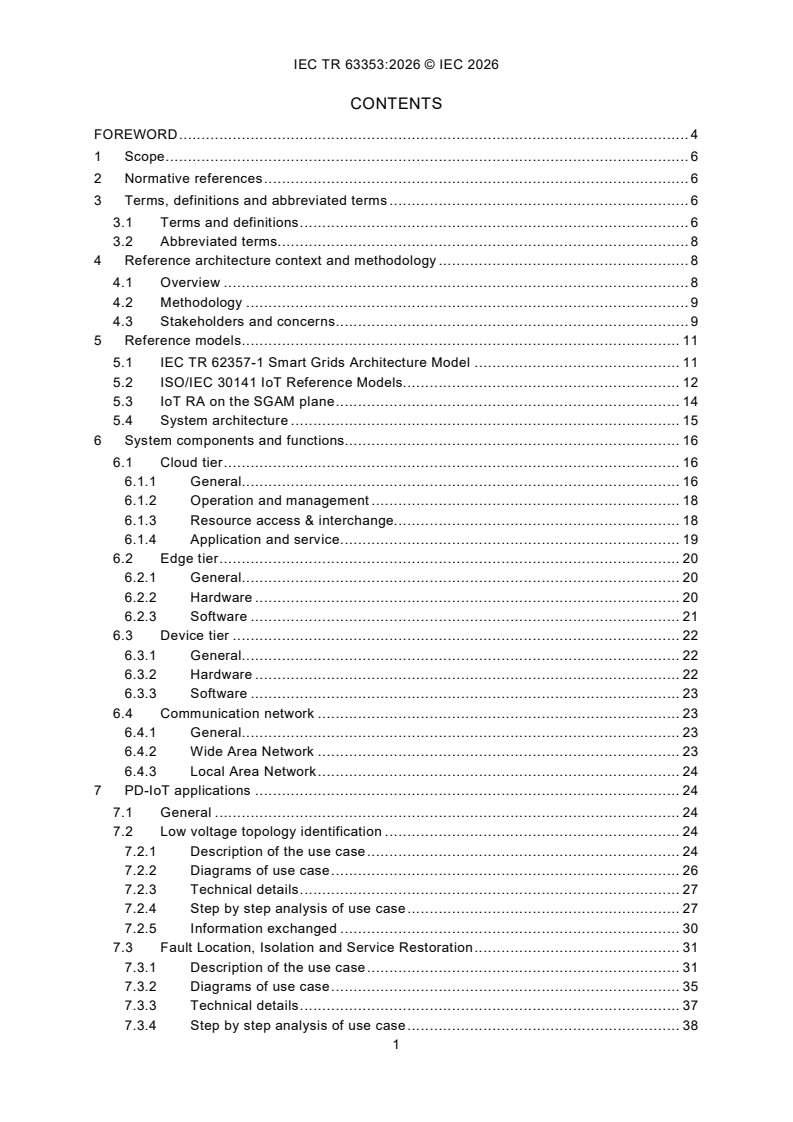
CONTENTS
FOREWORD . 4
1 Scope . 6
2 Normative references . 6
3 Terms, definitions and abbreviated terms . 6
3.1 Terms and definitions . 6
3.2 Abbreviated terms. 8
4 Reference architecture context and methodology . 8
4.1 Overview . 8
4.2 Methodology . 9
4.3 Stakeholders and concerns . 9
5 Reference models . 11
5.1 IEC TR 62357-1 Smart Grids Architecture Model . 11
5.2 ISO/IEC 30141 IoT Reference Models. 12
5.3 IoT RA on the SGAM plane . 14
5.4 System architecture . 15
6 System components and functions. 16
6.1 Cloud tier . 16
6.1.1 General. 16
6.1.2 Operation and management . 18
6.1.3 Resource access & interchange. 18
6.1.4 Application and service . 19
6.2 Edge tier . 20
6.2.1 General. 20
6.2.2 Hardware . 20
6.2.3 Software . 21
6.3 Device tier . 22
6.3.1 General. 22
6.3.2 Hardware . 22
6.3.3 Software . 23
6.4 Communication network . 23
6.4.1 General. 23
6.4.2 Wide Area Network . 23
6.4.3 Local Area Network . 24
7 PD-IoT applications . 24
7.1 General . 24
7.2 Low voltage topology identification . 24
7.2.1 Description of the use case . 24
7.2.2 Diagrams of use case . 26
7.2.3 Technical details . 27
7.2.4 Step by step analysis of use case . 27
7.2.5 Information exchanged . 30
7.3 Fault Location, Isolation and Service Restoration . 31
7.3.1 Description of the use case . 31
7.3.2 Diagrams of use case . 35
7.3.3 Technical details . 37
7.3.4 Step by step analysis of use case . 38
7.3.5 Information exchanged . 38
7.4 Real-time analysis of regional line losses . 38
7.4.1 Description of the use case . 38
7.4.2 Diagrams of use case . 41
7.4.3 Technical details . 42
7.4.4 Step by step analysis of use case . 44
7.4.5 Information exchanged . 44
7.5 Switchgear condition monitoring and operational view of connected
switchgear feeder . 44
7.5.1 Description of the use case . 44
7.5.2 Diagrams of use case . 46
7.5.3 Technical details . 47
7.5.4 Step by step analysis of use case . 47
7.5.5 Information exchanged . 48
7.6 Supervision of IEDs in substations and switchgears . 48
7.6.1 Description of the use case . 48
7.6.2 Diagrams of use case . 49
7.6.3 Technical details . 50
7.6.4 Step by step analysis of use case . 51
7.6.5 Information exchanged . 51
7.7 Grid monitoring using unified technological addressing of PD-IoT data . 52
7.7.1 Description of the use case . 52
7.7.2 Diagrams of use case . 54
7.7.3 Technical details . 55
7.7.4 Step by step analysis of use case . 56
Bibliography . 59
Figure 1 – SGAM plane . 11
Figure 2 – SGAM Model . 12
Figure 3 – Entity-based IoT reference model . 13
Figure 4 – Domain-based IoT reference model . 13
Figure 5 – Relation between entity-based RM and domain-based RM . 14
Figure 6 – Domain-based IoT RA mapped on the SGAM plane . 15
Figure 7 – PD-IoT system architecture . 16
Figure 8 – Cloud tier of PD-IoT . 18
Figure 9 – Overview diagram of the asset topology identification for low voltage
distribution networks . 26
Figure 10 – Fast fault location and isolation . 32
Figure 11 – Mixed distribution automation architecture combining distributed and
centralised monitoring and control . 33
Figure 12 – Overview diagram of the fault location, isolation and service restoration . 36
Figure 13 – Communication architecture of the fault location, isolation and service
restoration . 37
Figure 14 – Illustration of the principle of energy balancing . 40
Figure 15 – Communication architecture of real-time line losses analysis . 42
Figure 16 – Overview diagram of switchgear condition monitoring and operational view
of connected switchgear feeder. 46
Figure 17 – Communication architecture of switchgear condition monitoring and
operational view of connected switchgear feeder . 46
Figure 18 – Overview of supervision of IEDs of substation automation and protection
systems . 50
Figure 19 – Communication architecture of supervision of IEDs in substations and
switchgears . 50
Figure 20 – Reference PD-IoT architecture for the 7.7 grid monitoring using unified
technological addressing of PD-IoT data . 54
Figure 21 – Reference architecture of grid monitoring using unified technological
addressing of PD-IoT data . 55
INTERNATIONAL ELECTROTECHNICAL COMMISSION
____________
IIoT applications in power distribution systems management:
Architecture and functional requirements
FOREWORD
1) The International Electrotechnical Commission (IEC) is a worldwide organization for standardization comprising
all national electrotechnical committees (IEC National Committees). The object of IEC is to promote international
co-operation on all questions concerning standardization in the electrical and electronic fields. To this end and
in addition to other activities, IEC publishes International Standards, Technical Specifications, Technical Reports,
Publicly Available Specifications (PAS) and Guides (hereafter referred to as "IEC Publication(s)"). Their
preparation is entrusted to technical committees; any IEC National Committee interested in the subject dealt with
may participate in this preparatory work. International, governmental and non-governmental organizations liaising
with the IEC also participate in this preparation. IEC collaborates closely with the International Organization for
Standardization (ISO) in accordance with conditions determined by agreement between the two organizations.
2) The formal decisions or agreements of IEC on technical matters express, as nearly as possible, an international
consensus of opinion on the relevant subjects since each technical committee has representation from all
interested IEC National Committees.
3) IEC Publications have the form of recommendations for international use and are accepted by IEC National
Committees in that sense. While all reasonable efforts are made to ensure that the technical content of IEC
Publications is accurate, IEC cannot be held responsible for the way in which they are used or for any
misinterpretation by any end user.
4) In order to promote international uniformity, IEC National Committees undertake to apply IEC Publications
transparently to the maximum extent possible in their national and regional publications. Any divergence between
any IEC Publication and the corresponding national or regional publication shall be clearly indicated in the latter.
5) IEC itself does not provide any attestation of conformity. Independent certification bodies provide conformity
assessment services and, in some areas, access to IEC marks of conformity. IEC is not responsible for any
services carried out by independent certification bodies.
6) All users should ensure that they have the latest edition of this publication.
7) No liability shall attach to IEC or its directors, employees, servants or agents including individual experts and
members of its technical committees and IEC National Committees for any personal injury, property damage or
other damage of any nature whatsoever, whether direct or indirect, or for costs (including legal fees) and
expenses arising out of the publication, use of, or reliance upon, this IEC Publication or any other IEC
Publications.
8) Attention is drawn to the Normative references cited in this publication. Use of the referenced publications is
indispensable for the correct application of this publication.
9) IEC draws attention to the possibility that the implementation of this document may involve the use of (a)
patent(s). IEC takes no position concerning the evidence, validity or applicability of any claimed patent rights in
respect thereof. As of the date of publication of this document, IEC had not received notice of (a) patent(s), which
may be required to implement this document. However, implementers are cautioned that this may not represent
the latest information, which may be obtained from the patent database available at https://patents.iec.ch. IEC
shall not be held responsible for identifying any or all such patent rights.
IEC TR 63353 has been prepared by IEC technical committee 57: Power systems management
and associated information exchange. It is a Technical Report.
The text of this Technical Report is based on the following documents:
Draft Report on voting
57/2848/DTR 57/2881/RVDTR
Full information on the voting for its approval can be found in the report on voting indicated in
the above table.
The language used for the development of this Technical Report is English.
This document was drafted in accordance with ISO/IEC Directives, Part 2, and developed in
accordance with ISO/IEC Directives, Part 1 and ISO/IEC Directives, IEC Supplement, available
at www.iec.ch/members_experts/refdocs. The main document types developed by IEC are
described in greater detail at www.iec.ch/publications.
The committee has decided that the contents of this document will remain unchanged until the
stability date indicated on the IEC website under webstore.iec.ch in the data related to the
specific document. At this date, the document will be
– reconfirmed,
– withdrawn, or
– revised.
1 Scope
This technical report provides the general architecture and system components for applying the
IoT technology in power distribution networks. It describes the system architecture, system
components and several typical applications in integration and intelligent management of power
distribution networks.
2 Normative references
There are no normative references in this document.
3 Terms, definitions and abbreviated terms
3.1 Terms and definitions
For the purposes of this document, the following terms and definitions apply.
ISO and IEC maintain terminology databases for use in standardization at the following
addresses:
– IEC Electropedia: available at https://www.electropedia.org/
– ISO Online browsing platform: available at https://www.iso.org/obp
3.1.1
reference architecture
architecture description for a specific subject area that guides and constrains the structure and
behaviour of a related set of systems of interest
[SOURCE:ISO/IEC 20924:2024, 3.1.26]
3.1.2
Internet of Things
IoT
infrastructure of interconnected entities, people, systems and information resources together
with services which processes and reacts to information from the physical world and virtual
world
[SOURCE:ISO/IEC 20924:2024, 3.2.8]
3.1.3
Power Distribution Internet of Things
PD-IoT
information network which applies the IoT technologies for electric power network protection,
automation, monitoring, operation and planning applications in power distribution
3.1.4
cloud computing
paradigm for enabling network access to a scalable and elastic pool of shareable physical or
virtual resources with self-service provisioning and administration on-demand
[SOURCE:ISO/IEC 17788:2014,3.25]
3.1.5
edge
boundary between pertinent digital and physical entities, delineated by networked sensors
(3.1.9) and actuators (3.1.10)
[SOURCE: ISO/IEC TR 23188:2020, 3.1.2]
3.1.6
edge computing
distributed computing in which processing and storage takes place at or near the edge (3.1.5),
where the nearness is defined by the system's requirements
[SOURCE: ISO/IEC TR 23188:2020, 3.1.3]
3.1.7
PD-IoT device
entity of an IoT system that interacts and communicates with the objects and environment
related to electric power distribution through sensing or actuating, with embedded or external
modules
3.1.8
PD-IoT gateway
entity in an IoT system that connects one or more wide area networks and the PD-IoT devices
on those networks to each other and to one or more access networks
3.1.9
sensor
PD-IoT device (3.1.7) with the capability of sensing
[SOURCE:ISO/IEC 20924:2024 3.2.20, modified]
3.1.10
actuator
PD-IoT device (3.1.7) that changes one or more properties of a physical entity in response to
an input
[SOURCE:ISO/IEC 20924:2024, 3.2.20, modified]
3.1.11
application
APP
software designed to fulfil a particular purpose
[SOURCE : ISO/IEC 20924:2024, 3.1.1; SOURCE : ISO/IEC 24713-2:2008, 4.1, modified –
1 2
"program or piece of" has been deleted from the beginning of the definition. This document
applies application software or application program to avoid the misunderstanding of
application]
3.1.12
tag
human- or machine-readable mark, or digital identity used to communicate information about
an entity
Note 1 to entry: A tag can contain information that can be read by sensors to aid in identification of the physical
entity.
[SOURCE: ISO/IEC 20924:2024, 3.1.31]
3.2 Abbreviated terms
APP Application software or application program running on PD-IoT gateways
ASD Application & Service Domain
CoAP Constrained Application Protocol
DER Distributed energy resources
DSO Distribution System Operator
EV Electric Vehicle
FAN Field Area Network
IaaS Infrastructure as a Service
IED Intelligent Electronic Device
IoT Internet of Things
IoT RA Internet of Things Reference Architecture
LAN Local Area Network
MQTT Message Queuing Telemetry Transport
OMD Operations & Management Domain
PaaS Platform as a Service
PD-IoT Power Distribution Internet of Things
PED Physical Entity Domain
PLC Power Line Communication
RA Reference Architecture
RAID Resource Access & Interchange Domain
RTU Remote Terminal Unit
SGAM Smart Grids Architecture Model
SaaS Software as a Service
SCD Sensing & Controlling Domain
UD User Domain
WAN Wide Area Network
4 Reference architecture context and methodology
4.1 Overview
This document specifies a reference architecture for the IoT applications in power distribution
systems management and system components.
This document can be used by those people looking to
– Develop software or hardware
– Provide services involving IoT application
– Procure or implement IoT system
in power distribution management for creating interoperability and alignment.
4.2 Methodology
This document follows the approach and terminology that is defined in ISO/IEC/IEEE 42010.
ISO/IEC/IEEE 42010 specifies requirements for the use of architectural concepts and their
relationships, and provides a precise and structured approach of defining architectures.
IEC TR 62357-1 provides a clear and comprehensive map of interactions between different
systems in the power system management. ISO/IEC 30141 specifies a general IoT reference
architecture in term of defining system characteristics, a conceptual model, a reference model
and architecture views for IoT. Both documents are very helpful in generating the reference
architecture of the IIoT application in power system management. Therefore this document is
also aligned with IEC TR 62357-1 and ISO/IEC 30141.
4.3 Stakeholders and concerns
IoT application on a power distribution system can bring different types of businesses to the
power distribution system. The stakeholders that can be involved in the system include:
– Suppliers and production engineers: Design, supply, and deploy the hardware and software
on edge computing devices, end devices (sensors, IEDs, etc.) and local/field area network.
– Cloud service or hardware supplier: Provide cloud service or server hardware where the
PD-IoT Cloud functions can be deployed.
– Cloud application software engineering: Design and deploy the software on the cloud
(control centre, controlling station, Network management system, Remote asset
management, PD-IoT device management, etc.).
– Wide area network operator: Provide wide area network for the remote communication
between Cloud and Edge.
– Edge APP software engineering: Design and supply application software for the edge
computing devices for different purposes.
– Developer and builders: Construct and deploy the PD-IoT system to the power grid.
– Regulators and standard associations: Define the legal, standard, regulatory, and domain-
specific norms for safety, reliability, security, privacy, and resilience.
– Testers and assessors: Test the hardware and software to ensure that they are suitable for
use based on standards and legal regulation.
– Owners and users: Derive the benefits of PD-IoT when in use (DSOs, electricity market
operator, Virtual power plant, etc.).
– Operators and maintainers: Run the PD-IoT once it has been deployed and manage the
evolution.
Table 1 shows a list of viewpoints, stakeholders and concerns:
Table 1 – list of viewpoints, stakeholders and concerns
Viewpoint Stakeholders Concerns
Usage viewpoint – Developer and builders – How to interact with and what information can be
available to external systems
– Operators and maintainers
– How do users interact with the PD-IoT?
– Owners and users
– How to interact with the Physical Power Grid
– Suppliers and production
engineers – Is it able to support new business requirements?
– How to reduce the cost (especially the communication
costs)
– How to update software or deploy new functions
– How to monitor the status of the PD-IoT system
Functional – Cloud service or hardware – What is necessary for the data operations (create,
viewpoint supplier read, update, process, delete)?
– Wide area network operator – What data is available?
– Suppliers and production – Is a time stamp available for the operating data?
engineers
– How can all nodes have timing signals traceable to
– Cloud application software the same time scale with accuracies as required?
engineering
– Is it possible to incorporate the PD-IoT system within
– Edge APP software a network of other systems?
engineering
– Suppliers and production
engineers
– Testers and assessors
– Owners and users
Construction – Developer and builders – How to adapt the PD-IoT in different situations
viewpoint
– Owners and users – How to exchange information between internal
system, including WAN and FAN(LAN)
– Suppliers and production
engineers – What protocol and information model are used?
Dependability – Testers and assessors – How to ensure the functionality, performance of the
viewpoint deployed APPs
– Operators and maintainers
– How to protect the PD-IoT from security vulnerabilities
– Regulators and standard
associations
– Is this PD-IoT system free of maintenance? If no, is
there any other systems required for the maintenance
– Suppliers and production
service?
engineers
– How to prevent unauthorized entities from gaining
– Regulators and standard
access to the data?
associations
– How does the system deliver stable and predictable
performance in expected conditions?
– How does the system withstand instability and
unexpected conditions?
5 Reference models
5.1 IEC TR 62357-1 Smart Grids Architecture Model
IEC Technical Committee 57 published a Smart Grids Architecture Model (SGAM). This SGAM
partitioned the smart grid into the physical domains of the electrical energy conversion chain,
and the hierarchical zones for the management of the electrical process, in which "zones"
illustrate the physical and management aspects of the grid and "domains" represent the
complete electrical energy conversion chain (Generation, Transmission, Distribution,
Distributed Energy Resources (DER) and Customer Premises). Figure 1 shows the domains
and zones.
Figure 1 – SGAM plane
Interoperability is a key enabler for Smart Grids. In order to achieve interoperability between
different stakeholders, five superimposed interoperability layers are defined in SGAM as
Component, Communication, Information, Function and Business. The Smart Grids Architecture
Model is illustrated in Figure 2.
Figure 2 – SGAM Model
5.2 ISO/IEC 30141 IoT Reference Models
ISO/IEC 30141 developed an entity-based reference model and a domain-based reference
model (Figure 4) of the IoT systems.
The entity-based reference model consists of 10 IoT entities:
– Physical entities,
– Tags, in various types that can be attached to Physical Entities,
– IoT devices, including sensors and actuators,
– IoT gateways, including local services and data,
– IoT communication networks,
– Application and service subsystem,
– Operation and management subsystem,
– Resource access and interchange subsystem,
– Users. including both human users and digital users,
– Peer systems, including both IoT and non-IoT systems.
The connection between different entities is given in Figure 3.
Figure 3 – Entity-based IoT reference model
The domain-based IoT reference model abstracts the entities to six domains:
– Physical Entity Domain,
– Sensing & Controlling Domain,
– Operations & Management Domain,
– Application & Service Domain,
– Resource Access & Interchange Domain,
– User Domain.
The communication networks and peer systems are not shown in the domain-based IoT
reference model (Figure 4), but both are important components of any IoT system.
Figure 4 – Domain-based IoT reference model
The relationship between the entities and their domains is as shown in Figure 5. IoT-Users
belong to the User Domain. Application & Service subsystems belong to the Application &
Service Domain. Operations and Management subsystems belong to the Operations &
Management Domain. The Resource Access & Interchange subsystem belongs to the Resource
Access & Interchange Domain. loT devices and loT gateways are entities in the Sensing &
Controlling Domain. Physical Entities (Including Tags) exist in the Physical Entity Domain.
Figure 5 – Relation between entity-based RM and domain-based RM
5.3 IoT RA on the SGAM plane
Figure 6 maps the domain-based IoT RMs to the SGAM plane.
Physical Entities are the real-world assets that are sensed and acted upon by the loT devices.
In an IoT system in the power grid, these represent those facilities from power generation to
power utilization in the customer premises, for example generators, transformers, circuit
breakers, overhead lines, cables, electrical loads, which are part or directly connected to the
process. The Physical Entities are mapped to the Process zone which represents the physical,
chemical or spatial transformations of energy and the physical equipment directly involved.
Tags attached to Physical Entities can be helpful to identify the physical assets.
IoT devices are sensors and actuators that interacts with the Physical Entities. These are
described as "equipment to protect, control and monitor the process of the power system" in
the SGAM.
The loT gateway is a node to connect WAN and LAN. It often contains a management agent,
providing remote management capabilities, including data storage and local ("edge"or "fog")
computing capabilities. IoT gateways are usually deployed in the Station zone, which is the
areal aggregation for field level, for data concentration, functional aggregation and other similar
functions. loT gateways can contain other entities and provide a wider range of capabilities.
Figure 6 – Domain-based IoT RA mapped on the SGAM plane
The Application & Service subsystems, the Operations & Management subsystems and the
Resource Access & Interchange subsystems are upper-level subsystems deployed on the cloud.
The Application & Service subsystems provide analytic services for the data from IoT devices.
The Operation & Management subsystems include device registry, associated identity services
as well as the monitoring and administration capabilities for the IoT devices and gateways in
the system. The Resource Access & Interchange subsystems provide access control to IoT
users and peer systems. These subsystems are expected to cover the applications in the
Enterprise and Operation zones.
Users of the IoT system can include both human users and digital users. Human users typically
interact with the IoT system by HMIs from different kinds of user devices, while digital users by
service APIs provided by the Resource Access & Interchange subsystem. The Market zone in
the SGAM reflects the market operations possible along the energy conversion chain such as
energy trading, mass market, retail market; IoT systems usually do not have any direct relation
with those marketing activities except the IoT users. Those marketing systems can be treated
as a (digital) user of the IoT systems.
5.4 System architecture
The system architecture of IoT application in power distribution management, referred to as
Power Distribution Internet of Things (PD-IoT), is an information network which applies the IoT
technologies in power distribution and related businesses, including the DER domain and the
customer domain. Its system architecture is composed of three tiers, cloud, edge and terminal,
and the networks connect them together (see Figure 7).
The cloud tier is cloud platform in which system functions of the enterprise and operation zone
are deployed, including the Operation and Management subsystems, the Resource Access &
Interchange subsystems and all kinds of application and service subsystems.
The edge tier represents the edge computing IoT gateways for power distribution (PD-IoT
gateways), which is used to satisfy the functions of station zone, including data concentration,
functional aggregation and other similar functions. As a result, edge computing capability is an
important feature to IoT gateways compared to other IoT systems. With this edge computing
capability, edge devices can locally analyze data and trigger control actions when latency is
critical. Introducing software-defined IoT gateways can significantly increase the flexibility of
PD-IoT systems for various service demands in the power distribution system. Container-based
virtualization is recommended for software-defined gateways to ensure APP isolation and
portability.
Figure 7 – PD-IoT system architecture
The device tier is the IoT devices for power distribution (PD-IoT devices) used to collect data
from the physical entities for the PD-IoT system. This tier includes IoT sensors for data
acquisition (field zone) and actuators for grid control (field zone and process zone).
The networks provide communication channels for data and information exchange between
different tiers. The communication network includes the Wide Area Network (WAN) and the
Local Area Network (LAN), separated by the IoT gateways in the edge tier. Some IoT devices
can also be direct accessed by via cloud using WAN.
6 System components and functions
6.1 Cloud tier
6.1.1 General
The cloud is a system deployed by the cloud computing architecture, with unifying access to
edge and device tier data through the communication network, to achieve efficient management
of large-scale IoT infrastructure and efficient processing of massive sensory information
through cloud-edge collaboration.
The three layers of the cloud computing service model are:
– Infrastructure as a Service (IaaS) to provide virtualized computing resources over the
internet, including servers, storage, and networking components that can be rapidly
expanded and adjusted when needed.
– Platform as a Service (PaaS) to provide a platform, allowing customers to develop, run, and
manage application software without the complexity of building and maintaining the
infrastructure. The PaaS typically associated with developing and launching an application
program.
– Software as a Service (SaaS) to provide access to application programs and databases,
which is connected to various devices with a network connection.
The IaaS layer virtualizes the "cloud", the "edge", and the "terminal" to form a computation, a
data storage, and a network resource pool with flexible computing and storage scalability. The
PaaS layer completes the aggregation, transmission, and storage of PD-IoT data to the SaaS
layer. Based on the PaaS layer services, the SaaS layer provides public services support on
top of which developers can develop application programs to meet the business needs of the
distribution energy sector. These services could be owned and operated by any party, including
the asset owners that the services are deployed on.
The PD-IoT "cloud" aims to serve as a platform solution for PD-IoT systems, on which various
microservices can be developed to meet the business needs of the distribution energy sector.
This "cloud" can decouple application programs from the underlying hardware and data, to meet
massive terminal equipment connections, dynamic resource allocation, flexible system
deployment, agile application development, and future business needs.
As with the normal IoT system defined in ISO/IEC 30141:2018, PD-IoT cloud tier subsystems
include the Operation and Management subsystems, the Resource Access & Interchange
subsystems and Application and Service subsystems. These systems are deployed on the cloud,
either separately or in the same system.
Figure 8 provides a general example of the cloud tier of PD-IoT.
Figure 8 – Cloud tier of PD-IoT
The requirement and test of the cybersecurity can refer to IEC TS 62351.
6.1.2 Operation and management
The Operation and Management subsystem is the operational management of the PD-IoT
system. This subsystem is in the PaaS layer of the cloud service model.
The functions of this subsystem also include:
– Edge management, to support the IoT asset registration, identity, management and status
monitoring of edge and device tier from the cloud. The IoT asset registration includes the
IoT gateways to the cloud, and the IoT devices to the edge.
– APP repository, to manage different APPs of the software defined IoT gateways. Such
management includes publishing, version maintenance and removal from the APP
repository. This module is also capable to push chosen APP or profiles to one or more target
edge device(s). That/those IoT gateway(s) can change or add the function by deploying or
updating these APPs automatically.
– Fundamental business support, such as account management, device catalogue, etc. are
deployed in the Operation & Management subsystem.
6.1.3 Resource access & interchange
The Resource Access & Interchange subsystem provides access control service for internal
and external actors, for example users, peer systems, and other subsystems. This subsystem
is to provide unified access to edge and device data and provide services to the business
application systems through standardized data APIs. It is also important to ensure end-to-end
data confidentiality and integrity through encryption mechanisms.
The functions of this subsystem also include:
– Authentication and authorization, to provide unified access control of both data and
services.
– Protocol and model management, to allow edge and device data in various protocol or
information model to access the cloud database.
– All kinds of data transfer, including operational data, configuration data and control
commands for edge and device tier.
– Resource management, including resource publish and access interface for application
and services.
6.1.4 Application and service
The Application & Service subsystems provide most functions for enterprise and operational
management. These subsystems are related to both SaaS and PaaS layer.
The application programs, located in the SaaS layer, are expected to meet the needs of power
grid operation, customer service, enterprise operation, and emerging business expansion,
including internal business and external business.
– Internal business includes but is not limited to distribution network dispatch management,
distribution operation and maintenance management, distribution automation management,
power supply service command, asset operation and maintenance management. It is also
important to support the migration of existing systems to the cloud.
– External business includes but is not limited to smart energy services, regional energy
flexible networking, distribution data services, third-party application development, etc.
The basic services of the cloud platform are PaaS elements to provide IT infrastructure support
services for the IoT management platform. The basic services of the cloud platform include but
are not limited to big data services, artificial intelligence services, cloud middleware services,
microservice engines, and application integration services:
– Big data services can provide unified data storage and computing resources, meeting the
full lifecycle management requirements of massive distribution network data, and supporting
online expansion of storage capacity.
– Artificial intelligence services can use an open algorithm repository, supporting unified
management, independent maintenance, and upgrading of algorithms.
– Cloud middleware services to support distributed messaging and caching, meeting the
requirements of high-reliability transmission and exchange of messages between
distribution network applications.
– Microservice engines to support microservice development, deployment, governance, and
operation and maintenance.
– Application integration services including service release approval and lifecycle
management.
– Other grid information services to support grid management, for example asset management
system, grid topology system and geographic information system.
6.2 Edge tier
6.2.1 General
Edge tier represents devices with edge computing capa
...