

IEC TR 63610:2026
(Main)Augmented and mixed reality equipment and systems - Technology and standards review and gap analysis
- Abstract
IEC TR 63610:2026 analyses AR and MR technology in terms of four technical domains: content, platform, network and device. Based on this analysis, technical elements in each domain and requirements for interconnecting those technical domains are identified. On the same basis, this document identifies relevant standard development organizations’ activities and suggests items for standardization.
- Status
- Published
- Publication Date
- 09-Nov-2026
- Technical Committee
- TC 100 - Audio, video and multimedia systems and equipment
- Drafting Committee
- WG 1 - TC 100/TA 1/WG 1
- Current Stage
- PPUB - Publication issued
- Start Date
- 10-Nov-2026
- Completion Date
- 04-Dec-2026

IEC TR 63610:2026 is an IEC Technical Report on augmented reality (AR) and mixed reality (MR) equipment and systems. IEC TR 63610:2026 reviews AR and MR technology across content, platform, network and device domains, identifies how those domains connect, and points to standardization gaps and candidate items for future work. It is written for engineers, platform providers, device makers, service providers and standards teams that need a technical map of the field.
What does IEC TR 63610:2026 specify?
IEC TR 63610:2026 surveys AR and MR technology as a system made up of four technical domains - content, platform, network and device - often described in the document as C-P-N-D. The report uses that structure to identify technical elements in each domain, the interfaces between them, and the activities of other standard development organizations (SDOs) that already touch the same topics.
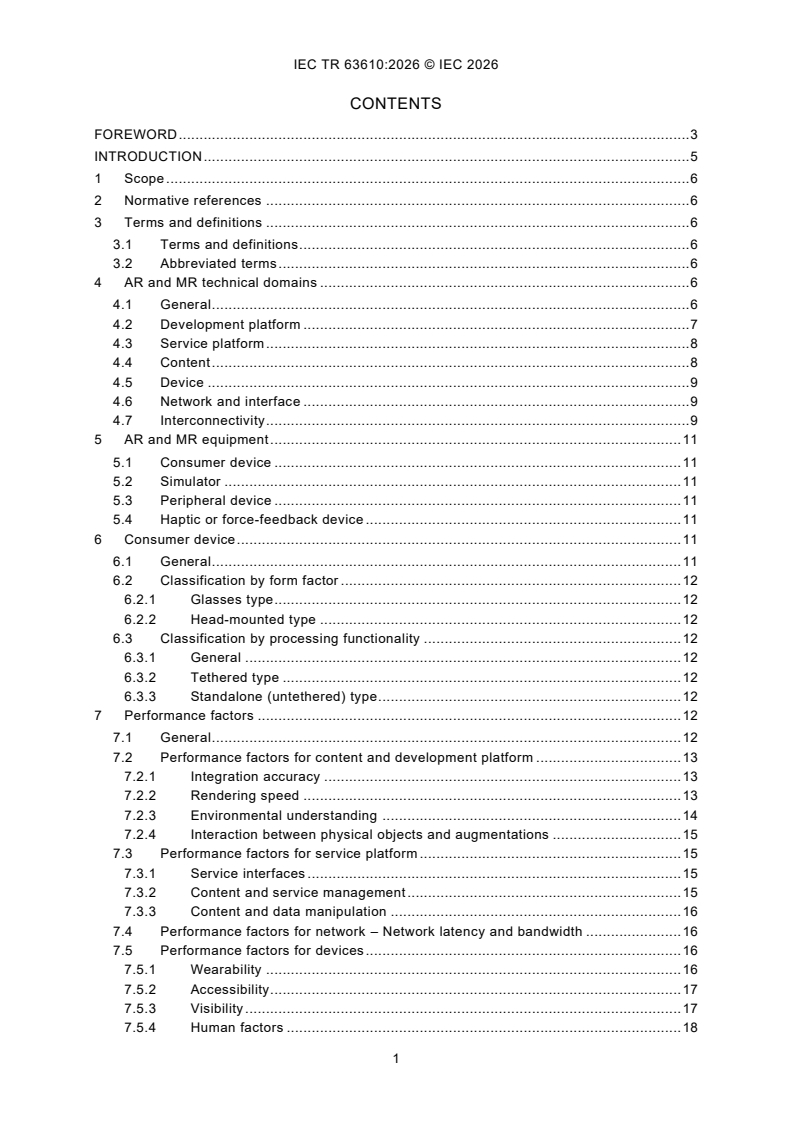
The document is organized into a foreword, introduction, clauses 1 to 9, and a bibliography. Clause 1 states the scope, Clause 2 covers normative references, Clause 3 gives abbreviations, Clause 4 reviews the AR and MR technical domains, Clause 5 classifies AR and MR equipment, Clause 6 classifies consumer devices, Clause 7 sets out performance factors, Clause 8 reviews international SDO activities, and Clause 9 identifies the standardization gap and potential items.
What are the key requirements of IEC TR 63610:2026?
IEC TR 63610:2026 is a technical report rather than a product standard, so its main value is the way it organizes the field and points to the technical points that matter in practice. The most useful parts are the domain model, the device classifications, the performance factors, and the gap analysis.
1. Clause 4 sets the C-P-N-D model
IEC TR 63610:2026 groups AR and MR technology into content, platform, network and device. Clause 4 explains how these domains interact, which helps readers place a product, interface or test method in the right part of the system. In practice, this is the report’s main framework for deciding where standardization work belongs.
2. Development platforms must support creation and publishing
IEC TR 63610:2026 says that a development platform provides authoring tools and interfaces to a service platform. Clause 4.2 describes functions such as 3D modeling or import, recognition of the real world, user-intention handling, interaction between users and objects, rendering, and content upload. For implementers, this means the authoring environment, the runtime model and the service connection all matter together.
3. Service platforms handle users, devices and applications
IEC TR 63610:2026 treats service platforms as systems for users, AR and MR devices, and applications. Clause 4.3 highlights content upload and download, charging, management of users and developers, content conversion, and links to external systems such as ERP, MES and PMS. In practice, this is the layer that governs distribution, account handling and integration with enterprise data.
4. Content must react to the real world
IEC TR 63610:2026 describes content as computer-generated 2D or 3D objects plus software. Clause 4.4 shows that content may come from pre-designed 3D objects, engineering drawings, operational data, or laser-scanner point clouds, and that it must respond to user movement, user intention and environmental changes. For content authors, this means the pipeline is not only about graphics, but also about registration and sensor-driven behavior.
5. Device and equipment classes are separated by use and processing
IEC TR 63610:2026 classifies AR and MR equipment into consumer devices, simulators, peripheral devices, and haptic or force-feedback devices in Clause 5. Clause 6 then classifies consumer devices by form factor, as glasses type or head-mounted type, and by processing functionality, as tethered type or standalone type. This matters when comparing mobility, weight, onboard processing and dependence on external compute.
6. Clause 7 gives the main performance factors to assess
IEC TR 63610:2026 identifies performance factors for content, platform, network and device. Clause 7 covers integration accuracy, rendering speed, environmental understanding, interaction between physical objects and augmentations, service interfaces, content and service management, content and data manipulation, network latency, wearability, accessibility, visibility, human factors, and interfaces, protocols and data formats. In practice, these are the criteria to use when evaluating whether an AR or MR solution is usable, interoperable and suitable for its task.
7. Clause 8 shows where related standardization already exists
IEC TR 63610:2026 reviews activity in ISO, IEC, W3C, OpenXR and IEEE groups. Clause 8 is useful because it shows where work already exists for displays, graphics, multimedia coding, sensing, learning content, immersive web APIs and immersive content frameworks. For readers planning new work, this helps avoid duplicating adjacent standards activity.
8. Clause 9 turns the review into potential standardization items
IEC TR 63610:2026 ends with a standardization gap analysis. Clause 9 and Table 3 group possible future items for content, platform, device, and interface and protocol topics, including interoperability, metadata, requirements for hardware resources, service interfaces, content conversion, device profiles, and measurement or test methods. This is the part to use when deciding what standards work may be needed next.
What terms does IEC TR 63610:2026 define?
IEC TR 63610:2026 does not list formal terms in Clause 3.1, but it does use key abbreviations in Clause 3.2 and throughout the document.
- AR - augmented reality, where digital content is overlaid on the real-world environment and can interact with it.
- MR - mixed reality, where digital content is integrated with the real world in a way that can respond to the surrounding environment.
- HMD - head-mounted display, a wearable display worn on the head and used in consumer AR and MR devices.
- SLAM - simultaneous localization and mapping, a method for building a map of an environment while tracking the user’s location in it.
- VAC - vergence-accommodation conflict, the mismatch between where the eyes converge and where they focus, which can cause discomfort.
- FOV - field of view, the angular extent of what the device can display or make visible.
- SDO - standard development organization, the type of body whose activities are reviewed in Clause 8.
Who uses IEC TR 63610:2026?
IEC TR 63610:2026 is useful to device manufacturers, software and platform developers, service platform providers, telecommunication companies, and standards writers working on AR and MR. These readers use it to classify products, compare technical approaches, and identify interoperability or measurement topics that may need standards.
The report is also relevant in manufacturing, education and training, retail and distribution, transportation, broadcasting, and personal entertainment. Those sectors are named in the document because AR and MR systems can be used for industrial training, visualization of operational data, user mobility, and hands-free interaction.
What does the IEC TR 63610:2026 document contain?
IEC TR 63610:2026 contains a structured survey of AR and MR technology, not a set of product requirements. It uses several figures to explain the C-P-N-D concept, interconnectivity among domains, occlusion, SLAM, object interaction, vergence-accommodation conflict, and the standardization gap.
Table 1 classifies consumer AR and MR devices by form factor and processing functionality. Table 2 summarizes the performance factors used to evaluate content, platform, network and device. Table 3 lists potential standardization items by technical domain.
The bibliography points to related work in MAR reference modeling, AR content formats, spatial tracking, multimedia cyber technology, immersive web APIs, OpenXR, IEEE AR and immersive-content work, and additional documents on content catalogues, sensor representation, live actors, benchmarking, tactile and haptic interaction, and eyewear-display measurement.
Get Certified
Connect with accredited certification bodies for this standard

ANCE
Mexican certification and testing association.

Intertek Slovenia
Intertek testing, inspection, and certification services in Slovenia.

LNE (Laboratoire National de Métrologie et d'Essais)
French national laboratory for metrology and testing.
Sponsored listings
Frequently Asked Questions
IEC TR 63610:2026 is a technical report published by the International Electrotechnical Commission (IEC). Its full title is "Augmented and mixed reality equipment and systems - Technology and standards review and gap analysis". This standard covers: IEC TR 63610:2026 analyses AR and MR technology in terms of four technical domains: content, platform, network and device. Based on this analysis, technical elements in each domain and requirements for interconnecting those technical domains are identified. On the same basis, this document identifies relevant standard development organizations’ activities and suggests items for standardization.
IEC TR 63610:2026 analyses AR and MR technology in terms of four technical domains: content, platform, network and device. Based on this analysis, technical elements in each domain and requirements for interconnecting those technical domains are identified. On the same basis, this document identifies relevant standard development organizations’ activities and suggests items for standardization.
IEC TR 63610:2026 is classified under the following ICS (International Classification for Standards) categories: 33.160.60 - Multimedia systems and teleconferencing equipment. The ICS classification helps identify the subject area and facilitates finding related standards.
IEC TR 63610:2026 is available in PDF format for immediate download after purchase. The document can be added to your cart and obtained through the secure checkout process. Digital delivery ensures instant access to the complete standard document.
Standards Content (Sample)
IEC TR 63610 ®
Edition 1.0 2026-11
TECHNICAL
REPORT
Augmented and mixed reality equipment and systems - Technology and
standards review and gap analysis
ICS 33.160.60 ISBN 978-2-8327-1592-5
All rights reserved. Unless otherwise specified, no part of this publication may be reproduced or utilized in any form or
by any means, electronic or mechanical, including photocopying and microfilm, without permission in writing from either
IEC or IEC's member National Committee in the country of the requester. If you have any questions about IEC copyright
or have an enquiry about obtaining additional rights to this publication, please contact the address below or your local
IEC member National Committee for further information.
IEC Secretariat Tel.: +41 22 919 02 11
3, rue de Varembé info@iec.ch
CH-1211 Geneva 20 www.iec.ch
Switzerland
About the IEC
The International Electrotechnical Commission (IEC) is the leading global organization that prepares and publishes
International Standards for all electrical, electronic and related technologies.
About IEC publications
The technical content of IEC publications is kept under constant review by the IEC. Please make sure that you have the
latest edition, a corrigendum or an amendment might have been published.
IEC publications search - IEC Products & Services Portal - products.iec.ch
webstore.iec.ch/advsearchform Discover our powerful search engine and read freely all the
The advanced search enables to find IEC publications by a publications previews, graphical symbols and the glossary.
variety of criteria (reference number, text, technical With a subscription you will always have access to up to date
committee, …). It also gives information on projects, content tailored to your needs.
replaced and withdrawn publications.
Electropedia - www.electropedia.org
The world's leading online dictionary on electrotechnology,
IEC Just Published - webstore.iec.ch/justpublished
Stay up to date on all new IEC publications. Just Published containing more than 22 500 terminological entries in English
details all new publications released. Available online and and French, with equivalent terms in 25 additional languages.
once a month by email. Also known as the International Electrotechnical Vocabulary
(IEV) online.
IEC Customer Service Centre - webstore.iec.ch/csc
If you wish to give us your feedback on this publication or
need further assistance, please contact the Customer
Service Centre: sales@iec.ch.
CONTENTS
FOREWORD . 3
INTRODUCTION . 5
1 Scope . 6
2 Normative references . 6
3 Terms and definitions . 6
3.1 Terms and definitions . 6
3.2 Abbreviated terms . 6
4 AR and MR technical domains . 6
4.1 General . 6
4.2 Development platform . 7
4.3 Service platform . 8
4.4 Content . 8
4.5 Device . 9
4.6 Network and interface . 9
4.7 Interconnectivity . 9
5 AR and MR equipment . 11
5.1 Consumer device . 11
5.2 Simulator . 11
5.3 Peripheral device . 11
5.4 Haptic or force-feedback device . 11
6 Consumer device . 11
6.1 General . 11
6.2 Classification by form factor . 12
6.2.1 Glasses type . 12
6.2.2 Head-mounted type . 12
6.3 Classification by processing functionality . 12
6.3.1 General . 12
6.3.2 Tethered type . 12
6.3.3 Standalone (untethered) type. 12
7 Performance factors . 12
7.1 General . 12
7.2 Performance factors for content and development platform . 13
7.2.1 Integration accuracy . 13
7.2.2 Rendering speed . 13
7.2.3 Environmental understanding . 14
7.2.4 Interaction between physical objects and augmentations . 15
7.3 Performance factors for service platform . 15
7.3.1 Service interfaces . 15
7.3.2 Content and service management . 15
7.3.3 Content and data manipulation . 16
7.4 Performance factors for network – Network latency and bandwidth . 16
7.5 Performance factors for devices . 16
7.5.1 Wearability . 16
7.5.2 Accessibility. 17
7.5.3 Visibility . 17
7.5.4 Human factors . 18
7.5.5 Interfaces, protocols and data formats . 19
8 International SDO activities . 19
8.1 ISO Technical Committee 159/Subcommitte 4: Ergonomics of human-system
interaction . 19
8.2 ISO Technical Committee 172/Subcommittee 3: Optimal materials and
components . 20
8.3 ISO/IEC Joint Technical Committee 1/Subcommittee 24: Computer graphics,
image processing and environmental data representation . 20
8.4 ISO/IEC Joint Technical Committee 1/Subcommittee 29: Coding of audio,
picture, multimedia and hypermedia information . 20
8.5 ISO/IEC Joint Technical Committee 1/Subcommittee 31: Automatic
identification and data capture techniques . 20
8.6 ISO/IEC Joint Technical Committee 1/Subcommittee 36: Information
technology for learning, education and training . 20
8.7 IEC Technical Committee 110: Electronic displays . 20
8.8 IEC Technical Committee 100: Audio, video and multimedia systems and
equipment . 20
8.9 World Wide Web Consortium (W3C) . 21
8.10 OpenXR . 21
8.11 IEEE P1589 . 21
8.12 IEEE 2888 . 21
8.13 IEEE 3079 . 21
9 Standardization gap . 21
Bibliography . 24
Figure 1 – C-P-N-D concept for understanding AR and MR technical domains . 7
Figure 2 – Interconnectivity among AR and MR technical domains . 10
Figure 3 – Example of environmental understanding (occlusion) . 14
Figure 4 – Example of environmental understanding (SLAM) . 14
Figure 5 – Examples of interaction among augmented objects and real objects . 15
Figure 6 – Vergence-accommodation conflict . 19
Figure 7 – Standardization gap and potential items . 23
Table 1 – Classification of consumer AR and MR devices . 11
Table 2 – Performance factors . 13
Table 3 – Potential standardization items . 22
INTERNATIONAL ELECTROTECHNICAL COMMISSION
____________
Augmented and mixed reality equipment and systems -
Technology and standards review and gap analysis
FOREWORD
1) The International Electrotechnical Commission (IEC) is a worldwide organization for standardization comprising
all national electrotechnical committees (IEC National Committees). The object of IEC is to promote international
co-operation on all questions concerning standardization in the electrical and electronic fields. To this end and
in addition to other activities, IEC publishes International Standards, Technical Specifications, Technical Reports,
Publicly Available Specifications (PAS) and Guides (hereafter referred to as “IEC Publication(s)”). Their
preparation is entrusted to technical committees; any IEC National Committee interested in the subject dealt with
may participate in this preparatory work. International, governmental and non-governmental organizations liaising
with the IEC also participate in this preparation. IEC collaborates closely with the International Organization for
Standardization (ISO) in accordance with conditions determined by agreement between the two organizations.
2) The formal decisions or agreements of IEC on technical matters express, as nearly as possible, an international
consensus of opinion on the relevant subjects since each technical committee has representation from all
interested IEC National Committees.
3) IEC Publications have the form of recommendations for international use and are accepted by IEC National
Committees in that sense. While all reasonable efforts are made to ensure that the technical content of IEC
Publications is accurate, IEC cannot be held responsible for the way in which they are used or for any
misinterpretation by any end user.
4) In order to promote international uniformity, IEC National Committees undertake to apply IEC Publications
transparently to the maximum extent possible in their national and regional publications. Any divergence between
any IEC Publication and the corresponding national or regional publication shall be clearly indicated in the latter.
5) IEC itself does not provide any attestation of conformity. Independent certification bodies provide conformity
assessment services and, in some areas, access to IEC marks of conformity. IEC is not responsible for any
services carried out by independent certification bodies.
6) All users should ensure that they have the latest edition of this publication.
7) No liability shall attach to IEC or its directors, employees, servants or agents including individual experts and
members of its technical committees and IEC National Committees for any personal injury, property damage or
other damage of any nature whatsoever, whether direct or indirect, or for costs (including legal fees) and
expenses arising out of the publication, use of, or reliance upon, this IEC Publication or any other IEC
Publications.
8) Attention is drawn to the Normative references cited in this publication. Use of the referenced publications is
indispensable for the correct application of this publication.
9) IEC draws attention to the possibility that the implementation of this document may involve the use of (a)
patent(s). IEC takes no position concerning the evidence, validity or applicability of any claimed patent rights in
respect thereof. As of the date of publication of this document, IEC had not received notice of (a) patent(s), which
may be required to implement this document. However, implementers are cautioned that this may not represent
the latest information, which may be obtained from the patent database available at https://patents.iec.ch. IEC
shall not be held responsible for identifying any or all such patent rights.
IEC TR 63610 has been prepared by IEC technical committee 100: Audio, video and multimedia
systems and equipment. It is a Technical Report.
The text of this Technical Report is based on the following documents:
Draft Report on voting
100/4582/DTR 100/4618/RVDTR
Full information on the voting for its approval can be found in the report on voting indicated in
the above table.
The language used for the development of this Technical Report is English.
This document was drafted in accordance with ISO/IEC Directives, Part 2, and developed in
accordance with ISO/IEC Directives, Part 1 and ISO/IEC Directives, IEC Supplement, available
at www.iec.ch/members_experts/refdocs. The main document types developed by IEC are
described in greater detail at www.iec.ch/publications.
The committee has decided that the contents of this document will remain unchanged until the
stability date indicated on the IEC website under webstore.iec.ch in the data related to the
specific document. At this date, the document will be
– reconfirmed,
– withdrawn, or
– revised.
INTRODUCTION
With the enhancement of technology, including computing processing units, optical systems,
sensors and computer graphics, augmented reality (AR) and mixed reality (MR) technology has
been reached to fulfil various requirements from consumers as well as various industries.
Especially, certain industries, which were already equipped with IT-based infrastructures such
as IoT and cloud-based service, and also interested in visualizing information gathered through
those infrastructures while ensuring user’s mobility as well as no direct manipulation of
information devices for the visualization, have higher potential to adopt AR and MR technology
for the improvement of efficiency and quality of work and for the convenience of users.
AR and MR technology is a computer-generated or digitally created content overlaid on user’s
real-world environment, which can interact with the digital content. This AR and MR can be
experienced via both AR equipment with diverse form factors such as glasses and head-
mounted devices, and service systems bringing AR and MR content and applications to
designated users.
The purpose of this document surveys AR and MR technology in detail in terms of content,
platform, network and device, so called C-P-N-D, and identifies potential technical items that
can be standardized within the scope of audio, video and multimedia systems and equipment.
1 Scope
This document, which is a Technical Report, analyses AR and MR technology in terms of four
technical domains: content, platform, network and device. Based on this analysis, technical
elements in each domain and requirements for interconnecting those technical domains are
identified. On the same basis, this document identifies relevant standard development
organizations’ activities and suggests items for standardization.
2 Normative references
There are no normative references in this document.
3 Terms and definitions
3.1 Terms and definitions
No terms and definitions are listed in this document.
ISO and IEC maintain terminology databases for use in standardization at the following
addresses:
– IEC Electropedia: available at https://www.electropedia.org/
– ISO Online browsing platform: available at https://www.iso.org/obp
3.2 Abbreviated terms
AOV angle of view
AR augmented reality
ERP enterprise resource planning
FOV field of view
HMD head-mounted display
MES manufacturing execution system
MR mixed reality
PMS project management system
SDO standard development organization
SLAM simultaneous localization and mapping
VAC vergence-accommodation conflict
VR virtual reality
4 AR and MR technical domains
4.1 General
AR and MR services can be delivered to users with the combination of cutting-edge
technologies from hardware to software. For the systematic classification of AR and MR
technical domains, this document explores the technical details in terms of content, platform,
network (or interface), and device (C-P-N-D) as shown in Figure 1.
Figure 1 – C-P-N-D concept for understanding AR and MR technical domains
4.2 Development platform
Development platform usually provides developers with authoring tools and interfaces to a
service platform for creating and publishing AR and MR content and applications. Some of the
development platforms are provided by device manufacturers and dedicated to specific AR and
MR devices they manufacture. In this case, the development platform supports their own
hardware-specific functions such as exchanging sensor data and control data with their own
formats through proprietary interfaces and protocols. The others are provided by software
companies for the purpose of supporting general AR and MR devices and commonly offer APIs
for developers to utilize.
A development platform typically supports the following functions:
– either modelling 3D objects or importing from other 3D authoring tools, or both;
– recognizing and understanding real world object, user’s intention, and environment;
– interaction among users, augmented objects and real objects;
– rendering functions, for example stereoscopic rendering or monoscopic rendering
depending on hardware specification of AR and MR device;
– interface to service platform for uploading the developed content.
4.3 Service platform
There are three types of service platforms to consider: for users, for AR and MR devices, and
for applications.
A service platform for users, similar to an application store for smartphone, enables not only
users (or service subscribers) to access the AR and MR content or applications, but also content
developers to upload their own created AR and MR content or application through interfaces
provided by the service platform provider. In most cases, those service platforms are practically
offered by AR device manufacturers because of the dependency between content and hardware.
For the general use of content regardless of hardware, content conversion can be performed
by content developer or in a service platform.
A service platform for users generally offers the following functions:
– interfaces to users for downloading (or purchasing) content and for charging for the
downloaded content;
– interfaces to developers for uploading content and for paying for the purchase of their
content;
– management of uploaded content, subscribed users, and developers;
– online authoring tools for content development;
– conversion of content depending on the hardware specification of a user’s device, if
applicable.
A service platform for VR, AR and MR devices has high-processing power and remotely
executes complex calculations for manipulating 3D objects and understanding a user and
environment by use of sensor data generated by VR, AR and MR devices having a relatively
low-processing power.
A service platform for applications, depending on the service scenarios, provides interfaces
with external service systems such as ERP, MES, PMS, etc. for obtaining original data to be
converted into 2D or 3D objects.
4.4 Content
Content is as a set of computer-generated 2D or 3D objects and software program. A software
program usually performs a rendering process and dedicated processes to provide designated
services. Since the scope is to render naturally 2D or 3D objects as if they are real objects
interacting with user and environment, it is important that the rendering process reflects the
recognition result of user’s movement, user’s intentions, and environmental changes.
The computer-generated object can usually be made by the use of the following sources:
– pre-designed 3D object;
– 2D or 3D object converted from engineering drawing data;
– 2D or 3D object converted from real-time operational data (i.e., value, text, etc.) or acquired
with laser scanner (i.e., point clouds), which is not binary data representing graphical
elements.
As for the pre-designed 3D object, it is important to recognize an exact displacement between
user and the 3D object, and the orientation of user’s head for realistic display of the 3D object
on a device the user wears, which is generally executed by a software program or a
development platform provided by a device manufacturer.
In case of the 2D or 3D object converted from engineering drawing data, it is also important to
integrate the converted 2D or 3D object exactly on the real object in addition to the recognition
of displacement and orientation of user.
Software program of content usually executes processes for understanding user’s intention and
environmental changes by receiving and analysing sensor data from AR and MR devices, and
for deciding how to control the 2D or 3D object and how to give feedback to user.
4.5 Device
Devices can be categorized into consumer devices, peripheral devices and simulators.
Consumer devices excite the senses of a user who wears them. For example, mostly AR and
MR consumer devices give virtual audio-visual sense, and haptic devices give the haptic
feedback. Peripheral devices are used by a user to control the AR and MR content and to make
AR and MR content understand the user’s intention, but they are not common in the applications
of AR and MR, unlike VR applications. Simulators imitate specific environments and give virtual
experiences to users similar to real environments, which are commonly used for the purpose of
industrial training and personal entertainment such as gaming.
4.6 Network and interface
Network is also essential to the AR technical domain. With the technical advance of mobile
network such as 5G, most of telecommunication companies are considering real-time AR
services delivering AR content from a service platform to subscribers via their 5G network. With
the high bandwidth of the 5G network, in case of real-time content, it is possible for the content
to transfer collected sensor data including audio, video and multimedia data (e.g.
heterogeneous sensor data) to the service platform, which deduces user’s intention,
environmental context, and so on, and sends the result back to the content almost in real time.
As for the interface, the following can be considered for standardization:
– interfaces among devices including wearable devices, simulators and controllers;
– interfaces between devices and a user;
– interfaces between content (or processing unit where content runs on) and sensors in a
specific device;
– interfaces between a service platform and a development platform (or developers) ;
– interfaces between a service platform and users (or subscribers).
4.7 Interconnectivity
Figure 2 depicts detailed functions of each technical domain including content, platform,
network and device, as well as data flow and interconnectivity among them.
Figure 2 – Interconnectivity among AR and MR technical domains
By using a development platform or a so-called "authoring tool", AR and MR content is usually
generated as an application program which can be run on a runtime system. Provided functions
of the content are dependent on hardware specification of a specific device so closely that it is
commonly authored by a development platform provided by a manufacturer of the device, which
means that it is essential for a client to benefit from a device and dedicated content to utilize
services.
A service platform provides upload and download links for developers and users (or
subscribers), respectively. In some cases, its connection can be extended to external servers
for bringing service-specific 3D objects, which can be converted to AR and MR objects suitable
for processing resource of an AR and a MR device.
NOTE ISO/IEC 18039:2019 [1] defines mixed and augmented reality (MAR) reference system architecture with
computational modules including MAR execution engine, sensors, context analyser and display/UI, and relevant
required information construct. It also analyses each of module in three viewpoints: enterprise, computational and
information viewpoints.
___________
Numbers in square brackets refer to the Bibliography.
5 AR and MR equipment
5.1 Consumer device
A consumer device commonly has displays and optics for displaying computer-generated
content. It also has various sensors to provide object manipulation functions. According to the
purpose of use and functionalities, consumer devices can be classified in many ways.
5.2 Simulator
AR and MR technology can be applied to the most of industrial purposes such as manufacturing,
education and training, retail and distribution, transportation, broadcasting, personal
entertainment. Specifically, in the application area of industrial education and training,
simulators are widely used and can be categorized as one of AR and MR devices when they
can interoperate and be synchronized with content displayed on a consumer device or any form
of display device.
5.3 Peripheral device
Peripheral devices, as user interface devices such as handheld controllers for 6DoF interaction
and other specialized controllers like steering wheels, flight sticks, haptic gloves, etc., are used
for some specific AR and MR applications to deliver a user’s intentions or commands to a
consumer device or content rather than using device-free interfaces such as voice recognition,
gesture recognition, gaze tracking, etc.
5.4 Haptic or force-feedback device
A haptic or force-feedback device in the AR and MR applications can be used for providing a
user with various haptic or force-feedback according to the type of user’s interaction and its
result. However, since the use of additional haptic or force-feedback device is rarely common
in the AR applications, a consumer device and a simulator can provide similar haptic feedback
and force-feedback on behalf of it.
6 Consumer device
6.1 General
Consumer devices for AR and MR applications are referred to in various ways such as AR and
MR glasses, smart glasses, HMDs, AR and MR devices. Clause 6 classifies consumer devices,
which are summarized with typical features in Table 1.
Table 1 – Classification of consumer AR and MR devices
Classification by form-
Glasses type Head-mounted type
factor
Lighter (smaller) ← Weight (volume) → Heavier (bigger)
Typical features Lower ← Functionality → Higher
Better ← Mobility (usability) → Worse
Classification by
Tethered type Standalone type
processing functionality
Lighter (smaller) ← Weight (volume) → Heavier (bigger)
Typical features Functionality depends
Worse ← Mobility (usability)→ Better
---------
...