

IEC 60670-1:2002
(Main)Boxes and enclosures for electrical accessories for household and similar fixed electrical installations - Part 1: General requirements
General Information
- Abstract
This part of IEC 60670 applies to boxes, enclosures and parts of enclosures (hereafter called "boxes" and "enclosures") for electrical accessories with a rated voltage not exceeding 1 000 V a.c. and 1 500 V d.c. intended for household or similar fixed electrical installations, either indoors or outdoors. This edition cancels and replaces the second edition of IEC 60670 published in 1989 and its amendment 1 (1994). This edition constitutes a technical revision. The contents of the corrigendum of February 2003 have been included in this copy.
- Status
- Published
- Publication Date
- 07-Jul-2011
- Technical Committee
- SC 23B - Plugs, socket-outlets and switches
- Current Stage
- DELPUB - Deleted Publication
- Start Date
- 10-Mar-2015
- Completion Date
- 28-Aug-2026
Buy Documents
IEC 60670-1:2002 - Boxes and enclosures for electrical accessories for household and similar fixed electrical installations - Part 1: General requirements Released:12/5/2002
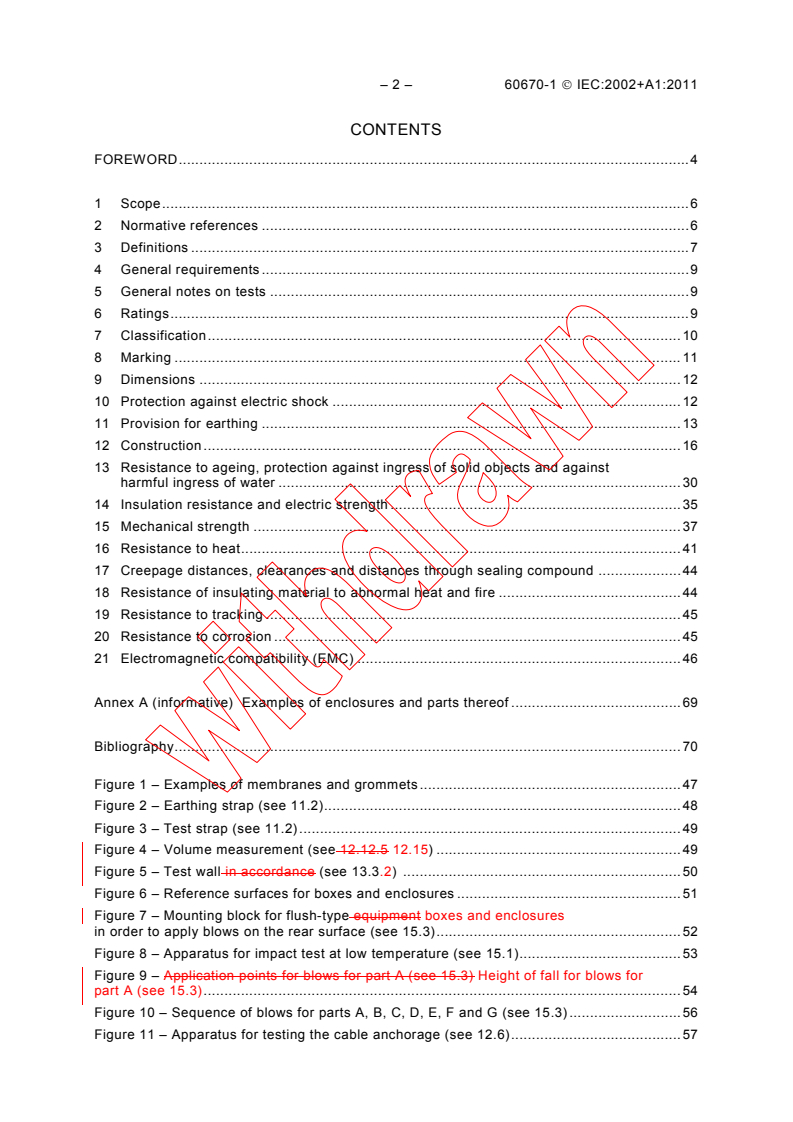
IEC 60670-1:2002+AMD1:2011 CSV - Boxes and enclosures for electrical accessories for household and similar fixed electrical installations - Part 1: General requirements Released:7/8/2011
Overview
IEC 60670-1:2002 specifies the general requirements for boxes and enclosures intended for electrical accessories used in household and similar fixed electrical installations. Issued by the International Electrotechnical Commission (IEC), this standard ensures safety, reliability, and compatibility for enclosures operating at a rated voltage not exceeding 1000 V a.c. and 1500 V d.c. Both indoor and outdoor applications are covered, supporting electrical installations in residential and commercial environments.
This international standard provides fundamental criteria for the construction, classification, marking, and use of electrical boxes and enclosures. By aligning products with IEC 60670-1, manufacturers and installers can ensure compliance with best practices and regulatory demands-helping protect users, equipment, and property.
Key Topics
Scope of Application
Applies to boxes, enclosures, and enclosure parts for electrical accessories in fixed installations for voltages up to 1000 V a.c. and 1500 V d.c. Covers use in households and similar environments.General Requirements
Outlines design and construction criteria to ensure electrical and mechanical protection, including impact resistance, ingress protection, and safe accommodation of live parts.Classification
Provides classification criteria based on:- Nature of materials (insulating, metallic, composite)
- Method of installation (flush, surface, semi-flush, embedded)
- Inlet types for cable/conduit entry
- Clamping mechanisms (retention, anchorage)
- Environmental conditions (temperature ranges)
- Degree of protection (such as IP code)
Marking and Documentation
Specifies required product markings (manufacturer, IP rating, reference codes, temperature ratings), and the need for legible, durable identification on either the product or packaging.Testing and Verification
Defines general test procedures for type testing boxes/enclosures, including preconditioning, sequence of tests, and criteria for repeat testing in case of non-conformity.Electrical Safety
Sets out standards for:- Protection against electric shock (access prevention to live parts)
- Earthing provisions for enclosures with exposed conductive parts
- Insulation resistance and electric strength
Applications
IEC 60670-1 is vital for industries and professionals engaged in the manufacture, distribution, and installation of electrical installation products. Typical applications include:
Residential Buildings:
Ensuring safe installation of switches, sockets, and connection points in homes and apartments.Commercial Premises:
Supporting reliable and standardized electrical distribution in offices, stores, and public buildings.Outdoor Installations:
Providing guidance for weather-resistant enclosures and boxes for use in exposed environments.Product Design & Certification:
Enabling manufacturers to design boxes and enclosures that meet international safety requirements, simplifying testing and market approval procedures.
By complying with IEC 60670-1, stakeholders can minimize risk, achieve regulatory acceptance in global markets, and guarantee safe operation of electrical systems.
Related Standards
- IEC 60670-2 – Particular requirements for boxes and enclosures for electrical accessories for fixed installations.
- IEC 60529 – Degrees of protection provided by enclosures (IP Code).
- IEC 61084 – Cable trunking and ducting systems for electrical installations.
- IEC 61140 – Protection against electric shock.
- IEC 60068-2-75 – Environmental testing - Hammer tests.
IEC 60670-1:2002 serves as a fundamental standard for the safety and performance of electrical boxes and enclosures, supporting safe and effective electrical installations worldwide. For designers, manufacturers, and installers, adherence is essential to meet both compliance and user safety expectations.
Relations
- Effective Date
- 05-Sep-2023
- Effective Date
- 05-Sep-2023
- Effective Date
- 05-Sep-2023
- Effective Date
- 05-Sep-2023
Buy Documents
IEC 60670-1:2002 - Boxes and enclosures for electrical accessories for household and similar fixed electrical installations - Part 1: General requirements Released:12/5/2002
IEC 60670-1:2002+AMD1:2011 CSV - Boxes and enclosures for electrical accessories for household and similar fixed electrical installations - Part 1: General requirements Released:7/8/2011
Get Certified
Connect with accredited certification bodies for this standard

IMQ S.p.A. (Certification)
Italian electrical product certification.

SLG Prüf- und Zertifizierungs GmbH
German testing and certification body.

UL Solutions
Global safety science company with testing, inspection and certification.
Sponsored listings
Frequently Asked Questions
IEC 60670-1:2002 is a standard published by the International Electrotechnical Commission (IEC). Its full title is "Boxes and enclosures for electrical accessories for household and similar fixed electrical installations - Part 1: General requirements". This standard covers: This part of IEC 60670 applies to boxes, enclosures and parts of enclosures (hereafter called "boxes" and "enclosures") for electrical accessories with a rated voltage not exceeding 1 000 V a.c. and 1 500 V d.c. intended for household or similar fixed electrical installations, either indoors or outdoors. This edition cancels and replaces the second edition of IEC 60670 published in 1989 and its amendment 1 (1994). This edition constitutes a technical revision. The contents of the corrigendum of February 2003 have been included in this copy.
This part of IEC 60670 applies to boxes, enclosures and parts of enclosures (hereafter called "boxes" and "enclosures") for electrical accessories with a rated voltage not exceeding 1 000 V a.c. and 1 500 V d.c. intended for household or similar fixed electrical installations, either indoors or outdoors. This edition cancels and replaces the second edition of IEC 60670 published in 1989 and its amendment 1 (1994). This edition constitutes a technical revision. The contents of the corrigendum of February 2003 have been included in this copy.
IEC 60670-1:2002 is classified under the following ICS (International Classification for Standards) categories: 29.120.10 - Conduits for electrical purposes. The ICS classification helps identify the subject area and facilitates finding related standards.
IEC 60670-1:2002 has the following relationships with other standards: It is inter standard links to IEC 60670:1989, IEC 60670-1:2002/AMD1:2011, IEC 60670-1:2002/COR1:2003, IEC 60670-1:2015. Understanding these relationships helps ensure you are using the most current and applicable version of the standard.
IEC 60670-1:2002 is available in PDF format for immediate download after purchase. The document can be added to your cart and obtained through the secure checkout process. Digital delivery ensures instant access to the complete standard document.
Standards Content (Sample)
����� CEI
�������������� IEC
60670-1
�������������
����������������
��������
�������������
�������
Boîtes et enveloppes pour appareillage électrique
pour installations électriques fixes pour usages
domestiques et analogues –
Partie 1:
Règles générales
Boxes and enclosures for electrical accessories
for household and similar fixed electrical
installations –
Part 1:
General requirements
������������ ����!�
�� ����!�����"��
#��$��#�%�%&���’����
����������������������������� ��������������������
��(����)������*+�,�����--&.�)���(�")�!+���������)+�#�� ��� ���� �� =+��+�9� �--&� +))� ��#� (�")�!+������ +��
����������������/�(+��������%����0������.�)+�#���12�� ������� <��6� +� ����8�+����� ��� �6�� %����� ������0� ���
��,�����)+�#���%��12��0 �3+�()�.���#�12��������<��� ���������+����#�%��12��0
�������������������� ���������������������
����,��������!����)���������!���+�����(�")�!+���������)+ �6����#������<�(�")��6��8�!����)��+����,��������� ����
#�����!��(��+���)���+�������������������(���")��0��+� (�")�!+�����0� ���� �3+�()�.� �������� ���"���� �0�.� �0�
�3��()�.�)������������4���������0�.��0������0������5���� +��� �0�� �� ��.� ���(�!��,�)9.� ��� �6�� "+��� (�")�!+����.
���(�!��,������)+�(�")�!+��������"+��.�)+�(�")�!+������� �6�� "+��� (�")�!+����� ��!��(��+���8� +��������� �� +��
"+��� ��!��(��+��� )4+���������� �.� ��� )+� (�")�!+����� �� �6�� "+��� (�")�!+����� ��!��(��+���8� +���������� �
"+�����!��(��+���)���+�����������������0 +����0
���������������������������� "��������������������������������������
������������������������������
��� !������� ��!6��5��� ���� (�")�!+������ ��� )+� #��� ��� �6�� ��!6��!+)� !������� � � ��#� (�")�!+������ ��� B�(�
!����+������ ��,�� (+�� )+� #��� + ��� 5�7�)� �� )���� )7��+� ������ !����+��� ��,��<� "9� �6�� ��#.� �6��� �������8� �6+�
+!���)� ��� )+� ��!6��5��0� ���� ������8�������� ��)+�� �� / �6�� !������� �� )�!��� !������� ��!6��)�890� �� ���+����
!����� (�")�!+����.� 9� !��(���� �+� ,+)�����.� ����� ���(�� ��)+���8� ��� �6��� (�")�!+����.� ��!)����8� ���� ,+)����9.� ��
��")��� �+��� )�� #+�+)�8��� ���� (�")�!+������ ��� )+� #�� +,+�)+")�� ��� �6�� ��#� #+�+)�8��� � � (�")�!+�����
:,���� !���������;� ��� ()��� ���� ���,�))��� ��������. :����"�)�<;� ��� +�������� ��� ��<� ��������.� +���������
+����������� ���!����8���+0� ������ ���+������ ���� )�� +���!����8���+0� �� ���+����� ��� �6�� ��"*�!��� �����
��*����/�)4���������)4+,+�!������������+,+�3� �����(��� !�������+�����+���<��B����(��8�����������+B���"9��6�
(+��)��!�������4�������5���+��)+"����!�����(�")�!+����. ��!6��!+)� !��������� <6�!6� 6+�� (��(+���� �6��
+����� 5��� )+� )����� ���� (�")�!+������ (+����.� ���� (�")�!+����.� +�� <�))� +�� �6�� )���� � � (�")�!+������ ������.
�8+)���������(���")���(+��)4���������+������’ ���+)���+,+�)+")�� �����6�� �))�<��8’
�� ������������������������������� �� ����#��������������������
�� ������������������������������������ �� �����������������������������
��� !+�+)�8��� ��� )�8��� ���� )�� ����� <�"� ��� )+� #�� �6�� ���)���� !+�+)�8��� ��� �6�� ��#� <�"� ����
:<<<0��!0!6$!+�)8� 06��;�,����(��������� +������� :<<<0��!0!6$!+�)8��06��;� ��+")��� 9��� ��� ��+�!6
��!6��!6��� ��� ���)��+��� ��� ���"���3� !�������. "9� +� ,+����9� � � !������+� ��!)����8� ��3�� ��+�!6��.
!��(���+���������!6��!6�����3���))��.�(+��!����� ��!6��!+)�!����������+����+���� �(�")�!+����0����
�4�����������+������(�")�!+����0������� ���+����� )���� �� ���+����� ��� +)��� +,+�)+")�� ��� ��!���)9
��� )�8��� ����� �8+)������ ���(���")��� ���� )�� ������� (�")�!+�����.� <��6��+<�� +��� ��()+!��
���,�))��� (�")�!+�����.� )��� (�")�!+������ ���()+� (�")�!+�����.�+��<�))�+��!����8���+0
!���������������.�+�����5�������)���!����8���+0
�� ��������� ��������
�� ��������� ��������
#�� ������� ���� ���������� (�")�!+������ (+����
�6��� ����+�9� � � ��!���)9� ������� (�")�!+�����
:<<<0��!0!6$=�06��;� ���� +����� ���(���")�� (+�
:<<<0��!0!6$=�06��;� ��� +)��� +,+�)+")�� "9� ��+�)0
!�������� �)�!�����5��0� >���))�?� (������� !���+!�
�)�+���!���+!���6��#�����������,�!��#������:���
+,�!� )�� ���,�!�� !)����� :,���� !���������;� (���� ()��
"�)�<;� ��� ���6����� ���+����0
�4�� ���+�����0
�� ���!�����������
�� ������������!����������
��� ,���� +,�?� ���� 5��������� +�� ��*��� ��� !����
� � 9��� 6+,�� +�9� 5��������� ��8+����8� �6��
(�")�!+����� ��� +,�?� "������ ��� ������8�������
(�")�!+����� ��� ����� ���6��� +�����+�!�.� ()�+��
��(()�����+����.� (����?� !���+!�� +,�!� )�� ���,�!�
!���+!���6��#�����������,�!��#�����’
!)�����’
��+�)’�!������,@��!0!6
��+�)’ !������,@��!0!6
��)’� A2�����-�-������
��)’� A2�����-�-������
�+3’� A2�����-�-��1���
�+3’� A2�����-�-��1���
����� CEI
�������������� IEC
60670-1
�������������
����������������
��������
�������������
�������
Boîtes et enveloppes pour appareillage électrique
pour installations électriques fixes pour usages
domestiques et analogues –
Partie 1:
Règles générales
Boxes and enclosures for electrical accessories
for household and similar fixed electrical
installations –
Part 1:
General requirements
©���#�������������������(����!����������,����⎯��#�(9��86����+))���86��������,��
Aucune partie de cette publication ne peut être reproduite ni No part of this publication may be reproduced or utilized in any
utilisée sous quelque forme que ce soit et par aucun procédé, form or by any means, electronic or mechanical, including
électronique ou mécanique, y compris la photocopie et les photocopying and microfilm, without permission in writing from
microfilms, sans l'accord écrit de l'éditeur. the publisher.
������+����+)� �)�!�����!6��!+)� #���������.� � 1.� ���� ��� >+���"�.� ��� C�3� �1�.� #D������ E���,+� ��.� �<��?��)+��
��)�(6���’�A2�����-�-�������� ��)� +3’�A2�����-�-��1����� ���+�)’����+�)@��!0!6��� F�"’�<<<0��!0!6
#�������G
G�
#�����������)�!�����!6��5���������+����+)� ���#��#���
������+����+)��)�!�����!6��!+)�#���������
�����������������������������������������
Pour prix, voir catalogue en vigueur
For price, see current catalogue
– 2 – 60670-1 � CEI:2002
SOMMAIRE
AVANT-PROPOS . 6
1 Domaine d’application .10
2 Références normatives .10
3 Définitions.12
4 Règles générales .16
5 Notes générales sur les essais.16
6 Caractéristiques assignées .16
7 Classification .18
8 Marquage .20
9 Dimensions.22
10 Protection contre les chocs électriques.22
11 Dispositions pour la mise à la terre.24
12 Construction .26
13 Résistance au vieillissement, protection contre la pénétration de corps solides et
contre la pénétration nuisible de l’eau.46
14 Résistance d’isolement et rigidité diélectrique.56
15 Résistance mécanique .58
16 Résistance à la chaleur .66
17 Lignes de fuite, distances d’isolement dans l’air et distances à travers le matériau
d’étanchéité .70
18 Résistance du matériau isolant à la chaleur anormale et au feu .70
19 Résistance au cheminement .72
20 Résistance à la corrosion .72
21 Compatibilité électromagnétique (CEM).74
Annexe A (informative) Exemples d'enveloppes et de leurs éléments .110
Bibliographie .112
Figure 1 – Exemples de membranes et de passe-fil .76
Figure 2 – Bande de mise à la terre (voir 11.2) .78
Figure 3 – Languette d'essai (voir 11.2) .80
Figure 4 – Mesure du volume (voir 12.12.4) .80
Figure 5 – Paroi d'essai (voir 13.3) .82
Figure 6 – Surfaces de référence pour boîtes et enveloppes .84
Figure 7 – Bloc de montage pour matériel encastré pour application des coups
sur l'arrière (voir 15.3) .86
Figure 8 – Appareil pour l'essai de choc à basse température (voir 15.1) .88
Figure 9 – Points d’application des coups pour la partie A (voir 15.3) .90
Figure 10 – Séquence des coups pour les parties A, B, C, D, E, F et G (voir 15.3) .92
Figure 11 – Appareil pour l'essai des serre-câble (voir 12.6) .94
60670-1 © IEC:2002 – 3 –
CONTENTS
FOREWORD . 7
1 Scope .11
2 Normative references.11
3 Definitions .13
4 General requirements .17
5 General notes on tests.17
6 Ratings .17
7 Classification .19
8 Marking .21
9 Dimensions.23
10 Protection against electric shock.23
11 Provision for earthing.25
12 Construction .27
13 Resistance to ageing, protection against ingress of solid objects and against
harmful ingress of water.47
14 Insulation resistance and electric strength .57
15 Mechanical strength.59
16 Resistance to heat .67
17 Creepage distances, clearances and distances through sealing compound.71
18 Resistance of insulating material to abnormal heat and fire.71
19 Resistance to tracking .73
20 Resistance to corrosion .73
21 Electromagnetic compatibility (EMC).75
Annex A (informative) Examples of enclosures and parts thereof .111
Bibliography.113
Figure 1 – Examples of membranes and grommets .77
Figure 2 – Earthing strap (see 11.2) .79
Figure 3 – Test strap (see 11.2) .81
Figure 4 – Volume measurement (see 12.12.5) .81
Figure 5 – Test wall in accordance (see 13.3) .83
Figure 6 – Reference surfaces for boxes and enclosures .85
Figure 7 – Mounting block for flush-type equipment in order to apply blows on the rear
surface (see 15.3) .87
Figure 8 – Apparatus for impact test at low temperature (see 15.1) .89
Figure 9 – Application points for blows for part A (see 15.3).91
Figure 10 – Sequence of blows for parts A, B, C, D, E, F and G (see 15.3) .93
Figure 11 – Apparatus for testing the cable anchorage (see 12.6) .95
– 4 – 60670-1 � CEI:2002
Figure 12 – Disposition pour l'essai des capots ou plaques de recouvrement
(voir 12.1.2.2).96
Figure 13 – Calibre (épaisseur 2 mm environ) pour la vérification du contour des
couvercles, capots ou plaques de recouvrement (voir 12.1.2.3).96
Figure 14 – Exemples d'applications du calibre de la Figure 13 sur des capots fixés
sans vis sur une surface de montage ou de support (voir 12.1.2.3) .98
Figure 15 – Exemples d'application du calibre de la Figure 13 (voir 12.1.2.3) .100
Figure 16 – Calibre pour la vérification des rainures, trous et dépouilles inverses
(voir 12.1.2.4).102
Figure 17 – Schéma montrant la direction d'application du calibre de la Figure 16
(voir 12.1.2.4).102
Figure 18 – Vérification des moyens de fixation des boîtes et enveloppes classifiées
selon 7.7.1 (voir 12.11).104
Figure 19 – Essai selon 12.14.3.106
Figure 20 – Barre rigide (voir 16.3) .108
Figure 21 – Représentation schématique de l’essai au fil incandescent (voir Article 18).108
Figure A.1 – Exemples d'enveloppes et de leurs éléments .110
Tableau 1 – Classification des boîtes et enveloppes .18
Tableau 2 – Forces à appliquer aux capots, plaques de recouvrement ou aux organes
de manœuvre dont la fixation ne dépend pas de vis .28
Tableau 3 – Forces et couples à appliquer aux serre-câble .34
Tableau 4 – Couples de serrage pour la vérification de la résistance mécanique des vis .40
Tableau 5 – Valeurs de l'essai de couple pour les presse-étoupe .44
Tableau 6 – Tension d'essai pour l'essai de rigidité diélectrique .58
Tableau 7 – Détermination des parties A, B, C, D, E, F et G.64
Tableau 8 – Hauteur de chute pour l'essai de choc .64
60670-1 © IEC:2002 – 5 –
Figure 12 – Arrangement for test on covers or cover-plates (see 12.1.2.2) .97
Figure 13 – Gauge (thickness about 2 mm) for the verification of the outline of lids,
covers or cover-plates (see 12.1.2.3) .97
Figure 14 – Examples of application of the gauge of Figure 13 on covers fixed without
screws on a mounting surface or supporting surface (see 12.1.2.3).99
Figure 15 – Examples of application of the gauge of Figure 13 (see 12.1.2.3) .101
Figure 16 – Gauge for verification of grooves, holes and reverse tapers (see 12.1.2.4) .103
Figure 17 – Sketch showing the direction of application of the gauge of Figure 16
(see 12.1.2.4).103
Figure 18 – Verification of fixing means for boxes and enclosures classified according
to 7.7.1 (see 12.11).105
Figure 19 – Test according to 12.14.3 .107
Figure 20 – Rigid crossbar (see 16.3) .109
Figure 21 – Diagrammatic representation of the glow-wire test (see Clause 18) .109
Figure A.1 – Examples of enclosures and parts of thereof.111
Table 1 – Classification of boxes and enclosures .19
Table 2 – Forces to be applied to covers, cover-plates or actuating members whose
fixing is not dependent on screws.29
Table 3 – Forces and torques to be applied to cable anchorages .35
Table 4 – Tightening torques for the verification of the mechanical strength of screws .41
Table 5 – Torque test values for cable glands .45
Table 6 – Test voltage for electric strength test .59
Table 7 – Determination of parts A, B, C, D E, F and G .65
Table 8 – Height of fall for impact test.65
– 6 – 60670-1 � CEI:2002
COMMISSION ÉLECTROTECHNIQUE INTERNATIONALE
____________
BOÎTES ET ENVELOPPES POUR APPAREILLAGE ÉLECTRIQUE
POUR INSTALLATIONS ÉLECTRIQUES FIXES
POUR USAGES DOMESTIQUES ET ANALOGUES –
Partie 1: Règles générales
AVANT-PROPOS
1) La CEI (Commission Electrotechnique Internationale) est une organisation mondiale de normalisation composée
de l'ensemble des comités électrotechniques nationaux (Comités nationaux de la CEI). La CEI a pour objet de
favoriser la coopération internationale pour toutes les questions de normalisation dans les domaines de
l'électricité et de l'électronique. A cet effet, la CEI, entre autres activités, publie des Normes internationales.
Leur élaboration est confiée à des comités d'études, aux travaux desquels tout Comité national intéressé par le
sujet traité peut participer. Les organisations internationales, gouvernementales et non gouvernementales, en
liaison avec la CEI, participent également aux travaux. La CEI collabore étroitement avec l'Organisation
Internationale de Normalisation (ISO), selon des conditions fixées par accord entre les deux organisations.
2) Les décisions ou accords officiels de la CEI concernant les questions techniques représentent, dans la mesure
du possible, un accord international sur les sujets étudiés, étant donné que les Comités nationaux intéressés
sont représentés dans chaque comité d’études.
3) Les documents produits se présentent sous la forme de recommandations internationales. Ils sont publiés
comme normes, spécifications techniques, rapports techniques ou guides, et agréés comme tels par les
Comités nationaux.
4) Dans le but d'encourager l'unification internationale, les Comités nationaux de la CEI s'engagent à appliquer de
façon transparente, dans toute la mesure possible, les Normes internationales de la CEI dans leurs normes
nationales et régionales. Toute divergence entre la norme de la CEI et la norme nationale ou régionale
correspondante doit être indiquée en termes clairs dans cette dernière.
5) La CEI n’a fixé aucune procédure concernant le marquage comme indication d’approbation et sa responsabilité
n’est pas engagée quand un matériel est déclaré conforme à l’une de ses normes.
6) L’attention est attirée sur le fait que certains des éléments de la présente Norme internationale peuvent faire
l’objet de droits de propriété intellectuelle ou de droits analogues. La CEI ne saurait être tenue pour
responsable de ne pas avoir identifié de tels droits de propriété et de ne pas avoir signalé leur existence.
La Norme internationale CEI 60670-1 a été établie par le sous-comité 23B: Prises de courant
et interrupteurs, du comité d'études 23 de la CEI: Petit appareillage.
Cette édition annule et remplace la deuxième édition de la CEI 60670 parue en 1989 ainsi que
son amendement 1 (1994). Cette édition constitue une révision technique.
Le texte de cette norme est issu de la deuxième édition de la CEI 60670, son amendement 1 et
des documents suivants:
FDIS Rapport de vote
23B/681/FDIS 23B/693/RVD
Le rapport de vote indiqué dans le tableau ci-dessus donne toute information sur le vote ayant
abouti à l'approbation de cette norme.
Cette publication a été rédigée selon les Directives ISO/CEI, Partie 2.
60670-1 © IEC:2002 – 7 –
INTERNATIONAL ELECTROTECHNICAL COMMISSION
____________
BOXES AND ENCLOSURES FOR ELECTRICAL ACCESSORIES
FOR HOUSEHOLD AND SIMILAR FIXED ELECTRICAL INSTALLATIONS –
Part 1: General requirements
FOREWORD
1) The IEC (International Electrotechnical Commission) is a worldwide organization for standardization comprising
all national electrotechnical committees (IEC National Committees). The object of the IEC is to promote
international co-operation on all questions concerning standardization in the electrical and electronic fields. To
this end and in addition to other activities, the IEC publishes International Standards. Their preparation is
entrusted to technical committees; any IEC National Committee interested in the subject dealt with may
participate in this preparatory work. International, governmental and non-governmental organizations liaising
with the IEC also participate in this preparation. The IEC collaborates closely with the International
Organization for Standardization (ISO) in accordance with conditions determined by agreement between the
two organizations.
2) The formal decisions or agreements of the IEC on technical matters express, as nearly as possible, an
international consensus of opinion on the relevant subjects since each technical committee has representation
from all interested National Committees.
3) The documents produced have the form of recommendations for international use and are published in the form
of standards, technical specifications, technical reports or guides and they are accepted by the National
Committees in that sense.
4) In order to promote international unification, IEC National Committees undertake to apply IEC International
Standards transparently to the maximum extent possible in their national and regional standards. Any
divergence between the IEC Standard and the corresponding national or regional standard shall be clearly
indicated in the latter.
5) The IEC provides no marking procedure to indicate its approval and cannot be rendered responsible for any
equipment declared to be in conformity with one of its standards.
6) Attention is drawn to the possibility that some of the elements of this International Standard may be the subject
of patent rights. The IEC shall not be held responsible for identifying any or all such patent rights.
International Standard IEC 60670-1 has been prepared by subcommittee 23B: Plugs, socket-
outlets and switches, of IEC technical committee 23: Electrical accessories.
This edition cancels and replaces the second edition of IEC 60670 published in 1989 and its
amendment 1 (1994). This edition constitutes a technical revision.
The text of this standard is based on the second edition of IEC 60670, its amendment 1 and
on the following documents:
FDIS Report on voting
23B/681/FDIS 23B/693/RVD
Full information on the voting for the approval of this standard can be found in the report on
voting indicated in the above table.
This publication has been drafted in accordance with the ISO/IEC Directives, Part 2.
– 8 – 60670-1 � CEI:2002
Le comité a décidé que le contenu de cette publication ne sera pas modifié avant 2005.
A cette date, la publication sera
reconduite;
supprimée;
remplacée par une édition révisée, ou
amendée.
Dans la présente norme, les caractères d'imprimerie suivants sont employés:
– prescriptions proprement dites: caractères romains
– modalités d'essais: caractères italiques
– notes: petits caractères romains.
Le contenu du corrigendum de février 2003 a été pris en considération dans cet exemplaire.
60670-1 © IEC:2002 – 9 –
The committee has decided that the contents of this publication will remain unchanged
until 2005. At this date, the publication will be
reconfirmed;
withdrawn;
replaced by a revised edition, or
amended.
In this publication, the following print types are used:
− requirements proper: in roman type
− test specifications: in italic type
− notes: in smaller roman type.
The contents of the corrigendum of Februray 2003 have been included in this copy.
– 10 – 60670-1 � CEI:2002
BOÎTES ET ENVELOPPES POUR APPAREILLAGE ÉLECTRIQUE
POUR INSTALLATIONS ÉLECTRIQUES FIXES
POUR USAGES DOMESTIQUES ET ANALOGUES –
Partie 1: Règles générales
1 Domaine d’application
La présente partie de la CEI 60670 s'applique aux boîtes, parties d'enveloppes et enveloppes
(ci-après désignées par les termes «boîtes» et «enveloppes») destinées à des appareillages
électriques ayant une tension assignée ne dépassant pas 1 000 V alternatifs et 1 500 V
continus prévus pour des installations électriques fixes à usages domestiques ou analogues,
pour l'intérieur ou l'extérieur.
NOTE 1 Les règles concernant des types de boîtes et d’enveloppes particuliers sont spécifiées dans la Partie 2
applicable de la CEI 60670.
Les boîtes et enveloppes conformes à la présente norme sont utilisables à des températures
ambiantes ne dépassant pas habituellement 25 °C, mais pouvant atteindre occasionnellement
35 °C.
La présente Norme internationale est prévue pour s'appliquer aux boîtes et enveloppes pour
appareillages électriques du domaine du comité d'étude 23 de la CEI.
NOTE 2 La présente norme peut aussi être utilisée comme document de référence pour d'autres comités et sous-
comités d'études de la CEI.
Les boîtes et enveloppes qui constituent une partie intégrante d'un appareillage électrique dont
elles assurent la protection contre des influences externes (par exemple chocs mécaniques,
pénétration de corps solides ou de l'eau, etc.) sont couvertes par la norme applicable à cet
appareillage.
Cette norme ne s’applique pas aux
– rosaces de plafond;
– connecteurs supports de luminaires;
– boîtes, enveloppes et parties d’enveloppes spécifiquement conçues pour être utilisées dans
les systèmes de goulottes et de conduits profilés conformes à la CEI 61084 et qui ne sont
pas prévues pour être installées en dehors de ces systèmes.
2 Références normatives
Les documents de référence suivants sont indispensables pour l'application du présent
document. Pour les références datées, seule l'édition citée s'applique. Pour les références non
datées, la dernière édition du document de référence s'applique (y compris les éventuels
amendements).
CEI 60068-2-75:1997, Essais d’environnement – Partie 2-75: Essais – Essai Eh: Essais aux
marteaux
CEI 60112:1979, Méthode pour déterminer les indices de résistance et de tenue au chemine-
ment des matériaux isolants solides dans des conditions humides
CEI 60423:1993, Conduits de protection des conducteurs – Diamètres extérieurs des conduits
pour installations électriques et filetages pour conduits et accessoires
60670-1 © IEC:2002 – 11 –
BOXES AND ENCLOSURES FOR ELECTRICAL ACCESSORIES
FOR HOUSEHOLD AND SIMILAR FIXED ELECTRICAL INSTALLATIONS –
Part 1: General requirements
1 Scope
This part of IEC 60670 applies to boxes, enclosures and parts of enclosures (hereafter called
“boxes” and “enclosures”) for electrical accessories with a rated voltage not exceeding
1 000 V a.c. and 1 500 V d.c. intended for household or similar fixed electrical installations,
either indoors or outdoors.
NOTE Requirements for particular types of boxes and enclosures are given in the relevant parts 2 of IEC 60670.
Boxes and enclosures complying with this standard are suitable for use at ambient tem-
perature not normally exceeding 25 °C but occasionally reaching 35 °C.
This International Standard is intended to apply to boxes and enclosures for electrical
accessories within the scope of IEC technical committee 23.
NOTE This standard may also be used as a reference document for other IEC technical committees and
subcommittees.
A box or an enclosure which is an integral part of an electrical accessory and provides
protection for that accessory against external influences (for example mechanical impact,
ingress of solid objects or water, etc.) is covered by the relevant standard for such an
accessory.
This standard does not apply to
– ceiling roses;
– luminaire supporting couplers;
– boxes, enclosures and parts of enclosures specifically designed to be used for cable
trunking and ducting systems complying with IEC 61084 and which are not intended to be
installed outside of these systems.
2 Normative references
The following referenced documents are indispensable for the application of this document.
For dated references, only the edition cited applies. For undated references, the latest edition
of the referenced document (including any amendments) applies.
IEC 60068-2-75:1997, Environmental testing – Part 2-75: Tests – Test Eh: Hammer tests
IEC 60112:1979, Method for determining the comparative and the proof-tracking indices of
solid insulating materials under moist conditions
IEC 60423:1993, Conduits for electrical purposes – Outside diameters of conduits for
electrical installations and threads for conduits and fittings
– 12 – 60670-1 � CEI:2002
CEI 60529:1989, Degrés de protection procurés par les enveloppes (Code IP)
CEI 60695-2-11:2000, Essais relatifs aux risques du feu – Partie 2-11: Essais au fil
incandescent/chauffant – Méthode d'essai d'inflammabilité pour produits finis
CEI 60695-10-2:1995, Essais relatifs aux risques du feu – Partie 10-2: Guide et méthodes
d'essai pour la minimalisation des effets de chaleurs anormales sur des produits
électrotechniques impliqués dans des feux – Méthode pour vérifier la résistance à la chaleur
des produits en matériaux non métalliques au moyen de l'essai à la bille
CEI 60981:1989, Conduits très lourds rigides en acier pour installations électriques
CEI 61032:1997, Protection des personnes et des matériels par les enveloppes – Calibres
d'essai pour la vérification
CEI 61084 (toutes les parties), Systèmes de goulottes et de conduits profilés pour installations
électriques
CEI 61140: 2001, Protection contre les chocs électriques – Aspects communs aux installations
et aux matériels
3 Définitions
Pour les besoins de la présente partie de la CEI 60670, les définitions suivantes s’appliquent.
3.1
enveloppe
combinaison de parties, telles que boîtes, capots, plaques de recouvrement, couvercles,
extensions de boîtes, appareillages, etc., assurant, après assemblage et montage comme en
usage normal, un degré approprié de protection contre les influences externes et un degré
déterminé de protection contre les contacts avec les parties actives enfermées, dans toutes les
directions accessibles (voir l’Annexe A)
3.2
boîte
partie d’une enveloppe pourvue de moyens pour fixer un capot, une plaque de recouvrement,
un appareillage, etc., et qui est prévue pour recevoir des appareillages (tels que socles de
prises, interrupteurs, etc.)
3.3
extension de boîte
partie d’une enveloppe destinée à l’extension d’une boîte dans le but soit d'accroître son
volume interne soit de l'ajuster lors du montage encastré ou semi-encastré avec la surface
finie du mur ou élément similaire
3.4
couvercle, capot ou plaque de recouvrement
partie d’une enveloppe ne faisant pas partie intégrante ou partie de l’appareillage, qui peut soit
maintenir un appareillage dans sa position soit l’enfermer
3.5
couvercle de rehausse
couvercle destiné à être monté directement sur la boîte pour permettre la fixation d’appa-
reillages et pour augmenter le volume interne de l’enveloppe
NOTE La partie centrale du couvercle est rehaussée afin de s’ajuster à l’épaisseur du mur ou du plafond et pour
permettre le montage d’un appareillage au ras de la surface du mur ou du plafond.
60670-1 © IEC:2002 – 13 –
IEC 60529:1989, Degrees of protection provided by enclosures (IP Code)
IEC 60695-2-11:2000, Fire hazard testing – Part 2-11: Glowing/hot-wire based test methods -
Glow-wire flammability test method for end-products
IEC 60695-10-2:1995, Fire hazard testing – Part 10-2: Guidance and test methods for the
minimization of the effects of abnormal heat on electrotechnical products involved in fires –
Method for testing products made from non-metallic materials for resistance to heat using the
ball pressure test
IEC 60981:1989, Extra-heavy duty rigid steel conduits for electrical installations
IEC 61032:1997, Protection of persons and equipment by enclosures – Probes for verification
IEC 61084 (all parts), Cable trunking and ducting systems for electrical installations
IEC 61140:2001, Protection against electric shock – Common aspects for installation and
equipment
3 Definitions
For the purposes of this part of IEC 60670, the following definitions apply.
3.1
enclosure
combination of parts, such as boxes, covers, cover-plates, lids, box extensions, accessories,
etc., providing after assembly and installation as in normal use, an appropriate protection
against external influences, and a defined protection against contact with enclosed live parts
from any accessible direction (see Annex A)
3.2
box
part of an enclosure provided with means for fixing a cover, cover-plate, accessory, etc., and
intended to receive accessories (such as socket-outlets, switches, etc.)
3.3
box extension
part of an enclosure which is intended to extend a box for the purpose of either increasing the
internal volume of the box or enclosure or to adjust for mounting the box flush or semi-flush
with the finished surface of a wall or the like
3.4
lid, cover or cover-plate
part of an enclosure, not integral with or part of an accessory, which may either retain an
accessory in position or enclose it
3.5
raised cover
cover intended for mounting directly onto a box to provide for the attachment of accessories
and to increase the internal volume of the enclosure
NOTE The centre portion of the cover is raised to accommodate a specific wall or ceiling thickness and to permit
the mounting of the accessory on it, flush with the surface of the wall or ceiling.
– 14 – 60670-1 � CEI:2002
3.6
partie conductrice accessible
partie conductrice d’un équipement électrique que l’on peut toucher, qui n’est normalement pas
active, mais qui peut devenir active lorsque l’isolation de base fait défaut
3.7
boîte ou enveloppe pour montage en saillie
boîte ou enveloppe destinée à être montée en saillie sur une surface (voir l’Annexe A)
3.8
boîte ou enveloppe pour montage encastré
boîte ou enveloppe destinée à être encastrée de façon à affleurer la surface de montage (voir
l’Annexe A)
3.9
boîte ou enveloppe pour montage semi-encastré
boîte ou enveloppe destinée à être encastrée dans une surface de montage et qui fait
partiellement saillie au niveau de la surface de montage
3.10
presse-étoupe
dispositif conçu pour permettre l'entrée d'un câble dans une enveloppe et qui assure l'étan-
chéité et la retenue. Il peut également assurer d'autres fonctions telles que mise à la terre,
liaison de continuité, isolement, protège-câble, détensionnement du câble, séparément ou en
combinaison
3.11
joint (garniture)
matériau utilisé pour remplir l’espace compris entre l’intérieur d’un presse-étoupe et le câble
qui le traverse, habituellement comprimé par le presse-étoupe et formant donc un joint
3.12
joint d’étanchéité
matériau introduit entre deux surfaces conjuguées d’une boîte qui forme un joint par
compression
3.13
passe-fil
composant utilisé pour soutenir et protéger le câble ou le conduit au point d’entrée. Il peut
également prévenir la pénétration de l’humidité ou de polluants (voir Figure 1)
3.14
membrane d’entrée
composant ou partie intégrante d’une enveloppe utilisé(e) pour protéger le câble et qui peut
être utilisé(e) pour soutenir le câble ou le conduit au point d’entrée
NOTE Une membrane d'entrée peut également prévenir la pénétration de l’humidité ou de polluants et elle peut
faire partie d’un passe-fil (voir Figure 1).
3.15
membrane de protection
composant ou partie intégrante d’une enveloppe qui n’est pas destiné(e) à être traversé(e) en
utilisation normale et est prévu(e) pour assurer une protection contre la pénétration d’eau ou
de corps solides et/ou permettre le fonctionnement d’un appareillage (voir Figure 1)
3.16
matériau composite
combinaison d’un métal et d’un matériau isolant
60670-1 © IEC:2002 – 15 –
3.6
exposed conductive part
conductive part of electrical equipment, which can be touched and which is not normally live,
but which can become live when basic insulation fails
3.7
surface mounting box or enclosure
box or enclosure which is intended for mounting on a surface (see Annex A)
3.8
flush-mounting box or enclosure
box or enclosure which is intended for mounting flush with the surface (see Annex A)
3.9
semi-flush mounting box or enclosure
box or enclosure which is intended to fit within a mounting surface and partially projects from
the mounting surface
3.10
cable gland
device designed to permit the entry of a cable into an enclosure and which provides sealing
and retention. It may also provide other functions such as earthing, bonding, insulation, cable
guarding, strain relief or a combination of these
3.11
seal (packing)
material used to fill up the space between the inside of a gland and the cable passing
through, usually compressed by the gland and thereby forming a joint
3.12
gasket
material introduced between mating surfaces of an enclosure which in compression forms a
joint
3.13
grommet
component used to support and protect the cable or conduit at the point of entry. It may also
prevent the ingress of moisture or contaminants (see Figure 1)
3.14
entry membrane
component or an integral part of an enclosure used to protect the cable which may be used to
support the cable or conduit at the point of entry
NOTE An entry membrane may also prevent the ingress of moisture or contaminants and may be part of a grommet (see
Figure 1).
3.15
protecting membrane
component or an integral part of an enclosure that is not intended to be penetrated in normal
use and is intended to provide protection against ingress of water or solid objects and/or to
allow the operation of an accessory (see Figure 1).
3.16
composite material
combination of metal and insulating material
– 16 – 60670-1 � CEI:2002
3.17
orifice à manchon
entrée ouverte d’une boîte permettant l’insertion et le logement d’un conduit
3.18
retenue de câble
capacité à limiter le déplacement d’un câble contre les forces de traction
3.19
serre-câble
capacité à limiter le déplacement d’un câble flexible contre les forces de traction et pression et
les torsions
4 Règles générales
Chacune des parties de l’enveloppe doit être conçue et construite de façon que l’enveloppe
procure, lorsqu'elle est montée et installée comme en usage normal, une protection électrique
et mécanique adéquate aux parties qu'elle enferme et réduise au minimum les dangers pour
l'usager et l'environnement.
La conformité est vérifiée par la réalisation des essais applicables spécifiés.
5 Notes générales sur les essais
5.1 Les essais selon cette norme sont des essais de type.
Sauf spécification contraire, les boîtes et enveloppes sont soumises aux essais telles qu’elles
sont fournies.
Les appareillages conformes à d'autres normes ne sont pas soumis à de nouveaux essais.
Les essais sur les boîtes et enveloppes en matériau isolant doivent être effectués après une
période de conditionnement préalable d’au moins 10 jours à la température ambiante et à une
humidité relative de l’air comprise entre 45 % et 85 %.
Sauf spécification contraire, les essais doivent être effectués dans l’ordre des articles à une
température ambiante de (20 ± 5) °C sur un lot de trois échantillons neufs.
5.2 Si l’un des échantillons ne satisfait pas à un essai en raison d’un défaut de montage ou
de fabrication, cet essai de même que ceux qui l’ont précédé et qui ont pu avoir une influence
sur le résultat de cet essai doivent être répétés sur un autre lot complet d’échantillons. Les
essais qui suivent doivent eux aussi être réalisés, sur ce même lot d’échantillons, dans l’ordre
demandé. Au terme de ces essais, les échantillons doivent tous être conformes aux exigences.
NOTE Lorsqu’il présente le premier lot d’échantillons, le demandeur peut aussi soumettre le lot supplémentaire
qui peut s’avérer nécessaire si un échantillon est défaillant. Le laboratoire d’essais peut alors, sans autre demande,
essayer le lot supplémentaire d’échantillons et ne le rejeter qu’en cas de nouveau défaut. Si le lot supplémentaire
d’échantillons n’est pas fourni
...
IEC 60670-1 ®
Edition 1.1 2011-07
INTERNATIONAL
STANDARD
NORME
INTERNATIONALE
colour
inside
Boxes and enclosures for electrical accessories for household and similar fixed
electrical installations –
Part 1: General requirements
Boîtes et enveloppes pour appareillage électrique pour installations électriques
fixes pour usages domestiques et analogues –
Partie 1: Règles générales
All rights reserved. Unless otherwise specified, no part of this publication may be reproduced or utilized in any form or by
any means, electronic or mechanical, including photocopying and microfilm, without permission in writing from either IEC or
IEC's member National Committee in the country of the requester.
If you have any questions about IEC copyright or have an enquiry about obtaining additional rights to this publication,
please contact the address below or your local IEC member National Committee for further information.
Droits de reproduction réservés. Sauf indication contraire, aucune partie de cette publication ne peut être reproduite
ni utilisée sous quelque forme que ce soit et par aucun procédé, électronique ou mécanique, y compris la photocopie
et les microfilms, sans l'accord écrit de la CEI ou du Comité national de la CEI du pays du demandeur.
Si vous avez des questions sur le copyright de la CEI ou si vous désirez obtenir des droits supplémentaires sur cette
publication, utilisez les coordonnées ci-après ou contactez le Comité national de la CEI de votre pays de résidence.
IEC Central Office
3, rue de Varembé
CH-1211 Geneva 20
Switzerland
Email: inmail@iec.ch
Web: www.iec.ch
About the IEC
The International Electrotechnical Commission (IEC) is the leading global organization that prepares and publishes
International Standards for all electrical, electronic and related technologies.
About IEC publications
The technical content of IEC publications is kept under constant review by the IEC. Please make sure that you have the
latest edition, a corrigenda or an amendment might have been published.
Catalogue of IEC publications: www.iec.ch/searchpub
The IEC on-line Catalogue enables you to search by a variety of criteria (reference number, text, technical committee,…).
It also gives information on projects, withdrawn and replaced publications.
IEC Just Published: www.iec.ch/online_news/justpub
Stay up to date on all new IEC publications. Just Published details twice a month all new publications released. Available
on-line and also by email.
Electropedia: www.electropedia.org
The world's leading online dictionary of electronic and electrical terms containing more than 20 000 terms and definitions
in English and French, with equivalent terms in additional languages. Also known as the International Electrotechnical
Vocabulary online.
Customer Service Centre: www.iec.ch/webstore/custserv
If you wish to give us your feedback on this publication or need further assistance, please visit the Customer Service
Centre FAQ or contact us:
Email: csc@iec.ch
Tel.: +41 22 919 02 11
Fax: +41 22 919 03 00
A propos de la CEI
La Commission Electrotechnique Internationale (CEI) est la première organisation mondiale qui élabore et publie des
normes internationales pour tout ce qui a trait à l'électricité, à l'électronique et aux technologies apparentées.
A propos des publications CEI
Le contenu technique des publications de la CEI est constamment revu. Veuillez vous assurer que vous possédez
l’édition la plus récente, un corrigendum ou amendement peut avoir été publié.
Catalogue des publications de la CEI: www.iec.ch/searchpub/cur_fut-f.htm
Le Catalogue en-ligne de la CEI vous permet d’effectuer des recherches en utilisant différents critères (numéro de référence,
texte, comité d’études,…). Il donne aussi des informations sur les projets et les publications retirées ou remplacées.
Just Published CEI: www.iec.ch/online_news/justpub
Restez informé sur les nouvelles publications de la CEI. Just Published détaille deux fois par mois les nouvelles
publications parues. Disponible en-ligne et aussi par email.
Electropedia: www.electropedia.org
Le premier dictionnaire en ligne au monde de termes électroniques et électriques. Il contient plus de 20 000 termes et
définitions en anglais et en français, ainsi que les termes équivalents dans les langues additionnelles. Egalement appelé
Vocabulaire Electrotechnique International en ligne.
Service Clients: www.iec.ch/webstore/custserv/custserv_entry-f.htm
Si vous désirez nous donner des commentaires sur cette publication ou si vous avez des questions, visitez le FAQ du
Service clients ou contactez-nous:
Email: csc@iec.ch
Tél.: +41 22 919 02 11
Fax: +41 22 919 03 00
IEC 60670-1 ®
Edition 1.1 2011-07
INTERNATIONAL
STANDARD
NORME
INTERNATIONALE
colour
inside
Boxes and enclosures for electrical accessories for household and similar fixed
electrical installations –
Part 1: General requirements
Boîtes et enveloppes pour appareillage électrique pour installations électriques
fixes pour usages domestiques et analogues –
Partie 1: Règles générales
INTERNATIONAL
ELECTROTECHNICAL
COMMISSION
COMMISSION
ELECTROTECHNIQUE
PRICE CODE
INTERNATIONALE
CODE PRIX CS
ICS 29.120.10 ISBN 978-2-88912-514-2
– 2 – 60670-1 IEC:2002+A1:2011
CONTENTS
FOREWORD . 4
1 Scope . 6
2 Normative references . 6
3 Definitions . 7
4 General requirements . 9
5 General notes on tests . 9
6 Ratings . 9
7 Classification . 10
8 Marking . 11
9 Dimensions . 12
10 Protection against electric shock . 12
11 Provision for earthing . 13
12 Construction . 16
13 Resistance to ageing, protection against ingress of solid objects and against
harmful ingress of water . 30
14 Insulation resistance and electric strength . 35
15 Mechanical strength . 37
16 Resistance to heat . 41
17 Creepage distances, clearances and distances through sealing compound . 44
18 Resistance of insulating material to abnormal heat and fire . 44
19 Resistance to tracking . 45
20 Resistance to corrosion . 45
21 Electromagnetic compatibility (EMC) . 46
Annex A (informative) Examples of enclosures and parts thereof . 69
Bibliography . 70
Figure 1 – Examples of membranes and grommets . 47
Figure 2 – Earthing strap (see 11.2) . 48
Figure 3 – Test strap (see 11.2) . 49
Figure 4 – Volume measurement (see 12.12.5 12.15) . 49
Figure 5 – Test wall in accordance (see 13.3.2) . 50
Figure 6 – Reference surfaces for boxes and enclosures . 51
Figure 7 – Mounting block for flush-type equipment boxes and enclosures
in order to apply blows on the rear surface (see 15.3) . 52
Figure 8 – Apparatus for impact test at low temperature (see 15.1) . 53
Figure 9 – Application points for blows for part A (see 15.3) Height of fall for blows for
part A (see 15.3) . 54
Figure 10 – Sequence of blows for parts A, B, C, D, E, F and G (see 15.3) . 56
Figure 11 – Apparatus for testing the cable anchorage (see 12.6) . 57
60670-1 IEC:2002+A1:2011 – 3 –
Figure 12 – Arrangement for test on covers or cover-plates (see 12.1.2.2) . 58
Figure 13 – Gauge (thickness about 2 mm) for the verification of the outline of lids,
covers or cover-plates (see 12.1.2.3) . 58
Figure 14 – Examples of application of the gauge of Figure 13 on covers fixed without
screws on a mounting surface or supporting surface (see 12.1.2.3) . 59
Figure 15 – Examples of application of the gauge of Figure 13 (see 12.1.2.3) . 60
Figure 16 – Gauge for verification of grooves, holes and reverse tapers (see 12.1.2.4) . 61
Figure 17 – Sketch showing the direction of application of the gauge of Figure 16
(see 12.1.2.4) . 61
Figure 18 – Verification of fixing means for boxes and enclosures classified according
to 7.7.1 (see 12.11) . 62
Figure 19 – Test according to to 12.14.3 12.12.3 . 63
Figure 20 – Rigid crossbar (see 16.3) . 64
Figure 21 – Diagrammatic representation of the glow-wire test (see Clause 18) . 64
Figure 22 – Example of mounting block for boxes to be embedded in masonry (flush
type and semi-flush type) according to 12.10 . 65
Figure 23 – Example of the fixing of the auxiliary device mounted on a specimen
according to 12.10 . 66
Figure 24 – Example of test apparatus for the test according to 12.10 . 67
Figure 25 – Example of the protected volume (see 13.3.4) . 68
Figure 26 – Demonstration of the non-penetration of the internal volume . 68
Figure A.1 – Examples of enclosures and parts of thereof . 69
Table 1 – Classification of boxes and enclosures . 10
Table 2 – Forces to be applied to covers, cover-plates or actuating members whose
fixing is not dependent on screws . 17
Table 3 – Forces and torques to be applied to cable anchorages . 20
Table 4 – Tightening torques for the verification of the mechanical strength of screws . 24
Table 5 – Torque test values for cable glands . 29
Table 6 – Test voltage for electric strength test . 37
Table 7 – Determination of parts A, B, C, D E, F and G. 40
Table 8 – Height of fall for impact test . 40
– 4 – 60670-1 IEC:2002+A1:2011
INTERNATIONAL ELECTROTECHNICAL COMMISSION
____________
BOXES AND ENCLOSURES FOR ELECTRICAL ACCESSORIES
FOR HOUSEHOLD AND SIMILAR FIXED ELECTRICAL INSTALLATIONS –
Part 1: General requirements
FOREWORD
1) The International Electrotechnical Commission (IEC) is a worldwide organization for standardization comprising
all national electrotechnical committees (IEC National Committees). The object of IEC is to promote
international co-operation on all questions concerning standardization in the electrical and electronic fields. To
this end and in addition to other activities, IEC publishes International Standards, Technical Specifications,
Technical Reports, Publicly Available Specifications (PAS) and Guides (hereafter referred to as “IEC
Publication(s)”). Their preparation is entrusted to technical committees; any IEC National Committee interested
in the subject dealt with may participate in this preparatory work. International, governmental and non-
governmental organizations liaising with the IEC also participate in this preparation. IEC collaborates closely
with the International Organization for Standardization (ISO) in accordance with conditions determined by
agreement between the two organizations.
2) The formal decisions or agreements of IEC on technical matters express, as nearly as possible, an international
consensus of opinion on the relevant subjects since each technical committee has representation from all
interested IEC National Committees.
3) IEC Publications have the form of recommendations for international use and are accepted by IEC National
Committees in that sense. While all reasonable efforts are made to ensure that the technical content of IEC
Publications is accurate, IEC cannot be held responsible for the way in which they are used or for any
misinterpretation by any end user.
4) In order to promote international uniformity, IEC National Committees undertake to apply IEC Publications
transparently to the maximum extent possible in their national and regional publications. Any divergence
between any IEC Publication and the corresponding national or regional publication shall be clearly indicated in
the latter.
5) IEC itself does not provide any attestation of conformity. Independent certification bodies provide conformity
assessment services and, in some areas, access to IEC marks of conformity. IEC is not responsible for any
services carried out by independent certification bodies.
6) All users should ensure that they have the latest edition of this publication.
7) No liability shall attach to IEC or its directors, employees, servants or agents including individual experts and
members of its technical committees and IEC National Committees for any personal injury, property damage or
other damage of any nature whatsoever, whether direct or indirect, or for costs (including legal fees) and
expenses arising out of the publication, use of, or reliance upon, this IEC Publication or any other IEC
Publications.
8) Attention is drawn to the Normative references cited in this publication. Use of the referenced publications is
indispensable for the correct application of this publication.
9) Attention is drawn to the possibility that some of the elements of this IEC Publication may be the subject of
patent rights. IEC shall not be held responsible for identifying any or all such patent rights.
This consolidated version of IEC 60670-1 consists of the first edition (2002) [documents
23B/681/FDIS and 23B/693/RVD], its amendment 1 (2011) [documents 23B/981/FDIS and
23B/991/RVD] and its corrigendum of February 2003. It bears the edition number 1.1.
The technical content is therefore identical to the base edition and its amendment and
has been prepared for user convenience. A vertical line in the margin shows where the
base publication has been modified by amendment 1. Additions and deletions are
displayed in red, with deletions being struck through.
60670-1 IEC:2002+A1:2011 – 5 –
International Standard IEC 60670-1 has been prepared by subcommittee 23B: Plugs, socket-
outlets and switches, of IEC technical committee 23: Electrical accessories.
This publication has been drafted in accordance with the ISO/IEC Directives, Part 2.
In this publication, the following print types are used:
− requirements proper: in roman type
− test specifications: in italic type
− notes: in smaller roman type.
The committee has decided that the contents of the base publication and its amendments will
remain unchanged until the stability date indicated on the IEC web site under
"http://webstore.iec.ch" in the data related to the specific publication. At this date, the
publication will be
• reconfirmed,
• withdrawn,
• replaced by a revised edition, or
• amended.
IMPORTANT – The “colour inside” logo on the cover page of this publication indicates
that it contains colours which are considered to be useful for the correct understanding
of its contents. Users should therefore print this publication using a colour printer.
– 6 – 60670-1 IEC:2002+A1:2011
BOXES AND ENCLOSURES FOR ELECTRICAL ACCESSORIES
FOR HOUSEHOLD AND SIMILAR FIXED ELECTRICAL INSTALLATIONS –
Part 1: General requirements
1 Scope
This part of IEC 60670 applies to boxes, enclosures and parts of enclosures (hereafter called
“boxes” and “enclosures”) for electrical accessories with a rated voltage not exceeding
1 000 V a.c. and 1 500 V d.c. intended for household or similar fixed electrical installations,
either indoors or outdoors.
NOTE Requirements for particular types of boxes and enclosures are given in the relevant parts 2 of IEC 60670.
Boxes and enclosures complying with this standard are suitable for use at ambient tem-
perature not normally exceeding 25 °C but occasionally reaching 35 °C.
This International Standard is intended to apply to boxes and enclosures for electrical
accessories within the scope of IEC technical committee 23.
NOTE This standard may also be used as a reference document for other IEC technical committees and
subcommittees.
A box or an enclosure which is an integral part of an electrical accessory and provides
protection for that accessory against external influences (for example mechanical impact,
ingress of solid objects or water, etc.) is covered by the relevant standard for such an
accessory.
This standard does not apply to
– ceiling roses;
– luminaire supporting couplers;
– boxes, enclosures and parts of enclosures specifically designed to be used for cable
trunking and ducting systems complying with IEC 61084 and which are not intended to be
installed outside of these systems.
2 Normative references
The following referenced documents are indispensable for the application of this document.
For dated references, only the edition cited applies. For undated references, the latest edition
of the referenced document (including any amendments) applies.
IEC 60068-2-75:1997, Environmental testing – Part 2-75: Tests – Test Eh: Hammer tests
IEC 60112:1979, Method for determining the comparative and the proof-tracking indices of
solid insulating materials under moist conditions
IEC 60423:1993, Conduits for electrical purposes – Outside diameters of conduits for
electrical installations and threads for conduits and fittings
IEC 60529:1989, Degrees of protection provided by enclosures (IP Code)
IEC 60695-2-11:2000, Fire hazard testing – Part 2-11: Glowing/hot-wire based test methods -
Glow-wire flammability test method for end-products
60670-1 IEC:2002+A1:2011 – 7 –
IEC 60695-10-2:1995, Fire hazard testing – Part 10-2: Guidance and test methods for the
minimization of the effects of abnormal heat on electrotechnical products involved in fires –
Method for testing products made from non-metallic materials for resistance to heat using the
ball pressure test
IEC 60981:1989, Extra-heavy duty rigid steel conduits for electrical installations
IEC 61032:1997, Protection of persons and equipment by enclosures – Probes for verification
IEC 61084 (all parts), Cable trunking and ducting systems for electrical installations
IEC 61140:2001, Protection against electric shock – Common aspects for installation and
equipment
IEC 62444:2010, Cable glands for electrical installations
3 Definitions
For the purposes of this part of IEC 60670, the following definitions apply.
3.1
enclosure
combination of parts, such as boxes, covers, cover-plates, lids, box extensions, accessories,
etc., providing after assembly and installation as in normal use, an appropriate protection
against external influences, and a defined protection against contact with enclosed live parts
from any accessible direction (see Annex A)
3.2
box
part of an enclosure provided with means for fixing a cover, cover-plate, accessory, etc., and
intended to receive accessories (such as socket-outlets, switches, etc.)
3.3
box extension
part of an enclosure which is intended to extend a box for the purpose of either increasing the
internal volume of the box or enclosure or to adjust for mounting the box flush or semi-flush
with the finished surface of a wall or the like
3.4
lid, cover or cover-plate
part of an enclosure, not integral with or part of an accessory, which may either retain an
accessory in position or enclose it
3.5
raised cover
cover intended for mounting directly onto a box to provide for the attachment of accessories
and to increase the internal volume of the enclosure
NOTE The centre portion of the cover is raised to accommodate a specific wall or ceiling thickness and to permit
the mounting of the accessory on it, flush with the surface of the wall or ceiling.
3.6
exposed conductive part
conductive part of electrical equipment, which can be touched and which is not normally live,
but which can become live when basic insulation fails
3.7
surface mounting box or enclosure
box or enclosure which is intended for mounting on a surface (see Annex A)
– 8 – 60670-1 IEC:2002+A1:2011
3.8
flush-mounting box or enclosure
box or enclosure which is intended for mounting flush with the surface (see Annex A)
3.9
semi-flush mounting box or enclosure
box or enclosure which is intended to fit within a mounting surface and partially projects from
the mounting surface
3.10
cable gland
device designed to permit the entry of a cable into an enclosure and which provides sealing
and retention. It may also provide other functions such as earthing, bonding, insulation, cable
guarding, strain relief or a combination of these
a device designed to permit the entry of a cable, flexible cable or insulated conductor into an
enclosure, and which provides sealing and retention. It may also provide other functions such
as earthing, bonding, insulation, cable guarding, strain relief or a combination of these
3.11
seal (packing)
material used to fill up the space between the inside of a gland and the cable passing
through, usually compressed by the gland and thereby forming a joint
3.12
gasket
material introduced between mating surfaces of an enclosure which in compression forms a
joint
3.13
grommet
component used to support and protect the cable or conduit at the point of entry. It may also
prevent the ingress of moisture or contaminants (see Figure 1)
3.14
entry membrane
component or an integral part of an enclosure used to protect the cable which may be used to
support the cable or conduit at the point of entry
NOTE An entry membrane may also prevent the ingress of moisture or contaminants and may be part of a grommet (see
Figure 1).
3.15
protecting membrane
component or an integral part of an enclosure that is not intended to be penetrated in normal
use and is intended to provide protection against ingress of water or solid objects and/or to
allow the operation of an accessory (see Figure 1).
3.16
composite material
combination of metal and insulating material
3.17
spout (hub)
open entry of a box permitting the insertion and containment of a conduit
3.18
cable retention
ability to limit the displacement of a fitted cable against pull forces
60670-1 IEC:2002+A1:2011 – 9 –
3.19
cable anchorage
ability to limit the displacement of a fitted flexible cable against pull and push forces and
torques
3.20
blanking-plug
a blanking-plug is a component used to close an open inlet or an open knock out
4 General requirements
Each part of the enclosure shall be so designed and constructed that, when mounted and
installed as for normal use, the enclosure ensures adequate electrical and mechanical
protection to the parts so enclosed and minimizes the risk of danger to the user or
surroundings.
Compliance is checked by carrying out the relevant tests specified.
5 General notes on tests
5.1 Tests according to this standard are type tests.
Unless otherwise specified boxes and enclosures are tested as delivered.
Accessories complying with other standards are not tested.
Tests on boxes and enclosures of insulating material shall be performed after a precondi-
tioning of at least 10 days at ambient temperature and relative air humidity of between 45 %
and 85 %.
Unless otherwise specified the tests shall be carried out in the order of the clauses at an
ambient temperature of (20 ± 5) °C on a set of three new specimens.
5.2 If one of the specimens does not satisfy a test due to an assembly or a manufacturing
fault, that test and any preceding ones which may have influenced the results of the test shall
be repeated and also the tests which follow shall be made in the required sequence on
another full set of specimens, all of which shall comply with the requirements.
NOTE When submitting the first set of specimens, the applicant may also submit the additional set of specimens
which may be necessary, should one specimen fail. The testing station will then, without further request, test the
additional set of specimens and will only reject if a further failure occurs. If the additional set of specimens is not
submitted at the same time, the failure of one specimen will entail rejection.
6 Ratings
See relevant parts 2 of this standard.
– 10 – 60670-1 IEC:2002+A1:2011
7 Classification
Boxes and enclosures are classified according to Table 1.
Table 1 – Classification of boxes and enclosures
Classification criteria
7.1 The nature of their material 7.1.1 Insulating
7.1.2 Metallic
7.1.3 Composite
a
7.2.1 Flush, semi-flush or 7.2.1.1 Non-combustible walls,
7.2 The method of installation
embedded in non-combustible ceilings or non-
combustible floors
7.2.1.2 Combustible walls,
combustible ceilings or combustible
floors
7.2.1.3 Hollow walls, hollow
ceilings, hollow floors or furniture
7.2.2 Surface mounting on 7.2.2.1 Non-combustible walls,
non-combustible ceilings, non-
combustible floors or
non-combustible furniture
7.2.2.2 Combustible walls,
combustible ceilings, combustible
floors or combustible furniture
7.2.3 Placement 7.2.3.1 Suitable for installation into
concrete during the casting process
(see 7.6)
7.2.3.2 Suitable for all types of
installation except into concrete
b
7.3 The type(s) of inlets (outlets) 7.3.1 With inlets for sheathed
cables for fixed installations
7.3.2 With inlets for flexible cables
7.3.3 With inlets for plain or
corrugated conduits
7.3.4 With inlets for threaded
conduits
7.3.5 With inlets for other types of
conductors/cables or conduits
7.3.6 With spouts (hub)
7.3.7 Without inlets. Inlet openings
will be made during installation
7.4 The clamping means 7.4.1 With cable retention
7.4.2 With cable anchorage
7.4.3 With clamping means for
flexible conduit
7.4.4 Without clamping means
7.5 The minimum and maximum 7.5.1 –5 °C to +60 °C
temperatures during installation
7.5.2 –15 °C to +60 °C
7.5.3 –25 °C to +60 °C
7.6 The maximum temperature 7.6.1 +60 °C
c
during the casting process
d
7.6.2 +90 °C
60670-1 © IEC:2002+A1:2011 – 11 –
Table 1 (continued)
Classification criteria
7.7 Boxes and enclosures for 7.7.1 Class Ha
hollow walls and the like according
7.7.2 Class Hb 7.7.2.1 Class Hb for walls
to 7.2.1.3 are classified as
7.7.2.2 Class Hb for ceilings
7.7.3 According to the degree of 7.7.3.1 IP2X
protection of the part mounted in the
hollow wall
7.7.3.2 >IP2X
7.8 The provision for fixing 7.8.1 Boxes supplied with screws
accessories to boxes
7.8.2 Boxes intended to receive
screws
7.8.3 Boxes intended to receive
claws
7.8.4 Boxes intended to receive
other means
a
Boxes and enclosures may be suitable for more than one method of installation.
b
Boxes and enclosures may have more than one type of inlet.
c
These apply only to boxes and enclosures classified according to 7.2.3.1.
d
These types are for use in concrete and will temporarily withstand temperatures up to +90 °C during the casting
process.
8 Marking
8.1 Boxes and enclosures shall be marked with
a) the name, trade mark or identification mark of the manufacturer or the responsible vendor.
In addition enclosures shall be marked with
b) the IP code against ingress of solid objects if higher than IP2X in which case the second
IP numeral shall also be marked;
c) the IP code against harmful ingress of water if higher than IPX0 in which case the first IP
numeral shall also be marked.
IPXX
d) the following marking on cover of flush enclosures intended to be mounted on rough
surfaces and where the IP is dependent on the surface (see Figure 5).
The IP code, if applicable, shall be marked on the outside of the enclosure so as to be easily
discernible when the enclosure is mounted and wired as for normal use.
e) the type reference, which may be a catalogue number;
NOTE In the following country the marking of the type reference is not used: UK.
The following information shall be marked on the boxes and enclosures or provided by the
manufacturer on the smallest package unit or in the instructions of the manufacturer:
f) the maximum temperature during the building process if 90 °C;
g) the necessary information concerning the openings which can be made during installation
in the case of boxes and enclosures classified according to 7.3.7;
h) the minimum temperature during installation for boxes classified according to 7.5.2
and 7.5.3;
– 12 – 60670-1 IEC:2002+A1:2011
i) for boxes and enclosures classified as in 7.7.2, the minimum internal volume in cm as
determined by the test in 12.15 2.5. The internal volume shall be marked on the inside of
the box or enclosure. The marking on a box or enclosure shall be such that the value can
be read after installation of the box in the normal manner but before the installation of the
wiring devices and wiring;
j) the symbol Ha for boxes classified according to 7.7.1 and the symbol Hb for boxes
classified according to 7.7.2.
Unless self-evident, further information for the correct use of the enclosure shall be given in
the manufacturer's catalogue or in an instruction sheet.
In special cases, in order to achieve a higher degree of protection by the use of special parts
an instruction sheet should be provided and should indicate the higher degree of protection.
In such a case, the marking covers the initial degree of protection.
8.2 The marking on the boxes and enclosures shall be durable and easily legible.
Compliance with 8.1 and 8.2 is checked by inspection and by the following test.
The test is made by rubbing the marking by hand for 15 s with a piece of cloth soaked with
water and again for 15 s with a piece of cloth soaked with petroleum spirit.
NOTE 1 Marking made by impression, moulding, pressing or engraving is considered durable and is therefore not
subjected to this test.
NOTE 2 It is recommended that the petroleum spirit used consist of a solvent hexane with an aromatic content of
maximum 0,1 % by volume, a kauributanol value of approximately 29, an initial boiling-point of approximately
65 °C, a dry point of approximately 69 °C and a density of approximately 0,68 g/cm³.
After the test the marking shall still be legible.
9 Dimensions
Boxes and enclosures shall comply with the appropriate standard sheets, if any.
Compliance is checked by inspection and measurement.
10 Protection against electric shock
Boxes and enclosures shall be so designed that, when they are assembled, equipped and
installed as for normal use in accordance with the manufacturer's instructions, the live parts
are not accessible.
Enclosures shall have a degree of protection of at least IPXXB, when assembled, equipped
and installed as for normal use.
Where enclosures are supplied without a cover, cover-plate or an accessory they are tested
with the appropriate parts fitted according to the information given in the manufacturer's
instructions.
Compliance is checked by inspection and in case of doubt by the following test.
Enclosures shall be tested with test probe 11 according to IEC 61032 applied for 1 min with a
force of 20 N, and the test probe shall not enter that part of the enclosure where live parts are
to be installed according to the manufacturer's instructions.
Tests shall be carried out on parts which are accessible after installation.
60670-1 IEC:2002+A1:2011 – 13 –
In addition, all enclosures according to 7.1.1 and 7.1.3 with parts of thermoplastic or
elastomeric material shall be subjected for 1 min to a force applied through the tip of test
probe 11 of IEC 61032 but at an ambient temperature of (35 ± 2) °C, the enclosure being at
this temperature.
The probe is applied to
– all places except membranes or the like, where yielding of insulating material could impair
the safety, with a force of 75 N;
– knock-outs with a force of 10 N.
Boxes and enclosures shall be so designed that, when they are assembled, equipped and
installed as for normal use in accordance with the manufacturer's instructions, live parts are
not accessible.
Where enclosures are supplied without a cover, cover-plate or an accessory they are tested
with the appropriate parts fitted according to the information given in the manufacturer's
instructions.
Compliance is checked by inspection and in case of doubt by the following test.
Enclosures shall be tested with test probe 11 according to IEC 61032 applied for 1 min with a
force of 20 N, and the test probe shall not penetrate in the internal volume of the enclosure,
as shown in Figure 26.
Tests shall be carried out on parts which are accessible after installation.
In addition, all enclosures according to 7.1.1 and 7.1.3 with parts made of thermoplastic or
elastomeric material shall be subjected for 1 min to a force applied through the tip of test
probe 11 of IEC 61032 but at an ambient temperature of (35 ± 2) °C, the enclosure being at
this temperature.
The probe is applied to all places except membranes or the like, where yielding of insulating
material could impair the safety, with a force of 75 N.
11 Provision for earthing
11.1 Boxes and enclosures with exposed conductive parts
Boxes and enclosures with exposed conductive parts shall be provided with an earthing
means of low resistance or have provision for the fitting of such an earthing means. For the
purpose of this requirement, small screws and the like, for fixing bases, covers or cover-
plates, etc. isolated from live parts, are not considered as exposed conductive parts.
Exposed conductive parts of covers or cover-plates shall be connected through a low-
resistance connection to the earthing means when fitted as for normal use.
Compliance is checked by inspection and the following test.
A current derived from an a.c. source having a no-load voltage not exceeding 12 V and equal
to (25 ± 1) A is passed between the earthing terminal and each exposed conductive part in
turn. The voltage drop between the earthing terminal and each of the exposed conductive
parts is measured, and the resistance calculated from the current and this voltage drop.
In no case shall the resistance exceed 0,05 Ω.
NOTE 1 Care should be taken that the contact resistance between the tip of the measuring probe and the
exposed conductive part under test does not influence the test results.
– 14 – 60670-1 IEC:2002+A1:2011
NOTE 2 In insulating boxes and enclosures having an IP > X0, provisions can be made for the addition of means
for the effective continuity of the earthing conductor, when more than one inlet is provided.
Boxes and enclosures with exposed conductive parts shall be provided with an earthing
means of low resistance or have provision for the fitting of such an earthing means. For the
purpose of this requirement, small screws and the like, for fixing bases, covers or coverplates,
etc. isolated from live parts, are not considered as exposed conductive parts.
The earthing means or the provision for the fitting of such an earthing means shall be located
so that:
– the means is readily accessible through the open face of the box, and
– the removal of an accessory mounted in the box does not disturb the continuity of the
earthing circuit, and
– the means is not part of a removable cover, back, or side of the box or enclosure.
Compliance is checked by inspection.
Exposed conductive parts of covers or cover-plates shall be connected through a low
resistance connection to the earthing means when fitted as for normal use.
Compliance is checked by the following test.
A current derived from an a.c. source having a no-load voltage not exceeding 12 V and equal
to (25 ± 1) A is passed between the earthing terminal and each exposed conductive part in
turn. The voltage drop between the earthing terminal and each of the exposed conductive
parts is measured, and the resistance calculated from the current and this voltage drop.
In no case shall the resistance exceed 0,05 Ω.
NOTE 1 Care should be taken that the contact resistance between the tip of the measuring probe and the
exposed conductive part under test does not influence the test results.
NOTE 2 In insulating boxes and enclosures having an IP degree higher than IPX0, provisions can be made for the
addition of means for the effective continuity of the earthing conductor, when more than one inlet is provided.
11.2 Boxes and enclosures of insulating material classified according to 7.7.2
Boxes and enclosures of insulating material shall be provided with a minimum of one earthing
strap having one screw terminal for earthing purposes with a connecting capacity of at least
4 mm . The design of the earthing strap shall ensure that the metal mounting yokes of
accessories mounted inside the box and metallic covers mounted on the box are connected to
the earthing conductors (see Figure 2).
Compliance is checked by the following test.
The test shall be conducted on one specimen in the condition as delivered and on one
specimen after it has been conditioned in an air-circulating oven for 168 h at 90 °C and then
cooled to room temperature.
The test strap shown in Figure 3 shall be attached to the earthing strap by placing the slotted
end under the earthing terminal screw. The threads of the earthing terminal shall not be
stripped when the torque shown in the relevant column of Table 4 is applied.
For testing of the conditioned sample the test strap shall be attached prior to the conditioning.
With the specimen secured, a force of 45 N shall be applied to the test strap for 5 min in the
direction perpendicular to the open face of the specimen.
60670-1 IEC:2002+A1:2011 – 15 –
The force shall be applied without jerks. If a tensile machine is used, a jaw separation speed
of 10mm/min shall be applied.
After each test the test strap shall not have become loose or detached from the specimen.
Boxes and enclosures of insulating material shall be provided with a minimum of one earthing
strap having one screw terminal for earthing purposes with a connecting capacity of at least
4 mm . The design of the earthing strap shall ensure that the metal mounting yokes of
accessories mounted inside the box and metallic covers mounted on the box are connected to
the earthing conductors (see Figure 2).
Compliance is checked by inspection.
The earthing strap shall be securely fastened to the box or enclosure.
Compliance is checked by the test in 16.3.2.
11.3 Boxes or enclosures with removable sides according to 7.1.2
A box or enclosure classified according to 7.1.2 that has removable sides shall be constructed
so that the electrical bond between separable parts includes at least one threaded screw
connection.
Compliance is checked by inspection.
11.4 Earthing terminal threads
The threads of the earthing terminal delivered with or integrated in boxes and enclosures shall
not be stripped when the torque shown in the relevant column of Table 4 is applied.
Compliance is checked by inspection and by the following test.
The screws are tightened and loosened 5 times.
The test is made by using a suitable screwdriver or an appropriate tool applying a torque as
indicated in Table 4.
If a screw has a hexagonal head with a slot, only the test with the screwdriver is made, with
the relevant torque given in column II of Table 4.
Greater values of torque may be used if so stated by the manufacturer, when the relevant
information is provided.
Column I applies to screws which cannot be tightened by means of a screwdriver with a blade
wider than the nominal diameter of the thread of the screw.
Column II applies to other screws which are tightened by means of a screwdriver.
Column III applies to screws and nuts which are tightened by means other than a screwdriver.
Column IV applies to screws which are tightened by means of a square blade screwdriver.
During the test, there shall be no damage, such as breakage of screw or damage to the head
slot (rendering the use of the appropriate screwdriver impossible) or to the threads or to the
enclosure impairing the further use of the fixing means. The screws shall not be tightened in
jerks.
– 16 – 60670-1 IEC:2002+A1:2011
12 Construction
Box
...