

IEC 61196-1:1995/AMD1:1999
(Amendment)Amendment 1 - Radio-frequency cables - Part 1: Generic specification - General, definitions, requirements and test methods
General Information
- Abstract
- Status
- Published
- Publication Date
- 19-Aug-1999
- Technical Committee
- SC 46A - Coaxial cables
- Current Stage
- DELPUB - Deleted Publication
- Start Date
- 22-Jun-2005
- Completion Date
- 28-Aug-2026

Overview
IEC 61196-1:1995/AMD1:1999 is Amendment 1 (1999) to the IEC generic specification for radio‑frequency cables (Part 1: general, definitions, requirements and test methods). It clarifies and corrects mathematical expressions, test procedures, specimen preparation, marking requirements and measurement expressions used in the original 1995 Part 1. The amendment was prepared by IEC TC 46/SC 46A (coaxial cables) and updates formulas, tolerances and references to related environmental test standards.
Key topics and technical requirements
This amendment revises key technical content used in cable design and test laboratories. Notable updates include:
- Definitions and formulas: Corrections to braiding formulae (variable W → N × d), lay factor K, filling factor q, and other core geometrical equations.
- Mechanical test procedures: Tolerances and speeds updated (e.g., specimen tolerances changed from ±10 mm to ±2 mm; drawing speed changed from 10 mm/min to 100 mm/min in specified tensile tests).
- Electrical measurement expressions: Revised expressions for ovality, eccentricity, resistance per km, capacitance measurement methods (two‑ and three‑terminal methods), and capacitance unbalance corrections.
- Screening and transfer parameters: Clarified procedures and expressions for screening attenuation (as), effective transfer impedance (ZTE) and how test results should be normalized (e.g., standardized velocity difference and 150 Ω reference).
- High‑frequency and time‑domain tests: Updates to equations and layout requirements for phase delay, electrical length, attenuation measurements and test set‑ups up to GHz ranges.
- Power rating and thermal coefficients: Corrected equations for power handling limits, temperature coefficients and conversion formulas for power rating vs frequency.
- Microphony (mechanically induced noise): Added a detailed definition and measurement method for cable microphony charge level (dB(μC/m)) including test rig and expected ranges.
- Administrative corrections: Sheath marking correction (e.g., "50 Ω" replacement), updated IEC cross‑references (IEC 60068 series), and numerous editorial fixes.
Applications
- Cable manufacturers use these updated formulas and test procedures for product specification, quality control and type testing of coaxial and RF cables.
- Test laboratories and certification bodies apply the corrected measurement methods for screening attenuation, transfer impedance, capacitance, phase delay, and microphony testing.
- System designers and EMC engineers consult the amendment when assessing cable performance in RF communications, broadcast, avionics and EMC-sensitive installations.
Who should use this standard
- RF/coaxial cable designers and R&D teams
- Manufacturing quality assurance and test engineers
- Accredited test laboratories and certification authorities
- EMC and system integration engineers
Related standards
- IEC 61196 series (other parts for specific cable categories)
- IEC 60068‑2‑1, IEC 60068‑2‑2, IEC 60068‑2‑14 (environmental test methods referenced in the amendment)
Keywords: IEC 61196-1 Amendment 1, radio‑frequency cables, coaxial cables, test methods, screening attenuation, transfer impedance, capacitance unbalance, microphony, cable specifications.
Relations
- Effective Date
- 10-Feb-2026
- Effective Date
- 10-Feb-2026
- Effective Date
- 05-Sep-2023
Get Certified
Connect with accredited certification bodies for this standard

ANCE
Mexican certification and testing association.

Intertek Slovenia
Intertek testing, inspection, and certification services in Slovenia.

LNE (Laboratoire National de Métrologie et d'Essais)
French national laboratory for metrology and testing.
Sponsored listings
Frequently Asked Questions
IEC 61196-1:1995/AMD1:1999 is a standard published by the International Electrotechnical Commission (IEC). Its full title is "Amendment 1 - Radio-frequency cables - Part 1: Generic specification - General, definitions, requirements and test methods". This standard covers: Amendment 1 - Radio-frequency cables - Part 1: Generic specification - General, definitions, requirements and test methods
Amendment 1 - Radio-frequency cables - Part 1: Generic specification - General, definitions, requirements and test methods
IEC 61196-1:1995/AMD1:1999 is classified under the following ICS (International Classification for Standards) categories: 33.120.10 - Coaxial cables. Waveguides. The ICS classification helps identify the subject area and facilitates finding related standards.
IEC 61196-1:1995/AMD1:1999 has the following relationships with other standards: It is inter standard links to EN 61196-4:2004, EN 62153-1-1:2004, IEC 61196-1:2005. Understanding these relationships helps ensure you are using the most current and applicable version of the standard.
IEC 61196-1:1995/AMD1:1999 is available in PDF format for immediate download after purchase. The document can be added to your cart and obtained through the secure checkout process. Digital delivery ensures instant access to the complete standard document.
Standards Content (Sample)
INTERNATIONAL IEC
STANDARD
61196-1
AMENDMENT 1
1999-08
Amendment 1
Radio-frequency cables –
Part 1:
Generic specification – General, definitions,
requirements and test methods
Amendement 1
Câbles pour fréquences radioélectriques –
Partie 1:
Spécification générique – Généralités, définitions,
prescriptions et méthodes d'essai
IEC 1999 Copyright - all rights reserved
International Electrotechnical Commission 3, rue de Varembé Geneva, Switzerland
Telefax: +41 22 919 0300 e-mail: inmail@iec.ch IEC web site http://www.iec.ch
Commission Electrotechnique Internationale
PRICE CODE
V
International Electrotechnical Commission
For price, see current catalogue
– 2 – 61196-1 Amend.1 IEC:1999(E)
FOREWORD
This amendment has been prepared by subcommittee 46A: Coaxial cables, of IEC technical
committee 46: Cables, wires, waveguides, r.f. connectors, and accessories for communication
and signalling.
The text of this amendment is based on the following documents:
FDIS Report on voting
46A/349/FDIS 46A/355/RVD
Full information on the voting for approval of this amendment can be found in the report on
voting indicated in the above table.
––––––––––––
Page 15
3.2.3 Braiding formulae
In table 1, against Variable W, in the description column, replace “N ” by “N × d”.
d
Page 17
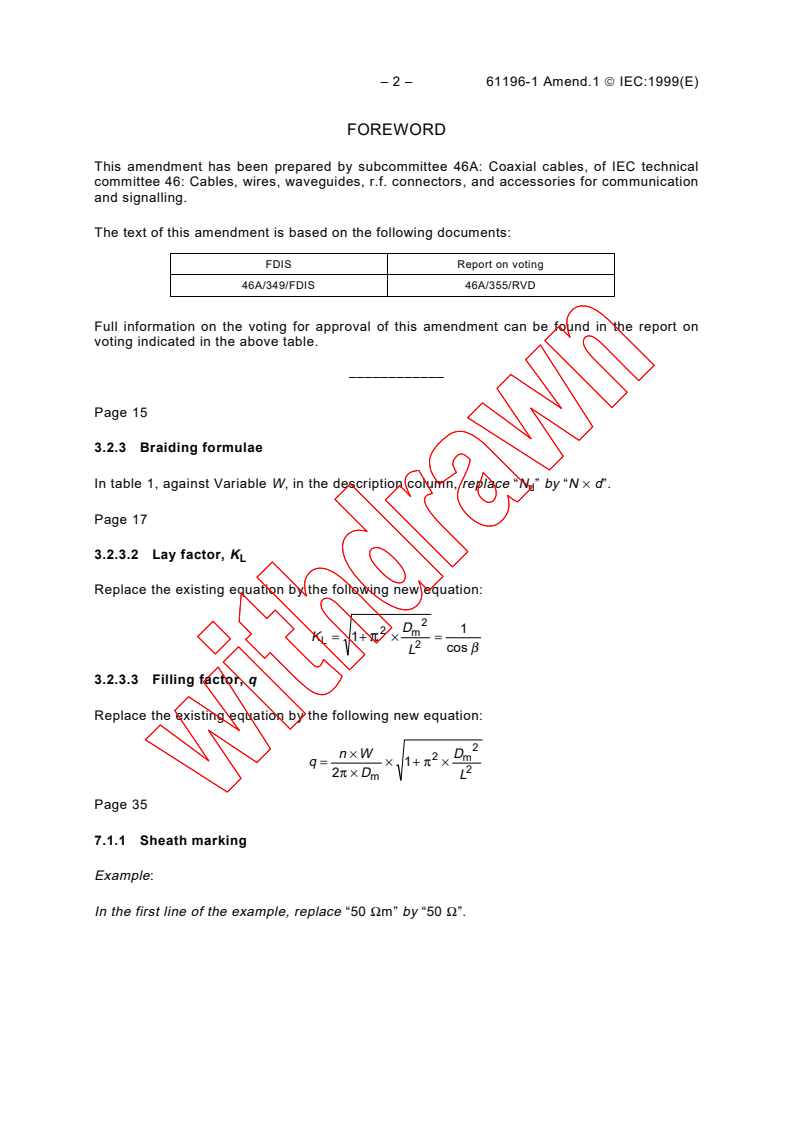
3.2.3.2 Lay factor, K
L
Replace the existing equation by the following new equation:
D 1
m
K = 1+ π × =
L
cos β
L
3.2.3.3 Filling factor, q
Replace the existing equation by the following new equation:
n × W D
m
q = × 1+ π ×
π ×
2 D
L
m
Page 35
7.1.1 Sheath marking
Example:
In the first line of the example, replace “50 Ωm” by “50 Ω”.
61196-1 Amend.1 IEC:1999(E) – 3 –
Page 41
9.1.5 Expression of results
Replace equation (1) by the following new equation:
2(D − D )
1 2
ovality (%) = × 100 (1)
D + D
1 2
Page 43
9.2.5 Expression of results
Replace equation (2) by the following new equation:
(T − T )
max min
eccentricity (%) = × 100 (2)
D
Page 47
10.1.2 Preparation of test specimen
In figures 1a, 1b and 1c, on page 49, replace the tolerance “± 10 mm” by “± 2 mm”.
Page 49
10.1.3 Procedure
Replace, in the second line of the third paragraph, “10 mm/min” by “100 mm/min”.
Replace, in figure 2c, on page 53, “Centre conductor” by “Outer conductor”.
Page 55
10.2.4 Requirement
Replace the second sentence by the following:
The cable shall meet the electrical requirements specified in the relevant cable specification.
10.3.3 Procedure
Replace, in the first line of the first paragraph “.in accordance with test A of IEC 68-2-1.” by
“.in accordance with IEC 60068-2-1, test Aa, .”.
Page 59
10.6.3 Procedure
Replace, in the third line of the first paragraph “.in accordance with test B of IEC 68-2-2.”
by “.in accordance with IEC 60068-2-2, test Ba/Bb,.”.
– 4 – 61196-1 Amend.1 IEC:1999(E)
Page 61
10.7.3 Procedure
Replace, in the first line of the first paragraph “.in accordance with test B of IEC 68-2-2.” by
“.in accordance with IEC 60068-2-2, test Ba,.”.
Page 63
10.9.3 Procedure
Replace, in the first line of the first paragraph “.in accordance with test B of IEC 68-2-2.” by
“.in accordance with IEC 60068-2-2, test Bb,.” .
Page 69
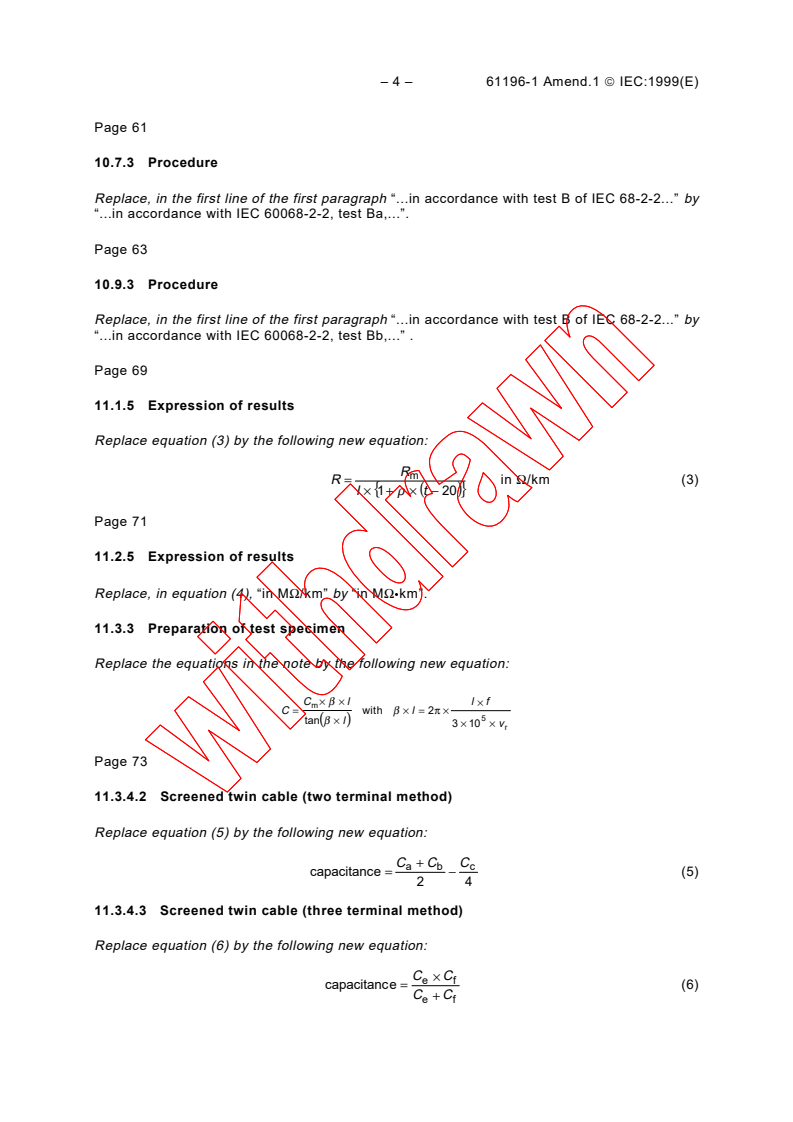
11.1.5 Expression of results
Replace equation (3) by the following new equation:
R
m
R = in Ω/km (3)
l × {}1+ ρ × ()t − 20
Page 71
11.2.5 Expression of results
Replace, in equation (4), “in MΩ/km” by “in MΩ�km”.
11.3.3 Preparation of test specimen
Replace the equations in the note by the following new equation:
C l
×β× l × f
m
C= with β × l = 2π ×
tan()β × l
3 × 10 × v
r
Page 73
11.3.4.2 Screened twin cable (two terminal method)
Replace equation (5) by the following new equation:
C + C C
a b c
capacitance = − (5)
2 4
11.3.4.3 Screened twin cable (three terminal method)
Replace equation (6) by the following new equation:
C × C
e f
capacitance = (6)
C + C
e f
61196-1 Amend.1 IEC:1999(E) – 5 –
Page 75
11.3.4.5 Capacitance unbalance of screened twin cables (three terminal method)
Replace equation (8) by the following new equation:
100 (C −C )
e f
capacitance unbalance = in % (corrected) (8)
C × C
e f
C
d
C + C
e f
11.4.4 Procedure
Replace, in the first paragraph, “.in accordance with test Na and Nb of IEC 68-2-14”, by “.in
accordance with IEC 60068-2-14, test Nb”.
Replace, in the third line of the second paragraph, “.at the end of each step” by “.at the end
of each cycle”.
Page 93
11.10.5.2 Procedure
Replace, after equation (17), “where l is in metres, l ≤ n ≤ 10” by “where l is in metres”.
Page 99
11.10.7 Electrical length and phase delay
Replace equation (24) by the following new equation:
ΔL 4
e
–3
≈ ≤ 10 (24)
L
D × f
e
3,e
Page 101
11.11.2.2 Temperature coefficient of phase constant
In equation (26), replace “CT” by “t ”.
c
Page 103
11.11.5.1 Layout
In figure 11, item 3, attenuator, replace “≥ 10 dBm” by “≥ 10 dB”.
Page 105
11.11.5.3 Expression of results
Replace, in the penultimate paragraph, “The sign of δb / b or TC is positive.” by “The sign
tot
of δb / b or t is positive.”.
tot c
– 6 – 61196-1 Amend.1 IEC:1999(E)
Page 109
11.11.6.3 Expression of results
In equation (30), replace “TC” by “t ”.
c
Page 111
11.11.7.3 Expression of results
In equation (32), replace “CT” by “t ”.
c
Page 115
11.12.3 Layout
In figure 14, item 1, sweep generator, delete “30 MHz to 1 000 MHz”.
Page 117
11.12.5.3 Accuracy of measurement
In the third sentence of the second paragraph, on page 119, replace “.over as wide a
frequency range as possible” by “.over a frequency range as wide as possible”.
Page 119
11.12.6 Procedure
Replace, on page 121, equation (42) by the following new equation:
3 (f − f ) l
2 1
(42)
n ≥
150 × ν
r
Page 133
11.13.7.2 Procedure
In the first line, delete the word “when”.
Replace the second line by “for an open-circuited test specimen when”.
Replace the fourth line by “for a short-circuited test specimen when”.
61196-1 Amend.1 IEC:1999(E) – 7 –
Page 135
11.13.7.3 Expression of results
Replace equation (52) by the following new equation:
Δf = (f – f ) / (n – n)(52)
n,2 n,1 2 1
Replace equation (53) by the following new equation:
8,686 × δf × π 100
α = × in dB/100 m at 20 °C (53)
2 × Δf × (1 + 0,002 × (t − 20)) l
Replace equation (54) by the following new equation:
150 × v
r
l = in metres (54)
Δf
where Δf is in megahertz (MHz).
Replace, on page 137, equation (57) by the following new equation:
868,6
α = × ln 1+ sin(b) + sin (b) (57)
l × (1 + 0,002 × (t − 20))
Page 141
11.16.2 Definitions
Replace, in the first line of the second paragraph, “.at the cable end plus the pulse
attenuation.” by “.at the cable end minus the pulse attenuation.”.
Page 143
11.16.4.1 Approximately sine squared pulse
Replace, in the second paragraph, “is the velocity ratio.” by “is the nominal relative velocity .”
Page 149
11.19.2 Definition
Replace equation (67) by the following new equation:
P ≈ U / Z (67)
u,max o
– 8 – 61196-1 Amend.1 IEC:1999(E)
Page 151
11.19.4.3 Test methods
In figure 28, on page 159, replace, in both the title and the X axis, “Power gain P /P dB” by
3 1
“Power gain P /P dB”.
R 1
Replace “a – a ” by “a = a ”.
k k,opt k k,opt
Replace “a = a + 3 dB” by “a = a ± 3 dB”.
k k,opt k k,opt
Replace “a = a + 6 dB” by “a = a ± 6 dB”.
k k,opt k k,opt
Page 161
After equations (73) and (74), under “where”, add “L is the series inductance”.
Replace equation (75) by the following new equation:
U × Z
o
U = (75)
a
(b × Z ) + Z(tan δ + )
o L
b
Page 163
Replace the line above equation (76) by the following:
“When at resonance ω LC = 1, with ω as the radian frequency, then the test voltage U is
defined as:”
Under equation (76), delete the two lines “and when at resonance ω LC = 1” and “with ω as
the radian frequency”.
2 2
Replace, in equation (77), “Z = Z et L/C = Z / a” by “Z = Z and L/C = Z /a”.
o o
Page 165
Replace equation (79), including the text “The maximum test current, I is defined as:” and the
explanatory text under “where” by the following:
When at resonance 1/ωC = ωL (79)
where
ω is the radian frequency;
C is the parallel capacitance;
L is the inductance of the test specimen.
61196-1 Amend.1 IEC:1999(E) – 9 –
Page 167
Replace equations (80), (81) and (82), including the text “At resonance”, by the following:
1/ωC = Z (2π l /λ)(80)
e o
1/ωC = Z × b (81)
then, the maximum test current I is defined as:
U
o
I = (82)
a
(b × Z) + Z (tan δ + )
o c
b
Replace the explanatory text under “where” by the following:
I is the electrical length of the test specimen;
e
λ
is the wavelength in free space at the test frequency;
o
U is the open-circuit voltage of the generator;
o
Z is the nominal characteristic impedance of the test specimen;
b is the phase shift of the test specimen, in radians;
a is the attenuation of the test specimen, in nepers;
δ is the loss angle of the parallel capacitance;
c
Z is the internal impedance of the generator.
o
Page 169
Replace, after equation (85), “v is the velocity ratio of the test specimen” by “v is the nominal
r r
relative velocity of the test specimen”.
Page 171
Replace equation (89) by the following new equation:
α (1+ 0,002 × (T −T )) + 0,5 × α
P
3 1,max a 2
d3
= (89)
P α (1+ 0,002 × (T −T )) + 0,5 × α
d1 1 1,max a 2
Under the equation, delete “η is the temperature coefficient of the outer conductor material”.
Page 173
Replace equation (92) by the following new equation:
α = α (1+ 0,002 × (T −T )) + α + α (1+ 0,002 × (T −T )) (92)
T 1 1,max a 2 3 1,max a
– 10 – 61196-1 Amend.1 IEC:1999(E)
11.19.5.2 Conversion formula for power rating versus frequency
Replace, on page 175, equation (97) by the following new equation:
α (f ) α (f ) + 0,5 × α (f )
T 1 1T 2 2 2
Y = × (97)
α (f ) α (f ) + 0,5 × α (f )
T 2 1T 1 2 1
Under the equation, replace “T” by “T ”.
a
Page 177
12.1.2.1 Electrically short cable lengths
In the note, replace “(λ is 300/ ε )” by “( λ = )”.
r
ε × f
r
12.1.2.2 Electrically long cable lengths
In figure 34, on page 179, replace “Test section l α D” by “Test section L”.
Replace equation (100) by the following new equation:
Z = max |Z ± Z | (100)
TE F T
Replace equation (101) by the following new equation:
U
2n
Z I × Z
02 2n 02
T = = (101)
n
U
1 I × Z
1 01
Z
Replace equation (102) by the following new equation:
U
2f
×
Z I Z
02 2f 02
T = = (102)
f
U
1 I × Z
1 01
Z
Page 181
12.1.4 Test set-up
Replace, on page 193, the second sentence of the third paragraph by the following:
For measurements in the range >1 GHz, the reflection factor of the feeding circuit including
the launcher should be ≤0,1.
12.1.5 Preparation of the test specimen (cable under test)
In the first line of the second paragraph, replace “(N, SKA)” by “(N, SMA)”.
61196-1 Amend.1 IEC:1999(E) – 11 –
Page 195
12.1.6.2 Uncontrolled currents
In the first sentence, replace “Special care in required.” by “Special care is required.”.
Page 199
12.1.8 Expression of results
Replace “Under consideration.” by the following new text:
From the test results above, both the effective transfer impedance Z and screening
TE
attenuation a can be calculated:
s
as defined: Z = Z ± Z → Z = max ()Z ; Z
TEn F T TE TEn TEf
f
2 π × f × L
a) Z ≈ × Z × Z × Env()T × 1+ (121)
TEn 01 02 n
f f
L v
±
where
Env(T ) is the envelope of the near-end/far-end coupling function;
n
f
L is the length of the cable under test (CUT).
−A /20
T
T =10
n (122)
f
v × v
1 2
v =
±
v ±v (123)
2 1
where
+ = near end and – = far end;
v is the phase velocity in the primary circuit;
v is the phase velocity in the secondary circuit.
A = A – (A /2) – (A /2) (see figure 58)
T s c j
NOTE – When Z >> Z , then Z ≈ Z , either near-end (T , v ) or far-end (T , v ) data may be used.
T F T TE n + f –
For practical purposes, it is preferable to use near-end measurement data for frequencies less than 30 MHz.
If Z >> Z then Z can be calculated by using the simplified procedure shown in figure 58, equation (131).
T F T
b) a = −20 log()max[]Env{}T ; Env{T} (124)
s 10 nf
The screening attenuation a shall also be presented in the normalized conditions |Δv/v | = 10 %
s 1
and Z = 150 Ω:
Z× 11 × v
TE 1
a()10 %/150 Ω≈−20 log (125)
s 10
2πf × Z × 150 Ω
– 12 – 61196-1 Amend.1 IEC:1999(E)
The screening attenuation is only valid for frequencies higher than the critical frequency.
v × v
1 2
f =
(126)
c
v − v × π × L
2 1
1 Input:
– frequency range
– impedance of CUT Z
– injection circuit Z
2 Measure reference data
A (dB)
o
3 Measure insertion loss of injection circuit
A = A' – A (dB) (127)
i i o
4 Measure insertion loss of CUT
A = A' – A (dB) (128)
c c o
5 Measure transfer function
A = A' – A (dB) (129)
s s o
6 A = A – (A /2) – (A /2) (dB) (130)
T s c i
−A /20
T
–1
(Z × Z ) × 10
Z = (2/L) × (Ω m ) (131)
T 01 02
7 Data output
Figure 58 – Computer flow chart, valid when Z >> Z
T F
Page 201
12.2.2 Definition
–1
In the second line of the first paragraph, replace “(Z /m )” by “(Z in mΩ/m)”.
T T
12.2.3 Test equipment
In the third line of the third paragraph, replace “.open end in soldered.” by “.open end is
soldered.”.
61196-1 Amend.1 IEC:1999(E) – 13 –
12.2.4.1 Method 1: Feeding through a resistance
Replace, on page 205, equation (104) by the following new equation:
2 2 22
(1− n ) x (cos x + m × sin x )
F′ = (104)
2 2
n{}cos x − cos(nx) +{sin x − n sin(nx)}
Page 207
12.2.4.2 Method 2: Direct feeding
Replace equation (106) by the following new equation:
(1− n )sin x
′′
F = (106)
2 2 2
{}{ }
n cos x − cos(nx) + sin x − nsin(nx)
Page 211
12.3.3.2 Pulse method
Replace, in the heading of the second column of the table, “Oscillator” by “Oscilloscope”.
Page 221
12.3.7 Determination of capacitance transfer impedance, Z
F
In the fourth line of the first paragraph, delete the word “reflector”.
12.4.1 Principle
In the third paragraph, replace “1 000 MHz” by “2 500 MHz”.
Add the following text after the third paragraph:
Absorbing clamps are commercially available for measurements from 30 MHz to 1 000 MHz
and from 300 MHz to 2 500 MHz.
Page 227
12.4.5.1 Method 1: Direct measurement
In figure 51, replace “5 = matching network if Z = Z .” by “5 = matching network if Z ≠
o 1 o
Z .”.
– 14 – 61196-1 Amend.1 IEC:1999(E)
Page 231
12.4.6.1 Insertion loss of the measuring set-up
On page 233, under equation (114), insert “λ” before “is the free space wavelength”.
Page 235
12.4.7 Expression of results
Replace the title of this subclause by the following new title.
12.4.7 Expression of test results and requirements
Replace the existing text by the following two new subclauses:
12.4.7.1 Expression of results
The screening attenuation a is defined as
s
P
a= 10 log (115)
s 10
()
max P ;P
2n2f
Where
P is the input power of the inner circuit of the test specimen;
P is the near-end cross-talk power of the matched outer circuit;
2n
P is the maximum far-end cross-talk power of the matched outer circuit;
2f
max (P ; P ) is the maximum power envelope to the near end or far end of the matched
2n 2f
outer circuit;
and
2 2
ω × Z × Z × ()v ± v
P 1 2 1 2
=
P
2n
Z± Z × ()v × v
f
F T 1 2
where
Z is the surface transfer impedance;
T
Z is the capacitive coupling impedance;
F
v is the propagation velocity of the inner circuit;
v is the propagation velocity of the outer circuit.
The test results are substantially dependent on the velocity difference between the inner and
outer circuit (v – v ). Therefore, the results shall also be presented in the standardized
1 2
condition where Z = 150 Ω and the velocity difference is 10 %. Normally, the standardized
condition gives a value of a that is 10 dB worse than the test results (see also table 5).
s
The measured powers indicated by the measuring receiver are P and P respectively.
4n 4f
61196-1 Amend.1 IEC:1999(E) – 15 –
Hence
P
a = 10 log − a
(116)
s 10 M
max()P ;P
4n4f
where
P is the power of the r.f. generator;
a is the insertion loss of the measuring set-up, according to 12.4.6;
M
max(P ; P ) is the maximum power envelope to the near end or far end indicated by the
4n 4f
measuring receiver.
NOTE – P = P + P .
2,max 2n 2f
12.4.7.2 Requirements
See table 5. Note that the surrounding conditions of the cable installation affect the clamp
measured a normally up to 10 dB, which should be subtracted from a .
s s
Page 237
12.5 Cable microphony charge level
Replace the title and “Under consideration.” by the following:
12.5 Cable microphony charge level (mechanically induced noise)
12.5.1 General
Coaxial cables, which are subjected to mechanical stresses such as shock, pulling force,
physical pressure or torsion, generate electrical charges which are noticeable as disturbing
currents or voltages on the cable.
These disturbances, referred to as “mechanically induced noises” or “cable microphony”, are
superimposed on the signals which the cable carries and become significant in the case of
low level signals.
The frequency range of these electro-mechanical transformations reaches up to about 20 kHz.
(In published literature, fast pulses up to the 1 GHz range are described, but they are not
included here.)
The advantage of the described measuring procedure is the precisely defined and controlled
excitation of the cable sample under test and the reproducibility of the measuring results.
For a simplified classification of cables with different noise behaviour, the cable microphony
charge level in dB micro-coulombs/metre (dB(μC/m)) is introduced as a unit of measure,
where 0 dB is 1 μC/m.
Specially designed cables have a microphony charge level of about –60 dB(μC/m), whereas
standard cables have a microphony charge level of about 0 dB(μC/m).
– 16 – 61196-1 Amend.1 IEC:1999(E)
12.5.2 Principle
The purpose of the test is to determine the charge which is generated in a cable when the
cable is subjected to mechanical stress.
12.5.3 Definition
cable microphony charge level: the logarithmic [20 log()] value of the ratio of the measured
charge related to the elongation ΔL (m) to 1 μC/m
12.5.4 Test equipment
Key
1 Generator, 0 kHz to 20 kHz
45a 6a
2 Power amplifier
3Vibrator
4 Accelerometer
5a Charge amplifier with extra double integrating
5b Charge amplifier
6a Oscilloscope, elongation measurement
2 3 5b 6b
6b Oscilloscope, microphony charge (level)
measurement
7Test rig
IEC 1066/99
8 Cable under test (CUT)
Figure 59 – Measurement set-up
12.5.5 Preparation of the test specimen
Three samples should be taken from a 10 m length of finished cable, at least 1 m apart from
each other. One end of each sample shall be provided with a suitable connector.
The other end of each sample shall be prepared to provide a closed screen against disturbing
noises from the environment. About 25 mm of the jacket shall be removed, leaving the braid
intact. The braid shall then be pushed back and a piece of the insulation shall be cut squarely.
The braid shall be stripped back and soldered without contact to the inner conductor.
12.5.6 Procedure
The cable under test is fixed at one end to the membrane of a vibrator and stretched with a
defined weight using special clamping jaws similar to a collet chuck (see 12.5.7.1). The free
end of the cable is connected to a charge amplifier.
The vibrator, which is fed with a sinusoidal signal, varies the stress on the cable under test
along its longitudinal axis. In this way both effects, the piezoelectric effect by strain in the
dielectric and the triboelectric effect by relative movement of the cable braid and dielectric are
stimulated and can be measured by only one measuring procedure.
The extension of the cable is measured and controlled by measuring the displacement of the
vibrator with an accelerometer. The accelerometer is fixed to the vibrator plate and connected
to one of the charge amplifiers. The output of the charge amplifier provides a voltage which is
proportional to the elongation of the cable by double integration of the accelerometer signal.
The cable under test is connected to an additional charge amplifier. The output of this charge
amplifier provides a voltage which is proportional to the charge in the cable under test and
may be connected to an oscilloscope or to a PC.
61196-1 Amend.1 IEC:1999(E) – 17 –
12.5.7 Measurement precautions
12.5.7.1 Fixing and mechanical pre-loading of the cable
The cable sample shall be fixed using special clamping jaws similar to a collet chuck. Care
shall be taken when fixing the sample so that induced torsion and undefined mechanical pre-
loading are avoided. Depending on torsion and/or pre-loading, different results of cable
microphony will be obtained. The sample may become compressed, which will cause errors in
the test results, therefore a defined mechanical pre-loading is required for repeatable results.
The defined mechanical pre-loading is obtained by using a guide pulley and a weight in
combination with the clamping jaws. Unless otherwise specified in the relevant cable
specification, a weight of 500 g is useful for cables with outer diameters up to 5 mm and a
weight of 1 kg for cables up to 10 mm outer diameters.
In order to avoid the cable sample hanging slack in the test rig with undefined mechanical
pre-loading, it is recommended that the test rig be so designed that the cable sample is
mounted vertically.
12.5.7.2 Elongation
The maximum relative elongation ΔL/L of the cable under test shall be within the dynamic
range of the cable in order to imitate a practical application, so that the cable is not destroyed
during the test procedure. In this dynamic range of relative elongation ΔL/L, of about 0,4 ‰
maximum the measured values show a linear increase with increasing relative elongation
ΔL/L.
12.5.7.3 Mechanical resonances
Under ideal conditions, the measured charge shows linear behaviour against frequency up to
approximately 20 kHz in the dynamic range of relative elongation ΔL/L of the cable sample.
Depending on the individual measuring set-up, at some frequencies, mechanical resonances
may occur, which are superimposed on the measured cable microphony and will corrupt the
results.
These mechanical resonances will be visible as peaks in the measured curve against
frequency. At these frequencies, the measured values are not valid.
To avoid mechanical resonances, attention should be paid to the rigid mounting of the
vibrator, and to the fixing points of the cable sample using only a few components having
short lever arms.
A ground plate of solid steel, mounted on a solid base, is recommended.
The preferred frequency range of excitation is 50 Hz to 200 Hz.
12.5.7.4 Reproducibility
As cable microphony varies along the length of the cable, reproducibility within reach of the
given measurement procedure is about factor 2 resp. within 6 dB. Where higher reproducibility
is required, the number of samples under test should be increased and statistical procedures
should be applied.
– 18 – 61196-1 Amend.1 IEC:1999(E)
12.5.7.5 Earth loops
In order to avoid unwanted earth loops, the charge amplifiers may be battery powered.
The frame of the test rig should act as a static screen to prevent the cable under test from
disturbing environmental LF noises.
12.5.8 Measurement conditions
The relative elongation ΔL/L of the cable sample shall be in the range of 0,1 ‰ to 0,5 ‰,
unless otherwise stated in the relevant cable specification.
Measurements shall be performed in a temperature range from 18 °C to 23 °C unless
otherwise stated in the relevant cable specification.
The frequency range of excitation shall be 50 Hz to 200 Hz, unless otherwise stated in the
relevant cable specification.
The variation coefficient, caused by mechanical resonances, shall be ≤10 % over the whole
measured frequency range.
Three measurements shall be taken with each of three different cable samples.
12.5.9 Expression of results
The correlation between acceleration a and distance s of the relative elongation ΔL/L of the
cable sample is given by:
s=s × sin ()ωt + θ (132)
o
d s
...