

IEC 61858-2:2014
(Main)Electrical insulation systems - Thermal evaluation of modifications to an established electrical insulation system (EIS) - Part 2: Form-wound EIS
General Information
- Abstract
IEC 61858-2:2014 lists the required test procedures for qualification of modifications of an established electrical insulation system (EIS) with respect to its thermal classification. This standard is applicable to EIS used in form-wound electrotechnical devices. The test procedures are comparative in that the performance of a candidate EIS is compared to that of a reference EIS, which has proven service experience in accordance with IEC 60505 or has been evaluated by one of the procedures given in IEC 60085 and IEC 60034-18-31.
- Status
- Published
- Publication Date
- 11-Feb-2014
- Technical Committee
- TC 112 - Evaluation and qualification of electrical insulating materials and systems
- Drafting Committee
- WG 6 - TC 112/WG 6
- Current Stage
- PPUB - Publication issued
- Start Date
- 12-Feb-2014
- Completion Date
- 30-Apr-2014
Buy Documents
IEC 61858-2:2014 - Electrical insulation systems - Thermal evaluation of modifications to an established electrical insulation system (EIS) - Part 2: Form-wound EIS Released:2/12/2014
IEC 61858-2:2014 Overview
IEC 61858-2:2014 is an international standard that defines the thermal evaluation procedures for modifications to an established electrical insulation system (EIS), specifically focusing on form-wound EIS used in electrotechnical devices. This part of the IEC 61858 series provides comparative test methods to assess how changes in an EIS affect its thermal classification, ensuring reliability and safety in electrical insulation systems. The standard emphasizes comparing the performance of a candidate EIS against a reference EIS with proven service experience following IEC 60505 or validated by IEC 60085 and IEC 60034-18-31.
By following IEC 61858-2, manufacturers and engineers can confidently qualify changes such as substitutions, additions, or thickness modifications in the insulation system, maintaining the quality and durability essential for high-performance electrical machines.
Key Topics Covered
- Thermal Classification and Evaluation: Establishes test procedures to assess thermal endurance and ranking of modifications to form-wound insulation systems.
- Comparative Testing Framework: Candidate EIS materials or components are evaluated relative to a reference system with established service history.
- Scope of Modifications: Includes substitution of phase or ground insulation layers, winding wire, and impregnating resin or varnish; evaluation of additives; and thickness adjustments.
- Specific Procedures:
- Procedure C: Single-point thermal aging test to determine relative thermal endurance index (RTE)
- Procedure D: Full thermal aging test for comprehensive thermal classification validation
- Relevant Materials: Focuses on rectangular winding wires, impregnating resins, and additives used within form-wound coils.
- Normative References: Incorporates related standards such as IEC 60085 (Thermal Evaluation), IEC 60034-18-31 (Thermal Classification for Form-wound Windings), and IEC 60317 series (Winding Wire Specifications).
Practical Applications
IEC 61858-2 is essential for professionals involved in electrical machine manufacturing, quality assurance, and product development:
- Form-Wound Coil Manufacturing: Ensures thermal integrity when changing insulation components during winding, impregnation, or finishing stages.
- Electrical Machine Design: Helps designers verify insulation suitability for thermal stress in motors, generators, transformers, and other electrotechnical equipment.
- Material Qualification: Aids materials engineers in qualifying new wire enamel coatings, resin formulas, or insulating fillers without compromising thermal ratings.
- Quality Control and Compliance: Provides manufacturers with standardized testing to demonstrate product safety and conformity with international thermal endurance requirements.
- Reliability Improvement: Supports maintenance of thermal longevity and prevention of insulation failure due to overheating by rigorous testing of modified systems.
Related Standards
- IEC 60505: Evaluation and qualification of electrical insulating materials and systems – foundational principles referenced in IEC 61858-2.
- IEC 60085: Electrical insulation – Thermal evaluation and designation – core thermal classification guidance.
- IEC 60034-18-31: Functional evaluation of insulation systems for rotating electrical machines – specific to form-wound winding applications.
- IEC 60216 Series: Thermal endurance properties of electrical insulating materials – details methods for determining thermal ageing indices.
- IEC 60317 Series: Specifications for particular types of winding wires – critical for wire material standardization in form-wound EIS.
By adhering to IEC 61858-2:2014, stakeholders in the electrotechnical industry ensure that modifications to insulation systems uphold thermal performance standards, thereby enhancing machine reliability, performance longevity, and operational safety. This standard is key in the qualification and certification processes of form-wound electrical insulation systems in motors, generators, transformers, and related applications.
Buy Documents
IEC 61858-2:2014 - Electrical insulation systems - Thermal evaluation of modifications to an established electrical insulation system (EIS) - Part 2: Form-wound EIS Released:2/12/2014
Get Certified
Connect with accredited certification bodies for this standard

IMQ S.p.A. (Certification)
Italian electrical product certification.

SLG Prüf- und Zertifizierungs GmbH
German testing and certification body.

UL Solutions
Global safety science company with testing, inspection and certification.
Sponsored listings
Frequently Asked Questions
IEC 61858-2:2014 is a standard published by the International Electrotechnical Commission (IEC). Its full title is "Electrical insulation systems - Thermal evaluation of modifications to an established electrical insulation system (EIS) - Part 2: Form-wound EIS". This standard covers: IEC 61858-2:2014 lists the required test procedures for qualification of modifications of an established electrical insulation system (EIS) with respect to its thermal classification. This standard is applicable to EIS used in form-wound electrotechnical devices. The test procedures are comparative in that the performance of a candidate EIS is compared to that of a reference EIS, which has proven service experience in accordance with IEC 60505 or has been evaluated by one of the procedures given in IEC 60085 and IEC 60034-18-31.
IEC 61858-2:2014 lists the required test procedures for qualification of modifications of an established electrical insulation system (EIS) with respect to its thermal classification. This standard is applicable to EIS used in form-wound electrotechnical devices. The test procedures are comparative in that the performance of a candidate EIS is compared to that of a reference EIS, which has proven service experience in accordance with IEC 60505 or has been evaluated by one of the procedures given in IEC 60085 and IEC 60034-18-31.
IEC 61858-2:2014 is classified under the following ICS (International Classification for Standards) categories: 29.080.30 - Insulation systems. The ICS classification helps identify the subject area and facilitates finding related standards.
IEC 61858-2:2014 is available in PDF format for immediate download after purchase. The document can be added to your cart and obtained through the secure checkout process. Digital delivery ensures instant access to the complete standard document.
Standards Content (Sample)
IEC 61858-2 ®
Edition 1.0 2014-02
INTERNATIONAL
STANDARD
NORME
INTERNATIONALE
colour
inside
Electrical insulation systems – Thermal evaluation of modifications to an
established electrical insulation system (EIS) –
Part 2: Form-wound EIS
Systèmes d'isolation électrique – Évaluation thermique des modifications
apportées à un système d’isolation électrique (SIE) éprouvé –
Partie 2: Système d’isolation électrique à enroulements préformés
All rights reserved. Unless otherwise specified, no part of this publication may be reproduced or utilized in any form
or by any means, electronic or mechanical, including photocopying and microfilm, without permission in writing from
either IEC or IEC's member National Committee in the country of the requester. If you have any questions about IEC
copyright or have an enquiry about obtaining additional rights to this publication, please contact the address below or
your local IEC member National Committee for further information.
Droits de reproduction réservés. Sauf indication contraire, aucune partie de cette publication ne peut être reproduite
ni utilisée sous quelque forme que ce soit et par aucun procédé, électronique ou mécanique, y compris la photocopie
et les microfilms, sans l'accord écrit de l'IEC ou du Comité national de l'IEC du pays du demandeur. Si vous avez des
questions sur le copyright de l'IEC ou si vous désirez obtenir des droits supplémentaires sur cette publication, utilisez
les coordonnées ci-après ou contactez le Comité national de l'IEC de votre pays de résidence.
IEC Central Office Tel.: +41 22 919 02 11
3, rue de Varembé Fax: +41 22 919 03 00
CH-1211 Geneva 20 info@iec.ch
Switzerland www.iec.ch
About the IEC
The International Electrotechnical Commission (IEC) is the leading global organization that prepares and publishes
International Standards for all electrical, electronic and related technologies.
About IEC publications
The technical content of IEC publications is kept under constant review by the IEC. Please make sure that you have the
latest edition, a corrigenda or an amendment might have been published.
IEC Catalogue - webstore.iec.ch/catalogue Electropedia - www.electropedia.org
The stand-alone application for consulting the entire The world's leading online dictionary of electronic and
bibliographical information on IEC International Standards, electrical terms containing more than 30 000 terms and
Technical Specifications, Technical Reports and other definitions in English and French, with equivalent terms in 14
documents. Available for PC, Mac OS, Android Tablets and additional languages. Also known as the International
iPad. Electrotechnical Vocabulary (IEV) online.
IEC publications search - www.iec.ch/searchpub IEC Glossary - std.iec.ch/glossary
The advanced search enables to find IEC publications by a More than 55 000 electrotechnical terminology entries in
variety of criteria (reference number, text, technical English and French extracted from the Terms and Definitions
committee,…). It also gives information on projects, replaced clause of IEC publications issued since 2002. Some entries
and withdrawn publications. have been collected from earlier publications of IEC TC 37,
77, 86 and CISPR.
IEC Just Published - webstore.iec.ch/justpublished
Stay up to date on all new IEC publications. Just Published IEC Customer Service Centre - webstore.iec.ch/csc
details all new publications released. Available online and If you wish to give us your feedback on this publication or
also once a month by email. need further assistance, please contact the Customer Service
Centre: csc@iec.ch.
A propos de l'IEC
La Commission Electrotechnique Internationale (IEC) est la première organisation mondiale qui élabore et publie des
Normes internationales pour tout ce qui a trait à l'électricité, à l'électronique et aux technologies apparentées.
A propos des publications IEC
Le contenu technique des publications IEC est constamment revu. Veuillez vous assurer que vous possédez l’édition la
plus récente, un corrigendum ou amendement peut avoir été publié.
Catalogue IEC - webstore.iec.ch/catalogue Electropedia - www.electropedia.org
Application autonome pour consulter tous les renseignements
Le premier dictionnaire en ligne de termes électroniques et
bibliographiques sur les Normes internationales,
électriques. Il contient plus de 30 000 termes et définitions en
Spécifications techniques, Rapports techniques et autres
anglais et en français, ainsi que les termes équivalents dans
documents de l'IEC. Disponible pour PC, Mac OS, tablettes
14 langues additionnelles. Egalement appelé Vocabulaire
Android et iPad.
Electrotechnique International (IEV) en ligne.
Recherche de publications IEC - www.iec.ch/searchpub
Glossaire IEC - std.iec.ch/glossary
Plus de 55 000 entrées terminologiques électrotechniques, en
La recherche avancée permet de trouver des publications IEC
en utilisant différents critères (numéro de référence, texte, anglais et en français, extraites des articles Termes et
comité d’études,…). Elle donne aussi des informations sur les Définitions des publications IEC parues depuis 2002. Plus
projets et les publications remplacées ou retirées. certaines entrées antérieures extraites des publications des
CE 37, 77, 86 et CISPR de l'IEC.
IEC Just Published - webstore.iec.ch/justpublished
Service Clients - webstore.iec.ch/csc
Restez informé sur les nouvelles publications IEC. Just
Published détaille les nouvelles publications parues. Si vous désirez nous donner des commentaires sur cette
Disponible en ligne et aussi une fois par mois par email. publication ou si vous avez des questions contactez-nous:
csc@iec.ch.
IEC 61858-2 ®
Edition 1.0 2014-02
INTERNATIONAL
STANDARD
NORME
INTERNATIONALE
colour
inside
Electrical insulation systems – Thermal evaluation of modifications to an
established electrical insulation system (EIS) –
Part 2: Form-wound EIS
Systèmes d'isolation électrique – Évaluation thermique des modifications
apportées à un système d’isolation électrique (SIE) éprouvé –
Partie 2: Système d’isolation électrique à enroulements préformés
INTERNATIONAL
ELECTROTECHNICAL
COMMISSION
COMMISSION
ELECTROTECHNIQUE
PRICE CODE
INTERNATIONALE
CODE PRIX T
ICS 29.080.30 ISBN 978-2-8322-1394-0
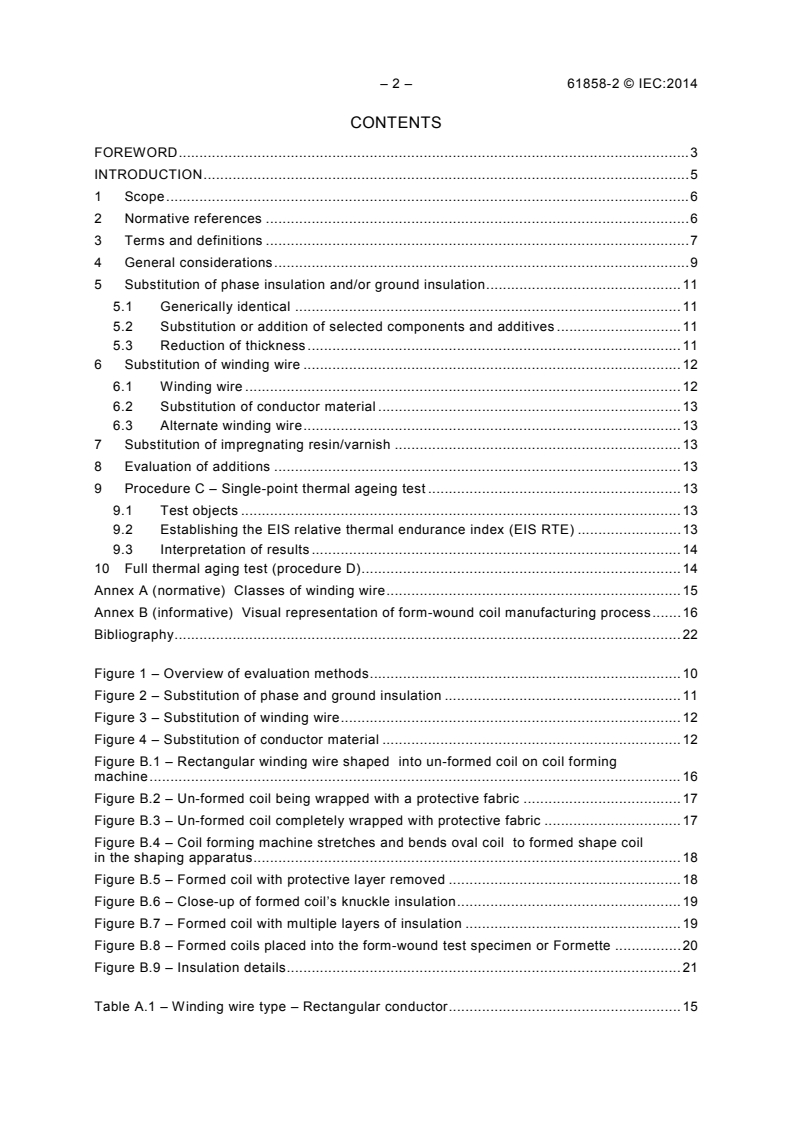
– 2 – 61858-2 © IEC:2014
CONTENTS
FOREWORD . 3
INTRODUCTION . 5
1 Scope . 6
2 Normative references . 6
3 Terms and definitions . 7
4 General considerations . 9
5 Substitution of phase insulation and/or ground insulation . 11
5.1 Generically identical . 11
5.2 Substitution or addition of selected components and additives . 11
5.3 Reduction of thickness . 11
6 Substitution of winding wire . 12
6.1 Winding wire . 12
6.2 Substitution of conductor material . 13
6.3 Alternate winding wire . 13
7 Substitution of impregnating resin/varnish . 13
8 Evaluation of additions . 13
9 Procedure C – Single-point thermal ageing test . 13
9.1 Test objects . 13
9.2 Establishing the EIS relative thermal endurance index (EIS RTE) . 13
9.3 Interpretation of results . 14
10 Full thermal aging test (procedure D) . 14
Annex A (normative) Classes of winding wire . 15
Annex B (informative) Visual representation of form-wound coil manufacturing process . 16
Bibliography . 22
Figure 1 – Overview of evaluation methods . 10
Figure 2 – Substitution of phase and ground insulation . 11
Figure 3 – Substitution of winding wire . 12
Figure 4 – Substitution of conductor material . 12
Figure B.1 – Rectangular winding wire shaped into un-formed coil on coil forming
machine . 16
Figure B.2 – Un-formed coil being wrapped with a protective fabric . 17
Figure B.3 – Un-formed coil completely wrapped with protective fabric . 17
Figure B.4 – Coil forming machine stretches and bends oval coil to formed shape coil
in the shaping apparatus . 18
Figure B.5 – Formed coil with protective layer removed . 18
Figure B.6 – Close-up of formed coil’s knuckle insulation . 19
Figure B.7 – Formed coil with multiple layers of insulation . 19
Figure B.8 – Formed coils placed into the form-wound test specimen or Formette . 20
Figure B.9 – Insulation details . 21
Table A.1 – Winding wire type – Rectangular conductor . 15
61858-2 © IEC:2014 – 3 –
INTERNATIONAL ELECTROTECHNICAL COMMISSION
____________
ELECTRICAL INSULATION SYSTEMS –
THERMAL EVALUATION OF MODIFICATIONS TO
AN ESTABLISHED ELECTRICAL INSULATION SYSTEM (EIS) –
Part-2: Form-wound EIS
FOREWORD
1) The International Electrotechnical Commission (IEC) is a worldwide organization for standardization comprising
all national electrotechnical committees (IEC National Committees). The object of IEC is to promote
international co-operation on all questions concerning standardization in the electrical and electronic fields. To
this end and in addition to other activities, IEC publishes International Standards, Technical Specifications,
Technical Reports, Publicly Available Specifications (PAS) and Guides (hereafter referred to as “IEC
Publication(s)”). Their preparation is entrusted to technical committees; any IEC National Committee interested
in the subject dealt with may participate in this preparatory work. International, governmental and non-
governmental organizations liaising with the IEC also participate in this preparation. IEC collaborates closely
with the International Organization for Standardization (ISO) in accordance with conditions determined by
agreement between the two organizations.
2) The formal decisions or agreements of IEC on technical matters express, as nearly as possible, an international
consensus of opinion on the relevant subjects since each technical committee has representation from all
interested IEC National Committees.
3) IEC Publications have the form of recommendations for international use and are accepted by IEC National
Committees in that sense. While all reasonable efforts are made to ensure that the technical content of IEC
Publications is accurate, IEC cannot be held responsible for the way in which they are used or for any
misinterpretation by any end user.
4) In order to promote international uniformity, IEC National Committees undertake to apply IEC Publications
transparently to the maximum extent possible in their national and regional publications. Any divergence
between any IEC Publication and the corresponding national or regional publication shall be clearly indicated in
the latter.
5) IEC itself does not provide any attestation of conformity. Independent certification bodies provide conformity
assessment services and, in some areas, access to IEC marks of conformity. IEC is not responsible for any
services carried out by independent certification bodies.
6) All users should ensure that they have the latest edition of this publication.
7) No liability shall attach to IEC or its directors, employees, servants or agents including individual experts and
members of its technical committees and IEC National Committees for any personal injury, property damage or
other damage of any nature whatsoever, whether direct or indirect, or for costs (including legal fees) and
expenses arising out of the publication, use of, or reliance upon, this IEC Publication or any other IEC
Publications.
8) Attention is drawn to the Normative references cited in this publication. Use of the referenced publications is
indispensable for the correct application of this publication.
9) Attention is drawn to the possibility that some of the elements of this IEC Publication may be the subject of
patent rights. IEC shall not be held responsible for identifying any or all such patent rights.
International Standard IEC 61858-2 has been prepared by IEC technical committee 112:
Evaluation and qualification of electrical insulating materials and systems.
The text of this standard is based on the following documents:
CDV Report on voting
112/253/CDV 112/274/RVC
Full information on the voting for the approval of this standard can be found in the report on
voting indicated in the above table.
This publication has been drafted in accordance with the ISO/IEC Directives, Part 2.
– 4 – 61858-2 © IEC:2014
A list of all parts in the IEC 61858 series, published under the general title Electrical
insulation systems – Thermal evaluation of modifications to an established insulation system
(EIS), can be found on the IEC website.
The committee has decided that the contents of this publication will remain unchanged until
the stability date indicated on the IEC web site under "http://webstore.iec.ch" in the data
related to the specific publication. At this date, the publication will be
• reconfirmed,
• withdrawn,
• replaced by a revised edition, or
• amended.
IMPORTANT – The 'colour inside' logo on the cover page of this publication indicates
that it contains colours which are considered to be useful for the correct
understanding of its contents. Users should therefore print this document using a
colour printer.
61858-2 © IEC:2014 – 5 –
INTRODUCTION
This International Standard describes procedures for the evaluation of changes to an
established electrical insulation system (EIS) for form-wound electro technical devices and
the effect of these changes on the thermal classification of the established EIS.
This Part 2 of IEC 61858 is for form-wound EIS. Part 1 of IEC 61858 addresses modifications
of wire-wound EIS.
General principles for evaluation and qualification of EIS can be found in IEC 60505. Unless
the procedures of this standard indicate otherwise, the principles of IEC 60505 should be
followed.
– 6 – 61858-2 © IEC:2014
ELECTRICAL INSULATION SYSTEMS –
THERMAL EVALUATION OF MODIFICATIONS TO
AN ESTABLISHED ELECTRICAL INSULATION SYSTEM (EIS) –
Part-2: Form-wound EIS
1 Scope
This part of IEC 61858 lists the required test procedures for qualification of modifications of
an established electrical insulation system (EIS) with respect to its thermal classification. This
standard is applicable to EIS used in form-wound electrotechnical devices. The test
procedures are comparative in that the performance of a candidate EIS is compared to that of
a reference EIS, which has proven service experience in accordance with IEC 60505 or has
been evaluated by one of the procedures given in IEC 60085 and IEC 60034-18-31.
2 Normative references
The following documents, in whole or in part, are normatively referenced in this document and
are indispensable for its application. For dated references, only the edition cited applies. For
undated references, the latest edition of the referenced document (including any
amendments) applies.
IEC 60085:2007, Electrical insulation – Thermal evaluation and designation
IEC 60034-18-31:2012, Rotating electrical machines – Part 18-31: Functional evaluation of
insulation systems – Test procedures for form-wound windings – Thermal evaluation and
classification of insulation systems used in rotating machines
IEC 60216-5, Electrical insulating materials – Thermal endurance properties – Part 5:
Determination of relative thermal endurance index (RTE) of an insulating material
IEC 60216-6, Electrical insulating materials – Thermal endurance properties – Part 6:
Determination of thermal endurance indices (TI and RTI) of an insulating material using the
fixed time frame method
IEC 60317 (all parts), Specifications for particular types of winding wires
IEC 60317-16, Specifications for particular types of winding wires – Part 16: Polyester
enamelled rectangular copper wire, class 155
(withdrawn)
IEC 60317-17, Specifications for particular types of winding wires – Part 17: Polyvinyl acetal
enamelled rectangular copper wire, class 105
IEC 60317-18, Specifications for particular types of winding wires – Part 18: Polyvinyl acetal
enamelled rectangular copper wire, class 120
IEC 60317-27, Specifications for particular types of winding wires – Part 27: Paper tape
covered rectangular copper wire
———————
Withdrawn in 2012.
61858-2 © IEC:2014 – 7 –
IEC 60317-28, Specifications for particular types of winding wires – Part 28: Polyesterimide
enamelled rectangular copper wire, class 180
IEC 60317-29, Specifications for particular types of winding wires – Part 29: Polyester or
polyesterimide overcoated with polyamide-imide enamelled rectangular copper wire, class 200
IEC 60317-30, Specifications for particular types of winding wires – Part 30: Polyimide
enamelled rectangular copper wire, class 220
(withdrawn)
IEC 60317-31, Specifications for particular types of winding wires – Part 31: Glass-fibre
wound, polyester or polyesterimide varnish-trated, bare or enamelled rectangular copper wire,
temperature index 180
IEC 60317-32, Specifications for particular types of winding wires – Part 32: Glass-fibre
wound resin or varnish impregnated, bare or enamelled rectangular copper wire, temperature
index 155
IEC 60317-33, Specifications for particular types of winding wires – Part 33: Glass-fibre
wound resin or varnish impregnated, bare or enamelled rectangular copper wire, temperature
index 200
IEC 60317-39, Specifications for particular types of winding wires – Part 39: Glass-fibre
braided, polyester or polyesterimide varnish-treated, bare or enamelled rectangular copper
wire, temperature index 180
IEC 60317-40, Specifications for particular types of winding wires – Part 40: Glass-fibre
braided, silicone varnish-tratead, bare or enamelled rectangular copper wire, temperature
index 200
IEC 60317-44, Specifications for particular types of winding wires – Part 44: Aromatic
polyimide tape wrapped rectangular copper wire, class 240
IEC 60317-47, Specifications for particular types of winding wires – Part 47: Aromatic
polyimide enamelled rectangular copper wire, class 240
IEC 60317-53, Specifications for particular types of winding wires – Part 53: Aromatic
polyamide (aramid) tape wrapped rectangular copper wire, temperature index 220
IEC 60317-58, Specifications for particular types of winding wires – Part 58: Polyamide-imide
enamelled rectangular copper wire, class 220
IEC 60505, Evaluation and qualification of electrical insulation systems
3 Terms and definitions
For the purposes of this document, the following terms and definitions apply.
3.1
enamelled winding wire
insulated conductors, round or shaped, where the insulation is applied in a liquid form and
applied to the conductor, made in accordance with the IEC 60317 series
———————
Withdrawn in 2009.
– 8 – 61858-2 © IEC:2014
3.2
wrapped insulated winding wire
insulated conductor, round or shaped, where the insulation is applied as a tape, with or
without an adhesive, made from a film or a paper and applied to the conductor, made in
accordance with the IEC 60317 series
3.3
random wire-wound coils
coils for use in an electrotechnical device made with enamelled winding wire without concern
for the location of the turns
3.4
precision wire-wound coils
coils for use in an electrotechnical device made with enamelled winding wire or sheet
conductor and insulation with each turn positioned in a specific and successive way
3.5
form-wound coils
rectangular wire formed to a coil for use in an electrotechnical device
Note 1 to entry: Usually made with an insulated conductor this may be enamelled, fibrous wrapped or enamelled
with fibrous wrapping. Afterwards the coil is wound it receives multiple layers of tape wrapped insulation and is
vacuum- or vacuum-pressure impregnated with a resin, or wrapped with sufficient layers of a pre-impregnated B-
stage tape and processed using resin-rich method.
3.6
wire-wound electrical insulation system
EIS evaluated with the wire wound coils that are either random or precision wound; not form
wound coils
3.7
wire-wound winding electrotechnical device
electrotechnical device designed utilizing a wire-wound EIS
3.8
electrical insulation system
EIS
insulating structure containing one or more electrical insulating materials (EIM) together with
associated conducting parts employed in an electrotechnical device
3.9
electrical insulating material
EIM
material with negligibly low electric conductivity, used to separate conducting parts at different
electrical potentials
3.10
candidate EIS
EIS under evaluation concerning its thermal endurance for service capability
3.11
reference EIS
established EIS evaluated on the basis of either a known service experience record or a
known comparative functional evaluation
3.12
EIS assessed thermal endurance index
EIS ATE
numerical value of temperature in degrees Celsius for the reference EIS as derived from
known service experience or a known comparative functional evaluation
61858-2 © IEC:2014 – 9 –
3.13
EIS relative thermal endurance index
EIS RTE
numerical value of the temperature in degrees Celsius of the candidate EIS which is relative
to the known EIS ATE of a reference EIS, when both EIS are subjected to the same ageing
and diagnostic procedures in a comparative test
4 General considerations
This standard provides relatively low cost and short-time methods by which the user can
make modifications to an established EIS by evaluating
a) the impact on the thermal life of the EIS if the thickness of an EIM is changed,
b) the compatibility, under thermal stress, of a substituted EIM,
c) the compatibility, under thermal stress, of other components used in intimate contact with
an established EIS.
EIM thermal indices (ATE/RTE) can be established by testing in accordance with IEC 60216-5
or IEC 60216-6. According to IEC 60505, an EIS may be constructed with EIMs having
different thermal indices. The thermal class of the EIS is established through testing and may
be higher or lower than any of the individual components.
There may be more than one EIS in a particular apparatus. These EIS may have different
thermal classes.
– 10 – 61858-2 © IEC:2014
Established EIS per IEC 60034-18-31
or IEC 60505
EIM modification of established EIS Evaluation of additions to
established EIS (8)
Addition of Addition
Change of
Substitution of EIM component
impregnating resin/ of other
thickness
varnish components
(5)
Impregnating
Phase or Ground Winding
resin/varnish
Insulation(5) Wire (6)
(7)
Substitution Substitution
allowed? allowed? (6.1)
Yes
No
No
Yes
Test per Clause 10
Single temperature Acceptable
aging test (Clause 9) results?
No
Yes
Acceptable
results? Can use in
EIS
No Yes
Modified EIS is acceptable
Test as new EIS according to IEC 60034-18-31
IEC 0519/14
Key
Single temperature EIS evaluation
No testing required
Full thermal aging EIS evaluation
Figure 1 – Overview of evaluation methods
NOTE Figure 1 provides guidance in selecting the proper clauses for evaluation of modifications to an established
form-wound EIS. Figure 1 serves as an overview for Clauses 5 to 8; Clauses 5 to 8 present details one category at
a time.
In Figures 2, 3, and 4, the following letters represent a test procedure as indicated below:
61858-2 © IEC:2014 – 11 –
• A = Procedure A: no testing required;
• B = Procedure B: sealed tube compatibility test (only utilized in IEC 61858-1);
• C = Procedure C: single-point thermal aging test (Clause 9);
• D = Procedure D: full thermal aging test (Clause 10).
5 Substitution of phase insulation and/or ground insulation
Generically
identical (5.1.1)
Yes No
C D
IEC 0520/14
Figure 2 – Substitution of phase and ground insulation
5.1 Generically identical
"Generically identical" refers to both chemical and physical properties of the original and
alternate materials. The alternate material shall have equal or better mechanical and
electrical performance in regards to the thermal endurance.
Based on application of other properties, e.g. water permeability or process ability, these are
critical to the performance of the system and should be considered prior to substitution.
Basic chemical composition and physical identity can be established by analytical data based
on appropriate spectroscopic analysis such as IR complimented with thermogravimetric,
differential thermal analysis (DTA) and absorption analysis. The specific tests should be
agreed upon by the interested parties.
Substitution of generically identical EIMs is allowed if it meets the criteria of Clause 9.
5.2 Substitution or addition of selected components and additives
Substitution or addition of select additives (e.g. colorants, fillers, etc.) in an EIM may be
allowed with reduced or no additional testing if agreed upon by all interested parties.
An EIM evaluated as part of the established EIS, used in combination with another EIM or
other component, may be used based upon acceptable results when tested in accordance
with Clause 9. The thickness of the established EIM shall not be less than that which was
evaluated in the established EIS.
5.3 Reduction of thickness
An EIM in the established EIS can be used at a reduced thickness if it is successfully
evaluated in accordance with Clause 9.
If none of the above conditions are met, full thermal aging in accordance with Clause 10 shall
be conducted.
– 12 – 61858-2 © IEC:2014
6 Substitution of winding wire
Same chemical composition of
coating and equal or greater thermal
endurance rating (6.1 a)
Yes No
Same chemical composition
coating with equal or greater
thermal class rating but corners are
a different shape or radius (6.1 b)
No Yes
A C D
IEC 0521/14
Figure 3 – Substitution of winding wire
6.1 Winding wire
Substitution of a winding wire evaluated in the established EIS can be made without additional
testing when one or more of the following conditions have been met:
a) the winding wire conforms to an IEC 60317 specification having the same chemical
composition, according to the Annex A groupings, as the winding wire evaluated in the
established EIS and has an equal or higher thermal class with an equal build;
and
b) the conductor is of a different size or shape, but the radius of the corners are the equal.
Tested with copper Tested with
(6.4) aluminium (6.4)
The insulation on the substitute aluminium The insulation on the substitute copper
conductor has the same chemical conductor has the same chemical
composition and the same or better thermal composition and the same or better thermal
rating rating
No
Yes No Yes
A D A D
IEC 0522/14
Figure 4 – Substitution of conductor material
61858-2 © IEC:2014 – 13 –
6.2 Substitution of conductor material
An established EIS, which has been evaluated with copper as the conductor, may use either
copper or aluminium conductor.
An established EIS, which has been evaluated with aluminium as the conductor, may use
either aluminium or copper conductor, provided the thermal performance of the substitute
winding wire has been established to be equal to or better than the winding wire evaluated.
6.3 Alternate winding wire
Winding wires that do not meet the criteria in 6.1 or 6.2 shall be evaluated in accordance with
case D of IEC 60034-18-31:2012.
7 Substitution of impregnating resin/varnish
Substitution of impregnating resin/varnish is allowed if it meets the criteria of Clause 9.
8 Evaluation of additions
Any potential additions to the EIS tested in accordance with IEC 60034-18-31, shall meet the
criteria of Clause 9.
9 Procedure C – Single-point thermal ageing test
9.1 Test objects
Representative test objects of the established EIS (reference EIS) and the candidate EIS shall
be constructed and tested in accordance with IEC 60034-18-31 with the following exceptions:
a) the reference and candidate EIS shall be concurrently tested at the same temperature;
b) the ageing temperature shall be selected from the full thermal ageing program of the
established EIS to give an expected test life of between 1 000 h to 2 000 h;
c) when an EIM, evaluated in the established EIS with multiple EIM, is no longer available,
the reference test objects shall be constructed with all remaining materials.
9.2 Establishing the EIS relative thermal endurance index (EIS RTE)
The RTE of the candidate EIS shall be established by comparing the original regression slope
of the reference EIS with the time–temperature data point for the candidate EIS. The
comparison shall be made using the correlation time established according to:
Correlation time
M M
−
T + 273,15 T + 273,15
R A
t = t ×e
x R
EIS RTE of the candidate EIS
M
T = − 273,15
c
t M
x
ln +
t T + 273,15
c A
– 14 – 61858-2 © IEC:2014
where
M is the slope of the reference EIS regression equation;
T is the EIS ATE of the reference EIS, in degrees Celsius (°C);
R
T is the ageing temperature in degrees Celsius (°C);
A
T is the EIS RTE of the candidate system in degrees Celsius (°C);
c
t is the life of the reference EIS in hours (h);
R
t is the life of the candidate EIS in hours (h);
c
t is the correlation time in hours (h).
x
NOTE The procedure is largely approximated, assuming that reference and candidate EIS have the same slope of
the thermal endurance line.
9.3 Interpretation of results
The candidate EIS shall be assigned the same thermal class rating as the reference EIS if the
EIS RTE value, derived in 9.2, is within ±5 K of the EIS ATE value of the reference EIS. If the
RTE value of the candidate EIS is not within ±5 K of the ATE value of the reference EIS, no
thermal class rating shall be assigned to the candidate EIS. The candidate EIS can be aged
at additional temperatures in accordance with IEC 60034-18-31 in order to establish the
thermal class.
10 Full thermal aging test (procedure D)
Full thermal aging test shall be evaluated in accordance with the IEC 60034-18-31.
61858-2 © IEC:2014 – 15 –
Annex A
(normative)
Classes of winding wire
Various types of commonly used enamelled winding wire, constructed in accordance with the
IEC 60317 series, are presented in Table A.1. The accepted practice for substitution of
winding wire is as follows:
a) winding wires of the same chemical composition with a thermal class equal to or higher
than the type of wire evaluated in the established EIS may be substituted into the
established EIS without additional testing;
b) winding wire of the same chemical composition having a thermal classification lower than
the thermal class of the wire type(s) evaluated in the established EIS shall not be
substituted;
c) winding wire that is not of the same chemical composition evaluated in the established
EIS shall not be substituted
d) winding wire substitutions not permitted under either b) or c) shall be tested according to
IEC 61858-1.
Table A.1 – Winding wire type – Rectangular conductor
Chemical composition of enamel Thermal class IEC
Conductor
(non solderable) Designation
Polyvinyl acetal 105 Copper 60317-17
Polyvinyl acetal 120 Copper 60317-18
Paper tape covered Copper 60317-27
Polyester 155 Copper 60317-16
Micapaper-PET film 155 Copper
Glass fibre wound resin or varnish impregnated 155 Copper 60317-32
Polyesterimide 180 Copper 60317-28
Glass fibre wound resin or varnish impregnated 180 Copper 60317-31
Glass fibre braided resin or varnish impregnated 180 Copper 60317-39
Glass fibre wound resin or varnish impregnated 200 Copper 60317-33
Polyester or polyesterimide/polyamide-imide overcoated 200 Copper 60317-29
Glass fibre braided resin or varnish impregnated 200 Copper 60317-40
Polyimide enamelled 220 Copper 60317-30
Aromatic polyamide (aramid), tape wrapped 220 Copper 60317-53
Aromatic polyamide-imide 220 Copper 60317-58
Aromatic polyimide 240 Copper 60317-47
Aromatic polyimide, tape wrapped 240 Copper 60317-44
– 16 – 61858-2 © IEC:2014
Annex B
(informative)
Visual representation of form-wound coil manufacturing process
Figures B.1 to B.9 illustrate the process involved in manufacturing form-wound coils.
NOTE Photos provided by courtesy of WuJiang Taihu Insulating Material Co., Ltd.
IEC 0523/14
Figure B.1 – Rectangular winding wire shaped
into un-formed coil on coil forming machine
61858-2 © IEC:2014 – 17 –
IEC 0524/14
Figure B.2 – Un-formed coil being wrapped with a protective fabric
IEC 0525/14
Figure B.3 – Un-formed coil completely wrapped with protective fabric
– 18 – 61858-2 © IEC:2014
IEC 0526/14
Figure B.4 – Coil forming machine stretches and bends oval coil
to formed shape coil in the shaping apparatus
IEC 0527/14
Figure B.5 – Formed coil with protective layer removed
61858-2 © IEC:2014 – 19 –
IEC 0528/14
Figure B.6 – Close-up of formed coil’s knuckle insulation
IEC 0529/14
Figure B.7 – Formed coil with multiple layers of insulation
– 20 – 61858-2 © IEC:2014
IEC 0530/14
Figure B.8 – Formed coils placed into the form-wound test specimen or Formette
61858-2 © IEC:2014 – 21 –
1. Top stick or wedge
2. Slot liner
3. Phase insulation
4. Coil representing phase A
5. Coil representing phase C
IEC 0531/14
Figure B.9 – Insulation details
– 22 – 61858-2 © IEC:2014
Bibliography
IEC 60172, Test procedure for the determination of the temperature index of enamelled
winding wires
_____________
– 24 – 61858-2 © IEC:2014
SOMMAIRE
AVANT-PROPOS . 25
INTRODUCTION . 27
1 Domaine d’application . 28
2 Références normatives . 28
3 Termes et définitions . 29
4 Conditions générales . 31
5 Substitution d'une isolation de phase et/ou d'une isolation de mise à la terre . 34
5.1 Génériquement identiques . 34
5.2 Substitution ou ajout de composants et d'additifs sélectionnés . 34
5.3 Réduction de l’épaisseur . 34
6 Substitution d’un fil de bobinage . 35
6.1 Fil de bobinage . 35
6.2 Substitution du matériau du conducteur . 36
6.3 Fil de bobinage de substitution . 36
7 Substitution de la résine et/ou du vernis d'imprégnation . 36
8 Évaluation des additions . 37
9 Procédure C – Essai de vieillissement thermique en un seul point . 37
9.1 Éprouvettes . 37
9.2 Indice d'endurance thermique relative du SIE (RTE du SIE) . 37
9.3 Interprétation des résultats . 38
10 Essai de vieillissement thermique complet (procédure D) . 38
Annexe A (normative) Classes de fil de bobinage . 39
Annexe B (informative) Représentation visuelle du processus de fabrication des
bobines préformées . 40
Bibliographie . 46
Figure 1 – Vue d'ensemble des méthodes d'évaluation . 33
Figure 2 – Substitution d'isolation de phase et d'isolation de mise à la terre . 34
Figure 3 – Substitution d'un fil de bobinage. 35
Figure 4 – Substitution du matériau du conducteur . 36
Figure B.1 – Fil de bobinage de section rectangulaire façonné en une bobine non
préformée sur une machine de formation de bobine . 40
Figure B.2 – Bobine non préformée, enveloppée par un tissu de protection . 41
Figure B.3 – Bobine non préformée, complètement enveloppée par un tissu de
protection . 41
Figure B.4 – Machine de formation de bobines qui étire et plie une bobine ovale pour
obtenir une bobine de profil formé dans l'appareillage de profilage . 42
Figure B.5 – Bobine formée avec couche de protection retirée . 42
Figure B.6 – Gros plan d'une isolation à emboîtement pour bobines formées . 43
Figure B.7 – Bobine formée avec plusieurs couches d’isolation . 43
Figure B.8 – Bobines formées placées dans l’éprouvette d’essai à enroulement
préformé ou Formette . 44
Figure B.9 – Détails de l’isolation . 45
Tableau A.1 – Type de fil de bobinage – Conducteur rectangulaire . 39
61858-2 © IEC:2014 – 25 –
COMMISSION ÉLECTROTECHNIQUE INTERNATIONALE
____________
SYSTÈMES D'ISOLATION ÉLECTRIQUE –
ÉVALUATION THERMIQUE DES MODIFICATIONS APPORTÉES À
UN SYSTÈME D’ISOLATION ÉLECTRIQUE (SIE) ÉPROUVÉ –
Partie 2: Système d’isolation électrique à enroulements préformés
AVANT-PROPOS
1) La Commission Electrotechnique Internationale (IEC) est une organisation mondiale de normalisation
composée de l'ensemble des comités électrotechniques nationaux (Comités nationaux de l’IEC). L’IEC a pour
objet de favoriser la coopération internationale pour toutes les questions de normalisation dans les domaines
de l'électricité et de l'électronique. A cet effet, l’IEC – entre autres activités – publie des Normes
internationales, des Spécifications techniques, des Rapports techniques, des Spécifications accessibles au
public (PAS) et des Guides (ci-après dénommés "Publication(s) de l’IEC"). Leur élaboration est confiée à des
comités d'études, aux travaux desquels tout Comité national intéressé par le sujet traité peut participer. Les
organisations internationales, gouvernementales et non gouvernementales, en liaison avec l’IEC, participent
également aux travaux. L’IEC collabore étroitement avec l'Organisation Internationale de Normalisation (ISO),
selon des conditions fixées par accord entre les deux organisations.
2) Les décisions ou accords officiels de l’IEC concernant les questions techniques représentent, dans la mesure
du possible, un accord international sur les sujets étudiés, étant donné que les Comités nationaux de l’IEC
intéress
...