

IEC 61000-4-15:1997/AMD1:2003
(Amendment)Amendment 1 - Electromagnetic compatibility (EMC) - Part 4: Testing and measurement techniques - Section 15: Flickermeter - Functional and design specifications
General Information
- Abstract
- Status
- Published
- Publication Date
- 12-Jan-2003
- Technical Committee
- SC 77A - EMC - Low frequency phenomena
- Drafting Committee
- WG 2 - TC 77/SC 77A/WG 2
- Current Stage
- DELPUB - Deleted Publication
- Start Date
- 24-Aug-2010
- Completion Date
- 28-Aug-2026
Buy Documents
IEC 61000-4-15:1997/AMD1:2003 - Amendment 1 - Electromagnetic compatibility (EMC) - Part 4: Testing and measurement techniques - Section 15: Flickermeter - Functional and design specifications Released:1/13/2003
Overview
IEC 61000-4-15:1997/AMD1:2003 is Amendment 1 to the international standard on electromagnetic compatibility (EMC), focusing on testing and measurement techniques for flicker measurement. Specifically, this amendment addresses the functional and design specifications for flickermeters-instruments used to evaluate voltage fluctuations and their perceptibility (flicker) in electrical power systems. Flicker, as measured by these instruments, can affect lighting quality and user comfort, making it essential for grid compliance and equipment design.
Developed by IEC Technical Committee 77, Subcommittee 77A (Low-frequency phenomena), this amendment updates aspects of the core IEC 61000-4-15 standard to enhance accuracy, consistency, and relevance of flicker measurements under defined conditions, such as 230 V/50 Hz and 120 V/60 Hz systems.
Key Topics
Functional and Design Updates
- Enhanced functional diagram for IEC flickermeters.
- Updated methodologies simulating the combined response of coiled filament gas-filled lamps and the human visual system.
- Detailed block structure: input adaptation, signal conversion, filtering, and output processing.
Measurement Parameters
- Revised tables for normalized flickermeter response to both sinusoidal and rectangular voltage fluctuations for 120 V/60 Hz and 230 V/50 Hz networks.
- Clarification of input voltage ranges: the amendment specifies acceptable input variations to ensure accurate and reliable results.
- Expansion of the test specifications for flickermeter classifiers with updated values and performance criteria.
Weighting Filters and Signal Processing
- Guidance for the use of high-pass and low-pass Butterworth filters for suppression of unwanted frequency components.
- Recommendation to use up to 6th order Butterworth filters for analog and digital implementations.
Voltage Variation Interpretation
- New annex clarifies the relationship between ΔV/V (relative voltage change) and the number of voltage changes per second, illustrating standard test waveforms for evaluating flicker phenomena.
Applications
The amendments to IEC 61000-4-15 have significant practical value in several sectors:
Power Quality Testing
- Utilities and laboratories use flickermeters built to this specification for grid compliance assessments and quality monitoring.
- Equipment manufacturers rely on these criteria to demonstrate that devices connected to electrical networks will not cause excessive flicker.
Lighting System Evaluation
- Assessment of perceptible flicker in lighting installations ensures user comfort and compliance with local power quality regulations.
- The standard's test profiles and response tables facilitate benchmarking for new lamp technologies.
Product Certification and Compliance
- Flickermeters calibrated and tested according to the amendment are essential in certifying products against voltage fluctuation limits.
- Manufacturers, testing bodies, and consultants use the standardized approaches for reporting and regulatory documentation.
Related Standards
When implementing IEC 61000-4-15:1997/AMD1:2003, consider these related standards for comprehensive EMC and power quality testing:
- IEC 61000-4-15:1997 – The base standard for flickermeter functional and design specifications.
- IEC 61000-3-3 – Electromagnetic compatibility (EMC) limits concerning voltage fluctuations and flicker in low-voltage supply systems.
- IEC 61000 family – Broader EMC series covering general testing, immunity requirements, and compatibility guidelines.
- National and regional standards which may reference or build upon IEC 61000-4-15 requirements for local applications.
For organizations focused on EMC compliance, power quality, and flicker measurement, aligning with this amended standard ensures accurate, repeatable results and supports regulatory compliance across international markets.
Relations
- Effective Date
- 05-Sep-2023
- Effective Date
- 05-Sep-2023
Buy Documents
IEC 61000-4-15:1997/AMD1:2003 - Amendment 1 - Electromagnetic compatibility (EMC) - Part 4: Testing and measurement techniques - Section 15: Flickermeter - Functional and design specifications Released:1/13/2003
Get Certified
Connect with accredited certification bodies for this standard

ANCE
Mexican certification and testing association.

Intertek Slovenia
Intertek testing, inspection, and certification services in Slovenia.

LNE (Laboratoire National de Métrologie et d'Essais)
French national laboratory for metrology and testing.
Sponsored listings
Frequently Asked Questions
IEC 61000-4-15:1997/AMD1:2003 is a standard published by the International Electrotechnical Commission (IEC). Its full title is "Amendment 1 - Electromagnetic compatibility (EMC) - Part 4: Testing and measurement techniques - Section 15: Flickermeter - Functional and design specifications". This standard covers: Amendment 1 - Electromagnetic compatibility (EMC) - Part 4: Testing and measurement techniques - Section 15: Flickermeter - Functional and design specifications
Amendment 1 - Electromagnetic compatibility (EMC) - Part 4: Testing and measurement techniques - Section 15: Flickermeter - Functional and design specifications
IEC 61000-4-15:1997/AMD1:2003 is classified under the following ICS (International Classification for Standards) categories: 33.100.20 - Immunity. The ICS classification helps identify the subject area and facilitates finding related standards.
IEC 61000-4-15:1997/AMD1:2003 has the following relationships with other standards: It is inter standard links to IEC 61000-4-15:1997, IEC 61000-4-15:2010. Understanding these relationships helps ensure you are using the most current and applicable version of the standard.
IEC 61000-4-15:1997/AMD1:2003 is available in PDF format for immediate download after purchase. The document can be added to your cart and obtained through the secure checkout process. Digital delivery ensures instant access to the complete standard document.
Standards Content (Sample)
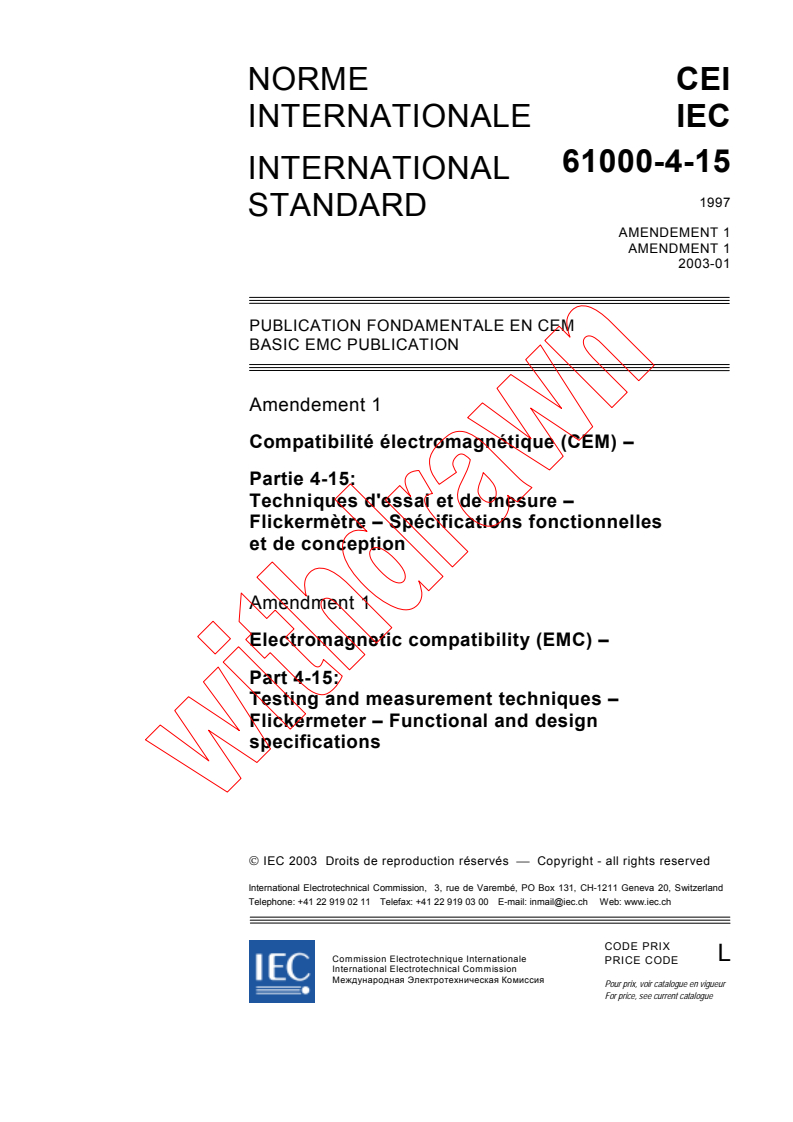
NORME CEI
INTERNATIONALE IEC
61000-4-15
INTERNATIONAL
STANDARD
AMENDEMENT 1
AMENDMENT 1
2003-01
PUBLICATION FONDAMENTALE EN CEM
BASIC EMC PUBLICATION
Amendement 1
Compatibilité électromagnétique (CEM) –
Partie 4-15:
Techniques d'essai et de mesure –
Flickermètre – Spécifications fonctionnelles
et de conception
Amendment 1
Electromagnetic compatibility (EMC) –
Part 4-15:
Testing and measurement techniques –
Flickermeter – Functional and design
specifications
IEC 2003 Droits de reproduction réservés Copyright - all rights reserved
International Electrotechnical Commission, 3, rue de Varembé, PO Box 131, CH-1211 Geneva 20, Switzerland
Telephone: +41 22 919 02 11 Telefax: +41 22 919 03 00 E-mail: inmail@iec.ch Web: www.iec.ch
CODE PRIX
L
Commission Electrotechnique Internationale
PRICE CODE
International Electrotechnical Commission
Международная Электротехническая Комиссия
Pour prix, voir catalogue en vigueur
For price, see current catalogue
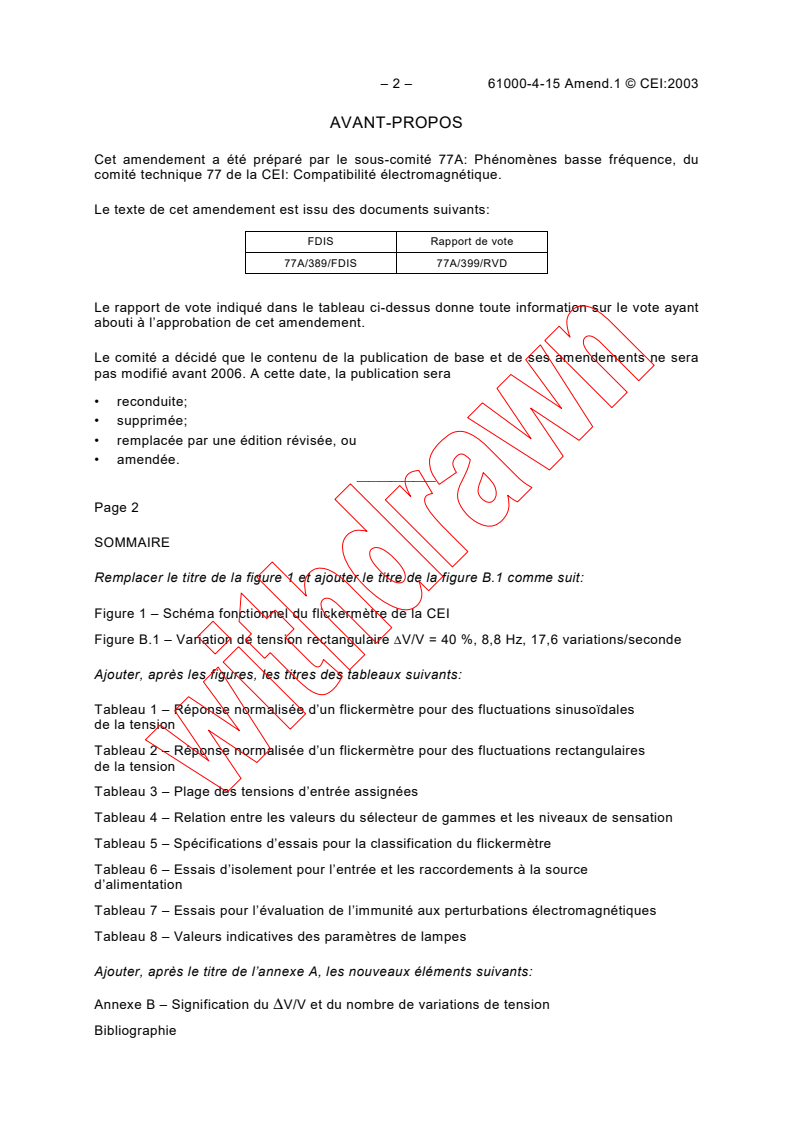
– 2 – 61000-4-15 Amend.1 © CEI:2003
AVANT-PROPOS
Cet amendement a été préparé par le sous-comité 77A: Phénomènes basse fréquence, du
comité technique 77 de la CEI: Compatibilité électromagnétique.
Le texte de cet amendement est issu des documents suivants:
FDIS Rapport de vote
77A/389/FDIS 77A/399/RVD
Le rapport de vote indiqué dans le tableau ci-dessus donne toute information sur le vote ayant
abouti à l’approbation de cet amendement.
Le comité a décidé que le contenu de la publication de base et de ses amendements ne sera
pas modifié avant 2006. A cette date, la publication sera
• reconduite;
• supprimée;
• remplacée par une édition révisée, ou
• amendée.
Page 2
SOMMAIRE
Remplacer le titre de la figure 1 et ajouter le titre de la figure B.1 comme suit:
Figure 1 – Schéma fonctionnel du flickermètre de la CEI
Figure B.1 – Variation de tension rectangulaire ΔV/V = 40 %, 8,8 Hz, 17,6 variations/seconde
Ajouter, après les figures, les titres des tableaux suivants:
Tableau 1 – Réponse normalisée d’un flickermètre pour des fluctuations sinusoïdales
de la tension
Tableau 2 – Réponse normalisée d’un flickermètre pour des fluctuations rectangulaires
de la tension
Tableau 3 – Plage des tensions d’entrée assignées
Tableau 4 – Relation entre les valeurs du sélecteur de gammes et les niveaux de sensation
Tableau 5 – Spécifications d’essais pour la classification du flickermètre
Tableau 6 – Essais d’isolement pour l’entrée et les raccordements à la source
d’alimentation
Tableau 7 – Essais pour l’évaluation de l’immunité aux perturbations électromagnétiques
Tableau 8 – Valeurs indicatives des paramètres de lampes
Ajouter, après le titre de l’annexe A, les nouveaux éléments suivants:
Annexe B – Signification du ΔV/V et du nombre de variations de tension
Bibliographie
61000-4-15 Amend. 1 IEC:2003 – 3 –
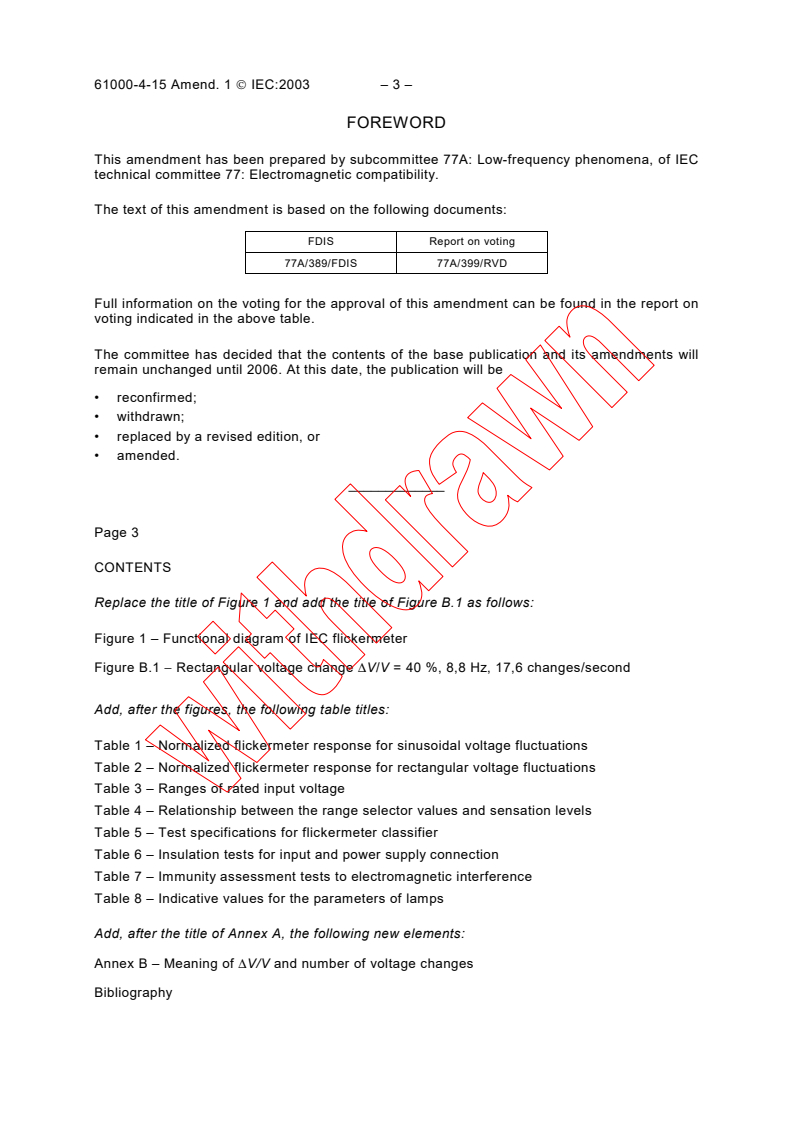
FOREWORD
This amendment has been prepared by subcommittee 77A: Low-frequency phenomena, of IEC
technical committee 77: Electromagnetic compatibility.
The text of this amendment is based on the following documents:
FDIS Report on voting
77A/389/FDIS 77A/399/RVD
Full information on the voting for the approval of this amendment can be found in the report on
voting indicated in the above table.
The committee has decided that the contents of the base publication and its amendments will
remain unchanged until 2006. At this date, the publication will be
• reconfirmed;
• withdrawn;
• replaced by a revised edition, or
• amended.
_____________
Page 3
CONTENTS
Replace the title of Figure 1 and add the title of Figure B.1 as follows:
Figure 1 – Functional diagram of IEC flickermeter
Figure B.1 − Rectangular voltage change ΔV/V = 40 %, 8,8 Hz, 17,6 changes/second
Add, after the figures, the following table titles:
Table 1 – Normalized flickermeter response for sinusoidal voltage fluctuations
Table 2 – Normalized flickermeter response for rectangular voltage fluctuations
Table 3 – Ranges of rated input voltage
Table 4 – Relationship between the range selector values and sensation levels
Table 5 – Test specifications for flickermeter classifier
Table 6 – Insulation tests for input and power supply connection
Table 7 – Immunity assessment tests to electromagnetic interference
Table 8 – Indicative values for the parameters of lamps
Add, after the title of Annex A, the following new elements:
Annex B – Meaning of ΔV/V and number of voltage changes
Bibliography
– 4 – 61000-4-15 Amend.1 © CEI:2003
Page 8
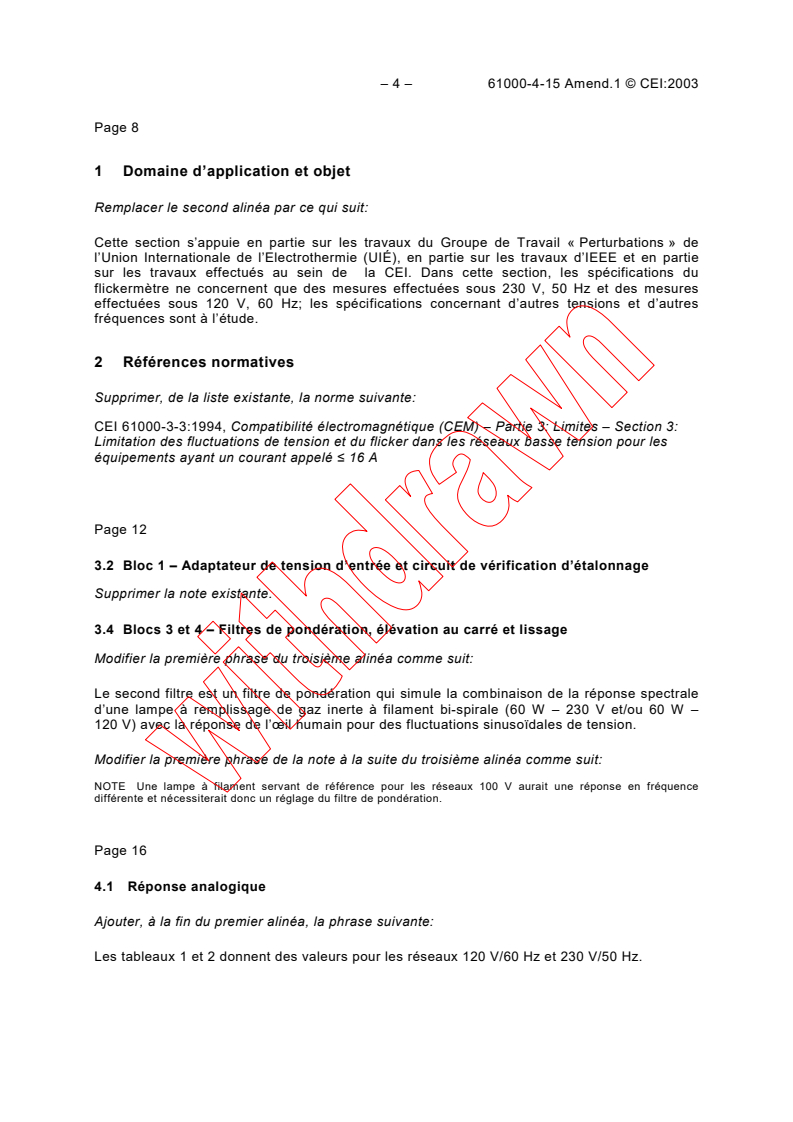
1 Domaine d’application et objet
Remplacer le second alinéa par ce qui suit:
Cette section s’appuie en partie sur les travaux du Groupe de Travail « Perturbations » de
l’Union Internationale de l’Electrothermie (UIÉ), en partie sur les travaux d’IEEE et en partie
sur les travaux effectués au sein de la CEI. Dans cette section, les spécifications du
flickermètre ne concernent que des mesures effectuées sous 230 V, 50 Hz et des mesures
effectuées sous 120 V, 60 Hz; les spécifications concernant d’autres tensions et d’autres
fréquences sont à l’étude.
2 Références normatives
Supprimer, de la liste existante, la norme suivante:
CEI 61000-3-3:1994, Compatibilité électromagnétique (CEM) – Partie 3: Limites – Section 3:
Limitation des fluctuations de tension et du flicker dans les réseaux basse tension pour les
équipements ayant un courant appelé ≤ 16 A
Page 12
3.2 Bloc 1 – Adaptateur de tension d’entrée et circuit de vérification d’étalonnage
Supprimer la note existante.
3.4 Blocs 3 et 4 – Filtres de pondération, élévation au carré et lissage
Modifier la première phrase du troisième alinéa comme suit:
Le second filtre est un filtre de pondération qui simule la combinaison de la réponse spectrale
d’une lampe à remplissage de gaz inerte à filament bi-spirale (60 W – 230 V et/ou 60 W –
120 V) avec la réponse de l’œil humain pour des fluctuations sinusoïdales de tension.
Modifier la première phrase de la note à la suite du troisième alinéa comme suit:
NOTE Une lampe à filament servant de référence pour les réseaux 100 V aurait une réponse en fréquence
différente et nécessiterait donc un réglage du filtre de pondération.
Page 16
4.1 Réponse analogique
Ajouter, à la fin du premier alinéa, la phrase suivante:
Les tableaux 1 et 2 donnent des valeurs pour les réseaux 120 V/60 Hz et 230 V/50 Hz.
61000-4-15 Amend. 1 IEC:2003 – 5 –
Page 9
1 Scope and object
Replace the second paragraph by the following:
This section is based partly on work by the “Disturbances” Working Group of the International
Union for Electroheat (UIE), partly on work of the IEEE, and partly on work within IEC itself.
The flickermeter specifications in this section relate only to measurements of 230 V, 50 Hz
inputs and 120 V, 60 Hz inputs; specifications for other voltages and other frequencies are
under consideration.
2 Normative references
Delete, from the existing list, the following standard:
IEC 61000-3-3:1994, Electromagnetic compatibility (EMC) – Part 3: Limits – Section 3:
Limitation of voltage fluctuations and flicker in low-voltage supply systems for equipment with
rated current ≤ 16 A
Page 13
3.2 Block 1 – Input voltage adaptor and calibration checking circuit
Delete the existing note.
3.4 Blocks 3 and 4 – Weighting filters, squaring and smoothing
Change the first sentence of the third paragraph to read as follows:
The second filter is a weighting filter block that simulates the frequency response to sinusoidal
voltage fluctuations of a coiled filament gas-filled lamp (60 W – 230 V and/or 60 W – 120 V)
combined with the human visual system.
Change the first sentence of the note following the third paragraph to read:
NOTE A reference filament lamp for 100 V systems would have a different frequency response and would require
a corresponding adjustment of the weighting filter.
Page 17
4.1 Analogue response
Add to the end of the first paragraph the following new sentence:
Tables 1 and 2 give values for 120 V/60 Hz and 230 V /50 Hz systems.
– 6 – 61000-4-15 Amend.1 © CEI:2003
Remplacer, à la page 18, les tableaux 1 et 2 existants par les suivants:
Tableau 1 – Réponse normalisée d’un flickermètre pour des fluctuations
sinusoïdales de la tension
(amplitude relative de la fluctuation de tension d’entrée ΔV/V
pour une unité de perceptibilité en sortie 5)
Fluctuation de tension Fluctuation de tension
Hz % Hz %
Lampe 120 V Lampe 230 V Lampe 120 V Lampe 230 V
réseau 60 Hz réseau 50 Hz réseau 60 Hz réseau 50 Hz
0,5 2,457 2,340 10,0 0,339 0,260
1,0 1,463 1,432 10,5 0,355 0,270
1,5 1,124 1,080 11,0 0,374 0,282
2,0 0,940 0,882 11,5 0,394 0,296
2,5 0,814 0,754 12,0 0,420 0,312
3,0 0,716 0,654 13,0 0,470 0,348
3,5 0,636 0,568 14,0 0,530 0,388
4,0 0,569 0,500 15,0 0,593 0,432
4,5 0,514 0,446 16,0 0,662 0,480
5,0 0,465 0,398 17,0 0,737 0,530
5,5 0,426 0,360 18,0 0,815 0,584
6,0 0,393 0,328 19,0 0,897 0,640
6,5 0,366 0,300 20,0 0,981 0,700
7,0 0,346 0,280 21,0 1,071 0,760
7,5 0,332 0,266 22,0 1,164 0,824
8,0 0,323 0,256 23,0 1,262 0,890
8,8 0,321 0,250 24,0 1,365 0,962
9,5 0,330 0,254 25,0 1,472 1,042
33,33 Essai non 2,130
prescrit
40,0 4,424 Essai non
prescrit
61000-4-15 Amend. 1 IEC:2003 – 7 –
Replace, on page 19, the existing Tables 1 and 2 by the following new tables:
Table 1 – Normalized flickermeter response for sinusoidal
voltage fluctuations
(input relative voltage fluctuation ΔV/V for one unit of perceptibility at output 5)
Voltage fluctuation Voltage fluctuation
Hz % Hz %
120-V lamp 230-V lamp 120-V lamp 230-V lamp
60 Hz system 50 Hz system 60 Hz system 50 Hz system
0,5 2,457 2,340 10,0 0,339 0,260
1,0 1,463 1,432 10,5 0,355 0,270
1,5 1,124 1,080 11,0 0,374 0,282
2,0 0,940 0,882 11,5 0,394 0,296
2,5 0,814 0,754 12,0 0,420 0,312
3,0 0,716 0,654 13,0 0,470 0,348
3,5 0,636 0,568 14,0 0,530 0,388
4,0 0,569 0,500 15,0 0,593 0,432
4,5 0,514 0,446 16,0 0,662 0,480
5,0 0,465 0,398 17,0 0,737 0,530
5,5 0,426 0,360 18,0 0,815 0,584
6,0 0,393 0,328 19,0 0,897 0,640
6,5 0,366 0,300 20,0 0,981 0,700
7,0 0,346 0,280 21,0 1,071 0,760
7,5 0,332 0,266 22,0 1,164 0,824
8,0 0,323 0,256 23,0 1,262 0,890
8,8 0,321 0,250 24,0 1,365 0,962
9,5 0,330 0,254 25,0 1,472 1,042
33,33 Test not required 2,130
40,0 4,424 Test not
required
– 8 – 61000-4-15 Amend.1 © CEI:2003
Tableau 2 – Réponse normalisée d’un flickermètre
pour des fluctuations rectangulaires de la tension
(amplitude relative de la fluctuation de tension d’entrée ΔV/V
pour une unité de perceptibilité en sortie 5)
Fluctuation de tension Fluctuation de tension
Hz % Hz %
Lampe 120 V Lampe 230 V Lampe 120 V Lampe 230 V
réseau 60 Hz réseau 50 Hz réseau 60 Hz réseau 50 Hz
0,5 0,600 0,514 10,0 0,264 0,205
1,0 0,547 0,471 10,5 0,280 0,213
1,5 0,504 0,432 11,0 0,297 0,223
2,0 0,471 0,401 11,5 0,309 0,234
2,5 0,439 0,374 12,0 0,323 0,246
3,0 0,421 0,355 13,0 0,369 0,275
3,5 0,407 0,345 14,0 0,411 0,308
4,0 0,394 0,333 15,0 0,459 0,344
4,5 0,371 0,316 16,0 0,513 0,376
5,0 0,349 0,293 17,0 0,580 0,413
5,5 0,323 0,269 18,0 0,632 0,452
6,0 0,302 0,249 19,0 0,692 0,498
6,5 0,282 0,231 20,0 0,752 0,546
7,0 0,269 0,217 21,0 0,818 0,586
7,5 0,258 0,207 22,0 0,853 0,604
8,0 0,255 0,201 23,0 0,946 0,680
8,8 0,253 0,199 24,0 1,072 0,743
9,5 0,257 0,200 33,33 Essai non 1,67
prescrit
40,0 3,46 Essai non
prescrit
61000-4-15 Amend. 1 IEC:2003 – 9 –
Table 2 – Normalized flickermeter response for rectangular
voltage fluctuations
(input relative voltage fluctuation ΔV/V for one unit of perceptibility at output 5)
Voltage fluctuation Voltage fluctuation
Hz % Hz %
120 V lamp 230 V lamp 120 V lamp 230 V lamp
60 Hz system 50 Hz System 60 Hz system 50 Hz system
0,5 0,600 0,514 10,0 0,264 0,205
1,0 0,547 0,471 10,5 0,280 0,213
1,5 0,504 0,432 11,0 0,297 0,223
2,0 0,471 0,401 11,5 0,309 0,234
2,5 0,439 0,374 12,0 0,323 0,246
3,0 0,421 0,355 13,0 0,369 0,275
3,5 0,407 0,345 14,0 0,411 0,308
4,0 0,394 0,333 15,0 0,459 0,344
4,5 0,371 0,316 16,0 0,513 0,376
5,0 0,349 0,293 17,0 0,580 0,413
5,5 0,323 0,269 18,0 0,632 0,452
6,0 0,302 0,249 19,0 0,692 0,498
6,5 0,282 0,231 20,0 0,752 0,546
7,0 0,269 0,217 21,0 0,818 0,586
7,5 0,258 0,207 22,0 0,853 0,604
8,0 0,255 0,201 23,0 0,946 0,680
8,8 0,253 0,199 24,0 1,072 0,743
9,5 0,257 0,200 33,33 Test not 1,67
required
40,0 3,46 Test
not required
– 10 – 61000-4-15 Amend.1 © CEI:2003
Page 18
4.2 Transformateur d’entrée
Remplacer, à la page 20, le tableau 3 existant par le tableau
...