

IEC 60068-2-38:2009
(Main)Environmental testing - Part 2-38: Tests - Test Z/AD: Composite temperature/humidity cyclic test
General Information
- Abstract
IEC 60068-2-38:2009 provides a composite test procedure, primarily intended for component type specimens, to determine, in an accelerated manner, the resistance of specimens to the deteriorative effects of high temperature/humidity and cold conditions. The major changes with regard to the previous edition concern the updating of the figures, changes to some of the wording and editorial corrections made for clarification.
- Status
- Published
- Publication Date
- 11-Jan-2009
- Technical Committee
- TC 104 - Environmental conditions, classification and methods of test
- Drafting Committee
- MT 16 - TC 104/MT 16
- Current Stage
- DELPUB - Deleted Publication
- Start Date
- 25-Mar-2021
- Completion Date
- 22-Mar-2019
Buy Documents
IEC 60068-2-38:2009 - Environmental testing - Part 2-38: Tests - Test Z/AD: Composite temperature/humidity cyclic test
IEC 60068-2-38:2009 - Environmental testing - Part 2-38: Tests - Test Z/AD: Composite temperature/humidity cyclic test
Overview
IEC 60068-2-38:2009 is an international standard published by the International Electrotechnical Commission (IEC) that defines a composite environmental test procedure known as Test Z/AD: Composite Temperature/Humidity Cyclic Test. This test is primarily designed for component-type specimens and evaluates their resistance to the deteriorative effects caused by cycles of high temperature/humidity and cold conditions in an accelerated manner. The standard updates figures, wording, and editorial clarifications from its previous 1974 edition to enhance accuracy and usability.
Key Topics
- Composite Temperature/Humidity Cyclic Testing: The test simulates realistic environmental conditions by subjecting specimens to rapid and repeated cycles of temperature and humidity changes, including excursions into sub-zero temperatures.
- Breathing Mechanism: The accelerated cycling focuses on detecting defects caused by the "breathing" effect, where moisture moves in and out of air-filled voids or fissures within the specimen, rather than just moisture absorption.
- Accelerated Environmental Stresses: Features such as a greater number of temperature variations, wider temperature ranges, higher rates of temperature change, and freezing of trapped moisture increase test severity compared to other cyclical damp heat tests.
- Test Chamber Requirements: Testing involves one or two chambers, with strict control of temperature (ranging from approximately -10 °C to 65 °C) and humidity (around 93% relative humidity at high temperatures). Uniformity of conditions and prevention of radiant heat or condensation on specimens is crucial.
- Test Application: The test is recommended for components with thermal characteristics allowing rapid temperature cycling and where failures due to moisture ingress and freezing are concerns. It is not advised for solid encapsulated specimens where diffusion effects dominate.
Applications
- Component Reliability Assessment: IEC 60068-2-38 is extensively used by manufacturers to assess the robustness of electronic components and assemblies against cyclical environmental stresses. It helps identify potential failure modes caused by moisture penetration and freezing.
- Accelerated Life Testing: By compressing environmental stress exposure into shorter timeframes through frequent temperature and humidity cycles, this standard supports accelerated durability evaluations for component design validation.
- Quality Control and Product Development: Engineers use the standard to qualify new materials or designs and to verify manufacturing quality under realistic but accelerated climate conditions.
- Environmental Qualification in Harsh Conditions: It is particularly valuable for components intended for use in environments featuring rapid temperature fluctuations and high humidity, such as automotive, aerospace, telecommunications, and industrial electronics.
- Integration in Test Sequences: Although not a replacement for steady-state or other damp heat tests (e.g., IEC 60068-2-78 or 60068-2-30), Test Z/AD is used in conjunction with these to provide comprehensive environmental qualification.
Related Standards
- IEC 60068-1: Provides general guidance and principles for environmental testing procedures, essential for applying Test Z/AD correctly.
- IEC 60068-2-30 (Test Db): Covers cyclic damp heat testing with slower temperature variations, suitable for larger specimens or those requiring thermal stability during cycling.
- IEC 60068-2-78 (Test Cab): Defines damp heat steady-state testing aimed at assessing moisture absorption and diffusion effects in solid encapsulated specimens.
- IEC Guide 104: Offers guidance on preparing safety publications, including basic safety standards relevant to environmental testing.
Practical Value and Keywords
Implementing IEC 60068-2-38:2009 allows manufacturers and test engineers to:
- Simulate Real-World Environmental Stresses: Accurately mimic component exposure to variable temperature and humidity cycles including freezing conditions.
- Detect Failure Mechanisms Early: Identify defects caused by moisture ingress and temperature-induced stresses before mass production.
- Ensure Compliance and Reliability: Meet international quality standards for environmental robustness ensuring component longevity.
- Optimize Test Chambers and Conditions: Design test environments that conform to stringent cycle parameters for reproducible results.
Keywords: IEC 60068-2-38, Test Z/AD, environmental testing standard, composite temperature humidity cyclic test, accelerated damp heat testing, component reliability, moisture ingress testing, temperature cycling test, freezing humidity cycles, electronic component qualification.
Relations
- Effective Date
- 25-Aug-2026
- Effective Date
- 25-Aug-2026
- Effective Date
- 25-Aug-2026
- Effective Date
- 05-Sep-2023
Buy Documents
IEC 60068-2-38:2009 - Environmental testing - Part 2-38: Tests - Test Z/AD: Composite temperature/humidity cyclic test
IEC 60068-2-38:2009 - Environmental testing - Part 2-38: Tests - Test Z/AD: Composite temperature/humidity cyclic test
Get Certified
Connect with accredited certification bodies for this standard

IMP NDT d.o.o.
Non-destructive testing services. Radiography, ultrasonic, magnetic particle, penetrant, visual inspection.
Inštitut za kovinske materiale in tehnologije
Institute of Metals and Technology. Materials testing, metallurgical analysis, NDT.
Q Techna d.o.o.
NDT and quality assurance specialist. 30+ years experience. NDT personnel certification per ISO 9712, nuclear and thermal power plant inspections, QA/
Sponsored listings
Frequently Asked Questions
IEC 60068-2-38:2009 is a standard published by the International Electrotechnical Commission (IEC). Its full title is "Environmental testing - Part 2-38: Tests - Test Z/AD: Composite temperature/humidity cyclic test". This standard covers: IEC 60068-2-38:2009 provides a composite test procedure, primarily intended for component type specimens, to determine, in an accelerated manner, the resistance of specimens to the deteriorative effects of high temperature/humidity and cold conditions. The major changes with regard to the previous edition concern the updating of the figures, changes to some of the wording and editorial corrections made for clarification.
IEC 60068-2-38:2009 provides a composite test procedure, primarily intended for component type specimens, to determine, in an accelerated manner, the resistance of specimens to the deteriorative effects of high temperature/humidity and cold conditions. The major changes with regard to the previous edition concern the updating of the figures, changes to some of the wording and editorial corrections made for clarification.
IEC 60068-2-38:2009 is classified under the following ICS (International Classification for Standards) categories: 19.040 - Environmental testing. The ICS classification helps identify the subject area and facilitates finding related standards.
IEC 60068-2-38:2009 has the following relationships with other standards: It is inter standard links to EN ISO 10374:1997, EN 15859:2010, EN ISO 19014-3:2018, IEC 60068-2-38:2021. Understanding these relationships helps ensure you are using the most current and applicable version of the standard.
IEC 60068-2-38:2009 is available in PDF format for immediate download after purchase. The document can be added to your cart and obtained through the secure checkout process. Digital delivery ensures instant access to the complete standard document.
Standards Content (Sample)
IEC 60068-2-38
Edition 2.0 2009-01
INTERNATIONAL
STANDARD
NORME
INTERNATIONALE
BASIC SAFETY PUBLICATION
PUBLICATION FONDAMENTALE DE SÉCURITÉ
Environmental testing –
Part 2-38: Tests – Test Z/AD: Composite temperature/humidity cyclic test
Essais d’environnement –
Partie 2-38: Essais – Essai Z/AD: Essai cyclique composite de température et
d’humidité
All rights reserved. Unless otherwise specified, no part of this publication may be reproduced or utilized in any form or by
any means, electronic or mechanical, including photocopying and microfilm, without permission in writing from either IEC or
IEC's member National Committee in the country of the requester.
If you have any questions about IEC copyright or have an enquiry about obtaining additional rights to this publication,
please contact the address below or your local IEC member National Committee for further information.
Droits de reproduction réservés. Sauf indication contraire, aucune partie de cette publication ne peut être reproduite
ni utilisée sous quelque forme que ce soit et par aucun procédé, électronique ou mécanique, y compris la photocopie
et les microfilms, sans l'accord écrit de la CEI ou du Comité national de la CEI du pays du demandeur.
Si vous avez des questions sur le copyright de la CEI ou si vous désirez obtenir des droits supplémentaires sur cette
publication, utilisez les coordonnées ci-après ou contactez le Comité national de la CEI de votre pays de résidence.
IEC Central Office
3, rue de Varembé
CH-1211 Geneva 20
Switzerland
Email: inmail@iec.ch
Web: www.iec.ch
About the IEC
The International Electrotechnical Commission (IEC) is the leading global organization that prepares and publishes
International Standards for all electrical, electronic and related technologies.
About IEC publications
The technical content of IEC publications is kept under constant review by the IEC. Please make sure that you have the
latest edition, a corrigenda or an amendment might have been published.
ƒ Catalogue of IEC publications: www.iec.ch/searchpub
The IEC on-line Catalogue enables you to search by a variety of criteria (reference number, text, technical committee,…).
It also gives information on projects, withdrawn and replaced publications.
ƒ IEC Just Published: www.iec.ch/online_news/justpub
Stay up to date on all new IEC publications. Just Published details twice a month all new publications released. Available
on-line and also by email.
ƒ Electropedia: www.electropedia.org
The world's leading online dictionary of electronic and electrical terms containing more than 20 000 terms and definitions
in English and French, with equivalent terms in additional languages. Also known as the International Electrotechnical
Vocabulary online.
ƒ Customer Service Centre: www.iec.ch/webstore/custserv
If you wish to give us your feedback on this publication or need further assistance, please visit the Customer Service
Centre FAQ or contact us:
Email: csc@iec.ch
Tel.: +41 22 919 02 11
Fax: +41 22 919 03 00
A propos de la CEI
La Commission Electrotechnique Internationale (CEI) est la première organisation mondiale qui élabore et publie des
normes internationales pour tout ce qui a trait à l'électricité, à l'électronique et aux technologies apparentées.
A propos des publications CEI
Le contenu technique des publications de la CEI est constamment revu. Veuillez vous assurer que vous possédez
l’édition la plus récente, un corrigendum ou amendement peut avoir été publié.
ƒ Catalogue des publications de la CEI: www.iec.ch/searchpub/cur_fut-f.htm
Le Catalogue en-ligne de la CEI vous permet d’effectuer des recherches en utilisant différents critères (numéro de référence,
texte, comité d’études,…). Il donne aussi des informations sur les projets et les publications retirées ou remplacées.
ƒ Just Published CEI: www.iec.ch/online_news/justpub
Restez informé sur les nouvelles publications de la CEI. Just Published détaille deux fois par mois les nouvelles
publications parues. Disponible en-ligne et aussi par email.
ƒ Electropedia: www.electropedia.org
Le premier dictionnaire en ligne au monde de termes électroniques et électriques. Il contient plus de 20 000 termes et
définitions en anglais et en français, ainsi que les termes équivalents dans les langues additionnelles. Egalement appelé
Vocabulaire Electrotechnique International en ligne.
ƒ Service Clients: www.iec.ch/webstore/custserv/custserv_entry-f.htm
Si vous désirez nous donner des commentaires sur cette publication ou si vous avez des questions, visitez le FAQ du
Service clients ou contactez-nous:
Email: csc@iec.ch
Tél.: +41 22 919 02 11
Fax: +41 22 919 03 00
IEC 60068-2-38
Edition 2.0 2009-01
INTERNATIONAL
STANDARD
NORME
INTERNATIONALE
BASIC SAFETY PUBLICATION
PUBLICATION FONDAMENTALE DE SÉCURITÉ
Environmental testing –
Part 2-38: Tests – Test Z/AD: Composite temperature/humidity cyclic test
Essais d’environnement –
Partie 2-38: Essais – Essai Z/AD: Essai cyclique composite de température et
d’humidité
INTERNATIONAL
ELECTROTECHNICAL
COMMISSION
COMMISSION
ELECTROTECHNIQUE
PRICE CODE
INTERNATIONALE
N
CODE PRIX
ICS 19.040 ISBN 978-2-88910-038-5
– 2 – 60068-2-38 © IEC:2009
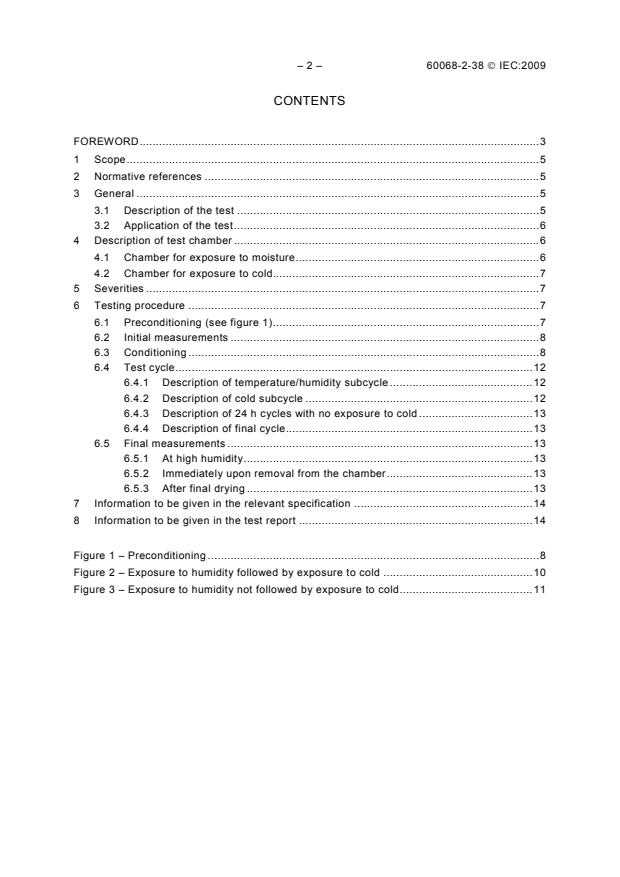
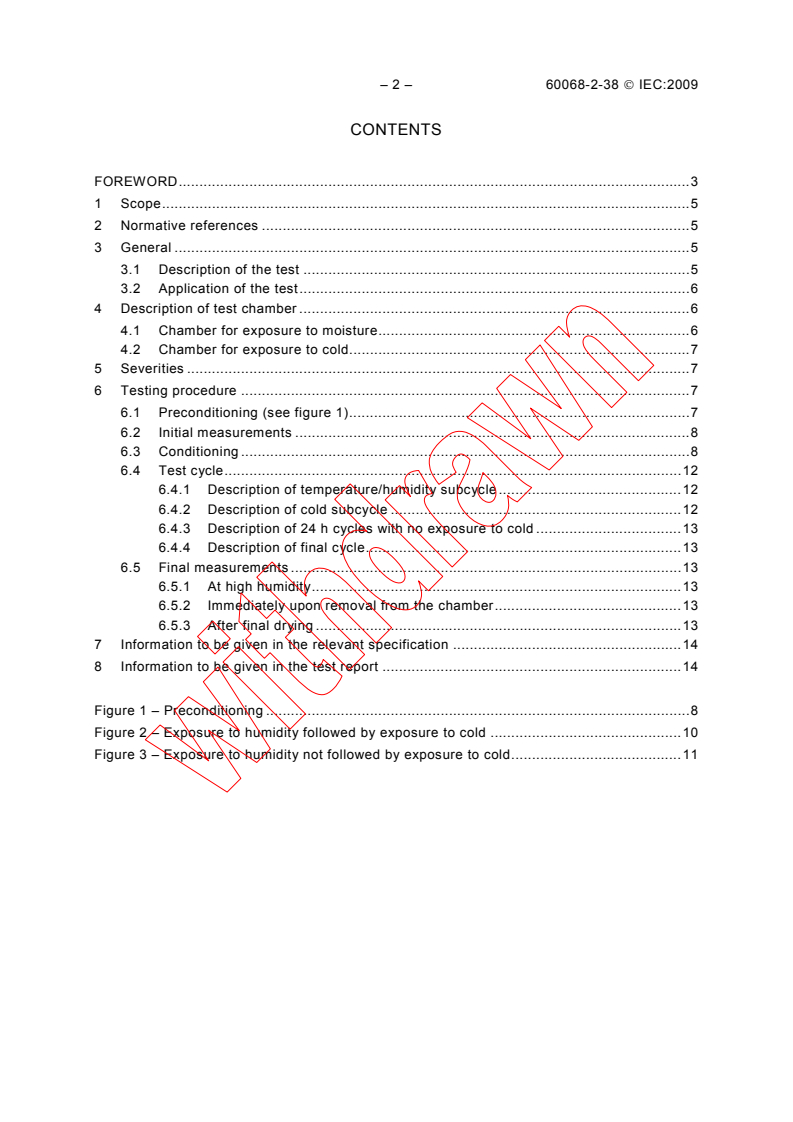
CONTENTS
FOREWORD.3
1 Scope.5
2 Normative references .5
3 General .5
3.1 Description of the test .5
3.2 Application of the test.6
4 Description of test chamber .6
4.1 Chamber for exposure to moisture.6
4.2 Chamber for exposure to cold.7
5 Severities .7
6 Testing procedure .7
6.1 Preconditioning (see figure 1).7
6.2 Initial measurements .8
6.3 Conditioning .8
6.4 Test cycle.12
6.4.1 Description of temperature/humidity subcycle .12
6.4.2 Description of cold subcycle .12
6.4.3 Description of 24 h cycles with no exposure to cold .13
6.4.4 Description of final cycle.13
6.5 Final measurements .13
6.5.1 At high humidity.13
6.5.2 Immediately upon removal from the chamber.13
6.5.3 After final drying .13
7 Information to be given in the relevant specification .14
8 Information to be given in the test report .14
Figure 1 – Preconditioning .8
Figure 2 – Exposure to humidity followed by exposure to cold .10
Figure 3 – Exposure to humidity not followed by exposure to cold.11
60068-2-38 © IEC:2009 – 3 –
INTERNATIONAL ELECTROTECHNICAL COMMISSION
____________
ENVIRONMENTAL TESTING –
Part 2-38: Tests –
Test Z/AD: Composite temperature/humidity cyclic test
FOREWORD
1) The International Electrotechnical Commission (IEC) is a worldwide organization for standardization comprising
all national electrotechnical committees (IEC National Committees). The object of IEC is to promote
international co-operation on all questions concerning standardization in the electrical and electronic fields. To
this end and in addition to other activities, IEC publishes International Standards, Technical Specifications,
Technical Reports, Publicly Available Specifications (PAS) and Guides (hereafter referred to as “IEC
Publication(s)”). Their preparation is entrusted to technical committees; any IEC National Committee interested
in the subject dealt with may participate in this preparatory work. International, governmental and non-
governmental organizations liaising with the IEC also participate in this preparation. IEC collaborates closely
with the International Organization for Standardization (ISO) in accordance with conditions determined by
agreement between the two organizations.
2) The formal decisions or agreements of IEC on technical matters express, as nearly as possible, an international
consensus of opinion on the relevant subjects since each technical committee has representation from all
interested IEC National Committees.
3) IEC Publications have the form of recommendations for international use and are accepted by IEC National
Committees in that sense. While all reasonable efforts are made to ensure that the technical content of IEC
Publications is accurate, IEC cannot be held responsible for the way in which they are used or for any
misinterpretation by any end user.
4) In order to promote international uniformity, IEC National Committees undertake to apply IEC Publications
transparently to the maximum extent possible in their national and regional publications. Any divergence
between any IEC Publication and the corresponding national or regional publication shall be clearly indicated in
the latter.
5) IEC provides no marking procedure to indicate its approval and cannot be rendered responsible for any
equipment declared to be in conformity with an IEC Publication.
6) All users should ensure that they have the latest edition of this publication.
7) No liability shall attach to IEC or its directors, employees, servants or agents including individual experts and
members of its technical committees and IEC National Committees for any personal injury, property damage or
other damage of any nature whatsoever, whether direct or indirect, or for costs (including legal fees) and
expenses arising out of the publication, use of, or reliance upon, this IEC Publication or any other IEC
Publications.
8) Attention is drawn to the Normative references cited in this publication. Use of the referenced publications is
indispensable for the correct application of this publication.
9) Attention is drawn to the possibility that some of the elements of this IEC Publication may be the subject of
patent rights. IEC shall not be held responsible for identifying any or all such patent rights.
International Standard IEC 60068-2-38 has been prepared by IEC technical committee 104:
Environmental conditions, classification and methods of test.
This second edition cancels and replaces the first edition, published in 1974, and constitutes
a technical revision.
The major changes with regard to the previous edition concern the updating of the figures,
changes to some of the wording and editorial corrections made for clarification.
The text of this standard is based on the following documents:
FDIS Report on voting
104/482/FDIS 104/487/RVD
Full information on the voting for the approval of this standard can be found in the report on
voting indicated in the above table.
– 4 – 60068-2-38 © IEC:2009
This publication has been drafted in accordance with the ISO/IEC Directives, Part 2.
It has the status of a basic safety publication in accordance with IEC Guide 104.
A list of all the parts in the IEC 60068 series, under the general title Environmental testing,
can be found on the IEC website.
The committee has decided that the contents of this publication will remain unchanged until
the maintenance result date indicated on the IEC web site under "http://webstore.iec.ch" in the
data related to the specific publication. At this date, the publication will be
• reconfirmed,
• withdrawn,
• replaced by a revised edition, or
• amended.
60068-2-38 © IEC:2009 – 5 –
ENVIRONMENTAL TESTING –
Part 2-38: Tests –
Test Z/AD: Composite temperature/humidity cyclic test
1 Scope
IEC 60068-2-38 provides a composite test procedure, primarily intended for component type
specimens, to determine, in an accelerated manner, the resistance of specimens to the
deteriorative effects of high temperature/humidity and cold conditions.
2 Normative references
The following referenced documents are indispensable for the application of this document.
For dated references, only the edition cited applies. For undated references, the latest edition
of the referenced document (including any amendments) applies.
IEC 60068-1, Environmental testing – Part 1: General and guidance
IEC 60068-2-30, Environmental testing – Part 2-30: Tests – Test Db: Damp heat, cyclic (12 h
+ 12 h cycle)
IEC 60068-2-78, Environmental testing – Part 2-78: Tests – Test Cab: Damp heat, steady
state
IEC Guide 104, The preparation of safety publications and the use of basic safety publications
and group safety publications
3 General
3.1 Description of the test
Test Z/AD is a cyclic temperature/humidity test which is designed to reveal defects in test
specimens caused by "breathing" as distinct from the absorption of moisture.
This test differs from other cyclic damp heat tests in that it derives its increased severity from:
a) a greater number of temperature variations or "pumping" actions in a given time;
b) a greater cyclic temperature range;
c) a higher cyclic rate of change of temperature;
d) the inclusion of a number of excursions to sub-zero temperatures.
The accelerated breathing and the effect of the freezing of trapped water in cracks and
fissures are the essential features of this composite test.
It is emphasized, however, that the freezing effect will occur only if the fissure dimensions are
large enough to allow the penetration of a coherent mass of water as is normally the case in
fissures between seals and metal assemblies, or between seals and wire terminations.
The degree of condensation will depend mainly upon the thermal time constant of the surface
of the test specimens and may be negligible for very small specimens but copious for large
specimens.
– 6 – 60068-2-38 © IEC:2009
Similarly, the breathing effect will be more apparent on specimens which contain relatively
large air-filled or gas-filled voids, but again, the severity of the test will depend to some extent
on the thermal characteristics of the specimens.
3.2 Application of the test
For the reasons given above, it is recommended that this test procedure be limited to
component type specimens when the construction of the specimens suggests a "breathing"
type of damp heat test combined with icing and where the thermal characteristics are
compatible with the rates of change of temperature, etc. of test Z/AD.
For solid type specimens, e.g. plastic encapsulated, where there may be small hairline cracks
or porous material, the absorption or diffusion mechanisms will predominate and a steady
damp heat such as test C of IEC 60068-2-78 is preferred for investigating these effects.
For larger specimens such as equipment or when it is essential for components to ensure
thermal stability during the various phases of the cycle, test Db of IEC 60068-2-30 should be
employed, although due to the reduced number of cycles in a given period, the degree of
acceleration may not be as fast. In this case, test Db should normally form part of a sequence
such as that defined in IEC 60068-1.
As in other damp heat tests, a polarizing voltage or electrical loading may be applied to the
specimens. In the case of electrical loading, the loading should be such that the temperature
rise of the specimens does not unduly affect the chamber conditions.
From the above, test Z/AD should not be considered to be interchangeable with, or an
alternative to, either steady-state or other cyclic damp heat tests, but the choice of test
procedure should be made with due regard for the physical and thermal characteristics of the
test specimens and the types of failure mechanisms which are significant for each particular
case.
4 Description of test chamber
The exposure to moisture, followed by cold, can either be performed in one chamber or in two
separate chambers.
4.1 Chamber for exposure to moisture
The chamber for the exposure to moisture shall be so constructed that:
a) The temperature can be varied between 25 °C ± 2 K and 65 °C ± 2 K in a period of
between 1,5 h and 2,5 h for both rising and falling temperatures.
b) The relative humidity can be maintained at (93 ± 3) % during the periods of constant or
rising temperature and between 80 % RH and 96 % RH during the falling temperature
periods.
c) The conditions prevailing at any point in the working space are uniform and are as similar
as possible to those prevailing in the immediate vicinity of suitably located temperature-
and humidity-sensing devices.
The air in the chamber shall therefore be continuously stirred at a rate necessary to
maintain the specified conditions of temperature and humidity.
d) The specimens under test shall not be subjected to radiant heat from the chamber
conditioning processes.
e) Water used for the maintenance of chamber humidity shall have a resistivity of not less
than 500 Ωm.
f) Condensed water shall be continuously drained from the chamber and not used again
unless it has been repurified.
60068-2-38 © IEC:2009 – 7 –
Precautions shall be taken to ensure that no condensed water from the walls and roof of the
test chamber can fall on the specimens.
4.2 Chamber for exposure to cold
The chamber for exposure to cold shall be so constructed that
a) the temperature can be maintained at –10 °C ± 2 K,
b) the conditions prevailing at any point in the working space are uniform and are as similar
as possible to those prevailing in the immediate vicinity of suitably located temperature-
sensing devices,
The air in the chamber shall therefore be continuously moving.
Care shall be taken that the thermal capacity of the specimen under test does not appreciably
influence conditions within the chamber.
The humidity chamber may be used for exposure to cold, in which case it shall meet the
requirements of 4.1 and, in addition, shall be so constructed that
1) the temperature can be lowered from 25 °C ± 2 K to –10 °C ± 2 K in a period of not more
than 30 min,
2) the specimen can be held at a temperature of –10 °C ± 2 K for a period of 3 h,
3) the temperature can be raised from –10 °C ± 2 K to 25 °C ± 2 K in a period of not more
than 90 min.
5 Severities
The number of 24 h cycles shall be 10, unless otherwise specified. If other than 10, the
relevant specification shall define the number.
6 Testing procedure
6.1 Preconditioning (see Figure 1)
Unless otherwise specified, the specimens in the unpacked, switched-off, ready-for-use state
shall be subjected to the conditions for "assisted drying" specified in IEC 60068-1
(55 °C ± 2 K with a relative humidity not exceeding 20 %) for a period of 24 h prior to the first
cycle of the damp heat test.
The specimens shall then be allowed to attain thermal stability at standard atmospheric
conditions for testing, or as otherwise specified, before the initial measurements are made.
– 8 – 60068-2-38 © IEC:2009
Relative humidity
not more than 20 %
0 12 24 Time (h)
No specific rate of
cooling is required
Pre-conditioning period
Initial
10 measurements
Stabilizing period
Drying period
0 12 24 Time (h)
IEC 2241/08
Figure 1 – Preconditioning
6.2 Initial measurements
The specimens shall be visually inspected and electrically and mechanically checked as
required by the relevant specification.
6.3 Conditioning
The total temperature tolerance of ±2 K given in this standard is intended to take account of
absolute errors in the measurement, slow changes of temperature and temperature variations
of the working space. However, in order to maintain the relative humidity within the required
Temperature (°C) Relative humidity (%)
60068-2-38 © IEC:2009 – 9 –
tolerances, it is necessary to keep the temperature difference between any two points in the
working space at any moment within narrower limits. The required humidity conditions will not
be achieved if such temperature differences exceed 1 K. It may also be necessary to keep
short-term fluctuations within ±0,5 K to maintain the required humidity.
The specimens shall be introduced into the humidity chamber, in the unpacked, switched-off,
ready-for-use state, and mounted in the normal orientation, if this is known, or as otherwise
specified and shall be subjected to 10 temperature/humidity cycles, each of 24 h duration.
During any five of the first nine of the above cycles after exposure to the humidity subcycle
(points a) to f) in Figure 2), the specimens shall be subjected to cold. The position of the cold
subcycles should be defined in the relevant specification.
– 10 – 60068-2-38 © IEC:2009
Relative humidity
uncontrolled
2 4 6 8 10 12 14 16 18 20 22 24
Time (h)
a b c d e f g
* *
* *
*
Preferred limit
1,5 1,5 1,5 1,5
Permissible limits
2,5 2,5 2,5 2,5
(see sub-clause 6.4.2)
Preferred limit
Permissible limits
(see sub-clause 6.4.2)
Time (h)
2 4 6 8 10 12 14 16 18 20 22 24
–10
* *
* Tolerance on time at these points ± 5 min IEC 2242/08
Figure 2 – Exposure to humidity followed by exposure to cold
This exposure may be performed either in the same chamber or in separate chambers. If
separate chambers are used for the high-temperature/high-humidity and low-temperature
subcycles of the test, the specimens should not be subjected to thermal shock conditions
unless it is known that they are insensitive to this degree of thermal shock.
Temperature (°C) Relative humidity (%)
60068-2-38 © IEC:2009 – 11 –
If a batch of specimens is subjected to thermal shock through the use of the two chamber
methods and significant failures occur, a further batch shall be retested with gradual change
of temperatures and shall be considered to have passed the test successfully if no significant
failures occur under these conditions.
The remaining four of the first nine cycles shall be run without exposure to cold (see 6.4.3 and
Figure 3). The humidity cycles prescribed are the same in all cases.
2 4 6 8 10 12 14 16 18 20 22 24
Time (h)
a b c d e f g
1,5 1,5 1,5 1,5
2,5 2,5 2,5 2,5
Time (h)
2 4 6 8 10 12 14 16 18 20 22 24
–10
IEC 2243/08
Figure 3 – Exposure to humidity not followed by exposure to cold
Temperature (°C) Relative humidity (%)
– 12 – 60068-2-38 © IEC:2009
6.4 Test cycle
6.4.1 Description of temperature/humidity subcycle
The description of temperature/humidity subcycles is applicable to all cycles (see Figures 2
and 3).
At "zero time" of every 24 h cycle, the chamber condition shall be controlled to a temperature
of 25 °C ± 2 K and relative humidity at (93 ± 3) %.
a) The temperature of the chamber shall be continuously raised to 65 °C ± 2 K in a period of
between 1,5 h and 2,5 h.
During this period, the relative humidity shall remain within the limits (93 ± 3) %.
b) The temperature and relative humidity in the chamber shall be maintained at 65 °C ± 2 K
and (93 ±3) % respectively until 5,5 h after the start of the cycle.
c) The temperature shall then be allowed to fall to 25 °C ± 2 K in a period of between 1,5 h
and 2,5 h.
During this period, the relative humidity shall remain within the limits 80 % to 96 %.
d) Beginning 8 h after the start of the cycle, the temperature shall again be raised to 65 °C ±
2 K in a period of between 1,5 h and 2,5 h. During this period, the relative humidity shall
be (93 ± 3) %.
e) The temperature and relative humidity in the chamber shall be maintained at 65 °C ± 2 K
and (93 ± 3) % respectively until 13,5 h after the start of the cycle.
f) The temperature shall then be drop to 25 °C ± 2 K in a period of between 1,5 h and 2,5 h.
During this period, the relative humidity in the chamber shall remain within the limits 80 %
to 96 %.
g) The chamber shall then continue to run at a stabilized temperature of 25 °C ±2 K and
relative humidity of (93 ±3) % until the start of the cold subcycle or until the end of the
24 h cycle as appropriate.
6.4.2 Description of cold subcycle
This description is applicable to any five of the first nine cycles (see Figure 2).
a) Following the completion of the temperature/humidity subcycle (points a) to f) in Figure 2),
the chamber is maintained at a temperature of 25 °C ±2 K and a relative humidity of
(93 ± 3) % for a period of at least 1 h but not more than 2 h.
b) The specimen shall then be exposed to cold by lowering the temperature of the chamber
or transferring to a second chamber.
If the specimen is transferred from one chamber to another, the transfer should be
completed within a period of 5 min. Beginning 17,5 h after the start of the cycle, the
ambient temperature of the chamber shall be reduced to –10 °C ±2 K. This temperature
shall be reached 18 h after the start of the cycle.
c) Beginning 18 h after the start of the cycle, the temperature shall be maintained at
–10 °C ±2 K for a period of 3 h.
No requirement for humidity is prescribed during the entire cold subcycle.
d) Beginning 21 h after the start of the cycle, the temperature shall be raised to 25 °C ±2 K.
This temperature shall be reached 22,5 h after the start of the cycle (see Figure 2).
If the specimen is transferred from one chamber to another, the transfer shall be
completed within a period of 10 min to 15 min.
e) The temperature of the chamber shall be maintained at 25 °C ±2 K until the 24 h cycle is
completed. During this period, the relative humidity shall be (93 ± 3) %.
60068-2-38 © IEC:2009 – 13 –
6.4.3 Description of 24 h cycles with no exposure to cold
This description is applicable to the remaining four of the first nine cycles (Figure 3).
Cycles which do not include a cold subcycle following the humidity/temperature subcycle are
the same as described in 6.4.1, except that under point g) the chamber shall be maintained at
a temperature of 25 °C ±2 K and relative humidity of (93 ± 3) % until the 24 h cycle is
completed.
6.4.4 Description of final cycle
In the final cycle, following the completion of the temperature and humidity subcycle, the
chamber is maintained at a temperature of 25 °C ±2 K and relative humidity of (93 ± 3) % for
a period of 3,5 h after which the final measurements are made.
6.5 Final measurements
6.5.1 Introductory remark
Electrical and mechanical measurements may be made
a) at high humidity,
b) immediately upon removal from the chamber,
c) after a drying period, or
d) as required by the relevant specification.
It should be realized that many measurements taken under high humidity conditions are not
directly comparable with those taken initially or after removal from the chamber.
6.5.2 At high humidity
The measurements shall be made during the last two hours of the 3,5 h period referred to in 6.4.4.
The relevant specification shall specify the particular precautions to be followed in making
measurements under conditions of high relative humidity, including the means to be adopted
for the removal of surface water if this is necessary.
The specimen shall be removed from the chamber after all measurements have been completed.
6.5.3 Immediately upon removal from the chamber
On completion of the final cycle, the specimen shall be removed from the chamber and be
kept at ambient temperature of laboratory.
If the initial measurements were made under conditions different from ambient temperature of
laboratory, the same conditions shall be used for both sets of measurements.
Electrical and mechanical measurements as specified shall be made within a period of
between 1 h and 2 h after removal from the chamber.
Measurements taken early in this time period may be repeated once only, later in the time
period. The later reading will be used for failure determination.
6.5.4 After final drying
On completion of the final cycle, the specimen shall be removed from the chamber and shall
be kept under standard atmospheric conditions for testing for a period of 24 h before the
specified final measurements are made.
– 14 – 60068-2-38 © IEC:2009
If the initial measurements were made under conditions other than standard atmospheric
conditions for testing, the same conditions shall be used for both sets of measurements.
Measurements may be made during the 24 h period, but only measurements made at the end
of the 24 h period shall be used for failure determination.
7 Information to be given in the relevant specification
When this test is included in the relevant specification, the following details shall be given as
far as they are applicable:
a) Type of test (subcycle)
b) Preconditioning
c) Initial measurements
d) Details of mounting and supports
e) Number of cycles
f) Position of cold subcycles
g) Measurements and/or loading during conditioning
h) Recovery
i) Final measurements
j) Any deviation in procedure as agreed upon between customer and supplier
8 Information to be given in the test report
As a minimum the test report shall show the following information:
a) Customer (name and address)
b) Test laboratory (name and address and details of
accreditation - if any)
c) Test dates (dates when test was run)
d) Type of test (Z/AD)
e) Purpose of test (development, qualification, etc.)
f) Test standard, edition (IEC 60068-2-38, editi
...
IEC 60068-2-38
Edition 2.0 2009-01
INTERNATIONAL
STANDARD
NORME
INTERNATIONALE
BASIC SAFETY PUBLICATION
PUBLICATION FONDAMENTALE DE SÉCURITÉ
Environmental testing –
Part 2-38: Tests – Test Z/AD: Composite temperature/humidity cyclic test
Essais d’environnement –
Partie 2-38: Essais – Essai Z/AD: Essai cyclique composite de température et
d’humidité
All rights reserved. Unless otherwise specified, no part of this publication may be reproduced or utilized in any form or by
any means, electronic or mechanical, including photocopying and microfilm, without permission in writing from either IEC or
IEC's member National Committee in the country of the requester.
If you have any questions about IEC copyright or have an enquiry about obtaining additional rights to this publication,
please contact the address below or your local IEC member National Committee for further information.
Droits de reproduction réservés. Sauf indication contraire, aucune partie de cette publication ne peut être reproduite
ni utilisée sous quelque forme que ce soit et par aucun procédé, électronique ou mécanique, y compris la photocopie
et les microfilms, sans l'accord écrit de la CEI ou du Comité national de la CEI du pays du demandeur.
Si vous avez des questions sur le copyright de la CEI ou si vous désirez obtenir des droits supplémentaires sur cette
publication, utilisez les coordonnées ci-après ou contactez le Comité national de la CEI de votre pays de résidence.
IEC Central Office
3, rue de Varembé
CH-1211 Geneva 20
Switzerland
Email: inmail@iec.ch
Web: www.iec.ch
About the IEC
The International Electrotechnical Commission (IEC) is the leading global organization that prepares and publishes
International Standards for all electrical, electronic and related technologies.
About IEC publications
The technical content of IEC publications is kept under constant review by the IEC. Please make sure that you have the
latest edition, a corrigenda or an amendment might have been published.
ƒ Catalogue of IEC publications: www.iec.ch/searchpub
The IEC on-line Catalogue enables you to search by a variety of criteria (reference number, text, technical committee,…).
It also gives information on projects, withdrawn and replaced publications.
ƒ IEC Just Published: www.iec.ch/online_news/justpub
Stay up to date on all new IEC publications. Just Published details twice a month all new publications released. Available
on-line and also by email.
ƒ Electropedia: www.electropedia.org
The world's leading online dictionary of electronic and electrical terms containing more than 20 000 terms and definitions
in English and French, with equivalent terms in additional languages. Also known as the International Electrotechnical
Vocabulary online.
ƒ Customer Service Centre: www.iec.ch/webstore/custserv
If you wish to give us your feedback on this publication or need further assistance, please visit the Customer Service
Centre FAQ or contact us:
Email: csc@iec.ch
Tel.: +41 22 919 02 11
Fax: +41 22 919 03 00
A propos de la CEI
La Commission Electrotechnique Internationale (CEI) est la première organisation mondiale qui élabore et publie des
normes internationales pour tout ce qui a trait à l'électricité, à l'électronique et aux technologies apparentées.
A propos des publications CEI
Le contenu technique des publications de la CEI est constamment revu. Veuillez vous assurer que vous possédez
l’édition la plus récente, un corrigendum ou amendement peut avoir été publié.
ƒ Catalogue des publications de la CEI: www.iec.ch/searchpub/cur_fut-f.htm
Le Catalogue en-ligne de la CEI vous permet d’effectuer des recherches en utilisant différents critères (numéro de référence,
texte, comité d’études,…). Il donne aussi des informations sur les projets et les publications retirées ou remplacées.
ƒ Just Published CEI: www.iec.ch/online_news/justpub
Restez informé sur les nouvelles publications de la CEI. Just Published détaille deux fois par mois les nouvelles
publications parues. Disponible en-ligne et aussi par email.
ƒ Electropedia: www.electropedia.org
Le premier dictionnaire en ligne au monde de termes électroniques et électriques. Il contient plus de 20 000 termes et
définitions en anglais et en français, ainsi que les termes équivalents dans les langues additionnelles. Egalement appelé
Vocabulaire Electrotechnique International en ligne.
ƒ Service Clients: www.iec.ch/webstore/custserv/custserv_entry-f.htm
Si vous désirez nous donner des commentaires sur cette publication ou si vous avez des questions, visitez le FAQ du
Service clients ou contactez-nous:
Email: csc@iec.ch
Tél.: +41 22 919 02 11
Fax: +41 22 919 03 00
IEC 60068-2-38
Edition 2.0 2009-01
INTERNATIONAL
STANDARD
NORME
INTERNATIONALE
BASIC SAFETY PUBLICATION
PUBLICATION FONDAMENTALE DE SÉCURITÉ
Environmental testing –
Part 2-38: Tests – Test Z/AD: Composite temperature/humidity cyclic test
Essais d’environnement –
Partie 2-38: Essais – Essai Z/AD: Essai cyclique composite de température et
d’humidité
INTERNATIONAL
ELECTROTECHNICAL
COMMISSION
COMMISSION
ELECTROTECHNIQUE
PRICE CODE
INTERNATIONALE
N
CODE PRIX
ICS 19.040 ISBN 978-2-88910-038-5
– 2 – 60068-2-38 © IEC:2009
CONTENTS
FOREWORD.3
1 Scope.5
2 Normative references .5
3 General .5
3.1 Description of the test .5
3.2 Application of the test.6
4 Description of test chamber .6
4.1 Chamber for exposure to moisture.6
4.2 Chamber for exposure to cold.7
5 Severities .7
6 Testing procedure .7
6.1 Preconditioning (see figure 1).7
6.2 Initial measurements .8
6.3 Conditioning .8
6.4 Test cycle.12
6.4.1 Description of temperature/humidity subcycle .12
6.4.2 Description of cold subcycle .12
6.4.3 Description of 24 h cycles with no exposure to cold .13
6.4.4 Description of final cycle.13
6.5 Final measurements .13
6.5.1 At high humidity.13
6.5.2 Immediately upon removal from the chamber.13
6.5.3 After final drying .13
7 Information to be given in the relevant specification .14
8 Information to be given in the test report .14
Figure 1 – Preconditioning .8
Figure 2 – Exposure to humidity followed by exposure to cold .10
Figure 3 – Exposure to humidity not followed by exposure to cold.11
60068-2-38 © IEC:2009 – 3 –
INTERNATIONAL ELECTROTECHNICAL COMMISSION
____________
ENVIRONMENTAL TESTING –
Part 2-38: Tests –
Test Z/AD: Composite temperature/humidity cyclic test
FOREWORD
1) The International Electrotechnical Commission (IEC) is a worldwide organization for standardization comprising
all national electrotechnical committees (IEC National Committees). The object of IEC is to promote
international co-operation on all questions concerning standardization in the electrical and electronic fields. To
this end and in addition to other activities, IEC publishes International Standards, Technical Specifications,
Technical Reports, Publicly Available Specifications (PAS) and Guides (hereafter referred to as “IEC
Publication(s)”). Their preparation is entrusted to technical committees; any IEC National Committee interested
in the subject dealt with may participate in this preparatory work. International, governmental and non-
governmental organizations liaising with the IEC also participate in this preparation. IEC collaborates closely
with the International Organization for Standardization (ISO) in accordance with conditions determined by
agreement between the two organizations.
2) The formal decisions or agreements of IEC on technical matters express, as nearly as possible, an international
consensus of opinion on the relevant subjects since each technical committee has representation from all
interested IEC National Committees.
3) IEC Publications have the form of recommendations for international use and are accepted by IEC National
Committees in that sense. While all reasonable efforts are made to ensure that the technical content of IEC
Publications is accurate, IEC cannot be held responsible for the way in which they are used or for any
misinterpretation by any end user.
4) In order to promote international uniformity, IEC National Committees undertake to apply IEC Publications
transparently to the maximum extent possible in their national and regional publications. Any divergence
between any IEC Publication and the corresponding national or regional publication shall be clearly indicated in
the latter.
5) IEC provides no marking procedure to indicate its approval and cannot be rendered responsible for any
equipment declared to be in conformity with an IEC Publication.
6) All users should ensure that they have the latest edition of this publication.
7) No liability shall attach to IEC or its directors, employees, servants or agents including individual experts and
members of its technical committees and IEC National Committees for any personal injury, property damage or
other damage of any nature whatsoever, whether direct or indirect, or for costs (including legal fees) and
expenses arising out of the publication, use of, or reliance upon, this IEC Publication or any other IEC
Publications.
8) Attention is drawn to the Normative references cited in this publication. Use of the referenced publications is
indispensable for the correct application of this publication.
9) Attention is drawn to the possibility that some of the elements of this IEC Publication may be the subject of
patent rights. IEC shall not be held responsible for identifying any or all such patent rights.
International Standard IEC 60068-2-38 has been prepared by IEC technical committee 104:
Environmental conditions, classification and methods of test.
This second edition cancels and replaces the first edition, published in 1974, and constitutes
a technical revision.
The major changes with regard to the previous edition concern the updating of the figures,
changes to some of the wording and editorial corrections made for clarification.
The text of this standard is based on the following documents:
FDIS Report on voting
104/482/FDIS 104/487/RVD
Full information on the voting for the approval of this standard can be found in the report on
voting indicated in the above table.
– 4 – 60068-2-38 © IEC:2009
This publication has been drafted in accordance with the ISO/IEC Directives, Part 2.
It has the status of a basic safety publication in accordance with IEC Guide 104.
A list of all the parts in the IEC 60068 series, under the general title Environmental testing,
can be found on the IEC website.
The committee has decided that the contents of this publication will remain unchanged until
the maintenance result date indicated on the IEC web site under "http://webstore.iec.ch" in the
data related to the specific publication. At this date, the publication will be
• reconfirmed,
• withdrawn,
• replaced by a revised edition, or
• amended.
60068-2-38 © IEC:2009 – 5 –
ENVIRONMENTAL TESTING –
Part 2-38: Tests –
Test Z/AD: Composite temperature/humidity cyclic test
1 Scope
IEC 60068-2-38 provides a composite test procedure, primarily intended for component type
specimens, to determine, in an accelerated manner, the resistance of specimens to the
deteriorative effects of high temperature/humidity and cold conditions.
2 Normative references
The following referenced documents are indispensable for the application of this document.
For dated references, only the edition cited applies. For undated references, the latest edition
of the referenced document (including any amendments) applies.
IEC 60068-1, Environmental testing – Part 1: General and guidance
IEC 60068-2-30, Environmental testing – Part 2-30: Tests – Test Db: Damp heat, cyclic (12 h
+ 12 h cycle)
IEC 60068-2-78, Environmental testing – Part 2-78: Tests – Test Cab: Damp heat, steady
state
IEC Guide 104, The preparation of safety publications and the use of basic safety publications
and group safety publications
3 General
3.1 Description of the test
Test Z/AD is a cyclic temperature/humidity test which is designed to reveal defects in test
specimens caused by "breathing" as distinct from the absorption of moisture.
This test differs from other cyclic damp heat tests in that it derives its increased severity from:
a) a greater number of temperature variations or "pumping" actions in a given time;
b) a greater cyclic temperature range;
c) a higher cyclic rate of change of temperature;
d) the inclusion of a number of excursions to sub-zero temperatures.
The accelerated breathing and the effect of the freezing of trapped water in cracks and
fissures are the essential features of this composite test.
It is emphasized, however, that the freezing effect will occur only if the fissure dimensions are
large enough to allow the penetration of a coherent mass of water as is normally the case in
fissures between seals and metal assemblies, or between seals and wire terminations.
The degree of condensation will depend mainly upon the thermal time constant of the surface
of the test specimens and may be negligible for very small specimens but copious for large
specimens.
– 6 – 60068-2-38 © IEC:2009
Similarly, the breathing effect will be more apparent on specimens which contain relatively
large air-filled or gas-filled voids, but again, the severity of the test will depend to some extent
on the thermal characteristics of the specimens.
3.2 Application of the test
For the reasons given above, it is recommended that this test procedure be limited to
component type specimens when the construction of the specimens suggests a "breathing"
type of damp heat test combined with icing and where the thermal characteristics are
compatible with the rates of change of temperature, etc. of test Z/AD.
For solid type specimens, e.g. plastic encapsulated, where there may be small hairline cracks
or porous material, the absorption or diffusion mechanisms will predominate and a steady
damp heat such as test C of IEC 60068-2-78 is preferred for investigating these effects.
For larger specimens such as equipment or when it is essential for components to ensure
thermal stability during the various phases of the cycle, test Db of IEC 60068-2-30 should be
employed, although due to the reduced number of cycles in a given period, the degree of
acceleration may not be as fast. In this case, test Db should normally form part of a sequence
such as that defined in IEC 60068-1.
As in other damp heat tests, a polarizing voltage or electrical loading may be applied to the
specimens. In the case of electrical loading, the loading should be such that the temperature
rise of the specimens does not unduly affect the chamber conditions.
From the above, test Z/AD should not be considered to be interchangeable with, or an
alternative to, either steady-state or other cyclic damp heat tests, but the choice of test
procedure should be made with due regard for the physical and thermal characteristics of the
test specimens and the types of failure mechanisms which are significant for each particular
case.
4 Description of test chamber
The exposure to moisture, followed by cold, can either be performed in one chamber or in two
separate chambers.
4.1 Chamber for exposure to moisture
The chamber for the exposure to moisture shall be so constructed that:
a) The temperature can be varied between 25 °C ± 2 K and 65 °C ± 2 K in a period of
between 1,5 h and 2,5 h for both rising and falling temperatures.
b) The relative humidity can be maintained at (93 ± 3) % during the periods of constant or
rising temperature and between 80 % RH and 96 % RH during the falling temperature
periods.
c) The conditions prevailing at any point in the working space are uniform and are as similar
as possible to those prevailing in the immediate vicinity of suitably located temperature-
and humidity-sensing devices.
The air in the chamber shall therefore be continuously stirred at a rate necessary to
maintain the specified conditions of temperature and humidity.
d) The specimens under test shall not be subjected to radiant heat from the chamber
conditioning processes.
e) Water used for the maintenance of chamber humidity shall have a resistivity of not less
than 500 Ωm.
f) Condensed water shall be continuously drained from the chamber and not used again
unless it has been repurified.
60068-2-38 © IEC:2009 – 7 –
Precautions shall be taken to ensure that no condensed water from the walls and roof of the
test chamber can fall on the specimens.
4.2 Chamber for exposure to cold
The chamber for exposure to cold shall be so constructed that
a) the temperature can be maintained at –10 °C ± 2 K,
b) the conditions prevailing at any point in the working space are uniform and are as similar
as possible to those prevailing in the immediate vicinity of suitably located temperature-
sensing devices,
The air in the chamber shall therefore be continuously moving.
Care shall be taken that the thermal capacity of the specimen under test does not appreciably
influence conditions within the chamber.
The humidity chamber may be used for exposure to cold, in which case it shall meet the
requirements of 4.1 and, in addition, shall be so constructed that
1) the temperature can be lowered from 25 °C ± 2 K to –10 °C ± 2 K in a period of not more
than 30 min,
2) the specimen can be held at a temperature of –10 °C ± 2 K for a period of 3 h,
3) the temperature can be raised from –10 °C ± 2 K to 25 °C ± 2 K in a period of not more
than 90 min.
5 Severities
The number of 24 h cycles shall be 10, unless otherwise specified. If other than 10, the
relevant specification shall define the number.
6 Testing procedure
6.1 Preconditioning (see Figure 1)
Unless otherwise specified, the specimens in the unpacked, switched-off, ready-for-use state
shall be subjected to the conditions for "assisted drying" specified in IEC 60068-1
(55 °C ± 2 K with a relative humidity not exceeding 20 %) for a period of 24 h prior to the first
cycle of the damp heat test.
The specimens shall then be allowed to attain thermal stability at standard atmospheric
conditions for testing, or as otherwise specified, before the initial measurements are made.
– 8 – 60068-2-38 © IEC:2009
Relative humidity
not more than 20 %
0 12 24 Time (h)
No specific rate of
cooling is required
Pre-conditioning period
Initial
10 measurements
Stabilizing period
Drying period
0 12 24 Time (h)
IEC 2241/08
Figure 1 – Preconditioning
6.2 Initial measurements
The specimens shall be visually inspected and electrically and mechanically checked as
required by the relevant specification.
6.3 Conditioning
The total temperature tolerance of ±2 K given in this standard is intended to take account of
absolute errors in the measurement, slow changes of temperature and temperature variations
of the working space. However, in order to maintain the relative humidity within the required
Temperature (°C) Relative humidity (%)
60068-2-38 © IEC:2009 – 9 –
tolerances, it is necessary to keep the temperature difference between any two points in the
working space at any moment within narrower limits. The required humidity conditions will not
be achieved if such temperature differences exceed 1 K. It may also be necessary to keep
short-term fluctuations within ±0,5 K to maintain the required humidity.
The specimens shall be introduced into the humidity chamber, in the unpacked, switched-off,
ready-for-use state, and mounted in the normal orientation, if this is known, or as otherwise
specified and shall be subjected to 10 temperature/humidity cycles, each of 24 h duration.
During any five of the first nine of the above cycles after exposure to the humidity subcycle
(points a) to f) in Figure 2), the specimens shall be subjected to cold. The position of the cold
subcycles should be defined in the relevant specification.
– 10 – 60068-2-38 © IEC:2009
Relative humidity
uncontrolled
2 4 6 8 10 12 14 16 18 20 22 24
Time (h)
a b c d e f g
* *
* *
*
Preferred limit
1,5 1,5 1,5 1,5
Permissible limits
2,5 2,5 2,5 2,5
(see sub-clause 6.4.2)
Preferred limit
Permissible limits
(see sub-clause 6.4.2)
Time (h)
2 4 6 8 10 12 14 16 18 20 22 24
–10
* *
* Tolerance on time at these points ± 5 min IEC 2242/08
Figure 2 – Exposure to humidity followed by exposure to cold
This exposure may be performed either in the same chamber or in separate chambers. If
separate chambers are used for the high-temperature/high-humidity and low-temperature
subcycles of the test, the specimens should not be subjected to thermal shock conditions
unless it is known that they are insensitive to this degree of thermal shock.
Temperature (°C) Relative humidity (%)
60068-2-38 © IEC:2009 – 11 –
If a batch of specimens is subjected to thermal shock through the use of the two chamber
methods and significant failures occur, a further batch shall be retested with gradual change
of temperatures and shall be considered to have passed the test successfully if no significant
failures occur under these conditions.
The remaining four of the first nine cycles shall be run without exposure to cold (see 6.4.3 and
Figure 3). The humidity cycles prescribed are the same in all cases.
2 4 6 8 10 12 14 16 18 20 22 24
Time (h)
a b c d e f g
1,5 1,5 1,5 1,5
2,5 2,5 2,5 2,5
Time (h)
2 4 6 8 10 12 14 16 18 20 22 24
–10
IEC 2243/08
Figure 3 – Exposure to humidity not followed by exposure to cold
Temperature (°C) Relative humidity (%)
– 12 – 60068-2-38 © IEC:2009
6.4 Test cycle
6.4.1 Description of temperature/humidity subcycle
The description of temperature/humidity subcycles is applicable to all cycles (see Figures 2
and 3).
At "zero time" of every 24 h cycle, the chamber condition shall be controlled to a temperature
of 25 °C ± 2 K and relative humidity at (93 ± 3) %.
a) The temperature of the chamber shall be continuously raised to 65 °C ± 2 K in a period of
between 1,5 h and 2,5 h.
During this period, the relative humidity shall remain within the limits (93 ± 3) %.
b) The temperature and relative humidity in the chamber shall be maintained at 65 °C ± 2 K
and (93 ±3) % respectively until 5,5 h after the start of the cycle.
c) The temperature shall then be allowed to fall to 25 °C ± 2 K in a period of between 1,5 h
and 2,5 h.
During this period, the relative humidity shall remain within the limits 80 % to 96 %.
d) Beginning 8 h after the start of the cycle, the temperature shall again be raised to 65 °C ±
2 K in a period of between 1,5 h and 2,5 h. During this period, the relative humidity shall
be (93 ± 3) %.
e) The temperature and relative humidity in the chamber shall be maintained at 65 °C ± 2 K
and (93 ± 3) % respectively until 13,5 h after the start of the cycle.
f) The temperature shall then be drop to 25 °C ± 2 K in a period of between 1,5 h and 2,5 h.
During this period, the relative humidity in the chamber shall remain within the limits 80 %
to 96 %.
g) The chamber shall then continue to run at a stabilized temperature of 25 °C ±2 K and
relative humidity of (93 ±3) % until the start of the cold subcycle or until the end of the
24 h cycle as appropriate.
6.4.2 Description of cold subcycle
This description is applicable to any five of the first nine cycles (see Figure 2).
a) Following the completion of the temperature/humidity subcycle (points a) to f) in Figure 2),
the chamber is maintained at a temperature of 25 °C ±2 K and a relative humidity of
(93 ± 3) % for a period of at least 1 h but not more than 2 h.
b) The specimen shall then be exposed to cold by lowering the temperature of the chamber
or transferring to a second chamber.
If the specimen is transferred from one chamber to another, the transfer should be
completed within a period of 5 min. Beginning 17,5 h after the start of the cycle, the
ambient temperature of the chamber shall be reduced to –10 °C ±2 K. This temperature
shall be reached 18 h after the start of the cycle.
c) Beginning 18 h after the start of the cycle, the temperature shall be maintained at
–10 °C ±2 K for a period of 3 h.
No requirement for humidity is prescribed during the entire cold subcycle.
d) Beginning 21 h after the start of the cycle, the temperature shall be raised to 25 °C ±2 K.
This temperature shall be reached 22,5 h after the start of the cycle (see Figure 2).
If the specimen is transferred from one chamber to another, the transfer shall be
completed within a period of 10 min to 15 min.
e) The temperature of the chamber shall be maintained at 25 °C ±2 K until the 24 h cycle is
completed. During this period, the relative humidity shall be (93 ± 3) %.
60068-2-38 © IEC:2009 – 13 –
6.4.3 Description of 24 h cycles with no exposure to cold
This description is applicable to the remaining four of the first nine cycles (Figure 3).
Cycles which do not include a cold subcycle following the humidity/temperature subcycle are
the same as described in 6.4.1, except that under point g) the chamber shall be maintained at
a temperature of 25 °C ±2 K and relative humidity of (93 ± 3) % until the 24 h cycle is
completed.
6.4.4 Description of final cycle
In the final cycle, following the completion of the temperature and humidity subcycle, the
chamber is maintained at a temperature of 25 °C ±2 K and relative humidity of (93 ± 3) % for
a period of 3,5 h after which the final measurements are made.
6.5 Final measurements
6.5.1 Introductory remark
Electrical and mechanical measurements may be made
a) at high humidity,
b) immediately upon removal from the chamber,
c) after a drying period, or
d) as required by the relevant specification.
It should be realized that many measurements taken under high humidity conditions are not
directly comparable with those taken initially or after removal from the chamber.
6.5.2 At high humidity
The measurements shall be made during the last two hours of the 3,5 h period referred to in 6.4.4.
The relevant specification shall specify the particular precautions to be followed in making
measurements under conditions of high relative humidity, including the means to be adopted
for the removal of surface water if this is necessary.
The specimen shall be removed from the chamber after all measurements have been completed.
6.5.3 Immediately upon removal from the chamber
On completion of the final cycle, the specimen shall be removed from the chamber and be
kept at ambient temperature of laboratory.
If the initial measurements were made under conditions different from ambient temperature of
laboratory, the same conditions shall be used for both sets of measurements.
Electrical and mechanical measurements as specified shall be made within a period of
between 1 h and 2 h after removal from the chamber.
Measurements taken early in this time period may be repeated once only, later in the time
period. The later reading will be used for failure determination.
6.5.4 After final drying
On completion of the final cycle, the specimen shall be removed from the chamber and shall
be kept under standard atmospheric conditions for testing for a period of 24 h before the
specified final measurements are made.
– 14 – 60068-2-38 © IEC:2009
If the initial measurements were made under conditions other than standard atmospheric
conditions for testing, the same conditions shall be used for both sets of measurements.
Measurements may be made during the 24 h period, but only measurements made at the end
of the 24 h period shall be used for failure determination.
7 Information to be given in the relevant specification
When this test is included in the relevant specification, the following details shall be given as
far as they are applicable:
a) Type of test (subcycle)
b) Preconditioning
c) Initial measurements
d) Details of mounting and supports
e) Number of cycles
f) Position of cold subcycles
g) Measurements and/or loading during conditioning
h) Recovery
i) Final measurements
j) Any deviation in procedure as agreed upon between customer and supplier
8 Information to be given in the test report
As a minimum the test report shall show the following information:
a) Customer (name and address)
b) Test laboratory (name and address and details of
accreditation - if any)
c) Test dates (dates when test was run)
d) Type of test (Z/AD)
e) Purpose of test (development, qualification, etc.)
f) Test standard, edition
...