

IEC 60689:2008
(Main)Measurement and test methods for tuning fork quartz crystal units in the range from 10 kHz to 200 kHz and standard values
General Information
- Abstract
IEC 60689:2008 applies to measurements and test methods for tuning fork quartz crystal units in the range from 10 kHz to 200 kHz and standard values for frequency control and selection. This edition includes the following significant technical changes with respect to the previous edition: a) The title of the first edition is Measurements and test methods for 32 kHz quartz crystal units for wrist watches and standard values. The title is modified and the frequency range of this second edition is extended to the range from 10 kHz to 200 kHz. b) The Lissajous method is defined in the first edition as the standard measurement method. The PI network and bridge method are used in this second edition. c) The PI network has a transformer for impedance matching. This composition differs from that of IEC 60444-1.
- Status
- Published
- Publication Date
- 26-Nov-2008
- Technical Committee
- TC 49 - Piezoelectric, dielectric and electrostatic devices and associated materials for frequency control, selection and detection
- Drafting Committee
- WG 11 - TC 49/WG 11
- Current Stage
- PPUB - Publication issued
- Start Date
- 27-Nov-2008
- Completion Date
- 15-Dec-2008
Buy Documents
IEC 60689:2008 - Measurement and test methods for tuning fork quartz crystal units in the range from 10 kHz to 200 kHz and standard values Released:11/27/2008
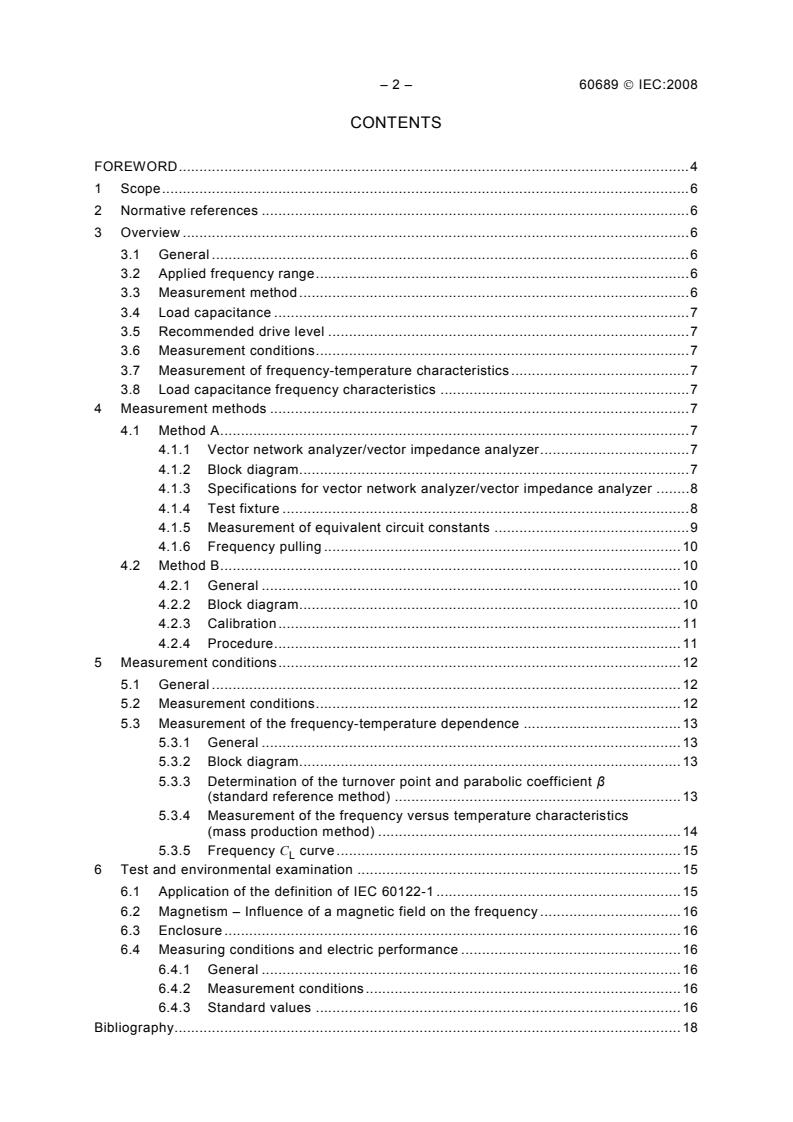
IEC 60689:2008 - Measurement and test methods for tuning fork quartz crystal units in the range from 10 kHz to 200 kHz and standard values Released:11/27/2008
Overview
IEC 60689:2008 - Measurement and test methods for tuning fork quartz crystal units in the range from 10 kHz to 200 kHz - defines measurement procedures and standard values for frequency control and selection of tuning‑fork quartz crystal units. This second edition expands the original 32 kHz wrist‑watch focus to a wider frequency band and modernizes accepted measurement techniques, providing manufacturers, test labs and designers with harmonized test methods and reference conditions.
Key topics and technical requirements
- Applied frequency range: 10 kHz to 200 kHz (extended from the first edition’s 32 kHz focus).
- Measurement methods:
- Method A (standard): Measurement using a vector network analyzer or vector impedance analyzer in a PI‑network configuration (IEC 60444 series based). Figures and test‑fixture diagrams are provided.
- Method B (permitted):Bridge method as a simpler alternative.
- Note: oscillator and Lissajous methods are not recommended for measuring equivalent circuit constants.
- PI network details: The PI network in this edition includes a transformer for impedance matching, differing from the composition in IEC 60444‑1.
- Load capacitance (standard values): 8 pF, 10 pF, 12 pF, 15 pF, 20 pF and 30 pF.
- Recommended drive level: 0.1 μW.
- Equipment/specs: Test equipment must cover 10 kHz–200 kHz. Tabled specifications include series resistance accuracy (1 %), signal level adjustment ranges (5 mV–1 V or 200 μA–20 mA rms) and spurious limits (40 dB max).
- Environmental and measurement conditions: Defined test conditions, frequency‑temperature characterization methods (turnover point, parabolic coefficient β), and load‑capacitance frequency characteristics are included.
Applications and users
IEC 60689 is primarily used by:
- Crystal manufacturers for production test, characterization and specification of tuning‑fork quartz units.
- Component test laboratories and quality control teams for standardized verification and acceptance testing.
- Oscillator and timekeeping device designers who need consistent frequency‑control data and load‑capacitance behavior.
- Suppliers and purchasers specifying component parameters for supply contracts or product datasheets.
Practical outcomes include consistent frequency specification, reliable equivalent circuit parameter measurement, and predictable temperature vs. frequency performance.
Related standards
Normative and referenced documents include:
- IEC 60444 (series) - zero phase technique in a π‑network
- IEC 60122‑1, IEC 60122‑3 - quartz crystal unit specifications and outlines
- IEC 60027, IEC 60050‑561, IEC 60617, ISO 1000
Keywords: IEC 60689, tuning fork quartz crystal, 10 kHz to 200 kHz, measurement methods, PI network, bridge method, vector network analyzer, load capacitance, frequency‑temperature characteristics.
Buy Documents
IEC 60689:2008 - Measurement and test methods for tuning fork quartz crystal units in the range from 10 kHz to 200 kHz and standard values Released:11/27/2008
IEC 60689:2008 - Measurement and test methods for tuning fork quartz crystal units in the range from 10 kHz to 200 kHz and standard values Released:11/27/2008
Frequently Asked Questions
IEC 60689:2008 is a standard published by the International Electrotechnical Commission (IEC). Its full title is "Measurement and test methods for tuning fork quartz crystal units in the range from 10 kHz to 200 kHz and standard values". This standard covers: IEC 60689:2008 applies to measurements and test methods for tuning fork quartz crystal units in the range from 10 kHz to 200 kHz and standard values for frequency control and selection. This edition includes the following significant technical changes with respect to the previous edition: a) The title of the first edition is Measurements and test methods for 32 kHz quartz crystal units for wrist watches and standard values. The title is modified and the frequency range of this second edition is extended to the range from 10 kHz to 200 kHz. b) The Lissajous method is defined in the first edition as the standard measurement method. The PI network and bridge method are used in this second edition. c) The PI network has a transformer for impedance matching. This composition differs from that of IEC 60444-1.
IEC 60689:2008 applies to measurements and test methods for tuning fork quartz crystal units in the range from 10 kHz to 200 kHz and standard values for frequency control and selection. This edition includes the following significant technical changes with respect to the previous edition: a) The title of the first edition is Measurements and test methods for 32 kHz quartz crystal units for wrist watches and standard values. The title is modified and the frequency range of this second edition is extended to the range from 10 kHz to 200 kHz. b) The Lissajous method is defined in the first edition as the standard measurement method. The PI network and bridge method are used in this second edition. c) The PI network has a transformer for impedance matching. This composition differs from that of IEC 60444-1.
IEC 60689:2008 is classified under the following ICS (International Classification for Standards) categories: 31.140 - Piezoelectric devices. The ICS classification helps identify the subject area and facilitates finding related standards.
IEC 60689:2008 is available in PDF format for immediate download after purchase. The document can be added to your cart and obtained through the secure checkout process. Digital delivery ensures instant access to the complete standard document.
Standards Content (Sample)
IEC 60689
Edition 2.0 2008-11
INTERNATIONAL
STANDARD
Measurement and test methods for tuning fork quartz crystal units in the range
from 10 kHz to 200 kHz and standard values
All rights reserved. Unless otherwise specified, no part of this publication may be reproduced or utilized in any form
or by any means, electronic or mechanical, including photocopying and microfilm, without permission in writing from
either IEC or IEC's member National Committee in the country of the requester.
If you have any questions about IEC copyright or have an enquiry about obtaining additional rights to this publication,
please contact the address below or your local IEC member National Committee for further information.
IEC Central Office
3, rue de Varembé
CH-1211 Geneva 20
Switzerland
Email: inmail@iec.ch
Web: www.iec.ch
About the IEC
The International Electrotechnical Commission (IEC) is the leading global organization that prepares and publishes
International Standards for all electrical, electronic and related technologies.
About IEC publications
The technical content of IEC publications is kept under constant review by the IEC. Please make sure that you have the
latest edition, a corrigenda or an amendment might have been published.
ƒ Catalogue of IEC publications: www.iec.ch/searchpub
The IEC on-line Catalogue enables you to search by a variety of criteria (reference number, text, technical committee,…).
It also gives information on projects, withdrawn and replaced publications.
ƒ IEC Just Published: www.iec.ch/online_news/justpub
Stay up to date on all new IEC publications. Just Published details twice a month all new publications released. Available
on-line and also by email.
ƒ Electropedia: www.electropedia.org
The world's leading online dictionary of electronic and electrical terms containing more than 20 000 terms and definitions
in English and French, with equivalent terms in additional languages. Also known as the International Electrotechnical
Vocabulary online.
ƒ Customer Service Centre: www.iec.ch/webstore/custserv
If you wish to give us your feedback on this publication or need further assistance, please visit the Customer Service
Centre FAQ or contact us:
Email: csc@iec.ch
Tel.: +41 22 919 02 11
Fax: +41 22 919 03 00
IEC 60689
Edition 2.0 2008-11
INTERNATIONAL
STANDARD
Measurement and test methods for tuning fork quartz crystal units in the range
from 10 kHz to 200 kHz and standard values
INTERNATIONAL
ELECTROTECHNICAL
COMMISSION
PRICE CODE
R
ICS 31.140 ISBN 978-2-88910-250-1
– 2 – 60689 © IEC:2008(E)
CONTENTS
FOREWORD.4
1 Scope.6
2 Normative references .6
3 Overview .6
3.1 General .6
3.2 Applied frequency range.6
3.3 Measurement method.6
3.4 Load capacitance .7
3.5 Recommended drive level .7
3.6 Measurement conditions.7
3.7 Measurement of frequency-temperature characteristics.7
3.8 Load capacitance frequency characteristics .7
4 Measurement methods .7
4.1 Method A.7
4.1.1 Vector network analyzer/vector impedance analyzer.7
4.1.2 Block diagram.7
4.1.3 Specifications for vector network analyzer/vector impedance analyzer .8
4.1.4 Test fixture .8
4.1.5 Measurement of equivalent circuit constants .9
4.1.6 Frequency pulling .10
4.2 Method B.10
4.2.1 General .10
4.2.2 Block diagram.10
4.2.3 Calibration.11
4.2.4 Procedure.12
5 Measurement conditions.12
5.1 General .12
5.2 Measurement conditions.12
5.3 Measurement of the frequency-temperature dependence .13
5.3.1 General .13
5.3.2 Block diagram.13
5.3.3 Determination of the turnover point and parabolic coefficient β
(standard reference method) .14
5.3.4 Measurement of the frequency versus temperature characteristics
(mass production method) .14
5.3.5 Frequency C curve.15
L
6 Test and environmental examination .15
6.1 Application of the definition of IEC 60122-1 .15
6.2 Magnetism – Influence of a magnetic field on the frequency .16
6.3 Enclosure .16
6.4 Measuring conditions and electric performance .16
6.4.1 General .16
6.4.2 Measurement conditions.16
6.4.3 Standard values .16
Bibliography.18
60689 © IEC:2008(E) – 3 –
Figure 1 – Block diagram of the measurement method using the vector network
analyzer or vector impedance analyzer .8
Figure 2 – Block diagram of test fixture.9
Figure 3 – Block diagram of test fixture (including a load capacitance).9
Figure 4 – Block diagram of test fixture for bridge method .11
Figure 5 – Block diagram of test fixture for bridge method (including a load
capacitance) .11
Figure 6 – Block diagram of measurement of the frequency-temperature dependence .13
Figure 7 – Frequency–temperature template
(Turnover point: 25 ± 5 °C, β =-45 × 10 /°C ) .14
–9 2
Figure 8a) – Δ f/f versus C curve .15
L
Figure 8b) – Δ f/f versus C curve .15
L
Figure 8 – Δ f/f versus C curve with different C .15
L Ls
Table 1 – Specifications for vector network analyzer/vector impedance analyzer .8
Table 2 – Standard values .17
– 4 – 60689 © IEC:2008(E)
INTERNATIONAL ELECTROTECHNICAL COMMISSION
____________
MEASUREMENT AND TEST METHODS FOR TUNING FORK
QUARTZ CRYSTAL UNITS IN THE RANGE FROM 10 kHz TO 200 kHz
AND STANDARD VALUES
FOREWORD
1) The International Electrotechnical Commission (IEC) is a worldwide organization for standardization comprising
all national electrotechnical committees (IEC National Committees). The object of IEC is to promote
international co-operation on all questions concerning standardization in the electrical and electronic fields. To
this end and in addition to other activities, IEC publishes International Standards, Technical Specifications,
Technical Reports, Publicly Available Specifications (PAS) and Guides (hereafter referred to as “IEC
Publication(s)”). Their preparation is entrusted to technical committees; any IEC National Committee interested
in the subject dealt with may participate in this preparatory work. International, governmental and non-
governmental organizations liaising with the IEC also participate in this preparation. IEC collaborates closely
with the International Organization for Standardization (ISO) in accordance with conditions determined by
agreement between the two organizations.
2) The formal decisions or agreements of IEC on technical matters express, as nearly as possible, an international
consensus of opinion on the relevant subjects since each technical committee has representation from all
interested IEC National Committees.
3) IEC Publications have the form of recommendations for international use and are accepted by IEC National
Committees in that sense. While all reasonable efforts are made to ensure that the technical content of IEC
Publications is accurate, IEC cannot be held responsible for the way in which they are used or for any
misinterpretation by any end user.
4) In order to promote international uniformity, IEC National Committees undertake to apply IEC Publications
transparently to the maximum extent possible in their national and regional publications. Any divergence
between any IEC Publication and the corresponding national or regional publication shall be clearly indicated in
the latter.
5) IEC provides no marking procedure to indicate its approval and cannot be rendered responsible for any
equipment declared to be in conformity with an IEC Publication.
6) All users should ensure that they have the latest edition of this publication.
7) No liability shall attach to IEC or its directors, employees, servants or agents including individual experts and
members of its technical committees and IEC National Committees for any personal injury, property damage or
other damage of any nature whatsoever, whether direct or indirect, or for costs (including legal fees) and
expenses arising out of the publication, use of, or reliance upon, this IEC Publication or any other IEC
Publications.
8) Attention is drawn to the Normative references cited in this publication. Use of the referenced publications is
indispensable for the correct application of this publication.
9) Attention is drawn to the possibility that some of the elements of this IEC Publication may be the subject of
patent rights. IEC shall not be held responsible for identifying any or all such patent rights.
International Standard IEC 60689 has been prepared by IEC technical committee 49:
Piezoelectric and dielectric devices for frequency control and selection.
This second edition cancels and replaces the first edition published in 1980. This edition
constitutes a technical revision.
This edition includes the following significant technical changes with respect to the previous
edition:
a) The title of the first edition is Measurements and test methods for 32 kHz quartz crystal
units for wrist watches and standard values. The title is modified and the frequency
range of this second edition is extended to the range from 10 kHz to 200 kHz.
b) The Lissajous method is defined in the first edition as the standard measurement
method. The PI network and bridge method are used in this second edition.
c) The PI network has a transformer for impedance matching. This composition differs
from that of IEC 60444-1.
60689 © IEC:2008(E) – 5 –
The text of this standard is based on the following documents:
FDIS Report on voting
49/809/FDIS 49/815/RVD
Full information on the voting for the approval of this standard can be found in the report on
voting indicated in the above table.
This publication has been drafted in accordance with the ISO/IEC Directives, Part 2.
The committee has decided that the contents of this publication will remain unchanged until
the maintenance result date indicated on the IEC web site under "http://webstore.iec.ch" in
the data related to the specific publication. At this date, the publication will be
• reconfirmed;
• withdrawn;
• replaced by a revised edition; or
• amended.
A bilingual version of this publication may be issued at a later date.
– 6 – 60689 © IEC:2008(E)
MEASUREMENT AND TEST METHODS FOR TUNING FORK
QUARTZ CRYSTAL UNITS IN THE RANGE FROM 10 kHz TO 200 kHz
AND STANDARD VALUES
1 Scope
This International Standard applies to measurements and test methods for tuning fork quartz
crystal units in the range from 10 kHz to 200 kHz and standard values for frequency control
and selection.
2 Normative references
The following referenced documents are indispensable for the application of this document.
For dated references, only the edition cited applies. For undated references, the latest edition
of the referenced document (including any amendments) applies.
IEC 60027 (all parts), Letter symbols to be used in electrical technology
IEC 60050-561, International Electrotechnical Vocabulary – Chapter 561: Piezoelectric
devices for frequency control and selection
IEC 60122-1, Quartz crystal units of assessed quality – Part 1: Generic specification
IEC 60122-3, Quartz crystal units of assessed quality – Part 3: Standard outlines and lead
connections
IEC 60444 (series), Measurement of quartz crystal unit parameters by zero phase technique
in a π-network
IEC 60617, Graphical symbols for diagrams
ISO 1000:1992, SI units and recommendations for the use of their multiples and certain other
Units
3 Overview
3.1 General
Units, graphical symbols, letter symbols and terminology shall, wherever possible, be taken
from the following standards: IEC 60027, IEC 60050-561, IEC 60122-1, IEC 60617, and ISO
1000.
3.2 Applied frequency range
The frequency range is from 10 kHz to 200 kHz.
3.3 Measurement method
The measurement method is according to the IEC 60444 series.
It is permitted to use the bridge method as a simple measuring method.
60689 © IEC:2008(E) – 7 –
NOTE Other methods like Lissajous-or oscillator methods are not recommended for measurement of equivalent
circuit constants.
3.4 Load capacitance
Currently, defined values of load capacitance are 8 pF, 10 pF, 12 pF, 15 pF, 20 pF and 30 pF.
3.5 Recommended drive level
Currently, the recommended drive level is 0,1 μW.
3.6 Measurement conditions
Measurement conditions are given in 5.2.
3.7 Measurement of frequency-temperature characteristics
The measurement of frequency-temperature characteristics is given in Clause 5.
3.8 Load capacitance frequency characteristics
The present conditions of load capacitance and frequency characteristics are given in 5.3.4.
4 Measurement methods
4.1 Method A
The measurement method accordi
...
IEC 60689 ®
Edition 2.0 2008-11
INTERNATIONAL
STANDARD
NORME
INTERNATIONALE
Measurement and test methods for tuning fork quartz crystal units in the range
from 10 kHz to 200 kHz and standard values
Méthodes de mesure et d’essai concernant le réglage des résonateurs à quartz
dans la plage comprise entre 10 kHz et 200 kHz et valeurs normales
All rights reserved. Unless otherwise specified, no part of this publication may be reproduced or utilized in any form
or by any means, electronic or mechanical, including photocopying and microfilm, without permission in writing from
either IEC or IEC's member National Committee in the country of the requester.
If you have any questions about IEC copyright or have an enquiry about obtaining additional rights to this publication,
please contact the address below or your local IEC member National Committee for further information.
Droits de reproduction réservés. Sauf indication contraire, aucune partie de cette publication ne peut être reproduite ni
utilisée sous quelque forme que ce soit et par aucun procédé, électronique ou mécanique, y compris la photocopie et les
microfilms, sans l'accord écrit de la CEI ou du Comité national de la CEI du pays du demandeur.
Si vous avez des questions sur le copyright de la CEI ou si vous désirez obtenir des droits supplémentaires sur cette
publication, utilisez les coordonnées ci-après ou contactez le Comité national de la CEI de votre pays de résidence.
IEC Central Office Tel.: +41 22 919 02 11
3, rue de Varembé Fax: +41 22 919 03 00
CH-1211 Geneva 20 info@iec.ch
Switzerland www.iec.ch
About the IEC
The International Electrotechnical Commission (IEC) is the leading global organization that prepares and publishes
International Standards for all electrical, electronic and related technologies.
About IEC publications
The technical content of IEC publications is kept under constant review by the IEC. Please make sure that you have the
latest edition, a corrigenda or an amendment might have been published.
Useful links:
IEC publications search - www.iec.ch/searchpub Electropedia - www.electropedia.org
The advanced search enables you to find IEC publications The world's leading online dictionary of electronic and
by a variety of criteria (reference number, text, technical electrical terms containing more than 30 000 terms and
committee,…). definitions in English and French, with equivalent terms in
It also gives information on projects, replaced and additional languages. Also known as the International
withdrawn publications. Electrotechnical Vocabulary (IEV) on-line.
IEC Just Published - webstore.iec.ch/justpublished Customer Service Centre - webstore.iec.ch/csc
Stay up to date on all new IEC publications. Just Published If you wish to give us your feedback on this publication
details all new publications released. Available on-line and or need further assistance, please contact the
also once a month by email. Customer Service Centre: csc@iec.ch.
A propos de la CEI
La Commission Electrotechnique Internationale (CEI) est la première organisation mondiale qui élabore et publie des
Normes internationales pour tout ce qui a trait à l'électricité, à l'électronique et aux technologies apparentées.
A propos des publications CEI
Le contenu technique des publications de la CEI est constamment revu. Veuillez vous assurer que vous possédez
l’édition la plus récente, un corrigendum ou amendement peut avoir été publié.
Liens utiles:
Recherche de publications CEI - www.iec.ch/searchpub Electropedia - www.electropedia.org
La recherche avancée vous permet de trouver des Le premier dictionnaire en ligne au monde de termes
publications CEI en utilisant différents critères (numéro de électroniques et électriques. Il contient plus de 30 000
référence, texte, comité d’études,…). termes et définitions en anglais et en français, ainsi que
Elle donne aussi des informations sur les projets et les les termes équivalents dans les langues additionnelles.
publications remplacées ou retirées. Egalement appelé Vocabulaire Electrotechnique
International (VEI) en ligne.
Just Published CEI - webstore.iec.ch/justpublished
Service Clients - webstore.iec.ch/csc
Restez informé sur les nouvelles publications de la CEI.
Just Published détaille les nouvelles publications parues. Si vous désirez nous donner des commentaires sur
Disponible en ligne et aussi une fois par mois par email. cette publication ou si vous avez des questions
contactez-nous: csc@iec.ch.
IEC 60689 ®
Edition 2.0 2008-11
INTERNATIONAL
STANDARD
NORME
INTERNATIONALE
Measurement and test methods for tuning fork quartz crystal units in the range
from 10 kHz to 200 kHz and standard values
Méthodes de mesure et d’essai concernant le réglage des résonateurs à quartz
dans la plage comprise entre 10 kHz et 200 kHz et valeurs normales
INTERNATIONAL
ELECTROTECHNICAL
COMMISSION
COMMISSION
ELECTROTECHNIQUE
PRICE CODE
INTERNATIONALE
CODE PRIX R
ICS 31.140 ISBN 978-2-8322-0883-0
– 2 – 60689 IEC:2008
CONTENTS
FOREWORD . 4
1 Scope . 6
2 Normative references . 6
3 Overview . 6
3.1 General . 6
3.2 Applied frequency range . 6
3.3 Measurement method . 6
3.4 Load capacitance . 7
3.5 Recommended drive level . 7
3.6 Measurement conditions . 7
3.7 Measurement of frequency-temperature characteristics . 7
3.8 Load capacitance frequency characteristics . 7
4 Measurement methods . 7
4.1 Method A . 7
4.1.1 Vector network analyzer/vector impedance analyzer . 7
4.1.2 Block diagram . 7
4.1.3 Specifications for vector network analyzer/vector impedance analyzer . 8
4.1.4 Test fixture . 8
4.1.5 Measurement of equivalent circuit constants . 9
4.1.6 Frequency pulling . 10
4.2 Method B . 10
4.2.1 General . 10
4.2.2 Block diagram . 10
4.2.3 Calibration . 11
4.2.4 Procedure . 11
5 Measurement conditions . 12
5.1 General . 12
5.2 Measurement conditions . 12
5.3 Measurement of the frequency-temperature dependence . 13
5.3.1 General . 13
5.3.2 Block diagram . 13
5.3.3 Determination of the turnover point and parabolic coefficient β
(standard reference method) . 13
5.3.4 Measurement of the frequency versus temperature characteristics
(mass production method) . 14
5.3.5 Frequency C curve . 15
L
6 Test and environmental examination . 15
6.1 Application of the definition of IEC 60122-1 . 15
6.2 Magnetism – Influence of a magnetic field on the frequency . 16
6.3 Enclosure . 16
6.4 Measuring conditions and electric performance . 16
6.4.1 General . 16
6.4.2 Measurement conditions . 16
6.4.3 Standard values . 16
Bibliography . 18
60689 IEC:2008 – 3 –
Figure 1 – Block diagram of the measurement method using the vector network
analyzer or vector impedance analyzer . 8
Figure 2 – Block diagram of test fixture . 9
Figure 3 – Block diagram of test fixture (including a load capacitance). 9
Figure 4 – Block diagram of test fixture for bridge method . 11
Figure 5 – Block diagram of test fixture for bridge method (including a load
capacitance) . 11
Figure 6 – Block diagram of measurement of the frequency-temperature dependence . 13
Figure 7 – Frequency–temperature template (Turnover point: 25 ± 5 °C, β =
–9 2
-45 × 10 /°C ) . 14
Figure 8a) – ∆ f/f versus C curve . 15
L
Figure 8b) – ∆ f/f versus C curve . 15
L
Figure 8 – ∆ f/f versus C curve with different C . 15
L Ls
Table 1 – Specifications for vector network analyzer/vector impedance analyzer . 8
Table 2 – Standard values . 17
– 4 – 60689 IEC:2008
INTERNATIONAL ELECTROTECHNICAL COMMISSION
____________
MEASUREMENT AND TEST METHODS FOR TUNING FORK
QUARTZ CRYSTAL UNITS IN THE RANGE FROM 10 kHz TO 200 kHz
AND STANDARD VALUES
FOREWORD
1) The International Electrotechnical Commission (IEC) is a worldwide organization for standardization comprising
all national electrotechnical committees (IEC National Committees). The object of IEC is to promote
international co-operation on all questions concerning standardization in the electrical and electronic fields. To
this end and in addition to other activities, IEC publishes International Standards, Technical Specifications,
Technical Reports, Publicly Available Specifications (PAS) and Guides (hereafter referred to as “IEC
Publication(s)”). Their preparation is entrusted to technical committees; any IEC National Committee interested
in the subject dealt with may participate in this preparatory work. International, governmental and non-
governmental organizations liaising with the IEC also participate in this preparation. IEC collaborates closely
with the International Organization for Standardization (ISO) in accordance with conditions determined by
agreement between the two organizations.
2) The formal decisions or agreements of IEC on technical matters express, as nearly as possible, an international
consensus of opinion on the relevant subjects since each technical committee has representation from all
interested IEC National Committees.
3) IEC Publications have the form of recommendations for international use and are accepted by IEC National
Committees in that sense. While all reasonable efforts are made to ensure that the technical content of IEC
Publications is accurate, IEC cannot be held responsible for the way in which they are used or for any
misinterpretation by any end user.
4) In order to promote international uniformity, IEC National Committees undertake to apply IEC Publications
transparently to the maximum extent possible in their national and regional publications. Any divergence
between any IEC Publication and the corresponding national or regional publication shall be clearly indicated in
the latter.
5) IEC provides no marking procedure to indicate its approval and cannot be rendered responsible for any
equipment declared to be in conformity with an IEC Publication.
6) All users should ensure that they have the latest edition of this publication.
7) No liability shall attach to IEC or its directors, employees, servants or agents including individual experts and
members of its technical committees and IEC National Committees for any personal injury, property damage or
other damage of any nature whatsoever, whether direct or indirect, or for costs (including legal fees) and
expenses arising out of the publication, use of, or reliance upon, this IEC Publication or any other IEC
Publications.
8) Attention is drawn to the Normative references cited in this publication. Use of the referenced publications is
indispensable for the correct application of this publication.
9) Attention is drawn to the possibility that some of the elements of this IEC Publication may be the subject of
patent rights. IEC shall not be held responsible for identifying any or all such patent rights.
International Standard IEC 60689 has been prepared by IEC technical committee 49:
Piezoelectric and dielectric devices for frequency control and selection.
This second edition cancels and replaces the first edition published in 1980. This edition
constitutes a technical revision.
This edition includes the following significant technical changes with respect to the previous
edition:
a) The title of the first edition is Measurements and test methods for 32 kHz quartz crystal
units for wrist watches and standard values. The title is modified and the frequency
range of this second edition is extended to the range from 10 kHz to 200 kHz.
b) The Lissajous method is defined in the first edition as the standard measurement
method. The PI network and bridge method are used in this second edition.
c) The PI network has a transformer for impedance matching. This composition differs
from that of IEC 60444-1.
60689 IEC:2008 – 5 –
This bilingual version (2013-07) corresponds to the monolingual English version, published in
2008-11.
The text of this standard is based on the following documents:
FDIS Report on voting
49/809/FDIS 49/815/RVD
Full information on the voting for the approval of this standard can be found in the report on
voting indicated in the above table.
The French version of this standard has not been voted upon.
This publication has been drafted in accordance with the ISO/IEC Directives, Part 2.
The committee has decided that the contents of this publication will remain unchanged until
the maintenance result date indicated on the IEC web site under "http://webstore.iec.ch" in
the data related to the specific publication. At this date, the publication will be
• reconfirmed;
• withdrawn;
• replaced by a revised edition; or
• amended.
– 6 – 60689 IEC:2008
MEASUREMENT AND TEST METHODS FOR TUNING FORK
QUARTZ CRYSTAL UNITS IN THE RANGE FROM 10 kHz TO 200 kHz
AND STANDARD VALUES
1 Scope
This International Standard applies to measurements and test methods for tuning fork quartz
crystal units in the range from 10 kHz to 200 kHz and standard values for frequency control
and selection.
2 Normative references
The following referenced documents are indispensable for the application of this document.
For dated references, only the edition cited applies. For undated references, the latest edition
of the referenced document (including any amendments) applies.
IEC 60027 (all parts), Letter symbols to be used in electrical technology
IEC 60050-561, International Electrotechnical Vocabulary – Chapter 561: Piezoelectric
devices for frequency control and selection
IEC 60122-1, Quartz crystal units of assessed quality – Part 1: Generic specification
IEC 60122-3, Quartz crystal units of assessed quality – Part 3: Standard outlines and lead
connections
IEC 60444 (series), Measurement of quartz crystal unit parameters by zero phase technique
in a π-network
IEC 60617, Graphical symbols for diagrams
ISO 1000:1992, SI units and recommendations for the use of their multiples and certain other
Units
3 Overview
3.1 General
Units, graphical symbols, letter symbols and terminology shall, wherever possible, be taken
from the following standards: IEC 60027, IEC 60050-561, IEC 60122-1, IEC 60617, and ISO
1000.
3.2 Applied frequency range
The frequency range is from 10 kHz to 200 kHz.
3.3 Measurement method
The measurement method is according to the IEC 60444 series.
It is permitted to use the bridge method as a simple measuring method.
60689 IEC:2008 – 7 –
NOTE Other methods like Lissajous-or oscillator methods are not recommended for measurement of equivalent
circuit constants.
3.4 Load capacitance
Currently, defined values of load capacitance are 8 pF, 10 pF, 12 pF, 15 pF, 20 pF and 30 pF.
3.5 Recommended drive level
Currently, the recommended drive level is 0,1 µW.
3.6 Measurement conditions
Measurement conditions are given in 5.2.
3.7 Measurement of frequency-temperature characteristics
The measurement of frequency-temperature characteristics is given in Clause 5.
3.8 Load capacitance frequency characteristics
The present conditions of load capacitance and frequency characteristics are given in 5.3.4.
4 Measurement methods
4.1 Method A
The measurement method according to the IEC 60444 series gives a copy of a block diagram
(including a load capacitance), test fixture (for Surface Mounted Device-units included) with
additional values of the resistances for high impedance value (standard PI-network 25 Ω) and
hardware requirements for a frequency range from 10 kHz to 200 kHz.
This measuring method is a standard measuring method in this document.
4.1.1 Vector network analyzer/vector impedance analyzer
The measurement method using the vector network analyzer or vector impedance analyzer is
based on the following method.
4.1.2 Block diagram
Figure 1 is a block diagram of the measurement method using the vector network analyzer or
vector impedance analyzer.
– 8 – 60689 IEC:2008
Personal
Analyzer
computer
Test fixture
IEC 2108/08
Figure 1 – Block diagram of the measurement method using
the vector network analyzer or vector impedance analyzer
4.1.3 Specifications for vector network analyzer/vector impedance analyzer
Specifications for vector impedance analyzer are shown in Table 1.
Table 1 – Specifications for vector network analyzer/vector impedance analyzer
Item Specifications
Frequency range The measurement range of equipment shall be from
10 kHz to 200 kHz.
-6
Frequency accuracy
1 × 10
Series resistance accuracy 1 %
Signal level adjusted range
5 mV – 1V or 200 µA – 20 mA
rms rms rms rms
Spurious 40 dB max.
Others RC23C, LAN, etc.
4.1.4 Test fixture
A test fixture shall be used. This test fixture shall be electrically and mechanically compatible
with the vector network analyzer or the vector impedance analyzer that is used.
Figures 2 and Figure 3 show the block diagrams of the equivalent circuit of the test fixture.
60689 IEC:2008 – 9 –
R R
2 2
Z = 50 Ω Z = 50 Ω
in out
R R OUT
IN
1 1
T (1: N) T (N: 1)
IEC 2109/08
Figure 2 – Block diagram of test fixture
C C
L1 L2
R
R 2
Z = 50 Ω Z = 50 Ω
out
in
OUT
IN R
R
T (1: N) T (N: 1)
IEC 2110/08
Figure 3 – Block diagram of test fixture
(including a load capacitance)
The equivalent series resistance of the crystal units takes on various values according to the
design. This resistance value varies in a range from 1 kΩ to 100 kΩ. For this reason, the
equivalent series resistance of the crystal units determines R and R appropriately. These
1 2
values should be determined through a contract with the customer. Since it is the low
frequency range, the structure and material of the test fixture are not defined specifically.
EXAMPLE Each constant takes on the following values in the following ranges.
R is 1 kΩ to 10 kΩ: N_TF = 10 000, R = 49,5 kΩ, and R = 5,008 MΩ
r 1 2
R is 10 kΩ to 20 kΩ: N_TF = 17 000, R = 50 kΩ, and R = 15,000 MΩ
r 1 2
is 20 kΩ to 40 kΩ: N_TF = 24 000, R
R = 50,464 kΩ, and R = 30 MΩ
r 1 2
R is 40 kΩ to 70 kΩ: N_TF = 33 000, R = 49,809 kΩ, and R = 55,008 MΩ
r 1 2
R is 70 kΩ to 200 kΩ: N_TF = 41, R = 50,119 kΩ, and R = 85,008 MΩ
r 1 2
NOTE The structure and material of the test fixture are determined through due examination.
4.1.5 Measurement of equivalent circuit constants
The measurements of equivalent resistance R , resonance frequency f , motional capacitance
r r
C , quality factor Q and load resonance frequency f are in accordance with the IEC 60444
1 L
series.
The load resonance offset between load resonance frequency f and resonance frequency f
L
r
can be calculated from the parameters C and C by the following formula.
0 1
∆f C
=
f 2 (C + C )
0 L
– 10 – 60689 IEC:2008
4.1.6 Frequency pulling
4.1.6.1 General
The frequency pulling shall compensate the frequency shifts by means of the following:
a) tolerances on other components of oscillator (e.g. watch) circuits;
b) adjustment tolerance;
c) ageing during the economic life of oscillator (e.g. watch) circuits;
d) frequency shifts due to shocks and vibrations.
4.1.6.2 Alternative determination of the motional capacitance C
The motional capacitance C can be determined alternatively with the frequency difference
when the crystal unit is measured with 2 different load capacitances.
The motional capacitance C is determined by a measurement of frequency, with use of two
load capacitances C and C , connected in series with the crystal unit (see Figure 3).
L1 L2
When
∆C = C − C
L L2 L1
∆f = f − f
L1 L2
∆f = f − f
1 L1 r
∆f = f − f
2 L2 r
f = resonance frequency
r
f and f are the resonance frequencies of the crystal unit connected in series with C and
L1 L2 L1
C respectively.
L2
Hence
2∆C ∆f ∆f
L 1 2
C = ×
f ∆f
r
NOTE The measurements corresponding to the motional capacitance C take a long time. For quality control in
production, a fixed value of C could be selected, and the frequency change is measured. For application in the
L
watch making industry, the scatter of C is also a very important factor.
4.2 Method B
4.2.1 General
It is permitted to use the bridge method as a simple measuring method. This simple
measuring method is permitted only for frequency measurement.
4.2.2 Block diagram
Figures 4 and 5 show the block diagrams of the test fixture for the bridge method. Each
resistance is based on a contract with a customer.
60689 IEC:2008 – 11 –
Z
Z
Z
C
b
a
A B
Z
Z
Z
D
Analyzer
IEC 2111/08
Figure 4 – Block diagram of test fixture for bridge method
Z
Z
C
C
L2
L1
Z
C
b
a
A B
Z
Z
Z
2 4
D
Analyzer
IEC 2112/08
Figure 5 – Block diagram of test fixture for bridge method
(including a load capacitance)
4.2.3 Calibration
The standard impedance Z (resistance) is connected between terminals CB. This impedance
has almost the same value as the equivalent series impedance (resistance) of the crystal
units to be measured. After that, the zero phase and drive level of this measurement system
are determined.
4.2.4 Procedure
The procedure is as follows:
– 12 – 60689 IEC:2008
1) after completing the initial calibration, the crystal units to be measured are connected
between the terminals ab.
When applying the load capacitance C , a load capacitance adapter (C and C ) is
L L1 L2
connected between terminals CB. Relationship between C and C is given by
L1 L2
Equation (a);
C = C = 2 ⋅ C (a)
L1 L2 L
2) the signal from the analyzer is added between terminals AB;
3) the frequency in the analyzer changes. Phase between terminals CD is set at zero. At this
time, the frequency is the series resonance frequency F ;
S
4) the equivalent series resistance R is given by Equation (b).
r
Z
R = Z = Z (b)
r 3 4
Z
NOTE 1 When changing frequency, the phase of the analyzer changes. At this time, the phase between terminals
CD is not in an equilibrium situation. For this reason, it does not suit a measurement of an equivalent circuit
constant.
NOTE 2 Since it is the low frequency range, the structure and material of the test fixture are not defined
specifically. These are based on a contract with the customer.
NOTE 3 The structure and material of the test fixture are determined through due examination.
NOTE 4 This bridge method may apply to the automatic bridge method.
5 Measurement conditions
5.1 General
A typical example is shown below.
The following conditions can be changed through a contract between manufacturer and users.
5.2 Measurement conditions
The measurement conditions are as follows:
a) enclosure not earthed;
b) the test fixture shall not apply any mechanical stress on the crystal unit to avoid causing
frequency changes;
c) the synthesizer shall have a frequency resolution of at least 10 MHz;
d) temperature: see Figure 7; in the worst case (turnover point at 30 °C, measurement at
–6
21 °C); the slope at T °C is about 1 × 10 /°C;
e) load capacitance C : the tolerance on the load capacitance should be decided
L
appropriately so that the frequency change does not exceed 10 % of the frequency
tolerance (see IEC 60122-1).
C and C shall be as near as possible to the crystal unit: the accuracy of the
L1 L2
measurement is dependent on this;
f) measuring level (Method A):
when only the voltage is given, the following formula can be used:
V
P =
R
r
C
R = Z = R ⋅ (1+ )
L 3 r
C
L
where
60689 IEC:2008 – 13 –
V is the r.m.s. value of the voltage at resonance frequency across the terminals of the
crystal unit;
P is specified in 3.5.
g) measuring level (Method B):
when only the voltage is given, the following formula can be used:
V
P =
Z
where
Z (R ) is measured in accordance with f);
3 r
V is the r.m.s. value of the voltage at resonance frequency across the terminals of the
crystal unit;
P is specified in 3.5.
5.3 Measurement of the frequency-temperature dependence
5.3.1 General
It is permitted to use the frequency-temperature dependence as a simple measuring method.
This simple measuring method is permitted only for frequency measurement.
5.3.2 Block diagram
Figure 6 shows the block diagram of measurement of the frequency-temperature dependence.
A thermo-couple or an equivalent device can be used for a thermometer device. The test
fixtures and the analyzer are used for Method A (see 4.1) or Method B (see 4.2). It is
acceptable that this measurement system be exchanged for an automatic system by contract
between customer and supplier.
Thermometer
Test fixtures
Analyzer
Oven
IEC 2113/08
Figure 6 – Block diagram of measurement of the frequency-temperature dependence
5.3.3 Determination of the turnover point and parabolic coefficient β (standard
reference method)
It is recommended to measure at least five points. In general, the nominal turnover point and
four points symmetrically located and nearest the first one, are considered.
–6
The measurement accuracy shall be better than ± 1 × 10 and the temperature shall be
controlled within ± 0,3 °C and measured within ± 0,1 °C.
The temperature stabilization time should be about 10 min for each measurement.
– 14 – 60689 IEC:2008
The turnover point and parabolic coefficient β are obtained by computation (e.g. linear
regression).
In the worst case, the error on the determination of the turnover point is ± 1 °C.
5.3.4 Measurement of the frequency versus temperature characteristics (mass
production method)
When it is not necessary to determine the turnover temperature, a 3-point measurement of
frequency versus temperature is sufficient.
The limiting points of the operating temperature range are chosen (−10 °C, +60 °C), as well
as the reference temperature.
The frequency variation shall remain within the limits of Figure 7, for the stated values of β
and the turnover point.
∆f
-6
(10 )
f
0 –10 +60 T (°C)
–70
IEC 2114/08
Figure 7 – Frequency–temperature template
–9 2
(Turnover point: 25 ± 5 °C, β =-45 × 10 /°C )
60689 IEC:2008 – 15 –
5.3.5 Frequency C curve
L
Figures 8a) and 8b) show the frequency versus C curve. Two different C are used.
L Ls
∆f
-6
(10 )
f
5 10 12 20 30 50 70 100 C (pF)
L
IEC 2115/08
Figure 8a) – ∆f/f versus C curve
L
∆f
-6
(10 )
f
σ
x
5 10 12 20 30 50 70 100 C (pF)
L
IEC 2116/08
Figure 8b) – ∆f/f versus C curve
L
Figure 8 – ∆f/f versus C curve with different C
L Ls
6 Test and environmental examination
6.1 Application of the definition of IEC 60122-1
The definition of IEC 60122-1 applies to the following:
Vibrations, shocks, mechanical stresses on terminals, insulation resistance between
enclosure and the leads, solderability of the leads, other methods of fixing, sealing
– 16 – 60689 IEC:2008
overpressure, marking and date of manufacture, these should be decided by the manufacturer
and the user.
6.2 Magnetism – Influence of a magnetic field on the frequency
The crystal unit is placed in a magnetic field for 1 min along each of the three principal
directions, and the frequency is measured. The change in frequency during and after the test
is noted.
NOTE The need of the test is subject to agreement between manufacturer and user.
6.3 Enclosure
Lead type package depends on IEC 60122-3. Lead-less surface mounted type package has
already been put to practical use. This has been added to an appropriate document.
6.4 Measuring conditions and electric performance
6.4.1 General
Insulation resistance is 100 V, 500 MΩ.
Measurement conditions and standard values are as follows:
6.4.2 Measurement conditions
The measurement conditions are as follows:
a) reference temperature should be fixed between 21 °C and 25 °C;
b) tolerance of the fixed reference temperature ± 0,5 °C for items 1 and 2; ± 1 °C for other
items;
c) drive level 0,1 µW;
d) load capacitance: 8 pF, 10 pF, 12 pF, 15 pF, 20 pF and 30 pF.
6.4.3 Standard values
Standard values are given in Table 2 hereinafter.
60689 IEC:2008 – 17 –
Table 2 – Standard values
Characteristics Symbol Unit Standard values
a b
kHz Type 1 Type 2
f
1 Nominal frequency
32,768
∆f
–6
2 Frequency tolerance 10 ± 20 ± 20
f
3 Maximum resonance resistance under all
Rr kΩ 30 100
operating conditions
4 Minimum motional capacitance C fF 2,0 0,8
Q See 4.1.5
5 Quality factor −
T °C
6 Turnover temperature 25 ± 5
i
–6 2
/ °C
β 10 −0,04
7 Maximum parabolic coefficient
8 Operating temperature range °C
− −10 to +60
9 Storage temperature range − °C −30 to +70
∆f
–6
10 Frequency variation due to vibration 10 3
f
∆f
–6
11 Frequency variation due to shock 10 5
f
∆f
12 Frequency variation due to ageing during
–6
10 3 5
the first year
f
∆f
13 Frequency variation due to mechanical
–6
10 3
stress on terminals
f
∆f
–6
14 Effect of support 10 3
f
15 Insulation resistance at 100 V MΩ 500
16 Maximum drive level P μW 1
a
Type 1 = so-called “thick” tuning fork.
b
Type 2 = so-called “thin” tuning fork.
NOTE The standard value of the nominal frequency (32,768 kHz) is one of the examples.
– 18 – 60689 IEC:2008
Bibliography
IEC 60068-1, Environmental testing – Part 1, General and guidance
IEC 60068-2-1, Environmental testing – Part 2-1: Tests –Test A: Cold
IEC 60068-2-2, Environmental testing – Part 2-2: Tests – Test B: Dry heat
IEC 60068-2-7, Basic environmental testing procedures – Part 2-7: Tests – Test Ga and
guidance: Acceleration, steady state
IEC 60068-2-13, Basic environmental testing procedures – Part 2-13: Tests – Test M: Low air
pressure
IEC 60068-2-14, Basic environmental testing procedures – Part 2-14: Tests – Test N: Change
of temperature
IEC 60068-2-17: Basic environmental testing procedures – Part 2-17: Tests – Test Q: Sealing
IEC 60068-2-20, Environmental testing – Part 2-20: Tests – Test T: Test methods for
solderability and resistance to soldering heat of devices with leads
IEC 60068-2-21, Environmental testing – Part 2-21: Tests – Test U: Robustness of
terminations and integral mounting devices
IEC 60068-2-27, Environmental testing – Part 2-27: Tests – Test Ea and guidance: Shock
IEC 60068-2-30, Environmental testing – Part 2-30: Tests – Test Db: Damp heat, cyclic (12 +
12 h cycle)
IEC 60068-2-31, Environmental testing – Part 2-31: Tests – Test Ec: Rough handling shocks,
primarily for equipment-type specimens
IEC 60068-2-45, Basic environmental testing procedures – Part 2-45: Tests – Test XA and
guidance: Immersion in cleaning solvents
IEC 60068-2-78, Environmental testing – Part 2-78: Tests-test Cab: Damp heat, steady state
IEC 61178-2, Quartz crystal units – A specification in the IEC Quality Assessment System for
:Sectional specification – Capability approval
Electronic Components (IECQ) – Part 2
IEC 61178-3, Quartz crystal units – A specification in the IEC Quality Assessment System for
Electronic Components (IECQ) – Part 3: Sectional specification – Qualification approval
(IECQ System) –
IEC Q 01, IEC Quality Assessment System for Electronic Components
Basic Rules
IEC QC 001002-2, IEC Quality Assessment System for Electronic Components (IECQ) –
Rules of Procedure – Part 2: Documentation
IEC QC 001002-3: 1998, IEC Quality Assessment System for Electronic Components (IECQ)
– Rules of Procedure – Part 3: Approval Procedures
60689 IEC:2008 – 19 –
IEC QC 001005 , Register of firms, products and services approved under the IECQ System,
including ISO 9000
___________
—————————
This publication has been withdrawn and replaced by the on-line certificate system available at
.
– 20 – 60689 CEI:2008
SOMMAIRE
AVANT-PROPOS . 22
1 Domaine d'application . 24
2 Références normatives . 24
3 Vue d’ensemble . 24
3.1 Généralités . 24
3.2 Plage de fréquences appliquées . 24
3.3 Méthodes de mesure . 24
3.4 Capacité de charge . 25
3.5 Niveau d’excitation recommandé . 25
3.6 Conditions de mesure . 25
3.7 Mesure des caractéristiques de fréquence en fonction de la température . 25
3.8 Caractéristiques de capacité de charge et de fréquence . 25
4 Méthodes de mesure . 25
4.1 Méthode A . 25
4.1.1 Analyseur de réseau vectoriel/analyseur d’impédance vectorielle . 25
4.1.2 Schéma fonctionnel . 25
4.1.3 Spécifications relatives à l’analyseur de réseau vectoriel/l’analyseur
d’impédance vectorielle . 26
4.1.4 Dispositif d’essai . 26
4.1.5 Mesure des constantes de circuit équivalent . 27
4.1.6 Entraînement en fréquence . 28
4.2 Méthode B . 28
4.2.1 Généralités . 28
4.2.2 Schéma fonctionnel . 28
4.2.3 Etalonnage . 29
4.2.4 Procédure . 29
5 Conditions de mesure . 30
5.1 Généralités . 30
5.2 Conditions de mesure . 30
5.3 Mesure de l'influence fréquence-température . 31
5.3.1 Généralités . 31
5.3.2 Schéma fonctionnel . 31
5.3.3 Détermination du point d’inversion et du coefficient parabolique β
(méthode de référence normale) . 32
5.3.4 Mesure des caractéristiques de fréquence par rapport à la
température (méthode relative à la production en série) . 32
5.3.5 Courbe de la fréquence en fonction de C . 32
L
6 Essai et examen d’environnement . 33
6.1 Application de la définition de la CEI 60122-1 . 33
6.2 Magnétisme – Influence d’un champ magnétique sur la fréquence. 34
6.3 Enveloppe . 34
6.4 Conditions de mesure et performance électrique . 34
6.4.1 Généralités . 34
6.4.2 Conditions de mesure . 34
6.4.3 Valeurs normales . 34
Bibliographie . 36
60689 CEI:2008 – 21 –
Figure 1 – Schéma fonctionnel de la méthode de mesure utilisant l’analyseur de
réseau vectoriel ou l’analyseur d’impédance vectorielle . 26
Figure 2 – Schéma fonctionnel du dispositif d’essai . 27
Figure 3 – Schéma fonctionnel du dispositif d’essai (y compris une capacité de
charge) . 27
Figure 4 – Schéma fonctionnel du dispositif d’essai pour la méthode du pont . 29
Figure 5 – Schéma fonctionnel du dispositif d’essai pour la méthode du pont (y
compris une capacité de charge) . 29
Figure 6 – Schéma fonctionnel de mesure de l’influence fréquence-température . 31
Figure 7 – Gabarit de fréquence–température (Point d’inversion: 25 ± 5°C, β =-45 ×
–9 2
10 / C ) . 32
Figure 8a) – courbe de ∆ f/f en fonction de C . 33
L
Figure 8b) – Courbe de ∆ f/f en fonction de C . 33
L
Figure 8 – Courbe de ∆ f/f en fonction de C avec différentes C . 33
L Ls
Tableau 1 – Spécifications relatives à l’analyseur d
...