

IEC 61215-1:2021
(Main)Terrestrial photovoltaic (PV) modules - Design qualification and type approval - Part 1: Test requirements
General Information
- Abstract
IEC 61215-1:2021 lays down requirements for the design qualification of terrestrial photovoltaic modules suitable for long-term operation in open-air climates. The useful service life of modules so qualified will depend on their design, their environment and the conditions under which they are operated. Test results are not construed as a quantitative prediction of module lifetime. This document is intended to apply to all terrestrial flat plate module materials such as crystalline silicon module types as well as thin-film modules. It does not apply to systems that are not long-term applications, such as flexible modules installed in awnings or tenting. This second edition of IEC 61215-1 cancels and replaces the first edition of IEC 61215-1, published in 2016. This edition includes the following significant technical changes with respect to the previous edition:
a. Addition of a test taken from IEC TS 62782.
b. Addition of a test taken from IEC TS 62804-1.
c. Addition of test methods required for flexible modules. This includes the addition of the bending test (MQT 22).
d. Addition of definitions, references and instructions on how to perform the IEC 61215 design qualification and type approval on bifacial PV modules.
e. Clarification of the requirements related to power output measurements.
f. Addition of weights to junction box during 200 thermal cycles.
g. Requirement that retesting be performed according to IEC TS 62915.
h. Removal of the nominal module operating test (NMOT), and associated test of performance at NMOT, from the IEC 61215 series.
The contents of the corrigendum of May 2021 have been included in this copy.
- Status
- Published
- Publication Date
- 22-Feb-2021
- Technical Committee
- TC 82 - Solar photovoltaic energy systems
- Drafting Committee
- WG 2 - TC 82/WG 2
- Current Stage
- PPUB - Publication issued
- Start Date
- 23-Feb-2021
- Completion Date
- 05-Mar-2021
Buy Documents
IEC 61215-1:2021 RLV - Terrestrial photovoltaic (PV) modules - Design qualification and type approval - Part 1: Test requirements Released:2/23/2021
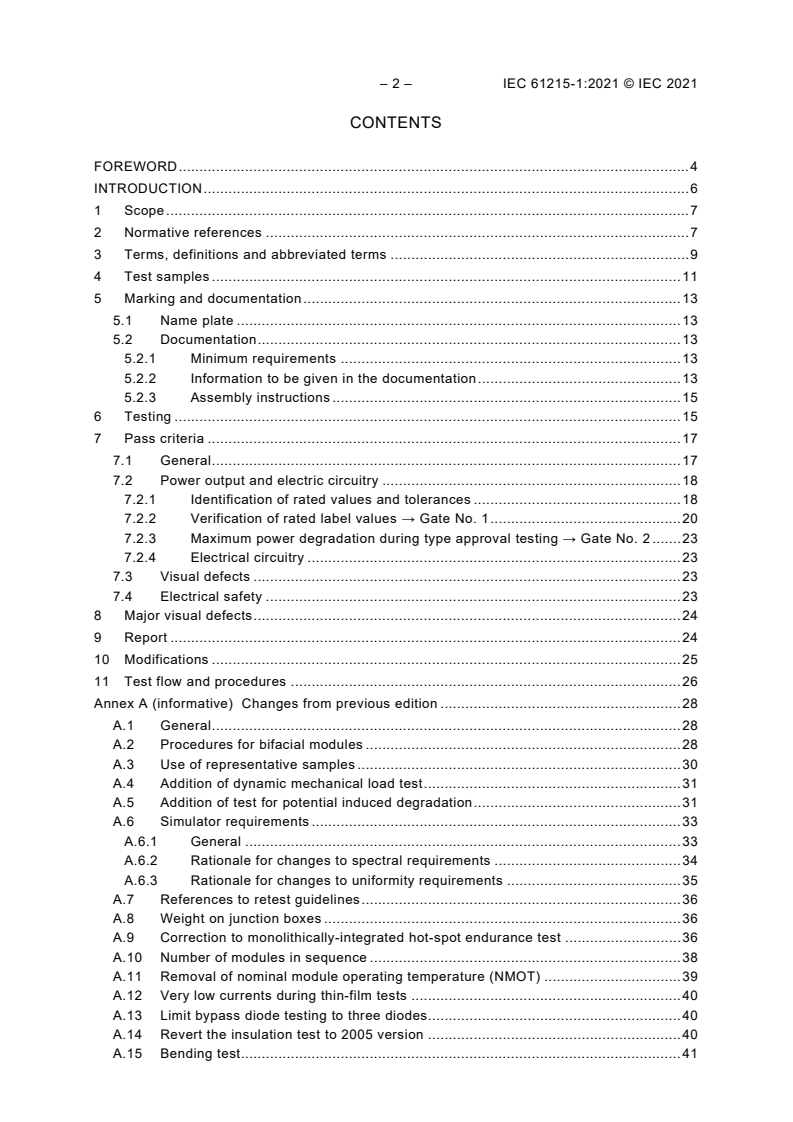
IEC 61215-1:2021 - Terrestrial photovoltaic (PV) modules - Design qualification and type approval - Part 1: Test requirements Released:2/23/2021
Overview
IEC 61215-1:2021 - Terrestrial photovoltaic (PV) modules: Design qualification and type approval - Part 1: Test requirements specifies the requirements for qualifying terrestrial flat‑plate PV modules (crystalline silicon and thin‑film) for long‑term operation in open‑air climates. Edition 2.0 (2021) replaces the 2016 edition and clarifies test methods, sampling, measurement and pass/fail criteria. The standard is intended to verify module robustness and performance under simulated environmental and electrical stress; test results are not a quantitative prediction of service lifetime.
Key topics and technical requirements
- Design qualification and type approval workflow for PV modules, including pass criteria and reporting requirements.
- Coverage of module technologies: crystalline silicon, thin‑film, bifacial and flexible modules intended for long‑term use. (Not intended for short‑term flexible installations like awnings or tenting.)
- Addition of new and updated test methods in edition 2021:
- Dynamic mechanical load test (from IEC TS 62782).
- Potential Induced Degradation (PID) related test (from IEC TS 62804‑1).
- Bending test for flexible modules (MQT 22).
- Guidance and procedures for bifacial PV testing and power measurement clarification.
- Weights added to junction box during 200 thermal cycles to simulate mechanical stress.
- Retesting requirements aligned with IEC TS 62915.
- Removal of NMOT (nominal module operating temperature) test from the IEC 61215 series.
- Emphasis on accurate power output measurements, interface documentation, marking, sample selection and component testing.
Practical applications and users
- PV module manufacturers use IEC 61215-1:2021 to develop products that meet internationally accepted design‑qualification criteria.
- Test laboratories and certification bodies apply the test requirements for type approval, reporting and certification.
- System designers, project developers and procurement teams reference the standard when specifying modules for long‑term installations and when comparing module durability.
- R&D and quality assurance groups use it for product validation, failure analysis and continuous improvement.
Related standards
- IEC 61215 series (other parts define specific procedures and device technology variations)
- IEC TS 62782, IEC TS 62804‑1, IEC TS 62915 (retesting), IEC 60721‑2‑1 (climate classification)
- IEC TS 63126 / IEC TS 63163 / IEC 62941 (related guidance on test extremes, consumer electronics PV, and manufacturing quality)
Keywords: IEC 61215-1:2021, PV modules, design qualification, type approval, bifacial PV, flexible modules, PID, bending test, thermal cycles, power output measurements.
Relations
- Effective Date
- 05-Sep-2023
- Effective Date
- 05-Sep-2023
Buy Documents
IEC 61215-1:2021 RLV - Terrestrial photovoltaic (PV) modules - Design qualification and type approval - Part 1: Test requirements Released:2/23/2021
IEC 61215-1:2021 - Terrestrial photovoltaic (PV) modules - Design qualification and type approval - Part 1: Test requirements Released:2/23/2021
Get Certified
Connect with accredited certification bodies for this standard

DNV
DNV is an independent assurance and risk management provider.

Lloyd's Register
Lloyd's Register is a global professional services organisation specialising in engineering and technology.
DNV Energy Systems
Energy and renewable energy certification.
Sponsored listings
Frequently Asked Questions
IEC 61215-1:2021 is a standard published by the International Electrotechnical Commission (IEC). Its full title is "Terrestrial photovoltaic (PV) modules - Design qualification and type approval - Part 1: Test requirements". This standard covers: IEC 61215-1:2021 lays down requirements for the design qualification of terrestrial photovoltaic modules suitable for long-term operation in open-air climates. The useful service life of modules so qualified will depend on their design, their environment and the conditions under which they are operated. Test results are not construed as a quantitative prediction of module lifetime. This document is intended to apply to all terrestrial flat plate module materials such as crystalline silicon module types as well as thin-film modules. It does not apply to systems that are not long-term applications, such as flexible modules installed in awnings or tenting. This second edition of IEC 61215-1 cancels and replaces the first edition of IEC 61215-1, published in 2016. This edition includes the following significant technical changes with respect to the previous edition: a. Addition of a test taken from IEC TS 62782. b. Addition of a test taken from IEC TS 62804-1. c. Addition of test methods required for flexible modules. This includes the addition of the bending test (MQT 22). d. Addition of definitions, references and instructions on how to perform the IEC 61215 design qualification and type approval on bifacial PV modules. e. Clarification of the requirements related to power output measurements. f. Addition of weights to junction box during 200 thermal cycles. g. Requirement that retesting be performed according to IEC TS 62915. h. Removal of the nominal module operating test (NMOT), and associated test of performance at NMOT, from the IEC 61215 series. The contents of the corrigendum of May 2021 have been included in this copy.
IEC 61215-1:2021 lays down requirements for the design qualification of terrestrial photovoltaic modules suitable for long-term operation in open-air climates. The useful service life of modules so qualified will depend on their design, their environment and the conditions under which they are operated. Test results are not construed as a quantitative prediction of module lifetime. This document is intended to apply to all terrestrial flat plate module materials such as crystalline silicon module types as well as thin-film modules. It does not apply to systems that are not long-term applications, such as flexible modules installed in awnings or tenting. This second edition of IEC 61215-1 cancels and replaces the first edition of IEC 61215-1, published in 2016. This edition includes the following significant technical changes with respect to the previous edition: a. Addition of a test taken from IEC TS 62782. b. Addition of a test taken from IEC TS 62804-1. c. Addition of test methods required for flexible modules. This includes the addition of the bending test (MQT 22). d. Addition of definitions, references and instructions on how to perform the IEC 61215 design qualification and type approval on bifacial PV modules. e. Clarification of the requirements related to power output measurements. f. Addition of weights to junction box during 200 thermal cycles. g. Requirement that retesting be performed according to IEC TS 62915. h. Removal of the nominal module operating test (NMOT), and associated test of performance at NMOT, from the IEC 61215 series. The contents of the corrigendum of May 2021 have been included in this copy.
IEC 61215-1:2021 is classified under the following ICS (International Classification for Standards) categories: 27.160 - Solar energy engineering. The ICS classification helps identify the subject area and facilitates finding related standards.
IEC 61215-1:2021 has the following relationships with other standards: It is inter standard links to IEC 61215-1:2021/COR1:2021, IEC 61215-1:2016. Understanding these relationships helps ensure you are using the most current and applicable version of the standard.
IEC 61215-1:2021 is available in PDF format for immediate download after purchase. The document can be added to your cart and obtained through the secure checkout process. Digital delivery ensures instant access to the complete standard document.
Standards Content (Sample)
IEC 61215-1 ®
Edition 2.0 2021-02
REDLINE VERSION
INTERNATIONAL
STANDARD
colour
inside
Terrestrial photovoltaic (PV) modules – Design qualification and type approval –
Part 1: Test requirements
All rights reserved. Unless otherwise specified, no part of this publication may be reproduced or utilized in any form
or by any means, electronic or mechanical, including photocopying and microfilm, without permission in writing from
either IEC or IEC's member National Committee in the country of the requester. If you have any questions about IEC
copyright or have an enquiry about obtaining additional rights to this publication, please contact the address below or
your local IEC member National Committee for further information.
IEC Central Office Tel.: +41 22 919 02 11
3, rue de Varembé info@iec.ch
CH-1211 Geneva 20 www.iec.ch
Switzerland
About the IEC
The International Electrotechnical Commission (IEC) is the leading global organization that prepares and publishes
International Standards for all electrical, electronic and related technologies.
About IEC publications
The technical content of IEC publications is kept under constant review by the IEC. Please make sure that you have the
latest edition, a corrigendum or an amendment might have been published.
IEC publications search - webstore.iec.ch/advsearchform IEC online collection - oc.iec.ch
The advanced search enables to find IEC publications by a Discover our powerful search engine and read freely all the
variety of criteria (reference number, text, technical publications previews. With a subscription you will always
committee, …). It also gives information on projects, replaced have access to up to date content tailored to your needs.
and withdrawn publications.
Electropedia - www.electropedia.org
IEC Just Published - webstore.iec.ch/justpublished
The world's leading online dictionary on electrotechnology,
Stay up to date on all new IEC publications. Just Published
containing more than 22 000 terminological entries in English
details all new publications released. Available online and
and French, with equivalent terms in 18 additional languages.
once a month by email.
Also known as the International Electrotechnical Vocabulary
(IEV) online.
IEC Customer Service Centre - webstore.iec.ch/csc
If you wish to give us your feedback on this publication or
need further assistance, please contact the Customer Service
Centre: sales@iec.ch.
IEC 61215-1 ®
Edition 2.0 2021-02
REDLINE VERSION
INTERNATIONAL
STANDARD
colour
inside
Terrestrial photovoltaic (PV) modules – Design qualification and type approval –
Part 1: Test requirements
INTERNATIONAL
ELECTROTECHNICAL
COMMISSION
ICS 27.160 ISBN 978-2-8322-9491-8
– 2 – IEC 61215-1:2021 RLV © IEC 2021
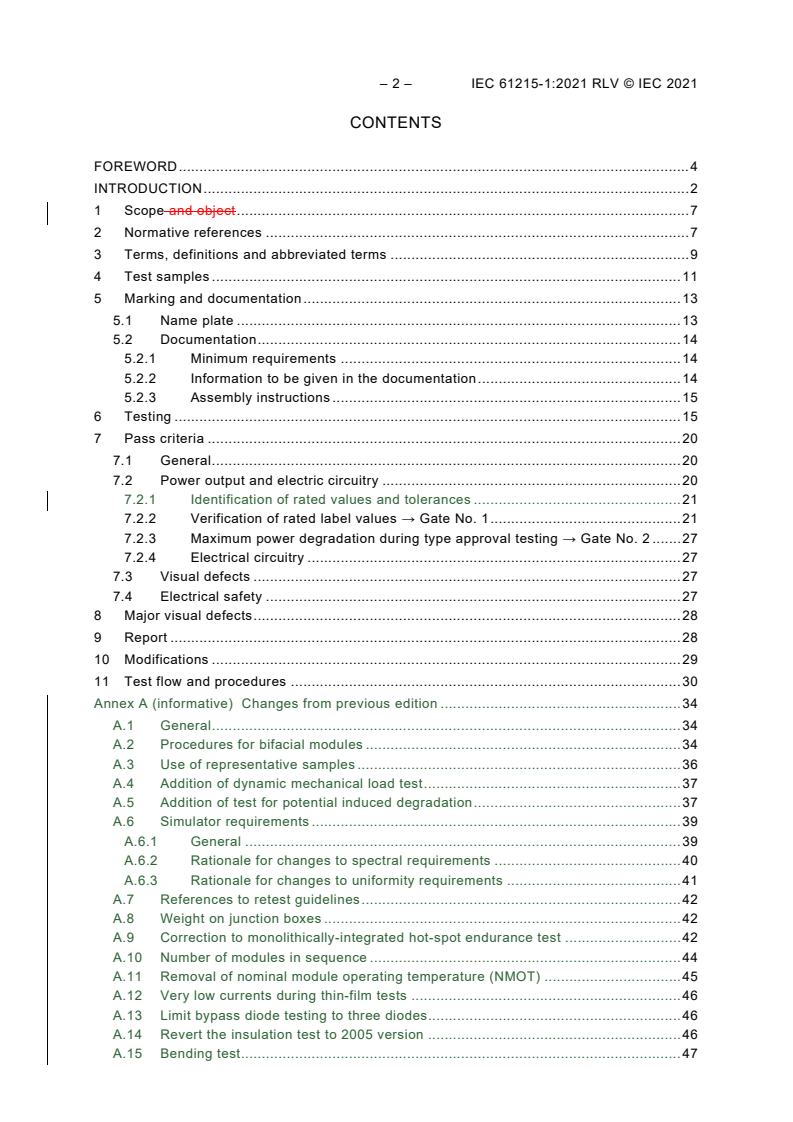
CONTENTS
FOREWORD . 4
INTRODUCTION . 2
1 Scope and object . 7
2 Normative references . 7
3 Terms, definitions and abbreviated terms . 9
4 Test samples . 11
5 Marking and documentation . 13
5.1 Name plate . 13
5.2 Documentation . 14
5.2.1 Minimum requirements . 14
5.2.2 Information to be given in the documentation . 14
5.2.3 Assembly instructions . 15
6 Testing . 15
7 Pass criteria . 20
7.1 General . 20
7.2 Power output and electric circuitry . 20
7.2.1 Identification of rated values and tolerances . 21
7.2.2 Verification of rated label values → Gate No. 1 . 21
7.2.3 Maximum power degradation during type approval testing → Gate No. 2 . 27
7.2.4 Electrical circuitry . 27
7.3 Visual defects . 27
7.4 Electrical safety . 27
8 Major visual defects . 28
9 Report . 28
10 Modifications . 29
11 Test flow and procedures . 30
Annex A (informative) Changes from previous edition . 34
A.1 General . 34
A.2 Procedures for bifacial modules . 34
A.3 Use of representative samples . 36
A.4 Addition of dynamic mechanical load test . 37
A.5 Addition of test for potential induced degradation . 37
A.6 Simulator requirements . 39
A.6.1 General . 39
A.6.2 Rationale for changes to spectral requirements . 40
A.6.3 Rationale for changes to uniformity requirements . 41
A.7 References to retest guidelines . 42
A.8 Weight on junction boxes . 42
A.9 Correction to monolithically-integrated hot-spot endurance test . 42
A.10 Number of modules in sequence . 44
A.11 Removal of nominal module operating temperature (NMOT) . 45
A.12 Very low currents during thin-film tests . 46
A.13 Limit bypass diode testing to three diodes. 46
A.14 Revert the insulation test to 2005 version . 46
A.15 Bending test . 47
A.16 Stabilization option for boron oxygen LID (MQT 19.3) . 47
Bibliography . 48
Figure 1 – Geometry that shows radius of curvature of a flexible module . 10
Figure 2 – Full test flow for design qualification and type approval of photovoltaic
modules . 19
Figure 3 – Examples of hypothetical partial nameplates (left column), datasheets
(center column), and derived rated values and tolerances (right column) . 23
Figure A.1 – Derived temperature coefficients (α) for nine different mc‑Si products
types. 44
Table 1 – Required component tests . 20
Table 2 – Summary of Gate No. 1 requirements . 20
Table 3 – Summary of test levels . 31
Table A.1 – Published uncertainty values as a function of simulator uniformity class . 41
Table A.2 – Summary of foil placement during insulation test in three different
versions. . 46
– 4 – IEC 61215-1:2021 RLV © IEC 2021
INTERNATIONAL ELECTROTECHNICAL COMMISSION
____________
TERRESTRIAL PHOTOVOLTAIC (PV) MODULES –
DESIGN QUALIFICATION AND TYPE APPROVAL –
Part 1: Test requirements
FOREWORD
1) The International Electrotechnical Commission (IEC) is a worldwide organization for standardization comprising
all national electrotechnical committees (IEC National Committees). The object of IEC is to promote
international co-operation on all questions concerning standardization in the electrical and electronic fields. To
this end and in addition to other activities, IEC publishes International Standards, Technical Specifications,
Technical Reports, Publicly Available Specifications (PAS) and Guides (hereafter referred to as "IEC
Publication(s)"). Their preparation is entrusted to technical committees; any IEC National Committee interested
in the subject dealt with may participate in this preparatory work. International, governmental and non-
governmental organizations liaising with the IEC also participate in this preparation. IEC collaborates closely
with the International Organization for Standardization (ISO) in accordance with conditions determined by
agreement between the two organizations.
2) The formal decisions or agreements of IEC on technical matters express, as nearly as possible, an international
consensus of opinion on the relevant subjects since each technical committee has representation from all
interested IEC National Committees.
3) IEC Publications have the form of recommendations for international use and are accepted by IEC National
Committees in that sense. While all reasonable efforts are made to ensure that the technical content of IEC
Publications is accurate, IEC cannot be held responsible for the way in which they are used or for any
misinterpretation by any end user.
4) In order to promote international uniformity, IEC National Committees undertake to apply IEC Publications
transparently to the maximum extent possible in their national and regional publications. Any divergence
between any IEC Publication and the corresponding national or regional publication shall be clearly indicated in
the latter.
5) IEC itself does not provide any attestation of conformity. Independent certification bodies provide conformity
assessment services and, in some areas, access to IEC marks of conformity. IEC is not responsible for any
services carried out by independent certification bodies.
6) All users should ensure that they have the latest edition of this publication.
7) No liability shall attach to IEC or its directors, employees, servants or agents including individual experts and
members of its technical committees and IEC National Committees for any personal injury, property damage or
other damage of any nature whatsoever, whether direct or indirect, or for costs (including legal fees) and
expenses arising out of the publication, use of, or reliance upon, this IEC Publication or any other IEC
Publications.
8) Attention is drawn to the Normative references cited in this publication. Use of the referenced publications is
indispensable for the correct application of this publication.
9) Attention is drawn to the possibility that some of the elements of this IEC Publication may be the subject of
patent rights. IEC shall not be held responsible for identifying any or all such patent rights.
This redline version of the official IEC Standard allows the user to identify the changes made to
the previous edition IEC 61215-1:2016. A vertical bar appears in the margin wherever a change
has been made. Additions are in green text, deletions are in strikethrough red text.
International Standard IEC 61215-1 has been prepared by IEC technical committee 82: Solar
photovoltaic energy systems.
This second edition of IEC 61215-1 cancels and replaces the first edition of IEC 61215-1,
published in 2016; it constitutes a technical revision.
This edition includes the following significant technical changes with respect to the previous
edition:
a) Addition of a test taken from IEC TS 62782.
b) Addition of a test taken from IEC TS 62804-1.
c) Addition of test methods required for flexible modules. This includes the addition of the
bending test (MQT 22).
d) Addition of definitions, references and instructions on how to perform the IEC 61215
design qualification and type approval on bifacial PV modules.
e) Clarification of the requirements related to power output measurements.
f) Addition of weights to junction box during 200 thermal cycles.
g) Requirement that retesting be performed according to IEC TS 62915.
h) Removal of the nominal module operating test (NMOT), and associated test of
performance at NMOT, from the IEC 61215 series.
Informative Annex A explains the background and reasoning behind some of the more
substantial changes that were made in the IEC 61215 series in progressing from edition 1 to
edition 2.
The text of this International Standard is based on the following documents:
FDIS Report on voting
82/1828A/FDIS 82/1848/RVD
Full information on the voting for the approval of this International Standard can be found in
the report on voting indicated in the above table.
This document has been drafted in accordance with the ISO/IEC Directives, Part 2.
A list of all parts in the IEC 61215 series, published under the general title Terrestrial
photovoltaic (PV) modules – Design qualification and type approval, can be found on the IEC
website.
The committee has decided that the contents of this document will remain unchanged until the
stability date indicated on the IEC website under "http://webstore.iec.ch" in the data related to
the specific document. At this date, the document will be
• reconfirmed,
• withdrawn,
• replaced by a revised edition, or
• amended.
The contents of the corrigendum of May 2021 have been included in this copy.
IMPORTANT – The 'colour inside' logo on the cover page of this publication indicates that it
dered to be useful for the correct understanding of its
contains colours which are consi
contents. Users should therefore print this document using a colour printer.
– 6 – IEC 61215-1:2021 RLV © IEC 2021
INTRODUCTION
Whereas Part 1 of this standards series describes requirements (both in general and specific
with respect to device technology), the sub-parts of Part 1 define technology variations and
Part 2 defines a set of test procedures necessary for design qualification and type approval.
The test procedures described in Part 2 are valid for all device technologies.
TERRESTRIAL PHOTOVOLTAIC (PV) MODULES –
DESIGN QUALIFICATION AND TYPE APPROVAL –
Part 1: Test requirements
1 Scope and object
This part of IEC 61215 lays down IEC requirements for the design qualification and type
approval of terrestrial photovoltaic (PV) modules suitable for long-term operation in general
open-air climates, as defined in IEC 60721-2-1.
This document lays down requirements for the design qualification of terrestrial photovoltaic
modules suitable for long-term operation in open-air climates. The useful service life of
modules so qualified will depend on their design, their environment and the conditions under
which they are operated. Test results are not construed as a quantitative prediction of module
lifetime.
th
In climates where 98 percentile operating temperatures exceed 70 °C, users are
recommended to consider testing to higher temperature test conditions as described in
IEC TS 63126. Users desiring qualification of PV products with lesser lifetime expectations
are recommended to consider testing designed for PV in consumer electronics, as described
in IEC TS 63163 (under development). Users wishing to gain confidence that the
characteristics tested in IEC 61215 appear consistently in a manufactured product may wish
to utilize IEC 62941 regarding quality systems in PV manufacturing.
This document is intended to apply to all terrestrial flat plate module materials such as
crystalline silicon module types as well as thin-film modules. It does not apply to systems that
are not long-term applications, such as flexible modules installed in awnings or tenting.
This document does not apply to modules used with concentrated sunlight although it may be
utilized for low concentrator modules (1 to 3 suns). For low concentration modules, all tests
are performed using the irradiance, current, voltage and power levels expected at the design
concentration.
This document does not address the particularities of PV modules with integrated electronics.
It may however be used as a basis for testing such PV modules.
The objective of this test sequence is to determine the electrical and thermal characteristics of
the module and to show, as far as possible within reasonable constraints of cost and time,
that the module is capable of withstanding prolonged exposure in climates described in the
scope. The actual lifetime expectancy of modules so qualified will depend on their design,
their environment and the conditions under which they are operated.
The objective of this test sequence is to determine the electrical characteristics of the module
and to show, as far as possible within reasonable constraints of cost and time, that the
module is capable of withstanding prolonged exposure outdoors. Accelerated test conditions
are empirically based on those necessary to reproduce selected observed field failures and
are applied equally across module types. Acceleration factors may vary with product design,
and thus not all degradation mechanisms may manifest. Further general information on
accelerated test methods including definitions of terms may be found in IEC 62506.
Some long-term degradation mechanisms can only reasonably be detected via component
testing, due to long times required to produce the failure and necessity of stress conditions
that are expensive to produce over large areas. Component tests that have reached a
– 8 – IEC 61215-1:2021 RLV © IEC 2021
sufficient level of maturity to set pass/fail criteria with high confidence are incorporated into
the IEC 61215 series via addition to Table 1. In contrast, the tests procedures described in
this series, in IEC 61215-2, are performed on modules.
2 Normative references
The following documents are referred to in the text in such a way that some or all of their
content constitutes requirements of this document. For dated references, only the edition
cited applies. For undated references, the latest edition of the referenced document (including
any amendments) applies.
IEC 60050 (all parts), International Electrotechnical Vocabulary (available at
http://www.electropedia.org)
IEC 60269-6, Low-voltage fuses – Part 6: Supplementary requirements for fuse-links for the
protection of solar photovoltaic energy systems
IEC 60891, Photovoltaic devices – Procedures for temperature and irradiance corrections to
measured I-V characteristics
IEC 60904-1, Photovoltaic devices – Part 1: Measurement of photovoltaic current-voltage
characteristics
IEC TS 60904-1-2:2019, Photovoltaic devices – Part 1-2: Measurement of current-voltage
characteristics of bifacial photovoltaic (PV) devices
IEC 60904-3, Photovoltaic devices – Part 3: Measurement principles for terrestrial
photovoltaic (PV) solar devices with reference spectral irradiance data
IEC 60904-10, Photovoltaic devices – Part 10: Methods of linear dependence and linearity
measurements
IEC TS 60904-13, Photovoltaic devices – Part 13: Electroluminescence of photovoltaic
modules
IEC 61140, Protection against electric shock – Common aspects for installation and
equipment
IEC 61215-2, Terrestrial photovoltaic (PV) modules – Design qualification and type approval –
Part 2: Test procedures
IEC 61730-1, Photovoltaic (PV) module safety qualification – Part 1: Requirements for
construction
IEC 61730-2, Photovoltaic (PV) module safety qualification – Part 2: Requirements for testing
IEC TS 61836, Solar photovoltaic energy systems – Terms, definitions and symbols
IEC 61853-1, Photovoltaic (PV) module performance testing and energy rating – Part 1:
Irradiance and temperature performance measurements and power rating
IEC 61853-2, Photovoltaic (PV) module performance testing and energy rating – Part 2:
Spectral response, incidence angle, and module operating temperature measurements
IEC TS 62782, Photovoltaic (PV) modules – Cyclic (dynamic) mechanical load testing
IEC 62790, Junction boxes for photovoltaic modules – Safety requirements and tests
IEC TS 62804-1, Photovoltaic (PV) modules – Test methods for the detection of potential-
induced degradation – Part 1: Crystalline silicon
IEC 62852, Connectors for DC-application in photovoltaic systems – Safety requirements and
tests
IEC TS 62915, Photovoltaic (PV) modules – Type approval, design and safety qualification –
Retesting
IEC 62941, Terrestrial photovoltaic (PV) modules – Quality system for PV module
manufacturing
IEC TS 63163: – Terrestrial photovoltaic (PV) modules for consumer products – Design
qualification and type approval
ISO/IEC 17025, General requirements for the competence of testing and calibration
laboratories
ISO/IEC Guide 98-3, Uncertainty of measurement – Part 3: Guide to the expression of
uncertainty in measurement (GUM:1995)
3 Terms, definitions and abbreviated terms
For the purposes of this document, the terms and definitions in IEC 60050 and IEC TS 61836
apply, as well as the following.
ISO and IEC maintain terminological databases for use in standardization at the following
addresses:
• IEC Electropedia: available at http://www.electropedia.org/
• ISO Online browsing platform: available at http://www.iso.org/obp
3.1
bins of power classes
power (typically maximum power) sorting criteria from the PV module manufacturer
3.2
tolerances
value range of electrical parameters on the label of the PV module as given by the
manufacturer
______________
To be published.
Under preparation. Stage at the time of publication: ADTS.
– 10 – IEC 61215-1:2021 RLV © IEC 2021
3.3
MQT
Module Quality Test
3.4
type approval
conformity test made on one or more items representative of the production
[SOURCE: IEC 60050-581:2008, 581-21-08 – Type test]
3.5
reproducibility
closeness of agreement between the results of measurements of the same value of a
quantity, when the individual measurements are made under different conditions of
measurement:
– principle of measurement,
– method of measurement,
– observer,
– measuring instruments,
– reference standards,
– laboratory,
– under conditions of use of the instruments, different from those customarily used,
after intervals of time relatively long compared with the duration of a single measurement.
[consistent with the International Vocabulary of Metrology (VIM), 3.7]
Note 1 to entry: The concepts of "principle of measurement" and "method of measurement" are respectively
defined in VIM 2.3 and 2.4.
Note 2 to entry: The term "reproducibility" also applies to the instance where only certain of the above conditions
are taken into account, provided that these are stated.
Note 3 to entry: It is recommended that laboratories determine their reproducibility according to the formulas and
principles in ISO 5725-2.
[SOURCE: IEC 60050-311:2001, 311-06-07]
3.6
flexible module
PV module that exhibits a radius of curvature of 500 mm or less in at least one direction
according to the manufacturer’s specification and is capable of bending to conform to a flat or
curved surface
Note 1 to entry: A curved module with a rigid shape is not considered a flexible module.
Note 2 to entry: Radius of curvature is defined as shown in Figure 1. During testing, the applied radius of
curvature is no smaller than that specified by the manufacturer.
Figure 1 – Geometry that shows radius of curvature of a flexible module
3.7
representative sample
sample that includes all the components of the module, except some repeated parts
Note 1 to entry: The representative samples shall use all key materials and subassemblies, as detailed in
Clause 4.
3.8
very large module
module that exceeds the size of standard 2,2 m × 1,5 m commercially-available simulators
Note 1 to entry: A very large module exceeds 2,2 m in length or width, or exceeds 1,5 m in both dimensions. Thus
a 3 m × 0,3 m module is considered very large, as is a 2,2 m × 2,2 m module.
Note 2 to entry: Very large modules are exempt from class A simulator spatial irradiance uniformity requirements,
as detailed in IEC 61215-2 MQT 02.
Note 3 to entry: During test sequences representative samples may be substituted for very large modules, within
the limits described in Clause 4.
Note 4 to entry: In future editions, the size threshold to be considered a very large module will likely increase to
larger dimensions.
3.9
bifacial PV modules
modules that can convert irradiation received on both the front-side and rear-side into electric
energy by means of the photovoltaic effect
3.10
bifaciality coefficients
ratios between the I-V characteristics of the rear-side and the front-side of a bifacial module
each measured under Standard Test Conditions (STC – IEC TS 61836), namely the short-
circuit current bifaciality coefficient φ , the open-circuit voltage bifaciality coefficient φ
Isc Voc
and the maximum power bifaciality coefficient φ
Pmax
Note 1 to entry: Bifaciality coefficients are fully defined in IEC TS 60904-1-2:2019, 6.2.
3.11
bifacial nameplate irradiance
BNPI
higher irradiance at which nameplate verification is performed for bifacial modules,
2 2
corresponding to 1 000 W/m on the module front and 135 W/m on the module rear, applied
in any method allowed by IEC TS 60904-1-2
3.12
bifacial stress irradiance
BSI
higher irradiance at which currents for stress are measured on bifacial modules,
2 2
corresponding to 1 000 W/m on the module front and 300 W/m on the module rear, applied
by any method allowed in IEC TS 60904-1-2, I-V characteristic at which may be extrapolated
from lower irradiances
4 Test samples
The PV module samples shall have been manufactured from specified materials and
components in accordance with the relevant drawings and process sheets and have been
subjected to the manufacturer’s normal inspection, quality control and production acceptance
procedures. The PV modules shall be complete in every detail and shall be accompanied by
the manufacturer’s handling, mounting, and connection instructions. When the PV modules to
be tested are prototypes of a new design and not from production, this fact shall be noted in
the test report (see Clause 9).
– 12 – IEC 61215-1:2021 RLV © IEC 2021
The number of test samples required is derived from the applicable test sequences
(see Clause 11).
Special test samples may be required for tests such as the bypass diode test MQT 18
(see IEC 61215-2).
For qualification of multiple bins of power classes within the boundaries given in future
IEC TS 62915 at least 2 modules each, from the lower end, median and higher end power
class shall be used for testing. If median power class does not exist the next higher class
shall be used. If qualification of a single power class shall be extended to further bins of
power classes within the boundaries given in IEC TS 62915 then at least 2 modules each,
from the lower end, median and higher end power class shall be used for label verification
(see Gate No.1 in 7.2.1). If a power class is extended only towards higher (or lower) bins,
then modules only from the higher (or lower) bins, respectively, shall be used for verification
of rated label values.
Qualification to multiple bins of power classes does not increase the minimum requirement of
one control sample used in 7.2.3.
It is advisable to provide additional spare samples meeting the same output power
requirements.
If applicable, the test samples shall be used to represent a group or family of products, or
variations in the materials, or production processes used to produce the modules. The
additional samples required for the test programme are then derived from IEC TS 62915.
For very large modules (as defined in 3.8), representative samples (as defined in 3.7) may be
used for all qualification tests given in Clause 11 and IEC 61215-2. During the design and
manufacturing of the representative samples, attention should be paid to reach the maximum
similarity to the full-size product in all electrical, mechanical, and thermal characteristics
related to quality and reliability. The cell, encapsulation methods, interconnects, terminations,
clearance and creepage distances around all edges, and distance through solid insulation
(relied upon insulation and cemented joints) shall be the same as on the actual full-size
products. Limits are placed on how much one may reduce the dimensions of a very large
module in making representative samples for qualification testing. The reduced dimension(s)
shall be no less than one half the dimensions that define a very large module. In other words,
when reducing the shorter dimension, the representative sample shall be at least 0,75 m wide.
In reducing the longer dimension, the representative sample shall be at least 1,1 m long. If
representative samples are used for any test, the test report shall include a table listing the
dimensions of the product being qualified, and for each MQT, the dimensions of the samples
tested. The table shall contain the statement, "Smaller samples were used for some tests as
noted above. Use of smaller samples may affect test results." For determination of maximum
power degradation during testing (7.2.3) on a representative sample, P (Lab_GateNo.1)
max
refers to the representative sample’s initial stabilized measured power output. However, for
verification of rated label values (7.2.2) a standard production product shall be measured,
either at the test facility or utilizing a test at the manufacturer monitored by the testing entity.
If representative samples are utilized in Sequence E, then one extra module, full-sized, is
required, and shall be subjected only to MQT 16 (static mechanical load test) and the
requirements therein.
Any representative sample used for MQT 09 (hot-spot endurance test) shall contain the same
number of cells per bypass diode (i.e. the same substring size) as the full-size product.
NOTE It is preferable in any test to measure a full-size sample, rather than a representative sample, when
equipment size allows.
Prior to beginning the qualification test, care should be taken not to damage the samples in
transit. Such care may include adherence to best practices in packing and shipping,[1] as
well as electroluminescence imaging according to IEC TS 60904-13 before and after shipping
to make sure cracks have not developed in transit.
For the requirements in the IEC 61215 series, a module shall be considered "bifacial " if the
manufacturer claims bifaciality on the nameplate or datasheet, or if the module exhibits a
maximum power bifaciality coefficient ≥ 20 %. If a module is to be tested as a monofacial
module, the test laboratory shall verify that the module is monofacial by at least one of the
following methods:
a) Information from the manufacturer showing that the rear of the cell is fully metallized;
b) Spectrally-resolved backsheet transmission data from the module manufacturer; or
c) Determination of bifaciality coefficient on one sample according to the procedure in
IEC TS 60904-1-2.
5 Marking and documentation
5.1 Name plate
Each module shall include the following clear and indelible markings. Unless otherwise
indicated, all the electrical parameters refer to STC:
a) name, registered trade name or registered trade mark of manufacturer;
b) type or model number designation;
c) serial number (unless marked on other part of product);
d) date and place of manufacture; alternatively serial number allowing to trace the date and
place of manufacture;
e) maximum system voltage;
f) class of protection against electrical shock (as defined in IEC 61140 and IEC 61730-1);
g) voltage at open-circuit or Voc including tolerances. For bifacial modules, open-circuit
voltage shall be reported at two irradiance levels. The first required irradiance level is
1 000 W/m2. The second required irradiance is BNPI, as defined in 3.11.
h) current at short-circuit or Isc including tolerances. For bifacial modules, short-circuit
current shall be reported at two irradiance levels, defined in 5.1g).
i) module maximum power or Pmax including binning and tolerances as defined in 3.1 and
3.2. For bifacial modules, Pmax shall be reported at the two irradiance levels, defined in
5.1g).
j) For bifacial modules the following information including tolerances, shall be given on the
nameplate: The values for the short-circuit current bifaciality coefficient φIsc, the open-
circuit voltage bifaciality coefficient φVoc, and the maximum power bifaciality coefficient
φPmax, measured at STC as defined in IEC TS 60904-1-2.
k) For flexible modules, the minimum radius of curvature.
All electrical data shall be shown as relative to standard test conditions (1 000 W/m , 25 °C,
AM 1,5 according to IEC TS 61836).
______________
Numbers in square brackets refer to the Bibliography.
– 14 – IEC 61215-1:2021 RLV © IEC 2021
For items a) through i) all electrical data shall be shown as relative to STC (1 000 W/m ,
25 °C, AM1.5 according to IEC TS 61836), except for bifacial modules where two irradiance
levels are required, as defined in 5.1g).
International symbols shall be used where applicable.
Compliance of marking is checked by inspection and MQT 06.1.
5.2 Documentation
5.2.1 Minimum requirements
Modules shall be supplied with documentation describing the methods of electrical and
mechanical installation as well as the electrical ratings of the module. The documentation
shall state the class of protection against electrical shock under which the module has been
qualified and any specific limitations required for that class. The documentation shall assure
that installers and operators receive appropriate and sufficient documentation for safe
installation, use, and maintenance of the PV modules.
NOTE It is considered to be sufficient that one set of documentation is supplied with the module shipping unit.
5.2.2 Information to be given in the documentation
a) all information required under 5.1 e) to i), and in addition j) for bifacial modules and k) for
flexible modules;
b) reversed current overload rating in accordance with IEC 61730-2 MST 26;
– overcurrent protection device type and rating are e.g. given in IEC 60269-6.
Overcurrent protection devices with a 1 h, 1,35 I overload rating, where I is the rated
n n
value of the overcurrent protection device, are recommended;
– recommended maximum series/parallel PV module configurations;
c) manufacturer’s stated tolerance for V , I and maximum power output under standard
oc sc
test conditions;
d) temperature coefficient for voltage at open-circuit;
e) temperature coefficient for maximum power;
f) temperature coefficient for short-circuit current.
All electrical data mentioned above shall be shown as relative to standard test conditions
(1 000 W/m , 25 °C, AM1.5 according to IEC TS 61836). Moreover the following parameters
shall be specified:
g) nominal module operating temperature (NMOT);
h) performance at NMOT (MQT 06.2);
g) performance at low irradiance (MQT 07).
International symbols shall be used where applicable.
Compliance is checked by inspection and MQT 04 through MQT 07.
The electrical documentation shall include a detailed description of the electrical installation
wiring method to be used. This description shall include:
h) the minimum cable diameters for modules intended for field wiring;
i) any limitations on wiring methods and wire management that apply to the wiring
compartment or box;
j) the size, type, material and temperature rating of the conductors to be used;
k) type of terminals for field wiring;
l) specific PV connector model/types and manufacturer to which the module connectors shall
be mated. Statement of the connector type only (such as "MC4 compatible ") is not
sufficient information to satisfy this requirement. Connector model/types and
manufacturers shall be included;
m) the bonding method(s) to be used (if applicable); all provided or specified hardware shall
be identified in the documentation;
n) the type and ratings of bypass diode to be used (if applicable);
o) limitations to the mounting situation (e.g., slope, orientation, mounting means, cooling);
p) a statement indicating the fire rating(s) and the applied standard as well as the limitations
to that rating (e.g., installation slope, sub structure or other applicable installation
information);
q) a statement indicating the design load per each mechanical means for securing the
module as evaluated during the static mechanical load test according to MQT 16. At
discretion of the manufacturer the test load and/or the safety factor γ may be noted, too.
m
To allow for increased output of a module resulting from certain conditions of use, the
installation instructions shall include relevant parameters specified by manufacturer or the
following statement or the equivalent:
"Under normal conditions, a photovoltaic module is likely to experience conditions that
produce more current and/or voltage than reported at standard test conditions. Accordingly,
the values of I and V marked on this module should be multiplied by a factor of 1,25
SC OC
when determining component voltage ratings, conductor current ratings, and size of controls
connected to the PV output."
5.2.3 Assembly instructions
These shall be provided with a product shipped in subassemblies, and shall be detailed and
adequate to the degree required to facilitate complete and safe assembly of the product.
6 Testing
It is requested that the test laboratory uses a control module to be able to detect drifts in their
measurement results.
The modules shall be divided into groups and subjected to the qualification test sequences in
Figure 1. Qualification test sequences are to be carried out in the order specified. The MQT
designations in the boxes refer to the corresponding test definitions in Part 2 of this standard.
Technology specific test details are listed in the respective parts of this standard.
Intermediate measurements of maximum power (MQT 02) and insulation test (MQT 03) are
not necessary, but they may be used to track changes.
The test laboratory shall use a laboratory simulator control module to be able to detect drifts
in their measurement results. The laboratory simulator control module is different than the
control module from sequence A, which is taken from the modules under test and is described
in 7.2.3 related to the reproducibility r. The laboratory simulator control module is a stable
module used on a periodic basis to check simulator output after calibration to a specific
irradiance.
The modules shall be divided into groups and subjected to the qualification test sequences in
Figure 2. Qualification test sequences are to be carried out in the order specified. The MQT
designations in the boxes refer to the corresponding test definitions in IEC 61215-2.
Technology-specific test details are listed in the respective parts of this standard. Required
module component tests are listed in Table 1. For each component qualification, the test
report shall note the test laboratory name and date when the requirement was met. Prior
– 16 – IEC 61215-1:2021 RLV © IEC 2021
certifications may be used to fulfill these requirements, as long as the certifications were
performed in accordance with all conditions noted in Table 1.
Intermediate measurements of maximum power (MQT 02) and insulation test (MQT 03) are
not required, but they may be used to track changes.
Any single test executed independently of a test sequence, e.g., on special test samples for
MQT 09 and MQT 18, shall be preceded by the initial tests of MQT 01, MQT 02, MQT 03, and
MQT 15 as appropriate.
In carrying out the tests, the tester shall strictly observe the manufacturer's handling,
mounting, and connection instructions. Sequence A may be omitted if the module type has
been tested according to IEC 61853-1. In this case the relevant test results from IEC 61853-1
shall be stated or referenced in the final report. For bifacial modules Sequence A cannot be
omitted until IEC 61853-1 has been amended to take bifacial modules into account.
Test conditions are summarized in Table 3. The test levels in Table 3 are the minimum levels
required for qualification. If the laboratory and the module manufacturer agree, the tests may
be performed with increased severities. In this case this shall be noted in the test report.
For flexible modules (see 3.6), the mounting substrate and adhesive or attachment means
shall also be included in the test. If more than one mounting substrate or adhesive o
...
IEC 61215-1 ®
Edition 2.0 2021-02
INTERNATIONAL
STANDARD
NORME
INTERNATIONALE
colour
inside
Terrestrial photovoltaic (PV) modules – Design qualification and type approval –
Part 1: Test requirements
Modules photovoltaïques (PV) pour applications terrestres – Qualification de la
conception et homologation –
Partie 1: Exigences d'essai
All rights reserved. Unless otherwise specified, no part of this publication may be reproduced or utilized in any form
or by any means, electronic or mechanical, including photocopying and microfilm, without permission in writing from
either IEC or IEC's member National Committee in the country of the requester. If you have any questions about IEC
copyright or have an enquiry about obtaining additional rights to this publication, please contact the address below or
your local IEC member National Committee for further information.
Droits de reproduction réservés. Sauf indication contraire, aucune partie de cette publication ne peut être reproduite
ni utilisée sous quelque forme que ce soit et par aucun procédé, électronique ou mécanique, y compris la photocopie
et les microfilms, sans l'accord écrit de l'IEC ou du Comité national de l'IEC du pays du demandeur. Si vous avez des
questions sur le copyright de l'IEC ou si vous désirez obtenir des droits supplémentaires sur cette publication, utilisez
les coordonnées ci-après ou contactez le Comité national de l'IEC de votre pays de résidence.
IEC Central Office Tel.: +41 22 919 02 11
3, rue de Varembé info@iec.ch
CH-1211 Geneva 20 www.iec.ch
Switzerland
About the IEC
The International Electrotechnical Commission (IEC) is the leading global organization that prepares and publishes
International Standards for all electrical, electronic and related technologies.
About IEC publications
The technical content of IEC publications is kept under constant review by the IEC. Please make sure that you have the
latest edition, a corrigendum or an amendment might have been published.
IEC publications search - webstore.iec.ch/advsearchform IEC online collection - oc.iec.ch
The advanced search enables to find IEC publications by a Discover our powerful search engine and read freely all the
variety of criteria (reference number, text, technical publications previews. With a subscription you will always
committee, …). It also gives information on projects, replaced have access to up to date content tailored to your needs.
and withdrawn publications.
Electropedia - www.electropedia.org
IEC Just Published - webstore.iec.ch/justpublished
The world's leading online dictionary on electrotechnology,
Stay up to date on all new IEC publications. Just Published
containing more than 22 000 terminological entries in English
details all new publications released. Available online and
and French, with equivalent terms in 18 additional languages.
once a month by email.
Also known as the International Electrotechnical Vocabulary
(IEV) online.
IEC Customer Service Centre - webstore.iec.ch/csc
If you wish to give us your feedback on this publication or
need further assistance, please contact the Customer Service
Centre: sales@iec.ch.
A propos de l'IEC
La Commission Electrotechnique Internationale (IEC) est la première organisation mondiale qui élabore et publie des
Normes internationales pour tout ce qui a trait à l'électricité, à l'électronique et aux technologies apparentées.
A propos des publications IEC
Le contenu technique des publications IEC est constamment revu. Veuillez vous assurer que vous possédez l’édition la
plus récente, un corrigendum ou amendement peut avoir été publié.
Recherche de publications IEC - IEC online collection - oc.iec.ch
webstore.iec.ch/advsearchform Découvrez notre puissant moteur de recherche et consultez
La recherche avancée permet de trouver des publications IEC gratuitement tous les aperçus des publications. Avec un
en utilisant différents critères (numéro de référence, texte, abonnement, vous aurez toujours accès à un contenu à jour
comité d’études, …). Elle donne aussi des informations sur adapté à vos besoins.
les projets et les publications remplacées ou retirées.
Electropedia - www.electropedia.org
IEC Just Published - webstore.iec.ch/justpublished
Le premier dictionnaire d'électrotechnologie en ligne au
Restez informé sur les nouvelles publications IEC. Just
monde, avec plus de 22 000 articles terminologiques en
Published détaille les nouvelles publications parues.
anglais et en français, ainsi que les termes équivalents dans
Disponible en ligne et une fois par mois par email.
16 langues additionnelles. Egalement appelé Vocabulaire
Electrotechnique International (IEV) en ligne.
Service Clients - webstore.iec.ch/csc
Si vous désirez nous donner des commentaires sur cette
publication ou si vous avez des questions contactez-nous:
sales@iec.ch.
IEC 61215-1 ®
Edition 2.0 2021-02
INTERNATIONAL
STANDARD
NORME
INTERNATIONALE
colour
inside
Terrestrial photovoltaic (PV) modules – Design qualification and type approval –
Part 1: Test requirements
Modules photovoltaïques (PV) pour applications terrestres – Qualification de la
conception et homologation –
Partie 1: Exigences d'essai
INTERNATIONAL
ELECTROTECHNICAL
COMMISSION
COMMISSION
ELECTROTECHNIQUE
INTERNATIONALE
ICS 27.160 ISBN 978-2-8322-9367-6
– 2 – IEC 61215-1:2021 © IEC 2021
CONTENTS
FOREWORD . 4
INTRODUCTION . 6
1 Scope . 7
2 Normative references . 7
3 Terms, definitions and abbreviated terms . 9
4 Test samples . 11
5 Marking and documentation . 13
5.1 Name plate . 13
5.2 Documentation . 13
5.2.1 Minimum requirements . 13
5.2.2 Information to be given in the documentation . 13
5.2.3 Assembly instructions . 15
6 Testing . 15
7 Pass criteria . 17
7.1 General . 17
7.2 Power output and electric circuitry . 18
7.2.1 Identification of rated values and tolerances . 18
7.2.2 Verification of rated label values → Gate No. 1 . 20
7.2.3 Maximum power degradation during type approval testing → Gate No. 2 . 23
7.2.4 Electrical circuitry . 23
7.3 Visual defects . 23
7.4 Electrical safety . 23
8 Major visual defects . 24
9 Report . 24
10 Modifications . 25
11 Test flow and procedures . 26
Annex A (informative) Changes from previous edition . 28
A.1 General . 28
A.2 Procedures for bifacial modules . 28
A.3 Use of representative samples . 30
A.4 Addition of dynamic mechanical load test . 31
A.5 Addition of test for potential induced degradation . 31
A.6 Simulator requirements . 33
A.6.1 General . 33
A.6.2 Rationale for changes to spectral requirements . 34
A.6.3 Rationale for changes to uniformity requirements . 35
A.7 References to retest guidelines . 36
A.8 Weight on junction boxes . 36
A.9 Correction to monolithically-integrated hot-spot endurance test . 36
A.10 Number of modules in sequence . 38
A.11 Removal of nominal module operating temperature (NMOT) . 39
A.12 Very low currents during thin-film tests . 40
A.13 Limit bypass diode testing to three diodes. 40
A.14 Revert the insulation test to 2005 version . 40
A.15 Bending test . 41
A.16 Stabilization option for boron oxygen LID (MQT 19.3) . 41
Bibliography . 42
Figure 1 – Geometry that shows radius of curvature of a flexible module . 10
Figure 2 – Full test flow for design qualification and type approval of photovoltaic
modules . 17
Figure 3 – Examples of hypothetical partial nameplates (left column), datasheets
(center column), and derived rated values and tolerances (right column) . 20
Figure A.1 – Derived temperature coefficients (α) for nine different mc‑Si products
types. 38
Table 1 – Required component tests . 17
Table 2 – Summary of Gate No. 1 requirements . 17
Table 3 – Summary of test levels . 26
Table A.1 – Published uncertainty values as a function of simulator uniformity class . 35
Table A.2 – Summary of foil placement during insulation test in three different
versions. . 40
– 4 – IEC 61215-1:2021 © IEC 2021
INTERNATIONAL ELECTROTECHNICAL COMMISSION
____________
TERRESTRIAL PHOTOVOLTAIC (PV) MODULES –
DESIGN QUALIFICATION AND TYPE APPROVAL –
Part 1: Test requirements
FOREWORD
1) The International Electrotechnical Commission (IEC) is a worldwide organization for standardization comprising
all national electrotechnical committees (IEC National Committees). The object of IEC is to promote
international co-operation on all questions concerning standardization in the electrical and electronic fields. To
this end and in addition to other activities, IEC publishes International Standards, Technical Specifications,
Technical Reports, Publicly Available Specifications (PAS) and Guides (hereafter referred to as "IEC
Publication(s)"). Their preparation is entrusted to technical committees; any IEC National Committee interested
in the subject dealt with may participate in this preparatory work. International, governmental and non-
governmental organizations liaising with the IEC also participate in this preparation. IEC collaborates closely
with the International Organization for Standardization (ISO) in accordance with conditions determined by
agreement between the two organizations.
2) The formal decisions or agreements of IEC on technical matters express, as nearly as possible, an international
consensus of opinion on the relevant subjects since each technical committee has representation from all
interested IEC National Committees.
3) IEC Publications have the form of recommendations for international use and are accepted by IEC National
Committees in that sense. While all reasonable efforts are made to ensure that the technical content of IEC
Publications is accurate, IEC cannot be held responsible for the way in which they are used or for any
misinterpretation by any end user.
4) In order to promote international uniformity, IEC National Committees undertake to apply IEC Publications
transparently to the maximum extent possible in their national and regional publications. Any divergence
between any IEC Publication and the corresponding national or regional publication shall be clearly indicated in
the latter.
5) IEC itself does not provide any attestation of conformity. Independent certification bodies provide conformity
assessment services and, in some areas, access to IEC marks of conformity. IEC is not responsible for any
services carried out by independent certification bodies.
6) All users should ensure that they have the latest edition of this publication.
7) No liability shall attach to IEC or its directors, employees, servants or agents including individual experts and
members of its technical committees and IEC National Committees for any personal injury, property damage or
other damage of any nature whatsoever, whether direct or indirect, or for costs (including legal fees) and
expenses arising out of the publication, use of, or reliance upon, this IEC Publication or any other IEC
Publications.
8) Attention is drawn to the Normative references cited in this publication. Use of the referenced publications is
indispensable for the correct application of this publication.
9) Attention is drawn to the possibility that some of the elements of this IEC Publication may be the subject of
patent rights. IEC shall not be held responsible for identifying any or all such patent rights.
International Standard IEC 61215-1 has been prepared by IEC technical committee 82: Solar
photovoltaic energy systems.
This second edition of IEC 61215-1 cancels and replaces the first edition of IEC 61215-1,
published in 2016; it constitutes a technical revision.
This edition includes the following significant technical changes with respect to the previous
edition:
a) Addition of a test taken from IEC TS 62782.
b) Addition of a test taken from IEC TS 62804-1.
c) Addition of test methods required for flexible modules. This includes the addition of the
bending test (MQT 22).
d) Addition of definitions, references and instructions on how to perform the IEC 61215
design qualification and type approval on bifacial PV modules.
e) Clarification of the requirements related to power output measurements.
f) Addition of weights to junction box during 200 thermal cycles.
g) Requirement that retesting be performed according to IEC TS 62915.
h) Removal of the nominal module operating test (NMOT), and associated test of
performance at NMOT, from the IEC 61215 series.
Informative Annex A explains the background and reasoning behind some of the more
substantial changes that were made in the IEC 61215 series in progressing from edition 1 to
edition 2.
The text of this International Standard is based on the following documents:
FDIS Report on voting
82/1828A/FDIS 82/1848/RVD
Full information on the voting for the approval of this International Standard can be found in
the report on voting indicated in the above table.
This document has been drafted in accordance with the ISO/IEC Directives, Part 2.
A list of all parts in the IEC 61215 series, published under the general title Terrestrial
photovoltaic (PV) modules – Design qualification and type approval, can be found on the IEC
website.
The committee has decided that the contents of this document will remain unchanged until the
stability date indicated on the IEC website under "http://webstore.iec.ch" in the data related to
the specific document. At this date, the document will be
• reconfirmed,
• withdrawn,
• replaced by a revised edition, or
• amended.
IMPORTANT – The 'colour inside' logo on the cover page of this publication indicates that it
contains colours which are considered to be useful for the correct understanding of its
contents. Users should therefore print this document using a colour printer.
– 6 – IEC 61215-1:2021 © IEC 2021
INTRODUCTION
Whereas Part 1 of this standards series describes requirements (both in general and specific
with respect to device technology), the sub-parts of Part 1 define technology variations and
Part 2 defines a set of test procedures necessary for design qualification and type approval.
The test procedures described in Part 2 are valid for all device technologies.
TERRESTRIAL PHOTOVOLTAIC (PV) MODULES –
DESIGN QUALIFICATION AND TYPE APPROVAL –
Part 1: Test requirements
1 Scope
This document lays down requirements for the design qualification of terrestrial photovoltaic
modules suitable for long-term operation in open-air climates. The useful service life of
modules so qualified will depend on their design, their environment and the conditions under
which they are operated. Test results are not construed as a quantitative prediction of module
lifetime.
th
In climates where 98 percentile operating temperatures exceed 70 °C, users are
recommended to consider testing to higher temperature test conditions as described in
IEC TS 63126. Users desiring qualification of PV products with lesser lifetime expectations
are recommended to consider testing designed for PV in consumer electronics, as described
in IEC TS 63163 (under development). Users wishing to gain confidence that the
characteristics tested in IEC 61215 appear consistently in a manufactured product may wish
to utilize IEC 62941 regarding quality systems in PV manufacturing.
This document is intended to apply to all terrestrial flat plate module materials such as
crystalline silicon module types as well as thin-film modules. It does not apply to systems that
are not long-term applications, such as flexible modules installed in awnings or tenting.
This document does not apply to modules used with concentrated sunlight although it may be
utilized for low concentrator modules (1 to 3 suns). For low concentration modules, all tests
are performed using the irradiance, current, voltage and power levels expected at the design
concentration.
This document does not address the particularities of PV modules with integrated electronics.
It may however be used as a basis for testing such PV modules.
The objective of this test sequence is to determine the electrical characteristics of the module
and to show, as far as possible within reasonable constraints of cost and time, that the
module is capable of withstanding prolonged exposure outdoors. Accelerated test conditions
are empirically based on those necessary to reproduce selected observed field failures and
are applied equally across module types. Acceleration factors may vary with product design,
and thus not all degradation mechanisms may manifest. Further general information on
accelerated test methods including definitions of terms may be found in IEC 62506.
Some long-term degradation mechanisms can only reasonably be detected via component
testing, due to long times required to produce the failure and necessity of stress conditions
that are expensive to produce over large areas. Component tests that have reached a
sufficient level of maturity to set pass/fail criteria with high confidence are incorporated into
the IEC 61215 series via addition to Table 1. In contrast, the tests procedures described in
this series, in IEC 61215-2, are performed on modules.
2 Normative references
The following documents are referred to in the text in such a way that some or all of their
content constitutes requirements of this document. For dated references, only the edition
cited applies. For undated references, the latest edition of the referenced document (including
any amendments) applies.
– 8 – IEC 61215-1:2021 © IEC 2021
IEC 60269-6, Low-voltage fuses – Part 6: Supplementary requirements for fuse-links for the
protection of solar photovoltaic energy systems
IEC 60891, Photovoltaic devices – Procedures for temperature and irradiance corrections to
measured I-V characteristics
IEC 60904-1, Photovoltaic devices – Part 1: Measurement of photovoltaic current-voltage
characteristics
IEC TS 60904-1-2:2019, Photovoltaic devices – Part 1-2: Measurement of current-voltage
characteristics of bifacial photovoltaic (PV) devices
IEC 60904-3, Photovoltaic devices – Part 3: Measurement principles for terrestrial
photovoltaic (PV) solar devices with reference spectral irradiance data
IEC 60904-10, Photovoltaic devices – Part 10: Methods of linear dependence and linearity
measurements
IEC TS 60904-13, Photovoltaic devices – Part 13: Electroluminescence of photovoltaic
modules
IEC 61140, Protection against electric shock – Common aspects for installation and
equipment
IEC 61215-2, Terrestrial photovoltaic (PV) modules – Design qualification and type approval –
Part 2: Test procedures
IEC 61730-1, Photovoltaic (PV) module safety qualification – Part 1: Requirements for
construction
IEC 61730-2, Photovoltaic (PV) module safety qualification – Part 2: Requirements for testing
IEC TS 61836, Solar photovoltaic energy systems – Terms, definitions and symbols
IEC 61853-1, Photovoltaic (PV) module performance testing and energy rating – Part 1:
Irradiance and temperature performance measurements and power rating
IEC TS 62782, Photovoltaic (PV) modules – Cyclic (dynamic) mechanical load testing
IEC 62790, Junction boxes for photovoltaic modules – Safety requirements and tests
IEC TS 62804-1, Photovoltaic (PV) modules – Test methods for the detection of potential-
induced degradation – Part 1: Crystalline silicon
IEC 62852, Connectors for DC-application in photovoltaic systems – Safety requirements and
tests
IEC TS 62915, Photovoltaic (PV) modules – Type approval, design and safety qualification –
Retesting
IEC 62941, Terrestrial photovoltaic (PV) modules – Quality system for PV module
manufacturing
IEC TS 63163: – Terrestrial photovoltaic (PV) modules for consumer products – Design
qualification and type approval
ISO/IEC Guide 98-3, Uncertainty of measurement – Part 3: Guide to the expression of
uncertainty in measurement (GUM:1995)
3 Terms, definitions and abbreviated terms
For the purposes of this document, the terms and definitions in IEC TS 61836 apply, as well
as the following.
ISO and IEC maintain terminological databases for use in standardization at the following
addresses:
• IEC Electropedia: available at http://www.electropedia.org/
• ISO Online browsing platform: available at http://www.iso.org/obp
3.1
bins of power classes
power (typically maximum power) sorting criteria from the PV module manufacturer
3.2
tolerances
value range of electrical parameters on the label of the PV module as given by the
manufacturer
3.3
MQT
Module Quality Test
3.4
type approval
conformity test made on one or more items representative of the production
[SOURCE: IEC 60050-581:2008, 581-21-08 – Type test]
3.5
reproducibility
closeness of agreement between the results of measurements of the same value of a
quantity, when the individual measurements are made under different conditions of
measurement:
– principle of measurement,
– method of measurement,
– observer,
– measuring instruments,
– reference standards,
– laboratory,
______________
Under preparation. Stage at the time of publication: ADTS.
– 10 – IEC 61215-1:2021 © IEC 2021
– under conditions of use of the instruments, different from those customarily used,
after intervals of time relatively long compared with the duration of a single measurement.
[consistent with the International Vocabulary of Metrology (VIM), 3.7]
Note 1 to entry: The concepts of "principle of measurement" and "method of measurement" are respectively
defined in VIM 2.3 and 2.4.
Note 2 to entry: The term "reproducibility" also applies to the instance where only certain of the above conditions
are taken into account, provided that these are stated.
Note 3 to entry: It is recommended that laboratories determine their reproducibility according to the formulas and
principles in ISO 5725-2.
[SOURCE: IEC 60050-311:2001, 311-06-07]
3.6
flexible module
PV module that exhibits a radius of curvature of 500 mm or less in at least one direction
according to the manufacturer’s specification and is capable of bending to conform to a flat or
curved surface
Note 1 to entry: A curved module with a rigid shape is not considered a flexible module.
Note 2 to entry: Radius of curvature is defined as shown in Figure 1. During testing, the applied radius of
curvature is no smaller than that specified by the manufacturer.
Figure 1 – Geometry that shows radius of curvature of a flexible module
3.7
representative sample
sample that includes all the components of the module, except some repeated parts
Note 1 to entry: The representative samples shall use all key materials and subassemblies, as detailed in
Clause 4.
3.8
very large module
module that exceeds the size of standard 2,2 m × 1,5 m commercially-available simulators
Note 1 to entry: A very large module exceeds 2,2 m in length or width, or exceeds 1,5 m in both dimensions. Thus
a 3 m × 0,3 m module is considered very large, as is a 2,2 m × 2,2 m module.
Note 2 to entry: Very large modules are exempt from class A simulator spatial irradiance uniformity requirements,
as detailed in IEC 61215-2 MQT 02.
Note 3 to entry: During test sequences representative samples may be substituted for very large modules, within
the limits described in Clause 4.
Note 4 to entry: In future editions, the size threshold to be considered a very large module will likely increase to
larger dimensions.
3.9
bifacial PV modules
modules that can convert irradiation received on both the front-side and rear-side into electric
energy by means of the photovoltaic effect
3.10
bifaciality coefficients
ratios between the I-V characteristics of the rear-side and the front-side of a bifacial module
each measured under Standard Test Conditions (STC – IEC TS 61836), namely the short-
circuit current bifaciality coefficient φ , the open-circuit voltage bifaciality coefficient φ
Isc Voc
and the maximum power bifaciality coefficient φ
Pmax
Note 1 to entry: Bifaciality coefficients are fully defined in IEC TS 60904-1-2:2019, 6.2.
3.11
bifacial nameplate irradiance
BNPI
higher irradiance at which nameplate verification is performed for bifacial modules,
2 2
corresponding to 1 000 W/m on the module front and 135 W/m on the module rear, applied
in any method allowed by IEC TS 60904-1-2
3.12
bifacial stress irradiance
BSI
higher irradiance at which currents for stress are measured on bifacial modules,
2 2
corresponding to 1 000 W/m on the module front and 300 W/m on the module rear, applied
by any method allowed in IEC TS 60904-1-2, I-V characteristic at which may be extrapolated
from lower irradiances
4 Test samples
The PV module samples shall have been manufactured from specified materials and
components in accordance with the relevant drawings and process sheets and have been
subjected to the manufacturer’s normal inspection, quality control and production acceptance
procedures. The PV modules shall be complete in every detail and shall be accompanied by
the manufacturer’s handling, mounting, and connection instructions. When the PV modules to
be tested are prototypes of a new design and not from production, this fact shall be noted in
the test report (see Clause 9).
The number of test samples required is derived from the applicable test sequences
(see Clause 11).
Special test samples may be required for tests such as the bypass diode test MQT 18
(see IEC 61215-2).
For qualification of multiple bins of power classes within the boundaries given in
IEC TS 62915 at least 2 modules each, from the lower end, median and higher end power
class shall be used for testing. If median power class does not exist the next higher class
shall be used. If qualification of a single power class shall be extended to further bins of
power classes within the boundaries given in IEC TS 62915 then at least 2 modules each,
from the lower end and higher end power class shall be used for label verification (see Gate
No.1 in 7.2.1). If a power class is extended only towards higher (or lower) bins, then modules
only from the higher (or lower) bins, respectively, shall be used for verification of rated label
values.
Qualification to multiple bins of power classes does not increase the minimum requirement of
one control sample used in 7.2.3.
It is advisable to provide additional spare samples meeting the same output power
requirements.
– 12 – IEC 61215-1:2021 © IEC 2021
If applicable, the test samples shall be used to represent a group or family of products, or
variations in the materials, or production processes used to produce the modules. The
additional samples required for the test programme are then derived from IEC TS 62915.
For very large modules (as defined in 3.8), representative samples (as defined in 3.7) may be
used for all qualification tests given in Clause 11 and IEC 61215-2. During the design and
manufacturing of the representative samples, attention should be paid to reach the maximum
similarity to the full-size product in all electrical, mechanical, and thermal characteristics
related to quality and reliability. The cell, encapsulation methods, interconnects, terminations,
clearance and creepage distances around all edges, and distance through solid insulation
(relied upon insulation and cemented joints) shall be the same as on the actual full-size
products. Limits are placed on how much one may reduce the dimensions of a very large
module in making representative samples for qualification testing. The reduced dimension(s)
shall be no less than one half the dimensions that define a very large module. In other words,
when reducing the shorter dimension, the representative sample shall be at least 0,75 m wide.
In reducing the longer dimension, the representative sample shall be at least 1,1 m long. If
representative samples are used for any test, the test report shall include a table listing the
dimensions of the product being qualified, and for each MQT, the dimensions of the samples
tested. The table shall contain the statement, "Smaller samples were used for some tests as
noted above. Use of smaller samples may affect test results." For determination of maximum
power degradation during testing (7.2.3) on a representative sample, P (Lab_GateNo.1)
max
refers to the representative sample’s initial stabilized measured power output. However, for
verification of rated label values (7.2.2) a standard production product shall be measured,
either at the test facility or utilizing a test at the manufacturer monitored by the testing entity.
If representative samples are utilized in Sequence E, then one extra module, full-sized, is
required, and shall be subjected only to MQT 16 (static mechanical load test) and the
requirements therein.
Any representative sample used for MQT 09 (hot-spot endurance test) shall contain the same
number of cells per bypass diode (i.e. the same substring size) as the full-size product.
NOTE It is preferable in any test to measure a full-size sample, rather than a representative sample, when
equipment size allows.
Prior to beginning the qualification test, care should be taken not to damage the samples in
transit. Such care may include adherence to best practices in packing and shipping,[1] as
well as electroluminescence imaging according to IEC TS 60904-13 before and after shipping
to make sure cracks have not developed in transit.
For the requirements in the IEC 61215 series, a module shall be considered "bifacial " if the
manufacturer claims bifaciality on the nameplate or datasheet, or if the module exhibits a
maximum power bifaciality coefficient ≥ 20 %. If a module is to be tested as a monofacial
module, the test laboratory shall verify that the module is monofacial by at least one of the
following methods:
a) Information from the manufacturer showing that the rear of the cell is fully metallized;
b) Spectrally-resolved backsheet transmission data from the module manufacturer; or
c) Determination of bifaciality coefficient on one sample according to the procedure in
IEC TS 60904-1-2.
______________
Numbers in square brackets refer to the Bibliography.
5 Marking and documentation
5.1 Name plate
Each module shall include the following clear and indelible markings. Unless otherwise
indicated, all the electrical parameters refer to STC:
a) name, registered trade name or registered trade mark of manufacturer;
b) type or model number designation;
c) serial number (unless marked on other part of product);
d) date and place of manufacture; alternatively serial number allowing to trace the date and
place of manufacture;
e) maximum system voltage;
f) class of protection against electrical shock (as defined in IEC 61140 and IEC 61730-1);
g) voltage at open-circuit or Voc including tolerances. For bifacial modules, open-circuit
voltage shall be reported at two irradiance levels. The first required irradiance level is
1 000 W/m2. The second required irradiance is BNPI, as defined in 3.11.
h) current at short-circuit or Isc including tolerances. For bifacial modules, short-circuit
current shall be reported at two irradiance levels, defined in 5.1g).
i) module maximum power or Pmax including binning and tolerances as defined in 3.1 and
3.2. For bifacial modules, Pmax shall be reported at the two irradiance levels, defined in
5.1g).
j) For bifacial modules the following information including tolerances, shall be given on the
nameplate: The values for the short-circuit current bifaciality coefficient φIsc, the open-
circuit voltage bifaciality coefficient φVoc, and the maximum power bifaciality coefficient
φPmax, measured at STC as defined in IEC TS 60904-1-2.
k) For flexible modules, the minimum radius of curvature.
For items a) through i) all electrical data shall be shown as relative to STC (1 000 W/m ,
25 °C, AM1.5 according to IEC TS 61836), except for bifacial modules where two irradiance
levels are required, as defined in 5.1g).
International symbols shall be used where applicable.
Compliance of marking is checked by inspection and MQT 06.1.
5.2 Documentation
5.2.1 Minimum requirements
Modules shall be supplied with documentation describing the methods of electrical and
mechanical installation as well as the electrical ratings of the module. The documentation
shall state the class of protection against electrical shock under which the module has been
qualified and any specific limitations required for that class. The documentation shall assure
that installers and operators receive appropriate and sufficient documentation for safe
installation, use, and maintenance of the PV modules.
NOTE It is considered to be sufficient that one set of documentation is supplied with the module shipping unit.
5.2.2 Information to be given in the documentation
a) all information required under 5.1 e) to i), and in addition j) for bifacial modules and k) for
flexible modules;
b) reverse current overload rating in accordance with IEC 61730-2 MST 26;
– 14 – IEC 61215-1:2021 © IEC 2021
– overcurrent protection device type and rating are e.g. given in IEC 60269-6.
Overcurrent protection devices with a 1 h, 1,35 I overload rating, where I is the rated
n n
value of the overcurrent protection device, are recommended;
– recommended maximum series/parallel PV module configurations;
c) manufacturer’s stated tolerance for V , I and maximum power output under standard
oc sc
test conditions;
d) temperature coefficient for voltage at open-circuit;
e) temperature coefficient for maximum power;
f) temperature coefficient for short-circuit current.
All electrical data mentioned above shall be shown as relative to standard test conditions
(1 000 W/m , 25 °C, AM1.5 according to IEC TS 61836). Moreover the following parameters
shall be specified:
g) performance at low irradiance (MQT 07).
International symbols shall be used where applicable.
Compliance is checked by inspection and MQT 04 through MQT 07.
The electrical documentation shall include a detailed description of the electrical installation
wiring method to be used. This description shall include:
h) the minimum cable diameters for modules intended for field wiring;
i) any limitations on wiring methods and wire management that apply to the wiring
compartment or box;
j) the size, type, material and temperature rating of the conductors to be used;
k) type of terminals for field wiring;
l) specific PV connector model/types and manufacturer to which the module connectors shall
be mated. Statement of the connector type only (such as "MC4 compatible ") is not
sufficient information to satisfy this requirement. Connector model/types and
manufacturers shall be included;
m) the bonding method(s) to be used (if applicable); all provided or specified hardware shall
be identified in the documentation;
n) the type and ratings of bypass diode to be used (if applicable);
o) limitations to the mounting situation (e.g., slope, orientation, mounting means, cooling);
p) a statement indicating the fire rating(s) and the applied standard as well as the limitations
to that rating (e.g., installation slope, sub structure or other applicable installation
information);
q) a statement indicating the design load per each mechanical means for securing the
module as evaluated during the static mechanical load test according to MQT 16. At
discretion of the manufacturer the test load and/or the safety factor γ may be noted, too.
m
To allow for increased output of a module resulting from certain conditions of use, the
installation instructions shall include relevant parameters specified by manufacturer or the
following statement or the equivalent:
"Under normal conditions, a photovoltaic module is likely to experience conditions that
produce more current and/or voltage than reported at standard test conditions. Accordingly,
the values of I and V marked on this module should be multiplied by a factor of 1,25
SC OC
when determining component voltage ratings, conductor current ratings, and size of controls
connected to the PV output."
5.2.3 Assembly instructions
These shall be provided with a product shipped in subassemblies, and shall be detailed and
adequate to the degree required to facilitate complete and safe assembly of the product.
6 Testing
The test laboratory shall use a laboratory simulator control module to be able to detect drifts
in their measurement results. The laboratory simulator control module is different than the
control module from sequence A, which is taken from the modules under test and is described
in 7.2.3 related to the reproducibility r. The laboratory simulator control module is a stable
module used on a periodic basis to check simulator output after calibration to a specific
irradiance.
The modules shall be divided into groups and subjected to the qualification test sequences in
Figure 2. Qualification test sequences are to be carried out in the order specified. The MQT
designations in the boxes refer to the corresponding test definitions in IEC 61215-2.
Technology-specific test details are listed in the respective parts of this standard. Required
module component tests are listed in Table 1. For each component qualification, the test
report shall note the test laboratory name and date when the requirement was met. Prior
certifications may be used to fulfill these requirements, as long as the certifications were
performed in accordance with all conditions noted in Table 1.
Intermediate measurements of maximum power (MQT 02) and insulation test (MQT 03) are
not required, but they may be used to track changes.
Any single test executed independently of a test sequence, e.g., on special test samples for
MQT 09 and MQT 18, shall be preceded by the initial tests of MQT 01, MQT 02, MQT 03, and
MQT 15 as appropriate.
In carrying out the tests, the tester shall strictly observe the manufacturer's handling,
mounting, and connection instructions. Sequence A may be omitted if the module type has
been tested according to IEC 61853-1. In this case the relevant test results from IEC 61853-1
shall be stated or referenced in the final report. For bifacial modules Sequence A cannot be
omitted until IEC 61853-1 has been amended to take bifacial modules into account.
Test conditions are summarized in Table 3. The test levels in Table 3 are the minimum levels
required for qualification. If the laboratory and the m
...